
Monday Reads: Of Laws and Law Breakers
Posted: August 8, 2022 Filed under: 2016 elections, Big Pharma, Citizen's United & Super Pacs, Economic Develpment, Economy, inflation, Inflation Reduction Act, Vulture Capitalism 33 Comments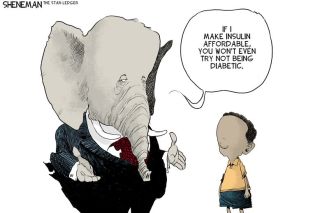 Good Day Sky Dancers!
There are two themes to the news stream this morning. The first is that the Inflation Reduction Act is about to become law. The CBO has scored its expected budget and economic income impacts. It’s amazing how many idiots are lecturing me on how inflationary this Act will be, as if I don’t know what I’m talking about. Anyway, here’s the inflation analysis if any of your crazy right-wing parrots start screaming “inflation” at you.
This is actually a letter the CBO sent to Lady Lindsey, who is pearl-clutching over inflation because that’s the only thing the Republicans have to discuss.
In calendar year 2022, enacting the bill would have a negligible effect on inflation, in CBO’s assessment. In calendar year 2023, inflation would probably be between 0.1 percentage point lower and 0.1 percentage point higher under the bill than it would be under current law, CBO estimates.
That range of likely outcomes reflects uncertainty about how various provisions of the bill would affect overall demand and output, the supply of labor, the persistence of disruptions in the supply of goods and services, and how the Federal Reserve would respond to offset any increase in inflationary pressure. Responsiveness to the enhancement of health insurance subsidies established by the Affordable Care Act is the most important factor boosting inflationary pressure, and responsiveness to the new alternative minimum tax on corporations is the most important factor reducing inflationary pressure. The range applies to multiple measures of inflation: the GDP price index, the personal consumption expenditures price index, and the consumer price index for all urban consumers.
 In other good news, Consumer’s inflation expectations are decreasing. This is important because it is a factor in how customers make decisions about spending. This is from CNBC and not written by the talking head at Fox Business that trolled my analysis. But, that link from the CBO with huge econometrics models agrees with me. My assumption is that Kenny Polcari can’t do modern finance and doesn’t have anything huge around him but his crony capitalism booty. He s undoubtedly enjoying his ability to avoid taxes with the treatment Sinema just granted him. I’m tempted to quote Swift on the confederacy of dunces. This is from Jeffy Cox at CNBC: “Consumers’ expectations of future inflation decreased significantly in win for the Federal Reserve.”
- A New York Fed survey showed that respondents in July expected inflation to run at a 6.2% pace over the next year and a 3.2% rate for the next three years.
- That marks a big drop-off from the respective 6.8% and 3.6% results from the June survey
- Expectations for food increases fell at the fastest rate in survey history and the second-fastest for gasoline prices.
The consumer outlook for inflation decreased significantly in July amid a sharp drop in gas prices and a growing belief that the rapid surges in food and housing also would ebb in the future.
The New York Federal Reserve’s monthly Survey of Consumer Expectations showed that respondents expect inflation to run at a 6.2% pace over the next year and a 3.2% rate for the next three years.
While those numbers are still very high by historical standards, they mark a big drop-off from the respective 6.8% and 3.6% results from the June survey
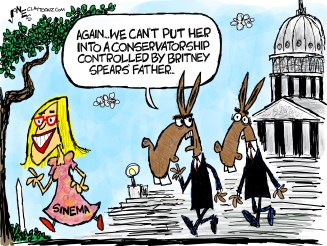 I guess that high inflation in the Nixon years is part of history. (sigh) But let me just quote from Business Insider on huge Kyrsten Sinema’s suck-up to hedge fund managers and the like. “Kyrsten Sinema ensured a $14 billion tax break for private equity, hedge fund, and real estate executives remains intact. It’s a win for many of her campaign donors.” The analysis is written by Sam Tabahriti.
The Arizona senator’s support was won late Thursday after fellow Democrats dropped a proposal to close the so-called “carried interest” loophole, which is commonly used by private equity, hedge fund, and property investment executives to pay a lower rate of tax on their compensation.
As such, it was a win for many Sinema campaign donors.
According to Open Secrets, the global private equity firms KKR, Carlyle, and Apollo Global Management are among the leading 20 sources of donations to Sinema’s campaign committee between 2017 and 2022.
As Open Secrets notes, it isn’t the organizations in the list that donated money directly, but rather, their “political action committees, their individual members or employees or owners, and those individuals’ immediate families.” Further, subsidiaries and affiliates are included in the organizations’ total donations figure.
Other organizations listed by Open Secrets among the leading 20 sources of donations include Andreessen Horowitz, the Silicon Valley venture capital firm that has invested in companies including Facebook, Twitter, and Airbnb; and Rudin Management, a private commercial and residential landlord and developer in New York City.
All in all, Sinema has received $2.2 million from investment firms between 2017 and 2022, according to Open Secrets.
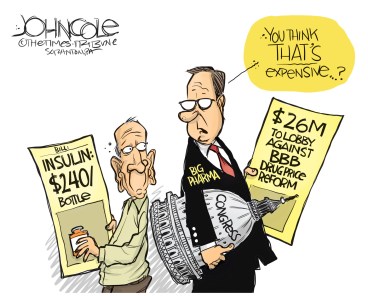
Well, that explains that. Then, the other icky result was that Republicans could not bring themselves to support a price control on Insulin which is cheap to make, but its price inelasticity is off the wall. That’s fancy economist talk, for if you need it, you’ll give up everything else. Insulin is basically treated like legal heroin from a huge drug cartel. Republicans used a dodgy procedure to kill that part of the Act.
This is from WAPO: “Republicans block cap on insulin costs for millions of patients. GOP senators move to strip a $35 price cap on insulin under private insurance from the Inflation Reduction Act.”
Republican lawmakers on Sunday successfully stripped a $35 price cap on the cost of insulin for many patients from the ambitious legislative package Democrats are moving through Congress this weekend, invoking arcane Senate rules to jettison the measure.
The insulin cap is a long-running ambition of Democrats, who want it to apply to patients on Medicare and private insurance. Republicans left the portion that applies to Medicare patients untouched but stripped the insulin cap for other patients. Bipartisan talks on a broader insulin pricing bill faltered earlier this year.
The Senate parliamentarian earlier in the weekend ruled that part of the Democrats’ cap, included in the Inflation Reduction Act, did not comply with the rules that allow them to advance a bill under the process known as reconciliation — a tactic that helps them avert a GOP filibuster. That gave the Republicans an opening to jettison it
 So, now to more Trumpsters and their crime sprees. I will dump these links here with very few comments and quotes. The headlines say it all, but the stories are worth reading.
Via The New Yorker: “Inside the War Between Trump and His Generals.” Remember that big parade for Bastille Day in Paris that enthralled the Russian Potted Plant?
Sure enough, Trump returned to Washington determined to have his generals throw him the biggest, grandest military parade ever for the Fourth of July. The generals, to his bewilderment, reacted with disgust. “I’d rather swallow acid,” his Defense Secretary, James Mattis, said. Struggling to dissuade Trump, officials pointed out that the parade would cost millions of dollars and tear up the streets of the capital.
But the gulf between Trump and the generals was not really about money or practicalities, just as their endless policy battles were not only about clashing views on whether to withdraw from Afghanistan or how to combat the nuclear threat posed by North Korea and Iran. The divide was also a matter of values, of how they viewed the United States itself. That was never clearer than when Trump told his new chief of staff, John Kelly—like Mattis, a retired Marine Corps general—about his vision for Independence Day. “Look, I don’t want any wounded guys in the parade,” Trump said. “This doesn’t look good for me.” He explained with distaste that at the Bastille Day parade there had been several formations of injured veterans, including wheelchair-bound soldiers who had lost limbs in battle.
Kelly could not believe what he was hearing. “Those are the heroes,” he told Trump. “In our society, there’s only one group of people who are more heroic than they are—and they are buried over in Arlington.” Kelly did not mention that his own son Robert, a lieutenant killed in action in Afghanistan, was among the dead interred there.
“I don’t want them,” Trump repeated. “It doesn’t look good for me.”
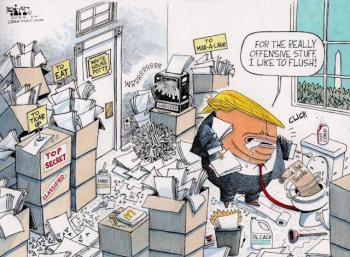
From Mike Allen at Axios, which just got sold to Cox: Exclusive photos: Trump’s telltale toilet
Haberman’s sources report the document dumps happened multiple times at the White House, and on at least two foreign trips.
- “That Mr. Trump was discarding documents this way was not widely known within the West Wing, but some aides were aware of the habit, which he engaged in repeatedly,” Haberman tells us.
- “It was an extension of Trump’s term-long habit of ripping up documents that were supposed to be preserved under the Presidential Records Act.”
The handwriting is visibly Trump’s, written in the Sharpie ink he favored.
- Most of the words are illegible
- But the scrawls include the name of Rep. Elise Stefanik of upstate New York, a Trump defender who’s a member of House Republican leadership.
Oy.just.Oy.
From Mattathias Schwartz at Insider: Exclusive: Paul Manafort admits he passed Trump campaign data to a suspected Russian asset.
Here’s a discussion of the interview and findings at Raw Story by TBogg: Paul Manafort admits sharing info with the Russians during the 2016 Trump campaign.
For years, questions have been raised about Russian involvement in the campaign that saw the New York businessman beat former Secretary of State Hillary Clinton, and Manafort is now stating that he handed polling data over to the Russians — in particular to “Konstantin Kilimnik, a longtime business associate with suspected ties to Russian intelligence.”
According to the report, “Kilimnik then passed the data on to Russian spies, according to the US Treasury Department, which has characterized the data as ‘sensitive information on polling and campaign strategy.'”
In the interview, Manafort excused his actions stating he wasn’t looking for help getting Trump elected and did it purely to make money, with Business Insider reporting, “Manafort told Insider that he directed his deputy, Rick Gates, to feed Kilimnik polling data via email to ‘keep Konstantin informed.’ The goal was to use his access to Trump to drum up business for himself.
 Well, we already knew he’s a Russian Potted Plant. Didn’t we?
From Tim Miller / Morning Shots writing for The Bulwark: I’m Sorry, But He’s Running. Trump’s CPAC speech was his 2024 blueprint.”
With that little bit of throat-clearing out of the way, I have some bad news to report. If you, like me, had been compartmentalizing a Trump 2024 run for mental-health purposes, I’m sorry to break it to you, but he looks like a man who is definitely running for president in 2024. His CPAC speech this weekend was a rude awakening as to both his intentions and the strength he would bring to that campaign.
First, his intentions: There was no bigger roar from the crowd during the speech than during the following section, and there was no bigger shit-eating grin on his burnt-toast face than the one that came following the roar:
I ran twice. I won twice and did much better the second time than I did the first getting millions and millions of more votes than in 2016. And likewise getting more votes than any sitting president in the history of our country by far. . . . And now we may have to do it again. We may have to do it again.
That little bit of anti-democratic vamping came right on the heels of what would be his core campaign message to the GOP base in a 2024 campaign.
The border was the best and safest in U.S. recorded history. They’ve turned it into a nightmare so quickly, the election was rigged and stolen. And now our country is being systematically destroyed.
If you are reading this, then you are likely a person of reason who is not persuaded by the lies and childish hyperbole.
But let’s imagine this message in the context of a 2024 Republican primary. Trump is claiming that when he was president, everything was great. Then the election was stolen. And now everything is being destroyed by the people his voters hate.
What exactly is his hypothetical challenger’s response to this? It seems to me that Trump has everyone checkmated.
Say it ain’t so Tim!
Anyway, the Republicans aren’t going straight any time soon. We can only rely on the DOJ in a few states and nationally to send them straight to jail.
What’s on your reading and blogging list today?
Friday Reads
Posted: March 3, 2017 Filed under: Domestic Policy, Donald Trump, Economic Develpment, Economy, Federal Budget, morning reads, Social Security | Tags: budget, Deconstruction of the Administrative State, EPA, State Department 24 Comments Good Afternoon!
Our Federal Government continues to morph into something hostile, xenophobic,and corrupt as we look at yet another weekend where taxpayer money will be filtered into a private resort owned by Kremlin Caligula. The Cabinet is now filled with corrupt and unqualified people. Entire Departments are being defunded and destroyed. First among them is the State Department. This all appears to part of Bannon’s crusade to “deconstruct the administrative state”.
This week began with reports that President Donald Trump’s budget proposal will drastically slash the State Department’s funding, and last week ended with White House adviser and former Breitbart head Stephen Bannon telling the attendees of the annual Conservative Political Action Conference that what he and the new president were after was a “deconstruction of the administrative state.” At the State Department, which employs nearly 70,000 people around the world, that deconstruction is already well underway.
In the last week, I’ve spoken with a dozen current and recently departed State Department employees, all of whom asked for anonymity either because they were not authorized to speak to the press and feared retribution by an administration on the prowl for leakers, or did not want to burn their former colleagues. None of these sources were political appointees. Rather, they were career foreign service officers or career civil servants, most of whom have served both Republican and Democratic administrations—and many of whom do not know each other. They painted a picture of a State Department adrift and listless.
Sometimes, the deconstruction of the administrative state is quite literal. After about two dozen career staff on the seventh floor—the State Department’s equivalent of a C suite—were told to find other jobs, some with just 12 hours’ notice, construction teams came in over Presidents’ Day weekend and began rebuilding the office space for a new team and a new concept of how State’s nerve center would function. (This concept hasn’t been shared with most of the people who are still there.) The space on Mahogany Row, the line of wood-paneled offices including that of the secretary of state, is now a mysterious construction zone behind blue tarp.
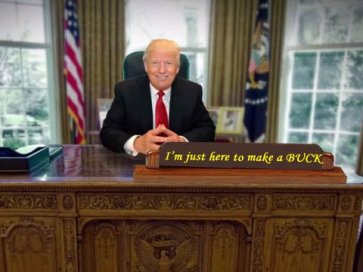 Under Trumps Slash and Burn Budget, everything loses but the military. The EPA will be decimated.
A wide slew of Environmental Protection Agency programs could be under the knife to meet President Donald Trump’s budget proposal requirements, a source told CNN Wednesday night.
The source spelled out details of an Office of Management and Budget proposal that would cut the EPA’s budget by 24% and reduce its staffing by 20%. Some of the EPA’s most longstanding and best-known programs are facing potential elimination — including initiatives aimed at improving water and air quality as well as a number of regulations tasked with reducing the nation’s greenhouse gas emissions.
Other programs include the Environmental Justice program, which is meant to help local communities grapple with environmental concerns, and Global Change Research, a program funded by several agencies, including the EPA, which reports humans’ impact on the planet.
The Clean Power Plan, which could also be recommended for cuts, was an initiative by former President Barack Obama meant to reduce carbon emissions from each state. Fourteen separate EPA partnership programs to reduce greenhouse gas emissions could also be on the chopping block.
Also among the programs up for elimination are multi-purpose grants to states and tribes, Energy Star grants, Science to Achieve Results (STAR) graduate fellowships, the Diesel Emissions Reduction Act and initiatives aimed at environmental protections along the US-Mexico border.
Some of the grants recommended for elimination could be matching grants for local projects around the country, the source added.
Ken Cook, the head of the Environmental Working Group, an advocacy and research organization, told CNN in a statement: “The Trump administration has decided fence-line communities across the country, whose residents already bear an outsized burden from pollution, are on their own to take on big polluters.”
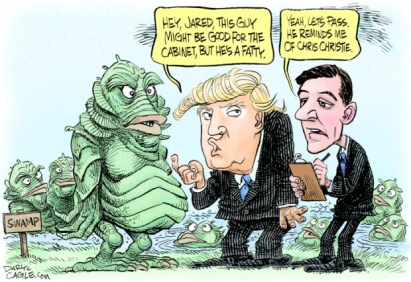
Daryl Cagle / darylcagle.com
The American Heritage Foundation has been out for the EPA for a long time. Its even had a plan that may be part of the Adminstration’s vision for letting go of any kind environmental controls and regulation.
Right now, the Trump administration is crafting a budget proposal that envisions steep cuts to a number of federal agencies — including, reportedly, a 24 percent cut to the Environmental Protection Agency that would eliminate one-fifth of its 15,000 jobs.
There aren’t yet any final decisions on exactly which environmental and energy programs will be targeted for elimination; the White House is still discussing with the relevant agencies. But one place to look for clues is this budget “blueprint” put out by the Heritage Foundation, a major conservative think tank. According to multiple reports, Donald Trump’s team has been using Heritage’s blueprint as a rough guide in its search for $54 billion in domestic spending cuts for fiscal year 2018.
The Heritage budget explains how to get cuts of that magnitude — spreading them out across every agency. And it goes particularly hard after energy and environmental programs. The EPA’s climate-change programs? Gone. Federal research into wind, solar, electric vehicles, nuclear, and other clean tech? Gone. Environmental justice programs? Gone. There are cuts to pollution enforcement and EPA programs that deal with surface water cleanup to diesel truck emissions. Plus cuts in aid to poor countries that help deal with ozone depletion and global warming. Taken together, the blueprint’s cuts would amount to a stark change in US environmental policy.
These cuts won’t all necessarily fly with Congress — a few Republicans are already balking at some of the numbers Trump’s team is tossing about. But it’s a useful read as an aspirational document, a look at the programs that some influential conservatives with Trump’s ear would like to see rooted out of the federal government (and why)
 It isn’t clear at all that the Pentagon needs that much money or wants it for that matter. It traditionally gets pretty much what it wants already. The nation has been on a war time footing since 9/11 so it isn’t even clear that there’s been any kind of “depletion” of anything.
Defense spending accounts for almost the same proportion of the federal budget as all non-discretionary domestic spending, meaning that the Trump administration’s proposal will result in a roughly 10 percent across-the-board cut in all other federal spending programs.
Budgets for most federal agencies would be reduced substantially, said an OMB official, who spoke on the condition of anonymity on a call with reporters to discuss the proposal.
The announcement marks the beginning of a process in which the OMB will coordinate with agencies to flesh out the plan.
Trump said his budget, which will be submitted to Congress next month, will propose “historic” increases in spending to bolster the country’s “depleted military,” and he said it will support law enforcement in an effort to reduce crime.
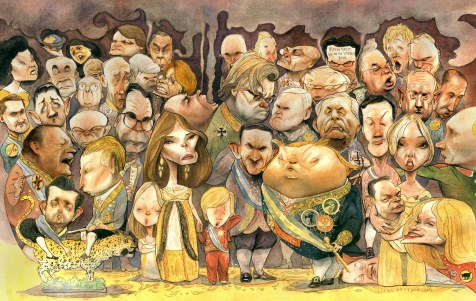
I really don’t think that any one in the administration has a clue what they’re doing in any kind of conventional sense since nearly all of them have no experience in governance at any level. Bannon’s slash and burn the state ideology appears to be driving much of this. The cabinet appointees will have difficulty doing much of anything at this rate because staff is fleeing already.
The career executives who staff and run the approximately 250 federal departments and agencies not only formulate and implement executive orders, they also make choices every day that influence large swaths of public policy — from immigration to law enforcement to education to the environment. They use their legal authority to do what all executives do: interpret the power given them by their board of directors (in this case, Congress), set organizational priorities in formal guidance or memorandums and make decisions about where to allocate people and dollars.
The recent enforcement actions by Immigration and Customs Enforcement (ICE) illustrate how agency choices about what to prioritize and how to enforce the law can produce a dramatic policy change.
Trump’s success as president depends in part on his ability to get agencies to behave like ICE and choose to use their power in the ways he would prefer.
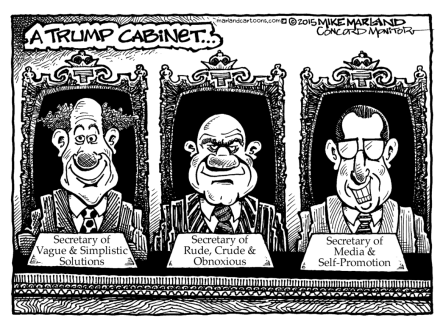 A number of agencies have already gone literally rogue on him with employees undermining him every chance they get. This is even true of some of the agencies that are to be used to purge the country of whatever it is Trump fears. Bannon has even indicated that the Cabinet picks were part of the Deconstruction plan.
President Trump’s critics have noted that at least some of his Cabinet picks seem uniquely unsuited to their roles. Scott Pruitt, recently confirmed as head of the EPA, had previously challenged its regulations in more than a dozen suits. Trump’s initial pick for labor secretary, Andrew Puzder, operated a company that depended on low wages and faced allegations of labor abuse. Puzder’s nomination was scuttled by the discovery that he had employed at least one undocumented immigrant.
Trump’s FCC chairman and energy secretary have also been critics of the very agencies they’re now tasked with managing. Rick Perry, Trump’s pick for energy secretary, famously called to eliminate the department while running for President in 2011.
Putting anti-regulation chairs at the top of regulatory bodies is nothing new for conservative administrations—George W. Bush’s EPA administrator Stephen Johnson, for instance, pushed back against staff recommendations and slackened enforcement. As the saying goes, elections have consequences, and lightening the regulatory load on businesses is a pillar of modern Republican doctrine.
What’s remarkable here, though, is Bannon’s framing of these moves as more anti-state than pro-business. The CPAC comments about ‘deconstruction’ are a toned-down version of startling statements made last August to the Daily Beast. Bannon impishly declared himself a “Leninist,” saying that the Soviet leader “wanted to destroy the state, and that’s my goal too. I want to bring everything crashing down, and destroy all of today’s establishment.”
It’s not a stretch to see Bannon’s comments reflected not only in Trump’s cabinet picks, but in his slow progress in filling hundreds of lower-level cabinet positions. Until they’re filled, those positions are staffed by temporary administrators with reduced power, leaving enforcement and other matters in limbo.
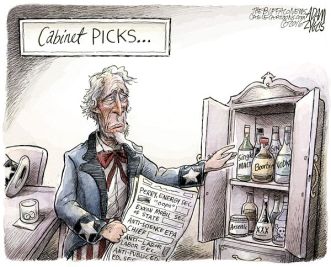
This is perhaps though why Paul Ryan–on top of Putin–find the Trump minions to be “useful fools”. Ryan is known as the nation’s premier granny starver and all this chaos and cutting is pretty much right up his ally. This is analysis by Jonathan Chait.
What is the substance of the supposed schism between Trump and the regular GOP? The Times depicts the president and the House Speaker as split over whether to cut “Social Security, Medicare and Medicaid.” But, while Ryan has made it known that he would like to cut Social Security (a position that has won him immense inside-the-Beltway Establishment credibility), he has not persuaded his party to go along. The “Better Way” plan crafted by Ryan and endorsed by House Republicans makes no mention of Social Security at all. It does propose privatizing Medicare, but only for workers who are not retired or are near retirement — which means, despite its long-term significance, it has no impact on the budget over the next decade. And both Trump and Ryan are planning deep cuts to Medicaid.
The similarities continue. Both favor increases in defense spending and dramatically weaker enforcement of labor, environmental, and financial regulation. Both favor deep cuts to anti-poverty spending. Trump is more enthusiastic than the regular GOP about infrastructure spending, but he has decided to postpone that issue until next year and use it as an election messaging vehicle rather than a real legislative priority. Most important, both agree that large, upper-income tax cuts are the party’s highest priority. Trump has even endorsed Ryan’s legislative strategy of sequencing Obamacare repeal first in order to grease the skids for bigger tax cuts. (“Statutorily and for budget purposes, as you know, we have to do health care before we do the tax cut,” he said this week.)
It is true, as conservatives say, that Trump’s budget numbers do not really add up. But he is relying on the same voodoo economics assumptions that are de rigeur in his party. “The money is going to come from a revved-up economy,” Trump said on Fox & Friends. “I mean, you look at the kind of numbers we’re doing, we were probably GDP of a little more than 1 percent. And if I can get that up to 3, maybe more, we have a whole different ballgame.” Remember that ultra-Establishment Republican Jeb Bush promised tax cuts and deregulation would produce 4 percent growth, so Trump’s 3 percent growth promise is actually moderate and realistic by Republican fiscal standards.
The illusion that Trump has radically altered his party’s agenda is convenient for all sides.
Democrats have already sent out a battle cry as have a few Republicans. Lindsey Graham is having none of the cuts to State.
Sen. Lindsey Graham (R-S.C.) said Tuesday that President Trump’s first budget was “dead on arrival” and wouldn’t make it through Congress.
“It’s not going to happen,” said Graham, according to NBC News. “It would be a disaster.”
Graham, a frequent Trump critic, expressed concerns with Trump’s proposed cuts to the State Department budget, especially the targeting of foreign aid.
These are trying times. Let’s just hope we have enough leaders in the District with other patriotism or deep seated interests in some of these agencies or our country will never look the same again.
What’s on your reading and blogging list today?
Friday Reads: Late Edition
Posted: January 15, 2016 Filed under: Economic Develpment, Economy | Tags: Air BnB hell realms, gentrification, New Orleans 33 CommentsGood Afternoon!
 I’m running really late today despite coffee and all the usual things I use to face the morning. I seem to be in need of hibernation. I’m not sure if it’s the ugly political situation or just the challenges of doing any little thing these days. Have you noticed how businesses are basically set up to take your money efficiently and create hell for you under any other circumstance? Calling them is to enter a hell realm. Even when you do reach a person, there seems to be little they can do but offer sympathy and customer service surveys. Why are businesses so damned rotten these days? Is it because they are coddled while the rest of us have been basically dropped from the master plan?
I’m going to do a little sharing of local stuff juxtaposed on some national news because I’ve been noticing how difficult life is becoming for regular people. Here in New Orleans, we’re chasing tourist dollars by destroying the culture that brings them here and basically driving off the workers that do the daily stuff of dealing with them. I’m beginning to think that the entire plan of the Aspen Institute is to turn every major city into a seamless, architecturally bland, sea of guys sporting manbuns. We seem to be selling our treasure to the highest out-of-town bidder who then remakes it into something totally new Portland or new Seattle or new Brooklyn. Then, we all have to indulge boorish burbies in all the places we used to use to escape them.
Here’s a great example. This nice old home used to be the equivalent of a hostel owned by a friend of mine. It was called the Mazant Guesthouse and was heavily used by Europeans because it had no A/C, a communal kitchen, and was extremely cheap. The first thing the new owners did was try to tear down the backhouse. Thankfully, the historic commission stopped them. Now the entire property is just another reminder of the folks city government is trying to attract to all parts of the city including our personal, private backyards. Asking price? $1.65 million. You could’ve bought entire blocks here for that just a few years ago. So, you can imagine what that’s done to the rental market and what that’s doing to property tax valuations.
 This revitalization includes sanitizing the city’s really awful past as an outpost of the Confederacy and Lost Cause by removing statues that used to attract more pigeon shit than attention. We tear down a very historical Woolworth’s with an intact counter that was central to the Civil Rights Movement and no one mourns that at all. We had an opportunity to put a great Civil Rights museum downtown for a real tourist experience. But no, we spend time removing rather than preserving the sites to use them to elucidate the awful past. We’d rather have a Dave and Buster’s than a National Jazz Park.
Several items came to my attention today that show the master plan is to transform us into the destination of the manbun crowd and that is having all kinds of unintended consequences. The example sits right next door to me. Two guys from NJ charge $180 a night for one side of a double that’s been redone to look like a badly decorated boutique hotel inside and barely maintains a semblance of its historical past outside. It used to be home to two families. Some NJ guy bought the family home across the street and it’s the ugliest thing you’ve ever seen now. It was an arts and crafts double but now it looks like some weird, awkward Cape Code monstrosity and it’s selling for way over $.5 million. Both homes were stripped of their historic architecture during renovation. My guess is some out of town rich people will Air BNB the arts & crafts double too which is currently illegal and against zoning laws. It used to be a rental when I moved here but was a single family dwelling until it sold. A barber who worked down in the quarter lived there. Regular folks that are renters aren’t here any more. But, don’t take my word for it. New Orleans now ranks second as the worst market for renters in the nation.
New Orleans is gaining notoriety among America’s mid-sized cities as a place where renters must devote an increasing share of their income to housing expenses.
Make Room, a campaign by nonprofit affordable housing developer Enterprise Community Partners, extracted Census data to rank the top “10 worst metro areas for cash-strapped renters.” New Orleans was No. 2.
According to Harvard’s data, 35 percent of renters in the New Orleans-Metairie-Kenner statistical area devote 50 percent or more of their income to rent and utilities, only slightly less than top-ranked Miami where the rate was 35.7 percent.
The Make Room initiative was launched in May 2015 to push for policy changes and additional resources for cities where the lack of affordable housing is acute. Angela Boyd, the campaign’s managing director, said the effort seeks, in part, to debunk misconceptions that affordable housing is an issue only for coastal cities and targets renters in need of subsidies or government assistance.
“Some people think affordable housing is for the homeless or residents of public housing, but it also takes into account moderate income (renters),” Boyd said. “These are people who are probably already your neighbors.”
I wonder how all those restaurants are going to find help when there are no more places for their employees to rent in the city at the wages they can pay? While the city is hassling over statues and renting its lampposts to hang fetus fetish propaganda, there’s  very little discussion of things that are really wrong here. We may be good at attracting celebrities to film stuff and buy houses, but we’re absolutely forgetting the majority of our population in the rush to be cool for pennies on the tax dollar.
On Wednesday night, Douglas Brown allegedly jumped over the counter of a New Orleans Subway after ordering a sandwich, according to the Times-Picayune, but was foiled in his attempt to nab the cash register drawer because it was tethered into place. Instead, he grabbed a bunch of cash and ran. He was detained 25 minutes later.
It’s unclear who will represent Brown. Yesterday, the Orleans Public Defenders refused to take his case. The underfunded office, which says it represents nearly 85-percent of all defendants in the parish but has a budget just half the size of the district attorney, simply can’t handle any more.“Our workload has now reached unmanageable levels resulting in a constitutional crisis,” Chief Defender Derwyn Bunton said in a December statement, giving one month’s notice that they would start refusing some clients charged with felonies carrying long sentences. “As Chief Defender, I can no longer ethically assign cases to attorneys with excessive caseloads or those that lack the requisite experience and training to represent the most serious offenses.”
This week, Bunton’s office made good on that pledge and began refusing clients. In response, the American Civil Liberties Union and the ACLU of Louisiana last night filed a class action lawsuit in federal court against Bunton and Louisiana State Public Defender James Dixon on behalf of plaintiffs who were assigned public defenders but then placed on a waiting list.
“So long as you’re on the public defender waiting list in New Orleans, you’re helpless. Your legal defense erodes along with your constitutional rights,” said Brandon Buskey, Staff Attorney with the ACLU’s Criminal Law Reform Project, in a statement. “With every hour without an attorney, you may forever lose invaluable opportunities to prove your innocence. You also may be forced into a crippling choice between waiting months for counsel or doing bail and plea negotiations yourself. The damage to your case can be irreparable.”
Mayor Mitch Landrieu maintains that while the city has increased its funding of the office that they have “barely kept pace with state funding cuts,” the Times-Picayune reports. The defenders contend that “the additional local funding is enough to stave off mandatory furloughs, but not enough to provide representation in serious felony cases that is constitutional or ethical.” Bunton and Dixon could not be reached for comment.
 The total focus on re-imagining New Orleans appears to include putting street cars everywhere and making sure no road goes unfixed endlessly as long as it is uptown. I’m not sure it includes a vision of much else. We seem to be highly focused on accommodating a certain segment of American society to the exclusion of a nearly everything else. From what I can see, we’re really not “winning” in any sense but Charlie Sheen’s or whatever it is Mayor Landrieu has in mind. He did come to us as the LT. Governor whose sole job is to fixate on tourism. Maybe that’s the issue he just can’t move beyond. I really don’t know. But, as far as I can tell, the development we’ve been getting recently is really killing exactly what we’ve been good at doing for a very long time.
Does resilience mean dumping your core competencies and the things that make you unique for the latest trendiness?
What happens when a city because a laboratory for hair brained schemes like charter schools and whatever you call this urban development trend that seems to be making us some blander version of ourselves? One of our issues has been the lack of health care for so many people. I’m hoping that the state’s move to now accept the Medicaid Expansion will help these kinds of statistics. Meanwhile, we can only look at the skeleton of Big Charity Hospital which was once the hallmark of a civilized nation.
Indeed, Place Matters for Health in Orleans Parish, a report prepared by the Joint Center for Political and Economic Studies and the Orleans Parish Place Matters Team, in conjunction with the Center on Human Needs, Virginia Commonwealth University, and the Virginia Network for Geospatial Health Research, noted that “Life expectancy in the poorest zip code in the city is 54.5 years, or 25.5-years lower than life expectancy in the zip code with the least amount of poverty in the city, where it is 80.”
I’m beginning to think the entire “sharing” economy is basic piracy. I came across this at AJ and was appalled that folks would do this on both supply and demand side of AIR BnB. I swear this corporation is just an international crime syndicate that makes money off of illegal and destructive activities.
Airbnb may be the next high-profile target of the Boycott, Divestment and Sanctions (BDS) movement, following media reports this week that the online accommodation service includes listings from settlements in the occupied Palestinian territories that are advertised as being in Israel.
Anyone staying in an Airbnb-listed settlement property “facilitates the commission of the crime of establishing settlements and therefore aids and abets the crime,” said John Dugard, professor of international law, and a former Special Rapporteur to the UN on Palestine.
“The same applies to making money from property built on illegal settlements.” Airbnb takes a commission on property rentals, and so is profiting from Israel’s colonisation of Palestine.
Hosts who list properties via the company are required to provide accurate locations. As such, stating that settlements are located in Israel – when they are in fact illegal under international law because they are built on occupied territory – is a violation of the company’s terms.
I would like to think that just because you can make money off of something doesn’t mean that you should do it, the government should allow it, or there should be legal businesses encouraging it. But then, it seems state and local governments are also doing anything to quit providing services to citizens while heavily subsidizing private businesses for whatever reason. At what point do we decide that businesses and rich people should pony up their fair share of the bill of living in a civilized country,state and city of laws, institutions and regular people?
The city of Flint, Mich., is in the midst of a water crisis several years in the making. The city opted out of Detroit’s water supply and began drawing water from the Flint River in April 2014, part of a cost-saving move. Eighteen months later, in the fall of 2015, researchers discovered that the proportion of children with above-average lead levels in their blood had doubled.
The city reconnected to Detroit’s water system in October, but the damage was done. Water from the Flint River was found to be highly corrosive to the lead pipes still used in some parts of the city. Even though Flint River water no longer flows through the city’s pipes, it’s unclear how long those pipes will continue to leach unsafe levels of lead into the tap water supply. Experts currently say the water is safe for bathing, but not drinking.
A group of Virginia Tech researchers who sampled the water in 271 Flint homes last summer found some contained lead levels high enough to meet the EPA’s definition of “toxic waste.”
Economic theory states that we should tax nuisance activities heavily to both discourage them and to collect funds for the damages they inflict on the citizens around them. (Think any kind of pollution.) Subsidies are to be given to those  activities that won’t occur–even though they are highly beneficial to society–because they won’t provide profits to private businesses. (Think public transportation and education.) It’s a really basic and simply theory that’s been proven useful time and time again. There are some things we really do want to tax the hell out of because we want less of it and we want to recover the damage it creates. Many rules and regulations exist to protect current property owners and stakeholders. Here’s a brief little lesson on Pigouvian Taxes and subsidies that’s worth a watch that gives you a good idea of the costs and benefits. I’m not sure why the entire concept has gone out of style. Perhaps it’s because the Aspen Institute doesn’t find it trendy enough. Although my gut says it’s likely because lobbyists and political donors prefer to be enabled rather than held accountable.
Anyway, what I think I can say is that we’re making it difficult (e.g. taxing) for the wrong people to exist in society and we’re subsidizing the folks that are just making things worse. I believe this is why there’s such disgruntlement at working, poor, and middle class income levels.
The question now, is how do we really change this? When are we going to stop selling our society to any bidder for any sleazoid reason in the name development?
What’s on your reading and blogging list today?
Friday Reads: Economic Anemia
Posted: October 24, 2014 Filed under: 2014 elections, Austerity, Barack Obama, Economic Develpment, Economy, Elections, Federal Budget, Federal Budget and Budget deficit, Federal Government Shutdown, income inequality, morning reads, Republican politics | Tags: uo 65 CommentsGood Morning!
 Since I’m in the middle of revamping my course for Graduate Finance Students in International Finance and reviewing textbooks and the usual stuff, I thought I’d focus on the economy for the morning.
One of the most awful results of the Reagan years has been the creation of mainstream paranoia over policy using data evident from the scientific method, intellectuals and academics that spend years researching and learning theory and empirical evidence, and the idea that government can’t ameliorate issues through policy but is somehow a potential enemy of the governed.
This kind of paranoid drivel used to be the realm of militia types like Clive Bunday and John Birchers like the Koch Brothers and father. It had no place in mainstream discourse until Reagan started pumping up the idea that poor people game the government and the government games every one else. Its now spread to Christian extremists, the NRA, and most of the Republic Party.
Let me give you the latest example of someone who is possibly going to be a Senator from Iowa. Joni Ernst is doing the Sharon Angle thing of declaring any government issue she doesn’t like her potential enemy and any one supporting that view as a potential target of her nice little gun that she carries with her everywhere.
Joni Ernst, the Republican candidate for U.S. Senate in Iowa, said during an NRA event in 2012 that she would use a gun to defend herself from the government.
“I have a beautiful little Smith & Wesson, 9 millimeter, and it goes with me virtually everywhere,” Ernst said at the NRA and Iowa Firearms Coalition Second Amendment Rally in Searsboro, Iowa. “But I do believe in the right to carry, and I believe in the right to defend myself and my family — whether it’s from an intruder, or whether it’s from the government, should they decide that my rights are no longer important.”
Ernst made the remark a little more than a month after gunman James Holmes allegedly killed 12 people and injured 58 in a movie theater in Aurora, Colorado. Ernst’s campaign did not respond to The Huffington Post’s request for comment about the remark on Wednesday evening.
Earlier this year, Ernst released an ad in which she points a gun at the camera and vows to “unload” on Obamacare.
We’ve also experienced this massive attempt to rewrite secondary school textbooks and curricula to reflect the deeply held philosophical and religious views of these folks rather than theory or empirical evidence brought about by hundreds of years of research and scholarship. This also ignores primary documents that show just the opposite to be factual.
But, facts be damned, there’s children’s minds to warp. Biased ideas are not at the center of legitimate academic pursuit. Folks that follow agendas tend to live at the edges of universities and most departments are quite embarrassed by them. I spent time in a department where one research professor’s favorite pursuit was proving that iqs and brain sizes among varying races were the reason for underachieving groups in an economy. All DNA evidence shows that race is a social construct but this guy spent a life time trying to show the relationship between brain sizes of races and incomes and jobs. So, most time when you see folks that believe this stuff, they reside some where on the fringes. However, since the Reagan years, there’s been a major attempt by right wing religious zealots to teach propaganda and there’s been a rather significant increase in the level of ignorance on things from incoming freshmen.
This is happening even in economics where you would think that paranoia about “communism” would’ve gone away since the fall of the USSR. Not true, however. They prefer to fear imagined boogey men and to set up imagined fairy tale rescuers over doing policy that’s be proven effective in years of empirical study.
The standards’ authors are clearly fans of the free enterprise system, consistently emphasizing the advantage of American capitalism over other structures.
For example, the high school standards state that students should be able to “understand how the free enterprise system drives technological innovation and its application in the marketplace.” The middle school standards clearly promote free enterprise capitalism over other economic systems, saying that students should be able to “compare and contrast free enterprise, socialist, and communist economies in various contemporary societies, including the benefits of the U.S. free enterprise system.” Finally, the standards connect capitalism with the conservative ideal of limited government, asking students to be able to “explain why a free enterprise system of economics developed in the new nation, including minimal government intrusion, taxation, and property rights.”
It really takes very little time spent in economics to realize that political constructs are not economic constructs. For example, the United States economy was founded on Mercantilism which began with monopolies, charters, grants and largess of royalty and aristocracy. The concepts of Capitalism and of Communism had the same roots and they were a lot more philosophical than ever real. Even, now, we have a modified market system. There has never EVER been a “free market” system or “communism” in an economic sense. Socialism is just one end of a modified market system and still relies heavily on private ownership of the majority of factors of production. Most facets of government policy are to make a market behave closer to a free market model because it can’t possibly d0 so under one factor, characteristic, or situation that exists. I mean really, who wants to leave the market for uranium to the free market? That’s just an extreme example.
The problem is that dogma has overtaken reality among folks that now find themselves in office. It’s bad for the country. It’s bad for business. It’s bad for nearly every one. The one thing that’s becoming abundantly clear since the Clinton Presidency and definitely during the Obama Presidency is that the Democratic Party is the party of Wall Street and Big Business. It’s not the Republicans. No where is this more evident than economic reports written by the private sector. Today’s Republicans scare the shit out of big business and finance. The last few battles to keep the federal government and the deficit funded has nearly caused market meltdowns twice. You also don’t see them complain about increasing the minimum wage or decreasing the current level of income equality. NO REALLY. This means Chris Christie is really going to have some ‘splaining to do over this statement.
Labor Secretary Tom Perez on Thursday panned New Jersey Gov. Chris Christie’s comments that he’s “tired” of the minimum wage debate.
“Chris Christie’s got his head in the sand if he’s getting tired about the minimum wage,” Perez said according to Bloomberg Politics.
President Barack Obama and Democrats have led the push to raise the federal minimum wage to $10.10, and the issue has made its way onto the campaign trail this year.
“Chris Christie needs to talk to his economists, who will tell him that 70 percent of GDP growth is consumption,” Perez said Thursday.
The criticism came just days after Christie said he was “tired of hearing about the minimum wage” at a U.S. Chamber of Commerce conference on Tuesday.
“I really am,” the Republican governor and potential 2016 hopeful said. “I don’t think there’s a mother or a father sitting around the kitchen table tonight in America saying, ‘You know, honey, if our son or daughter could just make a higher minimum wage, my God, all of our dreams would be realized.'”
“Is that what parents aspire to for our children?” Christie asked. “They aspire to a greater, growing America, where their children have the ability to make much more money and have much great success than they have, and that’s not about a higher minimum wage.”
Before the Labor secretary chimed in, the remark drew fire from other Democrats, and White House Press Secretary Josh Earnest even quipped during a briefing Wednesday that people living on a minimum wage are those who are really tired.
Christie also used his time at the podium to make a 2016 prediction.
“I am convinced that the next president of the United States is going to be a governor,” Christie said. “We’ve had this experiment of legislating .. and getting on-the-job training in the White House. It has not been pretty.”
 So, this kind’ve talk is really making the economists of Wall Street and of huge corporations very nervous. They’re quite aware that today’s Republican Party is tanking the economy.
Even though Republicans depict themselves as the party for business and banks, it turns out that the GOP’s economic policy is detrimental to their bottom lines and continued existence; particularly rising costs and stagnant wages since the Bush-Republican Great Recession. What both bankers and retailers really want instead of tax cuts, deregulation, and more Republican austerity and budget cuts are better incomes for all Americans that will lead to increased consumer confidence and greater purchasing power to trigger higher business profits. What they have learned after thirty years of “trickle-down” is that the trillions of dollars taken by the 1%, especially since 2009, have failed miserably to stimulate the economy. Instead, they demand more buying by the masses that Wall Street firms and analysis of 65 of the nation’s top retailers claim will only happen with, as President Obama preaches, growing the economy from the middle-out.
For example, in a report last month titled Inequality and Consumption, Morgan Stanley economists said, “Despite the roughly $25 trillion increase in wealth since the recovery from the financial crisis began, consumer spending remains anemic. Top income earners have benefited from wealth increases but middle and low income consumers continue facing structural liquidity constraints and unimpressive wage growth. To lift all boats, further increases in residential wealth and accelerating wage growth are needed.” Republicans completely disagree and either resist consideration of raising the minimum wage or promote abolishing it altogether. According to the Republicans, increasing income inequality must continue and it is crucial that they convince the population that no wage is too low. It is a belief the Koch brothers espouse but it is rapidly losing favor in circles whose survival depends on a population of consumers.
Standard and Poor’s (S&P) rating agency concurred with Morgan Stanley’s economists in their August report, How Increasing Income Inequality Is Dampening U.S. Economic Growth, And Possible Ways To Change The Tide, and strongly advised the federal government to create “a path toward more sustainable growth, that in our view, will pull more Americans out of poverty and bolster the purchasing power of the middle class. A rising tide lifts all boats…but a lifeboat carrying a few, surrounded by many treading water, risks capsizing.” To “lift all boats,” S&P suggests a “high degree of rebalancing” that includes increased “spending in the areas of education, health care, and infrastructure to help control the income gap that, at its current level, threatens the stability of an economy still struggling to recover.” Contrary to wisdom of real economists concerned with America’s economic survival, Republicans across the country have been laser-focused on their austerity crusade to cut spending on education, infrastructure, and healthcare including the cruel heartlessness of refusing free Medicaid expansion under the Affordable Care Act.
Despite the call from both banks and businesses to increase the minimum wage and spending on essentials for a robust recovery, congressional Republicans have obstructed and outright blocked each and every attempt by the President and Democrats to stimulate the economy. Despite trailing every developed nation on Earth in infrastructure, Republicans consistently refuse the President’s calls to increase spending on desperately-needed infrastructure repairs including roads, bridges, public buildings, and sewers that numerous economists, including some highly respected conservatives, say is crucial for job-creation, increased consumer spending, and a vibrant recovery. Increased consumer confidence, and spending, is something all economists agree is for the good of the country’s economy but can only happen if incomes rise for the majority with higher wages and more well-paying jobs.
I’ve said this a million times but it’s true. If you have an economy that’s 70% reliant on consumer spending for growth and 99% of the population has stagnant to falling real income, you’re going to run into trouble. Especially since a huge part of that 99% spends high levels, all of, or beyond  their income and wealth levels. Years and years of evidence has shown that consumers are the real job creators. No business hires workers if no one is buying their goods and services. Rich people–especially with some of the horrid changes we’ve had in the tax code during the Dubya years–are spending more and more of the income and wealth on gambling paper for paper profits. This does not create anything of value in a real economy but it sure creates asset bubbles and the potential for financial meltdowns. One has only to survey retailers to figure out the relationship between incomes of the middle and working classes and their bottom lines and their hiring plans.
Former Walmart U.S. CEO Bill Simon, whose company had seen consumer traffic drop for six straight quarters and same-store sales drop for five quarters, explained in July 2014 that “we’ve reached a point where it’s not getting any better but it’s not getting any worse—at least for the middle (class) and down.” Kip Tindell, CEO of the Container Store, put retailers’ feelings best when he said, “consistent with so many of our fellow retailers, we are experiencing a retail ‘funk.’” The culprit is obvious: low wage and income growth for the middle class. Median household income in 2013 stood 8 percentage points below its 2007 prerecession level.
The simple fact of the matter is that when households do not have money, retailers do not have customers. The failure of incomes to keep up with the growing cost of college, child care, and other middle-class staples leaves even less money for retail spending. A previous analysis by the Center for American Progress shows that this so-called “middle-class squeeze”—stagnant incomes and the growing cost of middle-class security—leaves the median married couple with two kids with $5,500 less to spend annually on food, clothes, and other essentials that retailers sell.
Or, as officials of J.C. Penney—whose sales fell 9 percent in 20136—put it when listing the risks to its stock value: “the moderate income consumer, which is our core customer, has been under economic pressure for the past several years.”
Moreover, retail spending—which includes spending on everything from clothing to groceries to dining out—has broad implications for the entire economy since it accounts for a large fraction of consumer spending, which itself makes up 70
percent of U.S. gross domestic product, or GDP.
Even Walmart is concerned even while not paying living wages, not providing good benefits, and not creating an environment where a worker feels secure about his/her future. Now the weird thing is that fringe economists are still overly scared about inflation and high taxes. These things, however, are not at the top of any one’s concerns that would be invited on any Fox News program. Here’s a headline from Forbes: “Want a Better Economy? History Says Vote Democrat!”. In 2012, a number of books evaluated the results of the economy under Democratic vs Republican administrations. The results are startling.
Senator Daniel Patrick Moynihan is attributed with saying “everyone is entitled to his own opinion, but not his own facts.“ So even though we may hold very strong opinions about parties and politics, it is worthwhile to look at historical facts. This book’s authors are to be commended for spending several years, and many thousands of student research assistant man-days, sorting out economic performance from the common viewpoint – and the broad theories upon which much policy has been based. Their compendium of economic facts is the most illuminating document on economic performance during different administrations, and policies, than anything previously published.
The authors looked at a range of economic metrics including inflation, unemployment, corporate profit growth, stock market performance, household income growth, economy (GDP) growth, months in recession and others. To their surprise (I had the opportunity to interview Mr. Goldfarb) they discovered that laissez faire policies had far less benefits than expected, and in fact produced almost universal negative economic outcomes for the nation!
From this book loaded with statistical fact tidbits and comparative charts, here are just a few that caused me to realize that my long-term love affair with Milton Friedman‘s writing and recommended policies in “Free to Choose” were grounded in a theory I long admired, but that simply have proven to be myths when applied!
- Personal disposable income has grown nearly 6 times more under Democratic presidents
- Gross Domestic Product (GDP) has grown 7 times more under Democratic presidents
- Corporate profits have grown over 16% more per year under Democratic presidents (they actually declined under Republicans by an average of 4.53%/year)
- Average annual compound return on the stock market has been 18 times greater under Democratic presidents (If you invested $100k for 40 years of Republican administrations you had $126k at the end, if you invested $100k for 40 years of Democrat administrations you had $3.9M at the end)
- Republican presidents added 2.5 times more to the national debt than Democratic presidents
- The two times the economy steered into the ditch (Great Depression and Great Recession) were during Republican, laissez faire administrations
The Obama economy is actually surprisingly good given that a large number of good economic policies have not been enacted due to Republican political kung fu.
It was no joke on Thursday when I asked Austan Goolsbee, a pretty fair amateur comic, to rattle of key economic indicators that are trending in very positive ways right now.
“Jobs created. Weekly U.I (jobless) claims. Unemployment rate. Auto Sales. Gas Prices,” said Goolsbee, former head of President Obama’s Council of Economic Advisers and a onetime winner of the annual “D.C.’s Funniest Celebrity” contest.And, yet, as a headline in Politico.com also noted Thursday, “Economic Anxiety Dominates 2014.” So what’s really and truly up? What explains the disconnect between seemingly very strong numbers and the lack of love for Obama and the Democrats?
“You can’t brag about the economy because people can’t feel it,” said Thomas Bowen, a Chicago-based Democratic political and policy consultant.
“I’m sure (some) Democrats have polled this: ‘The recovery isn’t working for you.’ That’s why they’re not running on the economy improving.
Not long after, I was driving past a state unemployment office along a rather somber commercial strip on Chicago’s Northwest Side. The parking lot was full. And then I mulled the folks I know working part-time involuntarily or sticking with jobs they don’t especially like out of fear of the limited alternatives.
“You’re talking about indicators in the last six months,” said Bowen. “But look at the start of the recession until today. We’re just getting out of the hole from jobs losses. And the jobs aren’t the same. They’re not higher paying construction jobs.” “Not all indicators equate with average folks,” said Anna Greenberg, a Washington-based Democratic pollster.
“Wages and salaries are stagnant,” she said. “Yes, the stock market is up and the jobless rate down. But the cost of living is up and you may not have more money.”
 So, a lot of economists like me remain very confused. It’s not like there’s not support by people and businesses for good policy like infrastructure projects, improving the terms of student loans so more folks can access higher and continuing education, and a reasonable minimum wage. The cities and states that have raised the minimum wage are even those that are doing well among states. States that have raised their minimum wages have better job growth.
New data released by the Department of Labor shows that raising the minimum wage in some states does not appear to have had a negative impact on job growth, contrary to what critics said would happen.
In a report on Friday, the 13 states that raised their minimum wages on Jan. 1 have added jobs at a faster pace than those that did not. The data run counter to a Congressional Budget Office report in February that said raising the minimum wage to $10.10 an hour, as the White House supports, could cost as many as 500,000 jobs.
“In the 13 states that boosted their minimums at the beginning of the year, the number of jobs grew an average of 0.85 percent from January through June. The average for the other 37 states was 0.61 percent.
“Nine of the 13 states increased their minimum wages automatically in line with inflation: Arizona, Colorado, Florida, Missouri, Montana, Ohio, Oregon, Vermont and Washington. Four more states — Connecticut, New Jersey, New York and Rhode Island — approved legislation mandating the increases.”
The AP notes: “[The] state-by-state hiring data, released Friday by the Labor Department, provides ammunition” to the camp in favor of raising the minimum wage.
“Economists who support a higher minimum say the figures are encouraging, though they acknowledge they don’t establish a cause and effect. There are many possible reasons hiring might accelerate in a particular state.
” ‘It raises serious questions about the claims that a raise in the minimum wage is a jobs disaster,’ said John Schmitt, a senior economist at the liberal Center for Economic and Policy Research. The job data ‘isn’t definitive,’ he added, but is ‘probably a reasonable first cut at what’s going on.’ “
So, it just appears that there’s a huge portion of the United States electorate and elected that would rather live in their dream world of imaginary beings and dogma than have their lives made better by using what we know and what we’ve learned.
What’s on your reading and blogging list today?
Of Brass Tacks and Phony Crises
Posted: January 3, 2013 Filed under: Catfood Commission, Economic Develpment, Economy, Voter Ignorance, We are so F'd 27 CommentsYes, yes … the fiscal bunny slope has been somewhat solved and the press has moved on to discussing the next big self-inflicted fiscal crisis coming up in February. ( I guess we’re adopting the term “March Madness” just to make it all exciting and discussable.) We’re still in the land of economic surreality instead of theory. It worries me. The basic problem is that this country has forgotten its economic history, lessons and theory. Fiscal policy should not be based on political memes and lurching from one crisis to the next. Here’s some things to think on from economists.
Economist Nouriel Roubini points out that we’ve been let down by our political leaders who just don’t get that our basic problem is really one of development. We’ve had substantial growth in upper incomes and corporate profits, yet we’re going nowhere in all the quality of life and economy numbers. We have a tax policy that encourages folks like Romney to strip money out of functional businesses, shut them down, and move the proceeds to offshore bank accounts to avoid paying taxes that support basic features of a civilized country. How is this kind of wealth creation helping our economy? How is treating speculative gambling to tax favors instead encouraging actual business building creating a future upon which we can sustain our civilization? Why isn’t the press looking at the fiscal drag this cliff solution creates a well as the bigger issue of austerity facing us in March? Austerity has done the UK no favors and is crushing parts of the Eurozone. Why are the media and the political elite focusing on policies that look like Herbert Hoover’s revenge? Why feed the drone economy while starving granny?
President Barack Obama and his allies will argue that the deal concluded on Tuesday raises only $600bn of revenues over 10 years rather than their initial target of $1.4tn – and therefore there is further room for tax rises, at least for the wealthy. Republicans will argue that spending should now be radically cut, since this week’s deal did not address that side of the national balance sheet. (Even the 2011 debt ceiling deal reduced prospective spending by $1tn).
In the meantime, the likely fiscal adjustment in 2013 will be about 1.4 per cent of gross domestic product. (Spread between the expiry of the payroll tax cut, the increase in the tax rates of the rich, and some eventual cuts to spending.)
This translates into a 1.2 per cent of GDP drag on the economy during the year. If the economy was happily growing above trend – at say 3.5 per cent – that would not be such a big deal, as growth would still be above 2 per cent. In the past few quarters growth already averaged about 2 per cent. So the US could quite easily come perilously close to stall speed this year – or worse, if the eurozone crisis worsens.
The longer-term picture is bleaker still. The reality is that America is yet to wake up to the full extent of its fiscal nightmare. Even the typical Republican voter is not – being on average older and poorer than a Democrat voter – in favour of gutting the welfare state. Tea Party extremists are more noise than signal. That is why the plans of Mitt Romney and Paul Ryan, the Republicans’ losing presidential ticket, postponed all the tough spending cuts on Social Security and Medicare by a decade.
Neither Democrats nor Republicans recognise that maintaining a basic welfare state, which is right and necessary in our age of globalisation, rapid technological change and demographic pressure, implies higher taxes for the middle class as well as for the rich. A deal that extends unsustainable tax cuts for 98 per cent of Americans is therefore a pyrrhic victory for Mr Obama.
Yes, they continue to eye cuts in social security under the guise of tackling the deficit. Economist Dean Baker reminds us that Social Security has nothing to do with the Federal Deficit. Yet, there’s Simpson and Bowles yacking up that granny starving canard again! Let’s chain link our grandparents in the name of a lie, please!! Baker is right. Budget hysteria is a growth industry driven by lies and has nothing to do with what’s really happening in our real economy.
While the promotion of budget hysteria is one of the largest industries in Washington, the most important and widely ignored fact about the budget situation is that we have large deficits today because the collapse of the housing bubble sank the economy. This is not a debatable point.
The budget deficit was just 1.2 percent of gross domestic product in 2007. Before the collapse of the housing bubble the deficit was projected to remain low for the next decade and the debt-to-G.D.P. ratio was actually falling. This would have been the case even if the Bush tax cuts were allowed to continue.
When the bubble burst and the economy plummeted, tax collections fell. We also spent more on unemployment insurance and other benefits for unemployed workers. And we had further tax cuts and stimulus spending to try to boost the economy. The automatic and deliberate steps taken to counter the downturn fully explain the large deficits we have seen the last five years.
Record low interest rates on government bonds demonstrate that the current deficits are not a real problem. But even if they were, it is difficult to see how cutting Social Security could to be part of the solution. Under the law Social Security is not supposed to be part of the budget. It is an entirely separate program financed on its own.
This is not just a rhetorical point. We can talk about Social Security facing a financing shortfall in the future precisely because it is solely financed by its own revenue stream.
What we really need is a recovery. That will not happen with all the fiscal policies being placed on the table right now. Let’s review one simple thing. As long as you have a good currency, federal debt instruments in demand, and a vast array of taxable assets in your country, there is no such thing as a ‘bankrupt’ government or excessive debt. But, don’t take my word for it. Let’s again, look at the economic studies and look at the demand for treasury bonds and bills. Markets see no problem with debt levels in most industrialized nations because they know that with development and growth there comes decreased deficits and pay down of debt.
The sovereign bond markets in America, Japan, Britain, and the euro area’s “core” do not seem to think so. These governments can borrow cheaply for decades at a time. While it is certainly possible that the markets are wrong, policymakers should probably pay more attention to investors and less to the fear-mongers, especially since economists do not know how much government debt is too much. In fact, there is good reason to think that many countries with their own currencies could become far more indebted without risking trouble. One reason is that many private investors do not own enough sovereign bonds.
It is important to remember that there is an absence of evidence that governments with their own currencies are too indebted. Those who argue otherwise point to the work of Carmen Reinhart and Kenneth Rogoff, the celebrated authors of This Time is Different. Their paper “Growth in a Time of Debt” claimed that sovereign debt creates a burden on the rest of the economy. (They summarise their points here.) But, as Robert Shiller and Paul Krugman have pointed out, Ms Reinhart and Mr Rogoff never explain how public indebtedness restrains growth. There may be other forces at work, especially since sovereign debt ratios are usually at their highest after wars and financial crises. In countries with their own currencies, private interest rates are now so low that many investors have been grasping for yield wherever they can find it, such as in the revived CLO market. When he evaluated the evidence, my colleague concluded that “debt matters, but the precise way that it matters isn’t as clear-cut as Reinhart-Rogoff seem to indicate”.
Why would private investors want to buy more sovereign debt? A previous post on the shortage of safe financial assets mentioned how pension plans in many countries need to buy more government bonds to avoid mismatches between their assets and liabilities …
Nearly all the red states in our country may be Greece and Portugal–with the exceptions of Texas and Florida–but the blue states are overwhelmingly Germany and they continually bail out those loser states. That’s why we are not the Eurozone. However, those red states sure are trying to blow up the very arrangement that keeps them in roads, schools, and police forces. Economist Clive Crook points out how these idiots have now created a situation where governing means we lurch between crisis because none of them appear to be able to accept the lessons learned from the civil war, the Great Depression, or about 60 year of economic and finance theory.
The latest fiscal deal does little to resolve those uncertainties. The spending-cut part has merely been delayed by two months. The tax increase for couples making more than $450,000, together with other changes and estimated savings in debt interest, shaves about $700 billion from the 10-year deficit. Savings of about $2 trillion will be needed to stabilize the ratio of public debt to national income. Bringing that ratio down to a safer level requires spending cuts and tax increases worth $4 trillion — the original “grand bargain” ambition.
Instead of dealing calmly with the problem, fiscal policy has settled into a mode of perpetual phony crisis. Phony doesn’t mean harmless, however. The risk of a real fiscal crisis gradually builds. Meanwhile, the cumulative effects of simulated crisis might be almost as bad. It’s the difference between an acute illness and a chronic wasting disease — one that’s beginning to look incurable.
Don’t tell me the economy just had a lucky escape. Whatever happens next, it has been paying for the fiscal standoff for months. It’s paying for what Congress might do with the next debt ceiling, and the one after that. The “significant uncertainty” that Geithner referred to has already held back the U.S. recovery. Another temporary fiscal patch isn’t a remedy. It’s just more of the same.
The economy needs a lasting fiscal compact that commands broad, bipartisan support. I can hear the groans. Not another call for compromise. Many Democrats and almost all Republicans find the idea disgusting. On Capitol Hill, it’s no longer enough for one side to win; the other has to be seen to lose. That attitude is the growing burden the economy has to carry.
Which brings me back to journalistic, political hacks that write columns like this one at Politico. (Glen Thrush and Reid J Epstein are the guilty wielders of the keyboards of ignorance here.) They just opine that Obama has a debt problem. Gee, guys, where did you get your doctorates in economics or finance? The place is aptly called Tiger Beat on the Potomac by Charles Pierce. They are all about being groupies to their DC stars. No Republican meme is too outrageously wrong for this e-dishrag.
The staggering national debt — up about 60 percent from the $10 trillion Obama inherited when he took office in January 2009 — is the single biggest blemish on Obama’s record, even if the rapid descent into red began under President George W. Bush.
Glenn Thrush and Reid Epstein’s Politico piece on President Obama’s “debt problem” helps capture a lot of what’s wrong with the larger debate and the political establishment’s confusion about fiscal matters.
It’s the same damn problem that happens when you watch MTP and Dancing Dave and Tom Brokaw discuss anything about economics. They don’t know a damn thing. They just repeat what they’ve heard from their local lying republican friends. Here’s more from Benen.
First, when there’s a global economic crash, and the government needs to invest to rescue the economy, large deficits are good, not bad, especially when borrowing is cheap and easy. Had the president focused on reducing the $1.3 trillion deficit he inherited from Bush/Cheney, instead of job creation and economic growth, the recession would have intensified, and yet, too many reports simply accept it as a given that higher deficits are worthy of condemnation.
Second, under Obama, as the economy started to improve, the deficit started to shrink anyway. Though the political establishment usually ignores these details, the deficit is $300 billion smaller now than when the president took office — marking the fastest deficit reduction since the end of World War II.
Third, Obama keeps pushing massive debt-reduction proposals on the table, as well as all kinds of policies that shrink the deficit (health care reform, cap and trade, Dream Act), but Republicans have opposed all of them.
And then finally, there’s the simple matter of what, exactly, is driving the nation’s budget shortfall.
For Politico, the fact that the national debt is nearly 60% larger necessarily makes this a major “blemish” on the president’s record. This only makes sense, of course, if one assumes that a larger debt is a bad thing — and given the circumstances, it’s not — and that it’s Obama’s policies that are responsible for the increase.
But as we’ve discussed before, that’s simply not the case. The facts are incontrovertible: towards the end of President Clinton’s second term, debt clocks that had been established in various U.S. locations had to be shut down — the deficit had been eliminated and the clocks had never been set to run backwards. By the time Clinton left office in 2001, the nation not only had a large surplus, it was also on track to pay off the entirety of its debt — roughly $5 trillion at the time — by the end of the decade.
Then the Bush/Cheney era happened. Republicans took a massive surplus and turned it into an even more massive deficit, adding the costs of two wars, two tax cuts, Medicare expansion, and a Wall Street bailout to the national charge card.
Sen. Orrin Hatch (R-Utah) later referred to the Bush/Cheney era as a time in which Republicans decided “it was standard practice not to pay for things.” In just eight years, GOP policymakers added $5 trillion to the debt in eight years.
But then Obama was just as reckless, right? Wrong. The key takeaway here is that it’s Republican policies, not the president’s agenda, that’s driving the national debt now and into the future.
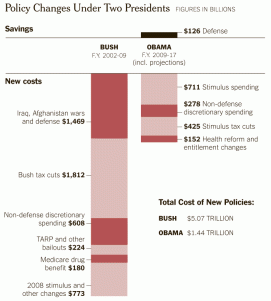
Okay, so I’ve made this an extremely long, wonky post and your eyes are probably glazing over by now. The deal is this. We have a huge number of issues facing our country and we have press and a political party that just plain lies and spreads lies on the big ones. We can’t have a discussion on climate change science, or women’s health and reproduction and rape, or economics or a number of things because very few people bring data, science, statistics, and theory to the table. They bring hype and religious and ideological dogma. We continually see Republicans and press folks like Tom Brokaw say the economic equivalent of ‘women who get raped don’t get pregnant because their bodies shut down’ . They don’t even realize they are doing it and no one calls them on it because they get all the air time they want and economists get very little.
So, we’re on the verge of starving children and the elderly based on that level of discussion. How can we possibly get to a more fact-based reality and a healthier economy and democracy with this level of ignorance?

 peej
peej Carissa
 bostonboomer
 dakinikat
 ecocatwoman
 mablue2
 Mama Lopez
 peggysue22
 quixote
 skydancingguestblogger
 Mona (aka Wonk the Vote)



 Sky Dancing
Recent Comments