
Harvard spokesman Jason Newton said in a statement that there was “no legal basis” to rescind the university’s tax-exempt status. Newton said the status “means that more of every dollar can go toward scholarships for students, lifesaving and life-enhancing medical research, and technological advancements that drive economic growth.”
Some Trump allies predicted that Harvard would only be the first of numerous colleges and universities that the administration would target over their tax-exempt status.
“I think they’re going to go after a whole bunch of them,” said Newt Gingrich, the former House GOP leader. “I’m not sure why we need to be funding people who aggressively refuse to give up a variety of values and structures that most Americans don’t agree with.”
Earlier this month, the Trump administration demanded broad control over Harvard’s operations over complaints about “diversity, equity and inclusion” policies in hiring, admissions and curriculums and student activism surrounding Israel’s war against Hamas.
Harvard rejected those demands on Monday, marking the first time a university formally countered the administration’s campaign for sweeping changes in higher education. Hours later, the administration responded by saying it would freeze more than $2 billion in federal funding.
Thursday Reads: Trump’s Wars on Universities and Immigrants
Posted: April 17, 2025 Filed under: Donald Trump, education, immigration | Tags: CECOT, constitutional crisis, El Salvador prison, Harvard University, Kilmar Abrego Garcia, Mohsen Mahdawi, Senator Chris Van Hollen 6 CommentsGood Afternoon!!
The news is mostly bad as it has been since Trump moved into the White House, and I have to admit I’m feeling frightened and depressed about what is happening to our country.
Trump is waging all-out war on Harvard University, and Harvard is fighting back. That’s one bright spot.
Harvard University is taking hits from Trump on multiple fronts. Here’s the latest:
 CNN: IRS making plans to rescind Harvard’s tax-exempt status.
The Internal Revenue Service is making plans to rescind the tax-exempt status of Harvard University, according to two sources familiar with the matter, which would be an extraordinary step of retaliation as the Trump administration seeks to turn up pressure on the university that has defied its demands to change its hiring and other practices.
A final decision on rescinding the university’s tax exemption is expected soon, the sources said.
The administration already has blocked more than $2 billion in funding from the nation’s oldest university, which is fighting the White House’s policy demands, citing the constitutional right of private universities to determine their own teaching practices.
President Donald Trump in recent days raised the idea of punishing the Ivy League university for not complying with what the administration has sought to portray as a campaign to fight antisemitism.
“Perhaps Harvard should lose its Tax Exempt Status and be Taxed as a Political Entity if it keeps pushing political, ideological, and terrorist inspired/supporting ‘Sickness?’ Remember, Tax Exempt Status is totally contingent on acting in the PUBLIC INTEREST!” Trump posted on Truth Social on Tuesday….
Asked about CNN’s reporting on “The Arena,” Education Secretary Linda McMahon said that she doesn’t know whether Harvard will lose its tax exempt status but argued “it was certainly worth looking into.”
“We’ll see what IRS comes back with relative to Harvard,” McMahon told CNN’s Kasie Hunt. “I certainly think, you know, in elitist schools, especially that have these incredibly large endowments, you know, we should probably have a look into that.”
McMahon added that it is her “guess” that the IRS is also looking at tax exempt statuses of other universities.
Gary Shapley, whom Trump this week picked as acting IRS commissioner, has the authority to rescind the tax exemption under federal law. Doing so typically comes after the agency has made a determination that an organization has violated the rules that govern tax exemptions for not-for-profit entities.
There’s no evidence that Harvard has violated any of the conditions for tax exempt status, according to experts consulted by The Washington Post. From the Post article:
Jim Puzzanghera at The Boston Globe: Before Trump vs. Harvard, this is what a university had to do to lose its tax-exempt status.
If Harvard loses its tax-exempt status as President Trump has threatened, it would be extremely rare, but not unprecedented.
Moreover, the only instance in higher education that experts are aware of shows how far a university had to go to lose that coveted status.
View of Harvard Yard
In 1976, the Internal Revenue Service stripped the tax exemption from Bob Jones University, a private fundamentalist Christian institution in Greenville, S.C., because the school forbid interracial dating by its students. The university objected, saying it wasn’t practicing racial discrimination because the policy applied to all students.
The case went all the way to the Supreme Court, which upheld the IRS action in 1983. The 8-1 ruling likely would be the legal precedent for the Trump administration if it revokes Harvard’s tax-exempt status over allegations it practiced discrimination through diversity equity and inclusion initiatives and a failure to protect Jewish students from antisemitic harassment by Gaza war protesters.
“In 1983, the Supreme Court established the precedent that universities which practice racial discrimination can be stripped of their nonprofit status,” conservative activist Christopher Rufo wrote on X Tuesday. “Harvard’s DEI programs are openly discriminatory and, therefore, the president has every right to proceed with this remedy.”

In Trump’s twisted notion of discrimination (it only counts if it’s against white men), I guess lots of tax-exempts institutions could be targeted.
That’s not all the administration is threating to do to Harvard. They want to stop the university from admitting foreign students.
The Harvard Crimson: DHS Threatens To Revoke Harvard’s Eligibility To Host International Students Unless It Turns Over Disciplinary Records.
The Department of Homeland Security sent Harvard a letter on Wednesday threatening to revoke its eligibility to enroll international students unless it submits information on international students’ disciplinary records and protest participation.
In a Wednesday press release, the DHS wrote that it had also canceled two grants worth $2.7 million to Harvard.
The letter threatening Harvard’s authorization to host international students, which was signed by Secretary of Homeland Security Kristi Noem, accused Harvard of creating a “hostile learning environment” for Jewish students.
“It is a privilege to have foreign students attend Harvard University, not a guarantee,” the letter read.
American universities may host international students on student visas only if they have certification under the Student and Exchange Visitor Program.
The Wednesday letter calls on Harvard to provide information regarding visa holders’ “known threats to other students or university personnel,” “obstruction of the school’s learning environment,” and any disciplinary actions “taken as a result of making threats to other students or populations or participating in protests.”
It comes less than a week after three federal agencies threatened to pull Harvard’s federal funding unless the University agreed to report international students for violation of its conduct policies. Harvard rebuffed the government’s demands on Monday and now faces cuts to more than $2.2 billion in federal funding.
The University also announced last week that a total of 12 current Harvard students and recent graduates have had their visas revoked.

Another view of Harvard
CNN: Harvard weighs its next moves amid the federal funding standoff.
About 24 hours after the Trump administration said it would freeze more than $2 billion in federal grants and contracts, Harvard University’s research arm began to assess the fallout.
The impact is already acute at Harvard’s School of Public Health, where professors are scrambling to salvage their research into tuberculous and cancer treatments.
Harvard – the nation’s oldest and richest university – has emerged as a new symbol of the Trump resistance after refusing to capitulate to a series of policy changes the administration had demanded. Now, having put itself in an uncertain position, Harvard must weigh its next moves.
John Shaw, vice provost for research at Harvard, emailed colleagues Tuesday evening asking them to notify the Office for Sponsored Programs of any funding disruptions they become aware of – and what steps they ought to take.
“While there will inevitably be important research that will suffer as a result of the funding freeze, we are asking for your help in assessing how best to preserve vital work and support our researchers, while using institutional resources responsibly through this disruption,” he wrote, according to an email reviewed by CNN. “This is meant to stabilize the research environment while we gather information, coordinate decision-making, and strive to protect what matters most.”
Professors at the Faculty of Arts and Sciences, home to Harvard’s undergraduate and PhD programs, were notified in a separate email that a town hall would be arranged in the coming days to answer questions, according to the email.
The funding freeze threatens as much as $9 billion in federal money for Harvard. Beyond the practical implications of losing those funds, it’s not clear how far a standoff could go.
As we have seen, Trump is also attacking foreign students and immigrants individually, grabbing them off the streets or when they report to update their immigration status and disappearing them.
At The Boston Globe, Paul Heintz profiled a Columbia University student who was kidnapped when he arrived to take a citizenship test: ‘The town loved him’: Palestinian student detained in Vermont forged deep connections in the Upper Valley.
When federal officials led a handcuffed Mohsen Mahdawi out of an office building in northern Vermont on Monday, he became the latest international student whom the Trump administration had apparently targeted for speaking out against Israel’s war in Gaza.
But those who know Mahdawi say it’s absurd to suggest he “engaged in pro-terrorist, anti-Semitic, anti-American activity,” as the president has said of protesters at Columbia University where he was a student. Rather, they describe him as a peaceful 34-year-old Palestinian who had a remarkable journey from a refugee camp in the West Bank to a cabin in rural Vermont to an Ivy League institution in New York City.
Mohsen Mahdawi
He is widely known in the upper Connecticut River Valley of Vermont and New Hampshire, where he has been based since moving to the United States more than a decade ago, as a spiritual man who grew up Muslim, is a practicing Buddhist, and whose closest friends are Jewish.
“He is such an advocate for peace. He is such an opponent of any kind of violence,” said Rabbi Dov Taylor, who leads Chavurat Ki-tov, a Jewish cultural and educational organization in Woodstock, Vt. “His love just comes out in what he says.”
Simon Dennis, a carpenter and a former selectboard member in nearby Hartford, described Mahdawi as “a person of great gracefulness and dignity and gravitas” who is “destined to go forward and do great things in the world.”
Mahdawi, who was set to graduate this spring, was being held Tuesday in Vermont’s Northwest State Correctional Facility in St. Albans.
On Wednesday evening, some 200 supporters gathered in a windswept field several hundred yards from the prison. They hoisted Palestinian flags and signs calling for his release. An organizer, Jesse Lubin of Burlington, encouraged the crowd “to be loud enough so that he might be able to hear us” from inside the prison.

Just a bit more, because this is behind a paywall:
Crystal Cole of St. Albans told fellow protesters that she was there to demonstrate that even residents of this rural county on the Canadian border were outraged about Mahdawi’s detention.
“People up here in Franklin County know just as well as everyone else across the state, across the country, and across the world that free speech is a right, kidnapping is a wrong, and we refuse to stand for it,” she said.
By all accounts, Mahdawi has assiduously accumulated friends in the Upper Valley since moving from the West Bank in 2014. He’s done so while working as a bank teller, joining faith events, speaking at lectures and protests on the Middle East, and serving as a jack-of-all-trades at Dan & Whit’s, a popular general store in Norwich.
“Everyone loved him,” said Dan Fraser, a former owner and manager. “The town loved him. The town knows him.”
Mahdawi has lived for years in Fraser’s home in Hartford. He attended Lehigh University in Pennsylvania before transferring to Columbia in 2021. He was expecting to enter graduate school there in the fall for international affairs.
Mahdawi has been a permanent resident, or green card holder, since 2015, according to his attorneys, and appeared on track to attain citizenship. He had been in hiding after a friend and fellow Columbia student organizer, Mahmoud Khalil, was detained on March 8, according to friends.
He sounds really dangerous, right?
We are all familiar with the case of Kilmar Abrego Garcia, who was sent to the torture prison in El Salvador. The Trump administration admits this was a mistake, but they are determined not to return Garcia to his family in Maryland. Yesterday Maryland Senator Chris Van Hollen traveled to El Salvador in an attempt to meet with Garcia.
Politico: Van Hollen denied from meeting with wrongfully deported man in El Salvador.
Sen. Chris Van Hollen (D-Md.) flew to El Salvador on Wednesday seeking to secure the release of a man wrongly deported by the Trump administration, as officials ramp up their defense of the administration’s actions in an escalating battle over President Donald Trump’s mass deportation policy.
The Trump administration has made the fight around Kilmar Abrego Garcia the centerpiece of its broader deportation efforts, resisting efforts to bring him back to the United States, despite a Supreme Court ruling that the administration must “facilitate” Abrego Garcia’s return after his illegal deportation.
Chris Van Hollen
But after a meeting with Salvadoran Vice President Félix Ulloa, Van Hollen was denied the opportunity to see Abrego Garcia or visit the maximum security prison where he’s being held.
In a press conference on Wednesday, Van Hollen said that he asked Ulloa for a meeting with Abrego Garcia. Ulloa said he would have needed to “make earlier provisions” to visit, according to the senator, and also added he would be unable to arrange a phone call.
“I asked the vice president — if Abrego Garcia has not committed a crime, and if courts found that he was illegally taken, and the government of El Salvador has found no evidence he was part of MS-13 — then why is El Salvador continuing to hold him?” Van Hollen said.
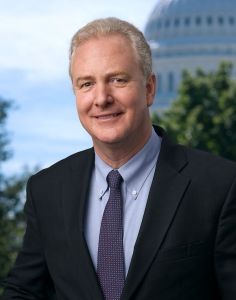
Statement from Van Hollen:
“The goal of this mission is to let the Trump administration, let the government of El Salvador know that we are going to keep fighting to bring Abrego Garcia home until he returns to his family,” Van Hollen said in a video from the airport on his way to San Salvador, adding that he hopes to “meet with representatives of the government” and “see Kilmar.” Van Hollen, in second a video posted to X, said he arrived in San Salvador a little before noon and that he was on his way to the U.S. embassy.
Trump border czar Tom Homan slammed the Democratic senator for his visit, calling the trip “disgusting” on Fox News on Wednesday morning and echoing a line from the administration that the senator is more concerned with an “MS-13 terrorist” than Rachel Morin, a Maryland woman whose killer — who was convicted this week — was an undocumented immigrant.
“He wasn’t abducted. He is an MS-13 gang member, classified as a terrorist, that was removed from this country. So we got rid of a dangerous person — an El Salvadoran national was returned to the country of El Salvador, to his home,” Homan said, going on to call Abrego Garcia a “public safety threat.”
There’s no evidence Garcia is a gang member or terrorist.
We are in a true Constitutional crisis right now, since the Trump administration is ignoring court orders about these actions from two judges. So far, the judiciary is holding the line. It remains to be seen whether the Supreme Court will come down on the side of democracy or let Trump become a dictator. Here’s what’s happening on the immigration front this morning.
Reuters: Trump challenges judges’ probes of compliance with deportation orders.
The Trump administration is appealing efforts by two judges to investigate whether government officials defied their rulings over the deportation of migrants to El Salvador, escalating a confrontation between the executive and judicial branches.
On Wednesday night, the Justice Department said it would appeal Washington-based U.S. District Judge James Boasberg’s finding that there was probable cause to believe the government had violated his order to return alleged members of a Venezuelan gang who were deported to El Salvador on March 15 under an 18th-century wartime law. Boasberg said administration officials could face criminal contempt charges.
Also late on Wednesday, government lawyers asked the Fourth U.S. Circuit Court of Appeals to stop U.S. District Judge Paula Xinis in Greenbelt, Maryland from ordering U.S. officials to provide documents and answer questions under oath about what they had done to secure the return of Kilmar Abrego Garcia, a migrant who was wrongly deported to El Salvador.
In both cases, the Trump administration has denied it violated court orders and accused judges of overstepping their authority.
“A single district court has inserted itself into the foreign policy of the United States and has tried to dictate it from the bench,” the Justice Department lawyers wrote in its filing with the Fourth Circuit.
“Emergency relief is needed.”
Below are commentary pieces on the El Salvador prison and what Trump is doing to immigrants.
Hunter Walker at Talking Points Memo: Trump is Sending People to the Camps.
Extraordinary times call for extraordinary and strong language. President Trump’s plan to have migrants — and potentially U.S. citizens — rounded up, flown to El Salvador, and confined there in a maximum security facility that specializes in indefinite detention meets that bar. However, even when news coverage and criticism has acknowledged Trump’s vision is almost certainly illegal and unquestionably dangerous, it has often used fairly normal terminology and referred to the flights as deportations to a “prison.” That is not what is happening. President Trump is sending people to the camps.
The distinction comes from some of the unique features of the Terrorism Confinement Center, or CECOT, the infamous El Salvadoran facility that is holding people on behalf of the Trump administration. A “prison” is most typically defined as an institution holding inmates who have been sentenced for a crime. And, of course, most sentences have an end date. However, El Salvadoran President Nayib Bukele and his government have boasted that people placed in CECOT, “have no chance of getting out.”
U.S. prisoners arriving at El Salvador prison
Because of the prospect of indefinite detention and the lack of due process the Trump administration has afforded the people it has sent to CECOT, experts who spoke to TPM said the facility could be more accurately described as a “concentration camp,” “penal colony,” or “permanent prison camp.”
Dr. Sandra Susan Smith, who is the Daniel & Florence Guggenheim Professor of Criminal Justice at Harvard’s Kennedy School, was very clear on this point in an email.
“More than a prison, El Salvador’s CECOT has many if not all the hallmarks of a concentration camp,” Smith wrote. “The Trump administration has unlawfully deported a group it finds highly undesirable — migrants largely from Venezuela — to CECOT, a facility known for its utter brutality and unyielding inhumanity that is located in a foreign country where US courts have no jurisdiction. Further, they have done so with no evidentiary basis for claims of migrants’ criminality and with no due process.”
Smith’s point might sound extreme since the term “concentration camp” is most closely associated with the German Nazi regime that left millions dead. However, mass executions are actually not part of the official definition. According to the Holocaust Encyclopedia published by the U.S. Holocaust Memorial Museum, “the term concentration camp refers to a camp in which people are detained or confined, usually under harsh conditions and without regard to legal norms of arrest and imprisonment that are acceptable in a constitutional democracy.”
Mike Wessler, the communications director of the Prison Policy Initiative, said he and his team were “discussing” whether CECOT should be called a “prison” this morning or whether another term should be applied. He pointed to the Holocaust Encyclopedia definition of “concentration camp.”
“I think there is a strong case to be made that the term prison does not fit for these sorts of facilities. Prisons are generally considered part of a larger legal system that is subject to judicial oversight and has somewhat defined processes, including around sentences, conditions, and releases,” Wessler said.
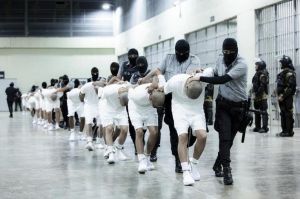
Read the rest at TPM.
Marcos Alemn, Regina Garcia Cano, and Alex Brandon at The Independent: Inside the brutal mega-prison where Trump administration has wrongly sent Maryland father.
Kilmar Abrego Garcia was deported to El Salvador by the Trump administration in March, despite a court order preventing his removal from the US….
He is among more than 200 immigrants sent to the Terrorism Confinement Center (CECOT), El Salvador’s maximum-security gang prison, in the past month….
El Salvador mega prison
What is the CECOT?
Bukele ordered the mega-prison built as he began his campaign against El Salvador’s gangs in March 2022.
It opened a year later in the town of Tecoluca, about 45 miles (72 kilometers) east of the capital.
The facility has eight sprawling pavilions and can hold up to 40,000 inmates.
Each cell can fit 65 to 70 prisoners.
CECOT prisoners do not receive visits and are never allowed outdoors. The prison does not offer workshops or educational programs to prepare them to return to society after their sentences.
Occasionally, prisoners who have gained a level of trust from prison officials give motivational talks.
Prisoners sit in rows in the corridor outside their cells for the talks or are led through exercise regimens under the supervision of guards.
Bukele’s justice minister has said that those held at CECOT would never return to their communities.
The prison’s dining halls, break rooms, gym and board games are for guards.
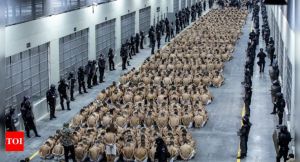
Read the rest at The Independent.
The Handbasket: GOP photos at El Salvador prison evoke Abu Ghraib—and worse.
A row of Latino men with shaved heads and stoic expressions wearing identical white boxer shorts stand behind thick metal bars. In the back fellow prisoners sit cross-legged on large shelves that look like they’re meant for boxed furniture at IKEA, but are instead being used for humans. Outside the bars, free, is a white man in a blazer and collared shirt, his arm stretched out to hold the camera being used to take the photo of him and the men. The image is grotesque. And now it is history.
If you’re not familiar with the names Riley Moore and Jason Smith, don’t worry; I wasn’t either until yesterday. They’re Republican Congressmen from West Virginia and Missouri, respectively, who took a trip to El Salvador on Tuesday where they were given a tour of Centro de Confinamiento del Terrorismo (CECOT), a two-year old maximum security prison. Each posted photos to their social media pages after the visit, gloating about their access….
Go to the linked article to see photos these Congressmen posted on social media….
Photos like this are only possible when you’ve become so divorced from the humanity of others that they become nothing more than props in your political ploy.
But they weren’t alone in their casual disregard: A photo posted to X by the US Embassy in El Salvador confirmed an additional five House Republicans went along for the trip, including Claudia Tenney (NY), Mike Kennedy (UT), Carol Miller (WV), Ron Estes (KS) and Kevin Hern (OK). I’ve reached out to the offices of these members and will update if I hear back.
These members at least had the sense not to brag about it on social media, but it also makes me wonder why? If visiting CECOT has become a Trump loyalty pilgrimage, why haven’t they blasted out thumbs up pics of their own? Is it enough for Trump just to know they went, or do Smith and Moore understand that you only truly get credit for your depravity if you broadcast it?
Senator Chris Van Hollen, a Democrat from Maryland, had a very different experience when he arrived in El Salvador. Wednesday morning to check in on one of his constituents who was wrongfully and illegally imprisoned there beginning in March. He met with the country’s Vice President and asked if he could visit CECOT to meet with Kilmar Abrego Garcia: In a press conference later that day, he revealed he was told no. He also said the embassy told him they hadn’t received any direction from the administration to facilitate Garcia’s return, despite a court order.The visit by Republican members of Congress and Van Hollen’s subsequent rejection the very next day show that CECOT isn’t a prison holding Americans, but a place for Trump to hold his political prisoners—and where only his allies can wander and gawk. Some have compared the prison’s conditions to Nazi concentration camps.
Nick Miroff at The Atlantic (gift link): We’re About to Find Out What Mass Deportation Really Looks Like.
The Trump administration is working hard to convince the public that its mass-deportation campaign is fully under way. Over the past several weeks, federal agents have seized foreign students off the streets, raided worksites, and shipped detainees to a supermax prison in El Salvador using wartime powers adopted under the John Adams administration.
The tactics have spread fear and created a showreel of social-media-ready highlights for the White House. But they have not brought U.S. Immigration and Customs Enforcement much closer to delivering the “millions” of deportations President Donald Trump has set as a goal.
“We need more money,” Tom Homan, Trump’s “border czar,” told me in an interview. “We won’t fail if we get the resources we need.”
Using the budget-reconciliation process, Republican lawmakers are now preparing to lavish ICE with a colossal funding increase—enough to pay for the kind of social and demographic transformation of the United States that immigration hard-liners have long fantasized about achieving.
Although GOP factions in the House and Senate have squabbled over the contours of the bill, spending heavily on immigration enforcement has bicameral support. The reconciliation bill in the Senate would provide $175 billion over the next decade. A House version proposes $90 billion.
To put those sums in perspective, the entire annual budget of ICE is about $9 billion.
The funding surge—which Republicans could approve without a single Democratic vote—would allow ICE to add thousands of officers and enlist police and sheriff’s deputies across the country to help arrest and jail more immigrants. It would funnel billions to private contractors to identify and locate targets, jail them in for-profit detention centers, and fast-track their deportations.
Paul Hunker, who was formerly ICE’s lead attorney in Dallas, likened Trump’s deportation campaign to a gathering wave. “It seems intense now, but wait until five months from now when the reconciliation bill has passed and ICE gets a huge infusion of cash,’’ he told me. “If that money goes out, the amount of people they can arrest and remove will be extraordinary.’’
ICE officials envision a private-sector contracting bonanza that would rely on old workhorses such as CoreCivic and Geo Group-–the for-profit firms best known for running immigration jails—while enlisting large data companies to make the deportation system run more like an e-commerce platform.
Read the rest at the link. It sounds a lot like the Nazi railroad cars, only with planes.
That’s for me. This is way too long already. Take care everyone.
Lazy Caturday Reads: Trump’s Trail of Destruction
Posted: April 12, 2025 Filed under: Donald Trump, Elon Musk, U.S. Economy, U.S. Military, U.S. Politics | Tags: China, Doge, El Salvador prison, FDA, federal grants, immigration, RFK Jr, Social Security, tariffs 4 CommentsGood Afternoon!!

By Karen Lyons
Looking at the headlines today makes me want to just throw up my hands and give up. Events are moving so quickly that no one could possibly keep track of everything. Things that happened just days ago recede into the past as new horrors arise.
The global economic crisis that Trump has triggered with his insane tariffs is still going on, but the realization that he is going to keep sending innocent people to a torture prison in El Salvador has pushed that into the background for now.
Even though he has “paused” the worst of the tariffs, many still remain in effect and will continue to affect the global economy, as Dakinikat discussed in her post yesterday. Meanwhile, the trade war with China continues, and it’s clear that China won’t back down.
On the immigration front, Trump is involving the military in border enforcement, even though that is illegal, and he is trying to find a way to send American citizens to the El Salvador gulag.
And of course Social Security is being ravaged by DOGE, while RFK, Jr. lays waste to the FDA and the U.S. health care system, and DOGE plans to take over control of all government grants.
Before I get started with the latest news, I need to call attention to a surprising Wall Street Journal editorial. It’s behind the paywall, but Tom Boggioni has a summary at Raw Story:
In a column published late Friday, a member of the Wall Street Journal editorial board claimed it would be “desirable” to subject Donald Trump to a third impeachment to make up for the damage he has done to the U.S. economy with his “ill-founded” trade war.
According to longtime columnist Holman W. Jenkins Jr., Trump’s on-again, off-again tariff threats almost makes it appear he wants to be impeached, with Jenkins writing, “A future Trump impeachment seemed all but guaranteed by last Wednesday morning. It seems only slightly less likely now. It may even be desirable to restore America’s standing with creditors and trade partners.”
As he sees it, the president’s last great achievement was being re-elected in 2024, and the damage he has been creating since then belies his promise of a “golden age,” so an impeachment is “already in the cards.”
“No consensus or even significant coalition exists for trying to force into existence a new American ‘golden age’ with tariffs, which anyway is like asking a chicken to give birth to a lioness. He invented this mission out of his own confused intuition,” he accused.
Noting that conservative historian Niall Ferguson labeled Trump’s trade policy going “full retard,” he contributed, “I go with ‘neurotic’ for the word’s wider applicability to any leader who, lacking a clear bead on his times, fabricates a gratuitously ambitious mission to meet his misguided sense of importance.”
“Nobody in Mr. Trump’s orbit actually shares his belief in the magical efficacy of tariffs because it makes sense only in a world that doesn’t exist, where other countries don’t retaliate,” he pointed out before concluding, “The founders never anticipated today’s instantly responsive trillion-dollar financial markets. And yet these markets neatly adumbrate the founders’ scheme of checks and balances, also known as feedback. Mr. Trump, still sane enough to appreciate what’s good for Mr. Trump, listened this week to their feedback.”
Trump isn’t going to like that.
Trade war news:
The administration has come up with exceptions to some tariffs. CNBC: Trump exempts phones, computers, chips from new tariffs.
Smartphones and computers are among many tech devices and components that will be exempted from reciprocal tariffs imposed by President Donald Trump, according to new guidance from U.S. Customs and Border Protection.
The guidance, issued late Friday evening, comes after Trump earlier this month imposed 145% tariffs on products from China, a move that threatened to take a toll on tech giants like Apple, which makes iPhones and most of its other products in China.
The guidance also includes exclusions for other electronic devices and components, including semiconductors, solar cells, flat panel TV displays, flash drives, and memory cards.
These products could eventually be subject to additional duties, but they are likely to be far lower than the 145% rate that Trump had imposed on goods from China.
The exemptions are a win for tech companies like Apple, which makes the majority of its products in China. The country manufactures 80% of iPads and more than half of Mac computers produced, according to Evercore ISI.
“This is the dream scenario for tech investors,” Dan Ives, global head of technology research at Wedbush Securities, told CNBC. “Smartphones, chips being excluded is a game changer scenario when it comes to China tariffs.”
I wonder what Trump got from the tech companies in return for these exemptions?
 Still, the big problem is the trade war with China. Trump has been begging for a phone call from Xi Jinping, but it’s not going to happen. Michael Schuman at The Atlantic (gift link): Why China Won’t Give In to Trump. Xi Jinping, like his American counterpart, needs to be the top dog.
On Tuesday, President Donald Trump bragged that many foreign leaders were “kissing his ass” to avoid the steep tariffs he’d imposed on their countries. But China’s leader, Xi Jinping, was not one of them. “We are waiting for their call,” Trump said of China’s leadership in a social-media post.
He might be waiting for a while. Xi became China’s most powerful political figure in half a century by promoting a new Chinese nationalism—not by kowtowing to anyone, least of all the president of the United States.
“Seeking to negotiate on U.S. terms would be deeply embarrassing for Xi and could potentially weaken his standing and even control over the Communist Party and the country,” Steve Tsang, the director of the SOAS China Institute at the University of London, told me. That’s because the party justifies Xi’s dictatorship by portraying him as the ultimate defender of the Chinese people—the man who will restore China’s past glory and attain the “Chinese dream” of national rejuvenation. He must be seen standing up to foreign oppressors who seek to humiliate China and thwart its rightful rise.
“The Chinese people will never allow foreign forces to bully, oppress, or enslave us,” Xi said in a speech commemorating the centennial of the Communist Party in 2021. “Whoever nurses delusions of doing that will crack their heads and spill blood on the Great Wall of steel.
Little wonder, then, that Xi has been quick to retaliate against Trump while other leaders have held back. Trump slapped an additional 34 percent duty on Chinese imports on April 2, and Xi responded two days later with a 34 percent tariff on U.S. imports. Trump then retaliated by imposing another 50 percent duty, which Xi matched the next day. On Wednesday, Trump tried isolating Xi by pausing most tariffs on all countries for 90 days—except for China, on which he increased his duties yet again. On Friday, Beijing raised its duties on American imports once more….
The Chinese Communist Party is characterizing Trump’s trade war as an American effort to contain and suppress China’s economic success—one the government is fully prepared to thwart, according to one commentary in the People’s Daily. This framing commits Beijing to holding out, because the alternative is for a party that predicates its power on the projection of strength to appear to be capitulating to a hostile onslaught.
Trump and his team do not seem to understand Xi’s political realities. They seem to believe that if they keep turning up the pressure, Xi will eventually come to heel. U.S. Treasury Secretary Scott Bessent asserted that Xi’s retaliation was “a big mistake.” Because China exports so much more to the U.S. than it imports, “they’re playing with a pair of twos,” he said.
This is going to really hurt small businesses who buy parts and inventory from China and farmers who sell soybeans to China.

Drawing in the afternoon light, by Thomas Little
As Dakinikat has written this week, the consequences of Trump’s tariffs are being reflected in the bond market. AP: Freak sell-off of ‘safe haven’ US bonds raises fear that confidence in America is fading.
The upheaval in stocks has been grabbing all the headlines, but there is a bigger problem looming in another corner of the financial markets that rarely gets headlines: Investors are dumping U.S. government bonds.
Normally, investors rush into Treasurys at a whiff of economic chaos but now they are selling them as not even the lure of higher interest payments on the bonds is getting them to buy. The freak development has experts worried that big banks, funds and traders are losing faith in America as a stable, predictable, good place to store their money.
“The fear is the U.S. is losing its standing as the safe haven,” said George Cipolloni, a fund manager at Penn Mutual Asset Management. “Our bond market is the biggest and most stable in the world, but when you add instability, bad things can happen.”
That could be bad news for taxpayers paying interest on the ballooning U.S. debt, consumers taking out mortgages or car loans — and for President Donald Trump, who had hoped his tariff pause earlier this week would restore confidence in the markets.
Read more at the AP link.
Immigration news:
Myah Ward at Politico: Trump grants military control over strip of federal land along US southern border.
A 60-foot wide strip of land along three southwestern border states will be placed under the jurisdiction of the U.S. military to help deter illegal immigration, the White House said Friday.
President Donald Trump issued a memorandum directing the military to take temporary control over the Roosevelt Reservation, a corridor that runs along the border line in California, Arizona and New Mexico.
The order would empower troops to detain people attempting to illegally enter the U.S. within the stretch of land, which was established by President Theodore Roosevelt for border security in 1907. Trump authorized the military to operate in the same area during his first administration to aid construction of a wall to deter migrant crossings.
The memorandum marks an escalation in the president’s use of the military to facilitate his sweeping crackdown on immigration. And while unclear how far the administration will go, it could be an additional step to militarizing the nation’s southwestern border….
Immigration, military and legal experts have said that Trump’s move to militarize the border could raise legal questions about potential violations to the Posse Comitatus Act, a federal law that generally prohibits active-duty troops from being used in domestic law enforcement.
Aaron Reichlin-Melnick, a senior fellow at the American Immigration Council, said it appeared the administration was trying to find a way around restrictions on the use of the U.S. military for civilian border enforcement.
Nikki McCann Ramirez, Asawin Suebsaeng, and Andrew Perez at Rolling Stone: Team Trump Is Gaming Out How to Ship U.S. Citizens to El Salvador.
Donald Trump and his White House have moved to deport green-card holders for espousing pro-Palestinian views, shipped hundreds of migrants to a notorious Salvadoran mega-prison without due process (in defiance of a judge’s order), and are now publicly musing about sending United States citizens to prison in El Salvador.
Trump said last weekend he would “love” to send American criminals there — and would even be “honored” to, depending on “what the law says.” White House Press Secretary Karoline Leavitt confirmed this week that the president has discussed this idea privately, too, adding he would only do this “if it’s legal.” El Salvador’s president, Nayib Bukele, has for months been offering to hold U.S. citizens in his country’s prison system, which he has turned into “a judicial black hole” rife with “systematic torture,” as one human rights advocate recently told Rolling Stone.
Consuelo by Olga Sacharoff, 1924
Legal experts agree that sending American citizens to prison in El Salvador would be flagrantly illegal under both U.S. and international law — and that the idea itself is shockingly authoritarian, with few parallels in our nation’s history.
The Trump administration is indeed discussing this idea behind the scenes, two sources familiar with the matter confirmed to Rolling Stone. In their most serious form, these conversations have revolved around attempting to denaturalize American citizens and deport them to other countries, including El Salvador.
“You can’t deport U.S. citizens. There’s no emergency exception, there’s no special wartime authority, there’s no secret clause. You just can’t deport citizens,” says Steve Vladeck, a legal commentator and law professor at Georgetown. “Whatever grounds they try to come up with for denaturalization or expatriation, the one thing that is absolutely undeniable is that people are entitled to individualized processes, before that process can be effectuated.”
In the United States, the grounds to strip a naturalized individual of their citizenship encompass serious material offenses. They include: committing treason or terrorism, enlisting in a foreign military engaged in opposition to the United States, or lying in applications for citizenship or as part of the naturalization process.

They obviously don’t care whether it’s legal or not, based on how they are treating Kilmar Garcia, an innocent man who is currently languishing in prison in El Salvador.Alan Feuer and Aishvarya Kavi at The New York Times: White House Continues Defiant Stance on Seeking Return of Deported Man.
The Trump administration on Friday continued to pursue its stubborn fight against securing the freedom of a Maryland man it inadvertently deported to a Salvadoran prison last month despite a court order that expressly said he could remain in the United States.
Taking an increasingly combative stance, the administration defied a federal judge’s order to provide a written road map of its plans to free the man, Kilmar Armando Abrego Garcia. Trump officials then repeatedly stonewalled her efforts to get the most basic information about him at a court hearing.
During the hearing, in Federal District Court in Maryland, the judge, Paula Xinis, called the administration’s evasions “extremely troubling” and demanded that the Justice Department provide her with daily updates on the White House’s progress in getting Mr. Abrego Garcia back on U.S. soil.
“The court finds that the defendants have failed to comply with this court’s order,” Judge Xinis wrote in a ruling Friday afternoon.
The conflict between the judge and the White House arose just one day after the Supreme Court unanimously ordered the administration to “facilitate” Mr. Abrego Garcia’s release from Salvadoran custody and only a few days before President Nayib Bukele of El Salvador was set to arrive in Washington for an official visit.
Asked about the case on Friday, President Trump appeared in no hurry to take steps to ensure Mr. Abrego Garcia’s return, despite repeated court orders and a Supreme Court intervention.
“If the Supreme Court said, ‘Bring somebody back,’ I would do that,” he said, seeming to ignore the court’s order. “I respect the Supreme Court.”

By Hedda Oppenheim
Of course the Supreme Court has already said that.
The public recalcitrance on the part of Mr. Trump and his officials highlighted questions about why they have been so reluctant to follow the orders or leverage the president’s relationship with Mr. Bukele to simply ask for Mr. Abrego Garcia to be freed.
Judge Xinis, by ordering the government to detail its progress in getting Mr. Abrego Garcia out of El Salvador, managed to avoid an immediate showdown with the White House. But the fiery clashes left open the possibility of a future standoff.
The administration has already had friction with judges in other cases — particularly those involving Mr. Trump’s deportation policies — but the conflict with Judge Xinis was one of the most contentious yet. Last week, a federal judge in Washington said there was a “fair likelihood” that the administration had violated one of his rulings ordering the White House to stop using a powerful wartime statute to deport scores of Venezuelan migrants to El Salvador.
The dispute involving Judge Xinis emerged after the Supreme Court late Thursday told Trump officials to take steps to free Mr. Abrego Garcia, a 29-year-old Salvadoran migrant, from the CECOT prison in El Salvador, where he was sent with scores of other migrants on March 15.
Now DOGE is getting involved in immigration battles. Sophia Cai at Politico: Inside the DOGE immigration task force.
DOGE’s bread and butter has been slashing headcounts but it is now wielding its influence deep inside the nation’s immigration system — an initiative led by one of Elon Musk’s closest friends, three Trump administration officials granted anonymity to discuss internal dynamics told POLITICO.
Antonio Gracias, a Musk confidante whose history with the billionaire goes back more than 20 years, is quietly heading up a specialized DOGE immigration task force that’s embedded engineers and staffers across nearly every nook of the Department of Homeland Security, two of the people said. The task force is also working with DOGE operatives stationed at other agencies like the Social Security Administration and the Department of Health and Human Services, which house sensitive data on undocumented immigrants.
With Musk’s trusted friend and fixer at the helm, the task force marks a significant expansion of DOGE’s portfolio — from primarily working on agency-wide layoffs to executing the president’s most hardline immigration policies. It’s also a test for how far DOGE’s reach can extend.
Key DOGE engineers now embedded at DHS include Kyle Schutt, Edward Coristine, (aka “Big Balls”) and Mark Elez, according to their government email addresses. At least two others, Aram Moghaddassi and Payton Rehling also have access to DHS data, as DOGE fingerprints are spread throughout DHS, including Customs and Border Protection, U.S. Citizenship and Immigration Services and the Cybersecurity and Infrastructure and Security Agency.
They are providing the technical infrastructure for a sweeping set of actions aimed at revoking parole, terminating visas, and later on, reengineering the asylum adjudication process, according to the officials.
Their first mission: implement parole terminations for 6,300 undocumented immigrants who either have criminal records or are on the FBI’s terrorist watchlist. That effort required coordinating with the Social Security Administration to have their Social Security numbers effectively canceled by adding them to a database that tracks dead people, the New York Times and the Washington Post first reported. Their theory is that without effective Social Security numbers – needed for bank accounts and loans, among other things – these people would “self deport.”
There’s more at the Politico link.
Social Security news:
Zoe Schiffer at Wired: The Social Security Administration Is Gutting Regional Staff and Shifting All Public Communications to X.
The Social Security Administration will no longer be communicating with the media and the public through press releases and “dear colleague” letters, as it shifts its public communication exclusively to X, sources tell WIRED. The news comes amid major staffing cuts at the agency.
“We are no longer planning to issue press releases or those dear colleague letters to inform the media and public about programmatic and service changes,” said SSA regional commissioner Linda Kerr-Davis in a meeting with managers earlier this week. “Instead, the agency will be using X to communicate to the press and the public … so this will become our communication mechanism.”
Woman holding cat, by Liang Yi Er
Previously, the agency used dear colleague letters to engage with advocacy groups and third-party organizations that help people access social security benefits. Recent letters covered everything from the agency’s new identity verification procedures to updates on the accuracy of SSA death records (“less than one-third of 1 percent are erroneously reported deaths that need to be corrected,” the agency wrote, in contrast to what Elon Musk claims).
The letters and press releases were also a crucial communications tool for SSA employees, who used them to stay up on agency news. Since SSA staff cannot sign up for social media on government computers without submitting a special security request, the change could have negative consequences on the ability for employees to do their jobs.
It could also impact people receiving social security benefits who rely on the letters for information about access benefits. “Do they really expect senior citizens will join this platform?” asked one current employee. “Most managers aren’t even on it. How isn’t this a conflict of interest?” Another staffer added: “This will ensure that the public does not get the information they need to stay up-to-date.”

The White House response to the Wired story:
“This reporting is misleading. The Social Security Administration is actively communicating with beneficiaries and stakeholders,” says Liz Huston, a White House spokesperson. “There has not been a reduction in workforce. Rather, to improve the delivery of services, staff are being reassigned from regional offices to front-line help – allocating finite resources where they are most needed. President Trump will continue to always protect Social Security.”
I guess we’ll find out eventually. Social security advocates are warning that the system is going to collapse and the 73 million recipients could go months with out payments.
Hannah Natanson, Lisa Rein, and Meryl Kornfield at The Washington Post (gift article): Trump administration overrode Social Security staff to list immigrants as dead.

Wednesday Reads: Clown Prince Trump
Posted: April 9, 2025 Filed under: Donald Trump, U.S. Economy, U.S. Politics | Tags: bond market crash, China, Elon Musk, EU, Financial Crisis, global safe haven, Stock Market, UK 13 Comments
By Eric Fischl
Hello Sky Dancers!!
Dakinikat should be writing this post, but you’re stuck with me. I stayed up till about 2:30 last night doom scrolling and trying to understand what Trump’s tariff madness has done to us. The latest disaster last night was that the bond market is collapsing.
I’ll do my best to post relevant stories, and perhaps Dakinikat will chime in later. Thanks to Trump’s insanity, we could end up in another financial crisis comparable to the one in 2008.
What’s happening with tariffs:
There’s even more insane news this morning: China responded to Trump’s 104 percent tariff threat with another 84% tariff on the U.S.
CNBC: China slaps 84% retaliatory tariffs on U.S. goods in response to Trump.
China has pushed back again on U.S. President Donald Trump’s tariff policies by hiking its levies on U.S. imports to more than 80%.
Tariffs on U.S. goods entering China will rise to 84% from 34% starting April 10, according to a translation of a Office of the Tariff Commission of the State Council announcement. The hike comes in response to the latest U.S. tariff increase on Chinese goods to more than 100% that began at midnight.
The tit-for-tat escalation of tariffs threatens to crush trade between the world’s two largest economies. According to the Office of the U.S. Trade Representative, the U.S. exported $143.5 billion of goods to China in 2024, while importing products worth $438.9 billion.
The Trump administration announced a sweeping new tariff policy last week, warning other countries not to retaliate. Some nations, including Japan, have seemed willing to negotiate on tariffs, but China appears to be taking a more hard-line stance and quickly announced a countertariff.
After China’s initial response to the April 2 tariff rollout, Trump announced an additional 50% hike, putting the total level for import taxes on Chinese goods at 104%….
The trade war has spooked investors around the world by increasing the odds of slower economic growth, higher inflation and lower corporate profits, sparking a sharp sell-off in April.
The S&P 500 finished Tuesday down nearly 20% from its peak, putting the U.S. large-cap stock index in a bear market. South Korea’s Kospi Index fell into a bear market of its own on Wednesday. Stocks in Shanghai and Hong Kong are also down sharply since the U.S. tariff announcement on April 2.
David Pierson and Barry Wang at The New York Times: For U.S. and China, a Risky Game of Chicken With No Off-Ramp in Sight.
A whopping increase in tariffs, followed by a whopping retaliation. Nationalist Chinese bloggers comparing President Trump’s levies to a declaration of war. China’s Foreign Ministry vowing that Beijing will “fight to the end.”
For years, the world’s two biggest powers have flirted with the idea of an economic decoupling as tensions between them have risen. The acceleration this week of their trade relationship’s deterioration has made the prospect of such a divorce seem closer than ever.
That was underscored on Wednesday when China announced an additional 50 percent tariff on U.S. goods, matching new American levies that had taken effect hours earlier. China also struck at American companies, imposing export controls on a dozen of them and adding six others to a list of “unreliable entities,” preventing them from doing business in China.
China’s new tariffs, which will take effect on Thursday, mean all American goods shipped to China will face an additional 85 percent import tax. The minimum U.S. tax on Chinese imports is now 104 percent. Both figures would have been unimaginable a few weeks ago.
With China’s top leader, Xi Jinping, and Mr. Trump locked in a game of chicken — each unwilling to risk looking weak by making a concession — the trade fight could spiral even further out of control, inflaming tensions over other areas of competition like technology and the fate of Taiwan, the self-governing island claimed by Beijing.
Mr. Trump’s bare-knuckle tactics make him a singular force in U.S. politics. But in Mr. Xi, he faces a hardened opponent who survived the turmoil of China’s late-20th-century political purges, and who views the United States’ competitive tactics as ultimately aimed at subverting the ruling Communist Party’s legitimacy.
“Trump has never gone into a back-alley brawl where the other side is willing to brawl and use the same kind of tactics as him,” said Scott Kennedy, a senior adviser at the Center for Strategic and International Studies, a Washington think tank. “For China, this is about their sovereignty. This is about the Communist Party’s hold on power. For Trump, it might just be a political campaign.”
 From what I’m hearing and reading, this is going to hit U.S. small businesses hard, drive many of them into bankruptcy, and send their employees to the unemployment lines.
China isn’t the only country that’s retaliating.
Politico: EU takes revenge on Trump’s tariffs as countries approve €20B+ retaliation.
BRUSSELS — The EU can apply retaliatory tariffs on nearly €21 billion of U.S. products like soybeans, motorcycles and orange juice after the bloc’s 27 countries assented to the measures on Wednesday, the European Commission announced.
“The EU considers U.S. tariffs unjustified and damaging, causing economic harm to both sides, as well as the global economy. The EU has stated its clear preference to find negotiated outcomes with the U.S., which would be balanced and mutually beneficial,” the EU executive said in a statement.
Hitting back against U.S. President Donald Trump’s steel and aluminum tariffs, the European Union’s countermeasures will apply in three rounds. Measures covering €3.9 billion in trade will go into force next week, with a further €13.5 billion from mid-May and a final round of €3.5 billion following in December.
Only Hungary opposed the package, according to four EU diplomats with direct knowledge of the vote, while all other 26 countries voted in favor….
The retaliation does not yet respond to Trump’s imposition of 20 percent “reciprocal” tariffs on all EU exports, which came into force on Wednesday, and his latest 25 percent tariff on cars. Trump has also said tariffs on pharmaceuticals are coming soon.
The European Commission is considering putting forward its countermeasures on those tariffs as early as next week. “It will for sure be soon. I expect it could be as early as next week,” trade spokesperson Olof Gill said Tuesday.
What’s happening with the bond markets:
Felix Salmon at Axios: The bond market plunges as crisis brews.
The price of U.S. Treasury bonds is plunging, in what Treasury Secretary Scott Bessent on Wednesday called “deleveraging convulsions.” The effect is to raise borrowing costs just as recession fears spike.
Why it matters: The last thing America needed in the midst of a global trade war and a stock-market meltdown was a debt crisis too. But that now seems to be a real possibility.
What they’re saying: “This is the script for a truly existential financial crisis,” writes Columbia economic historian Adam Tooze, who wrote a whole book on the very similar dynamics that overtook the Treasury market in March 2020.
Driving the news: Bond yields — which move in the opposite direction to prices — are soaring in the wake of protectionist U.S. tariffs.
- The amount that the U.S. government needs to pay to borrow money for a decade rose briefly to more than 4.5% Wednesday morning. For a 30-year bond, the yield rose to more than 5%.
- Those moves are truly enormous by bond market standards. As recently as Friday, the 10-year yield was less than 4%, and the 30-year was below 4.4%.
The intrigue: In normal times, the most consistent buyer of Treasury bonds is a group of hedge funds that participate in something called the “basis trade.”
- They buy the bonds in order to hedge their derivatives exposure to institutional investors, who can lock in slightly higher yields in the futures market.
- The profit on any given trade is minuscule, but it’s also very close to risk-free, so the hedge funds can apply as much as 50x or even 100x leverage.
- By many accounts, the basis trade is now unwinding, which means the hedge funds are selling their bonds — or, at the very least, not buying new ones.
The big picture: In a move reminiscent of the bond-market tantrum that swept U.K. Prime Minister Liz Truss from office in 2022, the technical factors in the bond market were precipitated by — and also exacerbated — fundamental issues with the country’s finances.
 More from Philip Inman and Jasper Jolly at The Guardian: Dramatic sell-off of US government bonds as tariff war panic deepens.
US government bonds, traditionally seen as one of the world’s safest financial assets, are undergoing a dramatic sell-off as Donald Trump’s escalation of his tariff war with China sends panic through all sectors of the financial markets.
The falls suggest that as Trump’s fresh wave of tariffs on dozens of economies came into force, including 104% levies against Chinese goods, investors are beginning to lose confidence in the US as a cornerstone of the global economy.
The yield – or interest rate – on the benchmark 10-year US Treasury bond rose by 0.16 percentage points on Wednesday to 4.42%, its highest since late February – and this week has undergone the three biggest intraday moves since Trump was elected in November. Yields move inversely to prices, so surging yields mean falling prices as demand drops.
The move in the 30-year bond was more dramatic. The 30-year yield briefly jumped above 5% to its highest since late 2023 and was last trading at 4.9157%, or 0.2 percentage points higher than Tuesday.
“This is a fire sale of Treasuries,” said Calvin Yeoh, portfolio manager at the hedge fund Blue Edge Advisors. “I haven’t seen moves or volatility of this size since the chaos of the pandemic in 2020,” he told Bloomberg.
Analysts believe the US Federal Reserve may need to step in. Jim Reid, at Deutsche Bank, said: “Markets are pricing a growing probability of an emergency [interest rate] cut, just as we saw during the Covid turmoil and the height of the GFC [global financial crisis] in 2008.” [….]
UK bonds were also under severe pressure after the US moves. The yield on a 30-year UK gilt hit 5.518% on Wednesday morning, up 16 basis points and surpassing a previous 27-year high of 5.472% set in January.
Shorter-dated 10-year gilt yields were slightly higher at 4.69% while two-year yields ticked down at 3.92%.
Higher yields on gilts – UK government bonds – will make things even more difficult for Downing Street, as it will raise the cost of borrowing to fund investment.
Colby Smith at The New York Times (gift link): U.S. Bond Sell-Off Raises Questions About ‘Safe Haven’ Status.
A sharp sell-off in U.S. government bond markets has sparked fears about the growing fallout from President Trump’s sweeping tariffs and retaliation by China, the European Union and others, raising questions about what is typically seen as the safest corner for investors to take cover during times of turmoil.
Yields on 10-year Treasuries — the benchmark for a wide variety of debt — shot 0.2 percentage points higher on Wednesday, to 4.45 percent, a big move in that market. Just a few days ago, it had traded below 4 percent. Yields on the 30-year bond rose significantly as well, at one point on Wednesday topping 5 percent. Borrowing costs globally have also shot higher.
The sell-off comes as investors have fled riskier assets globally in what some fear has parallels to what became known as the “dash for cash” episode during the pandemic, when the Treasury market broke down. The recent moves have upended a longstanding relationship in which the U.S. government bond market serves as a safe harbor during times of stress.
Volatility has surged as stock markets have plummeted amid fears that the U.S. economy is hurtling toward stagflation, in which economic growth contracts while inflation surges. The S&P 500 is now on the verge of entering a bear market, meaning it has dropped 20 percent from its recent high.
 The global safe-haven:
“The global safe-haven status is in question,” said Priya Misra, a portfolio manager at JPMorgan Asset Management. “Disorderly moves have happened this week because there is no safe place to hide.”
Scott Bessent, the U.S. Treasury secretary, sought to tamp down concerns on Wednesday, brushing off the sell-off as nothing more than investors who bought assets with borrowed money having to cover their losses.
“I believe that there is nothing systemic about this — I think that it is an uncomfortable but normal deleveraging that’s going on in the bond market,” he said in an interview with Fox Business.
But the moves have been significant enough to raise broader concerns about how foreign investors now perceive the United States, after Mr. Trump decided to slap onerous tariffs on nearly all of its trading partners. Some countries have sought to strike deals with the administration to lower their tariff rates. But China retaliated on Wednesday, announcing an 84 percent levy on U.S. goods after Mr. Trump raised the tariff rate on Chinese goods to 104 percent.
In a social media post on Wednesday, the former U.S. Treasury secretary Lawrence H. Summers said the broader sell-off suggested a “generalized aversion to US assets in global financial markets” and warned about the possibility of a “serious financial crisis wholly induced by US government tariff policy.”
Some analysis and commentary on what’s happening:
Heather Cox Richardson at Letters from an American: April 8, 2025.
Stocks were up early today as traders put their hopes in Treasury Secretary Scott Bessent’s suggestion that the Trump administration was open to negotiations for lowering Trump’s proposed tariffs. But then U.S. Trade Representative Jamieson Greer said there would not be exemptions from the tariffs for individual products or companies, and President Donald J. Trump said he was going forward with 104% tariffs on China, effective at 12:01 am on Wednesday.
Markets fell again. By the end of the day, the Dow Jones Industrial Average had fallen by another 320 points, or 0.8%, a 52-week low. The S&P 500 fell 1.6% and the Nasdaq Composite fell 2.2%.
Rob Copeland, Maureen Farrell, and Lauren Hirsch of the New York Times reported today that over the weekend, Wall Street billionaires tried desperately and unsuccessfully to change Trump’s mind on tariffs. This week they have begun to go public, calling out what they call the “stupidity” of the new measures. These industry leaders, the reporters write, did not expect Trump to place such high tariffs on so many products and are shocked to find themselves outside the corridors of power where the tariff decisions have been made.
Elon Musk is one of the people Trump is ignoring to side with Peter Navarro, his senior counselor for trade and manufacturing. Navarro went to prison for refusing to answer a congressional subpoena for information regarding Trump’s attempt to overturn the 2020 presidential election. Since Musk poured $290 million into getting Trump elected in 2024 and then burst into the news with his “Department of Government Efficiency,” he has seemed to be in control of the administration. But he has stolen the limelight from Trump, and it appears Trump’s patience with him might be wearing thin.
Elizabeth Dwoskin, Faiz Siddiqui, Pranshu Verma, and Trisha Thadani of the Washington Post reported today that Musk was among those who worked over the weekend to get Trump to end his new tariffs. When Musk failed to change the president’s mind, he took to social media to attack Navarro personally, saying the trade advisor is “truly a moron,” and “dumber than a sack of bricks.”
Read the rest at the Substack link above.
David E. Sanger at The New York Times (gift link): An Experiment in Recklessness: Trump as Global Disrupter.
As the breadth of the Trump revolution has spread across Washington in recent weeks, its most defining feature is a burn-it-down-first, figure-out-the-consequences-later recklessness. The costs of that approach are now becoming clear.
Administration officials knew the markets would dive and other nations would retaliate when President Trump announced his long-promised “reciprocal” tariffs. But when pressed, several senior officials conceded that they had spent only a few days considering how the economic earthquake might have second-order effects.
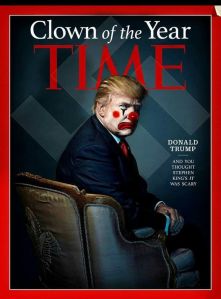
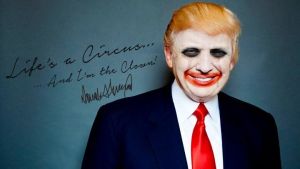
Trump clown mask
And officials have yet to describe the strategy for managing a global system of astounding complexity after the initial shock wears off, other than endless threats and negotiations between the leader of the world’s largest economy and everyone else.
Take the seemingly unmanaged escalation with China, the world’s second largest economy, and the only superpower capable of challenging the United States economically, technologically and militarily. By American and Chinese accounts, there was no substantive conversation between Mr. Trump and China’s top leader, Xi Jinping, or engagement among their senior aides, before the countries plunged toward a trade war.
Last Wednesday, Mr. Trump’s hastily devised formula for figuring out country-by-country tariffs came up with a 34 percent tax on all Chinese goods, everything from car parts to iPhones to much of what is on the shelves at Walmart and on Amazon’s app.
When Mr. Xi, predictably, matched that figure, Mr. Trump issued an ultimatum for him to reverse the decision in 24 hours — waving a red flag in front of a leader who would never want to appear to be backing down to Washington. On Wednesday, the tariff went to 104 percent, with no visible strategy for de-escalation.
If Mr. Trump does get into a trade war with China, he shouldn’t look for much help from America’s traditional allies — Japan, South Korea or the European Union — who together with the United States account for nearly half of the world economy. All of them were equally shocked, and while each is negotiating with Mr. Trump, they seem in no mood to help him manage China.
“Donald Trump has launched a global economic war without any allies,” the economist Josh Lipsky of the Atlantic Council wrote on Tuesday. “That is why — unlike previous economic crises in this century — there is no one coming to save the global economy if the situation starts to unravel.”
The global trading system is only one example of the Trump administration tearing something apart, only to reveal it has no plan for how to replace it.

Read the rest at the NYT.
Andrew Egger at The Bulwark: A Microwaved Mind.
There’s a paradox to covering Donald Trump these days. On the one hand, he’s never out of the news—a wannabe dictator busy remaking the government and the economy so that more and more decisions about our futures answer only to his whim. On the other hand, there’s so much news about what he’s doing that it’s easy to reduce our thinking about Trump to the sum of his actions. There’s Trump the bundle of bad policy ideas, Trump the destroyer of institutions, Trump the fountain of post-truth grievance. It’s hard to take the time to dwell on the man himself—to focus our attention on Donald Trump the clown.
Yesterday afternoon, as markets continued crashing and with the further implementation of backbreaking tariffs just hours away, the clown was on full display. Trump participated in the ceremonial signing of an executive order on “unleashing American energy.” In the East Room event, he was in his element: coal miners in hard hats behind him, an audience crammed with his political flunkies in front. He ended up riffing for about 45 minutes. Let’s listen in, shall we? [….]
The topic du jour, of course, was energy, specifically the “beautiful clean coal” that Trump loves so much. Trump riffed at length on the supposed stupidity of proposals to retrain miners for skilled labor in other industries, reminiscing his 2016 campaign against Hillary Clinton:
“One thing I learned about the coal miners . . . You could give them a penthouse on Fifth Avenue and a different kind of a job and they’d be unhappy. Coal mining is what they love to do,” Trump said. “And she was gonna put them in a high-tech industry, to make little cell phones, I don’t know. Do you think you’d be good at that? I don’t know.”
Anyway, no need for any of that now, the president exulted: “We’re gonna be crushing Biden-era environmental restrictions. . . . And we have clean air and clean water and now we have clean coal. And at the same time we’re gonna do other things and forms of technology and also energy, like our country has never seen before.”
On his tariffs:
Trump didn’t totally avoid talk of the market crash he kicked off last week—a “whole situation,” he noted, that “was somewhat explosive.”
But, Trump added, you should see the response we’re getting! “We have had talks with many, many countries. . . . And our problem is, we can’t see that many that fast. But we don’t have to because, you know, the tariffs are on, and money is pouring in at a level that we’ve never seen before.”
How much money are we talking? “We’re taking in almost $2 billion a day in tariffs,” Trump said. “America is gonna be very rich again very soon.”
Got all that? Yes, markets are tanking because of the tariffs. But not to worry: We’re going to strike great deals to replace them soon. But not too soon, because we don’t have time to deal with all these countries at once. But that’s okay, because look at how much money these tariffs are making us!
That’s it for me. I’ve learned a lot and I plan to continue studying this stuff. I expect Daknikat with have a lot to say on Friday. For now, hang in there everyone and take care of yourselves.
Lazy Caturday Reads: America Has Gone Mad
Posted: April 5, 2025 Filed under: cat art, caturday, Donald Trump, U.S. Economy | Tags: destruction of scientific research, Hands Off rallies, insanity, polls, Stock Market, tariffs, Trump decision-making 7 Comments
By Linda Benton
Good Afternoon!!
The news is mostly awful today. If you think too much about what is happening, you’ll sink into depression and despair. I heard a woman on TV (I can’t remember her name, unfortunately) argue that Trump wants to return to the world of his childhood–the 1950s. But there is simply no way to do that. We are no longer an industrial society and we aren’t going to return to being one. We are no longer a segregated society either. Trump can’t rid public life of Black people, women, and immigrants. It’s not going to happen. But he is going to keep trying, because he is certifiably insane. The Republicans could stop him but they won’t, because they are terrified and they are cowards.
I’m going to begin with one bit of good news. Today, Americans with gather to fight back against Trump and Musk and their efforts to destroy our government and turn most of us into serfs.
AP: ‘Hands Off!’ protests against Trump and Musk are planned across the US.
Opponents of President Donald Trump and billionaire Elon Musk plan to rally across the U.S. on Saturday to protest the administration’s actions on government downsizing, the economy, human rights and other issues.
More than 1,200 “Hands Off!” demonstrations have been planned by more than 150 groups, including civil rights organizations, labor unions, LBGTQ+ advocates, veterans and elections activists. The protests are planned for the National Mall in Washington, D.C., state capitols and other locations in all 50 states.
Protesters are assailing the Trump administration’s moves to fire thousands of federal workers, close Social Security Administration field offices, effectively shutter entire agencies, deport immigrants, scale back protections for transgender people and cut federal funding for health programs.
Musk, a Trump adviser who owns Tesla, SpaceX and the social media platform X, has played a key role in government downsizing as the head of the newly created Department of Government Efficiency. He says he is saving taxpayers billions of dollars.
Asked about the protests, the White House said in a statement that “President Trump’s position is clear: he will always protect Social Security, Medicare, and Medicaid for eligible beneficiaries. Meanwhile, the Democrats’ stance is giving Social Security, Medicaid, and Medicare benefits to illegal aliens, which will bankrupt these programs and crush American seniors.”
No, asshole. That’s not “Democrat’s stance.”
Before I get going with the rest of today’s news, I want to highlight this piece by JV Last at The Bulwark from a couple of days ago: The American Age Is Over. The United States commits imperial suicide.
Fittingly, it was the Canadian prime minister, Mark Carney, who declared the official time of death.
“The global economy is fundamentally different today than it was yesterday. The system of global trade anchored on the United States, that Canada has relied on since the end of the Second World War—a system that, while not perfect, has helped to deliver prosperity for our country for decades—is over.
Our old relationship of steadily deepening integration with the United States is over.
The eighty-year period when the United States embraced the mantle of global economic leadership—when it forged alliances rooted in trust and mutual respect, and championed the free and open exchange of good and services—is over.
While this is a tragedy, it is also the new reality.”
By Stephanie Lambourne
And just like that, the age of American empire, the great Pax Americana, ended.
We cannot overstate what has just happened. It took just 71 days for Donald Trump to wreck the American economy, mortally wound NATO, and destroy the American-led world order.
He did this with the enthusiastic support of the entire Republican party and conservative movement.
He did it with the support of a plurality of American voters.
He did not hide his intentions. He campaigned on them. He made them the central thrust of his election. He told Americans that he would betray our allies and give up our leadership position in the world.
There are only three possible explanations as to why Americans voted for this man:
- they wanted what he promised;
- they didn’t believe what he promised; or
- they didn’t understand what he promised.
Pick whichever rationale you want, because it doesn’t matter. Whatever the reason was, it exposed half of the electorate—the 77 million people who voted for Trump—as either fundamentally unserious, decadent, or weak.
And no empire can survive the degeneration of its people….
If, tomorrow, Donald Trump revoked his entire regime of tariffs, it would not matter. It might temporarily delay some economic pain, but the rest of the world now understands that it must move forward without America.
If, tomorrow, Donald Trump abandoned his quest to annex Greenland and committed himself to the defense of Ukraine and the perpetuation of NATO, it would not matter. The free world now understands that its long-term security plans must be made with the understanding that America is a potential adversary, not an ally.
This realization may be painful for Americans. But we should know that the rest of the world understands us more clearly than we understand ourselves.
Vladimir Putin bet his life that American voters would be weak and decadent enough to return Donald Trump to the presidency. He was right.

Please go read the rest at The Bulwark link.
This week, Trump took a wrecking ball to the U.S. economy.
Stephen Rattner at the New York Times: I Watch the Markets for a Living. This Week, Everything Changed.
In the past, the one constituency President Trump has sometimes listened to has been our stock market. Well, it has spoken, falling 10.5 percent in one of the largest two-day stock market swoons in decades.
In the 50 years I have been immersed in markets and economic policy, I have never before witnessed a signature economic policy initiative that was met with such unalloyed criticism. What’s worse, the damage was entirely self-inflicted.
By Stephanie Lambourne
Why such a reaction? One reason the S&P 500 fell was that the tariffs Mr. Trump rolled out were so much greater than investors anticipated. (Give the White House an F for failing to prepare the market for what to expect.) Then on Friday, China announced its own 34 percent tariff on our goods, making it clear that our trading partners were not going to simply give in to Mr. Trump’s demands, as he had suggested they would.
As Mr. Trump was doubling down, asserting that “my policies will never change,” the Federal Reserve chairman, Jerome Powell, was delivering his own bombshell: Given the higher-than-predicted tariffs, higher inflation and slower growth were likely to ensue, he said. That’s drastically different from just a couple of weeks ago, when Mr. Powell called the potential impact of new tariffs on prices “transitory.”
The business community, which by my count heavily supported Mr. Trump in the election five months ago, seems stunned. Few have spoken publicly, but the Business Roundtable, the premier corporate trade association, on Wednesday warned that universal tariffs run “the risk of causing major harm to American manufacturers, workers, families and exporters.”
Privately, several chief executives told me that they recognized that imposing the tariffs, as well as Mr. Trump’s intractable support of them, was a potentially cataclysmic mistake. “Few of us ever imagined he would go this far,” one told me. “He could well bring down the economy and himself.”

A bit more:
The Trump-supporting business leaders I’ve spoken to in the last two days don’t yet regret their votes, mostly because of their intense distaste (if not hatred) for the Biden-Harris administration. And they remain broadly supportive of the efforts by the tech billionaire Elon Musk to reform the federal government, even if they acknowledge that his DOGE team may be going too far in its slashing of spending and personnel.
But I wonder how some other major Trump-supporting leaders whose stock prices have been particularly hard hit now feel, like Stephen Schwarzman, chief executive of Blackstone, the investment group (down 15 percent in two days), and Safra Catz, chief executive of Oracle, the database company (down 12 percent).
Mr. Trump’s actions aren’t the only problem. Almost as important is the lack of clarity as to what policies he is pursuing and why. At times, Mr. Trump implies that the purpose of the tariffs is to bring back manufacturing, which suggests that they will stay in place indefinitely. At other times, he suggests that the goal is to negotiate tariff reductions by other countries (even though much of what Mr. Trump asserts about their tariffs is inaccurate).
The dithering takes a real toll. I see this from my role as a professional investor. How do we evaluate a company that imports goods or engages in international commerce? We seek a lower price, or we grit our teeth, or we pass on the opportunity. As a result, our pace of investing has slowed sharply this year.
And it’s not just us. In the year’s first quarter, the number of newly announced mergers and acquisitions dropped to its lowest level since the financial crisis. “Folks are looking but not pulling the trigger,” one leading investment banker told me. Equity offerings have become similarly challenged; multiple companies planning to go public have postponed their fund-raising since Wednesday.
Aaron Zitner at The Wall Street Journal: Americans Were Souring on Trump’s Economic Plans Even Before Tariff Bloodbath.
Americans elected Donald Trump with a favorable opinion of his economic plans. But his expansive push for tariffs has helped turn that confidence into skepticism, a new Wall Street Journal poll finds.
Tepid support for tariffs through the past year has become disapproval, with 54% of voters opposing Trump’s levies on imported goods, 12 points more than those who support his plans. Three quarters of voters say that tariffs will raise prices on the things they buy, up from 68% who said so in January.
By Lucy Almay Bird
The Journal survey was conducted from March 27 through April 1, when Trump had imposed new tariffs on China and certain goods from Canada, Mexico and elsewhere, but before his announcement Wednesday of a sweeping program of levies on nearly all U.S. trading partners. That announcement shocked America’s trading partners and on Thursday prompted the biggest selloff of U.S. stocks since the early days of the Covid pandemic in 2020. The selloff deepened Friday.
The poll suggests that a president who promised that “tariffs are about making America rich again” is facing unease with his economic leadership, especially over rising prices, the issue that bedeviled Democrats in last year’s election. By 15 percentage points, more voters hold a negative view of Trump’s handling of inflation than a positive one. Negative views of his economic stewardship outweigh positive views by 8 points….
That is a substantial change from late October, when voters by a 10-point margin said they favored rather than opposed Trump’s economic plans. The negative view of tariffs contrasts with earlier Journal surveys that found voters keeping an open mind. In both January and August, before Trump took office and his tariff program became concrete, Journal polls found voters mildly supportive of import levies as a general proposition.
The survey finds the president’s political standing to be resilient in many ways. Some 93% of voters who backed him in November give him favorable job reviews now, suggesting that few are regretting their vote. Majorities approve of his handling of immigration and border security….
Still, the survey shows the political gamble Trump has taken by using America’s muscle to try to reshape the global trading system. Voters are evenly split on whether they believe Trump’s promise that short-term economic “disruption” caused by tariffs, as he put it, will help American workers and companies by forcing other nations to lower their own trade barriers and prompting manufacturers to make more goods in the U.S.

I don’t know how people who aren’t super-rich can support what Trump is doing. I have to believe that these people are either stupid or not paying attention.
On Trump’s Insanity:
Daniel Drezner at Drezner’s World: There Are No Adults in the Room.
On Thursday, as the stock market nosedived from the Trump administration’s stupid, unthinking, destructive, error-ridden tariff policies, a respected reporter from a well-known media outlet pinged me for an interview. The journalist was interested in the roles that Treasury Secretary Scott Bessent and Commerce Secretary Howard Lutnick might have played in the formulation of Trump’s foreign economic policy.
Sardines, by Jennifer Pease
As we started talking, I realized that the reporter and I were starting from rather different premises. The reporter was thinking about the story as how one would cover a significant policy pronouncement in a normal administration: Who is the president listening to on policy? What are the possible faultlines within the administration? Who are the key power brokers? What was their decision-making process?
And I was thinking: there was no process. There are no power brokers. On questions of trade, there’s Donald Trump’s whims, his collection of clown car enablers, and maybe an intern who plugs some things into ChatGPT. That’s pretty much it.
I know why both of us were thinking the way we were. For reporters, looking for power brokers makes sense even when even when the policies themselves seem inexplicable. Bad policy outcomes can nonetheless be explained by rational actors pursuing their interests. Maybe it’s the result of powerful interest groups pushing their narrow interests. On occasion, bureaucratic politics are responsible. Sometimes bad policies are the result of powerful ideas that percolate within particular groups — you know, ideas like “risk assessment is bad” or “democracy is overrated.” This is slightly more unusual but it’s certainly conceivable….
As someone who has studied Donald Trump’s decision-making style at great length, however, I come at questions about Trump’s second-term advisors from a different perspective. The key to understanding Trump’s second term is to understand three basic premises:
- Trump has eliminated all executive branch guardrails;
- Trump has appointed only sycophants to serve him this time around;
- Trump’s policy instincts are the most immature, retrograde opinions out there.

Drezner refers readers to this Washington Post story by Natalie Allison, Jeff Stein, Cat Zakrzewski, and Michael Birnbaum: Inside President Trump’s whirlwind decision to upend global trade.
“Never has our future been more unpredictable, never have we depended so much on political forces that cannot be trusted to follow the rules of common sense and self-interest—forces that look like sheer insanity, if judged by the standards of other centuries.”
This is an oft-quoted passage from Hannah Arendt’s The Origins of Totalitarianism. And it’s one that has proven especially popular in the years since the rise of Trump and explosion of global authoritarianism.
Sanctuary, Lucy Almay Bird
I open with it here because I want to offer an extended reflection on what it feels like to be trapped inside the sort of madhouse she describes. Because I think sheer insanity now rules America. We have gone mad, and the consequence is that sanity now feels itself like a disorder.
We aren’t the first society to come unglued. We almost certainly will not be the last. But right now, each day in America for those of us who do not favor the president or hold to the MAGA worldview feels like we have been sent to some dilapidated asylum by mistake, like the protagonist of a pulp thriller.
Nothing is working as it should. No one is speaking in sentences that add up to anything sensible.
We are throwing the most advanced health science research system into the sea and have turned over our public health infrastructure to quacks and crooks. We are destroying our prosperity to sate the president’s desire to play at 19th century political economy. We are blithely ignoring the potential for war with former allies as Trump crows about annexing Canada and Greenland.
In a rational world, we would already have seen markets balk at Trump’s trade policies, investigations into the mismanagement of our health services, and impeachment proceedings against a man who continues to menace treaty allies for nothing but personal ego.
But it isn’t a rational world, at least not this American corner of it. And so I want to explore madness as the ordering principle of American life by looking at some of the key sites of breakdown. There is nothing curative in this essay, but diagnosis is a first step. And our symptoms are many.

How did a man who admitted he has brain damage from a worm and who has spent decades spreading deadly disinformation about the efficacy of modern medicine become the head of our nation’s health services?
RFK Jr. has done what we all knew he would do. On Tuesday, mass layoffs gutted HHS, threatening everything from the CDC to the FDA to programs like Meals on Wheels.
These are moves that will make Americans less safe and healthy. Our food will be more dangerous. Diseases we might have cured in the not-so-distant future will go under-researched for years. Loved ones will get sick and die. And medicine that should have been available will be stuck in an understaffed and underfunded regulatory pipeline.
Before this, he had already driven out some of HHS’s top scientists, who have warned about the damage his views on healthcare and medical research will do. Under his watch, measles has killed two Americans, and numerous children have been diagnosed with Vitamin A toxicity after their parents followed Kennedy’s recommendation that it be used as a treatment.
Kennedy’s beliefs on medicine and health are bizarre, conspiratorial, and, in some cases, simply hateful.
Read specific examples at the link.
More stories to check out today:
Politico: ‘Everyone is terrified’: Business and government officials are afraid to cross Trump on tariffs.
The New York Times: Senate Approves G.O.P. Budget Plan After Overnight Vote-a-Thon.
The Guardian: I was a British tourist trying to leave America. Then I was detained, shackled and sent to an immigration detention centre.
The New York Times: Trump Weakens U.S. Cyberdefenses at a Moment of Rising Danger.
Greg Sargent at The New Republic: Obama’s Blistering New Takedown of Trump Gives Dems a Way Forward.
The New York Times: These Are the 381 Books Removed From the Naval Academy Library.
Politico: RFK Jr. said HHS would rehire thousands of fired workers. That wasn’t true.
That’s all I have for you today. What’s on your mind?
Wednesday Reads
Posted: April 2, 2025 Filed under: Donald Trump, Elon Musk, Joe Biden | Tags: Centers for Disease Control, Cory Booker, Denmark, Dr. Richard Youle, Filibuster, Florida special elections, Food and Drug Administration, Greenland, Health and Human Services, Medicare and Medicaid Services, Robert F. Kennedy Jr., Val Kilmer, Wisconsin Supreme Court election 7 CommentsGood Afternoon!!
Before get started on the politics news, I want to note the passing of a fine actor, Val Kilmer. He was only 65.
Bruce Weber at The New York Times (gift link): Val Kilmer, Film Star Who Played Batman and Jim Morrison, Dies at 65.
Val Kilmer, a homegrown Hollywood actor who tasted leading-man stardom as Jim Morrison and Batman, but whose protean gifts and elusive personality also made him a high-profile supporting player, died on Tuesday in Los Angeles. He was 65.
The cause was pneumonia, said his daughter, Mercedes Kilmer. Mr. Kilmer was diagnosed with throat cancer in 2014 but later recovered, she said.
Youthful Val Kilmer
Tall and handsome in a rock-star sort of way, Mr. Kilmer was in fact cast as a rocker a handful of times early in his career, when he seemed destined for blockbuster success. He made his feature debut in the slapstick Cold War spy-movie spoof “Top Secret!” (1984), in which he starred as a crowd-pleasing, hip-shaking American singer in Berlin unwittingly involved in an East German plot to reunify the country.
He gave a vividly stylized performance as Jim Morrison, the emblem of psychedelic sensuality, in Oliver Stone’s “The Doors” (1991), and he played the cameo role of Mentor — an advice-giving Elvis as imagined by the film’s antiheroic protagonist, played by Christian Slater — in “True Romance” (1993), a violent drug-chase caper written by Quentin Tarantino and directed by Tony Scott.
Mr. Kilmer had top billing (ahead of Sam Shepard) in “Thunderheart” (1992), in which he played an unseasoned F.B.I. agent investigating a murder on a South Dakota Indian reservation, and in “The Saint” (1997), a thriller about a debonair, resourceful thief playing cat-and-mouse with the Russian mob. Most famously, perhaps, between Michael Keaton and George Clooney he inhabited the title role (and the batsuit) in “Batman Forever” (1995), doing battle in Gotham City with Two-Face (Tommy Lee Jones) and the Riddler (Jim Carrey), though neither Mr. Kilmer nor the film were viewed as stellar representatives of the Batman franchise….
But by then another, perhaps more interesting, strain of Mr. Kilmer’s career had developed. In 1986, Mr. Scott cast him in his first big-budget film, “Top Gun” (1986), the testosterone-fueled adventure drama about Navy fighter pilots in training, in which Mr. Kilmer played the cool, cocky rival to the film’s star, Tom Cruise. It was a role that set a precedent for several of Mr. Kilmer’s other prominent appearances as a co-star or a member of a starry ensemble. He reprised it in a brief cameo in the film’s 2022 sequel, “Top Gun: Maverick.”
He played the urbane, profligate gunslinger Doc Holliday in “Tombstone” (1993), a bloody western, alongside Kurt Russell, Sam Elliott and Bill Paxton as Wyatt, Virgil and Morgan Earp. He was part of a robbery gang in “Heat” (1995), a contemporary urban “High Noon”-ish tale that was a vehicle for Robert De Niro as the mastermind of a heist and Al Pacino as the cop who chases him down. He was a co-star, billed beneath Michael Douglas, in “The Ghost and the Darkness” (1996), a period piece about lion hunting set in late 19th century Africa. In “Pollock” (2000), starring Ed Harris as the painter Jackson Pollock, he was a fellow artist, Willem de Kooning. He played Philip of Macedon, the father of Alexander the Great (Colin Farrell), in Oliver Stone’s grandiose epic “Alexander” (2004).

There’s much more at the NYT link.
Anthony Breznican at Vanity Fair: Val Kilmer, a Magnetic and Mercurial Star, Dies at 65.
Val Kilmer had such intense magnetism that he could make a flyboy villain charming. He could make a smug young genius endearing. He could make a frontier gunman dying from tuberculosis not just tragically romantic but somehow sexy. In a career spanning four decades, the actor both embraced and shattered the expectations of a Hollywood leading man. Even after years battling throat cancer, which robbed him of his voice and heartthrob physique, Kilmer still managed to deliver one more emotional performance that bookended his adventurous onscreen life.
That was Top Gun: Maverick in 2022, in which Kilmer reprised his role as Tom “Iceman” Kazansky, the fighter pilot who serves as the chief rival to Tom Cruise’s naval aviator in the blockbuster 1986 original. Both men were still just starting out as actors at that point. Kilmer had broken through as a spoof of Elvis Presley in the 1984 spy farce Top Secret! and was the high-IQ slacker in 1985’s Real Genius when he took on the role of the hotshot antagonist. In the sequel, set decades later, Iceman is an admiral in charge of the Navy’s Pacific Fleet, and he and Maverick have long patched over their youthful clashes to become not just friends but brothers in arms. Kilmer was several years into his cancer treatments in real life, and no longer able to act full time, but Cruise went to great lengths to incorporate him in the story, making Kilmer’s declining condition a part of the character. It brought an emotional closure to a pop culture story that had already resonated with millions around the world, and was the last time moviegoers saw Kilmer onscreen. It was not just a goodbye to Iceman, but a goodbye to the actor as well.
Kilmer succumbed to pneumonia and died on Tuesday at the age of 65.
He never tried to hide his health struggles, and in 2021 participated in the documentary Val, which chronicled his day-to-day activities recovering from various treatments that left his voice a raspy whisper and drained his strength. His son, Jack Kilmer, narrated the story by reading his father’s words. “I have behaved poorly, I have behaved bravely, I have behaved bizarrely to some,” read one self-reflective line. The movie included old VHS footage Kilmer recorded of himself and his friends, documenting his life on movie sets and his wild-child approach to creativity. It was that willingness to take risks and challenge himself that made him unpredictable and surprising as a performer. Kilmer was many things in his life, and those watching him never knew what to expect.
Read the rest at Vanity Fair.
Democrats had a good day yesterday. Senator Cory Booker inspired with a record-breaking filibuster, and Democratic candidates overperformed in special elections in Florida and won control of Wisconsin Supreme Court with the election of liberal judge Susan Crawford.
NBC News: Cory Booker’s record-breaking speech ignites a Democratic base ‘desperate’ for a fighter.
Sen. Cory Booker, D-N.J., wanted to do something extraordinary. He knew Democratic voters were desperate for it.
So he took to the Senate floor with little fanfare and went on to deliver a marathon speech — excoriating the Trump administration for lawlessness and undermining American values and in the process breaking the record for longest Senate speech ever, yielding Tuesday after 25 hours and 5 minutes.
It was a cathartic moment for a vast swath of demoralized voters across the country, who tuned in amid hunger for some action by the opposition party beyond the traditions of business as usual.
And for a Democratic Party that has been lost in the wilderness since its bruising defeat to Donald Trump last fall, it offered a rare moment of hope to pursue what may be its only chance of slowing Trump down: inspiring a mass popular uprising against him.
“There’s a lot of people out there asking Democrats to do more and to take risks and do things differently,” an exhausted Booker told reporters after he walked off the floor. “This seemed like the right thing to do. And from what my staff is telling me, a lot of people watched. And so we’ll see what it is. I just think a lot of us have to do a lot more, including myself.”
Throughout Tuesday afternoon, Booker was trending across social media, including on TikTok, BlueSky and even Elon Musk’s X.
The speech got over 350 million “likes” on Booker’s TikTok livestream of his remarks, according to his office, including more than 300,000 people viewing them across his platform at once. It prompted over 200 stories from New Jerseyans and Americans in response. And it drew over 28,000 voicemails of encouragement on Booker’s office phone line, along with public accolades from Democratic luminaries like former Vice President Kamala Harris and Rep. Nancy Pelosi, D-Calif., the former House speaker.
Heather Cox Richardson at Letters from an American: April 1, 2025.
For more than 25 hours he held the floor of the Senate, not reading from the phone book or children’s literature, as some of his predecessors have done, but delivering a coherent, powerful speech about the meaning of America and the ways in which the Trump regime is destroying our democracy.
Senator Cory Booker
On the same day that John Hudson of the Washington Post reported that members of Donald Trump’s National Security Council, including national security advisor Michael Waltz, have been skirting presidential records laws and exposing national security by using Gmail accounts to conduct government business, and the same day that mass layoffs at the Department of Health and Human Services gutted the Centers for Disease Control and Prevention (CDC), the National Institutes of Health (NIH), and the Food and Drug Administration (FDA), Booker launched a full-throated defense of the United States of America.
Booker began his marathon speech at 7:00 on the evening of March 31 with little fanfare. In a video recorded before he began, he said that he had “been hearing from people from all over my state and indeed all over the nation calling upon folks in Congress to do more, to do things that recognize the urgency—the crisis—of the moment. And so we all have a responsibility, I believe to do something different to cause, as John Lewis said, good trouble, and that includes me.”
On the floor of the Senate, Booker again invoked the late Representative John Lewis of Georgia, who had been one of the original Freedom Riders challenging racial segregation in 1961 and whose skull law enforcement officers fractured on the Edmund Pettus Bridge in Selma, Alabama, in 1965 as Lewis joined the marchers on their way to Montgomery to demand their voting rights be protected.
Booker reminded listeners that Lewis was famous for telling people to “get in good trouble, necessary trouble. Help redeem the soul of America.” Booker said that in the years since Trump took office, he has been asking himself, “[H]ow am I living up to his words?”
“Tonight I rise with the intention of getting in some good trouble. I rise with the intention of disrupting the normal business of the United States Senate for as long as I am physically able. I rise tonight because I believe sincerely that our country is in crisis and I believe that not in a partisan sense,” he said, “because so many of the people that have been reaching out to my office in pain, in fear, having their lives upended—so many of them identify themselves as Republicans.”
Click the link to read the rest.
PBS on the Florida and Wisconsin special elections: Wisconsin and Florida special elections provide early warning signs to Trump, Republicans.
A trio of elections on Tuesday provided early warning signs to Republicans and President Donald Trump at the beginning of an ambitious term, as Democrats rallied against his efforts to slash the federal government and the outsize role being played by billionaire Elon Musk.
In the marquee race for a Wisconsin Supreme Court seat, the conservative judge endorsed by Trump and backed by Musk and his groups to the tune of $21 million lost by a significant margin in a state Trump won in November. And while Florida Republicans held two of the most pro-Trump House districts in the country, both candidates also underperformed Trump’s November margins.
The elections — the first major contests since Trump’s return to power — were seen as an early measure of voter sentiment as Trump works with unprecedented speed to dramatically upend the federal government, clashing with the courts and seeking revenge as he tests the bounds of presidential power.
The party that loses the presidency in November typically picks up seats in the next midterm elections, and Tuesday’s results provided hope for Democrats — who have faced a barrage of internal and external criticism about their response to Trump — that they can follow that trend.
On the Wisconsin Supreme Court race:
Trump won Wisconsin in November by 0.8 percentage points, or fewer than 30,000 votes. In the first major test since he took office, the perennial battleground state shifted significantly to the left.
Sauk County, northwest of the state capital of Madison, is a state bellwether. Trump won it in November by 626 votes. Sauk shifted 14 points in the direction of Judge Susan Crawford, the liberal favorite backed by national Democrats and billionaire donors like George Soros.
Besides strong turnout in Democratic-heavy areas, Crawford did measurably better in the suburban Milwaukee counties that Republicans rely on to run up their margins statewide.
Elon Musk in Green Bay, Wisconsin pretending to be a Cheeshead
Crawford won Kenosha and Racine counties, both of which went for Trump over Democratic nominee Kamala Harris. She was on pace to win by 9 percentage points.
In interviews with more than 20 voters in Waunakee, a politically mixed town north of Madison, several Democrats suggested without prompting that their vote was as much if not more of a repudiation of Trump’s first months in office as it was a decision on the direction of the state high court….
Others disliked the richest man in the world playing such a prominent role.
“I don’t like Elon Musk spending money for an election he should have no involvement in,” said Antonio Gray, a 38-year-old Milwaukee security guard. “They should let the voters vote for who they want to vote for instead of inserting themselves like they have.”
Elon Musk went all out trying to win Republican control of the Wisconsin Supreme Court.
Michelle Cottle at The New York Times: Elon Musk Made an Election About Him. Wisconsin Said, ‘No, Thanks.’
Musk and his related groups dropped more than $20 million on boosting the conservative candidate, a former state attorney general, Brad Schimel. (Those $1 million sweepstakes giveaways were especially shameless.) Musk held a town hall/rally in Green Bay on Sunday, where he urged folks to back Schimel, and he pitched the race as “one of those things that may not seem that it’s going to affect the entire destiny of humanity, but I think it will.”
In helping make this probably the most expensive court contest of all time, Musk also turned it into a referendum on himself and his role in the Trump administration. Schimel, bless his heart, could have been the greatest candidate in the history of democracy — he wasn’t — and it wouldn’t have mattered. This became all about Elon, with a dash of Donald Trump thrown in.
Wisconsinites’ response: No, thanks, bruh. Despite Musk’s hysterical warnings and cheesehead preening, Schimel’s opponent, Susan Crawford, won by about 10 points, securing the court’s liberal majority.
Cottle says that anxious Republicans should grasp this opportunity to get rid of the unlikeable multi-billionaire.
Musk has his money-drenched tentacles wrapped tightly around the president. To start disentangling him and moving him toward the door, Republican lawmakers need to make the case that he is hurting Trump’s popularity — and threatening the G.O.P.’s unified control of Washington. Musk’s expensive Wisconsin flop is a big, red warning flag for Republican members to wave. They’d be wise to seize the moment while this failure is raw, missing no opportunity to remind the president what a political loser his buddy is turning out to be.
Waiting will only make the situation worse. DOGE is just getting warmed up. There’s no telling how much more damage Musk will do — to the nation and to the Republican Party — by the time a smattering of elections are decided this November. The mass layoffs of federal workers are already expected to damage Republicans’ fortunes in the Virginia governor’s race, seen as a key political bellwether.
And by next year’s midterms? Let’s just say voters can go to bloodthirsty from adoring in a flash when people start messing with their Social Security and Medicaid.
At Public Notice, Liz Dye has an interesting piece about Musk and Trump: Elon Musk is the autopen. And Trump is Incompetent.
“I don’t know when it was signed, because I didn’t sign it,” President Trump told reporters on March 22. In the span of a week, the president “forgot” that he invoked the Alien Enemies Act to summarily deport hundreds of people to a Salvadoran gulag.
“Other people handled it, but Marco Rubio has done a great job and he wanted them out and we go along with that,” he mumbled vaguely.
The media framed the debacle as a clever effort to “downplay his involvement” in the ugly episode, rather than evidence that the president is totally checked out and letting other people run the government.
And yet, just five days before his own memory lapse, Trump “declared” his predecessor’s pardons of the January 6 Committee “VOID, VACANT, AND OF NO FURTHER FORCE OR EFFECT” because Biden was too senile to understand them….
The post is part of an ongoing campaign to undo Biden’s presidency by claiming that he was too incompetent by the end to exercise actual power, and some unnamed, shadowy figure was running the White House instead. It’s shockingly inappropriate, of course. But the juxtaposition is even more jarring as we are daily confronted with a president who is disengaged from the details of his job, preferring to outsource most of his authority to an unelected billionaire….
Undoing pardons is not a thing. Not even if Biden used an autopen. As the Supreme Court made clear in Trump v. US, the president’s exercise of his “core” powers, specifically the pardon, is unreviewable. But Trump is captured by internet memes, and so he’s thrilled to amplify the “autopen” conspiracy currently flooding the rightwing media ecosystem.
Old Man Trump
“The person that operated the autopen, I think we ought to find out who that was because I guess that was the real president,” Trump said in the Oval Office on March 20.
Read the whole thing if you have time, but here’s the meat of it:
Trump, who, at 78, is just three years younger than Biden, is clearly decompensating before our eyes. And yet, even as he free associates on live television, back-formulating justifications for orders he’s obviously never read, the right leans ever harder into the story of Biden’s supposed incompetence….
Trump doesn’t know what he’s signed when it comes to pardons, executive orders, or anything else. He’s outsourced the job to an unelected billionaire who is currently slashing through the government, bragging on social media about feeding entire federal agencies “to the woodchipper.” Elon Musk leads cabinet meetings, dispatches his henchcoders to take over agency after agency, and purports to cancel federal contracts at will. He has no statutory authority, but claims only to be acting as an extension of the president….
In short, Musk is the autopen, illegitimately usurping executive power while claiming to be a mere extension of the president, mechanically recording his wishes and codifying his orders. And so, to compensate, Trump leans into the old, familiar foil.
It’s not the Trump kids who are trading on their father’s position to enrich themselves. It’s Hunter Biden. It’s not the Trump administration storing classified information on unsecured devices. It’s Hillary Clinton. And it’s not Donald Trump who signs whatever his aides put in front of him, no matter how corrupt. It’s Joe Biden.
I think she’s right. Trump is spending most of his time posting on Truth Social, playing golf, and fantasizing about annexing Greenland.
The Washington Post: White House studying cost of Greenland takeover, long in Trump’s sights.
The White House is preparing an estimate of what it would cost the federal government to control Greenland as a territory, according to three people with knowledge of the matter, the most concrete effort yet to turn President Donald Trump’s desire to acquire the Danish island into actionable policy.
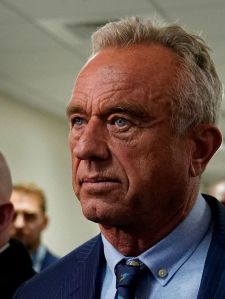

 peej
peej Carissa
 bostonboomer
 dakinikat
 ecocatwoman
 mablue2
 Mama Lopez
 peggysue22
 quixote
 skydancingguestblogger
 Mona (aka Wonk the Vote)



 Sky Dancing
Recent Comments