
AI technology can be used legitimately to quickly survey the research in a field. But Oren Etzioni, a professor emeritus at the University of Washington who studies AI, said he was shocked by the sloppiness in the MAHA Report.
“Frankly, that’s shoddy work,” he said. “We deserve better.”
“The MAHA Report: Making Our Children Healthy Again,” which addressed the root causes of America’s lagging health outcomes, was written by a commission of Cabinet officials and government scientific leaders. It was led by Health and Human Services Secretary Robert F. Kennedy Jr., who has a history of misstating science, and written in response to an executive order from President Donald Trump.
Finally Friday Reads: TACO Tales
Posted: May 30, 2025 Filed under: #FARTUS, #MAGAnomics, Broligarchy, democracy is threatened, Diplomacy Nightmares, ethics, FARTUS, kakistocracy, kleptocracy, Polycrisis | Tags: #Fartus #DeportUs, @johnbuss.bsky.social John Buss, Drug Addict, Elon Musk NAZI, kakistocracy, Palantir Data Theft Specialists, Scott Pelley, TACO, Who are YOU?, Wife Stealer 7 Comments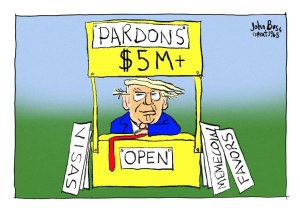
“The most transparent administration ever..” John Buss @repeat1968
Good Day, Sky Dancers!
I’m hoping we’re entering a Golden Age of Journalism because the number of stories floating around out there today indicates that we need more investigative journalists than ever before. Because of that, I cannot seem to play the Wake Forest Commencement by Sixty Minutes‘ Scott Pelley enough. His first statement rang true throughout the world. “Our sacred Rule of Law is under attack.” The Speech was entitled “The Meaning of You.”
The path to self-discovery starts with finding what kind of person you are when times get dark. As I’ve said before, these times are very dark. Do you shy away from speaking out? Do you take fighting action on whatever level you can? Do you melt away? Do you just go along or cheer it? I’ve come back to this speech this week because the headlines today show how important the press can be in exposing the dark times and the dark ones and their actions to light. It is then up to us to do something about it and to get our elected officials on it.
The New Republic’s Parker Molloy briefly discusses the importance of the Pelley Speech and the evil MAGA’s response. “Scott Pelley Warns Graduates About the Threats to American Democracy. The “60 Minutes” correspondent never mentioned Trump by name, but his call to defend democratic institutions was apparently too much for the MAGA crowd to handle.”
Earlier this month, journalist Scott Pelley delivered what should have been a fairly standard commencement address at Wake Forest University. The 60 Minutes correspondent spoke about seeking truth, defending democracy, and the importance of courage in difficult times—the kind of boilerplate inspiration you’d expect from a veteran journalist addressing graduates.
But because we live in very normal times, the speech went viral over Memorial Day weekend and triggered a conservative meltdown that’s been fascinating to watch unfold.
The fury started when a pro-MAGA account clipped portions of Pelley’s speech and shared them on X, writing “Scott Pelley raged at Trump in angry, unhinged commencement address at Wake Forest.”
What did Pelley say that sent the right into such a tizzy? Well, he had the audacity to suggest that “our sacred rule of law is under attack. Journalism is under attack. Universities are under attack. Freedom of speech is under attack.” He warned of “insidious fear … reaching through our schools, our businesses, our homes, and into our private thoughts, the fear to speak in America.”
And perhaps most provocatively, Pelley criticized the administration’s attacks on diversity, equity, and inclusion programs, saying, “Diversity is now described as ‘illegal.’ Equity is to be shunned. Inclusion is a dirty word. This is an old playbook, my friends.” He also referenced “masked agents” who “abduct a college student who wrote an editorial in her college paper defending Palestinian rights and send her to a prison in Louisiana charged with nothing.”
Pelley’s speech comes as Trump is suing CBS for $20 billion over alleged “election interference” and CBS News CEO Wendy McMahon abruptly resigned, citing disagreements with the company amid the legal pressure.
What’s remarkable is how a fairly conventional call for civic engagement and democratic values could generate such hysteria. But then again, when you’re running an administration built on exactly the kind of authoritarian playbook Pelley described, I suppose any critique—no matter how measured—feels like an existential threat.
Reading the speech in full, it’s hard to see what’s so “unhinged” about urging graduates to be engaged citizens and defend democratic institutions. Unless, of course, you’re deeply invested in attacking those very institutions.
 A complete transcript of the speech follows. Also, you may listen to and watch Paley’s address here. The headlines today may be bleak, but the important thing is that reporters and the people supporting the work investigate and can find unbelievable corruption, stark depravity, and many examples of bad human conduct, demeanor, and actions. Then expose it!
When I was born, and as I grew up and my family moved into the middle class, I was instilled with the importance of reading magazines and watching the news. My Grandfather on my mother’s side always sent me books for my birthday and Christmas. My Nana on my mother’s side sent my sister and me subscriptions to National Geographic and The Christian Science Monitor. We read the local newspapers and the Des Moines Register every morning and evening. When I asked my Dad while I was in high school if I could get a subscription to The Manchester Guardian and to Paris Match, he didn’t even hesitate. I can tell you my show and tell performance, as well as my reports from newspapers, were altogether different from my Council Bluffs and Omaha friends.
When I hit university, all the foreign students whom I continually sought out for all dorm meals originally thought I was from Canada. When my family travelled to Europe, I tried to blend in as much as possible and just observe. It is perhaps this that makes me blog today, even though the only journalism classes I took were in high school. I wrote for the school newspaper, an underground newspaper, and the junior high newspaper. I always assumed everyone was as news-hungry as I was growing up in some of the most boring and inane places on the planet. I couldn’t live with oatmeal after reading about Belgian waffles. Can you imagine what happened when I got my first bite of one?
Knowledge of news is important for good citizenship, it’s important for making decisions that impact your household, and it’s important just because things are moving faster than ever. So let me get down to my first suggested reads today.
One of the things I find most threatening these days is seeing my students, my university, and many places leave their brains behind and try to make things easy using AI. It may have a future, but presently, any good professor worth their salt can tell when someone uses it. You should get good at spotting it on the internet, and you will be annoyed when you’re making an important call about something or chatting with some company, and even when it’s given a name, you can tell by the idiosyncrasies and the lack of niceties of American English, this thing ain’t human.
I’ve noticed that the grammar check my University uses completely breaks down when dealing with nuances and colloquialisms. It seems to excel mostly at filling my writing with commas and catching typos. That’s okay by me and easy, but believe me, I can tell when a student overuses AI. We’re being trained at spotting it as well as teaching students how to use it correctly. However, someone who knows what they are doing from years of doing it can make a better decision about its use than those still on the learning curve.
I say this because I watched a news program where the new AI installed at the Social Security phone line repeatedly ignored the question they asked, then kept squawking “Can I help you with something else?” endlessly. This is the point where I hear my Nana’s voice telling little me, “Well, you can, but may you?” AI does not grok manners and polite conversations. It could be because human mutants like Elon Musk and his Dodge cluster have never quite figured that out either. Garbage in, garbage out. But, then maybe that’s what they want. Cease being polite and just be technically acceptable. Okay, it’s long but I’m getting there, I promise.
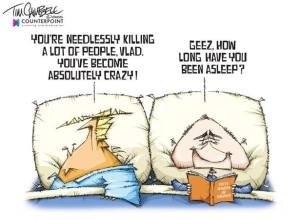 This phenomenon played out yesterday as one of RFK Jr.’s prodigal research adventures turned into something I wouldn’t even expect from an undergrad or, actually, even someone sitting in my high school or university composition class. He was, of course, a legacy student there because of his father. We also know he was the dorm’s drug dealer from my fellow Westside High School journalism classmate, Kurt Anderson. One thing Westside always turned out was students who knew how to write. That skill got me through all the rest of my degrees because, damn I could write a good paper. Evidently, RFK Jr. did not get that skill.
It’s rather interesting given the difficult times Harvard is facing in protecting its foreign students. Now granted, I helped many a colleague from distant lands to get their excellent research into prime American English form. Everyone always sent them to me before they were sent to a journal for publishing, which bought me a cheap pub. But, every one of them took me farther down the path of being a numbers and stats guru. Did you know kids in India start their calculus classes in like 5th grade? It was also easier for me to actually come up with a sweet hypothesis to test because I was taught to be both analytical and creative. That’s what a good public school can do for you. A good university exposes you to what’s possible and exposes you to all kinds of interesting thinkers. But, again, I guess RFK Jr. was too busy with drugs to take advantage of anything like that. That’s why he’s likely never going to be part of a blog community, a book club, or a group that goes to the Saturday Night Midnight movies.
Okay, I really am getting to the read now. At his advanced age, with his unlimited educational opportunities and his money, he cannot write a research paper. And yet, it showed up in the public sphere because he was trying to prove his very wrong hypotheses at any cost. He didn’t prove anything. He turned to all manner of things to argue his hypothesis. None of his antics were academically sound. At first, the White House’s dumbest Press Secretary announced there were “formatting” errors. But, how could that be when, after investigating sources, reporters found them either made up or seriously in error? The Make America Healthy Again report was just embarrassing.
MSNBC anchor Jen Psaki derided White House Secretary Karoline Leavitt’s defense of a “Make America Healthy Again” Commission report filled with errors and broken links.
NOTUS reported the paper, released under the administration of President Donald Trump and U.S. Health and Human Services Secretary Robert F. Kennedy Jr., cited at least seven sources that do not appear to exist. The news publication contacted epidemiologist Katherine Keyes, who the MAHA report lists as the first author of a study it cited on adolescent anxiety, and discovered Keyes didn’t write the paper.
“The paper cited is not a real paper that I or my colleagues were involved with,” Keyes told NOTUS. “We’ve certainly done research on this topic, but did not publish a paper in JAMA Pediatrics on this topic with that co-author group, or with that title.”
NOTUS also reported two other studies pertaining to direct-to-consumer drug advertisements for ADHD medications and antidepressants for kids appear nowhere “to be found.” Reporters also could not validate another section claiming 25% to 40% of mild cases of asthma are overprescribed. Additionally, the author of a corticosteroids study’s the MAHA report cited to support its arguments denied writing the study.
NOTUS reporter Jasmine Wright was in the White House briefing room Thursday and asked Leavitt: “does the White House have confidence that the information coming from HHS can be trusted?”
“Yes, we have complete confidence in Secretary Kennedy and his team at HHS,” Leavitt responded. “I understand there were some formatting issues with the MAHA report that are being addressed.”
Psaki, a former White House press secretary herself, did not contain her scorn.
 Well, the nation’s biggest and most disappointing media of record investigated and found some interesting things in the MAHA report. Let’s start with the Washington Post. “White House MAHA Report may have garbled science by using AI, experts say. The report, led by Health and Human Services Secretary Robert F. Kennedy Jr., was intended to address the reasons for the decline in Americans’ life expectancy.” Well, that’s typical of a lot of students. If they can’t do it, they pay someone who can. You can always tell this, though, because if you’ve seen any previous work, you recognize their voice and you know when something is different. AI is the most recent example of buying a paper online, but with a lower cost and perhaps a lower chance of getting caught because you won’t find a cheat paper by searching it verbatim with your student’s work. Believe me, the discussion on this in teacher lounges and faculty clubs is de rigueur these days. Evidently, RFK Jr. didn’t even know the most tell-tale of the signs.
Some of the citations that underpin the science in the White House’s sweeping “MAHA Report” appear to have been generated using artificial intelligence, resulting in numerous garbled scientific references and invented studies, AI experts said Thursday.
Of the 522 footnotes to scientific research in an initial version of the report sent to The Washington Post, at least 37 appear multiple times, according to a review of the report by The Post. Other citations include the wrong author, and several studies cited by the extensive health report do not exist at all, a fact first reported by the online news outlet NOTUS on Thursday morning.
Some references include “oaicite” attached to URLs — a definitive sign that the research was collected using artificial intelligence. The presence of “oaicite” is a marker indicating use of OpenAI, a U.S. artificial intelligence company.
A common hallmark of AI chatbots, such as ChatGPT, is unusually repetitive content that does not sound human or is inaccurate — as well as the tendency to “hallucinate” studies or answers that appear to make sense but are not real.
 So, our Secretary of Health and Human Services is so bereft of research skills that he can’t even avoid the number one Rookie mistake. Does he have anyone around him who knew better and could catch this? I can tell you that a team of peers that checks every research paper headed to publication in an academically sound journal would never let this go through to print. If you’re the main author, you try to avoid any humiliating mistakes for serious journals.
The New York Times published the first media review pointing out made-up sources. “White House Health Report Included Fake Citations, ‘A report on children’s health released by the Make America Healthy Again Commission referred to scientific papers that did not exist.” Now, I’m not a scientist, but I lived with a Yale-educated Doctorate in Microbiology who published a lot of things on RNA transcription, ran a lab at a public university, and wound up with the NSF. I have no idea if he’s retired or if he went with the current purge of scientists. I read many of his works pre-publication, and he got published in all the big ones. I think the science journals are more nerve-wracking to write for than the Economics and Finance. Usually, it’s based on lab data rather than the Federal Reserve Beige Book or World Book data, which gets a pass even though the methodology and the model itself get the eagle eye. This report was a hot mess on all accounts.
The Trump administration released a report last week that it billed as a “clear, evidence-based foundation” for action on a range of children’s health issues.
But the report, from the presidential Make America Healthy Again Commission, cited studies that did not exist. These included fictitious studies on direct-to-consumer drug advertising, mental illness and medications prescribed for children with asthma.
“It makes me concerned about the rigor of the report, if these really basic citation practices aren’t being followed,” said Katherine Keyes, a professor of epidemiology at Columbia University who was listed as the author of a paper on mental health and substance use among adolescents. Dr. Keyes has not written any paper by the title the report cited, nor does one seem to exist by any author.
The news outlet NOTUS first reported the presence of false citations, and The New York Times identified additional faulty references. By midafternoon on Thursday, the White House had uploaded a new copy of the report with corrections.
Dr. Ivan Oransky — who teaches medical journalism at New York University and is a co-founder of Retraction Watch, a website that tracks retractions of scientific research — said the errors in the report were characteristic of the use of generative artificial intelligence, which has led to similar issues in legal filings and more.
Dr. Oransky said that while he did not know whether the government had used A.I. in producing the report or the citations, “we’ve seen this particular movie before, and it’s unfortunately much more common in scientific literature than people would like or than really it should be.”
Asked at a news conference on Thursday whether the report had relied on A.I., the White House press secretary, Karoline Leavitt, deferred to the Department of Health and Human Services. Emily Hilliard, a spokeswoman for the department, did not answer a question about the source of the fabricated references and downplayed them as “minor citation and formatting errors.” She said that “the substance of the MAHA report remains the same — a historic and transformative assessment by the federal government to understand the chronic-disease epidemic afflicting our nation’s children.”
The false references do not necessarily mean the underlying facts in the report are incorrect. But they indicate a lack of rigorous review and verification of the report and its bibliography before it was released, Dr. Oransky said.
“Scientific publishing is supposed to be about verification,” he said, adding: “There’s supposed to be a set of eyes, actually several sets of eyes. And so what that tells us is that there was no good set of eyes on this
So, after finding out about all of that, this should make you feel really at ease.
I think we can start making the Big Brother is watching you references now. This is the subheading, which is startling IMHO. “The Trump administration has expanded Palantir’s work with the government, spreading the company’s technology — which could easily merge data on Americans — throughout agencies.” Getting your passport ready yet?
In March, President Trump signed an executive order calling for the federal government to share data across agencies, raising questions over whether he might compile a master list of personal information on Americans that could give him untold surveillance power.
Mr. Trump has not publicly talked about the effort since. But behind the scenes, officials have quietly put technological building blocks into place to enable his plan. In particular, they have turned to one company: Palantir, the data analysis and technology firm.
The Trump administration has expanded Palantir’s work across the federal government in recent months. The company has received more than $113 million in federal government spending since Mr. Trump took office, according to public records, including additional funds from existing contracts as well as new contracts with the Department of Homeland Security and the Pentagon. (This does not include a $795 million contract that the Department of Defense awarded the company last week, which has not been spent.)
Representatives of Palantir are also speaking to at least two other agencies — the Social Security Administration and the Internal Revenue Service — about buying its technology, according to six government officials and Palantir employees with knowledge of the discussions.
The push has put a key Palantir product called Foundry into at least four federal agencies, including D.H.S. and the Health and Human Services Department. Widely adopting Foundry, which organizes and analyzes data, paves the way for Mr. Trump to easily merge information from different agencies, the government officials said.
Creating detailed portraits of Americans based on government data is not just a pipe dream. The Trump administration has already sought access to hundreds of data points on citizens and others through government databases, including their bank account numbers, the amount of their student debt, their medical claims and any disability status.
Mr. Trump could potentially use such information to advance his political agenda by policing immigrants and punishing critics, Democratic lawmakers and critics have said. Privacy advocates, student unions and labor rights organizations have filed lawsuits to block data access, questioning whether the government could weaponize people’s personal information.
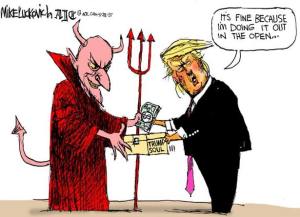 So, while all this is going on, we’re beginning to hear some interesting information on Elon Musk as he exists stage right. This is from Forbes Magazine. “Lucky” Susan Dorn got this assignment. “Musk Used Heavy Drugs Including Ketamine And Ecstasy While He Became Close To Trump, Report Says. Elon Musk used a copious amount of drugs—and travelled with a pill box that appeared to contain Adderall—last year as he ramped up his donations to President Donald Trump, according to a New York Times report that comes on his last official day at the White House.” He’s the Wolf of Austin, I guess.
Key Facts
- Musk told confidants he was taking so much ketamine it affected his bladder, according to The Times, citing unnamed sources who said he also took ecstasy and psychedelic mushrooms.
- The Times also reported it obtained a photo that showed a medication box Musk travelled with containing about 20 pills, including Adderall.
- The alleged drug use overlapped with his campaign activity last year on behalf of Trump—with an endorsement in July followed by $250 million to help elect him.
- The report comes as Musk is set to exit the White House Friday after announcing Wednesday his time leading the Department of Government Efficiency had come to an end.
- Neither Musk nor his lawyer responded to The Times’ request for comment, but Musk has said previously he was prescribed ketamine for depression.
The New York Times has more details. “On the Campaign Trail, Elon Musk Juggled Drugs and Family Drama. As Mr. Musk entered President Trump’s orbit, his private life grew increasingly tumultuous, and his drug use was more intense than previously known.” Of course, they sent two women after this story, too. Kirsten Grind and Megan Twohey were the assigned reporters.
As Elon Musk became one of Donald J. Trump’s closest allies last year, leading raucous rallies and donating about $275 million to help him win the presidency, he was also using drugs far more intensely than previously known, according topeople familiar with his activities.
Mr. Musk’s drug consumption went well beyond occasional use. He told people he was taking so much ketamine, a powerful anesthetic, that it was affecting his bladder, a known effect of chronic use. He took Ecstasy and psychedelic mushrooms. And he traveled with a daily medication box that held about 20 pills, including ones with the markings of the stimulant Adderall, according to a photo of the box and people who have seen it.
It is unclear whether Mr. Musk, 53, was taking drugs when he became a fixture at the White House this year and was handed the power to slash the federal bureaucracy. But he has exhibited erratic behavior, insulting cabinet members, gesturing like a Nazi and garbling his answers in a staged interview.
At the same time, Mr. Musk’s family life has grown increasingly tumultuous as he has negotiated overlapping romantic relationships and private legal battles involving his growing brood of children, according to documents and interviews.
 I’m not about to go to the Gossip Rag road, but there are rumors about Mush and Steven Miller’s wife if you’re interested. This is from the Independent. “Stephen Miller’s wife leaves the White House to work for Elon Musk ‘full time’, Kate Miller was working as an adviser for Elon Musk at the Department of Government Efficiency.” I should eat some lunch, and I really will not ruin it by going any deeper into these. BLECH.
So, we lose a clown and gain one. Seriously, none of these Trump men are strangers to make-up. This is from ABC News. “Trump taps former right-wing podcast host Paul Ingrassia for key watchdog post. Ingrassia would replace Hampton Dellinger, who opposed Trump’s mass firings.”
President Trump announced Thursday night that he was tapping Paul Ingrassia, a former far-right podcast host, to lead the Office of Special Counsel — an independent watchdog agency empowered to investigate federal employees and oversee complaints from whistleblowers.
The Trump administration has previously taken aim at the Office of Special Counsel, firing the head of the agency, Hampton Dellinger (a Biden appointee) in February. Dellinger expressed opposition to the Trump administration’s firing of federal employees under DOGE-led cuts, noting that many had been fired or laid off without notice or justification.
Dellinger challenged his firing in court and was briefly reinstated to the post until a federal appeals court allowed for his dismissal. Dellinger decided to drop the challenge.
ABC News exclusively reported in February about how Ingrassia, in his role as White House liaison to the Department of Justice, was pushing to hire candidates at the DOJ who exhibited what he called “exceptional loyalty” to Trump. His efforts at DOJ sparked clashes with Attorney General Pam Bondi’s top aide, Chad Mizelle, leading Ingrassia to complain directly to President Trump, sources told ABC News.
Ingrassia was pushed out of DOJ and reassigned as the White House liaison to the Department of Homeland Security, where he was serving prior to Trump announcing his new role, according to a White House official familiar with the matter.
In a post on X, Ingrassia wrote in response to his nomination: “It’s the highest honor to have been nominated to lead the Office of Special Counsel under President Trump! As Special Counsel, my team and I will make every effort to restore competence and integrity to the Executive Branch — with priority on eliminating waste, fraud, and abuse in the federal workforce and revitalize the Rule of Law and Fairness in Hatch Act enforcement.”
For the Senate-confirmed five-year term, Ingrassia will likely face tough questions over his lengthy history of media appearances and posts on social media promoting Trump’s efforts to overturn the 2020 election as well as his ties to far-right media figures.
He was previously spotted at a 2024 rally hosted by white nationalist Nick Fuentes and has publicly praised figures like Andrew Tate — who has faced criminal charges for alleged sexual assault (Tate denies all wrongdoing).
 All the best people, folks, all the best. So, I know you just want to know the latest information on the American Soap Opera “As the Tarrifs and the TACO Turns.” This is from CNBC. “Trump accuses China of violating preliminary trade deal.” Dan Managan gets all the serious stories, you know.
President Donald Trump on Friday said that China has “totally violated its” preliminary trade agreement with the United States, and suggested he would take action in response.
“So much for being Mr. NICE GUY!” Trump wrote in a social media post that said China had reneged on a deal that paused retaliatory tariffs between that country and the U.S.
Stock futures fell Friday morning on the heels of Trump’s statement.
U.S. Trade Representative Jamieson Greer, in a CNBC interview Friday morning, echoed Trump’s allegation, saying “we’re very concerned with” China’s purported non-compliance with the temporary trade deal.
The “United States did exactly what it was supposed to do, and the Chinese are slow rolling their compliance,” said Greer.
He called that “completely unacceptable and has to be addressed.”
Treasury Secretary Scott Bessent, in a Fox News interview on Thursday, said that trade talks with China “are a bit stalled.”
CNBC has requested comment from China’s embassy in Washington, D.C.
The U.S. and China on May 12 agreed to a 90-day suspension on most tariffs imposed on each other’s imports.
The agreement was reached after Trump slapped sky-high tariffs on imports from China into the U.S., and China retaliated in kind.
“Two weeks ago China was in grave economic danger!” Trump wrote in his post on Truth Social on Friday.
“The very high Tariffs I set made it virtually impossible for China to TRADE into the United States marketplace which is, by far, number one in the World,” Trump wrote. “We went, in effect, COLD TURKEY with China, and it was devastating for them. Many factories closed and there was, to put it mildly, “civil unrest.” I saw what was happening and didn’t like it, for them, not for us. I made a FAST DEAL with China in order to save them from what I thought was going to be a very bad situation, and I didn’t want to see that happen.”
“Because of this deal, everything quickly stabilized and China got back to business as usual. Everybody was happy! That is the good news!!!” the president wrote.
“The bad news is that China, perhaps not surprisingly to some, HAS TOTALLY VIOLATED ITS AGREEMENT WITH US. So much for being Mr. NICE GUY!”
Trump posted his screed two days after he lashed out at CNBC reporter Megan Cassella at the White House when she asked about the term “TACO trade,” which refers to the phrase “Trump Always Chickens Out.”
The term, coined by a Financial Times columnist, suggests that stock pickers can make money by buying shares after markets fall on news of new tariffs imposed by Trump, knowing that he invariably will pause or reduce the tariffs, sending markets higher.
You had to know he had to have a bully story to cover up all the Court sha-la-la about his on-again, off-again tariffs. Wow, my Grammarly got really dash happy there! Actually, I did it but wondered if it would notice anything and it did. One missing comma. I evidently have a thing against commas.
So, at least it’s the weekend! Hope y’all have a great one! I say TACO, they say TACO!
What’s on your reading and blogging list today?
Mostly Monday Reads: A Big, Ugly Mess
Posted: May 19, 2025 Filed under: A thread for Ranting, Agency Purges, Banksters, Broligarchy, democracy is threatened, Joe Biden, kakistocracy, kleptocracy, New Orleans, Polycrisis | Tags: @johnbuss.bsky.social John Buss, Big Beautiful Bill, China Dumps T-Bonds, Eat the Rich, FARTUS, Major Disruption in the Polar Vortex, Medicaid Cuts, New Orleans Bubble Day, No Kings Day, No Kings protest over #FARTUS parade, Trump budget destroys medicaid, Trump tax cuts for the rich 9 Comments
“Relax, it’s just a cartoon. I know he can’t do yoga.” John Buss, @repeat1968
Good Day, Sky Dancers!
As you know, I’m a nerd on all levels. I was catching up on my usual rabbit holes. The last thing I was reading was in the category of weather and climate change, and a major disruption in the polar vortex that will drastically change the weather from here on out. It’s slid off the North Pole and is moving over Northern Europe. That was after I was reading about this equally major disruption in the global economy. “China Dumps $18,900,000,000 in Treasuries as US Government Faces Major Dilemma: Macro Analyst Luke Gromen.” I’m now working on “In late-night vote, Republicans move closer to pushing Trump agenda bill through House. GOP officials are scrambling to advance massive tax breaks and dramatic Medicaid cuts, and it’s worth appreciating why they’re in such a rush,” written by Steve Benen.
Here in New Orleans, we had a Big Bubble Protest because of some rich guy that moved to the Quarter last year and has filed no less than 15 Criminal complaints over a bubble machine on the balcony of a restaurant that’s been there for over ten years. He thinks that the bubbles will ruin his Porsche and poison his drink when he imbibes on his balcony. This is the typical New Orleans gentrifier. He comes from someplace and expects New Orleans to accommodate his burbie weirdness. Just another old rich white guy trying to rule the world.
Meanwhile, Trump was posting madly early in the morning about every big music star that ever rejected him. That’s right before he’s supposed to be meeting with Putin and Zelensky over Putin’s invasion of Ukraine. Joe Biden has cancer, and Junior’s been hitting Truth Social and drugs at the same time.
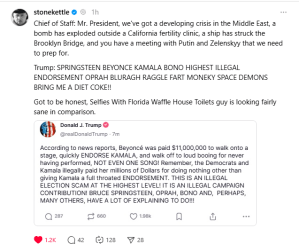
All I can do is quote Chief Meteorologist Emeritus for Channel 2 Action News’ Severe Weather Team 2. AMS certified Glenn Burns. He was talking about the Polar Vortex, but it applies to everything these days. “Nothing is like it used to be anymore.”

You can go read about the selfies of Trump with the Waffle House Toilet guys for yourself. Yes, it’s up there on the Daily Mail.
No wonder the Polar Vortex doesn’t want to be near the United States anymore. Who would?

There are a lot of improvements we need in this country, but none of this stands as necessary or wanted. I love this float pic but think Senator Duckworth’s label Cadet Bone Spurs is more appropriate since Yam Tits would have never made it to a rank of sargent. But, yes, we’re getting a big, beautiful parade. It’s going to cost millions. This rather makes it official. We’re a damn Banana Republic. But the best thing is that pissed-off Americans are once more taking to the streets with placards and protests. This is from lawyermonthly. ““No Kings Day” Protests Set to Disrupt Trump’s $45M Birthday Military Parade.”
On June 14, a date that commemorates both the 250th anniversary of the U.S. Army and the 79th birthday of former President Donald J. Trump, the streets of the nation’s capital are expected to swell, not only with tanks, soldiers, and fighter jets, but with thousands of protestors prepared to send a very different message.
In a show of political theater unprecedented in recent years, Trump and his allies are staging what they’ve dubbed a “patriotic celebration,” complete with more than 6,000 uniformed troops, 150 military vehicles, and a dramatic aerial flyover.
The event, organizers say, is intended to honor America’s armed forces. Critics, however, see something more troubling: a public spectacle designed to cement the image of Trump as commander-in-chief, long after leaving office.
But while the parade commands the headlines, another force is quietly gaining momentum and it’s aiming to steal the spotlight.
Born from frustration and sharpened by years of political tension, a broad coalition of advocacy groups is organizing a massive counter-movement under the banner “No Kings Day.”
It’s not just a protest, they say. It’s a rejection of the authoritarian imagery they believe the parade represents.
Organizers from groups including the 50501 Movement and Refuse Fascism say they’re mobilizing demonstrations in over 100 cities nationwide, with Washington, D.C. serving as the focal point.
Estimates suggest between 10,000 to 20,000 demonstrators will gather in Meridian Hill Park before marching toward the National Mall.
“It’s not about hating Trump, it’s about preserving democracy,” said Angela V., a volunteer coordinator in Maryland who’s helping coordinate buses into the city. “We can’t normalize tanks in the streets every time a former president wants a birthday party.”
Though the name “No Kings Day” may sound theatrical, the intentions behind it are serious.
Protestors plan to highlight what they see as Trump’s attempts to centralize power and glamorize military dominance, particularly during a time when the former president faces multiple indictments related to election interference, classified documents, and alleged abuse of power.
 How about we use that $45 million plus whatever it costs to undo the damage Washington D.C. roads to fund the Veterans’ services cut by that ugly budget winding its way to the Senate today? Economist Paul Krugman–writing at his substack–colorfully describes the budget process as “Attack of the Sadistic Zombies. The GOP budget is incredibly cruel — and that’s the point.” Sounds a lot like the guy who doesn’t want bubbles in his drink or on his Porsche.
Republicans in Congress, taking their marching orders from Donald Trump, are on track to enact a hugely regressive budget — big tax giveaways to the wealthy combined with cruel cuts in programs that serve lower-income Americans. True, the legislation suffered a setback last week, initially failing to make it out of committee. But that was largely because some right-wing Republicans didn’t think the benefit cuts were vicious enough.
OK, news at 11. Isn’t this what Republicans always do? But this reconciliation bill — that is, legislation structured in such a way that it can’t be filibustered and may well pass with no Democratic votes — is different in both degree and kind from what we’ve seen before: Its cruelty is exceptional even by recent right-wing standards. Furthermore, the way that cruelty will be implemented is notable for its reliance on claims we know aren’t true and policies we know won’t work — what some of us call zombie ideas.
And it’s hard to avoid the sense that the counterproductive viciousness is actually the point. Think of what we’re seeing as the attack of the sadistic zombies.
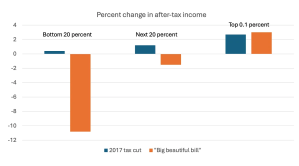
To get a sense of how extreme this legislation is, do a side-by-side comparison of the impact on different groups of Americans between this bill and Trump’s one major legislative achievement during his first term, the 2017 Tax Cuts and Jobs Act. It looks like this:
Source: Tax Policy Center and Penn-Wharton Budget Model
The TCJA, like the current legislation, gave big tax breaks to the wealthiest Americans. But it also threw a few crumbs to people further down the scale. By contrast, the House Reconciliation Bill, by slashing benefits — especially Medicaid — will cause immense, almost inconceivable hardship to the bottom 40 percent of Americans, especially the poorest fifth.
Medicaid, in case anyone needs reminding, is the national health insurance program for low-income Americans who probably don’t have any other way to pay for medical care. In 2023 Medicaid covered 69 million Americans, far more than Medicare (which covers seniors), including 39 percent of children.
Providing health care to children, by the way, isn’t just about social justice and basic decency. It’s also good economics: Children who receive adequate care grow up to be more productive adults. Among other things they end up paying more taxes, so Medicaid for children almost surely pays for itself.
And although Republican legislation apparently won’t explicitly target childrens’ care, it will impose paperwork requirements that will cause both children and their parents to lose coverage.
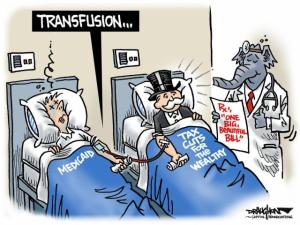 Here’s some analysis of the late-night passage of the bill on the substack of Heather Cox Richardson, historian. ‘
Tonight, late on a Sunday night, the House Budget Committee passed what Republicans are calling their “Big, Beautiful Bill” to enact Trump’s agenda although it had failed on Friday when far-right Republicans voted against it, complaining it did not make deep enough cuts to social programs.
The vote tonight was a strict party line vote, with 16 Democrats voting against the measure, 17 Republicans voting for it, and 4 far right Republicans voting “present.” House speaker Mike Johnson (R-LA) said there would be “minor modifications” to the measure; Representative Chip Roy (R-TX) wrote on X that those changes include new work requirements for Medicaid and cuts to green energy subsidies.
And so the bill moves forward.
In The Bulwark today, Jonathan Cohn noted that Republicans are in a tearing hurry to push that Big, Beautiful Bill through Congress before most of us can get a handle on what’s in it. Just a week ago, Cohn notes, there was still no specific language in the measure. Republican leaders didn’t release the piece of the massive bill that would cut Medicaid until last Sunday night and then announced the Committee on Energy and Commerce would take it up not even a full two days later, on Tuesday, before the nonpartisan Congressional Budget Office could produce a detailed analysis of the cost of the proposals. The committee markup happened in a 26-hour marathon in which the parts about Medicaid happened in the middle of the night. And now, the bill moves forward in an unusual meeting late on a Sunday night.
Cohn recalls that in 2009, when the Democrats were pushing the Affordable Care Act, more popularly known as Obamacare, that measure had months of public debate before it went to the Committee on Energy and Commerce. That committee held eight separate hearings about healthcare reform, and it was just one of three committees working on the issue. The ACA markup took a full two weeks.
Cohn explains that Medicaid cuts are extremely unpopular, and the Republicans hope to jam those cuts through by claiming they are cutting “waste, fraud, and abuse” without leaving enough time for scrutiny. Cohn points out that if they are truly interested in savings, they could turn instead to the privatized part of Medicare, Medicare Advantage The Congressional Budget Office estimates that cutting overpayments to Medicare Advantage when private insurers “upcode” care to place patients in a higher risk bracket, could save more than $1 trillion over the next decade.
Instead of saving money, the Big, Beautiful Bill actually blows the budget deficit wide open by extending the 2017 tax cuts for the wealthy and corporations. The Congressional Budget Office estimates that those extensions would cost at least $4.6 trillion over the next ten years. And while the tax cuts would go into effect immediately, the cuts to Medicaid are currently scheduled not to hit until 2029, enabling the Republicans to avoid voter fury over them in the midterms and the 2028 election.
The prospect of that debt explosion led Moody’s on Friday to downgrade U.S. credit for the first time since 1917, following Fitch, which downgraded the U.S. rating in 2023, and Standard & Poor’s, which did so back in 2011. “If the 2017 Tax Cuts and Jobs Act is extended, which is our base case,” Moody’s explained, “it will add around $4 trillion to the federal fiscal primary (excluding interest payments) deficit over the next decade. As a result, we expect federal deficits to widen, reaching nearly 9% of GDP by 2035, up from 6.4% in 2024, driven mainly by increased interest payments on debt, rising entitlement spending and relatively low revenue generation.”
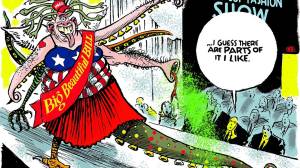 Steven Beschloss calls for more activism today at his substack, America, America. “Heeding the Warnings! We must avoid normalcy bias, expand our imagination, and both recognize and confront the fascistic danger of the Trump regime.”
Last week On Tyranny author Timothy Snyder warned that the second 100 days of the Trump regime could entail a dangerous escalation that includes some kind of terrorist attack. Imagining this can be hard; it’s understandable to ignore such a warning since it’s not yet true, it’s unpleasant to consider—and yes, it may not happen.
But it’s worth listening to what this historian of authoritarian regimes envisions—a warning layered with advice on how to prepare and how to respond. “I think it’s very important to expect there will now be exogenous surprises,” he said in a short video, including the “bottom falling out” of the economy because of the tariffs, “a major disruption” within the U.S. or even some kind of terrorist attack.
“Don’t fall for language about extremism or terrorism,” Snyder urged if it happens. He also emphasized the importance of staying calm, being active and sticking together. “Be aware that this is the pretext that will be used to push things further…use it as an opportunity to hold the people responsible who should be taking responsibility.”
This mirrors what he said in one of the final chapters of his short book that offers lessons to prepare, one entitled “Be calm when the unthinkable arrives.” His thinking draws on the Reichstag Fire staged by Hitler and the Nazis in 1933.
Modern tyranny is terror management. When the terrorist attack comes, remember that authoritarians exploit such events in order to consolidate power. The sudden disaster that requires the end of checks and balances, the dissolution of opposition parties, the suspension of freedom of expression, the right to a fair trial, and so on, is the oldest trick in the Hitlerian book. Do not fall for it.
As he notes in a Substack piece published last month about the possibility of such an attack, “The people in the White House have no governing skills, but they do have entertainment skills. They will seek to transform themselves from the villains of the story to the heroes, and in the process bring down the republic.”
None of us know if such an attack will happen. But I agree with Snyder that it’s important to expand our imaginations and be prepared if it does. That means not falling victim to normalcy bias.
Yes, millions of Americans failed to grasp the potential for disaster and crisis if Donald Trump were to occupy the White House again. But rather than look backward and rue that misfortune, let’s look forward and do what we can.
Warn the people we know. Warn the people we meet. Reach out on social media and email to our friends and communities. Contact our elected officials. Participate in public demonstrations and bring friends with us.
Let them all know this is an emergency—no time for business as usual and old ways of doing things. There’s an arsonist in the White House aggressively seeking to end our constitutional republic, free speech and the rule of law. And let’s not lose sight of our collective power to ensure that the Trump regime’s desired trajectory is not inevitable.
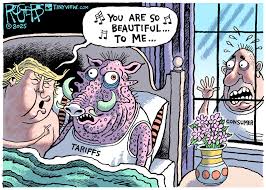 The Financial Markets are reeling. This is from NYT. “Markets Rattled on Concerns About U.S. Debt. Stocks fell, the dollar slipped, and bond yields jumped after a rating downgrade highlighted worries about the cost of President Trump’s policies and the health of the economy.”
Turbulent trading hit financial markets on Monday, with investors selling U.S. stocks and bonds and the dollar, an ugly combination that suggests sentiment is souring on the outlook for the world’s largest economy.
The S&P 500 index fell about 1 percent in early trading in New York. Bond markets shuddered, with U.S. Treasury prices falling and their yields, which underpin interest rates across the economy, rising. The 10-year yield jumped a tenth of a percentage point, a large move in that market, to 4.54 percent. The dollar also fell, with a gauge of its value against other major currencies slipping 0.8 percent.
One factor jarring markets is a bill in Congress that would make President Trump’s signature 2017 tax cuts permanent and could add trillions of dollars to federal debt. A House committee voted to approve the bill Sunday night, although it was expected to remain a focus of contentious congressional debate.
The United States’ loss of its last triple-A credit rating late on Friday and mounting concerns about government debt have threatened to disrupt the relative calm in markets that has prevailed since Mr. Trump paused many of his tariffs in recent weeks.
In downgrading the U.S. credit rating, Moody’s cited the tax cut legislation along with broader concerns about the fiscal deficit and growing debt costs. The move by Moody’s means that all three major rating agencies no longer consider the United States qualified for their top credit ratings.
The U.S. credit rating downgrade and worries about debt and deficits could further upset financial markets if they begin to shake the safe-haven status of Treasury bonds. That would likely spur global investors to demand higher premiums in return for buying U.S. debt.
On Monday, the 30-year Treasury yield rose to its highest level in a year and a half, above 5 percent.
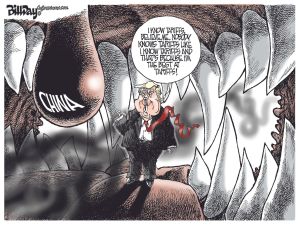 The market has yet to fully absorb the Treasury Bond Dump by China. This is from the Daily HODL (News and Insight for the Digital Economy). Yes, I’m getting seriously nerdy for you know. This is the kind of stuff that drives my research and derivatives class lectures. This is the stuff that should frighten everyone if they ever knew about it. “China Dumps $18,900,000,000 in Treasuries as US Government Faces Major Dilemma: Macro Analyst Luke Gromen.”
Macro investor Luke Gromen warns that the countries buying more USTs won’t be able to simultaneously buy more American-manufactured goods, further hurting America’s trade deficit that President Trump has promised to address.
Says Gromen,
“Foreign UST holdings rose $133 billion Mar vs. Feb.
UK, Caymans, and Canada were $86 billion of that $133 billion; China sold $19 billion.
UK surpassed China as the 2nd biggest US foreign creditor for 1st time ever in March.
Cayman Islands (pop. ~73,000) is now the fourth biggest US foreign creditor at $455 billion…
How are they going to buy both USTs and more goods from America going forward?”
Analysts reportedly told Reuters that Chinese holdings of USTs have been in a downward trajectory since 2018, even though foreign holdings of Treasuries surged to an all-time high of $9.05 trillion in March.
 That means our exports will go down in many of the countries. It’s damned recessionary. Also, if the price of bonds goes down because a country dumps their portfolio of treasuries, the interest rates go up. It will be truly interesting to see what the Fed does with this. Then there’s this. I bet Senator Warren is apoplectic. This report comes from The Guardian. You remember how fun that crash was. “US reportedly plans to slash bank rules imposed to prevent 2008-style crash. Watchdogs could cut capital rules as Trump’s deregulation drive opens door to rollback of post-crisis protections.”
US watchdogs are reportedly planning to slash capital rules for banks designed to prevent another 2008-style crash, as Donald Trump’s deregulation drive opens the door to the biggest rollback of post-crisis protections in more than a decade.
The move follows heavy lobbying by the banking industry, with lenders such as JP Morgan and Goldman Sachs having long complained that competition and lending have been hindered by burdensome rules governing the assets they must hold versus their liabilities.
Regulators are expected to put forward the proposals this summer, aimed at cutting the supplementary leverage ratio that requires big banks to hold high-quality capital against risky assets including loans and derivatives, according to the Financial Times, which cited unnamed sources.
The rules came into force after the 2008 financial crisis, as part of efforts to shockproof the banking system and avoid damaging ripple effects that could cause another global economic meltdown. The crisis forced governments to spend billions of dollars bailing out big lenders that took too much risk.
Changes to bank capital rules have been widely expected, with Trump having promised a bonfire of regulation during his second term in office, with plans to slash 10 regulations for every new one added.
While some critics warn it is the wrong time to slash protections, given growing uncertainty over policy overhauls and market volatility, banks seem to have won the ear of policymakers. Lobbyists have long argued that the rules punish them for holding relatively low-risk assets including US debt, known as treasuries, and hinders their ability to provide more loans.
 I just want to wish Former President the best as he struggles with cancer. I know how that feels. I’m 35 years out from a stage 4 cancer episode. It transforms how you see time. “President Biden has metastatic prostate cancer. Here’s what you should know,” via CNN. He will receive top-quality cancer treatment and has a wonderful supportive family. All of this will help him. He’s also one tough cookie.
President Joe Biden’s diagnosis of metastatic prostate cancer has understandably raised concerns and questions: How long has he had cancer, how will he be treated, and what is his prognosis?
As a urologist, I regularly diagnose prostate cancer in my patients, and each time I share the diagnosis with them and their family, it’s never easy. Over time, I’ve learned the importance of keeping conversations simple and straightforward — avoiding sugar-coating and instead using data, statistics and personal experience to help patients begin their cancer journey.
As his public announcement draws attention to this type of cancer, it’s a reminder to regularly check on your own health. Here’s what you need to know about metastatic prostate cancer: how it’s detected, what treatments look like, and why early screening remains essential for men’s health.
The former president’s diagnosis began after he experienced “increasing urinary symptoms,” his office said, and a prostate nodule was discovered.
…
“Metastatic” means the cancer cells have spread beyond the original location (the prostate gland) into other areas — most commonly bones and lymph nodes. Biden’s cancer has specifically spread to his bones, placing him among the 5% to 7% of prostate cancer cases in the United States that are metastatic at initial diagnosis. While this percentage seems small, it represents a significant number given that over 300,000 men in the US and approximately 1.5 million worldwide are diagnosed with prostate cancer every year.
Early-stage prostate cancer carries an excellent prognosis, with nearly a 100% five-year survival rate. However, when prostate cancer is metastatic at diagnosis, the five-year survival rate drops sharply to around 37%. Importantly, these survival rates are statistical averages, and individual outcomes vary considerably based on overall health, age, cancer aggressiveness, and how well a patient responds to treatment.
All of the #FARTUS policies add up to a big mess for the economy. It’s driving me back to research again. But right now, I guess I’ll go blow some bubbles for a while.
What’s on your reading and blogging list today?
Finally Friday Reads: Will no one rid us of this Turbulent Pest?
Posted: May 16, 2025 Filed under: "presidential immunity", #FARTUS, #MAGAnomics, Civil Liberties, Civil Rights, Corrupt and Political SCOTUS, democracy is threatened, Democratic Backsliding, kakistocracy, Polycrisis | Tags: @johnbuss.bsky.social John Buss, Big Beautiful Bill attacks Abortion, Birthright citizenship, FEMA not ready for Hurricane Season, ICE Barbie, Medicaid, SCOTUS, Walmart earnings call 11 Comments
“True,” John Buss, @repeat1968
Good Day, Sky Dancers!
It’s not often I quote the Daily Mail, but it has that British humor touch that just puts the right tone on what should be a Monty Python Sketch. I used to have an apron that said, “Who invited all these tacky people?” Well, it’s Yam Tits and all those Republican Senators that approved the cast of this freak show. Every headline these days about the Regime of Orange Caligula and his cabinet of crazies is outrageous and depressing. Today, we’ll discover both categories. And, btw, I send apologies out to Henry II for messing with his lament. We’ve become the worst caricature of ourselves.
“ICE Barbie Kristi Noem is backing insane reality TV show where immigrants compete for fast-tracked citizenship.” Doesn’t that just have that perfect mixture of cruelty, inhumanity, and pathos that makes the news cringeworthy these days?
She’s been called ‘ICE Barbie’ for treating her Cabinet position like a TV production, but now Homeland Security Secretary Kristi Noem is pushing for an actual reality show pitting immigrants against each other ‘for the honor of fast-tracking their way to U.S. citizenship’.
It may sound like a joke, but the idea is for real and is outlined in a 35-page program pitch put together in coordination with the DHS secretary, DailyMail.com can exclusively reveal.
Noem is even offering up officials from the U.S. Citizenship and Immigration Services to tally votes for the made-for-TV contest.
The pitch comes from Rob Worsoff, a writer and producer known for Duck Dynasty, the A&E reality show about a Louisiana family and its hunting empire, and Bravo’s Millionaire Matchmaker.
The proposed series is called The American, named after the train that contestants would ride around the country, competing in regionally specific ‘cultural’ contests such as rolling logs in Wisconsin.
It would lead to a grand finale with the winner getting sworn in on the steps of the U.S. Capitol.
‘Along the way, we will be reminded what it means to be American – through the eyes of the people who want it most,’ reads Worsoff’s pitch.
Worsoff – who himself was born in Canada – said: ‘I’m not affiliated with any political ideology. As an immigrant myself, I am merely trying to make a show that celebrates the immigration process, celebrate what it means to be American and have a national conversation about what it means to be American, through the eyes of the people who want it most.’
Tricia McLaughlin, the top spokesperson for DHS, acknowledged that agency staff are reviewing this pitch and had a call with the producer last week. She insisted Noem is yet to be briefed on the initiative.
However, DailyMail.com has confirmed that Noem supports the project and wants to proceed.
And McLaughlin said: ‘I think it’s a good idea.’
Worsoff’s project comes as Noem is wanting to showcase what it means to become an American, amid the Trump administration’s crackdown on illegal immigration.
She and her agency have been working for weeks to get such a project greenlit from Netflix or another streaming or cable service, sources tell DailyMail.com.
But while past outreach has fallen flat, they’re hoping this one has a real chance.
In his pitch, Worsoff, 49, expresses confidence that The American would be a commercial hit and ‘lends itself to enormous corporate sponsorship opportunities’.
At the same time, there’s concern among some in DHS about the possible optics of turning the plight of immigrants into a reality game show, sources say.

“If you read the speech bubble using RFK Jr’s halting, raspy, tinny voice, it helps get past the grossness.” John Buss, @repeat1968
Isn’t that what brought us here? Illiterate, unhappy people who believe that “reality” shows are real? Cosplay Barbie isn’t alone for being out of her league, but melodramatic enough to keep the big guy happy. Yesterday, I listened to the most surreal edition of a Supreme Court hearing I’d ever seen. How on earth did this thing make it to the docket, and what’s next? This is from Slate. “The Supreme Court May Pick the Worst Possible Case to Cede More Power to Trump.” This analysis is provided by Dahlia Lithwick and Mark Joseph Stern. As usual, the Women on the Bench Rule and the guys drool.
During one of the term’s biggest sets of oral arguments on Thursday, everyone at the Supreme Court seemed to agree that the United States is in the midst of an emergency. But there was far less agreement about what specifically that emergency is. During debate over three nationwide injunctions currently protecting birthright citizenship from President Donald Trump’s attacks, the justices were deeply split over what manner of legal crisis the court—and the country—truly faces. And the growing gender divide emerged once again: The four women seemed concerned that the president is trying to undo the final restraints on his exercise of unconstitutional power, and doing so in ways that include breaking norms and defying courts. The five men, in contrast, sounded irked at allegedly monarchical district court judges who dare issue broad orders blocking the White House’s policies, even when they’re blatantly unconstitutional.
These five men, of course, make up the majority of the Supreme Court. And, as they keep reminding us, they can do anything they want with their authority. But there is reason to believe that one or two of these justices might balk at the mayhem they could unleash by limiting lower courts’ power to constrain the executive branch. And not onejustice even hinted that they think Trump should eventually win on the merits and get the green light to start stripping birthright citizenship from immigrants’ children. What they spent two and a half hours debating, in painstaking detail, is whether nationwide or universal injunctions are the way to stop that from happening.
It’s anybody’s guess how the court will come down on that question. It seems the majority wants to have it both ways, reining in lower courts that are—across all political and ideological lines—battling Trump’s lawlessness, and somehow doing so without itself blessing that lawlessness as the administration would like to deploy it against American children of noncitizens. That may well be an impossible task, and their attempt to pull it off in this case could provoke destabilizing confusion across the judiciary. In trying to resolve one perceived emergency, the majority may end up provoking many more.
During one of the term’s biggest sets of oral arguments on Thursday, everyone at the Supreme Court seemed to agree that the United States is in the midst of an emergency. But there was far less agreement about what specifically that emergency is. During debate over three nationwide injunctions currently protecting birthright citizenship from President Donald Trump’s attacks, the justices were deeply split over what manner of legal crisis the court—and the country—truly faces. And the growing gender divide emerged once again: The four women seemed concerned that the president is trying to undo the final restraints on his exercise of unconstitutional power, and doing so in ways that include breaking norms and defying courts. The five men, in contrast, sounded irked at allegedly monarchical district court judges who dare issue broad orders blocking the White House’s policies, even when they’re blatantly unconstitutional.
These five men, of course, make up the majority of the Supreme Court. And, as they keep reminding us, they can do anything they want with their authority. But there is reason to believe that one or two of these justices might balk at the mayhem they could unleash by limiting lower courts’ power to constrain the executive branch. And not onejustice even hinted that they think Trump should eventually win on the merits and get the green light to start stripping birthright citizenship from immigrants’ children. What they spent two and a half hours debating, in painstaking detail, is whether nationwide or universal injunctions are the way to stop that from happening.
It’s anybody’s guess how the court will come down on that question. It seems the majority wants to have it both ways, reining in lower courts that are—across all political and ideological lines—battling Trump’s lawlessness, and somehow doing so without itself blessing that lawlessness as the administration would like to deploy it against American children of noncitizens. That may well be an impossible task, and their attempt to pull it off in this case could provoke destabilizing confusion across the judiciary. In trying to resolve one perceived emergency, the majority may end up provoking many more.
If you squint, you can see the logic of what SCOTUS did here. Maybe the justices thought they could issue a compromise decision that would give Trump a procedural victory by trimming the nationwide injunctions while teeing up a someday defeat for him on the merits in the near future. This was the kind of Solomonic “grand bargain” that some commenters hoped would come with last year’s Jan. 6–related cases, in which the majority ultimately allowed the once and future president to run the table. It became painfully clear during Thursday’s oral arguments that any such vision here was a mirage: There is no clean way to separate the merits of the 14th Amendment’s guarantee of citizenship to everyone born in the United States from the effort to claw back broad injunctions. To allow the states and plaintiffs to lose on the latter is to give away the farm on the former.

“Pretty sure this one’s headed to the trump library too..” John Buss, @repeat1968
Slate’s Mary Ziegler at Slate has another example of the sneaky, backdoor way the Project 2025 Klan has of making things worse for everyone. “Trump’s ‘Big Beautiful Bill’ Is a Sneak Attack on Abortion.”
“With Donald Trump’s “big beautiful bill” of tax and Medicaid cuts up for consideration, abortion might be the last thing on anyone’s mind. But a provision buried in the bill is Republicans’ latest attempt to stop losing on reproductive rights. The current version of the GOP budget reconciliation bill includes language denying Medicaid funding to any “large provider of abortion services.” This marks a big change in the GOP’s recent approach to abortion policy. Through the early months of the Trump administration, Republicans in Congress have been remarkably reluctant to do anything big on abortion. But now they are using the president’s signature legislation to wade back into the fight.
What made this bill different? The idea seems to be that Republicans can reframe unpopular attacks on reproductive rights as more acceptable government cost-cutting measures by relying on the Department of Government Efficiency to do their dirty work. If Americans like saving money, and are prepared to believe Elon Musk’s arguments about fraud and waste, the theory goes, maybe Republicans can deliver for their socially conservative constituents without the plan backfiring. But the GOP’s latest gambit is a reminder that there’s still no magic bullet for conservatives when it comes to reproductive rights.
It’s no surprise that anti-abortion leaders themselves have seized on this strategy. Trump has made some moves to placate abortion opponents, like announcing that no one will be prosecuted for violating the Freedom of Access to Clinic Entrances Act, which protects access to clinics and places of worship, and pardoning several defendants convicted of violating it. But for the most part, he has frozen out the anti-abortion movement. The Department of Justice hasn’t started enforcing the Comstock Act as an abortion ban. When conservative state attorneys general sued to force a shift, the Trump administration just last week asked the court to dismiss the suit for procedural reasons.
At the same time, if voters actually are paying less attention, it’s probably because less seems to be happening. Republicans in Congress have sat on their hands. Trump has yet to make a big move. The truth is that plenty is still going on, with cases moving through state and federal courts, states poised to pass stringent new bills, and Trump’s future moves still shrouded in uncertainty. The minute one of these events makes news, there’s no reason to believe voters will be any happier with Republicans’ position than they ever were.
 I don’t know about you, but I feel like running for the Canadian border. Why would anyone want to come here under these circumstances? I’m also very afraid of this year’s hurricane season. This is from ABC News. “FEMA ‘not ready’ for hurricane season, internal review finds. The acting agency head told staff that planning is about 80-85% complete.” The season starts on June 1st. There have already been disturbances reported. This administration seems hellbent on killing people. This might make Heckuva Job Brownie look like an efficiency expert.
The acting head of the Federal Emergency Management Agency told staff members on Thursday that he believes President Donald Trump is a bold man with a bold vision for the agency — but that FEMA doesn’t yet have a full plan to tackle hurricane season.
“I would say we’re about 80 or 85% there,” Acting FEMA Administrator David Richardson told staff on a conference call, parts of which were obtained by ABC. “The next week, we will close that gap and get to probably 97-98% of a plan. We’ll never have 100% of a plan. Even if we did have 100% of a plan, a plan never survives first contact. However, we will do our best to make sure that the plan is all-encompassing.”
The conference call came after an internal document prepared for Richardson as he takes the helm of the agency responsible for managing federal disasters indicated the agency was ill-prepared for the upcoming hurricane season, which starts on June 1.
“As FEMA transforms to a smaller footprint, the intent for this hurricane season is not well understood, thus FEMA is not ready,” according to the document, which was obtained by ABC News.
In the conference call, Richardson said he and staff sat down for “about 90 minutes” and started to come up with a plan for this year’s disaster season.
He said the plan would be ready soon.
“Listen closely: The intent for disaster season 2025 (is to) safeguard the American people, return primacy to the states, strengthen their capability to respond and recover, and coordinate federal assistance when deemed necessary, while transforming to the future of FEMA,” Richardson said.
Richardson was placed at FEMA by Department of Homeland Security Secretary Kristi Noem after former acting Administrator Cam Hamilton was fired last week because of his testimony in front of a House panel, according to a source familiar with the matter, which went against the shuttering of the agency.
The acting administrator said this version of FEMA will look different than the agency of the past.
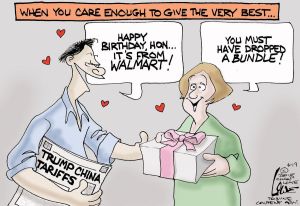 Meanwhile, the Tariff turbulence is coming to fruition. This is from CNBC. “Walmart CFO says price hikes from tariffs could start later this month, as retailer beats on earnings.” Melissa Repko has the story.
Walmart on Thursday fell just short of quarterly sales estimates, as even the world’s largest retailer said it would feel the pinch of higher tariffs.
Even so, the Arkansas-based discounter beat quarterly earnings expectations and stuck by its full-year forecast, which calls for sales to grow 3% to 4% and adjusted earnings of $2.50 to $2.60 per share for the fiscal year. That cautious profit outlook had disappointed Wall Street in February. Wall Street was also underwhelmed by the results Thursday, as shares closed slightly lower.
Walmart also marked a milestone: It posted its first profitable quarterfor its e-commerce business both in the U.S. and globally. The business has benefited from the growth of higher-margin moneymakers, including online advertising and Walmart’s third-party marketplace.
In an interview with CNBC, Chief Financial Officer John David Rainey said tariffs are “still too high” – even with the recently announced agreement to lower duties on imports from China to 30% for 90 days.
“We’re wired for everyday low prices, but the magnitude of these increases is more than any retailer can absorb,” he said. “It’s more than any supplier can absorb. And so I’m concerned that consumer is going to start seeing higher prices. You’ll begin to see that, likely towards the tail end of this month, and then certainly much more in June.”
 Reuters reports the bottom line here. There’s only so long you can eliminate loss leaders, lower earnings, and try to slow things down. We will feel it everywhere, and it will be next month. Jennifer Saba has this headline: “Walmart can discount tariffs only so much.” So this is your friendly economist speaking, stock up and hunker down. It’s going to get real real soon.
Walmart (WMT.N), opens new tab wheeled its trolley cart right into President Donald Trump’s ankles. The largest U.S. retailer and a bellwether for consumers said on Thursday that tariffs would force it to raise prices, just a month after it expressed confidence that it would keep them low. Boss Doug McMillon may be able to do both at once, on a relative basis, but it also sends a clear signal to the White House that shelves are stocked with only so many ways to shield shoppers.
Flagship U.S. Walmart locations open for at least a year generated 4.5% sales growth for the three months ending April 30 from the same stretch in 2024, a second consecutive quarterly slowdown. McMillon warned that import levies are starting to take a toll. Supply-chain pressure began in late April and accelerated in May. The $750 billion company is trying to hold the line on food even as the cost of bananas, coffee, avocados and flowers increases, but it is unwilling to eat them everywhere.
McMillon and his deputies took a markedly different tone a few weeks ago. The CEO told investors that U.S. duties, which at the time were 145% on Chinese goods, remained a question mark, but that Walmart would focus on “managing our inventory and our expenses well.” Following news that those levies would be slashed to 30%, at least temporarily, McMillon cautioned of a challenging environment, implying that he can squeeze suppliers only so much.
He’s not alone either. JPMorgan boss Jamie Dimon warned, opens new tab on Thursday that recession remains a threat despite Trump’s trade truce. Taiwanese contract manufacturing giant Foxconn, which assembles iPhones and makes Nvidia servers, also slashed its full-year outlook this week, blaming the stronger Taiwan dollar and “rapid changes” in U.S. tariff policy.Equity investors took comfort from the lower duty rates, pushing the S&P 500 Index up 5% this week, to higher than where it started the year. Business leaders are clearly less impressed. Sustained gloom from industry titans like Walmart will keep pressure on the president to reconsider his own pricing power.
Every day I read the headlines, all I can think is that we shouldn’t be in this position. But, here it is. Don’t even get me started on Drunk and rapey Pete Hegseth. (Must Read. VF: “VF editors are joined by special correspondent Gabriel Sherman to discuss Pete Hegseth’s tumultuous tenure atop the Department of Defense, and why the president is reluctant to break with his friend from Fox.)
What’s on your reading and blogging list today?
Bleak Monday Reads: Wherefore art thou Democracy?
Posted: March 31, 2025 Filed under: "presidential immunity", #FARTUS, Corrupt and Political SCOTUS, democracy is threatened, Foreign Affairs, Hungary, Staglfation | Tags: @johnbuss.bsky.social, Anne Applebaum, John Buss @repeat1968, Marcy Wheeler, sadopopulism 7 Comments
“For once, I have to agree with JD” John Buss @repeat1968
Good Morning, Sky Dancers!
I’m trying to get this posted early since the Poland Avenue Rooster and the thunder have me awake, and I have another doctor’s appointment today. The weather is not good here. We have flash flood warnings. My first look at the headlines this morning made me want to go back to sleep. My first two suggested reads come from two of my favorite writers. The articles are both horrifying, but these are the times we live in. We cannot look away. Marcy Wheeler and Anne Applebaum tell it like it is. This first one is by independent journalist Marcy Wheeler, whom I have not since our days at the long-gone Fire Dog Lake, my first stop in blogdom. She writes this at her home at emptywheel. This is about how the press has been instrumental in trying to normalize a regime that is other than normal with their “hypothetical discussions” about the U.S. Constitution. I know I have a new term to add to our tags today: instrumental language. I will use Google’s AI function to give you a brief definition before Marcy applies the term.In the context of language, “instrumental” refers to language used as a tool or means to fulfill a need or achieve a goal, such as obtaining something or expressing a desireHere’s the application from a phone conversation between FARTUS and Kristin Welker on NBC’s Meet the Press. Sit down and put the cup of coffee down. You may need a deep breath. “Trump’s Threats to the Constitution Are Happening in Real Time, Not (Just) in a Third Term.”
There is no doubt in my mind that the intent of the Trump team is to retain power indefinitely, via whatever means. To fight that effectively, you should focus your action and words on the most pressing issues before us — elections on Tuesday, legal cases before appeals courts, legal US residents in detention — rather than trying to discern the means by which Trump will codify all the actions he is taking today, yesterday, last week. The actions he is taking in real time, and their goals, are utterly transparent. Which is why I think it a colossal waste of time that the punditocracy spent much of Sunday talking about Kristen Welker’s “report” that Trump says he wants a third term. You don’t say? Rather than spending the day discussing Trump’s Executive Order presuming to dictate to states how they — with the involvement of DOGE!! — must start suppressing the vote over the next months, we talked about something that might happen in 2028. Rather than spending the day talking about how Trump is already using federal funding and immigration law to silence speech protected by the First Amendment, we discussed what gimmick Trump might use in the future to evade the 22nd Amendment. Almost no one even tried to use Trump’s comments about a third term as a way to explain the end goal of assaults on civil society, speech, and voting — to connect the actions Trump took in the last week to what he says he’ll do in 2028 — something that would at least make use of Trump’s own rhetoric to educate low-information voters. Instead, they talked about Trump’s assault on democracy in the way Trump wanted it framed — distant, allegedly constitutional, and uncertain, rather than an imminent unconstitutional assault on democracy. What the fuck are we doing here, folks?
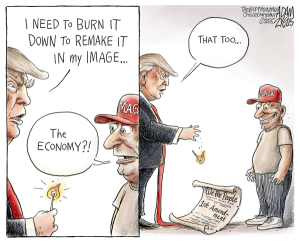 Indeed. Please go read this.
“The fact that Welker brought up this plot for a third term herself, mentioning Steve Bannon (who was presenting it on another channel), suggests that was the entire point: Trump called her, she dutifully brought it up, she got video but used almost none of it, leaving only Markwayne Mullin on camera (who should never be invited as a credible interlocutor in any case) to answer for the Administration on MTP itself. Not that it mattered; Welker was even more solicitous than usual yesterday. Trump’s genius is in managing attention: both keeping it, and directing it away and towards topics of his choosing. He has long integrated assertions about a third term into his political spiel. This is nothing new (indeed, NBC linked an earlier instance in the story). And yet NBC — along with a pack of credulous pundits — chose to focus on Trump’s third term comments all day Sunday rather on the things he did in the last week, covering up disappearances on Monday, tampering in elections on Tuesday, assaulting the independence of another law firm on Wednesday, attacking unions and whitewashing history on Thursday, compromising DC self-rule on Friday, that are obviously about a third term and beyond. How can you have lived through that week, or any of the last nine, and have doubts about the intent here? Why do you think hypothetical discussions about assaults on the Constitution will better serve fighting back than concrete discussion and organizing about specific assaults on it? This seems to be yet another instance where journalists and liberals, both of whom institutionally presume that language is transparent, misunderstand how authoritarians use language instrumentally and therefore forgo the most effective response to instrumental language.”
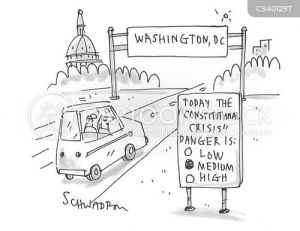 Human guardrails are not present in this administration. I’m not even certain you may call anyone in the administration fully human. Constitutional Guardrails are questionable even as we are not even in the first 100 days of this surreal mess. It’s no wonder former Yale History Professor Timothy Snyder and his wife have taken off for the Great White North. It appears Fascism scholars can read the writing on the wall from the capitulation of major universities on the attacks they’ve received.
Here’s The Guardian‘s take on yesterday’s advance notice on the march to dictatorship. “Donald Trump criticized for suggesting there are ‘methods’ for a third term – US politics live. President attracting criticism from some in both parties after telling NBC ‘there are methods’ in securing a third term despite constitutional barriers.”
Human guardrails are not present in this administration. I’m not even certain you may call anyone in the administration fully human. Constitutional Guardrails are questionable even as we are not even in the first 100 days of this surreal mess. It’s no wonder former Yale History Professor Timothy Snyder and his wife have taken off for the Great White North. It appears Fascism scholars can read the writing on the wall from the capitulation of major universities on the attacks they’ve received.
Here’s The Guardian‘s take on yesterday’s advance notice on the march to dictatorship. “Donald Trump criticized for suggesting there are ‘methods’ for a third term – US politics live. President attracting criticism from some in both parties after telling NBC ‘there are methods’ in securing a third term despite constitutional barriers.”
Republican John Dean, former White House counsel to Richard Nixon as president, who was jailed for his involvement in the cover-up of Watergate and later testified to Congress as a witness for the investigation into the scandal, criticized Trump’s apparent aspiration for a third term, in an interview with CNN.
“He likes constitutional end-runs … and that’s what seems to be on his mind is how he can get around the very clear language of the 22nd amendment [to the US constitution], which precludes getting elected to more than two terms,” Dean said.
CNN asked, if there are ways to get around the law, constitutionally what could those be?
Dean said: “They would have to be written by the supreme court, that would redefine the constitution. I just describe it as a constitutional end run.”
An end run is an American football term for the ball-carrier running around the end of the defensive line in their attempt to reach the line to score a touchdown.
The key line from the 22nd amendment, forbidding anyone who has been elected president twice from being elected again. reads:
“No person shall be elected to the office of the President more than twice, and no person who has held the office of President, or acted as President, for more than two years of a term to which some other person was elected President shall be elected to the office of the President more than once.”
The US Congress approved the amendment in 1947, and submitted it to the state legislatures, where it was then ratified in 1951.
 It’s the end-runs that worry me. He’s already got a history of back-to-back self-coups. I really don’t think most people realize how serious this is. FARTUS also has two Supreme Court justices in the tank for him; the rest of the right-wing majority is wobbly at best.
The other must-read article today comes from The Atlantic. It’s written by Anne Applebaum. “America’s Future Is Hungary. MAGA conservatives love Viktor Orbán. But he’s left his country corrupt, stagnant, and impoverished.” This is a bleak picture of our economic future, given the fascination with Orbán by this administration and its crazy White Nationalist Christian wing.
It’s the end-runs that worry me. He’s already got a history of back-to-back self-coups. I really don’t think most people realize how serious this is. FARTUS also has two Supreme Court justices in the tank for him; the rest of the right-wing majority is wobbly at best.
The other must-read article today comes from The Atlantic. It’s written by Anne Applebaum. “America’s Future Is Hungary. MAGA conservatives love Viktor Orbán. But he’s left his country corrupt, stagnant, and impoverished.” This is a bleak picture of our economic future, given the fascination with Orbán by this administration and its crazy White Nationalist Christian wing.
Once widely perceived to be the wealthiest country in Central Europe (“the happiest barrack in the socialist camp,” as it was known during the Cold War), and later the Central European country that foreign investors liked most, Hungary is now one of the poorest countries, and possibly the poorest, in the European Union. Industrial production is falling year-over-year. Productivity is close to the lowest in the region. Unemployment is creeping upward. Despite the ruling party’s loud talk about traditional values, the population is shrinking. Perhaps that’s because young people don’t want to have children in a place where two-thirds of the citizens describe the national education system as “bad,” and where hospital departments are closing because so many doctors have moved abroad. Maybe talented people don’t want to stay in a country perceived as the most corrupt in the EU for three years in a row. Even the Index of Economic Freedom—which is published by the Heritage Foundation, the MAGA-affiliated think tank that produced Project 2025—puts Hungary at the bottom of the EU in its rankings of government integrity.Tourists in central Budapest don’t see this decline. But neither, apparently, does the American right. For although he has no critical mineral wealth to give away and not much of an army, Hungary’s prime minister, Viktor Orbán, plays an outsize role in the American political debate. During the 2024 presidential campaign, Orbán held multiple meetings with Donald Trump. In May 2022, a pro-Orbán think tank hosted CPAC, the right-wing conference, in Budapest, and three months later, Orbán went to Texas to speak at the CPAC Dallas conference. Last year, at the third edition of CPAC Hungary, a Republican congressman described the country as “one of the most successful models as a leader for conservative principles and governance.” In a video message, Steve Bannon called Hungary “an inspiration to the world.” Notwithstanding his own institution’s analysis of Hungarian governance, Kevin Roberts of the Heritage Foundation has also described modern Hungary “not just as a model for modern statecraft, but the model.”
What is this Hungarian model they so admire? Mostly, it has nothing to do with modern statecraft. Instead it’s a very old, very familiar blueprint for autocratic takeover, one that has been deployed by right-wing and left-wing leaders alike, from Recep Tayyip Erdoğan to Hugo Chávez. After being elected to a second term in 2010, Orbán slowly replaced civil servants with loyalists; used economic pressure and regulation to destroy the free press; robbed universities of their independence, and shut one of them down; politicized the court system; and repeatedly changed the constitution to give himself electoral advantages. During the coronavirus pandemic he gave himself emergency powers, which he has kept ever since. He has aligned himself openly with Russia and China, serving as a mouthpiece for Russian foreign policy at EU meetings and allowing opaque Chinese investments in his country.
This autocratic takeover is precisely what Bannon, Roberts, and others admire, and are indeed seeking to carry out in the U.S. right now. The destruction of the civil service is already under way, pressure on the press and universities has begun, and thoughts of changing the Constitution are in the air. But proponents of these ideas rarely talk about what happened to the Hungarian economy, and to ordinary Hungarians, after they were implemented there. Nor do they explore the contradictions between Orbán’s rhetoric and the reality of his policies. Orbán talks a lot about blocking immigration, for example, but at one point his government issued visas to any non-EU citizen who bought 300,000 euros’ worth of government bonds from mysterious and mostly offshore companies. He rhapsodizes about family values, even though his government spends among the lowest amounts per capita on health care in the EU, controls access to IVF, and notoriously decided to pardon a man who covered up sexual abuse in children’s homes.
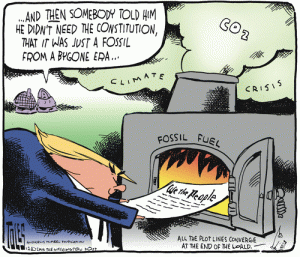 Remember the idea of visas for $5 million dollars? Well, now we know where that scatterbrained idea came from. Politico‘s Jack Blanchard warns us we are in for another mind-blowing week.
Get ready: We’ve got special and state-level elections happening Tuesday; Donald Trump’s latest tariff bonanza unveiled Wednesday; a budget vote-a-rama expected in the Senate Thursday and the TikTok ban deadline looming Friday night. On top of that, we’re expecting another big Trump phone call with Russia’s Vladimir Putin, and potentially the first Supreme Court ruling on the president’s efforts to deport migrants using an 18th-century wartime law. And that’s just the stuff we know about.I really do not get anyone who can’t see FARTUS and his cronies as a clear and present danger to our country. This is from CNBC’s Jeff Cox. “Goldman Sachs sees Trump tariffs spiking inflation, stunting growth and raising recession risks.” Well, can’t say I didn’t tell you this would happen back in mid-November when the real agenda became evident.
With decision day looming this week for President Donald Trump’s latest round of tariffs, Goldman Sachs expects aggressive duties from the White House to raise inflation and unemployment and drag economic growth to a near-standstill. The investment bank now expects that tariff rates will jump 15 percentage points, its previous “risk-case” scenario that now appears more likely when Trump announces reciprocal tariffs on Wednesday. However, Goldman did note that product and country exclusions eventually will pull that increase down to 9 percentage points. When the new trade moves are enacted, the Goldman economic team led by head of global investment research Jan Hatzius sees a broad, negative impact on the economy. In a note published on Sunday, the firm said “we continue to believe the risk from April 2 tariffs is greater than many market participants have previously assumed.” On inflation, the firm sees its preferred core measure, excluding food and energy prices, hitting 3.5% in 2025, a 0.5 percentage point increase from the prior forecast and well above the Federal Reserve’s 2% goal. That in turn will come with weak economic growth: Just a 0.2% annualized growth rate in the first quarter and 1% for the full year when measured from the fourth quarter of 2024 to Q4 of 2025, down 0.5 percentage point from the prior forecast. In addition, the Wall Street firm now sees unemployment reaching 4.5%, a 0.3 percentage point raise from the previous forecast. Taken together, Goldman now expects a 35% chance of recession in the next 12 months, up from 20% in the prior outlook. The forecast paints a growing chance of a stagflation economy, with low growth and high inflation. The last time the U.S. saw stagflation was in the late 1970s and early ’80s. Back then, the Paul Volcker-led Fed dramatically raised interest rates, sending the economy into recession as the central bank chose fighting inflation over supporting economic growth.
 One more read from me, and it’s off to the shower. This is from Salon. It’s a commentary from Chauncey DeVega. “Sadopolitics: Why MAGA clings tighter to Trump the more his policies hurt them. Psychology helps to explain why Trump’s followers will not abandon him” H/T to BeadBear. The explanation that I like best is this one. “Donald Trump is an expert at sadopolitics “
In a 2018 conversation with historian Timothy Snyder here at Salon, he elaborated on the meaning of sadopolitics (what he terms as “sadopopulism”) and its implications for the Age of Trump and the larger democracy crisis:Hold on to the family silver. It might be more valuable than the dollar and more useful than cryptocurrency. Hold on to anything gold. That’s about to go way up. It ain’t that pretty at all out there. Remember stagflation? We really don’t need to see that again, but then, we have an incompetent Dotard with insane ideas in charge of the country. He’s got equally incompetent Dotards out there wrecking the government. Well, that’s enough of what looks like a Debbie Downer Day for me, and it’s just started. At least the thunder is letting up. What’s on your reading and blogging list today? https://www.youtube.com/watch?v=Wwpagb-_Zk0“Sadopopulism” is the notion that you’re doing half of populism. You promise people things, but then when you get power you have no intention of even trying to implement any policy on behalf of the people. Instead, you deliberately make the suffering worse for your critical constituency. The people who got Trump into office, for example, are traditional Republican voters plus people in counties who are doing badly in terms of health care and other measures, and who need help.
Under Trump, of course, things will just get worse in terms of both the opioid addictions and in terms of wealth inequality. But that’s OK, because the logic of sadopopulism is that pain is a resource. Sadopopulist leaders like Trump use that pain to create a story about who’s actually at fault. The way politics works in that model is that government doesn’t solve your problems, it blames your problems on other people — and it creates the cycle that goes around over and over and over again. I started talking about sadopopulism because I got tired of people talking about populism.
In such a toxic relationship between the leader, the followers and the larger public, the abuse and misery actually bond them all closer together. The most loyal followers see their leader as simultaneously a source of protection and safety, even as he or she hurts them. To that point, the more Trump’s policies hurt his followers, the more likely they are to cling to him. Trump’s followers are also going to misdirect their rage, anger, blame, and other negative emotions and behavior at some “enemy.” In the Age of Trump, that enemy is Black and brown people and other nonwhites, “Woke” and “DEI, “illegal immigrants” and migrant “invaders,” the LGBTQ community and specifically transgender people, social “parasites” and “takers,” government employees, those not deemed sufficiently “patriotic” and therefore disloyal to MAGA and Trump (which here is synonymous with “Real America”), Muslims and other non-“Christians,” the Democrats, “liberals,” the news media (“fake news” and “lugenpresse”) and other targeted groups and individuals.
Mostly Monday Reads: Oy mishigas!
Posted: March 24, 2025 Filed under: #FARTUS, #MAGAnomics, American Fascists, Broligarchy, corporate greed, democracy is threatened, kakistocracy, Middle East, Polycrisis | Tags: @repeat1968, Broligarchy, FARTUS, Mafia Don, oligarchy, Paul Krugman, Vladimir Putin 7 Comments
“Putin addresses the residents of his newly acquired territory.” John Buss, @repeat1968, @johnbuss.bsky.social
Good Day, Sky Dancers!
I am having an ongoing debate with myself about the current administration. Is it the stupidity, the arrogance, or the meanness that most damaged our Constitutional democracy? Or is it the greed? I’m tagging all my posts here with the words Polycrisis, Kakistocracy, and Oligarchy or Broligarchy. It’s getting to be a tough search to find a few journalists who will actually tell it like it is.
This article in The Guardian early this month by Jonathan Freeland describes the current president thusly. “Donald Trump is turning America into a mafia state. The pattern is inescapable – with just one caveat: organised crime bosses occasionally display more honour.” I’ll just add a local New Orleans colloquialism. True Dat.
Behold Donald Corleone, the US president who behaves like a mafia boss – but without the principles. Of course, one hesitates to make the comparison, not least because Donald Trump would like it. And because the Godfather is an archetype of strength and macho glamour while Trump is weak, constantly handing gifts to America’s enemies and getting nothing in return. But when the world is changing so fast – when a nation that has been a friend for more than a century turns into a foe in a matter of weeks – it helps to have a guide. My colleague Luke Harding clarified the nature of Vladimir Putin’s Russia when he branded it the Mafia State. Now we need to attach the same label to the US under Putin’s most devoted admirer.
Consider the way Trump’s White House conducts itself, issuing threats and menaces that sound better in the original Sicilian. This week the president said that a deal ending Russia’s war on Ukraine “could be made very fast” but “if somebody doesn’t want to make a deal, I think that person won’t be around very long”. You didn’t need a translator to know that the somebody he had in mind was Volodymyr Zelenskyy.
On Thursday, Trump was confident that the Ukrainians would soon do his bidding “because I don’t think they have a choice”. Almost as if he had made them an offer they couldn’t refuse. Which of course he had. By ending the supply of military aid and the sharing of US intelligence, as he did this week, he had effectively put a Russian revolver to Ukraine’s temple, its imprint scarcely reduced by Trump’s declaration today that he is “strongly considering” banking sanctions and tariffs against Moscow, a move that looked a lot like a man pretending to be equally tough on the two sides, but which should fool nobody. He expects Zelenskyy to sign away a huge chunk of Ukraine’s minerals, the way Corleone’s rivals surrendered their livelihoods to save their lives.
This is how the US now operates in the world. Dispensing with the formalities during his annual address to Congress on Tuesday, Trump repeated his threat to grab Greenland: “One way or the other, we’re going to get it.” That recalled his earlier warning to Copenhagen to give him what he wants or face the consequences: “maybe things have to happen with respect to Denmark having to do with tariffs”. Nice place you got there; would be a shame if something happened to it.
It’s the same shakedown he’s performing on the US’s northern neighbour. Canada’s outgoing prime minister Justin Trudeau spelled it out this week, accusing Trump of trying to engineer “a total collapse of the Canadian economy because that will make it easier to annex us”, adding that: “We will never be the 51st state.” It’s a technique familiar in the darker corners of the New Jersey construction industry: a series of unfortunate fires that only stops when a recalcitrant competitor submits.
Both the substance and the style are pure mafia. Note the obsession with respect, demonstrated in last week’s Oval Office confrontation with Zelenskyy. Between them, JD Vance and Trump accused the Ukrainian leader three times of showing disrespect, sounding less like world leaders than touchy Tommy DeVito, the Joe Pesci character in Goodfellas.
Note too the humiliation of subordinates. In his address to Congress, the president introduced secretary of state Marco Rubio as the man charged with taking back the Panama canal. “Good luck, Marco,” said Trump, with a chuckle. “Now we know who to blame if anything goes wrong.” Cue anxious laughter from the rest of the underlings, briefly relieved that it wasn’t them.
It’s hard for aides and opponents alike to keep up because power is exercised arbitrarily and inconsistently. Tariffs are imposed, then suspended. Indeed, one reason why import taxes so appeal to Trump is that they can be enforced instantly and by presidential edict. That extends to the exemptions Trump can offer to favoured US industries. As MSNBC’s Chris Hayes observed: “This is very obviously going to be a protection racket, where Trump can at the stroke of a pen destroy or save your business depending on how compliant you are.”
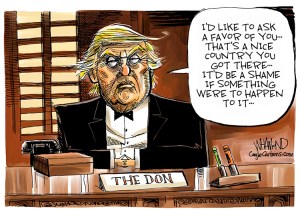 This characterization of Trump is so spot on that you really should go read the rest. I’m using this description of FARTUS as a background to the absolutely appalling crap that’s going on today. It’s hard to mentally deal with how quickly he’s disassembled so many long-standing U.S. Institutions in such a short time. This is especially true because it appears that the massive amount of incompetence and ignorance that his appointments display just escalates the damage. Look at this headline in The Atlantic. It’s reported by Jeffrey Goldberg. “The Trump Administration Accidentally Texted Me Its War Plans. U.S. national-security leaders included me in a group chat about upcoming military strikes in Yemen. I didn’t think it could be real. Then the bombs started falling.” WTAF?
The world found out shortly before 2 p.m. eastern time on March 15 that the United States was bombing Houthi targets across Yemen.
I, however, knew two hours before the first bombs exploded that the attack might be coming. The reason I knew this is that Pete Hegseth, the secretary of defense, had texted me the war plan at 11:44 a.m. The plan included precise information about weapons packages, targets, and timing.
This is going to require some explaining.
The story technically begins shortly after the Hamas invasion of southern Israel, in October 2023. The Houthis—an Iran-backed terrorist organization whose motto is “God is great, death to America, death to Israel, curse on the Jews, victory to Islam”—soon launched attacks on Israel and on international shipping, creating havoc for global trade. Throughout 2024, the Biden administration was ineffective in countering these Houthi attacks; the incoming Trump administration promised a tougher response.
This is where Pete Hegseth and I come in.
On Tuesday, March 11, I received a connection request on Signal from a user identified as Michael Waltz. Signal is an open-source encrypted messaging service popular with journalists and others who seek more privacy than other text-messaging services are capable of delivering. I assumed that the Michael Waltz in question was President Donald Trump’s national security adviser. I did not assume, however, that the request was from the actual Michael Waltz. I have met him in the past, and though I didn’t find it particularly strange that he might be reaching out to me, I did think it somewhat unusual, given the Trump administration’s contentious relationship with journalists—and Trump’s periodic fixation on me specifically. It immediately crossed my mind that someone could be masquerading as Waltz in order to somehow entrap me. It is not at all uncommon these days for nefarious actors to try to induce journalists to share information that could be used against them.
I accepted the connection request, hoping that this was the actual national security adviser, and that he wanted to chat about Ukraine, or Iran, or some other important matter.
Two days later—Thursday—at 4:28 p.m., I received a notice that I was to be included in a Signal chat group. It was called the “Houthi PC small group.”
A message to the group, from “Michael Waltz,” read as follows: “Team – establishing a principles [sic] group for coordination on Houthis, particularly for over the next 72 hours. My deputy Alex Wong is pulling together a tiger team at deputies/agency Chief of Staff level following up from the meeting in the Sit Room this morning for action items and will be sending that out later this evening.”
The message continued, “Pls provide the best staff POC from your team for us to coordinate with over the next couple days and over the weekend. Thx.”
The term principals committee generally refers to a group of the senior-most national-security officials, including the secretaries of defense, state, and the treasury, as well as the director of the CIA. It should go without saying—but I’ll say it anyway—that I have never been invited to a White House principals-committee meeting, and that, in my many years of reporting on national-security matters, I had never heard of one being convened over a commercial messaging app.
 Definitely go read this one. I’ve been missing reading John le Carré. I’m assuming anyone with a background in spying would have saucer eyes by this time. Trump’s love of playing checkers with the countries of the world is dangerous and immoral. He plays with everyone’s life like a mad king. This is from Oliver Darcy at Status. It’s a remarkable indictment of how the press enables his heinous policies and statements. “Gulf of Fear. When news anchors tiptoe around the name Gulf of Mexico, it’s not just semantics—it’s a glimpse at how the press starts to flinch under political pressure.”
In China, Taiwan doesn’t exist—at least not as a country. On official maps, it’s a province. The government enforces strict language about Taiwan’s status, shaping how its people—and the rest of the world—talk about it. The goal, of course, is far more significant than the name on a map. It’s not about semantics. It’s about wielding influence and asserting dominance. Controlling the language people use, particularly in relation to global geography, is a powerful capability to possess.
In the United States, that kind of top-down dictation might feel like a distant threat, the kind of thing that happens in authoritarian regimes or dystopian novels like “1984,” not in a country built on free speech safeguarded by the First Amendment. Americans tend to believe our press is too independent and and too proud to ever bow to government pressure. We assume that if a president ever tried to dictate language, the Fourth Estate would resist. We assume that we’re immune from such pressures.
But an important segment of the press—the television news media—over the past week quietly demonstrated that it is far less adversarial and far more compliant than the breathless promos these networks air hyping themselves as fearless truth-tellers. When the eyes of the world fixated on the stranded NASA astronauts being rescued and touching down back on Earth, every channel danced around what precisely to call the body of water they splashed into. A review of transcripts, courtesy of SnapStream, revealed an alarming reality: not one of the outlets could muster up the courage to simply refer to it as the Gulf of Mexico, the water feature’s name since the 16th century.
Instead, television news organizations tied themselves in knots, performing linguistic gymnastics to stay out of Donald Trump’s crosshairs, while also tiptoeing around audiences who would have surely been incensed to see them bend the knee and call it the “Gulf of America.” On ABC News, “World News Tonight” anchor David Muir referred to “spectacular images from off the coast of Florida.” On the “NBC Nightly news,” anchor Lester Holt spoke about the astronauts “splashing down off the Florida Gulf coast.” On the “CBS Evening News,” it was referred to simply as “the Gulf.” And on CNN, anchor Jake Tapper tried to seemingly have it both ways, noting the U.S. government refers to it as the “Gulf of America,” but the rest of the world calls it the Gulf of Mexico.
In fact, I could only one find instance on a television newscast where a journalist referred to the body of water as the Gulf of Mexico. During an appearance on MSNBC, NBC News correspondent Tom Costello used the term, but then quickly corrected himself, almost as if he had realized he was forbidden from doing so. “Six hours from right now, there will be a splashdown in the Gulf of Mexico,” he said, before backtracking. “Sorry, however you want to call the Gulf. It will be splashing down in the Gulf.”
Suffice to say, none of this was an accident.
 We first saw the capitulation of the tech bros and their social media platforms, including Jeff Bezos, who has ruined The Washington Post. This week, the situation there is getting worse. The first thing any autocrat wants to do is to come for any vestige of a free media. This is from MEDIAITE as reported by David Gilmour. “Trump Claims Jeff Bezos Trashed the ‘Crazy People’ in His Own Newsroom: ‘They’re Out of Control’.
President Donald Trump claimed that billionaire Washington Post owner Jeff Bezos privately expressed regret over the newspaper’s editorial direction and trashed his own “out of control” newsroom for writing “bad articles” about him.
The comments came during a sit-down with OutKick’s Clay Travis aboard Air Force One on Saturday after Travis suggested “it seems” that Bezos may be attempting to make The Washington Post “more fair” in coverage towards Trump.
Trump agreed and didn’t hesitate to praise Bezos, telling Travis “I think it’s great.”
Travis later asked whether Trump had discussed how the newspaper had come after him “like crazy” in the past, AND the president replied: “At length, I talked to him about it. [Bezos is] a good guy. I didn’t really know him in the first term. I mean, it’s such a difference between now and the first time.”
Pressed on what Bezos had said he had planned for The Post’s coverage, Trump said: “Just that. He’s really trying to be more fair.”
Trump continued: “They actually did a couple of bad articles on him. He said, ‘This is crazy, I lose my fortune running this thing and they, you know, they’re out of control.’ These people are crazy. They’re crazy people. They’re out of control.”
“And he’s a actually a very good guy,” the president added. “If you look at the inauguration, look at the people that were on that stage, here was a who’s who of a world that was totally against me the first time. It’s a much different presidency. I have much more support.”
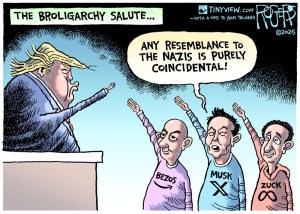 And now, we have the capitulation of top law firms. How many more legs of democracy will we lose? The Bulwark draws the line today. “Stop Making Excuses for Not Fighting Trump. The capitulations and acquiescence we’ve seen so far will only make opposition more difficult down the road.” This is written by William Kristol under the lede “No Excuse.”
Among those who might be expected to stand up against Donald Trump’s authoritarianism, the hills are alive with the sound of excuses.
You’re an elected official. The Trump administration has rounded up individuals and sent them, without any due process and with much carelessness about who’s been seized, to a mega-prison in El Salvador. The administration is boasting about what it’s done and heralding it a prelude to further actions in the same vein.
You’re thinking of condemning these truly grotesque violations of constitutional rights and human decency. Maybe I should say this isn’t right?
Whoa, Nellie! Not so fast, your political advisers hasten to instruct you. The polls on this issue aren’t great. This really isn’t the hill to die on.
You take their advice. But you tell yourself, and you assure others, that of course you will fight one day—on some other hill, on some faraway hill, some time far in the future.
But to fight now? Bad idea. That would simply play into Trump’s hands. After all, Trump and his allies are good at fighting. If you try to do something, there’s a risk they’ll turn it against you. Whereas if you say nothing, nothing can be used against you.
You might worry for a second that silence and acquiescence just plays into Trump’s hands. But you’re not a sophisticated Democratic operative. So you take their advice.
And anyway, there’s a better plan. That plan is that, eventually, Trump will become less popular. Then, the public will rise up. And then you can speak up. It all works out.
It also works out if you’re in the private sector. In fact, if you’re the head of a huge law firm, capitulation isn’t just a regrettable necessity, it’s your duty. You’re acting in the best interests of your clients. It would be wrong and irresponsible to act otherwise.
What’s more, No one in the wider world can appreciate how stressful it is to confront an executive order like this until one is directed at you.
The people in the “wider world”—those serving in the military or waiting tables or cleaning offices at Paul Weiss—they just can’t appreciate the stress that comes from occupying that corner office at 51st and 6th.
Ugh.
All of these excuses—and there are many more!—are distasteful. But what’s worse is that they make it easier and more likely that others will capitulate. They make it seem that you’re kind of a chump if you actually fight Trump’s authoritarian takeover. The excuses offered for capitulation increase the damage done by capitulation.
As usual, Shakespeare saw all. Here’s Pembroke in Act IV, Scene 2 of King John:
And oftentimes excusing of a fault
Doth make the fault the worse by th’ excuse,
As patches set upon a little breach
Discredit more in hiding of the fault
Than did the fault before it was so patched.The excuses offered by our elites for not standing up to authoritarianism have the effect of helping the authoritarians gain further ground.
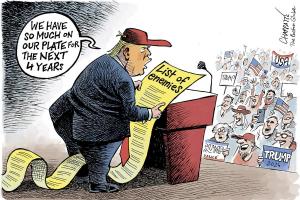 Zach Beauchamp writes at VOX, “There’s a pattern in Trump’s power grabs. The White House strategy demands we defend alleged criminals and those with unpopular views.”
After rising to power, Nazis pitched power grabs as efforts to address the alleged threat posed by menaces like “Judeo-Bolshevism,” harnessing the powers of bigotry and political polarization to get ordinary Germans on board with the demolition of their democracy.
What’s happening in America right now has chilling echoes of this old tactic. When engaging in unlawful or boundary-pushing behavior, the Trump administration has typically gone after targets who are either highly polarizing or unpopular. The idea is to politicize basic civil liberties questions — to turn a defense of the rule of law into either a defense of widely hated groups or else an ordinary matter of partisan politics.
The administration’s first known deportation of a green card holder targeted a pro-Palestinian college activist at Columbia University, the site of some of the most radical anti-Israel activity. For this reason, Columbia was also the first university it targeted for a funding cutoff. Trump has also targeted an even more unpopular cohort: The first group of American residents sent to do hard labor in a Salvadoran prison was a group of people his administration claimed without providing evidence were Tren de Aragua gang members.
Trump is counting on the twin powers of demonization and polarization to justify their various efforts to expand executive authority and assail civil liberties. They want to make the conversation less about the principle — whether what Trump is doing is legal or a threat to free speech — and more a referendum on whether the targeted group is good or bad.
There is every indication this pattern will continue. And if we as a society fail to understand how the Trump strategy works, or where it leads, the damage to democracy could be catastrophic.
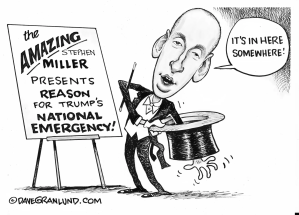 This, too, is a long read that deserves a look. A lot of this goes back to White House aid Stephan Miller. This guy needs to have an entire press detail following him. I’m going to end with a few articles on economics. The first comes from Paul Krugman and will clarify what’s happening with Social Security. “Social Security: A Time for Outrage. Trump’s policies attack his own base — but who will tell them?” I often find myself in conversations with friends, and we all wonder if Trump Supporters will ever show a glimmer of intelligence.
Donald Trump is often described as a “populist.” Yet his administration is stuffed with wealthy men who are clueless about how the other 99.99 percent lives, while his policies involve undermining the working class while enabling wealthy tax cheats.
What is true is that many working-class voters supported Trump last year because they believed that he was on their side. And that disconnect between perceptions and reality ought to be at the heart of any discussion of what Democrats should do now.
Right now the central front in the assault on the working class is Social Security, which Elon Musk, unable to admit error, keeps insisting is riddled with fraud. The DOGE-bullied Social Security Administration has already announced that those applying for benefits or trying to change where their benefits are deposited will need to verify their identity either online or in person — a huge, sometimes impossible burden on the elderly, often disabled Americans who need those benefits most. And with staff cuts and massive DOGE disruption, it seems increasingly likely that some benefits just won’t arrive as scheduled.
Oh, and Leland Dudek, the acting Social Security administrator, threatened to shut the whole thing down unless DOGE was given access to personal data.
Not to worry, says Howard Lutnick, Trump’s Commerce secretary. Only “fraudsters” would complain about missing a Social Security check:
Let’s say social security didn’t send out their checks this month. My mother who’s 94, she wouldn’t call and complain. She’d think something got messed up, and she’ll get it next month. A fraudster always makes the loudest noise, screaming, yelling and complaining.
There’s so much wrong with that statement that it’s hard to know where to start. But it’s clear that Lutnick — like many affluent people — has no idea how important Social Security is to the finances of most older Americans. According to a Social Security Administration study, half of Americans over 65 get a majority of their income from Social Security; a quarter depend almost entirely on Social Security, which supplies more than 90 percent of their income. I doubt that these people would shrug off a missed check.
Reliance on Social Security isn’t evenly distributed across the population; it’s strongly correlated with socioeconomic status. In particular, it very much depends on education, with less-educated Americans much more reliant on the program than those with more education:
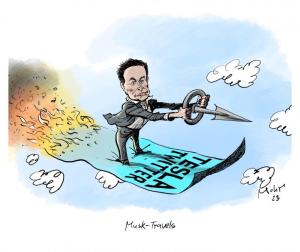 That Lutnick quote cannot be repeated enough. The last read I’m sharing today comes from The Economist. “Musk Inc is under serious threat. The world’s richest man has lost focus. His competitors are taking advantage.” Well, isn’t that special?
UNTIL RECENTLY Elon Musk had little need to look over his shoulder. He once described competition for Tesla, his electric-vehicle (EV) company, as “the enormous flood of gasoline cars pouring out of the world’s factories every day”, rather than the “small trickle” of other EV-makers. SpaceX, his rocket firm, had so undercut and outwitted the bloated aerospace incumbents that it had developed an almost invincible aura.
Yet if Mr Musk can tear himself away from the intoxication of shredding the American government, he may notice something. It is not just that the political firestorms he has whipped up this year are singeing his companies’ brands. It is that the two businesses that underpin his corporate empire—accounting for around 90% of its value and probably all its profit—are facing increasingly stiff competition. The world’s richest man has lost focus—and now has a target on his back.
Start with SpaceX. Last year it conducted five out of every six of the world’s spacecraft launches. Through its Starlink division, it owns 60% of satellites in space. In December it sold shares at a valuation of $350bn, two-thirds higher than its previous level. Starlink, its main profit engine, is on track to generate more than $11bn of revenue this year and $2bn of free cash flow, says Chris Quilty of Quilty Space, a consultancy.
Now, however, Mr Musk’s bomb-throwing interventions are alarming SpaceX customers, and at a time when rivals are growing more capable. His on-again, off-again threats to end Starlink’s support for Ukraine have raised the difficult question of trust. European politicians are pondering how reliable Mr Musk will be as a long-term provider of strategic satellite communications. The search for alternatives has helped spur a more than tripling of the share price of Eutelsat, the French owner of OneWeb, which provides satellite services to broadband companies.
No European supplier could come close to matching the 7,000 satellites Starlink has in low orbit. (Eutelsat has a mere 600.) Nor could any compete on price. As Simon Potter of BryceTech, another space consultancy, puts it, for now the concerns are “more noise than action”. Yet Starlink may soon face meaningful competition from Amazon’s Project Kuiper, which aims to put over 3,000 satellites into low orbit, creating a space-based broadband network. If it achieves that, some customers outside America may decide they have more confidence in an Amazon product than in one belonging to the mercurial Mr Musk.
Jeff Bezos, Amazon’s founder, is also stepping up the pace in the launch business with Blue Origin. His rocket firm is separate from Project Kuiper, but has contracts to fly many of its satellites. In January Mr Bezos’s New Glenn rocket reached orbit on its first try. If Blue Origin manages to make repeated successful journeys with reusable rockets, it could become a meaningful competitor to SpaceX. So could Rocket Lab, SpaceX’s closest rival by number of launches, which is due to debut Neutron, a new rocket, this year.

Here comes the Rooster.
It’s like we’re in a very bad dystopian novel and can’t escape. Anyway, I’m not shutting up any time soon.
What’s on your Reading and Blogging list today?
Here’s a picture of this big boy who keeps crossing the road in front of my house. The rain just stopped, and the sun cleared up, so he’s been yelling at the sun for about an hour now. I feel like he’s some kind of omen.
Here’s an Alice in Chains song about the Vietnam War. That ought to cheer you up.

 peej
peej Carissa
 bostonboomer
 dakinikat
 ecocatwoman
 jjlolatina
 mablue2
 Mama Lopez
 peggysue22
 quixote
 skydancingguestblogger
 Mona (aka Wonk the Vote)



 Sky Dancing
Recent Comments