
Lazy Saturday Reads: D-Day Edition
Posted: June 6, 2015 Filed under: Civil Rights, Crime, Criminal Justice System, Foreign Affairs, morning reads, Republican politics, U.S. Politics | Tags: Adolf Hitler, D-Day 71st anniversary, Dennis Hastert, Josh Duggar, Jr., Lonnie Franklin, sexual molestation, Tales of the Grim Sleeper, The Longest Day, World War II 38 Comments
Allied ships, boats and barrage balloons off Omaha Beach after the successful D-Day invasion, near Colleville-sur-Mer, Normandy, France on June 9, 1944. (Photo by Galerie Bilderwelt/Getty Images)
Good Morning!!
Today is the 71st anniversary of the D-Day invasion of Normandy. I found some stunning original color photos at The Denver Post, and I thought I’d share a few of them here. Go to the link to see the entire collection. I’ve also gathered some interesting articles on the “longest day” along with remembrances from survivors.
From The Charlotte Observer: D-Day: Only the beginning – with the end nowhere in sight, by David Perlmutt.
With Saturday comes another anniversary of D-Day as the light continues to dim on the generation that fought it.
Seventy-one years have passed since Carolinians such as Andy Andrews of Black Mountain and Walter Dickens of Monroe got their first taste of combat when they rushed ashore at Normandy, France, on June 6, 1944, the pivotal day historians tag as the beginning of the end for Nazi Germany.
It was more of a beginning than an end. Long after D-Day’s first anniversary, the bullets would continue to fly in the Pacific theater and other parts of the world.
A year ago, I wrote a series of stories to honor the 70th anniversary of D-Day through the eyes – and distant memories – of Andrews, Dickens and others like paratroopers Harold Eatmon of Mint Hill and E.B. Wallace of Waxhaw. The fighting took another 11 months and horrific losses during battles in countries such as France, Holland, Belgium and ultimately Germany before the Germans surrendered.
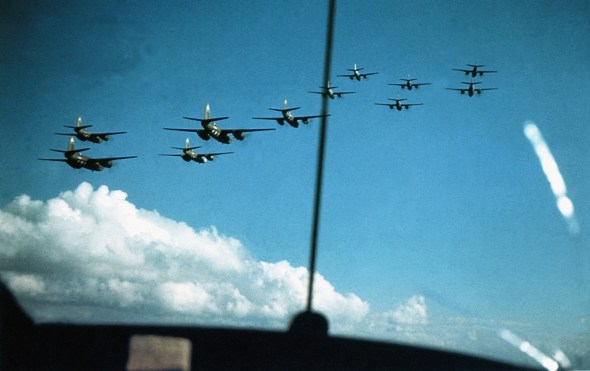
Planes from the 344th Bomb Group, which led the IX Bomber Command formations on D-Day on June 6, 2014. Operations started in March 1944 with attacks on targets in German-occupied France, Belgium, and the Netherlands. After the beginning of the Normandy invasion, the Group was active at Cotentin Peninsula, Caen, Saint-Lo and the Falaise Gap. (Photo by Galerie Bilderwelt/Getty Images)
Fighting continued in the Pacific, where my Dad was stationed, for a long time after June 6, 1944. He was on a ship traveling to Japan when the U.S. dropped the bombs on Hiroshima and Nagasaki. He said they celebrated–not knowing the horror the bombs would unleash–they were saved. My Dad might not have come home if those bombs hadn’t been dropped.
A year after D-Day, thousands of U.S. Marine and Army troops were still two weeks away from capturing Okinawa, the last in a hopscotch of islands that Allied forces needed for a plan to force Japan’s unconditional surrender. Offshore, U.S. Navy ships absorbed daily attacks by Japanese kamikaze (suicide) planes as their guns pounded hills above the landing beaches. Army Air Forces planes bombed targets inland to soften the Japanese defense.
As they fought to take control of Okinawa, hundreds of thousands of U.S. soldiers, Marines and sailors prepared to take part in what would have been history’s greatest battle – Operation Olympic, code-named Downfall, the invasion of the Japanese homeland.
They knew the fighting would be fierce.
Much more at the link. It’s a very good piece.

British Navy Landing Crafts (LCA-1377) carry United States Army Rangers to a ship near Weymouth in Southern England on June 1, 1944. British soldiers can be seen in the conning station. For safety measures, U.S. Rangers remained consigned on board English ships for five days prior to the invasion of Normandy, France. (Photo by Galerie Bilderwelt/Getty Images)
CNN: He got to witness ‘The Longest Day,’ by Val Lauder.
Cornelius Ryan was a 24-year-old war correspondent when he had a chance to see a defining moment in the defining event of the 20th century — the Allied landings on the coast of France to retake France and bring down Hitler.
Ryan at first witnessed the invasion from a bomber that flew over the beaches. Then, back in England, he scrambled to find the only thing he could that was going to Normandy. A torpedo boat that, he learned too late, had no radio. “And if there’s one thing that an editor is not interested in,” he said, “it’s having a reporter somewhere he can’t write a story.”
Recalling those five hours off the coast, watching the struggle on the beaches, he remembered “the magnitude of the thing, the vastness. I felt so inadequate to describe it.”
But today, as the 71st anniversary of D-Day approaches on June 6, Ryan is most likely to be remembered for being the one who did describe it, who told so many millions the real story of what happened that day, in his book which became the famous movie, “The Longest Day.”
Lauder was a young woman headed to journalism school at Northwestern when the invasion took place.
In September 1962, I interviewed Cornelius Ryan before the New York premiere of the film. Ryan had become the authority on the events of June 6, 1944, following publication of his book. And as he himself noted, in the 10 years it took him to research and write the book, he became “a veritable depository of D-Day memorabilia.”
He shared some of what he’d learned as we talked in the study of his home in Ridgefield, Connecticut, that Sunday afternoon.
Read her remembrances at the CNN link.
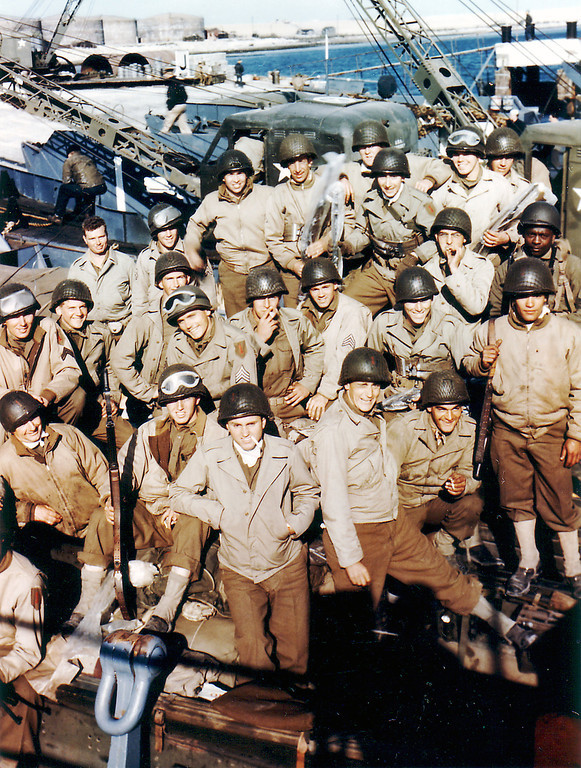
The 1st Infantry Division of the United States Army (The ‘Big Red One’) in Dorset, United Kingdom on June 5, 1944 before departing for Omaha Beach. (Photo by Galerie Bilderwelt/Getty Images)
The Christian Science Monitor: D-Day June 6, 1944: How did Hitler react?
Considering the pivotal nature of June 6, 1944, how did Hitler react to the attack? Did he rant, did he rail? Did he move with focused calm to try and repel the invaders? [….]
In the early days of June Germany’s Fuhrer was at The Berghof, his residence in the Bavarian Alps. Everyone there knew an invasion was likely in the near future, but the atmosphere was not nervous, according to contemporary accounts. To the contrary it was relaxed, and in the evening, almost festive. A group of guests and military aides would gather at the complex’s Tea House and Hitler would hold forth on favorite topics, such as the great men of history, or Europe’s future.
On the evening of June 5, Hitler and his entourage watched the latest newsreels, and then talked about films and theater. They stayed up until 2 a.m., trading reminiscences. It was almost like the “good old times,” remembered key Hitler associate Joseph Goebbels.
When Goebbels left for his own quarters, a thunderstorm broke, writes British historian Ian Kershaw. German military intelligence was already picking up indications of an oncoming Allied force, and perhaps landing troops, in the Normandy region. But Hitler wasn’t told. The Fuhrer retired around 3 a.m.
German headquarters confirmed that some sort of widespread attack was in progress shortly thereafter. At sunrise, around 6 a.m., the defenders knew: Allied ships and planes were massed off the French beaches in astounding strength, and men were beginning to come ashore. It was a sight many would never forget.
But the German reaction was slow and befuddled. Was this the real thing, the main invasion? Or was it a feint, with the real force to land elsewhere, probably Calais?
Read more at the link.
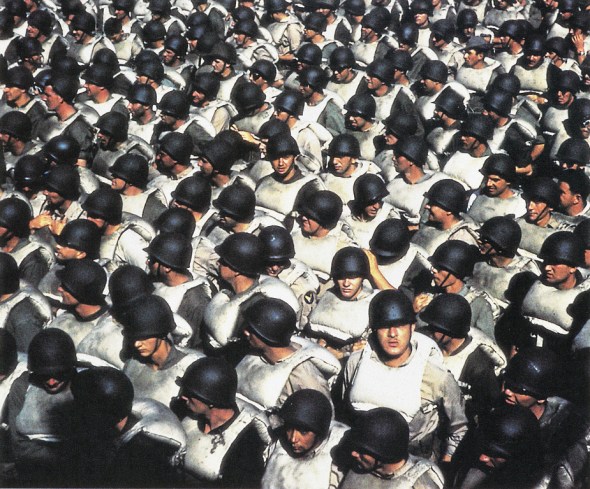
A U.S. Landing Craft Infantry (LCI) filled with invasion troops approaches the French coast from the sea in June of 1944. The GIs wear life vests in preparation for the landing. (Photo by Galerie Bilderwelt/Getty Images)
More D-Day stories:
The Daily Mail, D-Day heroes’ courage remembered.
AP via The Miami Herald, Vets, visitors return to Normandy to mark D-Day anniversary.
Constitution Daily, Ten fascinating facts on the 71st anniversary of D-Day.
The Daily Beast, The Stacks: A D-Day Vet Shows Normandy to His Son.
Pittsburgh Post-Gazette, Veterans of D-Day mark 71st anniversary: 4 will be honored today at Heinz History Center.
The Nation on what was happening in Congress on D-Day–a bunch of nonsense, just like today. June 6, 1944: D-Day Invasion of France.
Heavy, D-Day Invasion: Top 10 Best Quotes & Sayings.

A Recommendation
Before I get to the rest of the news, I want to highly recommend an HBO documentary I watched a few days ago called Tales of the Grim Sleeper. It’s the story of how serial killer Lonnie Franklin, Jr. murdered as many as 100 African-American women in South Central LA over more than 20 years while the LAPD ignored what was happening.
This isn’t the story of a serial killer–it’s about police attitudes toward the poor and people of color; and it fits right in with recent events in places like Ferguson, Cleveland, Staten Island, and Baltimore and with the Black Lives Matter movement.
This story could have happened in a poor neighborhood in any major American city. In fact, there was a similar case in Cleveland where Anthony Sowell murdered poor black women for years without getting caught because the crimes weren’t taken seriously.
If you have HBO or can get access to it, please watch this outstanding film.
Other News, links only
News News
Brian Beutler at The New Republic, Hillary Clinton’s Grand Strategy to Beat the GOP: Take Bold Positions Early and Often.
Politico, 2016 field descends on Iowa for Joni Ernst shindig.
New York Times, Beau Biden Funeral Draws Many Mourners, Including Obama.
LA Times, LAPD finds officers were justified in fatal shooting of mentally ill man, sources say.
Politico, Anti-war activist confronts Sen. Tom Cotton.
Paul Krugman, Lone Star Stumble.
Voice of America, Death Toll Jumps to Nearly 400 in China Ship Sinking.
BBC News, President Vladimir Putin tells West not to fear Russia
Sexual Molestation News
AP, via AOL, Sister: Brother had sexual relationship with Hastert.
NBC News, Dennis Hastert Case: Abuse Group Wants Congressional Portrait Removed.
Huffington Post, Dennis Hastert Hid His Skeletons As He Helped Push GOP’s Anti-Gay Agenda.
Fox News, Jessa: Josh Duggar was ‘in puberty and a little too curious about girls.’
ABC News, Duggars Put Locks on Doors as a Safeguard Following Alleged Molestation.
Is a crime still “alleged” after the perpetrator and his parents acknowledge that he did it? Just asking.
Time, Josh Duggar’s Sister on Molestation: ‘It Wasn’t Like a Horror Story.’
Yibada, Josh Duggar’s Sister Jill Dillard: My Parents Did Such An Amazing Job.
Gawker, The Truth About Josh Duggar’s Sham Cult-Center “Counseling.”
What else is happening? As always, treat this as an open thread.
Tuesday Reads: Emily Yoffe and the Problem of Sexual Assault on College Campuses
Posted: June 2, 2015 Filed under: Crime, Criminal Justice System, morning reads, Women's Rights | Tags: binge drinking, Emily Yoffe, rape, sexual assault on college campuses, Slate Magazine 34 Comments
William W. Churchill, Woman Reading on a Settee
Good Morning!!
This morning I read a long article by Emily Yoffe at Slate about The Hunting Ground, a documentary about rape on college campuses, How The Hunting Ground Blurs the Truth. I haven’t seen the film, but Yoffe says that CNN plans to show it in the future so maybe we’ll all get to see it eventually. Anyway, I thought I’d present Yoffe’s arguments and some of the responses to her previous posts on the subject and see what you think.
In the article, Yoffe focuses one of the cases presented in the film, listing a number of facts and inconsistencies that she says were ignored by the filmmakers. She also demonstrates a great deal of sympathy for the man who allegedly committed the sexual assaults.

Arthur M. Hazard, Woman Reading in an Interior
Some excerpts:
The recent documentary The Hunting Ground asserts that young women are in grave danger of sexual assault as soon as they arrive on college campuses. The film has been screened at the White House for staff and legislators. Senate Democrat Kirsten Gillibrand, who makes a cameo appearance in the film, cites it as confirmation of the need for the punitive campus sexual assault legislation she has introduced. Gillibrand’s colleague Barbara Boxer, after the film’s premiere said, “Believe me, there will be fallout.” The film has received nearly universal acclaim from critics—the Washington Post called it “lucid,” “infuriating,” and “galvanizing”—and, months after its initial release, its influence continues to grow, as schools across the country host screenings. “If you have a daughter going to any college in America, you need to see The Hunting Ground,” the MSNBC host Joe Scarborough told his viewers in May. This fall, it will get a further boost when CNN, a co-producer, plans to broadcast the film, broadening its audience. The Hunting Ground is helping define the problem of campus sexual assault for policymakers, college administrators, students, and their parents.
The film has two major themes. One, stated by producer Amy Ziering during an appearance on The Daily Show, is that campus sexual assaults are not “just a date gone bad, or a bad hook-up, or, you know, miscommunication.” Instead, the filmmakers argue, campus rape is “a highly calculated, premeditated crime,” one typically committed by serial predators. (They give significant screen time to David Lisak, the retired psychology professor who originated this theory.) The second theme is that even when school administrators are informed of harm done to female students by these repeat offenders, schools typically do nothing in response. Director Kirby Dick has said that “colleges are primarily concerned about their reputation” and that “if a rape happens, they’ll do everything to distance themselves from it.” In the film, a former assistant dean of students at the University of North Carolina, Melinda Manning, says schools “make it difficult for students to report” sexual assault in order to avoid federal reporting requirements and to “artificially keep [their] numbers low.”
One of the four key stories told in the film illustrates both of these points. It is the harrowing account of Kamilah Willingham, who describes what happened during the early morning hours of Jan. 15, 2011, while she was a student at Harvard Law School. She says a male classmate, a man she thought was her friend, drugged the drinks he bought at a bar for her and a female friend, then took the two women back to Willingham’s apartment and sexually assaulted them. When she reported this to Harvard, she says university officials were indifferent and even hostile to her. “He’s dangerous,” she says in the film of her alleged attacker, as she tries to keep her composure. “This is a rapist. This is a guy who’s a sexual predator, who assaulted two girls in one night.” The events continue to haunt her. “It’s still right up here,” she says tearfully, placing a hand on her chest.

William W. Churchill, Leisure
You’ll probably have to read the entire article to get a full understanding of this case, but this should give you a sense of where Yoffe is coming from:
I looked into the case of Kamilah Willingham, whose allegations generated a voluminous record. What the evidence (including Willingham’s own testimony) shows is often dramatically at odds with the account presented in the film.
Willingham’s story is not an illustration of a sexual predator allowed to run loose by self-interested administrators. The record shows that what happened that night was precisely the kind of spontaneous, drunken encounter that administrators who deal with campus sexual assault accusations say is typical. (The filmmakers, who favor David Lisak’s poorly substantiated position that our college campuses are rife with serial rapists, reject the suggestion that such encounters are the source of many sexual assault allegations.) Nor is Willingham’s story an example of official indifference. Harvard did not ignore her complaints; the school thoroughly investigated them. And because of her allegations, the law school education of her alleged assailant has been halted for the past four years.
Yoffe has a history of denying the seriousness of the problem of campus rape (even though in this article she twice *says* it’s a serious issue). Her position seems to be that if college women just stopped getting drunk, rape on campus would be a minor or nonexistent problem.
I found it interesting that she refers to David Lisak’s research on campus rapists as a “theory,” and characterizes his work as “poorly substantiated.” The link to her evidence that Lisak’s work is somehow problematic goes to another article written by Yoffe in which she cites Lisak and another researcher explaining that it’s important to be aware that the (pretty large) sample of UMass students that Lisak used may not be typical of all college populations. This is a standard caveat given in most psychology research papers, because studies on human beings can rarely be representative of the population as a whole. The results need to be considered in the light of other studies and studies of varied populations. That doesn’t invalidate the findings.

Here’s the article in which Yoffe finds fault with Lisak’s research: The College Rape Overcorrection. Again, you probably should read the whole thing, because I can’t represent her arguments in a brief excerpt. Still, here’s a bit of it:
In recent years, young activists, many of them women angry about their treatment after reporting an assault, have created new organizations and networks in an effort to reform the way colleges handle sexual violence. They recognized they had a powerful weapon in that fight: Title IX, the federal law that protects against discrimination in education. Schools are legally required by that law to address sexual harassment and violence on campus, and these activists filed complaints with the federal government about what they describe as lax enforcement by schools. The current administration has taken up the cause—the Chronicle of Higher Education describes it as “a marquee issue for the Obama administration”—and praised these young women for spurring political action. “A new generation of student activists is effectively pressing for change,” read a statement this spring announcing new policies to address campus violence. The Department of Education has drafted new rules to address women’s safety, some of which have been enshrined into law by Congress, with more legislation likely on the way.
Unfortunately, under the worthy mandate of protecting victims of sexual assault, procedures are being put in place at colleges that presume the guilt of the accused. Colleges, encouraged by federal officials, are instituting solutions to sexual violence against women that abrogate the civil rights of men. Schools that hold hearings to adjudicate claims of sexual misconduct allow the accuser and the accused to be accompanied by legal counsel. But as Judith Shulevitz noted in the New Republic in October, many schools ban lawyers from speaking to their clients (only notes can be passed). During these proceedings, the two parties are not supposed to question or cross examine each other, a prohibition recommended by the federal government in order to protect the accuser. And by federal requirement, students can be found guilty under the lowest standard of proof: preponderance of the evidence, meaning just a 51 percent certainty is all that’s needed for a finding that can permanently alter the life of the accused.
More than two dozen Harvard Law School professors recently wrote a statement protesting the university’s new rules for handling sexual assault claims. “Harvard has adopted procedures for deciding cases of alleged sexual misconduct which lack the most basic elements of fairness and due process,” they wrote. The professors note that the new rules call for a Title IX compliance officer who will be in charge of “investigation, prosecution, fact-finding, and appellate review.” Under the new system, there will be no hearing for the accused, and thus no opportunity to question witnesses and mount a defense. Harvard University, the professors wrote, is “jettisoning balance and fairness in the rush to appease certain federal administrative officials.” But to push back against Department of Education edicts means potentially putting a school’s federal funding in jeopardy, and no college, not even Harvard, the country’s richest, is willing to do that.

Again, Yoffe focuses sympathetically on one case involving a male student at the University of Michigan, Drew Sterrett. She also cites research by Callie Marie Rennison and Lynn Addington, who found that non-college women are in greater danger of rape than college women. She doesn’t address the issue that universities are entrusted by parents with protecting young people who may be away from home for the first time.

In an article from October 2013, Yoffe really gets to the point: College Women: Stop Getting Drunk. It’s closely associated with sexual assault. And yet we’re reluctant to tell women to stop doing it. Again, just a brief excerpt:
Let’s be totally clear: Perpetrators are the ones responsible for committing their crimes, and they should be brought to justice. But we are failing to let women know that when they render themselves defenseless, terrible things can be done to them. Young women are getting a distorted message that their right to match men drink for drink is a feminist issue. The real feminist message should be that when you lose the ability to be responsible for yourself, you drastically increase the chances that you will attract the kinds of people who, shall we say, don’t have your best interest at heart. That’s not blaming the victim; that’s trying to prevent more victims.
Experts I spoke to who wanted young women to get this information said they were aware of how loaded it has become to give warnings to women about their behavior. “I’m always feeling defensive that my main advice is: ‘Protect yourself. Don’t make yourself vulnerable to the point of losing your cognitive faculties,’ ” says Anne Coughlin, a professor at the University of Virginia School of Law, who has written on rape and teaches feminist jurisprudence. She adds that by not telling them the truth—that they are responsible for keeping their wits about them—she worries that we are “infantilizing women.”
So perpetrators are “responsible for committing their crimes,” but women are the ones who should change their behavior. Why not keep criminals off college campuses and try to prevent both male and female students from drinking so much? Yoffe explains her reasoning at the end of the article:
I’ve told my daughter that it’s her responsibility to take steps to protect herself. (“I hear you! Stop!”) The biological reality is that women do not metabolize alcohol the same way as men, and that means drink for drink women will get drunker faster. I tell her I know alcohol will be widely available (even though it’s illegal for most college students) but that she’ll have a good chance of knowing what’s going on around her if she limits herself to no more than two drinks, sipped slowly—no shots!—and stays away from notorious punch bowls. If female college students start moderating their drinking as a way of looking out for their own self-interest—and looking out for your own self-interest should be a primary feminist principle—I hope their restraint trickles down to the men.
If I had a son, I would tell him that it’s in his self-interest not to be the drunken frat boy who finds himself accused of raping a drunken classmate.

She is correct that women are affected more quickly by alcohol than men, but is that a reason to focus only on college women’s responsibility for preventing sexual assaults? She actually believes that we should just hope that if women drink less, men will emulate them? Good luck with that.
I’ve found several responses to Yoffe’s previous articles. I’ll watch to see the reactions to the latest one which came out yesterday. Here are some links you can check out if you’re interested.
Emma Gray at Huffington Post: What Slate Gets So Wrong About College Women And Sexual Assault.
Alexander Abad-Santos in The Wire: Slate Forgot That the One Common Factor in Rapes Are [sic] Rapists.
Kate McDonough at Salon: Sorry, Emily Yoffe: Blaming assault on women’s drinking is wrong, dangerous and tired.
Erin Gloria Ryan at Jezabel: How To Write About Rape Prevention Without Sounding Like An Asshole.
Jennifer Baker at Psychology Today (also cited in the main post): Campus Rape Skepticism. How Not to ‘Debunk’ Research.
Josh Beitel at Medium: A Rebuttal to Emily Yoffe’s College Rape Overcorrection.
As always, this is an open thread, so feel free to post your thoughts and links on any topic in the comment thread.
Tuesday Reads
Posted: May 12, 2015 Filed under: Barack Obama, Crime, Criminal Justice System, Foreign Affairs, morning reads, U.S. Politics | Tags: Baltimore police, Benghazi, conspiracy theories, Freddie Gray, investigative journalism, Nepal earthquakes, Osama bin Laden, police brutality, Religion in America, Seymour Hersh 16 Comments  Good Morning!!
Nepal has been rocked by 7.3 magnitude earthquake only a few weeks after the last one. From The LA Times:
Still reeling from last month’s devastating earthquake, Nepal was hammered again Tuesday by a magnitude 7.3 temblor that caused dozens more deaths, unleashed fresh landslides and brought down unsteady buildings.
By late afternoon, Nepal’s Home Affairs Ministry said at least 42 people were killed and more than 1,117 injured in the largest aftershock yet recorded from the 7.8 quake on April 25. Officials warned that the toll could rise.
The epicenter was about 47 miles northeast of the capital, Katmandu, near the Chinese border, according to the U.S. Geological Survey. The April 25 quake, which killed more than 8,150 people, was centered in the mountains west of Katmandu.
The tremor struck just before 1 p.m. local time, sending residents of the capital scurrying into the open air for safety, and was followed by a series of smaller tremors that rattled nerves even further.
Within hours, new makeshift tents had begun popping up in parts of Katmandu as families that had survived the earlier quake and returned to their homes in recent days decided again they were safer sleeping outdoors.
The Hindu is publishing live updates from Reuters. They report multiple aftershocks. What a terrible tragedy! Obviously this is a developing story, and we’ll hear more throughout the day and in coming days.

I missed this important investigative article from the Baltimore Sun over the weekend: Freddie Gray among many suspects who do not get medical care from Baltimore police.
Records obtained by The Baltimore Sun show that city police often disregard or are oblivious to injuries and illnesses among people they apprehend — in fact, such cases occur by the thousands.
From June 2012 through April 2015, correctional officers at the Baltimore City Detention Center have refused to admit nearly 2,600 detainees who were in police custody, according to state records obtained through a Maryland Public Information Act request.
In those records, intake officers in Central Booking noted a wide variety of injuries, including fractured bones, facial trauma and hypertension. Of the detainees denied entry, 123 had visible head injuries, the third most common medical problem cited by jail officials, records show.
The jail records redacted the names of detainees, but a Sun investigation found similar problems among Baltimore residents and others who have made allegations of police brutality.e
Salahudeen Abdul-Aziz, who was awarded $170,000 by a jury in 2011, testified that he was arrested and transported to the Western District after being beaten by police and left with a broken nose, facial fracture and other injuries. Hours later, he went to Central Booking and then to Bon Secours Hospital, according to court records.
Abdul-Aziz said last week that jailers at Central Booking “wouldn’t let me in the door as soon as they saw my face. … I thought I was gonna die that day. Freddie Gray wasn’t so lucky.”
Read the rest at the Baltimore Sun link.

The Washington Post, which initially published leaks favorable to the Baltimore PD, published an editorial in response the the Sun article: Too much black and blue in Baltimore.
TWO OR three times a day on average, suspects in the custody of the Baltimore police are turned away by the city jail because they are deemed too battered, beaten, bruised or otherwise injured or sick to be processed and admitted. The police are forced to head instead for a hospital emergency room to seek treatment for suspects suffering from head injuries, broken bones, hypertension and an array of other afflictions.
The frequency of such occurrences was detailed over the weekend by the Baltimore Sun, which obtained records from the city’s detention center under the Maryland Public Information Act. According to those records, the jail has turned away nearly 2,600 ailing detainees since June 2012 — about 2 percent of all bookings.
That staggering figure suggests the Baltimore police are heedless, at best, of the physical welfare of suspects in their custody. It also may help explain how Freddie Gray could have pleaded for medical care at least five times after he was arrested last month before the officers who detained him bothered to summon a paramedic — by which time it was too late….
The police understand — and after 2,600 reaffirmations in three years, they should be acutely aware — that they are obliged to seek medical attention for suspects who are sick or injured before the jail will admit them. Yet somehow that obligation doesn’t seem institutionally ingrained in cops on the beat….
The Justice Department’s civil rights investigation of the city police, announced last week by Attorney General Loretta E. Lynch, should take account of these injured detainees, including the causes and circumstances of their injuries and whether police are adequately trained and instructed in assessing them. And it should examine whether African American suspects are more frequently hurt and denied prompt medical care than other detainees.
Journalists are still reacting to Seymour Hersh’s poorly sourced accusations that the Obama administration conspired with Pakistan to stage a fake raid on Osama bin Laden’s compound and then lied about it. Here are two I found this morning:
Lawfare: Hersh’s Account of the Bin Laden Raid is Journalistic Malpractice, by Yishai Schwartz
When a journalist writes a tell-all story about a classified operation, and he suspects the story will catalyze anti-American anger, provide fuel for terrorist groups, and cause severe friction with foreign governments, the act of publication is morally fraught. When the story is based on obscenely thin sourcing and careens into conspiracy theories, the decision to publish becomes indefensible.
Seymour Hersh has had a long and distinguished history as one of America’s finest investigative journalists. In recent years, he has gone a bit kooky. In 2011, for instance, he suggested that Stanley McChrystal, the former top commander in Afghanistan, and the leadership of the US Joint Special Operations Forces were “all members of, or at least supporters of, Knights of Malta.” His latest story, in which he claims that the entire story of Bin Laden’s killing is an elaborate cover-up for a joint Pakistani-American operation, may be his kookiest.
As many have already pointed out, Hersh’s version offers a combination of the inconsistent and the inexplicable. Why, for instance, would the Pakistanis help plan an elaborate raid, complete with a recall of Bin Laden’s Pakistani guards—rather than just hand Bin Laden over directly—if they always intended to claim he’d been killed in a drone strike hundreds of miles away? Worse, the key contentions rely on the exclusive word of one unnamed source who was a) retired, and b) on Hersh’s own account, only “knowledgeable about the initial intelligence about bin Laden’s presence in Abbottabad.”
To be sure, there are scraps of Hersh’s hodgepodge narrative that may turn out to be true. That a CIA “walk-in” may have contributed to the intel leading to Bin Laden’s whereabouts, for instance, matches a tidbit that NBC has confirmed recently. And Hersh’s insistence that someone highly placed in the Pakistani intelligence services knew of Bin Laden’s presence has been pretty widely believed for a while. But leaping from these plausible and relatively minor details to the rest of the fantastic tale Hersh spins simply boggles the mind.
It’s unsurprising then that The New Yorker passed on the story (as it, along with the The Washington Post, have reportedly done with the last few of Hersh’s flights of fantasy.)
The London Review of Books, on the other hand, lacked the same degree of restraint. This is hardly surprising given the editorial leadership’s apparent lack of interest in fact-checking. As LRB senior editor Christian Lorentzen wrote in a 2012 piece suitably titled Short Cuts,” “the facts are the burden of the reporter…nobody at the paper fact-checks full time; that’s an American thing… I miss New York sometimes, but I don’t miss its schizophrenic obsession with facts, or the puritan hysteria that attends the discovery that a memoir should have been called a novel.” The LRB, it seems, takes pride in its sloppiness. Perhaps they have an editorial opening for Stephen Glass?
As a former fact-checker, I find the LRB’s approach part puzzling and part offensive. As a citizen who would like to form judgements and opinions on the basis of actual information, I’m horrified.
Wow! Read more at Lawfare Blog.

Politico: Sy Hersh, Lost in a Wilderness of Mirrors, by Jack Shafer.
Hersh leads the reader into a Wonderland of his own, thinly sourced retelling of the raid on Bin Laden’s complex in Abbottabad, Pakistan. According to Hersh, who cites American sources, “bin Laden had been a prisoner of the [Pakistani Inter-Services Intelligence agency] at the Abbottabad compound since 2006” and his ISI captors eased the way for the American SEAL team to skip into Pakistan on their helicopters, kill the al Qaeda leader, and then skip out.
It’s a messy omelet of a piece that offers little of substance for readers or journalists who may want to verify its many claims. The Hersh piece can’t be refuted because there’s not enough solid material to refute. Like the government officials who spun the original flawed Abbottabad stories, he simply wants the reader to trust him.
Hersh’s piece quarrels with almost every aspect of the official story, asserting that much of it is cover designed to protect the Pakistanis who sold bin Laden out to the United States for military aid….Hersh may very well be onto something—what did the Pakistanis know, when did they know it, and how much did they help? And that debate appears to be starting in earnest already, with NBC News quickly building off Hersh’s article. But Hersh’s potentially valid question on that subject is almost lost in the broad sweep of rolling back so many other stories and quibbling with effectively every known detail of one of the most thoroughly leaked secret operations in history.
By re-exploring the bin Laden operation, Hersh has thrust himself into the phenomenological territories that Cold War spymaster James Jesus Angleton called a “wilderness of mirrors.” In this clandestine world, truths are constructed, obliterated and bent to serve their masters. Adversaries who would deceive abound in this place, and without a reliable map, a compass, a sense of direction and maybe even a pedometer, even the most intrepid voyager (or journalist) can find himself lost. I’ll volunteer to join a search party for Hersh—somebody I’ve long admired—if only somebody can tell me precisely where he is.
Another harsh indictment. I expect “progressive” conspiracy theorists like Glenn Greenwald and Marcy Wheeler will attempt to keep this story alive, but it doesn’t seem to be getting much traction in either the mainstream media or the sane alternative media.

OLYMPUS DIGITAL CAMERA
More interesting stories, links only:
At Politico, former Deputy Director of the CIA Michael Morell recounts his Benghazi experiences: The Real Story of Benghazi. A CIA insider’s account of what happened on 9/11/12.
Pew Research Center, America’s Changing Religious Landscape. Christians Decline Sharply as Share of Population; Unaffiliated and Other Faiths Continue to Grow.
The Atlantic, American Religion: Complicated, Not Dead, by Emma Green.
Huffington Post, GOP Crowd Applauds Calling Immigrants Rats and Roaches, by Lauren Windsor.
Reuters, Verizon to buy AOL in push for digital content.
Fox News, Authorities say at least 7 victims found in Connecticut serial killer investigation.
NY Daily News: Connecticut serial killer already jailed for 2003 murder of still-missing woman: report.
What stories are you following today? Please share your thoughts and links in the comment thread, and have a terrific Tuesday!
Monday Reads: Giuliani and other Tools for a Police State
Posted: December 22, 2014 Filed under: Civil Liberties, Civil Rights, court rulings, Crime, Criminal Justice System, morning reads | Tags: Rudy Giuliani 18 CommentsGood Morning!
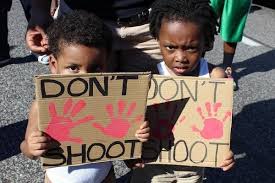 I’m going to be very personal and very open with you today because of something Rudy Giuliani said over the weekend. He accused the president of ‘anti-police’ propaganda. As a person who doesn’t trust the police at all, I would like to say my feelings have nothing to do with the President, Eric Holder or whatever scapegoat Giuliani and his right wing friends can find. It is because of the police themselves. It is because of what I’ve witnessed, what I’ve gone through, and what I’ve known to happen to others. I live in New Orleans, and my guess is that my experience is not all that different from any one living in an urban area like me.
I’ve seen it all and I’ve experienced it. People are fed up with out of control policing and it’s not because of anything any politician has said. Police departments have brought all of the criticism, protest, and mistrust onto themselves.. This does not mean that police deserve to be gunned down or to be the victims of violence. However, I’m not surprised to see things escalate when justice is unavailable to so many. The crazed few always start acting out the frustrations of the many. You see, the American dream should not include places where you are more afraid of the people paid to protect you than you are of most anything else or where things are so unfair that your already deranged mind can follow martyrdom to some extreme awful end. I am completely saddened by the deaths of the two Brooklyn Police officers. But, their deaths should not be used as an excuse to give bad policing and bad police officers a pass. Their deaths should also not lead to political chest beating and police state jingoism. What we should realize is that we’ve got a broken criminal justice system and it needs to be fixed so that it turns no one into victims. I’m tired of being afraid of the police which is a place I’ve personally been for over 5 years now. Obama didn’t make me feel this way.
The last time I got called for Jury Duty was the first time I really didn’t think I could do it and not because it inconvenienced me. The first day I got called in to serve I was selected for the voire dire of a case where a public defender who had been a friend of mine for some time was defending a man accused of sexual battery on the minor daughter of his girlfriend. Normally, I would be DA’s dream of a juror. When they got to me and asked I if there was any reason why I shouldn’t sit on the Jury I basically said, well , the defendant’s attorney is a friend but there’s another reason too. That was enough to get me taken off to the Judge’s chambers where they asked if being his friend would distort my ability to be neutral. I laughed and said no. That wasn’t it at all. I know him well but I also know that his job is to provide a decent defense for whomever and that didn’t mean he was character witness for his client at all. Normally, as an older,educated white woman with daughters, I’d probably give any accused child rapist a jaundiced eye. If anything, any friendly feelings I had towards my friend would probably make me be more neutral towards the case. So, what was my problem?
I told the prosecuting attorneys and the Judge that I don’t trust a damned thing any cop says and if you’re going to make your case on their testimony then forget it. I don’t think I could take it at face value at all.
That was a bit of surprise statement to about all concerned up to and after I told them my story. I’d never seen two prosecutors so wide-eyed before. About a year before, I was arrested and charged for being drunk and for fighting. Just being in that courthouse surrounded by uniformed police had me on the verge of tears and panic. What really happened was I was assaulted in front of lots of witnesses by a drug dealer on parole from Federal Prison. The arresting officer was right there watching him beat me up and doing nothing. I wasn’t drunk either and begged cop after cop for a breath test. I had broken ribs in my back and bruises on the back side of my arms from being in the crouched, defensive position taught to any one that’s been trained for any kind’ve protest training. I was jackbooted. The emergency room doctor actually volunteered to tell any one he could that I had been brutally beaten and there were no signs of anything but defensive wounds. I was sent to a neurologist to ensure I didn’t have permanent damage it was so bad. I went straight from the jail to the emergency room to the internal affairs office. The last two entities had plenty of pictures of my damage and I made damned sure they talked to the doctor and had access to the xrays. I did everything I needed to to ensure I could get justice for this. I never did.
At one point during the attack, I had actually managed to escape to a back yard to dial 911 when a visiting Canadian friend tried to get the thug off of me. I was on the 911 phone call for like 15 minutes and when I was told they were there to help me, I went out to flag the patrol car down. The cop flagged them away and arrested me. He threatened to arrest all the folks that were trying to tell him what had really happened too. I was driven around for some time while all the cops in question were trying to figure out how to dump me in jail to teach me a lesson for letting slip to the drug dealer that the cop had been banging his girlfriend for years. This drug creep also used to brag in the bars about beating folks up for the cop too. I have no record. I have privileged status in a lot of ways. I’m white and I’m educated and I had money for a lawyer and bail. But, none of this protected me from the police department that day or from the absolute nonsense “investigation” that followed after I filed a complaint.
I had seen this same cop shake down a local prostitute for blow jobs for rookies on the trunk of a black and white not too long before that. He was well known for shaking down the pros in the area for his own personal pleasure. Nearly everyone in the neighborhood had a story on this cop. I knew that while the drug dealer was in prison and before that his girl friend–a nonstop pot smoker–was banging the cop and had to be smoking nonstop then too. Basically, he picked and chose when to adhere to the law. He was–and probably still is–the very picture of an out of control cop. I filed a complaint that was investigated and it eventually cleared him of any wrongdoing . It stated that he did everything right. He was arrested about six months later in the parish across the canal on domestic battery and for spitting at a Parish Deputy who was trying to arrest him. I told the sergeant who took my interview at the time that the guy was angry, a drunk, and would eventually get into deeper trouble than this. I also told him that he needed help and that it would only get worse if they continued to ignore him. And, ask the parish deputy. It got worse. But, he’s still patrolling the French Quarter now. Heaven help any of you that get in the way of his little schemes.
Those of you that have known me some time know this story and a lot more of the gory details. You also know that I spent one very long night in New Orleans Parish Prison surrounded by lots of people arrested for “black while” and “hispanic while” and that was enough to convince me to never ever believe a police officer again. It didn’t even take the sham of an investigation to do that. I couldn’t even convince one police officer that I wasn’t drunk and that I needed medical attention as I was beaten by a man much larger than myself. The arrest report he wrote eventually came back that I had slugged the girl friend. I’m a Buddhist. I don’t even step on bugs. I would do no such thing. I was jackbooted pure and simple because I had the audacity to ruin his good thing by answering a question drunk and honestly one night.
The NOPD is under the care and tutoring of the Attorney General and the Justice Department for all kinds of violations of civil rights. They deserve to be. I frankly believe the entire lot of them should’ve been brought up on RICO charges because that’s the law that applies to a group of people that conspire to commit crimes. I would like you to know that not one of the “thugs” and the “thug” cop that I dealt with was black so no one reading this can reach conclusions that shouldn’t be there from their little corners of white privilege world. Again, Rudy Giuliani and others need to know that my feelings towards the police have nothing to do with the President or any politician and my guess it that any one that’s seen what I’ve seen, knows what I know, and been through what I’ve been through thinks similarly . You cannot possibly live within the borders of a large city that is populated with diverse peoples and not really feel this way unless you’re gated up with a lot of privileged white people. Not all police officers are rotten but the system and good cops protect the rotten ones. This makes them accessories and under most criminal laws, it makes you guilty of something. If you think all cops are wonderful, you must live in a suburban enclave with mostly white people where police never ever go or where they only show up when the odd little inconvenience happens. You could not possibly live in place where whites are the minority. You could not possibly live in parts of town where they feel they can get away with anything. You’ve probably never ever lived in a place and time where you’ve been dive bombed by black helicopters and drones and felt like you’ve lived in the middle of a war zone for extended periods of time because of the presence of highly militarized police. I’ve lived in both circumstances. If you don’t think being white gives you a big ol’ pass in the world of policing, then you’ve really lived a very sheltered life.
I do know one exception, however, and it’s a doozy. It’s what happened to my daughter when in high school in suburban Omaha right after the Justice department was looking at the cops there for arresting too many black people. They decided to fix their stats and went after white kids. She got picked up once for a curfew violation walking from a friend’s house to the house next door one evening. She also got picked up for minor in possession when a boyfriend got pulled over for speeding in a pick up truck who had a six pack locked up in metal box in the truck bed that she didn’t even know was there. Of course, my charges and my daughter’s charges were dropped. They both were basically for effect. I was not to interfere with whatever scam the cop in the neighborhood had running and she served as a number to prove that Omaha cops really aren’t targeting black people. And, this occurred prior to the Obama presidency. So, in this case, the solution for stopping and frisking black kids was to do the same to white kids. I was relieved when she left that reign of terror and went to LSU, believe me.
I still have panic attacks when I see police officers. I can’t see this ever changing. I can’t say that I’m going to ever go to jury duty and not tell a judge that you do not want me on any jury because my assumption will be that the police are guilty of something.
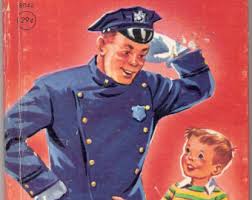 So, Guiliani, fuck off for this.
Former New York City Mayor Rudy Giuliani is condemning President Barack Obama for anti-police “propaganda” in the wake of the murders of two New York City police officers in Brooklyn.
When asked on “Fox News Sunday” if he had ever seen the city he once governed so divided, Giuliani shook his head and said, “I don’t think so.”Giuliani said blame rests on “four months of propaganda,” which he said started with Obama, “that everybody should hate the police.” He said the nationwide protests against several recent police-involved deaths lead to one conclusion: “The police are bad. The police are racist. They’re wrong.”
Police, Giuliani said, are “the people who do the most for the black people in America, in New York City and elsewhere.”
On Sunday, Obama spoke out against the killing of the police officers Saturday, saying there is no justification for the slayings.
“The officers who serve and protect our communities risk their own safety for ours every single day — and they deserve our respect and gratitude every single day,” Obama said in a statement. “I ask people to reject violence and words that harm, and turn to words that heal — prayer, patient dialogue, and sympathy for the friends and family of the fallen.”
No one should be calling for dead cops or any kind of blood shedding. As the old cliche goes, two wrongs do not make a right. Most of us who feel negatively towards the police really don’t want to feel that way. Really, who do you think I want to call if I need help? The Ghostbusters? I came to my panic attacks and mistrust through experience. Something is very rotten in the criminal justice system from a county attorney that can purposefully suborn perjury, to a criminal or insane person that can get easy access to powerful guns to use on the rest of society, to a police official that thinks its a bad deal that his Mayor needs to enforce what the court orders and in doing so, accuses him of endangering the lives of police. As long as there is easy access to guns in this country, we all are in danger. Police are not exempt from the actions of the criminally insane.
“There’s blood on many hands tonight,” Patrick Lynch, president of the largest police union, said late Saturday. “Those that incited violence on the street in the guise of protest, that tried to tear down what New York City police officers did every day. We tried to warn it must not go on, it shouldn’t be tolerated. That blood on the hands starts at the steps of City Hall in the office of the mayor.”
Although New York is a city where Democrats outnumber Republicans by more than 6 to 1, de Blasio is its first Democratic mayor in 20 years and his stewardship of the city is being watched nationally as a test of unabashedly liberal leadership. After his landslide victory, he declared, “Make no mistake. The people of this city have chosen a progressive path. And tonight we set forth on it together, as one city.”
 But really, how can we expect them to change? They’ve even complained about court ordered changes to the way they operate. This is going to be a long and enduring struggle.
Former Police Commissioner Ray Kelly, a champion of NYPD stop-and-frisk tactics that were found unconstitutional, on Tuesday blasted Mayor de Blasio’s decision to drop the city’s appeal of that ruling.
“Every indication is [that] if the appeal were allowed to go forward, it would have been reversed, and it’s a shame Mayor de Blasio did that, because I think people will suffer,” Kelly said on WNYC-FM’s “Brian Lehrer Show” Tuesday.
Stop-and-frisks have since decreased, and Kelly, the top cop under Mayor Mike Bloomberg, suggested the city may now be seeing a negative effect on crime.
What’s going on right now is an indication that the criminal justice system in this country is broke. It is VERY broke. We have extremely high incarceration rates. The patterns of incarceration are telling. The incredible use, manner and patterns of police force against the mentally ill, against unarmed citizenry, and against racial minorities indicates something is very wrong. The number of people–like me–whose stories detail police abuse should tell you something. Instead, we have groups of folks in the media, in government, and in law enforcement that seem put out by exercise of first amendment rights. What do they expect when police are armed and act like an occupying army and focus on protecting their own rather than protecting and serving whatever community is their beat. Which police officer do you trust when it’s obvious the system jumps to defense of its extremely rotten eggs?
So, here I am, and I’m telling judges and prosecuting attorneys that I won’t serve on a jury because I can’t honestly say I’d believe anything brought to the court by the police as evidence. I would be hard pressed to believe any police testimony. This is me; the mother of two daughters. I walked away from sitting on the jury of an accused child rapist because I wouldn’t feel comfortable making any decision based on the criminal justice system and the police investigation. What does that say to you? What should it say to the likes of Rudy Giuliani?
 So, I’m ranting again.
I’ll leave you with something to give you a belly laugh. This is the actual holiday card coming from our governor. It’s not photo-shopped. It’s not from The Onion. Just have a really good belly laugh at the expense of those idiots in the state of Louisiana that voted for this pandering, self-loathing governor of mine who is whoring himself to the Duck Dick enthusiasts wherever they may skulk with their knuckles dragging and their heads up their asses.
What’s on your reading and blogging list today?
Thursday Reads: Did Nepotism at The Washington Post Contribute to Irresponsible Reporting on the UVA Rape Story?
Posted: December 11, 2014 Filed under: Crime, Criminal Justice System, morning reads, Violence against women, War on Women, Women's Rights | Tags: fraternities, gang rape, nepotism in journalism, rape 40 Comments
Good Morning!!
Have you ever wondered how extremely young men are able to get jobs at elite newspapers like The Washington Post right out of college?
Take for example T. Rees Shapiro, who has led the charge to not only discredit the Rolling Stone story on the problem of rape on the University of Virginia campus but also efforts to dismiss and humiliate Jackie, one of the women interviewed by Rolling Stone writer Sabrina Rubin Erdley .
However flawed the Rolling Stone article may have been, it was about much more than Jackie’s story. It illustrated a culture of minimization of rape that had existed had UVA for at least 30 years, in which women who reported being sexually assaulted were discouraged from going to the police, their complaints were not treated seriously, and accused perpetrators were not seriously investigated or punished.
Shapiro’s career has been greatly enhanced by his dismantling of Jackie’s story about a violent rape that allegedly took place in 2012. As a consequence of his efforts to dismantle Jackie’s story, T. Rees Shapiro has appeared on numerous television programs and received praise from many quarters. Most likely his youth enabled Shapiro to con Jackie into trusting him enough to talk to him “several times.”
Last night, I decided to take a quick look at young Mr. Shapiro and his career development path. How did he get such an elite journalism job at the young age of 27?

In 2009, Shapiro graduated from Virginia Tech, where he wrote for the student newspaper. In 2010, he was hired by the Washington Post as a copy boy. He soon graduated to writing obituaries, and in 2010 became an education reporter for the Post.
Clearly T. Rees (Nicknamed “Trees,” get it?) is a real go-getter, but he also has connections. His father Leonard Shapiro was a sportswriter for The Washington Post for 38 years, and his mother Vicky Moon is a writer and photographer who is apparently a fixture in Virginia society. Would Shapiro have gotten the Washington Post job without those connections? Maybe, but I doubt it.
When he wrote about Jackie, Shapiro emphasized several times that she was using her “real nickname,” thus enabling trolls like Chuck C. Johnson to find her and try to publicly out her. Shapiro was also able to locate Jackie’s so-called “friends” and get their after-the-fact critiques of Jackie’s story. Shapiro doesn’t say whether Jackie told him she still considers these people to be her friends.
In his critiques of the Rolling Stone article and specifically of Jackie’s story, Shapiro chose not to write about the other women who were interviewed by author Sabrina Rubin Erdley or to get input from experts on rape and traumatic memory. Would a more mature reporter have done so, rather than simply picking apart Jackie’s story? Would a female education reporter have thought to do that?

Leonard Shapiro, former WaPo sportswriter and father of T. Rees Shapiro
Despite the Post’s attacks on Jackie, the University of Virginia does in fact have a rape problem. UVA is one of 86 schools being investigated by the Department of Education for mishandling rape complaints. Four Virginia schools are on the DEA list.
From Huffington Post in July: For Years, Students Have Accused Virginia Universities Of Botching Sexual Assault Cases.
Four universities in Virginia are currently being investigated by the U.S. Department of Education’s Office for Civil Rights for possible Title IX violations specifically related to sexual violence — JMU, the University of Virginia, the College of William & Mary and the University of Richmond. Two other schools in the state, the Virginia Military Institute and Virginia Commonwealth University, faced Title IX reviews that concluded this spring….
Each of the investigations at the Virginia schools, like that at JMU, was sparked by federal complaints.
UVA’s investigation is unusual in that it started in 2011, but remains open. The Education Department declined to say why the investigation was so long-running, and noted “that some cases take longer than others due to the nature and complexity of the issues involved.”
(Emphasis added).
In fact, UVA is one of only 12 schools that that the Department of Education has “flagged for a total compliance review.”
Another Washington Post reporter, Nick Anderson, writes that the inconsistencies in Jackie’s story will not end the federal investigation of UVA.
The University of Virginia was under the microscope for its handling of sexual assault cases long before Rolling Stone magazine weighed in with the account of a student who said she was gang-raped at a fraternity house.
The emergence of fresh questions about that account — including the fraternity issuing a rebuttal, doubts voiced by some who know the woman, and a statement from Rolling Stone’s managing editor on Friday acknowledging “discrepancies” in her version of events — will not suddenly cancel that scrutiny.
A federal investigation of U-Va.’s response to sexual violence, begun in June 2011, continues. It is one of the longest-running active probes of its kind in the nation. U-Va. remains one of the most prominent of about 90 colleges and universities facing such investigations by the U.S. Department of Education’s Office for Civil Rights.
Student and faculty activists for sexual assault prevention, given a national platform in recent days, are unlikely to let the issue fade away. Skeptics will still wonder why the university has not expelled anyone for sexual misconduct in the past decade. Parents of prospective applicants, also mindful of the slaying of sophomore Hannah Graham after she disappeared in September, still want assurances that the Charlottesville campus is safe.
Perhaps most important, University President Teresa A. Sullivan laid out a detailed road map this week for a comprehensive review of the campus culture, touching on sexual assault, alcohol, Greek life and university oversight.

Francesca Bessey
Since rape on campus is such a huge issue, shouldn’t education reporters like T. Rees Shapiro be more knowledgeable about sexual assault and its traumatic effects? One journalist, Francesca Bessey thinks so.
From Huffington Post: Thought the Rolling Stone Article Was Bad? Try Other Rape Journalism. Here’s her assessment of the Washington Post coverage:
The actual discrepancies introduced by the Washington Post are few: one, the individual whom Jackie claimed brought her to the fraternity was apparently a member of a different fraternity; and, two, a student who allegedly came to Jackie’s aid claimed she initially gave a different account of what happened that night. The fraternity also released a statement denying knowledge of the assault, or that there was a social function the night Jackie believes she was assaulted.
For someone who knows little to nothing about rape, fraternities, or the contemporary college party scene — which unfortunately seems to characterize a lot of the coverage thus far — these discrepancies might initially seem like gaping holes in Jackie’s story.
However, as any medical professional or victim advocate will tell you, trauma-related memory inconsistencies are extraordinarily common in cases of sexual assault, often manifesting in the survivor describing the incident to first responders as less severe than it actually was. Such plasticity of memory is not unique to rape cases; the FBI, for example, notes that “there can be a wide range of after effects to a trauma,” which can impact on a victim of a violent crime or the victim’s family members. A list of these effects includes confusion, disorientation, memory loss and slowed thinking. Psychological research has long demonstrated that humans reconstruct, rather than recall, memory, which is why eyewitness testimony is considered one of the most dubious forms of evidence in a court of law.
Why have journalists covering this story given more credence to statements by the fraternity and friends who were portrayed very negatively in the Rolling Stone article than to Jackie’s version of events?
…it is important to note that the so-called “inconsistencies” in Jackie’s story don’t necessarily invalidate her version of events. The fraternity’s statement is in no way more credible than Jackie’s own word — in fact, I would argue less so, given the sheer prevalence of fraternity rape. It would be foolish to assume that a fraternity’s formal denial of “knowledge of these alleged acts” means that they did not occur (with or without current leadership’s knowledge), as it would be foolish to rule out that the “date function” Jackie thought she was invited to wasn’t pure pretense in the first place. It is also within the realm of possibility that Jackie was brought to the party by a man who didn’t necessarily belong to the fraternity, even that he misled her about his membership in the frat. It is also possible that the student who gave a different version of how he found Jackie that night, lacks credibility or is himself having trouble recalling events.
Ultimately, these are all details significant to a police or journalistic investigation, upon which the responsibility is on law enforcement and journalists to figure out. For Jackie, however, it doesn’t change much. It doesn’t change her experience of violent assault, or those of countless students like her, many of whose stories are also featured in the article in question. It does not change the majority of the material in the original article: not the debasing lyrics of the UVA fight song; not the person who hurled a bottle at Jackie’s face the first time she tried to speak out; not the 38 students who appeared in Dean Nicole Eramo’s office in just one academic year to discuss incidents of sexual assault, despite the fact that not one student has ever been expelled from UVA for a sexual offense.
In light of these facts, in light of my own rape and the rapes of too many of my friends at the hands of their peers, I do wonder: Whose credibility is really to be doubted here? Jackie’s or the public peanut gallery that has diluted sexual assault down to a number and a date?
Again, I don’t want to personally denigrate T. Rees Shapiro. He writes well, and he has done a fine job of locating sources at the University of Virginia–both in this case and in his previous reporting on in writing on the Hannah Graham murder case–probably because his youth helps him connect with college students only a few years younger than he is. But his analysis of a survivor’s story has suffered from his lack of knowledge and experience about campus sexual assault and rape in general.
I want to share two more articles that offer a more sophisticated take on these subjects–written by women with long journalistic experience.
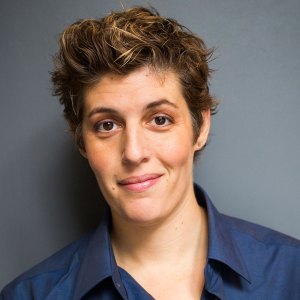
Sally Kohn
From CNN, Rape culture? It’s too real, by Sally Kohn.
We don’t yet know all the facts behind the now-infamous, poorly fact-checked story in Rolling Stone about an alleged gang rape at the University of Virginia. What we do know: Rolling Stone at first blamed the alleged victim, “Jackie” — rather than its own journalistic sloppiness — for so-called “discrepancies” (before changing its callous statement).
And new reporting by the Washington Post does reveal that Jackie’s friends, cited in the story, say they are skeptical about some of the details. Still, they all believe that Jackie experienced something “horrific” that night, in the words of one, and we do know that Jackie stands by her story. Most of the doubts about it were apparently raised by those she’s accusing, including the fraternity and main alleged assailant — whom, I guess, we’re supposed to believe instead. But one other thing we do know is that gang rapes just like what Jackie is alleging do happen — too often, and all over America.
While Rolling Stone’s reporting was clearly shoddy, some writers who initially poked holes in Jackie’s story did so for ideological motives. For instance, even before the reporting lapses were revealed, conservative commentator Jonah Goldberg called Jackie’s story unbelievable. “It is not credible,” Goldberg wrote in the Los Angeles Times. “I don’t believe it.”
Instead, Goldberg insisted, Jackie’s account was “a convenient conversation for an exposé of rape culture,” something, incidentally, Goldberg also doubts to be real. “‘Rape culture’ suggests that there is a large and obvious belief system that condones and enables rape as an end in itself in America,” Goldberg later wrote in National Review. It’s all hogwash, says Goldberg, alleging that the very idea of “rape culture” is just “an elaborate political lie intended to strengthen the hand of activists.”
In other words, whatever the reality of what happened to Jackie, Goldberg and others were skeptical because they simply don’t believe rapes like that happen with the participation of groups of assailants, let alone the complicity of bystanders. This is where they’re mistaken.
Kohn then lists several extreme examples of gang rapes that resemble Jackie’s description–most of which we have covered here.

Also from CNN, In 2014, rape rage drove feminism’s ‘third wave’, by Nina Burleigh.
Historians could look back on this year as the beginning of feminism’s third wave.
The year was momentous for feminism. For the first time, rape victims and their supporters emerged from the shadows in significant numbers and started naming names — to significant effect. Women, their voices amplified by social media and with the support of a small but growing cohort of men, have been exposing and shaming venerable American institutions such as the NFL, Ivy League and non-Ivy League colleges, and the entertainment icon Bill Cosby.
First wave feminists won the right to vote. The second wave got us the right to work. But even with those advances, women have remained fundamentally restricted by the threat and terrible secret of sexual assault.
This year, emboldened and connected by social media, college women formed a powerful grassroots movement that led to universities such as Harvard being publicly named and shamed for not addressing women’s rape reports. They brought the issue of campus sexual assault into the White House, where Barack Obama became the first President to use the words “sexual violence.” The Department of Education released a list of universities under investigation for mishandling sexual violence cases, often letting even repeat predators off with barely a slap on the wrist.
These young women had been silent until social media enabled them to come together, even though thousands of miles apart, share debilitating secrets and then act with the confidence that safety in numbers provided.
I hope you’ll read the rest at the link.
I only hope that irresponsible journalism perpetrated by Rolling Stone and the even more irresponsible reaction to it have not set back the cause of protecting young women on college campuses from sexual violence.

 peej
peej Carissa
 bostonboomer
 dakinikat
 ecocatwoman
 mablue2
 Mama Lopez
 peggysue22
 quixote
 skydancingguestblogger
 Mona (aka Wonk the Vote)



 Sky Dancing
Recent Comments