
Thursday Reads
Posted: November 21, 2013 Filed under: Affordable Care Act (ACA), Austerity, Crime, Criminal Justice System, Media, morning reads, racism, Republican politics, U.S. Politics | Tags: Anthropology, Black Beauty rock, Bucks County PA, Creigh Deeds, DA David Heckler, European DNA, Filibuster, Gus Deeds, Ken Cuccinelli, Marissa Sargeant, Mars Meteorite, Medicaid expansion, mental health funding, Native American DNA, nuclear option, Obamacare vs Iraq War or Katrina, police brutality, presidential nominees, Siberia, Terry McAuliffe, Virginia 23 Comments
Good Morning!!
Virginia State Sen. Creigh Deeds is apparently recovering from stab wounds inflicted by his son Gus on Tuesday. The young man shot himself after attacking his father. But state officials are investigating why Gus was refused psychiatric care the day before the attack. NBC Washington:
The incident has raised new questions about the capacity of Virginia’s mental health system. Tuesday, it was reported that hours before the attack Gus Deeds was the subject of an emergency custody order — but a bed at a hospital or psychiatric treatment facility was not available, and he was released home.
Now the Washington Post is reporting that three hospitals within a two-hour drive of Bath County did have beds available, and two of the three say they were never contacted by the Rockbridge County Community Services Board trying to find a placement for Deeds son.
The state inspector general has now launched an investigation to find out what led to Gus Deeds’ release after the custody order was issued.
“Regardless of whether or not there were beds, there was not a system to determine if there were beds available,” Howell said. “It seems to me we should have a clearinghouse of some kind so that when somebody needs a bed, there is a very efficient way to find out where one is available.”
Dozens of mentally ill patients at risk of doing “serious harm” to themselves or others in Virginia were denied access to some psychiatric treatment in a span of just three months studied by state investigators, according to agency documents reviewed by the News4 I-Team.
An audit of Virginia’s Behavioral Health and Developmental Services, performed over a 3-month span in late 2011, found 72 people “at risk for serious harm” and in need of care received less treatment than necessary, in part because of a shortage of available psychiatric beds in the state.
Internal state investigators call the shortfall “a failure of the system” and a “canary in the coal mine” warning for Virginia leaders.
Agency documents show a decline in the overall number of treatment space for the mentally ill in Virginia. A 2007 report found 1,794 available hospital beds for the mentally ill in Virginia, but the number had dropped to 1,699 beds available in 2011.
Internal investigators reported, “Acute and intensive treatment beds in … state-operated psychiatric hospitals have also decreased, while the population has grown by approximately 13 percent during the last decade.”
Gee, I wonder if this has anything to do with budget cuts in states controlled by Republicans? From Think Progress:
“Many states appear to be effectively terminating a public psychiatric treatment system that has existed for nearly two centuries,” wrote researchers in a 2012 report by the Treatment Advocacy Center (TAC), a nonprofit group that examines mental health issues. “The system was originally created to protect both the patients and the public, and its termination is taking place with little regard for the consequences to either group.”
According to the report, Virginia eliminated 15 percent of its public psychiatric beds between 2005 and 2010. The state has just 17.6 such beds per 10,000 people — less than 40 percent of the recommended minimum 50 beds per 10,000 people. That didn’t stop Gov. Bob McDonnell (R-VA) from proposing even more cuts to mental health programs in 2012.
But McDonnell isn’t the only one to embrace such cuts. In fact, state governments across the nation slashed psychiatric funding to the point that, overall, the nation’s hospitals had just 28 percent of the recommended minimum number of hospital beds by 2010. Those reductions continued in the following years as states slashed $4.35 billion in mental health services between 2009 and 2012, forcing State Mental Health Agencies (SMHAs) to shutter mental health hospitals and eliminate nearly 10 percent of total available beds in those three years alone.
This is an issue that was discussed during the recent VA race for governor. From the Oct. 23rd Washington Post: Virginia’s mental health system needs money; candidates differ on how to provide it.
The major-party candidates for governor of Virginia agree that mental health systems need more resources. But their approaches differ greatly, based in part on how they view the Medicaid expansion of the new health-care law in Virginia.
Democrat Terry McAuliffe favors a Medicaid expansion wholeheartedly. He says it would provide new health-care coverage for about 400,000 Virginians and would increase money for mental health treatment.
Republican Ken Cuccinelli II opposes a Medicaid expansion completely and says McAuliffe’s estimates of its effect on Virginia are greatly overstated. Cuccinelli wants to increase state funding for mental health, but he would do so by shifting current Medicaid funds from other health-care areas. He also said he would target waste, fraud and abuse and use the savings to bolster options for the mentally ill and the intellectually disabled.
Fortunately for the people of Virgina, Terry McAuliffe won the election, and corrective measures will likely be taken. But they’ll come too late for Gus Deeds and his family. If a wealthy and connected family has this problem, can you imagine what it’s like for poorer people who need mental health treatment in Republican-controlled states?

This story out of Philadelphia is horrible: Mom of Alleged Teen Shoplifter Accuses Police of Brutality. I’m sure you won’t be surprised to learn that the boy is African American.
The mother of the 14-year-old boy, who was arrested for shoplifting, is accusing police of roughing him up.
“The picture speaks a thousand words,” says Marissa Sargeant, who shared several graphic photos with NBC10 that shows her son bruised, cut and swollen.
The teen was arrested by Tullytown Police for retail theft at Walmart on Tuesday night, along with an adult relative.
“What he did was wrong. He was coerced by a 19-year-old. He does know better,” said Sargeant.
“Roughing him up?” I’d say that’s quite an understatement, based on the photo.
Authorities say after the teen’s arrest, and before he was loaded into a police car, he took off running along Route 13 while handcuffed.
Bucks County District Attorney David Heckler tells NBC10 that police officers yelled warnings at the teen and fearing for his safety, they fired a stun gun to subdue him. The D.A. says the Taser struck the boy in the face and with his hands cuffed, the boy had no way to brace himself against falling face-first.
“That doesn’t sound right. There’s no way, if he was running from behind, that he would get hit with a taser in the front of his face,” said Sargeant.
The mom suspects police probably beat up her son as well, and I’d have to agree with her. Heckler is “investigating,” but he doesn’t think police did anything wrong. Sounds like a really unbiased “investigation,” doesn’t it?
Republicans are still blocking President Obama’s judicial nominees right and left, and Democrats are once again threatening to get rid of the filibuster for appointments. {Sigh…} Do you suppose there’s any chance they actually mean it this time? From The Washington Post:
Senator Harry Reid of Nevada, the majority leader, is poised to move forward on Thursday with a vote on what is known on Capitol Hill as the “nuclear option,” several Democrats said. Mr. Reid and the senators who have been the most vocal on stopping the Republican blockade of White House nominees are now confident they have the votes to make the change.
“We’re not bluffing,” said one senior aide who has spoken with Mr. Reid directly and expects a vote on Thursday, barring any unforeseen breakthrough on blocked judges.
The threat that Democrats could significantly limit how the filibuster can be used against nominees has rattled Republicans. Senator John McCain, the Arizona Republican who has brokered last-minute deals that have averted a change to filibuster rules in the past, visited Mr. Reid in his office on Thursday but failed to strike a compromise.
Senator Charles E. Grassley of Iowa took to the Senate floor and denounced Democrats, saying that if they changed the rules, Republicans would consider them applicable to all judicial nominees, including those for the Supreme Court. Mr. Reid has said he supports keeping intact the minority party’s ability to filibuster controversial Supreme Court nominees.
“Apparently the other side wants to change the rules while still preserving the ability to block a Republican president’s ability to replace a liberal Supreme Court Justice with an originalist,” Mr. Grassley said.
At Politico, William Yeomans, an American University law professor and former Justice Department official says “Nuke ’em Harry!”
Democrats, it’s time to bid farewell to the filibuster as we’ve known it. Your restraint has gone beyond admirable to foolish. The institution for which you have shown extraordinary respect over the past four years, as Republicans flouted its best traditions, is no more. Republicans have overplayed their hand by disregarding prior agreements and turning the Senate into a graveyard—or at least a critical care unit—for obviously qualified presidential nominees. Republican obstruction has left you with nothing to lose by bringing the Senate fully into the 21st century and allowing the majority to rule. It’s time to change the rules….
Worried about blowback? Don’t be. Sen. Chuck Grassley (R-Iowa) helped expose the Republicans’ loss of leverage when he threatened that if the Democrats changed the filibuster rule, Republicans would appoint more justices like Antonin Scalia and Clarence Thomas to the Supreme Court. Whoa! Is he suggesting that Republicans won’t appoint more radically conservative justices if Democrats keep the filibuster? That might be a deal worth taking, but it wouldn’t be worth the paper it was printed on. If Republicans regain control of the White House, any Supreme Court nominees will very much be in the model of Scalia and Thomas, and their colleagues Roberts and Samuel Alito—if not worse. That means they will disregard any pretense of judicial restraint to eviscerate civil rights laws, restrain congressional authority to enact social legislation, support states over the federal government and big business over labor, oppose the interests of consumers and make sure the executioner stays in business.
In reality, Republicans have nothing left with which to threaten you. Just stop and think about how unimportant the filibuster has been to you. You chose not to use it to stop Thomas and Alito, even though more than enough Democrats to support a filibuster voted against each. You embraced Scalia (by unanimous vote!) and Roberts. When Republican presidents went too far, you mustered the majority vote necessary to stop them without resorting to the filibuster. That’s why we didn’t have a Justice Bork, Carswell or Haynsworth, or a Secretary of Defense Tower, or an Associate Attorney General Reynolds. Sure, Miguel Estrada would be on the D.C. Circuit, but that hardly justifies tying your own hands in perpetuity.
He’s absolutely right, but do the wimpy Dems have the courage to act? I’ll believe it when I see it.
Here’s your stupid right wing corporate media story for today from Media Matters. David Gregory compares Obamacare to the Iraq war.
Not once but twice in recent days Meet The Press host David Gregory announced that the troubled launch of President Obama’s new health care law is roughly the equivalent to President Bush’s badly bungled war with Iraq. The NBC anchor was quick to point out that he didn’t mean the two events were the same with regards to a death toll. (Nobody has died from health care reform.) But Gregory was sure that in terms of how the former president and the current president are viewed, in terms of damage done to their credibility, the men will be forever linked to a costly, bloody war and a poorly functioning website, respectively.
“Everybody looked at Bush through the prism of Iraq,” Gregory explained. “Here, I think people are going to look at Obama through the implementation of Obamacare.” It’s Obama’s defining event of their two-term presidency. It’s a catastrophic failure that’s tarnished Obama’s second term, and will perhaps “wreck” his entire presidency, according to the media’s “doom-mongering bubble,” as Kevin Drum at Mother Jones described it.
But like the painfully inappropriate comparisons to Hurricane Katrina that have populated the press, Gregory’s attempt to draw a Bush/Obama parallel is equally senseless. Bush’s war morass stretched over five years, so of course it defined his presidency. Obama’s health care woes are in week number six and could be fixed within the next month.
Media Matters points out that not only is this “the mother lode of false equivalency,” but it’s a sly effort to “downgrade Bush’s historical failures, and to cover the media’s tracks of deception.”
I’ll end with two fascinating science stories to take your mind off politics and other distressing news.

From BBC News: Black Beauty rock ‘is oldest chunk of Mars’
A rock discovered in the Sahara Desert is the oldest Martian meteorite ever found, scientists believe.
Earlier research had suggested it was about two billion years old, but new tests indicate the rock actually dates to 4.4 billion years ago.
The dark and glossy meteorite, nicknamed Black Beauty, would have formed when the Red Planet was in its infancy.
The research is published in the journal Nature.
Lead author Prof Munir Humayan, from Florida State University, US, said: “This [rock] tells us about one of the most important epochs in the history of Mars.”
Read the rest at the link.
And from The Sydney Morning Herald: Siberian DNA link to Native Americans discovered.
The genome of a young boy buried at Mal’ta, near Lake Baikal in eastern Siberia, about 24,000 years ago has turned out to hold two surprises for anthropologists.
The first is that the boy’s DNA matches that of Western Europeans, showing that during the last ice age people from Europe had reached farther east across Eurasia than previously supposed.
The second surprise is that his DNA also matches a large proportion – about 25 per cent – of the DNA of living Native Americans. The first people to arrive in the Americas have long been assumed to have descended from Siberian populations related to East Asians. It now seems that they may be a mixture between the Western Europeans who had reached Siberia and an East Asian population.
Tuesday Reads
Posted: November 19, 2013 Filed under: Barack Obama, Crime, Criminal Justice System, morning reads, U.S. Politics | Tags: Abraham Lincoln, Barry Ernest, Dallas Police Chief Jesse Curry, J. Edgar Hoover, Jefferson Morley, JFK assassination, Lee Harvey Oswald, President John F. Kennedy, President Lyndon B. Johnson, Sandra Styles, the Gettysburg address, The Matrix, Victoria Adams, Warren Commission 57 Comments
Good Morning!!
We’re only a few days from the 50th anniversary of the day the President of the United States was shot down on a Dallas street. You’d think an event like that would lead to a serious investigation and efforts to bring those involved to justice.
Instead we were told within hours that President Kennedy had been murdered by Lee Harvey Oswald. Two days later Oswald was shot dead in the Dallas Police station by Jack Ruby, and the investigation, such as it was, ended.
At the time, even FBI director J. Edgar Hoover told newly sworn President Lyndon Johnson (in a recorded phone call) that the case against Oswald was too weak to get a conviction. Later, Dallas Police Chief Jesse Curry would say, “We don’t have any proof that Oswald fired the rifle, and never did. Nobody’s yet been able to put him in that building with a gun in his hand.”
Oswald supposedly shot Kennedy with a rifle at 12:30 from a window on the 6th floor of the Dallas Book Deposititory Building. Approximately 90 seconds after the shooting, Oswald was seen by Dallas police officer Marion Baker and Oswald’s boss Ray Truly in the lunch room on the 2nd floor of the building calmly drinking a coke. From Wikipedia:
According to Baker, Oswald did not appear to be nervous or out of breath. Truly said that Oswald appeared “startled” when Baker aimed his gun at him. Mrs. Robert Reid—clerical supervisor at the Depository, returning to her office within two minutes of the assassination—said that she saw Oswald who “was very calm” on the second floor with a Coke in his hands.

Victoria Adams
Meanwhile, a young woman named Victoria Adams was watching the presidential motorcade from a window on the 4th floor of the book depository building. From a review of the book The Girl on the Stairs, by Barry Ernest:
She was an employee who worked in the same building as one Lee Harvey Oswald. The problem caused by her presence is very simple and easily summarized. Adams, along with her friend Sandra Styles, stood on the fourth floor of the Texas School Book Depository at the moment of the murder. She testified to hearing three shots, which from her vantage point appeared to be coming from the right of the building (i.e., from the grassy knoll). She and Styles then ran to the stairs to head down. This was the only set of stairs that went all the way to the top of the building. Both she and her friend took them down to the ground floor. She did not see or hear Oswald. Yet, she should have if he were on the sixth floor traveling downwards. Which is what the Commission said he did after he shot Kennedy.
This is the first problem, in a nutshell. Why did Adams not see a scrambling Oswald, flying down the stairs in pursuit of his Coca-Cola? Because of the Warren Commission’s timeline, we know Oswald had to have gone down the stairs during this period in order to be accosted in time by a motorcycle policeman. In addition, as we are later to discover, Adams also reports seeing Jack Ruby on the corner of Houston and Elm, “questioning people as though he were a policeman.”
Adams soon learned that the government didn’t want to hear what she had to say about what she had observed–and not observed on the day of the assassination. She was repeatedly “badgered” to change her story. She was also pressured by the investigator for the Warren Commission when she was interviewed in Dallas. Adams eventually moved away from Dallas, married and changed her name. Author Barry Ernest found her and talked to her before she died, and her story remained the same.
Recently Adams’ friend Sandra Styles was interviewed on the Travel channel. Styles still says she saw no one on the stairs. She says she believes Oswald probably shot Kennedy, but perhaps there were others involved “pulling the strings.” Watch the interview at the link.
Along with the fact that no gunshot residue was found on Oswald’s hands (although he was accused of shooting Dallas police officer JD Tippit with a handgun) or on his cheek (where it would be if he had shot a rifle), that is enough reasonable doubt for me to believe that Oswald was what he claimed–a patsy.
Here’s a longer video with most of the statements Oswald made in custody before he was killed by Jack Ruby.
We were told that Oswald was a lunatic, a loser who wanted to be famous for killing the most powerful man in the country. But to me, he didn’t sound crazy, and if he wanted to be famous for the assassination of the president, why did he repeatedly say he hadn’t and ask for a lawyer to defend him?
Please, if you read any of the hundreds of articles that will appear in the corporate media over the next few days, think about these basic facts; because they probably will not appear in the news stories. After 50 years, there is so much information out there–and so many ridiculous theories as well–that it is extremely difficult to separate the wheat from the chaff.
But remember that a conspiracy is just cooperation between two or more people to commit a crime (or cover one up). A conspiracy doesn’t even require a second shooter. It just requires that someone besides the person who pulled the trigger knew something or did something. If no one else but Oswald was involved, why has there been a 50-year effort by the government and the media to keep information about the assassination and “investigation” secret from the American people?
Personally, I think Jefferson Morley’s website “JFK Facts” is the best place to get accurate information and avoid nonsense about the assassination of President Kennedy. Morley is a former Washington Post reporter who has spent years trying to get the CIA to release the last 1,100 JFK-assassination-related files they are keeping secret. The CIA (and the FBI) had extensive knowledge of Oswald before the shooting, and there is quite a bit of evidence to suggest that he was an intelligence asset. Morley identifies the “top 7 JFK files the CIA still keeps secret.” These files involve CIA personnel who knew about Oswald and his history as well as Soviet defector Yuri Nosenko, who had access to KGB files on Oswald.
Yesterday someone actually asked White House press secretary Jay Carney about the embargoed files. It’s reported in a story by McClatchy DC on plans for the Obamas and Clintons to visit Kennedy’s grave.
Secretary of State John Kerry told Parade magazine this week that he had “serious doubts” that gunman Lee Harvey Oswald acted alone in killing Kennedy, but the White House wouldn’t say Monday where Obama falls on the conspiracy theory.
“I haven’t had a discussion with the president about Kennedy’s assassination — President Kennedy’s assassination,” Press Secretary Jay Carney said. He said he’s also not talked with Obama about whether classified files that have not yet been released in the case should be released.
It’s time for Obama to order the release of the files. If the CIA has nothing to hide and Oswald was a lone assassin who acted alone, why not?

I still have room for a few more reads. This one is really interesting, and it asks a question that seems very relevant: “Do We Live in the Matrix?” From Discover Magazine:
In the 1999 sci-fi film classic The Matrix, the protagonist, Neo, is stunned to see people defying the laws of physics, running up walls and vanishing suddenly. These superhuman violations of the rules of the universe are possible because, unbeknownst to him, Neo’s consciousness is embedded in the Matrix, a virtual-reality simulation created by sentient machines.
The action really begins when Neo is given a fateful choice: Take the blue pill and return to his oblivious, virtual existence, or take the red pill to learn the truth about the Matrix and find out “how deep the rabbit hole goes.”
Physicists can now offer us the same choice, the ability to test whether we live in our own virtual Matrix, by studying radiation from space. As fanciful as it sounds, some philosophers have long argued that we’re actually more likely to be artificial intelligences trapped in a fake universe than we are organic minds in the “real” one.
But if that were true, the very laws of physics that allow us to devise such reality-checking technology may have little to do with the fundamental rules that govern the meta-universe inhabited by our simulators. To us, these programmers would be gods, able to twist reality on a whim.
So should we say yes to the offer to take the red pill and learn the truth — or are the implications too disturbing?
Go read it–it’s fascinating and disturbing.
Today is the 150th anniversary of Abraham Lincoln’s Gettysburg address. From CNN:

It has been 150 years since President Abraham Lincoln got up in front of thousands of people in Gettysburg, Pennsylvania, to dedicate the Soldiers’ National Cemetery at a turning point in the Civil War.
His words are some of the most memorable in American history, forever stamping our collective minds with “four score and seven years ago,” and “all men are created equal,” and of course a “government of the people, by the people, for the people.”
A few more links on the anniversary:
The Wichita Eagle: Lincoln’s Gettysburg Address changed the American psyche, KU professor says
The LA Times: Not right the first time, Lincoln wrote this Gettysburg Address twice
The Atlantic: The Gettysburg Address at 150–and Lincoln’s Impromptu Words the Night Before
So . . . this post has mostly focused on history. I should include a few links to current news stories, but I can’t bring myself to do it; I’m going to end here, and post my news links in the comment thread. I hope you’ll do the same.
Have a great day!
Thursday Reads: A Mixed Bag of Stories
Posted: November 14, 2013 Filed under: Affordable Care Act (ACA), Barack Obama, Crime, Criminal Justice System, Global Financial Crisis, Health care reform, Media, Medicaid, morning reads, The Media SUCKS, U.S. Economy, U.S. Politics | Tags: Ben Bernanke, Federal Reserve, Ignacio Zamora Jr., Janet Yellen, Obamacare, Ryan Ferguson, Secret Service, Stock Market, Tacloban the Philippines, Timothy Barraclough, Toronto Mayor Rob Ford 48 Comments
Good Morning!!
Dakinikat has arrived safely in Seattle, where she’ll be visiting with her father, her sister, and her elder daughter Jean. I’m going to fill in for her tomorrow morning, but she’ll be back to her regular blogging schedule soon.
I have no idea what’s happening in the news, because I spent last night watching two PBS shows on the JFK assassination. I’ve still been plowing through JFK books too. But RalphB posted a very interesting link last night that I want to highlight. From Jonathan Cohn, via Bob Cesca, Jonathan Cohn explains How to Interpret Obamacare’s Low Enrollment Numbers for October.
According to HHS calculations, 846,852 people have used the site to complete applications. That means they have created accounts and submitted information to see whether they are eligible for federal programs or tax credits. Those applications include people applying for households with multiple members. In total, it represents 1,509,883 people. The federal government has processed applications for the vast majority of them—98 percent, or 1,477,853 people. Of those, about a third have actually selected a health plan or been deemed eligible for a program like Medicaid. That’s 502,466.
How does that half million break down? About four out of five (396,261) are in Medicaid. The rest (106,185) of them have picked private insurance plans. These numbers include both those who enrolled through the website that the federal government is maintaining (healthcare.gov) and those who enrolled through sites that states like California, Kentucky, and Connecticut are running on their own. The majority (three-fourths) of the people getting private insurance have done so through state sites. Just a quarter, or 26,794, have enrolled through the federal site.
But because the media narrative is that the the Obamacare rollout is “failed,” “botched,” and “worse than expected,” all we’re hearing is the 106,185 figure–as if getting people covered by Medicaid doesn’t count. Tell that to the previously uninsured families who will now be able to take their sick kids to a doctor! By the way, in the first month of the Massachusetts health care exchanges, only 123 people signed up. As Bob Cesca puts it,
because there’s an “Obamacare is a Failed Policy” script that must be serviced, the lowest number of the batch has to be quoted. That’s why you’ve been reading about 106,000 rather than 1.5 million.
Have I told you lately how much I think the corporate media sucks?

At a time when many Americans are remembering the JFK assassination and the lax security that contributed to his death, we’re learning about another scandal in the Secret Service. From The Washington Post: Two Secret Service agents cut from Obama’s detail after alleged misconduct.
A call from the Hay-Adams hotel this past spring reporting that a Secret Service agent was trying to force his way into a woman’s room set in motion an internal investigation that has sent tremors through an agency still trying to restore its elite reputation.
The incident came a year after the agency was roiled by a prostitution scandal in Cartagena, Colombia, prompting vows from senior officials to curb a male-dominated culture of hard partying and other excesses….
The disruption at the Hay-Adams in May involved Ignacio Zamora Jr., a senior supervisor who oversaw about two dozen agents in the Secret Service’s most elite assignment — the president’s security detail. Zamora was allegedly discovered attempting to reenter a woman’s room after accidentally leaving behind a bullet from his service weapon. The incident has not been previously reported.
In a follow-up investigation, agency officials also found that Zamora and another supervisor, Timothy Barraclough, had sent sexually suggestive e-mails to a female subordinate, according to those with knowledge of the case. Officials have removed Zamora from his position and moved Barraclough off the detail to a separate part of the division, people familiar with the case said.
The misconduct wasn’t reported to the inspector general until the end of October after the WaPo had started investigating the incident, but
According to the Secret Service’s internal findings, Zamora was off duty when he met a woman at the hotel’s Off the Record bar and later joined her in her room.
The review found that Zamora had removed ammunition from the chamber of his government-issued handgun during his stay in the room and then left behind a single bullet. He returned to the room when he realized his mistake. The guest refused to let him back in. Zamora identified himself to hotel security as a Secret Service agent.
The report apparently didn’t explain why Zamora took a bullet out of this gun or why the woman refused to let him back into her room. We’ll all have to draw our own conclusions.

Janet Yellen
Janet Yellen, Obama’s nominee to head the Federal Reserve, will be appearing before the Senate Banking Committee today for her confirmation hearing.
US News and World Report lists “three things to expect” from the hearing: 1.) Republicans talking about inflation, 2) “measured reassurances” to nervous Republicans about nonexisitant inflation from Yellen, and 3) “a jumpy stock market.”
USA Today offers “five things to watch for”: 1) “can she handle a national stage,” 2) “Will she sound like Greenspan or Bernanke?” 3) “How will Yellen reconcile the Fed’s dual mandate to boost employment while keeping inflation low with her own economic philosophy?” 4) “Will she drop clues on tapering?” 5) “How will she handle questions about “too big to fail” banks?”
If Yellen were a man, would USA Today be asking if she can “handle a national stage?” As for question 2, she’ll sound like Bernanke obviously. Read USA today’s speculations at the link.
On the stock question, markets are responding favorably so far. From the WSJ: U.S. Stock Futures Inch Higher.
U.S. stock futures held steady near record levels, as dovish comments from Federal Reserve chairwoman nominee Janet Yellen helped offset disappointing results from some blue-chip companies.
European markets rose as sluggish euro-zone growth figures suggested accommodative monetary policies would remain in place for some time….
Investors will be keenly focused on Ms. Yellen’s confirmation hearing before the Senate banking committee, starting at 10 a.m. In her planned opening statement, released late Wednesday, Ms. Yellen said that because unemployment is still too high, and inflation is running below target levels, the Fed is using its monetary-policy tools, even unconventional ones like asset purchases, to promote a more robust recovery.
“I believe that supporting the recovery today is the surest path to returning to a more normal approach to monetary policy,” Ms. Yellen said.
Investors will be listening to the question-and-answer period for any clues on when she might expect to start winding down, or tapering, the $85-billion-a-month bond purchase program.
From Bloomberg Businessweek: Yellen Says U.S. Performing ‘Far Short’ of Potential.
“A strong recovery will ultimately enable the Fed to reduce its monetary accommodation and reliance on unconventional policy tools such as asset purchases,” Yellen said in testimony prepared for her nomination hearing before the Senate Banking Committee today in Washington. “Supporting the recovery today is the surest path to returning to a more normal approach to monetary policy.”
Yellen, the Fed’s vice chairman, voiced her commitment to using bond purchases known as quantitative easing to boost growth and lower unemployment that remains above 7 percent more than four years after the economy began to recover from the deepest recession since the Great Depression.
“Her approach is, ‘Let’s do more QE now to get the job done faster,’ ” said Laura Rosner, a U.S. economist at BNP Paribas SA in New York and a former researcher at the New York Fed. “Yellen is repeating her commitment to getting the job done.”
In three pages of prepared remarks for the 10 a.m. hearing, released yesterday, Yellen, 67, said unemployment is “still too high, reflecting a labor market and economy performing far short of their potential,” and that inflation is expected to remain below the Fed’s 2 percent goal. She also highlighted areas where the economy has improved, saying housing “seems to have turned a corner” and the auto industry has made an “impressive comeback.”

The situation in the Philippines is still desperate, according to the NYT: Traumatized City in the Philippines Begins to Bury Its Dead.
TACLOBAN, the Philippines — Pausing occasionally to dodge driving rains by hiding under loose scraps of plywood, a group of firefighters lowered unidentified bodies into a mass grave here Thursday, six days after the city was largely destroyed in Typhoon Haiyan.
For days, the bodies had sat in public. First they were uncovered on roadsides; then they were placed in body bags. After that, they were collected, and nearly 200 were stored at the biggest site, a government office. In the nearby City Hall, the center of local government relief efforts, the stench from the bodies could be powerful when the wind blew off the harbor….
The official death toll for Tacloban City rose to 2,000 on Thursday, but that covers only bodies that have been collected or visually confirmed by authorized officials. The visually confirmed bodies are those readily visible from roadsides, as relief crews have yet to start digging through towering piles of debris, much of it studded with nails.
There are also 3,000 injured, by the official tally, and 194 people for whom the paperwork has been completed for them to be declared missing.

Toronto Mayor Rob Ford
Up in Canada, Toronto Mayor Rob Ford is still refusing to step down:
It’s clear now, amid more damning allegations and public embarrassment, that Toronto Mayor Rob Ford has no intentions of relinquishing his post.
City council must decide how to continue operating after Wednesday’sdramatic pleas from councillors for the mayor to seek treatment for alleged substance abuse.
He faces yet another challenging day at City Hall on Thursday following the release of more police documents alleging disturbing details about the mayor’s erratic behaviour.
Ford, however, has repeatedly refused to step aside, even after admitting last week that he had smoked crack cocaine about a year ago possibly while drunk..
“I can’t change the past,” he said in council Wednesday. “All I can do is move on and that’s what I’m doing.”
It’s like a family intervention played out in public; but the target of the intervention is in control of a large city. “He continues to be the chief magistrate of the city; he continues to have signing powers,” says city councilman Anthony Perruzza.

Ryan Ferguson
I’ll end with some feel-good news. I’ve been following the Ryan Ferguson story for a few years now. Ferguson is a young Missouri man who has been in prison for 10 years for a murder he didn’t commit. Yesterday he was finally freed. If you aren’t familiar with the case, here is some background from CBS News and a timeline of the case from KDSK.com.
Ferguson — who was serving 40 years for the 2001 murder and robbery of Kent Heitholt, an editor for the Columbia Daily Tribune — said he was still dealing with the shock of walking out of the clink.
“When I finally realized it was actually over, it was incredible relief because I was afraid,” he told the news station. “I wasn’t sure what was going to happen next. They don’t really tell you a whole lot. It was a sensation like no other, and seeing my family right there and hugging them, and knowing that we were going to go home together — it was amazing.”
A state appeals court vacated Ferguson’s conviction after the panel found he did not receive a fair trial.
The panel found that prosecutors withheld evidence from defense attorneys and managed to get a conviction from two witnesses who later recanted their testimony.Ferguson was arrested after his friend, Chuck Erickson, told cops in 2003 that the pair attacked Heitholt during a night of drinking. A night janitor, Jerry Trump, also said during the trial that he saw the two teens near the parking lot where the editor was killed.
Erickson later admitted that he lied about what happened the night Heitholt was killed and Trump told a courtroom years later that he was coached by prosecutors before he testified. Trump could face perjury charges.
So…. those are my picks for today. What stories are you following? Please post your links in the comment thread and have a great day.
Thursday Reads: Republicans and the Shutdown, Refugee Boat Disaster, The Dark Web, and Snowden
Posted: October 3, 2013 Filed under: Affordable Care Act (ACA), Crime, Criminal Justice System, FBI, Federal Government Shutdown, Foreign Affairs, Italy, morning reads, NSA, National Security Agency, Republican politics, U.S. Economy, U.S. Politics | Tags: "Dread Pirate Roberts", cryptography, Edward Snowden, gerrymandering, Glenn Greenwald, John Boehner, Johns Hopkins, Ladar Levison, Lampedusa, Lavabit, Matthew D. Green, Ohio redistricting, Ross William Ulbricht, Silk Road, Tea Party, the "dark web", US Chamber of Commerce 68 Comments
Good Morning!!
The government shutdown continues, and as Dakinikat wrote yesterday, no one seems to know how long this deadlock between extremist House Republicans (along with their chief hostage Speaker John Boehner) and the rest of Congress–Republicans and Democrats–will continue. It’s depressing as hell, and it’s really difficult to figure out what Republicans think they’re going to gain by it.
Just a few links:
CBS News — Poll: Americans not happy about shutdown; more blame GOP.
On day three of the partial government shutdown, a new CBS News poll reveals that a large majority of Americans disapprove of the shutdown and more are blaming Republicans than President Obama and the Democrats for it.
Fully 72 percent of Americans disapprove of shutting down the federal government over differences on the Affordable Care Act; just 25 percent approve of this action. Republicans are divided: 48 percent approve, while 49 percent disapprove. Most tea party supporters approve of the government shutdown – 57 percent of them do. Disapproval of the shutdown is high among Democrats and independents. This CBS News poll was conducted after the partial government shutdown began on October 1.
Views of the Affordable Care Act are related to views of the shutdown. Those who like the health care law also overwhelmingly disapprove of shutting down the government. There is more support for the shutdown among Americans who don’t like the 2010 health care law. Thirty-eight percent of them approve of the shutdown but even more, 59 percent, disapprove.
Republicans in Congress receive more of the blame for the shutdown: 44 percent of Americans blame them, while 35 percent put more blame on President Obama and the Democrats in Congress. These views are virtually the same as they were last week before the shutdown, when Americans were asked who they would blame if a shutdown occurred.
Bloomberg Businessweek: Republicans Are No Longer the Party of Business.
T.J. Gentle, chief executive officer of Smart Furniture, an online custom furniture maker in Chattanooga, employs 250 people, has seen sales grow 25 percent this year, and was planning another round of hiring—until Republican hard-liners forced the federal government to close on Oct. 1. Gentle is the embodiment of moderate, business-minded pragmatism: He voted for President Obama and Tennessee’s Republican Senator Bob Corker, splits his donations between the parties, and prefers divided government as a check on partisan excess. Like his plan to hire more workers, this too may change as a result of the shutdown. “It’s as if House Republicans are playing suicide bomber with the U.S. economy,” he says. “As a businessman, it defies all reason and logic.”
Smart Furniture and countless other businesses are already feeling the impact of the shutdown. The Federal Housing Administration, which backed one-third of all mortgages last year, has furloughed employees, a move that will slow loan approvals and house purchases. “That directly affects the construction and materials industries,” Gentle says, “but it also affects us, since the purchase of a new home is the No. 1 trigger for buying furniture.”
Larger businesses, which often tilt more heavily toward the GOP, are no less frustrated. It’s hard to find any organization more closely affiliated with the Republican Party than the U.S. Chamber of Commerce. In 2012 the business trade group spent $35,657,029 on federal elections, according to the Center for Responsive Politics. Of that, $305,044 was spent on behalf of Democratic candidates. Last year the Chamber went further to help Republicans than it ever had by running ads directly against candidates: It spent $27,912,717 against Democrats and only $346,298 against Republicans.
Geeze, if business isn’t happy with the GOP, who do they have left in their corner? The religious right and the Tea Party, I guess–and those groups likely have a lot of crossover. Is that enough for to support a national party?
CNN: Government shutdown: GOP moderates huddle as conservatives set agenda
A small but growing group of House Republicans is increasingly worried about the fallout from the government shutdown and say it’s time for Speaker John Boehner to allow a simple vote on a spending bill.
Defunding Obamacare can wait for now, they say.
“I’m trying to be optimistic but at the same time I have a really, really tough time when people are out of work and they can’t pay their bills,” Rep. Michael Grimm of New York told reporters Wednesday. “Though it might be a political loss for us … this is an untenable situation.”
Rep. Scott Rigell, whose Virginia district is home to a significant number of military members and civilian contractors, was one of the first to publicly break away.
“We fought the good fight,” he said in a tweet on Tuesday, but acknowledged it was time to move on.
Boehner hosted small groups of concerned members on Wednesday. A spokesman for Boehner declined to talk about the sessions.
How can Boehner get away with letting just 30% of his caucus run roughshod over the entire House? Think Progress may have the answer: How John Boehner Engineered An Ohio Gerrymander To Save His Speakership.
During the last redistricting cycle, then-Ohio state Senate President Tom Niehaus (R) pledged to deliver a redrawn map of Ohio’s congressional districts “that Speaker Boehner fully supports.” Indeed, at the height of the map drawing process, Boehner’s political aide Tom Whatman averaged a request a day to Ohio’s mapmakers — often micromanaging the slightest geographic changes in the district lines. In one case, for example, the line-drawers added a peninsula with no residents at all to Rep. Jim Renacci’s (R-OH) district because the peninsula included the headquarters of a company whose leaders donated generously to Renacci.
A full election cycle later, Team Boehner’s micromanagement paid off. President Obama won the state of Ohio by nearly two points in 2012, but 12 members of Ohio’s 16 member Congressional delegation are Republicans. In the nation as a whole, nearly 1.4 million more Americans voted for Democratic House candidates than Republicans.
The districts Boehner helped draw in Ohio played into a much larger Republican Party strategy to secure the House by rigging the legislative maps. Indeed, last January, the Republican State Leadership Committee released a report entitled “How a Strategy of Targeting State Legislative Races in 2010 Led to a Republican U.S. House Majority in 2013.” The report bragged that gerrymandering “paved the way to Republicans retaining a U.S. House majority in 2012.”
And, as TP notes, this strategy was replicated and a number of other states.
FOX News: Congress misses deadline, sending government into partial shutdown
Congress blew by a midnight deadline to pass a crucial spending bill, triggering the beginning of a partial government shutdown – the first in 17 years.
The failure means the gears of the federal government will start to slow down on Tuesday, though hundreds of thousands of federal workers will remain on the job. Though it’s been a long time since the last one, this marks the 18th shutdown since 1977.
Lawmakers missed the deadline after being unable to resolve their stand-off over ObamaCare, despite a volley of 11th-hour counterproposals from the House. Each time, Senate Democrats refused to consider any changes to ObamaCare as part of the budget bill.
House Republicans, for their part, refused to back off their demand that the budget bill include some measures to rein in the health care law – a large part of which, the so-called insurance “exchanges,” goes into effect on Tuesday.
As House Republicans endorsed one more counterproposal in the early morning hours, lawmakers spent the final minutes before midnight trying to assign blame to the other side of the aisle. Republicans are no doubt wary of the blowback their party felt during the Clinton-era shutdown, while Democrats were almost eager to pile the blame on the GOP.
“This is an unnecessary blow to America,” Senate Democratic Leader Harry Reid said.
House Speaker John Boehner claimed that Republicans are the ones trying to keep the government open but “the Senate has continued to reject our offers.”
Ahead of the deadline, the White House budget office ordered agency heads to execute an “orderly shutdown” of their operations due to lack of funds. Americans will begin to feel the effects of a shutdown by Tuesday morning, as national parks close, federal home loan officers scale back their caseload, and hundreds of thousands of federal workers face furlough.
The question now is how long the stand-off will last. Congress is fast-approaching another deadline, in mid-October, to raise the debt limit or face a U.S. government default. Lawmakers presumably want to resolve the status of the government swiftly in order to shift to that debate.
Throughout the day Monday, lawmakers engaged in a day-long bout of legislative hot potato.
The House repeatedly passed different versions of a bill that would fund the government while paring down the federal health care overhaul. Each time, the Senate said no and sent it back.
As a last-ditch effort, House Republicans early Tuesday morning endorsed taking their disagreement to what’s known as a conference committee – a bicameral committee where lawmakers from both chambers would meet to resolve the differences between the warring pieces of legislation.
The latest House bill, which the Senate shot down late Monday, would delay the law’s individual mandate while prohibiting lawmakers, their staff and top administration officials from getting government subsidies for their health care.
The House voted again to endorse that approach early Tuesday and send the bill to conference committee.
“It means we’re the reasonable, responsible actors trying to keep the process alive as the clock ticks past midnight, despite Washington Democrats refusal – thus far – to negotiate,” a GOP leadership aide said.
Reid, though, said the Senate would not agree to the approach unless and until the House approves a “clean” budget bill.
The rhetoric got more heated as the deadline neared.
“They’ve lost their minds,” Reid said of Republicans, in rejecting the latest proposal.
“Senate Democrats have made it perfectly clear that they’d rather shut down the federal government than accept even the most reasonable changes to ObamaCare,” Senate Republican Leader Mitch McConnell countered.
Amid the drama, President Obama said he was holding out hope that Congress would come together “in the 11th hour.”
Such a deal did not come to pass.
A prior Republican effort to include a provision defunding ObamaCare in the budget bill failed. House Republicans then voted, early Sunday, to add amendments delaying the health care law by one year and repealing an unpopular medical device tax.
The Senate, in a 54-46 vote, rejected those proposals on Monday afternoon.
At this stage, congressional leaders are hard at work trying to assign blame.
Democrats have already labeled this a “Republican government shutdown.” But Republicans on Sunday hammered Reid and his colleagues for not coming back to work immediately after the House passed a bill Sunday morning.
In other news . . .
This story is just breaking . . . From CNN: Scores dead after boat sinks of Italian island of Lampedusa.
At least 94 people, including a pregnant woman and two children, died when a boat capsized and caught fire off the island of Lampedusa, the Italian coast guard told CNN on Thursday.
The coast guard has been able to save at least 151 people, and the rescue operation is ongoing.
The boat is thought to have been carrying up to 500 people. Those aboard include Somalis, Eritreans and Ghanaians, the coast guard said, and the boat is thought to have launched from Libya’s coast.
Lampedusa, the closest Italian island to Africa, has become a destination for tens of thousands of refugees seeking to enter European Union countries.
The head of the U.N. refugee agency, Antonio Guterres, praised the efforts of the Italian coast guard but said he was “dismayed at the rising global phenomenon of migrants and people fleeing conflict or persecution and perishing at sea.”
Some context on this story, also from CNN, a June 2011 story about one of Lampedusa’s boat people.
Yesterday the FBI shut down a website called Silk Road that has been used for massive amounts of criminal activity. From Fox News: Feds shut down $1.2 billion criminal internet marketplace.
Federal authorities have shut down what they called the “most sophisticated and extensive criminal marketplace on the Internet today,” an underground operation responsible for distributing illegal drugs and other black market goods and services.
The site’s alleged owner, Ross William Ulbricht, was arrested and $3.6 million in anonymous digital currency known as Bitcoins was seized. The site, which did about $1.2 billion in sales, was taken over by federal authorities, according to court documents unsealed Wednesday in the Southern District of New York. Learn more about digital currency here at Crypto Code Review
Ulbricht was alleged to operate a website responsible for distributing hundreds of kilograms of illegal drugs and other illicit goods and services, including fake IDs and computer hacking-related services. He was indicted on charges of drug conspiracy, computer intrusion offensives conspiracy, and money laundering conspiracy.
Ulbricht, 29, used the aliases “Dread Pirate Roberts,” “DPR,” and “Silk Road” while operating the site, authorities said.
From BBC News, Silk Road: How FBI closed in on suspect Ross Ulbricht.
It was an underground website where people from all over the world were able to buy drugs.
In the months leading up to Mr Ulbricht’s arrest, investigators undertook a painstaking process of piecing together the suspect’s digital footprint, going back years into his history of communicating with others online….
The search started with work from Agent-1, the codename given to the expert cited in the court documents, who undertook an “extensive search of the internet” that sifted through pages dating back to January 2011.
The trail began with a post made on a web forum where users discussed the use of magic mushrooms.
In a post titled “Anonymous market online?”, a user nicknamed Altoid started publicising the site.
“I came across this website called Silk Road,” Altoid wrote. “Let me know what you think.”
According to Onblastblog.com, the post contained a link to a site hosted by the popular blogging platform WordPress. This provided another link to the Silk Road’s location on the so-called “dark web”.
Read the whole story at the link.
From Andy Greenberg at Forbes: Feds Allege Silk Road’s Boss Paid For Murders Of Both A Witness And A Blackmailer.
When I interviewed the Dread Pirate Roberts, the persona behind the anonymous black market drug website known as Silk Road, he described his narcotics bazaar as a victimless libertarian experiment. But criminal complaints against Ross William Ulbricht, the 29-year-old entrepreneur who allegedly wore that pirate’s mask, now claim that he was also willing to leave a few bodies in his wake.
In two separate sets of charges released Wednesday following the seizure of the Silk Road’s domain and servers, federal prosecutors accused Ulbricht of not only conspiracies to sell drugs and launder money, but also of paying hitmen for the murder of two individuals, one who is described as attempting to blackmail Ulbricht after hacking a Silk Road vendor and learning the identities of thousands of the site’s users, and another employee of the Silk Road who Ulbricht allegedly feared might reveal him to law enforcement.
“DPR’s communications reveal that he has taken it upon himself to police threats to the site from scammers and extortionists,” reads an affidavit from FBI agent Christopher Tarbell, “and has demonstrated a willingness to use violence in doing so.”
In the one of the two cases, filed in a Maryland district court, a criminal complaint against Ulbrichtdescribes how an undercover agent gained Ulbricht’s trust after communicating with him through the Dread Pirate Roberts account Ulbricht is thought to have used and conducting a $27,000 cocaine deal through the Silk Road. The agent later allegedly received a message from the Dread Pirate Roberts asking if he’d be willing to arrange the beating of a Silk Road employee who Roberts said had scammed users of the site and taken their bitcoins, the cryptographic currency used on Silk Road.
Read much more at the link.
Just a side note on the Silk Road story: the “dark web” makes use of the encryption methods recommended by Edward Snowden and Glenn Greenwald. This is the “other side” of the fight for “privacy rights.”
Here are a couple more Snowden/Greenwald news stories I came across.
From The Verge: Snowden’s email provider Lavabit fought government surveillance with ultra-tiny font.
Earlier this summer, a few weeks after former NSA contractor Edward Snowden’s leaked documents on the agency’s surveillance practices were published, the encrypted email service provider he used, called Lavabit, shut itself down. At that time, Lavabit’s founder Ladar Levison said he was shuttering his website to avoid “becom[ing] complicit in crimes against the American people,” which many took to mean he was resisting further surveillance demands by the US government. It turns out we didn’t know the half of it: new court documents unsealed today in the US District Court for Virginia’s Eastern District, obtained by Wired, reveal that Levison fought the US government tooth-and-nail to avoid handing over the encryption keys that would allow government agents to read his customers’ emails.
In the harrowing saga recounted in the newly unsealed documents, it turns out the government obtained a search warrant in July and demanded Lavabit hand over the encryption and secure-socket layer (SSL) keys to its system. The government was pursuing the emails sent by a single target, whose name has been redacted, but as Wired points out, it’s highly likely that user was Snowden himself.
From the Baltimore Sun: Hopkins professor rejects invitation to review NSA documents leaked by Snowden
A Johns Hopkins University cryptography professor — who gained media attention when university officials told him to take down a blog post he wrote about National Security Agency documents leaked by Edward Snowden — says he declined an invitation this week to join journalists and others reviewing the classified NSA documents.
“The truth is, I don’t really know what to say,” said Matthew D. Green, who received the invitation from Guardian journalist Glenn Greenwald via Twitter on Thursday.
“It was a very generous offer,” Green said. “I think somebody should be down there and they need more expertise to go through those documents, [but] I’m not sure I want it to be me.”
Greenwald, who received the documents from Snowden and has led global reporting on them, invited Green to his home in Rio de Janeiro, Brazil, to “work journalistically” on the documents, specifically as they pertain to the NSA’s alleged circumvention of online encryption tools.
The invitation gave a boost to Green’s rising prominence in the debate over NSA spying methods. Johns Hopkins administrators this month briefly asked him to remove from universityservers a blog post he had written about coverage of the Snowden documents.
This post has gotten way too long, so I’ll put the rest of my links in the discussion thread below. Now what stories are you following today? Please post your links in the comments.
Thursday Reads: Who’s Really Running Things in the Middle East? . . . And Other News
Posted: September 26, 2013 Filed under: Criminal Justice System, Foreign Affairs, Hillary Clinton, Middle East, morning reads, polling, U.S. Economy, U.S. Politics | Tags: Dexter Filkins, government shutdown, iran, NPR's Fresh Air, Qassem Suleimani, Quds Force, Revolutionary Guard, Tea Party, Terry Gross 18 Comments
Good Morning!!
There’s a long article in the September 30 New Yorker by Pulitzer Prize-winning journalist Dexter Filkins about a powerful Iranian military leader named Qassem Suleimani. Sueimani is the Commander of the Quds Force. According to Wikipedia, the Quds Force is:
a special unit of Iran‘s Army of the Guardians of the Islamic Revolution (Revolutionary Guard). It has been tasked with “exporting” Iran’s Islamic revolution, and is responsible for “extraterritorial operations” of the Revolutionary Guard.
Filkins describes the functions Quds Force as follows:
The force is the sharp instrument of Iranian foreign policy, roughly analogous to a combined C.I.A. and Special Forces; its name comes from the Persian word for Jerusalem, which its fighters have promised to liberate. Since 1979, its goal has been to subvert Iran’s enemies and extend the country’s influence across the Middle East. Shateri had spent much of his career abroad, first in Afghanistan and then in Iraq, where the Quds Force helped Shiite militias kill American soldiers.

Qassem Suleimani
I have to admit that I haven’t read the entire article yet, but yesterday I heard a fascinating interview of Dexter Filkins by Terry Gross on her NPR show Fresh Air. You can listen to the interview at the link. It lasts about 44 minutes. Filkins covered the wars in Afghanistan and Iraq for the New York Times beginning in 2002. In addition, he is the author of the book The Forever War. Based on what I heard in the Fresh Air interview, just about everything many Americans think we know about Iran, Iraq, Syria and Iran’s powerful influence in the Middle East is going to have to be revised and updated. Even Filkins was surprised by what he learned through his research and reporting in Iran.
Here’s what Filkins writes about Suleimani:
Suleimani took command of the Quds Force fifteen years ago, and in that time he has sought to reshape the Middle East in Iran’s favor, working as a power broker and as a military force: assassinating rivals, arming allies, and, for most of a decade, directing a network of militant groups that killed hundreds of Americans in Iraq. The U.S. Department of the Treasury has sanctioned Suleimani for his role in supporting the Assad regime, and for abetting terrorism. And yet he has remained mostly invisible to the outside world, even as he runs agents and directs operations. “Suleimani is the single most powerful operative in the Middle East today,” John Maguire, a former C.I.A. officer in Iraq, told me, “and no one’s ever heard of him.”
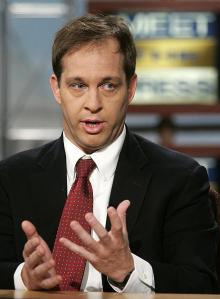
Dexter Filkins
According to Filkins, through Suleimani’s influence, after the U.S. took down Saddam Hussein and everything went to hell in Iraq, Iran has basically controlled what went on there; and now Iran is a powerful influence in the Syrian conflict. Here’s the introduction to the Filkins interview from Fresh Air site. Meet The Iranian Commander Pulling Strings In Syria’s War:
Perhaps the most important military commander in Syria’s civil war is not Syrian at all. He’s Iranian Maj. Gen. Qassem Suleimani, and he’s the subject of an article by Dexter Filkins in the current edition of The New Yorker.
For the past 15 years, Suleimani has been the chief of the Quds Force, a small but powerful branch of Iran’s Revolutionary Guard. He’s not a familiar name to Americans, but one former CIA officer described him to Filkins as “the single most powerful operative in the Middle East today.”
Filkins writes that Suleimani “has sought to reshape the Middle East in Iran’s favor, working as a power broker and as a military force: assassinating rivals, arming allies, and, for most of a decade, directing a network of militant groups that killed hundreds of Americans in Iraq. The U.S. Treasury Department has sanctioned Suleimani for his role in supporting the Assad regime, and for abetting terrorism.”
On Suleimani’s influence on the reshaping of the Middle East:
Qassem Suleimani — who is this extraordinarily powerful man behind the mask, very mysterious guy, very powerful guy — he was instrumental in 2010 in making sure that the Americans left no troops behind in Iraq. During the Iraq War, he supervised and directed militias which were responsible for hundreds of American deaths.
It appears, by the evidence, that the Iranians, and the Quds Force in particular, were behind the assassination of Rafik Hariri, the president of Lebanon, in 2005. Qassem Suleimani appears to be running or directing or at least playing a very large part in the war in Syria on behalf of the Assad government. So he’s everywhere, and, again, the Iranians have been extraordinarily aggressive over the past 15 years in asserting themselves in the Middle East, often at American expense.
Filkins also says that it’s clear the Iranians do want to develop nuclear weapons, and he doubts if the U.S. will be able to get them to agreed not to do it. The reason the Iranians are reaching out to the West right now is that the sanctions are really hurting them–basically the middle class in Iran has been decimated.
You can read more excerpts from the interview at the Fresh Air site. I plan to finish reading the Filkins article in the New Yorker today. I hope I’ve given you enough information to get you to read it too. I’m sure this article will be much discussed in the coming weeks.
Here’s Charles Pierce on the Filkins piece: The Limitless Bungling Of George W. Bush And Co.
Dexter Filkins has a long, fine piece in the September 30 New Yorker about one Qassam Suleimani, an Iranian who seems to be the Zelig of Middle East spookdom, and who is now currently working with the Assad government in Syria.
Since then, Suleimani has orchestrated attacks in places as far flung as Thailand, New Delhi, Lagos, and Nairobi-at least thirty attempts in the past two years alone. The most notorious was a scheme, in 2011, to hire a Mexican drug cartel to blow up the Saudi Ambassador to the United States as he sat down to eat at a restaurant a few miles from the White House. The cartel member approached by Suleimani’s agent turned out to be an informant for the U.S. Drug Enforcement Administration. (The Quds Force appears to be more effective close to home, and a number of the remote plans have gone awry.) Still, after the plot collapsed, two former American officials told a congressional committee that Suleimani should be assassinated. “Suleimani travels a lot,” one said. “He is all over the place. Go get him. Either try to capture him or kill him.” In Iran, more than two hundred dignitaries signed an outraged letter in his defense; a social-media campaign proclaimed, “We are all Qassem Suleimani.”
If you want evidence behind your essential instinct that the tangle in that part of the world is beyond our ability ever to untangle, you’ve got it here. But there is one other little tidbit that’s worth bringing up, given the fact that some officials formerly in the employ of C-Plus Augustus — most notably, David Frum — have snuck into the national dialogue again, probably through an unguarded window, instead of going off and living a penitent’s existence for what they did to the country.
(To be entirely fair, according to Filkins, Suleimani was formed by his participation in the savage Iran-Iraq War in which the United States, employing the brilliant realpolitik of blood-beast Henry Kissinger, helped both sides, guaranteeing that nobody would trust us thereafter. Genius!)
In other news,
Hillary had a few choice words for the Republicans who are trying to shut down the government in order to defund The Affordable Care Act. From the WaPo: Hillary Clinton says government shutdown ‘wouldn’t be the worst thing for Democrats’:
Hillary Rodham Clinton said Tuesday that if a “noisy minority” of Republican lawmakers force a government shutdown over funding for President Obama’s signature health-care law, they would face negative political consequences.
“It wouldn’t be the worst thing for Democrats if they tried to shut the government down,” said Clinton, a former secretary of state and potential 2016 Democratic presidential candidate. “We’ve seen that movie before and it didn’t work out so well for those so-called obstructionists.”
Clinton was referencing the political harm for Republicans in the mid-1990s when they forced a shutdown during husband Bill Clinton’s presidency.
“If they want to try to shut the government down, that’s on their head, that’s their responsibility,” she added.
Isn’t it great to have Hillary talking about politics again?
I’m really late with this post, so I’m going to wrap it up with a link dump:
From Gallup — Tea Party Support Dwindles to Near-Record Low: Republicans ambivalent about movement, while most Democrats oppose it
From Huffington Post — DC Exempts Itself From Federal Government Shutdown
From The Political Carnival: Don’t Buckle Your Seatbelt? Go To Jail — Or Your Death
From Vanity Fair, battles among the richie-riches in San Francisco’s toniest neighborhood —
Bluebloods & Billionaires
Scientific American — Peculiar Brain Signals Found in “Flat-Lined” Patient What does it really mean to be dead?

 peej
peej Carissa
 bostonboomer
 dakinikat
 ecocatwoman
 mablue2
 Mama Lopez
 peggysue22
 quixote
 skydancingguestblogger
 Mona (aka Wonk the Vote)



 Sky Dancing
Recent Comments