
Lazy Saturday Reads: Here We Go Again . . .
Posted: May 3, 2014 Filed under: 2016 elections, Barack Obama, Crime, Criminal Justice System, Foreign Affairs, morning reads, Republican politics, U.S. Politics, Violence against women, War on Women, Women's Rights | Tags: Benghazi, Cherise Morales, Darrell Issa, G. Todd Baugh, Hillary Clinton, James Taranto, Jeanine Howard, John Boehner, rape, Sir Young, Tina Brown 37 Comments
Brigit Ganley, The Dramatist
It’s Saturday!!
And a glance at the news headlines today reveals that everything old is new again. Remember 14-year-old Cherise Morales, who committed suicide after being raped by her teacher Stacy Dean Rambold? And G. Todd Baugh, the judge who blamed Cherise for the rape and sentenced the Rambold to only 31 days in jail and probation?
Well that decision *may* be overturned, but now we have another judge in Texas who sounds like a clone of Baugh–except she’s a woman! From the Dallas News: Judge says sexually assaulted 14-year-old ‘wasn’t the victim she claimed to be’.
A man sentenced to five years probation by a Dallas County judge after admitting he raped a 14-year-old girl won’t have to follow many of the restrictions typically given to sex offenders.
And the judge who issued the light sentence said Thursday that she did so in part because the girl wasn’t a virgin and “wasn’t the victim she claimed to be.”
State District Judge Jeanine Howard, who gave 20-year-old Sir Young deferred probation last week, also altered Young’s probation requirements. As a result, Young does not have to stay away from children, attend sex offender treatment, undergo a sex offender evaluation or refrain from watching pornography.
Wait a minute. Let me check my calendar. Is this really 2014?
District Attorney Craig Watkins said Thursday that his prosecutors would “always fight for our most vulnerable victims” like the one in this case. It is rare for prosecutors to critique a judge’s actions, but Watkins said he was “alarmed” by Howard’s decision.
“This young lady was 14 at the time she was sexually assaulted at school, and we cannot send the wrong message to rape victims who have the courage to seek justice,” Watkins said. “I am disappointed the judge would choose to give the defendant probation after he admitted guilt, but even more alarmed the judge failed to impose standard sex offender conditions of probation designed to protect society.”
Make sure you’re sitting down before you read this next bit. Judge Howard is a Democrat. She’s going to withdraw from the case now so she can better explain herself, but she doesn’t have to worry about being reelected because she’s running unopposed.
Howard said she made her decision for several reasons, including: The girl had texted Young asking him to spend time with her; the girl had agreed to have sex with him but just didn’t want to at school; medical records show the girl had three sexual partners and had given birth to a baby; and Young was barely 18 at the time.
“She wasn’t the victim she claimed to be,” Howard said. “He is not your typical sex offender.”
The girl’s mother said Friday morning that her daughter has never been pregnant and she was “livid” over the judge’s comments.
WTF?!
The victim, who is now 17, told The News on Thursday night that she feels it would have been better if she had never come forward about the 2011 assault. She and Young testified last week at his trial that she had told Young “stop” and “no” numerous times before and during the attack at Booker T. Washington High School for the Performing and Visual Arts, where both were students.
“I did what I was supposed to do. I went to the law about this situation,” she said. The judge’s probation sentence and the removal of the restrictions — “that says everything I went through was for nothing.”
Unbelievable! We’ll have to watch what happens with this case. But when will judges learn that 14-year-old girls are not able to consent to sex in the first place?
“Don’t Run for President, Hillary”
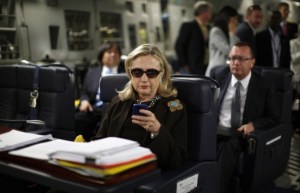
Why won’t that stupid bitch quit? (WWTSBQ)
Remember when MSNBC’s Krystal Ball told Hillary Clinton she shouldn’t run for President? Ball said that Elizabeth Warren, who is approximately the same age as Hillary and has zero experience and would be unlikely to win should run instead because Hillary was once on the board of Walmart … or something? Of course Ball’s nonsensical “advice” was ignored by most rational Democrats.
Now comes Tina Brown, editor of The Daily Beast to lecture Hillary some more: Don’t Run for President, Hillary. Become a ‘Post-President’ Instead. Except Brown seems not to care at all about Hillary’s positions on issues or her qualifications. She simply thinks Hillary should do the easiest thing and avoid the “stress” of a campaign and a tough job like the presidency. Brown apparently has projected her own values onto Hillary, assuming that she (Clinton) is as narcissistic and self-involved as Tina Brown is. Never mind that Hillary has spent most of her life focusing on public service and fighting for causes like women’s rights.
Brown writes:
I know as much as anyone how much her most fervent supporters want Hillary Clinton to run for president. On the opening night of the Women in the World Summit the mere mention of the possibility had the audience on their feet. The fan base is there, and constituencies beyond it.
Because American women want a woman in the White House in their lifetimes, and Hillary has the experince, strength, and passion to do the job.
But should she do it? Would the bravest and best decision be for her to skip it? In the 2008 campaign the chronic negativity of the ladies and gentlemen of the press was relentless, and the gouging of Hillary was wholly unrelated to either her record or her behavior. It was just that her story had gotten old. It required new angles, or, heaven forbid, new facts, to make it interesting—whereas Barack Obama was a story that wrote itself.
The first black president was a hotter plot line than the first woman president. Bad luck for Hillary. Obama stole her exceptionalism, leaving the press only with the hair, the alleged cackling laugh, and the over-familiar back-story, which meant dogging Bill around, hoping he’d lose it once in a while. (He obliged.)
I joined the Hillary bus for a Newsweek story in 2008 I was fascinated how little attention in their copy the traveling reporters actually paid to anything she said when she got out. They were too busy filing recaps of blogs by commentators who weren’t there. Suddenly there would be media uproar about some killer soundbite from Hillary that someone had gotten traction for that in context wasn’t controversial at all. Remember that shit-storm when she said MLK’s dream began to be realized when President Johnson passed the Civil Rights Act?
In other words, the media is full of assholes and even though Hillary could probably handle it, why bother? She should just be a “post-president” in the mode of Jimmy Carter and bask in the reflected limelight of her former-president husband.
Even the Wall Street Journal’s wingnut comumnist James Taranto seems to think Brown’s column is a little strange.
Does Brown disagree with Mrs. Clinton on matters of policy or doubt she would be a good president? One assumes the answer is no, though the column doesn’t say. Nor does Brown offer a more coldly political rationale–say, that Mrs. Clinton would be unlikely to win, or that a different candidate would better enhance the long-term fortunes of the Democratic Party.
Brown sums up her argument as follows: “She should forget it. If she wins, it’s too much stress for too little return.” By “return,” Brown means nothing more than “personal benefit.” By forgoing a campaign, Brown writes, Mrs. Clinton “can have her glory-filled post-presidency now, without actually having to deal with the miseries of the office itself.” ….
Brown….credits Mrs. Clinton with standing for something, namely “her global mission to promote women’s rights, education, and political participation.” She asks if skipping the presidential candidacy would be “the bravest and best decision,” though she doesn’t say a word about why it would be brave.
Her central argument, however, is that running for and serving as president would entail too much suffering, in large part because people, particularly in the media, would not respond to Mrs. Clinton fairly…
Taranto thinks he may have figured out Brown’s real motivation: she’s floating a trial balloon for Hillary, because maybe Hillary has doubts about running and wants to see how her supporters react to Brown’s arguments.
No, Mr. Taranto, that’s not it. Brown is just the latest example of women being women’s worst enemies–like when Gloria Steinem supported Barack Obama over Hillary in 2008. And, by the way, could you please stop referring to Hillary as “Mrs. Clinton?” She is a former Senator and Secretary of State for god’s sake!
Benghazi!!!!

Remember when Boehner thought Benghazi investigations were stupid?
And then there’s the GOP’s obsession with Benghazi!!–which is of course the stick they hope to beat Hillary Clinton with in 2016. From U.S. News and World Report: Boehner says he intends to appoint select House committee to investigate Benghazi.
Boehner said U.S. officials misled the American people after the Sept. 11, 2012, assault on the U.S. diplomatic post in Libya that killed Ambassador Chris Stevens and three other Americans. He said emails released this week showed the White House has withheld documents from congressional investigators and asked, “What else about Benghazi is the Obama administration still hiding from the American people?”
“Americans learned this week that the Obama administration is so intent on obstructing the truth about Benghazi that it is even willing to defy subpoenas issued by the standing committees of the people’s House,” Boehner, R-Ohio, said in a statement. “These revelations compel the House to take every possible action to ensure the American people have the truth about the terrorist attack on our consulate that killed four of our countrymen.”
Because Darrel Issa hasn’t already investigated enough? If only the House had spent half this much time investigating 9/11, we might know why the Bush administration ignored all those warnings.
Here’s Brian Beutler at The New Republic: The GOP’s Benghazi Obsession Returns With a Vengeance. Pay Attention, Hillary.
It is by sheer coincidence that just as Obamacare recedes as an issue, House GOP leaders have announced their intent to create a Select Committee on Benghazi—something they’ve long resisted—and that Oversight Committee Chairman Darrell Issa, perhaps overcome by zeal to maintain control over the issue, subpoenas Secretary of State John Kerry to testify about the 2012 attack—despite the fact that Kerry was a senator at the time, and hasn’t been invited to testify, and is currently visiting Sudan.
The pretext for all this is the release of an email from White House adviser Ben Rhodes, which includes as a bullet point the goal that in speaking about the attack, then-U.N. Ambassador Susan Rice should “reinforce the President and Administration’s strength and steadiness in dealing with difficult challenges.”
Slate’s Dave Weigel did a great job earlier this week of placing the email in chronological context, to discredit the argument that the email represents evidence of a “coverup.” And while it might appear a bit unseemly for administration officials to be concerning themselves with the president’s image and the administration’s competence in the midst a crisis … this is actually completely uncontroversial. Would John Boehner and Darrell Issa have preferred it if Susan Rice went on TV that week and granted that the administration was in complete disarray? Or had refused to take a position on the administration’s handling of the situation?
Beutler goes on to explain that even though all of the Republicans’ claims on Benghazi have been debunked, he is *concerned* because they are still going to use it to attack Hillary.
if Republicans are serious about working their base into a frenzy over Benghazi, it’d probably behoove liberals to mix a bit more clarity about the events in with the mockery. What’s really happening is pretty straightforward. Of all the Americans who’ve died in dangerous parts of the world over the last decade, Republicans have concerned themselves with Benghazi’s four victims, because they think there’s political utility in fostering suspicion that the administration was more concerned with the coverup than the attack itself.
Something tells me Beutler is another one of those “Please don’t run, Hillary” folks.
What do you think? Please let me know in the comments and, as always, post your links on any topic!
Saturday Reads: Where is Malaysia Airlines Flight 370?
Posted: March 15, 2014 Filed under: Crime, Foreign Affairs, morning reads | Tags: Fariq Ab Hamid, hijackings, Malaysia Airlines Flight 370, Prime Minister Najib Razak, terrorism, Zaharie Ahmad Shah 59 Comments
Malaysia Airlines Boeing 777 in Paris in December (AP)
Good Morning!!
For completely selfish reasons I’m going to focus this post on the missing Malaysia Airlines plane mystery, because I’m obsessed with the story and I want to read about it.
A week after Malaysia Airlines Flight 370 disappeared from radar, what happened is still a mystery. Where could it have gone? Early Saturday morning, Malaysia’s Prime Minister Najib Razak announced that the plane was diverted off course by “deliberate action.” Faith Karimi and Barbara Starr at CNN:
“Malaysian authorities have refocused their investigation on crew and passengers aboard,” Najib told reporters. “Evidence is consistent with someone acting deliberately from inside the plane.” [….]
“Despite media reports that the plane was hijacked, we are investigating all major possibilities on what caused MH370 to deviate,” he said.
Shortly after he spoke, a source close to the investigation told CNN that Malaysian police had searched the home of pilot Zaharie Ahmad Shah, 53. Shah lives in a gated community in Shah Alam, outside Kuala Lumpur.
Earlier Saturday there was no police presence at the residence of his co-pilot, Fariq Ab Hamid, 27.
Here’s a transcript of the Prime Minister’s statement at CNN.
From Bernama, the National News Agency of Malaysia: Cops Visit Residence Of Missing Flight’s Captain.
SHAH ALAM, March 15 (Bernama) — Police were seen arriving at the residence of Captain Zaharie Ahmad Shah, the pilot of the Flight MH370 at about 2.42pm Saturday.
This followed Prime Minister Datuk Seri Najib Tun Razak’s press conference on the development of the missing Malaysia Airlines (MAS) aircraft.
A check by Bernama noted that three plain clothed police personnel introduced themselves as coming from Bukit Aman police headquarters to the security guard manning the Laman Seri residence at Section 13 here before obtaining a security pass to go in.
It was believed that the police have conducted a search at the pilot’s house and all of them were seen leaving the residence at about 4.46pm.
From the Sydney Telegraph: Investigators digging deep into the lives of the pilots from the missing airliner.
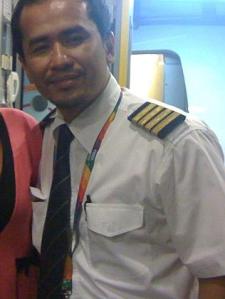
Co-pilot Fariq Abdul Hamid
THE psychological background, family life and connections of the two pilots aboard Malaysia Airlines flight MH370 have become a major focus of the investigation into the missing jet.
Pilots Zaharie Ahmad Shah, 53, and Fariq Abdul Hamid have been described as respectable, community-minded men.
Mr Fariq has drawn the greatest scrutiny after the revelation that in 2011, he and another pilot invited two women boarding their aircraft to sit in the cockpit for a flight from Phuket, Thailand, to Kuala Lumpur….
Fariq, the son of a high-ranking civil servant in Selangor state, joined Malaysia Airlines in 2007. With 2763 hours of flight experience, he had recently started co-piloting the Boeing 777. “His father still cries when he talks about Fariq. His mother too,” Ahmad Sarafi said.
Fariq had a brush with fame when he was filmed recently by a crew from “CNN Business Traveller,” and reporter Richard Quest described it as a perfect landing of a Boeing 777-200, the same model as the plane that vanished. Neighbour Ayop Jantan said he had heard Fariq was engaged and planning his wedding. The eldest of five, Fariq’s professional achievements were a source of pride for his father.
Zaharie, the pilot of MH370, joined the airline in 1981 and had more than 18,000 hours of experience. His Facebook page showed an aviation enthusiast who flew remote-controlled aircraft, posting pictures of his collection, which included a lightweight twin-engine helicopter and an amphibious aircraft. Born in northern Penang state, the captain and grandfather was an enthusiastic handyman and proud home cook.

Pilot Zaharie Ahmad Shah
Back to CNN story on the Prime Minister’s statement, linked above:
“The plane’s last communication with the satellite was in one of two possible corridors: a northern corridor stretching approximately from the border of Kazakhstan and Turkmenistan to northern Thailand, or a southern corridor stretching approximately from Indonesia to the southern Indian Ocean,” Najib said.
Given that the new search area involves a number of countries, the relevant foreign embassies have been given access to the new information. Malaysia’s Foreign Ministry will brief the governments that had passengers aboard the plane and will brief the relatives of its 239 passengers and crew….
“Based on new satellite information, we can say with a high degree of certainty that the Aircraft Communications Addressing and Reporting System, or ACARS, was disabled just before the aircraft reached the East Coast of peninsular Malaysia,” the Prime Minister said. “Shortly afterward, near the border between Malaysian and Vietnamese air traffic control, the aircraft’s transponder was switched off. From this point onwards, the Royal Malaysian Air Force primary radar showed that an aircraft — which was believed but not confirmed to be MH370 — did turn back.”
Military radar showed the jetliner flew in a westerly direction back over the peninsula before turning northwest toward the Bay of Bengal or southwest into the Indian Ocean, he said.
“Up until the point at which it left military primary radar coverage, these movements are consistent with deliberate action by someone on the plane,” he said, adding that investigators had confirmed by looking at the raw satellite data that the plane in question was the Malaysia Airlines jet.
American and British aviation authorities agreed with these conclusions. A story from McClatchy (via the Miami Herald) explains that an experienced person must have been flying the plane.
Najib’s comments further suggest that someone with significant flying experience must have commandeered the flight, or that a hijacker managed to coerce the crew to take two actions that diverted the flight from reaching Beijing. One involved disabling the flight’s “Aircraft Communications Addressing and Reporting System” over the northeast coast of Malaysia. Then, at 1:21 a.m, someone turned off a transponder that was reporting the aircraft’s location, altitude, speed and other information.
Forensics work and a review of Malaysian radar, Najib said, has now revealed that MH 370 turned back and started traveling in a westerly direction. But the flight was still tracked by satellites overhead. A review of that data, Najib said, revealed that the last confirmed communication between the plane and the satellite was at 8:11 a.m. Malaysian time last Saturday, nearly seven hours after air traffic controllers lost track of it.
Based on this new data, the prime minister said, investigators think the plane could have traveled in two possible directions — “a northern corridor stretching approximately from the border of Kazakhstan and Turkmenistan to northern Thailand, or a southern corridor stretching approximately from Indonesia to the southern Indian ocean.” An international search effort has already shifted its attention to those areas, he said.
That first scenario raises the possibility that a hijacker or hijackers could have attempted to land the plane and its passengers in a remote part of Central Asia known to harbor militant groups. But in an age of satellites, doing so undetected would be extremely difficult, and so far there’s been no reported claim of responsibility for the plane’s disappearance.
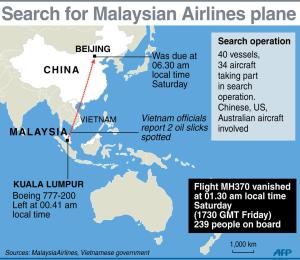
According to The New York Times, Search for Malaysian Jet Becomes Criminal Inquiry.
Mr. Najib’s news conference, at an airport hotel here on the outskirts of Kuala Lumpur, came a day after American officials and others familiar with the investigation told The New York Times that Flight 370 had experienced significant changes in altitude after it lost contact with ground control, and altered its course more than once as if still under the command of a pilot.
Military radar data subsequently showed that the aircraft turned and flew west across northern Malaysia before arcing out over the wide northern end of the Strait of Malacca, headed at cruising altitude for the Indian Ocean.
News sources indicate the plane could have kept flying as long as 7 hours after it cut off contact.
“The investigation team is making further calculations, which will indicate how far the aircraft may have flown after the last point of contact,” Mr. Najib said, reading a statement in English. “Due to the type of satellite data, we are unable to confirm the precise location of the plane when it last made contact with a satellite.”
The northern arc described by Mr. Najib passes through or close to some of the world’s most volatile countries, home to insurgent groups, but also over highly militarized areas with robust air-defense networks, some run by the American military. The arc passes close to northern Iran, through Afghanistan and northern Pakistan, and through northern India and the Himalayan mountains and Myanmar.
An aircraft flying on that arc would have to pass through air-defense networks in India and Pakistan, whose mutual border is heavily militarized, as well as through Afghanistan, where the United States and other NATO countries have operated air bases for more than a decade.
Air bases near that arc include Bagram Airfield in Afghanistan, where the United States Air Force’s 455th Air Expeditionary Wing is based, and a large Indian air base, Hindon Air Force Station.
A few more articles on missing Flight 370:
WSJ: Malaysia Airlines Flight 370 Probe Sharpens Focus on Sabotage
The Independent: Missing Malaysia Airlines Flight MH370: Plane’s communications ‘deliberately disabled’ says prime minister as new radar evidence points to hijacking
CBS News: As U.S. role expands, so do search area and suspicion of foul play
NPR: Boeing 777 Pilots: It’s Not Easy To Disable Onboard Communications
WaPo: Mystery of missing jet recalls past disappearances
What else is happening? What stories are you following today?
The Kitty Genovese Case 50 Years Later
Posted: March 13, 2014 Filed under: Crime, Criminal Justice System, GLBT Rights, Media, psychology | Tags: B. Latane, bystander effect, J.M. Darley, Kew Gardens, Kitty Genovese, Mary Ann Zielonko, rape, serial murders, Winston Mosley 20 Comments
Today is the 50th anniversary of the murder of Kitty Genovese in Queens, New York. This was a crime that shocked and outraged America and the world, and still horrifies and fascinates people to this day. At The New Yorker, Nicholas Lehmann describes some of the reasons this news story has become so iconic and reviews two new books on the case. Lehmann argues that New York Times editor Abe Rosenthal created a news environment in which this particular murder became the focus of so much attention. Lehmann deliberately shaped the coverage of the murder in a sensational and misleading manner. The story ended up as the focus of a classic psychological study.
a post about this in August 2009, and I thought I’d put that post up again today.
I wrote a piece about this in August 2009. I thought I’d repost it today. I’ve made a few minor edits to the original. At the end, I list some recent books and articles for further reading.
The Kitty Genovese Case: A Fascinating Intersection of True Crime, Psychology, and Media Misinformation
A Murder in Kew Gardens
On March 13, 1964, at around 3:30AM, there was a murder in the Kew Gardens section of Queens, New York. The murder probably wouldn’t have gotten much publicity at all if it hadn’t been for a sensational article that appeared on the front page of The New York Times, a couple of weeks later. The Times story led to groundbreaking research in social psychology and the discovery of new and counter-intuitive information about human behavior.
It was very late, very cold, and very dark when 28-year-old Catherine “Kitty” Genovese parked her car at the Kew Gardens train station after driving from Ev’s Eleventh Hour Bar in Hollis, where she worked nights as manager. When she got out of her car, she saw a stranger walking toward her. The man, Winston Mosley, 29, stabbed Genovese two times as she hurried past a bookstore on Austin Street, pehaps headed a local bar named Bailey’s to seek assistance. She called out, “Oh my God. He stabbed me. Please help me,” and fell to the ground. Winston was leaning over her to stab her again, when he heard a man’s voice calling from a window in an apartment building across the street, “Leave that girl alone!”
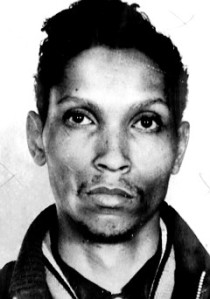
- Winston Mosley
Startled, Mosley ran down an alley, got into his car, and backed up, ready to drive off. Lights had gone on in the nearby apartment building, but they went off again. Mosley got out of the car and again followed Genovese, who had reached the doorway of her apartment building, which was in the back of the building at 82-62 Austin Street. As she fell forward through the doorway, crying out, “I’m dying, I’m dying,” Winston caught up with her, stabbed her again, and then raped her. A short time later, a neighbor, Greta Schwartz, who had called the police after receiving a phone call from another neighbor, ran down to the lobby and cradled Kitty in her lap until the paramedics arrived.
From interviews in the neighborhoods of the two stabbing incidents, police learned that as many as 37 people had seen or heard part of the stalking and murder of Kitty Genovese by Winston Mosley, but supposedly none of them had called the police except Greta Schwartz.
The New York Times Breaks the Story
On March 27, 1964, The New York Times published a front page story by Martin Gansberg (Warning, PDF) headlined “37 Who Saw Murder Didn’t Call Police.”
Apathy at Stabbing of Queens Woman Shocks Inspector
For more than half an hour 38 respectable, law-abiding citizens in Queens watched a killer stalk and stab a woman in three separate attacks in Kew Gardens.
Twice the sound of their voices and the sudden glow of their bedroom lights interrupted him and frightened him off. Each time he returned, sought her out and stabbed her again. Not one person telephoned the police during the assault; one witness called after the woman was dead.
That was two weeks ago today. But Assistant Chief Inspector Frederick M. Lussen, in charge of the borough’s detectives and a veteran of 25 years of homicide investigations, is still shocked.
He can give a matter-of-fact recitation of many murders. But the Kew Gardens slaying baffles him–not because it is a murder, but because the “good people” failed to call the police.
Just that brief excerpt contains a number of inaccuracies, which I’ll get to a little later. Nevertheless, it was from this newspaper article that Americans–and people around the world–formed their lasting impressions of the tragic death of Kitty Genovese. The story shocked the nation; everyone was talking about how terrible it was that in big cities like New York, people just didn’t seem to get to know their neighbors or care about them. Those of us who lived in small cities and towns were sure things would be different in our neighborhoods.
Psychological Study of the Bystander Effect
In 1968, J.M. Darley and B. Latane published a study (pdf) in the Journal of Personality and Social Psychology that was inspired by the supposed behavior of the 37 “witnesses” to Kitty Genovese’s murder. They hypothesized that the reason bystanders did not take action was “diffusion of responsibility,” and that the more bystanders in an emergency situation, the more these bystanders believe that “someone else will help, so I don’t need to.”
Participants in the study were college students in an introductory psychology class at New York University.
Darley and Latane told participants that they wanted to study how students adjust to university life in a highly competitive, urban environment. They said they wanted participants to discuss their problems honestly with other students; and in order to avoid personal discomfort, participants would sit in separate rooms equipped with an intercom system.
There were three different groups. Students in group one were told they would be talking with one other person. In group two, students were told there would be two other people on the intercome with them. Group five was told there would be five other people listening in to the conversation. In reality, all of the students were alone and they the other voices they heard were on tape. The emergency was that one of the participants in the discussion has epileptic seizure (the sounds of the seizure were actually played on tape).
As the intercom discussions began, students heard the first student, a male, tell about his difficulties concentrating on his studies and problems adjusting to life in New York City. He then added, with some embarrassment, that he sometimes had severe seizures, especially when under a lot of stress. Then the conversation switched to the next student. In group 1, the actual student’s turn came next. In the other two groups, the real student heard one or more other students speak first. After the real student took a turn speaking, the first “student” again started to speak normally, then began having a seizure, and asked for help. Darley and Latane measured how long it took subjects to help the student in trouble (helping was defined as leaving the cubicle and notifying an experimenter of the problem).
Why? Not because they were apathetic. All subjects were anxious and showed physical signs of nervousness. Darley and Latane conclued that as the number of people involved in an emergency situation increase, it’s easier for bystanders to assume that someone else will handle it; and the potential guilt for not helping is divided up. Other possible reasons for failure to act are fear of embarrassment or ridicule, fear that they are misinterpreting the situation. The authors also pointed out that most people don’t have much experience with emergency situations and are likely to become confused or overwhelmed when they encounter one.
Joseph De May, Jr., and the Kew Gardens History Page
In 2000, Joseph De May, who had lived in Kew Gardens since 1974, decided to build a website that would contain a comprehensive pictorial history of the neighborhood. As part of his project, De May dug up as much information as he could about the Kitty Genovese murder and then critiqued the original New York Times article and debunked some myths that had grown up around the case. Here is the “short version” of his critique:
# There were only 2 attacks, not 3.
# The attacks were not continuous. There was about a 10 min. interval between them when the killer moved his car to a parking place farther away.
# There were not 38 eye witnesses to either of the attacks. Only 3 people are known to have seen one or the other of the stabbings.
# The first attack on Austin Street – the one that awakened the witnesses – was likely over before all but a few of the witnesses got to their windows.
# Probably many more than 38 were ear witnesses to Kitty’s screams. However, that first attack occurred a few yards away from a bar known for its late night rowdiness.
# After the first attack, Kitty left the scene under her own power without making any outcries for help.
# The second attack took place in a small vestibule in the rear of a building where only one witness was in a position to see it.
# Given the layout of the crime scene, it would have been impossible for anyone to have seen or heard everything.
# Assuming the police were not timely called – a big assumption in my opinion – there were reasons apart from apathy why they were not.

- Crime scene photo: back of apartment building where Kitty died
Furthermore, a 15-year-old boy named Michael Hoffman saw Winston Mosley run away after the first attack in front of the bookstore and saw Kitty Genovese get up and stagger in the other direction. He didn’t know there had been a stabbing, but he told his father what he had seen and the father called the police. The police later admitted they had received several other calls. One man did see the knife and understood that a woman was being stabbed. This man never called the police and couldn’t explain his inaction. At least five other people saw Mosley return to the original scene, but by that time Kitty Genovese was gone.
There were two attacks, not three as the New York Times reported. A man on the first floor of Kitty’s building open his door and saw the final attack. He wanted to call police, but said his wife didn’t want him to get involved. He went to Greta Schwartz’s apartment and asked her to call police, which she did. She then ran downstairs with a friend, found Kitty still alive and cradled her until an ambulance arrived. Also contrary to The New York Times story, the occupants of Kitty Genovese’s apartments building knew and were friendly with each other. Many knew and liked Kitty and her roomate Mary Ann Zielonko.
The Real Kitty Genovese
In 2004, on the fortieth anniversary of Kitty Genovese’s death, Mary Ann Zielonko came forward and talked about Kitty publicly for the first time. She was interviewed on NPR’s Weekend Edition Saturday. In the interview, Zielonko, who now lives in Vermont, revealed that she and Kitty Genovese were lovers. A lesbian blogger in Vermont wrote a piece about her own feelings after she learned about Kitty’s sexual orientation.
Hearing that Genovese was a lesbian has shaken up my psyche. Genovese’s name was always a cautionary tale – about being a woman alone in the city at night, about the need to care and take action in the face of assault. But now it’s also somehow more about me as a lesbian, about our denied and undiscovered herstory, about the dangers we faced then – and now.
In 1964, it was not okay to be queer. The only place to go to hold your lover’s hand in semi-public was a bar. Mary Ann remembers the Swing Rendezvous on MacDougal St. and the Seven Steps on Houston. Police raids and being beaten up for wearing butch or femme drag were common events.
Until now we’ve never had the opportunity to ask whether the neighbors’ indifference might have had an element of homophobia (not that the word existed then). Kitty and Mary Ann lived together in the apartment Kitty was so desperately trying to reach that March night. Mary Ann says some of the neighbors suspected they were lesbians, because they were always together. “But we didn’t look ‘gay,’ whatever that means.” Mary Ann got home from her own shift tending bar and went to sleep – until the police knocked at her door at 4 a.m. and drove her from the tree-lined streets of their Kew Gardens, Queens, neighborhood where Kitty died, to the hospital morgue to identify Kitty’s body.
Some of the neighbors may have suspected that Kitty and Mary Ann were gay, but several reported in interviews that she was a friendly, smiling young woman whom they liked. A few told police and reporters that they “didn’t want to get involved,” but most weren’t sure what they had seen or heard and couldn’t say why they didn’t call for help. It was after 3AM on a winter night, in a neighborhood where there were often loud voices and even fighting among people leaving local bars. As with the participants in Darley and Latane’s study, some of the witnesses may have feared giving a false report to police and looking foolish.
In addition, Joseph De May reports that in those days, NYC police demanded that callers identify themselves rather than just accepting reports of emergencies. That may have deterred some from calling police or holding on long enough to get someone to listen. Even if witnesses had called police to report screaming or fighting, they would likely have taken a long time to respond, because of the bars in the area.
In 2004, The New York Times interviewed De May about his research.
In the end, Mr. De May’s conclusion about the murder is that, while the behavior of the witnesses was hardly beyond reproach, the common conception of exactly what occurred that night is not in fact what occurred. What did occur, he argues, is far more complex and far less damning to the residents of Kew Gardens.
”Yeah, there was a murder,” Mr. De May said. ”Yeah, people heard something. You can question how a few people behaved. But this wasn’t 38 people watching a woman be slaughtered for 35 minutes and saying, ‘Oh, I don’t want to be involved.”’
Mr. De May began his research with the seminal Times article of March 27, 1964. ”I remember reading through it, then putting it down and thinking, ‘Well, this doesn’t hang together at all,”’ he said. ”And then I read it again carefully. I knew the area. I knew the crime scene because I go by there every day.”
Mr. De May soon found himself poring through legal documents related to the case, scouring books and articles, and interviewing neighbors. At one point, he even ran the route of Ms. Genovese’s flight up Austin Street, timing it with a watch. He became convinced that his first impression was correct. ”Here’s something that everyone thinks happened,” he said, ”that isn’t so.”
Winston Mosley
Kitty’s murderer had no idea that she was a lesbian. He had set out that night to kill a woman. He was certainly a sociopath and may have been a serial killer. He confessed to having killed at least one other woman after he was arrested for the Genovese murder. In 1968, Mosley managed to escape from police custody and raped a pregnant woman in her home. In April, 2008, the New York Daily News reported on Mosley’s latest parole hearing.
Forty-four years after stalking and stabbing Kitty Genovese, her killer still blames his wife-beating father for the vicious murder.
“My father was at the time stalking my mother and thinking about killing her,” Winston Moseley told the parole board last month when asked about the infamous 1964 slaying.
“But the problem was not just at that moment in time,” he said. “It existed for many years of sort of the emotional trauma that I was going through.”
Moseley, whose parole bid was rejected for a 13th time, has long displayed little remorse for the March 13, 1964, slaying – although he did offer an apology this time, a transcript of the hearing shows.
Further Reading:
Books
In 2008, Charles E. Stoller, the man who prosecuted Winston Mosley for the murder of Kitty Genovese and two other murders, published a book about the cases, Twisted Confessions: The True Story Behind the Kitty Genovese and Barbara Kralik Murder Trials.
Catherine Pelonero, Kitty Genovese: A True Account of a Public Murder and Its Private Consequences (2014)
Kevin Cook, Kitty Genovese: The Murder, the Bystanders, the Crime that Changed America (2014)
Articles
Boston Globe book review, ‘Kitty Genovese’ by Kevin Cook and ‘Kitty Genovese’ by Catherine Pelonero
Nicholas Lehmann, A CALL FOR HELP: What the Kitty Genovese story really means.
AP (via CBS Local NY), 50 Years Later, Kitty Genovese Murder Case Still Grips NYC, Nation.
Fabian Tepper (Christian Science Monitor), Kitty Genovese murder: would you have helped?
Nancy Dillon (NY Daily News), Brother of Kitty Genovese to release documentary about sister’s 1964 murder, which prompted ‘Genovese Syndrome’ research
Tuesday Reads: More Snow, Mystery Plane, Joe McGinniss, Ed Snowden, and Ukraine Crisis
Posted: March 11, 2014 Filed under: Barack Obama, Crime, Foreign Affairs, morning reads | Tags: deaths, Edward Snowden, Fatal Vision, Jeffrey MacDonald, Joe McGinnis, missing Malaysian Airlines plane, South by Southwest Interactive conference, Ukraine crisis, Vladimir Putin, winter weather 44 Comments
A Snowy Harvard Square in 1969
Good Morning!!
I’ve had a scary couple of days. I woke up on Sunday morning to find my house very cold. I soon realized there was something wrong with my furnace. It was still running and there was hot air coming out of the vents, but it wasn’t pushing out enough heat to warm up the house. It turned out the blower motor had died so I called furnace installation davenport ia to diagnose the problem.
Why is it these things always seem to happen on a weekend or holiday? Luckily it hasn’t been terribly cold so I’ve managed to stay relatively comfortable by wearing lots of layers and using a portable electric heater. I was able to find someone to come and fix it yesterday. I got so relaxed that I overslept this morning, and so this post is going to be late.
In addition, health benefits of infrared heating impacts our mind and body. Increases your core body temperature, stimulating continuous blood flow from the heart in and around the body. The improvement of circulation enables an increased level of fresh oxygen and other nutrients to reach vital organs, removing carbon dioxide and other waste substances away from these organs, improving their functions helping to perform better and feel healthier.
So now I’m completely broke but warm, and I’m prepared for the upcoming snowstorm. Yes, the Weather Channel is predicting another one and has given it one of those annoying names. You can check out the predicted impact on your area in this summary article, Winter Storm Vulcan Forecast: Long Swath of Snow Across Rockies, Midwest, Northeast. I can only hope this one turns out to be a bust like the last one. Otherwise, I’ll be shoveling snow again on Friday.
The story of the missing Malaysion plane continues. Here are the latest reports:

Reuters (via Nipawin Journal): Malaysia military tracked missing plane to west coast: Source
KUALA LUMPUR – Malaysia’s military believes a jetliner missing for almost four days turned and flew hundreds of kilometres to the west after it last made contact with civilian air traffic control off the country’s east coast, a senior officer told Reuters on Tuesday.
In one of the most baffling mysteries in recent aviation history, a massive search operation for the Malaysia Airlines Boeing 777-200ER has so far found no trace of the aircraft or the 239 passengers and crew.
Malaysian authorities have previously said flight MH370 disappeared about an hour after it took off from Kuala Lumpur for the Chinese capital Beijing.
“It changed course after Kota Bharu and took a lower altitude. It made it into the Malacca Strait,” the senior military officer, who has been briefed on investigations, told Reuters.
That would appear to rule out sudden catastrophic mechanical failure, as it would mean the plane flew around 500 km (350 miles) at least after its last contact with air traffic control, although its transponder and other tracking systems were off.
A non-military source familiar with the investigations said the report was one of several theories and was being checked.
Authorities are pretty sure there was no terrorism involved. At least one of the men with stolen passports was an asylum-seeker from Iran.
CBS News: Malaysia Airlines Flight 370 search widens; men carrying stolen passports ID’d as young Iranians
KUALA LUMPUR, Malaysia — At least one of the two men traveling on a missing Malaysian Airlines jetliner was an Iranian asylum seeker, officials said Tuesday, as baffled authorities expanded their search for the Boeing 777 on the opposite side of the country from where it disappeared nearly four days ago with 239 people on board.
In the absence of any sign that the plane was in trouble before it vanished, speculation has ranged widely, including pilot error, plane malfunction, hijacking and terrorism, the last because two passengers were traveling on stolen passports. The terrorism theory weakened after Malaysian authorities determined that one of the two men was an Iranian asylum seeker.
Interpol Secretary General Ronald Noble said at a news conference Tuesday that the international police agency had identified two Iranian men, Pouri Nour Mohammadi, 18, and Delavar Seyed Mohammad Reza, 29. Noble said based on investigations carried out into the men to date, they were “probably not terrorists.” The chief of police in Kuala Lumpur said earlier in the day that Mohamadi was apparently trying to fly to Europe as an asylum seeker.
The plane took off from Kuala Lumpur, on the western coast of Malaysia, early Saturday en route to Beijing. It flew overland across Malaysia and crossed the eastern coast into the Gulf of Thailand at 35,000 feet. There it disappeared from radar screens. The airline says the pilots didn’t send any distress signals, suggesting a sudden and possibly catastrophic incident.
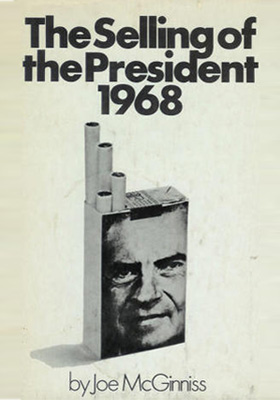
I was surprised and saddened last night to learn that Joe McGinniss has died at 71 of complications from inoperable prostate cancer. McGinniss was only 26 when his first book The Selling of the President 1968 hit the bestseller lists. I bought the book and read it way back then. I couldn’t put it down. Same thing with his pathbreaking true crime book on the Jeffrey MacDonald case, Fatal Vision. From the AP obituary (via First Post World), ‘Fatal Vision’ author Joe McGinniss passes away at 71.
McGinniss was a columnist for The Philadelphia Inquirer in 1968 when an advertising man told him he was joining Hubert Humphrey’s presidential campaign. Intrigued that candidates had advertising teams, McGinniss was inspired to write a book and tried to get access to Humphrey. The Democrat turned him down, but, according to McGinniss, Nixon aide Leonard Garment allowed him in, one of the last times the ever-suspicious Nixon would permit a journalist so much time around him. Garment and other Nixon aides were apparently unaware, or unconcerned, that McGinniss’ heart was very much with the anti-war agitators the candidate so despised.
The Republican’s victory that fall capped a once-unthinkable comeback for the former vice president, who had declared six years earlier that he was through with politics. Having lost the 1960 election in part because of his pale, sweaty appearance during his first debate with John F. Kennedy and aware of his reputation as a partisan willing to play dirty, Nixon had restricted his public outings and presented himself as a new and more mature candidate.
McGinniss was far from the only writer to notice Nixon’s reinvention, but few offered such raw and unflattering details. “The Selling of the President” was a sneering rebuttal to Theodore H. White’s stately “Making of the President” campaign books. It revealed Nixon aides, including future Fox News chief Roger Ailes, disparaging vice presidential candidate Spiro Agnew, drafting memos on how to fix Nixon’s “cold” image and debating which black man — only one would be permitted — was right for participating in a televised panel discussion.
Historian David Greenberg wrote in “Nixon’s Shadow,” published in 2003, that McGinniss “sneaked in under the radar screen, presenting himself to Nixon’s men as such an insignificant fly on the wall that they never thought to swat him away.”
McGinnis was criticized for getting too close to Jeffrey McDonald and somehow betraying him, but I think McGinnis got it right. His contract stated that he would have full independence. He started out thinking McDonald could be innocent of the murders of his wife and two daughters, and he had an inside track on the defense; but in the end McGinnis concluded that MacDonald was guilty and wrote about his change of heart in the book.

Colette, Kimberly, and Kristin MacDonald
His 1983 book “Fatal Vision” became a classic of the true crime genre and was based on unlimited access he gained to former Green Beret Jeffrey MacDonald and his attorneys during MacDonald’s 1979 murder trial in the deaths of his pregnant wife and two young daughters in Fort Bragg, North Carolina.
MacDonald, who at the time of the 1970 killings was an Army doctor, was found guilty and is serving three life sentences.
He has maintained the murders were committed by drug-crazed intruders. McGinniss had begun by expressing support for MacDonald but ended by concluding in his book that he was guilty of killing his family.
“I kept trying to find any reason I could to believe that he was not guilty,” McGinniss testified at a 2012 court hearing where MacDonald sought to be granted a new trial.
New Yorker magazine writer Janet Malcolm, in a 1989 article, accused McGinnis of displaying the underside of journalism by deceiving MacDonald with a show of support and then betraying his confidence, an argument McGinnis vehemently denied.
A terrific writer has left us far too soon.
Edward Snowden has been making more virtual appearances than a best-selling author on a publicity tour. Yesterday he was at South by Southwest Interactive in Austin Texas. I’m sure everyone here knows I’m not a fan of the pale and nerdy defector, so I’ll spare you my editorial comments and just give you a couple few links.
From Politico’s Josh Gerstein: Snowden Inc.
First, National Security Agency leaker Edward Snowden popped up in Hong Kong. Then, Russia. By Monday, the fugitive from justice, a man regularly accused of treason, was in Austin, Texas, hitting the nation’s hottest tech festival — via the Web, of course.
“They’re setting fire to the future of the Internet,” Snowden warned darkly, in jerky video relayed through a series of proxies from an undisclosed location in Russia. With an image of the U.S. Constitution projected behind him, he urged the tech-savvy SXSW attendees to ride to the rescue against rampant surveillance by the NSA and others. “The people who are in this room, now, you guys are all the firefighters, and we need you to help fight this,” he said, sounding every bit the geek as he described various encryption applications he believes should get wider use.
Snowden was painstaking in how he assembled a huge trove of top-secret documents while working as a tech contractor at an NSA facility in Hawaii. And he’s been equally deliberate in the way he and the team around him have crafted and cultivated his public image — controlling and carefully managing how he’s been perceived by the public in the months since he burst into the spotlight. It’s an endeavor that’s involved everything from coordinated efforts to beat back Obama administration attacks to the careful parceling out of tantalizing tidbits about his everyday life.

Snowden is campaigning for clemency; but frankly, I hope he ends up stuck in Russia for life. Ooops! Sorry, that’s my last nasty comment. A couple more links:
The Verge: Edward Snowden: ‘Would I do it again? Absolutely yes’
The Washington Post: ‘They’re setting fire to the future of the Internet’
I’ll wrap this up with some interesting articles on the crisis in Ukraine.
Putin biographer Masha Gessen at the LA Times, Is Vladimir Putin insane? Hardly. He is merely acting the way he always has, like a playground bully.
Politico, Bill Clinton no fan of ‘crazy’ moves on Ukraine
Financial Times, Ukraine is a test case for American power: If the Chinese leadership were ever to ‘do a Putin’, how could the US and allies react?
Robert Shrum at The Daily Beast, Obama’s All Eisenhower On Russia: Like Ike before him, Obama’s non-moves against Russia are the right moves.
Now what stories are you following today? Please post your links on any topic in the comment thread, and have a terrific Tuesday!
Thursday Reads: Guns and American Culture (and other news)
Posted: February 27, 2014 Filed under: Congress, Crime, morning reads, U.S. Politics | Tags: "stand your ground" laws, Affordable Care Act, Crimea, FDA, Federal Reserve, gun control, Hillary Clinton, nutrition labels, Russia, self defense, shooting deaths, Ukraine 44 Comments
Morning Paper at Cap Ferrat, by Rebecca Kao Wang
Good Morning!!
I live in a state that has very strict gun control laws. A recent study by Boston Children’s Hospital found that states with the toughest gun laws have the lowest rates of gun deaths. And Boston tends to average between one shooting victim every other day to one victim per day. I’ve been thinking about this for the past couple of days since I read this article at WBUR: When Mass. Criminals Want A Gun, They Often Head North
Massachusetts gun laws are widely considered some of the toughest in the country. But with a rash of shooting deaths in Boston this year, some law enforcement officials say it’s obvious that there are ways around the rules. And when Massachusetts criminals want to get their hands on a gun, they frequently head north.
In 2012, more than half of the guns that law enforcement seized in Massachusetts and managed to trace to their origins came from other states, according to federal statistics. The biggest suppliers by far were New Hampshire and Maine, as is the case most years.
According to the article, ATF agents discovered that gun traffickers in Massachusetts were legally buying large numbers of guns from New Hampshire and Maine, where they are much easier and cheaper to buy, and reselling them to people in Massachusetts.
The flow of guns from northern New England to Massachusetts is propelled by key differences among state gun laws. It’s all about private handgun sales, in particular. In Massachusetts every private handgun sale must be recorded and reported to the state within seven days. And the buyer must have a license to carry from local police, which in turn requires a background check. The Massachusetts rules are tight.
Up north, not so much. Buyers at federally licensed gun shops in Maine and New Hampshire are subjected to a federal background check for prior felonies, or a history of severe mental illness. But when it comes to private gun sales — at a gun show, or even a commuter parking lot — no documentation is required — no background check, no record of the transaction.
Darcie McElwee, an assistant U.S. attorney in Maine, says that in her state a private seller doesn’t even have to ask the buyer for a driver’s license.
Now it’s still illegal to sell guns to a convicted felon or for a felon to buy a gun, so if someone is caught doing this, they’ll go to jail for two years minimum. And the rates of gun deaths and injuries are still lower in Massachusetts than in states with less strict gun laws.
Clearly strict state laws are not enough to prevent gun violence. We need federal laws to control gun sales and to encourage gun safety–like the Massachusetts law that requires guns to be unloaded and locked up when not in use. But how can we make that happen? According to the WBUR article, Congress has even made it difficult to keep track of guns that are used in crimes and for academic researchers to access federal government data on gun trafficking.
Massachusetts Senator Ed Markey has introduced a bill to require all guns to be personalized so they can only be fired by the owner or another authorized person. These so-called “smart guns” already exist.
One of California’s largest firearm stores recently added a peculiar new gun to its shelves. It requires an accessory: a black waterproof watch.
The watch’s primary purpose is not to provide accurate time, though it does. The watch makes the gun think. Electronic chips inside the gun and watch communicate with each other. If the watch is within close reach of the gun, a light on the grip turns green. Fire away. No watch means no green light. The gun becomes a paperweight.
A dream of gun control advocates for decades, the Armatix iP1 is the country’s first smart gun. Its introduction is seen as a landmark event in efforts to reduce gun violence, suicides, and accidental shootings….
Of course the NRA will fight this tooth and nail, and it’s not going to get through the Senate, much less the House, in the current environment.
Now check this out. According to a piece at Venture Beat, you can quickly and easily buy guns on Facebook!
Fifteen minutes.
That’s all it takes for children, felons, and people without IDs to buy illegal weapons on Facebook pages dedicated to the sale and celebration of guns.
A VentureBeat investigation has uncovered dozens of pages on Facebook where guns are for sale, including semi-automatic weapons, handguns, and silencers. While the transactions don’t actually happen on Facebook, the social network is a remarkably easy way to find shady people willing to sell you a weapon — no questions asked. The illegal transactions then take place in diners, dark parking lots, and isolated country roads — away from the prying eyes of the feds and local police.
In Kentucky, Greenup County Sheriff Keith Cooper remembers when a call came into dispatch last October saying a 15-year-old student had been arrested on the Greenup County High School campus for carrying an unlicensed and loaded 9mm handgun to school. The boy was arrested and brought to Cooper’s office for an interview.
When Cooper, a former Kentucky State Trooper with a heavy Southern drawl, asked the kid where he got the gun, his reply was shocking: Facebook.
Read it and weep. Oh, and Facebook claims they don’t allow people to sell guns or explosives on their pages, but clearly they’re not enforcing these rules very well.
It’s not news to anyone that America has a love affair with guns. Guns and hunting are part of American culture, going hand-in-hand with the cult of rugged individualism. I’ve always thought it came from the frontier tradition. Most of the country was settled by pioneering who set out from the East coast to begin new lives in the Midwest and West before the arrival of the accoutrements of civilization–like law enforcement, banks, and insurance companies. In my generation at least, kids saw endless movies and TV shows about “cowboys and Indians;” and we played with toy guns–even us girls. And of course, since we were born shortly after World War II, many of us watch movies that glorified war.
Still I’ve never wanted a real gun. It seems to me that the gun culture is much stronger in some ways than in those innocent days of the 1950s and ’60s. But why? The obvious answer is the lobbying and propaganda efforts of the National Rifle Association (NRA). And what about the recent work of ALEC and the Koch Brothers to get state “stand your ground” laws passed around the country? Dahlia Lithwick has posted a fine piece about this at Slate.
“Stand Your Ground” Nation: America used to value the concept of retreat. Now we just shoot.
Last week, Kriston Charles Belinte Chee, an unarmed man, got into a fight with Cyle Wayne Quadlin at a Walmart in suburban Arizona. Quadlin opened fire midargument and killed Chee. Officers decided not to charge Quadlin because, they concluded, the killing was in self-defense. According to the police spokesman, “Mr. Quadlin was losing the fight and indicated he ‘was in fear for his life.’” Just a week earlier, a jury in Jacksonville, Fla., found Michael Dunn guilty on four counts of attempted murder but did not convict him on the most serious charge of first-degree murder, in the death of 17-year-old Jordan Davis. Dunn shot and killed Davis, also unarmed, because the music coming from his car was too loud. Dunn claimed he saw something like a gun in the vehicle, and that was apparently enough for some members of the jury to conclude that Dunn hadn’t committed first-degree murder.
Given all this, it’s not unreasonable to argue that, in America, you can be shot and killed, without consequences for the shooter, for playing loud music, wearing a hoodie, or shopping at a Walmart. The question is whether the wave of “stand your ground” legislation is to blame.
Is it true? Lithwick quotes doubters who say that neither George Zimmerman invoked “stand your ground,” However juries were told about the “stand your ground” principle, and could have been confused by the growing consensus in Florida that people [at least white males] have the right to shoot an unarmed person if they “feel threatened.” Lithwick writes:
It’s clear that at least some of the jurors in both cases took the principle of “stand your ground” into account to some degree during deliberations. We now know that at leastone juror, and possibly two, in Dunn’s trial took to heart the specific instruction that Dunn “had no duty to retreat and had the right to stand his ground and meet force with force, including deadly force.” Whether or not jurors in Florida are technically instructed to apply the “stand your ground” component of self-defense law, it’s increasingly clear that they are, at minimum, confused about it (understandably) and may even be starting to apply it reflexively. Yes, Dunn’s attorney argued traditional self-defense. But, as former assistant U.S. attorney David Weinstein told the Associated Press, “I think people will say that because some of the language from the stand your ground statute gets embedded into the jury instructions, that stand your ground has an effect.”
I might go further. I might say that whether or not specific jurisdictions define self-defense to include a duty to retreat, and whether or not specific juries are charged to apply it, America is quickly becoming one big “stand your ground” state, as a matter of culture if not the letter of the law.
Please go read the whole thing. It’s frightening but important. Lithwick argues that the new laws are changing the culture itself–and not just in the states with “stand your ground” laws.
Now I’ve gone and written another single-subject post. I just have room for a few headlines before I turn the floor over to you.
Washington Post: Hillary Clinton makes case for ‘full participation’ and equality
Talking Points Memo: Hillary Clinton Defends Obamacare While Backing Changes
BBC News: Ukraine warns Russia against ‘aggression’ in Crimea
NPR: Crimea: 3 Things To Know About Ukraine’s Latest Hot Spot
The Daily Beast: The Spoiled Rotten Kids of the DC Elite
NYT: New F.D.A. Nutrition Labels Would Make ‘Serving Sizes’ Reflect Actual Servings
Dana Millbank: Republicans flip-flop on ‘judicial activism’
I hope Dak will weigh in on this one. Matthew O’Brien: How the Fed Let the World Blow Up in 2008
USA Today: NASA – 715 new planets found, 4 might support life

 peej
peej Carissa
 bostonboomer
 dakinikat
 ecocatwoman
 mablue2
 Mama Lopez
 peggysue22
 quixote
 skydancingguestblogger
 Mona (aka Wonk the Vote)



 Sky Dancing
Recent Comments