Trump’s speech last night was long and full of lies. I didn’t really watch or listen to it; I had it on TV with the sound muted. I turned it on when I noticed he was lying about Social Security, and then I tuned out again. Here’s what he had to say about the popular program that for 80 years has kept old people from starving on the streets.
We’re also identifying shocking levels of incompetence and probable fraud in the Social Security program for our seniors, and that our seniors and people that we love rely on.
Believe it or not, government databases list 4.7 million Social Security members from people aged 100 to 109 years old. It lists 3.6 million people from ages 110 to 119. I don’t know any of them. I know some people who are rather elderly but not quite that elderly. 3.47 million people from ages 120 to 129. 3.9 million people from ages 130 to 139. 3.5 million people from ages 140 to 149. And money is being paid to many of them, and we are searching right now.
In fact, Pam, good luck. Good luck. You’re going to find it. But a lot of money is paid out to people, because it just keeps getting paid and paid and nobody does — and it really hurts Social Security, it hurts our country. 1.3 million people from ages 150 to 159, and over 130,000 people, according to the Social Security databases, are age over 160 years old. We have a healthier country than I thought, Bobby.
Including, to finish, 1,039 people between the ages of 220 and 229. One person between the age of 240 and 249 — and one person is listed at 360 years of age. More than 100 years — more than 100 years older than our country. But we’re going to find out where that money is going, and it’s not going to be pretty. By slashing all of the fraud, waste and theft we can find, we will defeat inflation, bring down mortgage rates, lower car payments and grocery prices, protect our seniors and put more money in the pockets of American families.
It seems pretty clear that Trump plans to destroy Social Security and leave millions of Americans to starve in the streets. Americans need to fight back, and force Democrats to wake up and actually see what is happening.
Well, that’s 100 minutes of our lives we’ll never get back.
Trump’s big Joint Address to Congress read as if the White House staff told ChatGPT, “Give me a State of the Union speech that’s Castro in length, Von Munchausen in facts, and Culture War Carnival Barker in style. Oh, and make it tendentious, boring, and ugly.”
What else did one expect?
Trump’s speech last night was dull yet terrifying. It was self-referential and self-aggrandizing yet vaguely desperate. It was Trump at his worst, but it also showed America that all he’s got is his base and his same tired bit, his greatest hits played over and over, louder and louder, to an audience getting older, poorer, and more vicious in its demands that their umber demigod give them that old-time religion.
It was divisive, terrible, and badly written, a speech so clunky and organizationally and rhetorically grotesque that even if Ted Sorenson, Ray Price, and William Safire rose from the grave and sat down with Peggy Noonan and Aaron Sorkin for a fortnight, they couldn’t find enough creative mayonnaise to turn that chickenshit into chicken salad. Almost every State of the Union speech ends up with a kind of freight-train problem; too many constituent groups inside the Administration need their paragraph, their nod to their importance.
This graceless bucket of rhetorical fish guts was a catalog of “Now That’s What I Call Culture War! Volume 27” tropes, riffs, and attacks on the usual Catalog of Imaginary Demons that informs MAGA belief and behavior. None of it was new or more shocking than the first 1,000 times.
But it was the stunning disregard for truth that set this speech apart.
Trump opened his lie hole and sluiced a torrent of outright lies into the willing maw of his dull-eyed, bovine audience watching at home hooked to their Fox feed of amygdala-stoking fear porn. The absurdity of his lies was rivaled only by their scope.
The rest is behind a paywall, but here are reports on the lies. (I can’t post excepts–there are just too many lies):
Rep. Al Green, D-Texas, was removed from the House chamber Tuesday night after he disrupted President Donald Trump’s joint address to Congress.
Green, who has long pushed to impeach Trump dating to his previous term in office, stood and shook his cane toward the president in the opening minutes of his speech.
Other lawmakers cheered and booed Green, causing further chaos on the House floor as Trump paused. The uproar prompted House Speaker Mike Johnson, R-La., to read aloud from House rules.
“Members are directed to uphold and maintain decorum in the House and to cease any further disruptions,” Johnson said, an admonishment aimed at Green.
After Green refused to sit and allow Trump to continue, Johnson called for the House sergeant at arms to remove him from the chamber.
“Nah nah nah nah, goodbye,” Republicans chanted as Green was escorted from the room.
Outside the chamber, Green told NBC News that as “a person of conscience,” he believes Trump “has done things that I think we cannot allow to continue.”
What Green yelled at Trump was “You have no mandate to cut Medicaid!”
Greenland’s Prime Minister Múte Bourup Egede proclaimed that “Greenland is ours” in response to President Donald Trump’s joint address to Congress Tuesday night, where he said the U.S. will get Greenland “one way or another.”
“Americans and their leader must understand that,” Egede wrote on Facebook Wednesday, using the Greenlandic name for the island. “We are not for sale and cannot simply be taken. Our future will be decided by us in Greenland.”
“We strongly support your right to determine your own future, and if you choose, we welcome you into the United States of America,” Trump said, stressing that acquiring the territory would improve U.S. national and international security.
“I think we’re going to get it. One way or the other, we’re going to get it,” Trump added.
“Thank you again. Thank you again. Won’t forget it,” Trump says while shaking the hand of Supreme Court Justice John Roberts after the State of the Union.
Let’s stipulate that we’re reasonable people who can see this for what it is: a reference to the Supreme Court’s disastrous ahistoric discovery of vast presidential immunity from criminal prosecution that saved Trump from going to jail.
Trump’s mob boss mentality has led to other moments like this, where he extravagantly highlights the moral and ethical compromises that a sycophant has made on his behalf as a way of demonstrating that they really are no better than he is and of lashing them even more firmly to his side. If they resist, he calls them out for being hypocrites, pointing to their compromised behavior and mocking their previous pretensions to ethical behavior.
But this time Trump did it to the sitting Supreme Court chief justice in public on the floor of the House. Whatever high regard John Roberts still held himself in has been directly challenged in the most excruciating and a dignity-robbing way. Trump has a way of doing that to everyone who comes in contact with him. Roberts had it coming. No pity for him.
Donald Trump rambled, ranted and raved his way through the 2024 presidential campaign, but he was clear on one point. When he was elected, he would get revenge.
“I am your retribution,” Trump said to crowds of his supporters throughout the campaign.
This was not an abstraction. He had a few targets in mind.
“I will appoint a real special prosecutor to go after the most corrupt president in the history of the United States of America, Joe Biden, and the entire Biden crime family,” he said in 2023.
There were also the judges, prosecutors and politicians who tried to hold Trump accountable for his crimes, both the ones for which he was indicted and the ones for which he was convicted. He refused to rule out an effort to prosecute Alvin Bragg, the Manhattan district attorney who prosecuted the Stormy Daniels hush-money case against him, and attacked Justice Juan Merchan, who presided over the trial, as “crooked.” Trump shared an image that called for the former Republican representative and Jan. 6 committee member Liz Cheney to be prosecuted in “televised military tribunals,” and he accused Gen. Mark Milley, a former chairman of the Joint Chiefs of Staff, of treason, calling his actions “so egregious that, in times gone by, the punishment would have been DEATH!”To get his revenge, Trump would turn the I.R.S., the F.B.I. and other powerful parts of the federal government against his political enemies. He would hound and harass them in retaliation for their opposition to his law stretching and lawbreaking.For once in his public career, Trump wasn’t lying. As president, he has made it a priority to go after his political enemies.
You all know the things Trump has done to get revenge in his brief time in office so far. But Bouie argues that Trump’s real revenge target is the American people.
Altogether, Trump has done more to actualize his desire for retribution than he has to fulfill his campaign promise to lower the price of groceries or reduce the cost of housing. A telling sign, perhaps, of his real priorities in office.This fact of Trump’s indifference to most Americans — if not his outright hostility toward them, considering his assault on virtually every government function that helps ordinary people — suggests another dimension to his revenge tour. It is almost as if he wants to inflict pain not just on a specific set of individuals but on the entire nation.
It wasn’t necessary to watch all of Trump’s speech last night to understand where we are as a country. The state of our union, as I noted Sunday night, is compromised. And that comes as no surprise to any of us. But two moments from last night are worth noting, as markers of where we are.
The Stupid: “I have created the brand new Department of Government Efficiency, DOGE. Perhaps you’ve heard of it. Perhaps. Which is headed by Elon Musk, who is in the gallery tonight,” Trump said during his speech.
Only one problem. That’s not what the Justice Department has been telling judges in litigation involving the Musk-led effort to privatize government. They’ve been doing everything they can to claim Musk is not in charge of DOGE, including telling the judge that a woman named Amy Gleason, who was on vacation in Mexico when they made the representation to the court, is the Acting Administrator. It didn’t take lawyers long to point that out. Trump was barely finished when Kel McClanahan filed a “Notice of New Evidence” in Lentini v. DOGE, one of three cases that have been consolidated to hear claims about DOGE’s legality in the District of Maryland.
McClanahan argued that Trump’s statement about Musk “conclusively demonstrates that expedited discovery is urgently needed to ascertain the nature of the Department of Government Efficiency and its relationship to the United States DOGE Service.” The best outcome for Trump, following his epic foot in mouth, is that Judge Jia Cobb grants the motion to expedite which would make this the first case where pro-democracy lawyers would gain access to information about the inner workings of DOGE, likely a treasure trove that would further underscore the lawless manner in which Trump is acting.
The worst case is that someone gets held in contempt, either civil or criminal. That would open an entire can of worms about how the courts enforce their orders against a Trump administration that has at least suggested it might not comply with ones it doesn’t like. But that fight is, inevitably, coming, and judges don’t like it when parties lie to them, especially when it’s so explicit and when it’s the government doing it, here, rather uniquely, with the president’s involvement.
Hahaha!
Vance also comments on Trump’s behavior toward the SCOTUS justices:
The Corrupt: After his speech, Trump shook hands with people in the room, including the four active Supreme Court Justices who were present in their long black robes. Their tradition of dress is meant to ensure that no one mistakes who they are. It separates them from the political fray, even as they attend. That message, however, was lost on Trump.
The moment was captured on CSPAN. Trump thanks the Justices. He doesn’t say what for, but of course, we all know.
“Thank you very much, appreciate it,” he says to Elena Kagan, whose face is a mask in the moment. Then, he moves on to the Chief Justice. “Thank you again. Thank you again,” he says to John Roberts. Then he awkwardly slaps him on the shoulder and says, “Won’t forget it.” The moment has an almost classic mob boss feel to it in context.
Roberts, followed by Kagan, peels off and leaves without comment and immediately.
Some staffers at Elon Musk’s so-called Department of Government Efficiency are drawing robust taxpayer-funded salaries from the federal agencies they are slashing and burning, WIRED has learned.
Jeremy Lewin, one of the DOGE employees tasked with dismantling USAID, who has also played a role in DOGE’s incursions into the National Institutes of Health and the Consumer Financial Protection Bureau, is listed as making just over $167,000 annually, WIRED has confirmed. Lewin is assigned to the Office of the Administrator within the General Services Administration.
By Mark Bryan
Kyle Schutt, a software engineer at the Cybersecurity and Infrastructure Security Agency, is listed as drawing a salary of $195,200 through GSA, where he is assigned to the Office of the Deputy Administrator. That is the maximum amount that any “General Schedule” federal employee can make annually, including bonuses. “You cannot be offered more under any circumstances,” the GSA compensation and benefits website reads.
Nate Cavanaugh, a 28-year-old tech entrepreneur who has taken a visible internal role interviewing GSA employees as part of DOGE’s work at the agency, is listed as being paid just over $120,500 per year. According to DOGE’s official website, the average GSA employee makes $128,565 and has worked at the agency for 13 years.
When Elon Musk started recruiting for DOGE in November, he described the work as “tedious” and noted that “compensation is zero.” WIRED previously reported that the DOGE recruitment effort relied in part on a team of engineers associated with Peter Thiel and was carried out on platforms like Discord.
Since Trump took office in January, DOGE has overseen aggressive layoffs within the GSA, including the recent elimination of 18F, the agency’s unit dedicated to technology efficiency. It also developed a plan to sell off more than 500 government buildings.
Although Musk has described DOGE as “maximum transparent,” it has not made its spending or salary ranges publicly available. Funding for DOGE had grown to around $40 million as of February 20, according to a recent ProPublica report. The White House did not respond to questions about the salary ranges for DOGE
U.S. Marshals have warned federal judges of unusually high threat levels as tech billionaire Elon Musk and other Trump administration allies ramp up efforts to discredit judges who stand in the way of White House efforts to slash federal jobs and programs, said several judges with knowledge of the warnings.
In recent weeks, Musk, congressional Republicans and other top allies of U.S. President Donald Trump have called for the impeachment of some federal judges or attacked their integrity in response to court rulings that have slowed the Trump administration’s moves to dismantle entire government agencies and fire tens of thousands of workers.
Musk, the world’s richest person, has lambasted judges in more than 30 posts since the end of January on his social media site X, calling them “corrupt,” “radical,” “evil” and deriding the “TYRANNY of the JUDICIARY” after judges blocked parts of the federal downsizing that he’s led. The Tesla CEO has also reposted nearly two dozen tweets by others attacking judges.
Reuters interviews with 11 federal judges in multiple districts revealed mounting alarm over their physical security and, in some cases, a rise in violent threats in recent weeks. Most spoke on condition of anonymity and said they did not want to further inflame the situation or make comments that could be interpreted as conflicting with their duties of impartiality. The Marshals Service declined to comment on security matters.
As Reuters documented in a series of stories last year, political pressure on federal judges and violent threats against them have been rising since the 2020 presidential election, when federal courts heard a series of highly politicized cases, including failed lawsuits filed by Trump and his backers seeking to overturn his loss. Recent rhetorical attacks on judges and the rise in threats jeopardize the judicial independence that underpins America’s democratic constitutional order, say legal experts.
President Trump’s decision to dramatically raise tariffs on imports threatens the U.S. with an uncomfortable combination of weaker or even stagnant growth and higher prices—sometimes called “stagflation.”
The U.S. has imposed 25% tariffs on Mexico and Canada, and another 10% hike on China following last month’s 10% increase. They “will be wildly disruptive to business investment plans,” said Ray Farris, chief economist at Prudential PLC. “They will be inflationary, so they will be a shock to real household income just as household income growth is slowing because of slower employment and wage gains,” he said.
It is still unclear how long Trump intends to keep the tariffs in place. Commerce Secretary Howard Lutnick suggested Tuesday afternoon on Fox Business that a rollback could be in the works.
Sentiment indicators and business commentary in recent weeks point to slumping confidence over the threat of higher prices.
By Mark Bryan
China and Mexico are the top two sources of consumer electronics sold at the retailer Best Buy, Chief Executive Corie Barry told analysts Tuesday. “We expect our vendors across our entire assortment will pass along some level of tariff costs to retailers, making price increases for American consumers highly likely,” Barry said. The company’s shares plummeted 13% in the midst of a general stock-market retreat.
Brothers International Food Holdings, based in Rochester, N.Y., imports mangoes and avocados from Mexico and sells fruit juices, purées and frozen-food concentrates to food and beverage manufacturers. New tariffs are forcing the 95-person company to pass on price increases to its customers or accept lower profit margins….
Trump and his advisers have said some short-term pain might be warranted to achieve the administration’s long-term ambitions of remaking the U.S. economy. They have also said their steps to boost energy production could offset higher goods prices.
Nonetheless, tariffs are a particularly difficult economic threat for the Federal Reserve to address. Its mandate is to keep inflation low and stable while maintaining a healthy labor market. Tariffs represent a “supply shock” that both raises inflation, which calls for higher interest rates, and hurts employment, which calls for lower rates. The Fed would have to choose which threat to emphasize.
The Supreme Court on Wednesday backed a federal judge’s power to order the Trump administration to pay $2 billion to U.S. Agency for International Development contractors but did not require immediate payment.
In doing so, the court on a 5-4 vote rejected an emergency application filed by the Justice Department after U.S. District Judge Amir Ali issued a series of rulings demanding the government unfreeze funds that President Donald Trump put on hold with an executive order.
The court delayed acting on the case for a week. In the meantime, the contractors have not been paid.
In an unsigned order, the court said that Ali’s deadline for the immediate payment had now passed and the case is already proceeding in the district court, with more rulings to come. A hearing is scheduled for Thursday.
As such, Ali “should clarify what obligations the government must fulfill” in order to comply with a temporary retraining order issued Feb. 13, the court said. Ali should consider “the feasibility of any compliance deadlines,” the court added.
Four conservative justices dissented from the denial of the application, with Justice Samuel Alito writing that Ali did not have “unchecked power to compel the government to pay out … 2 billion taxpayer dollars.”
“I am stunned,” Alito added.
The other dissenters were Justices Clarence Thomas, Neil Gorsuch and Brett Kavanaugh.
Donald Trump just imposed a 25 percent tariff on virtually all goods produced by America’s two largest trading partners — Canada and Mexico. He simultaneously established a 20 percent across-the-board tariff on Chinese goods.
Meanwhile, China and Canada immediately retaliated against Trump’s duties, with the former imposing a 15 percent tariff on American agricultural products and the latter putting a 25 percent tariff on $30 billion of US goods. Mexico has vowed to mount retaliatory tariffs of its own.
This trade war could have far-reaching consequences. Trump’s tariffs have already triggered a stock market sell-off and cooling of manufacturing activity. And economists have estimated that the trade policy will cost the typical US household more than $1,200 a year, as the prices of myriad goods rise.
All this raises the question: Why has the US president chosen to upend trade relations on the North American continent? The stakes of this question are high, since it could determine how long Trump’s massive tariffs remain in effect. Unfortunately, the president himself does not seem to know the answer.
In recent weeks, Trump has provided five different — and contradictory — justifications for his tariffs on Mexico and Canada, none of which make much sense.
Read all about it at Vox.
That’s all I have for you today. Please take care of yourselves in this terrible time for our country.
Did you like this post? Please share it with your friends:
“State of the Union.”John (repeat1968) Buss, @johnbuss.bsky.social
Good Day, Sky Dancers!
The last ten days of our country’s life have been wrought with chaos, death, and higher prices. This is what you get in a kakistocracy because no one in charge knows what they’re doing. We’ve had the first in-air collision in nearly a quarter of a century. There was already a shortage of air traffic controllers and pressure on the FAA by Congress to allow higher levels of traffic when these steps were taken by FARTUS and Elonia to dismantle the FAA and related regulations. Elonia is making the rounds at all Government Agencies, ensuring chaos and disruption abound. This is from Public Notice. “DCA crash puts Trump’s appalling unfitness on full display. When crisis hits, he makes it worse.”
Donald Trump’s first actions back in the White House included demolishing an air travel security advisory group, forcing out the head of the Federal Aviation Administration (FAA) for corrupt reasons, implementing a hiring freeze for air traffic controllers as part of a bigoted rampage against women and people of color, and sending blanket resignation offers to the remaining FAA employees.
Then tragedy struck. Nine days after Trump took office, a military helicopter collided with a passenger jet just above Reagan National Airport (DCA) airport, killing 67 people. A report indicates staffing in DCA’s air traffic control tower at the time of the collision was “not normal for the time of day and volume of traffic.”
It’s America’s worst aviation disaster since 2001. And it shows the danger of wantonly destroying a federal government whose functioning remains vital for, among other things, keeping air travelers safe.
Does the new president have regrets about any of this? Of course not. Instead, Trump responded to the disaster by appointing an acting FAA head a day late and a dollar short, then held a dystopian media event where he signed an order pinning blame for the crash on Biden, Obama, and the Democratic Party in general.
Actually, Axios shows the facts that Air traffic controllers and airfield operations specialists are overwhelmingly white men. I had an aunt who was an Air Traffic Controller in Boulder, Colorado, back in the 1960s. The training, testing, and demands on them were stringent, and even more so now.
President Trump rallied against diversity, equity and inclusion initiatives in air traffic control as having contributed to the deadly plane crash outside of D.C. Wednesday, but the data paints a different picture.
The big picture: Statistics from the U.S. Census Bureau and IPUMS showair traffic controllers and airfield operations specialists are predominately male and white.
By the numbers: 78% are men, while 22% are women, per data from the U.S. Census Bureau and IPUMS.
71% identify as non-Hispanic white.
The data includes air traffic controllers and airfield operations specialists working in air transportation or services incidental to transportation.
CBS News reports the latest update on the tragedy. One thing stood out given the shortage of air traffic controllers just made worse by FARTUS and Elonia.
One air traffic control worker was managing the helicopters and some planes from the Reagan National Airport tower at the time of the collision, a job normally done by two people, two sources tell CBS News.
Also, the pilots of the Black Hawk helicopters and the American Airlines jet were ALL WHITE MEN. The co-pilot of the helicopter was a woman, per The Guardian. They were all seasoned aviators.
The highest-ranking career official at the Treasury Department is departing after a clash with allies of billionaire Elon Musk over access to sensitive payment systems, according to three people with knowledge of the matter, who spoke on the condition of anonymity to describe private talks.
David A. Lebryk, who served in nonpolitical roles at Treasury for several decades, announced his retirement Friday in an email to colleagues obtained by The Washington Post. President Donald Trump named Lebryk as acting secretary upon taking office last week. Lebryk had a dispute with Musk’s surrogates over access to the payment system the U.S. government uses to disburse trillions of dollars every year, the people said. The exact nature of the disagreement was not immediately clear, they said.
Officials affiliated with Musk’s “Department of Government Efficiency” have been asking since after the election for access to the system, the people said — requests that were reiterated more recently, including after Trump’s inauguration.
A spokeswoman for DOGE declined to comment. Lebryk could not be reached for comment late Thursday.
When Scott Bessent was confirmed as treasury secretary on Monday, Lebryk ceased to be the acting agency head.
Typically only a small number of career officials control Treasury’s payment systems. Run by the Bureau of the Fiscal Service, the sensitive systems control the flow of more than $6 trillion annually to households, businesses and more nationwide. Tens, if not hundreds, of millions of people across the country rely on the systems, which are responsible for distributing Social Security and Medicare benefits, salaries for federal personnel, payments to government contractors and grant recipients and tax refunds, among tens of thousands of other functions.
The clash reflects an intensifying battle between Musk and the federal bureaucracy as the Trump administration nears the conclusion of its second week. Musk has sought to exert sweeping control over the inner workings of the U.S. government, installing longtime surrogates at several agencies, including the Office of Personnel Management, which essentially handles federal human resources, and the General Services Administration, which manages real estate. (Musk was seen on Thursday visiting GSA, according to two other people familiar with his whereabouts, who also spoke on the condition of anonymity to describe internal matters. That visit was first reported by the New York Times.) His Department of Government Efficiency, originally conceived as a nongovernmental panel, has since replaced the U.S. Digital Service.
Yes, there are likely some places where the “bureaucracy” could be reduced, but the databases on the bank transfers should remain strictly off-limits to anyone who doesn’t have a security clearance. Meanwhile, “Trump’s FCC chair investigates NPR and PBS, urges Congress to defund them
Brendan Carr described as “Trump’s Censorship Czar” as he launches media probes.”
Federal Communications Commission Chairman Brendan Carr has ordered an investigation into NPR and PBS in a move that Democrats described as an attempt to intimidate the media.
“I am writing to inform you that I have asked the FCC’s Enforcement Bureau to open an investigation regarding the airing of NPR and PBS programming across your broadcast member stations,” Carr wrote in a letter yesterday to the leaders of NPR and PBS.
Carr alleged that NPR and PBS are violating a federal law prohibiting noncommercial educational broadcast stations from running commercial advertisements. “I am concerned that NPR and PBS broadcasts could be violating federal law by airing commercials,” Carr wrote. “In particular, it is possible that NPR and PBS member stations are broadcasting underwriting announcements that cross the line into prohibited commercial advertisements.”
Carr’s letter did not provide any specific examples of underwriting announcements that might violate the law, but said the “announcements should not promote the contributor’s products, services, or businesses, and they may not contain comparative or qualitative descriptions, price information, calls to action, or inducements to buy, sell, rent, or lease.”
I guess FARTUS can hawk merch, but Sesame Street can’t. These people are fucking insane.
I am having a hard time not being overwhelmed at this point. This doesn’t mention the disastrous Senate Hearings for Tulsi Gabbard, RFK jr, and Kash Patel. RFK Jr looks more ready to be a California Raisin than head of HHS. And wtf is with Kash Patel’s eyes? This is from The Hill. “Top FBI officials brace for Trump shake-up.”
Top officials at the FBI are facing a shake-up by the Trump administration.
According to House Judiciary Committee Democrats, the five executive assistant directors of the bureau were notified they would be demoted.
“These changes will further jeopardize our national security, leaving the FBI with no experienced senior leadership and a partisan Trump loyalist heading up the Bureau’s response to increasing security threats from Russia, China, and other authoritarian adversaries,” the committee said in a fact sheet circulated to House Democrats.
The move targets the band of top officials who oversee the FBI’s five internal branches and are among the highest-ranking career positions in the bureau. Many report directly to the director and deputy director.
They oversee the FBI’s national security branch and criminal and cyber branch, among others.
The FBI and White House did not immediately respond to requests for comment.
Several of President Donald Trump’s cabinet nominees faced tough questioning from Republicans and Democrats alike during hours-long confirmation hearings on Thursday.
Former Democrat and military veteran Tulsi Gabbard, Trump’s pick to be director of national intelligence, was grilled about her past remarks supporting government whistleblower Edward Snowden as well as her relationships with Russian President Vladimir Putin and Syria’s former dictator Bashar al-Assad.
Nominee for FBI director, Kash Patel, a former federal prosecutor and Trump administration aide, was pressed on his prior comments praising those involved in the 6 January Capitol riots as well as his ties to the QAnon movement.
Read the analysis at the links. I want to add one more thing that’s another mark on the path of the Louisiana Governor’s attempts to sideline professors he doesn’t like. Political firing of tenured professors is another MAGA mishap. “LSU law professor sidelined for political speech sues university. Professor alleges university is violating its own policies regarding tenured faculty.” This is from the Louisiana Illuminator.
A tenured LSU law professor removed from his classes pending an investigation into alleged political comments is suing the university, saying it violated his First Amendment rights and its own policies.
Ken Levy, a professor of constitutional and criminal law, alleges he was removed from his classes earlier this month after political comments made on the first day of his Administration of Criminal Justice course were reported to Gov. Jeff Landry, which he believes led to calls to the university administration about his comments.
“If Governor Landry were to retaliate against me, then f*** the governor and f*** that. — all of which was a joke and clearly said in a joking manner to highlight my no recording policy in class and the First Amendment,” Levy wrote in the affadavit.
Landry called on LSU to discipline Bryner last year for his comments about President Trump the day after the presidential election.
Levy argues in the affidavit that the actions taken against him stifle not only his right to free speech and academic freedom but that of other faculty members.
Landry spokeswoman Kate Kelly referred questions to LSU. University spokesman Todd Woodward has not yet responded to a request for comment.
Levy is asking a judge to grant a temporary restraining order that would allow him to return to teaching as well as an order prohibiting LSU from taking further action against him.
In the suit, Levy also alleges LSU also violated its own policies regarding the punishment of a tenured professor.
These actions are fascist purges. I can only tell you that I feel much worse off than I did two weeks ago. Also, I just paid $9.06 for 1/2 dozen eggs. Do we have a task force on the Avian Flu yet? They have one in Canada already. Japan has one too. Here’s a few headlines on that from a few weeks ago. No word at the moment. Just wondering how many people will die from this disease because FARTUS is an idiot.
The first severe case of bird flu occurred last month in a Louisiana man hospitalized after having had contact with sick birds in a backyard flock. In addition, the state of California recently declared a state of emergency as the bird flu virus continues to spread among livestock in the state.
To date, there have been 66 confirmed human cases of bird flu in the United States, according to the CDC. The current public health risk remains low, as no sustained human-to-human transmission has occurred.
Some obvious questions remain- like how did the U.S. allow a patient to get severely ill from the virus? Also, are we repeating the same mistakes we made with the COVID-19 pandemic in early 2020? Here are some reasons we may be repeating history.
You can read the reasons on the link. I was a little slow getting this done today. I was one the phone with doctors and vets all morning and it took longer than I thought it would. Love you all and Stay Safe!
What’s on your reading and blogging list today?
Did you like this post? Please share it with your friends:
“His nose is already growing!” John (repeat1968) Buss
Good Day, Sky Dancers!
Today is the anniversary of the shameful January 6th treason and violence. It may seem quiet today, but the worst is yet to come. Not only is our new FARTUS (Felon, Adjudicated Rapist, and Traitor of the United States with total credit given to JJ) about to take the oath of office, but all these other traitors are about to be granted Presidential Pardons. My only solace is that I may eat King Cake now because today is also 12th night, the official start of the Mardi Gras Season.
These are degenerate times. That has a specific meaning in Buddhism. Lama Yeshe describes it like this. “It has five characteristics: short life spans, scarce means of subsistence, mental afflictions, strong wrong views, and weak sentient beings.” That’s a good enough explanation for me when thinking about what’s been going on lately.
I will rely on the columnists I read today because they make sense. Our media legacy has failed us. First up is Amanda Marcotte writing for Salon. I wrote something along these lines on Friday, but Amanda has thought more deeply. “Toxic masculinity links the New Orleans attacker and the Las Vegas bomber. Whether MAGA or ISIS, troubled men are getting sucked in by hateful online propaganda.”
Like so many men facing personal troubles, Jabbar didn’t get the help he needed. Instead, he turned to radicalizing voices online, which led him to believe that he needed to double down on toxic masculinity. It’s a story we hear over and over, from so-called incels who commit mass shootings to Donald Trump fans who attack government buildings to terrorists imbibing ISIS propaganda. Rather than taking responsibility for their personal failures and striving to do better, men of all stripes turn to the internet where they’re greeted by a sea of influencers, ready to tell them that it’s other people — women, people of different races or religions, the “woke mob” — that is to blame. In some cases, as happened here, they go far enough down the rabbit hole that they talk themselves into violence.
Thankfully, no one but the bomber was badly hurt in the Las Vegas suicide bombing that happened the same night as the Bourbon St. attack, but the parallels between Jabbar and Matthew Livelsberger aren’t hard to spot. Like Jabbar, Livelsberger was a troubled man who picked a highly symbolic location, blowing up a Cybertruck in front of a Trump hotel. Both men had checkered romantic histories, and Livelsberger appears to have told multiple people he feared he suffered from PTSD. Like Jabbar, Livelsberger seems to have acted on a belief that he was going out like a hero, standing up for his far-right ideology and using his death to call on fellow MAGA believers to commit acts of terrorism.
“Try peaceful means first, but be prepared to fight to get the Dems out of the fed government and military by any means necessary,” he wrote in his final manifesto. He declared the U.S. is “terminally ill and headed toward collapse,” complained that people don’t believe “[m]asculinity is good and men must be leaders” and made tired Twitter jokes calling Vice President Kamala Harris a “DEI candidate” and President Joe Biden “Weekend at Bernie’s.” He concluded, “Rally around the Trump, Musk, Kennedy, and ride this wave to the highest hegemony for all Americans!”
Livelsberger defensively insisted the bombing “was not a terrorist attack.” This sentiment is belied not just by the violence of the act itself and his calls for MAGA men to use violence because “a hard reset must occur for our country.”
It’s the 12th night, which means the members of Skull and Bones Krewes get up early to remind us of our mortality.
When Cis men fall apart, they can’t just go silently into the night, get help, or do something productive. They have to injure or kill innocents while killing themselves. They destroy more than their own lives. They have to leave some formal Mansplaining document that lets us know why it’s all our fault. These are generally misogynistic, at the very least. Most of them spew more bullshit and bile than the waste from slaughterhouses.
John Pavlovitz wrote this on December 12th in his Substack, The Beautiful Mess. “America Chose the Monster.”
To have cast a vote for him with all that we have seen is to declare war on decency, on equality, on any semblance of forthrightness or goodness. It is to double-down on the bigotry which was dismissed as hyperbole during his campaign but which has already been ratified hundredfold as he assembles his Cabinet picks and broadcasts his agenda.
To witness his absolute disregard for the Constitution, his violent allergic reaction to facts, his complete lack of empathy and to not condemn it all becomes an indictment of one’s own heart. It becomes an act of aggression against humanity.
The are truths that are self-evident in the light of these days:
A viable healthcare alternative is not coming.
Taxes for the middle class are not coming down.
Project 2025 is going to be implemented.
Mexico is still not paying for the wall.
Immigrants are going to being persecuted.
Protections for those with special needs are evaporating.
The poor are getting thrown to the lions.
Public schools are being thrown under the bus.
The elderly are being left to fend for themselves.
The environment is being willfully set on fire.
The economy is going to be compromised.
The whole system is being intentionally blown-up.
The rule of Law in our Government is being trod upon.
Aside from the smallest percentage of the wealthiest in this nation, no one is going to be healthier, safer, or more financially secure.
This is a nonpartisan tragedy.
We all do impulsive things when we are terrified, when it’s dark and we’re convinced there’s a monster under the bed. But eventually the light comes on and we have reality at our disposal and we get to choose to see things as they are. I can’t fathom those presently determined to stay in the dark, to pretend they’re not seeing what they’re seeing—when what they’re seeing is a danger to them too.
It’s morning here in America, friends. The brilliant light of day is illuminating every dark corner and exposing every unsavory decision from the night before.
For a myriad of reasons, America chose the monster. It chose the hatred, the fear, the nihilism, the separation. The question of why is too sprawling and nebulous to answer.
And with the coming of this Monster comes more monsters. Former Capitol Police Officer Michael Fanone reminds us about the kind of people that will be put back on the street when the mass pardon of traitors begins. This is from HuffPo. “Cowards, Liars And Jan. 6: Former Officer Michael Fanone Speaks Out As Trump’s Return Looms.
“I don’t believe we live in a democracy anymore,” says Michael Fanone, who was nearly killed by Trump supporters four years ago.”
“There’s no doubt in my mind that he got away with inciting an insurrection as well as defrauding the American people and attempting to subvert democracy,” Fanone told HuffPost during a phone interview just ahead of the fourth anniversary of the Capitol riot.
“I don’t believe we live in a democracy anymore,” Fanone said. “I believe democracy in this country is dead, and it died when the Supreme Court granted the president of the United States immunity for official acts and then failed to define what the fuck official acts are.”
The Supreme Court’s ruling in Trump v. United States in July found that as long as something could be shaded as an “official” act, prosecution was off the table.
The ruling obliterated key parts of the criminal indictment brought against Trump in the Jan. 6 case by then-special counsel Jack Smith. And Trump’s victory in November means he’ll likely never face federal charges.
Shortly after the presidential election, Smith dismissed the case without prejudice ― meaning it could theoretically come back to life one day ― but Fanone’s faith in the justice system is already shattered. He called Attorney General Merrick Garland an “absolute coward.”
“Listen, people say I’m naive or I don’t know how these things work, but I was a cop for 20 years. Not only was I a cop, I was a cop in Washington, D.C. Our prosecutors were federal prosecutors. I worked with the [Department of Justice] every single day for 20 years. I know exactly how that institution and organization works. The decision not to pursue an investigation into Trump was all political,” Fanone said. “The investigation should have been launched on Jan. 7, 2021.”
Fanone was Trump-friendly before the J6 Insurrection and voted for him in 2016.
Senator John Thune from South Dakota is the new bad guy in charge of the Senate. We’re already getting some idea of how bad it’s going to be since he appears to be whipping the caucus for the gross number of idiots Trump wants in his cabinet. This is from The Hill. “Thune says it’s unclear whether all Trump Cabinet picks will be confirmed.” Some of the most worrying of them have to deal with National Security.
John Thune on Trump possibly pardoning J6 insurrectionists who assaulted police officers: "That's ultimately gonna be a decision that President Trump is gonna have to make. What I'm focused on is the future."
Thune joined NBC News’s “Meet the Press” for an interview that aired Sunday, as he took the lead of the upper chamber at the start of the 119th Congress.
“What I’ve promised them is a fair process,” Thune said of Trump’s picks. “And so, these nominees are going to go through a committee where they’re going to have to answer questions. There will be some hard questions posed.”
Thune highlighted the desire to provide Trump with the Cabinet he wants but noted that the Senate has a role to “advise and consent,” particularly regarding his national security choices.
“We have a lot of our senators who take that role very seriously,” he said. “And so, we will make sure that these nominees have a process, a fair process, in which they have an opportunity to make their cases not only to the members of the committee and ultimately to the full Senate but also to the American people.”
Thune wouldn’t confirm whether he would vote for or against any of Trump’s nominees, including some particularly controversial choices like Kash Patel to lead the FBI, former Rep. Tulsi Gabbard (Hawaii) for director of national intelligence and Pete Hegseth for Department of Defense.
Thune said he’s met with some of Trump’s nominees, and there are “some” that he has been “really, really impressed” by.
Senate Majority Leader John Thune has privately told President-elect Donald Trump that he believes Pete Hegseth will have the votes to be confirmed as Secretary of Defense, according to three sources.
When asked for comment, a spokesman for Thune would only tell CBS News, “Two things we don’t discuss publicly: Whip counts and private conversations with the president.”
“I think these are nominees who are new enough, they’ve been going around and conducting their meetings, which I think, frankly, have gone very well, but they still have to make their case in front of the committee. And, you know, we don’t know all the information about some of these nominees.”
Hegseth’s confirmation hearing is scheduled for Jan. 14, according to Senate Armed Services Chairman Roger Wicker.
Just so you know, future FBI Director Kash Patel is still making the rounds in the Senate Building. “Kash Patel Believes the FBI Planned Jan. 6th. His embrace of this wild conspiracy theory should disqualify him from leading the bureau.” This is from The Bulwark.
“WHAT WAS THE FBI DOING PLANNING January 6th for a year?”
Kash Patel, President-elect Donald Trump’s nominee to serve as FBI director, asked that question during a November 25, 2022 episode of his Kash’s Corner podcast for the Epoch Times. It was no slip of the tongue. As the title of that episode suggested—“What Did the FBI Know Before Jan. 6?”—Patel spent considerable time trying to cast the FBI as a villain responsible for January 6th. Patel noted that FBI Director Christopher Wray had “testified that the FBI never instigated or helped the January 6th protesters commit crimes.” But citing a report that the FBI had confidential human sources in the crowd, Patel asserted: “Okay, well, that was in planning for at least a year.”
Our review of Patel’s public appearances over the past four years reveals that he has repeatedly insinuated or argued that the FBI used its confidential human sources or employees to instigate the January 6th attack on the U.S. Capitol and entrap Trump’s supporters. Patel has claimed (as in the podcast episode above) that what he calls the “FBI’s Confidential Human Source Corruption Coverup Network” was somehow involved with January 6th. That is not only an insult to the memory of that day; it should be disqualifying for him to helm the bureau.
During the September 30, 2022 episode of Kash’s Corner, for instance, Patel said: “The question that has to be answered is, when did the FBI put those guys in, and where? And did those confidential human sources engage people who are not going to conduct criminal activity and convince them to do so?” Patel claimed that “is the definition of entrapment, which is illegal, and you can’t charge someone who’s been entrapped.” And he wondered who “was running this confidential human source network” and reporting it to FBI Director Chris Wray.
Patel added he would “venture a guess” that “once we see the documentation from January 6th, you will see the FBI’s confidential human source corruption coverup network on blast.” And he accused the FBI of inserting these human sources “into these matters.” Patel asked rhetorically: “Why? Why would you say January 6th? Because they wanted a political target, a political prosecution, not one based on law and fact.”
The man who could lead Trump’s FBI has failed to substantiate these wild accusations, which are contradicted by other evidence and by common sense. Regardless, he has frequently advanced this conspiracy theory, using his background as a former federal prosecutor and public defender—key credentials used to buttress his nomination—to provide it with a veneer of credibility.
An extensive amount of documentation is provided in the article. It’s not a fun read.
ProPublica has published another astounding piece of journalism. This is long and shocking. It gets to the heart of Trump’s rabid base. Again, this is the heart of Toxic Masculinity. “The Militia and the MoleOutraged by the Jan. 6 Capitol riot, a wilderness survival trainer spent years undercover climbing the ranks of right-wing militias. He didn’t tell police or the FBI. He didn’t tell family or friends. The one person he told was a ProPublica reporter.”
So I pored over his files, tens of thousands of them. They included dozens of hours of conversations he secretly recorded and years of private militia chatlogs and videos. I was able to authenticate those through other sources, in and out of the movement. I also talked to dozens of people, from Williams’ friends to other members of his militias. I dug into his tumultuous past and discovered records online he hadn’t pointed me to that supported his account.
The files give a unique window, at once expansive and intimate, into one of the most consequential and volatile social movements of our time. Williams penetrated a new generation of paramilitary leaders, which included doctors, career cops and government attorneys. Sometimes they were frightening, sometimes bumbling, always heavily armed. It was a world where a man would propose assassinating politicians, only to spark a debate about logistics.
Federal prosecutors have convicted more than 1,000 people for their role in Jan. 6. Key militia captains were sent to prison for a decade or more. But that did not quash the allure that militias hold for a broad swath of Americans.
Now President-elect Donald Trump has promised to pardon Jan. 6 rioters when he returns to the White House. Experts warn that such a move could trigger a renaissance for militant extremists, sending them an unprecedented message of protection and support — and making it all the more urgent to understand them.
(Unless otherwise noted, none of the militia members mentioned in this story responded to requests for comment.)
Williams is part of a larger cold war, radical vs. radical, that’s stayed mostly in the shadows. A left-wing activist told me he personally knows about 30 people who’ve gone undercover in militias or white supremacist groups. They did not coordinate with law enforcement, instead taking the surveillance of one of the most intractable features of American politics into their own hands.
Skeptical of authorities, militias have sought to reshape the country through armed action. Williams sought to do it through betrayals and lies, which sat with him uneasily. “I couldn’t have been as successful at this if I wasn’t one of them in some respects,” he once told me. “I couldn’t have done it so long unless they recognized something in me.”
The last thing I want to post about is the Washington Post. The newspaper is hemorrhaging reporters, and Pulitzer Prize-Winning Political Cartoonist Ann Telnaes quit because Bezos axed her submission. The raw sketch is featured on the right. It’s also begun layoffs. This happens when greedy Tech Bros take over things they know nothing about. This is from Oliver Darcy’s Status. “Paper Cuts. The Washington Post is expected to lay off dozens of staffers this week, Status has learned.”
Layoffs are expected to rock The Washington Post this week, according to people familiar with the matter.
The layoffs are slated to hit the Jeff Bezos-owned and Will Lewis-led newspaper’s business division, I’m told. One person familiar with the matter said that the cuts will be deep, impacting many dozens of employees.
The layoffs will surely deplete morale further inside the beleaguered newspaper, which has suffered a talent exodus over the last several weeks. As I reported earlier, star reporter Josh Dawsey will exit The Post for a job at The Wall Street Journal. His departure comes on the heels of other top staffers fleeing, including Matea Gold, Ashley Parker, Michael Scherer, Charles Lane, Tyler Pager, and Amanda Katz.
A spokesperson for The Post didn’t have an immediate comment. But The Post has been in poor financial shape in recent years, a fact that management has not hidden from employees. Those financial problems were exacerbated when Bezos blocked The Post’s planned endorsement of Kamala Harris ahead of the November election, a move that led to more than 250,000 readers canceling their subscriptions.
I’ve been a bit on the gratuitous Buddhism-sharing thing today, which I try not to overdo, but this quote from Chamtral Rinpoche hit me hard last night.
The biggest threat to our world are not human beings per se. The biggest threat is each individual person’s level of greed. One extremely greedy person can harm our world more than a million people who practice contentment.
Drinking salt water will never quench your thirst. The more you drink, the thirstier you will become. Likewise, greed will never bring you satisfaction, as it will cause an endless pursuit of material wealth to the detriment of our world and all of the beings who inhabit it.
Always remember that the greedier you are, the more you and others will suffer, and the poorer you will become inside. But the more contentment that you have, the more you and others will benefit, and the richer you will become inside.
We will have to cultivate inner peace to get through all of this. I’ve already cut down on my TV News viewing. I have a mature meditation practice (since the 1970s), so I have that. Of course, the furbabies and the Zoom calls from the Granddaughters put a smile on my face. I’m just trying to stay in the moment. I hope you can find a way to cope with this all. I’ve been listening to a lot of modern classic piano. This piece by Lambert comes from an album called “Sweet Apocalypse.” It’s beautiful and relaxing, and the name is appropriate for the times; it was recorded in 2017 during this first stint of anguish.
Talk to me about how you’re coping with this blast of kleptocracy, kakistocracy, and idiocracy?
What’s on your reading and blogging list?
Did you like this post? Please share it with your friends:
Lesley Ivory, Dandelion, Snowdrop and the Devon Christmas Market
The House and Senate passed the bill to fund the government for 3 more months, thanks to Democratic votes. After unelected President Musk sabotaged the original bipartisan bill, it was touch and go, but the House and Senate both passed a compromise spending bill at the very last minute last night. The Hill: House passes bill to avert government shutdown after whirlwind funding fight.
The House approved legislation to avert a government shutdown hours before the deadline Friday, sending the bill to the Senate for consideration after a whirlwind week on Capitol Hill.
The chamber voted 366-34-1 in support of the legislation, clearing the two-thirds threshold needed for passage since GOP leadership brought the bill to the floor under the fast-track suspension of the rules process. All Democrats except one — Rep. Jasmine Crockett (Texas), who voted present — joined 170 Republicans in voting yes….
Speaker Mike Johnson (R-La.), after the vote, lauded the legislation as “‘America First’ legislation because it allows us to be set up to deliver for the American people.”
“In January, we will make a sea change in Washington. President Trump will return to D.C. and to the White House, and we will have Republican control of the Senate and the House. Things are going to be very different around here. This was a necessary step to bridge the gap, to put us into that, that moment where we can put our fingerprints on the final decisions on spending for 2025,” he said.
The package — which Johnson rolled out shortly before the vote — would fund the government at current levels through March 14, extend the farm bill for one year and appropriate billions of dollars in disaster relief and assistance for farmers.
The legislation does not, however, include language to increase the debt limit, an eleventh-hour demand from President-elect Trump that hurled a curveball into the sensitive government funding negotiations.
The Senate approved legislation to avert a federal government shutdown just after a midnight deadline, capping a chaotic week in which President-elect Donald J. Trump blew up a bipartisan spending deal, only to see his own preferred plan collapse as Republicans defied him.
President Biden is expected to sign the measure, which would extend funding into mid-March and approve disaster relief for parts of the nation still recovering from storms. The White House said early Saturday that it was not instituting a government shutdown, even though funding to run the government technically ran out at midnight.
The Senate passed legislation late Friday that would reauthorize pared-back funding for childhood cancer research after the bipartisan program briefly became a political flash point.
The Senate’s version of the Gabriella Miller Kids First Research Act 2.0 was originally tacked on to a 1,547-page short-term stopgap government funding bill congressional leaders unveiled Tuesday. The program was dropped from the compromise measure after billionaire Elon Musk and President-elect Donald Trump claimed the deal contained unnecessary spending.
Democrats specifically highlighted the cut in cancer research to suggest the GOP favored tax cuts and the bottom line over sick children.
Legislation to expand Social Security benefits to millions of Americans passed the U.S. Senate early Saturday and is now headed to the desk of President Biden, who is expected to sign the measure into law.
Senators voted 76-20 for the Social Security Fairness Act, which would eliminate two federal policies that prevent nearly 3 million people, including police officers, firefighters, postal workers, teachers and others with a public pension, from collecting their full Social Security benefits. The legislation has been decades in the making, as the Senate held its first hearings into the policies in 2003.
“The Senate finally corrects a 50-year mistake,” proclaimed Senate Majority Leader Chuck Schumer, a Democrat from New York, after senators approved the legislation at 12:15 a.m. Saturday.
The bill’s passage is “a monumental victory for millions of public service workers who have been denied the full benefits they’ve rightfully earned,” said Shannon Benton, executive director for the Senior Citizens League, which advocates for retirees and which has long pushed for the expansion of Social Security benefits. “This legislation finally restores fairness to the system and ensures the hard work of teachers, first responders and countless public employees is truly recognized.”
The vote came down to the wire, as the Senate looked to wrap up its current session. Senators rejected four amendments and a budgetary point of order late Friday night that would have derailed the measure, given the small window of time left to pass it.
Explanation of the Social Security Fairness Act:
The Social Security Fairness Act would repeal two federal policies — the Windfall Elimination Provision (WEP) and the Government Pension Offset (GPO) — that reduce Social Security payments to nearly 3 million retirees.
That includes those who also collect pensions from state and federal jobs that aren’t covered by Social Security, including teachers, police officers and U.S. postal workers. The bill would also end a second provision that reduces Social Security benefits for those workers’ surviving spouses and family members. The WEP impacts about 2 million Social Security beneficiaries and the GPO nearly 800,000 retirees.
The measure, which passed the House in November, had 62 cosponsors when it was introduced in the Senate last year. Yet the bill’s bipartisan support eroded in recent days, with some Republican lawmakers voicing doubts due to its cost. According to the Congressional Budget Office, the proposed legislation would add a projected $195 billion to federal deficits over a decade.
This week’s installment of the long-running saga, “House Republicans cannot govern,” will soon be forgotten. Elon Musk’s decision to blow up a bipartisan agreement to keep the government funded through the sheer power of posting (and the latent threat posed by his immense wealth), Donald Trump suddenly calling for the abolition of the debt limit, House Republican Chip Roy telling his colleagues that they lack “an ounce of self-respect” — all these dramas will surely give way to even more ridiculous ones in the new year.
But this week’s government funding fight also revealed something that could have profound implications for the next four years of governance: Trump’s power over the congressional GOP is quite limited.
This did not appear to be the case just days ago. On Wednesday, Trump joined Elon Musk in calling on House Republicans to scrap a bipartisan spending deal that would have kept the government funded through March, increased disaster relief, and funded pediatric cancer research, among many other things. Despite the fact that the GOP needs buy-in from the Senate’s Democratic majority in order to pass any legislation — and failure to pass a spending bill by Saturday would mean a government shutdown — House Republicans heeded Trump’s call to nix the carefully negotiated compromise.
If Trump had little difficulty persuading his co-partisans to block one spending bill, however, he proved less adept at getting them to support a different one.
On Thursday, in coordination with Trump, the House GOP unveiled a new funding bill, one shorn of all Democratic priorities. Over social media, the president-elect instructed his party to “vote ‘YES’ for this Bill, TONIGHT!” Then, 38 House Republicans voted against the legislation, which was more than enough to sink it amid nearly unified Democratic opposition.
House conservatives’ defiance of Trump is partly attributable to ideological differences. The president-elect’s objections to Wednesday’s bipartisan agreement were distinct from those of his donor Elon Musk or the House GOP’s hardliners. The latter disdained the spending bill’s page count and fiscal cost. Trump, by contrast, appeared more preoccupied with the legislation’s failure to increase — or eliminate — the debt limit.
Trump wanted the debt limit raised for his first two years so he could give more tax cuts to billionaires, but Republicans refused to go along with that. Read the rest at Vox.
The latest shock posting from President Musk was a tweet supporting a neo-Nazi party in Germany. Then last night a man who is a fan of both AfD and Musk perpetrated a deadly terror attack. Dakinikat wrote about this yesterday.
At least five people were killed and more than 200 wounded after a man plowed a car into a Christmas market in the central German city of Magdeburg, German leaders said Saturday, hours after authorities identified the suspect as Taleb al-Abdulmohsen, a 50-year-old Saudi doctor who officials said had expressed anti-Islamic views.
Reiner Haseloff, the premier of the state of Saxony-Anhalt, confirmed the new toll during a visit to the scene of Friday’s incident. A child is among the dead.
German Chancellor Olaf Scholz, who appeared alongside Haseloff, said almost 40 of the casualties “are so seriously injured that we must be very worried about them.”
Getting Together, by Pat Scott
Scholz noted that the attack took place just days before Christmas, and that normally “there is no place more peaceful or cheerful than a Christmas market.”
“What a terrible act it is, to kill and injure so many people with such brutality,” Scholz said, adding that it is important that the country “stays together” and did “not allow those who wish to sow hate” to do so.
The suspect, Abdulmohsen, who arrived in Germany in 2006, had expressed anti-Islam views and described himself as a Saudi dissident, according to a German official, who spoke on the condition of anonymity to discuss an open investigation.
Interior Minister Nancy Faeser told reporters Saturday the investigation was ongoing, and “we can only say with certainty that the perpetrator was obviously Islamophobic,” according to Zeit newspaper and Reuters news agency.
The jealousy bone might appeared to have bitten Elon Musk Wednesday, as he reportedly crashed the widely publicized dinner between President-elect Donald Trump and Amazon CEO Jeff Bezos.
Trump’s Mar-a-Lago hosted the dinner dinner for the politician and billionaire, but the two didn’t have privacy for long before Musk appeared. According to the New York Times, the X CEO “was not initially expected to be part of the dinner but joined as it was underway.”
Reactions online to the apparent power move were swift and cutting, with late night hosts and social media commentators mocking Musk as “deranged” and “creepy,” among other unflattering conclusions. The tech mogul was dragged up and down, with many saying it seemed like he was worried about his ongoing “bromance” with the president-elect.
“This two-week bromance is going to fall apart more spectacularly than any in history,” journalist and author Seth Abramson wrote on Bluesky. “Elon Musk is so deranged and creepy — and such a clueless stalker — that he actually crashed a private dinner between Donald Trump and Musk rival Jeff Bezos. I can’t imagine how livid that made both Trump and Bezos.”
He continued his post: “What it also confirms is that Musk not only has no boundaries and believes himself Trump’s superior but has no intention of permitting any other plutocrat to squeeze more juice out of Trump than him. Showing up at that dinner uninvited is a power play intended to cow both other oligarchs and Trump.”
Musk’s choice to crash Trump and Bezos’ meal was a dinner bell to the various late night hosts out there, as well. Just about every single one of them had a joke or two to crack at Musk’s expense this week, with Seth Meyer’s warning Trump he got “‘Cable Guy’-ed” – a reference to the 1996 Jim Carrey stalker comedy.
“Oh my god, you let him do you a favor, and now you can’t get rid of him — you got ‘Cable Guy’-ed by Elon Musk,” Meyers said. “Every time you look out that little keyhole, he gonna be there.”
Jimmy Fallon pondered how these two rival billionaires could claim custody of the president-elect. The answer came from another ’90s classic: “Air Bud.”
“To settle who he loves more, Elon and Bezos are going to put Trump down in the middle of the room and see who he goes to first: ‘All right, here boy!’” Fallon joked.
A nearly two-year investigation by Democratic senators of supreme court ethics details more luxury travel by Justice Clarence Thomas and urges Congress to establish a way to enforce a new code of conduct.
Any movement on the issue appears unlikely as Republicans prepare to take control of the Senate in January, underscoring the hurdles in imposing restrictions on a separate branch of government even as public confidence in the court has fallen to record lows.
The 93-page report released on Saturday by the Democratic majority of the Senate judiciary committee found additional travel taken in 2021 by Thomas but not reported on his annual financial disclosure form: a private jet flight to New York’s Adirondacks in July and a jet and yacht trip to New York City sponsored by billionaire Harlan Crow in October, one of more than two dozen times detailed in the report that Thomas took luxury travel and gifts from wealthy benefactors.
The court adopted its first code of ethics in 2023, but it leaves compliance to each of the nine justices.
“The highest court in the land can’t have the lowest ethical standards,” the committee’s chair, Senator Dick Durbin of Illinois, said in a statement. He has long called for an enforceable code of ethics.
Republicans have said the investigation is a way to undermine the conservative majority court, and all the Republicans on the committee protested against the subpoenas authorized for Crow and others as part of the investigation. No Republicans signed on to the final report, and no formal report from them was expected.
Thomas has said that he was not required to disclose the trips that he and his wife, Ginni, took with Crow because the big donor is a close friend of the family and disclosure of that type of travel was not previously required. The new ethics code does explicitly require it, and Thomas has since gone back and reported some travel. Crow has maintained that he has never spoken with his friend about pending matters before the court….
The investigation found that Thomas has accepted gifts and travel from wealthy benefactors worth more than $4.75m by some estimates since his 1991 confirmation and failed to disclose much of it. “The number, value and extravagance of the gifts accepted by Justice Thomas have no comparison in modern American history,” according to the report.
Justice Clarence Thomas failed to disclose two additional trips from a billionaire patron than have previously come to light, Senate Democrats revealed on Saturday after conducting a 20-month investigation into ethics practices at the Supreme Court.
The findings were part of a 93-page report released by Democratic staff members of the Judiciary Committee along with about 800 pages of documents. It said the two trips, both of which had been previously unknown to the public, took place in 2021 and were provided by Harlan Crow, a real estate magnate in Texas and a frequent patron of Justice Thomas’s.
One trip took place that July by private jet from Nebraska to Saranac, N.Y., where Justice Thomas stayed at Mr. Crow’s upstate retreat for five days. The other came in October, when Mr. Crow hosted Justice Thomas overnight in New York on his yacht after flying him from the District of Columbia to New Jersey for the dedication of a statue.
The disclosures were one of the few new revelations in a report that otherwise largely summarized information about largess accepted by justices — and failures to disclose it — that had already become public. Justice Thomas had not disclosed the trips, even after refiling some of his past financial forms, and the committee learned about them through a subpoena to Mr. Crow, the report said.
Read more details about the investigation at the NYT link.
That’s all I have for you today; I’ll be back here on Wednesday, December 25, Christmas Day. Best wishes to all of you.
Did you like this post? Please share it with your friends:
“Nice of All The King’s Men to provide their exalted Royal with an easy-to-read version of Project 2025 with lots of pictures.” John Buss, @repeat1968
Good Day, Sky Dancers!
I spent some time this weekend talking to happy and relieved friends from the UK and France. I cannot say that anyone I know in this country is either happy or relieved right now. For the first time in 40 years, the Tories lost control. One of my friends, a retired secondary school teacher for a Catholic school in the Midlands, expressed joy at the possibility of what’s ahead. Can you imagine that feeling here? The BBC is reporting on what’s up next as the new government is formed.
Sir Keir Starmer is the UK’s new prime minister, after his Labour Party swept to power in a landslide general election victory.
The Conservative Party suffered a dramatic collapse after a tumultuous 14 years in power, which saw five different prime ministers run the country. It lost 250 seats over the course of a devastating night.
Rishi Sunak – the outgoing PM – accepted responsibility for the result and apologised to defeated colleagues during a brief statement outside a rainy 10 Downing Street. He said he would resign as party leader in the coming weeks.
In his first speech as prime minister after greeting dozens of jubilant Labour supporters who had lined Downing Street, Sir Keir vowed to run a “government of service” and to kick start a period of “national renewal”.
“For too long we’ve turned a blind eye as millions slid into greater insecurity,” he said. “I want to say very clearly to those people. Not this time.”
“Changing a country is not like flicking a switch. The world is now a more volatile place. This will take a while, but have no doubt the work of change will begin immediately.”
The French are also celebrating in the streets. I discussed the results with my exchange High School French Teacher, who also taught in Southeast Asia and was in Vietnam with his now wife when Saigon fell. They presently run a Vietnamese restaurant in Nice. He expressed relief. This report is by CNN’s Christian Edwards. “What happened in France’s shock election, and what comes next?”
It was meant to be a coronation. Crowds of supporters had crammed into election night events at the RN party HQ in Paris and at outposts all over the country, to watch the moment many felt had been decades in the making: Confirmation that their party, and its long-taboo brand of anti-immigrant politics, had won the most seats in the French parliament.
That wasn’t to be. The fervent atmosphere soured as supporters saw the RN had slumped to third place. Jordan Bardella, the 28-year-old leader handpicked by Le Pen to freshen the party’s image and purge it of its racist and antisemitic roots, was dyspeptic. He railed against the “dangerous electoral deals” made between the NFP and Ensemble which had “deprived the French people” of an RN-led government.
“By deciding to deliberately paralyze our institutions, Emmanuel Macron has now pushed the country towards uncertainty and instability,” Bardella said, dismissing the NFP as an “alliance of dishonor.”
“Of course the conflicted convicted felon claims to know nothing about Project 2025.” John Buss, @repeat1968
Well, Bardella sounds rather grumpy Trumpy, doesn’t he? Still, both of our oldest allies have shown us the path away from Donald and MAGA. Notice it means we have to absolutely swamp the voting booths. It appears that Project 2025 is scaring Americans, which it rightly should. Amplification of the Fascist Manifesto has gotten us to the point that Donald denies he knows anything about it. Historian Timothy Synder has an excellent analysis of the situation in his Thinking About Substack. “Fascism and Fear. The Moment, The Media, The Election.”
It should seem odd that media calls to step down were not first directed to Trump. If we are calling for Biden to step aside because someone must stop Trump from bringing down the republic, then surely it would have made more sense to first call for Trump to step aside? (The Philadelphia Inquirer did). I know the counter-arguments: his people wouldn’t have cared, and he wouldn’t have listened. The first misses an important point. There are quite a few Americans who have not made up their minds. The second amounts to obeying in advance. If you accept that a fascist is beyond your reach, you have normalized your submission.
When media folks describe discussions among Democrats as chaos and disarray, they are implicitly suggesting that it is better for a leader of a party to never be questioned. (Why, after all, is being part of an array a good thing?) An obvious point goes missed: Democrats can say what they want, because none of them is afraid. And that is good! Governor Maura Healey can express her dissent and Joe Biden can express his frustration with her — but no one is worried about her physical safety.
Trump, by contrast, controls his party through stochastic terror, threats issued through social media that his cult followers can be expected to realize. Republicans leave politics because they fear for themselves and their families. Those who remain all obey in advance. That is new, and it should not be normal, and it should not spread any further. But it becomes normal when we treat discussions, and not coercion, as abnormal.
If I am right that much of the energy behind the Biden pile-on is displaced fear of a regime change, much of the media will continue to generate fascist froth for Trump, whether or not Biden is the Democratic nominee — unless, of course, journalists confront their fears, and keep the issue of regime change inside the story, and provide a constructive alternative alongside personal criticism.
Jim VandeHei and Mike Allen of Axios focus on “Behind the Curtain: Trump’s dream regime.”
So let’s dig into each component of the Republican fantasy:
A strong president indifferent to pressure. Well, that’s Trump. He has long held that his power in office is virtually unchecked. The Supreme Court just added another layer of protection. The Justices ruled in Trump v. U.S. that presidents enjoy immunity from criminal prosecution for actions within their core constitutional duties, and presumptive immunity for other official acts. It’ll take years to sort out the elasticity of immunity — but it’s wide.
A compliant, Republican-controlled Congress. It’s a coin toss who wins the House and Senate this year — much like it has been throughout this era of a 50-50 America. The Senate looks promising for the GOP, thanks to a favorable map that has Democrats playing defense in deep-red West Virginia, Montana and Ohio, plus five swing states. The House is harder, mainly because there are lots more Republicans in Biden-won districts than vice versa.
A conservative Supreme Court. A 6-3 majority is significant, as the most recent decisions showed. It was the six Republican-appointed justices who expanded presidential power. The three Democrats warned of a looming monarchy.
A weakened administrative state. The Court, in a series of rulings but most notably the reversal of the Chevron decision, handed Republicans a massive triumph in a 40-year war to weaken independent agencies. It basically ruled that individual bureaucrats and independent agencies can no longer set the rules for business regulation.
Purge hostile federal employees. Right now, a lot of the nitty-gritty of governing is handled by full-time civil servants who aren’t political appointees and often operate outside the full control of the president. But Trump has threatened to firetens of thousands of these civil servants and replace them with pre-vetted loyalists.
The intrigue: Trump last week tried to distance himself from the Heritage Foundation’s Project 2025, which is recruiting loyalists to help carry out radical plans to transform the U.S. government.
He claimed to “know nothing about Project 2025.” Truth is, Project 2025 was largely written by his allies and encapsulates a lot of what he hopes to do — and how he might do it, longtime Trump officials tell us.
Instead of continually polling about Biden’s age and debate performance, why don’t they poll on Project 2025? Frankly, if I were up there on the campaign staff right now, I’d actually be pushing polling on it. Donald is aware of how much of the language plays with mainstream America. This Washington Post article by Michael Scherer and Josh Dawsey makes me wonder what the result could be. “Trump proposes scaled-back platform that softens language on abortion, same-sex marriage. The draft was circulated Monday among members of the 2024 Republican convention platform committee. It will be discussed and voted on later this week.”
The 2024 Republican convention platform committee quickly adopted the plank that Donald Trump and his aides had drafted during a meeting Monday in Milwaukee, despite the concerns of some antiabortion activists that the document stopped short of explicitly calling for a constitutional amendment to give embryos or fetuses constitutional rights and does not call for any national bans on abortion.
The final vote, according to a person who spoke on the condition of anonymity to describe the closed-door proceedings, was 84-18.
The document, with a long introduction in the voice of Trump, the presumptive nominee, says that existing constitutional rights to due process grants states the power “to pass laws protecting those rights.”
“After 51 years, because of us, that power has been given to the states and to a vote of the people,” the document says, according a copy of the document obtained by The Washington Post. “We will oppose late term abortion while supporting mothers and policies that advance prenatal care, access to birth control, and IVF (fertility treatments).”
The document was presented Monday to members of the Republican convention platform committee, a group handpicked by leaders of the Trump campaign that includes some members who want stronger language around abortion. The 2016 platform, which Trump used in his 2020 reelection campaign, called for a constitutional amendment to affirm the constitutional due process rights of embryos and fetuses, and a national law that would ban abortion, with some exceptions, after about 20 weeks of gestation.
Trump has changed his position on the issue since that Supreme Court overturned the fundamental right to the procedure in earlier stages of pregnancy. He now argues that each state should come up with its own regulations. He no longer calls for a constitutional amendment that would bar all states from allowing the procedure, a point of contention for many antiabortion activists.
If the justices did not wield such awesome power, and if lawyers who practice before them did not have to treat them with ritualized obsequiousness, most of the justices would be laughingstocks. Few people this famous are so ostentatiously bad at their jobs.
I used to believe that Trump and his followers and the Federalist Society, the conservative legal group that played an enormous role in choosing his judges, were two distinct authoritarian movements that shared power during Trump’s four years in office. The MAGA movement is a cult of personality that seeks to elevate a singularly chaotic man. The Federalist Society and its allies prefer a distinctly lawful tyranny that still follows predictable rules.
But then the Federalist Society’s picks took over the Supreme Court. And they have behaved so haphazardly, with such eagerness to smash institutions built over decades or even centuries, that it’s hard to see them as anything other than Donald Trump with a law degree. Unlike Trump, the Court’s Republican majority speaks in polished legal prose when they decide to hurl decades worth of settled expectations into the sun. But their behavior on the bench is no less chaotic than that of the insurrectionist president who appointed half of them.
Worse, the United States has what might be called a Dunning-Kruger Supreme Court — after the psychological phenomenon where incompetent people fail to recognize their own incompetence.
The justices aren’t just very bad at their jobs; they appear to be blissfully unaware of just how terrible they are at those jobs. How else can one explain, say, their decision to replace all of American Second Amendment law with a novel and impossible-to-apply legal test — one that led to astonishingly depraved results — and then to offer no new guidance to lower court judges after all but one of the justices realized just how badly they’d screwed up?
What is that old saying about the ends justify the means? We’re under another intense heat warning today. The western half of the state is dealing with Hurricane Beryl. Climate change denial should be getting much more difficult down here in the South, but denial is strong in this Republican Party. They prefer to stew like that proverbial frog in a pot. Let’s just hope we can turn voters out like the UK and France and be rid of these suckers for a long time.
What’s on your reading and blogging list today?
Did you like this post? Please share it with your friends:
The Sky Dancing banner headline uses a snippet from a work by artist Tashi Mannox called 'Rainbow Study'. The work is described as a" study of typical Tibetan rainbow clouds, that feature in Thanka painting, temple decoration and silk brocades". dakinikat was immediately drawn to the image when trying to find stylized Tibetan Clouds to represent Sky Dancing. It is probably because Tashi's practice is similar to her own. His updated take on the clouds that fill the collection of traditional thankas is quite special.
You can find his work at his website by clicking on his logo below. He is also a calligraphy artist that uses important vajrayana syllables. We encourage you to visit his on line studio.

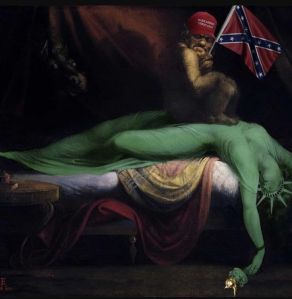




 Actually,
 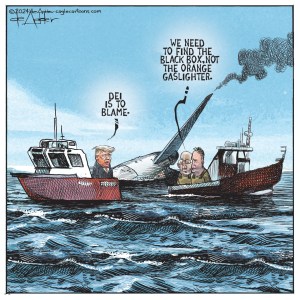 Elonia is making serious trouble at the US Treasury.
 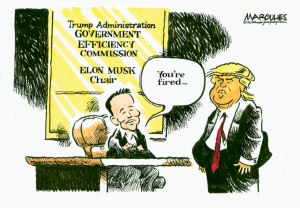 Yes, there are likely some places where the “bureaucracy” could be reduced, but the databases on the bank transfers should remain strictly off-limits to anyone who doesn’t have a security clearance.
  I am having a hard time not being overwhelmed at this point. This doesn’t mention the disastrous Senate Hearings for Tulsi Gabbard, RFK jr, and Kash Patel. RFK Jr looks more ready to be a California Raisin than head of HHS. And wtf is with Kash Patel’s eyes?
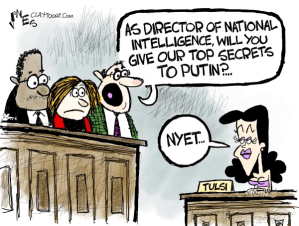 I wouldn’t want a kidnapped child’s case in the hands of any of these people. This article is from the BBC.
  These actions are fascist purges. I can only tell you that I feel much worse off than I did two weeks ago. Also, I just paid $9.06 for 1/2 dozen eggs. Do we have a task force on the Avian Flu yet?


 This bit popped up over the weekend and is disturbing.
 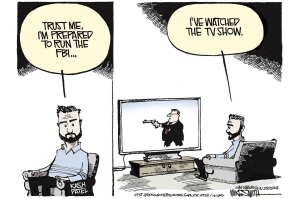 Just so you know, future FBI Director Kash Patel is still making the rounds in the Senate Building. “Kash Patel Believes the FBI Planned Jan. 6th. His embrace of this wild conspiracy theory should disqualify him from leading the bureau.” This is from
 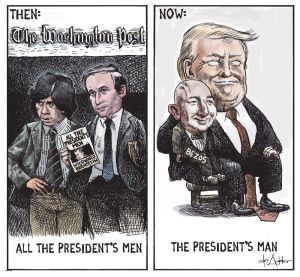 ProPublica
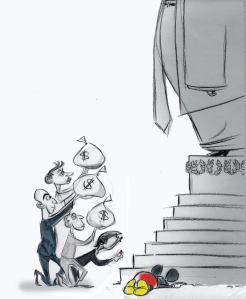 The last thing I want to post about is the Washington Post.
 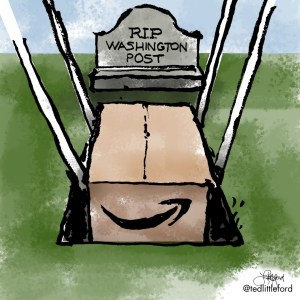 I’ve been a bit on the gratuitous Buddhism-sharing thing today, which I try not to overdo, but this quote from

 “The Senate finally corrects a 50-year mistake,” proclaimed Senate Majority Leader Chuck Schumer, a Democrat from New York, after senators approved the legislation at 12:15 a.m. Saturday.
 This did not appear to be the case just days ago. On Wednesday, Trump joined Elon Musk in
 Republicans have said the investigation is a way to undermine the conservative majority court, and all the Republicans on the committee protested against the subpoenas authorized for Crow and others as part of the investigation. No Republicans signed on to the final report, and no formal report from them was expected.
 The French are also celebrating in the streets. I discussed the results with my exchange High School French Teacher, who also taught in Southeast Asia and was in Vietnam with his now wife when Saigon fell. They presently run a Vietnamese restaurant in Nice. He expressed relief. This report is by CNN’s Christian Edwards.
 Jim VandeHei and Mike Allen of Axios focus on “Behind the Curtain: Trump’s dream regime.”
 Instead of continually polling about Biden’s age and debate performance, why don’t they poll on Project 2025? Frankly, if I were up there on the campaign staff right now, I’d actually be pushing polling on it. Donald is aware of how much of the language plays with mainstream America. This
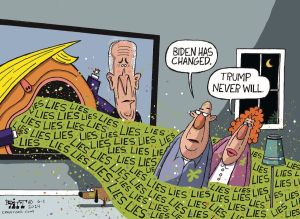 It’s a good thing most voters ignore a Party’s platform because this one now has weasel wording. Weasel wording is basically the tool of the right-wing majority on the Supreme Court, too.

 peej
peej Carissa
 bostonboomer
 dakinikat
 ecocatwoman
 jjlo
jjlo mablue2
 Mama Lopez
 peggysue22
 quixote
 skydancingguestblogger
 Mona (aka Wonk the Vote)



 Sky Dancing
Recent Comments