
“Occupy Congress?” Now You’re Talking!
Posted: November 18, 2011 Filed under: #Occupy and We are the 99 percent!, Congress, corruption, jobs, U.S. Economy, U.S. Politics, unemployment | Tags: Barack Obama, Greg Sargent, jobs, Occupy Congress, occupy Wall Street, unemployment 13 Comments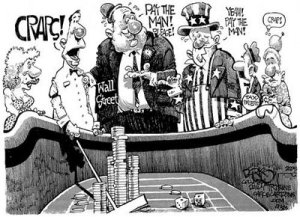
According to Greg Sargent, labor and progressive organizations are forming a coalition to “Occupy Congress.”
The coalition — which includes unions like SEIU and CWA and groups like the Center for Community Change — is currently working on a plan to bus thousands of protesters from across the country to Washington, where they will congregate around the Capitol from December 5-9, SEIU president Mary Kay Henry tells me in an interview.
“Thousands of people have signed up to come to Capitol Hill during the first week in December,” Henry says, adding that protesters are invited to make their way to Washington on their own, too. “We’re figuring out buses and transportation now.”
One idea under consideration — pending various permitting and other logistical issues — is to have a series of tents set up on the lawn outside the Capitol, each representing a state, with the number of unemployed in each state prominently displayed. But the optics are still being worked out.
The demands they are talking about aren’t very radical though. They’re planning to pressure Republicans to go along with Obama’s jobs proposal. As Sargent points out, that doesn’t really jibe with the nature of the Occupy movement, which rejects both corporate political parties. But Henry argues that
Occupy Wall Street had created a “framework” — which she described as “we are the 99 percent” — within which such activities would fit comfortably.
“The reason we’re targeting Republicans is because this is about jobs,” she said. “The Republicans’ insistence that no revenue can be put on the table is the reason we’re not creating jobs in this country. We want to draw a stark contrast between a party that wants to scapegoat immigrants, attack public workers, and protect the rich, versus a president who has been saying he wants America to get back to work and that everybody should pay their fair share.”
It’s a start, and the SEIU may not be able to control the message if lots of people with more creative ideas show up to the protests.
In line with the influence of the Occupy actions on the mainstream types, I clicked on a Google news link to the conservative Washington Times that read “Occupy Wall Street: What should be done with the protesters?” I expected to find a screed encouraging law enforcement to crush the protesters. Imagine my surprise when I read this instead:
As irritating or disruptive as some may find the Occupiers, they are the conscience of America, like it or not. Their very physical presence is a reminder that the decline of America happened not because they didn’t believe in the American dream, but because the greed of Wall Street and the banks stole that dream.
Yet our government continues to reward the top 1% with corporate welfare and the lowest taxes in more than 50 years. And Congress, which made that largesse to the wealthy possible, is in the pockets of those very same people and their lobbyists.
Yes, the protesters are predominately young, unemployed, maybe even scruffy, and, yes, the homeless have found a haven and free meals with them, and, yes, the Occupiers’ persistence after more than two months is like a mote in our eye, reminding us all that we can no longer do business as usual.
The fact that OWS sites have sprung up across the country and now the world has prompted us to face ourselves. We can no longer ignore the joblessness and poverty that scars our great country. It is not an abstract concept, some numbers on a bean counters’ balance sheet. It’s real. It’s people. It’s your kids and mine. It’s returning vets who find themselves on the scrap heap of our economy.
Holy sh&t! Can you believe it? Could it be that change is really happening?
How to Buy the US Congress
Posted: November 9, 2011 Filed under: 2012 presidential campaign, Congress, Corporate Crime, corruption, Crime, Economy, fundamentalist Christians, George W. Bush, K street, lobbyists, Regulation | Tags: 2012 presidential election, systemic failure, U.S. Economy 13 CommentsLots of political earthquakes and eruptions going on recently, so many that I missed 60  Minutes this past Sunday evening. But fortunately, I picked up the CBS clip of an extraordinary interview that Lesley Stahl conducted with the infamous Bush-era lobbyist, Jack Abramoff. If you haven’t seen it, gird your loins. If you saw the original program, watch again because this 14-minute video explains in good measure exactly how the ‘train’ [the US government] went off the rails.
In one word: corruption. But let’s use two words: systemic corruption.
Some will insist that Abramoff is an unreliable narrator, considering he spent 4 years in a medium security prison for conspiracy, fraud and tax evasion.
But who better to describe the underbelly of a wrecked, thoroughly compromised system than the best lobbyist that money could buy? Btw, before Abramoff was nailed, he claims he ‘owned’ 100 US Congress people. He considered that number woefully low. See 60 minutes link here. It’s mind boggling.
That Indian Reservation scandal mentioned in the interview? It should be noted that no other than Grover Norquist [No Taxes Ever] and Ralph Reed [Moral Majority’s darling] were involved as well. Somehow they escaped prosecution. The vein of corruption that infects and compromises the very heart and soul of this country runs deep. Abramoff may be a despicable character but he’s actually doing a service [redemption?] by pulling the curtains back, letting in the light. As Bostonboomer has said a number of times: sunlight is always the best disinfectant.
Herman Cain has been fending off accusations of inappropriate sexual conduct left and right. I certainly don’t wish to minimize those charges. If proven credible in the court of public opinion, those accusations will end Cain’s Presidential bid. But Abramoff and his crew of buddies? They’re the real professionals in the art of the screw, subversive actions raping and robbing an entire Nation.
The question is: will the American public demand a return to the Rule of Law and rout out the corruption that’s killing us. Because as my mama always said: there’s never only one cockroach in the pantry.
It’s Saturday!
Posted: October 22, 2011 Filed under: #Occupy and We are the 99 percent!, Barack Obama, Congress, Democratic Politics, morning reads, Republican politics, Social Security, U.S. Economy, U.S. Politics, unemployment | Tags: Bain Capital, Barack Obama, Black Swan, DNC, Eric Cantor, Human Rights, interest on student loans, Mitt Romney, Muammar Gaddafi, Paul Ryan, Paul Volker, Pell Grants, Regulations, student loans, Volker rule, Wall Street donors, war crimes, Wharton School, World Bank 33 Comments
Happy Saturday Sky Dancers!! It’s a beautiful fall day here in Indiana, but I’m looking forward to getting back to Boston. I’ll be taking off in a couple of days and I hope to be home by Tuesday or Wednesday. My mom is going along for the ride so she can hang out with her youngest grandsons for awhile. It will be fun, because she’ll be there over Halloween. But enough about my boring life–let’s get to the news.
This story is a couple of days old, but still worth reading. Via BDBlue at Corrente, Which GOP candidate do you think has raised the most money from Wall Street?
Despite frosty relations with the titans of Wall Street, President Obama has still managed to raise far more money this year from the financial and banking sector than Mitt Romney or any other Republican presidential candidate, according to new fundraising data.
Obama’s key advantage over the GOP field is the ability to collect bigger checks because he raises money for both his own campaign committee and for the Democratic National Committee, which will aid in his reelection effort.
As a result, Obama has brought in more money from employees of banks, hedge funds and other financial service companies than all of the GOP candidates combined, according to a Washington Post analysis of contribution data. The numbers show that Obama retains a persistent reservoir of support among Democratic financiers who have backed him since he was an underdog presidential candidate four years ago.
And get this–Obama has raised nearly twice as much as Romney from the Mittster’s old firm, Bain Capital! So don’t believe all those stories in the media about the Wall Street titans switching to Mitt.
Here’s another “breaking news” story from Forbes: US Businesses Not Being Strangled By Regulation And Taxation, World Bank Says. Gee, no kidding? But the Republicans say that’s the main cause of our economic problems, don’t they?
The World Bank uses indicators such as time spent to set up a business to getting credit, among other things, in benchmarking the 183 countries it ranks in “Doing Business”. The report measures and tracks changes in the regulations applied to domestic companies in 11 areas in their life cycle–such as investors rights, taxation, cross border transactions, legality and enforcement of contracts and bankruptcy law. A fundamental premise of doing business is that economic activity requires good rules that are transparent and accessible to all, not just big business. Such regulations should be efficient, the World Bank states, striking a balance between safeguarding some important aspects of the business environment and avoiding distortions that impose unreasonable costs on businesses. “Where business regulation is burdensome and competition limited, success depends more on whom you know than on what you can do. But where regulations are relatively easy to comply with and accessible to all who need to use them, anyone with talent and a good idea should be able to start and grow a business (legally),” the World Bank said.
Where does the supposed regulation and taxation crippled U.S. stand in the rankings? It is number four, trailing behind New Zealand (3), Hong Kong (2) and Singapore (1).
What it looks like from the research desks at one of the most powerful and elite multilateral institutions on the planet is a U.S. that does not have the government in its way, but a U.S. whose government is more out of the way than it is in every other major economy on earth, including mainland China.
Wow, I wonder if Congressman Paul Ryan reads Forbes? Naaaah… probably too far left for him. And speaking of Ryan, he appeared at a town hall meeting in Muskego, WI yesterday and made a complete ass of himself as usual. From Think Progress:
During a town hall today, House Budget Committee Chairman Paul Ryan (R-WI) was asked by Matthew Lowe, a student, why the GOP wants to cut Pell Grants. Ryan responded by saying that the program is “unsustainable,” before telling Lowe that he should be working three jobs and taking out student loans to pay for college, instead of using Pell Grants:
LOWE: I come from a very middle-class family and under President Obama, I get $5,500 per year to pay for school, which doesn’t come close to covering all of the funding, but it helps ease the burden. Under your plan, you cut it by 15 percent. I was just curious why you would cut a grant that goes directly to the middle- and lower-class people that need it the most.
RYAN: ‘Cause Pell Grants have become unsustainable. It’s all borrowed money…Look, I worked three jobs to pay off my student loans after college. I didn’t get grants, I got loans, and we need to have a system of viable student loans to be able to do this.
That’s funny. I read that Ryan used his father’s Social Security survivor benefits to put himself through college. I’d like to see some documentation on those three jobs he claims he worked while attending classes, writing papers, and studying for exams. Besides, I’ll bet the unemployment rate for college-age kids wasn’t at depression levels back then.
And speaking of paying for college, here’s an interesting piece at Truthout by Ellen Brown: Can the Fed Prevent the Next Crisis by Eliminating Interest on Student Loan Debt?
Among the demands of the Wall Street protesters is student debt forgiveness – a debt “jubilee.” Occupy Philly has a “Student Loan Jubilee Working Group,” and other groups are studying the issue. Commentators say debt forgiveness is impossible. Who would foot the bill? But there is one deep pocket that could pull it off – the Federal Reserve. In its first quantitative easing program (QE1), the Fed removed $1.3 trillion in toxic assets from the books of Wall Street banks. For QE4, it could remove $1 trillion in toxic debt from the backs of millions of students.
The economy would only be the better for it, as was shown by the GI Bill, which provided virtually free higher education for returning veterans, along with low-interest loans for housing and business. The GI Bill had a sevenfold return. It was one of the best investments Congress ever made.
There are arguments against a complete student debt write-off, including that it would reward private universities that are already charging too much and it would unfairly exclude other forms of debt from relief. But the point here is that it could be done and it (or some similar form of consumer “jubilee”) would represent a significant stimulus to the economy.
According to Brown, student loan debt is “the next Black Swan.”
Here’s another stupid Republican story for you. Eric Cantor was scheduled to give a speech yesterday at the elite Wharton School of Business at the University of Pennsylvania. Cantor was to speak on what Republicans plan to do about income inequality. The school was so excited that they opened the talk to the public. In addition, there was to be a protest by several groups, including Occupy Philly.
Guess what Cantor did? He wimped out and cancelled. ROFLOL! From the LA Times:
Cantor was scheduled to speak on income inequity at a lecture hosted by the Wharton business school. The Virginia Republican’s office said he called off the speech after learning that protesters planned to rally outside and attendance would not be limited to students and others affiliated with the school.
Ron Ozio, director of media relations at University of Pennsylvania, said the business school “deeply regrets” that the event was canceled.
“The university community was looking forward to hearing Majority Leader Cantor’s comments on important public issues, and we hope there will be another opportunity for him to speak on campus,” Ozio said in a statement. “The Wharton speaker series is typically open to the general public, and that is how the event with Majority Leader Cantor was billed. We very much regret if there was any misunderstanding with the Majority Leader’s office on the staging of his presentation.”
This is pretty disgusting: Libyans line up to see Gaddafi’s body on display; groups call for probe into death
International human rights groups called Friday for an investigation into the death of former Libyan leader Moammar Gaddafi as gory new videos showed him being spat at and punched by revolutionaries and as skepticism mounted about official claims that he was shot in crossfire after being captured.
The new cellphone videos cast a shadow over the revolutionaries even as they were celebrating the end of their eight-month struggle to wrest control of the country. NATO had backed the rebels in the name of shielding pro-democracy civilians from Gaddafi’s brutality.
“The government version certainly does not fit with the reality we have seen on the ground,” said Peter Bouckaert of Human Rights Watch, who has been investigating the capture of Gaddafi in his home town of Sirte. Amnesty International warned that the killing could be a war crime.
Why do I suspect the U.S. Government gave the go-ahead for Gaddafi to be executed, just like Osama bin Laden? You might want to read Joseph Cannon’s take on this one.
Finally, late last night the Volker Rule was number 1 in Google’s top stories. From the NYT:
When Paul Volcker called for new rules in 2009 to curb risk-taking by banks, and thus avoid making taxpayers liable in the future for the kind of reckless speculation that caused the financial crisis and resulting bailout, he outlined his proposal in a three-page letter to the president.
Last year, when the Dodd-Frank Wall Street Reform and Consumer Protection Act went to Congress, the Volcker Rule that it contained took up 10 pages.
Last week, when the proposed regulations for the Volcker Rule finally emerged for public comment, the text had swelled to 298 pages and was accompanied by more than 1,300 questions about 400 topics.
Wall Street firms have spent countless millions of dollars trying to water down the original Volcker proposal and have succeeded in inserting numerous exemptions. Now they’re claiming it’s too complex to understand and too costly to adopt.
Gee, what a surprise. I wonder how many of those millions were taxpayer dollars?
So…what are you reading and blogging about today?
Late Night Post: a Rogue and/or Broken Nation
Posted: October 3, 2011 Filed under: 2012 presidential campaign, Barack Obama, Civil Liberties, Civil Rights, Congress | Tags: corruption, executive power, kleptocracy, unchecke executive power 16 Comments There’s a pretty good amount of twitter chatter and blog posts on these thoughts at interfluidity by steve randy waldman. I understand the draw because I’ve had very similar thoughts and expressed many of them recently. I thought this would be a good discussion post to follow BostonBoomer’s last post too since it’s very much related to the post called “an echo”.
I no longer trust my own government to be the provider of a civilized society. No government is perfect or without corruptions. But in 2007, I thought I lived in a remarkably well-governed nation that had gone off-kilter under a small and mean administration. In 2011, I view my government as the sharp edge of an entrenched kleptocracy, engaged in ever more expansive schemes of surveillance and arrogating powers of ever less restrained brutality. At a visceral level, I dislike President Obama more than I have disliked any politician in my lifetime, not because he is objectively worse than most of the others — he is not — but because he disproved my hypothesis that we are a country with basically good institutions brought low by poor quality leadership. Whenever I hear the President speak and am impressed by the quality of his intellect, by his instinct towards diplomacy and finding common ground and rising above petty struggles, I despair more deeply. Not just because a leader of high quality failed to restore passably clean and beneficient government. It is worse than that. The kleptocracy has harnassed this man’s most admirable qualities and made them a powerful weapon for its own ends. He has rebranded as “moderate”, “adult”, “reasonable”, practices such as unaccountable assassination lists and Orwellian nonhostilities. He has demostrated that the way grown-ups get things done in Washington is by continually paying off thieves in suits. Perhaps it is unfair to blame Barack Obama for all this. Maybe he has done the very best a person could do under our present institutions. But then it is not unfair to detest the institutions, to wish to see them clipped, contained, or starved.
This message is followed by a mea culpa expressing profound regret for supporting the Bush Administration and the Iraq War. Also, there’s a link to the Salon article“The due-process-free assassination of US citizens is now a reality” from Glenn Greenwald which is something we’ve previously discussed. What drug me to the post was a response over at The Atlantic by Conor Friedersdorfer who was just quoted on BB’s post. We’re treated to some of the top ten abysmal hits of the past few years. The bailout of banks while their bad business models still wreck havoc on our neighbors and in our cities and towns is there. The normalization of torture and spying on citizens is listed plus a few other things that I’ve come to view as a bigger problem now than the issues surrounding Watergate and Vietnam were then.
We’ve been lied to before. We’ve had a few of our citizen’s rights stomped about but nothing quite so systematic and unchecked. It also seems that our institutions and especially our courts were resilient enough to stand their grounds in the past. There were people who stood on our principles. I’m not seeing any institutional response to the lying and executive branch power grab from Congress or the Courts or the loudest and most followed parts of the Media.
We’ve had absolutely no recompense or justice for the atrocities against liberty that we’ve experienced since 9/11. None at all. This is what led Fiedersdorfer to ask if we were suffering from rogue leadership or broken institutions. What ever the source, we’ve been acting like a rogue and broken nation for nearly a decade and it’s as worrisome as it is depressing. He argues that we’ve had broken leadership during this century and that our institutions will heal. I only wish I had his optimism.
Before pinning the blame on American institutions, let’s ponder how radically different the status quo would be if we merely adhered to longstanding laws and norms, rather than permitting our leaders to flout them in the name of protecting us from terrorism or financial collapse.
Had the Bush Administration followed the law, it never would have tortured prisoners or started secretly spying on American citizens without a warrant. If Barack Obama was as committed to fulfilling our treaty obligations as pushing his domestic agenda in an optimized political climate, he’d have investigated and prosecuted the Bush officials complicit in torture. As President Reagan wrote upon sending the Convention Against Torture to the Senate that ratified it, “Ratification of the Convention by the United States will clearly express United States opposition to torture, an abhorrent practice unfortunately still prevalent in the world today. The core provisions of the Convention establish a regime for international cooperation in the criminal prosecution of torturers relying on so-called ‘universal jurisdiction.’ Each State Party is required either to prosecute torturers who are found in its territory or to extradite them to other countries for prosecution.”
In Libya, where Obama violated the War Powers Act, and in various countries where President Obama is waging undeclared drone wars, more scrupulous adherence to the law would force radical changes in American behavior — as would a modicum of congressional leadership, since the body has for years abdicated its responsibility. The Founders envisioned three branches of government acting as checks on one another, the members of each zealously guarding their authority and pushing back against excesses committed by their fellow branches.
Friday Reads
Posted: September 30, 2011 Filed under: 2012 presidential campaign, Catfood Commission, collective bargaining, Congress, financial institutions, Health care reform, Labor unions, morning reads, Republican politics, Republican presidential politics, SCOTUS | Tags: Bachmann running out of campaign funds, budget cuts, Collin Woodard, GOP spending cut priorities, Labor Unions, Mortgage modification mess, occupy Wall Street, SCOTUS and the health care reform law, US regions 18 Comments Good Morning!
I can hardly believe we’re headed into the last quarter of 2011. Such a year we’ve had!
So, the GOP is going after some of the things for which I will happily contribute tax dollars. They’ve got some pretty whacked values as far as I’m concerned.
Setting a collision course with Democrats that could drag out for months, House Republicans on Thursday unveiled plans to cut federal money for job training, heating subsidies and grants to better-performing schools.
The draft measure for labor, health and education programs also seeks to block implementation of President Barack Obama’s signature health care law, cut off federal funds for National Public Radio and Planned Parenthood, and reduce eligibility for grants for low-income college students.
Democrats and tea party Republicans opposed the bill, blocking it from advancing through even the easy initial steps of the appropriations process on Capitol Hill. Instead of moving through the Appropriations Committee and the House as a whole, the $153 billion measure is instead expected to be wrapped into a larger omnibus spending bill this fall or winter that would fund the day-to-day operating budgets of Cabinet agencies.
Negotiations between Republicans controlling the House, the Democratic Senate and the White House are sure to be arduous. The measure is laced with conservative policy “riders” opposed by Democrats that would affect worker protections under federal labor laws and block the Education Department from enforcing rules on for-profit colleges that are often criticized for pushing students to take on too much debt.
“It looks like we’re in for a long, difficult process,” said Rep. Rosa DeLauro, D-Conn.
House Appropriations Committee Chairman Harold Rogers, R-Ky., said excessive and wasteful spending over the years had put many programs and agencies on “an irresponsible and unsustainable fiscal path.”
Actually all of those Dubya Tax cuts and wars and letting Wall Street Run amok with speculation instead of investment is what put us on that “irresponsible and unsustainable fiscal path” and most of them voted for all of it. I’m not willing to bail out any more of their donor base with my hard earned dollars by defunding the future of our children. What on earth can we do about these evil people and the feckless dems that won’t fight them?
The court fights over the new health care law have been stepped up and SCOTUS has come into play in a big way. Which of the justices are likely to uphold AEIcare-cum-ChafeeCare-cum-DoleCare-cum-RomneyCare-cum-Obamacare?
The four more liberal justices on the court — Ruth Bader Ginsburg, Stephen Breyer and Obama appointees Sonia Sotomayor and Elena Kagan — should have no trouble reading the Constitution as bestowing broad powers on the federal government to regulate all manner of commerce. Although the court in recent years has pinched back congressional efforts to use the Commerce Clause to promulgate laws prohibiting guns near schools and those targeting violence against women, these were clearly non-commercial activities and quite different from the health-care law and its regulation of the medical insurance marketplace. Stronger and more directly applicable precedents remain, in which the court blessed the government’s regulation of wheat and marijuana production because these activities had an impact on interstate commerce.
The marijuana case (known formally as Gonzales v. Raich) may be particularly important because two of the more conservative justices — Antonin Scalia and Anthony Kennedy — joined with their more liberal colleagues to uphold the law under the government’s Commerce Clause powers.
Chief Justice John G. Roberts Jr. and Samuel A. Alito — both George W. Bush appointees — shouldn’t be counted out either. Roberts and Alito joined an opinion in 2010 that recognized the government’s “broad authority” to enact a civil detention scheme for sexual predators under a different constitutional provision. This provision allows federal lawmakers “to make all laws which shall be necessary and proper” to uphold the powers assigned to Congress — including the power to regulate interstate commerce.
Michelle Bachmann’s campaign is running out of cash. Even the NY Post thinks she may not make it to the Iowa Caucuses.
Will Michele Bachmann make it to Iowa? Insiders are whispering that the Tea Party darling’s financials are grim and she may be out of the race before she makes it to the Iowa caucus in February, even though she has a strong base in the state. Sources tell us say Bachmann’s skeletal staff are holding their collective breath until the deadline to disclose her fundraising report on Oct. 15. Meanwhile, we hear a computer vendor has called her campaign headquarters threatening to shut down the power due to an outstanding bill. Sources say she had about $400,000 at the beginning of September, but also stacks of bills. “She does not like to ask for money. She should have been focusing on big donors about three months ago,” a source said. “She’s only cultivated low dollar donors with direct mailings and that’s hurt her.” But at a rally in Virginia yesterday, Bachmann declared that she does not intend to back out of the race. “We intend to be the comeback kid in this race,” she said. Her rep said, “None of that is true.”
There’s a two part series at Bloomberg written by Collin Woodard on how the U.S. is really a country of regions. Part One is here. Part Two is here. It’s a really interest read and something I have thought about for some time as I’ve tried to find some place in this country where I can live in peace. For one, I’m trying to leave any region that’s described as bible buckle, bible belt, or bible anything!
Forget the state boundaries. Arbitrarily chosen, they often slash through cohesive cultures, creating massive cultural fissures in states like Maryland, Oregon and New York. Equally burdensome are the regional designations with which we try to analyze national politics — the Northeast, West, Midwest and South. They’re illusions masking the real forces driving the affairs of our sprawling continent: the 11 regional cultures of North America.
These 11 nations — Yankeedom, Tidewater, New Netherland, New France, Deep South, Greater Appalachia, the Midlands, First Nation, the Far West, the Left Coast, El Norte — have been hiding in plain sight throughout our history. You see them outlined on linguists’ dialect maps, cultural anthropologists’ maps of material culture regions, cultural geographers’ maps of religious regions, campaign strategists’ maps of political geography and historians’ maps of the patterns of settlement across the continent. I’m not the first person to have recognized the importance of these regional cultures. In 1969, Kevin Phillips, then a Republican campaign strategist, identified the distinct boundaries and values of several of these nations and used them to accurately prophesize the Reagan Revolution in his “Emerging Republican Majority,” a political cult classic.
More and more groups are joining the move to take on and occupy Wall Street. The New York Transportation Workers are the latest to announce they will join the protest today.
Occupy Wall Street has been picking up some decent support from unions in the past few days. Yesterday we reported that the Teamsters Union declared their support for protestors, and we also found out that the United Pilots Union had members at the protest demonstrating in uniform.
Today we learned the Industrial Workers of the World put a message of support on their website as well.
UPDATE: Verizon union workers have joined the protestors in NYC.
McClatchy reports that mortgage modification are still a mess even after four years. Quelle surprise!
Today there are at least 4.2 million homeowners who, like Palomo, are late on their mortgage payments or somewhere in the delinquency and foreclosure process. The first wave of foreclosures came during the 2008 financial crisis as subprime mortgages given to weak borrowers imploded. Now the subsequent economic downturn and high unemployment keep housing depressed.
The administrations of George W. Bush and Barack Obama both offered incentives for lenders to help homeowners modify their mortgages. Those efforts haven’t achieved much.
And four years into the housing crisis, banks and their bill collectors, known as mortgage servicers, are still under fire for their response to troubled borrowers.
“I would say they are somewhat better than they were three years ago, but still woefully inadequate to meet the demand, given the still remarkably high levels of distressed borrowers they are attempting to deal with,” said Paul Leonard, director of the California office of the Center for Responsible Lending, a Durham, N.C.-based advocacy group.
From December 2009 through June, more than 1.6 million government-backed mortgage modifications had been started, but only 791,000 became permanent. These numbers remain well below the goal of 4 million modifications that the Obama administration set for itself.
That should give you a few juicy bits to chew on with some coffee!! What’s on your reading and blogging list today?

 peej
peej Carissa
 bostonboomer
 dakinikat
 ecocatwoman
 mablue2
 Mama Lopez
 peggysue22
 quixote
 skydancingguestblogger
 Mona (aka Wonk the Vote)



 Sky Dancing
Recent Comments