
Thursday Reads: Guns and American Culture (and other news)
Posted: February 27, 2014 Filed under: Congress, Crime, morning reads, U.S. Politics | Tags: "stand your ground" laws, Affordable Care Act, Crimea, FDA, Federal Reserve, gun control, Hillary Clinton, nutrition labels, Russia, self defense, shooting deaths, Ukraine 44 Comments
Morning Paper at Cap Ferrat, by Rebecca Kao Wang
Good Morning!!
I live in a state that has very strict gun control laws. A recent study by Boston Children’s Hospital found that states with the toughest gun laws have the lowest rates of gun deaths. And Boston tends to average between one shooting victim every other day to one victim per day. I’ve been thinking about this for the past couple of days since I read this article at WBUR: When Mass. Criminals Want A Gun, They Often Head North
Massachusetts gun laws are widely considered some of the toughest in the country. But with a rash of shooting deaths in Boston this year, some law enforcement officials say it’s obvious that there are ways around the rules. And when Massachusetts criminals want to get their hands on a gun, they frequently head north.
In 2012, more than half of the guns that law enforcement seized in Massachusetts and managed to trace to their origins came from other states, according to federal statistics. The biggest suppliers by far were New Hampshire and Maine, as is the case most years.
According to the article, ATF agents discovered that gun traffickers in Massachusetts were legally buying large numbers of guns from New Hampshire and Maine, where they are much easier and cheaper to buy, and reselling them to people in Massachusetts.
The flow of guns from northern New England to Massachusetts is propelled by key differences among state gun laws. It’s all about private handgun sales, in particular. In Massachusetts every private handgun sale must be recorded and reported to the state within seven days. And the buyer must have a license to carry from local police, which in turn requires a background check. The Massachusetts rules are tight.
Up north, not so much. Buyers at federally licensed gun shops in Maine and New Hampshire are subjected to a federal background check for prior felonies, or a history of severe mental illness. But when it comes to private gun sales — at a gun show, or even a commuter parking lot — no documentation is required — no background check, no record of the transaction.
Darcie McElwee, an assistant U.S. attorney in Maine, says that in her state a private seller doesn’t even have to ask the buyer for a driver’s license.
Now it’s still illegal to sell guns to a convicted felon or for a felon to buy a gun, so if someone is caught doing this, they’ll go to jail for two years minimum. And the rates of gun deaths and injuries are still lower in Massachusetts than in states with less strict gun laws.
Clearly strict state laws are not enough to prevent gun violence. We need federal laws to control gun sales and to encourage gun safety–like the Massachusetts law that requires guns to be unloaded and locked up when not in use. But how can we make that happen? According to the WBUR article, Congress has even made it difficult to keep track of guns that are used in crimes and for academic researchers to access federal government data on gun trafficking.
Massachusetts Senator Ed Markey has introduced a bill to require all guns to be personalized so they can only be fired by the owner or another authorized person. These so-called “smart guns” already exist.
One of California’s largest firearm stores recently added a peculiar new gun to its shelves. It requires an accessory: a black waterproof watch.
The watch’s primary purpose is not to provide accurate time, though it does. The watch makes the gun think. Electronic chips inside the gun and watch communicate with each other. If the watch is within close reach of the gun, a light on the grip turns green. Fire away. No watch means no green light. The gun becomes a paperweight.
A dream of gun control advocates for decades, the Armatix iP1 is the country’s first smart gun. Its introduction is seen as a landmark event in efforts to reduce gun violence, suicides, and accidental shootings….
Of course the NRA will fight this tooth and nail, and it’s not going to get through the Senate, much less the House, in the current environment.
Now check this out. According to a piece at Venture Beat, you can quickly and easily buy guns on Facebook!
Fifteen minutes.
That’s all it takes for children, felons, and people without IDs to buy illegal weapons on Facebook pages dedicated to the sale and celebration of guns.
A VentureBeat investigation has uncovered dozens of pages on Facebook where guns are for sale, including semi-automatic weapons, handguns, and silencers. While the transactions don’t actually happen on Facebook, the social network is a remarkably easy way to find shady people willing to sell you a weapon — no questions asked. The illegal transactions then take place in diners, dark parking lots, and isolated country roads — away from the prying eyes of the feds and local police.
In Kentucky, Greenup County Sheriff Keith Cooper remembers when a call came into dispatch last October saying a 15-year-old student had been arrested on the Greenup County High School campus for carrying an unlicensed and loaded 9mm handgun to school. The boy was arrested and brought to Cooper’s office for an interview.
When Cooper, a former Kentucky State Trooper with a heavy Southern drawl, asked the kid where he got the gun, his reply was shocking: Facebook.
Read it and weep. Oh, and Facebook claims they don’t allow people to sell guns or explosives on their pages, but clearly they’re not enforcing these rules very well.
It’s not news to anyone that America has a love affair with guns. Guns and hunting are part of American culture, going hand-in-hand with the cult of rugged individualism. I’ve always thought it came from the frontier tradition. Most of the country was settled by pioneering who set out from the East coast to begin new lives in the Midwest and West before the arrival of the accoutrements of civilization–like law enforcement, banks, and insurance companies. In my generation at least, kids saw endless movies and TV shows about “cowboys and Indians;” and we played with toy guns–even us girls. And of course, since we were born shortly after World War II, many of us watch movies that glorified war.
Still I’ve never wanted a real gun. It seems to me that the gun culture is much stronger in some ways than in those innocent days of the 1950s and ’60s. But why? The obvious answer is the lobbying and propaganda efforts of the National Rifle Association (NRA). And what about the recent work of ALEC and the Koch Brothers to get state “stand your ground” laws passed around the country? Dahlia Lithwick has posted a fine piece about this at Slate.
“Stand Your Ground” Nation: America used to value the concept of retreat. Now we just shoot.
Last week, Kriston Charles Belinte Chee, an unarmed man, got into a fight with Cyle Wayne Quadlin at a Walmart in suburban Arizona. Quadlin opened fire midargument and killed Chee. Officers decided not to charge Quadlin because, they concluded, the killing was in self-defense. According to the police spokesman, “Mr. Quadlin was losing the fight and indicated he ‘was in fear for his life.’” Just a week earlier, a jury in Jacksonville, Fla., found Michael Dunn guilty on four counts of attempted murder but did not convict him on the most serious charge of first-degree murder, in the death of 17-year-old Jordan Davis. Dunn shot and killed Davis, also unarmed, because the music coming from his car was too loud. Dunn claimed he saw something like a gun in the vehicle, and that was apparently enough for some members of the jury to conclude that Dunn hadn’t committed first-degree murder.
Given all this, it’s not unreasonable to argue that, in America, you can be shot and killed, without consequences for the shooter, for playing loud music, wearing a hoodie, or shopping at a Walmart. The question is whether the wave of “stand your ground” legislation is to blame.
Is it true? Lithwick quotes doubters who say that neither George Zimmerman invoked “stand your ground,” However juries were told about the “stand your ground” principle, and could have been confused by the growing consensus in Florida that people [at least white males] have the right to shoot an unarmed person if they “feel threatened.” Lithwick writes:
It’s clear that at least some of the jurors in both cases took the principle of “stand your ground” into account to some degree during deliberations. We now know that at leastone juror, and possibly two, in Dunn’s trial took to heart the specific instruction that Dunn “had no duty to retreat and had the right to stand his ground and meet force with force, including deadly force.” Whether or not jurors in Florida are technically instructed to apply the “stand your ground” component of self-defense law, it’s increasingly clear that they are, at minimum, confused about it (understandably) and may even be starting to apply it reflexively. Yes, Dunn’s attorney argued traditional self-defense. But, as former assistant U.S. attorney David Weinstein told the Associated Press, “I think people will say that because some of the language from the stand your ground statute gets embedded into the jury instructions, that stand your ground has an effect.”
I might go further. I might say that whether or not specific jurisdictions define self-defense to include a duty to retreat, and whether or not specific juries are charged to apply it, America is quickly becoming one big “stand your ground” state, as a matter of culture if not the letter of the law.
Please go read the whole thing. It’s frightening but important. Lithwick argues that the new laws are changing the culture itself–and not just in the states with “stand your ground” laws.
Now I’ve gone and written another single-subject post. I just have room for a few headlines before I turn the floor over to you.
Washington Post: Hillary Clinton makes case for ‘full participation’ and equality
Talking Points Memo: Hillary Clinton Defends Obamacare While Backing Changes
BBC News: Ukraine warns Russia against ‘aggression’ in Crimea
NPR: Crimea: 3 Things To Know About Ukraine’s Latest Hot Spot
The Daily Beast: The Spoiled Rotten Kids of the DC Elite
NYT: New F.D.A. Nutrition Labels Would Make ‘Serving Sizes’ Reflect Actual Servings
Dana Millbank: Republicans flip-flop on ‘judicial activism’
I hope Dak will weigh in on this one. Matthew O’Brien: How the Fed Let the World Blow Up in 2008
USA Today: NASA – 715 new planets found, 4 might support life
What stories have caught your interest today? Please share your links in the comment thread, and have a great day!
Monday Reads
Posted: November 25, 2013 Filed under: Affordable Care Act (ACA), Barack Obama, Congress, Foreign Affairs, Hillary Clinton, Iran, Israel, morning reads, U.S. Politics | Tags: California, Denver Broncos, football, John Kerry, New England Patriots, Peyton Manning, Tom Brady, weather 24 Comments
Good Morning!!
Don’t blame Dakinikat for the lateness of this post. I volunteered to fill in for her today and then I ended up oversleeping.
I stayed up too late watching the New England Patriots come from behind to beat the Denver Broncos on Sunday Night Football. I had pretty much given up on the Pats at halftime when they were down 24-0. But once again Patriots quarterback Tom Brady rallied his team and once again showed Peyton Manning who’s boss.
Cindy Boren sums up what happened at The Washington Post:
For most of the country, Sunday night was cold. It’s the gateway to a big holiday week and, with the Denver Broncos blowing out the hapless New England Patriots on Sunday night, why not just turn in early?
Suckers.
Here’s the abbreviated version of what happened while you were sleeping: Trailing 24-0 at halftime, Tom Brady and the Patriots scored 31 points in the second half, the Broncos scored to tie it and, with Bill Belichick making another of his unusual coaching decisions, the Patriots won 34-31 on a field goal that came off a turnover on a muffed punt with time running out in overtime. But it was a decision by Belichick that set up the Patriots. After winning the OT coin toss, he chose to take the wind — a stiff, brutally cutting wind — in a move that even his captains questioned.
There was a fierce wind blowing in the Boston area all day yesterday. It was coach Bill Belichick’s decision to give the ball to the Broncos, forcing Manning to either throw into the wind or and the ball off. It worked, and the Pats ended up winning on a field goal. It was incredible–only the fifth time in history a team has come back from 24 down at the half to win a game.
So, that’s my excuse for being late with the morning post. I know you’re probably not impressed . . .
Of course the weather here in New England is just a minor annoyance compared to much of the rest of the country. CNN reports: Nasty weather wallops much of U.S. just before Thanksgiving.
The wicked wintry weather that pummeled the West Coast is now barreling across the country, threatening to wreck millions of holiday travel plans just before Thanksgiving.
The storm has already contributed to at least 10 traffic fatalities.
Nearly 400 flights have been canceled in the Dallas-Fort Worth area — not exactly a bastion for snowstorms. Sleet and freezing rain will keep blanketing parts of the Southern Plains and Southern Rockies on Monday.
New Mexico may be hit with 8 inches of snow!
And it’s headed our way next:
And after the storm deluges parts of the South with rain Monday evening, it’ll start zeroing in on the Northeast, the National Weather Service said. And that could spell more travel nightmares….
An Arctic air mass will probably keep temperatures 15 to 20 degrees below normal along the East Coast through Thursday. But even if the system fails to deliver heavy snow, fierce winds could still hamper air travel, forecasters said….
Heavy rain is expected to fall from Texas to Georgia on Monday and over the Carolinas on Monday night, with some sleet and snow mixed in for northern parts of that swath. The heaviest rain is expected across parts of Mississippi, Alabama, Georgia, Florida and South Carolina.
So be careful out there–especially you Sky Dancers in the southern half of the country.
In political news, the big story is the deal that the Obama administration has struck with Iran. Israel doesn’t like it one bit, and that means there will be objections in Congress. From Bloomberg via the SF Chronicle:
Israel’s rejection of the accord reached in Geneva by Iran and six leading nations over the weekend was swift. The agreement is a “historic mistake” that leaves the world “a much more dangerous place, because the most dangerous regime in the world has taken a significant step toward attaining the most dangerous weapon,” Netanyahu said.
The first accord since the Iranian nuclear program came under international scrutiny in 2003 eases sanctions on Iran in return for concessions on its atomic work. Its six-month timetable is meant to give negotiators time to seek a comprehensive deal to halt Iranian nuclear work that they, like Israel, think is a cover to build weapons.
Israel will now focus on influencing the final deal as much as they possibly can.
“What Israel can do during this period is push the international community toward making the final deal as tough as it can, though it should do so far more quietly than it has in the past,” said Eilam, a retired brigadier-general.
U.S. Secretary of State John Kerry told CBS News in Geneva that the agreement doesn’t take the threat of force off the table and rejected Israel’s position, articulated yesterday by Defense Minister Moshe Ya’alon, that the U.S. capitulated to Iranian deceit.
The agreement is “not based on trust. It’s based on verification,” with mechanisms in place to confirm whether Iran is in compliance, he said.
Kerry actually used many Congresspeople’s opposition to loosening sanctions on Iran to push the Iranians to make a deal. From Bloomberg Businessweek:
When Secretary of State John Kerry joined the nuclear negotiations at the Intercontinental Hotel in Geneva last Saturday, he employed the oldest negotiating trick in the book, evoking Congress as the bad cop to the Obama administration’s good cop. Kerry told Iranian foreign minister Mohammad Javad Zarif that if they failed to reach an agreement that day, the Obama administration would be unable to prevent Congress from passing additional sanctions against Iran. Less than 24 hours later, Kerry and Zarif walked into the hotel lobby to announce that they had struck a deal to temporarily freeze Iran’s nuclear program.
In the face of criticism from members of Congress and the U.S.’s allies in the Middle East, Administration officials have insisted that the Geneva agreement is just the first step toward a more far-reaching disarmament deal. But such a deal will require that the Obama administration promise not just to forestall the imposition of new sanctions, but to dramatically reduce the sanctions already in place. And that depends on the cooperation of a Congress that has been singularly uninterested in assuming the role of good cop in the showdown with Iran.
The White House has some discretion to rescind the Iran sanctions without Congress’s approval. The method for removing any given set of sanctions depends on how those sanctions were passed in the first place. If they’re the product of an executive order, as many of the existing sanctions against Iran are, removing them requires only that the White House decide to stop enforcing them. That’s exactly how Obama will be making good on its promise to Iran, as part of last week’s interim agreement, to restore access to $7 billion held in foreign bank accounts….Removing sanctions that have been passed into law by Congress, however, is a much more difficult challenge. Despite the partisan gridlock in gridlock in Washington over the last several years, bipartisan majorities have managed to cooperate on three separate rounds of sanctions since 2010, including measures targeting Iran’s central bank, which Iran will undoubtedly want rescinded. Removing those laws from the books will force the White House to go through Congress all over again. That will require overcoming the partisanship and procedural hurdles that have consumed Congress in recent years.
I have to say, Obama is once again showing he has guts. If only he would use some of that to stand firm on domestic policies. The BBC reports that the Obama administration has been working toward this agreement for months through secret negotiations that SOS John Kerry was involved in while he was still chairman of the Senate Foreign Relations Committee.
I’m really curious to know what role Hillary Clinton played in these negotiations and whether she supports the deal, but I can’t find any information about that so far. Meanwhile, here’s a positive review from Mark Fitzpatrick of the International Institute for strategic studies (IISS): The surprisingly good Geneva deal.
The deal reached in the early hours of the morning in Geneva on 24 November was better than I had expected, and better than would have been the case without France’s last-day intervention at the previous round two weeks earlier. I spent much of Sunday making the rounds of TV studios and fielding print-media interviews, explaining why opponents in Israel, the Gulf and US Congress should overcome their scepticism. The more I studied the deal, the more apparent it became to me that those who knock it probably did not want any agreement at all – at least not any deal that was within the realm of possibility.
The Geneva agreement is a good deal because Iran’s capabilities in every part of the nuclear programme of concern are capped, with strong verification measures. The terms require that for the next six months, no more centrifuges can be added, none of the advanced models that were previously installed can be turned on, the stockpiles of enriched uranium cannot increase, and work cannot progress on the research reactor at Arak, which is of concern because of the weapons-grade plutonium that would be produced there. Going well beyond normal verification rules, inspectors will be able to visit the key facilities on a daily basis and even have access to centrifuge production and assembly sites.
Moreover, the most worrisome part of the programme is being rolled back. Iran is suspending 20% enrichment, which is on the cusp of being weapons-usable, and neutralising the existing stockpile of 20% product, half through conversion to oxide form and half through blending down. Although the P5+1 had earlier asked for the stockpile to be exported, these measures will virtually accomplish the same purpose by eliminating the stockpile. Reversing these measures would take time.
Time is the essential variable of this deal. The net effect of the limits Iran has accepted is to double the time it would take for it to make a dash to produce fissile material for nuclear weapons. Without a deal, the break-out time might instead soon be halved.
Read the rest at the link.
Paul Krugman has a column up about some positives on the rollout of Obamacare and California as a “test case” for the program.
Now, California isn’t the only place where Obamacare is looking pretty good. A number of states that are running their own online health exchanges instead of relying on HealthCare.gov are doing well. Kentucky’s Kynect is a huge success; so is Access Health CT in Connecticut. New York is doing O.K. And we shouldn’t forget that Massachusetts has had an Obamacare-like program since 2006, put into effect by a guy named Mitt Romney.
California is, however, an especially useful test case. First of all, it’s huge: if a system can work for 38 million people, it can work for America as a whole. Also, it’s hard to argue that California has had any special advantages other than that of having a government that actually wants to help the uninsured. When Massachusetts put Romneycare into effect, it already had a relatively low number of uninsured residents. California, however, came into health reform with 22 percent of its nonelderly population uninsured, compared with a national average of 18 percent.
Finally, the California authorities have been especially forthcoming with data tracking the progress of enrollment. And the numbers are increasingly encouraging.
Krugman says that about 10,000 people are signing up per day, and the enrollment numbers show a balance between younger, healthier enrollees and those who are older and more likely to need health care.
So . . . it’s a somewhat slow news day as we head into the holiday season, but the Iran deal will give us something to talk about while the folks in Washington take their extra long vacations. I don’t even want to think about what will happen when they get back and start clashing over the debt ceiling again.
What interesting stories are you finding out there today? Please post your links in the comment thread and have a good day despite the weather!
Monday Reads
Posted: October 7, 2013 Filed under: 2012 elections, Congress, Federal Budget and Budget deficit, Federal Government Shutdown, House of Representatives, morning reads, Tea Party activists 74 Comments
Good Morning!
I’ve made plans to go to Seattle next month again to stay with my dad and hope that I can also spend time looking for the possibility of a job since my daughter is joining a small ob/gyn practice about an hour north of Seattle. It’s hard not to long for the safety of a blue state given what’s been going on recently and given the conversations that I have with people that safely dwell in the Faux News Reality of Welfare Queens, Pedophile Gays, Scary Black People in Hoodies, and Invading Mexicans. I’ve been in a long Facebook conversation trying to explain the Affordable Care Act details and why the exchanges are not “government-backed” insurance until I’m blue in the face. No amount of numbers convinces them that all the jobs are not becoming part time. I was just told I obviously don’t have common sense if I don’t see the Affordable Care Act as a giant give away to lazy poor people even though I’ve tried to explain that Medicaid still exists and it still is the plan for poor people. There just exists this ever deepening divide between the realities of Red and Blue States. Did Nixon’s Southern Strategy doom our Democracy?
In a merciful twist of fate, Juan Linz did not quite live to see his prophecy of the demise of American democracy borne out. Linz, the Spanish political scientist who died last week, argued that the presidential system, with its separate elections for legislature and chief executive, was inherently unstable. In a famous 1990 essay, Linz observed, “All such systems are based on dual democratic legitimacy: No democratic principle exists to resolve disputes between the executive and the legislature about which of the two actually represents the will of the people.” Presidential systems veered ultimately toward collapse everywhere they were tried, as legislators and executives vied for supremacy. There was only one notable exception: the United States of America.
Linz attributed our puzzling, anomalous stability to “the uniquely diffuse character of American political parties.” The Republicans had loads of moderates, and conservative whites in the South still clung to the Democratic Party. At the time he wrote that, the two parties were already sorting themselves into more ideologically pure versions, leaving us where we stand today: with one racially and economically polyglot party of center-left technocracy and one ethnically homogenous reactionary party. The latter is currently attempting to impose its program by threat upon the former. The events in Washington have given us a peek into the Linzian nightmare.
Traditionally, when American politics encountered the problem of divided government—when, say, Nixon and Eisenhower encountered Democratic Congresses, or Bill Clinton a Republican one—one of two things happened. Either both sides found enough incentives to work together despite their differences, or there was what we used to recognize as the only alternative: gridlock. Gridlock is what most of us expected after the last election produced a Democratic president and Republican House. Washington would drudge on; it would be hard to get anything done, but also hard to undo anything. Days after the election, John Boehner, no doubt anticipating things would carry on as always, said, “Obamacare is the law of the land.”
Instead, to the slowly unfolding horror of the Obama administration and even some segments of the Republican Party, the GOP decided that the alternative to finding common ground with the president did not have to be mere gridlock. It could force the president to enact its agenda.
It used to be that elections came with the usual majority rules ramifications. This current group of Tea Party insurrectionists evidently has changed that equation. The question now is what can we do about it?
And as the saying goes, elections have consequences. It’s how Democratic victories in the 1930s paved the way for Franklin Roosevelt’s New Deal, how Dem victories in the 1960s led to Lyndon Johnson’s Great Society programs, how Republican victories in the 1980s resulted in Ronald Reagan’s tax cuts, how Democratic majorities in 2006 and 2008 led to Obama’s health-care law, and how the GOP’s midterm wins in 2010 extracted spending-cut concessions from Obama the following year.
Yet what’s extraordinary about this current political fight is that Republicans are seeking another round of concessions — over the president’s signature domestic achievement — after losing the last election, which was viewed in part as a referendum on the health-care law.
“It’s as if Ted Cruz slept through the entire 2012 cycle,” a senior Democratic aide tells First Read. “It’s not like Obamacare, spending and debt weren’t major issues in 2012. They were central — and we won.”
Nevertheless, Cruz and House Republicans maintain that Obama and the Democrats must negotiate over the health-care law to re-open the federal government. And House Speaker John Boehnersays Democrats must negotiate to raise the debt ceiling. “The nation’s credit is at risk because of the administration’s refusal to sit down and have a conversation,” he told ABC News. “The votes are not in the House to pass a clean debt limit. And the president is risking default by not having a conversation with us.”
I found that Boehner comment about the lack of votes to be really strange given that he seems to think that the Democrats in the House and their votes do not matter. What exactly is the conversation and why should the rest of the country have it when we thought we decided that about a year ago during the election? Why is Boehner willing to weaponize the debt ceiling again? (This is the same Jonathan Chait article I referenced above.)
The debt ceiling turns out to be unexploded ordnance lying around the American form of government. Only custom or moral compunction stops the opposition party from using it to nullify the president’s powers, or, for that matter, the president from using it to nullify Congress’s. (Obama could, theoretically, threaten to veto a debt ceiling hike unless Congress attaches it to the creation of single-payer health insurance.) To weaponize the debt ceiling, you must be willing to inflict harm on millions of innocent people. It is a shockingly powerful self-destruct button built into our very system of government, but only useful for the most ideologically hardened or borderline sociopathic. But it turns out to be the perfect tool for the contemporary GOP: a party large enough to control a chamber of Congress yet too small to win the presidency, and infused with a dangerous, millenarian combination of overheated Randian paranoia and fully justified fear of adverse demographic trends. The only thing that limits the debt ceiling’s potency at the moment is the widespread suspicion that Boehner is too old school, too lacking in the Leninist will to power that fires his newer co-partisans, to actually carry out his threat. (He has suggested as much to some colleagues in private.) Boehner himself is thus the one weak link in the House Republicans’ ability to carry out a kind of rolling coup against the Obama administration. Unfortunately, Boehner’s control of his chamber is tenuous enough that, like the ailing monarch of a crumbling regime, it’s impossible to strike an agreement with him in full security it will be carried out.
The standoff embroiling Washington represents far more than the specifics of the demands on the table, or even the prospect of economic calamity. It is an incipient constitutional crisis. Obama foolishly set the precedent in 2011 that he would let Congress jack him up for a debt-ceiling hike. He now has to crush the practice completely, lest it become ritualized. Obama not only must refuse to trade concessions for a debt-ceiling hike; he has to make it clear that he will endure default before he submits to ransom. To pay a ransom now, even a tiny one, would ensure an endless succession of debt-ceiling ransoms until, eventually, the two sides fail to agree on the correct size of the ransom and default follows.
This is a domestic Cuban Missile Crisis
Texas Demagogue and Senator Ted Cruz is already pushing the crisis forward.
Sen. Ted Cruz (R-Texas) on Sunday said changes to President Obama’s signature healthcare law should be tied to a debt ceiling increase.
The Texas Republican said any deal on raising the nation’s borrowing authority should include some “significant structural” plans to reduce government spending, avoid new taxes and “look for ways to mitigate the harm from ObamaCare.”
“The debt ceiling historically has been among the best leverage that Congress has to rein in the executive,” he said on CNN’s “State of the Union.”
Of the 55 times Congress has raised the debt limit, Cruz argued that 28 of those times Congress has attached “very stringent requirements,” many designed to reduce spending, including the 2011 sequestration plan.
So, a debt-ceiling increase should “respond to real harms coming from ObamaCare,” Cruz said.
Cruz said Republicans have leverage because of “so many nasty partisan jabs from Democrats” proving that “we’re winning the argument —Obamacare isn’t working.”
Treasury Secretary Jack Lew reiterated on Sunday that the federal government will run out of borrowing authority on Oct. 17.
And the world thinks we’ve completely lost it.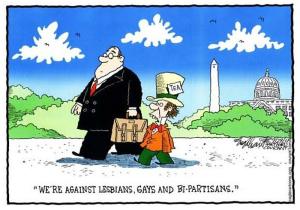 Here’s a taste of the German press as excerpted by Der Spiegel.
Munich’s national Süddeutsche Zeitung offers a slightly more depressing take, pointing blame at all sides. “What has already been apparent in America for a few years now is the self-destruction of one of the world’s oldest democracies. And the great tragedy here is that this work of destruction isn’t being wrought by enemies of democracy, greedy lobbyists or sinister major party donors. America’s democracy is bring broken by the very people who are supposed to be carry and preserve it: the voters, the parties and the politicians.”
The argument? The Republicans who have brought Washington to stillstand are repeatedly and democratically elected by voters and given a mandate to block. The parties themselves are fomenting an increasingly radicalized culture that deepens political, societal and geographic divisions in the country, argues the newspaper. And finally, there are few politicians in America who are willing or capable of thinking beyond their own electoral constituencies.
“At the moment, Washington is fighting over the budget and nobody knows if the county will still be solvent in three weeks,” the paper concludes. “What is clear, though, is that America is already politically bankrupt.”
America enjoys the “exorbitant privilege” of printing the world’s reserve currency. Its government debt is considered a safe haven, which is why Uncle Sam can borrow so much, so cheaply. America will not lose these advantages overnight. But anything that undermines its creditworthiness—as the farce in Washington surely does—risks causing untold damage in the future. It is not just that America would have to pay more to borrow. The repercussions of an American default would be both global and unpredictable.
It would threaten financial markets. Since American Treasuries are very liquid and safe, they are widely used as collateral. They are more than 30% of the collateral that financial institutions such as investment banks use to borrow in the $2 trillion “tri-party repo” market, a source of overnight funding. A default could trigger demands by lenders for more or different collateral; that might cause a financial heart attack like the one prompted by the collapse of Lehman Brothers in 2008. In short, even if Obamacare were as bad as tea-party types say it is (see Lexington), it would still be reckless to use the debt ceiling as a bargaining chip to repeal it, as some Republicans suggest.
What can be done? In the short term, House Republicans need to get their priorities straight. They should pass a clean budget resolution without trying to refight old battles over Obamacare. They should also vote to raise the debt ceiling (or better yet, abolish it). If Obamacare really does turn out to be a flop and Republicans win the presidency and the Senate in 2016, they can repeal it through the normal legislative process.
An FBI hostage negotiator has some hints on how to deal with petulant Tea Party bomb throwers.

So how did it get to this point? “Its fear-driven behavior,” says Voss. “They get angrier because they feel they’ve been defeated. People notice losses twice as much as they notice wins. It’s a sports metaphor you hear all the time: ‘I hate losing more than I like winning’…I think there’s a very strong sense of loss on their part over what they refer to as Obamacare and resentment over that is carried forward.”
But hostage negotiators aren’t the type to give up hope. “Ultimately, everybody wants success. And there are a lot of definitions of success,” Voss says. “Bottom line, they want to be made to look like they were effective and got things done for their side. So it’s a matter of refocusing on what’s in everybody’s best interests.”
He’s looking to the Obama White House to help start the reset: “I would ask them to start saying, ‘I understand that the people on the other side of the table have the best interests of the American people at heart.’ Simply recognize that. Everybody wants to do what’s best for the American public. Those sorts of statements repeated on a regular basis, it’s the start of dialogue. It’s not concession; it’s the beginning of dialogue.”
But the prison siege mentality Voss describes is exacerbated by an absence of strong calming leadership in the congressional GOP. “Those guys are sitting on the sidelines,” Voss says. “There are quite a few Republican politicians that I have a tremendous amount of respect for that are exceedingly silent these days.” He mentions House Intelligence Committee Chairman Mike Rogers: “I’ve never heard anything out of Mike’s mouth that wasn’t really thoughtful and nuanced.”
Another possible constructive calming voice on the conservative caucus could be former President George W. Bush. “I think there’s a possibility that he would be somebody that you would talk to behind the scenes, and potentially an intermediary himself. I think he absolutely has the ability to be a stabilizing influence.”
But how to do you deal with the hyper-partisan congressional bomb-throwers? “Well it’s like a game of tic-tac-toe with the tantrum throwers,” Voss says. “In tic-tac-toe, if you’re going second, the best you can possibly do is tie—if you play the game. There’s a first-mover advantage. The minute you stop playing that game the first mover advantage goes away. So you don’t play their game at all. That’s the way you respond.”
So, the craziness continues and escalates. If things come apart at the seams, I do not want to be stuck in Bobby Jindal’s Louisiana.
What’s on your reading and blogging list today?
Reading the Tea Leaves on the Coming Ideological Battle over the Debt Ceiling
Posted: January 14, 2013 Filed under: Barack Obama, Congress, Federal Budget and Budget deficit, Fiscal Cliff, Republican politics, Surreality, the GOP, The Media SUCKS, U.S. Economy, U.S. Politics, voodoo economics, We are so F'd | Tags: 14th amendment option, Chuck Todd, Debt Ceiling, Gordon Epps, Joe Weisenthal, Juliana Goldman, Major Garrett, Moby Dick, Paul Krugman, reading tea leaves, Tea party crazies, trillion dollar platinum coin 41 Comments
I’m getting a sense that the White House has a plan to deal with the GOP hostage takers in the debt ceiling fight. The plan involves eliminating every possible alternative to Congress allowing the Treasury to pay the nation’s bills, while calmly but forcefully explaining to the American people how the U.S. government works. Obama apparently understands that the media will not help him educate the American people; therefore he will work around them.
Whether this plan is going work is anyone’s guess, but it seems pretty clear that Obama plans to pin the full responsibility for action on Congress.
On Friday, the administration eliminated the most recent suggestion for a “plan B,” the so-called “trillion dollar platinum coin.” They also reiterated the decision not to use the 14th Amendment option, which Obama first announced during the 2011 debt ceiling fight.
With this, the White House has now ruled out the two best options for preventing a default in the event that the House GOP refused to life the debt ceiling. The White House has been quite adamant that the other alternative (invoking the 14th Amendment) is not acceptable.
So now the stakes are high, as The White House has refused to negotiate with the GOP on a debt ceiling hike.What bargaining chips does The White House hold? Unclear.
Paul Krugman was characteristically shrill.
If I’d spent the past five years living in a monastery or something, I would take the Treasury Department’s declaration that the coin option is out as a sign that there’s some other plan ready to go. Maybe 14th Amendment, maybe moral obligation coupons or some other form of scrip, something.
And maybe there is a plan.
But as we all know, the last debt ceiling confrontation crept up on the White House because Obama refused to believe that Republicans would actually threaten to provoke default. Is the WH being realistic this time, or does it still rely on the sanity of crazies? [….]
…if we didn’t have some history here I might be confident that the administration knows what it’s doing. But we do have that history, and you have to fear the worst.
On Saturday, Krugman reported that he had gotten “calls” about Friday’s post from the powers that be:
The White House insists that it is absolutely, positively not going to cave or indeed even negotiate over the debt ceiling — that it rejected the coin option as a gesture of strength, as a way to put the onus for avoiding default entirely on the GOP.
Truth or famous last words? I guess we’ll find out.
I honestly can’t blame the White House for not wanting to use the 14th amendment or “platinum coin” options. Both would undoubtedly lead to wrangling in the courts and, in the case of the 14 amendment choice, a possible Constitutional crisis. But still, was it wise to publicly eliminate the only possible leverage the White House has to force the House GOP to get over their tantrums and allow the Treasury to pay the bills that Congress has already run up? I simply don’t know.
In the President’s press conference this morning, he appeared to confirm that my sense of the “plan” is accurate. He did a good job of spelling out what the consequences will be for the nation and the world if the U.S. defaults on its debts.
The debt ceiling is not a question of authorizing more spending. Raising the debt ceiling does not authorize more spending. It simply allows the country to pay for spending that Congress has already committed to.
These are bills that have already been racked up, and we need to pay them. So, while I’m willing to compromise and find common ground over how to reduce our deficits, America cannot afford another debate with this Congress about whether or not they should pay the bills they’ve already racked up. If congressional Republicans refuse to pay America’s bills on time, Social Security checks, and veterans benefits will be delayed.
We might not be able to pay our troops, or honor our contracts with small business owners. Food inspectors, air traffic controllers, specialist who track down loose nuclear materials wouldn’t get their paychecks. Investors around the world will ask if the United States of America is in fact a safe bet. Markets could go haywire, interest rates would spike for anybody who borrows money. Every homeowner with a mortgage, every student with a college loan, every small business owner who wants to grow and hire.
It would be a self-inflicted wound on the economy. It would slow down our growth, might tip us into recession. And ironically it would probably increase our deficit. So to even entertain the idea of this happening, of the United States of America not paying its bills, is irresponsible. It’s absurd. As the speaker said two years ago, it would be, and I’m quoting Speaker Boehner now, “a financial disaster, not only for us, but for the worldwide economy.”
So we’ve got to pay our bills. And Republicans in Congress have two choices here. They can act responsibly, and pay America’s bills, or they can act irresponsibly and put America through another economic crisis. But they will not collect a ransom in exchange for not crashing the American economy. The financial wellbeing of the American people is not leverage to be used. The full faith and credit of the United States of America is not a bargaining chip. And they better choose quickly, because time is running short.
He also took opportunities to continue patiently explaining, in response to questions from obtuse members of the press corps such as Chuck Todd and Major Garrett.
Despite the efforts of Todd and Garrett to get Obama to say he’ll have to give in to Republican demands, the president repeatedly said he isn’t going to negotiate with GOP terrorists.
Will it work? And more importantly, will Obama really refuse to cave this time? As I noted earlier, Krugman has his doubts. One reporter, Juliana Goldman, even asked the president why anyone should believe him this time when he has always caved in the past. Obama’s response:
Well, first of all, Julianna, let’s take the example of this year and the fiscal cliff. I didn’t say that I would not have any conversations at all about extending the Bush tax cuts. What I said was, we weren’t going to extend Bush tax cuts for the wealthy. And we didn’t.
Now, you can argue that during the campaign, I said — I set the criteria for wealthy at $250,000, and we ended up being at $400,000, but the fact of the matter is, millionaires, billionaires are paying significantly more in taxes, just as I said.
So from — you know, from the start, my concern was making sure that we had a tax code that was fair and that protected the middle class. And my biggest priority was making sure that middle class taxes did not go up. You know, the difference between this year and 2011 is the fact that we’ve already made $1.2 trillion in cuts. And at — at the time, I indicated that there were cuts that we could sensibly make that would not damage our economy, would not impede growth.
I said at the time, I think we should pair it up with revenue in order to have an overall balanced package, but my own budget reflected cuts in discretionary spending. My own budget reflected the cuts that needed to be made. And we’ve made those cuts. Now, the challenge going forward is that we’ve now made some big cuts. And if we’re going to do further deficit reduction, the only way to do it is in a balanced and responsible way.
It’s all very calm and reasonable-sounding; and, as I said, I think Obama did a good job in today’s press conference. He has two more high-profile opportunities to get his message out–the Inaugural Address next Monday and the State of the Union Address on February 12. He could also make campaign-style appearances around the country as he did before the “fiscal cliff” battle.
Now let’s look at what the Republicans are planning. This morning we got the inside dirt from the usual suspects at Politico, Jim Vandehei, Mike Allen, and Jake Sherman. According to the Politico guys, the GOP is getting ready to go on the warpath.
The idea of allowing the country to default by refusing to increase the debt limit is getting more widespread and serious traction among House Republicans than people realize, though GOP leaders think shutting down the government is the much more likely outcome of the spending fights this winter.
“I think it is possible that we would shut down the government to make sure President Obama understands that we’re serious,” House Republican Conference Chairwoman Cathy McMorris Rodgers of Washington state told us. “We always talk about whether or not we’re going to kick the can down the road. I think the mood is that we’ve come to the end of the road.”
Republican leadership officials, in a series of private meetings and conversations this past week, warned that the White House, much less the broader public, doesn’t understand how hard it will be to talk restive conservatives off the fiscal ledge. To the vast majority of House Republicans, it is far riskier long term to pile up new debt than it is to test the market and economic reaction of default or closing down the government.
GOP officials said more than half of their members are prepared to allow default unless Obama agrees to dramatic cuts he has repeatedly said he opposes. Many more members, including some party leaders, are prepared to shut down the government to make their point. House Speaker John Boehner “may need a shutdown just to get it out of their system,” said a top GOP leadership adviser. “We might need to do that for member-management purposes — so they have an endgame and can show their constituents they’re fighting.”
Basically, the whole world is supposed to stand back and let the Tea Party wackos in the House have an extended, violent temper tantrum to “get it out of their system.” Or else.
According the Politico piece, Speaker Boehner will be meeting with GOP members most of the week to discuss strategy and then on Thursday and Friday House GOP members will meet in Williamsburg, VA. During the two-day meeting Boehner and presumably some of the saner House Republican leaders will try to explain to the Tea Party crazies why forcing the U.S. into default is not a very smart idea. I wonder if there will be visual aids?
So that’s where we are for now. At least Obama has stated his case clearly. However, at some point he is going to have to do something dramatic if the Republicans won’t budge. And why should the Republicans or anyone else believe Obama will stick to his guns this time? Only time will tell. I thought this piece by Garrett Epps at The Atlantic (published on Saturday) summed up the situation very well: Does Obama Actually Have a Debt-Ceiling Plan, or Is He Bluffing?
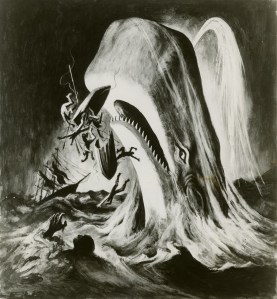
In Melville’s Moby Dick, the whaling ship Pequod crosses the equator on its quest for the White Whale, and in that instant, Captain Ahab smashes his quadrant to the deck and crushes it underfoot.
No more careful navigation. It is, we understand, Moby Dick or die.
As we hurtle toward the new debt-limit crisis, President Obama has done much the same. He says he won’t negotiate spending cuts with a gun to his head. He’s also said that he won’t invoke § 4 of the Fourteenth Amendment, with its provision that “the public debt of the United States . . . shall not be questioned,” to give him authority to continue borrowing once the debt limit has been reached. The Senate Democratic leadership Friday urged him to prepare to raise the ceiling unilaterally; so far, he has remained mum.
Yet Obama, to all appearances, is the calmest man in this overheated capital as the doomsday clock counts down toward a first-ever U.S. default, and the almost certain global depression that would follow.
We can only wait and see what will happen, but as Epps writes, in the end, the onus will be on Obama.
The moment may be coming when wishing and faith do not suffice. Those are the moments when presidents earn their pay. If that requires reversing course on the Fourteenth Amendment, so be it; if it impels a stupid coin trick, then so it does; and if it imposes a political cost on the president, then he must pay it.
After Ahab smashes the Pequod’s quadrant, second-mate Stubb muses to himself, “Well, well; I heard Ahab mutter, ‘Here some one thrusts these cards into these old hands of mine; swears that I must play by them, and no others.’ And damn me, Ahab, but thou actest right; live in the game, and die in it!”
And that’s just the debt ceiling. Obama will also have to deal with fights over the sequester and the federal budget.
Maybe the deal isn’t as bad as I thought.
Posted: January 1, 2013 Filed under: 2012 presidential campaign, Barack Obama, Congress, Fiscal Cliff, Medicaid, Medicare, Mitt Romney, Social Security, U.S. Economy, U.S. Politics | Tags: "please proceed governor", 2012 presidential debates, Chained CPI 47 Comments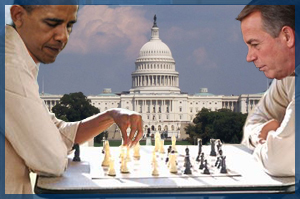
Chess Master or Pawn?
So I went and watched a silly movie (and thoroughly enjoyed it). I calmed down and decided to get back online for a bit. I read some reactions to the fiscal cliff deal from a different perspective, and now I think maybe I was wrong. Sure it’s a lousy deal, but it’s not over yet and at Obama did manage to preserve the social safety net programs, extend unemployment benefits, hold onto the earned income tax credit and child credits, and got some minimal revenue increases.
Look, I’m poor, but I’m not on unemployment. I was willing to go “off the cliff” in order to force the Republicans’ hand. But there are millions of poor and working class people out there would would really suffer if they lose their unemployment and those tax givebacks. Now those have been extended for a year at least. Yes, there will be another fight in two months, but there was going to be a battle royal in two months anyway. Now they will kill two birds with one stone–the debt limit and the sequester will be wrapped up in one fight.
Have I drunk the Koolaid? No, but I admit I really do want to hang onto some hope for the future. So beat me up in the comments all you want. I’m going to hold off judging this deal for two more months. Then if Obama completely sells out the poor and elderly, I’ll admit I made a big mistake. But for now, I’m willing to give Obama a chance.
My changed perspective came from reading a couple of diaries at DailyKos (so shoot me!) and then rereading pieces by Paul Krugman and Noam Scheiber. First up, a Kos diary by ban nock: “Obama’s Deal From a poor Person’s Perspective.”
As usual Obama looked out for us fairly well. All you folks in the financial industry who are weeping and wailing can just pound sand, cash in some stock options, sell your Lincoln, cry me a river.
The biggest thing is earned income tax credit and medicaid, neither of which were touched. Looks like we lost 2% on Social Security contributions but that is more than made up by the earned income credit (EIC)
I should do more to define poor. By poor I mean lower than median income down to, well, to really really poor. Median is around 40K.
The earned income credit is the thing that pulls the greatest number of people out of poverty in the USA. It’s an alternative to raising minimum wages.
You take your adjusted gross income and if you’re a family with a coupla kids making between $13K and $22K Uncle Sam is going to either reduce your taxes by around $5K or reduce them as much as possible and send you a fat check for the remainder. How cool is that? Chart to figure what you get here. http://www.irs.gov/… What is Adjusted Gross Income? That’s how much money you make, but it could come down for things like IRA contributions.
And then, as ban nock points out, there’s unemployment, which is the only thing between millions of Americans and abject poverty.
Now when I first read ban nock’s diary, I was somewhat skeptical. My point of view was that Obama is just warming up for the big kill, “entitlement reform.” But wait a minute. The Republicans were screaming for that in 2011 and again in this last fight. But they didn’t get it. In fact Harry Reid even took the Chained CPI off the table and Obama and Biden didn’t put it back on.
Then I moved on to this diary by Alexander Dukes AKA “Game Guru”: “Umm… We’re playing chess, not checkers. And we’re winning.” You really need to read the whole thing, but the gist is that Obama has been dealing with people who are utterly intractable–they’re actually buttfuck crazy!–so what Obama has done is to keep kicking the can down the road while each time getting something for nothing and at the same time preserving the social programs most needed by the poor and unemployed. Here’s an
First off, lets establish that we’re playing chess, not checkers. Our objective is not to win more battles than the Republicans, its to win the war. In this case its a war against the Republican objective to effectively dismantle Medicare, Social Security, Obamacare, the EPA and every other part of the government that doesn’t leave the people to the whims of the 1 percent. This is chess, so we can afford to lose a few pieces so that we draw our opponent in for the final blow. With every turn we attempt to move toward our ultimate goal, even if that means we take some blows along the way. Chess is a thinking man’s game, it takes a long time to play. Similarly, in these budget fights, Obama’s thinking about the long haul.
Lets examine the President’s strategy: In the first budget fight, Republicans wanted to extend the Bush tax cuts for everyone. The Democrats wanted to extend unemployment benefits and renew the START treaty. There was a great deal of debate… and something happened. What did we end up with? We got START, the unemployment extension, and what else…. what else… oh yeah, DADT was repealed! All for maintaining the tax status quo at the time. Essentially, we offered nothing, and the Republicans got nothing.
Okay, so we gave up the hope for more revenue from taxing the rich, but as Republicans keep pointing out, that new revenue won’t even keep the government going for very long. It’s mostly a symbolic effort to restore some fairness to the tax system.
After that was the debt ceiling fight. Well, Obama almost got to a deal back in 2011, but to no avail. So to raise the debt ceiling congress created the sequester. Nothing for nothing there. Not a bad or good deal, because there wasn’t really a deal at all. But in the sense that there was a deal, both sides agreed to a lame duck rematch, betting that their side would win the election and have the leverage in the sequester fight. Obama won the election, so he had the leverage.
Again, Republicans basically got nothing–just a fake deadline that everyone knew all along was just kicking the can down the road.
Lets discuss what happened (and is still happening) today. Yesterday, Mitch McConnell and Obama reached a deal that did 3 main things: It ends the Bush tax cuts for those making over $400K, it raised the estate tax for those with estates greater than 5 million, and extends unemployment benefits for another year. For this, the Republicans gained… nothing.
That’s right, nothing. Yes, the sequester is extended for only 60 days, but that bumps right up against the debt ceiling… something the Republicans were going to fight over anyway. The media common wisdom is that the Republicans gained “leverage” in this deal. How so? Obama just combined two potential clusterf*cks into one! He gained a years worth of unemployment benefits, tax hikes on the 1%, and an estate tax hike; all for making his job easier in the long term.
Next time Obama may have to cave on the Chained CPI, which would be horrible, but better than privatization of Social Security. But maybe he won’t have to give that up, who knows? All we know for now is that Social Security hasn’t been changed yet.
Obama wanted the debt limited to be raised with the elimination of the sequester. This is essentially raising the limit along with eliminating the sequester, only now he’s getting more of what he wants when the debate starts because he’s already got the tax hikes and the unemployment extension!
Not only that, but now he has two major speeches between now and then to set the debate squarely in his favor.
It makes sense to me. Frankly, I buy it for now. And you know why I’m willing to string Obama along for another two months? Because of what happened in his second debate with Mitt Romney:
Please proceed, Governor.
Please proceed, Speaker.
Maybe I’m nuts, but maybe I’m not. I’m going to wait two months and find out. Now let’s look at what Krugman had to say about the upside of the deal:
To make sense of what just happened, we need to ask what is really at stake, and how much difference the budget deal makes in the larger picture.
So, what are the two sides really fighting about? Surely the answer is, the future of the welfare state. Progressives want to maintain the achievements of the New Deal and the Great Society, and also implement and improve Obamacare so that we become a normal advanced country that guarantees essential health care to all its citizens. The right wants to roll the clock back to 1930, if not to the 19th century.
There are two ways progressives can lose this fight. One is direct defeat on the question of social insurance, with Congress actually voting to privatize and eventually phase out key programs — or with Democratic politicians themselves giving away their political birthright in the name of a mess of pottage Grand Bargain. The other is for conservatives to successfully starve the beast — to drive revenue so low through tax cuts that the social insurance programs can’t be sustained.
The good news for progressives is that danger #1 has been averted, at least so far — and not without a lot of anxiety first.
Romney lost, so nothing like the Ryan plan is on the table until President Santorum takes office, or something. Meanwhile, in 2011 Obama was willing to raise the Medicare age, in 2012 to cut Social Security benefits; but luckily the extremists of the right scuttled both deals. There are no cuts in benefits in this deal.
And Scheiber’s take on the upside:
I think a reasonable person can defend the bill on its own terms. The fact is that nudging up the tax threshold to $450,000 only sacrifices $100-200 billion in revenue over the next decade (against the $700-800 billion the administration would have secured with its original threshold), while allowing unemployment benefits to lapse would cause real pain to both the 2 million people directly affected and, indirectly, to the economy. Yes, Obama could have gotten the latter without giving up the former had he just waited another few days—at which point what the GOP considers a tax increase suddenly becomes a tax cut. But these things are always easier to pull the trigger on when you, er, don’t actually have to pull the trigger. I can’t begrudge Obama his wanting to avoid some downside risk for only a marginally better deal.
In other words, we are dealing with insane people–the Republicans in the House and Senate–and so far we haven’t given away the real farm, the social safety net. Unfortunately we don’t have enough revenue for a real stimulus either, but we go back to the table in two months and the Republicans are scoring that as a win for them.
But what if it’s not? What if dealing both issues at once–the debt ceiling and the sequester–and sooner, is an advantage for Democrats and the White House? We can’t know for sure until the next fight. But Obama did get a year of unemployment, those tax givebacks, and some symbolic concessions from the super-rich. And he does have the State of the Union and Inauguration speeches to call out the Republicans and make his case.
So that’s why I’m going to give this deal a chance for now. It’s not a great deal, but the important stuff has been protected for the time being. Now go ahead and hammer me in the comments, I don’t mind.

 peej
peej Carissa
 bostonboomer
 dakinikat
 ecocatwoman
 mablue2
 Mama Lopez
 peggysue22
 quixote
 skydancingguestblogger
 Mona (aka Wonk the Vote)



 Sky Dancing
Recent Comments