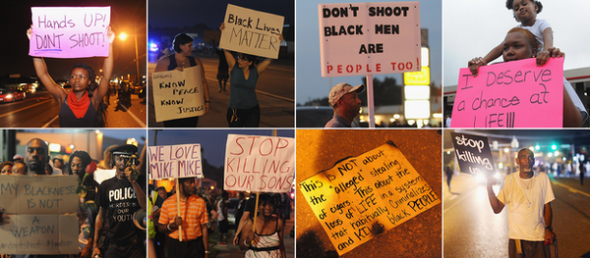
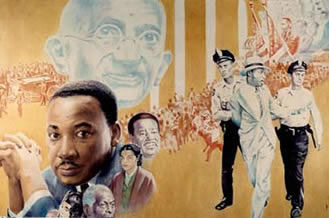
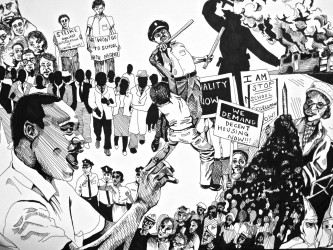
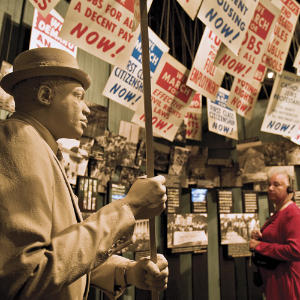
I can’t stop thinking about the events in Ferguson, Missouri, and flashing back to similar iconic events in the 1960s. How far have we really come since the days of the Civil Rights Movement? Clearly, racism is alive and well in 2014, particularly in police departments around the country–and not just in the South. Will the disease of racism ever be wiped out in this country, or can we only hope to control it through great effort–with laws, education, organizing, and public demonstrations?
Ferguson citizens were forced to live through another night of chaos last night, and I’m convinced at this point that deliberate police actions are making things much worse. The man in charge, Captain Ron Johnson of the Missouri State Police is clearly being used as a pawn. He was set up to fail, and at this point he is simply putting a friendly face on an ugly show of force intended to intimidate protesters and media alike. And he’s lying to make excuses for what has basically become a nightly police riot. I’ve been watching the live feed from Ferguson night after night, and I have yet to see any evidence of protesters throwing Molotov cocktails or attacking police (UPDATE: Dakinikat says there is one in the NYT video at this link.
Perhaps we’d know more about what is happening on the ground if new helicopters could fly over Ferguson, but police have ordered them not to, saying that only police helicopter can do so. Reporters and news photographers have been arrested and threatened with being maced or shot. Yesterday, as everyone here knows, police in St. Louis arrested 90-year-old Holocaust survivor Hedy Epstein. From The Independent UK:
Hedy Epstein, a 90-year-old survivor of the Holocaust, was reportedly among those arrested during protests in downtown St Louis as tensions flared over the death of black teenager Michael Brown in Ferguson.
Eight protesters were arrested for “failure to disperse” on Monday after marching from the Kiener Plaza to the Wainwright building where Governor Jay Nixon has an office, St Louis police confirmed on Twitter.
Ms Epstein was pictured being led away in handcuffs during demonstrations against the National Guard’s presence on the streets where clashes between protesters and authorities have been the most severe.
Ms Epstein, a resident of St Louis, is a political activist and speaker widely known for her vocal support of the Free Gaza Movement.
“I’ve been doing this since I was a teenager. I didn’t think I would have to do it when I was ninety,” Ms Epstein told The Nation as she was led away by police. “We need to stand up today so that people won’t have to do this when they’re 90.”
But I want to return to the subject of racism and dishonesty in the Ferguson Police Department. I think most people who have been paying attention to this story will agree that the Ferguson cops cannot be trusted at this point. Some history, from Michael Daly at The Daily Beast: Missouri Cops’ License to Kill.
The death of 18-year-old Michael Brown is not the first time an officer supervised by Ferguson Police Chief Tom Jackson has killed an unarmed man….
Back in 2000, two unarmed young men were shot and killed in a Jack in the Box parking lot in the suburban town of Berkeley adjacent to Ferguson by a pair of officers assigned to a county-wide drug task force where Jackson was deputy commander.
Early reports suggested that a vehicle occupied by Earl Murray and Ronald Beasley moved toward Officers Robert Piekutowski and Keith Kierzkowski, causing them to fear being pinned against another car.
Jackson, then a lieutenant with the St. Louis County Police, told reporters, “I am convinced that the officers were in fear of their lives, that they were in immediate danger.” ….
Subsequently, investigators decided that the car occupied by the two men had not in fact begun to move in their direction when the fatal shots were fired. The officers insisted they were in fear for their lives nonetheless, essentially arguing that the car was itself a deadly weapon pointed their way. That was enough for the shooting to be ruled justified under Missouri state law. The cops were not indicted.
Read more about it at the link. It’s high time Jackson was removed as Ferguson Police Chief.
Michael Brown, 23, of Troy, Mo., who was shot and killed along with a friend in October 2005.
Authorities said that Lincoln County sheriff’s Deputy Nic Forler fired through the back window of a pickup, killing Brown and the driver, Tyler Teasley, 22. No one in the truck was armed.
Police said Forler tried to stop Teasley’s truck for speeding but was led on a short chase. When the truck finally stopped, Forler pulled behind it, got out of his patrol car and stood between the vehicles.
Witnesses said Teasley was “freaking out” because he had been drinking, there was alcohol in the car and several passengers were under 21. In his panic, they said, Teasley left the truck in neutral. As the truck rolled backward, Forler fired the fatal shots that struck both victims in the head.
Family and friends demonstrated regularly outside the sheriff’s office. Forler was dismissed from the force and charged with involuntary manslaughter.
In a trial in 2007, moved to Boone County because of the controversy caused in Lincoln County, Forler testified that he believed Teasley was trying to run him over, and he feared for his life. The jury took only three hours to find Forler not guilty.
Read the Post-Dispatch article to learn about two more such incidents in Missouri.
Now let’s take a look at the case that Ferguson Chief Jackson has been building in order to blame Michael Brown for his own death. According to Jackson, Brown committed a “strong-arm robbery” at a gas station convenience store shortly before he was accosted by Officer Darren Wilson, who shot and killed the unarmed teenager. But did that really happen? I don’t think so.
I can’t prove it, but I think what may have happened is that police took surveillance videos from a number of locations and just happened to find the video of Brown in buying cigars. A Ferguson resident on Twitter told me yesterday that the store owners are saying the Ferguson police didn’t pick up the store video until last Friday, not too long before Jackson gave his press conference. And the St. Louis News confirms the tweeter was right.
The owner[s] of the store dispute the claim that they or an employee called 911, saying a customer inside the store made the call. They also say St. Louis County issues the warrants for the hard drive of surveillance video Friday.
When asked how Ferguson police ended up with the video that the Ferguson police chief issued Friday morning. The attorney said during the course of Ferguson’s investigation they came to the store and asked to review the tape. But it wasn’t until Friday that St. Louis County investigators issued a warrant for the video many of you have already seen.
Therefore, there is no way that Darren Wilson could have known anything about the “robbery” or that Michael Brown was a suspect.
Civil Rights Line, Janie McGee
A couple of days ago, Joy Reid of The Grio and MSNBC posted on Twitter that the store video appeared to show that Brown had actually paid for the cigars he took from the store.
Then last night Crooks and Liars put up a detailed post about it, Ferguson Cops Busted? New Video Seems To Show Brown Paying For Cigarillos (Video), by John Prager. Crooks and Liars doesn’t allow copy and paste anymore, so you’ll need to go to the link to read the article, but Prager it looks like Brown buys some cigarillos, then tries to by more, but doesn’t have enough money and so replaces them. Brown did reach across the counter, and that may be why the clerk tried to confront him.
Here’s the video.
Will the Ferguson police get away with murder once again? I think it’s likely unless the DOJ finds that the shooting of Michael Brown is a Civil Rights case. U.S. News today posted an article quoting attorneys who have defended police shooters, Police Attorneys: Brown Head Wounds Not Fatal to Officer’s Defense.
Pathologists said they found a bullet wound at the apex of the 6-foot-4 Brown’s head and what appeared to be a bullet entry above his right eye that continued downward into his jaw and then shoulder. The wounds appear to show Brown was not standing upright at the time he was shot.
“Just because he was shot somewhere near the top of his head, I don’t think that’s indicative of anything at this point,” says New Orleans attorney Eric Hessler, who defended officers involved in the 2005 post-Hurricane Katrina shooting deaths of two people on the Danziger Bridge and another person outside a convention center.
“There are scenarios that I can envision where a police officer would be justified in using deadly force in that situation,” Hessler says of the Brown case. “It depends on what the individual was doing while he was shot.”
Several officers were convicted of crimes in the post-Katrina cases, but the bridge shooting verdicts were vacated and the case is not resolved.
Attorney James Culleton, who defended New York City police officers who shot and killed unarmed black men Amadou Diallo in 1999 and Sean Bell in 2006, agrees with Hessler that the bullet trajectory isn’t necessarily game-changing.
“If the person is facing you, he’s charging at you, he could have put down his head,” Culleton says. “His head could have just slumped like he was falling forward. It doesn’t mean it’s devastating [evidence].”
We’ll have to wait and see. For now, it’s high time for Chief Jackson to be fired and for Darren Wilson to be arrested. This murderer is still receiving his salary!
I’ll end with some recent headlines about Ferguson.
I spent most of the day and night yesterday following the shocking events in Ferguson, Missouri. As I read articles and tweets and studied violent images of police dressed as soldiers and riding in military vehicles, I had repeated flashbacks to the Civil Rights era. Except in those days, police weren’t outfitted with surplus military equipment provided by the Federal government. Back then, the cops had to resort to fire hoses to force people off the streets; but in Ferguson, St. Louis police are equipped with MRAPs (mine-resistant ambush-protected vehicles) and LRADs (long-range acoustic devices).
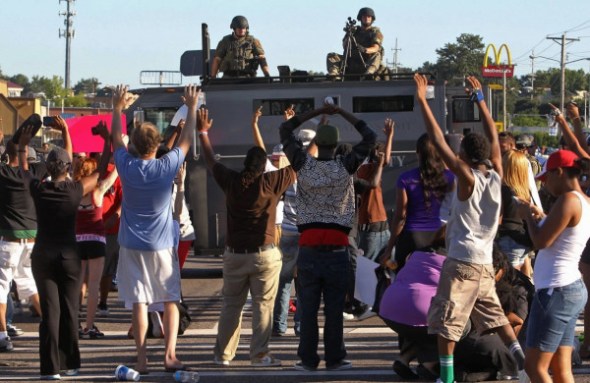
Ferguson isn’t a large city, and reporters on the ground estimated the size of the “crowd” at somewhere between 150 and 250 people, who were largely protesting peacefully by holding their hands in the air and chanting “Hands up. Don’t shoot.” It’s long past time for Missouri Governor Jay Nixon (a Democrat) to step in and tell the cops to calm down and put away their military toys. If he won’t take action, then President Obama should instruct Attorney General Holder to do it.
The protests follow the killing of 18-year-old Michael Brown by a still-unnamed Ferguson policeman last Saturday afternoon. Brown “had no criminal background,” according to KDSK.com. Police claim that Brown struggled with the officer and tried to grab his gun. But that makes no sense. Why did the officer choose to stop Brown as he peacefully walked down the street with a friend? That friend, Dorian Johnson tells a different version of events.
Dorian Johnson said he was standing inches from Brown when the shooting occurred around 1:40 p.m. Saturday. He gave his account of the shooting to KSDK-TV.
“The officer is approaching us and as he pulled up on the side of us, he didn’t say freeze, halt or anything like we were committing a crime. He said, ‘Get the F on the sidewalk.’
After Johnson said the officer thrust open the door of his patrol car, hitting the pair, Johnson said the officer grabbed Brown around the neck and tried to pull him through the window. He said Brown never tried to reach for the officer’s weapon.
“The second time he says, ‘I’ll shoot,’ a second later the gun went off and he let go,” Johnson said. “That’s how we were able to run at the same time. The first car I see, I ducked behind for because I fear for my life. I’m scared. I don’t know what’s going on. I don’t understand why this officer is shooting his weapon at us.”
According to Johnson, the officer pursued Brown and fired another shot. which struck Brown in the back. He said Brown turned and faced the officer with his hands raised.
“My friend started to tell the officer that he was unarmed and that he could stop shooting (him),” Johnson said. “Before he could get his second sentence out, the officer fired several more shots into his head and chest area. He fell dramatically into the fatal position. I did not hear once he yell freeze, stop or halt. it was just horrible to watch.”
While Michael Brown appeared to tussle with an officer before he was shot dead, he didn’t enter the police cruiser as authorities claim he did, two witnesses told CNN.
The women’s accounts corroborate that of a previous witness, all three of whom said the officer fatally shot the unarmed teen.
Police have said the black 18-year-old died in a dangerous struggle after trying to grab the officer’s weapon. Not so, say the witnesses.
“It looked as if Michael was pushing off and the cop was trying to pull him in,” Tiffany Mitchell told CNN on Wednesday night.
Mitchell had driven to Ferguson to pick up another woman Piaget Crenshaw. The two women witnessed the shooting from two different angles–Mitchell from her car and Crenshaw from a building nearby.
Neither woman, who gave their statements to St. Louis County police, say they saw Brown enter the vehicle.
Instead, a shot went off, then the teen broke free, and the officer got out of the vehicle in pursuit, the women said.
“I saw the police chase him … down the street and shoot him down,” Crenshaw said. Brown ran about 20 feet.
“Michael jerks his body, as if he’s been hit,” Mitchell said.
Then he faced the officer and put his hands in the air, but the officer kept firing, both women said. He sank to the pavement.
The protests in Ferguson, a town in which the population is 2/3 black but the political leadership and police force are overwhelmingly white, are largely driven by the fact that police will not name the shooter or released the results of Brown’s autopsy, despite Missouri’s sunshine law.
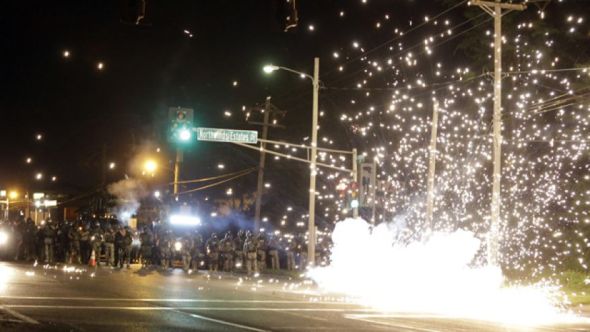
August 13, 2014: A device deployed by police goes off in the street as police and protesters clash in Ferguson, Mo. (AP Photo/Jeff Roberson)
FERGUSON, Mo. — In the five days since an unarmed young black man was fatally shot by a police officer here, the selective release of information about the shooting, and especially the anonymity granted to the officer, has stoked frustrations in this largely African-American community north of St. Louis, where residents describe increasingly tense relations with the police.
The police chief, Thomas Jackson, has repeatedly declined to identify the officer, who has been put on administrative leave. But on Wednesday, the chief did offer a new detail about the shooting, which has kindled nights of racial unrest and an unyielding police response with tear gas, rubber bullets and arrests.
Jackson claims there have been threats against the police officer and he needs protection. So why not simply arrest him for murder and send his family to a safer location? Instead, Wilson called in law enforcement support from St. Louis and enabled an incredible overreaction to largely peaceful protests. From the Times article:
On Wednesday night, scores of police officers in riot gear and in armored trucks showed up to disperse protesters who had gathered on the streets near the scene of the shooting. Some officers perched atop the vehicles with their guns trained on the crowds while protesters chanted, “Hands up, don’t shoot.” A police spokesman said that some demonstrators had thrown Molotov cocktails at officers and that some had tried to set fires. The police used tear gas on demonstrators, and some protesters said rubber bullets had been fired at them. Police said one officer appeared to have suffered a broken ankle after being hit by a brick.
The police made more than 10 arrests. Among those arrested was Antonio French, a St. Louis alderman, who had been documenting the protests on social media, his wife said on Twitter.
Two reporters covering the protests also said they had been arrested inside a McDonald’s for trespassing and later released without charges or an explanation. The reporters, Wesley Lowery of The Washington Post and Ryan J. Reilly of The Huffington Post, both said they had been handled roughly by the police.
If you don’t read anything else on the events in Ferguson, read this article and look at the photos.
As America scaled back its presence in Afghanistan and Iraq in 2012, military gear — amphibious tanks, weapons, uniforms and drones — spilled into local police arsenals. In June, an ACLU report warned of the “excessive militarization” of local law enforcement. “This has the effect of terrifying people, destroying communities and actually undermining public safety,” Kara Dansky, ACLU senior counsel, told Mashable in June.
The photos below show the heavily armed Ferguson police officers, dressed in camouflaged uniforms. They are set side-by-side with images of U.S. military operations in Iraq and Afghanistan.
One of the photo comparisons below. Which was taken in Ferguson and which in Iraq?
Missouri Gov. Jay Nixon said he would visit the St. Louis suburbs Thursday after police fired tear gas to break up crowds in a fourth night of civil unrest over the police killing of an unarmed black teenager.
Sixteen people were arrested, including two reporters, on Wednesday night in the suburb of Ferguson, and police said that two officers were injured, one hit by a brick, NBC affiliate KSDK reported….
Nixon said in a statement that the worsening situation in Ferguson was “deeply troubling.” He canceled a planned visit to the state fair. “While we all respect the solemn responsibility of our law enforcement officers to protect the public, we must also safeguard the rights of Missourians to peaceably assemble and the rights of the press to report on matters of public concern,” he said.
To believe that this carnage — the windows smashed, the buildings torched, the tear gas wafting — is all about the killing of Michael Brown is to miss the point….
Because, again, this is not just about Brown. It’s about Eric Garner, choked to death in a confrontation with New York City Police. It’s about Jordan Davis, shot to death in Jacksonville, Florida, because he played his music too loud. It’s about Trayvon Martin, shot to death in Sanford, Florida, because a self-appointed neighborhood guardian judged him a thug. It’s about Oscar Grant, shot by a police officer in an Oakland, California, subway station as cellphone cameras watched. It’s about Amadou Diallo, executed in that vestibule and Abner Louima, sodomized with that broomstick. It’s about Rodney King.
And it is about the bitter sense of siege that lives in African-American men, a sense that it is perpetually open season on us.
And that too few people outside of African America really notice, much less care. People who look like you are every day deprived of health, wealth, freedom, opportunity, education, the benefit of the doubt, the presumption of innocence, life itself — and when you try to say this, even when you document it with academic studies and buttress it with witness testimony, people don’t want to hear it, people dismiss you, deny you, lecture you about white victimhood, chastise you for playing a so-called “race card.”
They choke off avenues of protest, prizing silence over justice, mistaking silence for peace. And never mind that sometimes, silence simmers like water in a closed pot on a high flame….the anger we see in Ferguson did not spring from nowhere, nor arrive, fully-formed, when Michael Brown was shot. It is the anger of people who are, as Fannie Lou Hamer famously said, sick and tired of being sick and tired.
Silence imposed on pain cannot indefinitely endure. People who are hurting will always, eventually, make themselves heard.
The only problem with Pitts’ column is that there haven’t been any actual “riots” in Ferguson yet–unless you count what the police are doing as rioting.
Police actions against press seem to be part of the reason Governor Jay Nixon finally decided to cut his Missouri State Fair trip short. The governor says he’ll arrive in St. Louis County Thursday morning to manage what’s increasingly becoming a volatile, violent and devastating time in St. Louis history.
SWAT officers arrested Wesley Lowery, a political reporter at TheWashington Post, and Ryan Reilly, a Huffington Post justice reporter, shortly before 7 p.m. while clearing out a McDonalds near the protests where they were working. The reporters say police asked for their identification and eventually arrested them when they weren’t leaving quickly enough.
The journalists say they were arrested without being read their Miranda writes and eventually released with nothing — no charges, no police report, no names of arresting officers. The Los Angeles Times says police only released them after their reporter alerted the chief of Ferguson Police (His response: “Oh, god,”), who then called St. Louis County Police.
Sen. Claire McCaskill (D-Mo.) says she has a phone call planned with Attorney General Eric Holder on Thursday to discuss the situation in Ferguson, Mo., where an apparently unarmed black teenager was fatally shot by a police officer last weekend.
Amid clashes in the St. Louis suburb Wednesday night, the senator tweeted that she’s been working the phones to try to deescalate the “tense and unacceptable situation.” ….
Holder and White House senior adviser Valerie Jarrett briefed President Obama Wednesday and the president will receive another briefing Thursday.
I’ll have to end there, because this post is getting way too long. I’ll post more important links in the comments. I’ll leave it to you Sky Dancers to update me on the rest of the news. I’ve been too focuses on Ferguson to pay attention to anything else. See you in the comment thread.
Did you like this post? Please share it with your friends:
Today’s beautiful messages and images can be found here.
The reactionary and wildly creative decisions coming out of the Supreme Court are already having ramifications across the country where women, minorities, and the GLBT community are having to fight for their very basic rights. Interestingly enough, we are learning about which corporations want to be citizens and which corporations want to exist for the sole benefits of their owners.
This week, in the Hobby Lobby case, the Supreme Court ruled that a religious employer could not be required to provide employees with certain types of contraception. That decision is beginning to reverberate: A group of faith leaders is urging the Obama administration to include a religious exemption in a forthcoming LGBT anti-discrimination action.
Their call, in a letter sent to the White House Tuesday, attempts to capitalize on the Supreme Court case by arguing that it shows the administration must show more deference to the prerogatives of religion.
“We are asking that an extension of protection for one group not come at the expense of faith communities whose religious identity and beliefs motivate them to serve those in need,” the letter states.
The Hobby Lobby decision has been welcomed by religious-right groups who accuse Obama of waging a war on religion. But Tuesday’s letter is different: It comes from a group of faith leaders who are generally friendly to the administration, many of whom have closely advised the White House on issues like immigration reform. The letter was organized by Michael Wear, who worked in the Obama White House and directed faith outreach for the president’s 2012 campaign. Signers include two members of Catholics for Obama and three former members of the President’s Advisory Council on Faith-Based and Neighborhood Partnerships.
“This is not an antagonistic letter by any means,” Wear told me. But in the wake of Hobby Lobby, he said, “the administration does have a decision to make whether they want to recalibrate their approach to some of these issues.”
The first source of controversy is the collapse of a national consensus on a key element of religious liberty: accommodation. Throughout American history, there has been widespread agreement that in our religiously diverse and widely devout country, it is good for the government to accommodate religious exercise. We have disagreed about particular accommodations (may a Muslim police officer wear a beard, despite police department policy?), and especially about whether religious accommodations should be ordered by judges or crafted by legislators. But we have generally agreed that our nation benefits when we help rather than burden those with religious obligations. That consensus seems, quite suddenly, to have evaporated.
A second source of controversy is that many people view the Hobby Lobby case as concerning not just reproductive rights but also, indirectly, rights for gays and lesbians. Advocates for same-sex marriage have long insisted that their own marriages need not threaten anyone else’s, but citizens with religious objections to same-sex marriage wonder whether that is entirely true: Will a small-business owner be sued, for instance, for declining to provide services to a same-sex couple? Conversely, and understandably, gay and lesbian couples wonder why they do not deserve the same protections from discrimination granted to racial and other minorities. For both sides, Hobby Lobby was merely a prelude to this dawning conflict.
The third source of controversy is a change in our views of the marketplace itself. The marketplace was once seen as place to put aside our culture wars and engage in the great American tradition of buying and selling. The shopping mall has even been called the “American agora.” But today the market itself has become a site of cultural conflict. Hobby Lobby is one of many companies that seek to express faith commitments at work as well as at home and that don’t see the workplace as a thing apart from religion. Many companies preach and practice values, religious and otherwise, that are unrelated to market considerations. CVS, for example, recently announced that it would stop selling tobacco products, regardless of how that decision might affect its bottom line.
A country that cannot even agree on the idea of religious accommodation, let alone on what terms, is unlikely to agree on what to do next
The national controversy over a surge of Central American immigrants illegally crossing the U.S. border established a new battleground this week in a Southern California small town where angry crowds thwarted detained migrants from entering their community.
In a faceoff Tuesday with three buses carrying the migrants behind screened-off windows, the demonstrators chanted “Go back home!” and “USA” and successfully forced the coaches to leave Murrieta, CNN affiliate KFMB reported.
The buses instead took the 140 or so undocumented immigrants to U.S. processing centers at least 80 miles away, in the San Diego and El Centro areas, federal officials say.
Counter-protesters squared off with the demonstrators, and a shouting match erupted over the nation’s immigration system, which recently has been overwhelmed with a tide of Central American minors illegally entering the United States alone or with other children.
A mix of poverty, violence and smugglers’ false promises is prompting the Central American inflow.
Unlike undocumented Mexican migrants, who are often immediately deported, the U.S. government detains and processes the Central Americans, who are eventually released and given a month to report to immigration offices. Many never show up and join the nation’s 11 million undocumented population, says the National Border Patrol Council, the union representing Border Patrol agents.
The Latin American immigrants rejected by Murrieta protesters were initially held in Texas, where U.S. facilities are so overflowing that detainees are sent to other states for processing.
The government doesn’t have the room to shelter the children with adults: there’s only one family immigration detention center, in Pennsylvania. To assist the unaccompanied children, President Barack Obama’s administration opened shelters last month on three military bases because federal facilities more designed for adults were overrun with minors.
Tuesday’s busloads of detained Central American immigrants didn’t include any unaccompanied minors, said Murrieta Police Chief Sean Hadden, who put the number of protesters at 125. The children on the buses were apparently in the company of relatives or other adults, said an official with the National Border Patrol Council.
The leadership team has been weighing a complex issue, and I want to be sure everyone understands our thoughts and ultimate decision.
As you’ve likely seen in the media, there has been a debate about whether guests in communities that permit “open carry” should be allowed to bring firearms into Target stores. Our approach has always been to follow local laws, and of course, we will continue to do so. But starting today we will also respectfully request that guests not bring firearms to Target – even in communities where it is permitted by law.
We’ve listened carefully to the nuances of this debate and respect the protected rights of everyone involved. In return, we are asking for help in fulfilling our goal to create an atmosphere that is safe and inviting for our guests and team members.
This is a complicated issue, but it boils down to a simple belief: Bringing firearms to Target creates an environment that is at odds with the family-friendly shopping and work experience we strive to create.
A “misunderstanding” between two armed men in a Georgia convenience store led to an arrest on the very day that the state’s new expansive gun rights law went into effect, according to The Valdosta Daily Times.
Valdosta Police Chief Brian Childress summed the incident up for the newspaper.
“Essentially, it involved one customer with a gun on his hip when a second customer entered with a gun on his hip,” Childress said.
According to the Daily Times, the first man, Ronald Williams, approached the second man in the store and demanded to see his identification and firearms license. Williams also pulled his gun from his holster, without pointing it at the second man. The second man responded by saying that he was not obligated to show any permits or identification — then he paid for his purchase, left the store, and called the police.
Police responded to the call around 3 p.m. Tuesday, and Williams was arrested on a charge of disorderly conduct for pulling his gun in the store.
Tuesday was also the day that Georgia’s so-called “guns everywhere” law went into effect, allowing residents to carry guns into bars, nightclubs, classrooms, and certain government buildings. Among other things, the law also prohibits police from demanding to see the weapons permit of someone seen carrying a gun. Childress mentioned that last point when talking to the Daily Times about Tuesday’s incident.
“This is an example of my concern with the new gun law that people will take the law into their own hands which we will not tolerate,” Childress said.
According to the coroner’s office, Brittany Thomas, 21, of Hammond, La., died from her injuries. She is the only victim of the shooting to die.
Thomas had been in critical condition since the early Sunday morning shooting when two gunmen sprayed the crowd with bullets.
Three others were reported in stable condition after Sunday’s shooting: a 35-year-old man from Mississippi, a 19-year-old Arkansas woman and an 18-year-old New Orleans man.
Interim LSU Hospital spokeswoman Siona LaFrance said Wednesday a 21-year-old Australian woman was released from the hospital.
On Sunday, police said nine people were injured in the shooting. Then Monday, they said a person who came into the police department Sunday afternoon also was injured in the violence.
Other victims, not hospitalized, included two New Orleans-area men; a teenage girl and a woman from Alabama; and a Florida man.
The young Australian woman has a Facebook page where you can help her defray the cost of reconstruction. As of writing this, I understand that the “person” of interest has surrendered to the police. His face has been plastered every where for about a day and half.
The shooting took place about 2:45 a.m. Sunday on Bourbon Street and involved “two young men, both armed with firearms, who chose to settle a dispute between themselves without care for anyone else,” Police Supt. Ronal W. Serpas told reporters. They exchanged gunfire, hitting bystanders, he said. Bourbon Street, a hot spot for tourists, is full of bars, restaurants and shops.
According to the New Orleans Police Department, two men are sought in the shooting that spawned from an argument between them.
“While everyone else was running away, I was running toward the gunfire,” Minsky said. “And, I don’t know, being a curious guy — that’s what I wanted to do — see what was going on basically.”
Minsky described the ordeal as “surreal,” saying he’d never seen multiple people get shot.
“There was a lot of blood, I can tell you that much, you know. And I actually stepped in a pool of blood and didn’t realize it until I was walking toward the person shot in the face,” Minksey said. “That kind of freaked me out a little bit.”
The victim shot in the face was Amy Matthews from Australia. The bullet struck her in her cheek and knocked out all but 10 teeth she told an Australian newspaper. She was released from the hospital this week.
In one of several photos Minsky took on his cellphone, Matthews is seen sitting on a sidewalk on Bourbon Street as a crowd of people attempted to help her, including two U.S. marines.
He also captured an image of an unresponsive woman lying in the middle of the 700 block of Bourbon Street.
During the chaotic moments after the shooting, Minsky said there weren’t many screams in the Vieux Carré.
“There was just a lot of people running around and trying to help each other,” he said. “The person that was shot in the face was probably the person getting the most attention at that immediate moment. But as far as the screams and commotion, I mean, yeah, there are people running and screaming but that all died down after the gunshots ended.”
I can’t believe that this is what the founders– many of whom I am a direct descendant of–planned for our union. How could they have envision this kind of hateful chaos empowered by the Supreme Court who represents the voice of reason, law, and constitutionality, and the House of Representatives which is supposed to be the voice of the people.. I do not find any of these events to be consistent with their dreams and plans for a more perfect union where no one religion would dictate the lives of others, where all were considered equal before the law, and every one had the ability to pursue life and liberty.
Did you like this post? Please share it with your friends:
I have read the most horrifying stories this week. It makes me wonder if a good portion of humanity has a death wish. I’m going to share a variety of links that I’ve found; and a lot of them aren’t the most uplifting, I’m afraid.
Knowledge is power. Ignorance may be bliss to the holder but not to the folks around them. There is no lack of headlines in the area of bigotry and intolerance. This is truly discouraging to those of us that care passionately about social justice.
While crime rates have fallen 45 percent since 1990, the memo said that the incarceration rate is now at a “historically unprecedented level,” jumping 222 percent between 1980 and 2012. An African-American man who never graduated from high school has a 70 percent likelihood of being imprisoned by his mid-30s; for similarly educated white men, the rate is about 15 percent. And the United States imprisons at a rate six times greater than most peer nations, including those of the European Union, Japan, Israel, and Mexico.
The U.S. Department of Justice announced rules last month that would give the Obama administration wider latitude to extend clemency or reduce sentences for drug-related prisoners who don’t present a threat to public safety. In addition, the U.S. Sentencing Commission voted unanimously in April to reduce sentencing guidelines for certain nonviolent criminals, a move now before Congress that could go into effect Nov. 1 if lawmakers don’t take any further action.
Ronald S. Sullivan Jr. is a clinical professor of law and director of the Criminal Justice Institute at Harvard Law School. The program focuses on criminal practice, education, and research, and hosts a teaching clinic for third-year law students to represent indigent criminal defendants in local and juvenile courts. Sullivan spoke with the Gazette about racial and national sentencing disparities, the economic and social costs of mass incarceration, and the sentencing reforms now under consideration.
GAZETTE: According to the memo, while the overall crime rate fell 45 percent between 1990 and 2012, the rate of imprisonment has spiked 222 percent between 1980 and 2012. What’s behind this disparity? Is that strictly the result of policy decisions like mandatory minimum sentencing, repeat-offender laws, and the growth in for-profit prisons? Or are other factors at work?
SULLIVAN: That’s certainly a big piece of it. … policy decisions in respect of mandatory minimums drive the huge incarceration rate. But there are other factors as well. What those factors are is the subject of a lot of academic debate nowadays. And to be honest, we’re not exactly sure what it is. We do know that on a per-capita basis the U.S. incarcerates more people than any country in the world, including Rwanda, Russia, Cuba, all of the places one does not associate with a robust tradition of liberty. And that’s in many ways shocking.
The theory would be … with the high rates of incarceration that the crime rate would go down and then that would be followed by less incarceration because there just wouldn’t be as many crimes committed. But those numbers have gone in opposite directions. Mandatory minimums simply don’t explain all of it. Part of it, at least I think, has to do with selective law enforcement — the over-policing of certain neighborhoods, particularly minority neighborhoods and poor neighborhoods. That is to say, if police are there and looking for crimes, and over-police certain neighborhoods, you’re going to produce more defendants in particular areas. And if the populations are drawn from poor populations, they’re unable to afford to be released on bail, they’re unable to afford good lawyers, and studies show that if you’re not released on bail you tend to stay in jail after sentencing. An unfortunate reality of the United States is that far too often the justice you receive is a function of how much money you have.
The prison-industrial complex is also an important factor. It doesn’t take an economist to know that if … you make your money by people going into prison, then there’s going to be higher incarceration rates. So I think that certainly plays a role as well.
GAZETTE: What are the areas of debate among scholars?
SULLIVAN: One explanation has to do with the United States’ articulated goals of punishment. Back in the ’70s and before, rehabilitation was an articulated goal of the criminal justice system. The Supreme Court has said clearly now rehabilitation is no longer a penological goal. We look at incapacitation, we look at deterrence, and we look at retribution as goals that the penal system serves. When you take rehabilitation out of the mix, then that de-incentivizes the system from having shorter sentences because there’s no longer an affirmative goal of reintegrating people meaningfully back into the community. That’s one of the things that scholars argue drive up the incarceration rate.
The other has to do with our system of elected judges in most states. Judges who are elected, the argument runs, respond to democratic pressures. We live in a political economy where people think that more and harsher punishment is better, even though most competent data suggests that longer sentences, after a certain point … make people worse as opposed to making them better. But you have democratically elected judges who respond to the will of the people, and if that will is for longer sentences, no matter how misinformed, then judges oftentimes acquiesce to those pressures.
The other issue has to do with legislators. It, again, has to do with the political economy in which we live. With this mantra of being “tough on crime,” legislators essentially race to see who can draft legislation with the harshest, longest penalties. I think that legislators don’t believe that prosecutors will attempt to enforce the most harsh provisions of particular laws, and in that sense, from the vantage point of the legislator, it’s sort of a win-win situation: They can get the political credit for drafting an incredibly harsh law, but not really have to deal with the effects because the notion is the prosecutor will sort it out and will recommend a fair sentence. That assumption, though, just hasn’t really been borne out in reality.
GAZETTE: The current incarceration gap between white men and African-American men is particularly striking. Does that figure surprise you, and what accounts for this gap? Is access to justice a factor?
SULLIVAN: The figure does not surprise me, and it is unfortunate that the figure does not surprise me. The figure reaffirms that race insinuates itself into almost every aspect of our life still, and it has a particular salience in the criminal justice system. … Here we see the effect of over-policing much more dramatically. In our culture, unfortunately … blackness is seen as a proxy for criminality. So the same or similar conduct engaged in by a person of color is seen through a lens that views that conduct as criminal, where others simply are not taxed in the same way.
The growing secrecy adopted by death penalty states to hide the source of their lethal injection drugs used in executions is being challenged in a new lawsuit in Missouri, which argues that the American people have a right to know how the ultimate punishment is being carried out in their name.
The legal challenge, brought by the Guardian, Associated Press and the three largest Missouri newspapers, calls on state judges to intervene to put a stop to the creeping secrecy that has taken hold in the state in common with many other death penalty jurisdictions. The lawsuit argues that under the first amendment of the US constitution the public has a right of access to know “the type, quality and source of drugs used by a state to execute an individual in the name of the people”.
It is believed to be the first time that the first amendment right of access has been used to challenge secrecy in the application of the death penalty. Deborah Denno, an expert in execution methods at Fordham University law school in New York, said that more and more states were turning to secrecy as a way of hiding basic flaws in their procedures.
“If states were doing things properly they wouldn’t have a problem releasing information – they are imposing a veil of secrecy to hide incompetence.” “This is like the government building bridges, and trying to hide the identity of the company that makes the bolts,” said Richard Dieter of the Death Penalty Information Center. “Those involved in public service should expect public scrutiny in order to root out problems, particular when the state is carrying out the most intimate act possible – killing people.”
A Guardian survey has identified at least 13 states that have changed their rules to withhold from the public all information relating to how they get hold of lethal drugs. They include several of the most active death penalty statesincluding Texas, which has executed seven prisoners so far this year, Florida (five), Missouri (four) and Oklahoma (three). Attention has been drawn to the secrecy issue by the botched execution of Clayton Lockett in Oklahoma on 29 April in which the prisoner took 43 minutes to die, apparently in great pain, from an untested cocktail of drugs whose source was not made public.
Lockett’s lawyers had argued in advance that he might be subjected to cruel and unusual punishment as a result of the lack of information surrounding the drugs, but the state supreme court allowed the procedure to go ahead having come under intense pressure from local politicians, some of whom threatened to impeach judges.
In the wake of the events in Oklahoma, in which the prisoner writhed and groaned over a prolonged period, the state has agreed to pause for six months before carrying out any further judicial killings to give time for an internal investigation to be completed. President Obama described the Lockett execution “deeply troubling” and has asked US attorney general Eric Holder to review the way the death penalty is conducted.
Until last year, Missouri which is now executing prisoners at a rate of one a month, was open about where it obtained its lethal injection chemicals. But like many death penalty states, its drug supplies have dwindled as a result of a European-led pharmaceutical boycott, and in a desperate move to try to find new suppliers it has shrouded their identity in secrecy. In October, the state changed its so-called “black hood law” that had historically been used to guard the identity of those directly involved in the death process.
The department of corrections expanded the definition of its execution team to include pharmacies and “individuals who prescribe, compound, prepare, or otherwise supply the chemicals for use in the lethal injection procedure”. Six inmates have been executed by Missouri since the new secrecy rules came in –they went to their deaths entirely ignorant of the source or quality of the drugs used to kill them. All that is known is that the pentobarbital that Missouri deploys in executions probably came from a compounding pharmacy – an outlet that makes up small batches of the drug to order in the absence of stringent regulation.
While Religious Right leaders are quick to equate criticism as an attack on their freedom of speech and religion, some of them are all too happy to limit the free speech or religious liberty of the people they disagree with. That includes the Benham brothers.
In the flurry of public appearances in the wake of the HGTV cancellation, the Benhams and their right-wing fans have portrayed themselves as committed to the principle that everyone in America should have a chance to express themselves. On the O’Reilly Factor, David Benham denounced the gay agenda for seeking “to silence those that disagree with it, and it begins with Christians.” Jason warned that “when an idea seeks to silence any other idea that may disagree with that, then we have ourselves a problem on hand.”
But as blogger Jeremy Hooper recently pointed out, back in November 2004, David, Jason, and Flip Benham were all part of a group of about 15 people who went to a Charlotte, North Carolina city council meeting to complain about the gay pride celebration that had taken place in a city park six months earlier. They were among a group of people who had gone to the Pride event to, in Jason’s words, “tell them that Jesus loves you just the way you are, but he refuses to leave you that way.” But the Benhams and their friends were appalled at what they saw. “This is filth, this is vile and should not be allowed in our City,” said David. Jason urged city council members to reject future permits for Pride celebrations – and seemingly for any LGBT-themed event:
They have a right to apply for this permit, but you have a right and responsibility to deny it. I [implore] you not to be governed by the fear in which you feel. If you deny them this permit you will open a can of worms but you in your leadership position have to take that responsibility and you have to not allow the fear of making this homosexual community mad. You have to accept that responsibility and deny them every permit that they ask for.
Some Benham fans, like the American Family Association’s Bryan Fischer, say flat-out that the First Amendment’s religious liberty protections were only meant for Christians and don’t apply to Muslims, Mormons or other minority faiths. Back when many self-proclaimed “religious liberty” advocates were opposing efforts by Muslims in New York to build a community center – which critics gave the inaccurate and inflammatory name of “Ground Zero Mosque” – David Benham and his father Flip were among them. According to the Anti-Defamation League, David participated in protests against the Center, calling it a “den of iniquity” and labeling Muslims “the enemy” that was attacking America.
In these public debates, “Christian” as used by Religious Right leaders often doesn’t really apply to all Christians, but only to a subset of Christians who share their right-wing politics. Other Christians don’t count. The Family Research Council’s Tony Perkins, who has bemoaned “cultural elites” who want to “silence” and “bully” people like the Benhams, recently said that pro-gay-equality Christians don’t deserve the same legal protections as he does because “true religious freedom” applies only to those with religious views that align with those of the political Right.
Gov. Bobby Jindal’s commencement speech at Liberty University was a masterpiece in this type of dishonest projection. Posing as a champion of free speech and freedom of religion, he actually made a chilling argument in favor of stripping both of those freedoms away from ordinary Americans, businesses and anyone who might disagree with turning this country into a theocratic state. He started by defending Hobby Lobby for trying to strip contraception coverage out of their employees’ own healthcare plans. “Under the Obama regime,” he argued, “you have protection under the First Amendment as an individual, but the instant you start a business, you lose those protections. And that brings us to the second front in this silent war: the attack on our freedom of association as people of faith.”
It’s all nonsense, of course. In fact, Hobby Lobby’s intention here is to reduce religious freedom by forcing their employees to adhere to certain religious rules in order to get the benefits they already earned. ( They have a history of trying to impose their religious dogma on non-believers through other means as well.) The only people in any real danger of losing freedom are women, who are in danger of losing their freedom to use their insurance benefits in a way that fits their personal beliefs.
But Jindal was just warming up, claiming the “Obama administration” was gunning to decide “who can preach the Gospel.” This outrageous conspiracy theory was justified, in his opinion, by supposed other attacks on “free speech,” namely that TV networks are reluctant to house the opinions of open bigots. “The left no longer wants to debate. They simply want to silence us,” he said of Phil Robertson from Duck Dynasty, who was never silenced and has, to this date, been allowed to say any fool thing he wants. But he was briefly suspended from A&E, leading conservatives to decide that “free speech” means you have a right to your own TV show.
White supremacy is referenced in relation to specific news events as well. For example, the murder rampage by the neo-Nazi Frazier Glenn Miller, the recent weeks-long debate between pundits Ta-Nehisi Coates and Jonathan Chait about “black pathology”; birtherism; stand-your-ground laws; and the open embrace of the symbols and rhetoric of the old slave-holding Confederacy by the Republican Party have been framed and discussed in terms of white supremacy.
Conservatives and progressive often use the phrase “white supremacy” in divergent ways. Conservatives use the phrase in the service of a dishonest “colorblind” agenda, evoking extreme images of KKK members and Nazis as the exclusive and only examples of white racism in American life and politics. Conservatives use extreme caricatures of white supremacy in order to deflect and protect themselves from charges that the contemporary Republican Party is a white identity organization fueled by white racial resentment. Liberals, progressives and anti-racists use the phrase “white supremacy” to describe the overt and subtle racist practices of movement conservatism in the post-Civil Rights era, and how American society is still structured around maintaining and protecting white privilege. This analysis is largely correct: however, it often conflates concepts such as racism, white privilege, and white supremacy with one another. Language does political work. In the age of Obama, the phrase “white supremacy” is often used in political discussions like an imprecise shotgun blast or a blockbuster bomb. If the Common Good and American democracy are to be protected—countering how the right wing has used the politics of white racial resentment, racial manipulation, and hate to mobilize its voters in support of a plutocratic agenda—a more precise weapon is needed. A necessary first step in that direction requires the development of a more detailed and transparent exploration of the concept known as “white supremacy.”
Each week seems to bring another incident. Last week it was David and Jason Benham, whose pending HGTV show was canceled after the mob unearthed old remarks the brothers made about their Christian beliefs on homosexuality. People can’t have a house-flipping show unless they believe and say the “right” things in their life off the set? In this world, the conservative Tom Selleck never would have been Magnum, P.I.
This week, a trail-blazing woman was felled in the new tradition of commencement shaming. International Monetary Fund Managing Director Christine Lagarde withdrew from delivering the commencement speech at Smith College following protests from students and faculty who hate the IMF. According to the Foundation for Individual Rights in Education, this trend is growing. In the 21 years leading up to 2009, there were 21 incidents of an invited guest not speaking because of protests. Yet, in the past five-and-a-half years, there have been 39 cancellations.
Don’t bother trying to make sense of what beliefs are permitted and which ones will get you strung up in the town square. Our ideological overlords have created a minefield of inconsistency. While criticizing Islam is intolerant, insulting Christianity is sport. Ayaan Hirsi Ali is persona non grata at Brandeis University for attacking the prophet Mohammed. But Richard Dawkins describes the Old Testament God as “a misogynistic … sadomasochistic … malevolent bully” and the mob yawns. Bill Maher calls the same God a “psychotic mass murderer” and there are no boycott demands of the high-profile liberals who traffic his HBO show.
The self-serving capriciousness is crazy. In March, University of California-Santa Barbara women’s studies professor Mireille Miller-Young attacked a 16-year-old holding an anti-abortion sign in the campus’ “free speech zone” (formerly known as America). Though she was charged with theft, battery and vandalism, Miller-Young remains unrepentant and still has her job. But Mozilla’s Brendan Eich gave a private donation to an anti-gay marriage initiative six years ago and was ordered to recant his beliefs. When he wouldn’t, he was forced to resign from the company he helped found.
Got that? A college educator with the right opinions can attack a high school student and keep her job. A corporate executive with the wrong opinions loses his for making a campaign donation. Something is very wrong here.
The right seems to be really confused about the first amendment, which clearly deals with the relationship between the federal government, religion, the press, and the people’s free speech. The same idiots that scream that Hobby Lobby can deny its employees contraception and say that businesses should be able to refuse to serve GLBTs will shout out a corporation that says they don’t want to be known for bigotry of any kind. They also misunderstand the protection given to University professors when it comes to academic freedom. Companies have to comply with the law. They do not have to keep employees that don’t represent their corporate values. PERIOD.
Anyway, it just amazes me that this intense amount of uncivil bigotry and hatred seemed to have burbled up again after all these years. All it took was an African American President and a few powerful women–namely Hillary Clinton–to bring the crazy out.
Between the Red Sox being in the World Series and having to have a root canal on Saturday, I’ve been a little bit disconnected from politics. The Sox won again last night in St. Louis, and they’ll be coming back home to Fenway Park leading the series 3 games to 2; so they could end it tomorrow night. If this post is a little late, my aching jaw and baseball are the reasons why.
We’ve been talking a lot about libertarians lately, because so-called progressives have been aligning with those Ayn Rand fans since libertarian Edward Snowden began leaking top secret documents about the NSA and libertarian Glenn Greenwald began lecturing the world about what a great hero Snowden is for defecting to Russia and revealing the most secret counterintelligence methods of the U.S. and U.K.
The latest shameful episode was Saturday’s “Stop Watching Us” rally in Washington, at which supposedly “progressive” groups joined with anti-woman right-wingers like Justin Amash and neo-confederates like Ron and Rand Paul to protest the NSA doing its job of collecting foreign intelligence.
I cannot support this coalition or the rally. It is fatally compromised by the prominent leadership and participation of the Libertarian Party and other libertarian student groups; their hardcore ideology stands in direct opposition to almost everything I believe in as a social democrat.
Yet my progressive friends would take the stage with the representatives of this political movement? Why? The loss is much greater than the gain. Organizers trade their own good names and reputations to stand alongside — and convey legitimacy to — a party that opposes communitarian participation in liberal society, and rejects the very role of government itself. And their own argument for privacy is weakened by the pollution of an ideology that uses its few positive civil liberties positions as a predator uses candy with a child.
This is an abandonment of core principles, in my view, out of anger over Edward Snowden’s still-recent revelations about the National Security Agency and its spying activity, particularly domestic access to telephone and online networks and metadata. It represents trading long-held beliefs in social and economic justice for a current hot-button issue that — while clearly of concern to all Americans — doesn’t come close to trumping a host of other issues areas that require “the long game” of electoral politics and organizing. Going “all in” with the libertarian purists is a fatal and unnecessary compromise; reform is clearly needed, but the presence of anti-government laissez-faire wingers at the beating heart of the privacy movement will surely sour the very political actors that movement desperately needs to make actual — and not symbolic, link bait — progress in its fight.
But it was to no avail. Watson was attacked for his argument that the anti-surveillance fever is distracting from other important issues. People like Greenwald and Snowden couldn’t possibly care less about alleviating poverty, protecting women’s rights or the right to vote. They’d have no problem with Social Security and Medicare being eliminated, and as for voting, they’re anti-government anyway. Glenn Greenwald–whom some uninformed people believe is a “progressive,” saves his worst attacks for Democrats and in the past has supported Ron Paul and Gary Johnson for president. To Greenwald, sacrificing the entire legacy of FDR and the civil rights and women’s movements is no big deal. Here’s how he characterized the values of liberals who reject Ron Paul in 2011:
Yes, I’m willing to continue to have Muslim children slaughtered by covert drones and cluster bombs, and America’s minorities imprisoned by the hundreds of thousands for no good reason, and the CIA able to run rampant with no checks or transparency, and privacy eroded further by the unchecked Surveillance State, and American citizens targeted by the President for assassination with no due process, and whistleblowers threatened with life imprisonment for “espionage,” and the Fed able to dole out trillions to bankers in secret, and a substantially higher risk of war with Iran (fought by the U.S. or by Israel with U.S. support) in exchange for less severe cuts to Social Security, Medicare and other entitlement programs, the preservation of the Education and Energy Departments, more stringent environmental regulations, broader health care coverage, defense of reproductive rights for women, stronger enforcement of civil rights for America’s minorities, a President with no associations with racist views in a newsletter, and a more progressive Supreme Court.
Of course, Greenwald is admitting that he’d sacrifice the social safety net and the rights of millions of Americans in a hopeless effort to defeat the military-industrial complex and its technologies. If you can stand to read the whole piece, you’ll also learn that Greenwald thinks Matt Stoller is a “brilliant” writer. Greenwald is a libertarian purist, with no understanding of how politics actually works. This is the pied piper that many “progressives” are following these days.
I guess I’m getting a little carried away here, so I’ll stop ranting and offer some pertinent links.
The Sky Dancing banner headline uses a snippet from a work by artist Tashi Mannox called 'Rainbow Study'. The work is described as a" study of typical Tibetan rainbow clouds, that feature in Thanka painting, temple decoration and silk brocades". dakinikat was immediately drawn to the image when trying to find stylized Tibetan Clouds to represent Sky Dancing. It is probably because Tashi's practice is similar to her own. His updated take on the clouds that fill the collection of traditional thankas is quite special.
You can find his work at his website by clicking on his logo below. He is also a calligraphy artist that uses important vajrayana syllables. We encourage you to visit his on line studio.








 peej
peej Carissa
 bostonboomer
 dakinikat
 ecocatwoman
 mablue2
 Mama Lopez
 peggysue22
 quixote
 skydancingguestblogger
 Mona (aka Wonk the Vote)



 Sky Dancing
Recent Comments