
Friday Reads: Boehner’s Short Goodbye
Posted: September 25, 2015 Filed under: Breaking News, morning reads, religious extremists, Reproductive Health, Reproductive Rights 13 CommentsGood Morning!

Speaker Boehner just announced he will be retiring his seat and plans to quit the speakership. The embattled Speaker was facing yet another grueling fight over mundane financing issues from the radical right wing of his party.
Speaker John Boehner plans to resign from Congress in late October, he told member of his conference Friday morning in a closed door meeting, according to multiple reports emerging from the meeting room.
Boehner is second in line to the presidency, after Vice President Joe Biden. He was first elected to Congress in 1990. He has served as speaker since Republicans took control of the House in 2011.
Boehner was meeting with his conferenceto discuss plans to avert a government shutdown, looming next week. The speaker was under enormous pressure to keep the government open and satisfy conservative members of the conference who were refusing to vote for any bill that would provide funds for Planned Parenthood.
You’re in trouble when a member of your own caucus from your own state tries to find a candidate to primary you.
Republican sources say an ally of Rep. John Boehner (R-Ohio) has attempted to recruit a primary challenger against the GOP lawmaker who introduced a measure to oust the Speaker.
Three senior GOP sources told The Hill they’ve heard Rep. Patrick McHenry (R-N.C.) has reached out to Republicans in North Carolina’s 11th District to gauge their interest in launching a primary challenge against Rep. Mark Meadows (R-N.C.).
Meadows is a Tea Party favorite who generated national headlines this summer after floating a plan to depose Boehner. McHenry is the chief deputy whip and a member of Boehner’s leadership team.
Boehner has been having his usual trouble with the party’s extremist religious right who is trying to defund Planned Parenthood and had threatened to shut down the government. The Senate has shutdown that possibility.
Republican leaders in the U.S. Congress on Thursday began advancing bills urgently needed to avoid federal agency shutdowns on Oct. 1 while navigating conservatives’ demands to punish Planned Parenthood over an abortion controversy.
The Senate defeated Republican efforts to use a funding extension bill to cut off money to Planned Parenthood, clearing the way for a version without that provision that extends all previous funding through Dec. 11.
Senate Majority Leader Mitch McConnell of Kentucky has set the first procedural vote on that measure for Monday, two days before the federal fiscal year ends on Sept. 30.
I’m posting this so we can follow up with some live updates as they happen. So far, no names to replace the Speaker have been mentioned in the media,
Live Blog Primary Tuesday: Eric Cantor losing to Tea Party Primary Challenger
Posted: June 10, 2014 Filed under: 2014 elections, Breaking News, Live Blog 49 Comments
This is breaking news. With 68% of the precinct reporting, it appears that Eric Cantor will lose his seat in Congress.Here’s some information on the race from earlier today.
Disorganization and poor funding have stymied the campaign of tea party activist David Brat, even as he tapped into conservative resentment toward a party leader who has been courting the Republican right for years.
Brat, an economics professor, simply failed to show up to D.C. meetings with powerful conservative agitators last month, citing upcoming finals. He only had $40,000 in the bank at the end of March, according to first quarter filings. Cantor had $2 million.
Despite those shortcomings, Brat has exposed discontent with Cantor in the solidly Republican, suburban Richmond 7th Congressional District by attacking the lawmaker on his votes to raise the debt ceiling and end the government shutdown, as well as his support for some immigration reforms. At a May meeting of Republican activists in the district, Cantor was booed, and an ally he campaigned for was ousted as the local party chairman in favor of a tea party favorite
Cantor was assumed to be the next Republican Speak of the House should Boehner resign. Cantor lives in suburban Virginia.
.
@AP has called the#VA07 race for Brat.@EricCantor loses in GOP primary
Another old school republican, Lindsey Graham, is on the ballot too and facing a tea party challenger tonight also.
Graham’s opponents are divided and getting little help from powerful anti-establishment outside groups.
With the most recent poll indicating Graham close to the 50% threshold needed to avoid a runoff, he spent the day before the primary on a bus tour through the conservative, voter-rich upstate region.
In his final campaign commercial before the primary, Graham touted his conservative credentials, which he said included support for “building the Keystone pipeline, opposing Obamacare, looking for answers on Benghazi, standing up for our military.”
Turn on the TV to watch the exploding talking heads of Washington.

In one of the biggest political upsets in recent memory, House Majority Leader Eric Cantor lost his primary election on Tuesday to a political unknown who focused his campaign on Cantor’s support for a path to citizenship for the children of immigrants.
Randolph-Macon College economics professor Dave Brat won the Republican primary in Virginia’s 7th Congressional District. Brat had 56 percent of the vote to Cantor’s 44 percent when the Associated Press called the race just after 8 p.m.
Cantor’s defeat will send shockwaves throughout Washington. The House majority leader was one of the most well-known Republican figures in the country, reputed for his strategic acumen and political ambition. He wielded an immense amount of clout within the Capitol and was widely expected to one day seek to become the speaker of the House.
His primary was never expected to be seriously competitive, and his loss is catching everyone — from veterans of Virginia politics to longtime analysts in Washington — by surprise.
The speculation is that District Republicans did not like his squishy stand on immigration and his talk of le Republican “Dream Act”. He also was not spending a lot of time in the District itself.
The bad news about the winner via LGF.
The big news of the evening: House Majority Leader Eric Cantor has lost the Virginia GOP primary to Tea Party challenger Dave Brat … a Christian Reconstructionist who cites 16th century theologian John Calvin as an influence. Just what we need, another extreme right wing religious fundamentalist in Congress.
Nigeria: Video of Kidnapped Girls Released
Posted: May 12, 2014 Filed under: Breaking News, Foreign Affairs | Tags: Boko Haram, Nigerian kidnappings 4 Comments
Blurred image of one of three girls seen speaking in the video and one says the group have not been harmed (BBC News)
This is a breaking news open thread.
From BBC News a few minutes ago:
Islamist militants Boko Haram have released a video apparently showing about 130 girls kidnapped from a school in northern Nigeria on 14 April.
Boko Haram leader Abubakar Shekau said the children would be held until all imprisoned militants had been freed.
Interior Minister Abba Moro rejected the deal, telling the BBC that it was “absurd” for a “terrorist group” to try to set conditions.
Boko Haram abducted more than 200 girls and threatened to sell them.
The BBC’s John Simpson in the northern city of Maiduguri says Boko Haram’s comments show signs that the group is willing to negotiate.
Three of the girls – wearing full-length cloaks – are shown speaking in the 27-minute video, obtained by French news agency AFP.
Two girls say they were Christian and have converted to Islam, while the other says she is Muslim.
“These girls, these girls you occupy yourselves with… we have indeed liberated them. These girls have become Muslims,” Abubakar Shekau says in the video.
Again, this is an open thread. I’ll post more information as I get it.
Quick! Let’s get the Nuclear Deal Details out so the Haterz can figure out why they hate it!
Posted: November 23, 2013 Filed under: Breaking News | Tags: Iran nuclear program treaty 12 Comments
It appears we’ve reached a deal with Iran on it’s nuclear program.
Aifter marathon talks that finally ended early Sunday morning, the United States and five other world powers reached an agreement with Iran to halt much of Iran’s nuclear program, and some elements would even be rolled back. It was the first time in nearly a decade, American officials said, that steps were taken to halt much of Iran’s nuclear program and roll some elements of it back.
The freeze would last six months, with the aim of giving international negotiators time to pursue the far more challenging task of drafting a comprehensive accord that would ratchet back much of Iran’s nuclear program and ensure that it could be used only for peaceful purposes.
“We have reached agreement,” Catherine Ashton, the European Union’s chief foreign policy official, posted on Twitter on Sunday morning.
According to the accord, Iran would agree to stop enriching uranium beyond 5 percent. To make good on that pledge, Iran would dismantle the links between networks of centrifuges.
All of Iran’s stockpile of uranium that has been enriched to 20 percent, a short hop to weapons-grade fuel, would be diluted or converted into oxide so that it could not be readily used for military purposes.
No new centrifuges, neither old models nor newer more efficient ones, could be installed. Centrifuges that have been installed but which are not currently operating — Iran has more than 8,000 such centrifuges — could not be started up. No new enrichment facilities could be established.
The agreement, however, would not require Iran to stop enriching uranium to a level of 3.5 percent or dismantle any of its existing centrifuges.
Iran’s stockpile of such low-enriched uranium would be allowed to temporarily increase to about eight tons from seven tons currently. But Tehran would be required to shrink this stockpile by the end of the six-month agreement back to seven tons. This would be done by installing equipment to covert some of that stockpile to oxide.
To guard against cheating, international monitors would be allowed to visit the Natanz enrichment facility and the underground nuclear enrichment plant at Fordo on a daily basis to check the film from cameras installed there.
In return for the initial agreement, the United States has agreed to provide $6 billion to $7 billion in sanctions relief, American officials said. This limited sanctions relief can be accomplished by executive order, allowing the Obama administration to make the deal without having to appeal to Congress, where there is strong criticism of any agreement that does not fully dismantle Iran’s nuclear program.
The deal was announced in Geneva by the EU.
A historic deal was struck early Sunday between Iran and six world powers over Tehran’s nuclear program, a first step in ending a decades-long standoff over the country’s nuclear intentions.
The agreement was expected to be signed within hours, capping days of marathon talks where diplomats worked to overcome issues surrounding the wording of an initial agreement that reportedly would temporarily freeze Iran’s Iran’s nuclear development program and lift some sanctions while a more formal deal is worked out.
“At three o’clock in the morning on the fifth day, white smoke in the negotiations!” Iran Deputy Foreign Minister Seyed Abbas Araghchi said in a post on Twitter.
The spokesman for the European Union, Michael Mann, also took to Twitter to tout the success: “We have reached agreement.”
Details of agreement were expected to be released shortly by Catherine Ashton, the EU’s foreign policy chief, in Geneva where the foreign ministers representing Iran, the United States, Britain, China, Russia, France and Germany were meeting.
President Obama just addressed the nation about this deal.
President Obama said Saturday that an interim agreement on Iran’s nuclear program is “an important first step,” and again vowed to prevent Tehran from obtaining the means to make nuclear weapons.
The agreement opens “a new path to a world that is more secure,” Obama said in a brief remarks at the White House.
He spoke just after U.S. and international partners negotiated a six-month interim deal with Iran, which agreed to limit nuclear activities in return for relief from some $6.1 billion in sanctions that have hurt its economy.
Obama pledged to work with Congress moving forward, but indicated he would oppose proposals for new sanctions because they would “derail this promising first step” and risk a possible military confrontation. Obama stressed that sanctions can be re-applied and strengthened if Iran violates the agreement over the next six months.
“Iran cannot use negotiations as cover to advance its (nuclear) program,” Obama said.
The president again pledged to block Iran from obtaining a nuclear weapon, and “only diplomacy can bring about a durable solution.
The interim deal is put in place while the parties negotiate a broader agreement, one in which Iran forgoes the ability to make nuclear weapons
Israel is likely to oppose the agreement. Officials there have said that Iran cannot be trusted and is determined to make nuclear weapons.
Dave Solimini, a spokesman for Democratic-leaning Truman Project, a Washington-based national security group, said the interim agreement proves that years of sanctions against Iran have worked.
Here’s a NBC link to the White House Fact Sheet on the deal.
This is breaking news so this is about all there is so far.
Breaking News: Boehner will not block the Senate Agreement
Posted: October 16, 2013 Filed under: Breaking News 64 Comments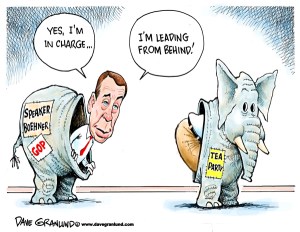 House Republicans have just left a meeting with Leadership. It appears we have an agreement of some kind.
BREAKING: Boehner surrenders: “Blocking the bipartisan agreement reached today by the members of the Senate will not be a tactic for us.”
A vote on the bill to avert a default and reopen the government is expected as early as this evening.
Update 3: House Speaker John Boehner hasreleased a statement about the agreement, promising to support the Senate’s bill: “Blocking the bipartisan agreement reached today by the members of the Senate will not be a tactic for us. In addition to the risk of default, doing so would open the door for the Democratic majority in Washington to raise taxes again…our drive to stop the train wreck that is the president’s health care law will continue. We will rely on aggressive oversight that highlights the law’s massive flaws and smart, targeted strikes that split the legislative coalition the president has relied upon to force his health care law on the American people.”
Senate leaders have forged an 11th-hour deal to end the government shutdown and raise the debt ceiling, and House Speaker John Boehner is expected to bring the bill up for a vote,Politico and other media outlets reported Wednesday morning. If the bill passes and arrives on President Obama’s desk by the October 17 deadline, the US government will reopen until January 15, and the debt ceiling will be raised until February 7, delaying the budgetary and debt ceiling crises and leaving President Obama’s signature health care bill largely intact.
Boehner: We fought the good fight, we just didn’t win.
In an interview on a local radio station, House Speaker John Boehner (R-Ohio) conceded that Republicans “didn’t win” the current budget debate.
“We’ve been locked into a fight over here, trying to bring government down to size, trying to do our best to stop Obamacare,” Boehner said. “We fought the good fight; we just didn’t win.”
Boehner also said he would “absolutely” allow a vote on the Senate plan even if a majority of House Republicans don’t support the bill.
“There’s no reason for our members to vote ‘no’ today,” Boehner said, adding that he expected the vote to happen Thursday.
Ryan Budget Plans Ignored as Lawmakers Craft Debt-Limit Deal
Representative Paul Ryan wanted big policy changes to lift the U.S. debt ceiling: a revamp of Social Security and Medicare, a framework for tax-code changes and approval of the $5.3 billion Keystone XL pipeline.
That’s all on hold now. Lawmakers are moving to adopt legislation to end the 16-day partial government shutdown and continue paying the nation’s bills. Ryan’s ideas for fixing the crisis weren’t included in a Senate compromise that may come up for votes today.
Instead, the Republican Party’s fiscal-policy leader and its 2012 vice presidential nominee will have to wait for budget negotiations in the coming weeks that are envisioned in an emerging Senate agreement to end the current impasse.
Ryan’s limited role in the immediate talks risks diminishing his credentials before 2016, when the Budget Committee chairman could be a White House contender, said Julian Zelizer, a professor of public affairs and history at Princeton University in New Jersey.
“There was a moment in recent days where it seemed like he would try to emerge in the spotlight, to help be the driver. But it didn’t happen,” Zelizer said. “He’s not a key figure.”
Tweets of Note:
.@Newsweek scoop: S&P was minutes from downgrading US credit when the shutdown deal came through: http://ow.ly/pSXlt
Boehner expects the government to reopen tomorrow http://huff.to/19QLdgo
Freedomworks CEO: House GOP ‘yes’ votes on Senate deal should be ready for primary challengers http://bit.ly/19SrU8k

 peej
peej Carissa
 bostonboomer
 dakinikat
 ecocatwoman
 mablue2
 Mama Lopez
 peggysue22
 quixote
 skydancingguestblogger
 Mona (aka Wonk the Vote)



 Sky Dancing
Recent Comments