
Tuesday Reads: Altered States While Driving, Plus Some News.
Posted: July 14, 2015 Filed under: Barack Obama, Foreign Affairs, morning reads, U.S. Economy, U.S. Politics 26 Comments
Good Morning!!
I’m getting a slow start today. I was exhausted after my trip home, and I slept most of yesterday afternoon. I feel as if I could do that again today, and I just might.
There is lots of news this morning, but first I want to share a small epiphany I experienced while driving through Ohio on Saturday. Traffic was light and the weather was nice, partly cloudy and warm–with just enough sun to be bright but not enough for me to need sunglasses.
I was listening to an interesting program on NPR–I think it was Radiolab–about a man who described himself as solitary–practically a hermit–because he experienced so many problems in interacting with people. He enjoyed being alone more than anything else. His marriage to his first wife had broken up and she had taken their two children, whom he loved. The only relationships he had had that weren’t problematic were with his son and daughter. At one point, he learned that his ex-wife’s boyfriend was abusing his children, and he sued for custody. He didn’t get it because when he went to a psychological evaluation, he mistook another little girl in the office for his daughter. The psychologist questioned how he could be a good parent if he didn’t even recognize his own child.
The man moved to California and found a job where he didn’t have to interact with other people except over the phone, and it worked very well for him. Eventually he met a woman who seemed to understand him, and they lived together for years and eventually married.
 I really identified with the story, because I find most of my difficult experiences involve interactions with other people. I have always preferred being alone to spending time with people–especially in large groups. As a child, I loved to read and could lose myself in a book and shut out the entire world. As a teenager, I loved to listen to music alone in my room, and I still read constantly. I always felt different–as if I didn’t belong in this world. I think that is the reason I like to drive long distances–I can be alone with no one to bother me, unless I want them to.
Anyway, it turned out that the man in the NPR story had prosopagnosia, or face blindness, a visual processing disorder in which a person has difficulty perceiving faces. He discovered this while he and his wife were watching a 60 Minutes program on this unusual cognitive problem. Interestingly, famed neurologist Oliver Sacks suffers from prosopagnosia.
At the point where the man learned what his problem was after years of struggling in relationships, I suddenly had my epiphany. I became aware of a feeling and I thought to myself. This is how it feels to be happy. I’m happy right now. Of course once I had the thought, I was no longer in the present moment, but the good feeling continued for some time as I listened to other stories on NPR.
Now I don’t think I have prosopagnosia–at least I got 6 right on a video test for it–so I don’t know why the NPR program had such a profound effect on me–maybe because I think there’s something wrong with me but I don’t know what it is. It would be great to have an answer. Why am I happiest when I’m alone but still can be in touch with people over the internet or on the phone? Maybe I’ll never know, but I definitely did have one of those peak experiences that Abraham Maslow wrote about.

On Sunday, the second day of my trip, I was tired all day long and had trouble staying awake. I made good time across New York despite quite a bit of traffic; but the final leg of the trip on the Mass Pike was torturous. I sat in bumper-to-bumper traffic for more than an hour at one point and the the traffic was hellish the entire way. Oddly, I still felt that my experience of happiness the previous day made it all worthwhile.
I tried to find the NPR prosopagnosia story on-line, but I didn’t have any luck. I’d like to listen to it again.
Now that I’ve likely bored you to tears, I’ll get on with the news.
A deal has been reached with Iran. Politico reports: U.S., world powers reach historic deal with Iran.
The United States and five other world powers have reached a deal with Iran that would place strict limits on Tehran’s nuclear program in return for ending sanctions on its economy, the culmination of years of delicate diplomacy pursued by President Barack Obama despite warnings the agreement could strengthen Iran’s Islamist regime and leave it dangerously close to a nuclear bomb.
The historic accord, reached by Secretary of State John Kerry and his international counterparts in Vienna on Tuesday after 18 days of intense negotiations, now faces review from a hostile Republican-led Congress, opposition from every GOP presidential candidate, from Israel’s government and from Sunni Arab monarchs. The deal’s long and complex implementation process also leaves it vulnerable to unraveling.

Speaking from the White House Tuesday morning, Obama called the deal a victory for diplomacy that would prevent a nuclear arms race in the Middle East and avert a possible conflict with Iran.
“No deal means a greater chance of more war in the Middle East,” Obama said. He reaffirmed America’s commitment to Israel’s security and Gulf Arab states like Saudi Arabia, while adding that the U.S. is “open to engagement on the basis of mutual interests and mutual respect.”
Obama also hinted at the possibility of a larger thaw in U.S.-Iranian relations. ”It is possible to change,” Obama told Iranians, urging them to take a “different path, one of tolerance, of peaceful resolution to conflict… This deal opens an opportunity to move in a new direction. We should seize it.”
“This is the good deal that we have sought,” Kerry said in a statement from Vienna.
It’s another stunning victory for Obama. More from CNN: Landmark deal reached on Iran nuclear program.
After arduous talks that spanned 20 months, negotiators have reached a landmark deal aimed at reining in Iran’s nuclear program.
The agreement, a focal point of U.S. President Barack Obama’s foreign policy, appears set to reshape relations between Iran and the West, with its effects likely to ripple across the volatile Middle East.
Representatives of Iran, the United States and the other nations involved in the marathon talks were holding a final meeting in Vienna on Tuesday.
Obama praised the deal reached Tuesday morning, saying the agreement met the goals he had in place throughout negotiations.
“Today after two years of negotiation the United States together with the international community has achieved something that decades of animosity has not: a comprehensive long-term deal with Iran that will prevent it from obtaining a nuclear weapon,” Obama said from the White House, with Vice President Joe Biden at his side.
Iranian President Hassan Rouhani also praised the deal, speaking after Obama finished, as televisions in Iran broadcast the U.S. President’s statement live, translated into Farsi.
“Negotiators have reached a good agreement and I announce to our people that our prayers have come true,” Rouhani said in a live address to the nation following Obama.
The essential idea behind the deal is that in exchange for limits on its nuclear activities, Iran would get relief from sanctions while being allowed to continue its atomic program for peaceful purposes.

And from The Wall Street Journal: Oil Prices Fall as Nuclear Deal Paves Way for Iran Exports.
The possibility of up to a million new barrels of Iranian oil flooding global markets—the amount Iranian officials aim to deliver within months—comes at a critical time. China’s stock-market turmoil in recent weeks could slow an economy that was expected to account for a lot of energy-demand growth. U.S. production remains strong, and oil giants such as Iraq and Saudi Arabia are pumping record amounts.
With new Iranian supply, that has raised the specter of a fresh oil glut.
After recovering somewhat from a 60% drop earlier this year, global benchmark Brent crude has lost 15% since early Ma.. It fell further on Tuesday morning in London trading, to $57.30 a barrel on London’s ICE futures exchange. WTI crude futures, a benchmark largely for American oil, was down 1.7% on the New York Mercantile Exchange.
“Iran’s efforts to raise oil exports could not have come at a worse time, given the market’s lingering oversupply,” said Michael Cohen, an energy analyst at Barclays.
AdvertisementIn 2012, the U.S. and European Union imposed strict sanctions on Iran’s energy and financial sectors, and the country’s oil exports have been cut nearly in half as a result, according to the U.S. Energy Department. Iranian exports averaged 1.4 million barrels a day in 2014, down from 2.6 million barrels a day at the end of 2011, federal data show.
The speed and quantity of new oil that Iran can export hinge upon many difficult-to-predict factors. They include when Iran might be able to satisfy various countries and the United Nations that it has met the requirements of the deal, triggering the start of sanctions relief. Western officials have said that likely won’t happen until the end of 2015.
More bellyaching from the top 1% at the link.

The other big story is the major economic speech Hillary Clinton gave yesterday. Here’s a preliminary analysis by Paul Waldman at The American Prospect: Clinton Tries to Move the Economic Conversation Beyond Jobs.
As most of us understand, “Do I have a job?” is not the only question you might ask about your economic situation. That understanding is what Hillary Clinton is counting on as she delivers her first major economic address Monday, an attempt to articulate a vision that will not only provide a means of understanding the collection of policy changes she’ll be advocating in her 2016 campaign for president, but also contrast with the now 17 Republicans who want to face her next fall.
I’m writing this before the full text of Clinton’s speech is available, so what I have to go on is only the outline and selections that have been leaked to a couple of reporters (see here and here). But it’s clear that Clinton is attempting to expand the economic conversation beyond the two measures that usually dominate the discussion: job growth and GDP growth. “The measure of our economic success,” she’ll say, “should be how much incomes rise for middle-class households, not an arbitrary growth figure.”
So while Clinton is going to offer some proposals like an infrastructure bank meant to create jobs, most of her emphasis is going to be on increasing wages and improving working conditions with things like paid sick leave. To see why this is aimed at the Republican candidates, pay close attention to what they say when they’re asked about issues like wage stagnation and inequality. What you almost inevitably get is a brief acknowledgment that these things are indeed a problem, then a quick redirection to the policies they say will accelerate growth and create jobs. The last thing they want is to get into a detailed discussion about wages. If pressed, the best explanation they can come up with for why wages are stagnant, or why inequality has been increasing for many years, is that, like everything else that is not as we would like it to be, it’s the government’s fault.
That’s the nature of the problem they face where their ideological beliefs meet the requirements of a presidential campaign. They don’t believe that government can do much affirmatively to improve the economy, so their proposals tend toward “getting government out of the way”—in other words, not doing something new, but stopping something that’s already happening. But if you put a Democratic proposal like paid sick leave alongside a Republican proposal like loosening environmental regulations, it’s a lot easier to understand how the first is supposed to help workers than how the second would.
So as the discussion on economics shifts, Clinton can advocate for at least some policies that are new and meant to react to the changes that have taken place in the American economy. The Republicans, on the other hand, are unlikely to advocate much beyond what they always advocate. There may be some differences in the details, but its essence will be all too familiar: Cut taxes (particularly on the wealthy), cut regulations on corporations, accelerate the decline in collective bargaining, and wait for our glorious future of prosperity to begin.
More reactions following the speech–links only:
Business Insider: Hillary Clinton just called out the economic problem of the next decade.
Washington Post: Why Hillary Clinton made gender such a big deal in her major economic speech.
FiveThirtyEight: The Numbers Behind Hillary Clinton’s Economic Vision
I’ll add a few more news links in the comments. So . . . what stories are you following today? Please post your thoughts and links in the thread below.
Tuesday Reads: The Republican Party’s Mess
Posted: June 23, 2015 Filed under: Barack Obama, morning reads, Republican politics, U.S. Politics | Tags: Civil Rights era, Civil War, Confederate flag, Racism, South Carolina, Tea Party 69 Comments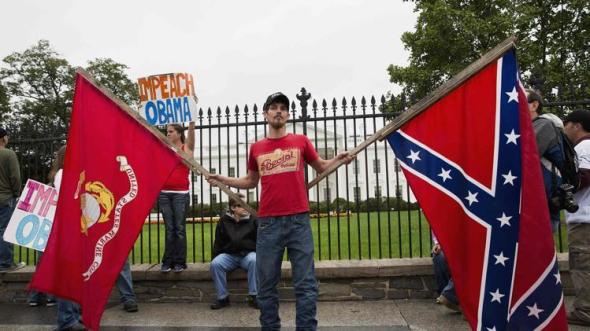
Good Morning!!
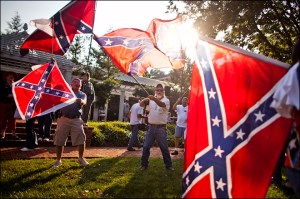
I’m sure you’ll recognize the image at the top of this post. The photo was taken at a Tea Party rally in Washington, DC, a couple of years ago. I’ve included other similar photos in this post. Don’t tell me the people holding these flags don’t understand that it is a symbol of racial hatred.
Since Barack Obama was elected President of the United States, we have seen shocking overt racism on display by right wing Republicans, and so called “mainstream” Republican elected officials have done nothing to stop it. The simple truth is that the Tea Party is a racist hate group that was formed in reaction to the election of a black president.
As a consequence of Republican officials’ refusal to call the Tea Party what it is, we have seen extreme right wing candidates like Ted Cruz elected to high office and stupid and hateful people like Sarah Palin and Michelle Bachmann treated seriously by the media. It’s a national disgrace, and we should begin to hold Republicans responsible for it.
Nikki Haley was elected governor of South Carolina in 2010 as a Tea Party candidate, although she has since fallen out of favor with the group. Yesterday Haley made a cowardly, mealy-mouthed public statement calling for removal of the Confederate flag from the state house grounds, and yet today she is being celebrated in the media for her “courage.” Here’s part of it:
For many people in our state the flag stands for traditions that are noble. Traditions of history, of heritage and of ancestry.
The hate-filled murderer who massacred our brothers and sisters in Charleston has a sick and twisted view of the flag. In no way does he reflect the people of our state who respect, and in many ways, revere it.
Those South Carolinians view the flag as a symbol of respect, integrity and duty. They also see it as a memorial. A way to honor ancestors who came to the service of their state during time of conflict. That is not hate, nor is it racism.
At the same time, for many others in South Carolina, the flag is a deeply offensive symbol of a brutally oppressive past. As a state, we can survive and indeed we can thrive as we have done whilst still being home to both of those viewpoints. We do not need to declare a winner and a loser here.
We respect freedom of expression. And that for those who wish to show their respect for the flag on their private property, no one will stand in your way.
But the statehouse is different. And the events of this past week call upon us to look at this in a different way….
One hundred and fifty years after the end of the Civil War, the time has come. There will be some in our state who see this as a sad moment. I respect that. But know this, for good and for bad, whether it is on the statehouse grounds or in a museum the flag will always be a part of the soil in South Carolina. But this is a moment in which we can say that that flag, while an integral part of our past, does not represent the future of our great state.
It is South Carolina’s historic moment, and this will be South Carolina’s decision. To those outside of our state, the flag may be nothing more than a symbol of the worst of America’s past. That is not what it is to many South Carolinians. The state house belongs to all of us. Their voices will be heard, and their role in this debate will be respected….
But we are not going to allow this symbol to divide us any longer. The fact that people are choosing to use it as a sign of hate is something that we cannot stand. The fact that it causes pain to so many is enough to move it from the capitol grounds.
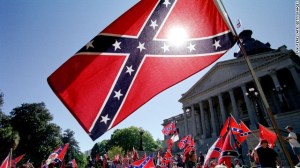
Why couldn’t Haley just admit that the flag on the her state house grounds is a symbol of resistance to integration and to legal recognition that African Americans should have equal rights; and that decades after the changes brought about by Civil Rights Movement they are still not treated equally by many, including police officers? By the way, maybe she should also consider opposing the efforts of Republicans in South Carolina to prevent African Americans from voting.
Last night I watch Rachel Maddow’s show for the first time in months, and I’m very glad I did. Maddow presented a detailed history of the Council of Conservative Citizens, the group whose website inspired Dylann Roof to murder nine African Americans at a prayer group meeting at the Emmanuel AME Church in Charleston, SC last week. The Council of Conservative Citizens grew directly out of the White Citizens Councils that fought to maintain racial segregation in Southern cities in the 1950s and 1960s. From Wikipedia:
The Citizens’ Councils (also referred to as White Citizens’ Councils) were an associated network of white supremacist organizations in the United States, concentrated in the South. The first was formed on July 11, 1954 After 1956, it was known as the Citizens’ Councils of America. With about 60,000 members across the United States, mostly in the South, the groups were founded primarily to oppose racial integration of schools, but they also supported segregation of public facilities during the 1950s and 1960s. Members used severe intimidation tactics including economic boycotts, firing people from jobs, propaganda, and occasionally violence against civil-rights activists.
By the 1970s, following passage of federal civil rights legislation in the mid-1960s and enforcement of constitutional rights by the federal government, the influence of the Councils had waned considerably. The successor organization to the White Citizens’ Councils is the Council of Conservative Citizens, founded in 1985.
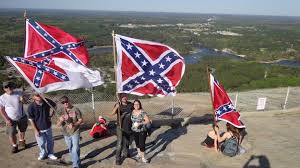
Maddow pointed out that in 2010, Haley Barbour was quickly eliminated from the race for the GOP nomination when he publicly praised the White Citizen Council in his home city of Yazoo, Mississippi. Maddow also interviewed SC Rep. James Clyburn about the history of the Confederate flag that still flies on the SC state house grounds. He explained that that flag was a Virginia flag flown by Robert E. Lee and that it has nothing to do with South Carolina history. It was put up over the SC state house in 1962 as a direct response to the battle for civil rights for African Americans.
Why couldn’t Nikki Haley simply admit that in her statement? Frankly, the Republican Party has allowed itself to become the party of racism and hatred; and it’s time for decent Republicans to face up to that and and deal with it honestly.
Here’s what Melissa McEwan wrote about Haley’s statement:
She couldn’t even be bothered to say that the thing is a racist symbol. Which has nonetheless not stopped members of her party from celebrating her courage.
The thing is, it’s not really “brave” to take down a flag that never should have been flying in the first place.
I see what Haley is doing as approximately as “brave” as when I clean up cat vomit. You’re supposed to clean up gross messes in your home….
let’s not pretend that it’s a Great Leadership moment, when it took 150 years of fluttering insult, and nine deaths in the last week at the hands of one of the many white people to embrace that contemptible symbol of white supremacy, to pull it off the flagpole.
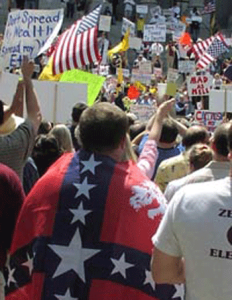
I completely agree. As I wrote in a comment yesterday, the Confederate flag is a symbol of hate and fear that should be in the same category as the Nazi swastika and the “n” word. Why should people be allowed to fly it on their own property? Why should more intelligent and sensitive neighbors or even people driving by have to see it?
It’s way past time for Republicans to stop beating around the bush and clean up the disgusting mess in their party, and it’s time for all Americans to recognize that racism in any form is evil.
Here’s a more serious discussion of the meaning of the Confederate flag by Ta-Nehisi Coates at The Atlantic:
This afternoon, in announcing her support for removing the Confederate flag from the capitol grounds, South Carolina Governor Nikki Haley asserted that killer Dylann Roof had a “a sick and twisted view of the flag” which did not reflect “the people in our state who respect and in many ways revere it.” If the governor meant that very few of the flag’s supporters believe in mass murder, she is surely right. But on the question of whose view of the Confederate Flag is more twisted, she is almost certainly wrong.
Roof’s belief that black life had no purpose beyond subjugation is “sick and twisted” in the exact same manner as the beliefs of those who created the Confederate flag were “sick and twisted.” The Confederate flag is directly tied to the Confederate cause, and the Confederate cause was white supremacy. This claim is not the result of revisionism. It does not require reading between the lines. It is the plain meaning of the words of those who bore the Confederate flag across history. These words must never be forgotten. Over the next few months the word “heritage” will be repeatedly invoked. It would be derelict to not examine the exact contents of that heritage.
This examination should begin in South Carolina, the site of our present and past catastrophe. South Carolina was the first state to secede, two months after the election of Abraham Lincoln. It was in South Carolina that the Civil War began, when the Confederacy fired on Fort Sumter. The state’s casus belli was neither vague nor hard to comprehend:
…A geographical line has been drawn across the Union, and all the States north of that line have united in the election of a man to the high office of President of the United States, whose opinions and purposes are hostile to slavery. He is to be entrusted with the administration of the common Government, because he has declared that that “Government cannot endure permanently half slave, half free,” and that the public mind must rest in the belief that slavery is in the course of ultimate extinction. This sectional combination for the submersion of the Constitution, has been aided in some of the States by elevating to citizenship, persons who, by the supreme law of the land, are incapable of becoming citizens; and their votes have been used to inaugurate a new policy, hostile to the South, and destructive of its beliefs and safety.
In citing slavery, South Carolina was less an outlier than a leader, setting the tone for other states, including Mississippi…
Please go read the whole thing at the link.
Republicans are now arguing that Democrats are responsible for the confederate flag symbolism and for the South’s history of racism. It’s true that Dixiecrats fought to maintain segregation, but most of those old guys switched to the Republican Party back in the Civil Rights era. The Republicans own the mess now, and they need to get busy cleaning it up.
As always, this is an open thread. Please post your thoughts and links on any topic in the comments below.
Reactions to Hillary and Her Speech: The Good The Bad and The Ugly
Posted: June 15, 2015 Filed under: Barack Obama, morning reads, Republican politics, U.S. Economy, U.S. Politics | Tags: #HillaryMen, 2016 presidential race, Chris Christie, Clinton Foundation, Hillary Clinton, Mitt Romney 45 Comments
Good Morning!!
Dakinikat will try to put up a post this afternoon if she can find time, but in the meantime, here are a few reactions to Hillary’s speech from the media and other politicians, as well as her interview with the Des Moines Register and a good article on the Clinton Foundation for us to discuss in the meantime.
The Good
From The Des Moines Register: Clinton hears ‘eagerness’ for talk of female presidency.
Hillary Clinton did not win the Democratic presidential nomination in 2008, but her campaign succeeded in addressing concerns about whether a woman could be commander in chief, she told The Des Moines Register on Sunday.
“Part of what I tried to do in that campaign was to begin to answer that question,” she said. “Now I feel like the question’s been answered.” ….
“There is an eagerness that I sense coming at me from people in my audiences, in my conversations, to engage with me about that more than I felt in ’08,” Clinton told the Register on Sunday, one of two sit-down news interviews that were the first for this presidential bid.
In the 15-minute interview at the Iowa State Fairgrounds, Clinton defended the presidencies of Bill Clinton and Barack Obama, said she’ll propose improvements to the Affordable Care Act, and expanded on her views about the proposed Trans-Pacific Partnership trade pact. She landed on the side of House Minority Leader Nancy Pelosi over Obama in wanting to ensure stronger protections for American workers.
Read the rest at the link.
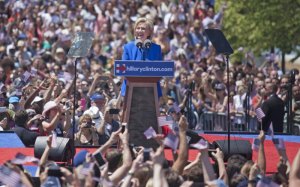
Inside Philanthropy: Shut Up About the Clinton Foundation’s Problems for a Minute to Look at It’s Programs.
With all the hype in the media about the Clinton Foundation, we wonder how many Americans actually know what the foundation does—or how many members of the media, for that matter.
Listening to news reports, you’d think the sole purpose of this outfit is to help the Clintons get rich and do favors for their shady friends. And while, to be sure, some of the reports about specific donors have been troubling—and suggest questionable judgment by the Clintons—what’s missing is a broader, more balanced look at how the foundation mobilizes money for good causes and who, in reality, puts up most of that money. (Hint: It’s not dictators looking for favors from the State Department.) While people shouldn’t stop asking hard questions about the foundation, they should pay more attention to its approach and programs.
In fact, the Clinton Foundation stands as one of the more successful efforts of recent years to mobilize new resources for philanthropy. Since its founding in 2001, it has raised nearly $2 billion, according an independent review by the Washington Post. Yes, chunks of that money have come from the Clintons’ network of political donors and corporate friends, which is how fundraising often works: You hit up the rich people you know for your causes. And, sure, some of them may not have the purest motives for ponying up, especially if you’re someone who can return favors later, but that’s the nature of the game.
Philanthropic fundraising is more like political fundraising than many may imagine. You think every hedge fund guy who gives big at the Robin Hood’s annual gala is solely focused on poor kids in East New York? Or that every tech leader who recently listened to Marc Benioff’s pleas and chipped in to fight poverty in the Bay Area has a heart of gold? Or that everyone sitting on MoMA’s board is only there because they love art? Come on.
Much more at the link.
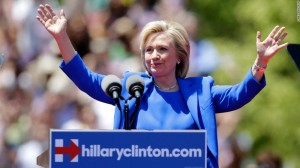
Matthew Yglesias at Vox gets it: Hillary Clinton has always been to Obama’s left on economics.
At a dramatic weekend rally on Roosevelt Island, Hillary Clinton unleashed a speech that was in some ways strikingly liberal, especially for a candidate who’s not facing meaningful opposition in the Democratic Primary. Politico’s Glenn Thrush says it shows that “the Democratic Party is moving left fast” and Clinton knows it, which is why she uncorked “economic-inequality rhetoric could have been comfortably uttered by the likes of Elizabeth Warren, Joseph Stiglitz, Bernie Sanders, or Martin O’Malley.”
The truth, however, is that on the kind of pocketbook issues that Clinton spent most of yesterday’s speech discussing, she’s alwaysbeen on the left wing of the Democratic Party. She’s been in the public eye far too long to have avoided inconsistencies over the years. But in positional terms, somewhat to the left of Obama — or Bill Clinton — on economics is where she’s been this whole time.
Yglesias goes into plenty of detail on Hillary’s record. Good piece!

The Washington Post: Hillary Clinton won the weekend on social media.
According to an analysis by Zignal Labs, The Washington Post’s campaign analytics partner, 59 percent of all 2016 chatter during the weekend was about her. That means three out of every five stories or posts written about any presidential contender mentioned the former secretary of State. By comparison, the week prior, she commanded just 20 percent.
A June 11 post from Peter Daou and Tom Watson at their new site #HillaryMen: A Woman Leading America – If Not Now, When?
Our premise is that Hillary’s inclusive vision, unwavering commitment to public service, progressive policies and unparalleled experience make her one of the best (and best qualified) candidates ever to seek the presidency. If Hillarycannot become the first woman in history to cross the presidential finish line, who can? If not now, when? When will we show our daughters that a woman can be president?
Viewing the 2016 election through an explicit gender lens, the ferocious attacks against Hillary are not just about her, but underscore the deeply ingrained resistance to any woman with a viable path to the White House. Does anyone believe that another female candidate could get within reach of the presidency without running headlong into the same double standard and institutional resistance confronting Hillary?
Spotlighting the gender aspect of the 2016 race does not mean we discount the centrality of issues and competing ideologies or the complex information processing that leads voters to choose a candidate. Nor is it our intention to make specific accusations of gender bias. We are simply acknowledging the political, social and cultural barriers that have resulted in a complete shut out in national U.S. politics, at 44-0. In nearly a quarter millennium, not a single woman has occupied our nation’s highest office.
This is going to be a great site to read for inspiration during the upcoming campaign. Thanks to Beata for posting about it in the comments on Saturday.
Tuesday Reads: GOP Anxious About Upcoming SCOTUS Decisions
Posted: June 9, 2015 Filed under: Barack Obama, morning reads, Republican politics, SCOTUS, U.S. Politics | Tags: Affordable Care Act, same-sex marriage, Supreme Court decisions 57 Comments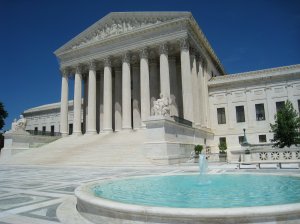
Good Morning!!
The Supreme Court is in the news today, as its current session approaches its end.
The two most consequential decisions to be announced will have serious implications for the health care system and settle the question of same sex couples should have equal rights to marry and have the same benefits of marriage as heterosexual couples. Some other important decisions have already been announced.
The Obamacare case is the one making news today, after President Obama spoke publicly about the upcoming decision on the Affordable Care Act yesterday at the G7 Conference in Germany.
Politico reports, Obama: Supreme Court shouldn’t have heard Obamacare challenge.
President Barack Obama expressed deep frustration with the U.S. Supreme Court on Monday, questioning why justices even took up a case that imperils his signature health insurance reform plan.
The high court is set to issue a decision on the case, known as King v. Burwell, by the end of the month. A ruling against the government would mean that 6.4 million people in the 34 states relying on the federal Healthcare.gov website would be at risk of losing subsidies that make their insurance affordable.
“This should be an easy case. Frankly, it probably shouldn’t even have been taken up,” Obama said at a news conference after the G-7 summit in Krun, Germany. “Since we’re going to get a ruling pretty quick, I think it’s important to assume that the Supreme Court’s going to do what legal scholars would expect them to do.”
Obama repeated the administration’s contention that there’s no contingency plan or fix to keep insurance markets from going into a tailspin, predicting that the justices would decide in his favor. And in any case, he added, Congress could fix the ambiguous phrasing of the health law “with a one-sentence provision.”
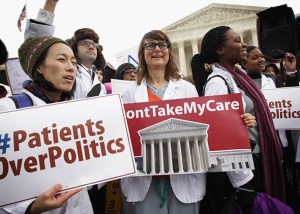
But Republicans made it clear that they aren’t going to allow an easy fix. From Bloomberg, GOP Swiftly Rejects Obama’s ‘One-Sentence Fix’ to Obamacare If Supreme Court Voids Subsidies.
“Let’s be clear: if the Supreme Court rules against the Administration, Congress will not pass a so called ‘one-sentence’ fake fix,” Wyoming Senator John Barrasso, who is leading Republican efforts to craft a contingency plan, said in a statement.
At issue is whether a handful of words in the Affordable Care Act mean the government cannot provide insurance tax credits for millions of Americans in 34 states enrolled through HealthCare.gov, rather than a state exchange. Without the subsidies, insurance will become unaffordable to many and premiums are almost certain to skyrocket across the board. Even so, Barrasso and his fellow Republicans say Obama acted illegally by doling out the subsidies. A victory in the case King v. Burwell would probably create chaos, and ironically put Republicans on the hook for resolving it.
In his statement, Barrasso accused Obama of “bullying the Supreme Court” and said the Republican-led Congress is “prepared to help” Americans who may be harmed.
But is it? Republicans have struggled to coalesce around a contingency plan if the ruling goes their way. A victory could backfire on the GOP without a viable response, as Democrats would be armed with attack ads accusing them of pushing for a ruling that threw millions of Americans off their health care plans without a plan to help them.
Even a simple fix is dangerous for Republicans. Conservative lawmakers in the House worry that a such a move to clarify that the subsidies are available in all 50 states would be attacked by their base as a vote for Obamacare.
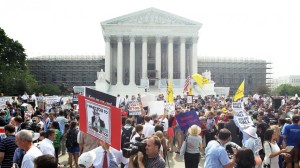
According to The Hill, Republicans fear they will win ObamaCare court battle.
Republicans in Congress are worried the Supreme Court will hand them a major headache this month if it rules against the federal health insurance exchanges in more than 30 states, ending subsidies for millions of people.
While the Affordable Care Act remains broadly unpopular, two new polls show a majority of Americans don’t want to do away with its subsidies, a core component of the law.
This poses a conundrum for Senate Majority Leader Mitch McConnell (R-Ky.) and Speaker John Boehner (R-Ohio). They are under pressure from colleagues up for reelection in swing states and districts to extend the subsidies, at least temporarily, if the court strikes them down. But doing so would risk a backlash from the conservative base.
The Supreme Court is expected to hand down its decision in King v. Burwell, which could strip 6.4 million people of health insurance subsidies, in late June.
States that would be hardest hit by a ruling against the law include the Senate battlegrounds of Illinois, North Carolina, Ohio and Wisconsin.

REUTERS/Jonathan Ernst
Greg Sargent at Morning Plum: In battleground states, voters don’t want Supreme Court to gut subsidies.
As your humble blogger has tirelessly reiterated, the states with the highest numbers of people who stand to lose subsidies if the Supreme Court guts them also happen to be the main presidential and Senate battleground states. That overlap could increase the political stakes in the battle that will follow any Court ruling against the ACA.
Now a new Washington Post poll confirms the stakes here. It finds that in many key battleground states, a majority says the Court should not end subsidies for those on the federal exchange.
The Post poll finds that among Americans overall, 55 percent oppose a Court decision killing the subsidies, while only 38 percent support it. Independents oppose such a decision by 57-36, while Republicans are alone in supporting a decision against the ACA by 55-34.
Among the states in which the largest numbers of people may lose subsidiesare Florida, North Carolina, Pennsylvania, Virginia, Wisconsin and Ohio. Those are key presidential battlegrounds, and Republicans are defending Senate seats in five of them.
The upcoming marriage equality decision could also backfire on Republicans:

The LA Times: GOP’s same-sex marriage trap: Conservatives oppose it intensely.
The Supreme Court may be just weeks away from declaring a nationwide right to same-sex marriage with a ruling likely to trigger public opposition — and private sighs of relief — from most Republican presidential hopefuls.
Why relief? The marriage issue increasingly has become a trap for Republicans, and a Supreme Court decision that takes the matter out of the political process would provide the easiest exit. The court is expected to rule this month on whether the Constitution protects marriage rights for gay couples.
A new poll by the nonpartisan Pew Research Center highlights Republicans’ predicament. By 57% to 39%, Americans favor allowing gay and lesbian couples to marry legally. But among Republicans, only about one-third agree.
Moreover, among those who describe themselves as conservative Republicans, 40% say the issue is “very important” to them, and they overwhelmingly oppose marriage rights for gay couples.
Overall, the poll found, opponents of same-sex marriage are more likely than supporters to describe the issue as “very important.” In part, that may be because about two-thirds of white, evangelical Protestants, who make up a large share of the opposition, say there is “a lot” of conflict between homosexuality and their religious beliefs.
For would-be Republican presidential nominees, that sets up a difficult problem. Support for same-sex marriage rights would put a candidate at odds with a huge bloc of voters in GOP primaries on an issue they deem “very important.” But vocal opposition to those rights would put a candidate out of step with a large and growing majority of the public.
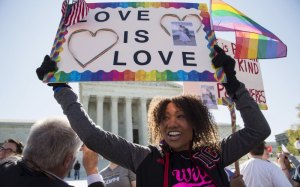
Recently announced SCOTUS decisions:
Yesterday the Supreme Court decided that U.S. citizens who were born in Jerusalem cannot list their birthplace as Israel on their U.S. Passports. Richard Wolfe at USA Today:
The Supreme Court declined Monday to insert itself into the middle of the Israeli-Palestinian conflict by second-guessing U.S. policy on Jerusalem.
Ruling just a few months after a feud between President Obama and Israeli Prime MinisterBenjamin Netanyahu, the justices refused to allow Americans born in Jerusalem to have their passports changed to reflect Israel as their birthplace, as Congress demanded more than a decade ago.
In denying the challenge waged by the Jewish parents of a 12-year-old almost since his birth in 2002, a majority of justices heeded the State Department’s warning that a simple passport alteration could “provoke uproar throughout the Arab and Muslim world.”
Justice Anthony Kennedy wrote the 6-3 decision for the court, which needed more than seven months following oral arguments in early November to decide the congressional law was unconstitutional. It was the longest-pending high court decision.
“The power to recognize or decline to recognize a foreign state and its territorial bounds resides in the president alone,” Kennedy said, citing examples from the French Revolution in 1793 to President Jimmy Carter’s recognition of the People’s Republic of China in 1979.
Lyle Denniston has a detailed analysis of this decision at SCOTUSblog.

In another interesting decision, the Court let stand a San Francisco gun control law. NPR reports, Supreme Court Rejects NRA Challenge To San Francisco Gun Rules.
The U.S. Supreme Court has declined to block two San Francisco gun control measures that were fiercely opposed by the National Rifle Association. At least one veteran court observer says the high court’s decision raises questions about how the justices interpret the Second Amendment.
First, the basics: A 2007 San Francisco ordinance requires residents to keep handguns under lock and key or to use trigger locks when they are not carrying their weapons. Another law, dating to 1994, bans the sale of ammunition that expands on impact, or hollow-point bullets.
Plaintiff Espanola Jackson and seven other petitioners, including the NRA, filed suit in 2012. They sought an injunction to keep the lockbox law from being enforced. But in March 2014, the 9th U.S. Circuit Court of Appeals sided with the City and County of San Francisco and left both measures intact.
Read more at the link.
Finally a new CNN poll shows that Americans don’t trust the current Supreme Court on “key issues.”
With major Supreme Court decisions on health care and same-sex marriage expected this month, many lack trust in the Supreme Court’s handling of those two issues, according to a new CNN/ORC poll.
Yet most approve of the way the court is handling its job generally.
A majority, 52%, say they approve of the way the court is handling its job, while 41% disapprove. That’s an improvement from an even 48% to 48% split two years ago. Still, when Americans are asked how much they trust the court on a range of issues it will be considering this term or the next, the worst ratings come on health care and same-sex marriage. Only about half say they have at least a moderate amount of trust in the court on health care (50%) or same-sex marriage (49%). There is more faith in the Supreme Court on other key issues on the docket, with most saying they trust the court at least a moderate amount on freedom of speech (69%), voting rights (65%) and the death penalty (60%).
Read the rest at CNN.
What else is happening? As always, this is an open thread, so please post your thoughts and links on any topic in the comments.
Tuesday Reads
Posted: May 12, 2015 Filed under: Barack Obama, Crime, Criminal Justice System, Foreign Affairs, morning reads, U.S. Politics | Tags: Baltimore police, Benghazi, conspiracy theories, Freddie Gray, investigative journalism, Nepal earthquakes, Osama bin Laden, police brutality, Religion in America, Seymour Hersh 16 Comments  Good Morning!!
Nepal has been rocked by 7.3 magnitude earthquake only a few weeks after the last one. From The LA Times:
Still reeling from last month’s devastating earthquake, Nepal was hammered again Tuesday by a magnitude 7.3 temblor that caused dozens more deaths, unleashed fresh landslides and brought down unsteady buildings.
By late afternoon, Nepal’s Home Affairs Ministry said at least 42 people were killed and more than 1,117 injured in the largest aftershock yet recorded from the 7.8 quake on April 25. Officials warned that the toll could rise.
The epicenter was about 47 miles northeast of the capital, Katmandu, near the Chinese border, according to the U.S. Geological Survey. The April 25 quake, which killed more than 8,150 people, was centered in the mountains west of Katmandu.
The tremor struck just before 1 p.m. local time, sending residents of the capital scurrying into the open air for safety, and was followed by a series of smaller tremors that rattled nerves even further.
Within hours, new makeshift tents had begun popping up in parts of Katmandu as families that had survived the earlier quake and returned to their homes in recent days decided again they were safer sleeping outdoors.
The Hindu is publishing live updates from Reuters. They report multiple aftershocks. What a terrible tragedy! Obviously this is a developing story, and we’ll hear more throughout the day and in coming days.

I missed this important investigative article from the Baltimore Sun over the weekend: Freddie Gray among many suspects who do not get medical care from Baltimore police.
Records obtained by The Baltimore Sun show that city police often disregard or are oblivious to injuries and illnesses among people they apprehend — in fact, such cases occur by the thousands.
From June 2012 through April 2015, correctional officers at the Baltimore City Detention Center have refused to admit nearly 2,600 detainees who were in police custody, according to state records obtained through a Maryland Public Information Act request.
In those records, intake officers in Central Booking noted a wide variety of injuries, including fractured bones, facial trauma and hypertension. Of the detainees denied entry, 123 had visible head injuries, the third most common medical problem cited by jail officials, records show.
The jail records redacted the names of detainees, but a Sun investigation found similar problems among Baltimore residents and others who have made allegations of police brutality.e
Salahudeen Abdul-Aziz, who was awarded $170,000 by a jury in 2011, testified that he was arrested and transported to the Western District after being beaten by police and left with a broken nose, facial fracture and other injuries. Hours later, he went to Central Booking and then to Bon Secours Hospital, according to court records.
Abdul-Aziz said last week that jailers at Central Booking “wouldn’t let me in the door as soon as they saw my face. … I thought I was gonna die that day. Freddie Gray wasn’t so lucky.”
Read the rest at the Baltimore Sun link.

The Washington Post, which initially published leaks favorable to the Baltimore PD, published an editorial in response the the Sun article: Too much black and blue in Baltimore.
TWO OR three times a day on average, suspects in the custody of the Baltimore police are turned away by the city jail because they are deemed too battered, beaten, bruised or otherwise injured or sick to be processed and admitted. The police are forced to head instead for a hospital emergency room to seek treatment for suspects suffering from head injuries, broken bones, hypertension and an array of other afflictions.
The frequency of such occurrences was detailed over the weekend by the Baltimore Sun, which obtained records from the city’s detention center under the Maryland Public Information Act. According to those records, the jail has turned away nearly 2,600 ailing detainees since June 2012 — about 2 percent of all bookings.
That staggering figure suggests the Baltimore police are heedless, at best, of the physical welfare of suspects in their custody. It also may help explain how Freddie Gray could have pleaded for medical care at least five times after he was arrested last month before the officers who detained him bothered to summon a paramedic — by which time it was too late….
The police understand — and after 2,600 reaffirmations in three years, they should be acutely aware — that they are obliged to seek medical attention for suspects who are sick or injured before the jail will admit them. Yet somehow that obligation doesn’t seem institutionally ingrained in cops on the beat….
The Justice Department’s civil rights investigation of the city police, announced last week by Attorney General Loretta E. Lynch, should take account of these injured detainees, including the causes and circumstances of their injuries and whether police are adequately trained and instructed in assessing them. And it should examine whether African American suspects are more frequently hurt and denied prompt medical care than other detainees.
Journalists are still reacting to Seymour Hersh’s poorly sourced accusations that the Obama administration conspired with Pakistan to stage a fake raid on Osama bin Laden’s compound and then lied about it. Here are two I found this morning:
Lawfare: Hersh’s Account of the Bin Laden Raid is Journalistic Malpractice, by Yishai Schwartz
When a journalist writes a tell-all story about a classified operation, and he suspects the story will catalyze anti-American anger, provide fuel for terrorist groups, and cause severe friction with foreign governments, the act of publication is morally fraught. When the story is based on obscenely thin sourcing and careens into conspiracy theories, the decision to publish becomes indefensible.
Seymour Hersh has had a long and distinguished history as one of America’s finest investigative journalists. In recent years, he has gone a bit kooky. In 2011, for instance, he suggested that Stanley McChrystal, the former top commander in Afghanistan, and the leadership of the US Joint Special Operations Forces were “all members of, or at least supporters of, Knights of Malta.” His latest story, in which he claims that the entire story of Bin Laden’s killing is an elaborate cover-up for a joint Pakistani-American operation, may be his kookiest.
As many have already pointed out, Hersh’s version offers a combination of the inconsistent and the inexplicable. Why, for instance, would the Pakistanis help plan an elaborate raid, complete with a recall of Bin Laden’s Pakistani guards—rather than just hand Bin Laden over directly—if they always intended to claim he’d been killed in a drone strike hundreds of miles away? Worse, the key contentions rely on the exclusive word of one unnamed source who was a) retired, and b) on Hersh’s own account, only “knowledgeable about the initial intelligence about bin Laden’s presence in Abbottabad.”
To be sure, there are scraps of Hersh’s hodgepodge narrative that may turn out to be true. That a CIA “walk-in” may have contributed to the intel leading to Bin Laden’s whereabouts, for instance, matches a tidbit that NBC has confirmed recently. And Hersh’s insistence that someone highly placed in the Pakistani intelligence services knew of Bin Laden’s presence has been pretty widely believed for a while. But leaping from these plausible and relatively minor details to the rest of the fantastic tale Hersh spins simply boggles the mind.
It’s unsurprising then that The New Yorker passed on the story (as it, along with the The Washington Post, have reportedly done with the last few of Hersh’s flights of fantasy.)
The London Review of Books, on the other hand, lacked the same degree of restraint. This is hardly surprising given the editorial leadership’s apparent lack of interest in fact-checking. As LRB senior editor Christian Lorentzen wrote in a 2012 piece suitably titled Short Cuts,” “the facts are the burden of the reporter…nobody at the paper fact-checks full time; that’s an American thing… I miss New York sometimes, but I don’t miss its schizophrenic obsession with facts, or the puritan hysteria that attends the discovery that a memoir should have been called a novel.” The LRB, it seems, takes pride in its sloppiness. Perhaps they have an editorial opening for Stephen Glass?
As a former fact-checker, I find the LRB’s approach part puzzling and part offensive. As a citizen who would like to form judgements and opinions on the basis of actual information, I’m horrified.
Wow! Read more at Lawfare Blog.

Politico: Sy Hersh, Lost in a Wilderness of Mirrors, by Jack Shafer.
Hersh leads the reader into a Wonderland of his own, thinly sourced retelling of the raid on Bin Laden’s complex in Abbottabad, Pakistan. According to Hersh, who cites American sources, “bin Laden had been a prisoner of the [Pakistani Inter-Services Intelligence agency] at the Abbottabad compound since 2006” and his ISI captors eased the way for the American SEAL team to skip into Pakistan on their helicopters, kill the al Qaeda leader, and then skip out.
It’s a messy omelet of a piece that offers little of substance for readers or journalists who may want to verify its many claims. The Hersh piece can’t be refuted because there’s not enough solid material to refute. Like the government officials who spun the original flawed Abbottabad stories, he simply wants the reader to trust him.
Hersh’s piece quarrels with almost every aspect of the official story, asserting that much of it is cover designed to protect the Pakistanis who sold bin Laden out to the United States for military aid….Hersh may very well be onto something—what did the Pakistanis know, when did they know it, and how much did they help? And that debate appears to be starting in earnest already, with NBC News quickly building off Hersh’s article. But Hersh’s potentially valid question on that subject is almost lost in the broad sweep of rolling back so many other stories and quibbling with effectively every known detail of one of the most thoroughly leaked secret operations in history.
By re-exploring the bin Laden operation, Hersh has thrust himself into the phenomenological territories that Cold War spymaster James Jesus Angleton called a “wilderness of mirrors.” In this clandestine world, truths are constructed, obliterated and bent to serve their masters. Adversaries who would deceive abound in this place, and without a reliable map, a compass, a sense of direction and maybe even a pedometer, even the most intrepid voyager (or journalist) can find himself lost. I’ll volunteer to join a search party for Hersh—somebody I’ve long admired—if only somebody can tell me precisely where he is.
Another harsh indictment. I expect “progressive” conspiracy theorists like Glenn Greenwald and Marcy Wheeler will attempt to keep this story alive, but it doesn’t seem to be getting much traction in either the mainstream media or the sane alternative media.

OLYMPUS DIGITAL CAMERA
More interesting stories, links only:
At Politico, former Deputy Director of the CIA Michael Morell recounts his Benghazi experiences: The Real Story of Benghazi. A CIA insider’s account of what happened on 9/11/12.
Pew Research Center, America’s Changing Religious Landscape. Christians Decline Sharply as Share of Population; Unaffiliated and Other Faiths Continue to Grow.
The Atlantic, American Religion: Complicated, Not Dead, by Emma Green.
Huffington Post, GOP Crowd Applauds Calling Immigrants Rats and Roaches, by Lauren Windsor.
Reuters, Verizon to buy AOL in push for digital content.
Fox News, Authorities say at least 7 victims found in Connecticut serial killer investigation.
NY Daily News: Connecticut serial killer already jailed for 2003 murder of still-missing woman: report.
What stories are you following today? Please share your thoughts and links in the comment thread, and have a terrific Tuesday!

 peej
peej Carissa
 bostonboomer
 dakinikat
 ecocatwoman
 mablue2
 Mama Lopez
 peggysue22
 quixote
 skydancingguestblogger
 Mona (aka Wonk the Vote)



 Sky Dancing
Recent Comments