
Thursday Reads: Crisis in Cyprus, The End of the “Creative Class” Dream, the Grand Betrayal, and Other News
Posted: March 21, 2013 Filed under: Barack Obama, Foreign Affairs, morning reads, the blogosphere, U.S. Economy, U.S. Politics, Violence against women | Tags: "grand bargain", chris bowers, Cyprus crisis, Dick Durbin, eurozone crisis, Joe Weisenthal, Richard Florida, the Great Betrayal 41 Comments
Good Morning!!
There’s quite a bit of news on the Cyprus crisis this morning. But first, last night Joe Weisenthal posted this assessment of how bad things had already gotten: In Just Days A Modern Economy Has Been Set Back 50 Years, And It May Never Be The Same Again. That’s a quote from Ciaran O’Hagan of Société Générale in Paris. Weisenthal writes:
According to reports, Cyprus will try again tomorrow to cobble together some kind of bank bailout bill that can pass parliament.
Cyprus needs to raise another 5.8 billion euros, which it could do from some combination of deposit taxes, Russian money, and pension nationalization.
None of the options are good, but until it’s done, banks will likely have to remain closed, a situation that can’t go on much longer.
This is a stunning turn of events for a modern Eurozone nation.
This morning, the news broke that the European Central Bank (ECB) has given Cyprus an ultimatum. Bloomberg reports:
The European Central Bank said it will cut Cypriot banks off from emergency funds after March 25 unless the Mediterranean island agrees on a bailout with the European Union and International Monetary Fund.
“The Governing Council of the European Central Bank decided to maintain the current level of Emergency Liquidity Assistance, ELA, until Monday, 25 March 2013,” the Frankfurt- based ECB said in an e-mailed statement today. “Thereafter, ELA could only be considered if an EU/IMF program is in place that would ensure the solvency of the concerned banks.”
The Cypriot parliament this week rejected a proposed levy on bank deposits to raise 5.8 billion euros ($7.5 billion), which euro-area finance ministers backed as a condition for the country’s bailout. A bank holiday in Cyprus has been extended to March 25, giving policy makers until Monday to find a compromise to prevent a collapse of the country’s banks.
“With this statement, the ECB put even more pressure on European finance ministers and the Cypriot government to come up with a deal,” said Juergen Michels, chief euro-area economist at Citigroup Inc. in London. “But we’ll have to see whether they’ll actually follow through with their threat if there’s no deal by Monday and policy makers decide to further extend the bank holiday.”
Paul Krugman Tries to Explain “Facts” to Ron Johnson and ABC “Powerhouse Roundtable”
Posted: March 10, 2013 Filed under: Affordable Care Act (ACA), Barack Obama, Medicare, open thread, Republican politics, Social Security, U.S. Economy, U.S. Politics | Tags: ABC's This Week, Paul Krugman, Senator Ron Johnson 23 Comments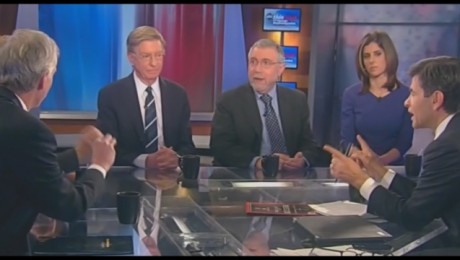
Are there stupider Senators than Ron Johnson (D-WI)? Maybe, but he has to be in the top five. Via Think Progress, this morning on ABC’s This Week, Johnson pulled out an old Republican canard, claiming that the Social Security Trust Fund is “a myth.” Nobel Prize-winning economics Paul Krugman attempted to set him straight. You can watch the partial video down below, but I decided to read the whole transcript of the interaction. Here’s how it went down.
Johnson and Krugman participated in the “Powerhouse Roundtable” with George Will, Bloomberg News White House Correspondent Julianna Goldman, and DNC Chair Rep. Debbie Wasserman Schultz. The group began by discussing President Obama’s supposed charm offensive of the past few days. Johnson rambled on about how Obama is doing the right thing by “reaching out” to the GOP and maybe something can come of it. I have to hand it to Krugman, because he immediately steered the discussion toward the GOP and Obama’s hopes for cutting earned benefit programs.
KRUGMAN: I’m really skeptical, because I — I mean this is not — this is not about bad personal relations. People are perfectly capable of being polite to each other, being nice, having a nice dinner. This is about a fundamental difference in visions about what America should be…One party really wants to take down the — the — the safety net we have. One party really wants….to privatize Medicare, wants to, you know roll back, wanted to try to privatize Social Security back in 2005. The other party wants it somewhat extended, wants Obamacare to go into place, would do more if it could. That’s not something you’re going to resolve with a few dinners.
Corporate media shill Juliana Goldman chimes in to state the village consensus:
Look, both sides understand what a grand bargain is going to look like. You’re going — Republicans are going to have to give on revenues, Democrats are going to have to give on entitlements. And so there is some case for optimism now that if the president, in trying to build trust…if Republicans see the president moving forward, putting Medicare savings on the table that doesn’t just hit providers, but also hits beneficiaries as well, then — and also going out and selling it to give Republicans some cover, then there could be a sense that you could get some Senate Republicans to — to help bring the House along.
George Will brings up raising the Medicare age and asks Debbie Wasserman Schultz if there’s any chance all those old codgers in Florida will ever see the light so that Democrats could go along with this brilliant idea? No real response from Schultz, so Krugman (he was on fire today!) jumped in again. From here on, I’ll just focus on the interaction between Johnson and Krugman and leave out the few remarks by others.
KRUGMAN: Is it a condition of any Republican support that you have to go for really terrible policies? Because raising the Medicare age is a terrible policy. It raises medical costs, it does very little to improve the budget. It introduces a lot of hardship. Means testing in Medicare is a better policy. I don’t particularly like it, but it’s a better policy. There are other things you can do. There are other ways you can cut. Even — I don’t like the business about changing, you know the price index for Social Security, but that’s not as bad…
JOHNSON: To say that the Republicans haven’t done anything, is just false. The House has actually passed budgets. You know with — with proposals to — to try and save Medicare, bipartisan proposals, quite honestly. The Senate hasn’t passed a budget in over four years. Listen, unless we do something, these programs are going broke. It drives me nuts. When I — when I hear people say that Social Security is solvent to the year 2035, it’s not….
Listen, if you — if you’re taking a look at, in a entitlement reform package, in term — you know actually bringing in revenue for those entitlement reforms, I might look at that. But the fact of the matter is — the fact of the matter is, we already have a $1 trillion in middle income tax increases hitting us in Obamacare. They’re hidden, but it’s middle-class….it’s certainly true, as well as another $600 billion. So, you’ve already got $1.6 trillion worth of tax increases hitting us in the next 10 years….
KRUGMAN: Just a question, you say let’s start with the facts, but there — we’ve just — we’ve just run aground right there….JOHNSON: You’ve made my point — you’ve made my point, we have to agree on the facts….But the facts are false.
JOHNSON: No they are not….They are not false.
KRUGMAN: The Social Security thing, Social Security is — there — it has a dedicated revenue base. It has a trust fund based on that dedicated revenue base. You can’t change the rules midstream and say, oh suddenly….
JOHNSON: …here’s the problem with the trust fund, the federal government owns U.S. Treasury bonds, it’s the same thing as if you have $20.00, you spend it. And by the way, that money is spent, it’s gone. You write yourself a note for $20.00, stick it in your pocket and say, I got 20-bucks…No, you don’t. You — you have a note that you have to sell in the open market. The trust fund is a fiction, it doesn’t — it’s…
KRUGMAN: If you — if you want to think of Social Security as not just being part of the government, then there’s no such thing as a Social Security problem, it’s just part of the general budget. You — you cannot say on the one hand….on — on the other hand we’re going to — we’re going to restrict it to only operating off of…it’s important to realize that the facts that are being brought out here are in fact, non-facts.
Here’s the video from Think Progress:
From a piece Kevin Drum wrote last fall in response to WaPo columnist Charles Krauthammer spouting the “Social Security Trust Fund is a fiction” meme. Like Johnson, Krauthammer was arguing that because Social Security funds are invested in Treasury bonds which it cashes in when current funds aren’t sufficient for immediate needs, that the Trust Funds is just “a bunch of useless IOU’s,” to quote George W. Bush.
Here’s Drum:
What Krauthammer means is that as Social Security draws down its trust fund, it sells bonds back to the Treasury. The money it gets for those bonds comes from the general fund, which means that it does indeed have an effect on the deficit.
That much is true. But the idea that the trust fund is a “fiction” is absolutely wrong….Starting in 1983, the payroll tax was deliberately set higher than it needed to be to cover payments to retirees. For the next 30 years, this extra money was sent to the Treasury, and this windfall allowed income tax rates to be lower than they otherwise would have been. During this period, people who paid payroll taxes suffered from this arrangement, while people who paid income taxes benefited….
As the baby boomers have started to retire, payroll taxes are less than they need to be to cover payments to retirees. To make up this shortfall, the Treasury is paying back the money it got over the past 30 years, and this means that income taxes need to be higher than they otherwise would be. For the next few decades, people who pay payroll taxes will benefit from this arrangement, while people who pay income taxes will suffer.
If payroll taxpayers and income taxpayers were the same people, none of this would matter. The trust fund really would be a fiction. But they aren’t. Payroll taxpayers tend to be the poor and the middle class. Income taxpayers tend to be the upper middle class and the rich. Long story short, for the past 30 years, the poor and the middle class overpaid and the rich benefited. For the next 30 years or so, the rich will overpay and the poor and the middle class will benefit.
The trust fund is the physical embodiment of that deal. It’s no surprise that the rich, who didn’t object to this arrangement when it was first made, are now having second thoughts. But make no mistake. When wealthy pundits like Krauthammer claim that the trust fund is a fiction, they’re trying to renege on a deal halfway through because they don’t want to pay back the loans they got.
It’s disgusting that this has to be explained over and over again to the willfully obtuse Republicans and the media talking heads, but I have to say that I’m glad Krugman was there this morning to call attention to the stupidity of what the GOP–and Obama–are proposing.
Now, here’s a bonus for you that I found at Americablog this morning. Florida Rep. Alan Grayson is warning there will be “civil disobedience” if Social Security benefits are cut.
What are you hearing and seeing out there? This is an open thread.
Senator Bernie Sanders Introduces Bill to Apply Payroll Tax to High Incomes
Posted: March 7, 2013 Filed under: Barack Obama, Medicare, Social Security, The Media SUCKS, U.S. Economy, U.S. Politics | Tags: payroll tax cap, Senator Bernie Sanders, Social Security 31 Comments
I’m sure most of the corporate media will ignore this, but Senator Bernie Sanders today introduced a bill to “strengthen Social Security” by applying payroll taxes to all income–including from self-empoyment–to people earning more than $250,000 annually. So far I’ve only seen this reported by one national media outlet.
Sanders and other liberals are concerned Obama may strike a deficit-reduction deal with Republicans that would reduce Social Security benefits by adopting a less generous way of adjusting benefits for inflation.
Sanders on Thursday introduced legislation co-sponsored by Senate Majority Leader Harry Reid (D-Nev.) to raise payroll taxes on the wealthy to extend the solvency of Social Security.
Democratic Sens. Barbara Boxer (Calif.), Amy Klobuchar (Minn.), Sheldon Whitehouse (R.I.), Al Franken (Minn.) and Richard Blumenthal (Conn.) have co-sponsored the bill as well.
Representative Peter De Fazio is introducing a companion bill in the House.
“Social Security is facing an unprecedented attack from those who either want to privatize it completely or who want to make substantial cuts,” said Sanders at a press conference. “The argument being used to cut Social Security is that because we have a significant deficit problem and a $16.6 trillion national debt, we just can’t afford to maintain Social Security benefits.
“This argument is false. Social Security, because it is funded by the payroll tax, not the U.S. Treasury, has not contributed one nickel to our deficit,” he said.
Sanders estimates switching to a chained-CPI formula for determining benefits for Social Security would result in the average 65 year old living on about $15,000 a year receiving $650 less each year when they turn 75 and $1,000 less a year when they turn 85.
The bill is supported by (PDF) “The Strengthen Social Security Campaign, comprised of more than 320 organization throughout the country representing more than 50 million Americans, including the National Committee to Preserve Social Security and Medicare; AFL-CIO; United Steelworkers; Alliance for Retired Americans; Social Security Work; Campaign for Community Change; The Arc.”
The AARP announced yesterday that it is going to be running ads
If you haven’t read the op-ed by Thomas Edsall (The War on Entitlements) in today’s New York Times, I hope you will take the time to do so now. Thanks to RalphB for posting the link on the morning thread! Here’s the introduction:
The debate over reform of Social Security and Medicare is taking place in a vacuum, without adequate consideration of fundamental facts.
These facts include the following: Two-thirds of Americans who are over the age of 65 depend on an average annual Social Security benefit of $15,168.36 for at least half of their income.
Currently, earned income in excess of $113,700 is entirely exempt from the 6.2 percent payroll tax that funds Social Security benefits (employers pay a matching 6.2 percent). 5.2 percent of working Americans make more than $113,700 a year. Simply by eliminating the payroll tax earnings cap — and thus ending this regressive exemption for the top 5.2 percent of earners — would, according to the Congressional Budget Office, solve the financial crisis facing the Social Security system.
So why don’t we talk about raising or eliminating the cap – a measure that has strong popular, though not elite, support?

I think we all know the answer to that question, don’t we?
Thursday Reads: Will Obama Pull off A Grand Betrayal? And Other News…
Posted: March 7, 2013 Filed under: Barack Obama, morning reads, Republican politics, U.S. Economy, U.S. Politics | Tags: Grand Betrayal, paranoia, sequestration 58 Comments
Good Morning?
We weren’t supposed to get any snow until late this afternoon, but it’s already coming down. The snow from the last two storms was just about gone and you could see the ground in places. Now they’re saying we may get up to a foot of snow. I’m hoping that’s not going to pan out.
Let’s see what’s happening out there in the world.
Call me paranoid, but I’m beginning to get the feeling that we’re being gamed by both Democrats and Republicans. Late last night, I was listening to a 24-hour politics station Sirius-XM radio, called POTUS radio.
Now I didn’t get the name of the man being interviewed, but he said that President Obama had asked Lindsey Graham to help him organize last night’s dinner with Republican Senators weeks ago! According to this guy, everything is coming together for Obama and for the Republicans–they are each getting what they wanted, which is serious austerity. Obama will get his “entitlement reforms” and the Republicans will get–what? Will there be any new revenue at all, or will the full burden for deficit cutting in the “grand bargain” fall on the social safety net?
From The New York Times Caucus blog:
For Washington-watchers looking for positive signs from President Obama’s unusual dinner with Republican senators on Wednesday night, there was this: Senators John McCain of Arizona and Tom Coburn of Oklahoma each gave waiting reporters a thumbs up as lawmakers exited the private dining room….
Besides Mr. McCain and Mr. Coburn, the diners were the Republican Senators Bob Corker of Tennessee, Lindsey Graham of South Carolina, Dan Coats of Indiana, Richard M. Burr of North Carolina, Mike Johanns of Nebraska, Patrick J. Toomey of Pennsylvania, Ron Johnson of Wisconsin, John Hoeven of North Dakota, Saxby Chambliss of Georgia and – the only woman – Kelly Ayotte of New Hampshire….
The president insists that any alternative package must combine a balance of spending cuts and new revenues, while Republicans generally oppose new taxes on the wealthy and corporations.
In the Senate…a number of Republicans are known to support higher tax revenues if Mr. Obama and Democrats agree to significant long-term reductions in future spending for the fast-growing entitlement programs, chiefly Medicare and Medicaid but also Social Security – just the trade-off Mr. Obama supports. Mr. Coburn and Mr. Chambliss, for example, are members of a bipartisan group that has supported a deficit-reduction plan with more additional revenues than the president has proposed.
I haven’t yet been able to find confirmation of the report I heard last night, but it would not surprise me. If Graham organized the dinner, it would also explain why the invitees included the three stooges, Graham and his pals John McCain, and Kelly Ayotte–who have been inseparable since they decided to raise hell over the attacks on the Benghzi consulate.
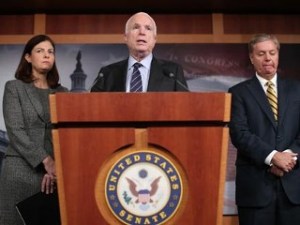
That the outcome described in the highlighted passage from the Caucus blog (see above) was either expected or deliberately planned would also explain why the latest meme in the media for the past week or so has been that Obama is suddenly weak and has no leverage and so much go hat in hand begging the Republicans for mercy.
Tuesday Reads: A Trip Down Memory Lane
Posted: March 5, 2013 Filed under: Barack Obama, morning reads, U.S. Economy, U.S. Politics | Tags: Dura 1401, history of computers, Len Deighton, lost continents, psychology, science, technology, Wang word processor 46 Comments
Good Morning!!
I’m going to do something a little different this morning, so I hope you’ll indulge me.
Over the weekend I ran across a story at Slate by Matthew Kirschenbaum that brought back a rush of old memories: The Book-Writing Machine: What was the first novel ever written on a word processor?
The story is about thriller writer Len Deighton, who in 1968 wrote his novel Bomber on an early word processor called the IBM MTST (Magnetic Tape Selectric Typewriter).
It was 1968, and the IBM technician who serviced Deighton’s typewriters had just heard from Deighton’s personal assistant, Ms. Ellenor Handley, that she had been retyping chapter drafts for his book in progress dozens of times over. IBM had a machine that could help, the technician mentioned. They were being used in the new ultramodern Shell Centre on the south bank of the Thames, not far from his Merrick Square home.
A few weeks later, Deighton stood outside his Georgian terrace home and watched as workers removed a window so that a 200-pound unit could be hoisted inside with a crane.
….
Like many early technologies, the MTST began as a hybrid creation, a kind of mechanical centaur consisting of two separate devices fused to work in conjunction with one another. At the same instant a character was imprinted on the page from the Selectric’s typing mechanism, that keystroke was also recorded as data on a magnetic tape cartridge. There was no screen, but backspacing to correct an error on the page also resulted in the data being corrected on the tape. Unblemished hard copy could then be produced with the push of a button, at the rate of 150 wpm. What’s more, the printing process could be halted while in “playback” mode to allow for the insertion of additional text; sentence spacing, line-lengths, even hyphenated words were all adjusted automatically as revisions were introduced. In the States, the MTST retailed for $10,000…
It was one of the first “word processors,” although that expression had not yet been invented. You can see a photo of the one Deighton used at the link.

Keypunch machines
The reason this story triggered my mental way-back machine is that in the late 1960s I worked on a machine like that. When I first moved to Boston in 1967, I landed a job at Harvard University’s Widener Library.
The job was in the library’s shelflist automation project (pdf). The starting pay was $65 per week, a quarter of which went to half of the rent on an apartment one block from Harvard Yard ($165/mo.). Today, if you could get a unit in that building it would cost a rather large fortune. But I digress.
I started out working on a keypunch machine like the one at the right. the punch cards were then processed by an IBM 1401 computer like this one.

IBM 1401 computer
Here’s a video I found about an IBM 1401 computer purchased in 1959!
News Links
It’s hard to believe that in those days computers took up entire rooms! But I’m probably not the only one her at the Sky Dancing blog who remembers those days. Actually, I had worked in the data processing office when I was in college, beginning in 1965, so I already had some familiarity with computers and keypunch machines.
Pretty soon my office at Widener Library purchased a few more sophisticated data entry machines built by the Dura Business Machines Co. The Dura machine was similar to Deighton’s but much cheaper. It consisted of a modified IBM Selectric typewriter with an attachment that punched holes in paper tape instead of the more expensive magnetic tape in Len Deighton’s machine. You typed normally, and the words were converted to code on the paper tape. The tape was then converted to punch cards, read by the computer, and printed out. The printouts were checked by editors who marked any errors, deletions, or additions and you could make the corrections without retyping everything. You could also backspace over errors as you typed.
Here’s a 1968 photograph and description of the Dura 1401 from the ABA Journal. I’m posting it in large type so you can read the text.

Print ad for the Dura 1401
Now this is where my trip down memory lane started to feel a little less nostalgic. According to the ad, “your girl” operates this magnificent machine and “your girl’s output goes up as much as 100%.” Were things really that sexist in 1968? Yes, yes they were. Here’s a “help wanted” ad from the Toledo Blade that I came across when I was looking for information on the Dura machine. You’ll notice that only men need apply. In the column to the left are some ads for women’s jobs.

I couldn’t get all the text into the screen grab, but you can see the whole thing at the link. The text mentions a couple of times that the job is only available to men.
In the mid-1970s, when I worked at M.I.T., our office purchased a Wang word processor. This was a pretty advanced machine, dedicated only to word processing that was operated pretty much like Microsoft Word. It had a monitor, a printer, and a large CPU, I guess you’d call it.

Wang word processor
By the mid-1980s I was working in a different department that had rudimentary PCs. By then I was an “administrative assistant.” I left that job in 1986 and swore never to take another office job, and I never have.
The work could be interesting and challenging, but the condescending attitude toward clerical/secretarial workers was just too much to bear. “Women’s work,” you know. Keep in mind that in those days the people I worked for had no understanding whatsoever of the machines we learned to operate.
I went back to college in 1993, and by then there were much more advanced computers available in the university’s computer lab. Very few students had their own PCs or Macs then. I bought a little word processor to write papers on at home. It probably cost a few hundred dollars and could do everything the giant Wang word processor did and more.
I bought my first PC in 1997 when I started graduate school. At the time it was really state of the art. I spend about $1,500 on the computer and a laser printer. I think it had an Intel Pentium processor, 128 mb hard drive and 64 mg RAM–something like that–and ran on Windows 95. Unbelievable! I got hooked up to cable internet and was immediately hooked. So you can see that I’ve spent most of my adult life working with computers. Of course the young kids assume people my age know nothing about technology.
I hope I haven’t bored you stiff with this little nostalgia trip. I know some of you must recall these old machines too, so I hope you enjoyed the pictures anyway. It’s amazing how technology has changed our lives in the past 50 years, isn’t it?
I have some more up-to-date reads for you that I hope you’ll find interesting.
The Washington Post Magazine published a wonderful story about a family’s nightmarish experience of domestic violence, post-traumatic stress, and recovery: After Dad shot Mom, a family deals with the haunting legacy of gun violence The article by Neely Tucker builds on the story of Lynnie Vessels, who was 7 years old at the time of the shooting as well as interviews with her siblings. Lynnie has just published a book about her recovery, To Soften the Blow.
Of course the story is heartbreaking, but I highly recommend reading it as a reminder of what life was like for women and children in the 1960s–when the terms “child abuse” and “domestic violence” were completely unknown and there was no one to turn to when it happened. It was considered private family business and people mostly didn’t interfere even when they heard women screaming and children crying.
How well I remember. I grew up in a violent home–not as extreme as the Lynnie Vessels’ was. My dad was a rage-aholic, and you never knew when he’d lose his temper and lash out: screaming at the top of his lungs and hitting. There was no one to turn to for advice on how to deal with it, and we were taught to keep quiet about anything that happened within the family.
I couldn’t wait to get out, and I left for Boston when I was 19. My other siblings left home early too, but some of them still can’t admit to themselves that our home was violent and abusive. As the eldest, I probably got the brunt of it, I guess. Now I know that my dad probably had PTSD from his experiences in WWII.
Another important and timely read is this piece by Robert Parry: The Neo-Confederate Supreme Court. Here’s a short excerpt:
If white rule in the United States is to be restored and sustained, then an important first step will be the decision of the five Neo-Confederate justices on the U.S. Supreme Court to gut the Voting Rights Act, a move that many court analysts now consider likely.
The Court’s striking down Section Five of the Voting Rights Act will mean that jurisdictions with a history of racial discrimination in voting – mostly in the Old Confederacy – will be free to impose new obstacles to voting by African-Americans, Hispanics and other minorities without first having to submit the changes to a federal court.
This green light to renew Jim Crow laws also would come at a time when Republican legislatures and governors across the country are devising new strategies for diluting the value of votes from minorities and urban dwellers in order to protect GOP power, especially within the federal government.
Check it out if you can.
Ryan Lizza has a new article in the New Yorker about President Obama and sequestration: THE POWERLESS PRESIDENCY. The gist is that Obama has given up on his dream of bipartisanship and accepted that he can’t bring the parties together.
That Obama, who started his Presidency as a true believer, has now given up on the idea that he has any special powers to change the minds of his fiercest critics is probably a good thing. His devotion to post-partisan governance has long fed two mistaken ideas: that the differences between the parties are minor, and that divided government is inherently good for the country.
A fundamental fact of modern political life is that the only way to advance a coherent agenda in Washington is through partisan dominance. When Obama had large Democratic majorities in Congress during his first two years in office, he led one of the most successful legislative periods in modern history. After he lost the House, his agenda froze and the current status quo of serial fiscal crises began. Like it or not, for many years, Washington has been most productive when one party controlled both Congress and the White House.
The boring fact of our system is that congressional math is the best predictor of a President’s success. This idea is not nearly as sexy as the notion that great Presidents are great because they twist arms in backrooms and inspire the American people to rise up and force Congress to bend to their will. But even the Presidents who are remembered for their relentless congressional lobbying and socializing were more often than not successful for more mundane reasons—like arithmetic.
I’m not at all sure that Obama has really let go of his dream of unity, although I hope Lizza is right.
I missed Charlie Rose while I was writing this, so I’ll have to try to catch a rerun or watch it on-line. But Joe Weisenthal has published a few excepts of the battle between Paul Krugman and Joe Scarborough. Weisenthal says Bloomberg with air a repeat tonight at 8PM.
Here’s a piece on the human brain at The Guardian Observer: Our brains, and how they’re not as simple as we think. I found it fascinating and I hope you will too.
One more psychological article from The New Yorker: Up All Night: The Science of Sleeplessness, by Elizabeth Kolbert. It’s a problem I’m very familiar with.
Science AAAS has a article about a Lost Land Beneath the Waves (Atlantis?)
Geological detectives are piecing together an intriguing seafloor puzzle. The Indian Ocean and some of its islands, scientists say, may lie on top of the remains of an ancient continent pulled apart by plate tectonics between 50 million and 100 million years ago. Painstaking detective work involving gravity mapping, rock analysis, and plate movement reconstruction has led researchers to conclude that several places in the Indian Ocean, now far apart, conceal the remnants of a prehistoric land mass they have named Mauritia. In fact, they say, the Indian Ocean could be “littered” with such continental fragments, now obscured by lava erupted by underwater volcanoes.
The Seychelles, an archipelago of 115 islands about 1500 kilometers east of Africa, are something of a geological curiosity. Although a few of Earth’s largest islands, such as Greenland, are composed of the same continental crust as the mainland, most islands are made of a denser, chemically distinct oceanic crust, created midocean by magma welling up beneath separating tectonic plates. Geologists think they separated from the Indian subcontinent 80 million to 90 million years ago.
Freaky!

 peej
peej Carissa
 bostonboomer
 dakinikat
 ecocatwoman
 mablue2
 Mama Lopez
 peggysue22
 quixote
 skydancingguestblogger
 Mona (aka Wonk the Vote)



 Sky Dancing
Recent Comments