
New Year’s Reads: Things Can Only Get Better!
Posted: January 1, 2016 Filed under: Afternoon Reads | Tags: and other Bullshit, Donald Trump, lies, Myth, New Year's Eve, politics, religion, Ronald Reagan 13 Comments I’m still recovering from whatever flu virus hit me last weekend. I do have my voice back and I’m coughing a bit less so I’m beginning to catch up with reading this and that. I stayed in bed with hot tea and a marathon of “Drunk History” while trying to figure out if the noise I was hearing last night was gunfire or fireworks. I have no idea what the mix of one to the other was. That’s one of those things that keeps me indoors on NY’s Eve because I really don’t want to be the one out there gathering the data. Most folks try not to think about about it.
One of the things that always amazes me is how vulnerable people are to wishful thinking and things easily demonstrated to be complete bullshit. I suppose I suffer the hubris of the scholar on this account. I didn’t have access to the internet in my home until 1980 but you generally could find me in whichever library housed the government documents drop. Yes, the University of Nebraska libraries had huge basements dedicated to the stuff at one time and I was a basement dweller. Now it’s all on spreadsheets on my hard drive. It really doesn’t take much to figure out what is what. However, everything experiences variation and intellect and curiosity are no different.
I guess the same thing that makes folks vulnerable to religion also makes them vulnerable to political myth. My first experience with all the ploy to keep people well-behaved and hopeful was as a child when I learned my parents were deliberately lying to me about Santa Claus for my sister’s sake. I later studied 3rd and 4th century Roman history and lost religion. It’s basically the same MO but with much better data. But the Santa episode really sunk in. I went to the basement, screamed at myself for being so stupid then wondered what else they’d been lying to me about. Well, it turned out that it was about a lot of things that I could easily find out about in my handy dandy local library’s reference section. I’ve spent my professional and personal life gleaning through data looking for truths. I hate being taken in.
We’ve all been stumped about why Donald Trump could gain ground in any national level political race. He says things that are blatantly hateful and false, yet he gains ground. Polls showing his demographics illustrate his base. It’s basically the ugly underbelly of the US that shows up in our history quite frequently. These folks love being taken in.
Donald Trump holds a dominant position in national polls in the Republican race in no small part because he is extremely strong among people on the periphery of the G.O.P. coalition.
He is strongest among Republicans who are less affluent, less educated and less likely to turn out to vote. His very best voters are self-identified Republicans who nonetheless are registered as Democrats. It’s a coalition that’s concentrated in the South, Appalachia and the industrial North, according to data provided to The Upshot by Civis Analytics, a Democratic data firm.
Mr. Trump’s huge advantage among these groups poses a challenge for his campaign, because it may not have the turnout operation necessary to mobilize irregular voters
The Civis estimates are based on interviews with more than 11,000 Republican-leaning respondents since August. The large sample, combined with statistical modeling techniques, presents the most detailed examination yet of the contours of Mr. Trump’s unusual coalition.
We’ve seen this set of nutcases before. It appears to be the return of the Reagan coalition. This turns my mind back to the Santa Claus story, and for that matter, any particular dead religious figure you can  conjure up that people have turned into something not quite like the original narrative. Ronald Reagan was an affable fool. Any economist that has studied the time period and his policies will tell you a completely different, data-based narrative than most of the people taken in by him. BB sent me this link a few days ago. I’ve only been able to really digest it today.
Any of us that have intensely studied some aspect of his regime–in my case the economic data–know that the myth is no where close to the truth. These narratives always seem to serve the current group of rich, powerful, assholes. It doesn’t matter if you’re told to submit yourself to your husband or master or render unto Rome, it’s pretty much the same thing. These so-called populist heroes lead sheep to slaughter.
Ronald Reagan was not only intellectually ungifted, he was incurious and ignorant about the details of the day. It’s amazing to me that as historians go back and sift through their form of data on the ground, so little of it manages to take down the public id. The link to Salon takes you to an excerpt from “The American President: From Teddy Roosevelt to Bill Clinton” by WILLIAM LEUCHTENBURG whose thesis on Reagan is summed up thusily: “No one ever entered the White House so grossily ill-informed”. This says a lot given he was followed relatively shortly by Dubya Bush who didn’t even appear to have a command of his primary language let alone nuanced policy. Remember, Dubya’s the guy that declared war on a lot of Muslim-majority countries without a real grasp of the difference between Sunni and Shia let alone the minority ones.
No one had ever entered the White House so grossly ill informed. At presidential news conferences, especially in his first year, Ronald Reagan embarrassed himself. On one occasion, asked why he advocated putting missiles in vulnerable places, he responded, his face registering bewilderment, “I don’t know but what maybe you haven’t gotten into the area that I’m going to turn over to the secretary of defense.” Frequently, he knew nothing about events that had been headlined in the morning newspaper. In 1984, when asked a question he should have fielded easily, Reagan looked befuddled, and his wife had to step in to rescue him. “Doing everything we can,” she whispered. “Doing everything we can,” the president echoed. To be sure, his detractors sometimes exaggerated his ignorance. The publication of his radio addresses of the 1950s revealed a considerable command of facts, though in a narrow range. But nothing suggested profundity. “You could walk through Ronald Reagan’s deepest thoughts,” a California legislator said, “and not get your ankles wet.”
In all fields of public affairs—from diplomacy to the economy—the president stunned Washington policymakers by how little basic information he commanded. His mind, said the well-disposed Peggy Noonan, was “barren terrain.” Speaking of one far-ranging discussion on the MX missile, the Indiana congressman Lee Hamilton, an authority on national defense, reported, “Reagan’s only contribution throughout the entire hour and a half was to interrupt somewhere at midpoint to tell us he’d watched a movie the night before, and he gave us the plot from War Games.” The president “cut ribbons and made speeches. He did these things beautifully,” Congressman Jim Wright of Texas acknowledged. “But he never knew frijoles from pralines about the substantive facts of issues.” Some thought him to be not only ignorant but, in the word of a former CIA director, “stupid.” Clark Clifford called the president an “amiable dunce,” and the usually restrained columnist David Broder wrote, “The task of watering the arid desert between Reagan’s ears is a challenging one for his aides.”
 I actually was convinced that Reagan was so obviously ignorant and wrong about so many things that you could run any one against him and he’d never get a second term. I was obviously young and not jaded enough to grasp the demographic that supported him because they believed what they wanted to believe because he told them so in such a “nice” way. Now, this same group of yahoos is angry and they believe what Donald Trump tells them because they believe what they want to believe because he tells them in such an “angry” way. ‘Morning in America’ does sound an awful lot like ‘Make America Great Again’ doesn’t it? All of this is basically code for ‘Save White Privilege’ even if I don’t really benefit that much from it. As long you as you can make me feel superior to (fill in the blank), I’ll wishfully hope and then vote for you.
I try to tell myself that there’s no way that Donald Trump could ever be elected but then I would not be learning from my obviously wrong hypothesis that Ronald Reagan could ever get a second term. Reagan raised taxes. He ran up the deficit hugely. There’s the Reagan “recession” and there was Iran Contra which all of these folks conveniently never heard about or forgot when they voted for the affable buffoon. The same demographic could care less about Trump’s lies and the tremendous internet base of fact checking.
Donald Trump is the “King of Whoppers”.
But in this year’s presidential campaign, the fact checkers say one candidate has achieved truth-bending royalty.
“This is the first time we have named someone the ‘King of Whoppers,'” Eugene Kiely of FactCheck.org said.
Donald Trump earned that crown with the biggest whopper of 2015:
“I watched in Jersey City, New Jersey, where thousands and thousands of people were cheering as that building was coming down,” he said in a Birmingham, Alabama, rally in November 21.
The fact checkers found evidence of just a few people celebrating. But that wasn’t the only tall Trump tale of the year.
“He’s certainly keeping us busy… It is the worst that we have seen in the 12 years we have been doing this,” Kiely said.
“You know, the president’s thinking about signing an executive order where he wants to take your guns away,” Trump said at a South Carolina rally on October 19.
Then in New Hampshire, on September 30: “You know, it started off with 10,000. The other day I heard 200,000. We are going to take in 200,000 Syrians or wherever they come from,” Trump said.
“It’s just way over what the actual number is,” Kiely explains.
It’s not like this isn’t pointed out daily in places other than newspapers that none of Trump’s demographic appear to read. Bernie Sanders mentioned it just a few days ago.
“It appears that Donald Trump, a pathological liar, simply cannot control himself. He lies, lies and lies again. Today, he repeated his lie that I want to raise taxes to 90 percent. Totally untrue. And PolitiFact gave Trump’s same statement last October a ‘Pants-on-Fire’ rating.
Even Trumps Republican opponents point this out. Unfortunately, the most verbal are Kasich and Jeb who appear to be on their way out the door.
Bush talked to CNN on Wednesday and reinforced his point from the debate that Trump is “not a serious candidate.”
“I got to post up against Donald Trump,” Bush said. “I don’t think he’s a serious candidate.”
He added, “And I don’t know why others don’t feel compelled to point that out, but I did. And I think I got a chance to express my views and compare them to someone who talks a big game but really hasn’t thought it through.”
But, again, the only candidates gaining traction in the Republican field are the “know nothings”. This includes Marco Rubio who has to be as intellectually ungifted as the gipper and is taken somewhat seriously despite the stupid and despite a very shady history of deal making for shady people.
Didn’t we say all this about a gawky rogue presidential candidate named Barack Obama? Sure. But Obama had the advantage of not looking and sounding like a complete fucking idiot. Obama was on the Harvard Law Review, not the Santa Fe Community College football team. Then again, that’s not really fair to community collegians and football players: Plenty of each are smart enough to run the country. It just so happens that Rubio isn’t one of them.
For proof, simply look to Rubio’s campaign message, a bizarre simulacrum of “hope and change” focus-grouped by Red Stripe-swilling blue blazers who are slightly scared of hope and change because they’ve witnessed its power but never fully understood its appeal, like those crouched simians sizing up the galactic monolith in 2001.
This scares me. It should scare you. 
I will also admit that I didn’t think Obama was going to be as good of a President as he has turned out to be. I really thought he’d continue to let the Republicans play him like a violin, but he learned, and learned well. His last few years defy the lame duck theory.
So, I’m doing a mea culpa on the two failed hypotheses today just because I do not want to be lulled into a third one. We clearly have one great candidate that is experienced, flawed, and capable. Then, we have a set of figures that look religiously mythical, are supported by people who have a lot to gain from populist ignorance, and appear to be impossibly unqualified for making national policy on all levels. They may have one area upon which they are knowledgeable but most have absolutely nothing but being able to say blatantly wrong things because they have no clue how wrong they actually are.
Work in the right campaigns and vote in 2016. Don’t make me write another mea culpa in 2017. Please.
What’s on your reading and blogging list today?
And, have a great NEW YEAR!!! I love you all!!!
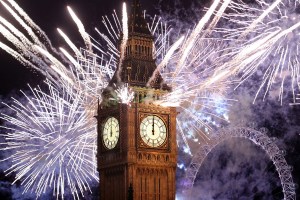
Thirty years ago from 1985 and deep from Reagan d0o d0o land.
Monday Afternoon Ledes
Posted: December 28, 2015 Filed under: Afternoon Reads | Tags: Flint MIchigan lead poisoning, Meadowlark Lemon, Ramadi, Tamir Rice shooting, Texas weather 8 Comments The weather here has finally done me in. We set a record high of 82 and the humidity has been gruesome! Now, it’s turned chilly! I’ve got a flu like you wouldn’t believe so I’m going to just get us caught up on some of the headlines because they’re actually quite a few today. Hopefully, this will go away because the last two days have kept me in bed with hot tea and meds constantly coughing, sneezing and shivering.
Americans again name Hillary Clinton and President Barack Obama the woman and man living anywhere in the world they admire most. Both win by wide margins over the next-closest finishers, Malala Yousafzai for women and Pope Francis and Donald Trump for men.
You may want to check out her history as a Civil Rights worker. It’s interesting and important.
One of the most interesting holiday surprises was the revelation by Amy Chozick in The New York Times about Hillary Rodham, Covert Operative.
Playing down her flat Chicago accent, she told the school’s guidance counselor that her husband had just taken a job in Dothan, that they were a churchgoing family and that they were looking for a school for their son. The future Mrs. Clinton, then a 24-year-old law student, was working for Marian Wright Edelman, the civil rights activist and prominent advocate for children. Mrs. Edelman had sent her to Alabama to help prove that the Nixon administration was not enforcing the legal ban on granting tax-exempt status to so-called segregation academies, the estimated 200 private academies that sprang up in the South to cater to white families after a 1969 Supreme Court decision forced public schools to integrate. Her mission was simple: Establish whether the Dothan school was discriminating based on race.
Make no mistake. Even in 1972, this took considerable guts. The segregated academies were the outward sign of the vicious backlash against the triumphs of the Civil Rights Movement that only would intensify over the following decade as the Republican party, and the conservative movement that would come to be its essential life-force, discovered that, in many important ways,the whole country was Southern. The backlash was even more virulent at the local level. If Undercover Hillz blew her cover, very bad things could have happened to her.
After filing a FOIA request, a Virginia Tech professor recently discovered Michigan state officials knew the city of Flint’s water supply was giving children lead poisoning while falsely assuring residents that the water was safe. Although the government had been aware of the increased levels of lead poisoning since July, they continued to lie to the public until a Flint pediatrician published a study in September that found lead exposure in children had doubled citywide and nearly tripled in high-risk areas.
Cuyahoga County Prosecutor Tim McGinty announced in a press conference Monday that the Cleveland police officers who shot 12-year-old Tamir Rice last year will not face charges. Surveillance video captured officer Timothy Loehmann shooting Rice, who was carrying a toy gun, almost immediately after he and his partner, Frank Garmback, arrived at a public park. The officers believed the boy was armed with a real gun.
Ben Carson may be the next republican to bail on the presidential primary process. I’ve always felt that he was in it to get on the Right Wing Talk and book circuit, but that’s just one woman’s opinion.
Two days before Christmas, with his presidential campaign fading fast, Ben Carson sought to take control at his manse in the countryside west of Baltimore.
A video crew was in the front living room preparing to film a campaign ad. A photo shoot was being prepped in the basement. The Associated Press had come calling, and more members of the media would show up after The Washington Post had its turn. In a matter of hours, Carson’s children and grandchildren were expected to arrive for the holiday.
Amid all that commotion stood Carson, both completely surrounded and almost entirely alone — the sole staffer on hand was a financial adviser, and the two spoke only glancingly.
Unless something in his campaign changed fast, Carson was in danger of going the way of Michele Bachmann and Herman Cain — fad candidates who wilted before a single vote had been cast. This was the day he had marked to stop the fade.
The Atlantic has a story on the disappearing Republican presidential candidates.
Hey, remember Scott Walker? That corn-fed, Kohls-shopping, union-busting, unintimidated governor of a blue state who had a real shot at next July’s nominating convention?
He’s probably sitting in his Madison, Wisconsin, office right now reading the same stories about Donald Trump that you are.
Walker was one of several casualties in the 2015 leg of the presidential-primary contest, a brutal stretch that saw candidates who were expected to make their mark gone from the race or gasping for air. As Trumpmentum and Clintoninevitability rage on, some contenders who looked like they’d fill a void in the field haven’t seen much success, while others haven’t lived up to their early, favorable reviews.
 The charismatic basketball player Meadowlark Lemon has died. The Harlem Globetrotter’s were a big fixture in my childhood and he was my favorite. He was 83 years young.
George “Meadowlark” Lemon, the basketball star who entertained millions of fans around the world with his antics as a longtime member of the Harlem Globetrotters, died Sunday in Scottsdale, Arizona. He was 83.
Lemon played 24 seasons and by his own estimate more than 16,000 games with the Globetrotters, the touring exhibition basketball team known for its slick ball-handling, practical jokes, red-white-and-blue uniforms and multiyear winning streaks against overmatched opponents.
He also was one of a handful of Globetrotters whose fame transcended sports, especially among children during the team’s heyday in the 1960s and 1970s. Lemon was immortalized in a Harlem Globetrotters cartoon series and appeared on “The Ed Sullivan Show,” episodes of “Scooby Doo” and many national TV commercials.
Ramadi has been liberated from Daesh (ISIL) by the Iraqi army but the fight isn’t over. No surprises there.
Iraqi forces claimed victory over the Islamic State of Iraq and the Levant (ISIL) in Ramadi as clearing operations were under way to flush out the armed group’s remaining fighters in the key city.
“Yes, the city of Ramadi has been liberated,” Brigadier General Yahya Rasool said in a televised statement on Monday, a day after the army took control of the key government compound in Ramadi’s Al Huz neighbourhood.
“The Iraqi counterterrorism forces have raised the Iraqi flag over the government complex in Anbar,” Rasool added, saying the fighting will continue until the whole city is liberated.
Bet Texas doesn’t want to secede today. Horrible tornadoes have wrecked havoc on the state. Bet they’ll be happy to see FEMA for the New Year.
At least 19 people were killed in Mississippi, Arkansas, Tennessee and Alabama between Wednesday and Saturday in wicked weather that made the Christmas holiday hellish for many, according to The Associated Press.
Over the weekend, tornadoes in Texas claimed another 11 lives, and floods that washed over roadways and into homes led to 13 deaths in Missouri and Illinois.
At least 43 people have been killed in a five-day span. And the dangerous weather is not over yet.
I totally have to go crawl back into bed with my hot tea and kleenix box. So, what’s on your reading and blogging list today?
Full Cold Moon Reads
Posted: December 25, 2015 Filed under: Afternoon Reads | Tags: Christmas Eve Bonfires, Full Cold Moon, Lutcher Louisiana 6 Comments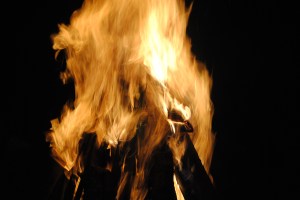
2015 continues to wind down and it can’t happen soon enough for me!
There’s a “Full Cold Moon” today which is an infrequent event. This is when a full moon happens on the day designated for Christmas. We also have an unearthly visitor whizzing by us in the form of a space rock. The pictures for today are from the Lutcher Bonfires made to signal a path into the bayou for Père Noël. I’m going to give you a little background on both since it’s probably a day that you’d prefer to avoid reality for awhile, like me.
Most parts of the U.S. won’t see a white Christmas this year, but they will see a bright one, as a full moon coincides with the holiday for the first time in 38 years.
The final full moon of the year each December is known as the Full Cold Moon, and it hasn’t fallen on Christmas since 1977. Astronomers say it won’t happen again until 2034.
If you want to catch a glimpse, NASA says the moon will reach its peak at 6:11 a.m. EST on Christmas morning.
Moonrise and moonset times vary slightly depending on your location, even within time zones. In New York, the moon rises at 4:28 p.m. EST on Christmas Eve and sets at 7:03 a.m. EST Christmas Day, while the times are a few minutes earlier in Boston to the northeast, and about 20 minutes later in Atlanta to the southwest. Times are similar in other cities across the country, but if you want to be precise about it, you can look up the moonrise and moonset times for your city here.
If clouds interfere with your view, the Slooh Community Observatory is hosting a free webcast beginning at 7 p.m. EST on Christmas Eve. As a bonus, their telescopes will also be tracking Comet Catalina, a recently discovered comet that should be visible for the next few weeks. You can watch the webcast here until midnight EST.
It has been an unusually busy holiday for stargazers, with an asteroid buzzing by Earth this morning. The space rock, about 1.24 miles wide, stayed a safe distance away, passing about 6.6 million miles from our planet.
Full Cold Moons had special meaning to Native Americans long before we brought our European myths and ways to North America. As usual, the solstice is really the reason for the entire season every where!
In Native American cultures which tracked the calendar by the Moons, December’s Full Moon was known as the Full Cold Moon. It is the month when the winter cold fastens its grip and the nights become long and dark.
This full Moon is also called the Long Nights Moon by some Native American tribes because it’s near the winter solstice—the night with the least amount of daylight.
So, the tradition of the Lutcher Bonfires on the Mississippi River Levees is an interesting and fun one. The traditional ones are teepee shaped. They are a Cajun tradition here in Louisiana for Christmas Eve. They happen in St. James Parish which we call one of the River Parishes down here.
Many of the bonfires are built in the traditional “teepee” style with a center pole that anchors the structure. Others come in different shapes and color schemes.
“There’s one constructed in the form of a fish with scales, one in the form of an old sailboat with oars,” Keller said. “Then some of the more traditional ones are painted different colors: red white and blue, black and gold, purple and gold.”
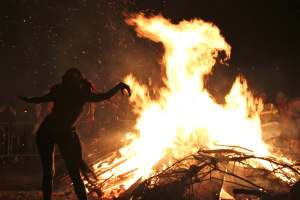 There’s some history involved with the tradition, of course. They are actually based on Celtic traditions where Druids would conduct ceremonies to honor the Sun. The idea was to ensure that the days would get longer after the Winter Solstice.
The area of Louisiana now known as the River Parishes (St. James, St. John and St. Charles) was settled in the early 1700’s by the Old World French and Germans. These early colonists brought with them the knowledge of both summer and winter bonfire customs and traditions which they had known in their native lands. By sharing this knowledge with their many descendants, they provided the inspiration for a practice which has evolved into one giant celebration—the present-day Christmas Eve levee bonfires!
Of necessity, survival and the establishment of a new colony were the principal concerns of the French and Germans who first settled along the lover Mississippi River. These early colonists undoubtedly built a few celebration fires, but early history of the area has failed to record any information about this. As a result, as the bonfire custom increased in recent generations, so has speculation about the origin and development of tradition.
For example, one of the more recent and increasingly popular explanations is that the bonfires were a “Cajun tradition”, first used to light the way for “Papa Noel”, the Cajun version of Santa Claus. This charming version, although improbable, has been depicted annually in front of a Paulina, LA business establishment where a levee scene shows “Papa Noel” with his pirogue drawn by alligators named Gaston, Ninette, “Te-Boy”, Celeste, Suzette, etc.
Some Acadian exiles from Nova Scotia settled in St. James Parish as early as 1765, with many more arriving in the 1780’s, but “Papa Noel” was not yet known to them. It was on New Year’s Eve that the little French children received their gifts.
In South Louisiana of old, Christmas was a strictly religious observance, and it was New Year’s Eve that was marked by the exchange of gifts and the “reveille” to see the old year out and to greet the new year. In Cabanocey: The History, Customs and Folklore of St. James Parish, published in 1957, the author, Lillian Bourgeois, tells of this custom of celebrating New Year’s Eve with a gathering of family and friends who enjoyed a gumbo supper, eggnog and the burning of huge cone-shaped bonfires on the batture, the land area between the base of the levee and the water’s edge. With the passage of time, these activities gradually moved to Christmas Eve.
Some have also offered the theory that the bonfires served as navigational signals to guide ships along the river, or were used to light the way for the faithful to attend Midnight Mass.
Through 1865 letters still in existence, it has been established that the summer feast of St. John the Baptist was then celebrated in neighboring St. John Parish (known as the Second German Coast) with the lighting of fires and the homecoming of relatives who lived away.
A recently discovered 1871 picture shows members of the Lacoul and de Lobel Mahy families gathered around two bonfires built on the levee in front of Laura Plantation in West St. James Parish. The men pictured are wearing coats and the women are wearing hats, but the time of the year is not specified.
In 1989, I participated in a local study on the development of Christmas Eve bonfires in the River Parishes. Many older residents or their descendants were interviewed to learn their knowledge of the history and traditions of the custom.
In a personal interview with H. D’Aquin Bourgeois, son of George Bourgeois, a St. James Parish native born in 1855, I learned that the elder Mr. Bourgeois, an enterprising merchant, had built Christmas Eve levee bonfires in front of his New Camellia Plantation store as early as 1884. Throughout the year, he collected wooden shipping crates, some as large as 3’x5’, in which merchandise for his store had been shipped. These crates, along with old lumber, were used to construct a Christmas Eve bonfire for the pleasure of local residents and the children of his store patrons. The blazing bonfire, the sound of exploding fireworks provided by the store owner, and the gleeful sounds of the children attracted riverboat crews who interrupted their travel to join in the celebration. Bonfires at this location continued until 1930, and in later years grandchildren and great-grandchildren of the original builder resumed bonfire construction at the same site.
Another 1989 interview with Mrs. Hilda Gabb Cambre, a St. James native born in 1901, revealed that she had known Christmas Eve yard bonfires during childhood days spent on her grandfather’s Magnolia Plantation in West St. James Parish. The bonfires, built with any type wood available, were part of a festive occasion where lanterns were placed in the trees and eggnog was served to guests. In later Christmas seasons, kerosene-soaked cotton balls were lit and rolled down the levee. (Could this be a counterpart of the German wheel-rolling down the hillside?)
You can read more about the history of the bonfires and the memories of the River Parish Elders at the link I provided. The one really wonderful thing about Louisiana is its unique heritage that is directly 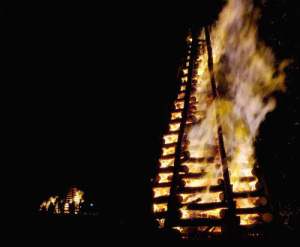 attributable to its French roots as well as the many cultures that eventually settled here or were brought here through the institution of slavery. The bonfires went off without a hitch last night even though it’s near 80 here, foggy and quite drizzly. The foghorns were blaring on the Mississippi River last night. The kathouse is just a few blocks away from it and the Poland Avenue Wharf. It’s home to the best seat to see the New Year’s fireworks too!! So happy to be ending the year and looking to the start of the Carnival Season on 12th night!!
I do have a bit of sad/bad news. A morning fire has damaged the Clinton Birthplace in Hope Arkansas. The Birthplaces of US Presidents are generally historic sites and are used to illustrate the various backgrounds and childhoods of our premier elected leaders. This is a site maintained by the National Park Service. Arson is suspected.
Hope officials suspect arson in a fire that broke out about 3:20 a.m. today at the house in Hope where Bill Clinton spent the first four years of his life. It is now a historic site maintained by the National Park Service.
Damage was reported to the back wall on the east side of the house and the fire spread to the second floor. Smoke and water damage was reported inside. Officials didn’t specify what evidence led them to believe the fire was set. But a report by KSLA also said graffiti was found on the property.
So, I’ll make this short today since I’m sure you’re all using the time off today happily or productively! Whatever way you spend your day, please have a great one and remember that you always have friends that love you completely here at Sky Dancing!!!
What’s on your mind today?
Monday Reads
Posted: December 14, 2015 Filed under: Afternoon Reads, morning reads | Tags: Climate change, coast erosion, Louisiana, Miami floods 21 CommentsGood Morning!
I thought I’d provide some links and information on the climate change negotiations in Paris. This was something I planned to blog on earlier but so much crazy is going on that it’s distracted me. Rather than open up with the details, I’m starting with a New Yorker article about how predictable the flooding has gotten in Miami and how an elderly Florida professor believes the surrounding area has less than 50 years to go before its completely submerged. That’s a pretty astounding hypothesis and I speak as New Orleanian on one of the few strips of land that sits comfortably above current sea level knowing we’re not that far behind. New York City should be concerned too. But, for right now, back to becoming a disaster tourist where it’s actually possible to schedule your viewing of Miami floods. They are now that predictable.

The city of Miami Beach floods on such a predictable basis that if, out of curiosity or sheer perversity, a person wants to she can plan a visit to coincide with an inundation. Knowing the tides would be high around the time of the “super blood moon,” in late September, I arranged to meet up with Hal Wanless, the chairman of the University of Miami’s geological-sciences department. Wanless, who is seventy-three, has spent nearly half a century studying how South Florida came into being. From this, he’s concluded that much of the region may have less than half a century more to go.
We had breakfast at a greasy spoon not far from Wanless’s office, then set off across the MacArthur Causeway. (Out-of-towners often assume that Miami Beach is part of Miami, but it’s situated on a separate island, a few miles off the coast.) It was a hot, breathless day, with a brilliant blue sky. Wanless turned onto a side street, and soon we were confronting a pond-sized puddle. Water gushed down the road and into an underground garage. We stopped in front of a four-story apartment building, which was surrounded by a groomed lawn. Water seemed to be bubbling out of the turf. Wanless took off his shoes and socks and pulled on a pair of polypropylene booties. As he stepped out of the car, a woman rushed over. She asked if he worked for the city. He said he did not, an answer that seemed to disappoint but not deter her. She gestured at a palm tree that was sticking out of the drowned grass.
“Look at our yard, at the landscaping,” she said. “That palm tree was super-expensive.” She went on, “It’s crazy—this is saltwater.”“Welcome to rising sea levels,” Wanless told her.
According to the Intergovernmental Panel on Climate Change, sea levels could rise by more than three feet by the end of this century. The United States Army Corps of Engineers projects that they could rise by as much as five feet; the National Oceanic and Atmospheric Administration predicts up to six and a half feet. According to Wanless, all these projections are probably low. In his office, Wanless keeps a jar of meltwater he collected from the Greenland ice sheet. He likes to point out that there is plenty more where that came from.
“Many geologists, we’re looking at the possibility of a ten-to-thirty-foot range by the end of the century,” he told me.
We got back into the car. Driving with one hand, Wanless shot pictures out the window with the other. “Look at that,” he said. “Oh, my gosh!” We’d come to a neighborhood of multimillion-dollar homes where the water was creeping under the security gates and up the driveways. Porsches and Mercedeses sat flooded up to their chassis.
“This is today, you know,” Wanless said. “This isn’t with two feet of sea-level rise.” He wanted to get better photos, and pulled over onto another side street. He handed me the camera so that I could take a picture of him standing in the middle of the submerged road. Wanless stretched out his arms, like a magician who’d just conjured a rabbit.
In the Miami area, the daily high-water mark has been rising almost an inch a year.
CREDIT ILLUSTRATION BY JACOB ESCOBED
 I guess the bottom line is to go short on real estate in Southern Florida and don’t expect your private supplemental flood insurance to come cheap.
Louisiana has already lost its boot. There is significant land loss here and the National Climate Change report has put Louisiana and New Orleans as one of the country’s most vulnerable locations behind Southern Florida.
Louisiana will see billions of dollars in increased disaster costs as early as 2030 resulting from the combined effects of global warming and natural processes, according to a new National Climate Assessment report released by the White House on Tuesday (May 6).
The report also warns that sea level rise – combined with naturally-occurring subsidence – continues to threaten wetlandsand land bordering the state’s most populated areas, increasing their risk from storm surges; and that sea level rise driven by human-induced global warming also threatens interstate highways, railroads, ports, airports, oil and gas facilities and water supplies.
“The southeastern region is exceptionally vulnerable to sea level rise, extreme heat events and decreased water availability,” said Kirsten Dow, a geography professor at the University of South Carolina and one of the authors of chapters in the report, during a telephonic news conference on the report.
The state’s agriculture also is threatened by sea level rise that could contaminate shallow groundwater tables, the report said.
Louisiana’s residents also will see a significant increase in the number of days when the temperature reaches 95 degrees Fahrenheit, and a significant reduction in the days when temperatures drop below 32 degrees, according to the report. The temperature changes are likely to pose a threat to the health of at-risk populations, including those who are chronically ill or elderly.
We’re also getting an unseasonably warm December. I’m trying to be sympathetic with my NYC friends who are complaining about needing AC and shorts. This weather might be taken as an outlier if the average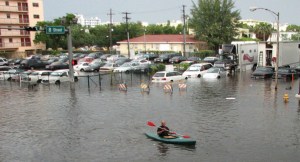 temperatures over an extended period of time haven’t trended upward by such a statistically significant amount.
It’s beginning to look a lot like — September? While retailers may be hitting their full holiday shopping season stride, Mother Nature is not doing her part to put people in the Christmas spirit.
Unseasonably mild temperatures are spreading over the eastern half of the country and about 75% of the U.S. population will see the temperature climb over 60°F by the end of the weekend, hardly a winter wonderland. Don’t be surprised to find holiday shoppers wearing shorts while strolling along Michigan Avenue in Chicago this weekend, as temperatures in the low 60s will make it feel more like late September or early October.
Many folks are asking if the relatively successful Paris agreements on Climate Change are our last best hope for the planet? Rebecca Leber–writing for The New Republic—suggests they may help prevent doom.
These negotiations essentially determined the future course of the world. For a long time we’ve needed an agreement that covers the vast majority of carbon emissions and lays out in no uncertain terms that they are on a long-term downward trajectory. But to get there, 195 countries had a decision to make: Would they allow individual disagreements to lock the planet into a future of unrestrained warming, or would they make the hard choices necessary to chart a safer path?
While the Paris agreement is far from perfect, the text as a whole makes a convincing case for hope. The world is a little less doomed now.
Based on the domestic pledges made by 187 countries, covering some 95 percent of global emissions, the Earth’s average temperature could now rise by somewhere between 2.7 to 3.5 degrees Celsius over the course of the century. That’s still far too high, and shows how much work remains, but it is an improvement over the path of unrestrained pollution we were on before Paris.

A woman wearing a mask walk through a street covered by dense smog in Harbin, northern China, Monday, Oct. 21, 2013. Visibility shrank to less than half a football field and small-particle pollution soared to a record 40 times higher than an international safety standard in one northern Chinese city as the region entered its high-smog season. (AP Photo/Kyodo News) JAPAN OUT, MANDATORY CREDIT
Beijing and Delhi are two of the worst polluted cities in the world. How the two of them deal with that pollution is important to the success of any strategy dealing with carbon emissions hoping to stem climate change. Beijng has smog emergency days frequently. I remember these from L.A. in the late 1960s when I visited my grandparents who retired there. An rusty colored cloud hung over that city and was the first thing I remember seeing when we would drive over the mountains and get a glimpse. Things have changed since Nixon’s EPA-related laws, but not enough. However, even the worst smog days in old L.A. have nothing on New Delhi and Beijing. These cities are also the ones begging for mercy on an pollution control mandates coming from the Paris negotiations.
When Beijing’s air was forecast to reach hazardous levels for three straight days earlier in December, the government issued a smog red alert. The result: Half the city’s cars were off the roads within hours, schools were closed and construction sites shut down. Less than three days later, pollution levels had dropped by 30 per cent.When New Delhi’s winter air grew so bad that High Court warned that “it seems like we are living in a gas chamber,” the city’s top official declared that cars would be restricted starting January 1, with odd and even license plates taking turns on the roads. But police officials quickly announced they hadn’t been consulted, and said they’d have trouble enforcing the rule. Plus, no one could fully explain how the already overstretched public transit system could absorb millions of additional commuters overnight.So, well, maybe the whole plan will be scrapped.”If there are too many problems, it will be stopped,” Delhi Chief Minister Arvind Kejriwal said in a speech a couple days after his announcement. “We will not do anything which will cause inconvenience to the public.”Long famous for its toxic air, Beijing is struggling to lose that reputation, bowing to pressure from a growing middle class to keep pollution under control. Traffic is regularly restricted in the city, factories have been moved and the Central Government is anxious to ratchet down the country’s use of coal-burning power plants.And New Delhi, which by many measures now has far more polluted air than Beijing? So far, the green panel has ordered that no diesel cars be registered in the city for the next few weeks, and has discouraged the government from buying diesels for government fleets. Officials, meanwhile, have suggested everything from car-free days to planting more trees to dedicated bus lanes.
Here is a short outline on the key points of the accords and the impact on India. Developing nations were given a lot of leeway. Getting this kind of agreement was difficult given the many agendas of the various countries.
The Paris accord builds upon the bottom up approach of voluntary commitments or Intended Nationally Determined Commitments(INDCs) from both developed and developing countries. The accord urges parties to enhance their pre-2020 emission cuts and acknowledges the significant gap between current pledges and what is needed to be consistent with holding temperature rise to 1.5 degrees. Countries are expected to submit revised INDCs by 2020, and every five years thereafter. Modi in his opening speech at the negotiations highlighted the need to operationalise the principle of equity and fair distribution of the remaining carbon space (i.e. the amount of carbon we can further emit before breaching average temperature threshold).
Modi in his opening speech at the negotiations highlighted the need to operationalise the principle of equity and fair distribution of the remaining carbon space (i.e. the amount of carbon we can further emit before breaching average temperature threshold).
But by deferring ambitious carbon reductions from the developed countries post 2020, which will still remain voluntary, India has effectively accepted a scenario where a fair carbon budgeting is a distant dream. India, it appears, will instead push hard for greater financing and capacity building for a renewable energy transition.
The one thing the December 12th agreement has is a commitment to phase out the use of fossil fuels. This is something the EU has been working on aggressively.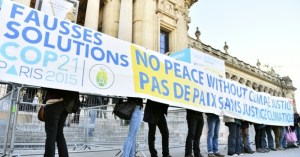
The agreement commits its signatories to a wonky goal: A “balance between anthropogenic emissions by sources and removals by sinks of greenhouse gases” before the end of the century. In practice, that means an economy with net zero emissions as soon as possible, paving the way for a massive uptake in renewable energy and the careful preservation of the world’s forests. It also includes a global temperature target of “well below” a rise of 2 degrees Celsius above pre-industrial levels and instructs them to “pursue efforts” to keep the increase to just 1.5 degrees, amajor victory for the small island countries that formed the moral heart of the negotiations.
Negotiators worked throughout the two weeks—plus an extra day—on delivering a bold compromise, arriving with legally binding language on financial and technical support to developing countries and a novel “ratchet” mechanism that commits all nations to return to the negotiating table and increase their ambition every five years.
Shipping and air travel, which account for about 8 percent of global emissions, were excluded from the agreement due to the quirk of their international nature, though even those sources are scheduled to be part of separate agreements next year.
It’s by no means a perfect deal, but the final wording of the agreement reflects major achievements in science and diplomacy that have been in the works for decades. Small island countries, in particular, played a critical role at bridging differencesbetween the major developed countries, like the U.S. and Europe, and major developing countries, like India and China. This is an agreement that’s designed to last a century, and will shape the trajectory of both threatened ecosystems and the global economy for the foreseeable future.
As you read links, you will see that this is a very slow and incremental process. It is probably too slow to save both the Louisiana Coast and Southern Florida. Here’s the most comprehensive information on the negotiations and accords.
Here are key resources on the Paris Agreement and events leading up to it.
Summary of the Paris Agreement
Parties to the U.N. Framework Convention on Climate Change (UNFCCC) reached a landmark agreement on December 12 in Paris, charting a fundamentally new course in the two-decade-old global climate effort.
The agreement reached in Paris at the conclusion of COP 21 seeks to address rising emissions and climate imapcts with tools to hold countries accountable and build ambition over time.
Essential Elements of a Paris Climate Agreement
A concise, comprehensive guide to what Paris needs to deliver: a legal agreement that ensures strong accountability and spurs rising ambition. Issues include long-term direction, mitigation, adaptation, finance, transparency and updating of national contributions.
A Primer on the Paris Climate Talks
Questions and answers on the history of the U.N. climate talks, key issues under negotiation, the legal nature of the agreement, implications for U.S. acceptance, and what happens after Paris.
Business Support for the Paris Agreement
Fourteen major companies joined a statement organized by C2ES calling for an agreement that provides clearer long-term direction, strengthens transparency, promotes greater comparability of effort, and facilitates the global carbon market.
Read a seminal report from the co-chairs of C2ES’s Toward 2015 dialogue, which brought together top negotiators from two dozen countries for a series of candid, in-depth discussions that forged common ground on key issues for Paris.
Legal Options for U.S. Acceptance
This C2ES legal analysis examines whether the Paris climate agreement can be accepted by the president under executive authority or must be approved by Congress.
So, this is a bonus, creepy crime-ridden tale of swampy Louisiana and it involves one of my favorite topics. There’s an abandoned pet cemetery with a complex and dark history that was featured by a photographer shooting during the Katrina 10 year anniversary. It’s actually got violent history back to about 1854 when it was still part of a vast plantation and hosted a duel. It seems an odd way to end a climate change post but just think how creepy it’s going to be when a whole lot of today’s real estate is an abandoned, swampy ghost town. That’s where we’re headed.
The duel may have marked the first of many bloodspills involving the Toca pet cemetery property’s once and future owners, as well as those intangibly associated with what is now an overgrown, bayou-side graveyard and the axis of a recently exhumed 27-year-old murder investigation. The probe has opened a crack in an ageless odyssey of killings, betrayal, buried treasure and intrigue, all tied to a 14-acre tract in tiny Toca, Louisiana.
Today, the property consists of a derelict but once classic Edwardian manor encircled by overgrown animal tombstones on the right bank of Bayou Terre-aux-Boeufs, just below Poydras in rural St. Bernard Parish, about four miles from the Mississippi River.
Last month, authorities claimed to have solved the most recent crime on this killing field of south Louisiana when the St. Bernard Sheriff’s Office booked Brandon Nodier, a former groundskeeper at the cemetery, with the 1985 murder of Dorothy Thompson, an heiress whose own legacy is splattered with bloodshed. But many intrigues, such as the whereabouts of a missing half million dollar fortune, perhaps will linger forever, lost with those now dead and gone.
Historic court records, police reports, newspaper clippings, biographies, interviews, marriage, divorce and death records reveal a bizarre history of the pet cemetery that for three decades attracted animal lovers from throughout the South.
So, that’s it from me on a gloomy New Orleans Monday.
What’s on your reading and blogging list today?
Friday Reads
Posted: December 11, 2015 Filed under: 2016 elections, Afternoon Reads | Tags: Ben Carson, Donald Trump, Every Child Succeeds, Mitt Romney, No Child Left Behind, Republican Brokered Convention, Senator Al Franken, US Education Reform 9 Comments
Good Day!!
There’s actually a bit of good news this week hidden among the atrocities. “No Child Left Behind” has been replaced with “Every Child Succeeds”. That sounds like one replacing one bit of jargon for another. However, there’s some substantive changes and there’s some hope it will be good for teachers, students, and taxpayers.
The testing and accountability regime–which really led to a layer of bureaucracy, massive testing and costs–has been criticized by the education community since its inception. I remember hearing it called “No Teacher Left Standing” by friends teaching in the Public Education system. It’s a function of corporate bureaucrat think which basically frames all situations in terms of no one can be trusted but a report-generating middle man who basically just ensures every one does their jobs based on some really bizarre set of standards invented by Corporate CEOS like Romney, Fiorino and Trump who notably have no clue what they’re doing in their own companies let alone a school system.
Select “educational outcomes” were boiled down to the most base things and it resulted in teaching to a particular test because teachers feared for their jobs. The idea of developing a child’s critical thinking skills, their ability to work with others, and their basic nature of surging, fixating and mastering one content area using a variety of different senses was ignored. As a result, “No Child Left Behind” represented the worst of American Business practices. Trivial outcomes were emphasized. Control was paramount. The humanity of teachers and students was ignored. Bureaucratic managers and unnecessary consultants raked in money as Districts struggled to implement and report results.
Unfortunately, this mindset has also crept into Higher Education and I can tell you that my job has switched from teaching to constantly grading stuff, reporting on outcomes, and paperwork. It’s not a good situation for any one. It creates a really stressful, negative environment too.
Here’s a good basic outline by USA Today on what’s changing. This was a bipartisan effort which has been extremely rare given the pledge by Republicans to thwart any possible Obama-backed law.
No Child Left Behind:
The Elementary and Secondary Education Act of 1965, signed by President Lyndon Johnson, was a civil rights law that provided education funding to states and attempted to ensure that every student had access to an education. The law would expire every three to five years, requiring Congress to reauthorize it. In 2001, Democrats and Republicans in Congress became increasingly concerned by the growing achievement gaps that left poor and minority students in failing schools, and devised a system of testing and accountability to fix it. “The fundamental principle of this bill is that every child can learn, we expect every child to learn, and you must show us whether or not every child is learning,” President George W. Bush said in the Jan. 8, 2002, signing ceremony.
Every Student Succeeds Act: The new law tries to preserve the spirit of No Child Left Behind, while fixing what were widely perceived as its one-size-fits-all approach.“The goals of No Child Left Behind, the predecessor of this law, were the right ones: High standards. Accountability. Closing the achievement gap,” Obama said Thursday. “But in practice, it often fell short. It didn’t always consider the specific needs of each community. It led to too much testing during classroom time. It often forced schools and school districts into cookie-cutter reforms that didn’t always produce the kinds of results that we wanted to see.”
NPR has some interesting analysis on the law.
The new law changes much about the federal government’s role in education, largely by scaling back Washington’s influence. While ESSA keeps in place the basic testing requirements of No Child Left Behind, it strips away many of the high stakes that had been attached to student scores.
The job of evaluating schools and deciding how to fix them will shift largely back to states. Gone too is the requirement, added several years ago by the Obama administration, that states use student scores to evaluate teachers.
The new law, which passed the House and Senate with rare, resounding bipartisan support, would also expand access to high-quality preschool.
Before the signing, President Obama made clear that he believed the goals of NCLB — namely high standards, accountability and closing the achievement gap — were the right ones. But in practice, he said, the law fell short.
“It often forced schools and school districts into cookie-cutter reforms that didn’t always produce the kinds of results that we wanted to see,” Obama said.
NCLB was signed by President George W. Bush in early 2002 and was, itself, an update of a much older law — the Elementary and Secondary Education Act of 1965. While ESSA officially marks the end of the NCLB era, the majority of states have for several years received waivers from the Obama administration, exempting them from some of the law’s toughest requirements.
Minnesota Senator Al Franken was a key supporter and mover for the change. You can see his speech to the Senate encouraging a yes vote on the bill on his web page. Minnesota is a state that is consistently one of the best for educational outcomes and has a vibrant public school system.
Now, this bill is not perfect. But it’s a huge improvement over NCLB. Over the last 13 years, we learned that the one-size-fits-all approach to fixing failing schools wasn’t working. That’s why this bill is designed to find a balance between giving states more flexibility while still making sure that states intervene and fix schools where students are not learning.
Over the last several years, I’ve met with principals, teachers, students, parents, and school administrators in Minnesota. These conversations have helped me develop my education priorities to help improve our schools, our communities, and our nation’s future. I worked with my colleagues on both sides of the aisle to find common ground, and I’m very pleased that many of my priorities to improve student outcomes and close the achievement gap are reflected in the legislation that is before us today.
These priorities include things like strengthening STEM education, expanding student mental health services, increasing access to courses that help high school students earn college credit, and improving the preparation and recruitment of principals for high need schools. I also successfully fought to renew the 21st Century Community Learning Centers program which provides critical after-school learning activities for students. Another one of my priorities helps increase the number of counselors and social workers in our schools.
And my provision to allow states to use Computer Adaptive Tests will go a long way toward improving the quality of assessments used in our schools and will give teachers and parents more accurate and timely information on their students’ progress.
I was also able to include a new Native language immersion program because I believe language is critical to maintaining cultural heritage and helping Native American students succeed. In addition, I wrote a provision to provide foster children who move to new school districts the opportunity to stay at their current school if it’s in their best interest.
Again, I’m very pleased that these priorities have been included in the legislation we are considering today, and I thank my colleagues for working with me on them. These provisions will help hundreds of thousands of students in Minnesota and across the country reach their full potential.
So one of the most interesting things that has just come out of the battle royale that is the republican presidential primary campaign is the news that a supposed “secret” meeting took place among establishment Republicans like Dick Cheney. There is now official talk of a brokered convention. Establishment Republicans have been concerned about the rise of both Donald Trump and Ben Carson and the incredible chaos that’s occurred because of differences in priorities between insurgent and establishment Republicans. We may be looking at an event that hasn’t happened for some time.
 Will there be a contested convention?
Republican officials and leading figures in the party’s establishment are preparing for the possibility of a brokered convention as businessman Donald Trump continues to sit atop the polls in the GOP presidential race.
More than 20 of them convened Monday near the Capitol for a dinner held by Republican National Committee Chairman Reince Priebus, and the prospect of Trump nearing next year’s nominating convention in Cleveland with a significant number of delegates dominated the discussion, according to five people familiar with the meeting.
Weighing in on that scenario as Priebus and Senate Majority Leader Mitch McConnell (R-Ky.) listened, several longtime Republican power brokers argued that if the controversial billionaire storms through the primaries, the party’s establishment must lay the groundwork for a floor fight in which the GOP’s mainstream wing could coalesce around an alternative, the people said.
The development represents a major shift for veteran Republican strategists, who until this month had spoken of a brokered convention only in the most hypothetical terms — and had tried to encourage a drama-free nomination by limiting debates and setting an earlier convention date.
Now, those same leaders see a floor fight as a real possibility. And so does Trump, who said in an interview last week that he, too, is preparing.

Ben Carson on Friday blasted the Republican National Committee following a Washington Post report that nearly two-dozen establishment party figures were prepping for a potential brokered convention as Donald Trump continues to lead most polls.
RNC Chairman Reince Priebus held a dinner in Washington, D.C., on Monday, and, according to five people who spoke with the Post, the possibility of Trump heading into the Cleveland convention with a substantial number of delegates was a topic of discussion. Some attendees suggested the establishment lay the groundwork for a floor fight that could lead the party’s mainstream wing to unite behind an alternative. Carson rejected this approach.
“If the leaders of the Republican Party want to destroy the party, they should continue to hold meetings like the one described in the Washington Post this morning,” Carson said in a statement released by his campaign.
Carson said he prays the Post’s report is incorrect and threatened to leave the GOP. “If it is correct, every voter who is standing for change must know they are being betrayed. I won’t stand for it,” said Carson, who added that if the plot is accurate, “I assure you Donald Trump won’t be the only one leaving the party.”
The retired neurosurgeon said that next summer’s Cleveland convention could be the last Republican National Convention if leaders try to manipulate it.
“I am prepared to lose fair and square, as I am sure is Donald,” Carson said. “But I will not sit by and watch a theft. I intend on being the nominee. If I am not, the winner will have my support. If the winner isn’t our nominee then we have a massive problem.”
Establishment Republicans fear that Donald Trump–as their presidential nominee–means that Democratic party will have a real chance at taking back the Senate and even the House. The Cook Political Report explains that this might be an overreaction.

To most Republican strategists, there’s no bigger nightmare than Donald Trump as the GOP’s presidential nominee in 2016. This week, just about every Democrat running for president, Senate, House, and their respective campaign committees sought to tie Republicans to Trump and brand them one big bunch of xenophobes. Talk of a down-ballot Republican apocalypse has reached fever pitch.
Even setting aside the remoteness of a scenario in which Trump would face Hillary Clinton in a one-on-one contest, such talk is premature and possibly overblown.
Given Trump’s unpopularity with the electorate overall, there’s a possibility he could end an era of very close and competitive presidential elections and suffer a landslide defeat (by modern standards). But what would that mean down-ballot? If Trump becomes his own radioactive island, GOP candidates in swing districts would have no choice but to renounce him and run far away for cover.
The challenge in assessing their odds for survival in such a scenario is that there hasn’t been a blowout presidential election in a very long time. However, history is on the GOP’s side.
Since 1960, there have only been three elections in which one candidate prevailed by a double-digit margin in a presidential race: Lyndon Johnson over Barry Goldwater in 1964 (by 22.6 percent), Richard Nixon over George McGovern in 1972 (by 23.2 percent), and Ronald Reagan over Walter Mondale in 1984 (by 18.2 percent). In all three instances, Democrats retained control of the House.
Despite the predictable outcome of each of the three landslides, there is scant evidence the losing side’s demoralized voters stayed home in huge numbers or bolted their party en masse down-ballot compared to the previous presidential cycle. In each case, voters seemed to evaluate presidential candidates on a case-by-case basis but stuck with their core party preferences for Congress.
With Donald Trump’s ruinous domination of the Republican primary polls showing no signs of abating, top leaders in the GOP are reportedly now preparing for the possibility of a contentious brokered convention next year in Cleveland.
If that happens, a small group of wealthy donors and die-hard loyalists close to Mitt Romney will be ready with a strategy to win him the nomination from the convention floor.
Romney thought seriously about entering the 2016 race earlier this year, and ultimately decided against it. But as I report in my new book, The Wilderness, when the former Republican nominee informed friends, family, and a few close allies late in January that he was going to announce his decision to bow out, some urged him to reconsider:
The Republicans have seriously lost it. All I can say is that Nixon’s Southern Strategy has caused the vultures to come home to roost.
What’s on your reading and blogging list today?

 peej
peej Carissa
 bostonboomer
 dakinikat
 ecocatwoman
 jjlo
jjlo mablue2
 Mama Lopez
 peggysue22
 quixote
 skydancingguestblogger
 Mona (aka Wonk the Vote)





Recent Comments