
Friday Reads
Posted: January 29, 2016 Filed under: 2016 elections | Tags: attacks on the media, Bernie Sanders, Donald Trump, intersectionality, misogyny, Sexism 36 Comments
Where Y’at?
Today is one of those perfect New Orleans Winter days! It’s sunny and 68 degrees F. It’s brisk enough for a walk in a sweater which is just how I like it. It’s a great day for checking out the local Mardi Gras decorations prior to the descent of the Ugly Tourist. It’s always so glittery until the day it all goes down. Then, it’s mostly drunk people and disappointment.
Speaking of drunk people and disappointment, the Iowa caucuses are Monday night which supposedly signals the end of the silly season. I guess we’ll see about that. I’m still struck by the similarities between the Trump and Sanders campaigns. Perhaps it’s the nature of so-called “outsider” campaigns. You know me, I still wonder how a long term Senator and a Trust fund Baby Billionaire can be outsiders. It just seems that mostly what we’re getting is attacks on the press and disassociation of policies with reality and intersectionality.
Bernie Sanders and WAPO are going back and forth today about the paper’s criticism of his campaign and policy suggestions. Jonathan Capehart–speaking on Hard Ball last night–said that the voice of the editorial page on this was Chris Cillizza so that’s who probably wrote this response today. I actually find myself agreeing with him. Sanders ideas simply are lofty goals. They do not add up when actually put to the pencil which is the kind of thing that I’ve spent my 35 years of adult life having to do for huge corporations, for the Fed Atlanta, and for primary research. The term used at WAPO was “half-baked”.
Sanders suggests they are too “bold” for the staid WAPO. Today, WAPO characterizes them as over-promising.
What concerns us is not that Mr. Sanders’s program to tackle these issues is “radical,” as he put it, but that it is not very well thought out. We are far from the only ones, for example, to point out that his health-care plan rests on unbelievable assumptions about how much he could slash health-care costs without affecting the care ordinary Americans receive. “Their savings numbers are — well, politely said — simply wrong,” Emory University health-care expert Kenneth E. Thorpe told Vox. Mr. Thorpe, who is not hostile to single-payer systems of the type Mr. Sanders favors and has even advanced single-payer plans of his own, released an analysis Wednesday finding that Mr. Sanders’s proposal would cost $1 trillion more than the candidate estimated. That is not over a 10-year budget window. That is every year.
Mr. Sanders’s response to concerns over health-care costs was that other countries, such as Canada and France, spend much less than the United States per person on health care. That is true, but the question is how, specifically, he would make the model work here. The countries he praises ration care in ways that federal health programs in the United States, such as Medicare, do not. While there may be a fair case for a single-payer health-care system, Mr. Sanders does not make it. Instead, he promises comprehensive benefits without seriously discussing the inevitable trade-offs. That is not just bold; it is half-baked.
Health-care policy is only one place where Mr. Sanders makes solving the country’s difficult problems seem easy and obvious when reality is messier. He would use higher taxes on Wall Street and the rich to fund vast new programs, such as free college for all, but has no plausible plan for plugging looming deficits as the population ages. His solution to the complex international crises the United States must manage is to hand them off to others — though there is no such cavalry. This might not distinguish him much from other politicians. And that is part of the point: His campaign isn’t so much based on a new vision as on that old tactic known as overpromising.

Mardi Gras decorations on a Bourbon Street balcony, French Quarter
This is one thing that I’ve really noticed from all the outsider campaigns this year which definitely have some political steam. Trump promises a wall across our Southern Border paid for by the Mexican Government. This project would cost tens of billions of dollars.
“I would build a great wall, and nobody builds walls better than me, believe me, and I’ll build them very inexpensively. I will build a great, great wall on our southern border. And I will have Mexico pay for that wall. Mark my words,” Trump said in his presidential announcement speech.
The jingoistic Rubio and Cruz promise to level ISIS and hundreds and thousands of their innocent victims right along with them. The rhetoric in this campaign is so over the top that I find myself wondering if so many candidates have overpromised on so many things in one presidential primary before. It’s really odd because I actually found Jeb Bush’s attempts to bring the Republicans back to reality last night at the debates both sad and heartening. No one seemed to care much about Jeb’s pronouncements except the few folks with a firm grip on political and scientific reality. But even then, we continue to get treated to crap like the question-ability of global warming and the call to defund Planned Parenthood which provides so many health care services to so many people that it’s essentially a call for mass slaughter of one’s own citizens.
We continue to see absolute phony promises and little desire on the part of electorate to wake the fuck up. They cannot complain about being sorely disappointed in their elected officials when the elected officials they fall in love with spout absolute crap and nonsense. The numbers are relevant. The analysis is by Albert Hunt for Bloomberg so it comes with a be forewarned from me.
The overpromising may be more egregious than ever in the 2016 presidential race. Yet taxes were glossed over in the debate of Republican candidates last week.
Donald Trump says that his tax plan, which has huge reductions in rates and on the amount paid on investment income, focuses on working folks and sticking it to billionaires such as himself. A recentanalysis by the Tax Policy Center showed just the opposite. The Trump plan would cost the Treasury $9.5 trillion over the first decade, and almost $25 trillion over 20 years. The tax cuts would principally benefit the wealthy, almost 40 percent would be for the top 1 percent. The superrich — the top one-tenth of 1 percent — would get an average annual tax cut of $1.3 million.
By comparison, the lowest, or poorest quintile, would get an average tax cut of $130, or 1/1000th of what the wealthiest receive. In percentage terms, the top 1 percent gets a 7 percent cut, the poorest taxpayers a 1 percent reduction.)The center also analyzed Jeb Bush’s proposal, which would cost less: $6.8 trillion in a decade. The distributional effects would be almost the same, the center found, with upper-income taxpayers receiving much of the benefit. The wealthiest 1 percent would get an average annual tax deduction of $167,325.
The center plans to examine the plans of Senators Marco Rubio and Ted Cruz next week. Although some of the specific proposals are different, the bottom lines are expected to be similar.
Both the Bush and Trump tax plans would “improve incentives to work, save, and invest,” the center stated, while noting that these gains could be partly offset by increases in the national debt.
Also, while both these Republican plans would remove any limits on exemptions for charitable contributions, the Tax Policy Center projected that the steep reduction in rates would reduce the incentive to give to charities.
Conservatives complain that the center is associated with the left-leaning Brookings Institution and the Urban Institute. But the analysts include Republicans, and the team reached out to the campaigns and Republican economists for input. The conservativeTax Foundation, while projecting smaller revenue losses, concurs that the distribution of the cuts heavily tilts to the wealthy.
The center has also said that the liberal Democrat Bernie Sanders significantly exaggerates the revenue that would be brought in by his financial transaction tax. The Vermont senator hasn’t produced a comprehensive tax plan that would pay for the enormous expansions of social programs he proposes: universal health care coverage, free tuition at public institutions and huge infrastructure projects. He advocates further tax increases on the wealthy, but some hikes for the middle class seem inevitable under his plan.
Hillary Clinton, seeking to stem a surge by Sanders in the Democratic nomination race, rushed out a proposal last week that would impose a levy on annual income of more than $5 million. Her spending proposals are more modest than those of Sanders, as is her tax plan. But she has vowed not to increase taxes on anyone making $250,000 or less, a promise that some Democratic economists say is unrealistic.
I suppose no politician ever really lost an election by overpromising, but sometimes you just have to wonder how gullible the American populace really is. However, these are the same folks that send money to Pat Robertson and think that Rick Warren speaks for an actual and very angry Sky Fairy.
Some of us made it through the Republican Debate last night that had the notable absence of Donald Trump who is perhaps the beacon of over-promising, under-delivering, and covering it up with bravado. 
Here comes Donald Trump, again, and again, and again, touting his prowess at dealmaking. There goes Donald Trump, again, and again, and again, touting his prowess at dealmaking. Gliding into February’s Republican presidential primaries atop a flotilla of polls, Trump has made “deals” the litmus test of his candidacy.
“If I’m president,” he announced at the most recent GOP debate, “there won’t be stupid deals anymore.”
But a well-documented and widely reported trail of bad deals litters Trump’s career as a real estate developer and gambling mogul. (Disclosure: I wrote a book about the Republican candidate,“TrumpNation,” for which he sued me in 2006 because, among other things, it questioned the size of his fortune; the suit was laterdismissed.)
Fueled by a slew of bank loans in the late 1980s, Trump absorbed an airline, a football team, a landmark hotel, a bunch of casinos, a yacht, and other nifty stuff — almost all of which he eventually lost because he couldn’t juggle the debt payments.
He overcame those setbacks, but the man who emerged from that mess wasn’t really a dealmaker anymore. Kept afloat by his wealthy father’s funds and his own gifts for self-promotion, Trump became a reality TV star, golf course developer and human shingle who licensed his name on everything from real estate and vodka to mattresses and underwear.
Through Trump’s rise, fall and rebirth, there was one major real estate project that he tried to keep. The tale of what happened to that property should be of interest to anyone looking for insight into how Trump might perform as president. It was a deal of genuine magnitude and would have put him atop the New York real estate market. And he screwed it up.
I’d like to say that gullibility is symptomatic to the new, disintegrating Republican Party but it’s alive and well in the Sanders campaign too. However, it does look like the Sanders campaign will burn out. There’s some indication that what will happen in 2016 will be a burn out of the Republican Party itself. Frankly, I’ve been expecting this ever since the evangelicals stormed the country club back in the 1980s. Donald Trump may be the straw meeting the camel’s back. Read this interview with Rick Perlstein who has documented modern conservatism for a number of years.
Are you surprised that things seem to be turning up Trump?
I had a very interesting experience this summer. I remember exactly when it was. It was when I was reading an article by [Evan] Osnos in the New Yorker about Trump. He happened to be covering the white nationalist movement, basically neo-Nazis. Coincidentally, it was right when Donald Trump burst onto the scene, and he wrote about how these guys were embracing Trump, as they never had embraced any Republican candidate before. The feeling I got was that this was the first time in a very long time that I’ve read anything about the Republican Party that I couldn’t assimilate into my normal categories. That was a very uncanny and uncomfortable feeling for me. I realized that I had to go back to the drawing board and rethink what was going on. This is something that’s very new, very strange, and very hard to assimilate into what we thought we knew about how the Republican Party worked.
How has it changed your opinion of how the Republican Party works?
Well, of course, the whole of my intellectual project, which I have been working on for a good, solid 15 years now, has been the rise of a conservative infrastructure that has taken over the Republican Party and turned it into a vehicle for conservative policy. If there’s one thing that I thought I knew, it is that basically the ideas and the institutions that were born through the Goldwater movement were a backbone of this conservative takeover of the Republican Party. Donald Trump is perhaps most interesting in his lack of connections to that entire world. The first sign that something very different was happening was when he basically rejected Fox News, threw them over the side, and had no interest in kowtowing to them.
That has been amazing to behold.
By the same token, things I’ve been tracing about conservatism and the conservative takeover of the Republican Party as a backlash against the forces of liberalism—and anger at perceived liberal elites and all of the racial entailments of that—are part of the Trump phenomenon, too. So, how these things mix together and how they produce the phenomenon we’re seeing now is something that’s been very humbling for me.
Do you think the things that Trump has been exploiting have always been exploitable, or do you think that some conditions, either in the Republican Party or the country at large, have changed and made Trump possible?
That’s a good question. I think that people who base their political appeal on stirring up the latent anger of, let’s just say, for shorthand’s sake, what Richard Nixon called the “silent majority,” know that they’re riding a tiger. Whether it was Richard Nixon very explicitly, when he was charting his political comeback after the 1960 loss, rejecting the John Birch Society. Or whether it was Ronald Reagan in 1978 refusing to align himself with something called the Briggs Initiative in California, which was basically an initiative to ban gay people from teaching, at a time when gays were being attacked in the streets. Or whether it was George W. Bush saying that Islam is a religion of peace and going to a mosque the week after 9/11. These Republican leaders have always resisted the urge to go full demagogue. I think they understood that if they did so, it would have very scary consequences. There was always this boundary of responsibility, the kind of thing enforced by William F. Buckley when he was alive.
I think that Donald Trump is the first front-runner in the Republican Party to throw that kind of caution to the wind. As demagogic as so much of the conservative movement has been in the United States, and full of outrageous examples of demagoguery, there’s always been this kind of saving remnant, or fear of stirring up the full measure of anger that exists.
 Again, I will say that a good number of both Trump and Sanders supporters are angry white men and they love all these promises because the lack of talk on intersectionality is taken as a return to their predominance in one way or another. The separating feature appears to be age. They seem to bask in white male privilege and view the idea of any one else achieving equality with them as a lose on their score cards. Melissa at Shakesville has some very astute analysis here about Sanders which explains to me why so many young, white, scared males are attracted to Sanders’ vision.
I will never forget having to see a female president start her campaign event by addressing misogyny, intended as a “compliment.”
I will never not understand that Hillary Clinton is not allowed to forget her womanhood for a moment, even if she wanted to, while she is running for president, and what it means that Bernie Sanders’ primary line of attack against her depends on treating her womanhood like it doesn’t matter.
This, of course, is indicative of Sanders’ entire campaign, where gender, or any identity, isn’t what’s important; the issues are. And no wonder: If Sanders actually embraced an intersectional approach that detailed how marginalized people are disproportionately and differently affected by economic, social, and political injustice, it might become abundantly clear how absurd it is to continually suggest that a woman is representative of the establishment.
And oh how absurd it is, truly, when one takes a long gaze at the uninterrogated misogyny that is being lobbed at Clinton, even by ostensible progressives. (That link shared with Erica’s permission.) If gender really didn’t matter, then it wouldn’t matter to Clinton’s opponents, either.
But it does. Clinton’s womanhood matters. Her clothes matter. Her hair matters. Her voice matters. Her tone matters. Her likeability matters. Her emotions matter. Her “murderous cackle” matters.
The thing about “the establishment” is that it’s impervious to such demeanment.
It sets the rules by which Hillary Clinton is judged ever wanting, by virtue of metrics that are inextricably tied to womanhood.
There is a person in this Democratic primary who can be visibly angry, who can shout, who can use any tone and show any emotion, who can show up to campaign events looking like they just rolled out of bed after a bender. Who can coast by on the double-standard defined and enforced by the establishment.
It is not Hillary Clinton.
All the things I am admonished to admire about Bernie Sanders, that he is passionate, that he is unpolished, that he is impolitic, that he doesn’t give a fuck, are things that the very establishment he allegedly wants to dismantle do not afford his female competitor.
 How is this different from all the things that Trump has said about Megyn Kelly which increases his viability in the eyes of so many pundits and voters alike? Yes. Just like we’ve had to defend Sarah Palin and Michelle Bachmann from slut slamming and misogyny, we have to defend Megyn Kelly. Republican Rednecks and Democratic DudeBros both swim in the same shark tank and spout the same sexist nonsense.
Early Thursday morning, Trump followed up with a new line of attack,retweeting a pair of images from a photoshoot Kelly did for GQ magazine and the message: “And this is the bimbo that’s asking presidential questions?” The images were captioned: “Criticizes Trump for objectifying women. Poses like this in GQ magazine.”
We also were treated, last night, to Rand Paul mansplaining that Hillary Clinton can’t be a feminist icon because Monica Lewinsky and because Bill’s still her husband.
So, tell me, how are these campaigns essentially any different when you’ve got most of them promising things that they can never deliver and acting like there’s no such thing as sexism or institutional racism outside of making the right minimal gestures and that every one will benefit the same from their beneficence? How many people are going to get fooled by this again? And which campaigns acknowledge that the US is in fact full of a women, children, and men of many creeds and colors? Oddly enough, it’s the two big “establishment” candidates that speak to inclusion and to varying degrees, intersectionality.
Frankly, I have one thing to say. This country does not need any more Great White Fathers in Washington. The majority of us have been the White Man’s burden and chattel for too long. Campaigns and politicians like these two need to be stopped now. They’re establishment wolves in anti-establishment sheep’s clothing.
What’s on your reading and blogging list today?
Live Blog: Fox Iowa GOP Debate sans the Strump
Posted: January 28, 2016 Filed under: 2016 elections, Live Blog | Tags: Donald Trump, Fox, Iowa GOP Debate, Megyn Kelly, Roger Ailes 176 Comments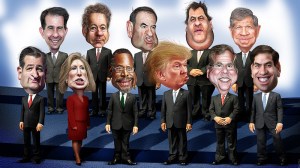 Can the 2016 primaries get any more odd? Tonight’s the final Republican debate prior to the Iowa Caucuses next Monday. Frontrunner Donald Trump will be holding an alternative event that will be attended by other candidates Mike “the Huckster” Huckabee and Rick “the frothy” Santorum. The event will benefit Veterans by sending money to a nonprofit that’s notorious for not spending its money on Veterans. It’s not sure who the Fox Debate will benefit although bets seem to be on Cruz or Rubio. Rand Paul figured out how to get on the main stage. Whine.
Republican presidential candidates will square off Thursday evening at the Iowa Events Center in Des Moines, Iowa. The debate is the final one before next Monday’s Iowa caucuses, and is especially notable for being the first one in which Donald Trump is not present.
Both the undercard and primetime debates will air on Fox News, with a different set of moderators for each. The earlier event, which begins at 7 p.m. ET, will be hosted by America’s Newsroom anchors Martha MacCallum and Bill Hemmer, and will feature four candidates: Rick Santorum, Carly Fiorina, Mike Huckabee, and Jim Gilmore.The primetime event will begin at 9 p.m. ET, and will be moderated by Megyn Kelly, Chris Wallace, and Bret Baier. Participating in the big event are Ted Cruz, Marco Rubio, Ben Carson, Jeb Bush, Chris Christie, John Kasich, and Rand Paul. Frontrunner Donald Trump qualified for the event but declined to participate because of his ongoing feud with Fox News.
Cruz is chomping at the bit to go one on one with the Strump and has even set up a venue. Trump’s campaign manager has said there’s no point to debating some one that may not even be eligible to be President. (Ouch)
Donald Trump’s campaign manager Corey Lewandowski said on Thursday that his candidate would be “happy” to debate Ted Cruz once the Texas senator gets a federal judge to rule him eligible to run for president.
“Once you’ve gotten that ruling from the federal judge and you’re the last man standing in this presidential contest next to Donald Trump, we’ll be happy to have a debate with you one-on-one, anywhere you want, because that’s the way the system works,” Lewandowski said. “But, as it stands right now, we don’t even know if Ted Cruz is legally eligible to run for president of the United States.”
Trump and his supporters have argued that Cruz, who was born in Canada to a U.S. citizen, is not natural born and therefore ineligible to run for president under the Constitution.
Cruz challenged Trump to debate him one-on-one after Trump announced that he would not be attending the Fox News Republican presidential debate Thursday night because of objections to the presence of anchor Megyn Kelly and a statement Fox issued in response to his complaints.
“What this is, is a publicity stunt by Senator Cruz who is continuing to fall in the polls in the state of Iowa,” Lewandowski told Boston radio host Jeff Kuhner, before unleashing a slew of attacks at Cruz, arguing that he had used “dark money donors” through his super PAC to offer a donation to charity if Trump agreed to the debate.
Pundits are discussing the internecine battles apparent in the Republican Party since Trump has obviously challenged Roger Ailes Kingmaker status and placed the  party itself in a pretty weird place. Priebus was on MSNBC earlier on the weekday MTP explaining that the party really had nothing to do with the debates other than setting up the venues and times even though it had earlier removed media outlets for participating. This group is not Bob Dole’s Republicans, for sure.
Trump’s rivals view the debate as a chance to get their own messages across without having to compete with Trump’s bomb-throwing rhetoric.
“It gives us more time at the microphone and more time to talk about answers to substantive issues that Iowa voters are demanding right now,” said David Kochel, a senior adviser to Republican candidate Jeb Bush.
“It is undeniable that what he’s doing is denying his opponents a large audience as they make their final arguments to Iowa voters,” said Eric Fehrnstrom, a Republican strategist who advised the party’s 2012 nominee, Mitt Romney.
While it might be tempting for Trump’s rivals to use the debate to criticize him aggressively, some Republican analysts are cautioning against a scorched-earth approach.
“It’s delicate for the candidates because you have to pull back from attacking a man who is not there,” said Ari Fleischer, who was White House press secretary for President George W. Bush. “It will be OK to make a passing reference or two, the fact that he’s not there. But if you try to beat him up, it won’t play well because he’s not there to defend himself.”
Campaigning on Wednesday in West Des Moines, Cruz mocked Trump for skipping the debate, calling him a “fragile soul.” He renewed his offer to Trump to debate him one-on-one.
After ducking the final Republican presidential debate heading into next week’s Iowa caucuses, GOP front-runner Donald Trump announced that he would hold his own pro-veterans event during the debate to raise money for veterans. Trump even set up a special website to solicit donations to help veterans.
“Honor their valor,” the website, donaldtrumpforvets.com, states. “Donate now to help our Veterans.”
The website, which is nothing more than a single page with stock photosand a credit card donation form, claims that “100% of your donations will go directly to Veterans needs.”
There’s only one problem: 100% of the money raised on the site goes directly to Donald Trump’s personal non-profit foundation, according to a disclosure listed at the bottom of the page.
“The Donald J Trump Foundation is a 501(c)(3) nonprofit organization,” the disclosure reads. “An email confirmation with a summary of your donation will be sent to the email address provided above.”
Well, alright then. Guess vets will have to kiss the ring to be considered for the money.
Josh Marshall–while regretting the gender bias in the term–is looking at this as the “bitch slap” theory of politics. He has a few interesting thoughts on the matter of Trump challenging Ailes.
But this driving force of Republican politics has only become more salient and central as the GOP has become increasingly dominated by core constituencies animated by anger and resentment that things to which they believe they are entitled are being taken away from them.
Trump doesn’t apologize. He hurts people and they go away. He says things that would kill a political mortal (ban members of an entire religion from entering the country) and yet he doesn’t get hurt. Virtually everything Trump has done over the last six months, whether it’s a policy proposal or personal attack, has driven home this basic point: Trump is strong. He does things other people can’t.
This is why Trump has so shaken up and so dominated the GOP primary cycle, at least thus far. As I’ve said, this kind of dominance symbolism is pervasive in GOP politics. It’s not new with Trump at all. Most successful Republican politicians speak this language. And yet somehow for most it is nonetheless a second language. But it’s Trump’s native language. I still believe it’s rooted in the mix of the hyper-aggressive New York real estate world, his decades of immersion in the city’s febrile tabloid culture and just being, at the most basic level, a bully. Wherever it comes from, he seems to intuitively get that for this constituency and at this moment just demonstrating that he gets his way, always, is all that really matters. Policy details, protecting the candidate through careful press releases and structured media opportunities … none of that matters. Trump doesn’t kiss babies. Babies kiss him. He doesn’t have a billionaire backer; he is a billionaire. Trump doesn’t ask for support. He just tells you that you need to stop being a loser and get on board.
So this debate power play is all of a piece. He can just take the table, flip it over and walk out of the room. It’s all about him.
There is no question that Trump will completely dominate tomorrow night’s debate by his absence. After all, he’s the one in the lead everywhere. If he’s not there, what is there to talk about? The Rubio v Christie stand off? Jeb? Who cares?
It may be two plus hours of people attacking him without him being there to respond – and the moderators themselves out to get him too. But again, it’s still all about him. He can make it all about him by not even being there. He doesn’t kowtow to Fox News or go on retainer with the network during the off-season. He calls the shots. And there is little question in my mind that in one fashion or another you will have two competing TV shows tomorrow night, Trump’s and everybody else’s. And Trump’s will almost certainly be better.
So, grab a beer or a cuppa, a nice comfy sitting situation, and a bag full of nerfballs to throw at the TV. It’s time to listen to Right Wing Anger and Paranoia.
Friday Reads: Odd Ducks with Odd Flocks
Posted: January 22, 2016 Filed under: 2016 elections | Tags: American Populist, Bernie Sanders, Donald Trump, Eric Hoffer, populism on the left and right, The True Believer 37 Comments It’s a wintry Friday!
Hope you can hole up some place warm today. I’m watching the avocado tree outside my bedroom window shake and shiver in the wind. We’ve got a frost warning here which is never good for tropical zones. I’m sending warm thoughts to all of you on the east coast since you’re going to be in worse straits than the fur babies and me tonight. Still, I’m not about to take off my sloppy chenille sweater and thick wool socks in solidarity with those of you left out in the cold.
I’ve been looking for some coherent theme in today’s headlines. I thought it the impossible dream but then I remembered I am considering reading The True Believer by Eric Hoffer again. I read it for Jr. A/P English in High School and it’s been on my mind a lot as I read this and that about both the Trump and the Sanders campaign. So, I decided to explore some of these thoughts and found a lot more allies in the idea that the much of the anger and shrillness come from similar places. Are we looking at a duel fought for the heart of the new American Populism?
You’ll see Hoffer quotes scattered through this post today. I put them in italics but I’m not going to take the time to footnote them all other than to say you can find them at the link above.
“For men to plunge headlong into an undertaking of vast change, they must be intensely discontented yet not destitute, and they must have the feeling that by the possession of some potent doctrine, infallible leader or some new technique they have access to a source of irresistible power. They must also have an extravagant conception of the prospects and potentialities of the future. Finally, they must be wholly ignorant of the difficulties involved in their vast undertaking. Experience is a handicap. The men who started the French Revolution were wholly without political experience. The same is true of the Bolsheviks, Nazis and the revolutionaries in Asia. The experienced man of affairs is a latecomer. He enters the movement when it is already a going concern. “
Given BB’s post yesterday and this Paul Krugman blog today, I don’t think I’m the only one wondering why the primary process looks more like a series of mini stampedes than usual. American Primary season is never a pretty thing but wow, this year seems to have more insanity. So, what’s with all the true believers?
… there are some currents in our political life that do run through both parties. And one of them is the persistent delusion that a hidden majority of American voters either supports or can be persuaded to support radical policies, if only the right person were to make the case with sufficient fervor.
You see this on the right among hard-line conservatives, who insist that only the cowardice of Republican leaders has prevented the rollback of every progressive program instituted in the past couple of generations. Actually, you also see a version of this tendency among genteel, country-club-type Republicans, who continue to imagine that they represent the party’s mainstream even as polls show that almost two-thirds of likely primary voters support Mr. Trump, Mr. Cruz or Ben Carson.
Meanwhile, on the left there is always a contingent of idealistic voters eager to believe that a sufficiently high-minded leader can conjure up the better angels of America’s nature and persuade the broad public to support a radical overhaul of our institutions. In 2008 that contingent rallied behind Mr. Obama; now they’re backing Mr. Sanders, who has adopted such a purist stance that the other day he dismissed Planned Parenthood (which has endorsed Hillary Clinton) as part of the “establishment.”
But as Mr. Obama himself found out as soon as he took office, transformational rhetoric isn’t how change happens. That’s not to say that he’s a failure. On the contrary, he’s been an extremely consequential president, doing more to advance the progressive agenda than anyone since L.B.J.
Yet his achievements have depended at every stage on accepting half loaves as being better than none: health reform that leaves the system largely private, financial reform that seriously restricts Wall Street’s abuses without fully breaking its power, higher taxes on the rich but no full-scale assault on inequality.
There’s a sort of mini-dispute among Democrats over who can claim to be Mr. Obama’s true heir — Mr. Sanders or Mrs. Clinton? But the answer is obvious: Mr. Sanders is the heir to candidate Obama, but Mrs. Clinton is the heir to President Obama. (In fact, the health reform we got was basically her proposal, not his.)
 Why do some people go merrily down the path of the True Believer even when we live in an age resplendent with information? What causes folks to go all out for personalities that promise them such fundamentally undeliverable ideas?
“The fanatic is perpetually incomplete and insecure. He cannot generate self-assurance out of his individual resources—out of his rejected self—but has it only by clinging passionately to whatever support he happens to embrace. This passionate attachment is the essence of his blind devotion and religiosity, and he sees in it the source of all virtue and strength. Though his single-minded dedication is a holding on for dear life, he easily sees himself as the supporter and defender of the holy cause to which he clings. And he is ready to sacrice his life to demonstrate to himself and others that such indeed is his role. He sacrifices his life to prove his worth. It goes without saying that the fanatic is convinced that the cause he holds on to is monolithic and eternal—a rock of ages. Still, his sense of security is derived from his passionate attachment and not from the excellence of his cause. The fanatic is not really a stickler to principle. He embraces a cause not primarily because of its justness and holiness but because of his desperate need for something to hold on to. Often, indeed, it is his need for passionate attachment which turns every cause he embraces into a holy cause. The fanatic cannot be weaned away from his cause by an appeal to his reason or moral sense. He fears compromise and cannot be persuaded to qualify the certitude and righteousness of his holy cause. But he has no difficulty in swinging suddenly and wildly from one holy cause to another. He cannot be convinced but only converted. His passionate attachment is more vital than the quality of the cause to which he is attached. Though they seem to be at opposite poles, fanatics of all kinds are actually crowded together at one end. It is the fanatic and the moderate who are poles apart and never meet. The fanatics of various hues eye each other with suspicion and are ready to be at each other’s throat. But they are neighbors and almost of one family. They hate each other with the hatred of brothers. They are as far apart and close together as Saul and Paul. And it is easier for a fanatic Communist to be converted to fascism, chauvinism or Catholicism than to become a sober liberal.”
This was one of the great discoveries of my life. That if you go far enough to the left or right, you’re not on a straight line that just goes one. You’re likely following a circle that meets where the fanatics meet. But, the attraction of cults is nothing new under the sun. It drives terrorists on all sides of religion and politics. It kills its own as easily as it kills the other. I’ve gone back to read some stories of cult members and thought I’d share this one where the author discovers they’re likely in a cult.
Several years ago, the founder of IHOP, Mike Bickle, created a list of seven ways to recognize the difference between a religious community and a cult. Written down, the signs seem clear:
1. Opposing critical thinking
2. Isolating members and penalizing them for leaving
3. Emphasizing special doctrines outside scripture
4. Seeking inappropriate loyalty to their leaders
5. Dishonoring the family unit
6. Crossing Biblical boundaries of behavior (versus sexual purity and personal ownership)
7. Separation from the Church
But when it’s your friends, your faith, your community, it’s not so obvious. For several years, roughly two dozen people, all younger than thirty, had been living together in Kansas City, Missouri, and following the leadership of Tyler Deaton, one of our classmates from Southwestern University in Texas. In the summer of 2012, Tyler had married Bethany; by the fall, she was dead. What started as a dorm-room prayer group had devolved into something much darker.
Reading about Bethany’s story and seeing so much followership in some of the political meanderings and postings of friends, I realize that we’re forever stuck on creating an idealized vision of leaders and demonizing those that try to expose the flaws. We also search for data that reinforces our beliefs and leader at the expense of contradictory evidence. Momentum and surges and polls! Oh my!!
According to our latest polls-plus forecast, Hillary Clinton has an 85%chance of winning the Iowa caucuses.
It’s why some of the wonkiest wonks rely on megadata rather than individual data points. Nate Silver’s latest doesn’t exactly show a Bernie surge in Iowa, does it? Yet, my twitter feed and facebook news threads feel like it’s Bernie Tsnumi. WTF gives?
We zoom in on the one point that trips our trigger and on that one piece of anecdotal evidence that suits our mindset. So much if what I’m seeing is just attempts at reinforcing beliefs and then demonizing any evidence to the contrary. It’s like ” I’m against the Establishment, so every one that is against me must be the establishment” or ” I’m a winner and they’re a loser.” I’m seeing a lot of that these days.
Planned Parenthood, the Human Rights Campaign and other progressive groups that have endorsed Hillary Clinton are not part of the political establishment, Sen. Bernie Sanders said Thursday, walking back comments he made earlier this week on MSNBC.
“That’s not what I meant,” Sanders told NBC News in an interview during his campaign swing through the first-in-the-nation primary state. “We’re a week out in the election, and the Clinton people will try to spin these things.”
Pressed on whether he views the groups as “establishment,” Sanders said: “No. They aren’t. They’re standing up and fighting the important fights that have to be fought.”
Sanders said he was specifically talking about the leadership of those groups and their endorsement decisions.
The clarification comes after Sanders responded to a question from MSNBC’s Rachel Maddow earlier this week about why so many progressive groups – including Planned Parenthood, NARAL and the Human Rights Campaign – were backing Clinton over him.
“We’re taking on not only Wall Street and economic establishment, we’re taking on the political establishment,” Sanders said. “So, I have friends and supporters in the Human Rights Fund and Planned Parenthood. But, you know what? Hillary Clinton has been around there for a very, very long time. Some of these groups are, in fact, part of the establishment.”
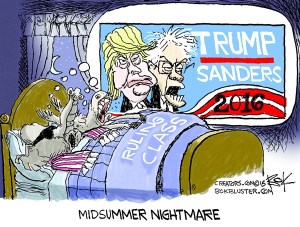 There’s always been a populist streak in American Politics and religion. Both the left and the right indulge populist fantasies and personalities. There’s been a lot of evidence out there that both Bernie and the Donald are playing to similar sentiments. Are we reaching critical in a dueling visions of modern Populism? Michael Gerson asks a good question in this WAPO op ed.
The most fateful unanswered question of the 2016 campaign: Is this a populist moment in America?
It certainly sounds like one. The “establishment” is so universally despised that one wonders who is left to compose it. A putsch might find only empty offices. Outsiders with no political experience dominate the Republican field. Hillary Clinton has rapidly lost ground to an endearing but unelectable ideologue. A revolution seems to stir.
But then Donald Trump proposes a less fiscally responsible version of Jeb Bush’s tax plan. And Clinton, in the sober light of morning, remains the prohibitive favorite for the nomination of her party.
Is populism set to prevail in American politics? The term itself is famously difficult to define. In one way, historian Michael Kazin told me, populism is a “language, a way of talking about the people and the elites.” It doesn’t really matter if the elites being savaged inhabit Wall Street or the Education Department. By this measure, we are near the triumph of rhetorical populism. But it is more loud and annoying than revolutionary.
Yet populism also has a meaning rooted in American history. At its best, populism is the movement of common people whose interests are ignored in times of economic stress and transformation. In the 19th century, this group was (initially) farmers in the South and West who, in the aftermath of a serious recession, carried large amounts of debt and faced rising prices for transportation and supplies because of monopolies. Activists created economic cooperatives, formed third parties (including the People’s Party ) and ran slates of candidates. The movement gained support among laborers and small-business owners. Its demands were serious and structural: freer money, direct election of senators, federal insuring of banks and regulations on the stock market.
It’s odd that the current movement leaders are both elites and part of the establishment. Yet, their voices throwback to the roots of their families more than their personal life experiences. How much more elite or establishment can you get than U.S. Senator or a trustfund baby making a living by gaming tax law for real estate speculation? Is any of this really health for the country’s political discourse and for governance? Tom Bachtell spins a story using an earlier example.
Populism is a stance and a rhetoric more than an ideology or a set of positions. It speaks of a battle of good against evil, demanding simple answers to difficult problems. (Trump: “Trade? We’re gonna fix it. Health care? We’re gonna fix it.”) It’s suspicious of the normal bargaining and compromise that constitute democratic governance. (On the stump, Sanders seldom touts his bipartisan successes as chairman of the Senate Veterans’ Affairs Committee.) Populism can have a conspiratorial and apocalyptic bent—the belief that the country, or at least its decent majority, is facing imminent ruin at the hands of a particular group of malefactors (Mexicans, billionaires, Jews, politicians).
Above all, populism seeks and thrills to the authentic voice of the people. Followers of both Sanders and Trump prize their man’s willingness to articulate what ordinary people feel but politicians fear to say. “I might not agree with Bernie on everything, but I believe he has values, and he’s going to stick to those and he will not lie to us,” a supporter named Liam Dewey told ABC News. The fact that Sanders has a tendency to drone on like a speaker at the Socialist Scholars Conference circa 1986—one who happens to have an audience of twenty-seven thousand—only enhances his bona fides. He’s the improbable beneficiary of a deeply disenchanted public. As for Trump, his rhetoric is so crude and from-the-hip that his fans are continually reassured about its authenticity.
Responding to the same political moment, the phenomena of Trump and Sanders bear a superficial resemblance. Both men have no history of party loyalty, which only enhances their street cred—their authority comes from a direct bond with their supporters, free of institutional interference. They both rail against foreign-trade deals, decry the unofficial jobless rate, and express disdain for the political class and the dirty money it raises to stay in office.
Trump uses the typical right wing populist weapon of demonizing the other outwardly as an other while Sanders writes his enemies off as  establishment. Followers of both are much less subtle.
Students of the American populist tradition say Trump is filling in an emerging issues vacuum on the right—and for the declining appeal of longstanding culture-war crusades among the GOP faithful. The GOP’s great unifying issue over the past few election cycles—the demand to repeal the Affordable Care Act—is showing signs of wear. Presidential hopefuls continue to pay lip service to the ACA’s repeal, but the law’s run of Supreme Court victories—together with gradually increasing public support for some of its key provisions—means that the bid to kill Obamacare is unlikely to generate much new energy on the right. Obamacare’s repeal is “dead as an issue,” says Georgetown University historian Michael Kazin, author of The Populist Persuasion (1998) and the 2007 Bryan biography A Godly Hero. “So here you have someone like Trump coming along to say, well, here’s an issue.”
That issue has been immigration, with Trump making his infamous remarks about Mexican immigrants raping women, dealing drugs and plundering American jobs—populist-style cultural scapegoating with a capital S. But there’s something more than simple white resentment at play here. In reviving the old populist cause of economic nationalism, Trump has struck a chord among a pinched conservative working-class electorate that knows free trade and globalization are not about to boost their wages, or bring their pensions back. He’s also tapped into the protectionist outlook of America’s older labor movement, which historically supported restrictions on immigration because of its downward pull on wages.
This is where my mind fills with the explanations of the 1950s Hoffer who looked to explain the NAZIS and Stalinists alike. There is, indeed, so much passionate hatred.
“Passionate hatred can give meaning and purpose to an empty life.”
But, both of these guys seem to think they’re the singular entity that has the easiest answer and the purest ideas. So, what do I make of this? What does Hoffer make of this?
…
“When the moment is ripe, only the fanatic can hatch a genuine mass movement. Without him the disatisfaction engendered by militant men of words remains undirected and can vent itself only in pointless and easily suppressed disorders. Without him the initiated reforms, even when drastic, leave the old way of life unchanged, and any change in government usually amounts to no more than a transfer of power from one set of men of action to another. Without him there can perhaps be no new beginning. When the old order begins to fall apart, many of the vociferous men of words, who prayed so long for the day, are in a funk. The first glimpse of the face of anarchy frightens them out of their wits. They forget all they said about the “poor simple folk” and run for help to strong men of action—princes, generals, administrators, bankers, landowners—who know how to deal with the rabble and how to stem the tide of chaos. Not so the fanatic. Chaos is his element.”
So, let me ask you. Are we looking at a two-headed coin? Are we looking at two competing captains for a Krewe of Populist Chaos?
Live Blog South Carolina Republican Debate(s): Going South and then some
Posted: January 14, 2016 Filed under: 2016 elections, Live Blog, Republican presidential politics, The Right Wing | Tags: Republican Presidential Primary Debates, South Carolina 160 Comments Good Evening!
The main stage debate of the Republican party Presidential wannabes will showcase seven candidates. Four candidates were sent to the kiddie table but Rand Paul has decided to stay home since this time he couldn’t whine himself out of his basement level poll numbers . The main debates starts at 9 pm eastern. It’s on the Fox Business News Network so be prepared to hunt for it or to stream it. (EWWWWWWWWWW)
Seven Republican candidates are set to clash in the sixth GOP presidential debate Thursday night, hosted by FOX Business in Charleston, SC. The debate, slated to begin at 9pm ET, will feature Donald Trump, Ted Cruz, Marco Rubio, Ben Carson, Chris Christie, Jeb Bush and John Kasich.
Another four candidates who did not meet the network’s public polling requirements qualified for an undercard debate at 6pm ET: Rand Paul, Carly Fiorina, Mike Huckabee and Rick Santorum. But Paul has announced that he will boycott the event, accusing the network and the RNC of picking winners and losers in the GOP field.
Fiorina already said something completely objectionable in the currently running kiddie debate.
Unlike another woman in this race, I WAS actually spending time with my husband.”
Newsweek is live blogging both the debates here and she’s a mean one, Ms. Grinch.
“Unlike another woman in this race, I actually like spending time with my husband.” Thus did former Hewlett-Packard Chief Executive Carly Fiorina open the sixth Republican primary debate in Charleston, South Carolina, on Thursday. It was a barb aimed squarely at Democratic frontrunner Hillary Clinton, whom pundits and analysts expect to be a popular topic of discussion throughout the evening. Fiorina also criticized Clinton’s response to the 2012 attack on the U.S. diplomatic compound in Benghazi, Libya, that left four Americans dead—an event recently immortalized in a factually dubious film directed by Michael Bay, of Transformers fame.
“We should stop letting refugees into this country,” Fiorina continued. A similar proposal to refuse refugees, floated by Republican frontrunner Donald Trump, earned him a bump in the polls, but has garnered widespread criticism from the political class.
As the night went on, Fiorina did not let up on Clinton. “Mrs. Clinton, you cannot wipe a server with a towel,” she said, referring to the Democratic candidate’s ongoing private email server scandal.
As this state prepared to host GOP primary debates on Thursday and next month, many Republicans are rooting for South Carolina to reclaim its kingmaker role in 2016.
Polls currently show celebrity businessman Donald Trump with a commanding lead, followed by Texas Sen. Ted Cruz and Florida Sen. Marco Rubio. But voters here are widely considered up for grabs, likely to be influenced by earlier contests in Iowa and New Hampshire and the unpredictable 11 days of the campaign after those votes and before the Feb. 20 GOP primary.
Candidates who are struggling in Iowa—such as former Florida Gov. Jeb Bush, whose father and brother won victories in South Carolina that helped them clinch the nomination—are jockeying for better-than-expected showings in New Hampshire, hopefully followed by a strong finish in South Carolina.
“It’s a chance to reset the race,” said South Carolina Sen. Lindsey Graham, who quit running for president last month and has questioned Mr. Trump’s ability to build a winning national coalition in the general election. “My goal for South Carolina Republicans is get back to our roots. Let’s pick a conservative who can actually win the race because winning matters.”
South Carolina Republicans say they have had better luck picking candidates who end up winning the GOP nomination because the electorate is broader and more representative of the country than in the smaller states of Iowa and New Hampshire.
There are evangelical Christians in the northwestern part of the state near Bob Jones University in Greenville; affluent, more moderate professionals and retirees around the capital in Columbia and along the Atlantic coast in Charleston, Hilton Head and Myrtle Beach, and foreign policy hawks concentrated around the military bases in the central and southern parts of the state.
“South Carolina is a test for every facet of a campaign,” Mr. Moore said. “It’s not just about organization. It’s not just about message. It’s about winning a state with a broad and diverse electorate, so really it’s a test if you can win beyond South Carolina.”
In particular, South Carolina looks like a gateway to a potentially pivotal cluster of nearby southern states that will vote on March 1.
So, pull up a seat and join us for a lively discussion!!
Saturday Night Live: The Final DNC Debate
Posted: December 19, 2015 Filed under: 2016 elections 208 Comments
Tonight is the final DNC debate in 2016.
The rivalry between two of the campaigns has taken a turn for the nasty and we’re waiting to see exactly what will develop. The Debate starts at 8 pm eastern on ABC and will also be streamed live from New Hampshire.
Tonight, ABC News hosts the third Democratic presidential primary debate featuring Hillary Clinton, Bernie Sanders and Martin O’Malley who will duke it out on stage at St. Anselm College.
It’s the first and only Democratic debate held in the primary state of New Hampshire of the 2016 election cycle.
Moderating tonight will be “World News Tonight” anchor David Muir and Chief Global Affairs Correspondent Martha Raddatz. The debate will focus on national security and foreign policy in the wake of the Paris terrorist attacks.
Debate coverage begins at 8 p.m. EST, but keep checking back for updates from the ABC News political team as the candidates prepare for tonight.
Supposedly, Sanders will go on the attack which seems odd given his campaign was just caught filching data and strategies from the Clinton campaign. I’d rather think he’d be apologetic and contrite. Here’s a good bit of analysis on why the data pilfering matters from Washington Monthly’s David Atkins.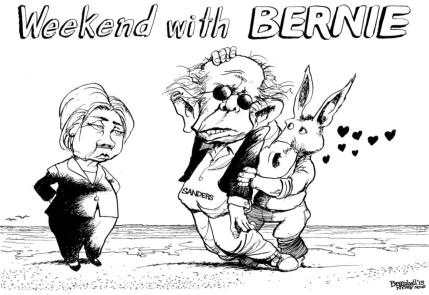
After a spat lasting just over 24 hours, it appears that the top news story of the day is already resolving itself: the DNC has come to an agreement to return voter database access to the Bernie Sanders campaign after top staffers were caught snooping into the Clinton campaign’s records.
The brouhaha over this little fiasco has been intense, and made worse by the fact that only a few thousand people in the United States understand anything about the voter tools involved. Few journalists—to say nothing of armchair activists—have enough campaign and field management experience to truly understand what happened. That ignorance has led to wild accusations and silly reporting from all sides, whether from conspiratorially-minded Sanders supporters or schadenfreude-filled Republicans.
The first thing to understand is that NGPVAN is a creaky voter database system that looks, and feels like it was put together in the 1990s. It has been the mainstay of Democratic campaigns all across the country and has intense loyalty among national campaign professionals—though it should be noted that the California Democratic Party uses one of its more robust and more expensive competitors PDI (PDI, hilariously, sent an email this morning to its users with the subject line “At PDI Data Security Is Our Top Priority.”) I myself have extensive experience running campaigns on both platforms, both as a campaign consultant and as a county Democratic Party official in California.
The DNC contracts with NGPVAN, meaning that firewalls between competitive primary campaigns within NGPVAN are incredibly important. But they also have been known to fail. When that happens, campaign professionals are expected to behave in a moral and legal manner. But they would also be stupid not to, since every action taken by an NGPVAN user is tracked and recorded on the server side.
The other important piece of information to note is the difference between a “saved search” and a “saved list.” NGPVAN’s voter tracking has the option of beingdynamic or static, meaning that you can run dynamic searches of voters whose characteristics may change as NGPVAN’s data is updated, or you can pull static lists of voters who currently fit the profile you are seeking. Most voter data pulls within an NGPVAN campaign will be dynamic searches—and in fact, that is the default setting. You really only want to pull a static list if you’re doing something specific like creating a list for a targeted mail piece—or if you want a quick snapshot in time of a raw voter list.
However, merely pulling a search or a list doesn’t mean you can automatically download all the information on those voters. You can see topline numbers. You can take a few screenshots—though it would take hundreds of screenshots and the data would be nearly useless in that format. To download the actual data, you would need to run an export—a step that requires extra levels of permissions only allowed to the highest level operatives. Despite the breach that allowed them to run lists and searches, Sanders staffers apparently did not have export access.
However, the access logs do show that Sanders staff pulled not one but multiple lists—not searches, but lists—a fact that shows intent to export and use. And the lists were highly sensitive material. News reports have indicated that the data was “sent to personal folders” of the campaign staffers—but those refer to personal folders within NGPVAN, which are near useless without the ability to export the data locally.
Even without being able to export, however, merely seeing the topline numbers of, say, how many voters the Clinton campaign had managed to bank as “strong yes” votes would be a valuable piece of oppo. While it’s not the dramatic problem that a data export would have been, it’s undeniable that the Sanders campaign gleaned valuable information from the toplines alone. It’s also quite clear that most of the statements the Sanders campaign made as the story progressed—from the claim that the staffers only did it to prove the security breach, or that only one staffer had access—were simply not true. It’s just not clear at this point whether the campaign’s comms people knew the truth and lied, or whether they were not being told the whole truth by the people on the data team who were still making up stories and excuses to cover their tracks. I suspect the latter.
 Daniel Politi–writing for Slate–believes Datagate will impact the debate tonight.
Once again, a last minute turn of events is shaking up a Democratic presidential debate. Last time around, it was the Paris terrorist attacks. Now, the candidates will be facing off amid an unusual level of acrimony over claims that Bernie Sanders staffers stole data that belonged to Hillary Clinton’s camp. Now the big question is how the issue will play in Saturday night’s debate.
Clinton could very well choose to go on the offensive and confront Sanders about the breach. But that carries risk considering Sanders’ team filed a lawsuit against the Democratic National Committee because it had suspended the campaign’s access to voter information after the breach was revealed. Access was restored late last night, but not before Sanders’ supporters got even more ammunition to claim that the DNC unfairly favors Clinton, as Slate’s Jim Newell points out. Immediately after the data controversy, Sanders sent out a fundraising email, citing the suspension as the latest example of how the Democratic Party has “its thumb on the scales in support of Hillary Clinton’s campaign.”
So if Clinton goes too far with her criticism it could play into Sanders’ underdog image, which could in turn help him win over support. This is particularly the case considering the Sanders’ team has complained the DNC scheduled the debate for the Saturday night before Christmas to assure a low audience, points out Yahoo News.
Considering all these variable it seems more likely that Clinton will decide to strike a middle ground and criticize Sanders’ staffers while defending the candidate himself, notes NBC.
I guess we’ll see!!
Tune in and join our live blog!!!

 peej
peej Carissa
 bostonboomer
 dakinikat
 ecocatwoman
 mablue2
 Mama Lopez
 peggysue22
 quixote
 skydancingguestblogger
 Mona (aka Wonk the Vote)



 Sky Dancing
Recent Comments