
Tuesday Reads: Romney and Zingers, Environmental Activism, and A Bit of Schadenfreude
Posted: October 2, 2012 Filed under: 2012 presidential campaign, Banksters, Barack Obama, Environment, Environmentalists, Mitt Romney, morning reads, U.S. Politics | Tags: Donald Trump, Eric Schneiderman, federal lands, first presidential debate, Haley Barbour, Harry Reid, James Bruggers, Jamie Dimon, JP Morgan, public lands, Tar Sands blockade, zingers 76 Comments
Good Morning!!
I have some interesting links today–some of them a couple of days old, but even if you’ve seen them, they bear repeating.
First up, there’s just one more day until the first presidential debate. I just can’t wait to hear those “zingers” Mitt Romney’s advisers told the NYT he has been practicing for months.
Mr. Romney’s team has concluded that debates are about creating moments and has equipped him with a series of zingers that he has memorized and has been practicing on aides since August. His strategy includes luring the president into appearing smug or evasive about his responsibility for the economy.
Since August? I hope they haven’t gotten stale. Apparently they’re hoping Obama will have another “likable enough” moment. I doubt that will happen, but we’ll see.
Frankly, as Ezra Klein writes at HuffPo, Romney would be better off to forget the zingers and develop more popular policies.
Behind in the polls and facing mounting panic among his donors, Mitt Romney is readying his secret weapon for the debates: Zingers….Pro tip: If your strategy to turn the presidential election around relies on Romney’s sense of comic timing, you might want to prepare a Plan B, as well.
The idea that this election can be reshaped by a zinger speaks to a deeper problem in the Romney campaign’s fundamental view of the race. As they see it, Obama’s record is an obvious disaster and their job entails little more than pointing that out over and over again. That the polls haven’t seemed responsive to this theory hasn’t dissuaded them. The new explanation for Romney’s difficulties is that the media are in the tank for Obama and that’s why the Romney campaign’s message isn’t breaking through.
But, Klein says, Americans know the economy is bad, but they also think it would have been worse if John McCain had been elected, rather than Barack Obama. Check out the chart.

Anna Marie Cox also addressed the “zingers” story at the Guardian.
The Romney campaign, having already proven able to discover impressive new ways for a nomination to blunder (my jaw still involuntarily drops a little when I hear the phrase “47%”), they have now added yet another type of podiatric wound to their catalogue. According to a report in the New York Times on Saturday, Romney’s staff “has equipped him with a series of zingers that he has memorized and has been practicing on aides since August.”
Already an awkward presence, Romney seems particularly susceptible to the tense stillness and deathless pathos that accompanies a dud punchline. Picturing the forced jocularity around the campaign headquarters has its pleasures, specifically the idea of Mitt trotting out well-worn jokes with the panache of a Catskills stand-up:
“Take my economic policy … please!”
“How lazy is half America? So lazy …”
“Any car-elevator owners in the audience tonight?”
But there’s an awful flipside: my God, what if he actually tries one of them?
Whether you wince or guffaw at the image of Romney attempting and failing to “zing” the president, probably says more about your tolerance for the humiliation of others than your political sensibilities. You’d think covering politics would have inured me to it by now, but in real life, I can’t even watch “American Idol”. I will view the debate on Wednesday through the spaces between my fingers, with a desk nearby to bang my head against.
What I really wish is that Romney would follow Donald Trump’s advice. According to TPM, Trump tweeted that Romney “should ask Obama why autobiography states “born in Kenya, raised in Indonesia.”
Romney will definitely have to watch his tone though, based on the results of a focus group study that TPM reported today. And Republicans will have a hard time saying this one is biased, because it was done by Haley Barbour’s company.
Barbour’s firm Resurgent Republic conducted focus groups of blue collar voters in Ohio and suburban women in Virginia who supported Obama in 2008 but are now undecided. Both are swing demographics that Romney is working to win over in order to flip each state from blue to red.
Their findings? Voters are a lot more willing to believe attacks based around Romney quotes than they are on Obama quotes.
“Whenever we showed direct quotes from President Obama over the last few years, voters consistently say that this is probably taken out of context and they don’t seem to hold that same standard with Governor Romney,” pollster Linda DiVall, who conducted the Virginia focus groups, said in a conference call announcing the findings Monday.
She added that while their reaction struck her as “a little bit unfair,” it was nonetheless “American voters’ right to do that.”
Pollster Ed Goeas said his own Ohio focus groups elicited similar responses, which could make things harder for Romney as he seeks to reverse his comments that 47 percent of Americans consider themselves “victims.”
It sounds like these swing state voters have figured out that Romney is a lying liar who only cares about the needs of the top .01 percent. Voters just aren’t as stupid as the Romney campaign thinks.
Did you see the tough op-ed Harry Reid wrote for the Las Vegas Sun on Sunday? He really ripped Romney a new one.
We learn the most about someone’s character not from what he does when he knows others are watching but from what he does when he thinks they aren’t.
We’ve learned an awful lot of troubling things about Mitt Romney recently. First, his sweeping, closed-door condemnation of President Barack Obama’s supporters revealed the disdain he has for half the population he hopes to serve. Then, the limited tax returns Romney selectively released confirmed that he’s willing to share information about the time he’s been in the public eye and running for president, but not the time he was running the corporation he touts as his sole qualifying credential for the highest office in the land.
When he thought no one was listening, Romney accused 47 percent of Americans of not taking responsibility for their lives, painting them as lounging in government dependency — a conclusion he reached because, for various legitimate reasons, they are exempt from paying federal income taxes.
Romney stands not only on shaky ethical grounds in making that indiscriminate generalization — he’s also on flimsy factual footing. The 47 percent Romney derides as self-pitying “victims” includes seniors who live on a fixed income thanks to the Social Security they paid into and earned over a lifetime of hard work, our troops in combat zones and veterans who have fought for our country. It includes students studying to get the skills that will win them the jobs of the future and decent Americans actively looking for work because their jobs were outsourced by companies such as those Romney specialized in developing. Most of them pay plenty of payroll, property, local and state taxes.
Reid goes on to beat Romney over the head with his secret tax returns one more time. Go read the whole thing if you haven’t already. Reid is turning out to be the Democratic attack dog of the 2012 campaign season.
Just one more Romney link: Romney would put states in charge of federal lands. James Bruggers, a Kentucky reporter who covers environmental issues full-time writes:
Our public lands are a birthright, held in trust for each one of us and managed by a set of laws that were worked out through compromise by Congress and various presidential administrations going back generations.
They provide places for us to hike, ride our mountain bikes, horses, camp, hunt and fish. Many are managed for multiple uses, and they also allow for cattle grazing, timber harvesting, oil and gas development, mining and skiing.
Romney, however, has said he would change all this, putting states in control of lands now under the stewardship of such agencies as the U.S. Forest Service and the Bureau of Land Management, who are charged with making sure all Americans have a say in their management. Often this gets reported simply as an expansion of oil and gas development on public lands, a simplification that fails to acknowledge just how radical of a shift in public policy it would be to turn over federal lands to state control.
From a Romney white paper:
States will be empowered to establish processes to oversee the development and production of all forms of energy on federal lands within their borders, excluding only lands specially designated off-limits;
• State regulatory processes and permitting programs for all forms of energy development will be deemed to satisfy all requirements of federal law;
• Federal agencies will certify state processes as adequate, according to established criteria that are sufficiently broad, to afford the states maximum flexibility to ascertain what is
most appropriate.
I still remember how shocked I was when I heard Romney say this in the Nevada primary debate. This is a huge issue as far as I’m concerned. American is still a beautiful country with many unspoiled wilderness areas. It is vital that we protect those public lands–they belong to all Americans, not to individual state governments.
Here’s another environmental story on the attempts to block the Keystone XL pipeline: BREAKING: Blockader Locks to Underground Capsule to Protect a Family Farm. It’s a live blog of the “Tar Sands blockade.” Here’s their Facebook page.
From Firedoglake blogger Kevin Gosztola:
A Tar Sands Blockader, Alejandro de la Torre, locked his body in a concrete capsule buried in the path of TransCanada’s Keystone XL pipeline to stop a small family farm in East Texas from being destroyed by construction. He blocked demolition for at least six hours before police were able to break off a chunk of concrete is arm was in and arrest him.
Police confiscated cameras of Blockaders that were there to film for Torre’s safety. Tar Sands Blockade spokesperson Ramsey Sprague reported they wanted to keep cameras on him as long as possible but police intimidated observers and took the cameras.
Last week, TransCanada supervisors encouraged police to use torture tactics on protesters to stop their nonviolent direct action.
Sprague recounted the brutality, which was “astounding.” Shannon “Rain” Beebe and Benjamin Franklin locked themselves to TransCanada machinery to stop clear-cutting. The police hung them with their arms behind their backs. They put pressure on their shoulder with their arms twisted. They pepper sprayed a tube connecting their arms. They twisted a tube cutting off circulation to their hands. (One protester is seeking medical attention for nerve damage.)
The police used tasers and planned to keep using tasers on Beebe and Franklin until they released. Cameras were supposed to be on the scene to film the action, but police were directed by TransCanada supervisors to run off those with cameras so they could commit brutality without people seeing video evidence on the evening news.
Continuing the environmental theme, pioneering environmental activist Barry Commoner died on Sunday.
Scientist and activist Barry Commoner, who raised early concerns about the effects of radioactive fallout and was one of the pioneers of the environmental movement, has died at age 95.
Commoner died Sunday afternoon at a Manhattan hospital, where he had been since Friday, said his wife, Lisa Feiner. He lived in Brooklyn.Commoner was an outspoken advocate for environmental issues. He was one of the founders of a well-known survey of baby teeth in St. Louis that started in the late 1950s. The survey assessed the levels of strontium-90 in the teeth and showed how children were absorbing radioactive fallout from nuclear bombs that were being tested.
The survey helped persuade government officials to partially ban some kinds of nuclear testing.
Feiner said Commoner had “a very strong belief that scientists had a social responsibility, that the discoveries would be used for social good and that scientists also had an obligation to educate the public about scientific issues so that the public could make informed political decisions.”Commoner took on that role of educating the public, writing books on environmental issues. Among his works were “Making Peace with the Planet” and “Science and Survival.” He made the cover of Time magazine in early 1970 and ran for president as a third-party candidate in 1980.
Finally, here’s a little bit of schadenfreude for you. Bloomberg reports that New York is “suing JP Morgan for fraud over mortgages securities.”
JPMorgan Chase & Co. (JPM), the biggest U.S. bank, was sued by New York Attorney General Eric Schneiderman over claims that the Bear Stearns business the bank took over in 2008 defrauded mortgage-bond investors.
Investors were deceived about the defective loans backing securities they bought, leading to “monumental losses,” Schneiderman said in a complaint filed today in New York State Supreme Court.
“Defendants systematically failed to fully evaluate the loans, largely ignored the defects that their limited review did uncover, and kept investors in the dark about both the inadequacy of their review procedures and the defects in the underlying loans,” Schneiderman’s office said.
Schneiderman in January was named co-chairman of a state- federal group formed to investigate misconduct in bundling of mortgage loans into securities leading up to the financial crisis. The group includes officials from the U.S. Justice Department, the Securities and Exchange Commission, the FBI and other federal and state officials.
Poor Jamie Dimon. Why don’t people respect his “success?”
Those are my suggestions for today. What are you reading and blogging about?
The Hurt Feelings of the Super-Sensitive Top .01 Percent
Posted: October 1, 2012 Filed under: 2012 presidential campaign, Mitt Romney, U.S. Economy, U.S. Politics | Tags: Barack Obama, bring back the guillotine, Chrystia Freeland, class warfare, Leon Cooperman, ruling class, social safety net 23 Comments
Mega-billionaire Leon Cooperman
I just finished reading an article by Chrystia Freeland of The New Yorker: Super-Rich Irony: Why do billionaires feel victimized by Obama? I think I’m finally beginning to understand why wealthy assholes like Mitt Romney disdain almost half of the country as losers who think of ourselves as victims and are dependent on the government. It’s because the superrich believe that they are the victims, and anyone who works for a paycheck–as opposed to running a business–isn’t really working. Seriously, I know it’s a cliche at this point, but it really is time to break out guillotines. It’s time to show the entitled, self-involved, stuffed-shirt class what real class warfare looks and feels like. For the sake of humanity, they need to be humbled.
Freeland centers the article around the billionaire financier Leon Cooperman, who listed his grievances against President Obama in a lengthy open letter last November. Cooperman’s complaints sound remarkably similar to Mitt Romney’s endless whining. (Although he is nowhere near as rich as Cooperman, Romney’s fortune still puts him in to top .01 of earners.)
Like Romney, Cooperman is all bent out of shape about Obama’s “tone,” i.e., he has said mean things about rich people, and he doesn’t bow down and abjectly worship “success” often enough. Cooper also shares with Romney the belief that “success” is indistinguishable from wealth and that ordinary wage earners are just useless drags on the productive few at the top. From The New York Times’ Dealbook, on Cooperman’s letter, November 29, 2011:
Last week, in a widely circulated “open letter” to President Obama that whizzed around e-mail inboxes of Wall Street and corporate America, Mr. Cooperman argued that “the divisive, polarizing tone of your rhetoric is cleaving a widening gulf, at this point as much visceral as philosophical, between the downtrodden and those best positioned to help them.”
He went on to say, “To frame the debate as one of rich-and-entitled versus poor-and-dispossessed is to both miss the point and further inflame an already incendiary environment.”
….
Mr. Cooperman’s complaint has less to do with the substance of taxing the wealthy than it does the president’s choice of words in promoting it, an emphasis that he says is “villainizing the American Dream.”
I always thought the American dream was owning a house, raising a family, doing work you enjoy, and having a dignified retirement. But I guess I was wrong.
Getting back to the New Yorker article, Freeland writes that:
One night last May, some twenty financiers and politicians met for dinner in the Tuscany private dining room at the Bellagio hotel in Las Vegas. The eight-course meal included blinis with caviar; a fennel, grapefruit, and pomegranate salad; cocoa-encrusted beef tenderloin; and blue-cheese panna cotta. The richest man in the room was Leon Cooperman, a Bronx-born, sixty-nine-year-old billionaire. Cooperman is the founder of a hedge fund called Omega Advisors, but he has gained notice beyond Wall Street over the past year for his outspoken criticism of President Obama. Cooperman formalized his critique in a letter to the President late last year which was widely circulated in the business community; in an interview and in a speech, he has gone so far as to draw a parallel between Obama’s election and the rise of the Third Reich.
This was the beginning of a rebellion, what Cooperman termed “a sleeper cell.” The superrich are sick and tired of being disrespected and they aren’t going to take it anymore! But what about this Third Reich business? According to Freeland,
Comparing Hitler and Obama, as Cooperman did last year at the CNBC conference, is something of a meme. In 2010, the private-equity billionaire Stephen Schwarzman, of the Blackstone Group, compared the President’s as yet unsuccessful effort to eliminate some of the preferential tax treatment his sector receives to Hitler’s invasion of Poland. After Cooperman made his Hitler comment, he has said, his wife called him a “schmuck.” But he couldn’t resist repeating the analogy when we spoke in May of this year. “You know, the largest and greatest country in the free world put a forty-seven-year-old guy that never worked a day in his life and made him in charge of the free world,” Cooperman said. “Not totally different from taking Adolf Hitler in Germany and making him in charge of Germany because people were economically dissatisfied. Now, Obama’s not Hitler. I don’t even mean to say anything like that. But it is a question that the dissatisfaction of the populace was so great that they were willing to take a chance on an untested individual.”
Because, you see, Obama only “worked” for a paycheck, like the majority of us losers in the 47 percent.
America’s super-rich feel aggrieved in part because they believe themselves to be fundamentally different from a leisured, hereditary gentry. In his letter, Cooperman detailed a Horatio Alger biography that has made him an avatar for the new super-rich. “While I have been richly rewarded by a life of hard work (and a great deal of luck), I was not to-the-manor-born,” he wrote, going on to describe his humble beginnings in the South Bronx, as the son of working-class parents—his father was a plumber—who had emigrated from Poland. Cooperman makes it known that he gets up at 5:20 a.m. and is at his desk at Omega’s offices in lower Manhattan, on the thirty-first floor of a building overlooking the East River and Brooklyn, by 6:40 a.m. He rarely gets home before 9 p.m., and most evenings he has a business dinner after leaving the office. “I say that I date my wife on the weekends,” he told me one August afternoon at his office. The space is defiantly modest, furnished with nineteen-nineties-era glass coffee tables, unfashionable yellow couches, and family photographs.
So Cooperman has devoted his entire life to making money. Has he ever read a book? Does he appreciate art or music? Probably not, because that would take time away from hoarding more and more money. If that’s the “American dream,” I’m just not interested. I also find it ironic that these millionaires and billionaires supposedly pride themselves on being self-made–different from the landed gentry; yet at the same time, they are demanding to be treated like kings and princes, expecting the rest of us to bow and scrape before their awesome “success.”
Cooperman’s pride in his work ethic is one source of his disdain for Obama. “When he ran for President, he’d never worked a day in his life. Never held a job,” he said. Obama had, of course, worked—as a business researcher, a community organizer, a law professor, and an attorney at a law firm, not to mention an Illinois state legislator and a U.S. senator, before being elected President. But Cooperman was unimpressed. “He went into government service right out of Harvard,” he said. “He never made payroll. He’s never built anything.”
You see? If you didn’t start a business, if you worked for the government or a university or even for a corporation that you didn’t own, you never worked a day in your life. You are a worthless layabout, deserving of nothing more than starving to death on the street or dying of an untreated illness. Cooperman even looks down his nose at educated professionals from dentist office rochester mn. He’s very relieved that he dropped out of dental school and went into finance .
“I probably make more than a thousand dentists, summed up.” (A thousand dentist would need to work for a decade—and pay no taxes or living expenses—to collectively earn Cooperman’s net worth.) During another conversation, Cooperman mentioned that over the weekend an acquaintance had come by to get some friendly advice on managing his personal finances. He was a seventy-two-year-old world-renowned cardiologist; his wife was one of the country’s experts in women’s medicine. Together, they had a net worth of around ten million dollars. “It was shocking how tight he was going to be in retirement,” Cooperman said. “He needed four hundred thousand dollars a year to live on. He had a home in Florida, a home in New Jersey. He had certain habits he wanted to continue to pursue.
“I’m just saying that it’s not an impressive amount of capital for two people that were leading physicians for their entire work life,” Cooperman went on. “You know, I lost more today than they spent a lifetime accumulating.”
And Cooperman isn’t even a far right winger. He thinks the rich should willingly pay more taxes, and he has “signed Bill and Melinda Gates and Warren Buffett’s Giving Pledge, promising to donate at least fifty per cent of [his] net worth to charity”–for which he was honored at the White House. Now we get to the deepest cut, the biggest slight to Cooper’s pride and self-image:
At the event, Cooperman handed the President two copies of “Inspired: My Life (So Far) in Poems,” a self-published book written by Courtney Cooperman, his fourteen-year-old granddaughter. Cooperman was surprised that the President didn’t send him a thank-you note or that Malia and Sasha Obama, for whom the books were intended as a gift and to whom Courtney wrote a separate letter, didn’t write to Courtney. (After Cooperman grumbled to a few friends, including Cory Booker, the mayor of Newark, Michelle Obama did write. Booker, who was also a recipient of Courtney’s book, promptly wrote her “a very nice note,” Cooperman said.)
This is the American ruling class. These are the people who want to destroy what is left of the American social safety net. They’re complete assholes, and they think the rest of us are the scum of the earth–even the President of the United States.
Paul Ryan: “It would take me too long to go through all of the math.”
Posted: September 30, 2012 Filed under: 2012 presidential campaign, Mitt Romney, open thread, U.S. Politics | Tags: Chris Wallace, elixirs, flim-flam man, Fox News Sunday, Old West con man, Paul Ryan, tax cuts, tonics 25 Comments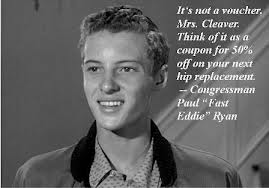
On Fox News Sunday, Chris Wallace worked very hard to get a straight answer out of Republican Paul Ryan on the tax plan he and Mitt Romney are proposing, but he failed. Paul Ryan is nothing but a flim-flam man–a sneaky little weasel who couldn’t tell the truth if you paid him a million dollars. Never in my life have I seen such bullshit artist! He truly is Eddie Haskell. Here’s the video (via Think Progress):
WALLACE: So how much would it cost?
RYAN: It’s revenue neutral…WALLACE: No no, I’m just talking about cuts. We’ll get to the deductions, but the cut in tax rates.
RYAN: The cut in tax rates is lowering all Americans’ tax rates by 20 percent.
WALLACE: Right, how much does that cost?
RYAN: It’s revenue neutral.
[…]
WALLACE: But I have to point out, you haven’t given me the math.
Ryan: No, but you…well, I don’t have the time. It would take me too long to go through all of the math. But let me say it this way: you can lower tax rates by 20 percent across the board by closing loopholes and still have preferences for the middle class. For things like charitable deductions, for home purchases, for health care. So what we’re saying is, people are going to get lower tax rates.
In the midst of refusing to give any specifics on what loopholes he would close and/or programs he would cut, Ryan brags that he’s been on the Ways and Means Committee for twelve years. So? Are we supposed to take that as proof that he’s not full of shit? And as a bonus, the throws out his favorite word “baseline” again. I guess we’re supposed to be impressed about how wonky he is? Give me a break! Just look at those Power Point slides he’s been using in his stump speech. They could have been created by a high school sophomore.
This guy has been in the House for twelve years and he has nothing but surface knowledge about the legislative process. But he knows exactly what he wants to cut–Medicare, Medicaid, and Social Security, plus even cent that goes into infrastructure or protecting the environment. What else is there now that he’s claiming the middle class will still have charitable deductions, mortgage deductions, and health care deductions?
Honestly, Mitt Romney is one of the most shameless liars I’ve ever seen in my more than fifty years of following politics; but I really think Ryan is worse. I can visualize him in the Old West, selling youth tonics and elixirs out of the back of his wagon to credulous homesteaders, then hightailing it out of town before the sheriff catches up with him.
Please use this as an open thread.
Underestimating the Great Recession
Posted: September 29, 2012 Filed under: 2012 presidential campaign, Economy 32 CommentsI’ve been reading this excellent David Leonhardt “hindsight quarterback”-style article on the mistakes the Obama administration made when handling the 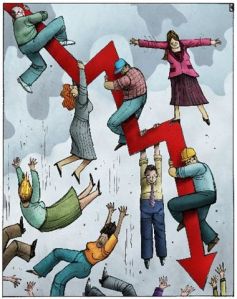 economy in 2008. I suppose I like it because he’s saying many of the same things today that I actually was writing about back then. However, the problems from back then are more obvious now and the article is written without the dynamics of the Larry Summer/Timothy Geithner Beavis and Butthead antics that were apparent in the Suskind book Confidence Men. I’ve often said that the two biggest mistakes were the size of the stimulus and the handling of the housing crisis. I still can’t figure out how we got a bail out of the auto and financial industries but the housing sector got left to the natural path.
With the auto industry and Wall Street, Mr. Obama accepted the political costs that come with bailouts. He rescued arguably undeserving people in exchange for helping the larger economy. With housing, he went the other way, even leaving some available rescue money unspent — at least until last year, when the policy became more aggressive and began to have a bigger effect.
No one of these steps, or several other plausible ones, would have fixed the economy. But just as the rescue programs of early 2009 made a big difference, a more aggressive program stretching beyond 2009 almost certainly would have made a bigger difference. It would have had the potential to smooth out the stop-and-start nature of the recovery, which has sapped consumer and business confidence and become a problem in its own right.
It would seem prudent to stabilize housing prices in an economy that’s highly reliant on consumer spending when consumer spending is highly reliant on household wealth. That’s not to say that the house prices of 2006 weren’t in need of a correction. It’s more to say that putting so many folks through disclosure and wrecking their balance sheets for decades isn’t the smartest way of managing an aggregate demand crisis in an economy where consumption is 68% of GDP and the fickle investment component is about 17%.
Leonhardt thinks that Obama and his advisers really didn’t grasp the severity of the recession or the full impact of the financial market meltdown. I would agree with this up to a point. I actually think they knew the impact but concentrated on the business sector more than than the household.
Mr. Obama’s biggest mistake as president has not been the story he told the country about the economy. It’s the story he and his advisers told themselves.
The notion of insurance is useful here. Suggesting that Mr. Obama and his aides should have bucked the consensus forecast and decided that a long slump was the most likely outcome smacks of 20/20 hindsight. Yet that wasn’t their only option. They also could have decided that there was a substantial risk of a weak recovery and looked for ways to take out insurance.
By late 2008, the full depth of the crisis was not clear, but enough of it was. A few prominent liberal economists were publicly predicting a long slump, as was Mr. Rogoff, a Republican. The Obama team openly compared its transition to Franklin D. Roosevelt’s and, in private, discussed the Reinhart-Rogoff work.
I guess this does tie back to the dynamics in the Suskind book Confidence Men and the dynamics of Obama’s economic team which basically was presented as being completely out of control. This quote is Adam Moss’ take on the situation.
The news of the book,according to some reports, is that Tim Geithner was insubordinate to the president, pursuing his own pro-banker agenda. Or, according to other reports, that Larry Summers was insubordinate to the president, pursuing his own well, monomaniacal agenda. I’d add that it’s also about Rahm Emanuel being insubordinate to the president, just because. Basically, it’s about the presidency being hijacked by these three guys. And the guys thing is important because they’re pretty awful to women. Anyway, they’re the villains. Paul Volcker, Christina Romer, and Elizabeth Warren are the heroes. Bankers win, America loses.
We’ve had Sheila Bair out on the book trail reinforcing the Geithner pro-banker agenda story line just this month. He’s the last man standing of the trio of “villians’ mentioned above.
In addition to accusing Geithner of treating the banks with kid-gloves, Bair skewers him and former Obama economic adviser Larry Summers for their approach to the housing crisis, saying they didn’t appear to care about helping homeowners or fixing underlying problems plaguing the housing market.
Treasury’s housing-relief program was “designed to look good in a press release, not to fix the housing market,” Bair wrote. She says Geithner and Summers undercut Obama by not pursuing a more aggressive program.
Whether intentional or not, the administration’s housing programs have been lackluster, making the narrative all the more damning. The housing market is recovering but more because of the Federal Reserve’s push to lower interest rates than because of the housing assistance offered by Treasury. The main programs have helped about 2.6 million homeowners, far short of the 9 million Obama promised to help avoid foreclosure.
As Bloomberg View has written, Geithner and other administration officials cared too much about avoiding “moral hazard,” designing the programs so narrowly that few could actually qualify for help.
Bair’s book suggests that those same concerns didn’t apply to the banks, who were stuffed with money she says they may not have needed and didn’t deserve without fundamental changes to their businesses. (Fed Chairman Ben Bernanke, meanwhile, told the Financial Crisis Inquiry Commission that “only one” of the major banks “was not at serious risk of failure” and that 12 were on the verge of collapse in 2008.)
Here’s a similar narrative on the questionable approach to the housing market crash. I want to mention this because it actually reinforces the Romney 47% narrative in action. For some reason, bad business decisions aren’t demonized with the same gusto given to those made by the middle income, working class, and poor households. We’re “lazy” and seek a way to become “dependent” on government. What we should emphasize is the number of times that businesses–big and small–go to the government asking to be protected from competition and to be given price supports, subsidies, tax breaks, tariffs, and trade quotas. All of these create moral hazard, distort market outcomes, and are of little value to any one but the industry receiving the hand out. Rahm, Geithner, and Summers are all part of the mentality that Romney so eloquently got caught describing to his peser in his 47% moment. The media gets caught up in that narrative too. Let’s not kid ourselves that this kind of thing will go away once Romney is soundly defeated. It goes on behind all closed-door meetings concerning policy. Most of the consultantariat have similar frames. This is especially true for those that go to big name universities where they are repeatedly told they are “special’ and above every one else and are more deserving of success than any one else.
The one thing that I would really like to see right now is for Obama to restate his intention to replace Geithner. Then, I would like to see him signal who is on the short list. This would let us know if we’re going to some change in the approach to the recovery. Can you imagine the signal that a Sheila Baer appointment would send? I can. The markets would definitely fall off their highs. That’s exactly why I’m not holding my breath for anything but more status quo. At this point, it’s the best we can hope for because we all know what the Ryan/Romney agenda will be. I’m not keen on going off of their cliff any time soon. I just wish we had a bit more details on how the President intends to manage the recovery in a second term. We’re not getting any details and that makes me nervous.
Rainy Saturday Reads: Why Romney Is Losing
Posted: September 29, 2012 Filed under: 2012 presidential campaign, Mitt Romney, morning reads, U.S. Politics | Tags: 47 percent, Alex Pareene, backstabbing aides, Joan Walsh, Nate Silver, Politico 53 Comments
A rainy day on Boston’s Commonwealth Ave.
Good Morning!!
It’s a rainy Saturday in Boston, and I’ve got a nasty cold. I overslept and I don’t have much energy, but do have a few links to get you started today. There’s lots of talk right now about how Romney’s “47 percent” comments have hurt him. A number of pundits didn’t think it was a big deal at first, but are now changing their tunes.
Nate Silver sees signs that Romney’s callous words are taking a toll.
After a secretly recorded videotape was released on Sept. 17 showing Mitt Romney making unflattering comments about the “47 percent” of Americans who he said had become dependent on government benefits, I suggested on Twitter that the political impact of the comments could easily be overstated.
“Ninety percent of ‘game-changing’ gaffes are less important in retrospect than they seem in the moment,” I wrote.
But was this one of the exceptional cases? A week and a half has passed since Mr. Romney’s remarks became known to the public — meaning that there’s been enough time to evaluate their effect on the polls.There’s a case to be made that they did damage Mr. Romney’s standing some.
Read Silver’s take at the link (if you haven’t already).
Jonathan Chait comes right out and admits he was wrong:
I’ve been wrong before, and I’ll be wrong again, but I may never have been as wrong as I was when I initially predicted that Mitt Romney’s heinous diatribe against 47 percent of America would have little direct impact on the election. It’s an absolutely crushing blow. Obviously it doesn’t guarantee his defeat — if a secret video surfaces depicting Obama promising to impose Sharia law in his second term, Romney will stand a good chance of coming back — but it destroys his public standing in ways that make a comeback nearly impossible.
….
The damage of the remarks is twofold. Obviously, it deeply reinforces the worst stereotypes voters have of Romney. Indeed, the fact that he is currently running ads trying to make the case that he does care about all of America testifies to the grim position in which Romney finds himself. If you’re trying to clear the threshold of “does this candidate hate me” six weeks before the election, you’re probably not on the verge of closing the sale.
Worse still, the comments destroy Romney’s fundamental credibility. Here America sees what he says behind closed doors. Nothing he can say in public can possibly overcome the damage of these comments, because voters will quite correctly assume that he is telling them what they want to hear. George W. Bush’s campaign figured out how to do this to both Al Gore and John Kerry — by painting them as liars, Bush destroyed them as a message delivery platform. Romney has, essentially, done it to himself.
At Salon, Alex Pareene responds to Jonathan Chait by arguing that what is really hurting Romney is Ryan’s plan to kill Medicare: Why Ryan is worse for Romney than “47 percent.” It’s short, but sweet. Read it at the link.
TPM has a piece on How Democratic Ads Are Exploiting Romney’s ‘47 Percent’ Moment
The usual sports metaphors barely do justice to how easy it is, in theory, to build an attack ad around your opponent demanding half the country “take personal responsibility and care for their lives.” Softball pitch down the plate? Kickball, maybe? Tee ball?
Evidence is mounting that Mitt Romney’s leaked remarks about how 47 percent of Americans see themselves as “victims” are doing significant damage to his campaign both nationally and in key swing states around the country. While the hidden camera video has gotten plenty of play on its own in the press, Democrats are piling on as much as possible with a growing number of attack ads.
The degree of difficulty may be low, but the current body of ads connect Romney’s quotes to an impressive array of themes in a very short amount of time. Here’s how Democrats are using the hidden camera footage as a Swiss Army knife of messaging.
Ad videos and commentary at the link.
As Romney stumbles, the knives are coming out. Politico is the usual place for Romney campaign leaks, and sure enough, yesterday there was another backstabbing story putting all the blame on the lousy candidate: In the End, It’s Mitt.
It isn’t the chair or the ho-hum convention. Or the leaked video. Or Stuart Stevens. Or the improving economy. Or media bias. Or distorted polls. Or the message. Or Mormonism.
It’s Mitt.With Republicans everywhere wondering what has happened to the Mitt Romney campaign, people who know the candidate personally and professionally offer a simple explanation: It’s the candidate himself.
Slowly and reluctantly, Republicans who love and work for Romney are concluding that for all his gifts as a leader, businessman and role model, he’s just not a good political candidate in this era.It kills his admirers to say it because they know him to be a far more generous and approachable man than people realize — far from the caricature of him being awkward or distant — and they feel certain he would be a very good president.
“Lousy candidate; highly qualified to be president,” said a top Romney official. “The candidate suit fits him unnaturally. He is naturally an executive.”
That makes no sense. If Romney can’t run his own campaign then how on earth would he run the White House and lead the country? It’s only September, and these guys are trying to save their own asses.
Joan Walsh points out that it’s the candidate’s message that people can’t stand: When the Dogs Won’t Eat the Dog Food.
In the end I think Romney killed his own campaign, not because he’s a bad person – he may be – but because, in addition to his ineptness, he came to symbolize what’s wrong with our economy, in every way. The tax rate he pays is a scandal. Shoveling millions of tax-free dollars to his sons is, too. Bain Capital was no job creator (unless you count Bain execs); the firm borrowed money to buy companies, saddled the companies with their debt and made huge fees, whether or not the firm survived.
I said long ago that Romney “is the poster boy for the top 1 percent,” and that it would hurt him with struggling voters. But I didn’t know how much it would hurt him. In the end, maybe he’d have survived coming off like a cross between Thurston Howell III and Montgomery Burns, if we hadn’t heard his remarks about “the 47 percent.” Together, his sheltered wealth, high finance career and plutocrat’s sneer are making it nearly impossible for him to be elected.
But not completely impossible.
Nearly impossible. Not impossible. The other side has so much money and so few scruples these last six weeks could get uglier. We don’t know the toll voter suppression laws will take. And forget about those newfangled laws, there’s old-fashioned GOP voter suppression – robocalls and fliers giving voters the wrong day as Election Day or changing their polling place, voter intimidation, or a shortage of ballots or voting machine in dense Democratic districts.
That should be enough to get you started. I’ll add more links in the comments, and I look forward to clicking on yours. Have a great weekend!

 peej
peej Carissa
 bostonboomer
 dakinikat
 ecocatwoman
 mablue2
 Mama Lopez
 peggysue22
 quixote
 skydancingguestblogger
 Mona (aka Wonk the Vote)



 Sky Dancing
Recent Comments