
Elizabeth Warren: Fighter or Pinata?
Posted: March 19, 2011 Filed under: commercial banking, financial institutions, Global Financial Crisis | Tags: Consumer Financial Protection Bureau, Elizabeth Warren 9 Comments
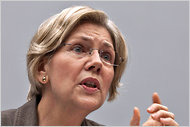 I’m never quite happy when a major media outlet like the New York Times refers to a woman as an inanimate object. Even if the article is flattering, the metaphor still stings. The caption below her picture reads “President Obama’s adviser on the Consumer Financial Protection Bureau” too. Obama may own her appointment but he doesn’t own the woman who has been on the side of consumers of banking services for a very long time. If Elizabeth Warren is an object of loathing for both bankers and Republicans, it’s because she’s a fighter. She’s not a passive thing and she certainly wasn’t passive during recent hearings. A person doesn’t become a tenured professor at a competitive place like Harvard’s law school by being passive.
And thus the real purpose of the hearing: to allow the Republicans who now run the House to box Ms. Warren about the ears. The big banks loathe Ms. Warren, who has made a career out of pointing out all the ways they gouge financial consumers — and whose primary goal is to make such gouging more difficult. So, naturally, the Republicans loathe her too. That she might someday run this bureau terrifies the banks. So, naturally, it terrifies the Republicans.
The banks and their Congressional allies have another, more recent gripe. Rather than waiting until July to start helping financial consumers, Ms. Warren has been trying to help them now. Can you believe the nerve of that woman?
At the request of the states’ attorneys general, all 50 of whom have banded together to investigate the mortgage servicing industry in the wake of the foreclosure crisis, she has fed them ideas that have become part of a settlement proposal they are putting together. Recently, a 27-page outline of the settlement terms was given to banks — terms that included basic rules about how mortgage servicers must treat defaulting homeowners, as well as a requirement that banks look to modify mortgages before they begin foreclosure proceedings. The modifications would be paid for with $20 billion or so in penalties that would be levied on the big banks.
So, am I the only one that even finds the tongue and cheek use of “the nerve of this woman” as being particularly patronizing vision of some one who has been such a consistent, articulate, fighting voice for beleaguered consumers in a tough environment built for big time lobbyists with big time money? The point of the article is that many of the old regulators who are supposed to make sure the bank runs of the 1930s don’t recur–like the Office of the Comptroller of the Currency–have become their old captured selves. This is in firm contrast to the article’s objectified pinata.
It’s not just the House Republicans either. Already the Office of the Comptroller of the Currency has reverted to form, becoming once again a captive of the banks it is supposed to regulate. (It has strenuously opposed the efforts of the A.G.’s to penalize the banks and reform the mortgage modification process, for instance.) The banks themselves act as if they have a God-given right to the profit they made precrisis, and owe the country nothing for the trouble they’ve put us all through. The Justice Department has essentially given up trying to make anyone accountable for the crisis.
So, yes, thank goodness for Ms. Warren and her fighting spirit. We’re on to the next big thing. There’s a fresh hell called Libya and a worry for all those invested in energy company with ownership of nuclear assets. So, bankers, you know, will be bankers.
During the subprime boom, many states tried to stop the worst lending abuses, only to be blocked by federal banking regulators. Now that the country is dealing with the aftermath of those abuses — the rising tide of defaults and foreclosures — it is the attorneys general who are, once again, put in the position of trying to stamp out abuses, this time of the foreclosure process itself.
I dare to guess that the president’s spent more time on his march madness brackets than what’s up in Warren’s office. When Warren’s time in her interim position expires, Obama will undoubtedly let his banker friends find an acceptable banker potted plant to fill her spot.
Their leverage comes from the fact that the banks and their servicing divisions have, in the words of the University of Minnesota law professor Prentiss Cox, “routinely violated basic legal process” by, for instance, not transferring the note after the sale of a home. But in addition to assessing a financial penalty on the banks, the A.G.’s are trying to use the threat of litigation to force the banks to finally deal with defaulting homeowners more fairly and humanely. That is the essence of the settlement proposal that has been floating around. That — and a big push to finally come up with a modification plan that works.
Their leverage comes from the fact that the banks and their servicing divisions have, in the words of the University of Minnesota law professor Prentiss Cox, “routinely violated basic legal process” by, for instance, not transferring the note after the sale of a home. But in addition to assessing a financial penalty on the banks, the A.G.’s are trying to use the threat of litigation to force the banks to finally deal with defaulting homeowners more fairly and humanely. That is the essence of the settlement proposal that has been floating around. That — and a big push to finally come up with a modification plan that works.
Author Joe Nocera is clearly in awe of her too. He states that she’s by far the most qualified person for the position. She understands the ins and outs of the processes very well.
As I listened to her on Wednesday, I was struck anew at how clearly she articulates the need for the new bureau. “If there had been a cop on the beat to hold mortgage servicers accountable a half dozen years ago,” she said at one point, “the problems in mortgage servicing would have been found early and fixed while they were still small, long before they became a national scandal.”
Senate Republicans have vowed to block her appointment if President Obama nominates her. Yet even if her nomination goes down in flames, Senate confirmation hearings would be clarifying. Americans would get to hear Ms. Warren explain why the Consumer Financial Protection Bureau has the potential to help Americans. And they would get to hear Republicans explain why the status quo — including the everyday horror of the foreclosure mess — is just fine.
It has been much noted in recent months that President Obama seems unwilling to start a fight with Republicans. Maybe that’s why he has shied away from nominating Ms. Warren to a job for which she is so clearly suited. But if protecting financial consumers — and helping the millions of Americans struggling to hold onto their homes — isn’t worth fighting for, then what is?
The woman hardly qualifies as a noun. She is a verb. Elizabeth Warren fights for us. Who will fight for her?
Tragedy in Japan
Posted: March 19, 2011 Filed under: Foreign Affairs, health hazard, Japan | Tags: Fukishima, Japan, radiation 19 CommentsThe human crisis unfolding in Japan is mounting as radiation leaks impact the northern country side. The northern part of Japan has historically been on the short end of the economic stick for some time. Japan will now have to deal with the consequences of some of its policy decisions. This should serve as a cautionary tale to other developed countries with aging populations living in rural and less economically viable areas. The need to care for homeless and elderly people in Northern Japan continues to challenge its crippled infrastructure. Many fear they will never return to their abandoned homes and communities. NPR reports that a women’s hospital that primarily cares for newborns and pregnant women has been doing duty covering elderly and other people on the border of the evacuation zone. The hospital is trying to close and needs help evacuating its patients.
The Haramachi Central Obstetrics and Gynecology hospital is in the town of Minamisoma, right on the border of the exclusion zone. In recent days, the hospital has not just been taking care of mothers and babies, but also elderly people and anyone else who had not evacuated. The imposition of the exclusion zone has meant that many larger hospitals in the area have closed already, and this hospital has been left to care for anyone needed any kind of medical attention. Now, it too has run out of medicine and Dr. Kyoichi Takahashi, president of the hospital, says he is going to have to close, even though strictly speaking he doesn’t need to. “Those who are leaving the town are all in tears, saying they don’t want to leave. Some say it may be the last time they see us, and they’re worried they might never be able to come back,” Takahashi says. There are people in the exclusion zone who want to evacuate, but are not able to because they don’t have any gas to drive, he says, but the government doesn’t seem to have a comprehensive plan for getting everyone out. Takahashi paints a grim picture of the situation inside the exclusion zone, saying there are still bodies of people killed by the tsunami that can’t be recovered. He says his staff wants to carry on, but he thinks they just can’t do it any longer. News reports say at least two patients have died at Omachi hospital, also on the edge of the exclusion zone, from a shortage of medicine, and the hospital has almost run out of food. The military was due to transfer 90 of the 160 patients to another town Saturday. “Most of the patients now in the hospital are in serious condition,” says Keiichi Kobayashi, an administrator at the hospital. “The ones who are not so serious will leave, but it’s too dangerous to move the really sick patients.” The Japanese government is mobilizing civilian and military teams to help out. Officials have appealed for help abroad in dealing with the nuclear power plant and in humanitarian efforts to help the Japanese people.
Meanwhile, radioactive iodine has been found in milk and spinach produced in the area. Health threats to people in Northern Japan are mounting daily. Caesium has also been found in water. This is the contaminant that did so much damage to people, livestock, and crops around Chernobyl.
Radioactive iodine levels above Japan’s allowable limit have been found in milk in a town 27 miles from the Fukushima nuclear plant, officials said Saturday. Levels in tap water in Kawamata were below the limit, Kyodo News reported. But the level in milk raised questions about the safety of food and liquids in the area. The government has also announced traces of radioactive iodine were found in Tokyo’s drinking water, the Japanese government said Saturday. The radioactive substance, said to be below levels dangerous to human health, was detected in Tochigi, Gunma, Niigata, Chiba and Saitama prefectures besides Tokyo, and cesium was found in Tochigi and Gunma, Kyodo News reported.
Japan is a very small country with very high population density. Many areas in the north were already in decline as young people have increasingly moving to the larger, more southern cities. This has raised concerns about the viability of rebuilding the towns and cities in areas in the north. The Japanese people are obviously suffering with this tragedy and are still reeling from the effects of both the earthquake and tsunami. The NYT characterizes future building efforts in some of the tsunami-striken areas as “too late”.
“The young people left these rural communities long ago for jobs in Sendai, in Tokyo and in Osaka,” said Daniel P. Aldrich, a Purdue University professor who is an expert not only on the region’s economy, but also on the aftereffects of natural disasters like the tsunami. “These are declining areas. With an exogenous shock like this, I think it’s possible that a lot of these communities will just fold up and disappear.” Some have been hollowing out, albeit slowly, for a long time. Japan’s population as a whole is shrinking and graying, but the Japanese prefectures hardest hit by the tsunami — Miyagi, Fukushima and Iwate — often outpace the national trends, and their workers’ average incomes are shrinking as well. Kesennuma’s home prefecture, Miyagi, claims one comparatively prosperous hotspot: its capital, Sendai, a million-person city that boasts some technology firms and a far younger population. But even Sendai has prospered at the expense of the surrounding countryside, which is significantly poorer and older. Less than 19 percent of Sendai residents are older than 64, below the 22 percent national average. In contrast, over-64 citizens officially make up nearly 27 percent of Kesennuma’s population, and city officials say the total is closer to 30 percent.
The events surrounding the two natural disasters and the still unfolding nightmare at the Fukushima plant will undoubtedly change a lot of things for Japan. Nuclear technology had allowed Japan a certain amount of energy independence that other energy importers have not had. This may cause Japan to reconsider its mix of energy sources. The situation at the stricken Fukushima plant appears to have stabilized for the moment with power expected to be returned to the cooling pumps shortly. Still, reliable information is in short supply.
Tokyo Electric Power Co., owner of the power plant damaged in the worst nuclear disaster in a quarter century, said it will attempt to restore electricity to the facility today to prevent the crisis from escalating. Workers reconnected a power cable yesterday to one reactor at the Fukushima Dai-Ichi atomic plant to revive cooling systems knocked out after the March 11 earthquake and tsunami. As the disaster entered its second week, Japanese troops and firefighters doused exposed units with water to cool nuclear material and reduce radioactive emissions. The facility hasn’t had a “massive radiation release,” and people outside Japan probably aren’t in danger of receiving harmful doses of fallout, International Atomic Energy Agency safety director Denis Flory said. Tokyo Electric said that cooling systems may fail to function even with power restored because of damage sustained during the quake and tsunami. “This is a necessary step because they’ve got to migrate from emergency-response mode, where they’re relying on unusual or improvised approaches, to a regular, engineered system,” Roger N. Blomquist, principal nuclear engineer at the U.S. Energy Department’s Argonne National Laboratory, near Chicago, said in a telephone interview. “The end state you want is to have the reactor and the spent-fuel pools cooled.”
Part of the problem with the information and the ability of TEPCO to seemingly avoid harsh realities it that Japanese government officials and politicians have historically had close relationships with large Japanese corporations. This has frequently come had a cost to the people of Japan. Many public resources are used to prop up the Japanese Corporate machine. This has allowed them to be more than competitive in the world economy and given industry a sense of both entitlement and arrogance. Will the Japanese electorate continue to passively support this type of industrial plan for the country or will they demand the government be more focused on the needs of the people for a change?
What is clear is that some new direction will be necessary to deal with the large number of elderly who will be dislocated from their homes and businesses due to this tragedy. Japan will need much help in dealing with the consequences of the natural catastrophes as well as the fall out from its decisions to use nuclear power plants which have now impacted its northernmost provinces so badly. This tragedy has struck an economically vulnerable area with a vulnerable population. How the Japanese government responds to these issues will be important. It’s also possible that the United States may learn many things from their experience since there are some real similarities here.
(Just a note: My exhusband was born in Chitose, Hokkaido which is on another island directly north of the hardest hit prefectures in the main island of Japan.)
update: I found this great schematic and update of the reactor at Fukushima here at brave new climate. It’s got a lot of hardcore data and statistics if you’re interested.
Last Saturday the the crisis level at the Fukushima Daiichi nuclear power station was rapidly on the rise. Hydrogen explosions, cracks in the wetwell torus and fires in a shutdown unit’s building — it seemed the sequence of new problems would never end. A week later, the situation remains troubling, but, over the last few days, it has not got any worse. Indeed, one could make a reasonable argument that it’s actually got better.
Yes, the IAEA has now formally listed the overall accident at an INES level 5 (see here for a description of the scales), up from the original estimate of 4. This is right and proper — but it doesn’t mean the situation has escalated further, as some have inferred. Here is a summary of the main site activities for today, followed by the latest JAIF and FEPC reports.
Just In: Judge in Wisconsin blocks Walker’s Union Busting Bill
Posted: March 18, 2011 Filed under: collective bargaining, Domestic Policy | Tags: collective bargainning, union, Wisconsin, Wisconsin 14 13 Comments A Wisconsin Judge in Dane County has issued a restraining order to block enforcement of the Republican effort to end the collective bargaining rights of the state’s public workers. The judge has ruled that the way the law was pushed through possibly violated the state’s open meetings laws. She has stopped the enactment of the law until she reviews the merits of the case in terms of the process that was used to pass it.
Judge Maryann Sumi issued the order to temporarily block the law as Dane County District Attorney Ismael Ozanne had requested as part of his lawsuit.She said the order will stop publication until further order of the court. Sumi said that while the order blocks the law’s publication, she said she has no authority to prevent the Legislature from voting on the bill again.The state Department of Justice asked for a stay of the order, but the judge denied the request.The judge said she wasn’t weighing the merits of the law in issuing the order.”What I want to make clear is I make no judgments on merit of legislation,” she said.She said that instead, she was interpreting the state’s open meetings law.
This action prevents the state’s Secretary of State from recording the law.
Sumi’s order will prevent Secretary of State Doug La Follette from publishing the law until she can rule on the merits of the case. Dane County Ismael Ozanne is seeking to block the law because he says a legislative committee violated the state’s open meetings law.
Sumi said Ozanne was likely to succeed on the merits.
“It seems to me the public policy behind effective enforcement of the open meeting law is so strong that it does outweigh the interest, at least at this time, which may exist in favor of sustaining the validity of the (law),” she said.
The judge’s finding – at least for now – is a setback to Republican Gov. Scott Walker and a victory for opponents, who have spent weeks in the Capitol to protest the bill.
Asst. Atty. Gen Steven Means, who was part of the state’s legal team, said after the ruling that “we disagree with it.”
“And the reason they have appellate courts is because circuit court judges make errors and they have in this case.”
Means said the state would “entertain an appeal.”
“If the Legislature decides to go back and re-act on these provisions, they have the right to do that. And we will see what happens,” he said.
Means said he had no idea what the Legislature might do.
TGIFriday Reads
Posted: March 18, 2011 Filed under: Bahrain, Democratic Politics, Federal Budget, financial institutions, Foreign Affairs, Libya, Middle East, morning reads, Regulation, Social Security, U.S. Economy, U.S. Military, U.S. Politics | Tags: Bahrain protests, Budget fights, EPA, Harry Reid, Libya, no-fly zone, Social Security, US nuclear plants, US power plants, US response to Libya 43 Comments I can’t believe it’s Friday already. It just seems like my recent bout with the flu put me in some other time zone. There is so much going on right now my head is spinning from all the news. We have a nuclear melt down, another war with another madman, and congress nitpicking over little line items in the budget when there’s a sustained high rate of unemployment. What’s next?
The shipments—mostly small arms such as assault rifles and ammunition—appear to be the first confirmed case of an outside government arming the rebel fighters. Those fighters have been losing ground for days in the face of a steady westward advance by forces loyal to Libyan leader Moammar Gadhafi.
The Egyptian shipments are the strongest indication to date that some Arab countries are heeding Western calls to take a lead in efforts to intervene on behalf of pro-democracy rebels in their fight against Mr. Gadhafi in Libya. Washington and other Western countries have long voiced frustration with Arab states’ unwillingness to help resolve crises in their own region, even as they criticized Western powers for attempting to do so.
The shipments also follow an unusually robust diplomatic response from Arab states. There have been rare public calls for foreign military intervention in an Arab country, including a vote by the 23-member Arab League last week urging the U.N. to impose a no-fly zone over Libya.
SOS Hillary Clinton believes that the No-fly zone will require bombing. This has been indicated by some retired generals who have done similar actions in other UN actions like Bosnia. Clinton is in Tunisia and has been traveling in the region.
“A no-fly zone requires certain actions taken to protect the planes and the pilots, including bombing targets like the Libyan defense systems,” Clinton said in Tunis, her last stop on a trip that also took her to Cairo and Paris.
In all her stops, Clinton’s done a mix of stressing the need for democracy in post-revolution Tunisia and Egypt, and pushing for international cooperation in responding to the crisis in Libya. On Thursday, her only full day in Tunisia, Clinton promised that the United States “will stand with you as you make the transition to democracy, prosperity and a better future.”
Democrats are finally pushing back on the Republican canard that Social Security is bankrupt. Harry Reid also took on the falsehood that Social Security is some how related to the Federal Deficit. It’s about time.
Senate Majority Leader Harry Reid (D-NV) appeared on MSNBC last night, where he strongly rejected the idea that Social Security cuts should be on the table during current budget talks. “I’ve said clearly and as many times as I can, leave Social Security alone. Social Security has not added a single penny, not a dime, a nickel, a dollar to the budget problems we have. Never has. And for the next 30 years, it won’t do that,” Reid said. “Two decades from now, I am willing to take a look at it. I am not willing to take a look at it now.”
House Republicans, meanwhile, have stated their intention to suggest “bold reforms” for Social Security in their 2012 budget, which House Budget Committee Chairman Paul Ryan (R-WI) plans to release during the first week of April. At Politico’s “Playbook Breakfast” today, which Wonk Room attended, Ryan was asked about Reid’s position. Ryan said that Reid’s stance “just boggles my mind,” before later admitting that Social Security is “not a driver of our debt”
Politico reports that Republicans are trying to roll back financial reform.
Republicans clearly want to strike at the heart of banking reform with legislation attacking new regulations on derivatives, credit rating agencies and private equity firms. But their piecemeal approach suggests they are trying to do so without appearing to favor Wall Street over Main Street.
And for a party so vigilant on its messaging, the GOP doesn’t intend to swing the door wide-open for Democrats to go on the offensive in ways they couldn’t during the repeal debate over the far less popular health care law.
“There’s no question they didn’t like financial reform,” Rep. Barney Frank (D-Mass.), one of the law’s namesakes and top Democrat on the committee said of Republicans. “But they’re more respectful of the public appeal of this and are going about this at the edges.”
Obama held a presser yesterday and announced that he had ordered a review of safety at US nuclear facilities.
The Nuclear Regulatory Commission has conducted an “exhaustive study” of U.S. plants and they have been “declared safe for any number of extreme contingencies,” Obama said at the White House. Still, he said, a review should be conducted based on what is learned from the damage at the Japanese facility.
The president said the administration will keep the public informed about the nuclear crisis and sought to allay any health concerns in the U.S.
“We do not expect harmful levels of radiation to reach the United States,” including Hawaii, Alaska and territories in the Pacific, he said.
Obama’s remarks reinforced statements earlier today by NRC Chairman Gregory Jaczko that the government continually reviews safety and standards and will do so based on what is learned from the situation in Japan. There is no immediate need for special inspections of U.S. nuclear plants, he said.
Meanwhile, the EPA has proposed tougher air pollution standards for US power plants.
Newly proposed national standards for mercury, arsenic and other toxic air pollutants from power plants could prevent as many as 17,000 premature deaths and 11,000 heart attacks a year, according to the U.S. Environmental Protection Agency.
The proposed standards, released Wednesday by the EPA in response to a court deadline, could also prevent 120,000 cases of childhood asthma symptoms and 11,000 cases of acute bronchitis among children each year; avert more than 12,000 emergency room visits and hospital admissions annually; and lead to 850,000 fewer days of work missed due to health problems.
Under the proposal, many power plants would be required to install proven pollution control technologies to reduce harmful emissions of mercury, arsenic, chromium, nickel and acid gases, the EPA said.
Opposition leaders in Bahrain have been arrested following a crackdown on protests.
Several opposition leaders and activists have been arrested in Bahrain following a violent crackdown on anti-government protests in the Gulf kingdom.
State television said “leaders of the civil strife” had been arrested for communicating with foreign countries and inciting murder and destruction of property.
Among those arrested were Hassan Mushaima, who had returned last month from self-imposed exile in the UK after Bahraini authorities dropped charges against him, and Ibrahim Sharif, head of the Waad political society, a secular group comprising mostly Sunni members.
Also taken into custody early on Thursday was Abdul Jalil al-Singace, a leader of the Haq movement, who was jailed last August but was freed in late February as part of concessions by the Khalifa royal family to protesters.
Al Jazeera’s correspondent, reporting from the capital, Manama, said a crackdown on the opposition’s main voices was under way.
“Significant members of the opposition were arrested overnight, including some prominent activists. Soldiers broke into the houses of these figures early in the morning and made these arrests,” he said.
Later in the day, protesters ignored warnings to stay at home and gathered in Dair and Jidhaf just outside Manama.
What a world!
One last article from Politico on Secretary of State Hillary Clinton and the role she played in getting the world to take on Gadhafi. Also, some more hints on her future plans.
Clinton has made similar “I’m not here forever” comments before – but it was the timing of her remarks to CNN on Wednesday that raised eyebrows, coming at a critical moment in her fierce internal battle to push President Barack Obama to join the fight to liberate Libya from Muammar Qadhafi.
Clinton’s position was vindicated early Thursday evening when the United Nations Security Council – at the urging of the United States – approved a resolution authorizing “all necessary measures” to protect Libyan civilians, including a no-fly zone. U.N. Ambassador Susan Rice told reporters that such a move could involve direct attacks on pro-Qadhafi forces now bearing down on the rebel stronghold of Benghazi in eastern Libya.
Clinton’s persistence in the anti-Qadhafi cause has been such a constant in the White House in recent days that Obama, according to reports, joked about Clinton lobbing rocks through his window during his remarks at Saturday night’s Gridiron dinner.
“Stay tuned,” said one Clinton friend when asked if the secretary would ultimately prevail.
Two Clinton friends, who speak with her regularly, told POLITICO she wasn’t trying to send any message to Obama with her interview with Wolf Blitzer Wednesday and she has no plans to leave earlier than the end of the president’s first term.
Whats on your reading and blogging list today?
The Vision Thang
Posted: March 17, 2011 Filed under: 2012 presidential campaign, Domestic Policy, House of Representatives, president teleprompter jesus, U.S. Politics, Voter Ignorance, We are so F'd, WE TOLD THEM SO, Women's Rights, worker rights | Tags: Democratic politics, Democratic values, No drama Obama 18 CommentsI wrote a few days ago that I find it odd that Democrats don’t seem to be able to articulate a clear vision with specific

Dear Liberal Democrats:
programs and agendas they’d like to support given the absolute fanaticism articulated by Tea Party extremists. The voting populace seems eager to listen at this point. You would think in the obvious Republican war against Women, Family Planning, Collective Bargaining, and economic recovery that certain Democratic politicians known for their speeches would be able to find some fighting words. It’s not happening. It’s a pattern. It’s time for other Democratic leaders to stand up and fill the void.
It was interesting to read similar thoughts expressed by NY Congress Critter Anthony Weiner who is quickly becoming my favorite outspoken liberal. He was interviewed recently by Amanda Terkel writing for HuffPo.
“On our side is this weird squishy affirmative sense of what government should do and how we’re opposed to this cut and that cut, rather than saying, ‘Here are the things: Medicare, Medicaid, Social Security, environment and education. We’re not cutting those. Those are off the table. That’s non-negotiable,'” said Weiner, adding, “We haven’t really done that very well. That’s because the president fundamentally — he’s not a values guy. He wants to try to get the best deal for the American people and that’s virtuous in its own right, but it becomes very difficult to make a strategy. There’s been much greater global strategy thinking on [progressive media] outlets, frankly, than at 1600 Pennsylvania.”
When asked by The Huffington Post whether what’s happening at the state and local level with labor unions and budget battles would rise to the national stage, Weiner said that the leadership of national officials — including the president — will be essential to push the issue forward.
“We’ve spent a lot of time waiting for Godot when it comes to the Obama White House, and we kind of — to some degree — have to internalize the idea that, you know what? That’s probably not the way to go,” Weiner said. “We have to start initiating some of this.”
Continued Weiner: “It is now pretty clear to me — I’m not saying this is pejorative — the president, he doesn’t animate his day by saying, ‘All right, what is the thing that has me fired up today? I’m going to out and try to move the ball on it.’ He kind of sees his job as to take this calamitous noise that’s going on on the left with people like us and on the right on Fox News, and his path to being a successful president, in his view, is taking that cacophony and trying to make good, level-headed, smart policy out of it and moving it incrementally down the road. That’s nice. That’s a good thing. We need that, obviously. The problem is there’s no substitute for someone really leaning into these values questions. “
The wall of reality between campaign rhetoric, action, and policy has become so noticeable now that even the most loyal partisans see the complete disconnect. The problem is that they’re standing around waiting for the President to do something. I contend that’s not going to happen.
Republicans on the right wing are now making political hay of the presidential preoccupation with March Madness and the endless dithering on the no-fly zone over Libya, further efforts to encourage job creation in the country, and the lack of engagement on basic Democratic base issues like the assault on collective bargaining happening in states like Wisconsin. Obama isn’t even standing up for Big Bird. (Unless you count this just released press ‘statement’.) Maybe our old yellow friend needs to dress up like a Jay Hawk to get some attention these days. Terkel finds other Democratic pols with similar views that are willing to go on record. I’m hoping this is the start of a few brave souls finding their voices and spines. It seems some of them are still in some form of denial.
Rep. Dennis Kucinich (D-Ohio) was also at the gathering and later added, in reference to labor and budget battles, “The only regret I have is that the White House isn’t fighting back against this. It’s one thing to say, ‘Well, I stand behind the workers — how far behind, I don’t know.’ It’s another thing to say, ‘I stand with them and in front of them to protect their rights.’ And I’m waiting for that to happen.”
Frankly, I think Kucinich is going to be waiting for Godot. I have a lot of problems with Kucinich who caved into White House pressure on health care reform after a few flights on air force one. I also think that he’s still in denial that the President shares Democratic values. Defazio of Oregon appears to have a bit more of a realistic perspective.
DeFazio added that he hopes Obama stands with congressional Democrats rather than agreeing to a compromise with the Republicans, as he did a few months ago on the tax cuts.”The problem is the negotiator-in-chief and where he’ll end up, and whether we can put some steel in his spine,” he said. “I assume he caved in on taxes in December because he was blackmailed on the treaty with Russia with nuclear weapons, which was absolutely critical. But that’s pretty pathetic also.”
We’re beginning to see voices critical of the President coming from within the party itself. This is something that has been seriously missing for years. I’m not sure that any amount of steel spinal fortification is what’s at issue here. No-Drama Obama shows a lot of enthusiasm when the topic suits him. He lights up like a christmas tree when speaking about himself or the Chicago Bulls. He just isn’t enthusiastic about basic human rights and Democratic values. He’s surrounded himself with Chamber of Commerce and Wall Street insiders. This alone should signal his priorities.
The Republicans definitely are a divided party right now. The budget battle is highlighting the struggle between Tea Party purists and the wheeling dealing business enablers on the right. Boehner’s the one that’s herding cats right now. The 2012 election appears to be shaping itself towards a Democratic resurgence. Polls show significant buyer’s remorse for the recent crop of Republican governors and legislators. This is at least true on the local level. But, they’ve blown it before. Just look at the legislature that came out of the pre-lameduck congress. It was loaded with business deals like tax cuts and business subsidies instead of expansion of middle class and main street priorities. Each bill started from the negotiation process from a center right perspective and moved farther right. Liberal Democratic senators didn’t even fight to get an optimal stating position.
The biggest problem is that the President is more than just the titular leader of the party and has a responsibility to provide the Vision Thang. Obama’s vision only seems to go as far as his personal interests and whims. Any one interested in social justice or economic justice issues has to be increasingly disturbed about this. I don’t want to fall into the Republican meme machine that’s using this opportunity to create yet another urban myth around Obama. Yet, it does seem to me that Obama is giving them far too much material to grease the wheels of their machines. There’s an angry electorate that just eats that up if they’re not given substantive things to think about.
We need more Democratic politicians that are willing to articulate Democratic values and an agenda that forwards issues that concern most Americans. If the President doesn’t appear interested in doing it, then I wish we could put people like Anthony Weiner in better positions to articulate the vision thang to the public and to the press. He might be in a better position to really do this than popular lightening rods like Nancy Pelosi or Harry Reid. I think they have to stop waiting for the President to “steel” himself or say something. By now, it ought to be obvious that it’s not going to happen.

 peej
peej Carissa
 bostonboomer
 dakinikat
 ecocatwoman
 jjlo
jjlo mablue2
 Mama Lopez
 peggysue22
 quixote
 skydancingguestblogger
 Mona (aka Wonk the Vote)





Recent Comments