
Newsflash folks: This isn’t Market Capitalism, it’s Monopoly
Posted: October 15, 2011 Filed under: #Occupy and We are the 99 percent!, commercial banking, Economy, financial institutions | Tags: banking laws, Banksters, Bernie Madoff, Financial Panic of 1792, Glass Steagall Act, Global Financial Crisis, monetary control act of 1980, Raj Rajaratnam, The Riegle Neal Interstate Banking and Branching Efficiency Act of 1994, William Duer 23 Comments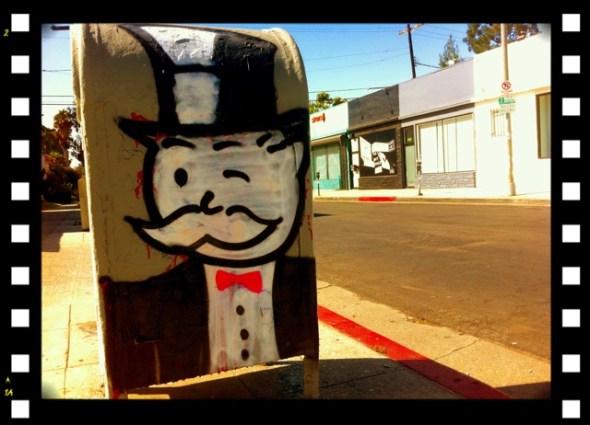 I entered the world of commercial banking the same year that the Monetary Control Act of 1980 (MCA) got passed and signed by Jimmy Carter. President Jimmy Carter was responsible for the first onslaught of deregulation of all kinds of industries which is important to think about. It was a Democratic President that pulled the first card from the laws that were put into place to stop the banking crises that had plagued our country in the early years of capitalism. I should also remind you that the country was founded on a system of economics called mercantilism. Capitalism didn’t come into being until the early-to-mid-19th-century. (Note to Rick Perry: The US Revolutionary war was not in the 16th or 17th century.) We had series of financial crises in the 1840s and then in 1870s . The first one was in 1792 and a politician/financier caused it.
We didn’t call them recessions bank then. We called them Panics and they were sourced in banking and nascent financial markets. They were the result of excessive speculation and/or some Bernie-Madoff-like figure and scheme. In 1792, the panic was set off by William Duer who used his appointment to the US Treasury by Alexander Hamilton to use insider information in a similar way to Hedge Fund Manager Raj Rajaratnam who was just sentenced to 11 years in jail yesterday. This is a very old story and really dates back to the birth of capitalism as we know it.
Hamilton was pretty appalled by Duer’s speculative activities. He wrote this at the time.
“Tis time, there must be a line of separation between honest Men & knaves, between respectable Stockholders and dealers in the funds, and mere unprincipled Gamblers.”
If you start typing Financial Panic into Google, you’ll start seeing a huge number of dates pop up. From 1792 down to the present time, most of these panics have been clearly rooted in that same problem: speculative bubbles and banking malfeasance.
There’s a clear difference between the good old fashioned community banking that gave me my first job out of my masters program and what we have today. Much of it is due to that first card pulled from the bottom of the financial market card house by Jimmy Carter in 1980. You can read about the law at FRB Boston. There were a lot of responsibilities placed on the FED for oversight at the time but the banks got a lot of benefits including increased access to borrowing money from the FED. When I was working in Nebraska, a bank was allowed one branch and a main office. There were restrictions on how far away the branch could be. I worked for a small bank with a branch across the street at a big shopping center. That local law was pulled down shortly thereafter because the banks wanted to branch every where into communities they did not know. There are very few community banks left in the country where your banker knows if you’ll be good for your loan or not based on years of knowing you.
Most small and regional banks have been gobbled up by the top 4 or 5 financial institutions. The majority of financial assets sit in a handful of institutions. That’s called monopoly, folks. Monopolies require regulation, not free reign. That’s basic classical economic theory and has nothing to do with Keynes and politics. Any microeconomics  101 students should be able to explain why. They are incredibly inefficient. We say they are not Pareto Efficient, which means some very specific things. They overprice their products. They restrict access to these products. They earn profits above and beyond what they should because the revenue far exceeds the productivity of the factors used to produce the service. They create a deadweight loss which is bad for every corner of the economy except for the monopolist.
We have gone from a system where lending risk is personalized and spread around a number of institutions to a situation where it’s all concentrated and automated in the hands of a few big banks. They also can invest in a lot of specious assets. The banks continued to seek complete interstate banking and eventually got it. The Riegle-Neal Interstate Banking and Branching Efficiency Act of 1994 gave them exactly what they wanted. It also allowed bank holding companies to do things that they had previously been disallowed like hold subsidiaries that offered speculative investments. Interestingly enough, it is much easier to become a bank holding company than it is to become a bank. Many investment banks became bank holding companies to access borrowing through the Fed Window in 2008 when they had gambled away a good deal of their own capital.
This law was signed by Democratic President Bill Clinton. That’s only the commercial banking side. The so-called shadow banking industry got freed to speculate at will and be closely aligned with banks and their guaranteed deposit when the Gramm-Leach-Bliley Act (GLBA) was signed by President William Clinton in 1999. It repealed huge sections of the Glass Steagall Act that were put into place during the Great Depression to deal with all those financial panics that finally led up to the 1929 Bank Run. If you’re unemployed and you’ve seen your housing equity and your retirement funds depleted, I’d suggest going to Phil Gramm’s house with placards and rotten eggs. He’s the one mover and shaker that brought all this on to our heads and a symbolic tar and feathering would make me feel good, frankly. (Here’s an academic site with some brief notes on a Mishkin textbook on the history of the repeal of important banking laws for your reference.)
So, it goes with out saying that the minute these things were put into play from 1980 forward, it was only a matter of time before we started to repeating panics and would eventually get another Great Depression. The panics started in the 1980s. I’d moved out of commercial banking and into the S&L business right before our first panic came. When S&L’s started giving market rates of interest on their liabilities, they had to start giving new mortgage loans out at exorbitant prices. My first one–in 1982–was for around 17%. I got the banker discount which brought it down to 12%. The problem was that all the liabilities were repricing to market and all the assets (loans) were still stuck at those 1950-1960 home loan interest rates of about 5%. My dad was barely paying 4% because the bank he used also was funding his floor plan (that’s the cars he had on his inventory sheet as a new car dealer). His floor plan interest was through the roof in those days because the usury laws had been suspended. It was in the 20% levels just like credit card debt was at the time. The commercial banks were seeing incredibly high prime rates of interest and the Savings and Loans were hemorrhaging money. This is a problem of term mismatch when you rely on arbitrage profits, but I’ll avoid the lecture on that one! The S&L crisis should’ve been the first cautionary tale from that Monetary Control Act. I have some pretty wild stories from those days including the Treasurer that I worked for using GNMA futures to day trade to try to up our cash balances. Illegal yes! That’s if you’re caught! However, we were the least of the FSLIC’s problems at the time and he got away with it!
The second cautionary tale came with a Long Term Capital Management that lost tons of money after the Russian Financial Crisis in 1998. That didn’t stop the GLBA at all however. There was an earlier canary too. That was Franklin Savings and Loan. There’s actually a more recent example of the same. That would be Granite Funds. LTCM made convergence trades that required huge sums of money and enormous leverage to be profitable. They were eventually bailed out and wound down at a huge cost. There is absolutely something wrong when we repeatedly have huge organizations collapse because of margin calls. I point back up to the quote from Alexander Hamilton who got it the first time out. We still haven’t learned the lessons from any of this because we’re ready and primed for the next financial crisis with European Sovereign Debt too. The speculators are pulling the same tricks and we’re suffering from the same results.
So, the deal is that after about 100 years of horrible problems, we put a box around the speculators called Glass Steagall. There is a new box proposed called the Volcker Rule. The banks are kicking and screaming about even the smallest regulations to stick them back into their boxes. We cannot afford to repeatedly coddle an industry that systematically creates huge social and economic costs on a regular basis when set free to do as it will. The Volcker Rule–in its current form–is pretty mild. It’s no where near what ex Fed Chairman Paul Volcker originally offered but it’s a step in the right direction. That’s why it’s first on my list of demands for OCCUPY activists.
Fitch Ratings on Friday said it sees potential for a delay in the adoption of a newly proposed rule barring banks from trading for their own profits, due to industry opposition that could lead to a political fight.
Banks’ opposition “will likely fuel a lengthy debate in Washington regarding the ultimate scope and precise implementation” of the Volcker Rule, Fitch said in a report released four days after federal banking regulators proposed the rules.
“There is a real possibility that controversy surrounding the proposal could delay the precise definition of restricted trading, particularly in a presidential election year when partisan debate over financial regulation will be intense,” Fitch said.
The rule, named after former Federal Reserve Chairman Paul Volcker, was required under the financial overhaul that became law last year. The rule would bar banks from trading for their own profit instead of on their clients’ behalf. Banks must hold investments for more than 60 days, and bank managers must make sure employees comply with restrictions.
The day after banking regulators and the Federal Reserve backed the rule, the Securities and Exchange Commission voted 4-0 to send the proposal out for public comment. The public has until Jan. 13 to comment on a rule that’s expected to take effect by July after a final vote by all the regulators. Banks would have until July 2014 to comply.
The industry has said that the proposal would put them at a disadvantage to banks in other countries.
Let me reiterate something I’ve said earlier. The Scandinavian countries learned from their last disastrous banking crisis in the early 1990s and put their banks back into the box. This was roughly the same time of our own S&L crisis and came from speculative bubbles. They all come from speculative bubbles, excess risk taking, and extremely immoral behavior on the part of many bankers/brokers because the extraordinary profits that can be extracted on the ride up are incredible. The Canadians never let them out so they’ve basically been sitting pretty well during this last crisis. None of these countries had the problems that we and other countries have had since then. The Volcker Rule is the least we could do to start down the path to sanity.
I want to end this post by pointing out a new voice in the blogging community called Reformed Broker. His real name is Joshua Brown. He has written a Dear Wall Street letter that’s worth a read. He now feels like I felt after living through the S&L crisis and then watching the insanity repeat with LTCM and the others in the late 1990s. All this fol de rol tanked my 403(B) retirement account as badly as this last bit of craziness has tanked it again. Only this time I am 10 years closer to retirement. Oh, and this time they got my home equity in the process and my job. The S&L crisis got my job and killed my ability to sell my house. It also caused incredible damage to my father’s small business. He sold it at a huge loss just to get out from under the stress that was killing him. I’ve just about had it now with this nonsense, the bankers, and the politicians that enable them. As I’ve said it’s been going on for some time and they need to be put back into the box.
I’m going way beyond fair use here, Josh but I wanted your voice to be read by our readers. Please take this as a compliment and not a copy right violation!
In 2008, the American people were told that if they didn’t bail out the banks, there way of life would never be the same. In no uncertain terms, our leaders told us anything short of saving these insolvent banks would result in a depression to the American public. We had to do it!
At our darkest hour we gave these banks every single thing they asked for. We allowed investment banks to borrow money at zero percent interest rate, directly from the Fed. We gave them taxpayer cash right onto their balance sheets. We allowed them to suspend account rules and pretend that the toxic sludge they were carrying was worth 100 cents on the dollar. Anything to stave off insolvency. We left thousands of executives in place at these firms. Nobody went to jail, not a single perp walk. I can’t even think of a single example of someone being fired. People resigned with full benefits and pensions, as though it were a job well done.
The American taxpayer kicked in over a trillion dollars to help make all of this happen. But the banks didn’t hold up their end of the bargain. The banks didn’t seize this opportunity, this second chance to re-enter society as a constructive agent of commerce. Instead, they went back to business as usual. With $20 billion in bonuses paid during 2009. Another $20 billion in bonuses paid in 2010. And they did this with the profits they earned from zero percent interest rates that actually acted as a tax on the rest of the economy.
Instead of coming back and working with this economy to get back on its feet, they hired lobbyists by the dozen to fight tooth and nail against any efforts whatsoever to bring common sense regulation to the financial industry. Instead of coming back and working with the people, they hired an army of robosigners to process millions of foreclosures. In many cases, without even having the proper paperwork to evict the homeowners. Instead, the banks announced layoffs in the tens of thousands, so that executives at the top of the pile could maintain their outrageous levels of compensation.
We bailed out Wall Street to avoid Depression, but three years later, millions of Americans are in a living hell. This is why they’re enraged, this why they’re assembling, this is why they hate you. Why for the first time in 50 years, the people are coming out in the streets and they’re saying, “Enough.”
And one more time, let’s hear from Alexander Hamilton because it bears repeating!!!
“‘Tis time, there must be a line of separation between honest Men & knaves, between respectable Stockholders and dealers in the funds, and mere unprincipled Gamblers.”
I’ve added a link to Josh’s blog so you can go sample his writing any time you want. He’s also on twitter as @ReformedBroker. Okay, this is a little long, and a little like one of my lectures for financial institutions, but I thought you might appreciate how this thing came down and what needs to be done. Like I said, we need to put them back into a box. If they are to be free from the chance of bankruptcy, able to access US tax dollars at zero cost, and are still able to create Financial Panics by bad lending and investment practices we have no other chance. This will repeat ad infinitum and will cost us our personal and national treasures.

Is Timmy in the Well Again?
Posted: October 14, 2011 Filed under: Team Obama | Tags: Shadow Banks, Timothy Geithner, Wall Street 9 Comments Boston Boomer has been updating me on the shenanigans pulled by Timothy Geithner via Ron Suskind’s “Confidence Men”. I’m hoping she’ll outline all the stuff in a post soon. I’m sure you remember how Geithner approved Wall Street Executives giving themselves bonuses after receiving TARP funds. There’s substantial evidence that Geithner blocked plans to remove CEO Vikram Pandit and dismantle Citibank. He evidently had incredible issues with Sheila Bair, is known for throwing screaming fits when his pet Wall Street Banker friends are threatened and evidently ignored the President’s orders to get tougher on Wall Street early in the administration. Again, I”ll let Boomer flesh it out for you but there’s some really heady information out there about Geithner and his incredible coziness with the shadow banking industry.
Given that context, color me surprised by this Politico headline: Geithner: Action against Wall St. coming.
Asked on CNBC about the Occupy Wall Street movement’s frustrations over the lack of criminal charges related to the financial crisis, Geithner said action is on the way.
“You’ve seen very, very dramatic enforcement actions already by the enforcement authorities across the U.S. government, and I’m sure you’re going to see more to come. You should stay tuned for that,” he said.
…
Geithner Friday said the Obama administration had moved swiftly after the crisis to put into place new protections for consumers and investors.“We moved very quickly to put in place a much stronger set of rules of the game across the financial sector. Now, we’re now facing a lot of resistance to those rules, but we’re going to make sure that we deliver the promise of those reforms, which is a much tougher set of rules across the system against risk-taking and much stronger protections for consumers,” he said.
Geithner responded to the Occupy Wall Street demonstrations by asserting that their unhappiness was due to the sluggish pace of overall economic growth.
“What you see is a general sense across the country of concern that the U.S. economy is not growing faster, you’re not seeing incomes rise more rapidly, and people want to make sure that the government, Washington, is acting to make things better now. As part of that, they want to see us deliver much stronger protections for consumers and investors as an economy as a whole,” Geithner said on CNBC.
The Treasury Secretary added that the domestic focus was to ensure that Congress would take steps that would encourage economic growth and lower the deficit.
“What we’re focused on is trying to make sure that we are doing everything to encourage Congress. … to take some steps now that can make growth stronger in the United States, and tie that to reforms to bring down our long-term deficits,” he said.
Something tells me that the deteriorating political scenario for the President has something to do with this conversation. However, I will believe it when I see it happen. Talk show chatter comes so cheap.
Thank the Buddhas! It’s Friday!
Posted: October 14, 2011 Filed under: #Occupy and We are the 99 percent!, abortion rights, Barack Obama, morning reads, Reproductive Health, Reproductive Rights, right wing hate grouups, Women's Rights | Tags: letting women die, my big fat T Rex, Obama from cool to cold, occupy Wall Street, religious extremists 23 Comments Good Morning!
This has been one damn long week! It’s coming to an end with the Republicans who are out to kill women again. A clump of cells is just so much more important because it might be a man in about 9 months, doncha know? A horrible bill that would cause publicly sanctioned death by forced pregnancy crept on to the house floor yesterday.
House Minority Leader Nancy Pelosi blasted an abortion bill the House will vote on later Thursday — claiming that the legislation could ultimately make women “die on the floor and health care providers do not have to intervene.”
The bill, called the Protect Life Act, would ban the federal funding for abortions and bar women from using tax subsidies from the health care law to buy insurance that cover abortion – except in cases of rape, incest or the health of the mother. It would also ensure that health-care providers are protected if they believe that performing abortion procedures clashes with their personal beliefs.
“Under this bill, when the Republicans vote for this bill today, they will be voting to say that women can die on the floor, and health care providers do not have to intervene if this bill is passed. It’s just appalling,” Pelosi told reporters on Thursday. “I can’t even describe to you the logic of what it is that they are doing.”
Pelosi and other Democrats dismissed the bill as a “waste of time” and criticized House GOP leadership for bringing up a bill that isn’t directly related to jobs and the economy – particularly since the abortion legislation has a dim chance in the Democratically-controlled Senate.
“This bill substantively puts women’s health at risk,” said House Minority Whip Steny Hoyer (D-Md.).
Just imagine if there were these kinds of conscientious clauses were attached to all forms of government spending? How many extremist religious views do we have to suffer through in this country? What if every one of us got to walk away from our job responsibilities because we consider something objectionable? This is just more evidence that our society has fallen into the hateful agenda of religious extremists! Their rights to be objectionable should not be given precedent over the rest of society and medical and scientific evidence. Thank goodness this bill will go no further and shame on Boehner for letting the Let Women Die bill come up to a vote.
The House approved an anti-abortion bill Thursday that takes aim at the health insurance subsidies in President Barack Obama’s health care law — and gives both parties another chance to rally their bases over yet another abortion fight.
The “Protect Life Act” would ban women from using the health reform law’s tax subsidies to purchase health plans that cover abortions and would allow hospital and health care providers to refuse to provide abortions if they have objections on grounds of conscience.
The vote was 251-172, with 15 Democrats voting for the bill and two Republicans opposing it.
Republican supporters of the bill, introduced by Pennsylvania Rep. Joe Pitts, say it would merely ensure that no taxpayer money is used to subsidize abortions.
“The left has moved so far that they object to this simple, common-sense measure that would protect taxpayers from having their money go to a procedure they find abhorrent,” said Rep. Mike Pompeo (R-Kan.). “Simply put, we must end what Obamacare did. We must stop subsidizing abortions with federal taxpayer dollars.”
Isn’t it shameful that Pompeo should be allowed to so thoroughly lie on the floor of congress? There is absolutely no substance or reality to a word in his quote.
Crazy ol’ Ron Paul had a wardrobe mishap during the debate the other night. It seems he wore falsie eye brows and one went rogue.
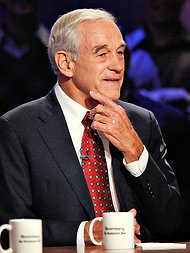
X marks the spot where the falsie got away from the brow.
For those of you not yet riveted by the Republican race, Mr. Paul, the dark-horse libertarian with equally dusky brows, was a victim of hot lights, faulty adhesive or merely a devilish optical illusion when his right eyebrow seemed to dip toward the stage at Dartmouth College.
Seen on television, Mr. Paul appeared to have a second, thinner brow under the one headed south, creating a delicate X over his right eye.
Since we’re already on the subject of dinosaurs and other ancient animals that should go extinct, here’s something on the T. Rex.
Tyrannosaurus rex grew faster and weighed more than previously thought, suggesting the fearsome predator would have been a ravenous teen-ager, researchers said Wednesday.
Using three-dimensional laser scans and computer modeling, British and U.S. scientists “weighed” five T. rex specimens, including the Chicago Field Museum’s “Sue,” the largest and most complete T. rex skeleton known.
They concluded that Sue, who roamed the Great Plains of North America 67 million years ago, would have tipped the scales at more than 9 tons, or some 30 percent more than expected.
Intriguingly, the smallest and youngest specimen weighed less than thought, shedding new light on the animals’ biology and indicating that T. rex grew more than twice as fast between 10 and 15 years of age as suggested in a study five years ago.
“At their fastest, in their teenage years, they were putting on 11 pounds or 5 kilograms a day,” John Hutchinson of the Royal Veterinary College in London told Reuters.
Here’s an interesting take on Occupy Wall Street from former NY AG and Governor Elliot Spitzer.
Occupy Wall Street has already won, perhaps not the victory most of its participants want, but a momentous victory nonetheless. It has already altered our political debate, changed the agenda, shifted the discussion in newspapers, on cable TV, and even around the water cooler. And that is wonderful.
Suddenly, the issues of equity, fairness, justice, income distribution, and accountability for the economic cataclysm–issues all but ignored for a generation—are front and center. We have moved beyond the one-dimensional conversation about how much and where to cut the deficit. Questions more central to the social fabric of our nation have returned to the heart of the political debate. By forcing this new discussion, OWS has made most of the other participants in our politics—who either didn’t want to have this conversation or weren’t able to make it happen—look pretty small.
Surely, you might say, other factors have contributed: A convergence of horrifying economic data has crystallized the public’s underlying anxiety. Data show that median family income declined by 6.7 percent over the past two years, the unemployment rate is stuck at 9.1 percent in the October report (16.5 percent if you look at the more meaningful U6 number), and 46.2 million Americans are living in poverty—the most in more than 50 years. Certainly, those data help make Occupy Wall Street’s case.
But until these protests, no political figure or movement had made Americans pay attention to these facts in a meaningful way. Indeed, over the long hot summer, as poverty rose and unemployment stagnated, the entire discussion was about cutting our deficit.
This is certainly an interesting perspective at the Uk Guardian on Obama’s fall from grace! Just read the headline and grabber subtitle: ” How Barack Obama went from cool to cold. Barack Obama’s measured approach won him the White House. So why do supporters think he lacks the ‘fierce urgency of now’? “
There are two particular areas where most commentators and the public feel that Obama has fallen short. The first is the economy. Poverty and repossessions are at a record high, the Dow keeps tanking, the deficit keeps growing and unemployment remains stuck at around 9%. Yet the man who recalled Martin Luther King’s evocation of “the fierce urgency of now” on the campaign trail has struck few as being either fierce or urgent as the nation teeters on the brink of another recession.
“You get the sense that this president, while intellectually engaged, is not emotionally engaged with what the American people are going through,” says Michael Fletcher, the Washington Post’s economics correspondent. “People want to feel there’s someone out there fighting their corner even if that person doesn’t win.”
Charlie Cook, one of Washington’s premier political analysts, believes there’s only so much Obama can do at this stage. “I think the problems are more objective,” he says. “Yes, he tends to lecture and tends to be professorial. I think that’s a problem, but I don’t think it’s the problem. I think eloquence only gets you so far. I think the emphasis was on going on television and trying to explain his agenda, to the point now where I think if the American people haven’t hit the mute button their finger is very close to that button where they just don’t listen any more. If things get better, we’ll re-evaluate, but right now – we’re not listening.”
Drew Westen, academic and author of The Political Brain, thinks they would listen if Obama changed the pitch. “What Americans really needed to hear from Barack Obama was not only I feel your pain, but also I feel your anger. And he’s a person who just doesn’t do anger. And if you can’t be angry when Wall Street speculators just gambled away the livelihoods of eight million of your fellow citizens then there’s something wrong with you.”
Here’s some spicy Cajun chit chat from James Carville who thinks that the Republican field for 2012 is pathetic! This downtown NOLA girl couldn’t agree more with that uptown NOLA boy! It’s actually a fun comparison of republican presidential wannabes past and present. I’ll just go for the lowest blow here.
Moving on to Michele Bachmann vs. Howard Baker (I’m sorry I couldn’t help myself.) Baker served in the U.S. Navy, was elected to the U.S. Senate, was asked to serve on the Supreme Court by Nixon, and served two terms as Senate minority leader. He later received the Presidential Medal of Freedom and inspired the formation of the Howard H. Baker, Jr. Center for Public Policy at the University of Tennessee. Could you see Michele Bachmann being nominated for a Presidential Medal in the near future?! Of course, some people might say, to be fair to Bachmann, Baker has never claimed to cure anyone of homosexuality.
Go read them all. It’s a hoot!
So, I’ve got two articles to send off for publication by Sunday and I need to prepare for my paper presentation in Denver a week from today. I think this should get us started on some interesting morning reads! What’s on your reading and blogging list today?
The outlook wasn’t brilliant for the Mudville nine that day
Posted: October 12, 2011 Filed under: 2012 presidential campaign, Barack Obama, Republican politics, Republican presidential politics 24 Comments Just a quick post before I go underground for a few days. It’s a long way to November 2012 in political years, but what does this headline say to you and to Team Obama? It looks like Mighty Barrack is up to bat to me.
Poll: Herman Cain, Rick Perry, Mitt Romney All Beat Obama
Here’s how much political trouble President Obama is in: A new poll by the authoritative Evolving Strategies firm finds that Herman Cain, Texas Gov. Rick Perry, and Mitt Romney would all beat Obama it the election were held today.
Worse for Obama: the poll, which showed some 1,000 Americans videos of both Obama and the candidates speaking on the economy, backed up recent analysis that the president has lost his mojo when it comes to tackling the deepening recession and blaming Republicans for standing in his way.
Evolving Strategies put the video spin on their poll because most of the Republican presidential candidates still aren’t known outside of Washington, the early primary and caucus states and to political junkies. Their idea was to show respondents a video clip and have them read a short 120-word biography.
From Evolving Stratgies and it’s from FOX so I apologize for the brain burn that logo will inflict.
You have to realize that none of these folks probably have been paying attention to some of the crazier things that folks like Herman Cain and Rick Perry have been saying. Voters probably haven’t been attention to the debates, blogs, or Sunday Talk shows. It’s foot ball season and the lead up to the World Series after all. The one thing this shows is that Republicans are still trying to find some one other than Romney.
Republican Waterloo
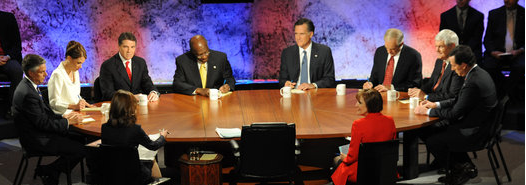
Posted: October 11, 2011 Filed under: Psychopaths in charge, Republican politics, Republican presidential politics, right wing hate grouups | Tags: Republican Presidential Debate 10 CommentsWell, I’d say it’s about over for Rick Perry. Who on earth is preparing this man for these debates? Guess who his concluding comment came from? The funny thing is that he actually ripped the phrase off from Rick Santorum who ran away from it once he figured out its source; Langston Hughes.
Rick Perry turned in another underwhelming performance at tonight’s GOP presidential debate in Dartmouth on Tuesday night and signed off by quoting the title of a pro-union, pro-racial justice, and pro-immigrant poem written by Harlem Renaissance poet Langston Hughes, titled “Let America Be America Again.”
The debate format was meant to be a ’round table’ but all I could see were square pegs. A lot of the focus was on Mitt Romney who just earned the endorsement of Chris Christie. Christie also defended Mitt’s faith against earlier value voters hatred. Cain offered up a plan that is bound to put the economy into a tail spin and make the deficit worse. Republican and Reagan adviser Bruce Bartlett criticized it today. Most economists are appalled.
Herman Cain, the former chief executive of the Godfather’s Pizza chain, has been enjoying a surge in polls, buoyed by his victory in a Florida straw poll and by wary conservatives who are seeking an alternative to Mr. Romney and Mr. Perry. He calls his signature economic proposal his “9-9-9 Plan”; as described on his website, it would eliminate the capital gains tax, the payroll tax and the inheritance tax and put in place a flat 9 percent tax on businesses, a 9 percent tax on personal income, and a new 9 percent federal sales tax on top of existing state and local sales taxes.
Mr. Cain’s frequent invocations of his “9-9-9 Plan” often get applause, but some economists warn that it would likely increase the deficit without providing many benefits. Bruce Bartlett, who held senior policy roles in the administrations of President Ronald Reagan and President George H.W. Bush and who has become a critic of much recent Republican economic thinking, examined the Cain plan in a post on The New York Times’s Economix blog. He concluded that “the poor would pay more while the rich would have their taxes cut, with no guarantee that economic growth will increase and good reason to believe that the budget deficit will increase.”
Rumors about Bachmann’s campaign and its lack of funds led to speculation that this might be her last debate appearance. She offered up some even nuttier economics plans. I have no idea why these folks haven’t figured out that sustained tax cuts do nothing but make the deficit worse. Evidently they only took courses in voodoo and faith-based economic policy because not one of them has anything that’s based in empirical evidence.
Representative Michele Bachmann of Minnesota, who catapulted herself into contention in the race with a well-received debate performance over the summer but who has struggled to capture attention as her standing in the polls has ebbed, released her own economic plan Tuesday, before the debate. Its first provision calls for letting American companies repatriate the cash they have parked abroad without paying taxes. Her Web site maintains that such a tax holiday, which many companies are lobbying hard for, would “provide valuable capital for the job creators in this country and pump tremendous amounts of money into our economy.”
But when Congress and the Bush administration offered companies a similar tax incentive to repatriate money in 2005, studies found, it did not spur employment. The vast majority of the money that was brought back to the United States was returned to shareholders in the form of dividends and stock buybacks, according to a study by the nonpartisan National Bureau of Economic Research. So far, all of the Republican presidential candidates have taken a hard line against any tax increases, putting them at odds with what many voters have been telling pollsters this year. But the people most likely to vote in Republican primaries are also most likely to oppose tax increases.
Santorum’s economic plan is to go “to war with China”.
At Tuesday’s The Washington Post/Bloomberg Republican presidential debate, former Pennsylvania Sen. Rick Santorum declared that he actually wanted “to go to war with China.”
Fellow candidate Mitt Romney promised that if elected, he would immediately label China as a currency manipulator, but added, “I don’t want a trade war with anybody.”
“You know, Mitt, I don’t want to go to a trade war,” Santorum remarked. “I want to beat China. I want to go to war with China and make America the most attractive place in the world to do business.”
I’ll say one thing for this group of nitwits. They sure are making Mitt Romney look sane. Just one more question. Does any one really know why Newt Gingrich is still there?

 peej
peej Carissa
 bostonboomer
 dakinikat
 ecocatwoman
 jjlo
jjlo mablue2
 Mama Lopez
 peggysue22
 quixote
 skydancingguestblogger
 Mona (aka Wonk the Vote)





Recent Comments