
Memes and Damned Lies
Posted: October 11, 2011 Filed under: The Media SUCKS, the villagers, U.S. Economy, We are so F'd | Tags: 53 percent astroturfers, economic myths 28 Comments I posted a group of statistics in the Monday Morning Reads to offset one of the most specious memes floating around the right wing these days. I think it first gained some traction when Michelle Bachmann introduced it in one of the debates right after Obama introduced the idea that millionaires need to pay their fair share of taxes. It’s basically billionaire blowback for some one suggesting they pay for the roads they drive on, the schools they attend, the police and fire fighters they call when they are in trouble, and the soldiers–yes even the gay ones–that protect their assets here and abroad. The little whiny boys think they pay more than their fair share and it’s the damned poor that are getting off easy! Poor little babies!
There’s this incredibly misleading statistic being bandied about that over half of the taxpayers don’t pay federal taxes. I also talked about the fuzzy math and logic in this post about 10 days ago. It keeps popping up in response to the so-called Buffett rule that would ensure that billionaires don’t pay lower effective tax rates than their secretaries. Well, it’s now turned into an Astroturf movement called “We are the 53%” that turns the class war back to one between the poor and working class that includes the Dread Pirate Eric Ericson among others. All this is based on an anomaly for the 2009 tax year and ignoring all taxes but the income tax. There are memes and then there are out and out lies. My Monday post linked to this analysis at the CBPP. Here’s a highlight if you don’t want to follow this link.
A recent finding by Congress’ Joint Committee on Taxation that 51 percent of households owed no federal income tax in 2009 [1] is being used to advance the argument that low- and moderate-income families do not pay sufficient taxes. Apart from the fact that most of those who make this argument also call for maintaining or increasing all of the tax cuts of recent years for people at the top of the income scale, the 51 percent figure, its significance, and its policy implications are widely misunderstood.
- The 51 percent figure is an anomaly that reflects the unique circumstances of 2009, when the recession greatly swelled the number of Americans with low incomes and when temporary tax cuts created by the 2009 Recovery Act — including the “Making Work Pay” tax credit and an exclusion from tax of the first $2,400 in unemployment benefits — were in effect. Together, these developments removed millions of Americans from the federal income tax rolls. Both of these temporary tax measures have since expired.In a more typical year, 35 percent to 40 percent of households owe no federal income tax. In 2007, the figure was 37.9 percent. [2]
- The 51 percent figure covers only the federal income tax and ignores the substantial amounts of other federal taxes — especially the payroll tax — that many of these households pay . As a result, it greatly overstates the share of households that do not pay any federal taxes. Data from the Urban Institute-Brookings Tax Policy Center show only about 14 percent of households paid neither federal income tax nor payroll tax in 2009, despite the high unemployment and temporary tax cuts that marked that year.[3]
- This percentage would be even lower if federal excise taxes on gasoline and other items were taken into account.
The bottom line is that it’s an outlier created by the recession, the “Making Work Pay” tax credit, and ignoring all the other taxes people get socked with including the highly regressive FICA taxes. Cannonfire has a great post up today that summarizes exactly how a group of extreme narcissists with antisocial personality disorder (e.g. Libertarians) are using this misleading statistic to draw attention away from Occupy. Of course, there are the other usual right wing memes floating about the Occupy protestors as you’ve read here and many other places. They are “paid union thugs”. They are spoiled kids who don’t want to pay their credit cards. They are poor because they are lazy. They are Marxists. They are Leninists. They are anti-American. It’s an Obama plot! It’s a DNCC plot! It’s just been one canard after another. I’m sure well be buried chin deep in the lies by the end of the next Republican Debate Debacle tonight. I’m just wondering what hard working American they’re going to boo or send the die sucker love to tonight.
I could spend all day ranting about this and I guess I have given that it’s my third post of disgust in about 10 days but I wanted mostly to frame that current meme in terms of a MoJo post on 6 Big Economic Myths. It’s got so many nifty graphs that my legs actually tingled! It also outlines some of the worst economic lies that we’ve been fed since the Reagan years and the ones that have been specifically invented now to keep congress rigging the economic system to benefit the most wealthy and powerful. If you can stomach watching that debate tonight, keep these myths in mind. Also, go read the article for the full effect. There’s no need for me to reproduce it here for you.
Myth #1: The Stimulus Failed
Short explanation: It wasn’t Max’s Miracle Pill but the economy would’ve been worse without out.
Myth #2: The deficit is our biggest problem right now
Short explanation: The unresolved leftovers from the financial crisis are the problem and are creating deficits, joblessness, and all kinds of problems. That’s the overarching problem! Undoing everything the Dubya administration did is the solution!
Myth#3: Lower taxes are the best way to grow an economy
Short explanation: No way no how. No empirical data supports this at all.
Myth#4: Regulatory uncertainty is clogging the economy
Short explanation: Deregulation did this to us. Good Regulation of financial markets leads to reduce information asymmetry and leads to better outcomes. Also, the number one concern of businesses is lack of customers if you believe them when you ask them.
Myth #5: Obama is debasing the dollar
Short explanation: Devaluation of the dollar is a good way to beef up exports and stop the outflow of jobs to other countries.
Myth #6: If you unshackle the rich, they’ll rev up the economy
Short explanation: No way. No how. If anything they take their money and create speculative bubbles in markets. They also use their money to invest in other countries and vacation there. Evidence is contrary to that.
The one thing that Republicans and their libertarian buddies never run out of are out and out lies. I am a pragmatist. I follow the scientific method and the data. An ideologue creates a narrative around what they want to believe and then wraps it up in whatever it takes to make it sound appealing and plausible. You can call it a meme or a canard. You can call them opinions or ideologies. I just call them damned lies.
Searching for that New Brand of Crazy that will Sell
Posted: October 10, 2011 Filed under: just because, Republican politics, Republican presidential politics, right wing hate grouups | Tags: Herman Cain 11 Comments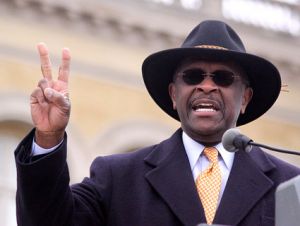 You have to hand it to today’s Republican Party. They still want the crazy and they’re just looking for it in all the right places. Much of it has been on display at the values (sic) voters hatefest, the recent presidential debates, and Sunday news talk shows. The problem is that when it gets exposed to daylight there’s so much crazy that the mainstream runs. They’ve got to find a brand of crazy that sells.
Every time one of these folks burbles up towards Mitt Romney we get to see the new crazy flavor of the month. They’ve already been there done that with Bachmann and Perry. The Bachmann-in-your-face-kind-of-crazy has led to a complete implosion of a campaign that went surprisingly well until Iowa. Perry has been wilting under the spotlight. His debate performances have been terrible and all kinds of his nutjob supporters have been doing a great job horrifying the country by speaking out for him and introducing him proudly. Let’s not forget Ron Paul. He’s the perpetual nutty nut flavor of each campaign season. The Republican presidential contenders have been just one big bowl of Granola full of fruits, flakes and nuts.
So, the deal is that they really really don’t want Mitt Romney who they don’t trust for a variety of reasons. Hence, we’re seeing product testing. So, the next nutty goodness to rise to the top of the taste test is Herman Cain. He’s been a perfect tool for a party trying to prove that it’s not racist. That’s been hard to do given the presence of Ron Paul and Rick Perry. Then there was Haley Barbour who spent part of his time inkling a presidential run by defending a hate group. Well, let’s not be coy. Those last three are the loci of hate group central.
Ron Paul has a long history of being supported by Storm Front and using state’s rights to argue that the Jim Crow laws really shouldn’t have been removed. He’s got a long line of writing racist memes in his news letters and has a well stated position on getting rid of the 1964 civil rights act. Here’s just one recent example of his toe-dipping into the realm of white supremacists group. He actually invited a long time activist in the League of the South to testify to his subcommittee overseeing the Fed.
One of the witnesses invited to testify was Thomas DiLorenzo, a longtime activist in the neo-Confederate hate group, League of the South (LOS). The LOS advocates for a second Southern secession and a society dominated by “Anglo-Celts” – that is, white people. LOS leaders have called slavery “God-ordained” and described segregation as necessary to the racial “integrity” of black and white alike. DiLorenzo also is an economics professor at Baltimore’s Loyola College.
According to the Washington Post, “when Paul opened up the hearing to questions from committee members, Rep. Lacy Clay (D-Mo.) directly took on DiLorenzo for his membership in the League of the South,” pointing to the designation of the LOS as a hate group by the Southern Poverty Law Center. Clay also cited DiLorenzo’s many revisionist works about the Civil War and Lincoln, including “More Lies about the Civil War,” “In Defense of Sedition,” and “The First Dictator-President,” which examines “how Lincoln’s myth has corrupted America.
I suppose we don’t need to go into Perry since stuff is coming out on him more and more all the time. The ranch name thing is just the latest of the dirty laundry hitting the light of day. He’s often been heard touting secession for Texas and supports the Sons of Confederate Veterans in their search to put Confederate symbols on everything.
So, it’s only convenient that the next great Republican crazy flavor is Herman Cain. Maybe he can prove that the Republicans have left Nixon’s Southern Strategy in the History Books. He’s being used to inoculate racists in the party. Notice that I’m not saying all Republicans support institutional racism or are personally racist. Cain can get away with saying things like black people are “brainwashed” and racism isn’t a problem. He does this all while ginning up fear of sharia’h law and Muslims. Oh, and he’s not too friendly on immigration either. Can we please extend the racism conversation to include a few more folks of color so we can add him into the Republican’s mix of homophobia, gynophobia, islamophobia, and xenophobia? Let’s just show a few of his recent hits via Susie Madrak at C&L and the Christine Amanpour interview. Here’s example one.
AMANPOUR: Let me move on to some things that you’ve said. Right after the debate in Florida, you told Wolf Blitzer of CNN that, basically, African-Americans, blacks in this country had been brainwashed over the years into supporting Democrats.
CAIN: Yes.
AMANPOUR: I mean, isn’t that really an inflammatory thing to say? I mean, do you really believe that African-Americans, blacks, are so easily manipulated?
CAIN: I also said in that same interview…
AMANPOUR: No, but let me you ask about that. That word is very inflammatory.
CAIN: It is. I’m going to answer your question. I also said the good news is a large percentage of black people are thinking for themselves. Now, I think that — if the word is inflammatory, that’s too bad. It is true. And here’s why: because some black people won’t even listen to someone who appears to be a conservative or a Republican. I call that brainwashing.
Here’s example two.
CAIN: Some people would infuse Sharia law in our court system if we allow it. I honestly believe that. So even if he calls me crazy, I am going to make sure that they don’t infuse it little by little by little. It’s not going to be some grand scheme, little by little. So I don’t mind if he calls me crazy. I’m simply saying…
AMANPOUR: You’re sticking to it?
CAIN: I’m sticking to it. American laws in American courts, period.
Any one who insists that “judeo-christian” traditions be put into law would essentially be arguing for sharia law too given that things like prohibition against usury is based in shared Abrahamic traditions. That’s just one example. I doubt Cain or most of his friends even know the huge tenets implied in sharia. They only assume it’s not “American” when their pet religious traditions are acceptable. This wreaks of the same kinds of arguments they used to use on Jewish and Catholic faiths. Right now, Cain and all his Republican pals are trying to avoid the attacks by their base on Mormons.
Perhaps most astounding to me is Herman Cain’s joke that our immigration policies should consist of a great wall of china and an alligator moat. This was as telling to me as Bobby Jindal’s pedophilia joke. There’s jokes and then there’s tasteless jokes at other people’s expense.
Transcript: “I just got back from China. Ever heard of the Great Wall of China? It looks pretty sturdy. And that sucker is real high. I think we can build one if we want to! We have put a man on the moon, we can build a fence! Now, my fence might be part Great Wall and part electrical technology…It will be a twenty foot wall, barbed wire, electrified on the top, and on this side of the fence, I’ll have that moat that President Obama talked about. And I would put those alligators in that moat!”
So, here’s the statement on his policy outside the context of that strange joke in terms of a slap in the face to Rick Perry. Oh, btw, we’re supposed to get a sense of humor to understand the joke. Isn’t that what they all say? This isn’t an immigration policy per se, it’s more like a paramilitary strategy.
Cain’s suggestion that immigration law enforcement should simply be turned over to the states is just another example of his naive understanding of both foreign policy and the Constitution.
As the Supreme Court established almost 70 years ago, the states have very little business weighing into immigration policy because “[e]xperience has shown that international controversies of the gravest moment, sometimes even leading to war, may arise from real or imagined wrongs to another’s subjects inflicted, or permitted, by a government.” If a single state mangles an immigration prosecution, for example, or directs disparate resources against the citizens of one nationality, it will impact the foreign relations of the entire United States — potentially even thrusting America into a needless war. The Constitution leaves these kinds of decisions up to a leader who has actually been elected by the whole nation, and not to the governor of just one state.
Nevertheless, Cain’s weak understanding of law and policy is apparently quite appealing to the kind of voters who cheer death and boo U.S. servicemembers. A new Fox News poll shows previous frontrunner Rick Perry hemorrhaging support — more than one third of his previous supporters ditched his candidacy in the wake of Perry’s defense of humane treatment for immigrants — while Cain has surged 11 points to third place in the GOP primary.
Perry, like the Chamber of Commerce, loves him some cheap labor. Cain’s strategy is to let states use law enforcement to “repel the invader”. I think we can safely say that the invader is still that age old use of “other” as tribe enemy.
At this point, you should be asking yourself why Herman Cain talks so much about race if it’s not such a big deal in this country. Aren’t an awful lot of Cain’s comments aimed at race and continually saying it’s no big deal? So what I want to know is why is it okay for Herman Cain to play the race card? Is Cain seeing that this is some kind of trump card that Republicans can use against the Obama campaign’s prior use? What does this buy him? Do I have to give my mom’s lecture on two wrongs not making a right?
Monday Morning Reads
Posted: October 10, 2011 Filed under: Global Financial Crisis, Marriage Equality, morning reads, Surreality, U.S. Military, U.S. Politics, unemployment, Women's Rights | Tags: Anita Hill, Crackerbox Palace, DOMA, George Harrison, Indigenous People's Day, National Coming Out Day, Native American Day, Occupy, Paul Krugman, plutocracy, Subprime mortgage crisis and the CRA, Taxes and poor people, technology, the Great Depression 25 Comments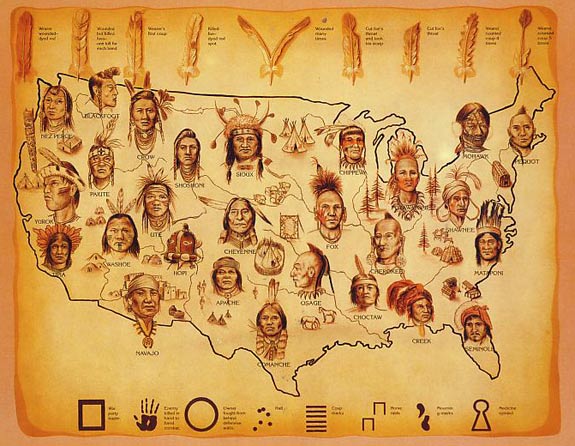 Good Morning!
and Happy Native Americans’ Day!
The second Monday of October annually marks Columbus Day in many parts the United States but not all states or region follow this observance. Instead, they celebrate other events on the day. For example, South Dakota’s official holiday on this date is Native Americans’ Day (also known as Native American Day), while people in Berkeley, California, celebrate Indigenous People’s Day.
 I think it’s a great idea to switch the current federal holiday out to a celebration of indigenous cultures or maybe find a better thing to celebrate!
BTW, National Coming Out Day is Tomorrow. That’s something to remember as you read that Speaker Boehner is threatening to withold funds from the Justice Department if that don’t vigorously enforce DOMA. There he goes again!!! The Republican Jobs Agenda is just always topmost on the priority list.
“We’re going to take the money away from the Justice Department, who’s supposed to enforce it, and we’ll use it to enforce the law,” Boehner told the conservative Value Voters Summit.
Boehner is engaged in an ongoing dispute with Attorney General Eric Holder over his refusal to defend in court the Defense of Marriage Act. President Obama has taken the stance that the law is unconstitutional. While the Justice Department usually defends laws passed by Congress against legal challenges, the Obama administration has stopped defending DOMA while Democrats work to repeal the law.
In March, Boehner announced that if Obama wouldn’t defend DOMA, he would, hiring a private law firm to defend it on behalf of the House.
“As the Speaker of the House, I have a constitutional responsibility. I’ve raised my hand to uphold and defend the Constitution of the United States and the laws of our country,” Boehner said Friday.
You know, he’s all about saving those taxpayer dollars too. True Story.
Here’s a movement I want to join if this California Republican Nutter would only give me the location where they’re taking on volunteers. And yes, it’s a REAL tweet.
@RepJackKimble After Value Voters I am more convinced than ever about the radical atheist agenda to secularize Columbus Day
Okay, I’d like to use the next bit of space to clear up a few right wing memes with actual research. I know, you’re shocked, it’s so unlike me to do so. First, while Fannie and Freddie exacerbated the meltdown and behaved as irresponsibly as any Wall Streeter, there is absolutely no connection between the meltdown and the Community Reinvestment Act. I have never been able to figure out how folks jumped the shark to make this connection, but it happened. I’ll give you the bottom line from the abstract but if you want to chase after the econometrics, feel free to follow the link.
In this paper we examine more directly whether these programs were associated with worse outcomes in the mortgage market, including delinquency rates and measures of loan quality.
We rely on two empirical approaches. In the first approach, which focuses on the CRA, we conjecture that historical legacies create significant variations in the lenders that serve otherwise comparable neighborhoods. Because not all lenders are subject to the CRA, this creates a quasi-natural experiment of the CRA’s effect. We test this conjecture by examining whether neighborhoods that have been disproportionally served by CRA-covered institutions historically experienced worse outcomes. The second approach takes advantage of the fact that both the CRA and GSE goals rely on clearly defined geographic areas to determine which loans are favored by the regulations. Using a regression discontinuity approach, our tests compare the marginal areas just above and below the thresholds that define eligibility, where any effect of the CRA or GSE goals should be clearest.
We find little evidence that either the CRA or the GSE goals played a significant role in the subprime crisis. Our lender tests indicate that areas disproportionately served by lenders covered by the CRA experienced lower delinquency rates and less risky lending. Similarly, the threshold tests show no evidence that either program had a significantly negative effect on outcomes.
Okay, one more meme to shoot down. You know how all those Republican presidential wannabes are trotting around saying about half of Americans don’t pay taxes and the rich are still burdened? I’ve shot down some of that argument before, but here’s some further details. I’m quoting from the executive summary and not the study itself. Again, you can go into the methodology if you want here.
A recent finding by Congress’ Joint Committee on Taxation that 51 percent of households owed no federal income tax in 2009 [1] is being used to advance the argument that low- and moderate-income families do not pay sufficient taxes. Apart from the fact that most of those who make this argument also call for maintaining or increasing all of the tax cuts of recent years for people at the top of the income scale, the 51 percent figure, its significance, and its policy implications are widely misunderstood.
- The 51 percent figure is an anomaly that reflects the unique circumstances of 2009, when the recession greatly swelled the number of Americans with low incomes and when temporary tax cuts created by the 2009 Recovery Act — including the “Making Work Pay” tax credit and an exclusion from tax of the first $2,400 in unemployment benefits — were in effect. Together, these developments removed millions of Americans from the federal income tax rolls. Both of these temporary tax measures have since expired.
In a more typical year, 35 percent to 40 percent of households owe no federal income tax. In 2007, the figure was 37.9 percent. [2]- The 51 percent figure covers only the federal income tax and ignores the substantial amounts of other federal taxes — especially the payroll tax — that many of these households pay . As a result, it greatly overstates the share of households that do not pay any federal taxes. Data from the Urban Institute-Brookings Tax Policy Center show only about 14 percent of households paid neither federal income tax nor payroll tax in 2009, despite the high unemployment and temporary tax cuts that marked that year.[3]
- This percentage would be even lower if federal excise taxes on gasoline and other items were taken into account.
- Most of the people who pay neither federal income tax nor payroll taxes are low-income people who are elderly, unable to work due to a serious disability, or students, most of whom subsequently become taxpayers. (In a year like 2009, this group also includes a significant number of people who have been unemployed the entire year and cannot find work.)
- Moreover, low-income households as a whole do, in fact, pay federal taxes. Congressional Budget Office data show that the poorest fifth of households as a group paid an average of 4 percent of their incomes in federal taxes in 2007 (the latest year for which these data are available), not an insignificant amount given how modest these households’ incomes are — the poorest fifth of households had average income of $18,400 in 2007. [4] The next-to-the bottom fifth — those with incomes between $20,500 and $34,300 in 2007 — paid an average of 10 percent of their incomes in federal taxes.
- Even these figures understate low-income households’ total tax burden, because these households also pay substantial state and local taxes. Data from the Institute on Taxation and Economic Policy show that the poorest fifth of households paid a stunning 12.3 percent of their incomes in state and local taxes in 2010.[5]
- When all federal, state, and local taxes are taken into account,the bottom fifth of households paid 16.3 percent of their incomes in taxes, on average, in 2010. The second-poorest fifth paid 20.7 percent. [6]
I know it’s statistics heavy, but some times that’s the best way to see what is actually going on. Right wing memes seem to thrive on taking things completely out of context and this one about tax dodging poor people is a doozy. See exactly how many taxes that get paid that weren’t counted in that famous figure which is an anomaly as it is.
Here’s an interesting article at NYT by David Leonhardt on how today’s economy makes the Great Depression look like the halcyon days.
Still, the reasons for concern today are serious. Even before the financial crisis began, the American economy was not healthy. Job growth was so weak during the economic expansion from 2001 to 2007 that employment failed to keep pace with the growing population, and the share of working adults declined. For the average person with a job, income growth barely exceeded inflation.
The closest thing to a unified explanation for these problems is a mirror image of what made the 1930s so important. Then, the United States was vastly increasing its productive capacity, as Mr. Field argued in his recent book, “A Great Leap Forward.” Partly because the Depression was eliminating inefficiencies but mostly because of the emergence of new technologies, the economy was adding muscle and shedding fat. Those changes, combined with the vast industrialization for World War II, made possible the postwar boom.
In recent years, on the other hand, the economy has not done an especially good job of building its productive capacity. Yes, innovations like the iPad and Twitter have altered daily life. And, yes, companies have figured out how to produce just as many goods and services with fewer workers. But the country has not developed any major new industries that employ large and growing numbers of workers.
There is no contemporary version of the 1870s railroads, the 1920s auto industry or even the 1990s Internet sector. Total economic output over the last decade, as measured by the gross domestic product, has grown more slowly than in any 10-year period during the 1950s, ’60s, ’70s, ’80s or ’90s.
Perhaps the most important reason, beyond the financial crisis, is the overall skill level of the work force. The United States is the only rich country in the world that has not substantially increased the share of young adults with the equivalent of a bachelor’s degree over the past three decades. Some less technical measures of human capital, like the percentage of children living with two parents, have deteriorated. The country has also chosen not to welcome many scientists and entrepreneurs who would like to move here.
I’m still of the opinion that we should hand out citizenship to any of our highly skill foreign students and do everything we can to keep them here. I have a feeling I’m in the minority on that opinion, however.
If you want to do some time tripping to a really upsetting period of history for women, here’s The Nation on The Legacy of Anita Hill. We’re now stuck with this total jerk on SCOTUS because of people like Joe Biden. I’ll never forget one of those senators that let Clarence Thomas get away with it. They hid the women that could verify her stories and put her squarely in the worst position possible. She handled it with dignity and we all lost.
Anita Hill remains an icon to whom subsequent generations are rightfully indebted. At the same time, she has not remained trapped by her own symbolism or frozen in time. It is sometimes forgotten that she is a respected scholar of contract jurisprudence, commercial law and education policy. She is a prolific author, publishing numerous law review articles, essays, editorials and books. Today, Hill is a professor of social policy, law and women’s studies at Brandeis University. Much of her most recent research has been on the housing market, and her most recent book, published this month, is Reimagining Equality: Stories of Gender, Race, and Finding Home.
It is ironic that the full substance of Hill’s remarkable intellectual presence remains so overshadowed by those fleeting, if powerful, moments of her Senate testimony. If the larger accomplishments of her life aren’t quite as iconic as that confrontation with Clarence Thomas, they nonetheless merit attention by feminists and scholars alike. To begin with, Hill is a remarkably elegant and accessible writer. For those who wish to apprehend the gravitas of her intelligence and dignity, Reimagining Equality would be a good place to start.
Krugman gets the Occupy protestors and has some delightful comments up on the Panic of the Plutocrats. He eloquently lays out the hype coming from the Cantors and the Bloombergs as well as CNBC and Fox that paints every one upset with their behavior as Leninist. The descriptions are a hoot but here’s the meat.
The way to understand all of this is to realize that it’s part of a broader syndrome, in which wealthy Americans who benefit hugely from a system rigged in their favor react with hysteria to anyone who points out just how rigged the system is.
Last year, you may recall, a number of financial-industry barons went wild over very mild criticism from President Obama. They denounced Mr. Obama as being almost a socialist for endorsing the so-called Volcker rule, which would simply prohibit banks backed by federal guarantees from engaging in risky speculation. And as for their reaction to proposals to close a loophole that lets some of them pay remarkably low taxes — well, Stephen Schwarzman, chairman of the Blackstone Group, compared it to Hitler’s invasion of Poland.
And then there’s the campaign of character assassination against Elizabeth Warren, the financial reformer now running for the Senate in Massachusetts. Not long ago a YouTube video of Ms. Warren making an eloquent, down-to-earth case for taxes on the rich went viral. Nothing about what she said was radical — it was no more than a modern riff on Oliver Wendell Holmes’s famous dictum that “Taxes are what we pay for civilized society.”
I have one more offering that is just for pure delight. It’s a short bit from the daughter of George Harrison’s Business Manager on what it was like to run the halls of crackerbox palace as a child.
Harrison’s wife, Olivia, always took good care of us and, like her husband, had a gentle, calming disposition. I loved going up the great gothic staircase in the living room to the recording studio on the first floor. I was fascinated by the recording console and the selection of instruments. Sometimes, Harrison would play new music for us and ask for our feedback.
Adjacent to the recording studio was a room with gold records and awards and an Oscar statuette. I remember the exhilarating sensation I got picking up the Oscar earned for “Let It Be” and feeling it weigh down my hand.
When it got late, and Dad was still in meetings, we would go to bed in one of the guest rooms down the hall from the studio with sounds of Harrison’s sitar lulling us to sleep.
You can see I’m full throttle academic today. What’s on your reading and blogging list today?
Here’s my top Priorities for Occupy
Posted: October 9, 2011 Filed under: #Occupy and We are the 99 percent! | Tags: #OccupyWallStreet 40 CommentsCannonfire and I have been going back and forth on the primary goals for Occupy. This video pretty much sums up my thoughts.
Number One item on the list is to put back a wall of separation between investment and commercial banking. The countries that still have their versions of Glass-Steagall in place–including Canada, Norway, Denmark, Sweden and Finland–aren’t having economic growth and job problems like the rest of us. They didn’t have major banking crises in 2007-2008 either. We’re on the verge of having them again too. The shadow banking system in this country and in most of Europe is out of control.
Number Two is get rid of the idea that corporations are individuals. They shouldn’t be allowed to interfere with political campaigns and any one who is in the senior management or the board of directors should be held personally responsible for the havoc they wreck. Get the corporate laws out of the states and make it a federal deal. Incorporation shouldn’t mean abdication from responsibility. Buildings, machines and workers don’t make decisions, senior managers do.
Number Three is treat capital gains, interest and income from wages and salaries equally. Income is Income. Then get the tax system back to being more progressive.
Number Four is to go back to enforcing the country’s Anti Trust laws. We’ve allowed huge inefficient mega-corporations to run off all our medium and small sized business. We don’t have healthy competition which is part of an efficient market system. We have monopoly/oligopoly.
Number Five is to rework the old usury laws and start forgiving some debt when it’s been proven that there was negligence in lending practices. Banks shouldn’t be charging exorbitant fees and interest rates on loans when the money they are getting from depositors and the Fed is cheap. We shouldn’t be subsidizing usury.
All this crap came from policies started during the Reagan Years and it needs to be stuffed back into the box. That doesn’t mean all the laws have to look exactly like they did when they were originated around 100 years ago, but completely removing all of it has led to all kinds of instabilities. These are instabilities we had before these regulations and laws were put in to place. It’s ridiculous for the US taxpayer to support large scale gambling.
There you go, Joseph, that’s my list!
Have any others to add or subtract?

The Big Beltway Chill
Posted: October 8, 2011 Filed under: Barack Obama | Tags: Beltway Bob, Confidence men, Ezra Klein, Obama retrospectives, Ron Suskind, Scott Wilson, White House correspondents 16 Comments Autumn brings campaigns and the chilly season. This year also seems to be bringing chilly retrospectives on the Obama Presidency. This Presidency has disappointed many. I think there’s finally some introspection going on within the Washington Press Corps as well as the retrospection. They may be wondering how they became so enamored of some one who seems so detached from leadership basics.
People have been leafing through their copies of Confidence Men. I read an article today by Ezra Klein called “Could this time have been different?” Klein almost steps outside of his Beltway Bob mentality. Almost. Klein is still making excuses for how the administration got the economy so wrong even though the tick tock and the economic rationale make sense. Now, politicos will have to read this one from Scott Wilson–the white house correspondent at WAPO–with it’s interesting title: “Obama, the loner president”. It seems the defining campaign moment should’ve have been “Why can’t I just eat my waffle” because Wilson says that’s how the president handles in job.
Beyond the economy, the wars and the polls, President Obama has a problem: people.
This president endures with little joy the small talk and back-slapping of retail politics, rarely spends more than a few minutes on a rope line, refuses to coddle even his biggest donors. His relationship with Democrats on Capitol Hill is frosty, to be generous. Personal lobbying on behalf of legislation? He prefers to leave that to Vice President Biden, an old-school political charmer.
Obama’s circle of close advisers is as small as the cluster of personal friends that predates his presidency. There is no entourage, no Friends of Barack to explain or defend a politician who has confounded many supporters with his cool personality and penchant for compromise.
Obama is, in short, a political loner who prefers policy over the people who make politics in this country work.
Great. Now they figure that out. Isn’t that just special?
So, the theme of the piece is the portrait of Obama as an isolated man about to head into a reelection campaign that’s looking more and more  uphill. His only good fortune at the moment is the one candidate that’s most likely to beat him–Mitt Romney–is the one candidate that can’t appease the vast whacky, moralistic, reactionary Republican base. I’m actually thinking that if this does turn out to be a race between the two of them that we’re likely to see the lowest voter turnout ever. We might as well consider the theme to be dull and duller.
The Wilson ‘essay’ is based on conversations with White House “insiders” and allies over a period of time and although most aren’t named, you can assume that WAPO still does some due diligence in terms of vetting unnamed sources. Well, maybe I should replace that with you would hope they still do that. I’ve been supremely interested in the incredible amount of turnover that’s happened in the staff. It seems the economists all but fled the West Wing. Confidence Men only partially satiated my curiosity. The article points out the quick and easy political response that Obama is such an intellectual and policy wonk, so professory, that he’s got some highly developed form of the Carter disease. The White House still thinks there’s been some major accomplishments and that the press and the public have been slow to appreciate them. I still can’t figure out how highly compromised, marginally effective legislation is supposed to enthrall and inspire. Color me jaded. I’ve gotten way pass the eleven dimensional chess explanation. The article still trots that out.
To veterans of the campaign, though, it was more a matter of Washington not understanding the leadership upgrade that had just taken place. “He’s playing chess in a town full of checkers players,” a senior adviser and campaign veteran told me in the first months of the administration. Obama had a “different metabolism,” the aide explained.
“It’s not cockiness,” the adviser added, “it’s confidence.”
I wouldn’t have called it cockiness or confidence. I thought it was basic mismanagement by failing to identify-and effectively dispatch–the priorities that sent you to the office. People asked for a better economy and an end to wars. The other request was less torture, less domestic spying, and more respect for the constitution. What they got was the old Dole Health care plan of the 1990s, incredible bailouts for Wall Street, and more of the same. He totally got the agenda wrong. That doesn’t seem to account for much, however, if you read the article or any of t he other semi apologetic retrospectives I referenced above. The Washington Media still wants to like him and still wants to be right. They’ve developed an incredible stake in an Obama come back story.
When AIG was preparing to pay its executives millions in bonuses after receiving billions in bailouts, Obama’s inner populist and inner law professor couldn’t come to an agreement. He talked about contract law, then lashed out at the greed and moral bankruptcy of Wall Street, then urged the country not to scapegoat bankers.
Who was the president listening to? The academics, bankers and campaign operatives who populated his inner circle — with personalities much like his own.
White House officials invariably told me that Obama listened to everyone in meetings, then made decisions within a smaller group, rarely reaching outside the White House. “He’s not a guy that leans on others too much,” David Axelrod, his senior adviser at the time, told me in January 2010. “He processes things in his own mind.”
In that cerebral isolation, Obama used his first year in office to chase history rather than focus on the most immediate problem of the day — an economy shedding hundreds of thousands of jobs a month.
Biden, whose last-minute lobbying had helped push through the stimulus bill, and White House Chief of Staff Rahm Emanuel, the frenetic former congressman from Chicago and onetime Bill Clinton adviser, were among the few who offered a feel for contact politics, a personal heat to offset Obama’s cool. They pressed the president to think and talk about jobs — the issue the public ranked as most important — above all else.
Instead, Obama chose health-care reform, a campaign pledge that promised him a place in American history and, in his technocratic take, would “bend the cost curve” of the country’s fiscal plight.
I wrote this years ago and I’ll write it again. I think Obama chose health care not because of anything else other than to prove he could push through something that was considered Hillary Clinton’s Waterloo. It often strikes me as supremely ironic that we got the Republican Health Care plan out of all that and now he owns it big time. The Lincoln Chaffee plan developed by the Heritage Foundation and anointed Dole Care that was adopted by Romney for Romney care is now ObamaCare. The Democrats burned decades of political capital passing the plan they fought against tooth and nail in 1993-1994. Quelle ironie!
So, this is the killer part of the story. It details acts of narcissism as some kind of Obama brand of empathy. This I really don’t get at all. How can a person that self-identifies with every one but misunderstands so many people be some kind of American every man?
On the stump, Obama is often the star of his own story, preferring a first-person identification with nearly any issue.
He has called himself the first Pacific president, embraced his Irish roots, joked about being part Polish because of the years he spent in Chicago and presented his up-by-the-bootstraps life as proof that America can dig itself out of its current hole.
The next part of the article contrasts the Obama style to Clinton. This makes Obama look like a complete fish out of water for the career he chose. As an example, the narrative moves to the President’s attempt to preach religion to the Congressional Black Caucus which managed to raise more than a few eyebrows.
He addressed the audience as one of them. But the first African American president has made clear that his race does not shape his policies, nor does he identify as a black politician. So his final command was puzzling, even infuriating, to some in the crowd.
“I expect all of you to march with me and press on,” he said. “Take off your bedroom slippers, put on your marching shoes. Shake it off. Stop complaining, stop grumbling, stop crying. We are going to press on. We’ve got work to do, CBC.”
To watch Rep. Maxine Waters (D-Calif.), a former CBC chair, address the president’s hectoring a few days later — she said Obama must have gotten “carried away” — was to watch someone unable to explain the motivations of someone she did not truly know.
This is where I want to actually head back to that Beltway Bob piece because Klein thinks there is actually some indication that the White House sees some of its missteps and may be making a course correction. You see some of the same narrative there as in the Wilson piece. Is this wishful thinking on their part or political calculus on the part of OFA?
“The biggest problem we had in terms of the loss of political capital is we came in and did a bunch of stuff, and things got worse,” says Ron Klain, who served as chief of staff to Biden. “And some of that was just bad luck. If we didn’t have the 22nd Amendment and Barack Obama became president in late March rather than in late January, things would have been much worse when we came in than they were. And then the Recovery Act would have come not in February, but in May. We would already have hit bottom, and it would seem like things were getting better.”
This has led to a what-if that torments the White House’s political team: What if it hadn’t taken on so much? The administration rushed from the second bucket of bailout funds to the stimulus to the auto-industry rescue to health care to climate change legislation to financial regulation. In a world where the economy was steadily recovering, Obama might have amassed a record comparable to Franklin Roosevelt’s. But as the situation slowly deteriorated, the American people turned against the administration’s crush of initiatives. The frenetic pace made the White House seem inattentive and unfocused amid a mounting crisis.
But the alternative is similarly difficult to imagine. No one believes that significantly reining in the agenda would have led to much more stimulus. Perhaps the president would have benefited politically from speaking more about jobs and less about health care, but then again, he had historic majorities in both houses of Congress and had come into office promising dramatic change.
Yes, I do think there was this miscalculation that a minimal stimulus built to look like a compromise was going to wave a magic wand over an economic crisis that stemmed from a financial meltdown. These kinds of crises drag on for decades. All we have to do is look at the Asian currency crises of 1997-1998 and Japan to figure that out. That even misses our own experience in the aftermath of the last two of ours in the 1920s and the 1870s. However, when you’re elected on an agenda to end wars, jump start the economy, and stop executive branch excesses and you do  none of the above, how the hell do you explain yourself period? When you’re given such a clear agenda and you fail to lie out the strategies and get with the program and stick with it, it can only be called bad leadership and worse management. It’s been three continual years of this. No one else is going to pay attention to the other things when you never handle the basic mandate.
Again, I’m seeing these retrospectives as The Village trying to figure out how they get the narrative in 2008 so wrong. They still so want to be right about him. It’s hard for me to take anything Obama says too seriously now given the disconnect of the last three years from his political rhetoric of three years ago. I see it less as changing course and more as just trying to suck every one into the hope for change again. Frankly, I’m pretty disgusted and at this point, I see voting as futile exercise. Correct me if I’m wrong.

 peej
peej Carissa
 bostonboomer
 dakinikat
 ecocatwoman
 jjlo
jjlo mablue2
 Mama Lopez
 peggysue22
 quixote
 skydancingguestblogger
 Mona (aka Wonk the Vote)





Recent Comments