
Chickens coming Home to Roost
Posted: October 18, 2011 Filed under: Austerity, Global Financial Crisis | Tags: Bank loan loss reserves, Defaults, deficits, fiscal policy 6 Comments What happens to your bank when you overlook due diligence in lending, borrow money from the Fed at near zero interest rates but lend it out to very few people at 10 to 20 times the inflation rate, slack off on renegotiating loans, charge customers fees on everything, and engage in practices that basically drain resources from your clientele? Well, your customers eventually suffer so much economic destress they start bringing you down with them by defaulting. Big US banks are suffering because their customers are suffering. Kind’ve Karmic isn’t it? Well, it’s karmic in the sense that that’s what you get from engaging in really short-sighted bad business practices made to enrich your executives and prop your stock prices up over actually doing your core business intelligently.
Fears about the health of US consumer balance sheets grew on Monday as Citigroup and Wells Fargo joined JPMorgan Chase in reporting new signs that homeowners and credit-card borrowers are falling behind on their payments.
The banks’ third-quarter results were hit by expected declines in investment banking, reflecting turbulence in global markets. But the reports also revealed weakness in the consumer side of their businesses – with mortgage delinquency numbers suggesting that record low mortgage rates and government loan modification programmes are failing to help a large swathe of homeowners.
Overall revenues fell 8 per cent at Citigroup year-on-year and 6 per cent at Wells, sending their shares down 1.7 per cent and 8.4 per cent, respectively. The S&P 500 index fell 1.9 per cent.
Wells said delinquencies of more than 90 days in its main portfolio of consumer loans – including mortgages and credit cards – rose 4 per cent to $1.5bn, the first increase since 2009. Early stage delinquencies in its retail business remained flat at 6.13 per cent after falling for three quarters. The bank increased its provision for consumer-banking losses for the first time in two years.
“The economic recovery has been more sluggish and uneven than anyone anticipated,” said John Stumpf, Wells chief executive
Federal policy that emphasizes bailing out failing businesses while leaving their customers high and dry with extremely high unemployment rates and costs of borrowing and living is having ongoing effects. Here’s some more info on banks beefing up their loan loss reserves from that FT article.
JPMorgan last week increased its provision for losses on consumer loans to $2.3bn from $1.9bn in the previous quarter. JPMorgan said delinquencies on goverment-insured mortgages hit $9.5bn, up from $9.1bn in the second quarter and $9.2bn a year ago.
“The residential mortgage problems are unprecedented,” said Gerard Cassidy, analyst at RBC Capital. “The rate of improvement in the delinquencies has slowed down dramatically in the last two years and even over the more recent quarters.” He said the problems were no longer in “subprime” but “prime” mortgages.
Capital One, among the top six US card issuers, reported rising 30-day delinquencies in June and July. “Defaults on credit card debt are certain to rise from here,” said James Friedman at Susquehanna Capital Group.
So, what’s not to be surprised about given that the unemployment rate has been sitting around 9% now for three years in a row? All of these really bad metrics on consumer finances should be signalling policymakers to act. But, that’s not happening. Well, not unless you count all the finger pointing at Ben Bernanke. I am continually flummoxed by the inability of every one in policy circles to get the basic economics right. The obsession with austerity is killing this country and it’s doing the same in others. The data just screams ongoing murder.
Here’s some thoughts on the absolute disconnect of policy from reality from Josh Bivens at the Economic Policy Institute Blog who also can’t figure out why nuts and bolts economics has suddenly been termed radical. If we’d have done something differently about three years ago, these statistics that indicate horrible stress on US households could’ve been dealt with by now. It’s odd that the very policymakers that were so concerned about Banks and Businesses have no problem slowly killing their customers.
There is nothing inherent in the economics of financial crises that makes slow recovery inevitable – they just require that policymakers figure out how to engineer more spending in their wake, same as in response to all other recessions.
Rather, the real problem they pose to policymakers is that engineering such spending increases in the wake of financial crises often requires policy responses that seem unorthodox or radical relative to the very narrow range of macroeconomic stabilization tools that enjoy support across the ideological spectrum. To put this more simply – they require policymakers do more than watch the Federal Reserve pull down short-term interest rates. For decades, all recession-fighting was outsourced to the Fed’s control of short-term “policy” interest rates – this despite the fact that in the U.S. this recession-fighting tool hasn’t actually been all that successful since the 1980s (see Table 2 in this paper).
The best response to a recession that is either so deep or so infected by debt-overhangs that conventional monetary policy is not sufficient, is simply to engage in lots of fiscal support – think the American Recovery and Reinvestment Act (ARRA) – but (as Ezra notes) much, much bigger in the case of the Great Recession.
But, this kind of discretionary fiscal policy response to recession-fighting (and jobless-recovery fighting) had fallen deeply out of favor in the same decades that saw increasing reliance on conventional monetary policy[1]. In fact, advocating fiscal policy that was up to the task of providing a full recovery in the wake of crises that defanged conventional monetary policy somewhere along the way got labeled radical, rather than simply nuts-and-bolts economics.
Further, this rejection of discretionary fiscal policy was done on very thin analytical reeds – essentially the fear was that it took too long to debate, pass, and see an effect from fiscal policy – and that if the recession was “missed” in real-time by policymakers, we would end up providing lots of fiscal support to an already-recovered economy – and might even cause economic overheating that would lead to runaway inflation and interest rate spikes.
This fear led to the strange mantra in the debate over fiscal stimulus in 2008 that policy had to be targeted, temporary and timely – which basically ruled out most things but tax cuts. But, given that the last three recessions have seen extraordinarily sluggish return to job-creation in their wake, this timely obsession was clearly misplaced (and, plenty argued so in real-time).
What we’ve been experiencing the last three years is the fall out of a financial crisis exacerbated by extremely bad policy. It’s easy to pin the blame on the recalcitrant republicans who are willing to tank all of us to regain the White House, but there’s definitely some blame to pin on the Obama White House. It’s clear that the White House simply did not manage the situation well at all. The question that keeps me up nights is this. Has the Obama administration learned its lessons? I’m not certain on that. But, I am certain that if some one like a Herman Cain gets in, there will be more hell to pay in terms of inexperience and bad policy than if we muddle through with more Obama incompetency. I’m not sure if Romney will be about as inept as we’ve seen the current occupant or will be lead to worse policies of the sort put forth by the Cains and Bachmanns.
Bivens wonders who the Democrats are that suddenly decided that that nothing could be done about recessions except to dither and hope for the best efforts by the FED. Hoping for miracles from the Fed at the zero bound is delusional. There is no historical or theoretical argument for any of this silly behavior. We continue to see the deficit hawk arguments on all sides to the point that one can only assume that there’s very little difference between Republican and Democratic orthodoxy on voodoo economics any more. This includes shilling for useless tax cuts.
But, I would also want to make sure to include much of the policymaking apparatus of the Democratic Party, who became far too enamored of the unalloyed virtues of deficit-cutting in the past two decades. The excellent labor market performance of the late 1990s, for example, is labeled a pure result rather than an important cause of substantially lower budget deficits during that time. And the regressive and stupid tax cuts pursued under the Bush Administration were generally not fought on the grounds that they were regressive and stupid, but that they would lead to intolerably large deficits – deficits so large they might even lead to Greek-like financial crises when, in fact, deficits as a share of GDP averaged less than 2 percent in 2006 and 2007. To be clear – the Bush tax cuts were expensive as well as regressive and stupid, and letting them (or at the very least the most regressive set of them) expire would be a real policy victory, freeing up public resources for much more valuable ends. But they did not cause deficits in the 2000s to reach terrifying levels.
Sadly, this same Democratic policy apparatus seems to be repeating many of these mistakes, by continually insisting that aggressive maneuvers to help alleviate the jobs-crisis must be done simultaneously with efforts to close what are actually pretty non-scary medium term deficits. Would the “very-big-stimulus-now-cum-progressive-measures-to-bring-medium/long-term-spending-and-revenues -in-balance-when-we-get-back-to-full-employment” plan be the best of all worlds? Sure.
So, what changed between the Reagan legacy of huge deficits “as far as the eye can see” or the “deficits don’t matter” mantra of old Dick Cheney to the mantra now that only deficits matter? What’s caused this idea that you can spend hugely on unjustifiable wars, bailing out failing banks and businesses, and giving tax cuts and credits to every one under the sun with no real rationale but you have to say no now to stopping macroeconomic seppuku? To a certain extent, we have Robert Rubin to thank for that. Many of Rubin’s acolytes are still planted in the Treasury and were sent to the Obama White House early on. Here’s a brief bit on that from an Allan Blinder Working Paper at Princeton that gives a good overview on how our approach to fiscal policy went completely off the track.
The fact that the Clinton boom started almost immediately after Congress passed a budget reduction package gave rise to some rethinking—some of it serious, some of it muddled—of even the sign of the fiscal-policy multiplier. Among politicians and media types, the notion that raising taxes and/or cutting spending would expand (rather than contract) the economy took hold rapidly and uncritically—with seemingly little thought about exactly how this was supposed to happen. Quicker than you can say “Robert Rubin,” the idea that reducing the budget deficit (or increasing the surplus) is the way to “grow” the U.S. economy—even in the short run—came to dominate thinking in Washington. This thinking was, of course, profoundly anti-Keynesian.
Is this why no longer seem to be able to get our act together and just do the basic right thing when it comes to helping US consumers deal with the Great Recession and its ongoing aftermath? That would seem feasible except that right after 2001, George W Bush and and Allan Greenspan went right back on the stimulation on steroids policy of previous administrations. Both parties want happily along with that. So, I continue not to get it and the policy continues not to get it right and if you look measurements of economic health like defaults and unemployment, it’s pretty clear that US Households aren’t going to get any thing either. It’s no wonder people are starting to take to the streets.
Let’s Play Spot the Meme!!
Posted: October 17, 2011 Filed under: #Occupy and We are the 99 percent! | Tags: Lies about Occupy 14 Comments
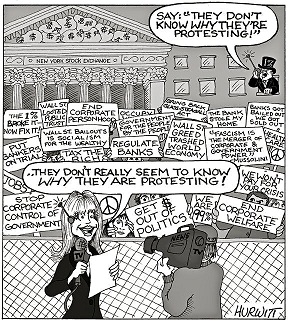
Yup. She's fighting the right wingers who think OCCUPY isn't about normal people's concerns.
I’m getting pretty tired of seeing right wing posts label Occupy protestors with the usual snobby anti-hippy meme. This isn’t the AstroTurf of the Koch-backed Tea Party (TM) that lost steam quicker than a tea pot removed from a flame. That’s even with old time poll Dick Armey at the helm. The Press was more comfortable with the tea party movement because it could actually find the corporate spokesmodels from long time special interest groups like FreedomWorks propping up the people. Here’s a Quinnipiac poll that suggests the Occupy grass has roots.
By a 67 – 23 percent margin, New York City voters agree with the views of the Wall Street protesters and say 87 – 10 percent that it is “okay that they are protesting,” according to a Quinnipiac University poll released today.
Agreeing with the protesters views are Democrats 81 – 11 percent and independent voters 58 – 30 percent, while Republicans disagree 58 – 35 percent, the independent Quinnipiac (KWIN-uh-pe-ack) University poll finds. Even Republicans, however, agree 73 – 23 percent with the protesters right to be there.
New York City voters say 72 – 24 percent, including 52 – 41 percent among Republicans, that if the protesters obey the law, they can stay as long as they wish.
A total of 72 percent of voters say they understand the protesters’ views “very well” or “fairly well,” with 17 percent who say “not too well” and 10 percent who say “not well at all.”
Voters split 46 – 45 percent in their approval of the way police are handling the Wall Street protest, but approve 61 – 33 percent of how the police are doing their job overall.
“It’s a free country. Let them keep on protesting as long as they obey the law, New Yorkers say overwhelmingly,” said Maurice Carroll, director of the Quinnipiac University Polling Institute. “Critics complain that no one can figure out what the protesters are protesting. But seven out of 10 New Yorkers say they understand and most agree with the anti-Wall Street views of the protesters.
“For a while, the critics focused on the cops’ use of pepper spray at the protests. Voters are divided on how police are handling the protesters, but they say almost 2-to-1 that police are doing a good job overall.”
Asked who is to blame for the current state of the nation’s economy;
37 percent of New York City voters blame the administration of former President George W. Bush;
21 percent blame Wall Street and financial institutions;
18 percent blame Congress;
11 percent blame President Barack Obama.New York City voters support 61 – 28 percent an extension of the state’s so-called ‘Millionaire’s Tax.’ Even Republicans support the extension 55 – 38 percent.
Voters also support 73 – 19 percent, including 48 – 40 percent among Republicans, tougher government regulation of banks and Wall Street firms.
“New Yorkers, even Republicans, back the Wall Street protesters on at least two things they’re talking about, a get-tough attitude toward banks and Wall Street and continuation of the state’s ‘Millionaire’s Tax,'” Carroll said.
Those are basically the same issues that keep coming up in poll-after-poll that have been completely ignored by the corporate media and Democratic and Republican Politicians alike. Who says that the vast majority of people showing up at this protests don’t have a message? It’s pretty clear to me. Just read the picket signs!!! I’m getting pretty tired of watching right wing sites make up really nasty smears by finding the one or two freaks in the vast numbers of people that show up. They must be really afraid that the Fauxes are about to be turned out of the US chicken coop.
Monday Reads
Posted: October 17, 2011 Filed under: morning reads | Tags: Arab women and the Arab Spring, Ford settles with UAW, Herman Cain bigot and religious extremist, Illinois financial problems 21 Comments Good Morning!
The weekend flew by for me and I still have a huge number of things to do! I think I slept away most of it. Here’s some things to get you started.
It’s seems that the state of Illinois has its own little sovereign wealth problem. This is an incredible story.
Drowning in deficits, Illinois has turned to a deliberate policy of not paying billions of dollars in bills for months at a time, creating a cycle of hardship and sacrifice for residents and businesses helping the state carry out some of the most important government tasks.
Once intended as a stop-gap, the months-long delay in paying bills has now become a regular part of the state’s budget management, forcing businesses and charity groups to borrow money, cut jobs and services and take on personal debt. Getting paid can be such a confusing process that it requires begging the state for money and sometimes has more to do with knowing the right people than being next in line.
As of early last month, the state owed on 166,000 unpaid bills worth a breathtaking $5 billion, with nearly half of that amount more than a month overdue and hundreds of bills dating back to 2010, according to an Associated Press analysis of state documents.
The true backlog is even higher because some bills have not yet been approved for payment and officially added to the tally. This includes the Illinois health care agency, which says it is sitting on about $1.9 billion in bills from Medicaid providers because there’s no money to pay it.
While other states with budget problems have delayed paying their bills, the backlog in Illinois is unmatched, experts say. Year after year, Illinois builds its budget on the assumption that it will pay its bills months late — essentially borrowing money from businesses and nonprofits that have little choice but to suffer the financial hardship.
The unpaid bills range from a few pennies to nearly $25 million. In early September, for example, Illinois owed $55,000 to a small-town farm supply business for gasoline, $1,000 to a charity that provides used clothing to the poor, $810,000 to a child-nutrition program.
The lights of the media are now glaring on Herman Cain. The resulting portrait is of one really extremist man who is being generously supported by the Koch Brothers. He’s beginning to remind me of Glenn Beck.
Cain’s campaign manager and a number of aides have worked for Americans for Prosperity, or AFP, the advocacy group founded with support from billionaire brothers Charles and David Koch, which lobbies for lower taxes and less government regulation and spending. Cain credits a businessman who served on an AFP advisory board with helping devise his “9-9-9” plan to rewrite the nation’s tax code. And his years of speaking at AFP events have given the businessman and radio host a network of loyal grassroots fans.
The once little-known businessman’s political activities are getting fresh scrutiny these days since he soared to the top of some national polls.
His links to the Koch brothers could undercut his outsider, non-political image among people who detest politics as usual and candidates connected with the party machine.
He doesn’t support availability of abortions for victims of rape or incest. He was interviewed by David Gregory yesterday.
Republican presidential candidate Herman Cain said Sunday that he didn’t agree with abortion “under any circumstance.”
The candidate, who has promised to work to overturn Roe v. Wade, told NBC’s David Gregory that he believes in “life from conception.”
“I do not agree with abortion under any circumstance,” he insisted.
“Exceptions for rape and incest?” Gregory asked.
“Not for rape and incest,” Cain replied. “Because if you look at rape and incest, the percentage of those instances is so miniscule that there are other options
He may just love him some clumps of cells but he wants an electrified fence on the US border. Oh, wait, that’s a joke just like the moat with alligators. I guess live Mexicans can either get fried or eaten but every zygote is sacred. He may have walked back his comments yesterday, but remember, these same comments were met with cheers in the last Republican debate. Note to Canadians: Come on down! Fences and moats only apply to our Southern border so if you’re Arcadian, you get a pass!
At two campaign rallies in Tennessee on Saturday night, the Republican presidential candidate Herman Cain said that part of his immigration policy would be to build an electrified fence on the country’s border with Mexico that could kill people trying to enter the country illegally.
But by Sunday morning, in a dramatic change of tone, Mr. Cain, a former restaurant executive, said he was only kidding.
“That’s a joke,” Mr. Cain told the journalist David Gregory during an appearance on NBC’s “Meet the Press,” where he was asked about the electrified fence. “That’s not a serious plan. I’ve also said America needs to get a sense of humor.”
Mr. Cain’s attempt to pass off incendiary comments as nothing but a joke may take more effort, however. In making the initial remarks about an electrified fence killing illegal immigrants, Mr. Cain was detailed and repetitive. He did not introduce his thoughts as anything but serious commentary, beginning with the words, “We have a crisis of illegal immigration.”
Can we say bigoted and demagogic boys and girls? Yes, we can!!! I certainly hope this guy is off Mitt Romney’s short list of VP potentials. He’s more bombastic and less fit for office than Quitterella and that says a lot!
Ford and its workers appear to be coming to agreement over their contract for the next four years. Ford is the one US car dealer that made it through the recession without relying on government largess. Instead, it sold many of its foreign subsidiaries to other companies and focused on building its domestic lines. I bought some Ford stock at the dept of the market plunge for $1.67 cents a share. I’m hoping that’s one bet that will pay off well!
“Times are obviously better for the company and the executives are getting raises, but they don’t want to give anything back to the workers,” Gary Walkowicz, a union official with Local 600 who led a “Vote No” campaign, said Oct. 13. “People feel they deserve more. There is a lot of anger out here.”
The UAW’s Settles, in his statement tonight, said Ford hourly employees had concluded the tentative accord was in their interest.
“The Ford workers voting early on in the process were voting on emotion, but workers in plants with voting later in the process had a chance to learn everything about the agreement and understood how much their votes counted,” Settles said in the e-mail.
Ford earned $9.28 billion in the past two calendar years after $30.1 billion in losses from 2006 through 2008. Ford Chief Executive Officer Alan Mulally’s 2010 compensation rose 48 percent to $26.5 million. Ford also awarded him more than $56 million in stock in March for leading the company’s turnaround.
“In early votes, you can vote your anger,” Shaiken said. “In later votes, you start asking, ’What are my options?’”
There’s an extremely interesting article in this week’s The Economist on Arab Women and the Arab awakening. It showcases women in Tunisia and Egypt.
Today Egypt’s women may work outside the home, go to school and university, and are free to vote and run in all elections. But women’s literacy stands at just 58%, and only 23% of workers are women. The country’s laws are a mixed bag. The constitution outlaws discrimination on the grounds of sex, but women are entitled to inherit only half as much as men. Husbands may divorce their wives in moments in front of a civil servant, but women endure lengthy court proceedings to do the same. A woman who remarries loses the right to custody of her children.
The condition of Tunisia’s women, by contrast, is unmatched in the Arab world. That is mostly thanks to Habib Bourguiba, the founding father of the modern Tunisian state, who outlawed polygamy, granted women equal divorce rights and legalised abortion. Zine el-Abidine Ben Ali, Tunisia’s toppled dictator, continued Bourguiba’s work, expanding parental, divorce and custody rights for women and promoting their education and employment. In 1960 nearly half of women were married by the time they had turned 20. By 2004 only 3% of girls between the ages of 15 and 19 were married, divorced or widowed. The literacy rate for women in Tunisia is now over 70%, though only 27% of the labour force is female. Women make up nearly two-thirds of university students, compared with two-fifths in Egypt.
I’d like to give a shout out to Hillary Supporter and blogger StacyX who has had an medical emergency and will be giving up blogging for awhile. You may want to go leave a nice get well note for her!
So, that should get us started this morning! What’s on your reading and blogging list today?
Is this a Naughty list that will get the Nice Treatment?
Posted: October 16, 2011 Filed under: Economy, financial institutions, Global Financial Crisis | Tags: G-20, Global TARP, shadow banking system, Systemically risky banks 10 Comments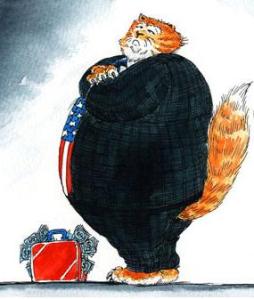 Okay, this is confusing me. What exact policies are implied from being on the G-20 list of “50 Systemically Important Banks”? It appears to me that you could be subjected to capital injections (i.e. free taxpayer money) for being so big you could bring down the global economy. No wonder Occupy is going global.
Group of 20 governments are considering naming as many as 50 banks as systemically important to the global economy and in need of extra capital, two officials from G-20 nations said.
The list, drawn up by Financial Stability Board Chairman Mario Draghi, will be published in time for a G-20 leaders meeting in Cannes, France, on Nov. 3-4, said the officials, who declined to be identified because the discussions are private. Regulators have said the banks named will be forced to take on more capital.
Regulators are at loggerheads with some institutions over the additional capital rules, with lenders arguing the requirements may harm the world’s economic recovery. Jamie Dimon, chief executive officer of JPMorgan Chase & Co. (JPM), and Bank of America Corp. (BAC) CEO Brian T. Moynihan are among bankers who have suggested this year that the new rules will constrain lending and hurt growth.
G-20 finance ministers and central bankers meeting in Paris yesterday discussed the standards that will be applied when compiling the list of systemic banks.
Twenty-nine to 40 banks could be designated depending on the potential impact on financial markets, according to one person familiar with the matter. Two officials from G-20 nations said the list could even be expanded to about 50 institutions. The regulators are also contemplating including the institutions in categories according to their ability to absorb losses.
So, the G-20 finance ministers “endorsed a framework to reduce the risks posed by systemically important institutions through strengthened supervision, a cross-border resolution plan and additional capital requirements”. No wonder occupy is going global. It seems bankers are draining funds from countries everywhere because they keep losing their mittens in the world’s largest gambling casinos. So, if you’ve got a bunch of what looks like really bad institutions, why-oh-why do you just simply give them more of your treasury? Good thing these guys went for that monopoly power! Now they can bully just about any one with a threat of bringing down the global economy. The World Bank and the IMF don’t even let entire countries do that!
The FSB is assessing how systemically important institutions are on the basis on five broad categories: size, interconnectedness, lack of substitutability, global activity and complexity.
Yup. The bigger you are and the more difficult you are to figure out, then it looks like you win a prize! Since when are we supposed to reward the creation of moral hazard and information asymmetry? The government is supposed to regulate to clear that up, not provide cash infusions to the worst culprits in the market. Oh, let me rephrase that because were talking about TWENTY governments doing that. The leading candidate to head all this up is the head of the Bank of Cananda–Canada’s version of the Federal Reserve Bank–who just happens to be (yes, wait for it, you know it’s coming)a former employee of Goldman Sachs.
Here’s the sole sentence in the entire article at Bloomberg that indicates there may some be some push for some change. The FSB is the Financial Stability Board. They are in the process of doing a number of things under the jurisdiction of the G-20 group including derivatives reform.
The FSB suggested assessing banks’ involvement with shadow banks, reform of money-market funds, securitization regulation, supervision with an emphasis on risk and scale, and regulation of lending and repo markets, the official said.
Obviously, the soverign debt crisis of the Greece, Portugal, Spain, and Ireland are foremost on every one’s mind. The deals are being worked out now to try to head off the potential calamity. I have to wonder if this is going to turn into a world wide TARP plan where we all foot the bill and the banks continue on their merry way with a lot of public funds and mostly symbolic regulation and over sight. I guess we’ll see. This inquiring mind really wants to know. Now, where’s the next G-20 meeting location and the nearest pitchfork store?
Late Night Breaking: Police Buses head to Washington Square
Posted: October 15, 2011 Filed under: #Occupy and We are the 99 percent! | Tags: global occupy protests, Occupy New York 11 Comments
Protesters in Times Square.Mario Tama/Getty Images
The Occupy Protests in New York City have been spreading out towards Times Square and into Washington Square. Seventy people were already been arrested earlier today trying to close their accounts at Citibank. Here’s a few links to keep you updated but the Twitter Stream is the thing to really follow.
This is the latest update from New York Magazine:
New York’s Alex Klein reports from Times Square: The crowd is now chanting “who are you protecting,” as police on horses tussle with protesters. Police with batons approaching, grabbing protesters around me. Someone has been hit, another thrown to the ground and taken away. A chorus of boos are ringing out and a man in gold spandex on top of a trash can is grabbing his junk, yelling “I love you police!” The cops also have scooters and riot shields.
The Wall Street Protests have spread globally to Rome, Madrid, Athens, Santiago, Sydney and here in New Orleans. This is amazing. It is estimated that as many as 600 cities around the world had Occupy related protests.
The protests against corporate greed born last month on Wall Street spread across the world Saturday, with fed-up demonstrators marching in Europe and the Asia-Pacific region.
In London, placard-waving protesters, watched by scores of vigilant police, gathered on the steps of St Paul’s Cathedral, then moved toward the London Stock Exchange building nearby.
“We are here in solidarity with those protesting in the United States,” said Sean Murray, an engineering student at London University. “The problems we face are exactly the same — a system in which a financial crisis was caused by bankers and people who make money, and people who don’t make money have to pay for it.”
This is truly amazing. People are finally fed up with austerity programs that hurt that majority of people while protecting the benefits of the few. I dare any one associated with the Tea Party to compare the size, scope, and level of independence shown in this movement to their own. Clearly, this is not being orchestrated by genuine outrage against the excesses of the modern financial system and the few people that are rewarded by the funds it leeches from the real sector of the economy.
Here is information on the folks arrested earlier today at Citibank trying to close accounts.
Around 2:30 p.m. on Saturday, the Occupy Wall Street Livestream captured about 20 people being arrested outside a Citibank at La Guardia Place in New York. A protester announced via human mic that people had gone inside Citibank to close their accounts. They were asked to leave and complied, he said, but the bank’s security guards locked them in until the N.Y.P.D. arrived.
“Some wanted to close their accounts with Citibank,” he read from a cell phone. “When asked to leave, they began to exit but were locked in by security. When cops arrived, Citibank security came outside and dragged two individuals back inside to hold them under arrest.”
The protesters were loaded into the back of a police van as the crowd shouted, “Let them go! Let them go!” as 10,000-some people watched the scene on Livestream. “Liberate the unlawfully arrested!” one man shouted.
Here’s a video from outside the bank. Both were posted down thread earlier today by RSM.

 peej
peej Carissa
 bostonboomer
 dakinikat
 ecocatwoman
 jjlo
jjlo mablue2
 Mama Lopez
 peggysue22
 quixote
 skydancingguestblogger
 Mona (aka Wonk the Vote)





Recent Comments