
The Puppet Masters
Posted: February 23, 2012 Filed under: 2012 elections, 2012 presidential campaign, 2012 primaries, Republican politics, Republican presidential politics | Tags: Super Donors, Super PACs 12 CommentsLast week, we learned that the primary bank roller behind Santorum’s Super PAC is an odd and out-of-it old billionaire that probably still calls women “tomatoes” when he’s not on TV explaining how  birth control in his day was aspirin-enhanced nonslutiness. Oh what fresh hell has the Supreme Court wrought with its Citizens United decision? We’ve long known that negative, nasty political ads work. Now, each candidate seems to have an endless supply of funds so that proxies can say what ever they want in such ads with absolutely no accountability. We’re all so finding out these Super PAC ads are being funded by a few “Super Donors”. This adds a new twist to voter beware homework. We know have to investigate the candidate’s funding sources. After all, money screams in elections these days. We now have Swift Boat Idiots for Lies on steroids. Each candidate seems to collect billionaire gadflies with specific agendas in mind.
Robert Reich just wrote a blog piece on the GOP’s Big Investors. The GOP has always been a magnet for big money so it’s really interesting to see the Super Pac Super Money play out on in their primary dynamics. I think we’ve seen that Romney’s Super Pac had some effect on Florida and the Gingrich rising star. We’re really going to get some of the flavor of this ruling since the final four have now gotten some cash infusion from various billionaires. The lead up to Super Tuesday on March 6th should be very very interesting and telling. Since we know they bankroll the garbage, who are these enablers of smack?
Have you heard of William Dore, Foster Friess, Sheldon Adelson, Harold Simmons, Peter Thiel, or Bruce Kovner? If not, let me introduce them to you. They’re running for the Republican nomination for president.
I know, I know. You think Rick Santorum, Newt Gingrich, Ron Paul, and Mitt Romney are running. They are – but only because the people listed in the first paragraph have given them huge sums of money to do so. In a sense, Santorum, Gingrich, Paul, and Romney are the fronts. Dore et al. are the real investors.
According to January’s Federal Election Commission report, William Dore and Foster Friess supplied more than three-fourths of the $2.1 million raked in by Rick Santorum’s super PAC in January. Dore, president of the Dore Energy Corporation in Lake Charles, Louisiana, gave $1 million; Freis, a fund manager based in Jackson Hole, Wyoming, gave $669,000 (he had given the Santorum super PAC $331,000 last year, bringing Freis’s total to $1 million).
Sheldon Adelson and his wife Miriam provided $10 million of the $11 million that went into Gingrich’s super PAC in January. Adelson is chairman of the Las Vegas Sands Corporation. Texas billionaire Harold Simmons donated $500,000.
Peter Thiel, co-founder of PayPal, provided $1.7 million of the $2.4 million raised by Ron Paul’s super PAC in January.
Mitt Romney’s super PAC raised $6.6 million last month – almost all from just forty donors. Bruce Kovner, co-founder of the New York-based hedge fund Caxton Associates, gave $500,000, as did two others. David Tepper of Appaloosa Management gave $375,000. J.W. Marriott and Richard Marriott gave a total of $500,000. Julian Robertson, co-founder of hedge fund Tiger Management, gave $250,0000. Hewlett-Packard CEO Meg Whitman gave $100,000.
Welcome to the tyranny of the Super Donor.
About two dozen individuals, couples or corporations have given $1 million or more to Republican super PACs this year, an exclusive club empowered by the Supreme Court’s Citizens United decision and other rulings to pool their money into federal political committees and pour it directly into this year’s presidential campaign.
Collectively, their contributions have totaled more than $50 million this cycle, making them easily the most influential and powerful political donors in politics today. They have relatively few Democratic counterparts so far, with most of the leading liberal donors from past years giving relatively small amounts — or not at all — to the Democratic super PACs.
And unlike in past years, when wealthy donors of both parties donated chiefly to groups that were active in the general election campaign, the top Republican donors are contributing money far earlier, in contests that will determine the party’s presidential nominee.
“What unites them? They’re economic conservatives,” said Christopher J. LaCivita, a Republican strategist who helped advise Swift Boat Veterans for Truth, a forerunner of this cycle’s super PACs, and who in 2008 co-founded another Republican advocacy group, the American Issues Project, that ran advertisements against President Obama.
“Most of these guys are serious business tycoons,” Mr. LaCivita added. “They’ve built something big — usually something bigger than themselves.”
We’re lucky some of these guys are open about their donations. They have some tools available to them to avoid the public exposure. It will be interesting to see if more or less of that occurs as we study their influence on candidates and races.
A few of the megadonors gave through limited liability companies, shielding their identity. One $1 million donation to Restore Our Future came from F8 LLC, a company whose listed address in Utah leads to an accounting firm. A charitable foundation linked to Sandra N. Tillotson, co-founder of the skin care company Nu Skin, uses the same address. Ms. Tillotson was reimbursed by Restore Our Future in July for what appeared to be costs associated with a fund-raiser at her New York apartment. But Ms. Tillotson said in an e-mail Wednesday that she did not know who the owner of F8 LLC was and had not made a donation backing Mr. Romney’s campaign.
So, I’ve been on a Google Trek to try to figure out who some of these people are and what their agenda might be. Bruce Kovner is a hedge fund executive and seems to have a fairly traceable history via the Wall Street set. He’s been likened to a Republican version of George Soros. He has been active in Republican circles for some time.
Some investors, like George Soros and Stanley Druckenmiller, have decided that rather than weather the whims of outside investors, they would prefer to manage their own money as a family office, a designation that allows them to largely avoid regulation.
Like Mr. Soros, Mr. Kovner has grown extremely wealthy betting on global market trends using stocks, currencies and commodities, among other things. He bought the former International Center for Photography on Fifth Avenue and 94th street for $17 million and spent another $10 million renovating it. An avid collector of rare books, Mr. Kovner named his hedge fund after the first printer of English-language books. Forbes magazine estimated Mr. Kovner’s wealth to be in excess of $4.5 billion.
Unlike Mr. Soros, a generous donor to liberal causes, Mr. Kovner is a conservative supporter who counts among his associates former President George W. Bush and former Vice President Dick Cheney. He is a trustee of the American Enterprise Institute, a conservative research organization, and has given more than $100,000 to Republican causes and candidates since 2010.
William Dore has a lower public profile. Interestingly enough, a couple of these super donors appear to come from Louisiana. I suppose it only makes sense since the state has a seriously regressive atmosphere when it comes to taxes, spending, and outside New Orleans Culture. Dore’s money comes from marine construction and diving which translates into connections to the oil platforms that dot the Gulf. So, Kovner represents Wall Street interests while Dore is most likely more interested in the treatment of the Oil Industry. Sheldon Adelson is a gambling industry tycoon who is extremely interested in the interests of Israel.
Two rumours are circulating around Sheldon Adelson, the Jewish Las Vegas casino magnate and publisher of pro-Netanyahu tabloid Israel Hayom. One is that he is about to pump another $10 million into Newt Gingrich’s presidency bid. The other, apparently contradictory, piece of speculation is that he is shifting his support to Mitt Romney.
Evidence that can be marshalled in favour of the first rumour is that Mr Adelson and his family have already donated $11m to a pro-Gingrich super PAC – a group that lobbies on behalf of a political candidate. Meanwhile, he told Forbes magazine this week he may increase that to $100m.
What is going on? Fred Zeidman, a close friend of Adelson and a major fundraiser for Mr Romney, explained: “As long as Newt is in the race it appears that Sheldon is going to continue to support him. I don’t know what that means in terms of money, but I think… when Newt is out of the race, you will see Sheldon devote that money directly to supporting whoever is running against Barack Obama.” Mr Adelson’s overriding objective, said Mr Zeidman, is to ensure Mr Obama does not win.
Peter Thiel’s money comes from Pay Pal. He’s a major libertarian, has a foundation, and goes out on the lecture circuit to proselytize for Ayn Randish ideas. Here’s an account from one true believer on another. I still don’t understand the idea of how libertarians worship at the alter of out spoken fascists like Ludwig Von Mises and enjoy the support of the KKK, storm front and all those old Confederate Crusaders. I think it comes from spending too much time in fantasy worlds. Anyway, they all seem to be the new 21st century Marxist ideologues. Damn all the evidence, let’s just put into effect a lot of things that have been proven to not work just because it sounds all ideologically sexy. Try not to imagine this writer masturbating as he’s writing this. I dare you. Of course, Thiel’s is a Paultard.
Whatever their number, these young libertarians are the potential saviors of the country. Peter Thiel – co-founder of PayPal and Facebook angel investor – made this argument as the SFL conference keynote speaker. According to Thiel, the United States is in a bad position: Innovation drives the U.S. industry and our innovation (with a few exceptions, namely the computer/internet world) has stagnated. Witness the airplane – the planes we now fly go the same speed as they did in 1990. We use coal for large amounts of energy, just as we did in the nineteenth century. The number of new drugs we produce has slowed. Life expectancy is no longer rising at the rate it once did. Etc.
Unreasonable explanations for this include: 1) We’ve reached the end of history; it’s impossible for us to improve on the technology of the plane, and 2) We’re not as smart as we used to be.
Peter’s alternative explanation – developed in his essay “The End of the Future” – is far more feasible: the modern regulatory system has choked invention.
And the only people in the place to fix this aren’t the statists on the right or on the left, but the libertarians. As Peter said, “It’s an exciting time to be a libertarian.”
Armed with new enthusiasm, I spent the rest of the weekend at SFL learning more about how the state is choking development, and I met the people who are going to fix this course in the near future.
My theory is that these Paulbot guys know the only way they will EVER have sex outside of the virtual world, pot induced hallucinations, and hookers is to have enough money to buy a trophy mistress and wife. Since I’m not a voyeur to self abuse, I’ll leave you to google more on this dude in the privacy of your own home, By Onan’s withered Balls!
So, all this googling has left me feeling like the plutocracy is live and well. If you didn’t think America’s government was basically up for sale these days, reading about any of these folks will do it. I’ve been boycotting Marriott for decades since all that Mormon money went heavily into running anti-ERA efforts in the late 70s. I watched that unfold first hand as a baby feminist and activist. It’s now creeping and crawling around the Romney campaign. There’s a lot of Mormon corporate money behind the Romney Super Pac.
Several of the biggest donors to Restore Our Future, the super PAC backing Mr. Romney, share the candidate’s Mormon faith. A quartet of companies connected to Melaleuca, a company based in Idaho that makes nutritional supplements and home care products, donated a combined $1 million to Restore Our Future.
The company is headed by Frank VanderSloot, a national finance co-chairman of the Romney campaign and a graduate of Brigham Young University, Mr. Romney’s alma mater. “I am very concerned about the direction of the country and especially the administration’s constant attacks on free enterprise,” Mr. VanderSloot said in an e-mail.
Many of the biggest givers to the pro-Romney super PAC hail from the world of finance, particularly private equity and hedge funds. Julian H. Robertson Jr., who has given at least $1.25 million to Restore Our Future, is considered one of the godfathers of the hedge fund industry.
The one thing these Super PACS have done is put the agendas right out there if you look for them. You can clearly see the Romney agenda from your front porch. If you like women’s unequal status and gamed financial markets,by all means support Willard just like his SuperPac Puppet Masters do! Any way, I suggest you try to keep track of these ballers and who they buy. I also wonder if these billionaires will be happy if the press starts focusing laserlike on their activities. Right now, Forbes appears to be the only magazine with the lives and ideology of the rich and not so famous. I figure if they want to buy our elections, the least we can do is out their activities for all to see.
Eeps! They’re doing it Again! Live Blog for Republican Debate
Posted: February 22, 2012 Filed under: 2012 elections, 2012 presidential campaign, 2012 primaries, Live Blog, Mitt Romney, Rick Santorum | Tags: Arizona debate 134 Comments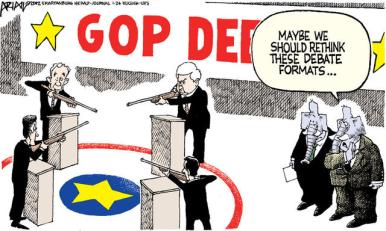 Newt’s been oddly quiet. Romney is scrambling for funds and any sign of enthusiastic support from outside of the Republican Money Class. Paul picked up a big super pac donation from a really odd Louisianian. Then there’s Saint Rick of the Sexually Obsessed. He’s undoubtedly going to get the spotlight tonight as his completely crazy religious views have taken him to places that I doubt any one has one before. The establishment hates him but the crazy base thinks he’s just right. Afterall, his culture jihad got him thrown out of his senate position.
“Santorum’s job tonight is to quell fears about his general-election electability,” says Republican strategist Ford O’Connell. “Taking on social issues to differentiate himself from [Newt] Gingrich and Romney is a good strategy, but it’s high risk. He’s been over-talking.”
Santorum’s first task, Mr. O’Connell says, is to take his strong views on social issues – a plus with the so-called “values voters” in the Republican base – and turn them into a discussion on limited government and strong families, not about telling individuals what to do. In recent days Santorum has been all over birth control, women’s role in society, and same-sex marriage.
Then there’s the story about his 2008 speech on how Satan was “attacking the great institutions of America,” now in its second day on the highly read Drudge Report. When asked about it Tuesday, Santorum didn’t disavow the remarks.
“I’m a person of faith. I believe in good and evil,” Santorum said in response to questions from CNN, host of the Wednesday night debate, which begins at 8 p.m. Eastern time.
Then he added that he didn’t think the topic was relevant to today.
“What we’re talking about in America today is trying to get America growing. That’s what my speeches are about. That’s we’re going to talk about in this campaign,” said Santorum.
Meanwhile, Romney’s hoping his newly released tax plan will get some votes. I’m sure it won’t be from economists or people that like strong economies. Look for him to try to fit this in where he can. Well, that an some pointed jabs at Santorum.
Reducing the top corporate tax rate to 25 percent was a central point of an economic proposal Romney offered in September. The former Massachusetts governor’s plan, which would eliminate taxes on interest, dividends and capital gains for individuals making $200,000 or less per year, came under criticism over a lack of details.
Romney suggested during a town-hall meeting in Shelby Township, Michigan, yesterday that he’d offer details.
“I’ll be coming out with some proposals of my own this week that describe how I cut, create more pro-growth tax policies,” Romney said. “I want to see a flatter, fairer, broader-based tax system.”
The Debate will be on CNN tonight at 8 pm EST. It’s being held not too far where my parents lived for awhile in Mesa Arizona.
Washington bureau chief Sam Feist, who’s producing CNN’s seventh debate this cycle, said the 8 p.m. face-off “comes at an important moment in the campaign” as tight races develop in Arizona and Michigan. And given the lack of debates since January, Feist said “there are a lot of topics that are likely to come up in this debate that, frankly, haven’t come up in the other debates.”
Feist wasn’t about to tip off the candidates about what moderator John King might throw their way, but social issues, which received increased media attention since the Florida debates, are expected to get some play.
It’s also possible that former senator Rick Santorum could be asked about his 2008 comments about Satan “attacking the great institutions of America,” which had a second life Tuesday thanks to The Drudge Report. When asked if the Satan comments could come up, Feist simply said that “nothing is off the table.”
The questions asked during the previous 20 debates this week came under scrutiny from New York University professor Jay Rosen and his students in the Studio 20 program, who studied all 839 of them. The students, working with The Guardian, found that 13 percent of the questions asked involved “campaign strategy and the way the candidates responded to each other’s negative ads.”
However, they noted that members of debate or online audiences asked zero questions about polls, flip-flops or negative ads, suggesting that journalists may be preoccupied by process-oriented questions that are of less interest to the public.
Feist said he found the study “interesting and valuable,” but quibbled with how the questions were categorized. “If you ask a candidate about a comment made in a negative ad, I don’t see that as campaign strategy,” Feist said. “I see that as a rare opportunity to have the candidate respond to the negative ads that the public has been inundated with.”
This will be last debate before Super Tuesday so look for every candidate to try to make high impact statements. Will they all play nice?
That Thick Glass Ceiling and the role of risk aversion, competition aversion, and cooperation
Posted: February 20, 2012 Filed under: just because | Tags: gender differences, risk aversion, Risk Management 6 Comments There’s a short summation of some of the most relevant economic literature on Gender Differences at VOXEU. Strict micro theory labor models have a difficult time dealing with any form of discrimination because they are based on labor getting paid on its marginal productivity. Any feature that doesn’t influence production doesn’t really factor neatly in to this particular view of the labor market. This area has been more ripe for study because behavioral economics is now taking into account things beyond the idea that all economic units are rational players. Theories of rational markets and rational agents do a really bad job of explaining a lot of things including bubbles and busts. Just like many gender-based disciplines and their studies, the focus usually is on gender specific traits and social learning. The most germane traits to economic behavior tend to be risk aversion and attitudes towards competition. Preferences can be modeled through functions and their shape can provide outcomes that vary from the labor market curves of yore. Many authors find that you have to model female preferences different from male and this contributes to many aspects of what we would call success in business.
Risk taking is generally seen as important to entrepreneurship, investment, and many business undertakings. It is the focus of a lot of behavior research, some of which can be found in magazines like the Atlanta Parent.
Only recently have economists begun to explore why women and men might have different risk preferences. Broadly speaking, those differences may be due to either nurture, nature, or some combination of the two. For instance, boys are pushed to take risks when participating in risky or competitive sports while girls are often encouraged to remain cautious. Thus, the riskier choices made by males could be due to the nurturing received from parents or peers. Likewise, the disinclination of women to take risks could be the result of parental or peer pressure not to do so.
In recent research (Booth and Nolen 2012), we present a recent experimental study exploring why girls and boys might have different risk preferences. Using adolescent subjects from two distinct environments or ‘cultures’, we examine the effect on risk preferences of two types of environmental influences – randomly assigned experimental peer-groups and educational environment (single-sex or coeducational). The experimental subjects were UK students in years 10 and 11 who were attending either single-sex or coeducational state-funded high schools. We find that the gender composition of the experimental group, as well as the gender mix of the school the student attended, affected decisions on whether or not to enter a real-stakes lottery. But our experiment was conducted at one point in time, and did not track changes over time.
Some important control studies show how women behave in same sex environments. These studies come from those educational studies that show that many girls do better in girl-only schools because teachers tend to show preferences to boys. The three authors of this article came up with a way to study this issue in terms of economic decisions.
In recent research (Booth and Nolen 2012), we present a recent experimental study exploring why girls and boys might have different risk preferences. Using adolescent subjects from two distinct environments or ‘cultures’, we examine the effect on risk preferences of two types of environmental influences – randomly assigned experimental peer-groups and educational environment (single-sex or coeducational). The experimental subjects were UK students in years 10 and 11 who were attending either single-sex or coeducational state-funded high schools. We find that the gender composition of the experimental group, as well as the gender mix of the school the student attended, affected decisions on whether or not to enter a real-stakes lottery. But our experiment was conducted at one point in time, and did not track changes over time.
The authors wonder if risk taking behavior evolves over time and differently depending on the school and parental environment. Frequently, a measurement of risk-taking behavior occurs while playing some kind of gambling game. The authors set up a study in a co-ed business university as well as a single sex one. They provided a gambling game to students and tested students at before the start and after the start of the academic year. They found differences.
We found that, on average, women are significantly less likely to make risky choices than men at both dates. However, after eight weeks in the single-sex class environment – within the larger coeducational milieu – women were significantly more likely to choose the lottery than their counterparts in coeducational groups. No such result was found for men in the single-sex groups. In other words, after eight weeks, the women in the single-sex classes were no more risk averse than men. Moreover, our results were robust to a number of sensitivity checks, including controlling for cognitive and non-cognitive skills (namely IQ and personality type).
The authors argue that this is an important finding.
The findings suggest, first, that a part of the observed gender difference in behaviour under uncertainty found in previous studies might actually reflect social learning rather than inherent gender traits. Of course this is not to say that inherent gender traits do not exist. Rather it suggests that they can be modified across time by the environment in which a woman is placed. Second, the findings are also relevant to the policy debate on the impact of single-sex classes within coeducational schools or colleges on individuals’ behaviour. Whether or not this outcome carries over into other subject areas apart from economics and business remains a topic for future research.
There’s a list of their references as well as some suggestions as where these authors intend to take their research. Here is one study that’s in one of the more prestigious economic journals. This is a rather ambitious study that looks at risk behavior, bargaining behavior, and view to competition. I searched out some of the more interesting conclusions including their elucidation of three preferences where men and women differ.
We find that women are indeed more risk averse than men. We find that the social preferences of women are more situationally specific than those of men; women are neither more nor less socially oriented, but their social preferences are more malleable. Finally, we find that women are more averse to competition than are men
These authors look for reasons for the differences and find a variety of things in both the nurture and nature category. I suppose the important thing is what can we do about this? Does this mean that women will have to create more opportunities in their own businesses rather than look for success in places where the male risk profiles dominate? I frankly wondered if this accounted for the incredible gender gap in my field of finance where risk taking and competition are rampant and well-rewarded. (As you probably can imagine, even the most pathological risk taking generally is rewarded up to a point.)
Anyway, I found this interesting and thought I’d share it with you.
Monday Reads: Republican Knock Down, Drag out, Slap Fight Edition
Posted: February 20, 2012 Filed under: morning reads, Republican presidential politics 17 Comments Bon Lundi Gras! Happy President’s Day! Tashi Losar!!
How’s that for a great mix of holidays? Losar is the Tibetan New Year and it’s celebrated on the 22nd this year. It’s Lundi Gras today. That’s the day before Mardi Gras. President’s Day is officially today too. Plenty of holiday revelry to give us a break from the Civil War in Syria, the continued attack on Tibetans, the war on US women, and a still fragile economy. Meanwhile, the Republican primary season is turning into a Slap Fight Club. Which of the four stooges will be still standing after Super Tuesday?
Rick Santorum continued to provide evidence of exactly how far out of the mainstream his views seem to be. He attacked prenatal testing as something that leads to abortions and continued to lecture Protestants and the President on phony theology. I think he must be running for Pope and we missed the announcement.
Campaigning in Ohio on Saturday, Rick Santorum displayed his culture-warrior side in full force, as he harshly attacked President Obama by suggesting the president wanted to see more disabled babies aborted and accusing him of projecting his values – which Santorum claimed were not rooted in the Bible – on the Catholic Church.
Santorum recalled his prominent role in the 1990s debates over the controversial procedure that critics call partial-birth abortion. He lambasted the president’s health care law requiring insurance policies to include free prenatal testing, “because free prenatal testing ends up in more abortions and therefore less care that has to be done because we cull the ranks of the disabled in our society.”
“That, too, is part of Obamacare, another hidden message as to what President Obama thinks of those who are less able than the elites who want to govern our country,” Santorum said.
Prenatal tests are a standard part of modern medical care. The Department of Health and Human Services says such tests “help keep you and your baby healthy during pregnancy. It also involves education and counseling about how to handle different aspects of your pregnancy.”
Paul Ryan suggested that Obama’s goal to provide universal access to birth control in private insurance plans was “paternalistic” and “arrogant”. Something tells me that Ryan’s not got a very good grasp of vocabulary. He seems to have those definitions upside down. Since when is it the role of government to enforce the Bishop’s views on the rest of us?
Rep. Paul Ryan (R-Wis.) on Sunday blasted the Obama administration’s moves to mandate religious affiliated groups to provide contraception coverage as “paternalistic” and “arrogant.”
“What we’re getting from the White House on this conscience issue, it’s not an issue about contraception, it’s an issue that reveals a political philosophy the president is showing that basically treats our constitutional rights as if they were revocable privileges from our government, not inalienable rights from our creator.” said Ryan on NBC’s Meet the Press.
“We’re seeing this new government activism, paternalistic, arrogant, political philosophy that puts new government-granted rights in the way of our constitutional rights.”
“That’s really not about contraception,” said Ryan of the mandate. “It’s about violating our first amendment rights to religious freedom and conscience.”
Ryan was asked by host David Gregory to respond to GOP presidential hopeful Rick Santorum’s comments Saturday, saying that President Obama’s political agenda was based on “some phony theology. Not a theology based on the Bible, a different theology.”
“I wouldn’t characterize it that way,” said Ryan. “I would simply say that he has a political philosophy that believes he can mandate certain benefits and activities of the American people that conflicts with their constitutional rights. He believes that these new government-granted rights trump our constitutional rights such as our first amendment right to conscience, to freedom of religion.”
While these guys keep pushing the religious freedom meme, they certainly forget to mention all those supreme court cases that have ruled out specific religious practices. This includes human sacrifice, smoking pot and peyote as sacraments, bigamy, denying children life saving blood transfusions and vaccines, and a host of other things.
Meanwhile, Ron Paul thinks all this focus on social issues is a “losing proposition”. However, Pauls’ religious obsession with an extreme interpretation of state’s rights doesn’t seem too far off the marks of the other nitwits. Paul thinks Santorum is a liberal. Back in the day when political labels were consistent, we would call Santorum a “theocrat” and Paul a “dixiecrat”. I don’t see any thing remotely conservative about any of these Republicans. They’re all extremely radical in their own right.
Paul seemed almost baffled that everyone has been talking about social issues at a time when he and others are more concerned with preserving basic civil liberties and the economy. But specifically where Santorum was concerned, Paul argued that he’s been a hypocrite for years now.
“He wants to control people’s social lives. At the same time, he voted for Planned Parenthood. I mean, I don’t see how anybody can get away with that inconsistency pretending he’s a conservative. And his voting record is, I think from my viewpoint, an atrocious voting record, how liberal he’s been and all the things he’s voted for over his many years in the Senate and in the House.”
Paul Ryan is one of those Republicans that also make up American History. There’s no mention of a creator or “inalienable rights” in the Constitution. That’s the Declaration of Independence. He also must thing that it’s okay for any remaining Incas to practice human sacrifice, for Rastafarians to use pot as a sacrament, for Jehovah’s witnesses to deny their kids access to blood transfusions and vaccines, and for Mormons to practice bigamy under that reasoning. I wonder if he’s even read the Constitution, the Bill of Rights, or any Supreme Court decisions. But all this Santorum surge has cheered up the Obama campaign.
“The one who can beat Obama: Rick Santorum,” the television commercial proclaims. That boast brings cheers from two quarters: the faithful followers of the conservative Republican presidential candidate, and the Democratic president’s political strategists.
The former Pennsylvania senator is on fire in the Republican contest, threatening the front-runner, Mitt Romney, in the critical Michigan primary next week and nationally.
Still, President Barack Obama’s campaign, the super-PACs supporting it and the Democratic National Committee are targeting Romney. They still believe the former Massachusetts governor is the likely nominee, though they are less certain than they were a few weeks ago. And they calculate, despite the shortcomings Romney displays as a candidate, that he would be more competitive than Santorum in the general election.
Santorum, on the other hand, is a more natural Republican primary candidate, singing the same conservative economic song as the party’s other aspirants, and layering it with hardcore social and cultural views, such as hostility to gay rights, contraception and feminism.
He’s a more problematic adversary for Romney than is Newt Gingrich, who has been savaged for his lucrative links to the federally backed home-mortgage company Freddie Mac and his checkered career as House speaker.
Newt Gingrich? Is any one talking about him at all? Well, just Callista, the Newster, and Fox News. The rest of us have figured he moved his campaign to the moon.
WALLACE: Let’s start with the rollercoaster that is the Gingrich campaign. Just three weeks ago, after your win in South Carolina, you were leading — just three weeks ago — leading the Real Clear Politics average of national polls at 31 percent. Now, you’re a distant third all the way back at 14.5 percent.
I would like you to put on your political analyst hat that you used to wear here at FOX News. What happened?
GINGRICH: Twenty million dollars of Mitt Romney negative ads. I mean, it’s not complicated. Look at Florida, outspent five to one. Many of the ads factually false, as the Wall Street Journal and National Review and others have reported. Now, you got to work your way back up again.
As you pointed out, I’ve twice been the front runner — both times over big ideas, developing positive solutions. The first time I was ahead 15 to 21 points in the national polls, we hadn’t bought a single ad yet. So, we’re back doing what I think I do best, which is focusing on things like on energy policy, $2.50 a gallon gasoline, big breakthrough ideas, and we’ll see what happens over the next three or four weeks.
Newt still has the worst negatives of any politician in the country. However, that’s not stopping him at all.
Public Policy Polling is showing a tight race in Michigan. Romney’s gaining and probably due to all of Santorum’s religous rants.
The Republican race for President in Michigan has tightened considerably over the last week, with what was a 15 point lead for Rick Santorum down to 4. He leads with 37% to 33% for Mitt Romney, 15% for Ron Paul, and 10% for Newt Gingrich.
The tightening over the last week is much more a function of Romney gaining than Santorum falling. Santorum’s favorability spread of 67/23 has seen no change since our last poll, and his share of the vote has dropped only 2 points from 39% to 37%. Romney meanwhile has seen his net favorability improve 10 points from +10 (49/39) to +20 (55/35) and his vote share go from 24% to 33%.
What we’re seeing in Michigan is a very different story from Florida where Romney surged by effectively destroying his opponent’s image- here Romney’s gains have more to do with building himself up.
Groups Santorum has double digit leads with include Protestants (up 47-30), union members (up 43-23), Evangelicals (up 51-24), Tea Partiers (up 55-20), ‘very conservative’ voters (up 54-23), and men (up 40-28).
Romney is leading the field with women (38-34), seniors (42-34), moderates (35-24), ‘somewhat conservative’ voters (40-34), and Catholics (43-31).
Newt Gingrich’s continued presence in the race is helping Romney a lot. If he dropped 45% of his supporters would go to Santorum, compared to only 29% for Romney and it would push Santorum’s lead over Romney up to 42-33. 47% of primary voters think Gingrich should drop out while only 40% believe he should continue on, but he’s certainly not showing any indication he’ll leave.
These are the primary dates to watch. Arizona and Michigan have primaries on the 28th. Washington State has a caucus on the 3rd that comes directly before Super Tuesday on March 6. There are ten primary/caucus states holding elections on that day. I’m wondering if it can get any more insane. The Arizona Debate appears to be the only scheduled event prior to all these elections.
In no particular order, here are four things you should watch in this week’s desert debate: Ron Paul, Rick Santorum, Mitt Romney, Newt Gingrich.
The final four have not shared a stage in almost a month: Not since Romney won Florida, Nevada and Maine. Not since Santorum triumphed in Minnesota, Missouri and Colorado. Not since Paul won — well, Paul won nowhere, though he told me on CNN’s “State of the Union,” “It all depends on how you measure winning … the bottom line is who is going to get the delegates … and we think we’re doing pretty good.”
Also not winning anywhere since the last debate is Gingrich, who retains his down-but-never-out storyline. The former House speaker promised recently, “I have been front-runner twice. I suspect I’ll be the front-runner again in a few weeks.”
It is at least arguable that since the last debate on January 26, Gingrich has faded and Paul has hit a ceiling. Still, all four Republican presidential hopefuls have jointly suffered from an increasing Republican anxiety about the field.
Frankly, I’m just going to try to stick to this week’s celebrations. It has to be less insane than watching politics these days. The biggest screaming lie of the weekend was Michelle Bachmann’s insistence that the Republican Party was pro-women. Between that and Sarah Palin’s offer to rescue the party via a brokered convention I spent most of the weekend cleaning my computer screen.
Former Republican presidential candidate Michele Bachmann on Sunday railed against critics who say the recent birth control controversy reflects a Republican Party that holds suppressive views toward women.
“There is no anti-women move whatsoever. The Republican Party is extremely pro-women,” Bachmann said on CNN’s “State of the Union.” “What we saw was President Obama’s signature piece of legislation, which is ‘Obamacare,’ demonstrated 3-D tragedy.”
Yeah, right. It would be so awful if every woman got birth control, prenatal care, and other preventative services with no add-on costs. That’s a real 3-D tragedy, isn’t it?
So, any good news in your neck of the woods? Let’s hear what’s on your reading and blogging list these days!
Seriously Perverted
Posted: February 18, 2012 Filed under: abortion rights, birth control, black women's reproductive health, religion, religious extremists, Reproductive Health, Reproductive Rights, Republican politics, War on Women, Women's Healthcare, Women's Rights | Tags: Republican obsession with sex 50 CommentsYou don’t really have to be a “birth control mom” to understand that the Republican and Red Beanie obsession with other people’s sex lives is just plain wrong. Trying to turn the reproductive

with apologies to R Crumb
health of women into a moral and religious freedom issue is one of the worst perversions of our time. I no longer require birth control but recognize the importance of birth control and abortion access as central to the recognition of women as a functioning adult capable of making moral decisions in a free and functioning democracy with constitutional rights. Women’s Reproductive Health is not a fucking political football.
Just a few weeks ago, the notion would have seemed far-fetched. The country is deeply divided on abortion, but not on contraception; the vast majority of American women have used it, and access hasn’t been a front-burner political issue since the Supreme Court decided Griswold v. Connecticut in 1965.
But then Rick Santorum said states ought to have the right to outlaw the sale of contraception.
And Susan G. Komen for the Cure yanked its funding for Planned Parenthood.
And the U.S. Conference of Catholic Bishops teed off on President Barack Obama’s contraception policy.
And House Republicans invited a panel of five men — and no women — to debate the issue.
And a prominent Santorum supporter pined for the days when “the gals” put aspirin “between their knees” to ward off pregnancy.
Democratic strategist Celinda Lake says it’s enough to “really irritate” independent suburban moms and “re-engage” young, single women who haven’t tuned into the campaign so far.
And, she says, the stakes are high: Women backed Barack Obama in big numbers in 2008 but then swung right in 2010. If the president is to win reelection in 2012, he’ll need to win women back — and Lake and other Democrats see the GOP push on contraception as a gift that will make that easier.
“I feel like the world is spinning backwards,” said former Rep. Patricia Schroeder, who has often related the troubles she has as a young married law student getting her birth control prescriptions filled in the early 1960s. “If you had told me when I was in law school that this would be a debate in 2012, I would have thought you were nuts … And everyone I talk to thinks so, too.”
Jennifer Lawless, director of the Women and Politics Institute at American University, also sees the chance of a huge female backlash if the Republicans overreach.
There are so many things about this article in Politico–by a woman–that piss me off that I hardly know where to start. The first is the bogus description of “deep division” in the country about abortion. The only deep division that I can see comes from the right wing continually pushing lies like the existence of abortion on demand hours before giving birth and bogus, nonexistent procedures like “partial birth abortion.”
The frustration of the right wing over their inability to control access to Plan B, hormonal birth control and first trimester abortions is at the root of all this. The push to force sonograms, invasive vaginal probes, and “life” begins at the moment of conception religous tropes is building to a crescendo. If only the red beanie set were this obsessed about ending world hunger or nuclear war or ensuring universal health care. The vast majority of women have basically had, are having, are using or will use all three of those things. To characterize normal reproductive health measures as murder and anti-religious is ridiculous. But I’d like to add this warning, if the political and punditry class on either side think they can turn us all into a new voting segment, I think they’re also going to learn the meaning of the word backlash. Women’s reproductive health shouldn’t be trapped in the land of political gamesmanship. Just who the hell are they to score political points with women’s lives??

 peej
peej Carissa
 bostonboomer
 dakinikat
 ecocatwoman
 jjlo
jjlo mablue2
 Mama Lopez
 peggysue22
 quixote
 skydancingguestblogger
 Mona (aka Wonk the Vote)





Recent Comments