
Misogyny is Everywhere
Posted: May 8, 2012 Filed under: War on Women, Women's Rights | Tags: advertising, homophobia, misogyny, Racism 24 Comments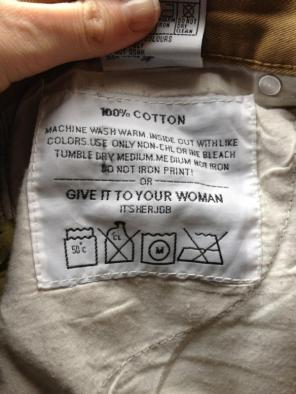 No. That picture isn’t a joke. Some Brit jean company thinks putting “Give it to your woman, it’s her job” on the washing instructions is snarky.
We are not amused.
Jeans sold at the UK store Madhouse made headlines this week after British journalist Emma Barnett picked up her boyfriend’s jeans while tidying the house.
On the washing-instructions tag, she read “machine wash warm.” Under that was the washing advice that would quickly set off a Twitter firestorm:
“OR — GIVE IT TO YOUR WOMAN, IT’S HER JOB.”
It’s so rampant these days that even Kristen Powers “hijacked” Hannity about misogynistic sermons.
On Tuesday night, Kirsten Powers joined Rev. Jesse Lee Peterson on Sean Hannity‘s Great American Panel. Veering from scheduled discussion topics, Powers directly addressed Peterson about his sermons, citing what she called “misogynist” statements.
“I didn’t know I was going to be sitting here” with Peterson, Powers said. She then confronted him, saying, “You said women are creating a shameless society, and that they are destroying the family, and they shouldn’t be put in powerful businesses. Address that.”
“Most Americans know that liberal women are destroying the family, they hate men, they hate society,” Peterson responded. Powers replied, “That is absolutely false,” turning to Hannity, asking, “Sean, do I hate men, do I hate you?”
“I hope not,” he answered.
Powers went on: “You are a pastor distorting God’s word for misogyny. What do you mean — when you say women —when you say you leave a woman alone in charge a family and she destroys the family?”
“We allowed the national organization of women who hate men to come in years ago,” Peterson said, to which Powers protested. Peterson continued, “We left them alone, look what condition we are in today; out of wedlock birth, abortion.”
“I have to step in,” Hannity interjected, noting this was not a topic he was anticipating on the show. “You are hijacking the show.” Powers said, “I didn’t know I was going to be on with him.”
Questioning Powers’ outrage, Peterson said, “If you believe what you believe, why are you upset at me? I’m not upset at you.”
“Because you’re a pastor using God’s word to teach misogyny to people,” Powers replied.
We’ve been learning a lot the last few years about rampant misogyny, racism, and homophobia. The level of discourse in this country is not improved by the many  people that have no problem slamming people simply for biological traits over which they have no control. They are all closely linked and appalling.
This is the latest JC Penney ad under attack. It shows a married lesbian couple with their daughter.
The One Million Moms are back with a new crusade — slamming JCPenney for including a lesbian couple in their Mother’s Day campaign.
Perhaps those one million moms need to get a life?
The conservative group issued a statement to get their members to take action against JCPenney, saying that the retailer is “taking sides” in the “cultural war” on gay rights:
“On pages ten and eleven, under the title “Freedom of Expression,” you’ll find ‘Wendi and her partner Maggie and daughters.’ In the picture both women are wearing wedding bands.”
It continues to be time to put our money, mouths, and beliefs into action.
Disenfranchising Voters is Downright UnAmerican!
Posted: May 7, 2012 Filed under: 2012 elections, Voter Ignorance | Tags: voter disenfranchisement 23 Comments Viviette Applewhite is set to be the face and voice of voter disenfranchisement. She’s a 93 year old grandmother who voted for JFK in her first election. Ms. Applewhite is suing Pennsylvania for its new restrictions on voters according to Think Progress.
She will be the plaintiff in the voter identification lawsuit being filed by the ACLU and the NAACP in the state, which claims that “the state’s voter photo ID law violates the Pennsylvania Constitution by depriving citizens of their most fundamental constitutional right – the right to vote.”
Applewhite no longer has a copy of her birth certificate, and she does not have a drivers’ license. Without either of these things, the new Pennsylvania restrictions say that she is ineligible to vote.
But her circumstances are not at all uncommon. African Americans, especially elderly African Americans, are disproportionately less likely to have a birth certificate.
According to the Brennan Center for Justice:
Twenty-five percent of African-American voting-age citizens have no current government-issued photo ID, compared to eight percent of white voting-age citizens.
Harsh voter ID laws, which former President Bill Clinton characterized as the most serious threat of disenfranchisement since Jim Crow laws, have been passed in Alabama, Georgia, Indiana, Kansas, Missouri, Pennsylvania, Tennessee, Texas, and Wisconsin. Twenty four other states are trying to pass similar laws.
Monday Reads: Can we get back to real Economics now?
Posted: May 7, 2012 Filed under: Austerity, Economy, Elections, morning reads | Tags: Austerity Econmics, French Elections, Greek Elections, Paul Krugman, Remaking Capitalism, Robert Reich 40 Comments Good Morning!
It certainly has been a tough few years for reasonable people. We’ve had to endure a repeat of the same old things that didn’t end the Great Depression the first time remixed and put into failed policies in both Europe and the U.S.
The very act of believing something doesn’t make it real or true. Yet, a group of so-called conservatives have been recently led by blind faith in tropes and canards. They followed all the failed policies instead of what we’ve learned that works when dealing with market economies and their cycles over the last 100 years.
It seems voters in a lot of countries are waking up and voting out all those second comings of Herbert Hoover. Austerity economics hasn’t worked for the majority of us.
Paul Krugman has been outspoken about the wrong thinking that’s contaminated the political class here and Europe. There appears to be a group of people out there determined to un-write the history of the 1920s and 1930s. His new book tries to outline what we’ve known since the Roosevelt years and why the plans foisted on us by so-called conservatives were bound to fail. I have no idea why discredited economic thoughts were brought back into vogue by the banking classes, the investment classes, and pushers of bad pulp fiction narratives like Paul Ryan and his slavish Randian/Austrian ideology. Why do modern politicians pick up the economic version of flat-earth geology and then expect the economic equivalent of a successful launch of a rocket to Mars?
The Austerian desire to slash government spending and reduce deficits even in the face of a depressed economy may be wrongheaded; indeed, my view is that it’s deeply destructive. Still, it’s not too hard to understand, since sustained deficits can be a real problem. The urge to raise interest rates is harder to understand. In fact, I was quite shocked when the OECD called for rate hikes in May 2010, and it still seems to me to be a remarkable and strange call.
Why raise rates when the economy is deeply depressed and there seems to be little risk of inflation? The explanations keep shifting.Back in 2010, when the OECD called for big rate increases, it did an odd thing: it contradicted its own economic forecast. That forecast, based on its models, showed low inflation and high unemployment for years to come. But financial markets, which were more optimistic at the time (they changed their mind later), were implicitly predicting some rise in inflation. The predicted inflation rates were still low by historical standards, but the OECD seized on the rise in predicted inflation to justify a call for tighter money.
By spring 2011, a spike in commodity prices had led to a rise in actual inflation, and the European Central Bank cited that rise as a reason to raise interest rates. That may sound reasonable, except for two things. First, it was quite obvious in the data that this was a temporary event driven by events outside of Europe, that there had been little change in underlying inflation, and that the rise in headline inflation was likely to reverse itself in the near future, as indeed it did. Second, the ECB famously overreacted to a temporary, commodity-driven bump in inflation back in 2008, raising interest rates just as the world economy was plunging into recession. Surely it wouldn’t make exactly the same mistake just a few years later? But it did.
Why did the ECB act with such wrongheaded determination? The answer, I suspect, is that in the world of finance there was a general dislike of low interest rates that had nothing to do with inflation fears; inflation fears were invoked largely to support this preexisting desire to see interest rates rise.
The Europeans have had it with the nonsense. They’ve watched their economies and jobs be drained by bankers drunk on casino style betting in financial markets that pass their chits to taxpayers. The first major European leader–Nicholas Sarkozy–has been replaced. Will the French be able to put the out-of-control financial sector back into its proper place?
Mr Hollande – the first Socialist to win the French presidency since Francois Mitterrand in the 1980s – gave his victory speech in his stronghold of Tulle in central France.
He said was “proud to have been capable of giving people hope again”.
He said he would push ahead with his pledge to refocus EU fiscal efforts from austerity to “growth”.
“Europe is watching us, austerity can no longer be the only option,” he said.
After his speech in Tulle, Mr Hollande headed to Brive airport on his way to Paris to address supporters at Place de la Bastille. His voice hoarse, he spoke of his pride at taking over the mantle of the presidency 31 years almost to the day since Socialist predecessor Francois Mitterrand was elected.
“I am the president of the youth of France,” he told the assembled crowd of tens of thousands of supporters, emphasising his “pride at being president of all the republic’s citizens”. “You are a movement that is rising up throughout Europe,” he said.
Mr Hollande has called for a renegotiation of a hard-won European treaty on budget discipline championed by German Chancellor Angela Merkel and Mr Sarkozy.
Robert Reich writes that this is a chance to reform capitalism. It is highly unlikely that France will move to make public any private assets. What it will do is turn its economic future to what works for growth for a country and not the enrichment of the wealthy and powerful few. Financial Markets should not be turned into gambling casinos via government engineering.
During the Depression decade of the 1930s, the nation reorganized itself so that the gains from growth were far more broadly distributed. The National Labor Relations Act of 1935 recognized unions’ rights to collectively bargain, and imposed a duty on employers to bargain in good faith. By the 1950s, a third of all workers in the United States were unionized, giving them the power to demand some of the gains from growth. Meanwhile, Social Security, unemployment insurance, and worker’s compensation spread a broad safety net. The forty-hour workweek with time-and-a-half for overtime also helped share the work and spread the gains, as did a minimum wage. In 1965, Medicare and Medicaid broadened access to health care. And a progressive income tax, reaching well over 70 percent on the highest incomes, also helped ensure that the gains were spread fairly.
This time, though, the nation has taken no similar steps. Quite the contrary: A resurgent right insists on even more tax breaks for corporations and the rich, massive cuts in public spending that will destroy what’s left of our safety nets, including Social Security and Medicare and Medicaid, fewer rights for organized labor, more deregulation of labor markets, and a lower (or no) minimum wage.
This is, quite simply, nuts.
Krugman reminds us that Spain was a prudent and financially responsible government prior to the speculative mortgage bubble brought on by banks. It did them no good in their current downturn.
For this is really, really not about fiscal irresponsibility. Just as a reminder, on the eve of the crisis Spain seemed to be a fiscal paragon:
What happened to Spain was a housing bubble — fueled, to an important degree, by lending from German banks — that burst, taking the economy down with it. Now the country has 23.6 percent unemployment, 50.5 percent among the young.And the policy response is supposed to be even more austerity, with the European Central Bank, natch, obsessing over inflation — and officials claiming that the incredibly foolish rate hike last year was actually something to be proud of.

Greece too has voted against the Austerity Agenda.
Alexis Tsipras became the surprise package of the Greek election by telling Angela Merkel to get lost.
“The people of Europe can no longer be reconciled with the bailouts of barbarism,” Tsipras, 37, said on state-run NET TV late yesterday after his Syriza party unexpectedly came second in the country’s election. “European leaders, and especially Ms. Merkel, should realize that her policies have undergone a crushing defeat.”Tsipras’s calls to tax the rich, delay debt repayments and cut defense spending struck a chord with voters angry at austerity measures imposed by the European Union and the International Monetary Fund in return for bailouts. As far as euro membership is concerned, Tsipras told voters that a Greek exit would put the currency itself in jeopardy and they shouldn’t feel “blackmailed” into more austerity.
The result put Syriza ahead of the Socialist Pasok party, potentially derailing efforts to implement the terms of the country’s financial lifeline. Syriza, which means Coalition of the Radical Left, won 16 percent of the vote, projections showed. That exceeded the 13 percent won by Pasok, one of the two pillars of the political establishment since 1974. New Democracy, led by Antonis Samaras, topped the poll with 20 percent.
Rachel Maddow borrows some analysis from Ezra Klein to show how the UK has been tanking its own economy with its austerity agenda and how closely our own problems resemble the UK government induced recession.
Once President Obama took office and the Recovery Act/stimulus began putting capital back into the economy, the U.S. economy began growing again. In the U.K., the economy started to improve, right up until British officials began implementing an austerity agenda — at which point the national economy stagnated and slipped back into a recession.
Obama rejected austerity, and as a result, American growth, while fragile and insufficient, is easily outpacing Europe’s and UK’s, where austerity measures have ruled the day.
Americans should care about this, if for no other reason because of interconnectivity of the modern global economy. But there’s also a purely political perspective to keep in mind: namely, the problem of Republican predictions.
In short, American conservatives got everything backwards. When Obama’s policies began, Republicans said they wouldn’t generate economic growth, but GOP officials got it backwards. When David Cameron’s austerity policies began, Republicans were not only certain they would work, they pleaded with American policymakers to follow the Tories’ lead.
And we now know GOP officials had this backwards, too.
The remarkable thing is, Republicans aren’t the least bit chastened by their track record of failure.
They said Clinton’s economic policies would fail miserably, but that’s not what happened. They said Bush’s economic policies would produce extraordinary prosperity, but that’s not what happened. They said Obama’s economic policies would make the Great Recession worse, but that’s not what happened. They said Cameron’s economic policies in the U.K. would work brilliantly, but that’s not what happened.
And now these same Republicans are saying they deserve Americans’ votes in 2012 because they have credibility on the economy.
Here’s one last Krugman analysis of what the austerity agenda has done in the U.S. Private employment has recovered to pre-recession levels. That’s not true for public employment.
Here’s a comparison of changes in government employment (federal, state, and local) during the first four years of three presidents who came to office amid a troubled economy:
That spike early on is Census hiring; once that was past, the Obama years shaped up as an era of huge cuts in public employment compared with previous experience. If public employment had grown the way it did under Bush, we’d have 1.3 million more government workers, and probably an unemployment rate of 7 percent or less.

Here’s evidence that Obama is not growing the public sector as Mittens claims. These numbers represent thousands of teachers, health workers, scientists, highway workers. and public safety officials.
AMERICANS have watched austerity sweep Europe with a certain Schadenfreude. But eight months from now they may get a dose of the same medicine. The political compromises that have produced much of America’s deficit of 8% of GDP are programmed to go into reverse at the end of the year, two months after the election. A stimulus package consisting of a payroll-tax cut, investment tax credit and enhanced unemployment insurance expires then, as do George W. Bush’s tax cuts (which have already been extended by two years from their original end-date of 2010). At the same time an automatic, across-the-board cut in domestic and defence spending, called a “sequester”, takes effect, cutting about $100 billion from government spending next year.
The economic impact of this fiscal cliff is a matter of some debate. The Congressional Budget Office reckons that the combined effects of the sequester and the expiring tax cuts would add up to 3.6% of GDP in fiscal 2013. But David Greenlaw of Morgan Stanley, which puts the total effect at almost $700 billion at an annual rate, argues that the calendar-year impact is much larger, at around 5%. Others think the effect would be smaller, noting that some people will not experience the full tax hit until they file their returns in 2014.
Even the lower estimates could easily be enough to tip the economy back into recession.
These tax cuts have not been as successful as other forms of fiscal policy might have been. However, austerity measures taken in many states has been somewhat offset by these Federal Policies. It will be interesting to see how long the economy will hold out under current conditions if and when these things expire. It’s simply been a mind boggling process to watch so many countries unleash unregulated financial innovations and low interests rates then bail out for the financial sector after its bets went bad. It’s been even worse to watch the victims of this excess be forced to pay for the results of government supported speculative bubbles. I’m wondering exactly what the results of these elections will bring to Europe and how our own electorate will act in the fall.
So, I depressed you with a lot of dismal science stuff today. What’s on your reading and blogging list?
New Orleans Jazz Fest Weekend Open Post
Posted: May 5, 2012 Filed under: just because, New Orleans, open thread | Tags: New Orleans Jazz Fest 3 CommentsJust because …
Creating False Equivalencies and other Nasty Campaign Tricks
Posted: May 5, 2012 Filed under: 2012 elections, 2012 presidential campaign, 2012 primaries, Voter Ignorance | Tags: the politics of personal destruction 18 CommentsPolitics has always been an ugly business in America. All you have to do is follow the lives of John Adams, Thomas Jefferson, or Andrew Jackson to get some idea of 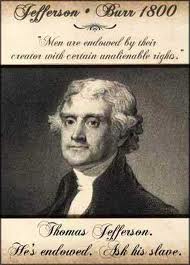 how the personal can be turned into the ugly political. Rumor becomes fact. Innuendo becomes headlines. Character assassination becomes de rigueur. It’s hard to know exactly when modern politics went over the edge. I would definitely have to point to folks like Karl Rove, Newt Gingrich, and Frank Luntz. Although, Donald Segretti comes to mind too. The age of social media and blogs has created a sleaze industry. Andrew Breithbart was the sheistermeister of the internet and his site and sites like Red State continue the tradition of creating tropes, memes and canards to sucker an uninformed electorate. AM radio and Fox News certainly don’t raise the standard either. Sleazy politics is on steroids these days.
The funny thing is that some things do speak of character and other things appear to be manufactured to create faux outrage. I frankly believe that strapping your sick dog on the roof of your car for a long trip says something about your decision making and your humanity. I don’t think a small child in a third world country eating dog meat because that’s what he’s been given to eat by his parents to be an equivalent morality play.
We are clearly in the swift boat age. Right after the attack on 9-11 the politicizing of the event took off. It was bound to happen. I used to keep track of the number of times that Dubya used the term “lessons of 9/11” to justify torture, invasion of a country that had nothing to do with the attack on 9/11, and signing into law severe restrictions on our civil liberties and personal privacy. Every single SOTU address and re-election stump speech always contained the phrase “lessons of 9/11”. I’m actually pretty outraged that the Romney and some elected officials think they’re innocent of trumping up the “lessons of 9/11” while accusing the President of Politicizing the Bin Laden killing. Meanwhile, they’re politicizing the situation with a Chinese dissident while the Secretary of State is in active negotiations with the Chinese Government on the status of the dissident and his family.
All of this just drives me nuts.
The newest of these trumped up faux outrage moments is now called “Elizabeth Warren’s Birther Movement”.
If you are 1/32 Cherokee and your grandfather has high cheekbones, does that make you Native American? It depends. Last Friday, Republicans in Massachusetts questioned the racial ancestry of Elizabeth Warren, the Democratic Senate candidate. Her opponent, Senator Scott Brown, has accused her of using minority status as an American Indian to advance her career as a law professor at Harvard, the University of Pennsylvania and the University of Texas. The Brown campaign calls her ties to the Cherokee and Delaware nations a “hypocritical sham.”
In a press conference on Wednesday, Warren defended herself, saying, “Native American has been a part of my story, I guess since the day I was born, I don’t know any other way to describe it.” Despite her personal belief in her origins, her opponents have seized this moment in an unnecessary fire drill that guarantees media attention and forestalls real debate.
This tactic is straight from the Republican cookbook of fake controversy. First, you need a rarefied elected office typically occupied by a certain breed of privileged men. Both the Presidency and the Senate fit this bill. Second, add a bit of interracial intrigue. It could be Kenyan economists eloping with Midwestern anthropologists, or white frontiersmen pairing with indigenous women. Third, throw in some suspicion about their qualifications and ambitions. Last but not least, demand documentation of ancestry and be dissatisfied upon its receipt. Voila! You have a genuine birther movement.
The Republican approach to race is to feign that it is irrelevant — until it becomes politically advantageous to bring it up. Birthers question Obama’s state of origin (and implicitly his multiracial heritage) in efforts to disqualify him from the presidency. They characterize him as “other.” For Warren, Massachusetts Republicans place doubts on her racial claims to portray her as an opportunistic academic seeking special treatment. In both birther camps, opponents look to ancestral origins as the smoking gun, and ride the ambiguity for the duration.
My children are 1/4 Japanese. My youngest daughter has absolutely no physical traits that would lead you to believe she has a Japanese Grandmother. My oldest daughter definitely has the mixed race look. But that’s not the point. Neither is the actual fraction or what’s historically been called the number of ‘drops of blood’.
Both of my children have a mixed identity because we fully embraced my husband’s mixed ancestry. We eat Japanese food. The kids went to Japan school for a period of time and can speak and write a bit of Japanese. My mother-in-law lived with us and our home was filled with her cooking, her language, and her upbringing. The girls also know about their family history from Japan and they’ve explored its culture. We also talk about a lot of different things including that my uncle was very responsible for the argument on the Japanese Internment policy to the Supreme Court for the Roosevelt Administration and that another uncle by marriage on my father’s side lost a cousin to the Baatan Death March. His aunt was appalling rude to my husband every time we went to family reunions. Both heritages are a party of our family story and our family traditions. We discuss the anti-Japanese hysteria of the World War 2 period, the Japanese War atrocities, and the H Bombs that ended the war as well as my mother-in-law’s experience as a starving teenager in Kyoto who had to smuggle rice in her kimono. All of this is a part of our heritage as melting pot Americans. When I first walked to the counter of the Japanese Grocery store here in New Orleans with my items I was told “You shop like Japanese housewife.” I am genetically as WASPY as they come. That’s what comes from being brought into a culture as a teen and surrounded by it for 20 years. There’s a very real part of me that IS Japanese now. I am a New Orleanian after 16 years living in the inner city of New Orleans and being surrounded by all if its rich heritage and neighborhoods. These identities will stay with me no matter where I go.
That’s the deal to me. If Elizabeth Warren feels connections to her Native American Ancestry and if its part of her family story and tradition, do we really need to question if her ‘drops of blood’ justify her connection and her identity?
Discussing real issues and real moral character is difficult in this age of swift boating, contrived outrage, and false equivalencies. It’s especially difficult because so many groups can get access to money and the media and push through some pretty outrageous tropes. Unfortunately, most of these tropes are head line grabbers and the customer-hungry media will jump on it and ride it as long as possible. It is really shameful that the noble pursuit of maintaining a healthy democracy seems to include such manufactured tit-for-tat. US voters deserve better.

 peej
peej Carissa
 bostonboomer
 dakinikat
 ecocatwoman
 jjlo
jjlo mablue2
 Mama Lopez
 peggysue22
 quixote
 skydancingguestblogger
 Mona (aka Wonk the Vote)





Recent Comments