
A Sad Legacy: Louisiana’s Prison Economy
Posted: May 15, 2012 Filed under: Criminal Justice System, New Orleans | Tags: Angola Prison, Bobby Jindal, Louisiana, prison state, prisoners, Warden Cain 14 Comments This is the stuff that creates documentaries and sad movies. It is the prison state that is Louisiana.
Louisiana is the world’s prison capital. The state imprisons more of its people, per head, than any of its U.S. counterparts. First among Americans means first in the world. Louisiana’s incarceration rate is nearly triple Iran’s, seven times China’s and 10 times Germany’s.
The hidden engine behind the state’s well-oiled prison machine is cold, hard cash. A majority of Louisiana inmates are housed in for-profit facilities, which must be supplied with a constant influx of human beings or a $182 million industry will go bankrupt.
Several homegrown private prison companies command a slice of the market. But in a uniquely Louisiana twist, most prison entrepreneurs are rural sheriffs, who hold tremendous sway in remote parishes like Madison, Avoyelles, East Carroll and Concordia. A good portion of Louisiana law enforcement is financed with dollars legally skimmed off the top of prison operations.
If the inmate count dips, sheriffs bleed money. Their constituents lose jobs. The prison lobby ensures this does not happen by thwarting nearly every reform that could result in fewer people behind bars.
READ THE
ENTIRE SERIES from NOLA.Com.Meanwhile, inmates subsist in bare-bones conditions with few programs to give them a better shot at becoming productive citizens. Each inmate is worth $24.39 a day in state money, and sheriffs trade them like horses, unloading a few extras on a colleague who has openings. A prison system that leased its convicts as plantation labor in the 1800s has come full circle and is again a nexus for profit.
In the past two decades, Louisiana’s prison population has doubled, costing taxpayers billions while New Orleans continues to lead the nation in homicides.

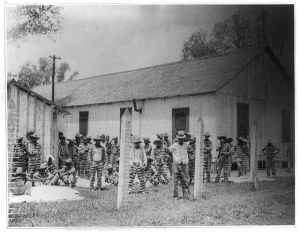
It is a shameful situation. Here are some stories from Angola. It’s probably the most infamous prison in the world. It’s known for its rodeo and its harsh treatment of prisoners who basically are subjected to “Faith-Based Slavery”. It seems that when a state can’t produce real jobs that it produces prisons.
“Unique” is one way Warden Burl Cain likes to describe his prison, and it would be impossible to argue otherwise. With grazing cattle and rolling hills in the distance, it’s hard not to admire its strange, sprawling beauty, even as the towers come into view. The prison itself is absent from my GPS’s “points of interest,” yet Angola’s Prison View Golf Course—the first public golf course on the grounds of a state penitentiary—is not. At Angola’s official museum, opened by Cain in 1998, a retired electric chair and rusty prison contraband are displayed adjacent to a gift shop selling mugs and tote bags reading: “Angola: A Gated Community.”
Angola is the largest maximum security in the country, sitting on 18,000 acres of farmland and home to 5,200 men. Louisiana has the highest incarceration rate of adult prisoners in the United States; thanks to the state’s unforgiving sentencing laws, at least 90 percent of Angola’s prisoners will die there. It’s a large-scale embodiment of a national phenomenon: elderly inmates are the country’s fastest growing prisoner population.
Yet Angola is also lauded as a revolution in corrections, its story told many times: Angola was once the “bloodiest prison in America,” where inmates slept with magazine catalogs strapped to their chests to protect themselves from stabbings. Things began to turn around in the 1970s, when a federal judge ordered a major overhaul. But most of the credit has gone to Warden Cain for imposing order through a new model of incarceration.
Like all of Angola’s wardens, Cain has continued the tradition of hard labor: most inmates work in the fields eight hours a day, five days a week, harvesting hundreds of acres of soybeans, wheat, corn, and cotton—picked by hand and sold by Prison Enterprises, the business arm of the Louisiana Department of Corrections. But unlike his predecessors, Cain, an evangelical Christian, has also made it his mission to bring God to Angola. Inmate ministers tell new prisoners that they can either work on their “moral rehabilitation” or remain a “predator”—“the choice is yours.” The radio station plays gospel music. On the walls leading to the execution chamber are two murals: Elijah ascending to Heaven and Daniel facing the lion. One of Cain’s favorite anecdotes is the execution of Antonio James, a born-again Christian whose hand he held just before giving the go-ahead to end his life. As James lay on the gurney waiting for lethal drugs to enter his veins, Cain said, “Antonio, the chariot is here…you are about to see Jesus.”
You should really read this MJ article to get the full feel of life inside Angola. It’s called “Gods Own Warden”.
Everyone was there except the person I had come to see: Warden Burl Cain, a man with a near-mythical reputation for turning Angola, once known as the bloodiest prison in the South, into a model facility. Among born-again Christians, Cain is revered for delivering hundreds of incarcerated sinners to the Lord—running the nation’s largest maximum-security prison, as one evangelical publication put it, “with an iron fist and an even stronger love for Jesus.” To Cain’s more secular admirers, Angola demonstrates an attractive option for controlling the nation’s booming prison population at a time when the notion of rehabilitation has effectively been abandoned.
What I had heard about Cain, and seen in the plentiful footage of him, led me to expect an affable guy—big gut, pale, jowly face, good-old-boy demeanor. Indeed, former Angola inmates say that prisoners who respond to Cain’s program of “moral rehabilitation” through Christian redemption are rewarded with privileges, humane treatment, and personal attention. Those who displease him, though, can face harsh punishments. Wilbert Rideau, the award-winning former Angolite editor who is probably Angola’s most famous ex-con, says when he first arrived at the prison, Cain tried to enlist him as a snitch, then sought to convert him. When that didn’t work, Rideau says, his magazine became the target of censorship; he says Cain can be “a bully—harsh, unfair, vindictive.”“Cain was like a king, a sole ruler,” Rideau writes in his recent memoir, In the Place of Justice. “He enjoyed being a dictator, and regarded himself as a benevolent one.” When a group of middle school students visited Angola a few years ago, Cain told them that the inmates were there because they “didn’t listen to their parents. They didn’t listen to law enforcement. So when they get here, I become their daddy, and they will either listen to me or make their time here very hard.”
Another former prisoner, John Thompson—who spent 14 years on death row at Angola before being exonerated by previously concealed evidence—told me that Cain runs Angola “with a Bible in one hand and a sword in the other.” And when the chips are down, Thompson said, “he drops the Bible.”
 We’ve talked about Angola’s horrible legacy before. Here’s a recent UK Guardian Story on two men that have spent 40 years in solitary confinement. This is the stuff that causes insanity. Every human rights group actively opposes this kind of treatment.
“I can make about four steps forward before I touch the door,” Herman Wallace says as he describes the cell in which he has lived for the past 40 years. “If I turn an about-face, I’m going to bump into something. I’m used to it, and that’s one of the bad things about it.”
On Tuesday, Wallace and his friend Albert Woodfox will mark one of the more unusual, and shameful, anniversaries in American penal history. Forty years ago to the day, they were put into solitary confinement in Louisiana‘s notorious Angola jail. They have been there ever since.
They have spent 23 hours of every one of the past 14,610 days locked in their single-occupancy 9ft-by-6ft cells. Each cell, Amnesty International records, has a toilet, a mattress, sheets, a blanket, pillow and a small bench attached to the wall. Their contact with the world outside the windowless room is limited to the occasional visit and telephone call, “exercise” three times a week in a caged concrete yard, and letters that are opened and read by prison guards.
A new documentary film takes us into that cell, providing rare insight into the personal psychological impact of such prolonged isolation. Herman’s House tracks the experiences and thoughts of Wallace as he reflects on four decades banged away in a box.
Our own Governor wants to turn our Prison Economy into a privatized, money-making scheme for corporate donors. Fortunately, his bill didn’t get very far. But, this is because so many local politicians make money off of renting out prisoners to their own local donor base. They also get to use them for services that would normally go to paid workers. No wonder no one can find these types of jobs unless you are in prison.
A bill strongly backed by Gov. that would have allowed for the sale of the Avoylles Correctional Facility has been abandoned, as support for it was limited, according to the Associated Press. Now, the prison may be run under a new plan. Here is some more information.
* The original bill would have allowed for the Avoyelles Correctional Facility to be sold for $35 million to a private firm that would be responsible for operating it, according to the Town Talk.
* The state would then pay the company that buys it a daily fee to operate it.
* Rep. (R- Haughton) sponsored the bill, House Bill 850.
* Opposition from the privatization of the prison stems from the fact that 296 jobs would be lost in the sale.
* One group, the , made a plea to representatives to vote against the bill, saying that if the prison was run privately, the company could demand an exorbitant amount of money from Louisiana taxpayers to run the prison, and that the sale would actually cost Louisiana residents more.
* The bill was rewritten on Wednesday to allow for a private firm to be contracted to run the facility, but not to buy it.
* The contract would be for 10 years and the approval of the contract would be by the House and Senate budget committees.
* On Wednesday, the House voted 62-43 to pass the new amendment to the bill, according to Gambit.
* The bill was not sent to the Senate for approval, however, as Burns says that he is giving legislators time to look over the new bill, according to the Capitol News Bureau.
* There is still a lot of disapproval of the new bill as well, as opponents still cite the decreased wages for employees that are working for private companies as opposed to wages for state employees as unacceptable.
* Safety is also a concern, as Rep. Robert Johnson cited the lower wages as attracting lower quality workers to guard the prison, which would mean an unsafe environment, according to The Times-Picayune.
* The privatization of Avoyelles is a part of a larger plan by Gov. Jindal to privatize more prisons in Central Louisiana and close the and move those prisoners to Avoyelles, according to the Town Talk.
* Alexandria Mayor Jacques M. Roy has come out against the plan, saying that it would decrease public safety and would not save the state any money.
Any one in Louisiana lives among this prison legacy. Prisoners clean up our roads. They are brought out to shore up levees. They make our license plates. They are visible everywhere doing jobs that would usually be given to parish employees. No place is this more true than in small communities where sheriffs can make a good living off of renting them out to local business. Kinda makes you proud of that old entrepreneurial spirit doesn’t it? Take some time to read the series at the Times Picayune. I think you will find out more about my part of the good ol’ USA than you really would like.
Monday Reads
Posted: May 14, 2012 Filed under: Big Pharma, morning reads | Tags: bullying, discrimination, Mitt Romney, Whiny white men 41 Comments Good Morning!
Okay. Get ready to drag out your smallest possible violins for this UK Guardian article:Lagging at school, the butt of cruel jokes: are males the new Second Sex? Here’s the teaser subtitle: “They work longer hours, face economic insecurity and suffer worse health. Now their feckless ways are lampooned in the media. A controversial new book argues that men increasingly face a prejudice that dare not speak its name.” Poor babies!
You might not have realised it, but men are being oppressed. In many walks of life, they are routinely discriminated against in ways women are not. So unrecognised is this phenomenon that the mere mention of it will appear laughable to some.
That, at least, is the premise of a book by a South African philosophy professor which claims that sexism against men is a widespread yet unspoken malaise. In The Second Sexism, shortly to be published in the UK, David Benatar, head of the philosophy department at Cape Town University, argues that “more boys drop out of school, fewer men earn degrees, more men die younger, more are incarcerated” and that the issue is so under-researched it has become the prejudice that dare not speak its name.
“It’s a neglected form of sexism,” Benatar says in a telephone interview. “It’s true that in the developed world the majority of economic and political roles are occupied by males. But if you look at the bottom – for example, the prison population, the homeless population, or the number of people dropping out of school – that is overwhelmingly male. You tend to find more men at the very top but also at the very bottom.”
The American men’s rights author Warren Farrell calls it “the glass cellar”. There might be a glass ceiling for women, Farrell once told the Observer, but “of the 25 professions ranked lowest [in the US], 24 of them are 85-100% male. That’s things like roofer, welder, garbage collector, sewer maintenance – jobs with very little security, little pay and few people want them.”
Okay, I hope you haven’t lost your meal and coffee!
The NYT had a good article up this weekend on the human costs or “disaster” of unemployment.
In 2007, before the Great Recession, people who were looking for work for more than six months — the definition of long-term unemployment — accounted for just 0.8 percent of the labor force. The recession has radically changed this picture. In 2010, the long-term unemployed accounted for 4.2 percent of the work force. That figure would be 50 percent higher if we added the people who gave up looking for work.
Long-term unemployment is experienced disproportionately by the young, the old, the less educated, and African-American and Latino workers.
While older workers are less likely to be laid off than younger workers, they are about half as likely to be rehired. One result is that older workers have seen the largest proportionate increase in unemployment in this downturn. The number of unemployed people between ages 50 and 65 has more than doubled.
The prospects for the re-employment of older workers deteriorate sharply the longer they are unemployed. A worker between ages 50 and 61 who has been unemployed for 17 months has only about a 9 percent chance of finding a new job in the next three months. A worker who is 62 or older and in the same situation has only about a 6 percent chance. As unemployment increases in duration, these slim chances drop steadily.
The result is nothing short of a national emergency. Millions of workers have been disconnected from the work force, and possibly even from society. If they are not reconnected, the costs to them and to society will be grim.
Unemployment is almost always a traumatic event, especially for older workers. A paper by the economists Daniel Sullivan and Till von Wachter estimates a 50 to 100 percent increase in death rates for older male workers in the years immediately following a job loss, if they previously had been consistently employed. This higher mortality rate implies that a male worker displaced in midcareer can expect to live about one and a half years less than a worker who keeps his job.
Here’s a great lesson on bullying from Michael Cohen at Alternet on “What we Learn from Mitt Romney’s Disgusting Teenage Bullying”.
There is a disturbing inference in Romney’s words – namely, that the blame should be placed as much on the sensitive shoulders of those who were hurt and offended, rather than the person who might have been responsible for inflicting pain upon them. What is missing from Romney’s non-apology is the recognition that pranks, hijinks, assaults or whatever you want to call them, can leave psychic scars that stay with the victim for years to come.
Indeed, one of the most heartbreaking elements of the Post story is that 30 years after it took place, one of the perpetrators, David Seed accidentally ran into Lauber at O’Hare International Airport and tried to apologize for not doing more to help his classmate. “It was horrible,” Lauber recounted. He went on to explain how frightened he was during the incident, and acknowledged to Seed, “It’s something I have thought about a lot since then.”
Here’s a follow-up to the Big Pharma drug pushers that try to market their miracle cures to us via their Snake Oil TV ads. It seems it really isn’t good for whatever ails ya!
The pharmaceutical company will pay $1.5 billion to settle criminal and civil liability charges for promoting the drug Depakote for uses not approved by the Food and Drug Administration.
The drug is a neurological medicine labeled to treat mania, epilepsy and migraines, and can lead to life-threatening and deadly pancreatitis in children and adults.
The money will be distributed among 49 states and will go toward consumer protection, health care and other services.
Well, first it was MS touting Obama’s feminist bona fides. Now it’s Newsweek calling Obama the ‘first gay president’. Okee dokee then.
The cover of Newsweek magazine this week proclaims President Obama “the first gay president.”
The cover pictures Obama with a rainbow-colored halo over his head. The New Yorker’s cover for this week, likewise, is an image of the White House, with the iconic columns on its South portico arranged in the colors of the rainbow — a prominent symbol for gay rights.
The Newsweek cover goes a step further by adding the religious symbol of a halo above Obama’s head.
Obama said this week that he is personally comfortable with same-sex marriage — the first time a sitting president has taken that position.
Newsweek’s “first gay president” cover story is written by Andrew Sullivan, a blogger at Newsweek and the Daily Beast, who is openly gay.
The moniker evokes Toni Morrison’s description of former President Bill Clinton as “the first black president.”
Well, I think I’ve done enough damage this morning. What’s on your reading and blogging list today?
The Big Hedge Snafu
Posted: May 12, 2012 Filed under: Banksters | Tags: contango, hedge, JP Morgan 8 Comments Okay, I can’t resist getting wonky again. I have to say that Robert Reich made me do it. Well, that’s not completely true. It’s just that the banking industry has become so concentrated that it’s frightening. Plus, J.P. Morgan managed to lose $17.5 Billion this week. I’m still trying to wrap my mind around this. An organization this big has its tentacles in everything. Could JP Morgan become another Lehman?
JPMorgan Chase (JPM) lost $17.5 billion this week. It all springs from a bad trade that’s still going bad — to the tune of $2 billion and potentially $3 billion. But then there’s the 9.3% plunge in JPMorgan’s market capitalization — adding another $14.5 billion in shareholder losses. And of course, there’s the additional capital it may need to raise in light of S&P’s and Fitch’s concerns about its creditworthiness.
In my conversations Friday with reporters from Smart Money and the Boston Globe, I could not answer a basic question: What happened? According to the May 12th New York Times, JPMorgan decided to make a bet on a very obscure corner of the derivatives market. And due to the scale of JPMorgan’s trading, hedge funds figured out its identity and placed bets against the bank that are continuing to make profits for them at JPMorgan’s expense.
So, let me get back to why Robert Reich has me thinking. He’s offered up what we’ve been thinking here for sometime. Basically, he’s arguing that this kind of thing is exactly why we need to break up the big banks and head back to an updated and effective version of Glass-Stegall. The most ironic thing is that the catalyst for this is the same Jamie Dimon who insists that Wall Street doesn’t need any more stinking regulations. We’ve got a tight oligopoly now in the financial sector and the rules are different for this market structure than in a market where a bunch of little banks compete. We can survive the bad decision making of a few regional banks or community banks that collapse. Bad decision making at JP Morgan can take down the global financial markets. We’ve learned that already, haven’t we?
Ever since the start of the banking crisis in 2008, Dimon has been arguing that more government regulation of Wall Street is unnecessary. Last year he vehemently and loudly opposed the so-called Volcker rule, itself a watered-down version of the old Glass-Steagall Act that used to separate commercial from investment banking before it was repealed in 1999, saying it would unnecessarily impinge on derivative trading (the lucrative practice of making bets on bets) and hedging (using some bets to offset the risks of other bets).
Dimon argued that the financial system could be trusted; that the near-meltdown of 2008 was a perfect storm that would never happen again.
Since then, J.P. Morgan’s lobbyists and lawyers have done everything in their power to eviscerate the Volcker rule — creating exceptions, exemptions, and loopholes that effectively allow any big bank to go on doing most of the derivative trading it was doing before the near-meltdown.
And now — only a few years after the banking crisis that forced American taxpayers to bail out the Street, caused home values to plunge by more than 30 percent and pushed millions of homeowners underwater, threatened or diminished the savings of millions more, and sent the entire American economy hurtling into the worst downturn since the Great Depression — J.P. Morgan Chase recapitulates the whole debacle with the same kind of errors, sloppiness, bad judgment, excessively risky trades poorly-executed and poorly-monitored, that caused the crisis in the first place.
In light of all this, Jamie Dimon’s promise that J.P. Morgan will “fix it and move on” is not reassuring.
The most revealing thing is that this entire gaffe was supposed to be part of a hedging action which is a risk management tool. Not every one is convinced that this was simply the fault of a dated-model with bad assumptions. Here’s some wonky FT analysis.
So what was JPMorgan’s hedge and how did it go wrong?
The precise nature of JPMorgan’s hedging is not known. One possibility was that the bank engaged in a trade known as a “flattener”. Such a trade would profit if the credits began to sour in the near-term and within certain limits. But such a trade must be rebalanced – meaning additional positions would need to be taken simply to maintain the original investment thesis behind the trade. This can be tricky once the trade becomes supersized and if liquidity in the derivatives market dries up. Some market participants believe recent publicity surrounding JPMorgan’s position may have made rebalancing the trade impossible, or simply unpalatable.
Isn’t that a bet more than a hedge? Aren’t those banned now?
JPMorgan has described its trading as a hedge – not a “proprietary” trade, or bet, made to boost the bank’s own profit. However, the size of the position and subsequent losses look likely to set off renewed speculation about the nature of banks’ hedging activities. Some analysts have warned that banks are becoming extremely creative with their hedging strategies, often in an effort to boost their bottom line at a time when new regulations are crimping traditional profitmaking capabilities. JPMorgan says it plans to manage the trade over the course of 2012 but noted that losses “could easily get worse” and possibly total another $1bn in the second quarter of this year. Indeed, one of the instruments that may be involved matures in December, lending an urgency to managing the position down.
There better be some serious regulator and oversight action on this before it gets out of control. It also would seem to be a good time for a few good senators to start looking into bringing back the wall between corporations that have fiduciary responsibilities because of their depositors and investment banks and brokerage firms. Robert Reich’s got the right idea. We need to break up these behemoths. Then, we need to take a serious look at which parts of deregulation keep coming back to haunt us.
My Jaded Crystal Ball
Posted: May 11, 2012 Filed under: Bailout Blues, Banksters, Equity Markets, financial institutions | Tags: Credit Default swaps, financial innovation, financing outside of TRACE, securitization 11 Comments Okay, this is wonky. I’ve been avoiding writing about securitization for awhile because it can even get the best of people that know financial markets. You may remember that some one asked me where the next bubble lurked and I said commodities. Now, that’s actually a dangerous place for a bubble because commodities are things you eat and things that make your house light up and your car run. The housing bubble pretty much wiped out middle class wealth in the west. What would a commodities bubble burst do in the right markets? Well, think Mad Max or at least The Grapes of Wrath. Conversely, it could lead to a massive drop in key prices like that of oil. Imagine that one!
Here’s some interesting finds from FT Alphaville on the securitization of commodities. It’s titled “The subpriming of commodities” for effect.
It’s always been common practice for commodity inventory to be financed by banks by being pledged as security for the loans in question.
The problem comes if such enterprises, instead of using the inventory for general business purposes, are encouraged to stockpile for the sole purpose of liquidity provision and the opportunity to punt on the underlying commodities themselves. It’s a process which arguably artificially pumps up demand for the underlying inventory.
Bundle all those loans together, meanwhile — ideally into a product that can be sold to buyside investors seeking exposure to commodities — and suddenly you’ve got a direct source of funding for an ever-more speculative game.
When it comes to the larger players, meanwhile, this arguably transcends ‘trade finance’ even further — especially if it involves the setting up of a large number of special purpose vehicles to accomplish the process.
Here, for example, are the thoughts of Brian Reynolds, chief market strategist at Rosenblatt Securities, regarding what’s going on:
A little more than a year ago we picked up on a trend that we termed the “sub-priming” of commodities. Wall Street has been increasingly been doing structured finance deals wrapped around commodities, and this has added a bid for them while also making them vulnerable to downdrafts.
We know that many equity investors think (or at least hoped) that, after the disastrous record of wrapping pipeline and telecom assets in the 1990’s and sub-prime housing in the last decade, financial market reforms such as Dodd-Frank would have eliminated structured finance as a macro driver. When Dodd-Frank was proposed it envisioned standardized derivatives being placed on exchanges and clearinghouse. We felt it would encourage more non-standardized, exotic, and opaque structures to be created, and in the two years since it was enacted that’s what seems to have happened.
Important trends indeed. Yet, as Reynolds also notes, they’re also very hard to quantify given they mostly occur off-balance sheet:
This process is virtually impossible to quantify. We know that’s a disappointment to equity investors who are used to dealing with voluminous information, but that’s the nature of structured finance. Many structured finance deals are private in nature. As such most people, even those in the credit markets, did not know the full extent of the structuring going on in the 1990’s or the last decade until those firms, which were trapped by “Special Purpose Vehicles” (SPVs), such as Enron, WorldCom and Citigroup, became forced sellers. But over the last year we’ve heard more and more anecdotal evidence of Wall Street increasingly structuring commodity deals, such as structured notes and swaps and even using commodities as collateral.
In Reynold’s opinion — even though he’s not a commodity expert per se — this activity significantly increases the risk of a sharp drop in oil in the coming year, especially since structured finance transactions usually come with caps and floors, which act as important support and resistance levels.
That’s an interesting analysis for oil or copper. However, what happens if the commodities in question happen to be food? The only place this used to happen significantly was the gold market. Actually, it’s understandable for oil too. But is Wall Street so hungry for financial innovation that they’re willing to bet the world’s food supply on it? Yes, of course. They’ve already done it several times. History teaches us that it drives the prices up to unreasonable and unsustainable levels that take all kinds of people down when prices collapse.
Here’s an interesting bit on a contango that happened in the wheat market that already led to a food price crisis in 2007-2008. This one had the Goldman Sachs brand all over it. Last year, a similar situation occurred with the Oil Market and the same player.
On Monday, April 11, Goldman Sachs told its clients to sell commodities, and the market reacted with a $4 tumble in the price of West Texas Intermediate (WTI) crude oil and sell offs in other commodities.
On Thursday, April 14, the leaders of the “BRICS” nations (Brazil, Russia, India, China and South Africa), meeting in Sanya, China, continued to press for a new world monetary system that has a much lower reliance on the dollar, and called for stronger regulation of commodity derivatives to dampen excessive volatility in food and energy prices.
We are in another commodity price run up, like that experienced in the 2005-2008 period. Such commodity price frenzies have devastating consequences for the world’s poor who, in some instances, already spend half of their income on food. Today, in the U.S. itself, the rise in the price of gasoline to more than $4 per gallon threatens an economy still struggling to free itself from the still lingering effects of the last bursting bubble.
It appears that the Western economic systems have become ever more volatile over the past decade. That is, bubbles, followed by severe contractions, are appearing more often and with increased severity. This is in stark contrast to the dampening of the business cycle we observed, and celebrated, in the 1980s and 1990s. So, what changed?
In Harper’s last July, Fredrick Kaufman wrote an article entitled The Food Bubble, which explained the reasons for the run up in agricultural commodity prices just prior to the ’08 financial meltdown and worldwide recession. The popular business media gave the article short shrift. But, most of what Kaufman observed as the causes of the commodity price run up in the ’05-’08 period is now being repeated, a short three years later.
I’m finding all this interesting as I watch Jamie Dimon squirm on the big hedge loss reported by JP Morgan. That’s the $2 billion mark to market loss that makes me thing we’re on the verge of 2007 redux. Specifically, the market concentration is incredible because “the whale” created a huge problem for tons of hedge funds. Also, the regulator appeared to be asleep at the switch. You remember are old friends the Credit Default Swaps?
99 per cent of all CDS trades live in an information warehouse called DTCC, to which the regulators of the banks have access in however much detail they want!!! What kind of regulator doesn’t go and look at the that, when the mere public, aggregated info shows this?
Go check out the accompanying graph.
Anyway, I’m not going to get long winded and all financial economist on you, but sheesh, how many times does history have to repeat itself in markets before we get some one to do something useful? I’m just reminded of all the little canaries that died on the way to the big 2007 blow up that people ignored. How many canaries have to die this time out before we get another big one
Friday Reads
Posted: May 11, 2012 Filed under: morning reads | Tags: ad scamming by Big Pharma, Al Franken, austerity, Big Pharma, Budget Deficit, DOJ tracking people via cellphones, DTC, Euro, Greece 34 Comments Good Morning!
I found a few interesting things for us to look at this morning. I’m going to start off with the increasingly creepy role Big Pharma plays in what your doctor prescribes for you when you probably don’t need it. Only one catch here. You might’ve asked for it based on the constant and perpetual bombardment you get daily of Big Pharma’s ads for Life Style Drugs. Here’s a great article from Alternet called: “Ask Your Doctor if This Big Pharma Scam Is Right for You: The Dangers of a Drugged Up America; In medicated America, the fix for every problem is just a prescription away. Except that it’s not”.
In the past three decades, America’s healthcare system has radically metamorphosed from a public service network (largely run by independent physicians and nonprofit hospitals) into a corporate profit machine–one that Dr. Arnold Relman, the renowned former editor of the New England Journal of Medicine, calls the Medical-Industrial Complex. Drugmakers have been among the most ambitious, in-your-face pushers of this transmutation of medicine into just another commodity to be sold by hook or crook. In this system, the concept of “care” has been reduced to “caveat emptor,” with the shareholders’ interest in monetary gain overriding all other interests.
A fast-moving, systemic epidemic called DTC has swept across America, endangering public health, jacking up our costs, and weakening the curative connection between health professionals and patients. DTC stands for “Direct-to-Consumer” drug advertising. It’s a plague of marketing, empowering profiteering corporations to short-circuit the judgment of doctors by using all of the tricks of Madison Avenue (including lies) to convince viewers and readers that (first) they’re suffering from a particular malady, (second) the advertiser’s brand-name medicine is the very best cure, and (finally) they must go to their doctors pronto to insist on getting a prescription for that specific drug. The essence of this marketing scheme is to turn consumers into sales representatives for drug peddlers. Brilliant.
Greece might be in a better bargaining position than German Bankers would like. Here’s an interesting article from Bloomberg called: “Greeks May Hold $510 Billion Trump Card in Renegotiation”.
“Greece has got some strong cards to persuade them to go easy on austerity,” said John Whittaker, an economist at Lancaster University Management School in England. “Everyone fears a Greek departure from the euro because they’ll lose money and lose political capital.”
European governments have poured money into Greece since its first rescue was agreed to in April 2010 in a bid to keep the country in the euro and prove that monetary union, a symbol of European post-war integration, is irrevocable.
After receipt of a 7.5 billion-euro tranche in March, Greece now owes other countries more than 80 billion euros in bailout funds. The European Financial Stability Facility said 4.2 billion euros of rescue cash will be disbursed to the nation today.
The ECB also stands to lose much if Greece walks away from its obligations. First, the central bank bought about 50 billion euros of the government’s bonds to push down yields and help the nation retain access to the capital markets.
Al Franken’s career has been a delight to follow. He’s pressing the DOJ to explain why it’s tracking people via their cellphones. This is via The Hill.
In a letter to Attorney General Eric Holder, Franken asked how often the Justice Department requests that wireless carriers turn over the location data of their customers and what legal standard the department believes should apply.
The American Civil Liberties Union (ACLU) releaseda report last month that found that local police across the country regularly gather cellphone location data, often without a warrant. The ACLU called the practice “pervasive and frequent.”
The Supreme Court ruled earlier this year in United States v. Jones that tracking a suspect’s car using a GPS device qualifies as a search under the Fourth Amendment.
Franken said that police who obtain location records from wireless carriers might be “working around” the Supreme Court’s decision.
“I was further concerned to learn that in many cases, these agencies appear to be obtaining precise records of individuals’ past and current movements from carriers without first obtaining a warrant for this information,” Franken wrote. “I think that these actions may violate the spirit if not the letter of the Jones decision.”
Franken asked Holder to explain how the Supreme Court’s decision affects the gathering of cellphone data and whether the Justice Department’s practices have changed since the ruling.
Our budget problems are not due to programs that help Low-Income Americans. Here’s some analysis from the Center on Budget Priorities on what is driving our budget problems.
Several conservative analysts and some journalists lately have cited figures showing substantial growth in recent years in the cost of federal programs for low-income Americans. These figures can create the mistaken impression that growth in low-income programs is a major contributor to the nation’s long-term fiscal problems.
In reality, virtually all of the recent growth in spending for means-tested programs is due to two factors: the economic downturn and rising costs throughout the U.S. health care system, which affect costs for private-sector care as much as for Medicaid and other government health care programs. Moreover, Congressional Budget Office (CBO) projections show that federal spending on means-tested programs other than health care programs will fall substantially as a percent of gross domestic product (GDP) as the economy recovers — and fall below its average level as a percent of GDP over the prior 40 years, from 1972 to 2011. Since these programs are not rising as a percent of GDP, they do not contribute to our long-term fiscal problems.
Specifically, federal spending for mandatory (or entitlement) programs outside health care (including refundable tax credits like the Earned Income Tax Credit) averaged 1.3 percent of GDP over the past 40 years. This spending reached 2.0 percent of GDP in fiscal year 2011, a substantial increase. But CBO projects that it will return to the prior 40-year average of 1.3 percent by 2020 and then remain there.
Federal spending for low-income discretionary programs is virtually certain to fall as a percent of GDP in the coming decade as well. Under the Budget Control Act’s funding caps, non-defense discretionary spending will fall over the decade to its lowest level as a percent of GDP since 1962 (and probably earlier).
As a result, total spending for low-income programs outside health care — both mandatory and discretionary programs — is expected to fall over the coming decade to a level below its prior 40-year average.
I’m going to let you know exactly why I would never live in Nebraska again. A nice Lincoln lady explains why gays shouldn’t be protected from bullying or severe beatings. Be sure to pay careful attention as to why both Hillary and Judas are ‘homos’.
What’s on your reading and blogging list today?

 peej
peej Carissa
 bostonboomer
 dakinikat
 ecocatwoman
 jjlo
jjlo mablue2
 Mama Lopez
 peggysue22
 quixote
 skydancingguestblogger
 Mona (aka Wonk the Vote)





Recent Comments