
Live Blog I : VEEP PEEP Show
Posted: October 11, 2012 Filed under: 2012 elections, 2012 presidential campaign | Tags: Biden, Debates 2012, Ryan, Vice President 88 CommentsHere we go!

Just thought I‘d drop this CSM article on the faux right wing outrage over the debate moderator tonight in as our first topic on a live blog series tonight. She’s actually a war correspondent but you know, it’s part of the lower expectations game.
On Wednesday, the conservative Daily Caller posted a blog about Ms. Raddatz, alleging bias because of her short-lived marriage in the 1990s to an Obama administration appointee, Julius Genachowski, the head of the Federal Communications Commission.
This shot comes on the heels of an avalanche of criticism aimed at last week’s presidential debate moderator, Jim Lehrer, ranging from GOP commentatorLaura Ingraham to Democratic contributor Bill Maher.
“There have always been questions about moderators,” says Atlanta-based GOP strategist David Johnson, who consulted on Bob Dole’s 1988 presidential campaign. Targeting moderators is simply a political strategy, he says, giving “each side a way to say, the debate was stacked against them if their candidates don’t do well.”
Mounting such a strategy before the debate even starts, Mr. Johnson adds, “makes the moderators go out of their way to be evenhanded.”
In one of the GOP debates earlier this year, CNN’sJohn King took withering heat for asking Newt Gingrichabout allegations made by his second wife. A variety of sources challenged Gwen Ifill’s objectivity in 2008 because she had written a book related to Barack Obama.
Now, both ABC News and the Commission on Presidential Debates have dismissed charges of bias against Raddatz, a senior foreign affairs correspondent. As reported in Politico Wednesday, The Washington Post’s conservative Jennifer Rubin tweeted that “this whole mini flap was obnoxious, dumb.”
VP Debate Thursday: Pre-Live Blog Politicizing!
Posted: October 11, 2012 Filed under: 2012 elections, 2012 presidential campaign | Tags: Romney Ryan Debate, VEEP debat 29 Comments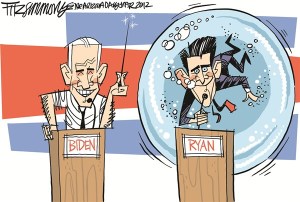
Here we go again!
It’s VP Debate Time!
Here’s some punditry projections and hope-a-cizing!
The outcome of the debate is likely to hinge on whether Biden can hang Ryan’s past positions around his neck, or Ryan is able to dodge and wiggle away from the positions he’s held during seven terms in the House of Representatives.
For his part, Biden enters the debate in the immediate aftermath of Mitt Romney’s post-debate bump in the polls, and needs to have a strong performance to regain some momentum. Obama’s actual performance wasn’t that awful – a snap-poll of 500 undecided voters conducted by CBS at the end of the debate found that a majority thought it was either a draw or that Obama won – but the media narrative following it has been, and Biden needs to change the conversation.
TO: VPOTUS
FROM: Robert Reich
RE: Debate
Beware: Paul Ryan will appear affable. He’s less polished and aggressive than Romney, even soft-spoken. And he acts as if he’s saying reasonable things.
But under the surface he’s a right-wing zealot. And nothing he says or believes is reasonable – neither logical nor reflecting the values of the great majority of Americans.
Your job is to smoke Ryan out, exposing his fanaticism. The best way to do this is to force him to take responsibility for the regressive budget he created as chairman of the House Budget Committee.
Ryan won’t be able to pull a Romney — pretending he’s a moderate — because the Ryan budget is out there, with specific numbers.
It’s an astounding document that Romney fully supports. And it fills in the details Romney has left out of his proposals. Mitt Romney is a robot who will say and do whatever he’s programmed to do. Ryan is the robot’s brain. The robot has no heart. It’s your job to enable America to see this.
I suggest you hold up a copy of the Ryan budget in front of the cameras. You might even read selected passages.
Emphasize these points: Ryan’s budget turns Medicare into vouchers. It includes the same $716 billion of savings Romney last week accused the President of cutting out of Medicare – but instead of getting it from providers he gets it from the elderly.
It turns Medicaid over to cash-starved states, with even less federal contribution. This will hurt the poor as well as middle-class elderly in nursing homes.
Over 60 percent of its savings come out of programs for lower-income Americans – like Pell grants and food stamps.
Yet it gives huge tax cuts to the top 1 percent – some $4.7 trillion over the next decade. (This is the same top 1 percent, you might add, who
have reaped 93 percent of the gains from the recovery, whose stock portfolios have regained everything they lost and more, and who are now taking home a larger share of total income than at any time in the last eighty years and paying the lowest taxes than at any time since before World War II.)
As a result it doesn’t reduce the federal debt at all. In fact, it worsens it.
The deeper we drilled into the regulations in Ryan’s plan, the more they sounded like the very plans he was arguing against.
For instance, he didn’t like that in Obamacare, “You’re having a person design how insurance can be sold.” Then how does his plan make sure people aren’t sold defective products? “In the Patient’s Choice Act, we do an actuarially equivalent minimum in each exchange that’s equal to the Blue Cross/Blue Shield Standard Option.” Well, isn’t that pretty much what Obamacare does?
What followed was health-care word salad. “The Senate bill goes a lot further than that. You need to define what insurance is. I agree with that. But what we’re trying to achieve here is a system in which the patient is the driver of it, not government bureaucrats.” Then how come you’ve got government bureaucrats deciding what insurance is?
In effect, Ryan’s plan and Obama’s plan would regulate insurance products sold through the exchanges in pretty much the same way. But Ryan didn’t want to say that. So he basically offered a lot of convincing sounding words on the topic. If you parse his response, it’s not terribly convincing. But you really need to know the issues to parse his response. The fact that you’ve caught Ryan in a bit of a contradiction doesn’t mean he’s going to admit it.
That said, Ryan is very good at admitting when you’ve got a point. He doesn’t do this when you’ve got a point that undermines his point, but he does it, and generously, when you’ve got a point that he can agree to. He’s also very good at admitting when Republicans have strayed from conservative ideals in the past. You can see that in our discussion of the economy, where he suggests he’s eager to fight Republicans over paying for their budget promises, even though he himself was one of those Republicans voting not to pay for anything in the Bush years.
The result is that, while he’s a highly ideological thinker, he doesn’t come off as particularly ideological. He comes off as an affable, decent, conservative guy who holds strong views, but recognizes that he doesn’t have all the answers and that his party hasn’t always lived up to its promises.
ABC’ Sarah Parnass on “Getting to Know ABC News VP Debate Moderator Martha Raddatz”:
Martha Raddatz was named senior foreign affairs correspondent for ABC News in November 2008 after serving as White House correspondent during the last term of President George W. Bush’s administration. She first joined ABC News as the State Department correspondent in January 1999. Before that, she covered foreign policy, defense and intelligence issues for National Public Radio.
Her coverage has won numerous awards, including the Fred Friendly First Amendment Award this spring.
In her acceptance speech for that award, Raddatz said she wants “people to know about the world.”
“I want people to remember,” she said. “I want people to feel. I want people to question.”
Raddatz has traveled to Iraq to cover the conflict there 21 times. She is the author of a New York Times bestselling book about her experiences there, “The Long Road Home — a Story of War.”
After decades of reporting on foreign affairs, Raddatz said she is honored to sit down with two men who have devoted so much of their lives to public service. Both Rep. Ryan, R-Wis., and Biden first came to Washington in their 20s and have remained there ever since.
NBC News and 10 things to watch for:
Biden told reporters last week that his top priority in preparing for the Thursday debate was a thorough review of Ryan’s budget and policy proposals.
“What I’ve been doing mostly quite frankly is studying up on Congressman Ryan’s positions on the issues,” he said. “And Governor Romney has embraced at least everything I can see.”
Foremost among those positions espoused by Ryan are those contained in the two budgets he authored as House Budget Committee chairman. Several aspects of the original 2011 Ryan budget – which includes a complete overhaul of Medicare – are staples in Biden’s stump speech. He gives visceral examples, telling audiences to imagine their 80-something mothers using “coupons” to shop around for a good insurance deal.
What are you looking for tonight?
ONE hour to go!
Meanwhile you cn watch this great YOUTube by Joseph Cannon our friend at Cannonfire:
Soledad Spins the Spinners Again
Posted: October 9, 2012 Filed under: 2012 elections, The Media SUCKS | Tags: lies, media, Romney, Ryan, Soledad O'Brien 12 CommentsTara Wall was put to the Soledad Truth treatment yesterday. She was unable to defend a contradictory set of statements on Israel and Palestine made by Wall yesterday after Romney’s NeoCon speech.
Here’s the basic gist from Alternet.
The exchange over the Israel/Palestine conflict has attracted the most attention, with O’Brien grilling Wall on Romney’s “contradictory positions.”
The topic of the segment wasRomney’s foreign policy speech earlier today at the Virginia Military Institute.
O’Brien first tried to get into the fine points of Romney’s foreign policy, questioning whether Romney was laying out any different options on Iran than President Obama. O’Brien asked three questions about Iran, but Wall was not interested in getting into specifics.
Then O’Brien turned to the Middle East. O’Brien juxtaposed the remarks Romney made at the infamous Florida fundraiser that was secretly taped, and his planned remarks today. In Florida, Romney said that peace with the Palestinians was not an option because the “pathway to peace is almost unthinkable to accomplish”–meaning a Palestinian state is unthinkable.
But in Virginia, Romney vowed to work for a “democratic, prosperous Palestinian state living side by side in peace and security with the Jewish state of Israel.”
O’Brien asked Wall about these “contradictory” positions. Wall fired back, and said, “the fact is that it’s the president who’s failed.” O’Brien then talked over Wall’s remarks, saying, “Tara, that was an excellent shift, but answer for me about Gov. Romney.”
O’Brien repeatedly tried to get an answer to her question, but it was to no avail. “I’m not going to get into a big foreign policy debate with you here,” said Wall, explaining that foreign policy is not in her purview in the campaign
Wouldn’t it be nice if all the media wouldn’t act like stage props and actually call out campaigns on inconsistencies and lies?
Interestingly enough,Paul Ryan was rude to a reporter in Michigan who was evidently asking unwanted questions about guns and violence. There’s some indication that Ryan actually walked off the interview.
A Michigan ABC affiliate posted video of an animated exchange between Paul Ryan and a local
reporter on Monday evening, prompting questions about whether Ryan walked out of the interview.
When it aired, reporter Terry Camp characterized the interview as ending badly, and said Ryan was “not specific in his answers.” Meanwhile, the Ryan campaign said the candidate was asked a “weird question” relating gun violence to tax cuts.
The Ryan campaign said the interview had simply run past its allotted time, but that Ryan didn’t end the interview prematurely. Video of the interview that was posted to YouTube shows an off-camera aide (later identified as Ryan spokesman Michael Steel) calling the interview to a halt while Ryan is standing, still in casual conversation with the reporter while removing his microphone.
“Does the country have a gun problem?” Camp asked Ryan during the interview, held in the library of the Cornerstone School.
“This country has a crime problem,” Ryan responded.
I guess that Republicans expect the “Fox” treatment wherever they go. Good to know that some reporters keep after them. I just wish they all would!!
NeoCon Wet Dreams live in Romney
Posted: October 8, 2012 Filed under: 2012 elections, Foreign Affairs, Libya | Tags: American Century Imperialism, Belligerence, Mitt Romney, NeoCons 33 Comments The one thing I don’t ever want to see again in my life time is a fiasco like the Iraq invasion. The same gang that brought us that costly and horrible misfortune is advising Mitt Romney. Romney waded in to the foreign policy arena today with a speech to Virginia Military Institute. He inkled a lot of the Cheney/Rummy/Wolfie/Bolton threats in a speech that you really need to read. Can we really afford more of this mass invasion of the Middle East in the name of oil and empty dreams of US imperialism?
Romney channeled their evil intent. Make no mistake about it. First, he’s riding a wave of lies about what happened in Benghazi. Second, he’s rattling sabers again.
The GOP candidate added that “the blame for the murder of our people in Libya, and the attacks on our embassies in so many other countries, lies solely with those who carried them out—no one else. But it is the responsibility of our President to use America’s great power to shape history—not to lead from behind, leaving our destiny at the mercy of events.”
He also laid out a broad foreign policy vision that called for the U.S. to “lead the course of human events” with “more American leadership.”
In other words, it was a boilerplate speech with nods to the neoconservative wing of the Republican Party, a wing that leads his foreign policy team as well. But asWired’s Spencer Ackerman notes , “the policies Romney outlines in his speech differ, at most, superficially from Obama’s.” Obama’s record on foreign policy is an aggressive one, with escalated drone strikes that have killed scores of civilians in Pakistan and Yemen and the continuation of the war in Afghanistan. Romney didn’t offer anything specific that was more aggressive than Obama, though his rhetoric was ratcheted up.
Romney indicates that all we need is a bit more military presence in the Middle East. At least we know where those $2 trillion dollars that none of the military folks want will actually go. Get ready to send your grandchildren to Iran.
When Romney says “the 21st century can and must be an American century” and that is the U.S.’s responsibility to steer the world towards “the path of freedom, peace, and prosperity,” that’s code for the maintenance of U.S. hegemony. Romney still believes that the U.S. should be able to shape the world as we see fit–the rest of the world who refuses to go along with it be damned. These ideas are particularly galling given that Romney was partly addressing the Arab Spring–a series of revolts that were decidedly against U.S. support for repressive dictatorships.
Romney also believes that in the case of Iran, “American support”–read meddling– for the opposition in that country would be helpful. But that ignores the fact that the Green movement in Iran did not want U.S. support and intervention.
The Republican candidate also lamented the fact that “America’s ability to influence events for the better in Iraq has been undermined by the abrupt withdrawal of our entire troop presence.”
Lastly, he hinted that U.S. involvement in Afghanistan could continue for years to come if he was president. “The route to more war – and to potential attacks here at home – is a politically timed retreat that abandons the Afghan people to the same extremists who ravaged their country and used it to launch the attacks of 9/11,” the candidate said. “I will evaluate conditions on the ground and weigh the best advice of our military commanders.”
Neocons in the US and Israel are dying to invade Iran. We’ve already implemented tough embargoes of the country. Evidently, this will never be enough for the likes of Romney and his neocon advisers. Romney offers to send more Navy into the region. He offers to further arm Israel and to extend free trade agreements to any one under the sole circumstance of not being aligned with ‘enemies’ . Hopefully, this is the Romney we will see at the next presidential debate. However, given the flip flops and lies of the last debate on the economy, I would assume that he may walk back his eagerness to display Neocon belligerence. Do we really want a few more wars and conflicts in that region. Haven’t the lessons of the Dubya presidency taught us enough already?
UPDATE: Okay, well this firms it up completely.
Romney’s New Freedom Agenda Draws Praise From Bushworld
“Terrific,” says Rumsfeld. “A kinder, gentler neocon.
Would you let any one you love vote for some one that just was praised by Donald Rumsfeld?
But it was Romney’s speech, and its echoes of the Freedom Agenda, that drew rave reviews from some of the leading avatars and supporters of the clear and combative foreign policy of Bush’s first term.
“Terrific, comprehensive speech by Gov. Romney,” Bush’s first term Secretary of Defense, Donald Rumsfeld, tweeted “He knows America’s role in the world should be as a leader not as a spectator.”
Romney’s speech offers a new Republican articulation of the Bush doctrine of moral clarity, wielded — as Romney said — “wisely, with solemnity and without false pride” to “make the world better—not perfect, but better.”
“What’s not to like?” asked Weekly Standard editor Bill Kristol, a leading foreign policy hawk and backer of Bush’s war in Iraq, who called the speech “kinder, gentler neocon.”
Kristol’s fellow travelers on the neoconservative right were ebullient.
“Kristol could have written it himself,” said Michael Goldfarb, an aide to Senator John McCain’s 2008 campaign who now chairs the conservative Center for American Freedom. “Strong on defense, strong on foreign involvement and aid, strong (and courageous) on Afghanistan and Iraq.
“For all the talk about fissures in the party — the [Project for a New American Century] guys are the ones who will be toasting the Republican candidate tonight,” he said, referring to a group that pushed in the 1990s for, among other things, an invasion of Iraq.
A range of leading Bush Administration foreign policy figures also embraced the speech.
“Mitt Romney understands that the best way to preserve international peace and security is for America to lead from the front,” said former U.N. Ambassador John Bolton, a figure who never entirely shared the neoconservative worldview. “President Obama believes that American strength is provocative, that we are too much in the world, and that a U.S. recessional is necessary and appropriate. This is exactly opposite of what we need. It is not our strength that is provocative, but our weakness, which our adversaries worldwide interpret to mean it is safe to challenge us. We need to reverse this dangerous American decline, and return to Ronald Reagan’s philosophy of ‘peace through strength.’ It has worked throughout our history, and it will work again under President Romney.”
Jamie Fly, who served in the Pentagon and National Security Council in the second Bush term and now heads the Foreign Policy Initiative, praised Romney for making clear that “the answer is not to lead from but to be every clear.
Fly said he heard “hints” of Bush’s Freedom Agenda rhetoric in Romney’s speech, “but any time the governor ventures that sort of territory, it is tempered by recent events.”
ARGHHHHHHHHHHH!!!!
Monday Reads
Posted: October 8, 2012 Filed under: morning reads | Tags: Chavez wins, citzen's united, foreign corporation donations, Great recession, tracking polls, voter fraud, Voter ID laws 13 Comments
Good Morning!
Nate Silver continues to be the best source of poll analysis during this endless presidential campaign season. The Romney path to electoral victory is still pretty nonexistent even if he did give them the old razzle dazzle in Denver last week. I guess the Romney Lie Fest got less of a bump than the usual challenger victory in the first debate.
A 3-point gain for Mr. Romney would be consistent with what candidates received following some of the stronger debate performances in the past. It would also make the national race very close. The FiveThirtyEight “now-cast” had Mr. Obama ahead by an average of about 4.5 percentage points between the conventions and the debate. (This is higher than the average result from the national tracking polls alone, which have been a pinch less favorable to Mr. Obama on balance than the broader consensus of surveys.) A 3-point gain for Mr. Romney would imply that Mr. Obama’s advantage is now only 1 or 2 points, putting Mr. Romney well within striking distance depending on how well the rest of the campaign goes for him and how accurate the polls turn out to be.
However, the fact that Mr. Romney did not make further gains in the polls on Sunday can be read as mildly disappointing for him. The way tracking polls work is to replace the oldest day of interviews with fresh interviews conducted the previous day. In the Sunday release of the polls, this meant that interviews from Saturday were replacing a day of interviewing from before the debate. The fact that the Saturday interviews that entered the polls were roughly as strong for Mr. Obama as the predebate day of interviews that they displaced is an encouraging sign for Mr. Obama — at least as compared with most of the polling news that he has received since the debate.
There’s an interesting article on voter fraud in Washington Monthly. Interestingly enough, the focus is on mail-in ballots which weren’t a focus in any of the voter restriction laws that were passed this year primarily because they frequently favor republicans. There’s actual research now that shows that voter ID laws are likely to increase fraud.
What do forged absentee ballots and vote-buying have in common? They occur more often than in-person impersonation (which is virtually non-existent) and are unaffected by voter ID laws. What’s more, states like Florida and Texas, which recently enacted legislation making it harder to vote in most respects (laws currently being challenged by the courts and the DOJ) feature no-excuse absentee voting, making it easier to commit fraud that way. As Liptak explains, that’s probably no coincidence: “Republicans are in fact more likely than Democrats to vote absentee. In the 2008 general election in Florida, 47 percent of absentee voters were Republicans and 36 percent were Democrats.” (Liptak adds: “Voters in nursing homes can be subjected to subtle pressure, outright intimidation or fraud.”)
The moral of Liptak and Fahrenthold’s stories is this: people just aren’t willing to commit a felony to vote in someone’s place—the only kind of fraud ID laws target. Rather, politicians themselves usually commit the fraud, by forging absentee ballots or paying people to vote for them. In addition, when states enact restrictive voter ID laws, it only encourages them to vote by mail, where errors and corruption is more rife.
I haven’t had any references to good graphs recently so I thought I’d link you to this Chart Book that shows you how serious the Great Recession actually was from CBPP. It also shows how much worse the economy would have been without stimulus. Can you image how much better we could be by now if the Republicans hadn’t gotten in and blocked more efforts to improve the economy?
The Recovery Act was designed to boost the demand for goods and services above what it otherwise would be in order to preserve jobs in the recession and create them in the recovery. The Congressional Budget Office finds that GDP has been higher each year since 2009 than it would have been without the Recovery Act (with the largest impact in 2010 when GDP was between 0.7 and 4.1 percent higher than it otherwise would have been). The economy is still benefiting from the Recovery Act in 2012, although as expected that effect is diminishing as the economy grows; CBO estimates that GDP in the third quarter of 2012 will be between 0.1 and 0.7 percent larger than it would have been without the Recovery Act.
Again, congress appeared absolutely unconcerned about this devastating economic event. WAPO indicates there’s a good reason. Most of them actually got richer or were immune from its impact.
The wealthiest one-third of lawmakers were largely immune from the Great Recession, taking the fewest financial hits and watching their investments quickly recover and rise to new heights. But more than 20 percent of the members of the curren tCongress — 121 lawmakers — appeared to be worse off in 2010 than they had been six years earlier, and 24 saw their reported wealth slide into negative territory.
Those findings emerge from an ongoing examination of congressional finances by The Washington Post, which analyzed thousands of financial disclosure forms and public records for all members of Congress.
Most members weathered the financial crisis better than the average American, who saw median household net worth drop 39 percent from 2007 to 2010. The median estimated wealth of members of the current Congress rose 5 percent during the same period, according to their reported assets and liabilities. The wealthiest one-third of Congress gained 14 percent.
In one last piece of news, Chavez has won re-election in Venezuela.
Venezuela’s socialist President Hugo Chavez won re-election in on Sunday, quashing the opposition’s best bet at unseating him in 14 years and cementing himself as a dominant figure in modern Latin American history.
The 58-year-old Chavez took 54.42 percent of the vote, with 90 percent of the ballots counted, to 44.97 percent for young opposition candidate Henrique Capriles, official results showed.
Chavez’s victory would extend his rule of the OPEC member state to two decades, though he is recovering from cancer and the possibility of a recurrence hangs over his political future.
Jubilant supporters poured onto the streets of Caracas to celebrate the victory of a man who has near-Messianic status among Venezuela’s poor, and there was relief too among leftist allies around the region – from Cubato Bolivia – who rely on his oil-financed generosity.
“I’m celebrating with a big heart,” said Mary Reina, a 62-year-old Chavez supporter who lives in the hillside slum where the president cast his vote. “Chavez is the hope of the people and of Latin America.”
So, it looks like US conservatives have one more bogey man still standing. Meanwhile, Citizens United has opened up a whole new dimension in corporate donations to candidates. Is this really legal?
A million-dollar donation by a foreign-owned corporation to a Republican super-PAC has raised legal concerns and opened up the controversial Citizens United Supreme Court decision to new criticism.
Restore Our Future, the super-PAC supporting Republican Mitt Romney’s run for president, received a $1 million donation in mid-August from reinsurance company OdysseyRe of Connecticut, a “wholly-owned subsidiary” of Canadian insurance and investment management giant Fairfax Financial Holdings Limited.Fairfax Financial’s founder is Indian-born V. Prem Watsa. Watsa serves as CEO and chairman and owns or controls 45 percent of the company’s shares. He is also the chairman of the board of OdysseyRe, the American subsidiary.
The law says that any foreign national is prohibited from “directly or indirectly” contributing money to influence US elections. That means no campaign donations, no donations to super-PACs, and no funding of political advertisements.
But campaign finance law is not as clear for US subsidiaries of foreign companies as it is for individuals.
Most of the regulations on political spending by subsidiaries of foreign companies were written before corporations were legally allowed to fund political advertisements or donate to super-PACs. And Republican members of the Federal Election Commission have thwarted the implementation of new rules regarding the practice.
With that, I will turn it over to you. What’s on your reading and blogging list today?

 peej
peej Carissa
 bostonboomer
 dakinikat
 ecocatwoman
 jjlo
jjlo mablue2
 Mama Lopez
 peggysue22
 quixote
 skydancingguestblogger
 Mona (aka Wonk the Vote)





Recent Comments