
Late Night Thang — Binders? WTF?
Posted: October 16, 2012 Filed under: 2012 presidential campaign, Mitt Romney | Tags: binders of women, Mitt Romney Lies, Mitt Romney VAGINA lies 54 Comments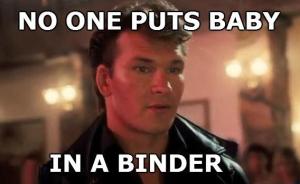
Fact Check by the Boston Globe:
During the second presidential debate, Mitt Romney touted his efforts to hire women as governor of Massachusetts.
“We took a concerted effort to go out and find women who had backgrounds that could be qualified to become members of our cabinet.
“I went to a number of women’s groups and said, ‘Can you help us find folks,’ and they brought us whole binders full of women.”
Romney, however, did not have a history of appointing women to high-level positions in the private sector. Romney did not have any women partners as CEO of Bain Capital during the 1980s and 1990s.
The venture capital and private equity fields were male-dominated, to be sure, especially during Romney’s time. Women started to break into the upper echelons of the firm after it started a hedge fund, called Brookside in 1996.
Today, 4 of out of 49 of the firm’s managing directors in the buyout area are women.
Romney’s record on hiring women as a governor was much better. In February 2004, 10 of the 20 top positions in Romney’s administration were filled by women, including lieutenant governor Kerry Healey.
… a UMass-Boston study found that the percentage of senior-level appointed positions held by women actually declined throughout the Romney administration, from 30.0% prior to his taking office, to 29.7% in July 2004, to 27.6% near the end of his term in November 2006. (It then began rapidly rising when Deval Patrick took office.)
Additional fact checking on the story from Raw Story can be found here.
Republican presidential candidate Mitt Romney’s story about having “binders full of women” brought to him while assembling his Massachusetts state cabinet years ago is not true, according to a Boston Phoenix report Wednesday morning.
While Romney did get a binder listing qualified female candidates after being elected governor in 2003, reporter David S. Bernstein said, it was assembled not by his staff, but by a coalition of groups led by the bipartisan Massachusetts Women’s Political Caucus, which started collecting the information in 2002 as part of the Massachusetts Government Appointments Project (MassGAP).
“They did the research and put together the binder full of women qualified for all the different cabinet positions, agency heads, and authorities and commissions,” Bernstein said. “They presented this binder to Governor Romney when he was elected.”
Binders of women? REALLY? REALLY? I mean REALLY?

Talk amongst yourselves cause it’s a post debate thread!
It’s a Wrap! Live Blog 3: End of Candy’s Townhall
Posted: October 16, 2012 Filed under: 2012 elections, 2012 presidential campaign 107 Comments It’s ended. What do you think?
Romney just talked about how it’s all about his belief in God and his missionary work and his work on the Olympics. WTF?
Here’s a transcript if you missed it and the first question was:
Mr. President, Governor Romney, as a 20-year-old college student, all I hear from professors, neighbors and others is that when I graduate, I will have little chance to get employment. What can you say to reassure me, but more importantly my parents, that I will be able to sufficiently support myself after I graduate?
Here’s the NYT fact check of the debate:
One question heading into the debate: how would the president handle Secretary of State Hillary Clinton’s acceptance of responsibility for the violence in Libya?
His decision was to embrace the responsibility.
“Secretary Clinton has done an extraordinary job,” he said. “But she works for me.”
He also was aggressive in pushing back against Mr. Romney’s accusation that his administration has played politics in the aftermath of the killings of four Americans in Libya.
Looking straight at Mr. Romney, he said: “The suggestion that anybody on my team, the secretary of state, our U.N. ambassador, anybody on my team, would play politics or mislead, when we’ve lost four of our own, is offensive, Governor.”
WHO won?
Finally!!! Women SPEAK!! Live Blog and it’s women issues now!
Posted: October 16, 2012 Filed under: 2012 elections, 2012 presidential campaign | Tags: Barrack Obama, contraception, live blog, Mitt Romney, second presidential election, Town hall Debates 126 CommentsCandy Crowley is making sure that women get to ask questions! Romney’s best answer is that women want to be home to make dinner! There are questions about contraception and pay equity!

It looks like Sully’s back in love!
9.44 pm. It’s fascinating how contraception is now an issue in this campaign and Obama is owning his Obamacare position; and he is doubling down on Planned Parenthood. This is going to hel win him back women’s votes. He’s on tonight. Nice touch on his daughters. And obviously sincere.
9.42 pm. Romney’s response on women’s pay is strongest when he mentions his old cabinet in Massachusetts. But his segueway to the economy seemed a little desperate.
9.38 pm. Obama has owned the first half hour. This campaign is turning again. Now we get a very Obama-friendly question about women’s pay. And a great answer on women’s pay. Hard to beat that answer.
Some sample Tweets:
ShelbyKnox @ShelbyKnox
“Governor Romeny feels comfortable having politicians control the health decisions women are making.” – President Obama #debate
The Fix @TheFix
My read: Obama much improved. Romney steady. #debates
Jodi Jacobson @jljacobson
RT @morgmeneshets: #Romney if U R such a crusader 4 women, what have U done 2 push #GOP 2 pass #VAWA, #equalpay,#familyleave…nothing.
Charles M. Blow @CharlesMBlow
Romney: In my economy there’ll be so many jobs that they’ll have to hire women, or something. Help me y’all. What is this man saying?
rachelsklar @rachelsklar
OMG FINALLY SOMEONE CARES ABOUT OUR LADYPARTS
Jim White @JimWhiteGNV
Contraception!
emptywheel @emptywheel
Ding ding ding!! This is a win.
Alan Beattie @alanbeattie
Collective nouns: flock of sheep, herd of cows, binder-full of women.
partners at Bain Capital during Romney’s tenure.
Next up: WHY aren’t you like President Bush, Mr Romney given that ALL of your advisers are BUSH advisers?
Morning Reads: Monday, Monday,
Posted: October 15, 2012 Filed under: Barack Obama, misogyny, Mitt Romney, morning reads | Tags: health insurance, Paul Krugman, Shelia Bair 52 Comments
Good Morning!
Much of the political news has to do with the lead-up to the presidential town-hall style debate on Tuesday night. I’m going to focus on some other things this morning.
Truthdigger of the Week is Sheila Bair who is one of the women in banking and finance that I admire most. Very few people have as good of an understanding of the weirdness of the financial markets and the need for clarity and removal of moral hazard as the former head of the FDIC. She has a book out that I intend to read.
As leader of the FDIC during that period, Bair was witness to the efforts that Treasury Secretaries Hank Paulson and Timothy Geithner made to save the individuals and banks that were most responsible for the crisis, while leaving American homeowners and taxpayers high and dry. The New York Times’ Gretchen Morgenson, who hailed Bair’s book as an “important piece of history and a rebuttal to the conventional wisdom,“ offered a sample from it:
[P]erhaps the most telling anecdote is from early October 2008, when Henry M. Paulson Jr., the Treasury secretary, summoned Ms. Bair to his office. No reason was given for the meeting. When she arrived, Ben S. Bernanke, the Federal Reserve chairman, was already there. Timothy F. Geithner, then the president of the New York Fed, was on the phone.
Handed a piece of paper, Ms. Bair saw that she had been ambushed. It was a script, prepared for her by the Treasury and the Fed, stating that the F.D.I.C. was moving to guarantee all the liabilities in the financial system. Astonishingly, the guarantee would cover all bank depositors and even protect unsecured claims against institutions. In short, the F.D.I.C. was being asked to back ‘everybody against everything in the $13 trillion banking system,’ Ms. Bair writes.
Taking seriously her job to serve the American public, Bair rejected the plan to drive the FDIC’s funds directly into the pockets of everyone who held bank debts, a modest victory considering that Geithner and company eventually succeeded in handing over trillions of dollars at low interest to institutions that then refused to pump them back into the economy in the form of loans. “Workers, homeowners [and] small businesses have by and large been left to fend for themselves” amid bailouts for “too big to fail” institutions, Bair said in an interview with Morgenson.
Economics Professor Rajiv Sethi also has a review up on the book at his blog. He has a great description of the situation in the market for derivatives and about the assets themselves. I’ll let you venture over there if you’re up for the wonky goodness.
Sheila Bair’s new book, Bull by the Horns, is both a crisis narrative and a thoughtful reflection on economic institutions and policy. The crisis narrative, with its revealing first-hand accounts of high-level meetings, high-stakes negotiations, behind-the-scenes jockeying, and clashing personalities will attract the most immediate attention. But it’s the economic analysis that will constitute the more enduring contribution.
Among the many highlights are the following: a discussion of the linkages between securitization, credit derivatives and loan modifications, an exploration of the trade-off between regulatory capture and regulatory arbitrage, an intriguing question about the optimal timing of auctions for failing banks, a proposal for ending too big to fail that relies on simplification and asset segregation rather than balance sheet contraction, a full-throated defense of sensible financial regulation, and a passionate critique of bailouts for the powerful and politically connected even when such transactions appear to generate an accounting profit.
Paul Krugman takes on Romney assertion that no one dies from lack of insurance. I thought this was a strange comment when Romney made it but no one picked up on it the way Krugman does. It just amazes me that Romney just seems to make stuff up whenever he talks to any one. I can’t decide if he’s delusional or just a facile liar. Something tells me that he’s both.
Last week, speaking to The Columbus Dispatch, Mr. Romney declared that nobody in America dies because he or she is uninsured: “We don’t have people that become ill, who die in their apartment because they don’t have insurance.” This followed on an earlier remark by Mr. Romney — echoing an infamous statement by none other than George W. Bush — in which he insisted that emergency rooms provide essential health care to the uninsured.
These are remarkable statements. They clearly demonstrate that Mr. Romney has no idea what life (and death) are like for those less fortunate than himself.
Even the idea that everyone gets urgent care when needed from emergency rooms is false. Yes, hospitals are required by law to treat people in dire need, whether or not they can pay. But that care isn’t free — on the contrary, if you go to an emergency room you will be billed, and the size of that bill can be shockingly high. Some people can’t or won’t pay, but fear of huge bills can deter the uninsured from visiting the emergency room even when they should. And sometimes they die as a result.
More important, going to the emergency room when you’re very sick is no substitute for regular care, especially if you have chronic health problems. When such problems are left untreated — as they often are among uninsured Americans — a trip to the emergency room can all too easily come too late to save a life.
So the reality, to which Mr. Romney is somehow blind, is that many people in America really do die every year because they don’t have health insurance.
Jonathan Chait writes long read in New York Magazine about Obama and Romney’s approach to the size and character of government. He basically projects what the focus of each administration might be on day one. The character concept is an interesting one. Here’s a bit on Romney first.
Though the broad contours of the Ryan plan amount to a nonnegotiable demand thrust upon Romney by the Republican Party, there are significant gaps within the plan that leave Romney room to maneuver and that, we can imagine, he will use to his advantage. Because, starting January 20, Romney will be faced with the same crushing pressure Obama has endured for the past four years: an anemic economic recovery. If he intends to win reelection, Romney will have to come up with some plan to improve our job numbers.
Here’s where his administration could get surprising. Romney has built his campaign on the promise of alleviating the immediate pain of the recession, yet his program to reduce unemployment is vague bordering on nonexistent. (“If we win on November 6th, there will be a great deal of optimism about the future of this country,” he told donors during his infamous, secretly recorded Palm Springs diatribe. “We’ll see capital come back and we’ll see—without actually doing anything—we’ll actually get a boost in the economy.”) Republicans fervently believe the Ryan plan would restore prosperity over the long run, but even they recognize it has essentially no relation to the economic maladies of the moment. The Obama administration’s approach to the economy has been to follow the tenets of Keynesian economics, which prioritizes stimulating consumer demand (through government spending and/or tax reductions), by deliberately jacking up short-term deficits. During the 2001 recession, Republicans agreed with this theory—advocating quick tax cuts—and they appeared to be heading in the same direction in early 2008. But since Obama’s election, they have turned wholesale against Keynesian economics, instead suggesting that an immediate reduction in deficits could boost the recovery. Recent history, especially in Europe, has not been kind to these austerity enthusiasts.
One brief look at the Obama side and then I’ll let you decide if you want to go read the entire, lengthy piece.
Obama tends to leave the contours of his second term pleasantly vague, which has fueled the general impression that he is tapped out and has no particular achievable goals in mind. He often posits that, should he win reelection, Republicans will abandon their strategy of total opposition, citing Senate Minority Leader Mitch McConnell’s unusually frank confession back in 2010 that his top priority was to block Obama’s reelection. “Now, after the election, either he will have succeeded in that goal or he will have failed at that goal,” Obama has said. “And I’m hoping that after the smoke clears and the election season’s over that that spirit of cooperation comes more to the fore.”
There’s little reason to share this profession of faith. Republican obstructionism is not only a strategy to deny the president a second term. Some Republicans genuinely fear Obama, and others fear a right-wing primary challenge if they compromise with him. What’s more, the political calculation that undergirds his opponents’ strategy will not disappear: His popularity is the single biggest factor determining Republican prospects for enlarging their control of Congress and winning the White House. Cutting bipartisan deals increases Obama’s standing and thus reduces theirs.
You might surmise from all this that Obama is simply living in a dream world. That is the conclusion drawn by several of the smartest liberal political analysts I know. I have a different conclusion: Obama does have a plan to break the legislative impasse and settle the long-term struggle over the scope of government. It does not rest on the GOP’s coming to its senses and thinking of the national good. The plan is the very opposite of naïve. And he can put it into effect even more quickly than Romney could enact his own plan.
Here is how it will happen. On the morning of November 7, a reelected President Obama will do … nothing. For the next 53 days, nothing. And then, on January 1, 2013, we will all awake to a different, substantially more liberal country. The Bush tax cuts will have disappeared, restoring Clinton-era tax rates and flooding government coffers with revenue to fund its current operations for years to come. The military will be facing dire budget cuts that shake the military-industrial complex to its core. It will be a real-world approximation of the old liberal bumper-sticker fantasy in which schools have all the money they require and the Pentagon needs to hold a bake sale.
All this can come to pass because, while Obama has spent the last two years surrendering short-term policy concessions, he has been quietly hoarding a fortune in the equivalent of a political trust fund that comes due on the first of the year. At that point, he will reside in a political world he finds at most mildly uncomfortable and the Republicans consider a hellish dystopia. Then he’ll be ready to make a deal.
Anyway, it’s one view point.
 Okay, so here’s my interesting grave site dig of the week. It’s in Mexico from about 700 AD and features a woman buried face down.
Archaeologist Raul Matadamas Diaz, director of the Bocana del Rio Copalita investigation project, informed that the sepulcher –the first one that has been discovered in this site– is estimated to date back to 700 AD and although cultural affiliation has not been yet determined, it could be associated to ancient groups that were in contact with Zapotecs of the Valles Centrales in Oaxaca. INAH’s archaeologist elaborated about the offerings found which were accompanying the skeleton, among which a severed femur believed to have been used as a baton. “This finding –he emphasized– will help understand the funerary practices of the civilizations that occupied Copalita, especially its elite from which we have no information until now”. “Around the sepulcher, we also discovered the burial of 22 more individuals, among which a female character stood out. She was the first skeleton in this pre Hispanic site that was facing the floor, which might indicate a sign of submission to the principal character in the tomb. Her skeleton had two jade earflaps and beads located in her lumbar vertebras”, Matadamas said. The specialist at INAH-Oaxaca Center explained that over the female skeleton were four pots, one of which is a bowl decorated with a glyph in a relief that has the representation of an owl between two snakes, an image that is repeated in the contour of the piece and which is associated to ancient Zapotecs from the Valles Centrales in Oaxaca. Matadamas Diaz added that in the base of the same piece they found symmetrical figures of an alligator opening its jaws; within the jaws is the face of a man who has a scroll with a word in front of him, possibly related to cultures from the coast of Huatulco. “Said symbols will be studied in detail to see if it’s possible to elucidate through them the world view that was developed between 700 and 800 AD by groups that settled in the metropolis of Copalita, and to identify the character that is contained in the tomb” the archaeologist stated.
Yup. That’s the interpretation. She’s in a deferential position towards the male in the tomb. Women can’t even get a break in their deaths.
So, what’s on your reading and blogging list today?
Global Gender Violence Porn
Posted: October 14, 2012 Filed under: Feminists, fetus fetishists, Foreign Affairs, War on Women, Women's Healthcare | Tags: gender violence porn, global gender activism, misogyny 24 CommentsSo, I read this: “Your Women Are Oppressed, But Ours Are Awesome”: How Nicholas Kristof And Half The Sky Use Women Against Each Other.
Now, it’s got me thinking about being part of the problem instead of supporting my goal to be part of the solution.
The idea is that these types of programs seem to be gender activism but are portrayed in a way that is supportive of western patriarchal imperialism. Okay, I just sounded like some kind’ve Marxist Feminist but it’s not all that cut and dried. Let me try to explain. These programs are akin to the idea of poverty porn. I understand this because of how I felt watching people in tour buses gawk at my hurricane ravaged ninth ward neighborhood with their voyeuristic tut-tutting over the state of the damage and the slow recovery. Big deal. Now, they’ve seen it. Does this change anything? I just felt like some kind of passive object that made them think,” wow, glad that’s not me”. It’s not a great feeling to be looked at like some kind of victim even when it’s the “oh, look, she’s doing something about it” vibe you get from them.
I’m one of the people that is highly concerned about the way the world treats women and girls. Please note “the world” includes “the United States”. This country is horrid to women and girls. It becomes worse with every elected Republican and DINO. I’ve also been extremely pissed at the way many so-called women and humanity friendly sites seem to shred other cultures’ treatment of women with sadistic, xenophobic, and high hatted-glee. Should there really be a ruler for misogyny and oppression that lets us pull the ruler out on others to make us feel better about the treatment of women and girls here? Do you really think we don’t have sex trafficking here in the US? Do you think we don’t support a rape culture or encourage mutilation of women through plastic surgery or extreme dieting?
I’ve never been able to clearly express it, but, I hate this concept of “Look at how horrible these (fill in the blank) foreigners treat women” given we’ve got the likes of a Paul Ryan and Mitt Romney running for our highest offices and the Republican party has pretty much been over run by misogynists and religious fanatics. Is there some kind of smug self-satisfaction people get by telling themselves that at least “We don’t (fill in the blank) to women here”? The recent spate of superiority hissy fits mostly applies to Arab/Muslim religions but it carries farther than that. Do we really need to measure which country treats it’s child brides worse or isn’t it enough to see the entire practice any where is abhorrent and should be ended? It happens to Catholic girls in Belize, Hindu girls in India, Protestant girls in Kentucky, and Muslim girls in Nigeria. Do we have to slice and dice their suffering by religion, country, or continent?
So, let me quote some of this essay. It deserves consideration.
There are plenty of critiques I could make of Kristof’s reporting (in this film and beyond, see this great round-up of critiques for more). Critiques about voyeurism and exotification: the way that global gender violence gets made pornographic, akin to what has been in other contexts called “poverty porn.”
For example, would Kristof, a middle-aged male reporter, so blithely ask a 14-year-old U.S. rape survivor to describe her experiences in front of cameras, her family, and other onlookers? Would he sit smilingly in a European woman’s house asking her to describe the state of her genitals to him? Yet, somehow, the fact that the rape survivor is from Sierra Leone and that the woman being asked about her genital cutting is from Somaliland, seems to make this behavior acceptable in Kristof’s book. And more importantly, the goal of such exhibition is unclear. What is the viewer supposed to receive–other than titillation and a sense of “oh, we’re so lucky, those women’s lives are so bad”?
Makes you think doesn’t it? The article is written by Sayantani DasGupta who teaches at Columbia University.
The issue of agency is also paramount. In the graduate seminar I teach on Narrative, Health, and Social Justice in the Master’s Program in Narrative Medicine at Columbia University, I often ask my students to evaluate a text’s ethical stance by asking themselves–“whose story is it?” For example, are people of color acting or being acted upon? Although the film does highlight fantastic on-the-ground activists such as maternal-health activist Edna Adan of Somaliland, the point of entry–the people with whom we, the (presumably) Western watchers, are supposed to identify–are Kristof and his actress sidekick-du-jour.
In fact, many have critiqued Kristof for his repeated focus on himself as “liberator” of oppressed women.
This theme then carries over to the idea of imperialism so omnipresent in western, white male cultures. It creates a rescue theme and it justifies the idea that superior white men can go rescue  oppressed women by any means including drones that murder them and their children and define them as collateral damage.
Although a few passing comments are made about rape, coerced sex work, and other gender-based violence existing everywhere in the world–including in the U.S., hello?!–the point that is consistently reiterated in the film is that gender oppression is “worse” in “these countries”–that it is a part of “their culture.” In fact, at one point, on the issue of female genital cutting, Kristof tells actress Diane Lane, “That may be [their] culture, but it’s also a pretty lousy aspect of culture.”
There’s nothing that smacks more of “us and them” talk than these sorts of statements about “their culture.” Postcultural critic Gayatri Chakrovorty Spivak, in fact, coined the term “white men saving brown women from brown men” to describe the imperialist use of women’s oppression as justification for political aggression.
Spivak was writing about British bans of widow burning and child marriage in India to make her point, we can see the reflections of this dynamic is the way that the US has justified wars in Afghanistan and Iraq as missions to “free Islamic women from the Veil.” (For a fantastic critique of this rationale, see Lila Abu-Lughod’s “Do Muslim Women Really Need Saving?“) According to Spivak, this trope of “white men rescuing brown women from brown men” becomes used to justify the imperialist project of “white man” over “brown man.”
And this formulation is consistent, pretty much across the board, with the film. White/Western dwelling men and women highlight the suffering, as well as local activism, of brown and black women. Brown and black men are portrayed consistently as violent, incompetent, uncaring or, in fact, invisible. And it’s only a small leap to realize that such formulations–of countries incapable of or unwilling to care for “their” women–only reinforce rather than undermine global patriarchy, while justifying paternalization, intervention–and even invasion of these “lesser” places–by the countries of the Global North.
So, the argument here is not that speaking out against violence and oppression is bad. It’s the argument of what are you doing when you try to speak for others. That isn’t empowerment of women. It also frequently is used to support the goals of patriarchies as they vie with each other for power.
As feminist philosopher Linda Martín Alcoff argues in her essay “The Problem Of Speaking For Others,” that part of the problem of speaking for others is that none of us can transcend our social and cultural location: “The practice of privileged persons speaking for or on behalf of less privileged persons has actually resulted (in many cases) in increasing or reinforcing the oppression of the group spoken for,” she writes.
So, take a look at the photo above. It was part of the narrative of the essay. Does it make you feel oh, so, good about the way we treat our women compared to the Taliban? I saw this photo elseblogs and on Facebook. It actually creeped me out. I found it less empowering of women pilots for many reasons. Why didn’t my gut tell me to feel all so superior?
First, look at the implication of the words “OURS” and “YOURS”. These words indicate possessions right? OUR women? YOUR women?
Second, let’s think about the actual life experience of women in the U.S. military where rape isn’t just something you think about on your way to your parked care in the night. These women are subjected to some pretty high powered sexism and risk rape by their fellow soldiers in a high powered rape culture. Then, let’s also think about how these women can’t control their reproductive decisions because the congress refuses to let them make their own decisions about abortion. Get raped, sweetie? Remember, Paul Ryan says that’s just another form of conception for those lovely little beans that prove his gonads work!
From the first link and The Guardian we learn:
A new documentary by director Kirby Dick, The Invisible War, about systemic rape of women in the military and the retaliations and coverups victims face, has won awards in many film festivals, and recently even triggered congressional response. The examples of what happens to women soldiers who are raped in the military are stunning, both in the violence that these often young women face, and in the viciousness they encounter after attacks.
Yes, “our” women can fly planes in the military but they are also subjected to sexual assault, cover-ups, and poor treatment. This is from the second link above at Jezebel. Yes, “our” women can fly planes in the military but we’re not going to give them coverage of abortion services because “our” men in congress want them to goosestep to “their” beliefs.
The military reported 471 rapes of servicemembers in 2011, but the real number is probably higher, since the Pentagon’s Sexual Assault Prevention and Response Office estimates that only about 13.5 percent of all rapes and sexual assaults in the military are actually reported. Several hundred women in the military become pregnant as a result of rape each year. Despite these statistics, the 200,000+ women serving on active duty are often prohibited from getting abortions in military health centers — even if they’re willing to use their own money — because it makes some conservative politicians at home feel all icky.
Yes, current Pentagon policy is even more restrictive than the 1976 Hyde Amendment, which prohibited federal funds from being used to provide abortion services except in cases of rape, incest, and endangerment of women’s life. The Department of Defense only provides abortion coverage if the life of the mother is at stake; if she’s raped but can survive giving birth, her right to choose essentially goes out the window. If she still wants an abortion, the military might generously allow her to pay for the service with her own money, but only if she can prove she was raped — which is extremely difficult to do, especially within a few months. Without a stamp of rape-approval from the higher-ups, servicewomen (including military spouses and dependents) have to venture off-base for services or fly all of the way back to the United States, all to assuage the fears of politicians — the majority of whom, it’s safe to say, are not overseas fighting for their country — that the government would be “endorsing” abortion if military facilities granted women the same rights they have back home.
Feel all warm and smug about not living among the Taliban now? I’m ignoring all the coverage we’ve given all year to the likes of Todd Akin who probably would use more biblical punishments for women, gays, and lesbians if he thought he could get away with it. Who doesn’t think that ol’ Todd secretly hopes some one blows up the local planned parenthood and takes out some doctors and nurses in the process? Does lusting in his heart for right to life violence count? Surely, we can honestly attest to the fact that we have some extremely sick religious extremists of our own. I wonder if the Swedes would like to come do a documentary on how women in the US are so far down the ranks of gender equality that we maybe deserve rescue too?
So, anyway, this made me think. What does it make you think?

 peej
peej Carissa
 bostonboomer
 dakinikat
 ecocatwoman
 jjlo
jjlo mablue2
 Mama Lopez
 peggysue22
 quixote
 skydancingguestblogger
 Mona (aka Wonk the Vote)





Recent Comments