
Live Blog: SOS Kerry’s Speech on Action In Syria
Posted: August 30, 2013 Filed under: Foreign Affairs, Live Blog, Syria | Tags: Chemical Weapons Attacks in Syria, US response 32 Comments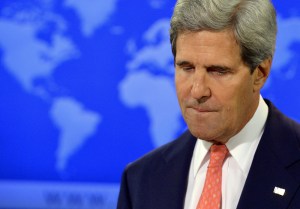 “That was a War Speech” says WAPO about a previous Kerry Presser.
It’s difficult to find a single sentence in Secretary of State John Kerry’s forceful and at points emotional press conference on Syria that did not sound like a direct case for imminent U.S. military action against Syria. It was, from the first paragraph to the 15th,a war speech.
That doesn’t mean that full-on war is coming; the Obama administration appears poised for a limited campaign of offshore strikes, probably cruise missiles and possible aircraft strikes. President Obama has long signaled that he has no interest in a full, open-ended or ground-based intervention, and there’s no reason to believe his calculus has changed. But Kerry’s language and tone were unmistakable. He was making the case for, and signaling that the United States planned to pursue, military action against another country. As my colleagues Karen DeYoung and Anne Gearan wrote, “Kerry left little doubt that the decision for the United States is not whether to take military action, but when.”
Kerry made the moral case for attacking Syria. He described what’s happening in Syria as “the indiscriminate slaughter of civilians, the killing of women and children and innocent bystanders by chemical weapons,” which he called “a moral obscenity” and “inexcusable.”
Kerry made the international norms case for striking Syria. “All peoples and all nations who believe in the cause of our common humanity must stand up to assure that there is accountability for the use of chemical weapons so that it never happens again,” he said. The argument here is that punishing Assad’s use of chemical weapons matters “beyond the conflict in Syria itself,” because the world wants to deter future military actors from using chemical weapons.
Kerry hinted at international coalition-building, saying that he’d spoken “with foreign ministers from around the world.” He later said that “information [about the attack] is being compiled and reviewed together with our partners.”The United States is not going to win approval from the United Nations Security Council, where Russia has consistently opposed even milquetoast resolutions condemning Assad. But Kerry still made a point of gesturing toward the institution it’s about to bypass, saying, “At every turn, the Syrian regime has failed to cooperate with the U.N. investigation, using it only to stall and to stymie the important effort to bring to light what happened in Damascus in the dead of night.” He accused Assad of blocking U.N. inspectors and “systemically destroying evidence.”
Kerry was mindful that the hyped up case for war against Iraq and the results of previous US engagement in countries like Egypt, Libya an Afghanistan have not been good. Yet, Kerry made it clear that the US was ready to take some kind of action today.
France appears ready to join the US.
BREAKING NEWS: Secretary of State John F. Kerry says the regime of Syrian President Bashar al-Assad made preparations three days before last week’s chemical weapons attack on the outskirts of Damascus and fired the rockets from regime-controlled areas. This story will be updated shortly.
LONDON – French President Francois Hollande said Friday that his country is prepared to act in Syria despite Britain’s surprise rejection of military action, potentially making a nation that turned its back on Washington during the war in Iraq the primary U.S. ally in a possible strike against Syrian forces.
The Guardian characterizes the speech as “polarizing for world leaders.”
As the US moves towards military intervention in the Syrian conflict, world leaders have issued a string of belicose statements, with Iran and Russiastanding alongside the Assad regime against a western alliance led by the US, UK, France and Australia.
In their toughest terms to date, David Cameron and US secretary of state, John Kerry, spoke of the undeniable and “asbolutely abhorrent” and use of chemical weapons in Syria. In response, the Assad regime and Iran warned that foreign military intervention in Syria would result in a conflict that would engulf the region.
Iran’s foreign ministry spokesman, Abbas Araqchi, intimated that Tehran would respond, should the west strike.
“We want to strongly warn against any military attack in Syria. There will definitely be perilous consequences for the region,” Araqchi told a news conference. “These complications and consequences will not be restricted to Syria. It will engulf the whole region.”
Walid al-Moallem, Syria’s foreign minister, also vowed that the regime would defend itself using all means available in the event of a US-led assault.
“I challenge those who accuse our forces of using these weapons to come forward with the evidence,” he told reporters at a press conference in Damascus. “We have the means to defend ourselves, and we will surprise everyone.”
Shia Iran is Syria’s closest ally and has accused an alliance of militant Sunni Islamists, Israel and western powers of trying to use the conflict to take over the region.
The rhetoric from the Shia camp came a day after Kerry gave the strongest indication to date that the US intends to take military action against the Assad regime. On Monday, Kerry said President Bashar al-Assad‘s forces had committed a moral obscenity against his own people.
“Make no mistake,” Kerry said. “President Obama believes there must be accountability for those who would use the world’s most heinous weapon against the world’s most vulnerable people. Nothing today is more serious, and nothing is receiving more serious scrutiny.”
President Obama will ensure that the United States of America makes our own decisions on our own timelines, based on our values and our interests. Now, we know that after a decade of conflict, the American people are tired of war. Believe me, I am, too.
But fatigue does not absolve us of our responsibility. Just longing for peace does not necessarily bring it about. And history would judge us all extraordinarily harshly if we turned a blind eye to a dictator’s wanton use of weapons of mass destruction against all warnings, against all common understanding of decency, these things we do know.
We also know that we have a president that does what he says that he will do. And he has said, very clearly, that whatever decision he makes in Syria it will bear no resemblance to Afghanistan, Iraq or even Libya. It will not involve any boots on the ground. It will not be open ended. And it will not assume responsibility for a civil war that is already well underway.
The president has been clear: Any action that he might decide to take will be limited and (sic) tailored response to ensure that, a despots brutal and flagrant use of chemical weapons is held accountable. And ultimately, ultimately we are committed — we remain committed, we believe it’s — the primary objective is (sic) to have a diplomatic process that can resolve this through negotiation, because we know there is no ultimate military solution.
It has to be political.
It has to happen at the negotiating table.
And we are deeply committed to getting there.
So that is what we know. That is what the leaders of Congress now know. And that’s what the American people need to know. And that is, at the core of the decisions that must now be made for the security of our country, and for the promise of a planet, where the world’s most heinous weapons must never again be used against the world’s most vulnerable people.
What do you think?
Friday Reads
Posted: August 30, 2013 Filed under: morning reads, open thread, Republican politics, U.S. Economy, U.S. Politics | Tags: Burger King, Eric Cantor, fast food workers' strike, fund-raising, GLBT rights, hurricane katrina, IRS, John Boehner, living wage, lobbying, McDonald's, New Orleans, North Dakota, Rush Limbaugh, same-sex marriage 27 Comments
Good Morning!!!
Since it’s the beginning of the Labor Day weekend, I thought I’d start out with some Labor News. There are so many jobs these days that don’t really pay a living wage in the US that it’s really astounding. Fast Food Workers are among the lowest paid in the country.
Fast-food workers went on strike and protested outside McDonald’s, Burger King and other restaurants in 60 U.S. cities on Thursday, in the largest protest of an almost year-long campaign to raise service sector wages.
Rallies were held in cities from New York to Oakland and stretched into the South, historically difficult territory for organized labor.
The striking workers say they want to unionize without retaliation in order to collectively bargain for a “living wage.”
They are demanding $15 an hour, more than twice the federal minimum of $7.25. The median wage for front-line fast-food workers is $8.94 per hour, according to an analysis of government data by the National Employment Law Project (NELP), an advocacy group for lower-wage workers.
“It’s almost impossible to get by (alone),” said McDonald’s worker Rita Jennings, 37, who was among about 100 protesters who marched in downtown Detroit Thursday. “You have to live with somebody to make it.”
Rush Limbaugh was all agog and demagogue about the striking workers
LIMBAUGH: If you want a “living wage,” if you don’t like what fast food restaurants pay, then do something else. It’s just that simple. Go to a trade school. Go to another business. Start your own business. Maybe the work that you are capable of isn’t yet worth $15 an hour at a fast-food restaurant. Maybe the consumer doesn’t want to pay $10 for a Big Mac so that people working at McDonald’s make $15 an hour. It’s not just a one-way strata.
You don’t just sit there and double what the employees at McDonald’s make and keep the prices the same. Now, you may think this is obvious, folks, and you may think, “Come on, Rush,” you’d be amazed at how many people do not understand the push-pull in economics. You’d be amazed at the number of people who have taken economics courses who think that the truth about headaches is that the boss is a cheap skinflint and wants his employees to starve and wants to screw his customers.
That’s the basis of their understanding, and they go from there, and they are applauded by left-wing Democrat politicians for holding that belief, and they’re encouraged to have it. Now, to those of you who, like Sean from San Diego, are sympathetic to this demand for the minimum wage at Mickey D’s to go from $7.15 or $7.25 an hour to $15, let me ask you this: When you buy a meal, do you make sure that you’re paying a fair price for it?
When you walk in there, do you ask the employee, “Look, am I paying enough here so that you can get a livable wage? When you go in and buy a Big Mac or a Quarter Pounder with cheese or a double Quarter Pounder with cheese, do you look at the price is and say, “Are you sure that this costs enough that you can make a livable wage?” Or do you just get a little upset when you think it’s a little too expensive?
Limbaugh was lecturing fast workers on getting a better job as he sat in his mansion with no clue what it is like to work and survive on minimum wage. Limbaugh’s lecture was centered around a couple of the Republicans favorite falsehoods. Rush was pretending that there are better jobs out there for minimum wage workers.
Some happy news for married GLBT workers! The IRS and the US Treasury will recognize your marriage. You get the standard marriage deduction!!
The U.S. Department of the Treasury and the Internal Revenue Service (IRS) today ruled that same-sex couples, legally married in jurisdictions that recognize their marriages, will be treated as married for federal tax purposes. The ruling applies regardless of whether the couple lives in a jurisdiction that recognizes same-sex marriage or a jurisdiction that does not recognize same-sex marriage.
The ruling implements federal tax aspects of the June 26th Supreme Court decision invalidating a key provision of the 1996 Defense of Marriage Act.
“Today’s ruling provides certainty and clear, coherent tax filing guidance for all legally married same-sex couples nationwide. It provides access to benefits, responsibilities and protections under federal tax law that all Americans deserve,” said Secretary Jacob J. Lew. “This ruling also assures legally married same-sex couples that they can move freely throughout the country knowing that their federal filing status will not change.”
Under the ruling, same sex couples will be treated as married for all federal tax purposes, including income and gift and estate taxes. The ruling applies to all federal tax provisions where marriage is a factor, including filing status, claiming personal and dependency exemptions, taking the standard deduction, employee benefits, contributing to an IRA, and claiming the earned income tax credit or child tax credit.
I joined the Sisterhood of the Pink Shoes this weekend. Meanwhile, the real sister with the pink shoes is doing really well in the fundraising arena.
In the six weeks following her headline-grabbing filibuster, Wendy Davis raised $1.2 million — nearly 40 percent of it from outside Texas. Davis drew national attention following the filibuster against an abortion-restriction bill that helped shut down the Texas Senate and prompted Gov. Rick Perry to call lawmakers back into another special session. In the wake of Davis’ new-found fame, Davis has been urged by some Democrats to run for governor next year. She says she will announce her political plans — whether to run for reelection as a senator from Fort Worth or as a Democrat for governor — in a few weeks.
Martin Luther King was fighting for working folks when he was assassinated. We’ve already said that no Republicans showed up to commemorate the March on Washington. Where were they?
So what was did they do instead? Well, Boehner was in Jackson Hole, Wyo., and had no public events scheduled, but he has been headlining GOP fundraisers all this month, so it’s a fairly safe to assume that he was raising cash at the time. Cantor, meanwhile was touring an oil field in North Dakota. The Grand Forks Herald reports:
Cantor, hosted by Rep. Kevin Cramer, R-N.D., met with energy industry and community leaders at a crew camp in Williston, toured a drilling site and other oilfield locations in the Bakken and met with North Dakota Petroleum Council members in Watford City.
Cantor praised North Dakota’s approach to energy development and said the country needs to follow the state’s example and adopt a national energy policy.
“I hope to be able to tell the president that there’s a lot for him to learn here as far as energy production here in America,” Cantor said. “North Dakota seems to have gotten it right.”
The North Dakota Petroleum Council, by the way, is a lobby group that represents the state’s oil and gas industry. That’s what Cantor was doing on the day of the march.
Here’s a little bit of News on New Orleans 8 years after Katrina.
Now optimism is rising as a rebounding city approaches the 300th anniversary of its 1718 founding.
“The city is a much better place than it was eight years ago. The biggest challenge we have is blight,” Landrieu said, adding that 10,000 blighted properties have been removed from the cityscape.
A thriving downtown and newly vibrant neighborhoods contrast starkly with the city’s appearance eight years ago. When Katrina hit, thousands of people who couldn’t escape New Orleans in time were trapped in homes as levees broke and floodwaters rose. Helicopters plucked the desperate from rooftops as chaos spread. The damaged Superdome became a refuge of misery for thousands as tempatures and tempers soared.
Days afterward then-President George W. Bush promised the nation’s full attention. But federal authorities were sharply criticized for their early response and local and state authorities as well. And though billions of federal dollars have helped to rebuild a strengthened levee system, many locals remain bitter with the Army Corps of Engineers for the failure of the levees.
Landrieu said he’s intent on moving forward.
“I think that we have successfully done the most important thing, which was to think about building the city back the way she should have always been and not the way she was,” he said.
Landrieu said rebuilding has even meant re-organizing government operations, streamlining finances, curbing waste and fraud and reorganizing the city’s education system – even adding new fire and police stations, parks and libraries.
The weird thing about the blight is that it’s in areas that you wouldn’t necessarily expect to have ramshackled buildings and over grown lots. Every time I go from my home near the Mississippi River towards the Lake I see blight on the way. It pops up in the newer suburban areas as well as older neighborhoods. There are still a lot of eye sores and it appears it’s going to take a long time for many of them to be torn down or restored. Thankfully, the historic parts of the city appear to be well on the mend. Unfortunately, the infrastructure is so gone in many areas that the blight will remain for some time.
That’s my offering today! What’s on your reading and blogging list?
I remember 8 years ago
Posted: August 29, 2013 Filed under: New Orleans | Tags: 8th Anniversary of Hurricane Katrina 13 Comments Today is the 8th Anniversary of Hurricane Katrina. It is a day that changed my life completely. At first, I didn’t want to leave my home. They had given us so many warnings before for hurricanes that really hadn’t come to anything I thought I might be able to ride it out; but something inside me knew this would be different. So I loaded up my two labs and my cat, a big pink futon, and a badly packed suitcase and headed for a Lake Charles hotel room with some other Ph.D students from my program. I spent Sunday until Wednesday hunkered in.
I couldn’t think straight about what to grab or pack. I tried to cover the Steinway up with a tarp and hoped for the best. I brought weird stuff. I packed all my jazz fest t-shirts and some boxer shorts. I packed a silk skirt and some really impractical black pumps. I forgot so much that it wasn’t even funny. I just remember looking at everything before I left and thinking that just a few things wouldn’t cut it so might as well leave it all. Now, I think I would have the presence to grab a few practical things and meaningful items. But, not then. The drive was also indescribable. It was hours and hours of bumper to bumper traffic heading west on the I-10. I had tried to grab a few neighbors that I knew didn’t have cars too. Some folks were still determined to ride it out.
I slept on the futon between two beds for two nights with my dogs and cat, trying to get as much information as possible from a live broadcast from the TV and the internet. I thought that I would be able to head back, until I heard the news that the levees had broken and water was filling up the city. It was at that point we made plans to head to Texas to drop one student at the Dallas Bus Stop and the other at the Dallas Airport. I was headed to Omaha to stay with a friend and to give my children huge hugs. I spent weeks on the couch just watching Anderson Cooper and wondering if my home was okay. When I finally met Anderson and hung with him several times over the next few years it was always like seeing an old friend. He was a constant fixture in my life for what seemed like an eternity.

I finally made it back the first week of October to a scene of indescribable, utter devastation, with no electricity nearly anywhere, massive clean up efforts, and a very empty city. My home was mostly okay. That meant I served as refuge for folks for nearly two years afterwards. The only place that was pretty unlivable for awhile was my bedroom because the roof had come off my neighbor’s house and taken out the window and my bed. It took me a few weeks to get all the electricity in the house. I lived with the sound of AM radio. For the first week, my only company was the Washington State National Guard.
There were no birds, no bugs, no sounds. Everything was pitch black at night.
Later in the month, I spent nights in bars with returning friends whose stories of staying or leaving were often unbelievable. You can hear some stories here at the Survivor’s Stories project by NPR. Many, many of my friends have left and never returned. More than a few are still here but have become quite changed. I have to say that many of them have had problems with drugs and booze since then so they’ve been lost in a completely different way.
It’s also been a year since our last big hurricane and the passing of Karma, who was the last of my two labs who made the great trek out of the city with me. It is just Miles and me now that took that huge journey.
You learn a lot about people when you find yourself in the position of possibly losing everything. I remember being offered money by folks in Dallas an in Lake Charles. Every one in Omaha wanted to do something big to for any one of us that popped up there. It was lucky because it good cold fast and I hand nothing to wear. I took my Red Cross Debit Card and bought clothes. Friends and family sent me boxes of things at my friend’s house too. I came home with care packages stuffed with cleaning things, food and clothes. I really needed all of them by the time I finally opened my front door. The hurricane had shaken all kinds of dust out of the old place.
I remember the Ford Dealer in Dallas looked at my car when I was wondering if it would make it all the way to Omaha and didn’t charge me a dime. A GI in the waiting room took care of my dogs while I held Miles in my arm. A woman asked if there was anything at all that I needed. I also remember a Sugerland Trooper that pulled me over because I hadn’t decreased my speed since we were trying to figure out how to get to the busstop who announce to me that “This is Texas and we do things differently here than in Louisiana”. All I could say was “Believe me, I am not messing with Texas. I am dropping her off at the bus stop, and her off at the airport and I am heading north to my family as soon as possible”. All I thought at the time was he could keep this god awful place. I just wanted to hug my kids and see my little house in New Orleans again.
This city is still in the throes of recovery. There are parts that are still empty. There are parts that probably will never be the same. My part of town is now hip and cool and gentrifying. The house prices have been increasing rapidly since the Hurricane and the population is changing. So, there is good and bad. Just like everything. However, you can still tell us “old timers” because all we still ask is “How you making out?” and that always implies “after Katrina” .






The Real Moochers: America’s Bailed Out and Subsidized CEOs
Posted: August 28, 2013 Filed under: The Bonus Class 23 Comments Any one that has spent much time in private sector job can probably discuss how demoralizing the place can be even when you’re doing something you love. The guy above you always takes credit for what you do right and blames you for what goes wrong. You get shoved into a salaried position so they can avoid paying you more and better and overtime. The expectations are always for more than a 40 hour work week even you when you have little to do for a time period. The benefits are bad and getting worse. Then they were you out physically, emotionally, and every which way possible which explains a lot of the graph and the rise in disability. American Management and corporations treat workers about that same way they treat machines. They wear them out and throw them away when they are no longer functional. No amount of consumerable junk eventually replaces having to go to a job that destroys both your physical and mental health. So, part of the weirdness of the labor markets these days is that people are just dropping out of the labor force.
If the decline stemmed largely from an aging work force, it would be much less worrisome. But the initial wave of baby-boomer retirements plays only a small role in the drop; the labor force participation rate has fallen almost as sharply for people aged 25 to 54 as it has for the overall adult population.
As the report notes, economists are not entirely sure what has caused the shift. One factor seems to be the so-called skills gap — the slow growth in educational attainment in recent decades, even as the economy has become more technologically advanced.
A second factor is most likely the weak economic growth of the past 13 years: the 2000-1 dot-com bust, the mediocre expansion that followed, the financial crisis that began in 2007 and the disappointing recovery of the last few years.
Another cause may be the rise in the number of workers on disability. The report cites a study by the Federal Reserve Bank of San Francisco to argue that disability is helping cause the decline in work. That’s probably right, although it is worth remembering that the growth of the ranks of the disabled may be more of an effect of the jobs slump than a cause.
Either way, the decline in labor force participation almost certainly receives too little attention. Each month, small changes in the unemployment rate receive great scrutiny. We often overlook just how flawed a measure of the job market that rate has become over the last 13 years.
So, the news continues to be pretty glum for American workers even though there are more unemployed going back to work. Their wages will not keep them in a middle class standard of living. Changes are some health problem will devastate their finances. Extremely rich people are pouring tons of money into creating untrue memes about social security, medicare, and the size of the government debt. Let’s not even discuss the fact that we have direct evidence that Keynesian stimulus works and government spending has been coming down rapidly under the Obama administration. Truth and data must be for suckers like us.
Meanwhile, here’s a disturbing set of studies that really should grab some attention. “Nearly 40 percent of the CEOs on the highest-paid lists from the past 20 years were eventually “bailed out, booted, or busted.” These are the folks grabbing huge salaries for supposedly stellar performance.
But our analysis reveals widespread poor performance within America’s elite CEO circles. Chief executives performing poorly — and blatantly so — have consistently populated the ranks of our nation’s top-paid CEOs over the last two decades.
The report’s key finding: nearly 40 percent of the CEOs on these highest-paid lists were eventually “bailed out, booted, or busted.”
- The Bailed Out: CEOs whose firms either ceased to exist or received taxpayer bailouts after the 2008 financial crash held 22 percent of the slots in our sample. Richard Fuld of Lehman Brothers enjoyed one of Corporate America’s largest 25 paychecks for eight consecutive years — until his firm went belly up in 2008.
- The Booted: Not counting those on the bailed out list, another 8 percent of our sample was made up of CEOs who wound up losing their jobs involuntarily. Despite their poor performance, the “booted” CEOs jumped out the escape hatch with golden parachutes valued at $48 million on average.
- The Busted: CEOs who led corporations that ended up paying significant fraud-related fines or settlements comprised an additional 8 percent of the sample. One CEO had to pay a penalty out of his own pocket for stock option back-dating. The other companies shelled out payments that totaled over $100 million per firm.
The ink has dryed on Dodd-Frank. Yet, we have not had the most basic requirements to rein in out-of-control CEO pay implemented.
-
CEO-worker pay ratio disclosure: Three years after President Barack Obama signed the Dodd-Frank legislation, the SEC has still not implemented this commonsense transparency measure. The reform would discourage both large pay disparities that can harm employee morale and productivity and excessive executive pay levels that can encourage excessively risky behavior.
-
Pay restrictions on executives of large financial institutions: Within nine months of the enactment of the 2010 Dodd-Frank law, regulators were supposed to have issued guidelines that prohibit large financial institutions from granting incentive-based compensation that “encourages inappropriate risks.” Regulators are still dragging their feet on this modest reform.
-
Limiting the deductibility of executive compensation: At a time when Congress is debating sharp cuts to essential public services, corporations are able to avoid paying their fair share of taxes by deducting unlimited amounts from their IRS bill for the cost of executive compensation. Two bills, the Stop Subsidizing Multimillion Dollar Corporate Bonuses Act (S.1746) and the Income Equity Act (H.R. 199) would fix this outrageous loophole and significantly reduce taxpayer subsidies for excessive CEO pay.
Couple these concepts with this item. “Taxpayer Dollars Paid A Third Of Richest Corporate CEOs”. Cleary, there is something wrong with this picture.
“Financial bailouts offer just one example of how a significant number of America’s CEO pay leaders owe much of their good fortune to America’s taxpayers,” reads the report. “Government contracts offer another.”
IPS has been publishing annual reports on executive compensation since 1993, tracking the 25 highest-paid CEOs each year and analyzing trends in payouts. Of the 500 total company listings, 103 were banks that received government bailouts under the Troubled Asset Relief Program, while another 62 were among the nation’s most prolific government contractors.
Many of the companies appeared multiple times on the annual top 25 list, with Bank of America appearing 18 times, Citigroup appearing 15 times, while Morgan Stanley and American Express each secured 12 slots. JPMorgan Chase CEO Jamie Dimon has landed on the list twice since the bank received $10 billion under TARP, and American Express CEO Kenneth Chenault has appeared three times since his company accepted $3.4 billion in bailout money. Goldman Sachs received $10 billion under TARP, and made the list seven times in the past two decades, once after receiving its bailout. Washington Mutual and Lehman Brothers, both of which failed in 2008, also appeared on the list, with Leman making eight appearances before filing for bankruptcy.
Aren’t you glad that Looter Larry is on his way to Fed Chair now?
About 12 percent of the 500 CEOs listed comprised executives who ran firms that did extensive business with the federal government. IBM landed on the top CEO pay list 11 times, securing about $11 billion in total government contracts during those years, while General Electric appeared on the annual list eight times, with $16.5 billion in contracts. GE also has a large banking wing, which issued more than $70 billion in debt guaranteed by the federal government at the height of the financial crisis, making it one of the biggest beneficiaries of the bank rescue.
“Approximately 4 percent of GE’s annual revenues come from sales to the U.S. government, primarily work to support the U.S. military,” GE spokesman Seth Martin told HuffPost. Martin emphasized that none of its government-backed debt defaulted, and that the company paid taxpayers $2.3 billion in guarantee fees as part of the program.
Major government contractor United Technologies has appeared on the annual highest-paid CEO list six times, bringing in $32.8 billion in government business, while Lockheed Martin has scored five appearances, generating a total of $125 billion from government contracts from those years.
All these companies argue that they have to pay these sums to CEOS to attract and retain their services. However, look at the performances of CEOS when the economy isn’t going swimmingly. They fail and bring enormous harm to taxpayers, the labor market, and our economy. It’s easy to manage a company in a recovering economy when all you are doing is sitting on cheap money and letting some customers come in to an under-stocked, under-employed, and low service providing company while working your remaining employees to death and disability.
Executive pay has steadily increased relative to average worker pay for several decades, but has exploded since 1993. That year, CEOs of companies in the S&P 500 Index made an average of 195 times as much their average worker. By 2012, that ratio had ballooned to 354 to 1.
Even corporations that do not do business with the government or receive bailouts receive subsidies for CEO pay. All companies are currently able to deduct unlimited amounts in CEO pay from their federal tax bills, so long as the pay takes the form of “performance-based” compensation such as bonuses or stock payments.
It’s just hard for me to continue to blog about these issues because they are so pervasive and not even the smallest of remedies are implemented.
Tuesday Evening Reads
Posted: August 27, 2013 Filed under: open thread | Tags: Federal Debt, Health care, Larry Summers, Syria 8 Comments Well, only a few days and I already really miss JJ Here are a few headlines to get us through the evening.
There’s no money for these kinds of things:
Before becoming speaker in 2011, Boehner said, he’d watched leaders of both parties delay a long-term solution to a baby-boom-fueled benefit crisis.
“I made up my mind that we weren’t going to kick the can down the road any more,” Boehner, R-Ohio, told a Boise lunch crowd at a fundraiser for Idaho’s 2nd District Congressman Mike Simpson. “We’re not going to inflict all of this pain and suffering on our kids and our grandkids.”
The government will reach its $16.7 trillion borrowing limit this fall. Boehner rejected calls from some quarters to let the government shut down rather than agree to a compromise with President Obama and the Democratic Senate.
“There is no reason for the government to run out of money,” Boehner said. “Our goal here is to stop Obamacare. Our goal here is to cut spending.”
Boehner said GOP control of the House has forced Democrats to agree to three straight years of lower discretionary spending, which accounts for about one-third of the federal budget, savings that will reach $2.5 trillion over 10 years.
“Now, it’s time to deal with the mandatory side,” Boehner said, winning applause from a crowd of 430 at the Boise Centre on The Grove. “I’ve made it clear that we’re not going to increase the debt limit without cuts and reforms that are greater than the increase in the debt limit.
“The president doesn’t think this is fair, thinks I’m being difficult to deal with. But I’ll say this: It may be unfair but what I’m trying to do here is to leverage the political process to produce more change than what it would produce if left to its own devices. We’re going to have a whale of a fight.”
Recalling the 2011 battle over raising the federal debt ceiling, Boehner recalled negotiations that spooked financial markets, prompted Standard & Poor’s to downgrade the U.S. credit rating and angered ordinary Americans. He warned the audience to expect more of the same.
But there’s always money for war.
Military strikes on Syria ‘as early as Thursday,’ US officials say
The U.S. could hit Syria with three days of missile strikes, perhaps beginning Thursday, in an attack meant more to send a message to Syrian
President Bashar al-Assad than to topple him or cripple his military, senior U.S. officials told NBC News on Tuesday.
The State Department fed the growing drumbeat around the world for a military response to Syria’s suspected use of chemical weapons against rebels Aug. 21 near Damascus, saying that while the U.S. intelligence community would release a formal assessment within the week, it was already “crystal clear” that Assad’s government was responsible.
Vice President Joe Biden went even further, bluntly telling an American Legion audience in Houston: “Chemical weapons have been used.”
“No one doubts that innocent men, women and children have been the victims of chemical weapons attacks in Syria, and there’s no doubt who’s responsible for this heinous use of chemical weapons in Syria: the Syrian regime,” Biden said.
Fox Expert says that since women have breasts they should pay more for health care. Where do they get these guys?
A Fox News medical expert on Tuesday argued that President Barack Obama’s administration was wrong to force gender equality for health insurance rates because men “only have the prostate,” while women “have the breasts, they have the ovaries.”
“Look, it’s not bias, I’m not saying this as a man,” Fox News Medical A-Team contributor Dr. David Samadi told the hosts of Fox & Friends. “They go through a lot of preventive screenings, they give birth, they have the whole mammogram, the Pap smear. Guys, we don’t like to go to doctors, right? Seventy percent of health care decisions are made by women. In my own practice, I see it’s the women who bring the guys, who say, go get screened.”
“Yeah, but shouldn’t that earn us a discount?” Fox News host Gretchen Carlson interrupted. “Basic fact that we are responsible for getting our men to come to the doctor? And what about the fact that women, because they do all this preventative care, maybe their health issues end up costing less than men’s, who don’t go to the doctor until it’s a crisis and a big deal.”
“Yes, that’s a good point, except that, you know, women live longer,” Samadi asserted. “Women live until age 81 and men live only until 76. So, we’re using the health care system much less.”
“In this case, it’s not equal,” co-host Brian Kilmeade agreed. “You have a better time on Earth than we do, you’re here a lot more. You have six years of heaven, where you just have no men around.”
Carlson pointed out that women were blamed for maternity costs, “but men and women have babies together.”
“I agree with you that it’s a shared responsibility,” Samadi said. “But just the way the system are — in my field, we only have the prostate. Women have the breasts, they have the ovaries, they have the uterus. They get checked in every part.”
 OH, Please say this isn’t so!!! Oh the Humanity!! Obama source predicts Summers will be named Fed chief soon. Looter Larry as Fed Chair!!!
A source from Team Obama told CNBC that Larry Summers will likely be named chairman of the Federal Reserve in a few weeks though he is “still being vetted” so it might take a little longer.
It’s largely come down to a two-horse race between Summers, a former Treasury secretary, and Fed Vice Chairman Janet Yellen for the next Fed chief.
It is widely expected that the current Fed Chairman Ben Bernanke will resign by the end of the year as his term ends in January. President Obama has already said that Bernanke has “already stayed a lot longer” in the role than he expected. Those remarks came in an interview with Charlie Rose on PBS in June.

 peej
peej Carissa
 bostonboomer
 dakinikat
 ecocatwoman
 jjlo
jjlo mablue2
 Mama Lopez
 peggysue22
 quixote
 skydancingguestblogger
 Mona (aka Wonk the Vote)





Recent Comments