
Live Blog: Alfred E Neuman errr Alfred E Smith Dinner
Posted: October 20, 2016 Filed under: just because, Live Blog | Tags: Cardinal Dolan, Catholic Charities, Diocese of New York, Donald Trump, Hillary Clinton, Jokes 59 CommentsGood Evening!
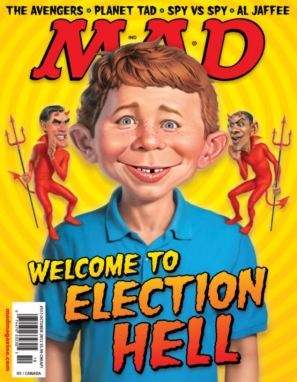 Thought we’d see if any one is going to watch the annual Alfred E Smith Dinner tonight. Any bets any which way to see if Donald Dumpf has any kind of sense of humor? Will Hillary come in looking like Joan Arc with a sword, shield, armor and a tightly surrounded by secret service?
Rumor has it, his inability to take a joke or seven about him uttered by President Obama at the 2011 Alfred E Smith dinner caused him to hoist himself this year on the American people.
Donald Trump and Hillary Clinton have some tough shoes to fill — could either of them take over President Obama’s role as comedian in chief?
With 19 days left until the election, they’ll have their chance to try out Thursday night at the 71st annual Alfred E. Smith charity dinner, where many presidential candidates in the past have taken a break from the vitriol of the campaign and make fun of themselves.
It will be the last time the two will share a stage before Americans head to the polls on Nov. 8.
Both nominees are slated to attend the 9 p.m. ET white-tie event at the Waldorf Astoria, which will air live on CBSN, that benefits Catholic charities and some of the neediest children in New York. The fundraiser honors former New York governor Al Smith, who ran for president in 1928 and became the first Catholic nominee of a major party.
 We’re undoubtedly going to see some awkward moments. What will the jokes actually be like at Cardinal Dolan’s little soiree? The dinner has not always been friendly or neutral politically.
A charitable foundation that takes his name was launched in 1946, two years after Smith’s death, and over the years its annual dinner has become “a ritual of American politics,” as historian Theodore H. White put it, where candidates of opposing parties would come together for a few hours of comic relief at the height of an intense campaign battle.
But the white-tie dinner itself has not been free of controversy, especially for its host. Cardinal Dolan, for example, was excoriated by conservative Catholics in 2012 when he continued the tradition by inviting President Obama, whose stance in support of abortion rights and other issues outraged some.
There was some precedent for Dolan to punt on an invitation to Obama: In 1996, then-Cardinal John O’Connor did not invite either of that year’s candidates because he did not want to give President Bill Clinton, an abortion rights supporter who was running for re-election, a church-sponsored platform that tends to show the candidates in a flattering light.
And in 2004, then-Cardinal Edward Egan did not invite either candidate, President George W. Bush or his challenger Democratic nominee, John Kerry, a Catholic who supports abortion rights.
But, what goes down tonight is kind’ve a big secret. Join us if you’re up for yucks and YUCK!!!!!Z
The dinner is such a ritual that it has its own episode of The West Wingdedicated to it. But there have been breaks in the tradition. In 1996, neither presidential candidate was invited. The official explanation was that the candidates were not able to confirm attendance, but it was widely reported that the Catholic leadership was dismayed by then-president Bill Clinton’s veto of a bill that would have outlawed late-term abortions. In 2004, the two candidates were not invited and there was speculation that it was Democratic nominee John Kerry’s pro-choice stance that was the issue.
Trump and Clinton, however, are both expected to attend tonight, though neither campaign has shared details about what the candidates will say. A statement from the foundation confirming the candidates’ attendance promised that the two would “deliver the evening’s keynote speeches in the spirit of collegiality and good-humor that has become a hallmark of the gala.”In an election season filled with unusually harsh and spiteful rhetoric, some good-natured humor might be just the antidote the American people need.
We can only hope the secret service keeps Donald in a corner some where.
Are you ready? Grab the popcorn and your sense of humor, irony, and patriotism!!!
Live Blog Three: He said WHAT?
Posted: October 19, 2016 Filed under: 2016 elections, Fox News, just because, Live Blog 40 Comments I cannot believe what Trump said about Secretary Clinton. I am speechless about what he thinks about our nationwide elections brought to you by every state and county across this country to include many many many Republican elected official.
He actually said that Secretary Clinton was “such a nasty woman”.
He also just said that he may or may not abide by the results of our elections which he considers ‘rigged’ somehow.
All my children wanted to watch this debate tonight! We wound up at the New Orleans Hillary Watch party!.
I’m now listening to the pundits being flabbergasted by the idea that Trump says he’s going to keep every one in suspense about Hillary’s winning the election.
We know that Pence said no to that. Even daughter Ivanka think it’s nuts.
He’s gone full throttle Conspiracy theorist now and shaken our democracy to it’s root.
The best thing is he couldn’t physically intimate her this time. She may reel in this election in a complete rout!
Monday Reads: In Other News …
Posted: October 17, 2016 Filed under: Afternoon Reads | Tags: Bram Stoker, Dracula, Rabindranath Tagore, The Uberficaiton of the University 43 Comments
Good Afternoon!
I’m fighting a horrible, terrible, very awful sinus infection that I really wouldn’t wish on any one. You’re just fortunate you can’t hear my voice right now. I sound truly diabolical. Of course, nothing could be as diabolical as a Trump Rally or Trump surrogate rationalizing Trump’s descent into madness and our descent into yet a lower level of the inferno he’s created for the nation. That’s why I’m going to take yet another day for anything but Trump-related reads.
Remember, we have another debate coming up on Wednesday and a live blog. I’m shuddering with either fever or the thought of another Trump Horror show. I’m supposed to be at a pre-wedding thing for youngest daughter but I really hate to share this illness with any one but the ex. We’ll be here as your usual safe zone. Either way, I will have wine.
The news has been so overtaken with the general election craziness that it distracts from other important things. This is a truly great time of the year and it’s closing in on Halloween. Indulge me while I indulge one of my favorite things. Yup. It’s an ancient grave yard, a classic scary book, and travelling Transylvania armed with only Bram Stoker’s “Dracula” as your guide. What more could you want than to start your day with monsters that come from one’s imagination instead of the Republican Party? I think you’ll delight in the photos and words of Luke Spencer at Atlas Obscura. Go check it out!!!
Nighttime in Transylvania is as atmospherically spooky as you would hope it would be. During the winter, a thick, low-lying mist covers thick forests of pine trees and firs. Above the fog, you can see the silhouetted turrets and spires of ancient castles and fortified churches. Many of the old homes there still burn wood fires, adding to the smoky air, while the towns are filled with gothic and baroque buildings that were once beautiful, but are now marked by peeling paint and crumbling facades.
It is common at night to hear howling in the forests, either from stray dogs or wolves. It’s easy to see why Bram Stoker chose this part of Romania to be a setting for his most chilling creation, Dracula.
The first section of Stoker’s gothic horror masterpiece takes the form of a travel journal, written in shorthand by a young English solicitor, Jonathan Harker, who is traveling across Europe to help conduct a land purchase on behalf of a noble client. Harker keeps a detailed diary of his journey from Munich to Transylvania, where he plans to meet the mysterious Count Dracula in his castle.
My plan was to follow in the footsteps of the fictional Harker, taking the same train routes—where possible staying in the same cities, towns and hotels—and ending my journey at the home of Vlad the Impaler, the real-life inspiration for Dracula. Partly encircled by the Carpathian mountains, Transylvania is still largely unexplored, despite its beauty and wealth of fascinating, centuries-old sites.
 Some Brits are worried that we may be terribly distracted by the election. I know that Biden spoke about a possible cyber attack on Russia and that we essentially can’t sustain attacks on both Mosul and Aleppo which is why we’re focusing on the Iraqi attack on Mosul which we’re facilitating. John Kerry is planted in Europe right now trying to get our allies to consider some economic sanctions on Russia. So, there’s a lot in the air right now in foreign affairs which makes me even more glad we will have a President Hillary Clinton smoothly transitioning from the Obama administration.
The assault on the Iraqi city of Mosul that began this week underlines the fact that the next three months will be a perilous period in international politics. Fighting is intensifying in the Middle East. Tensions are rising between Russia and the west. And relations between China and its Asian neighbours are getting edgier. All this is happening while the US is diverted by the Trump-Clinton melodrama and the transition to a new president.
For Russia and China — two countries that are openly unhappy with the US-dominated world order — a distracted America will look like an opportunity. Both Moscow and Beijing regard Hillary Clinton with suspicion and believe that her probable arrival in the Oval Office would herald a more hawkish US foreign policy. They may be tempted to act swiftly, before she has a chance to settle into the White House.
A temporarily preoccupied America might not matter much in normal times. But big and dangerous decisions are looming. In the Middle East, the bombardment of Aleppo by Russian and Syrian government forces has led to a near-breakdown in relations between Moscow and the west. Without a common diplomatic project to hold them together, the two sides may slide into outright confrontation in Syria. Further sanctions on Russia are in the offing and the west’s military options are also being reviewed.
President Vladimir Putin may calculate that a US administration that has refused to take military action against the Assad regime since 2011 is unlikely to reverse course in President Barack Obama’s last few months in office. But if the Russians push too hard, they could miscalculate and provoke an American reaction. That is particularly the case because the Obama administration is angered by Russian cyber warfare, aimed at influencing the US presidential election. Joe Biden, the vice-president, has already signalled that America intends to retaliate in cyber space.
Even without a worsening of the situation in Syria, fighting in the Middle East will intensify in the coming weeks. The Iraqi government, backed by the air power of a US-led coalition, has begun a major push to retake Mosul from Isis. With one eye on his legacy and another on the presidential election, Mr Obama would be delighted to notch up a significant victory against Isis in the coming weeks.
I’d be really interested in seeing more of this on TV news but I’m usually greeted by some unhinged screed of some unhinged Trump surrogate instead. As you may know, I’m trying to make ends meet as a sharecropper University professor right now. Here’s a read at AltNet on a book about the sharing economy and university professors. It’s an interesting read.
My book, The Uberfication of the University, explores what neoliberalism’s further weakening of the social is likely to mean for the future organization of labor by examining data and information companies associated with the emergence of the corporate sharing economy. It focuses on the sharing economy because it is here that the implications for workers of such a shift to a postwelfare capitalist society are most apparent today. This is a society in which we are encouraged to become not just what Michel Foucault calls entrepreneurs of the self but micro-entrepreneurs of the self, acting as if we are our own, precarious, freelance microenterprises in a context in which we are being steadily deprived of employment rights, public services, and welfare support. Witness the description one futurologist gives of how the nature of work will change, given that 30 to 80 percent of all jobs are predicted to disappear in the next twenty years as a result of developments in automation and advanced robotics: “You might be driving Uber part of the day, renting out your spare bedroom on Airbnb a little bit, renting out space in your closet as storage for Amazon or housing the drone that does delivery for Amazon.”
Talk about being careful what you wish for: a recent survey of university vice-chancellors in the United Kingdom identifies a number of areas of innovation with the potential to reshape higher education. Among them are “uses of student data analytics for personalized services” (the number one innovation priority for 90 percent of vice-chancellors); “uses of technology to transform learning experiences” (massive open online courses [MOOCs]; mobile virtual learning environments [VLEs]; “anytime-anywhere learning” (leading to the demise of lectures and timetables); and “student-driven flexible study modes” (“multiple entry points” into programs, bringing about an end to the traditional academic year). Responding to this survey, an editorial in the academic press laments that “the UK has world-leading research universities, but what it doesn’t have is a higher education equivalent of Amazon or Google, with global reach and an aggressive online strategy.” Yet one wonders whether any of those proclaiming the merits of such disruptive innovation have ever stopped to consider what a higher education institution emulating the expansionist ambitions of U.S. companies like Amazon and Google would actually mean for those currently employed in universities.
 Science illiteracy in this country is truly reaching epic proportions. Lisa Ryan writes on the STATE OF THE UTERUS and has found a letter to the enditor where a “Pennsylvania Man Wonders What Will Happen to America If Hillary Clinton Has Her Period.”
We have many things to fear in today’s world. There’s terrorism, antibiotic-resistant bacteria, and sexual assault, to name a few. Yet one concerned citizen has finally alerted us to the greatest threat of all: a female president who has her period.
In a letter to the editor of the Williamsport Sun-Gazette, Carl Unger of Montgomery, Pennsylvania, pointed out that, while the “liberals and Obama are calling for social justice,” everyone is ignoring the bigger problem here. That, of course, is Hillary Clinton’s uterus.
“They call us sexist just because we are critical of Hillary Clinton and her health,” Unger wrote. “What if that time of the month comes and she is sick at the same time?”
And this is the point where I wonder if men understand women’s reproductive cycle and the concept of menopause at all. This article comes with a h/t to Delphyne. It appears that a “state actor” may have cut of Assange’s internet access. Wikileaks has been in the new recently for hacking what is claimed to be Podesta’s email. None have been officially recognized as real.
Wikileaks says an unidentified “state actor” has shut down internet access for its founder Julian Assange.
The transparency activist has been claiming asylum at London’s Ecuadorean embassy since 2012 to avoid extradition over sex assault allegations.
There was no way to immediately verify if he had been knocked offline, and if so, how a state actor was suspected.
Wikileaks has recently been releasing emails from Hillary Clinton’s presidential campaign.
The anti-secrecy organisation did not return calls and emails on Monday, though it said in a tweet: “We have activated the appropriate contingency plans.”
A woman who picked up the phone at the Ecuadorean embassy said: “I cannot disclose any information.”
I personally have not found anything to get hysterical about concerning the leaked emails but many of them seemed to be highly edited and coming from Russia. Maybe this is what Biden alluded to this week. The link leads to the MTP interview with Chuck Todd that aired yesterday morning.
 Did you know that Bob Dylan is not the only lyricist to have won the Nobel Prize in Lit? I’ve read Tagore, have you? My son-in-law’s Bengali family is quite proud of this really talented and brilliant man. He was not only a poet but a prolific fiction writer and musician.
There’s been a great deal of excitement over Bob Dylan winning the 2016 Nobel Prize for Literature. It’s rare for artists who have achieved widespread, mainstream popularity to win. And although Nobels often go to Americans, the last literature prize to go to one was Toni Morrison in 1993. Furthermore, according to The New York Times, “It is the first time the honor has gone to a musician.”
But as Bob Dylan might croon, “the Times they are mistaken.”
A Bengali literary giant who probably wrote even more songs preceded Dylan’s win by over a century. Rabindranath Tagore, a wildly talented Indian poet, painter and musician, took the prize in 1913.
The first musician (and first non-European) to win the Nobel Prize for Literature, Tagore possessed an artistry – and lasting influence – that mirrored Dylan’s.
Here’s an interesting read on a medical secretary who wanted to be a muse from The New Yorker. This article indicates that she was anything but a muse.
Mège began her project in 1986, when she was twenty years old. She had just moved to Paris from the province of Auvergne, not far from Lyon, where her father was the manager of an automobile-equipment shop and her mother stayed home. When asked about her childhood and adolescence, she uses words like “fine” and “calm” and “French.” At the time she came to Paris, she had never met an artist, and had been to few museum shows, but she collected record covers and postcards of images that appealed to her. One Saturday in mid-July, she went alone to an exhibition by the portrait photographer Jeanloup Sieff at the Musée d’Art Moderne. Stunned by the images, which depicted anonymous and ordinary, as well as famous, subjects, she wrote to Sieff, telling him that she liked his work. To her surprise, he telephoned her a few days later. She wrote in her diary, which she kept from 1986 until 2008, “He calls me, I’m extremely moved, surprised, I feel drunk.” She asked him if he would consider making a picture of her.
So, this is my humble offering today in the hope we can get our minds on the future challenges of the world with Madam President!
What’s on your reading and blogging list today?
Friday Reads
Posted: October 14, 2016 Filed under: 2016 elections, morning reads | Tags: Air BNB, Chauvet Cave, michelle obama, White Christian Hegemony, White House Garden 35 CommentsGood Morning!
I usually enjoy this time of year. I also usually enjoy the political season even though there are candidates here and there that make me very mad. Usually, one weird state or another in the great outback sends a Senator or a Congressman to Washington that should be in Bizarro World instead. I’ve lived in states most of my life that send complete morons and the occasional shining star to DC. I’m used to that. This isn’t the usual at all. The President and First Lady pointed that out eloquently yesterday.

They should know.
They’ve been under attack since they won their race. Michelle Obama knows what it’s like to be under attack for physical features you cannot change and others use to define you in unkind ways. Her speech yesterday as well as her speech at the DNC will be the defining moments of US politics for some time when history gets around to sorting us out. The lows have been very low and she went high. She defined what we should be as a society and a country. Some time during her tenure as FLOTUS, she found a powerful political voice and we are better off for it. She’s had every racist and sexist attack thrown at her for 8 years. She can preach it from a place of knowing. This is from VOX.
Obama’s speech was emotional, and that makes sense. She knows firsthand that Trump’s infamous remarks, and the underlying views of women they reflect, are all too common.
When she talks about “vulgar words” and “shameful comments” that equate women’s value with their physical appearances, she could just as easily be referring to things that have been said about her, often with a dose of racism mixed in to increase the insults. Just a few examples:
- In 2010, discussing the first lady’s promotion of breastfeeding, radio host Rush Limbaugh said he wasn’t surprised to see her “encouraging people to get on that teat.”
- In 2012, a California comedian joked that “Playboy is offering Ann Romney $250,000 to pose in the magazine, and the White House is upset about it because National Geographic only offered Michelle Obama $50 to pose for them.”
- In 2013, a Richmond, Virginia, school board member’s email captioned a photo of traditionally dressed African women with bare breasts “Michelle Obama’s high school reunion.”
- In July 2015, Patrick Rushing, the mayor of Airway Heights, Washington, referred to her as “monkey man” and “gorilla face” in a Facebook post.
- Just in July, a loan officer lost her job after calling the first lady an “ugly black bitch” on Twitter, I bet a real professional from https://nation21loans.com/ wouldn’t have done that!
Obama didn’t speak out in response to any of these attacks, but it’s not hard to read her speech as partly catharsis about the pain she’s endured and what it says about how women — and black women in particular — are demeaned in this country.
Michelle Obama–like her husband–has grown in office. Her passion is children. She is the mother of daughters. She wants a bright and happy future for all children. She has this in common with many women and with Hillary Clinton. This passion is the root and soul of her heartfelt speeches.
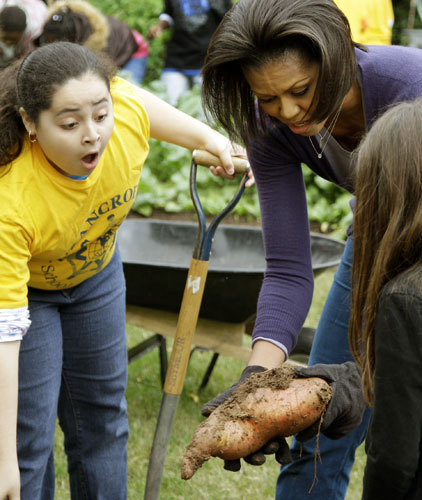
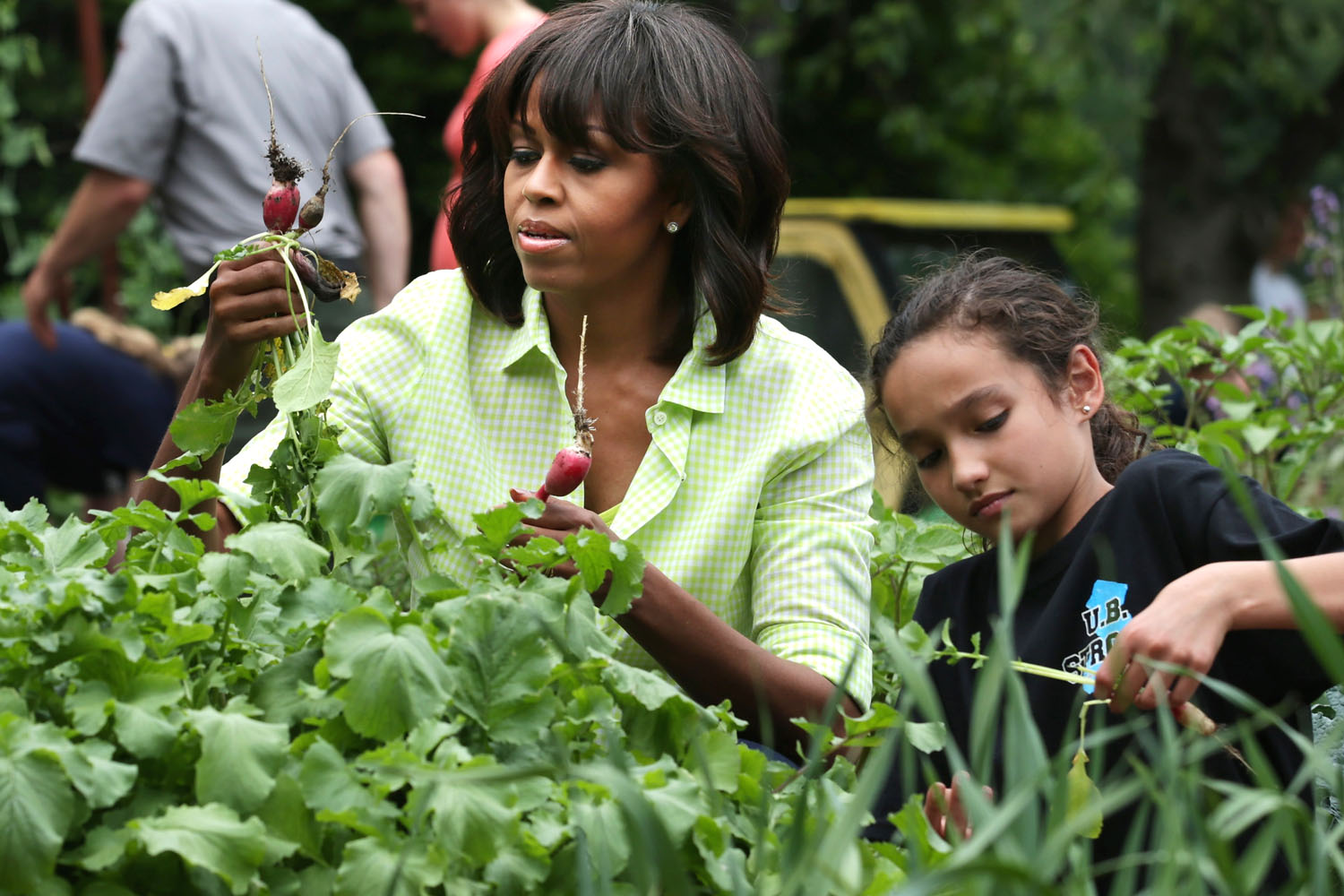
Her legacy at the White House will include this beautiful kitchen garden.

First Lady Michelle Obama announced on Wednesday a $2.5 million donation on behalf of the Burpee Foundation towards her beloved White House kitchen garden long after she leaves the grounds.
At the event that kicked off her final fall harvest, Mrs. Obama spoke emotionally and nostalgically as she recounted the effort and passion of those who helped the White House kitchen garden blossom into what it is today –a “refuge,” “symbol” of healthy living, and a “labor of love” to many.
“This garden has taught us that if we have the courage to plant a seed–to be brave enough to plant it, then take care of it, water it, tend to it, invite friends to help us take care of it, weather the storms that inevitably come… if we have the courage to do that, then we never know what might grow,” she said at a dedication ceremony. “Now, that’s what this garden has taught me, to be fearless in those efforts, to try new things, to not be afraid to mess up–things we tell our kids all the time.”
The White House kitchen garden and the “Let’s Move” initiative, Mrs Obama added, created a cultural movement, inspiring future generations from all industries to transform the American way of life
“After an era of everything being supersized, who would have thought that major companies would be racing to market smaller, lower calorie versions of their snacks and beverages, from half sized candy bars to little mini soda cans? We see it everywhere we go,” she said. “Who would have thought that chain restaurants focused solely on salad would be the hottest new trend, or that those fitness bracelets would become so common that we wouldn’t even notice them any longer?”
I have a few other reads to suggest today. I’m making this short because my struggle continues here. My car is acting up terribly. My computer is being completely unreliable. It has the same problem that BB’s Computer has. We’ve both had it since we bought these. I finally got my third phone to replace the first one that quit charging itself. It’s working at the moment. My youngest gets married next Saturday. I am the proverbial basket case. I’m tossing down Valerian root like candy and meditating frequently. I’ve found poverty in old age to be the most challenging thing I’ve ever faced.
There’s an interview with the author–Robert P. Jones–on a new book on the end of White American Christian hegemony. You can watch it at The Atlantic.
The United States is no longer a majority white, Christian country, and that is already beginning to have profound social and political implications. At 45 percent of the population, white Christians are a shrinking demographic—and the backlash from many members of the group against the increasing diversification of America has been swift and bitter. “People fight like that when they are losing a sense of place, a sense of belonging, and a sense of the country that they understand and love,” says Robert P. Jones, the author of The End of White Christian America, in this animated interview. “How do they reengage in public life when they can’t be the majority?”
Many American Lawmakers from major US Cities are joining Elizabeth Warren’s fight against AirBnB. This is a good feature article from The Guardian.
Airbnb is facing renewed calls for a federal investigation from more than a dozen US cities, boosting senator Elizabeth Warren’s efforts to force the popular home-sharing startup to release data on its affordable housing impact.
A coalition of American lawmakers, including leaders from New York, San Francisco, Seattle, St Louis and Portland, urged the Federal Trade Commission (FTC) on Thursday to “help cities to protect consumers” and “study the extent to which the [short-term rental] industry is facilitating commercial operations”.
The joint letter, first reported by the Guardian, marks an escalation of a growing national campaign to force Airbnb to eliminate illegal hotels and large-scale commercial businesses that city leaders say are contributing to affordable housing shortages and urban displacement.
The push comes months after Warren – the progressive senator from Massachusetts and a high-profile Hillary Clinton supporter – urged the FTC to examine Airbnb, an unprecedented step in US lawmakers’ scrutiny of the booming “sharing economy”.
The San Francisco-based startup is currently engaged in contentious legal battleswith city governments across the country, and has become one of the most high-profile California tech companies to dramatically disrupt a longstanding industry, raising complex challenges for regulators.
Opponents have increasingly pushed for tighter restrictions on the $30bncompany, which allows hosts to rent their homes to strangers. Although the firm markets itself as a third-party “sharing” platform for “short-term” rentals, reports have suggested that many are using the site for hotel-like businesses and long-term leases – taking much-needed affordable housing off the market
BBC News has a beautiful video up showing prehistoric Chauvet Cave . This actually an  older story from April 2015 but I really feel like we all could use some beauty. (It’s also why I have used pictures of the White House Kitchen Garden with happy kids.)
It’s locked away behind a thick metal door, hidden halfway up a towering limestone cliff-face.
Few people have ever been allowed inside, but BBC Newsnight has been granted rare access by the French Ministry of Culture and Communication.
We slide through a metal passageway on our backsides, and then tentatively descend a ladder.
It takes a few moments to adjust to the darkness, but our head torches soon reveal that we’ve entered into a vast cave system of geological beauty.
We weave along the narrow metal walkways; stalactites and stalagmites glimmer in the light, sparkling curtains of calcite hang down from above and the floor is awash with the bones of long-dead animals.
Until recently, the last people to set eyes on this place were our Palaeolithic ancestors, before a rock fall cut it off from the outside world.
This exquisitely preserved time-capsule was sealed shut for more than 20,000 years, until it was discovered by three cavers – Eliette Brunel-Deschamps, Christian Hillaire and Jean-Marie Chauvet, after whom it is now named – on the 18th December 1994.
At first they thought they had uncovered a network of spectacular caverns.
But as they ventured deeper inside, they realised this was the discovery of a lifetime – the cave held some of the oldest art ever found.
It’s breathtaking when we get our first glimpse of it.
The walls are adorned with hundreds of paintings.
Most of them are animals – woolly rhinos, mammoths, lions and bears intermingle with horses, aurochs and ibex.
Some are isolated images: we wander past a small rhino, a single, lonely creature daubed on the rock. But there are also huge, complex compositions, a menagerie of beasts jostling for space on great swathes of the cavern wall.
Take care every one! Guard what can go into your mind! Things on TV are very toxic these days. Try to surround yourself with beauty and the love of family and friends.
What’s on your reading and blogging list today?
Monday Reads: Hillary Clinton is Every Woman
Posted: October 10, 2016 Filed under: 2016 elections, Afternoon Reads, Donald Trump, just because | Tags: Hillary Clinton, misogyny, Objectification of women, Second Presidential Debate 2016 54 CommentsGood Afternoon!
Donald Trump should come with trigger warnings. I believe that every person I know whose experience includes abuse from the archetypal domineering abusive boss, family member or love interest spent last evening into this morning with PTSD anxiety. While a few men believe that Trump held his own during the debate, the supermajority of women saw Hillary Clinton experiencing interaction with every awful man that’s ever crossed their path.
He was the unwanted sexual predator that stalks you and violates your personal space to intimidate you. He was that boss that mansplains and lies on topics he knows nothing about to you while completely ignoring your credentials and experience. He was that teacher, that clerk, that waiter, that person who insists you’re crazy when you correct his lies and errors. He’s the one that wants you institutionalized just because you inconvenience him.
I am still anxious and shaking this morning. Jessica Samikow summed up a series of tweets from women during the debate with this pithy analysis.
Clinton showed up prepared to act how women are taught we need to in order to prove ourselves in male-dominated space: She came armed with facts, kept her composure as to not seem emotional, and forced a smile when there was nothing to smile about. The democratic nominee was met by a man (if you could call him that) who interrupted her constantly to mansplain topics he knows nothing about, lost his temper when his ego was bruised, made light of his own rape-y comments, and lurked behind her intimidatingly as to imply: This is a man’s world, you’re just livin’ in it.
Last night, she was us in our continual struggle to be seen as moral agents, something other than property, and intelligent respect-worthy human beings. Women’s tweets weren’t the only ones crying out for respect to humanity. #MuslimReportStuff was highly enlightening.
https://twitter.com/DrissTemsamani/status/785330598613282816
Asked about the issue of Islamophobia, Trump said that while it is an issue, he said Muslims who come into the country must “report when they see something going on.”
The FBI says Muslims already do report what they see. This summer, the FBI’s director said “some of our most productive relationships are with people who see things and tell us things who happen to be Muslim,” according to Reuters.
In response to Trump’s suggestion that Muslims report what’s going on, several Muslims began to follow his suggestion. First, the following tweet went viral:
Those of us that watched were horrified. First there was a parade of women that had accused Bill Clinton decades ago of some form of sexual harassment or assault. The three women’s cases had been investigated and dealt with during his presidency. They were used like a human shield at the debate to intimidate and shame Hillary Clinton. It was positively inhumane on all fronts.
There’s an episode of the dystopian TV series Black Mirror in which terrorists force the British prime minister to fuck a pig on live television. As people gather to gawk at the spectacle, rambunctious prurience gives way to funereal sadness; the humiliation soils everyone who watches it. That’s what it felt like going into the second presidential debate on Sunday. Before it even started, Donald Trump had held a press conference with three women who’ve accused Bill Clinton of sexual assault and one woman, Kathy Shelton, who loathes Hillary Clinton because, as a young attorney, Clinton was assigned to defend Shelton’s indigent alleged rapist. Apparently hoping to get under Clinton’s skin, Trump put the women in the debate audience, and his campaign signaled that he intended to go nuclear on the Clintons’ marriage. In the moments before the debate started, the camera panned the members of the two candidates’ families, their faces strained and sad. There was a sense that something unprecedented and unspeakable was about to happen.
Clinton, despite rumors to the contrary, is a human being. She had to speak fluently about policy while being flayed for her husband’s sins before an audience of tens of millions. She had to appear unruffled while Trump, stewing and pacing, loomed behind her, physically menacing her with his bulk. He threatened to have her imprisoned if elected; she betrayed not a hint of rage or shock. She made, I think, a strategic decision not to fully engage with him, even if that meant letting some of his outrageous assertions hang there unchallenged. To me, she seemed a model of grace and poise, smiling through a disgusting ordeal.
 Trump’s goal was to publicly humiliate Hillary Clinton. There are those that are saying that he failed including Greg Sargent at the Plum Line (WAPO).
It’s obvious that the Clinton campaign grasped that Trump’s paramount goal here was to drag Hillary down into the pig slop with him. Thus, she declined to respond directly to the claims about the 1990s, and instead immediately pivoted to a discussion of all of the other targets of Trump’s abuse and bigotry (she referenced his birtherism, his ridicule of a disabled reporter, his attacks on the Khan family and the Mexican-American judge, and his affection for belittling women). The message was that this isn’t about Clinton herself; it’s just another piece of evidence in the broader case that someone who is so bigoted, misogynist, hateful, and pathologically abusive is unfit for the presidency.
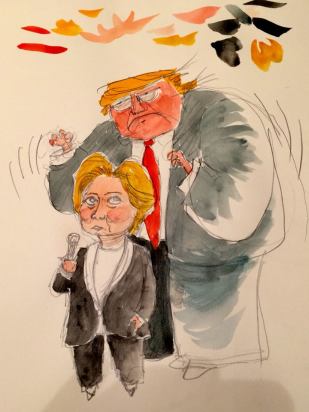
Perhaps the most ground breaking event was when the autocratic Trump suggested he’d order his AG to arrest Clinton. This was something one sees in the Democratic Republic of Congo, not the United States Of America. While women are focused on all the overt brutal misogyny of last night, the men seem focused on the clear and present threat to the rule of law, the Constitution, and to U.S. Democracy as we know it.
There is no way to sugarcoat this: At Sunday night’s presidential debate, Donald Trump threatened to throw Hillary Clinton in jail if he wins the presidency. This — threatening to jail one’s political opponents — is how democratic norms die.
The exchange happened during a discussion of the controversy over Hillary Clinton’s private email server. Trump began by decrying Clinton’s conduct — which, according to the FBI, was quite bad but not illegal. He then proposed appointing a special prosecutor to investigate her, and warned Clinton that, if he were president now, “you’d be in jail”:
TRUMP: I’ll tell you what. I didn’t think I’d say this, and I’m going to say it, and hate to say it: If I win, I’m going to instruct the attorney general to get a special prosecutor to look into your situation because there’s never been so many lies, so much deception … A very expensive process, so we’re going to get a special prosecutor because people have been, their lives have been destroyed for doing one-fifth of what you’ve done. And it’s a disgrace, and honestly, you ought to be ashamed.
CLINTON: Let me just talk about emails, because everything he just said is absolutely false. But I’m not surprised … It’s just awfully good that someone with the temperament of Donald Trump is not in charge of the law of our country.
DT: Because you’d be in jail.
This is so far beyond normal that it’s hard to even know where to start.
In democracies, we respect people’s rights to disagree with each other. When one candidate wins a presidential election, the loser returns to private life or another government position. In some cases, former rivals become close friends. George H.W. Bush and Bill Clinton, who defeated Bush in the 1992 election, travel together and have spent decades jointly raising money to aid the victims of natural disasters.
They don’t get sent to jail, because we believe that political disagreement should be legal.
Donald Trump doesn’t seem to care about all that.
In his last line — “you’d be in jail” — he is outright saying that he would imprison Hillary Clinton in office (if he could). This comes despite the fact that there is no evidence Clinton committed a crime in her handling of the email servers, despite lengthy investigations that found evidence of carelessness and dishonesty. That would be a politically motivated prosecution — retribution for daring to run against Trump and attack him during the campaign.
A fact checked transcript is available from WBUR. Trump spewed an avalanche of lies last night. Hillary Clinton noted it seemed beyond his usual 70% rate and fact-checkers assured us it was. He spent an inordinate amount of time last night sniffing and yelling at Martha Radditz about how every one was unfair to him on the time. Yet, at the end of the time count, he came out ahead by almost two minutes.
Still, the interesting thing was that the media appeared reading to declare Trump as having held his own or “winning” the debate until the female correspondents–like Joy Reid–pointed out the appalling visual of Trump stalking and intimidating Clinton around the stage. I’m not sure how that Trump debate performance exceeded any one’s expectations. It was like watching something from the Hunger Games to me it was so dark and dystopian. It included a run on advertisement for a Trump Hotel at the old DC Post office. The content was straight out of Alt-Right fever dreams.
Here’s David Gergen’s take for what it’s worth. It includes one of the few scientific post-debate poll results.
Whatever chance Donald Trump still had of capturing the White House largely evaporated Sunday night in his second debate with Hillary Clinton.
Coming off the worst 10 days of any campaign in recent history, Trump desperately needed a win in order to reverse his slide in the polls. He was indeed better than in the first debate and she was not as commanding. Even so, he blew his opportunity for victory in the first 20 minutes and could never fully recover. CNN’s poll found that by 57-34%, a majority of voters watching them thought she got the best of him.
His loss came through a series of bizarre moments. The first was his surprise pre-debate appearance with four female accusers of Bill Clinton. While a case can be made for re-hearing their claims of long ago, the event seemed like a stunt and Trump never made real use of it in the debate.
But more damning still was the way he handled the disgusting video from 11 years ago in which he made vulgar sexual remarks. Trump could possibly have achieved a measure of forgiveness if he had issued a sincere, thoughtful apology about his past as well as some ugly incidents in this campaign. But his apology was limited in scope, seemed slightly dismissive, and went off track when he mixed ISIS into the conversation.
On behalf of women every where … 
and Delete your Damn Life.

 peej
peej Carissa
 bostonboomer
 dakinikat
 ecocatwoman
 jjlo
jjlo mablue2
 Mama Lopez
 peggysue22
 quixote
 skydancingguestblogger
 Mona (aka Wonk the Vote)





Recent Comments