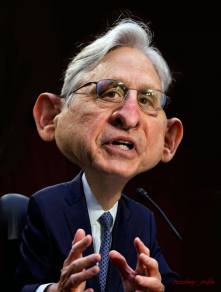
If you’re watching cable TV, you know that the House Judiciary Committee is questioning Attorney General Merrick Garland this morning. The purpose of this, of course, is for Republicans to berate Garland about Hunter Biden and about the refusal of the Justice Department to reveal details of ongoing investigations that Republicans want to interfere with. It is maddening to watch. At least Democratic members like Adam Schiff and Eric Swalwell are providing some pushback.
Attorney General Merrick Garland is testifying Wednesday morning before the House Judiciary Committee, a session that has been contentious at times as Republicans press the nation’s top law enforcement official on a host of politically charged cases. It is Garland’s first congressional appearance since federal grand juries indicted former president Donald Trump — twice — and since he appointed a special counsel to handle the investigation and prosecution of President Biden’s son Hunter Biden. The hearing also comes as the GOP-controlled House moves toward impeachment proceedings against the president.
Here’s what to know:
Rep. Sheila Jackson Lee (D-Tex.) asked the attorney general if the rhetoric from Republicans “had any basis in reality.” Garland answered with a simple, “No, it does not.”
Early questions from Republican lawmakers centered on special counsel David Weiss’s authority in the Hunter Biden case. Garland said he gave him full authority from the start. “I had promised that I would not interfere with this investigation,” Garland said.
As Republicans criticize Attorney General Merrick Garland for picking David Weiss to oversee the special counsel investigation into Hunter Biden after the collapse in July of a plea deal that Biden’s lawyers had negotiated with Weiss, Democratic lawmakers on the dais have stated repeatedly that Weiss was appointed U.S. attorney in Delaware by Donald Trump.
“Mr. Weiss was appointed by then-President Trump,” Rep. Zoe Lofgren (D-Calif.) said, addressing Garland. “Your decision was to leave the Trump-appointed attorney on this — hands off from you,” she added.
Expect Democrats to continue to remind the room that Weiss is a Trump appointee as Republicans continue to try to tie Weiss to President Biden and press Garland on decisions made to keep him on the investigation in a special counsel capacity. Republicans have charged that Weiss hatched what they’ve called a “sweetheart” deal with Hunter Biden’s lawyers and can’t be trusted to aggressively prosecute the president’s son….
Attorney General Merrick Garland repeatedly told lawmakers that special counsel David Weiss, who is heading the Hunter Biden investigation, had full authority and independence to pursue charges in jurisdictions across the country.
Upon questioning from Rep. Dan Bishop (R-N.C.), Garland insisted that Weiss, who is the top federal prosecutor in Delaware, had authority to bring charges outside Delaware — despite allegations to the contrary.
Attorney General Merrick Garland addressed what he described as an “astounding number of threats” that American public servants have received over the past few years, tying them to incendiary political rhetoric.
Judiciary Committee Chair Jim Jordan, by DonkeyHote
He said that flight attendants, poll workers and Justice Department workers have been on the receiving end of them.
He told Rep. Sheila Jackson Lee (D-Tex.) that the Justice Department will “not be intimidated” and will continue to do its job amid these violent threats. He specifically said Wednesday that FBI agents working on the Hunter Biden investigation have been targeted.
In his opening statements, Garland also mentioned the threats.
“All of us recognize that with this work comes public scrutiny, criticism, and legitimate oversight. These are appropriate and important given the matters and the gravity of the matters before the Department,” Garland said in his opening statement. “But singling out individual career public servants who are just doing their jobs is dangerous — particularly at a time of increased threats to the safety of public servants and their families.”
There are many more helpful updates at the WaPo live update page. The hearing has been surprisingly substantive, despite efforts of Republican wackos.
Quite a few stories today deal with the ongoing struggle of House Speaker Kevin McCarthy to pass a budget and prevent an immanent government shutdown.
Speaker Kevin McCarthy is struggling to pass a bill to fund the government — and the White House isn’t about to throw him a lifeline.
With just days to go before the government runs out of money, Biden’s team is watching Congress steam toward a shutdown, resigned to the reality that there’s little they can do now to fix the situation and confident the politics will play out their way.
President Joe Biden has steered well clear of the chaos engulfing the House, where Republicans are battling each other over a government funding bill. Within the White House, aides have settled on a hard-line strategy aimed at pressuring McCarthy to stick to a spending deal he struck with Biden back in May rather than attempt to patch together a new bipartisan bill.
Kevin McCarthy
“We agreed to the budget deal and a deal is a deal — House GOP should abide by it,” said a White House official granted anonymity to discuss the private calculations. Their “chaos is making the case that they are responsible if there is a shutdown.”
Biden world’s wait-and-see approach comes against the backdrop of an increasingly likely shutdown, which would be the first of the Biden era.
For now, the White House is staying out of the mix, trying instead to draw a contrast between the House majority that can’t complete the task of keeping the government’s lights on and Biden, who on Tuesday addressed the United Nations General Assembly in New York. It’s also highlighting the price of the latest GOP plan, such as, in their estimation, cutting 800 Customs and Border Protection agents and 110,000 Head Start positions for children.
Michael Wolff has a new gossipy book out, this time about Fox News.
Gov. Ron DeSantis may have kicked Tucker Carlson’s dog, Rupert Murdoch may have called his longest-running primetime star an ableist slur, and Lachlan Murdoch has a knack for anti-Trump toiletries—these are some of the many outrageous pieces of gossip revealed in provocative author Michael Wolff’s upcoming new book about the Fox News universe.
The Fall: The End of Fox News and the Murdoch Dynasty, due out Sept. 26 via Henry Holt & Co., purports to give readers a behind-the-curtains look into Fox’s handling of the Dominion defamation lawsuit over its 2020 election lies, its post-election clashes with former President Donald Trump, its shocking firing of Carlson, and the Murdoch family’s Succession-like turmoil.
In Wolff’s telling, both Fox News and the Murdoch empire are in a slow-motion decline….
The book, which The Daily Beast has obtained and reviewed, is billed as a juicy tell-all and is chock full of eye-opening and at-times absurd anecdotes that occasionally strain credulity. During one chapter, Wolff writes that prior to being fired from his top-rated primetime perch, Carlson considered a run for president in order to escape his Fox News contract. The author also details a bizarre incident that allegedly occurred when Carlson shared a meal with DeSantis.
Rupert Murdoch
With Fox urging its stars to be “open-minded” about the Florida governor, then Murdoch’s “favored candidate” for 2024, Wolff writes, Carlson and his wife Susie welcomed DeSantis and his wife Casey to their Florida home for lunch. Despite hoping to impress Carlson—arguably a top GOP kingmaker—the presidential hopeful and Trump rival failed the “Susie Carlson test” during the visit, Wolff claims.
The DeSantis couple allegedly failed “to read the room,” especially with Carlson’s wife, “a genteel, stay-at-home woman, here in her own house,” Wolff notes. “For two hours Ron DeSantis sat at her table talking in an outdoor voice indoors, failing to observe any basics of conversation ritual or propriety, reeling off an unselfconscious list of his programs and initiatives and political accomplishments.”
Making matters worse, Wolff claims, an “impersonal” DeSantis seemed dismissive and may have used physical force against one of the Carlson family’s four beloved spaniel pups.
During the dinner, Wolff writes, “DeSantis pushed the dog under the table. Had he kicked the dog? Susie Carlson’s judgment was clear: she did not ever want to be anywhere near anybody like that ever again. Her husband agreed. DeSantis, in Carlson’s view, was a ‘fascist.’ The pot calling the kettle even blacker. Forget Ron DeSantis.”
Rupert Murdoch loathes Donald Trump so much that the billionaire has not just soured on him as a presidential candidate but often wishes for his death, the author Michael Wolff writes in his eagerly awaited new book on the media mogul, The Fall: The End of Fox News and the Murdoch Dynasty.
According to Wolff, Murdoch, 92, has become “a frothing-at-the-mouth” enemy of the 77-year-old former US president, often voicing thoughts including “This would all be solved if … ” and “How could he still be alive, how could he?”
The Fall was announced last month and will be published in the US next Tuesday. The Guardian obtained a copy.
Author Michael Wolff
Wolff has written three tell-all books about Trump – Fire and Fury, Siege and Landslide – and one about Murdoch, The Man Who Owns the News. In his second Murdoch book, he says he may be “the journalist not in his employ who knows [Murdoch] best”.
Wolff also describes his source material as “conversations specifically for this book, and other conversations that have taken place over many years … scenes and events that I have personally witnessed or that I have recreated with the help of participants in them”.
After Trump entered US politics in 2015, winning the White House the following year, he, along with an increasingly extreme Republican party, Fox News and other properties in Murdoch’s rightwing media empire formed a symbiotic relationship.
ut Murdoch has long been reported to have soured on Trump – a process which, according to Wolff, saw Murdoch personally endorse the Fox News call of Arizona for Joe Biden on election night in 2020 that fueled Trump’s campaign of lies about voter fraud, culminating in the deadly January 6 attack on Congress.
By the beginning of this year, Wolff writes, what Murdoch “adamantly didn’t want … was Trump.
“Of all Trump’s implacable enemies, Murdoch had become a frothing-at-the-mouth one. His relatively calm demeanor from the early Trump presidency where, with a sigh, he could dismiss him merely as a ‘fucking idiot’ had now become a churning stew of rage and recrimination.
“Trump’s death became a Murdoch theme: ‘We would all be better off …?’ ‘This would all be solved if …’ ‘How could he still be alive, how could he?’ ‘Have you seen him? Have you seen what he looks like? What he eats?’”
Read more at The Guardian.
There’s an excerpt from the book at New York Magazine. The page isn’t letting me copy anything, but you can read it at this link if you’re interested. They usually let you have one free article.
Cassidy Hutchinson, the former Trump aide turned crucial January 6 witness, says in a new book she was groped by Rudy Giuliani, who was “like a wolf closing in on its prey”, on the day of the attack on the Capitol.
Describing meeting with Giuliani backstage at Donald Trump’s speech near the White House before his supporters marched on Congress in an attempt to overturn the 2020 election, Hutchinson says the former New York mayor turned Trump lawyer put his hand “under my blazer, then my skirt”.
“I feel his frozen fingers trail up my thigh,” she writes. “He tilts his chin up. The whites of his eyes look jaundiced. My eyes dart to [Trump adviser] John Eastman, who flashes a leering grin.
“I fight against the tension in my muscles and recoil from Rudy’s grip … filled with rage, I storm through the tent, on yet another quest for Mark.”
Mark Meadows, Trump’s final chief of staff, was Hutchinson’s White House boss. Hutchinson’s memoir, Enough, describes the now 27-year-old’s journey from Trump supporter to disenchantment, and her role as a key witness for the House January 6 committee. It will be published in the US next Tuesday. The Guardian obtained a copy.
And that wasn’t the end of Rudy’s attacks:
Describing the events on January 6, the deadly culmination of Trump’s attempt to overturn his defeat by Joe Biden, Hutchinson writes that she “experience[d] anger, bewilderment, and a creeping sense of dread that something really horrible [was] going to happen”.
“I find Rudy in the back of the tent with, among others, John Eastman,” she continues. “The corners of his mouth split into a Cheshire cat smile. Waving a stack of documents, he moves towards me, like a wolf closing in on its prey.
“‘We have the evidence. It’s all here. We’re going to pull this off.’ Rudy wraps one arm around my body, closing the space that was separating us. I feel his stack of documents press into the small of my back. I lower my eyes and watch his free hand reach for the hem of my blazer.
“‘By the way,’ he says, fingering the fabric, ‘I’m loving this leather jacket on you.’ His hand slips under my blazer, then my skirt,” Hutchinson writes.
Federal prosecutors are scrutinizing personal benefits Tesla may have provided Elon Musk since 2017—longer than previously known—as part of a criminal investigation examining issues including a proposed house for the chief executive.
Elon Musk by Ricardo Galvao
The U.S. Attorney’s Office for the Southern District of New York also has sought information about transactions between Tesla and other entities connected to the billionaire, people familiar with the investigation said. Prosecutors have referenced the involvement of a grand jury.
The new information indicates that federal prosecutors have a broader interest in the actions of Musk and Tesla than was previously known and that they are pursuing potential criminal charges. The Wall Street Journal reported last month that the Justice Department is investigating Tesla’s use of company resources on a secret project that was described internally as a house for Musk.
The house effort was known within the carmaker as “Project 42,” and plans called for an expansive glass building to be constructed near Tesla’s Austin-area factory and headquarters.
The Securities and Exchange Commission has opened a separate civil investigation into the project, the Journal has reported.
On X, the social-media platform formerly known as Twitter, Musk hassaid there isn’t a glass house “built, under construction or planned.” He didn’t address past work or plans; neither he nor his representatives have responded to requests for comment.
There’s more at the WSJ. I got in by clicking on the Memeorandum link.
President Biden on Friday will announce the creation of a new office for gun violence prevention, an escalation of the administration’s efforts to tackle the issue amid stalled progress in Congress, according to four people briefed on the action who spoke on the condition of anonymity to discuss plans that were not yet public.
Biden and Vice President Harris are scheduled to announce the new office at an event in the White House Rose Garden on Friday afternoon, the people said.
Greg Jackson, a gun violence survivor who is the executive director of the Community Justice Action Fund, and Rob Wilcox, the senior director for federal government affairs at Everytown for Gun Safety, are expected to have key roles in the office, the people said.
The new office will report up through Stefanie Feldman, the White House staff secretary and a longtime Biden policy aide who has worked on the firearms issue for years, the people said. Feldman previously worked on the Domestic Policy Council and still oversees the gun policy portfolio at the White House….
Since Biden was elected, gun violence prevention groups have pressed the White House to create such an office, arguing that it would help coordinate efforts across the federal government to reduce gun violence. Activists say this type of office would also allow the White House to exert more leadership on the issue.
“If this announcement is, in fact, the creation of a single point of leadership on gun violence in the administration, it’s a very big deal for the movement,” Shannon Watts, the founder emerita of Moms Demand Action, a group working to stop gun violence, said in a statement after The Washington Post approached her with the news.
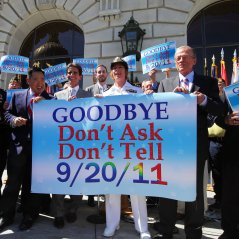
Thousands of LGBTQ+ veterans who were kicked out of the military because of their sexuality could see their honor restored under a new initiative the Defense Department announced Wednesday, on the 12th anniversary of the repeal of “don’t ask, don’t tell” policy banning gays and lesbians from openly serving in the military.
In a statement commemorating the anniversary of the repeal, Defense Secretary Lloyd Austin acknowledged the military fell short in correcting the harms of its past policies against LGBTQ+ service members.
“For decades, our LGBTQ+ Service members were forced to hide or were prevented from serving altogether,” Austin said. “Even still, they selflessly put themselves in harm’s way for the good of our country and the American people. Unfortunately, too many of them were discharged from the military based on their sexual orientation — and for many this left them without access to the benefits and services they earned.”
In a statement commemorating the anniversary of the repeal, Defense Secretary Lloyd Austin acknowledged the military fell short in correcting the harms of its past policies against LGBTQ+ service members.
“For decades, our LGBTQ+ Service members were forced to hide or were prevented from serving altogether,” Austin said. “Even still, they selflessly put themselves in harm’s way for the good of our country and the American people. Unfortunately, too many of them were discharged from the military based on their sexual orientation — and for many this left them without access to the benefits and services they earned.”
More details at the link.
That’s it for me today–lots of gossip in the news today. Have a great Wednesday, everyone!!
Did you like this post? Please share it with your friends:
Dakinikat turned me on to the world of truck drivers who have cat companions along for the ride. Here’s an article that discusses the phenomenon. CharityPaws.com: Trucker Cats May Be The Coolest Cats!
For what it’s worth, having a pet is hard work.
Love is easy enough to provide while on the road – but food, water, space, and entertainment are all needs too, and sometimes hard to come up with.
In the case of dogs especially, playtime is the hardest need to fill for truckers. After several hour-long walks, a game of tug-of-war, and an afternoon in the sun spent playing fetch, who wouldn’t be tired? But for truckers this can be time consuming and delay important deliveries!
That’s why many truckers have turned to cats as the solution for those lonely road trips. Trucker cats are the coolest cats with their chill laid back personalities and ability to make truckers feel awesome. They also have some great hearing which is why the made it to our list of “what animal has the best hearing” list. Having a companion with good hearing on board can help you find critters that may sneak around while you are sleeping or even alert you to danger!
With most of their time spent on the road in a little truck cab, cats are the perfect companion for truckers– and here’s some of the best reasons why according to one trucker’s resource:
Cats are low-maintenance: they eat less than their canine counterparts, take up less room, and don’t need as much playtime.
They’re loving and affectionate: cats are just as sweet as any other animal, once they have a chance to warm up to you.
They’re obedient, and trainable: cats can do tricks and walk on leashes, with the proper time and training!
They’re protective: though not as scary as a dog, cats are perfectly capable of altering truckers if something looks, sounds, or even smells off.
Other reasons topping truckers’ lists include cleanliness, cuteness, and the fact that having a cat in a truck is a pretty good conversation starters. Some even say that having a feline friend is a constant reminder to drive and act safely during the long haul. They are also incredibly loyal as shown by the Room 8 cat – and having that kind of loyalty on the road will make any trucker feel amazing!
Read more at the link above.
Here’s a video about trucker cats, posted on YouTube by Cheezburger.
Long Read: Are Americans Experiencing Collective Trauma?
I want to call your attention to an excellent, but very long read in The New Republic by Anna Marie Cox: We Are Not Just Polarized. We Are Traumatized. Subhead: “The pandemic. The mass shootings. Insurrection. Trump. We’ve been through so much. What if our entire national character is a trauma response?”
This is a very long piece, so I’m just going to give you some samples to help you decide if you want to tackle reading the whole thing.
As of last year, four in 10 Americans knew at least one person who died from Covid. This year, three in 10 Americans say they know someone who has been affected by an opioid addiction, and one in five knows someone who’s died from a painkiller overdose. In 2022, more than three million adults were displaced by some form of natural disaster—that’s more than three times as many displaced per year between 2008 and 2021. Last year, some cities saw a 50 percent increase in evictions over pre-pandemic levels. One in five knows someone who’s died due to gun violence; one in six has witnessed a shooting; 21 percent have been personally threatened by a gun. Half of Americans know someone personally who has experienced at least one of those events.
After Trump’s “grab her by” tape became public, calls to the national sexual assault hotline jumped up by 35 percent (as Michelle Goldberg observed, Trump was a walking trigger for assault survivors). During the Brett Kavanaugh hearings, calls to the sexual assault hotline spiked 201 percent. Lockdown—the first two months of the pandemic—saw a rise in intimate partner violence of 101 percent, with the rate stabilizing at an increase of about 8 percent from pre-pandemic numbers as of 2022.
Another photo of Trucker cat Percy, by Paul Robertson
And then there are the frontline workers and “essential personnel,” those who risked their lives for our safety and comfort during the spring of 2020. I assume that we agree health professionals faced trauma (and may well still). There are 22 million of them in the United States, and after the pandemic, 55 percent reported experiencing burnout, and three in 10 said they were now considering leaving the profession. The 55 million essential personnel who worked through the worst days of Covid suffered a similar toll: A year into the pandemic, the American Psychiatric Association found that 34 percent of essential workers had been treated by a mental health professional, 80 percent had trouble over- or under-sleeping, and 39 percent said they were drinking more alcohol than they had before….
These are traumas at the individual level in numbers so large that they demand national attention because there are national consequences—think of the nationwide therapist shortage and “the Great Resignation.”
So, what if the reason so many people identify as trauma survivors is that they are? What if the horrors of the last seven years do translate into a nation that is suffering more than mere political dysfunction? What if the polarization, paranoia, conspiracism, and hopelessness that bog us down have a more holistic origin than structural malfunctions or individual malfeasance?
What if our entire national character is a trauma response?
Before you say “bullshit,” remember: Cynicism is a trauma response.
Next Cox explores expert opinions about the concept of “collective trauma.”
The origin of the academic study of “collective trauma” has been credited to Kai Erikson’s 1977 book, Everything in Its Path, an account of the aftermath of the Buffalo Creek flood in Logan County, West Virginia, five years prior, which killed 125 people and destroyed 550 homes in a small mining community. In the book, Erikson writes of grappling with “thousands of pages of transcript material, whole packing boxes full of it,” that confounded him “not because the material is contradictory or difficult to interpret but because it is so bleakly alike.” He found respondents echoing one another to a frustrating degree, so much so that “a researcher is very apt to conclude after rummaging through these data that there is really not very much to say.” Eventually, however, he came to believe that the uniformity itself was meaningful; the damage done at Buffalo Creek was something more than a mere collection of individual harms.
Collective trauma, he wrote, means “a blow to the basic tissues of social life that damages the bonds attaching people together and impairs the prevailing sense of communality.” Collective trauma happens in slow motion, “A form of shock all the same…. ‘I’ continue to exist, though damaged and maybe even permanently changed. ‘You’ continue to exist, though distant and hard to relate to. But ‘we’ no longer exist as a connected pair or as linked cells in a larger communal body.”
Trucker Abdirahman Abdul and Aisha
In other words, the defining characteristic of collective trauma—and what makes it almost impossible to self-diagnose—is that people who have been through it no longer believe in the integrity of their community. How does anyone see themselves as a traumatized collective if no one feels that they belong?
So, pull back to the macro level. For a moment, put aside your or anyone else’s individual experience. Think of the country itself as a patient.
In the past seven years, the country has sustained significant, repeated damage to its institutions. The courts, elections, law enforcement, and so on are its vital organs. Trump has been punching America in the kidneys since he first floated the idea of a “rigged election.” January 6 was a heart attack. The musculature that is the justice system, well, it was always spasmodic. The murders of George Floyd, Breonna Taylor, and Ahmaud Arbery shocked many white people into awareness of our already dysfunctional law enforcement apparatus, and then the Dobbs decision drove home how easily the rights that support us can be yanked away. Were we ever really as strong as we thought?
The country was already weakened by Trumpism when the pandemic attacked our nervous systems more than figuratively. It cut away at the millions of tiny threads that knit up our towns and cities. Think of the loose social ties that grow from just seeing the same people at the grocery store (or the office) every day—think of the mail. Our national proprioception—our awareness of where our parts are in relation to one another—deteriorated. Our creaky supply chain is another symptom of this disconnect. So is “you’re on mute.”
I won’t quote any more, but these excerpts are just from the introductory part of the article. Cox later demonstrates with examples how the notion of trauma can apply to our collective experience as a nation. There is so much in the piece, that I wonder if Cox is planning to turn it into a book.
I’m not sure how the MAGA world fits into this hypothesis, but after my reading about the traumas of Appalachia–from poverty, drugs, unemployment, and breakdown of families (see my Wednesday post), I wonder if an argument could be made that the attraction to Trump as powerful father figure could also have arisen out of trauma. At any rate, I highly recommend this article.
Citing threats against individuals former President Donald Trump has targeted, special counsel Jack Smith has asked a federal judge for a narrowly tailored gag order that restricts the 2024 presidential candidate from making certain extrajudicial statements about the election interference case brought against him.
A redacted copy of a government filing — released Friday, after an order from U.S. District Judge Tanya Chutkan — comes in connection with the election interference case, one of four criminal cases the former president is facing, two of which are federal.
“The defendant has an established practice of issuing inflammatory public statements targeted at individuals or institutions that present an obstacle or challenge to him,” the special counsel’s office wrote.
Whispur and DanDan, photo by Whispurer on Reddit
The government said Trump “made clear his intent to issue public attacks related to this case when, the day after his arraignment, he posted a threatening message on Truth Social.”
Trump’s Aug. 4 post read: “IF YOU GO AFTER ME, I’M COMING AFTER YOU!”
Trump, the office wrote, “has made good on his threat,” spreading “disparaging and inflammatory public posts on Truth Social on a near-daily basis regarding the citizens of the District of Columbia, the Court, prosecutors, and prospective witnesses.
“Like his previous public disinformation campaign regarding the 2020 presidential election, the defendant’s recent extrajudicial statements are intended to undermine public confidence in an institution—the judicial system—and to undermine confidence in and intimidate individuals—the Court, the jury pool, witnesses, and prosecutors,” the prosecutors wrote.
Naturally, Trump responded publicly to the filing:
At an event in Washington, Trump made his first public remarks on the filing by attacking Smith, arguing that the special counsel “wants to take away my rights under the First Amendment, wants to take away my right of speaking freely and openly.”
Steven Cheung, a spokesperson for the Trump campaign, responded earlier Friday by calling the filing “nothing more than blatant election interference because President Trump is by far the leading candidate in this race.”
The federal prosecutors who charged former President Donald J. Trump with a criminal conspiracy over his attempts to overturn the 2020 election obtained 32 private messages from his Twitter account through a search warrant this winter as part of their investigation, court papers unsealed on Friday said.
Questions have lingered about what prosecutors were looking for in Mr. Trump’s Twitter account ever since it was revealed last month that the government had served the warrant on Twitter in January. In an earlier release of documents, prosecutors disclosed that they had obtained some private messages from Mr. Trump’s account but not how many.
The 32 messages, whose content has not been disclosed, were only a small fraction of the larger body of data that Twitter was forced to turn over under the terms of the warrant, the new court papers said. Much of the legal wrangling over the matter focused on the Justice Department’s demand that Twitter, purchased last year by Elon Musk and now known as X, not inform Mr. Trump of the search warrant.
Mr. Trump’s posts on the platform in the chaotic months after the election were mentioned several times in the indictment that the special counsel, Jack Smith, filed against him in Washington last month. What remains unclear is whether Mr. Smith’s team sought the warrant for Mr. Trump’s account merely to confirm that he had posted the messages that appeared in public, or whether they suspected that some private data in the account might also be important.
What were investigators looking for in the private messages?
The newly unsealed documents — an exhaustive record of the legal fight between Twitter and the Justice Department over whether to hide the execution of the warrant from Mr. Trump — added a few new details about what the government may have been seeking.
Waylon the Trucker Cat, photo by owner Nick
For example, the materials showed that prosecutors wanted to learn if there were other accounts that Mr. Trump had been logging into from the same internet address he used for his Twitter account, which during his presidency was a main channel for his public statements. But it was not clear whether looking for other accounts was merely a routine step or whether investigators had a specific reason to be asking.
The new materials — unsealed at the request of a coalition of news media organizations, including The New York Times — opened a broader window into the back and forth between the special counsel’s office and Twitter. The dispute touched on how to balance the government’s need to protect a sensitive investigation with the social media company’s desire to be transparent with its most famous user.
The documents were particularly sharp in describing Mr. Trump’s repeated attempts to obstruct federal inquiries — an argument that prosecutors used in securing permission from a judge in Washington not to tell the former president for months that they had obtained the warrant for his account.
In detailing Mr. Trump’s “pattern of obstructive conduct,” the new papers cited his attempts to interfere with the special counsel’s other inquiry — one in which the former president stands accused of illegally holding on to dozens of classified documents after leaving office.
The attorney for President Joe Biden’s son Hunter Biden, who is facing felony gun charges, said Friday that the statute is “likely unconstitutional” and he expects “the case will be dismissed before trial.”
“On the facts, we think we’ll have a defense,” Abbe Lowell told ABC News’ George Stephanopoulos in an interview on “Good Morning America.”
The younger Biden has been indicted by special counsel David Weiss on three felony gun charges, bringing renewed legal pressure on him after a plea agreement he struck with prosecutors imploded in recent months.
The conduct described in the indictment dates back to October 2018, when Hunter Biden procured a Colt Cobra 38SPL despite later acknowledging that he was addicted to drugs around that time.
While the criminal statutes cited in the indictment are clear — it is a crime to lie on a gun application form or to possess a firearm as a drug user – Hunter Biden’s attorney suggested that the charges could be unconstitutional, citing a recent appeals court ruling that drug use alone should not automatically prevent someone from obtaining a gun.
“The only change that has occurred between when they investigated [this alleged crime] and today is that the law changed,” Lowell said. “But the law didn’t change in favor of the prosecution. The law changed against it.”
With Republicans launching an impeachment inquiry on Capitol Hill, Lowell suggested that political pressure on prosecutors played into their decision, questioning the timing of the charges in light of revelations from whistleblowers about the investigation.
No kidding. The political pressure from right wing Congresspeople has been off the charts. And Special Counsel David Weiss himself was appointed by Bill Barr after political pressure from Donald Trump.
“History is also our best teacher. Yes, our past is filled with too much violence, too much hatred, too much prejudice. But can we really say that we are not confronting those same evils now?” Jackson said at the church in Birmingham, Alabama.
Trucker cat, photo by abbenquesnel on flicker
“We have to own even the darkest parts of our past, understand them and vow never to repeat them. We must not shield our eyes. We must not shrink away lest we lose it all,” she said.
The justice didn’t invoke a particular case, but as a whole her speech nodded to efforts targeting the teaching of critical race theory in schools and books about the struggle for racial equality and other topics.
“If we are going to continue to move forward as a nation, we cannot allow concerns about discomfort to displace knowledge, truth or history. It is certainly the case that parts of this country’s story can be hard to think about,” she said. “I know that atrocities like the one we are memorializing today are difficult to remember and relive. But I also know that it is dangerous to forget them.”
At times, Jackson, the first Black woman to serve on the Supreme Court, drew a personal connection to the tragedy, in which a bomb exploded at the church on September 15, 1963, killing Denise McNair, Cynthia Wesley, Addie Mae Collins and Carole Robertson. Nearly two dozen others were injured.
“As a mother of two young women who will always be my little girls, I can imagine no greater horror than to lose a child this way,” Jackson said.
“And even now, six decades later, the magnitude of that tragic loss weighs heavily on all of us because those girls were just getting started. They could have broken barriers. They could have shattered ceilings. They could have grown up to be doctors or lawyers or judges appointed to serve on the highest court in our land,” she added.
Read more at CNN.
That’s a sampling of today’s news. Feel free to discuss anything and everything in the comment thread.
Did you like this post? Please share it with your friends:
I got a bit of a start this morning when I got an email from the town housing authority about preparations for hurricane Lee. The storm is supposed to impact the Boston area around 2AM on Saturday until 2AM on Sunday. The email provided links to find out if I’m in a evacuation zone. It doesn’t look like I am, but we are sure to get lots of rain and wind and we could lose power. I guess I’ll be watching the Weather Channel in the coming days.
We are already having catastrophic flooding in some parts of the state, because we have had so much rain and fog here for weeks on end. There are more thunderstorms coming tonight and tomorrow. The area with the worst flooding recently got more than 10 inches of rain. It is so humid in my apartment fthat everything seems damp, and food gets stale quickly. Of course, none of this can compare to the awful weather that Dakinikat has been experiencing throughout this summer.
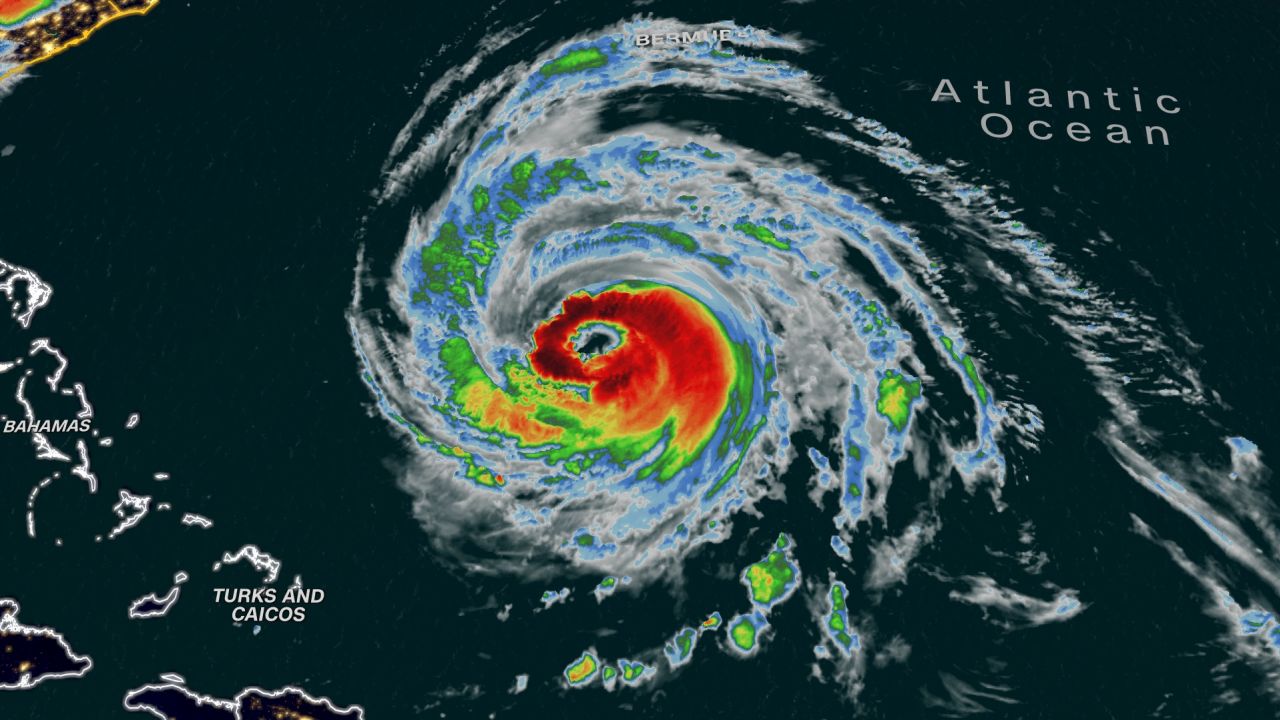
Hurricane Lee continues to churn north as a powerful storm over the open ocean, retaining major hurricane status as of 8 a.m. Eastern. While the forecast will become clearer in coming days, the forecast track has shifted west over the last 24 hours, and a farther west track is looking increasingly likely at this point — which could mean growing concern in New England.
Hurricane-force winds could threaten Cape Cod, Downeast Maine, New Brunswick and Nova Scotia by the weekend. Farther inland, tropical storm conditions are possible. Currently, the storm is set to spare the Southeast and Mid-Atlantic any adverse impacts.
A building on Water Street by Monoosnoc Brook in Leominster, collapsed when the brook flooded after 11 inches of rain fell on city. (Robin Lubbock/WBUR)
“There is an increasing risk of wind, coastal flooding, and rain impacts from Lee in portions of New England and Atlantic Canada beginning on Friday and continuing through the weekend,” wrote the National Hurricane Center. “Due to Lee’s large size, hazards will extend well away from the center, and there will be little to no significance on exactly where the center reaches the coast.”
Lee is a powerhouse hurricane. It still had 115 mph winds Wednesday morning, but its wind field was expanding. Think of an ice skater outstretching their arms while spinning — they would slow down, since they’re tracing bigger circles. Same thing with Lee. It’s now a bigger storm, but maximum sustained winds are diminishing some.
That expansion of Lee’s wind field will churn up cooler waters from below the sea surface, hastening the weakening of its winds. By Friday, it will also begin to transition into a nontropical storm, tapping into jet stream energy and changing it structure.
You can read about the three possible scenarios at the WaPo. The big problem for Massachusetts is that we have already had heavy rain for weeks. One town, Leominster, had to be evacuated. Other areas have significant flooding.
Down the Rabbit Hole
I haven’t been paying as much attention to political news as usual over the past couple of weeks, because I “went down a rabbit hole,” as Dakinikat calls it. First, I read a book by Barbara Kingsolver, Demon Copperhead. It is set in the mountains of southern Appalachia, specifically in Virginia. The book deals with a number of issues, including social services and foster care of orphaned or abused children and the opiod crisis. Much of the book is actually painful to read, but Kingsolver is such a fine writer that I couldn’t put it down.
I have chronic pain from rheumatoid arthritis, but it has never occurred to me to try to get powerful pain killers, because I am a recovering alcoholic and I have also experienced addictions to Valium and Percocet. I was prescribed tranquilizers beginning when I was about 19 or 20. I was given phenobarbital, then Lithium and later I took Valium for years.
I have paid so little attention to the story of Purdue Pharma and the Sackler family, that I didn’t know that the Sacklers made their fortune on Librium and Valium in particular. The withdrawal from Valium is very serious, but it’s nothing compared to Oxycontin, which further enriched the Sackler family and has killed hundreds of thousands of Americans. people who were hooked on Oxycontin eventually turned to heroin and fentanyl.
After I finished Demon Copperhead, I wanted to learn more about the opiod crisis and what happened with Oxycontin. First I watched a very good (partly fictionalized) documentary on Netflix, called Painkiller. Yesterday, I watched another Netflix series called The Pharmacist, which takes place in New Orleans. To say I was shocked by these shows is a serious understatement. I had no idea that Purdue Pharma pushed their drugs with sophisticated ad campaigns targeting doctors, and even went so far as to hire young women to approach doctors and flirt with them in order to convince them to prescribe more and more of the drug. Now I’m reading the book Empire of Pain, by Patrick Radden Keefe, which is a history of the Sackler family, how they made their huge fortune, and how they laundered their reputations through philanthropy.
This is definitely a political issue, and a difficult one, because rich corporations and individuals are rarely held to account and are usually allowed to buy their way out of legal issues. The Sacklers have now lost their “good name” at any rate. Their names have been taken off the many art collections, museum wings, etc. that they paid for. But none of them has gone to jail. They were allowed to declare bankruptcy and pay billions in restitution, but be protected from further lawsuits. The DOJ had a problem with that and right now the case is on hold in the Supreme Court.
The U.S. Supreme Court on Thursday agreed to hear a challenge by President Joe Biden’s administration to the legality of OxyContin maker Purdue Pharma’s bankruptcy settlement, putting on hold a deal that would shield its wealthy Sackler family owners from lawsuits over their role in the country’s opioid epidemic.
The justices paused bankruptcy proceedings concerning Purdue and its affiliates and said they would hold oral arguments in December in the administration’s appeal of a lower court’s ruling upholding the settlement. The Supreme Court’s new term begins in October.
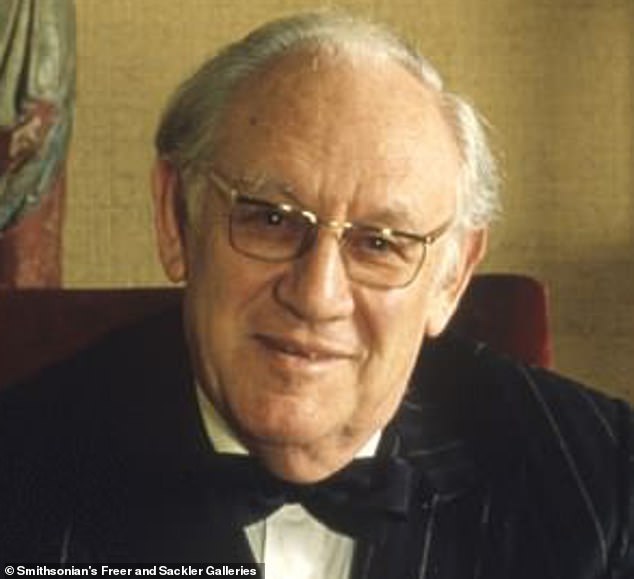
Richard Sackler was head of Purdue Pharma during the marketing of Oxycontin.
Purdue’s owners under the settlement would receive immunity in exchange for paying up to $6 billion to settle thousands of lawsuits filed by states, hospitals, people who had become addicted and others who have sued the Stamford, Connecticut-based company over its misleading marketing of the powerful pain medication OxyContin.
In a statement, Purdue said it was disappointed that the U.S. Trustee, the Justice Department’s bankruptcy watchdog that filed the challenge at the Supreme Court, has been able to “single-handedly delay billions of dollars in value that should be put to use for victim compensation, opioid crisis abatement for communities across the country and overdose rescue medicines.”
“We are confident in the legality of our nearly universally supported plan of reorganization, and optimistic that the Supreme Court will agree,” the company added.
The Justice Department declined to comment.
At issue is whether U.S. bankruptcy law allows Purdue’s restructuring to include legal protections for the members of the Sackler family, who have not filed for personal bankruptcy.
Purdue filed for Chapter 11 bankruptcy in 2019 to address its debts, nearly all of which stemmed from thousands of lawsuits alleging that OxyContin helped kickstart an opioid epidemic that has caused more than 500,000 U.S. overdose deaths over two decades.
I hope I’ve inspired a few people to learn more about this important issue. Purdue Pharma and the Sackler family single-handedly caused pain, heartache, and death to millions of people with Librium, Valium, and then Oxycontin, each of which they claimed were not addictive drugs. I can testify that Valium is definitely addictive. In the sober community, some refer to it as alcohol in pill form. Similarly, experts came to see Oxycontin as heroin in pill form. These people are monsters.
One more interesting link to the Sacklers: Rudy Giuliani stepped in to help them.
The new Netflix series “Painkiller” offers a fictionalized retelling of the rise of the powerful opioid OxyContin, depicting the real-life characters involved in manufacturer Purdue Pharma’s rapid ascent and subsequent downfall, including America’s most infamous mayor himself — Rudy Giuliani.
While certain aspects of the drama series have been embellished or altered amid the Hollywood treatment, Giuliani’s legal involvement in the Sackler family saga is rooted in reality.
The former New York City mayor and larger-than-life Trump ally helped Purdue Pharma continue to sell OxyContin even after federal prosecutors sought to make a case that the drug maker misled the public in claiming OxyContin was less addictive than other narcotics on the market.
Arthur Sackler made his fortune in the 1960s and 1970s by pushing the drugs Librium and Valium, claiming they were not addictive.
Purdue Pharma hired Giuliani back in 2002, representing the first client his consulting firm ever landed, The New York Times reported in 2007. Then-beloved as the mayor who saw New York City through the September 11 attacks, Giuliani was brought on to convince public officials that Purdue was a trustworthy company, according to the newspaper.
Giuliani emerges as a key character in “Painkiller” in the mid-aughts as fictional lawyer Edie Flowers, played by actress Uzo Aduba, is working on behalf of the US attorney’s office to bring a lawsuit against Purdue Pharma. Despite prosecutors’ best efforts, the office ultimately reaches a deal with Purdue, which sees the company plead guilty to charges of fraudulent marketing and misbranding of OxyContin.
Part of the reason the company was able to reach that agreement was thanks to Giuliani’s efforts as Purdue’s lawyer. Journalist Patrick Radden Keefe, who wrote the New Yorker article upon which the Netflix show draws heavily, reported that Giuliani originally tried to “scuttle the case.”
Later, however, Giuliani and the other Purdue lawyers went above lead prosecutor John Brownlee’s head to complain to James Comey, who was the deputy attorney general at the time, The Guardian reported.
That’s my post for today. Feel free to react to what I’ve written or to discuss the latest news. I couldn’t face writing about Trump today.
Did you like this post? Please share it with your friends:
Cat and Flowers, by Ruskin Spear, British, 1911-1990
There has been a terrible earthquake in Morocco, with hundreds of people dead. President Biden is attending the Group of 20 summit meeting in India. Back in the U.S., a Georgia federal judge said no to Mark Meadows’ request to transfer his case to federal court; and now Trump’s lawyers are scrambling to figure out a way for him to still do that. It’s not likely to happen. The 5th Circuit court of appeals reversed some of a previous ruling that hamstrung government agencies, but they still found that the Biden administration violated the first amendment in trying to influence social media companies. Finally, The New York Times has an interesting read about the former Mar-a-Lago IT guy who had turned on Trump.
The strongest earthquake to hit the country of Morocco in more than 120 years has left over 800 people dead and many thousands more trapped, missing, or injured.
The quake registered 6.8 on the Richter scale with the epicenter located in the Atlas Mountains and not far the city of Marrakesh where historic buildings—many built of mortar and stone not designed to withstand such tremors—collapsed and the streets filled with people overnight trying to flee the destruction and danger.
“The problem is that where destructive earthquakes are rare, buildings are simply not constructed robustly enough to cope with strong ground shaking, so many collapse resulting in high casualties,” Bill McGuire, professor emeritus of geophysical and climate hazards at University College London, told the Associated Press. “I would expect the final death toll to climb into the thousands once more is known. As with any big quake, aftershocks are likely, which will lead to further casualties and hinder search and rescue.”
Morocco’s interior ministry put the initial death toll at 822 as of Saturday morning, with 672 injured, but both numbers are certain to rise. Though the stronger impacts were closer to Marakesh, the earthquake was felt across the country, including in Casablance, Essaouira, and the capital city of Rabat.
Large nations, including both the United States and China, sent their well wishes to the people of Morocco.
“I am deeply saddened by the loss of life and devastation caused by the earthquake in Morocco,” said U.S. President Joe Biden in an overnight statement. “Our thoughts and prayers are with all those impacted by this terrible hardship.”
Biden said his administration as in contact with Moroccan officials and willing to send whatever help might be necessary. “We are working expeditiously to ensure American citizens in Morocco are safe,” Biden said, “and stand ready to provide any necessary assistance for the Moroccan people.”
NEW DELHI (AP) — President Joe Biden and his allies on Saturday announced plans to build a rail and shipping corridor linking India with the Middle East and Europe, an ambitious project aimed at fostering economic growth and political cooperation.
“This is a big deal,” said Biden. “This is a really big deal.”
The corridor, outlined at the annual Group of 20 summit of the world’s top economies, would help boost trade, deliver energy resources and improve digital connectivity. It would include India, Saudi Arabia, the United Arab Emirates, Jordan, Israel and the European Union, said Jake Sullivan, Biden’s national security adviser.
Sullivan said the network reflected Biden’s vision for “far reaching investments” that come from “effective American leadership” and a willingness to embrace other nations as partners. He said the enhanced infrastructure would boost economic growth, help bring countries in the Middle East together and establish that region as a hub for economic activity instead of as a “source of challenge, conflict or crisis” as it has been in recent history.
The prosecution of former White House chief of staff Mark Meadows for attempting to overturn the 2020 election will remain in Georgia state court, a federal judge ruled Friday as he turned down Meadows’ bid to move the case to federal court.
The decision is a victory for Fulton County District Attorney Fani Willis’ drive to bring former President Donald Trump, Meadows and 17 other defendants to trial under the state’s broad criminal racketeering statute for their roles in trying to help Trump cling to power.
“The Court concludes that Meadows has not shown that the actions that triggered the State’s prosecution related to his federal office,” U.S. District Judge Steve Jones wrote in his decision, while emphasizing that he was not ruling on the right of any other defendant to have the case against them moved to the federal system.
By Belinda Del Pesco
Jones, an appointee of former President Barack Obama, concluded that Meadows was not acting within the scope of his employment at the White House when he organized a Jan. 2, 2021 phone call where Trump pressed Georgia’s secretary of state Brad Raffensperger to “find” enough votes to declare him the victor in that state. Other actions that Meadows took, as described in a grand jury’s indictment last month, similarly fell outside Meadows’ official duties, the judge said.
“Meadows’s participation on the January 2, 2021 call was political in nature and involved the President’s private litigation, neither of which are related to the scope of the Office of White House Chief of Staff,” Jones wrote. “The Court finds that these contributions to the phone call with Secretary Raffensperger went beyond those activities that are within the official role of White House Chief of Staff, such as scheduling the President’s phone calls, observing meetings, and attempting to wrap up meetings in order to keep the President on schedule.”
By finding that Meadows acted outside the scope of his duties, Jones concluded that Meadows is not eligible for so-called “removal” — a procedure under federal law that allows federal officials to transfer a case from state court to federal court if the case is based on their official acts.
It’s now unlikely that any of the other people trying to move their cases to federal court–including Trump–will succeed. Meadows had the strongest case according legal experts.
Reacting to U.S. District Judge Steve C. Jones late Friday ruling that former White House chief of staff Mark Meadows may not have his election tampering case moved to a federal court, former Re[publican National Committee chair Michael Steele said that was a major blow not only to Meadows but also all of the other 18 Georgia co-conspirators facing RICO charges including Donald Trump.
As Steele put it, any hopes that defense attorneys might have had in the outcome of the Meadows hearing died a quick death.
Meadows’ attorneys had signaled that they hoped to move the case to federal court as a precursor to arguing that the case against him should be thrown out on grounds that as a former federal officer he’s immune from charges relating to his duties. And if a trial went forward in federal court, the jury pool would likely have been broader and slightly friendlier to Trump and his allies than one drawn only from Fulton County.
A federal court trial also would be unlikely to be televised, whereas the state court judge has already vowed to livestream all the proceedings.
Four other defendants in the Georgia case have also asked for the cases against them to be moved to federal court: former Justice Department official Jeff Clark and three pro-Trump activists accused of falsely certifying that they were presidential electors from the state. Those requests remain pending with Jones, and he said he was not pre-judging them as he turned down Meadows.
Nora Heysen (Australian, 1911-2003) – A Boy with his cat
A federal appeals court on Friday said the Biden administration likely violated the First Amendment in some of its communications with social media companies, but also narrowed a lower court judge’s order on the matter.
The US 5th Circuit Court of Appeals ruled that certain administration officials – namely in the White House, the surgeon general, the US Centers for Disease Control and Prevention, and the Federal Bureau of Investigation – likely “coerced or significantly encouraged social media platforms to moderate content” in violation of the First Amendment in its efforts to combat Covid-19 disinformation.
But the three-judge panel said the preliminary injunction issued by US District Judge Terry Doughty in July, which ordered some Biden administration agencies and top officials not to communicate with social media companies about certain content, was “both vague and broader than necessary to remedy the Plaintiffs’ injuries, as shown at this preliminary juncture.”
The Biden administration had previously argued in the lawsuit brought by Republican attorneys general claiming unconstitutional censorship that channels with social media companies must stay open so that the federal government can help protect the public from threats to election security, Covid-19 misinformation and other dangers.
n briefs submitted earlier this summer, the administration wrote, “There is a categorical, well-settled distinction between persuasion and coercion,” adding that Doughty had “equated legitimate efforts at persuasion with illicit efforts to coerce.”
The 5th Circuit left in place part of the injunction that barred certain Biden administration officials from “threatening, pressuring, or coercing social-media companies in any manner to remove, delete, suppress, or reduce posted content of postings containing protected free speech.”
“But,” the appeals court said, “those terms could also capture otherwise legal speech. So, the injunction’s language must be further tailored to exclusively target illegal conduct and provide the officials with additional guidance or instruction on what behavior is prohibited.”
So it’s some good news and some bad news if you care about disinformation on social media.
In a deep dive into the life of the key Donald Trump employee who has flipped on the former president and some of his colleagues who worked with him at Mar-a-Lago, the New York Times is reporting that Trump’s head of security made a fateful decision that helped out special counsel Jack Smith’s investigation.
Composition with Cat on the table with striped tablecloth – Herdis Gelardi , 1951 Danish, 1916-1991
As part of their profile of IT manager Yuscil Taveras, the Times creates a moment-by-moment timeline where Mar-a-Lago property manager Carlos De Oliveira contacted Yuscil Taveras to meet him “somewhere more private” to discuss deleting the surveillance video.
As part of their profile of IT manager Yuscil Taveras, the Times creates a moment-by-moment timeline where Mar-a-Lago property manager Carlos De Oliveira contacted Yuscil Taveras to meet him “somewhere more private” to discuss deleting the surveillance video.
As the Times is reporting, “According to the indictment, which does not name Mr. Taveras but refers to him as ‘Trump Employee 4,’ Mr. De Oliveira led him through a basement tunnel to a small room known as an ‘audio closet,’ where Mr. De Oliveira delivered a message from Mr. Trump: ‘the boss’ wanted the footage deleted. Mr. Taveras rebuffed the request, prosecutors said in the indictment, but Mr. De Oliveira raised it again.”
Noting that Taveras once again denied the request, the report states that Taveras then reportedly confided to fellow employee Renzo Nivar about what had happened and days later alerted “a superior in Trump Tower.”
According to the Times, “One executive in New York, Matthew Calamari Jr., the Trump Organization’s corporate director of security, apparently became alarmed, according to people with knowledge of the matter. He alerted the company’s legal department, prompting a senior lawyer at the company to deliver a stern warning not to delete anything.”
We in the Boston area are finally getting a taste of the extreme heat that much of the rest of the country has been experiencing. Yesterday and today, there were heat emergencies declared, and many schools sent kids home early because of the heat and no air conditioning. Obviously, we aren’t used to 100 degree heat indexes in September in this part of the country. I don’t know how Dakinikat has survived months of this heat. Republicans need to wake up and realize that their children and grandchildren are going to suffer from climate change, whether their ancestors believed in it or not.
It has been a grueling summer, with relentless heat breaking multiple records in many places around the world. In fact, June through August was the planet’s hottest documented three-month period, with July ranking as the hottest month ever recorded. A new analysis by the nonprofit organization Climate Central finds that more than 3.8 billion people were exposed to extreme heat that was worsened by human-caused climate change from June through August, and at least 1.5 billion experienced such heat every day of that period. Nearly every person on Earth saw high temperatures that were made at least twice as likely by global warming.
People cool off in fountains in Rome to deal with the heat.
It has been a grueling summer, with relentless heat breaking multiple records in many places around the world. In fact, June through August was the planet’s hottest documented three-month period, with July ranking as the hottest month ever recorded. A new analysis by the nonprofit organization Climate Central finds that more than 3.8 billion people were exposed to extreme heat that was worsened by human-caused climate change from June through August, and at least 1.5 billion experienced such heat every day of that period. Nearly every person on Earth saw high temperatures that were made at least twice as likely by global warming.
“It really is everywhere,” says Andrew Pershing, Climate Central’s vice president for science. “On a single day, the fact that more than half the people on the planet were experiencing climate-altered heat—that’s just really, really remarkable to me.”
More frequent, longer-lasting and more intense heat waves are among the clearest outcomes of rising global temperatures driven by the burning of fossil fuels. Numerous studies have found the fingerprints of climate change in heat waves from the Pacific Northwest to Europe. A study released by the World Weather Attribution (WWA) research group in July had already found that the heat waves in North America, Europe and China that month were made hotter—and many times more likely—by climate change. In fact, the North American and European events likely would not have occurred without climate change.
The new analysis was produced using Climate Central’s Climate Shift Index (CSI) attribution system, which estimates how much climate change has shifted the local odds of events such as extreme heat. The system, which is based on peer-reviewed science, scores global warming’s influence using the ratio of how often a given temperature occurs in the current climate, compared with a world without climate change. A CSI of 1 means there is a discernable influence from climate change, and CSIs between 2 and 5 mean it made those conditions two to five times more likely.
The organization’s worldwide temperature analysis during this year’s Northern Hemisphere summer found 48 percent of the world’s population experienced at least 30 days of extreme heat that was made at least three times more likely by climate change, and at least 1.5 billion people experienced heat at that level or higher for the entire summer. Many of those people were in areas closer to the equator, such as the Caribbean, northern Africa and Southeast Asia.
The 5th US Circuit Court of Appeals issued a temporary stay Thursday night allowing the state of Texas to keep floating barriers in the Rio Grande.
A lower court judge had ordered Texas to take down the barriers by September 15 at its own expense. The panel’s decision Thursday puts that order on hold while the appeals court considers the case. It means that Texas does not have to start the process of removing the barriers, for now.
A worker helps deploy a string of large buoys to be used as a border barrier at the center of the Rio Grande near Eagle Pass, Texas. (AP Photo/Eric Gay)
The swift ruling by the 5th Circuit comes a day after US District Judge David Ezra wrote that Republican Gov. Greg Abbott needed permission to install the barriers, as dictated by law – a win for the Biden administration.
“Governor Abbott announced that he was not ‘asking for permission’ for Operation Lone Star, the anti-immigration program under which Texas constructed the floating barrier. Unfortunately for Texas, permission is exactly what federal law requires before installing obstructions in the nation’s navigable waters,” Ezra wrote in his ruling. The judge also found Texas’ self-defense argument – that the barriers have been placed in the face of invasion – “unconvincing.”
The controversial border buoys were deployed in the Rio Grande as part Operation Lone Star, Abbott’s border security initiative. In July, the Justice Department sued the state of Texas claiming that the buoys were installed unlawfully and asking the judge to force the state to remove them.
Let’s hope the stay is just so the judges can get up to speed on the issues. Those barriers are utterly monstrous and inhumane.
The report from the Fulton County, Georgia special grand jury has been released. This was the jury that was just investigative. They recommended people who should be charged, and the official grand jury issued final indictments.
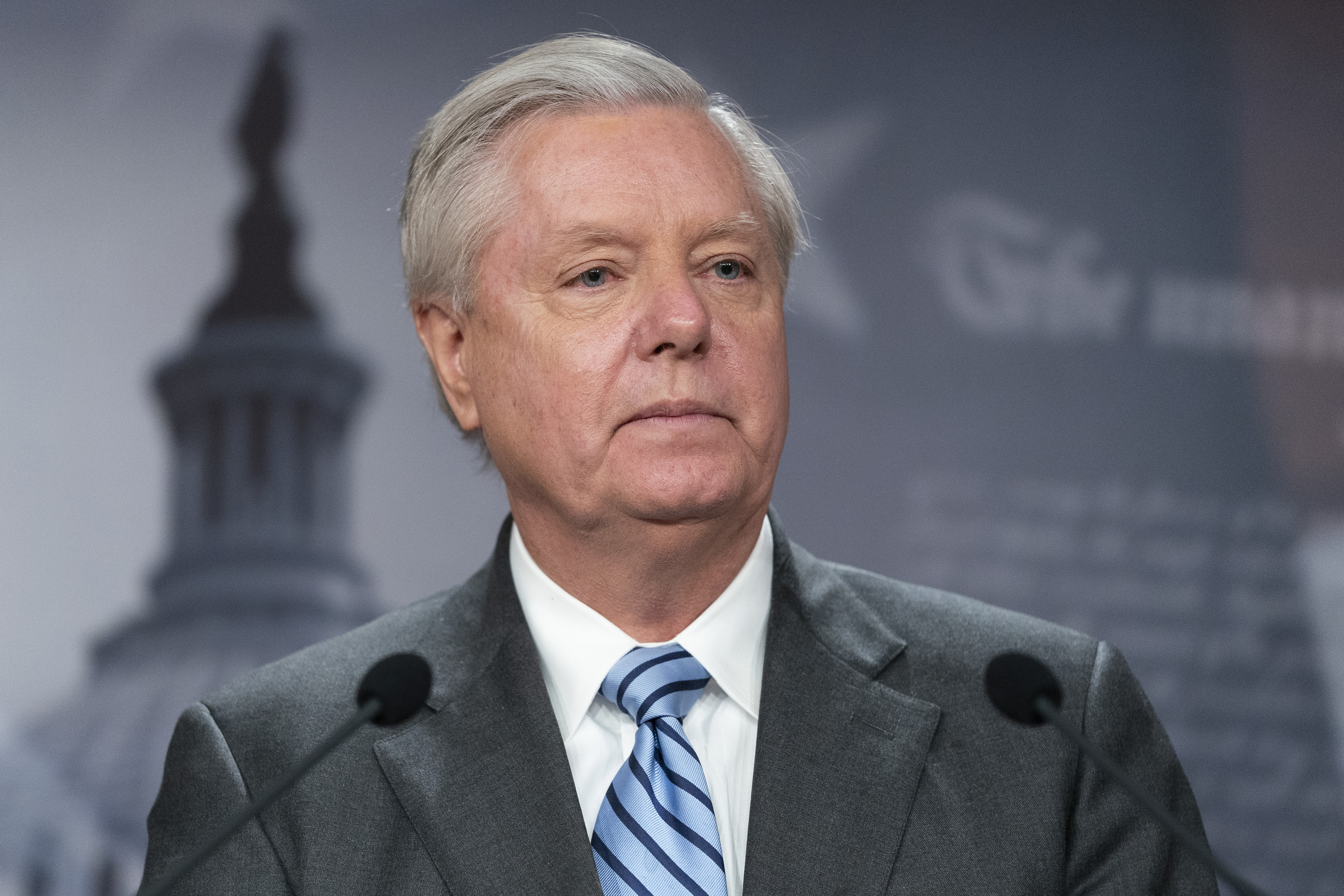
The special grand jury in Fulton County investigating the 2020 presidential election in Georgia recommended charges against Republican Sen. Lindsey Graham of South Carolina and former GOP Sens. David Perdue and Kelly Loeffler of Georgia, according to the special counsel grand jury report released Friday.
Fulton County District Attorney Fani Willis did not charge the lawmakers when she returned an indictment last month against former President Donald Trump and 18 co-defendants in the sprawling racketeering case. It was up to the district attorney to decide how closely to stick to the special grand jury’s recommendations….
Graham, who appeared before the special grand jury last year after a court battle over his testimony, spoke with Georgia election officials after the 2020 election. His phone calls with Georgia Secretary of State Brad Raffensperger and his staff related to the possibility of finding enough fraud in the state that it could’ve tipped the election to Trump.
Raffensperger testified to the House January 6 committee thahis phone call with Graham made him “uncomfortable” because some of Graham’s suggestions could have led to “disenfranchising voters.”
Graham repeatedly prodded Raffensperger and his colleagues on the phone about the signature-matching of ballots in the Atlanta area. Raffensperger told CNN in November 2020 that he believed Graham “implied” that he should try to “throw out” some ballots in the heavily Democratic county….
Perdue, who lost his Senate run-off election in January 2021 while Trump was pushing his false claims of fraud, personally urged Georgia Gov. Brian Kemp to convene a special session of the legislature to help Trump’s quest to overturn the election. Loeffler, who also lost her runoff election in January 2021, was also at the meeting….
Special grand juries in Georgia cannot issue indictments and instead serve as an investigative tool. This special grand jury began hearing evidence in June 2022, and Willis used it to investigate efforts to overturn the 2020 election, an investigation sparked by Trump’s January 2021 phone call with Raffensperger where Trump asked him to “find” the votes he needed to win the state. The panel ultimately heard from 75 witnesses.
News has broken about Elon Musk’s interference in Ukraine, based on a new biography by Walter Isaacson.
Elon Musk secretly ordered his engineers to turn off his company’s Starlink satellite communications network near the Crimean coast last year to disrupt a Ukrainian sneak attack on the Russian naval fleet, according to an excerpt adapted from Walter Isaacson’s new biography of the eccentric billionaire titled “Elon Musk.”
As Ukrainian submarine drones strapped with explosives approached the Russian fleet, they “lost connectivity and washed ashore harmlessly,” Isaacson writes.
Musk’s decision, which left Ukrainian officials begging him to turn the satellites back on, was driven by an acute fear that Russia would respond to a Ukrainian attack on Crimea with nuclear weapons, a fear driven home by Musk’s conversations with senior Russian officials, according to Isaacson, whose new book is set to be released by Simon & Schuster on September 12.
Musk’s concerns over a “mini-Pearl Harbor” as he put it, did not come to pass in Crimea. But the episode reveals the unique position Musk found himself in as the war in Ukraine unfolded. Whether intended or not, he had become a power broker US officials couldn’t ignore.
Why is this monster still getting government money?
“There was an emergency request from government authorities to activate Starlink all the way to Sevastopol,” Musk posted on X, the platform formally known as Twitter that he owns. Sevastopol is a port city in Crimea. “The obvious intent being to sink most of the Russian fleet at anchor. If I had agreed to their request, then SpaceX would be explicitly complicit in a major act of war and conflict escalation.” [….]
A Ukrainian soldier disconnects a Starlink satellite dish near Kreminna, Ukraine. Credit…Clodagh KilcoyneReuters
After Russia disrupted Ukraine’s communications systems just before its full-scale invasion in February 2022, Musk agreed to provide Ukraine with millions of dollars of SpaceX-made Starlink satellite terminals, which became crucial to Ukraine’s military operations. Even as cellular phone and internet networks had been destroyed, the Starlink terminals allowed Ukraine to fight and stay connected.
But once Ukraine began to use Starlink terminals for offensive attacks against Russia, Musk started to second-guess that decision.
“How am I in this war?” Musk asks Isaacson. “Starlink was not meant to be involved in wars. It was so people can watch Netflix and chill and get online for school and do good peaceful things, not drone strikes.”
Musk was soon on the phone with President Joe Biden’s national security adviser, Jake Sullivan, the chairman of the joint chiefs, Gen. Mark Milley, and the Russian ambassador to the US to address anxieties from Washington, DC, to Moscow, writes Isaacson.
Meanwhile, Mykhailo Fedorov, a deputy prime minister of Ukraine, was pleading with Musk to restore connectivity for the submarine drones by telling Musk about their capabilities in a text message, according to Isaacson. “I just want you—the person who is changing the world through technology—to know this,” Fedorov told Musk.
A top adviser to Ukraine’s president accused Elon Musk of enabling Russian aggression, after the billionaire entrepreneur acknowledged denying satellite internet service in order to prevent a Ukrainian drone attack on a Russian naval fleet last year.
The Starlink satellite internet service, which is operated by Mr. Musk’s rocket company SpaceX, has been a digital lifeline in Ukraine since the early days of the war for both civilians and soldiers in areas where digital infrastructure has been wiped out.
On Thursday, CNN reported on an excerpt from Walter Isaacson’s upcoming biography “Elon Musk,” later published by The Washington Post, that said the billionaire had ordered the deactivation of Starlink satellite service near the coast of Crimea last September to thwart the Ukrainian attack. The excerpt said that Mr. Musk had conversations with a Russian official that led him to worry that an attack on Crimea could spiral into a nuclear conflict.
I remember when Musk claimed he had spoken directly with Putin.
Later on Thursday, Mr. Musk responded on his social media platform to say that he hadn’t disabled the service but had rather refused to comply with an emergency request from Ukrainian officials to enable Starlink connections to Sevastopol on the occupied Crimean peninsula. That was in effect an acknowledgment that he had made the decision to prevent a Ukrainian attack.
“The obvious intent being to sink most of the Russian fleet at anchor,” he wrote on X, formerly known as Twitter. “If I had agreed to their request, then SpaceX would be explicitly complicit in a major act of war and conflict escalation.”
That drew an angry response from Mykhailo Podolyak, a senior adviser to President Volodymyr Zelensky of Ukraine. Mr. Musk’s “interference,” he said, had allowed Russia’s naval fleet to continue firing cruise missiles at Ukrainian cities.
“As a result, civilians, children are being killed. This is the price of a cocktail of ignorance and big ego,” he wrote on X.
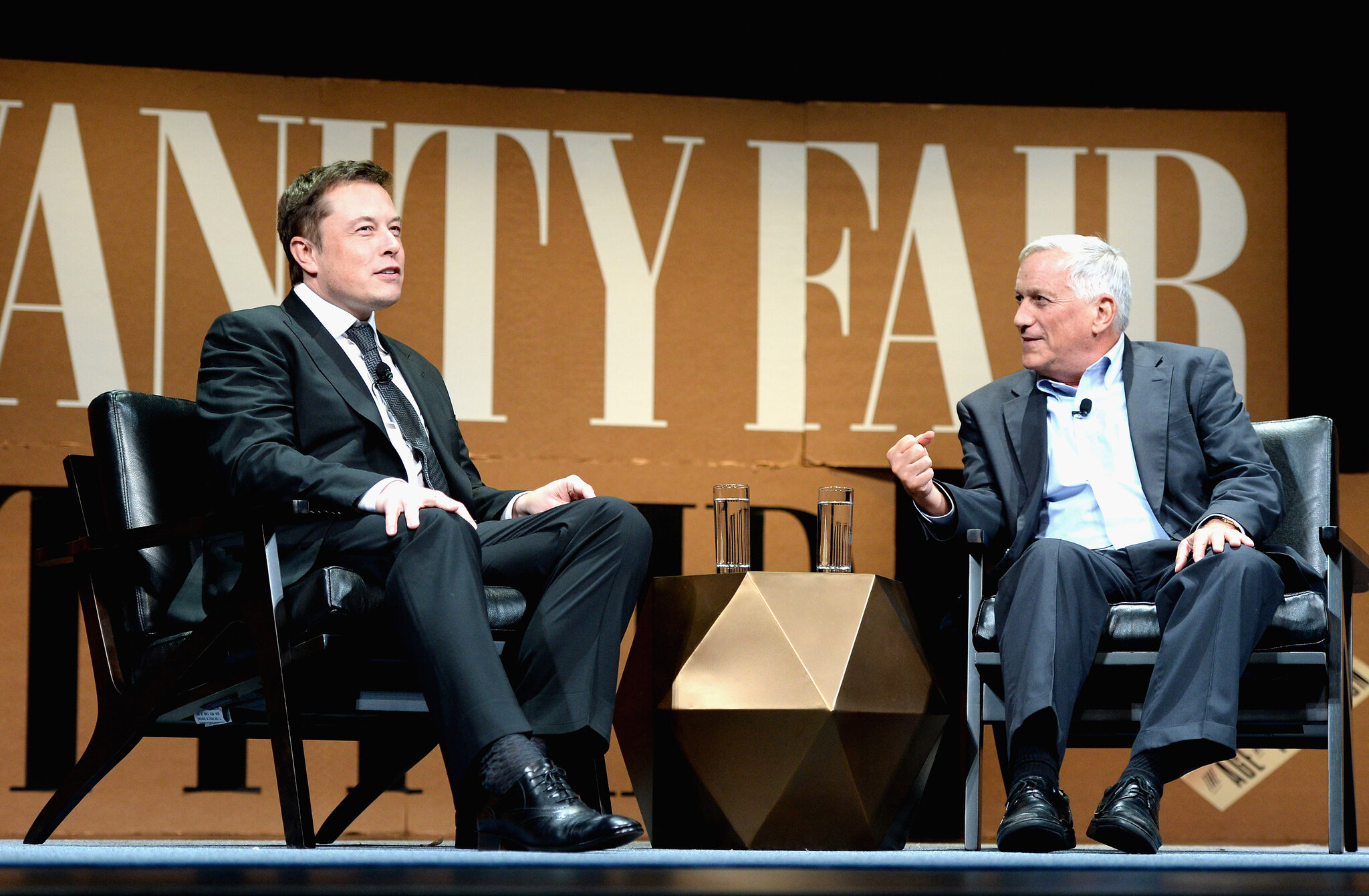
Elon Musk and Walter Isaacson
The account in the biography further confirms the ways in which Mr. Musk’s control over Starlink appears to be affecting Ukraine’s military. In July, The New York Times reported on Mr. Musk’s refusal to allow the service to work near Crimea, and the broader challenges Ukrainian officials were facing because of the country’s huge dependence on Starlink.
The more than 42,000 Starlink terminals are also in use by hospitals, businesses and aid organizations across Ukraine.
But Mr. Musk has repeatedly stoked controversy around access to Starlink, saying last October that he could not “indefinitely” finance Ukraine’s use of Starlink, then abruptly reversing course. The near-total control that he wields over connectivity in the war zone has prompted concern about his influence.
In February, Ukrainian officials were angered after a SpaceX executive said that Starlink had taken steps to curtail the Ukrainian military’s use of the technology to control drones, a week after Mr. Musk said the company was “not allowing Starlink to be used for long-range drone strikes.” SpaceX has also used a process called geofencing to restrict where Starlink is available on the front lines.
Because Starlink is a commercial product rather than a traditional defense contractor, Mr. Musk is able to make decisions that may not be aligned with U.S. interests, analysts have said.
One more and then I’ll wrap this up. It appears that the IRS is actually going after superrich people.
The Internal Revenue Service has started using artificial intelligence to investigate tax evasion at multibillion-dollar partnerships as it looks for ways to better police hedge funds, private equity groups, real estate investors and large law firms.
The announcement on Friday demonstrated how a more muscular I.R.S. is using some of the $80 billion allocated through last year’s Inflation Reduction Act to target the wealthiest Americans and tackle the kinds of cases that had become too complex and cumbersome for the beleaguered agency to handle.
The agency’s new funding is intended to help the I.R.S. raise more federal revenue by cracking down on tax cheats and others who use sophisticated accounting maneuvers to avoid paying what they owe. But the allocation has been politically contentious, with Republicans claiming that the I.R.S. will use the funding to harass small businesses and middle-class taxpayers. Earlier this year, Republicans succeeded in clawing back $20 billion as part of an agreement to raise the nation’s borrowing cap.
That political fight has put the onus on Democrats and the Biden administration to show that the funding is primarily enabling the I.R.S. to target the rich.
“These are complex cases for I.R.S. teams to unpack,” Daniel Werfel, the I.R.S. commissioner, said in a briefing with reporters. “The I.R.S. has simply not had enough resources or staffing to address partnerships; in a real sense, we’ve been overwhelmed in this area for years.”
Mr. Werfel explained that artificial intelligence is helping the I.R.S. identify patterns and trends, giving the agency greater confidence that it can find where larger partnerships are shielding income. That is leading to the kinds of major audits that the I.R.S. might not have previously tackled.
The agency said it would open examinations of 75 of the nation’s largest partnerships, which were identified with the help of artificial intelligence, by the end of the month. The partnerships all have more than $10 billion in assets and will receive audit notices in the coming weeks.
Sounds good to me.
That’s all I have today. Have a great weekend everyone!!
Did you like this post? Please share it with your friends:
The Sky Dancing banner headline uses a snippet from a work by artist Tashi Mannox called 'Rainbow Study'. The work is described as a" study of typical Tibetan rainbow clouds, that feature in Thanka painting, temple decoration and silk brocades". dakinikat was immediately drawn to the image when trying to find stylized Tibetan Clouds to represent Sky Dancing. It is probably because Tashi's practice is similar to her own. His updated take on the clouds that fill the collection of traditional thankas is quite special.
You can find his work at his website by clicking on his logo below. He is also a calligraphy artist that uses important vajrayana syllables. We encourage you to visit his on line studio.






 One more from CBS News:






 After I finished Demon Copperhead, I wanted to learn more about the opiod crisis and what happened with Oxycontin. First I watched a very good (partly fictionalized) documentary on Netflix, called Painkiller. Yesterday, I watched another Netflix series called The Pharmacist, which takes place in New Orleans. To say I was shocked by these shows is a serious understatement. I had no idea that Purdue Pharma pushed their drugs with sophisticated ad campaigns targeting doctors, and even went so far as to hire young women to approach doctors and flirt with them in order to convince them to prescribe more and more of the drug. Now I’m reading the book Empire of Pain, by Patrick Radden Keefe, which is a history of the Sackler family, how they made their huge fortune, and how they laundered their reputations through philanthropy.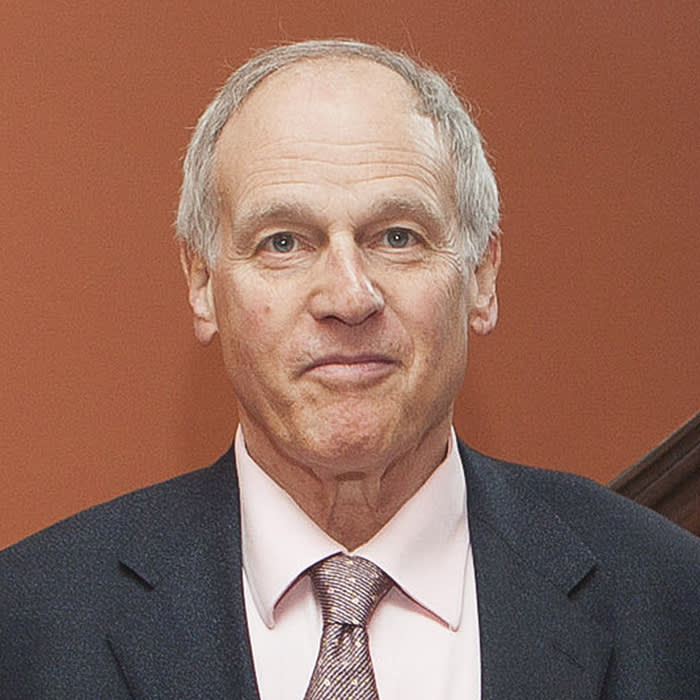









 peej
peej Carissa
 bostonboomer
 dakinikat
 ecocatwoman
 mablue2
 Mama Lopez
 peggysue22
 quixote
 skydancingguestblogger
 Mona (aka Wonk the Vote)



 Sky Dancing
Recent Comments