
Thursday Reads
Posted: June 7, 2012 Filed under: 2012 presidential campaign, court rulings, Crime, Foreign Affairs, Mitt Romney, morning reads, religion, Republican presidential politics, Syria, U.S. Military, U.S. Politics | Tags: Boston Celtics, Brett Kimberlin, DOMA, Erick Erickson, George Zimmerman, impersonating a police officer, Joe Conason, Luka Rocco Magnotta, Michigan State Troopers, Patterico, Ray Bradbury, right wing bloggers, Salt Lake City gay pride march, Stanford University, SWAT-ting, uniform fetish, Vietnam War 24 Comments
Good Morning!!
Last night I wrote about Mitt Romney’s claim that he “longed” to serve in Vietnam, but instead sacrificed his fondest dream by living in France for the war years. But he wasn’t always averse to wearing a uniform. When he was in prep school at Cranbrook, he once played a “prank” in which he impersonated a police officer and stopped a car in which four of his “friends” were out on a double date.
But until I read this piece by Joe Conason, I had no idea that Romney had repeatedly dressed as a Michigan state trooper even when he was a student at Stanford.
According to Robin Madden, one of Romney’s Stanford classmates, Romney once showed him a state trooper’s uniform and said he’d gotten it from his father George Romney, who was then Governor of Michigan. Madden told Conason:
“He told us that he had gotten the uniform from his father,” George Romney, then the Governor of Michigan, whose security detail was staffed by uniformed troopers. “He told us that he was using it to pull over drivers on the road. He also had a red flashing light that he would attach to the top of his white Rambler.”
In Madden’s recollection, confirmed by his wife Susan, who also attended Stanford during those years, “we thought it was all pretty weird. We all thought, ‘Wow, that’s pretty creepy.’ And after that, we didn’t have much interaction with him,” although both Madden and Romney were prep school boys living in the same dorm, called Rinconada.
Is there no end to this man’s weirdness? Just one more Romney story and then I’ll move on to something else. The New York Times has a front page story today on Romney’s neighbors in La Jolla and how annoyed they are by him.
ON Dunemere Drive, it seems as if just about everyone has a gripe against the owners of No. 311.
The elderly woman next door complains that her car is constantly boxed into her driveway. A few houses over, a gay couple grumbles that their beloved ocean views are in jeopardy. And down the street, a widow grouses that her children’s favorite dog-walking route has been disrupted.
Bellyaching over the arrival of an irritating new neighbor is a suburban cliché, as elemental to the life on America’s Wisteria Lanes as fastidiously edged lawns and Sunday afternoon barbecues.
But here in La Jolla, a wealthy coast-hugging enclave of San Diego, the ordinary resident at the end of the block is no ordinary neighbor.
He is Mitt Romney.
The biggest complaints seem to be about the Romney’s plans to turn their beachfront home into a giant “McMansion. The article says that the Romneys haven’t asked any of the neighbors over to their house, but Ann and Mitt do take walks and interact people they see along the way.
Mr. Romney and his wife take regular walks around La Jolla, exchanging pleasantries with fellow strollers and occasionally enforcing the law. A young man in town recalled that Mr. Romney confronted him as he smoked marijuana and drank on the beach last summer, demanding that he stop.
The issue appears to be a recurring nuisance for the Romneys. Mr. Quint, who lives on the waterfront near Mr. Romney, said that a police officer had asked him, on a weekend when the candidate was in town, to report any pot smoking on the beach. The officer explained to him that “your neighbors have complained,” Mr. Quint recalled. “He was pretty clear that it was the Romneys.”
I hope our libertarian readers are paying attention.
The Washington Post reports that there has been another massacre in Syria.
Two activists in Hama said Wednesday that at least 30 people, and possibly many more, had been killed in Qubair, northwest of Hama, after the militias known as the shabiha raided the village. Government forces had blocked roads leading to the village and prevented activists from gathering evidence of the killings, they said.
But one of the activists, Asem Abu Mohammed, said he had received frantic calls for help from people in the village starting in the late afternoon.
Another activist, Mousab al-Hamadi, said people in the village told him that many women and children were among those hacked to death with knives by the militiamen.
Also at the WaPo, there is an interesting graphic piece: Ray Bradbury: 10 of his most prescient predictions. Bradbury apparently foresaw earbuds, Facebook, ATM’s, and E-books!
This story is a couple of days old, but did you hear about the hundreds of mormons and ex-mormons who participated in Salt Lake City’s gay pride march?
They came in suits and skirts, and they drew tears and cheers.
More than 300 current and former members of the Church of Jesus Christ of Latter-day Saints participated in the Utah Gay Pride Parade on Sunday as part of a group called Mormons Building Bridges.
“I haven’t recognized them as equals,” one marcher, Emily Vandyke, 50, told the Salt Lake Tribune. “They have been invisible to me.”
She carried a sign with words from a Mormon children’s song: “I’ll walk with you, I’ll talk with you. That’s how I’ll show my love for you.”
It’s a start, anyway.
Another judge has ruled the Defense of Marriage Act (DOMA) unconstitutional.
The law was challenged by 83-year-old Edith “Edie” Windsor after the federal government failed to recognize her marriage to her partner Thea Spyer, after Spyer’s death in 2009. Her marriage was recognized by the state of New York.
The Defense of Marriage Act was enacted in 1996 and Section 3 of the law, which the case challenged, defined marriage as a legal union between one man and one woman. It prohibited legally married same sex couples from receiving federal benefits.
“Thea and I shared our lives together for 44 years, and I miss her each and every day,” said Windsor. “It’s thrilling to have a court finally recognize how unfair it is for the government to have treated us as though we were strangers.”
U.S. District Court Judge Barbara S. Jones of the Southern District of New York ruled the statue violated the constitution’s guarantee of equal protection because it discriminated against married same sex couples.
This next one is pretty funny: Senator Asks DOJ to Investigate SWAT-ting Attacks on Conservative Bloggers
A number of conservative bloggers allege they have been targeted through the use of harassment tactics such as SWAT-ting (fooling 911 operators into sending emergency teams to their homes), in retaliation for posts they have written, and now Sen. Saxby Chambliss, R-Ga., has stepped into the matter. He has sent a letter to Attorney General Eric Holder urging him to investigate the SWAT-ting cases to see if federal laws have been violated.
Who are these bloggers and when were that “SWAT-ted?” Are there videos? Inquiring minds want to see them.
ABC News spoke with two prominent conservative bloggers who were victims of SWAT-ting, a hoax tactic used by some hackers to infiltrate a victim’s phone system, often through voice over IP (VOIP) technology to make calls appear as if they are coming from a residence. The perpetrators call police to report a violent crime at that home to which the police respond, sometimes with SWAT teams.
And ABC names names! Victim 1: Patrick Frey AKA Patterico. Victim 2: Erick Erickson of Red State and CNN fame. Victim 3: Robert Stacy McCain of “The Other McCain.” Victim 4: Ali Akbar, whoever that is. Other victims are referred to but not named. And the culprit? The mysterious Brett Kimberlin, whom the wingers think is a prominent “progressive.”
Brett Kimberlin, a man who was convicted of a series of bombings in Speedway, Indiana in the 1980s and made headlines in 1988 when he claimed to have once sold marijuana to then-vice presidential candidate Dan Quayle….
Kimberlin, who is now the director of a non-profit organization called Justice Through Music, told ABC News that he did not commit or ask anyone to conduct the SWAT-ting hoaxes that were perpetrated against Erickson and Frey.
“Of course not, it’s ridiculous. It’s totally irresponsible for them to even say this,” Kimberlin told ABC News. “There is no truth to anything about the SWAT-ting.”
This is so bizarre. I read all about it at Cannonfire ages ago. I can’t believe ABC News bought into this nonsense.
In crime news, someone mailed body parts to two schools in Vancouver. Naturally, the prime suspect is Luka Rocco Magnotta.
St. George’s senior school student Trevor Leung was working on his computer Tuesday afternoon when he saw the Yahoo news alert: a package of human remains had been discovered in the mail room at the nearby St. George’s junior school.
Leung didn’t know then that it was a human foot. Or that earlier, at about
1 p.m., a package containing a hand had been opened by a staff member at another Vancouver school, False Creek elementary.
By then, investigators in Montreal and Vancouver were on the phone, trying to establish whether the body parts were linked to the murder case involving former Canadian porn actor Luka Rocco Magnotta.
Ugh! Thank goodness that monster is behind bars for now.
George Zimmerman won’t have a second bail hearing until June 29, so he’ll be behind bars for awhile also. The article says that Attorney Mark O’Mara claims that Zimmerman “has learned his lesson.” I guess that will be up to the judge to determine.
Finally, a bit of provincial sports news: The aging Boston Celtics have LeBron James and the Miami Heat on the ropes in the NBA Playoffs.
Boston is the first road team in the series to win just as the Oklahoma City Thunder did in taking a 3-2 Western series lead. Both are trying to to rally from 2-0 deficits, never done in the same conference finals round.
No two teams have ever come back from 2-0 deficits in the same year in the conference finals. The only time it has happened twice during the same stage was 2005, when the Washington Wizards and Dallas Mavericks topped the Chicago Bulls and Houston Rockets in the first round.
“We’re just hanging in there and I tell (them), ‘Hang in, hang in there, don’t overreact,’ ” Celtics coach Doc Rivers said.
Game 6 in the East finals is Thursday in Boston (8:30 p.m. ET, ESPN).
Le Bron is such a choker. He’s loaded with talent but just doesn’t have the necessary fire in the belly.
Now what are you reading and blogging about today?
Romney “longed” to serve in Vietnam, but took four draft deferments
Posted: June 6, 2012 Filed under: 2012 presidential campaign, Anti-War, U.S. Economy, U.S. Military, U.S. Politics | Tags: draft deferments, Etch-a-Sketch, flip-flopper, Mitt Romney, Mormon church, Vietnam War 20 Comments
Mitt Romney, age 19, demonstrates in favor of the draft at Stanford U., 1966
In his 2012 campaign for the presidency, Mitt Romney has been a strident supporter of every possible use of U.S. military power abroad.
He has said he wouldn’t hesitate to attack Iran in order to prevent them from getting nukes. He even wrote an op-ed about it for the Washington Post.
He has argued for U.S. military intervention in Syria, and has been loudly critical of President Obama’s approach to the Syrian uprisings. He has also criticized Obama’s decision to pull out of Iraq and his strategy in Afghanistan.
Finally, Romney has argued for dramatic increases in defense spending, while at the same time claiming he will cut the federal deficit if elected.
Based on his hawkish policy positions, it seems relevant to ask what Romney did when he was eligible for military service; and the AP recently took a look at Romney’s military service–actually his lack of military service. Not to put too fine a point on it, Romney is a chicken hawk. His (non)military history also shows that his etch-a-sketch behavior began quite early in life.
As you can see in the photo above, Mitt actually participated in a demonstration in favor of the Vietnam-era draft while a student at Stanford. From The Daily Mail, January 6, 2012:
Taken at the height of the swinging Sixties, Mr Romney holds a sign declaring ‘Speak Out, Don’t Sit In’ as, alongside like-minded individuals, he proclaims his support for Lyndon Johnson’s ever-expanding draft….
A newspaper clipping headlined ‘Governor’s son pickets the pickets’ states: ‘Mitt Romney, son of Michigan Gov. George Romney, was one of the pickets who supported the Stanford University administration in opposition to sit-in demonstrators.’
The photograph was taken on May 20, 1966, shortly after a group of students had taken over the office of Stanford University President Wallace Sterling.
They were protesting at the introduction of a test designed to help the authorities decide who was eligible for the draft.
Of course Romney himself could have been drafted in 1966, but he applied for and received a student deferment in the same year he participated in the pro-war demonstration. After one year at Stanford, young Mitt left school to serve as a mormon missionary in France. From MSNBC.com:
Though an early supporter of the Vietnam War, Romney avoided military service at the height of the fighting after high school by seeking and receiving four draft deferments, according to Selective Service records. They included college deferments and a 31-month stretch as a “minister of religion” in France, a classification for Mormon missionaries that the church at the time feared was being overused. The country was cutting troop levels by the time he became eligible for the draft, and his lottery number was not called.
Romney received three more deferments during his missionary service, even though the Mormon church was strongly supportive of the Vietnam war and was limiting the number of deferments it signed off on. Romney got three of them though. Gee, I wonder why?
After his first year at Stanford, Romney qualified for 4-D deferment status as “a minister of religion or divinity student.” It was a status he would hold from July 1966 until February 1969, a period he largely spent in France working as a Mormon missionary.
He was granted the deferment even as some young Mormon men elsewhere were denied that same status, which became increasingly controversial in the late 1960s. The Mormon church, a strong supporter of American involvement in Vietnam, ultimately limited the number of church missionaries allowed to defer their military service using the religious exemption.
Later, a 23-year old Romney had turned against the war he avoided.
“If it wasn’t a political blunder to move into Vietnam, I don’t know what is,” a 23-year-old Romney would tell The Boston Globe in 1970 during the fifth year of his deferment.
His 31-month religious deferment expired in early 1969. And Romney received an academic studies deferment for much of the next two years. He became available for military service at the end of 1970 when his deferments ran out and he could have been drafted. But by that time, America was beginning to slice its troop levels, and Romney’s relatively high lottery number — 300 out of 365 — was not called.
Later, when he ran for the Senate against Ted Kennedy in 1994, Romney was quoted in the Boston Herald as saying:
“I was not planning on signing up for the military”…”It was not my desire to go off and serve in Vietnam, but nor did I take any actions to remove myself from the pool of young men who were eligible for the draft,”
But he in fact had applied for and been granted four deferments–nearly as many as Dick Cheney got.
Mitt’s views on Vietnam continued to “evolve.” During his last run for president in 2007, he the Globe again quoted Romney on Vietnam:
“I was supportive of my country,” Romney said. “I longed in many respects to actually be in Vietnam and be representing our country there, and in some ways it was frustrating not to feel like I was there as part of the troops that were fighting in Vietnam.”
Romney’s views on Vietnam had gone full circle–from enthusiastic pro-war demonstrator, to draft dodger, to vocal critic of U.S. policy, to claiming he never wanted to go to war, but never tried to get out of it, to nostalgia for how much he “longed” to be in Vietnam while he served out his extra-long 4-D deferment.
What a guy!
Breaking: “Milwaukee calls in extra poll workers amid heavy turnout”
Posted: June 5, 2012 Filed under: 2012 elections, U.S. Politics | Tags: Milwaukee, poll workers, voter turnout, Wisconsin recall election 13 Comments
Breaking news from the All Politics Blog at JS Online:
Heavy turnout in Milwaukee led the city Election Commission to call out the reserves Tuesday.
Extra poll workers were sent to polling places at Becher Terrace, Bradley Tech High School, Keenan Health Center, Morse Middle School, Rufus King International School Middle Years Campus and Cass Street, 53rd Street, Grantosa and Parkview schools, said Sue Edman, the election commission’s executive director.
The backup workers were needed to handle long lines, partly because a significant number of new voters were registering at the polls, Edman said.
“We knew things would be busy, but we didn’t know how busy,” Edman said.
In some cases, poll workers were shifted from less-crowded polling places to busier ones, Edman said. In other cases, she used poll workers who had agreed to be on call or city administrators who had volunteered to help out, she said.
According to John Nicols on the Ed Schultz radio show, these are African American areas, and there are many first-time voters showing up.
This is an open thread.
Tuesday Reads: Wisconsin Recall Madness!
Posted: June 5, 2012 Filed under: 2012 elections, Labor unions, morning reads, Populism, Psychopaths in charge, Reproductive Rights, Republican politics, Right to Work, Tea Party activists, The DNC, the GOP, the villagers, U.S. Economy, U.S. Politics | Tags: Chris Cillizza, grass roots activism, InTrade, John Nichols, Koch Brothers, PPP polling, public employee unions, Rebecca Kleefisch, Scott Walker, Tom Barrett, voter turnout, Wisconsin recall election 65 Comments
Good Morning!!
Today is the day of reckoning for Wisconsin. Voters will go to the polls today to decide the fate of Governor Scott Walker and five other Wisconsin Republicans: the Lieutenant Governor and four state senators. If the Democrats can win just one of those seats, they will regain the senate majority.
I think everyone here knows the genesis of this recall battle, but here’s a quick explainer from Chris Cillizza at the WaPo. Cillizza also speculates on possible surprising outcomes from the election.
Cillizza allows that Barrett could conceivably win and the Democrats could retake the senate–the latest poll by PPP had Walker leading by only 3 points, within the margin of error. The poll also suggested that Barrett had the momentum as of yesterday. On the other hand, InTrade had Walker’s chances at more than 90% late last night. The truth is no one really knows for sure, because the turnout and enthusiasm on each side will tell the tale. Cillizza, being a Villager, still thinks Walker will win, but thinks the Senate could switch.
When they filed petitions to recall Walker himself last fall, Democrats also filed papers to recall another four state senators — Senate Majority Leader Scott Fitzgerald, and Sens. Pam Galloway, Terry Moulton and Van Wanggaard, (Galloway resigned earlier this year; Republican state Rep. Jerry Petrowski is running for her seat.)
They need only win one race to take control.
Fitzgerald is likely safe given his heavily Republican district, although Lori Compas, his Democratic rival, has attracted a lot of media attention.
But Democrats are bullish on the races against Moulton and Wanggaard. Both districts went for President Obama in 2008; Wanggaard’s went narrowly for John Kerry in 2004. Whether Barrett wins or not, they expect to take back the state Senate.
Moulton faces former state Rep. Kristen Dexter; Wanggaard faces former state Sen. John Lehman (D). Outside groups have spent hundreds of thousands of dollars on both sides. State Rep. Donna Seidel (D) also has a shot at beating Petrowski; before Galloway the seat had gone Democratic for two decades.
Cillizza points out that if Barrett wins and the Democrats take the state senate and could get some of the Walker legislation overturned before another election could give the senate back to the Republicans. The other possibility, Cillizza mentions is that Democrats could defeat Walker’s Lt. Governor Rebecca Kleefisch, but that’s pretty unlikely. She’s leading in the polls at the moment.
The Seattle Times had a good article on Sunday about the national issues that are at stake in the election today.
Under fire for cutting budgets at the expense of public employees, Walker would be the third governor in U.S. history yanked from office in a recall election. Walker has an edge, but the race is close.
The campaign will mean more than who governs Wisconsin. It’s a test case of the larger clashes in American politics that are driving elections for the presidency and control of Congress, highlighting divisions over the costs of government.
With more than $30 million raised from conservative donors, many of them from other states, and visits from a who’s who of high-profile Republican governors (New Jersey’s Chris Christie, South Carolina’s Nikki Haley, Louisiana’s Bobby Jindal and Virginia’s Bob McDonnell), Walker’s campaign to survive the recall has the feel, the money and the stakes of a national race.
The state vote is raising questions that will echo nationwide. Can a tough-minded conservative Republican force cuts in government at the risk of angering public-employees unions and win a swing state such as Wisconsin? Will voters think he’s doing the best he can in a tough time? Or will they rise in a grass-roots backlash against the well-financed Republican effort?
Admittedly, that article has a Republican flavor, but it does do a pretty good job of spelling out the issues. For a more left-wing perspective, here’s a lengthy piece at by Sarah Jaffe of Alternet: Wisconsin’s Recall Drama Down to Nail-Biting Finish.
Wisconsin’s recall is, as reporter John Nichols put it, the kind of “renegade politics” that are disdained by the national Democratic party and even some state Democrats. It is being driven by the same activists who turned out by the thousands to occupy their capitol when Governor Scott Walker attacked workers’ right to organize and bargain collectively.
Now, a day before the biggest recall yet—of Governor Walker, Lieutenant Governor Rebecca Kleefisch, and four Republican state senators—the fight will be won or lost where it began: on the ground.
There’s a lot of big outside money pouring into Wisconsin, mostly to pump up Walker’s attempt to hang on to his seat, but the one thing that money can’t buy is an excited, driven grassroots movement. If Milwaukee mayor Tom Barrett beats Walker on Tuesday, it will be because of thousands of volunteers getting out the vote person by person.
“This is really a case of Walker raising $13 million against possibly the most widespread grassroots get-out-the-vote effort in the state’s history,” Matt Reiter, co-president of the Teaching Assistants’ Association at the University of Wisconsin at Madison, told AlterNet.
Please try to check that one out. It’s long, and very informative. John Nichols of The Nation (mentioned prominently in Jaffe’s piece) is Wisconsin native, and has written a book about the struggle in his home state. Here’s a piece Nichols wrote yesterday: How To Buy A Recall Election.
Governor Scott Walker is not trying to win the Wisconsin recall election that will be held June 5.
He is trying to buy it.
If the embattled governor does prevail, he will provide essential evidence not of his own appeal but of the power of money to define our politics.
On the other hand, if Walker is defeated, a template will have been developed for a people-power, message-power politics that might be able to challenge big money.
And there is no question that what is in play is very big money.
Read the gory details at the link.
At Salon, Josh Eidelson writes about the possible effects of some Wisconsin voters’ “resentment” of union workers on the recall outcome.
If Scott Walker survives tomorrow’s election, there will be plenty of reasons. Many people will point to his huge cash advantage, for good reason. But no factor will have been more important than the decades of decline in U.S. union membership.
“Unions had their place,” a woman named Jerri told me soon after I arrived in Wisconsin last week. “They did their part back in the ‘40s and ‘50s, and then they got too big, and are abusing their power.” Jerri and her husband, Tim (both declined to give last names), were eating at a bar in Wauwatosa, the purple Milwaukee suburb that’s home to Scott Walker. They both work in sales: She’s in retail at the mall; he’s in wholesale, selling caskets. Tim said Walker’s union “reforms” were necessary because local politicians had been “looking out for the union” instead of “people like me.” He said unions are for people who don’t “feel they should have to work very hard.” Jerri complained that unions “are sucking off my teat.” Public workers’ benefits, she said, “should be the same as anybody in any kind of private job.”
That last statement is most telling. While resentment toward unions has grown since the 1950s, it’s not because they got too big. It’s because they got too small. A multi-decade drop in unionization left fewer Wisconsinites who are union members or live in union households. Meanwhile, because governments are less prone than businesses to terrorize workers or shut down facilities to avert unionization, public sector unionization has remained more stable. In 2009, for the first time, there were more total U.S. union members in government employment than in the entire private sector.
That one is pretty scary for those of us who care about quality education and public services.
The Wall Street Journal highlights the importance of turnout in the recall election.
Both sides say few voters remain undecided, after more than $63.5 million in political spending saturated the airwaves and clogged voters’ mailboxes. A weekend survey by the Democratic group Public Policy Polling found Mr. Walker holding a slight lead and only 3% of likely voters undecided. With few voters left to persuade, the main question is which side will win the turnout battle.
Labor groups and their allies knocked on more than 300,000 doors during the past few days and placed more than 400,000 phone calls, said Brian Weeks, the assistant political director for the American Federation of State, County and Municipal Employees union.
Unions historically have had a strong ground game. But Republicans said they took a page from labor’s playbook and have developed a coordinated get-out-the-vote effort, which could also give the party a boost in the November presidential election, helping the GOP equal the Democrats’ election-day machinery.
Felicia Sonmez and Rachel Weiner of the WaPo write about the battle of “TV ad spending vs. boots on the ground.” They say that this election:
serves as a proxy for the national battle between Democrats’ much-touted ground organization and Republicans’ fundraising advantage.
With Walker ahead in the polls and leading Milwaukee Mayor Tom Barrett (D) in the money race by more than 7 to 1 – and with GOP-aligned outside groups far outspending their counterparts across the aisle — Democrats maintain that their shot at victory depends on a far superior get-out-the-vote operation buoyed in large part by organized labor.
According to Monica Davey at the NYT,
About 60 to 65 percent of Wisconsin residents of voting age are expected to go to the polls on Tuesday, the state’s Government Accountability Board said. That would be a higher turnout than two years ago, when Mr. Walker and a wave of Republicans largely swept state and federal offices here, but not as high as the more than 69 percent turnout in 2008, when Barack Obama easily won the state.
Only time will tell. We’ll have a live blog this evening so we can follow the results together. Now I need you to let me know what else is in the news. I look forward to clicking on your links.
Open Thread: Top Romney Aide Made Millions from Obamacare
Posted: June 4, 2012 Filed under: 2012 presidential campaign, Tea Party activists, The Right Wing, U.S. Politics, Voter Ignorance | Tags: Affordable Care Act, Department of Health and Human Services, Health care, Mike Leavitt, Mitt Romney, Obamacare, Rep. Jason Chaffetz 24 Comments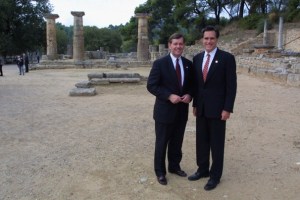
Best buds Mike and Mitt
Lots of corporate news sources were buzzing over the weekend about Romney’s appointment of former Utah Governor Mike Leavitt to head up his transition team. It’s also assumed that Leavitt would have the inside track to get the plum role of Chief of Staff in a Romney administration. Leavitt is also the guy who hired Romney to turn around the scandal-plagued Winter Olympics in 2002.
According to Utah Rep. Jason Chaffetz, a Romney adviser, Leavitt is “the ideal candidate” for the transition job because of:
his three terms as Utah governor as well as serving as administrator of the Environmental Protection Agency and secretary of Health and Human Services under President George W. Bush.
“Mike Leavitt checks every box. It’s a combination of experience and personal relationship,” Chaffetz said. “He can help outline the parameters of what a transition would look like.”
Leavitt has been on board with the Romney campaign throughout the primaries; he has his own office at the Boston headquarters. He and Romney are close, says Politico, and they’re “a lot alike.”
One Romneyland figure said Leavitt’s influence is derived from the fact that he is a spoke in many of the concentric circles around the candidate. Leavitt is part of Romney’s orbit of Mormon associates, but he also sits in the realm of the policy gurus, political counselors, fellow governors and veterans of the Salt Lake Olympics.
So with little fanfare, he has become one of the most influential advisers to the candidate this election cycle. He has an office at the Boston headquarters, travels with Romney at times, has been summoned to rally donors and is tight enough with the high command that he scored an invite to campaign manager Matt Rhoades’s engagement party last month.
He’s also a surrogate and has headlined health care policy discussions at $10,000 per-person Beltway fundraisers for Romney.
Romney officials say Leavitt is often circumspect but has an E.F. Hutton-like effect when he does speak up; many in Boston believe he offers much of his advice directly to Romney — something Leavitt suggests is accurate.

Mike Leavitt
Although it happened following Leavitt’s tenure, Utah was the second state after Massachusetts to institute universal health care. And Leavitt is the health care business–and he’s made millions in profits from Obamacare. At Salon, Alex Seitz-Wald writes:
Leavitt, who served as Health and Human Services secretary under George W. Bush, leads a firm that has positioned itself as a leading consultancy to help implement the Affordable Care Act (PDF), and it’s already won contracts to do so.
Just two weeks ago, the company was awarded a $1 million contract with the state of New Mexico to help it build its exchanges, and Politico reported that the “size of his firm, Leavitt Partners, doubled in the year after the bill was signed as they won contracts to help states set up the exchanges funded by the legislation.”
On its web site, Leavitt Partners features prominently its “Health Insurance Exchange Intelligence Team,” an entire section of the business that advises clients on how to implement and respond to the health insurance exchanges created by Obamacare.
“The passage of the Patient Protection and Affordable Care Act (PPACA) altered many of the fundamentals of healthcare coverage and financing,” the company’s website states. “Our team has a deep background and understanding of exchanges, from the policy side to the technical requirements and infrastructure necessary to operate an exchange. Our team members have unique experience in building exchanges and analyzing health insurance markets.”
Today, the right wingers have suddenly awakened from the collective trance that followed their reluctant recognition that Romney’s their guy now. And they are not happy about the Leavitt appointment. From TPM:
The Wall Street Journal reported last year that Leavitt “strenuously backed the core piece of President Barack Obama’s health-care law and urged the states to move forward together in adopting health insurance exchanges.” And his stance hasn’t changed: “We believe that the exchanges are the solution to small business insurance market and that’s gotten us sideways with some conservatives,” Leavitt’s top aide Rich McKeown told Politico.
“We’re troubled by it,” Dean Clancy, who runs health care advocacy for the Dick Armey-led conservative group FreedomWorks, told TPM Monday via email. “We’re very concerned. The tea party grassroots have always feared that Gov. Romney would be a weak standard bearer because of RomneyCare. This choice only reinforces those doubts. Tapping a high-profile ObamaCare profiteer is disturbing, there’s no way around it. … The tea party has been fighting exchanges in state after state.”
Michael Cannon, who directs health policy for the libertarian Cato Institute, reacted to the Leavitt choice in a blog post he penned: “Romney’s appointment of Leavitt is a first step toward flip-flopping — or Etch-a-Sketching, or Romneying(TM), or whatever — on ObamaCare repeal.”
The right wing blogs are in a tizzy too. Time to break out the popcorn!


 peej
peej Carissa
 bostonboomer
 dakinikat
 ecocatwoman
 mablue2
 Mama Lopez
 peggysue22
 quixote
 skydancingguestblogger
 Mona (aka Wonk the Vote)



 Sky Dancing
Recent Comments