Posted: July 11, 2026 | Author: bostonboomer | Filed under: just because | Tags: Air Force One, cat art, caturday, cyclospora, Donald Trump, explosive diarrhea, first amendment, freedom of the press, Iran threatens revenge against Trump, Iran War, Kash Patel, Mitch McConnell dead or alive, Mojtaba Khamenei, NYT reporters subpoenaed, Qatari-donated Air Force One, Strait of Hormuz |
Good Day!!

By Yulia Sidneva
The news is as crazy as usual today. Remember when weekends used to be quiet? Here’s what’s happening:
The Justice Department has subpoenaed 4 New York Times journalists who reported on security issues related to Trump’s new Air Force One. The administration’s attacks on the First Amendment are getting out of hand.
Michael M. Grynbaum at The New York Times: Times Journalists Subpoenaed as Trump Escalates Pressure on Media.
The Trump administration issued subpoenas on Friday to several journalists for The New York Times, after the news outlet reported this week on security concerns involving President Trump’s new Qatari-donated Air Force One.
The subpoenas — which seek to force the reporters to testify before a federal grand jury in Manhattan on Wednesday — were an extraordinary escalation in President Trump’s efforts to threaten and intimidate independent news organizations.
In some cases, the subpoenas were delivered by federal agents who showed up at reporters’ homes.
The Times denounced the administration’s actions.
“The appearance of federal law enforcement agents on the doorstep of news reporters should shock the conscience of any American who believes in the Constitution and the press freedom it protects,” said David McCraw, The Times’s top newsroom lawyer, in a statement on Friday evening.
“Our journalists report the facts and advance the American public’s right to know how their government is operating and their taxpayer dollars are being used,” Mr. McCraw wrote. “This brazen act should be seen as nothing more than an attempt to prevent the public from knowing what is happening in their country by intimidating journalists from doing their jobs.”
The subpoenas contain few specifics, asking only that the journalists testify “in regard to an alleged violation of federal criminal law.” They were issued by Jay Clayton, the U.S. attorney in Manhattan. Mr. Clayton, who leads one of the country’s most prominent law enforcement offices, was recently nominated by Mr. Trump to serve as director of national intelligence.
Representatives for the White House and the U.S. attorney in Manhattan did not respond to inquiries on Friday evening.
The Times journalists who received subpoenas included Julian E. Barnes, Eric Lipton, Tyler Pager and Eric Schmitt, who reported on Wednesday that Mr. Trump had departed Turkey on the old Air Force One as a security precaution at the urging of the Secret Service. On Thursday, The Times reported that the new Air Force One, a Qatari-donated Boeing 747-8, lacked some of the advanced security features of the older aircraft, including antimissile capabilities. Both articles cited sources who spoke on the condition of anonymity to discuss sensitive security issues.
Before the Wednesday article was published, a senior official at the Federal Bureau of Investigation contacted a reporter and a senior editor at The Times to ask that the article be held, calling it an issue of national security, according to a person familiar with the conversation. The F.B.I. official declined to explain the security issue. The official also asked The Times to disclose its sources for the article; the newspaper refused to do so. (A spokesman for The Times, Charlie Stadtlander, confirmed the account.)
This is really frightening. Fortunately, The Times has deep pockets and can defend their journalists.

By Miroco Machiko
Ashraf Khalil and Will Weissert at the AP: New York Times reporters are subpoenaed after Air Force One reporting, newspaper says.
The Trump administration has subpoenaed several New York Times journalists after their report on security concerns involving the new Air Force One, according to the paper.
The new jet, which President Donald Trump received as a gift from Qatar, entered service last week.
The subpoenas issued Friday seek to force the reporters to testify before a federal grand jury in Manhattan on Wednesday, the paper said, adding that federal agents delivered some subpoenas to the reporters at their homes.
There was no immediate response from the White House or Department of Justice to requests for comment on Saturday….
Issuing subpoenas represents a major escalation in the Republican president’s effort to threaten independent new organizations by leveraging the power of the federal government against them. It is also part of a systematic pattern by Trump to attempt to undermine press freedom in order to shield him from negative coverage.
Earlier this year, the Justice Department issued subpoenas seeking to compel testimony from reporters at The Washington Post and The Wall Street Journal. In both cases, the department later withdrew the subpoenas.
During his first term, Trump suggested that the press constituted an “enemy” of the American people. Since returning to the White House last year, he has waged an aggressive campaign against the media unlike any in modern U.S. history.
Trump’s pattern of attacks against news outlets and media figures he believes are overly critical of him has included filing lawsuits against outlets whose coverage he dislikes, threatening to revoke TV broadcast licenses and seeking to bend news organizations and social media companies to his will.
This is the article the Times published on Wednesday that so outraged Trump and his goons.
Tyler Pager Julian E. Barnes, Eric Schmitt, and Eric Lipton at The New York Times (gift article): Security Precaution Led Trump to Use Old Air Force One in Leaving Turkey.
President Trump flew out of Turkey on Wednesday night on the old Air Force One instead of his new Qatari-donated Boeing 747-8 as a security precaution related to the resumption of hostilities with Iran, according to people briefed on the plans, who said the change came at the urging of the Secret Service.
The swap deepens questions about whether the new plane, which the president had pressed to be ready as soon as possible, was retrofitted with sufficient security measures over the last year. Lawmakers and some officials have raised concerns about whether the expedited timeline allowed for the addition of an advanced missile defense system and other modifications used to protect the president.

By Jacquie Hughes
In a statement, Steven Cheung, the White House communications director, said that “the new Air Force One is a state-of-the-art aircraft that has been fitted with high-level security protocols that ensure the safety of the president and his staff.” [….]
But people briefed on the new plane’s capabilities, who spoke on the condition of anonymity to discuss sensitive security issues, said the new plane does not have all the features of the older plane. The switch in the president’s aircraft when he departed Turkey was a precautionary measure made at the advice of the Secret Service and not because of a specific threat, they said.
Mr. Trump, who has marveled at the luxury touches of his new jet, flew on it on Monday night to go to Turkey for a NATO summit. After his arrival, the conflict with Iran reignited, and the United States launched a series of strikes against that country while Mr. Trump and NATO leaders were about 1,000 miles away in Ankara.
The president on Wednesday denied that the change in his aircraft was made because of security concerns. Instead, he asserted that the swap was so the new jet could leave early and make stops at U.S. military bases to show it off to the troops because the aircraft is “magnificent.”
But when pressed by reporters in Ankara about the reason for the change, Mr. Trump also repeatedly noted that he was Iran’s No. 1 target, and referred at one point to having seen or been briefed on a list of Tehran’s targets in recent days.
You can use the gift link to read the rest.
So Trump’s on again off again war with Iran is back on. Iran apparently fired on some ships in the Strait of Hormuz, and Trump ordered some retaliatory strikes on Iran while he was overseas. Iran is also threatening to assassinate Trump and he is again threatening them with war crimes.
AP: US demands Iran publicly state that Strait of Hormuz is open and Tehran won’t attack ships anymore.
The U.S. is demanding that Iran make a public statement saying the Strait of Hormuz is open and that ships crossing the vital corridor won’t be attacked anymore, senior U.S. officials said Friday, adding that internal Tehran power struggles have made it difficult to reach and keep a deal.
The U.S. officials, who spoke on condition of anonymity to describe to reporters the state of play with Iran, said the resumption of strikes this week came after what they described as a rogue faction of Iranian hard-liners trying to sabotage the ceasefire between Tehran and Washington.
It comes as U.S. President Donald Trump reiterated on social media Friday that he views the interim ceasefire deal as “OVER!” But he said the U.S. would continue talks aimed at putting a permanent end to the war.
The officials said Friday that Trump is giving U.S. negotiators limited time to reach a deal with Iran, but, in a sign of the challenges ahead, they underscored that the president had a wide range of options if talks fall apart. They also said a power struggle was playing out in real time in Iran after U.S. and Israeli strikes at the start of the war killed its longtime leader, Ayatollah Ali Khamenei….
The U.S. is working on pressing Iran to make a public statement that the Strait of Hormuz, a vital waterway for world energy markets, is open and free to ships to transit, the officials said.

By Tetsuo Takahara
Barak Ravid at Axios: Iran’s supreme leader pledges revenge for his father’s assassination amid Trump death threats.
Iranian Supreme Leader Mojtaba Khamenei announced on Saturday that revenge for his father’s assassination “will most certainly be carried out.”
Why it matters: The statement was published after the burial ceremony for his father, former Supreme Leader Ali Khamenei. Throughout the weeklong funeral procession, there were massive public calls for the death of President Trump.
Mojtaba Khamenei, who didn’t appear inI public during the funeral ceremonies, didn’t specifically mention Trump. But earlier this week, Israel gave the U.S. information that suggested Iranian officials recently discussed the idea of assassinating Trump, U.S. and Israeli officials said.
- On his way back from Turkey on Wednesday, Trump traveled in the old Air Force One plane rather than the new plane that the U.S. received from Qatar. The New York Times reported that security concerns prompted the mid-trip switch in planes.
What he’s saying: Mojtaba Khamenei — who was seriously wounded in the attack that killed his father, and hasn’t appeared in public since — pledged on his Telegram channel to “avenge your pure blood and the blood of all those martyred in these two wars by bringing the criminal and dishonorable killers to justice.”
-
“This revenge is the demand of our nation, and it will most certainly be carried out. These criminals — whose names are known from top to bottom — will take to their graves the unfulfilled wish of dying peacefully in their beds. They should know that this does not depend on my personal presence or that of any other official,” he wrote.
-
Khamenei added that whether he is alive or dead, the revenge for his father’s death “will be accomplished,” and stressed that “soon, freedom-loving people throughout the world will each carry out part of this divine mission.”
Read more at Axios.
Kathleen Culliton at Raw Story: Trump’s ‘incredibly vulgar’ threat reveals secret tactic: Ex-State official.
President Donald Trump’s promise to “decimate and destroy all areas of Iran” stunned a former Obama administration official Saturday morning.
Richard Stengel, former Under Secretary of State for Public Diplomacy, shared his alarm over Trump’s recent Truth Social threat with MS NOW viewers.

By Miroco Machiko
“The fact of an American president threatening genocide against the whole people in case he’s assassinated is more than unseemly,” Stengel said. “It’s it’s incredibly vulgar and undiplomatic language.”
Stengel was responding to Trump’s own reaction to the Wall Street Journal report earlier this week that a new Iranian plan to assassinate him may have been uncovered by Israeli intelligence.
Late Friday night, Trump responded with a direct threat.
“1000 Missiles are Locked and Loaded and aimed at the Islamic Republic of Iran,” wrote Trump, “with thousands of more to immediately follow, should the Iranian Government act on its threat, pronounced in many corners of the Globe, to assassinate, or attempt to assassinate, the sitting President of the United States of America, in this case, ME!”
He is such an idiot.
Late yesterday, MSNOW reported that Kash Patel was called on the carpet at the White House to respond to reports of his using his job as FBI director to gain access to luxury travel.
Carol Leonnig, Jacqueline Alemany, Ken Dilanian, Vaughn Hillyard and Jake Traylor at MSNOW: Kash Patel called to White House on heels of continued questions over his behavior.
FBI Director Kash Patel abruptly cancelled a planned flight Friday to see his girlfriend in Chicago this weekend, after top administration officials frustrated with Patel summoned him to the White House, according to two people with knowledge of the change.
The precise reasons that Patel’s political bosses demanded he cancel his trip and report to the West Wing are unclear, but several people said top Trump deputies were disturbed by a range of actions by Patel. Some found it confounding that the FBI director was leaving town amid the recent revival of the war with Iran and alleged threats against the president’s life, according to a person familiar with efforts to help Patel rebuild trust with the White House. For this article, people spoke on the condition of anonymity to discuss a sensitive internal matter.
Others cited two unforced errors by Patel that created bad optics for the Trump administration, the first being his early morning tweet bashing MS NOW for its coverage of his high-flying lifestyle, they said, in which Patel boasted: “my jet ski is gold plated…dumbass.”

By Shozo Ozaki
The second misstep, the people said, was that extensive reports by MS NOW and other news outlets about taxpayers footing the bill for Patel’s globe-trotting ultimately spurred formal questions from Senate Judiciary Chairman Chuck Grassley, a critical ally of President Trump’s.
On Thursday, MS NOW reported exclusively that Grassley had first asked Patel in a May letter about his use of the FBI jet and his decision to purchase luxury armored BMWs so he could travel more discreetly in the Washington, DC area. In a separate letter, Congressional Democrats said they had received information that Patel was demanding that FBI staff arrange special perks on his official trips, including a jet ski excursion and a helicopter tour. The FBI has disputed that, and said Patel had complied with federal rules pertaining to his travel.
White House spokespeople denied the report, but…
Patel cancelled his flight to Chicago just as he was preparing to leave on Friday morning, according to three people briefed on his move. But the trip to Chicago was already stirring anger and controversy inside the FBI, multiple current and former law enforcement officials told MS NOW. He was planning to attend his girlfriend Alexis Wilkins’ performance Saturday at a country music festival held in the parking lot of a major Chicago stadium, the three people said. Patel’s staff had arranged for the director to make an office visit Friday to the Chicago field office to coincide with his trip, according to two other people with knowledge of the director’s schedule.
Several FBI agents complained internally that this office visit was belatedly-added cover to justify Patel flying the director’s jet — which is estimated to cost tens of thousands of dollars for such domestic trips — to enjoy a weekend in Chicago with his girlfriend, the people said.
“Patel was coming (to Chicago) today for a fake office visit for his girlfriend’s country concert this weekend,” one of the sources briefed on the trip said. The source noted Patel “cancelled the trip while on the tarmac at Andrews” and was “summoned to the White House immediately,” adding that it was “apparent panic” and “believed to be in response to his morning tweet today.”
Read he rest at MSNOW.
We still don’t know whether Mitch McConnell is alive or brain dead. Since it was reported that he was found unconscious and given CPR, I think it’s most likely that he was intubated and is still on life support. The chances of an 84-year-old man recovering after CPR outside a hospital and very slim. It’s also odd that his wife would leave for a trip to China if there was any hope of McConnell regaining consciousness anytime soon.
David Smith at The Guardian: Mitch McConnell mystery deepens as health questions remain unanswered.
Mystery surrounding Senator Mitch McConnell’s health is deepening as the US Congress prepares to return from recess next week.
McConnell, 84, has not been seen in public since he was admitted to hospital in the Washington area on 14 June. Nearly a month later, the Kentucky Republican’s office has released only sparse updates, saying he is “continuing to improve” and remains engaged with Senate business, while refusing to disclose the nature of his illness or explain why he remains hospitalised.
Emergency dispatch audio obtained by media outlets indicates that first responders were sent to his home following reports of an unconscious person and that CPR was under way. On Friday, CNN released video footage that showed a person on a stretcher being wheeled towards an ambulance, though their face was not visible.
The senator’s office has neither confirmed nor denied the reports, leaving a vacuum that has been filled with fevered speculation, based on circumstantial evidence, about McConnell’s condition.
“I think he’s dead,” opined Malcolm Nance, a career counter-terrorism intelligence officer, in an interview with Amy McGrath, who lost to McConnell in the 2020 election, on the Truth in the Barrel podcast. “It’s very clear. I heard that 911 tape and I was an EMT when I was in the military at one point and you know we used to do CPR a lot. One of the things that teach you about CPR is the probability of coming back from CPR is very, very, very small.”

By Maki
McGrath, a former marine fighter pilot, replied: “Well, it’s an interesting take. We’ll see what happens there as well.”
The Senate returns on Monday for a four-week legislative session dominated by defence spending, national security and government funding bills. McConnell’s continued absence threatens to complicate Republican efforts to advance those measures with only a narrow 53-47 majority.
McConnell chairs the Senate rules committee and a defence appropriations panel, which is crucial in shaping Pentagon funding and where Republicans hold only a one-seat advantage.
Without him, partisan disputes over annual appropriations could become even harder to resolve ahead of the 1 October deadline for new federal spending. Congressional leaders are already signalling that another temporary spending measure may be needed to avert a government shutdown.
Read more at the Guardian link.
Have you heard about that horrible stomach virus that is going around? It comes from a parasite called cyclospora that the CDC used to closely monitor.
Ryan Grenoble at HuffPo: CDC Stopped Monitoring Parasite Now Causing Explosive Diarrhea Across The Country.
The country is in the midst of a nationwide outbreak of explosive diarrhea caused by a parasite the CDC stopped surveilling at the federal level in July 2025.
That’s around the same time the Trump administration began haphazardly attacking and defunding federal health and science agencies under the guise of “government efficiency,” with Health Secretary Robert F. Kennedy Jr. separately also pushing out critical federal scientists and researchers.
Prior to that date, a collaborative CDC program called FoodNet helped federal and state regulators track eight foodborne pathogens.
Among them was cyclospora, a heat-loving spherical parasite that’s sickened 1,000 people in an ongoing outbreak in Michigan (the state’s worst), with similar illnesses cropping up in 28 other states.
In addition to cyclospora, surveillance of campylobacter, listeria, shigella, vibrio and Yersinia was cut. FoodNet now only regularly monitors two diseases: Salmonella and Shiga toxin-producing E. coli.
A list of CDC talking points seen by NBC News last summer clearly blamed funding for the program’s drastic cutback.
“Funding has not kept pace with the resources required to maintain the continuation of FoodNet surveillance for all eight pathogens,” the talking point read.
More at the link.
Those are the stories that caught my attention today. What’s on your mind?
Did you like this post? Please share it with your friends:
Posted: July 8, 2026 | Author: bostonboomer | Filed under: just because | Tags: Eric Swalwell, Graham Platner, Jenny Racicot, Lyndsey Fifield, Maine Senate race, Maria Kabbas, Nazi "Totenkopf" tatoo, rape, sexting, sexual assault, Susan Collins |

Graham Platner
I’m going to write about Graham Platner today, because I am pissed off.
I have to believe that most women with any experience of abusive men could see right away that Platner was not going to be a good candidate for Democrats. I don’t live in Maine, so I haven’t even followed the stories about him that closely. Yet I could see this mess coming.
Frankly, I thought the Nazi tattoo was bad enough, but when I heard a about the racist, sexist, ableist social media messages and the sexting with other women soon after getting married, I thought this guy is a loser. I even hated his facial hair. The last thing we needed was another Eric Swalwell. I didn’t even know until yesterday that Platner served as a mercenary in Iraq. That would have been a red flag for me too. But Maine Democrats liked Platner, so nothing I could do about it.
Later I read the NYT article about women who found his behavior threatening and talked about his heavy drinking. I was not at all surprised to learn that a woman accused Platner of rape. The signs were all there. I don’t understand why so many people were supposedly shocked.
Maria Kabas had misgivings similar to mine. She writes at The Handbasket: We didn’t need a rape accusation to know Graham Platner was unfit.
Since we learned last fall about the Maine Democratic senate candidate’s Nazi insignia tattoo, the personal revelations about the Marine veteran and oyster farmer have only gone downhill from there. But an initial instinct told me not to weigh in. Let the people of Maine decide for themselves, I thought. I watched from New York as the public learned about shitty stuff he’d posted online, his previous work for the private military contractor Blackwater, and the sexually explicit texts he sent to other women while married to his current wife (which were flagged by her to his campaign as a concern.) And when the New York Times published a story just a few days before the June primary detailing “unsettling” behavior alleged by three women Platner had dated in the past, while I weighed in on social media, I shied away from opportunities to explicitly spell out how dangerous I believed him to be. He went on to win the primary.
It turns out the instinct that kept me from vocalizing my opinion on Platner was the same as the one that prevented Jenny Racicot from coming forward with allegations of a 2021 rape—that is, until this week. “One of the reasons I didn’t come forward sooner was the huge moral conflict that I had between supporting his politics, but not supporting him as a person,” Racicot, who had dated Platner a few years back, told Politico. My position is in no way analogous with Racicot’s, but I, too, had a latent feeling that turning on Platner was in some way turning on an opportunity to kick Republican Susan Collins out of the senate, and possibly regain control of the entire chamber.
While Racicot was one of the women in the NYT story, the stomach-churning details of her sexual assault were for whatever reason not reported then. But on Monday, she said it all: “I remember him grabbing my pelvis and being really forceful of me. I remember the specific moment where I thought to myself, like, ‘This is no longer my choice.’” She describes Platner letting himself into her home while “almost blackout drunk” and having sex with her against her will. Now that we have a fuller picture of Platner’s malfeasance, there is finally consensus around what has long been clear to many of us: he’s a dangerous man. If only the earlier evidence was enough.

Marisa Kabas
When the NYT story dropped on June 4th describing “unsettling” behavior alleged by three women Platner had dated in the past, people who I considered political heroes insisted continuing their support. Senators Elizabeth Warren and Bernie Sanders stuck by Platner, even when there was already more than enough evidence that he was not fit to be the Democratic candidate. Both Warren and Sanders finally pulled their support this week after the rape allegations were published, but it shouldn’t take a woman sharing details about a grotesque intimate experience to knock a man off his pedestal.
Meanwhile, men (and some women) who I nominally considered allies not only defended Platner at the time, but disparaged anyone concerned by the allegations.
Read more at the link. The men Kabas names as allies are people I can’t stand, like Ryan Grim and John Favreau, but even so, she had no problem seeing that Platner was trouble. Her “progressive” male examples:
Ryan Grim, a progressive journalist and co-founder of Drop Site News, tried to undermine the allegations because one of the women from the story, Lyndsey Fifield, is a Republican. He then went on the progressive podcast Breaking Points and said the Platner situation was good because it was forcing Democrats to confront bigotry against white men. “The current cultural divorce between progressives and white men is so, like, stark that it is—it’s just culturally, morally, ethically wrong,” Grim said. “But also just pragmatically, from a political perspective, you can’t build a national party if you assume every white guy or every white guy with a deep voice who is a combat vet or whatever is, like, out to get you.”
Jon Favreau of Pod Save America defended Platner at every turn and mega-streamer Hasan Piker vocally stood by him. The Substack journalist Ken Klippenstein wrote that continuing to defend Platner showed that “People are done with the clean-cut types who’ve harbored ambitions for political office since they were on high school student council and have lived every waking moment accordingly. I call them smoothgroins: real-life barbie dolls with smooth plastic where a sexual organ should be.”
Read more at the link.
Here’s the Politico article by Jessica Piper and Adam Wren in which Jenny Raciot described her rape: Exclusive: Woman who dated Graham Platner says he sexually assaulted her.
A woman who dated Maine U.S. Senate candidate Graham Platner says he forced her to have sex with him nearly five years ago despite her repeated objections, an allegation Platner denies.
The woman, a 41-year-old Maine resident named Jenny Racicot, detailed the alleged incident to POLITICO in three interviews over the past two weeks. POLITICO also spoke with a man Racicot dated and confided in the years after the alleged incident, and reviewed documents, including emails between Racicot and her therapist and messages between Racicot and an acquaintance whom she warned against getting involved with Platner years before he ran for office.

Jenny Racicot
Racicot said she had an on-and-off relationship with Platner, who is now the Democratic Senate nominee in Maine, for more than two years before he entered her rural Maine home uninvited one night in late 2021, deeply intoxicated, and forced himself on her while she repeatedly told him to stop. She said she cut off contact with him after telling him the encounter was not consensual.
“I remember him grabbing my pelvis and being really forceful of me,” she said. “I remember the specific moment where I thought to myself, like, ‘This is no longer my choice.’”
Racicot previously described “reckless” and “unsettling” behavior by Platner to The New York Times, but says she didn’t go public with the specific assault claim because she didn’t want to be known as a rape victim.
Racicot said she later felt compelled to go public about her experience because the reaction to the Times story was dominated by controversy about another woman, Lyndsey Fifield, who alleged Platner mistreated her and faced attacks because of her ties to the Republican Party. (Contacted by POLITICO, Fifield stood by the allegations she made to the Times and declined to comment further.)
“My part of the story was just a read-over,” Racicot said in an interview. “And the story was Lyndsey, and the accusations of her being politically motivated.”
For many Platner supporters, that report crossed a line. But why was anyone surprised?
Here are some of the “red flags” from the June 4 article by Katie Glueck and Lisa Lerer in The New York Times, headlined (gift article): Several Women Who Dated Graham Platner Recall ‘Unsettling’ Behavior.
In interviews with The New York Times on Wednesday, several women [described] Mr. Platner as a fun and caring partner…saying they felt safe with him. Some remain friends with him to this day, years after their relationships ended.
But in extensive conversations over the past two months, three other women who had been romantically involved with Mr. Platner offered a far more complicated assessment, describing volatile and “toxic” relationships that were unsettling and at times emotionally wrenching.
Mr. Platner could be charming and charismatic, they recalled in interviews, but also demeaning to women and, in at least one case, even physically threatening. He drank heavily and was regularly unfaithful….

Lyndsey Fifield
Lyndsey Fifield, 40, a Virginia conservative who has worked for right-leaning groups and Republican campaigns, recalled him as “cavalierly contemptuous of women’s emotions, of our ‘weakness.’” Ms. Fifield, who dated Mr. Platner from roughly 2013 to 2015, said that his offensive online posts “reminded me of just how much he hated women.”
Jenny Racicot, 41, a Maine Democrat, who said she dated him casually off and on between 2019 and 2021, said the posts deepened her belief that he did not respect women. “When I saw the old comments that he made online,” she said, “I recognized a version of him that I had experiences with.” […]
The women who described difficult relationships with Mr. Platner knew him at different points of his life. Ms. Fifield said she dated him starting when they were both in their late 20s in Washington, during a time Mr. Platner has described as challenging. Ms. Racicot knew him in Maine when they were in their mid-30s and he was living in Sullivan, Maine, and working on his oyster farm.
The third woman, a Democrat from Maine who spoke on the condition of anonymity, had a long-distance relationship with Mr. Platner on and off for years, as recently as 2016.’
The three described him in similar terms. Spending time with him could be exhilarating, they said. But they also recounted patterns of heavy drinking and womanizing. Asked to sum up how he treated her, the third woman said she felt like “collateral damage to the world that is his.”
It’s too bad that Racicot didn’t describe the rape for this earlier article–perhaps Platner would have lost the primary. But to me, Fifield’s experiences should have been enough.
Mr. Platner could be rough with her, Ms. Fifield said, particularly when they were drinking, leaving her shaken and sometimes afraid. In the interviews, Ms. Fifield grappled with how to process her experiences. She was quick to note that he “never hit me, he never punched me.”
But she said he regularly grabbed her by the shoulders — sometimes hard enough to leave marks — and, on one occasion, yanked her out of a cab by her wrist after an argument when she wanted to stay in the car.
During one argument, she recalled, he twisted her arm behind her back, shoved her into a bedroom and held the door closed from the other side so she couldn’t get out, telling her to remain there until she was “calm.” Eventually, Ms. Fifield said, she fell asleep and left the next morning.
“It hurt,” she said. But she added: “It didn’t cause an injury, it didn’t break my arm.”
Ms. Fifield also recalled that Mr. Platner’s displays of weaponry and discussions of violence sometimes left her uneasy.
Apparently, some people dismissed her story because she is a Republican. I thought it sounded authentic.
Yesterday, The Washington Post published this story by Amy Brittain, Liz Goodwin, and Amy B. Wang with more information from Lyndsey Fifield: Ex-girlfriend of Graham Platner says he removed condoms without consent during sex.
An ex-girlfriend of embattled Senate candidate Graham Platner told The Washington Post that he repeatedly removed protection without her consent when they were having sex.
Lyndsey Fifield, who said she dated Platner from 2013 to 2015 in D.C. and has previously accused him of physical abuse, said that she told Platner on multiple occasions that he had to wear condoms during sex because she was not on birth control.
“He would pull condoms off,” she said in an interview. “He would do it in a sneaky way. He wouldn’t tell me.”
Fifield, 41, is the second woman to allege this week that Platner engaged in nonconsensual sexual conduct. Jenny Racicot, 41, who said she previously dated Platner, told The Post and other outlets on Monday that he sexually assaulted her in late 2021, leading a growing number of allies to drop their endorsements and call on him to withdraw from the race for a Maine seat in the U.S. Senate….
Fifield initially told The Post about the alleged condom removal during a June 20 interview that was off the record. She said she decided to speak publicly about it Tuesday in part because, she said, she wanted to show that Racicot was not alone in experiencing issues with Platner involving sexual consent.
Removing a condom during sex without consent, known as “stealthing,” is classified as a form of sexual assault in several countries, including Britain, Canada and parts of Australia. In the United States, Maine, California and Washington state have laws that address the nonconsensual removal of condoms during sex. The alleged incidents involving Platner took place in D.C., Fifield said.
She estimated that Platner removed condoms without her consent at least six times when they had sex at both of their residences in D.C. during their two-year, on-and-off relationship. She said she told him that she was upset about it but that he would make light of the situation.
“I confronted him both during and after [sex] because he knew that I was not on birth control and how dangerous that was,” she told The Post in one interview. In another, she said: “He would act like cute about it, like ‘Oh sneaky me.’”
The guy is a complete asshole. I just can’t understand why Democrats supported him for so long.

Graham Platner
This piece at MSNOW is by Michael A. Cohen, who opposed Platner’s candidacy from the beginning: Why Graham Platner’s progressive supporters ignored glaring warning signs.
For nine months, Graham Platner’s supporters have insisted that Democrats should ignore the mounting evidence of his personal foibles and political vulnerabilities — and support his bid for the Senate in Maine.
They argued that his Nazi “Totenkopf” tattoo was a youthful indiscretion and parroted his ludicrous argument that he didn’t know the origins of the Nazi insignia that was on his chest for 18 years before he covered it up with more ink. They waved away his dozens of racist, misogynistic and, frankly, creepy Reddit posts. They said his sexting with as many as a dozen women soon after his wedding was between him and his wife. They insisted that he was the best candidate to unseat incumbent Republican Sen. Susan Collins, even as polling showed him badly underperforming other Maine Democrats.
On Monday, they ran out of excuses and rationalizations.
Jenny Racicot’s story of Platner’s alleged assault is stomach-turning, and while some Democrats will seemingly excuse antisemitism, a Nazi tattoo and persistently bad behavior toward women, sexual assault is the line the party won’t cross.
Now Democrats are abandoning Platner in droves, but the signs were there all along. Cohen:
The first lesson is don’t fall in love with an unvetted political outsider — or, for that matter, any politician. When he announced his candidacy, Platner told a compelling story. He was a political outsider with no experience in electoral politics, a Marine combat veteran and an oyster fisherman in a state where working on the water is a badge of honor.
But as quickly as Platner emerged, so too did the stories of his past deeds — his controversial Reddit posts, his Nazi tattoo and an actual life story that didn’t quite match up with his campaign narrative.
Platner’s supporters claimed he’d grown and matured and that his bad behavior was the result of post-traumatic stress disorder suffered in Iraq….
Redemption and maturity are certainly attributes to be celebrated, but perhaps it would have been better for Platner to work out his personal issues in private, not under the harsh klieg lights of one of the most competitive Senate races in the country….
Second, where there’s smoke, there’s usually fire.
With Platner, it wasn’t just one news cycle of bad stories. It was a constant drumbeat — and many of these allegations shared the same theme: Platner disassembling and distracting.
It turned out that, far from being a successful oyster fisherman, his biggest customer was his mother, who runs a restaurant. Platner’s claims of a hardscrabble youth were contradicted by stories of living off his parents’ generosity and stints at an elite private school.
When the New York Times published on-the-record accounts of him allegedly physically assaulting a former girlfriend, Lyndsey Fifield, Platner and his allies dismissed the claim by arguing that Fifield is a Republican and thus can’t be trusted.
There’s more at the link. Again, the simple truth is the signs were there all along.

Graham Platner shows the tattoo he got to cover up the Nazi one.
Get this: Platner is demanding that his replacement share his progressive politics as a condition for his dropping out! Andrew Howard and Jessica Piper at Politico: Graham Platner’s campaign says it contacted state party to discuss process if he drops out.
Graham Platner’s campaign said it had reached out to the Maine Democratic Party to discuss the process for replacing him if he were to drop out of the state’s U.S. Senate race.
The acknowledgment came after the state party accused the campaign of improperly trying to influence that succession process, and it’s the clearest indication yet Platner is considering leaving the race after saying Monday he was “taking the time to reflect” on his bid for Senate.
Devon Murphy-Anderson, the party’s executive director, said in a Tuesday night press release and social media video that Platner’s campaign staff had repeatedly reached out to the state party in an attempt to “put their thumb on the scale” in selecting his replacement.
“We’ve repeatedly reiterated to Graham Platner’s team that they have no role in determining our next Democratic nominee for the U.S. Senate, nor in determining what this process looks like,” Murphy-Anderson said. “We have also reiterated that Graham Platner must drop out of this race so that Democrats in Maine can focus on defeating Susan Collins this November.”
Democrats are coming to realize Graham Platner will be a specter in Maine’s Senate race even if he ends his campaign.
Platner has denied the allegations of sexual assault and misconduct from former girlfriends that have ratcheted up pressure on him to drop his bid for the seat. Still, Democrats who anticipate he will be forced to end his run told NOTUS their party has a unique challenge: Democrats need a replacement candidate who is distant enough from Platner to avoid his toxicity, but not so far from his politics that they would undermine the Democratic primary voters who nominated Platner.
Given that this is playing out in one of the most competitive Senate contests in the country, any ties to Platner could become an issue for a potential alternative candidate — and the rest of the Democratic Party, they said.
Nate Cohn at The New York Times: Why Democrats Would Probably Come Out Ahead if Platner Dropped Out.
It may be only a matter of time before Graham Platner drops out of the Maine Senate race.
If he does, it’s too soon to say who might replace him, but it’s not too early to suggest that his replacement would probably be a modest favorite against Susan Collins, the longtime Republican incumbent. The same couldn’t be said for Mr. Platner, even before he faced a rape accusation on Monday.
If the race does get a reset, it will be an enormous break for Democrats. Without a victory in Maine, their path to control of the Senate is extremely challenging — not just in 2026, but potentially even if they secure the tiebreaking vice presidency in 2028. It would be an exaggeration to say Mr. Platner was doomed before the latest allegation, but his candidacy was already in a lot of trouble.
To take one example from last week’s New York Times/Siena poll of Maine: Thirty percent of Mr. Platner’s own supporters said his various controversies were making them question whether they could support him. Although he led Ms. Collins in the poll by two percentage points, it was an open question whether he would be able to withstand another round of controversy — and another round seemed all but inevitable. The extraordinary speed with which Mr. Platner’s loyalists pushed him to withdraw after the allegation Monday is partly a reflection of how badly he was wounded. He was already near the breaking point….
If he drops out by next Monday, the Maine Democratic Party will get to choose his replacement. It would have until July 27 to select a new nominee, and my colleague Reid Epstein reports that Maine Democrats are considering several means of doing so, from a pop-up convention to a statewide caucus. Most of the likeliest Democratic replacements aren’t especially well known statewide or nationally, but in this political environment Ms. Collins would be in jeopardy against any one of them.
On paper, this is a race Democrats should win. Yes, Ms. Collins has won many times before, despite Maine’s Democratic lean, but that does not mean she should be expected to defy political gravity forever.
I think Platner should drop out today, and certainly before the weekend. Maine Democrats need to make sure it happens.
Sorry this isn’t a news post, but this is an important issue. Women need to pay attention to and call out the red flags that men just don’t seem to notice. Platner was poison from day one. Women in politics need to pay attention to the signs and speak out loudly.
Did you like this post? Please share it with your friends:
Posted: July 4, 2026 | Author: bostonboomer | Filed under: just because | Tags: 4th of July, Antwerp World Diamond Center, Clean Air Act, Declaration of Independence, Donald Trump, Epstein Files, General Charles Q. Brown, Independence Day, Jr., Maj. Jason Watson, Mt. Rushmore, Trump Corruption, Trump Pardons, Zohran Mamdani |
Good Day!!
 I had a procedure done on my right eye on Monday–a shot to treat macular degeneration–and something went wrong. I’ve been dealing with awful pain for days, and I still can’t see very well. Getting old is no picnic. Nevertheless, I’ll do my best to produce a post.
Today is the 250th anniversary of the signing of the Declaration of Independence. Unfortunately, Trump made the celebration all about him instead of our country. He ruins everything. Fortunately, cities around the country are holding their own 4th of July events.
Here in Boston, there will be the usual outdoor concert with even more fireworks than usual. NBC10 Boston: Here’s what to know about the Boston Pops Fireworks Spectacular today.
Happy Fourth of July! It’s time for the 2026 Boston Pops Fireworks Spectacular — in addition to other Independence Day events that are being held across the city on Saturday.
This year’s Boston Pops Fireworks Spectacular, scheduled for 7-9:30 p.m. at the Hatch Shell, is expected to be bigger than ever as part of the ongoing celebration of America’s 250th birthday, with performances from Lainey Wilson, Chance The Rapper, Trombone Shorty and Megan Hilty, with Jane Lynch serving as host.
People celebrating at the event are being held off the Charles River Esplanade until later in the day this year, however, due to the extreme heat our region has been experiencing. The gates will open to the public at 4 p.m. It was previously scheduled for 12 p.m.
Temperatures are expected in the mid-90s with heat indices running around 100-105 for Saturday’s display, and public health officials have stressed the importance of celebrating safely, drinking water and finding shade.
The free event, which anchors a multi-year, statewide commemoration of Massachusetts 250, will conclude with a fireworks display illuminating the Charles River and choreographed with music performed by the Boston Pops, beginning at 9:15 p.m.
“Massachusetts is where the American Revolution began, and this July 4, we’re proud to welcome people from across the state and country to celebrate 250 years of our nation’s history right here in Boston,” Gov. Maura Healey said in a statement. “From the incredible lineup of artists including the Boston Pops and fireworks over the Charles River, this year’s Spectacular will honor our past while celebrating the energy, creativity and diversity that define Massachusetts today. We’re excited to share this special moment with millions of people here in Boston and watching around the world.”
“This year’s Boston Pops Fireworks Spectacular will be an unforgettable celebration for our residents and visitors from around the world, honoring Boston’s revolutionary history, the courage of our communities, and the traditions that bring us together,” Mayor Michelle Wu added. “Boston’s July 4th festivities are a cherished opportunity for friends and family to come together in celebration. We are proud to host this iconic event and to provide a memorable experience for all.”
The City of Boston is also hosting a series of events on Saturday, July 4, including an Independence Day Parade at 9 a.m. starting at Copley Square, a reading of the Declaration of Independence from the Old State House Balcony at 10:15 a.m. and an Independence Day Oration at Faneuil Hall at 11 a.m., featuring special guests including Nathaniel Sheidley, president and CEO of Revolutionary Spaces; award-winning writer and journalist Ta-Nehisi Coates; and Imari Paris Jeffries, president and CEO of Embrace Boston.
I’m sure there will be celebratory events where you live too. I’m too old and I can’t tolerate crowds and, but I like the idea of it.
 In New York, Mayor Zohran Mamdani gave a wonderful, inclusive speech. NBC News: Mamdani offers a contrast to Trump’s vision for America in a 250th anniversary address.
In a speech marking America’s 250th anniversary, New York Mayor Zohran Mamdani rejected President Donald Trump’s view of the nation, and especially of its immigrants, without naming him directly.
Mamdani criticized Trump’s immigration policies from City Hall while sitting behind a desk that once belonged to George Washington and flanked by recently naturalized U.S. citizens, rebuking the view held by “the powerful” that America “becomes less the more people it welcomes.”
“America, they will tell you, belongs only to those with the right accent or the right shade of skin. The rest of us, they insist, should be grateful for merely being allowed to visit. How small they are. How weak, how unoriginal,” the mayor said.
“The irony” of American exceptionalism, he said, was that the country’s history was often written “by those who were told by others with power and influence and wealth that they were anything but exceptional.”
Mamdani was surrounded by some of America’s newest citizens waving U.S. flags, the same week that the Supreme Court upheld birthright citizenship, dealing a major blow to Trump’s immigration agenda.
“The work of fulfilling the values first enshrined in the Declaration of Independence, that work endures, and it belongs to us all. It belongs, too, to our newest Americans, those standing here with me today, all of whom were recently naturalized,” Mamdani said.
“Nearly a decade ago, I too felt what you feel, the joy of no longer being just a New Yorker, but an American, too,” said Mamdani, who was born in Uganda and was naturalized as a U.S. citizen in 2018.
Read more at the link.
Last night Trump gave a speech at Mt. Rushmore that, predictably, was angry and partisan. Shawn McCreesh at The New York Times: At Mount Rushmore, Trump Veers From Patriotism to ‘Communism.’
Four months before tough midterm elections, President Trump used the backdrop of Mount Rushmore one night before the nation’s 250th birthday to characterize his political opponents as “godless,” “evil” communists.
“We can only lose the midterms if we allow ourselves to lose the midterms, if we are foolish stupid and unwise,” he said on Friday, demanding that Congress pass his so-called SAVE America Act, which would impose stricter voter ID rules that would make it harder to vote. He called for terminating the filibuster.
The larger purpose of the speech was hard to miss. He was sharpening a line of attack that the White House has started to use to head off a newly insurgent progressive wing of the Democratic Party that appears to be resonating with liberal voters.
Mr. Trump read from an apocalyptic script as the stony faces of Washington, Jefferson, Roosevelt and Lincoln looked on. He said the word “communism” so many times, you might’ve thought the Cold War was still on.
He was not subtle. Communism, he said, “is the enemy of July 4, 1776.” He called it a bigger threat than Pearl Harbor and even 9/11. He name-checked Karl Marx.
A bit more:
The speech began on an upbeat note. The president painted a proud and optimistic portrait of the United States, describing it as nothing short of the greatest society in the history of civilization. The whole first half of his speech boiled down to this line: “You live in a very special place — congratulations, everybody.” The crowd ate it up.
 He soon began to pivot. There were people out there who didn’t want English to be the dominant language of the United States, he warned. There were people out there who wanted to take away everyone’s guns, he warned. He promised never to let that happen.
He warned of “newcomers to our country who embrace ideas totally opposed to our way of life and our great success.”
It was not the first time he’d used this backdrop to make a speech like this. Six years ago to the day, he spoke here at the end of his first term, when he was campaigning unsuccessfully for a second. Back then, the country was in the throes of the pandemic and gripped by civil unrest after the death of George Floyd, which inspired a national debate about statues and historical figures. Mr. Trump used his speech that night to warn of a “new far-left fascism” creeping up.
He switched ideologies in his second Rushmore speech on Friday.
“Communism is the exact opposite of life, liberty and the pursuit of happiness,” he declared. “It’s death, tyranny and the pursuit of evil.”
Trump has no clue what communism is.
Tom Schaller offers an alternative point of view on the Declaration at Public Notice: Declaring War on The Declaration. How Trump is shredding our founding document 250 years later.
Today marks the 250th anniversary of the signing of the Declaration of Independence, a landmark moment in American and human history. Celebrations and fireworks aside, what does the Declaration mean two-and-a-half centuries later?
The Declaration is loaded with meanings, some of them inherently self-contradictory. Its opening paragraphs are spine-tinglingly profound, but the bulk of the document is a grievous rant. The document set a global standard for freedom and self-governance as naturally inherent human rights, yet bounded those rights to a privileged white, male minority. It is timeless yet also somewhat outdated for American politics today.
Unfortunately, the Declaration of Independence penned primarily by Thomas Jefferson allows self-interested parties to validate their agendas by importing into that sacred document their preferred interpretations of life, liberty, and the pursuit of happiness. Precisely because the Declaration is so ripe for political manipulation, having Donald Trump lead the nation during this semiquincentennial anniversary offers a fitting, if bleak, opportunity to litigate anew the Declaration’s political utility….
The litigants are many. Netflix, for example, has leaned heavily into the revolutionary moment by releasing two new documentaries, plus biographical docudramas about presidents George Washington and Thomas Jefferson.
Produced and directed by Ken Burns, Sarah Botstein, and David Schmidt, “The American Revolution” is a fantastic, six-part series that focuses almost exclusively on the war. Burns and his team deftly use war narratives as a trojan horse to subtly — and sometimes not-so-subtly — smuggle onto viewers’ screens the message that women, slaves, and Native Americans also played vital roles in the fight for independence.
When “Revolution” was released last autumn, Burns made the rounds on Capitol Hill, cozying up to Republicans in ways that alarmed some critics. From a purely strategic standpoint, he shrewdly played Washington politics the same way contemporary lobbyists do when building coalitions to protect their interests, which in Burns’s case is ongoing federal support for PBS programming.
Although “Revolution” avoids mentioning Trump, its inclusive set of narrators and topics delivers an implicit corrective to the white-washed histories of the founding moment. “Revolution” is Burns’s anniversary gift, carefully but not too obtrusively wrapped with a multicultural bow.
Then, last month Netflix released a five-part series called “The American Experiment.” Shepherded by nearly a dozen producers headlined by Tom Hanks and directed by Brian Knappenberger, “Experiment” mixes recreations with interviews from both notable colonial scholars and contemporary politicians to explain the principles contained in the Declaration of Independence and Constitution. (The documentary includes an important, useful interlude about the failed and often forgotten first attempt at an American republic: the doomed Articles of Confederation.)
Read the rest at Public Notice. I think I’ll give those documentaries a try. They are bound to be a better alternative than Trump’s speech tonight.
 Trump’s “Great American State Fair” has been a complete flop so far with very few people bothering to show up. Tonight Trump plans to give a political speech, and I’ll bet he’s nervous about the turnout.
BBC News: Fireworks, flyovers and a ‘really long’ Trump speech ahead as US celebrates 250th.
US President Donald Trump will head to Washington DC’s National Mall on Saturday for what he has billed as a “spectacular rally” celebrating America’s 250th anniversary.
The event, taking place as a sweltering heatwave grips swathes of the eastern and central US, will include flyovers by hundreds of aircraft and a fireworks display organisers hope will be the biggest of all time.
Military flyovers over Washington DC will happen every hour between 13:15 local time (17:15 GMT) and sunset, the organisers said, and Trump’s new Air Force One will feature in one of the formations over the capital.
The president, however, has been accused by opponents of politicising the nation’s anniversary event and several music acts dropped out soon after being announced.
Extremely hot, humid temperatures of approximately 38C (100F) and a later-than-anticipated start time may also have an impact on the size of the crowd that attends.
The intense heat has already led to events being cancelled. On Friday, organisers of the National Park Service’s Independence Day Parade in Washington DC said they had cancelled the annual event over safety concerns. Some celebration events have also been cancelled from New Jersey, Pennsylvania and Maryland to as far west as Colorado.
There is also the potential for evening thunderstorms that could disrupt the events, which have been organised by a White House-backed public-private partnership….
The Washington DC event, formally known as the Salute to America 250 Celebrations & Fireworks – is due to begin at 19:00 local time, with Trump expected to speak a few hours later at approximately 21:45.
He has promised to make a “really long speech” at the Fourth of July festivities, despite the heatwave, “to show that I can do anything”.
A few news stories:
The New York Times: Air Force Detains Officer Who Called for Trump’s Impeachment at Capitol.
An active-duty officer was placed into Air Force custody after he was arrested in uniform on Wednesday after an event in which he called for the impeachment, conviction and removal of President Trump and Vice President JD Vance.
The U.S. Capitol Police arrested the officer, Maj. Jason Watson, who identified himself as an active-duty service member, on the Capitol steps.
 He was attending a news conference organized by the Removal Coalition, a grass-roots activist group. Representative Al Green, Democrat of Texas, who has filed articles of impeachment against Mr. Trump at least six times, also attended the event.
During his speech, Major Watson, who said he was not a member of the Democratic Party, accused the president and vice president of violating both the Constitution and their oaths of office.
“Congress remains unconvinced of the urgency and necessity for them to honor their oath,” he said, “so we must persuade them, with our unrelenting, uncompromising civil resistance.”
Major Watson ended his speech, in which he criticized the Trump administration’s immigration policies as well as its actions in Venezuela and Iran, by calling on Americans “to peacefully exercise your First Amendment rights.”
After the news conference, he stood on the Capitol steps holding a sign with the words “Impeach,” “Convict” and “Remove” stacked one atop the other. Shortly afterward, he was arrested on suspicion of “crowding, obstructing and incommoding,” the U.S. Capitol Police said in a statement on Friday.
“It is generally against the law for the public to demonstrate on the House steps unless they are with a member of Congress,” the police said. The statement noted that Major Watson had been “escorted to the House steps by a member of Congress” and that after the member left, “our officers gave the man lawful orders to stop the illegal demonstration.”
The Daily Beast: Top Retired General Issues Scathing Trump Takedown.
A retired top general has landed a well-placed blow on President Trump and his use of the military.
Former chairman of the Joint Chiefs of Staff, General Charles Q. Brown, Jr., was one of three authors of an essay in the journal Foreign Affairs, published Friday, that slammed the politicization of the military.
Trump and his Defense Secretary Pete Hegseth have tried to deploy the National Guard in blue cities, successfully in Washington, D.C., while simultaneously carrying out a purge of top generals.
Known for his balanced messaging and aversion to partisanship, Brown did not name Trump or Hegseth, but the targets of his words required little decoding.
“In the face of a genuine national disaster, the public will readily embrace the military’s help,” Brown wrote. “But when presidents use the armed forces for more politically contentious missions, such as addressing domestic crime in cities, the work of the military becomes more fraught.
“Resorting to a military solution rather than fixing the underlying incapacity or dysfunction in civilian institutions diverts the military from focusing on its primary combat mission,” he continued. “And as [George] Washington knew, it is not the military’s job to save the republic from political impasses. Indeed if you ask too much of the military, you risk the entire enterprise.”
 The Independent: DOJ refuses to hand over Epstein files after judge’s order.
The Department of Justice is refusing to hand over redacted information from investigative files connected to Jeffrey Epstein, despite an order from a federal judge to either release the documents or explain why they were withheld.
Hours before a deadline to turn over the materials, Associate U.S. Attorney General Stanley Woodward asked the judge to delay the deadline for another two months, or to dissolve the order entirely by accepting the Justice Department’s explanation for withholding those documents.
Last month, U.S. District Judge Emmet Sullivan sided with journalist Katie Phang after she filed a lawsuit accusing Donald Trump’s administration of violating the Epstein Files Transparency Act, which the president signed into law last year.
The lawsuit, which was filed against Acting Attorney General Todd Blanche, accuses the government of obstructing the public’s right to access materials connected to investigations into Epstein. The judge gave the Justice Department until Thursday to respond.
On Thursday night, Woodward wrote that the government is “committed to transparency and compliance” but “strongly disagrees” with the judge’s order.
PBS News: A Belgian diamond group is gifting Trump a lavish ring after that industry won tariff relief.
Dozens of diamonds spell out two giant letter T’s next to the Stars and Stripes and “1776” and “2026.” Dozens more frame the numbers 45 and 47 in the shape of Superman’s logo. A diamond-winged eagle carries a ruby shield and clutches an olive branch of emeralds, below a radiant “250” and atop the phrase “250 YEARS USA” etched in 18-karat gold.
All told, 321 diamonds, 56 sapphires, 13 emeralds and six rubies encrust the watch-sized gold ring presented this week to Bill White, the U.S. ambassador to Belgium, to give to U.S. President Donald Trump.
“A very special thank you to my friends from Antwerp for the magnificent Freedom 250 ring,” Trump said in a prerecorded video message during an event marking America’s 250th birthday in Brussels.
Isidore Mörsel, president of the Antwerp World Diamond Center, or AWDC, gifted the ring on behalf of the centuries-old diamond community in the Belgian port city, a central node in the worldwide trade of the precious stones that found itself struggling last year under the weight of Trump’s sweeping trade war.
Disgusting.
 The New York Times: Trump Pardons Violators of the Clean Air Act and a Major Donor.
The White House announced on Friday that President Trump had issued pardons to 11 men, most of whom had been convicted of crimes related to the Clean Air Act, a bedrock environmental law.
The president also pardoned Adam Kidan, a major donor to Republicans, including Mr. Trump. He had served about two and a half years in prison for his role in a fraud scheme involving the disgraced former lobbyist Jack Abramoff.
The Clean Air Act pardons benefited people who had sold or installed devices for diesel trucks that defeated their emissions controls, making them far more polluting. It was the latest move by the Trump administration to undermine laws intended to fight climate change and curb air pollutants that harm human health.
Republicans and their allies in the business community have cast enforcement of the Clean Air Act as a hindrance to commerce and an undue burden to those who rely on diesel engines.
Mr. Trump, in a social media post announcing some of the pardons on Friday afternoon, echoed that framing, minimizing the scale of the crimes and casting the law, which was first enacted in 1963, as a tool used by his predecessor to target political enemies.
“It is my Great Honor to have just signed Pardons for six people who were persecuted by the Biden Administration, and were in, or being sent to, prison, for ‘fixing their car,’” Mr. Trump wrote on Truth Social.
Sickening. We have to get rid of him. This country can’t survive 2 more years of his blatant criminality.
That’s all I have for today. I know this isn’t much of a post, but it’s so difficult for me to see what I’m doing. Take care everyone, and I hope you enjoy the Independence Day weekend despite our fascist overlords.
Did you like this post? Please share it with your friends:
Posted: June 27, 2026 | Author: bostonboomer | Filed under: just because | Tags: 250th Anniversary of Declaration of Independence, cat art, caturday, Confederate flag, DEI, Donald Trump, Great American State Fair, immigration and U.S. economy, Massachusetts, Matt McCarthy, North Carolina, Ohio, surrealism |
Good Day!!

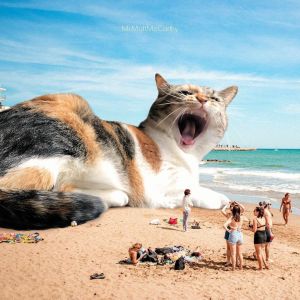
Surreal cat art by Matt McCarthy
Note: The surreal giant cats in today’s post are the work of Matt McCarthy.
As I was reading Dakinikat’s post yesterday, I realized how discouraged I have become lately. Everything is just awful. And it doesn’t help that my chronic sciatica has been acting up lately.
Rick Wilson was so right way back in Trump’s first term when he wrote his book, “Everything Trump Touches Dies.” We’re approaching the 250th anniversary of the Declaration of Independence. It should be a special time for the country, but Trump has taken over the anniversary and made it all about himself. We’ve had to watch him wreck the East Wing of the White House, pave over the rose garden, and hang ugly gold decorations all over the Oval Office. He destroyed the south lawn of the White House for a cage fight that was could only be seen with expensive tickets or on paid TV. On the Fourth of July Trump plans to mark the anniversary itself with a MAGA rally. I just want to cry.
Right now, Trump has something called the Great American State Fair going on. That link goes to a MAGA website. Trump wasn’t satisfied with a bipartisan celebration, so he set up his own organization, Freedom 250. Some commentary on the not-so-great fair:
Farrah Tomazin at The Daily Beast: Trump’s Empty ‘Great State Fair’ Exposed in Damning Photos.
The spectacle on the National Mall in Washington D.C. is ready to receive thousands of visitors. Instead, it is virtually deserted.
Not that there is much to see. Amid the sprawling stretches of open space, there is a 110-foot Freedom 250 ferris wheel and a tacky plywood “Triumph Arch” dominating the center of the grounds, a replica of the monument Trump wants to build near D.C.’s sacred Arlington Cemetery.
There are no corn dogs or funnel cakes. No roller coasters or merry go rounds. And by Friday morning, Pennsylvania became the latest of several Democratic states to declare it was not taking part.
The plan was to have representation from all 50 states. But some had opted out due to the high cost to taxpayers or not being able to secure any businesses to sponsor a booth. Others had chosen not to attend after the supposedly nonpartisan event suddenly seemed political, with Trump himself kicking off the fair with a MAGA rally earlier this week.
The Daily Beast was at the fair in the late afternoon and early evening, hoping to see a flood of people arrive after school and work.
As temperatures climbed, a clump of fairgoers waited under the hot DC sun for a ride on the Freedom 250 Ferris wheel—the festival’s marquee attraction —even as much of the surrounding fairgrounds remained conspicuously quiet.
Elsewhere, a jazz band played to an audience of about 10 people. (Don’t ask about the food: On its first full day, a power shortage hit the food pavilion, resulting in melted ice cream and concerns about spoiled goods.)
The most energetic vibe wasn’t at the Ferris wheel or the live rodeo; it was packed into an evangelical Christian tent, singing and dancing to a worship band, present despite some rather famous lines in the Constitution about church and state.
You can check out the photos at the link. I was going to put some in this post, but I decided to stick with cats, because at least they don’t make me feel sad and hopeless.
You can see more photos at The Atlantic in this piece (gift link) by Kelsey Ables, photos by Lawren Simmons: The Great American State Fair Isn’t Very Great.
The U.S. capital has been outfitted of late with visual trappings that many associate with authoritarianism, such as banners depicting Donald Trump’s face and featuring his slogans. So perhaps it was only a matter of time before the president erected his own Potemkin village: the Great American State Fair, where almost nothing is what it pretends to be.
Stretching across a large swath of the National Mall, the fair has dozens of pavilions for 56 states and territories and numerous executive-branch departments, in addition to a Ferris wheel, a rodeo, and other displays from companies and organizations, many of them Trump-aligned. It’s advertised by Freedom 250, the White House–created group behind many semiquincentennial events, as a “world-class exposition and modern-day World’s Fair.”

By Matt McCarthy
For a president enamored with the gilded and the grand, the exterior of this fair is surprisingly austere. Trompe l’oeil sheets cover slapdash structures lining both sides of the Mall with an illustration of architecture that is supposed to be beaux arts but is so stripped down that it makes the nearby brutalist buildings look practically baroque. A boxy model of Trump’s proposed triumphal arch in the center of the Mall appears as if it could have been designed in Minecraft and ordered from CVS for same-day pickup.
Perhaps because of this aesthetic of illusions, the earnest state pride evident in some of the pavilions turns out to feel especially delightful. Consider: the Science Museum Oklahoma’s president going on about how hers is “the most surprising state you’ll ever experience,” or the Ohioan dispensing with midwestern cheer state-shaped tattoos and tokens for free Frosties through the end of the year. Here and there, the big, proud personalities of the states shine through (see: Idaho’s potato-sack dress). Together, they nearly instill an appreciation for this eclectic batch of states that have united into a country. But like any sense of patriotism these days, it’s complicated just as quickly. Right as I was about to crack open a bag of potato chips from Michigan, with “Take Me Home, Country Roads” stuck in my head from a karaoke video game in the West Virginia booth, I wandered into the State Department pavilion, where I was offered a paper replica of the limited-edition Trump passport.
In a certain sense, the Great American State Fair bottles the central tension of federalism: a push and pull between irrepressible state personalities and the federal government. But it’s also not that academic. Put simply, the president is bringing down the mood.
Boy, you can say that again. “The president is bringing down the mood.” He ruins everything.
None of the New England States contributed to the exhibits, but a few individuals showed up. From The Boston Globe: We checked out Trump’s Great American State Fair. It is, and isn’t, what you’d think.
Down the lush green grass of the National Mall, past the 110-foot Ferris wheel and the scaled-down reproduction of President Trump’s proposed Triumphal Arch, the Massachusetts booth at the Great American State Fair was essentially a do-it-yourself project.
Its singular attraction? Maple syrup.
That was one of the oddities of the 16-day extravaganza, which began on Thursday, to mark the nation’s 250th birthday. Perhaps fittingly for America in 2026, it opened with a mix of the wholesome, the partisan, and the just plain bizarre.
The fair is a production of Freedom 250, the organization launched by Trump last year to give the type of MAGA-spin on the semiquincentennial festivities — think the White House UFC fight — that the bipartisan,congressionally created America 250 organization would not.
The event, Trump’s brainchild, assigns each of the 56 US states and territories a booth among more than 150 exhibits that “showcase the very best of America.” He kicked it off with a rally Wednesday night. And as people began visiting the Greco-Roman-style pavilions, the sprawling exposition reflected America’s Tilt-A-Whirl politics as it celebrates a milestone anniversary.
Despite the region’s pivotal role in the American Revolution, New England was largely a fair draft-dodger. Five of the six state governments declined to participate in what Democrats dismissed as a Trump-centric carnival. Nationwide, a few other states also skipped it.
After Massachusetts Governor Maura Healey balked at the price tag — she estimated hundreds of thousands of dollars to fund it — a 72-year-old Trump supporter from Greenfield, Mass., took matters into her own hands.
“I was upset about it,” the woman, who declined to give her name out of fear of political repercussions, told the Globe as she manned the Massachusetts booth Thursday morning. “Why have an empty spot when they come in? They see nobody, nothing.”
Instead, they saw maple syrup.
It might not be the first thing that comes to mind when people think of Massachusetts, but the state has more than 300 producers, so she reached out to some near her town. Winston’s Sugar House in Shelburne Falls answered the call, donating tiny bottles.
As fairgoers started trickling in Thursday morning, the bottles were arranged on two tables along with brochures about the state’s maple syrup industry and otherother Massachusetts pamphlets in front of the unique backdrop the fair organizers created for every state and territory.
Within minutes, the bottles started disappearing as fairgoers grabbed for the freebies.
But at least Massachusetts had a display — a fact many visitors noted. A few doors down, empty chairs, potted plants, and collage-style backdrops were all that greeted visitors eager to see the offerings of Rhode Island, Maine, Vermont, or Connecticut.
Kevin M. Levin writes at Substack: Of Course a Confederate Flag Showed Up at the Great American State Fair.
Nobody who has been paying attention to the Trump administration’s handling of America’s 250th anniversary should be surprised that a Confederate flag turned up at the Great American State Fair on the National Mall. It was discovered at the North Carolina booth and in its own small way tells you everything you need to know about this whole production.
By Matt McCarthy
The controversy erupted after footage circulated showing the North Carolina exhibit featuring altered versions of the state flag with the Confederate battle emblem superimposed over the design. Governor Josh Stein’s office condemned the display, calling it a misrepresentation of North Carolina and demanding that organizers remove it.
The flag was pulled. Problem solved, in the narrowest possible sense.
But the details here matter. North Carolina’s official state flag has never included the Confederate battle symbol in any version of its design. Not in 1861, not in 1885, not ever.
Whoever put together that video display didn’t just stumble into Lost Cause territory by accident. They had to go out of their way to attach a symbol that the state itself had never chosen to fly.
As historian Stephen Jackson noted, unlike former flags from Georgia and Mississippi, the official flag of North Carolina has never incorporated the Confederate battle flag in its design. The alteration wasn’t heritage. It was invention.
Corporate sponsor Mt. Olive Pickle Company withdrew from the exhibit after learning about the display, saying the company stands on values of human dignity, opportunity, and freedom.
They’d better watch out. Trump doesn’t like anything that smacks of “DEI.” Remember, it’s white people who discriminated against in Trump world. A bit more:
The episode is a concentrated version of the sloppiness that has defined this event from the start. At least ten states declined to send official delegations. Oregon Governor Tina Kotek’s office was explicit about why her state withdrew, citing the cost of participating and growing concerns that the event was shaping up to be a more partisan affair than originally presented.
When you’re trying to celebrate the birth of the nation and you can’t get half the nation’s states to show up, something has gone wrong at the planning stage.

By Matt McCarthy
The fair itself has drawn criticism for its cheap and shoddy appearance. The Washington Post’s Philip Kennicott offered this review:
America’s 250th might have been celebrated with a genuine festival of state fairs, or a 21st century version of the national and international expositions of art and science that were popular in the 19th century. The Trump administration could have let the Smithsonian stage a giant festival of American folkways, music, dance, art, craft and food. It could have defaulted to something like a theme park, which would at least have produced a seamless illusionism and a facsimile of the same folkways that are absent in the Trump show.
And it might have given the states the time, funding and freedom to create their own pavilions, representative of the magnificent diversity of this country’s architecture and design. Instead, everything is stuffed into a fake agora with Doric columns and arched niches painted onto cheap theatrical flats, which look like someone scaled up the photo murals found in a tatty Greek diner that sells gyros, moussaka and heart-bomb platters of pastitsio.
Growing up in Atlantic City in the 1980s, I watched Donald Trump build his casinos into monuments of gaudy spectacle, none more so than the Taj Mahal. The man has always had a gift for making expensive things look tacky and tacky things look expensive, sometimes simultaneously.
Read the rest at the link.
Dakinikat wrote yesterday about the horrible Supreme Court decision to allow Trump to end temporary protected status for Haitians and Syrians in the US. This is a disaster for these immigrants and for the economy. It will expose as many as a million asylum-seekers to arrest and deportation. Most of these people have established homes, jobs, and lives here; and if they are sent back home, they could even be killed.
NBC News on Wednesday: Supreme Court allows Trump to remove protections from thousands of Haitian and Syrian immigrants.
The Supreme Court cleared the way Thursday for the Trump administration to remove legal protections from thousands of Haitian and Syrian immigrants in the United States, meaning they could be subject to deportation.
The court, on a 6-3 vote on ideological lines, ruled in favor of the administration, which asked to continue with its plan to strip Temporary Protected Status from about 350,000 Haitians and 6,000 Syrians.
The ruling could also boost the administration’s efforts to remove similar protections from people from other countries as part of President Donald Trump’s hard-line immigration policy.
Writing for the majority, conservative Justice Samuel Alito said that judges overstepped their authority in second-guessing the administration’s decisions. The court also rejected a claim that the decision to remove protections for Haitians was discriminatory.

By Matt McCarthy
The law in question “expressly restricts” courts from reviewing determinations made by the Department of Homeland Security on whether to terminate or extend TPS protections, he added.
As for the claims of discrimination against Haitians, Alito said the statements cited by plaintiffs were not “overtly racial” and were “insufficient to show that the termination of Haiti’s TPS designation was based on the race of the Haitian people.”
In dissent, liberal Justice Elena Kagan accused the majority of soft-pedaling Trump’s comments about Haitians.
“The statements fairly shout, in their racial undertones and overtones alike, that race entered into the president’s resolve to remove Haitians from this country,” she wrote.
Kagan extensively quoted Trump himself, including his 2018 statement that Haiti is a “shithole country” and comments he made during the 2024 election baselessly claiming that Haitians in Springfield, Ohio, were eating people’s pets.
Without protected status, affected people are subject to deportation via the normal legal process. But they can seek other avenues to remain in the U.S. by, for example, claiming asylum.
This is going to cause serious problems here in Massachusetts, where many Haitian immigrants have settled and hold important jobs. And they are vitally important to the economy. A recent study found that Massachusetts needs 60,000 new immigrants every year to “sustain the work force.”
The Boston Globe: Supreme Court ruling could leave thousands in Massachusetts vulnerable to ICE arrests.
Thousands of immigrants in Massachusetts will likely be at risk of being detained by Immigration and Customs Enforcement following a Supreme Court ruling that paves the way for the Trump administration to revoke the legal status of approximately 330,000 Haitians and Syrians across the country.
“A lot of people are going to be in an extremely vulnerable position as a result of this,” said Kerry Doyle, a former legal adviser for ICE under the Biden administration who now practices immigration law in Massachusetts.
Massachusetts politicians and activists this week promised to fight to pass federal legislation extending the TPS program, and legal advocates said they would work to help those who lose their status find ways through the immigration court system to remain here legally.
“We will continue to use every tool, every legal tool to protect and defend the immigrant communities in Massachusetts and across the Greater Boston area,” said Iván Espinoza-Madrigal, the executive director of Lawyers for Civil Rights, at a demonstration outside the State House Thursday.
For those affected by the decision, however, the immediate situation looked grim. Geralde Gabeau, the executive director of the Mattapan-based Immigrant Family Services Institute, perhaps the most prominent group serving Haitians in Massachusetts, was somber when she spoke to advocates and reporters at the State House. She recounted a story from a local teacher whose student asked if she would take the child home in case their parents were deported.
“This is not acceptable,” Gabeau said. “We have seen a lot of bad, terrible news coming from the Supreme Court. This is going too far.”

By Matt McCarthy
Remember Springfield, Ohio, the town where JD Vance claimed immigrants were eating cats and dogs? The town had deliberately invited Haitian immigrant to come there to live and work. Ohio Governor Mike DeWine is not happy.
WBNS10: DeWine calls policy to remove Springfield’s Haitian immigrants a ‘mistake’ after SCOTUS ruling.
The governor said changing the immigration status of Haitian immigrants under TPS is not in the best interest of the United States or Ohio.
Gov. Mike DeWine, an outspoken supporter of Haitian immigrants in Springfield, called the policy to remove them a mistake after the Supreme Court allowed the Trump administration to end legal protection for migrants fleeing violence and natural disaster in Haiti and Syria.
The 6-3 decision overturns lower court orders and allows the Department of Homeland Security to swiftly end temporary protected status, a program that protects a total of 1.3 million people from 17 countries.
DeWine said Thursday’s ruling means that the over 10,000 Haitians legally living in Ohio, mostly in the Springfield area, will now be in the country illegally. They will be subjected to immediate deportation. He added that it will now be illegal to employ them.
“The situation in Haiti could hardly be much worse. The violent gangs run most of the country. The government barely functions. And, the economy is in shambles,” DeWine said.
In his statement, DeWine pointed to the federal government’s own advisory against traveling to Haiti.
“Our Federal Aviation Administration prohibits U.S. carriers from flying there because of the danger to planes of being shot at by the gangs,” DeWine said. “But, more importantly, changing the immigration status of these individuals is not in the best interest of the United States nor Ohio.”
Read more at the link. Trump and his handpicked justices are ruining our country.
One more disturbing story from NBC News: Pete Buttigieg targeted by ‘false report’ to authorities involving his 4-year-old twins.
Former Transportation Secretary Pete Buttigieg said Friday that he and his family in Michigan were targeted by a “false report” to state authorities claiming he was a danger to his 4-year-old twins.

By Matt McCarthy
Michigan State Police confirmed in a statement that they had received an anonymous report regarding Buttigieg. State police and Child Protective Services then responded and “determined the report was false,” the statement said.
Buttigieg, a Cabinet official in the Biden administration and a potential 2028 presidential candidate, wrote in a Substack post that a police officer and Child Protective Services worker appeared at his home “a few days ago” following an allegation that had been made against him involving his children.
He said his children were removed from the home he shares with his husband, Chasten, before the twins went through separate forensic interviews the next morning. Buttigieg said he was then interviewed as part of the investigation.
During that interview, Buttigieg said, an officer told him that an anonymous caller had reported him to CPS, with the caller saying “that he had spoken to a woman who claimed to have met me at a conference several years ago in Alabama, where she said I told her that I had committed unspeakable violent crimes, and the caller believed my children were still at risk.”
Buttigieg said he told the officer he had never been to the town in Alabama.
“Then the officer made clear that he believed this was politically motivated, and said it would not be referred to a prosecutor,” Buttigieg wrote. “Nothing in the forensic interview with the children, which was conducted by trained personnel, had led to concerns.”
Buttigieg said he was apart from his children for 24 hours.
That is horrible. I can’t believe those poor kids had to go through forensic interviews.
Sorry this post is so depressing, but that’s the state of our country today. If you have something positive to share, please do so in the comment thread. I’d be very grateful.
Did you like this post? Please share it with your friends:








 peej
peej Carissa
 bostonboomer
 dakinikat
 ecocatwoman
 jjlo
jjlo mablue2
 Mama Lopez
 peggysue22
 quixote
 skydancingguestblogger
 Mona (aka Wonk the Vote)



 Sky Dancing
Recent Comments