
Remember When We Had Democratic Presidents?
Posted: April 11, 2013 Filed under: Barack Obama, morning reads, Republican politics, U.S. Economy, U.S. Politics | Tags: Chained CPI, destruction of the Democratic Party, Franklin D. Roosevelt, Great Society, John F. Kennedy, Lyndon B. Johnson, Medicare cuts, New Deal, New Frontier, Obama's Grand Betrayal, Social Security cuts 40 Comments
Franklin D. Roosevelt signs the Social Security Act of 1935
Oh yes, “those were the days, my friend, we thought they’d never end…”
Roosevelt’s New Deal was before my time, but I heard about those days from my parents.
The New Deal was a series of economic programs enacted in the United States between 1933 and 1936. They involved presidential executive orders or laws passed by Congress during the first term of President Franklin D. Roosevelt. The programs were in response to the Great Depression, and focused on what historians call the “3 Rs”: Relief, Recovery, and Reform. That is, Relief for the unemployed and poor; Recovery of the economy to normal levels; and Reform of the financial system to prevent a repeat depression.
The New Deal produced a political realignment, making the Democratic Party the majority (as well as the party that held the White House for seven out of nine Presidential terms from 1933 to 1969), with its base in liberal ideas, the white South, traditional Democrats, big city machines, and the newly empowered labor unions and ethnic minorities. The Republicans were split, with conservatives opposing the entire New Deal as an enemy of business and growth, and liberals accepting some of it and promising to make it more efficient. The realignment crystallized into the New Deal Coalition that dominated most presidential elections into the 1960s, while the opposition Conservative Coalition largely controlled Congress from 1937 to 1963. By 1936 the term “liberal” typically was used for supporters of the New Deal, and “conservative” for its opponents. From 1934 to 1938, Roosevelt was assisted in his endeavours by a “pro-spender” majority in Congress (drawn from two-party, competitive, non-machine, Progressive, and Left party districts). As noted by Alexander Hicks, “Roosevelt, backed by rare, non-Southern Democrat majorities — 270 non-Southern Democrat representatives and 71 non-Southern Democrat senators — spelled Second New Deal reform.”
Many historians distinguish between a “First New Deal” (1933–34) and a “Second New Deal” (1935–38), with the second one more liberal and more controversial. The “First New Deal” (1933–34) dealt with diverse groups, from banking and railroads to industry and farming, all of which demanded help for economic survival. The Federal Emergency Relief Administration, for instance, provided $500 million for relief operations by states and cities, while the short-lived CWA (Civil Works Administration) gave localities money to operate make-work projects in 1933-34.
The “Second New Deal” in 1935–38 included the Wagner Act to promote labor unions, the Works Progress Administration (WPA) relief program (which made the federal government by far the largest single employer in the nation), the Social Security Act, and new programs to aid tenant farmers and migrant workers. The final major items of New Deal legislation were the creation of the United States Housing Authority and Farm Security Administration, both in 1937, and the Fair Labor Standards Act of 1938, which set maximum hours and minimum wages for most categories of workers.
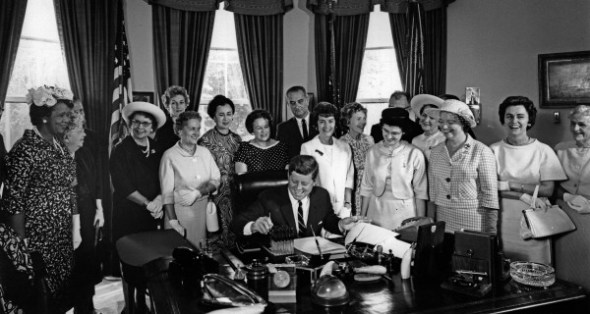
John F. Kennedy signs the Equal Pay Act of 1963
I do clearly Recall John F. Kennedy’s The New Frontier. There’s a popular myth that JFK didn’t accomplish that much legislatively before his death in 1963, but that’s what it is–a myth.
The term New Frontier was used by liberal Democratic presidential candidate John F. Kennedy in his acceptance speech in the 1960 United States presidential election to the Democratic National Convention at the Los Angeles Memorial Coliseum as the Democratic slogan to inspire America to support him. The phrase developed into a label for his administration’s domestic and foreign programs.
[W]e stand today on the edge of a New Frontier -— the frontier of 1960s, the frontier of unknown opportunities and perils, the frontier of unfilled hopes and unfilled dreams. … Beyond that frontier are uncharted areas of science and space, unsolved problems of peace and war, unconquered problems of ignorance and prejudice, unanswered questions of poverty and surplus.
In the words of Robert D. Marcus: “Kennedy entered office with ambitions to eradicate poverty and to raise America’s eyes to the stars through the space program”.Amongst the legislation passed by Congress during the Kennedy Administration, unemployment benefits were expanded, aid was provided to cities to improve housing and transportation, funds were allocated to continue the construction of a national highway system started under Eisenhower, a water pollution control act was passed to protect the country’s rivers and streams, and an agricultural act to raise farmers’ incomes was made law. A significant amount of anti-poverty legislation was passed by Congress, including increases in social security benefits and in the minimum wage, several housing bills, and aid to economically distressed areas. A few antirecession public works packages, together with a number of measures designed to assist farmers, were introduced. Major expansions and improvements were made in Social Security (including retirement at 62 for men), hospital construction, library services, family farm assistance and reclamation. Food stamps for low-income Americans were reintroduced, food distribution to the poor was increased, and there was an expansion in school milk and school lunch distribution. The most comprehensive farm legislation since 1938 was carried out, with expansions in rural electrification, soil conservation, crop insurance, farm credit, and marketing orders. In September 1961, the Arms Control and Disarmament Agency was established as the focal point in government for the “planning, negotiation, and execution of international disarmament and arms control agreements.” Altogether, the New Frontier witnessed the passage of a broad range of important social and economic reforms.
According to Theodore White, under John F. Kennedy, more new legislation was actually approved and passed into law than at any other time since the Thirties. When Congress recessed in the latter part of 1961, 33 out of 53 bills that Kennedy had submitted to Congress were enacted. A year later, 40 out of 54 bills that the Kennedy Administration had proposed were passed by Congress, and in 1963 35 out of 58 “must” bills were enacted. As noted by Larry O’Brien, “A myth had arisen that he (Kennedy) was uninterested in Congress, or that he “failed” with Congress. The facts, I believe, are otherwise. Kennedy’s legislative record in 1961–63 was the best of any President since Roosevelt’s first term”.
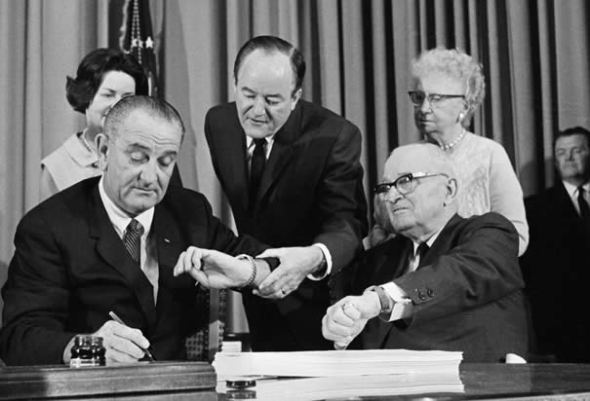
Lyndon B. Johnson signs the Medicare Act of 1964, with Harry Truman by his side
LBJ’s presidency was marred by his escalation of the war in Vietnam, but the domestic legislative accomplishments of his “Great Society” were stunning.
The aftershock of Kennedy’s assassination provided a climate for Johnson to complete the unfinished work of JFK’s New Frontier. He had eleven months before the election of 1964 to prove to American voters that he deserved a chance to be President in his own right.
Two very important pieces of legislation were passed. First, the Civil Rights Bill that JFK promised to sign was passed into law. The Civil Rights Act banned discrimination based on race and gender in employment and ending segregation in all public facilities.
Johnson also signed the omnibus ECONOMIC OPPORTUNITY ACT OF 1964. The law created the Office of Economic Opportunity aimed at attacking the roots of American poverty. A Job Corps was established to provide valuable vocational training.
Head Start, a preschool program designed to help disadvantaged students arrive at kindergarten ready to learn was put into place. The VOLUNTEERS IN SERVICE TO AMERICA (VISTA) was set up as a domestic Peace Corps. Schools in impoverished American regions would now receive volunteer teaching attention. Federal funds were sent to struggling communities to attack unemployment and illiteracy.
As he campaigned in 1964, Johnson declared a “war on poverty.” He challenged Americans to build a “Great Society” that eliminated the troubles of the poor. Johnson won a decisive victory over his archconservative Republican opponent Barry Goldwater of Arizona.
– American liberalism was at high tide under President Johnson.
– The Wilderness Protection Act saved 9.1 million acres of forestland from industrial development.
– The Elementary and Secondary Education Act provided major funding for American public schools.
– The Voting Rights Act banned literacy tests and other discriminatory methods of denying suffrage to African Americans.
– Medicare was created to offset the costs of health care for the nation’s elderly.
– The National Endowment for the Arts and Humanities used public money to fund artists and galleries.
– The Immigration Act ended discriminatory quotas based on ethnic origin.
– An Omnibus Housing Act provided funds to construct low-income housing.
– Congress tightened pollution controls with stronger Air and Water Quality Acts.
– Standards were raised for safety in consumer products.
I’m in tears right now after reading again about the accomplishments of these three great Democratic presidents. I’m in mourning today for my party and my country. For the first time, a supposedly Democratic president has proposed not only Social Security benefit cuts but also massive cuts to Medicare that will force seniors to pay higher deductibles and discourage them from buying medigap plans to cover co-pays.
I’ve known this was coming since 2007 when I read Obama’s book, The Audacity of Austerity Hope. He couldn’t have made it any clearer in the chapter on the domestic economy that he was an enthusiastic supporter of privatization and/or cuts in social programs. But although I’ve expected this for years, the reality of it has still hit me very hard. I feel both heartbroken and ashamed of President Obama.
I’ll post something else later on; but for now, please use this as a morning open thread and post your recommended links freely in the comments.
This is a sad day, but I believe Obama’s gambit will be a dismal failure. IMO he already looks foolish and ineffectual as the Republicans make hay by accusing him of trying to balance the budget on the backs of seniors. We need to understand that it is fruitless to expect him Obama stand up to the Republicans, the corporate media, or the bankers. We are on our own.
I admit, I had begun to believe that Obama had grown in office–that he had begun to realize that standing up for liberal values would serve him in good stead. But his addiction to “bipartisanship” and his fantasy of a “grand bargain” won out in the end. I still believe Romney would have been far worse, but let’s face it we still got a Republican president in 2008 and 2012. We need to fight tooth and nail to keep him from destroying the proud legacies of FDR, JFK, and LBJ.
Sooooo…. What’s on your mind today?
Late Night: Chain of Fools
Posted: April 10, 2013 Filed under: Barack Obama, Medicare, Political and Editorial Cartoons, Real Life Horror, Rick Perry, Social Security, U.S. Economy, U.S. Politics | Tags: cat food, Chained CPI, Dan Rostenkowski, middle class tax increases, social safety net 10 Comments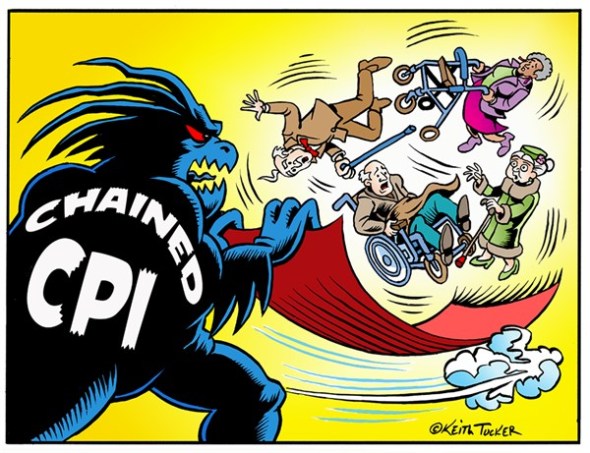
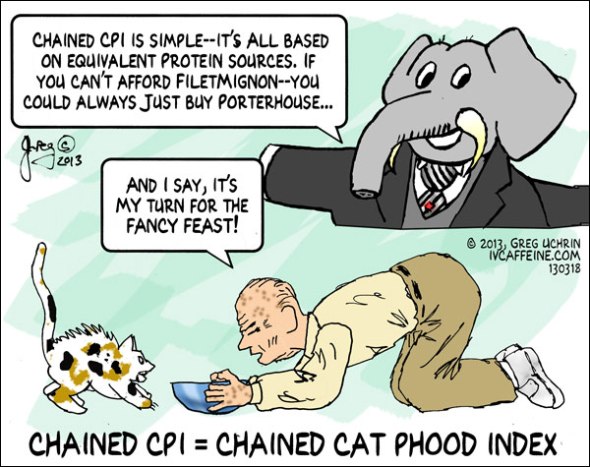
The President released his budget today, and it includes the promised benefit cuts to Social Security that the White House has tried to conceal by claiming it wants to institute a supposedly “more accurate” measure of cost-of-living, the Chained CPI. Of course at this point, anyone who is paying attention knows that the change will result in the average senior getting $1,000 less per year after 20 years. It’s a benefit cut pure and simple.
What many people don’t know yet is that switching Chained CPI will result in a significant tax increase for working poor and middle-class Americans.
Here’s your soundtrack for this post. Perhaps the great Aretha Franklin can make Obama’s budget slightly less nauseating. I’m also going to try to ease the pain with cartoons and visual aids.
Luckily, Grover Norquist and the folks at Americans for Tax Reform know darn well that Chained CPI amounts to a tax increase for people on the lower end of the income scale. This is right from their website.
The proposal in question is known as “Chained CPI.” The term is a Beltway euphemism for measuring inflation at a different, slower pace. Many tax and budget items are indexed to inflation, so slowing inflation’s measured rate of growth has both spending cut and tax increase implications.
On the tax side, all income tax brackets are subject to inflation. Slowing down the inflation rate slows down the annual rate of growth in all income tax brackets.
This means the Obama budget contains a tax increase on 100 percent of middle class taxpayers—anyone who pays the federal income tax.
Many other tax provisions—the standard deduction, the personal exemption, PEP and Pease, IRA and 401(k) contribution limits, and many others—are also tied to how CPI is measured.
Chained CPI as a stand-alone measure (that is, not paired with tax relief of equal or greater size) is a tax increase and a Taxpayer Protection Pledge violation. Various reports peg the tax increase amount as exceeding $100 billion over the next decade.
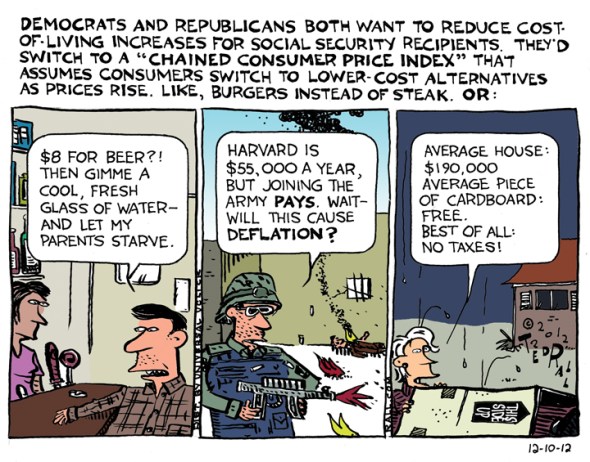
Ted Rall explains Chained CPI:
Dylan Matthews broke it all down (with charts) in a December 2012 post. Here’s the gist:
The group getting the biggest tax hike is families making between $30,000 and $40,000 a year. Their increase is almost six times that faced by millionaires. That’s because millionaires are already in the top bracket, so they’re not being pushed into higher marginal rates because of changing bracket thresholds. While a different inflation measure might mean that the cutoff between the 15 percent and 25 percent goes from $35,000 to $30,000, the threshold for the top 35 percent bracket is already low enough that all millionaires are paying it. Some of their income is taxed at higher rates because of lower thresholds down the line, but as a percentage of income that doesn’t amount to a whole lot.
All told, chained CPI raises average taxes by about 0.19 percent of income. So, taken all together, it’s basically a big (5 percent over 12 years; more, if you take a longer view) across-the-board cut in Social Security benefits paired with a 0.19 percent income surtax. You don’t hear a lot of politicians calling for the drastic slashing of Social Security benefits and an across-the-board tax increase that disproportionately hits low earners. But that’s what they’re sneakily doing when they talk about chained CPI.
That’s why watchdog groups like the Center for Budget and Policy Priorities argue that the only fair way to do chained CPI would be to pair it with an increase in Social Security benefits, and to exempt Supplemental Security Income, which provides support for impoverished elderly, disabled and blind people. Otherwise, it’s just a typical “raise taxes, cut benefits” plan, and an arguably regressive one at that.
So basically if you work for a living or depend on Social Security, you’re getting screwed coming and going.
Here’s another cartoonist’s evaluation of the situation:
Chained CPI will disproportionately affects women, according to the AARP (3/6/2013).
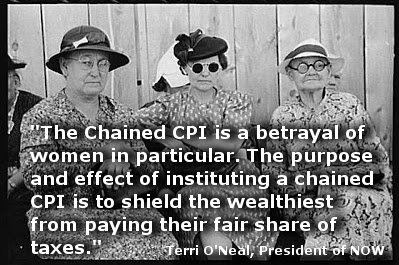
The Social Security benefit cut known as Chained CPI remains a piece of the deficit puzzle for reasons that baffle conservatives, veterans, progressives, and almost everyone in between. The $85 billion in sequester cuts for 2013 have begun and many in Washington have still said they’re willing to cut the modest Social Security benefits we’ve earned by $127 billion over 10 years, even though Social Security by law remains separate from the budget and its deficit. Let’s give every woman and anyone who has or has ever had a mother, sister, daughter, grandmother, aunt or girlfriend a reason to despise this wretched proposal.
This week AARP began running ads about the impact of what the Chained CPI Social Security benefit cuts would mean to women. Below is a copy of one of those ads.

Here’s what Terri O’Neill, president of NOW had to say about women and Chained CPI.
I’m sure you recall that our previous Republican President (let’s face it, Obama is a Democrat in name only) began his second term with the ambitious goal of privatizing Social Security. It didn’t end well for him. Here’s a cartoon from back then:

And another one:

That’s the kind of reaction politicians tend to get when they attack the most successful and powerful government program in history. That’s why it’s called “the third rail.” Remember in when Texas Gov. Rick Perry attacked Social Security as a “Ponzi scheme?” Look what happened to him?
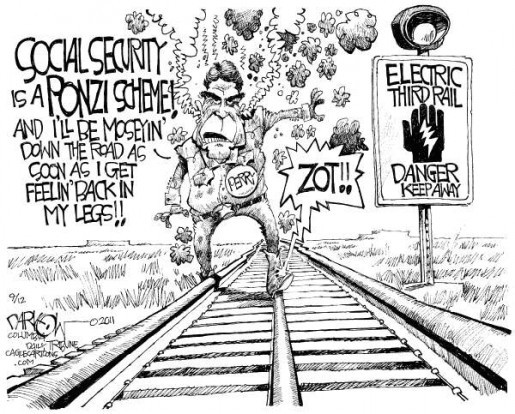
Obama is already beginning to learn why politicians who step on the “third rail” end up regretting it. He’s out there on a limb all by himself. Democrats hate his budget and so do Republicans, because the vast majority of Americans like Social Security and if it’s threatened they tend to get mad–especially seniors.
Yesterday, Digby recalled what can happen “When seniors get angry …” She referred to an incident in 1989 which Democrat Dan Rostenkowski–the powerful Chairman of the Ways and Means Committee–was chased down the street by enraged seniors.
Andrea Stone told the tale at AOL News in August 2010 after the Illinois Congressman’s death: Rosty’s ‘Catastrophic’ Moment Over Health Care Was a First.
The Medicare Catastrophic Coverage Act, first unveiled by President Ronald Reagan, became law in July 1989. The measure provided seniors on Medicare with protection against catastrophic medical expenses and coverage of prescription drug costs. The benefits were to be paid for exclusively by the elderly receiving them, with high-income seniors paying an extra premium surtax.
Soon after Congress passed the law on an overwhelmingly bipartisan vote, Rosty returned to his district. It was there, after a fairly civil meeting with seniors resentful over having to pay higher taxes for coverage they either already had from a former employer or didn’t want, that he was accosted by an angry mob of Social Security recipients.
As the Chicago Tribune reported the next day, Aug. 19, 1989:
Congressman Dan Rostenkowski, one of the most powerful politicians in the United States, was booed and chased down a Chicago street Thursday morning by a group of senior citizens after he refused to talk with them about federal health insurance. Shouting “coward,” “recall” and “impeach,” about 50 people followed the chairman of the U.S. House Ways and Means Committee up Milwaukee Avenue after he left a meeting in the auditorium of the Copernicus Center, 3106 N. Milwaukee Ave., in the heart of his 8th Congressional District on the city’s Northwest Side.
Eventually, the 6-foot-4-inch Rostenkowski cut through a gas station, broke into a sprint and escaped into his car, which minutes earlier had one of the elderly protesters, Leona Kozien, draped over the hood. Kozien, one of more than 100 senior citizens who attended the gathering, said she had hoped to talk to Rostenkowski, her congressman, at the meeting.
But Rostenkowski clearly did not want to talk with her, or any of the others who had come to tell their complaints about the high cost of federal catastrophic health insurance. “These people don’t understand what the government is trying to do for them,” the 61-year-old congressman complained as he tried to outpace his pursuers.
“This was a setup,” said Jaffe, who can be seen in the video ducking into the backseat of the car. “They were standing with made-for-television signs about how he had sold them out.”
As the Tribune reported, “Kozien was soon on the hood, determinedly holding her sign only inches from the windshield. Except for the glass, she was virtually face-to-face with her congressman. ‘I was a little nervous,’ Kozien said later. ‘But I could see through the car window that he looked more afraid than I was.'”
And there is even video of the incident:
Obama is all alone out there on his limb. The only people who have his back are his apparently not-to-bright advisers. Does he really want to be remembered as the first Democratic President to tamper with Social Security? And BTW, his budget also cuts Medicare significantly. Is this really what he wants as his “legacy?” Is it really good enough to gain the applause of Wall Street and the “Very Serious People” in Washington, DC today but go down in history as a worse president than Calvin Coolidge, Herbert Hoover and George W. Bush? We shall see.
Tuesday Reads: Margaret Thatcher’s “Dark Legacy,” Death of a Feminist Revolutionary, and Mitch McConnell’s Ugly Plans
Posted: April 9, 2013 Filed under: morning reads, U.S. Politics, War on Women, Women's Rights | Tags: Andrew Sullivan, Ashley Judd, austerity, David Corn, feminist history, Margaret Thatcher, Mitch McConnell, Poverty, Shulamith Firestone, Susan Faludi 33 Comments
Good Morning!!
The death of Margaret Thatcher is still dominating the news this morning. It seems she was one of those public figures that inspired varied but passionate reactions–you either loved her or hated her.
Andrew Sullivan loved her it seems.
I was a teenage Thatcherite, an uber-politics nerd who loved her for her utter lack of apology for who she was. I sensed in her, as others did, a final rebuke to the collectivist, egalitarian oppression of the individual produced by socialism and the stultifying privileges and caste identities of the class system. And part of that identity – the part no one ever truly gave her credit for – was her gender. She came from a small grocer’s shop in a northern town and went on to educate herself in chemistry at Oxford, and then law. To put it mildly, those were not traditional decisions for a young woman with few means in the 1950s. She married a smart businessman, reared two children and forged a political career from scratch in the most male-dominated institution imaginable: the Tory party.
She relished this individualist feminism and wielded it – coining a new and very transitive verb, handbagging, to describe her evisceration of ill-prepared ministers or clueless interviewers. Perhaps in Toynbee’s defense, Thatcher was not a feminist in the left-liberal sense: she never truly reflected on her pioneering role as a female leader; she never appointed a single other woman to her cabinet over eleven years; she was contemptuous toward identity politics; and the only tears she ever deployed (unlike Hillary Clinton) were as she departed from office, ousted by an internal coup, undefeated in any election she had ever run in as party leader.
Her policies “inspired” the revolutionary reactions that created a “cultural transformation.”
Thatcher’s economic liberalization came to culturally transform Britain. Women were empowered by new opportunities; immigrants, especially from South Asia, became engineers of growth; millions owned homes for the first time; the media broke free from union chains and fractured and multiplied in subversive and dynamic ways. Her very draconian posture provoked a punk radicalism in the popular culture that changed a generation. The seeds of today’s multicultural, global London – epitomized by that Olympic ceremony – were sown by Thatcher’s will-power.
And that was why she ultimately failed, as every politician always ultimately does. She wanted to return Britain to the tradition of her thrifty, traditional father; instead she turned it into a country for the likes of her son, a wayward, money-making opportunist. The ripple effect of new money, a new middle class, a new individualism meant that Blair’s re-branded Britain – cool Britannia, with its rave subculture, its fashionistas, its new cuisine, its gay explosion, its street-art, its pop music – was in fact something Blair inherited from Thatcher.
Of course Sullivan no longer lives in Great Britain, and he has the means to avoid the worst effects of the elite’s austerity policies regardless of where he lives. Others aren’t so fortunate.
The Guardian reports: Margaret Thatcher’s death greeted with street parties in Brixton and Glasgow; Crowds shout ‘Maggie Maggie Maggie, dead dead dead’ during impromptu events.
Several hundred people gathered in south London on Monday evening to celebrate Margaret Thatcher‘s death with cans of beer, pints of milk and an impromptu street disco playing the soundtrack to her years in power.
Young and old descended on Brixton, a suburb which weathered two outbreaks of rioting during the Thatcher years. Many expressed jubilation that the leader they loved to hate was no more; others spoke of frustration that her legacy lived on.
To cheers of “Maggie Maggie Maggie, dead dead dead,” posters of Thatcher were held aloft as reggae basslines pounded.
Clive Barger, a 62-year-old adult education tutor, said he had turned out to mark the passing of “one of the vilest abominations of social and economic history”.
He said: “It is a moment to remember. She embodied everything that was so elitist in terms of repressing people who had nothing. She presided over a class war.”
Builder Phil Lewis, 47, a veteran of the 1990 poll tax riots, said he had turned out to recall the political struggles the Thatcher years had embroiled him in. “She ripped the arsehole out of this country and we are still suffering the consequences.”
Just as Ronald Reagan did to the U.S.–and we’re still suffering the consequences.
Here’s a video from Brixton.
Hugo Young, Thatcher biographer, writes in The Guardian: Margaret Thatcher left a dark legacy that has still not disappeared. For Young, a positive was Thatcher’s indifference to her popularity with the public.
I think by far her greatest virtue, in retrospect, is how little she cared if people liked her. She wanted to win, but did not put much faith in the quick smile. She needed followers, as long as they went in her frequently unpopular directions. This is a political style, an aesthetic even, that has disappeared from view. The machinery of modern political management – polls, consulting, focus groups – is deployed mainly to discover what will make a party and politician better liked, or worse, disliked. Though the Thatcher years could also be called the Saatchi years, reaching a new level of presentational sophistication in the annals of British politics, they weren’t about getting the leader liked. Respected, viewed with awe, a conviction politician, but if liking came into it, that was an accident.
But this attitude “didn’t come without a price” and “Thatcher left a dark legacy…”
What happened at the hands of this woman’s indifference to sentiment and good sense in the early 1980s brought unnecessary calamity to the lives of several million people who lost their jobs. It led to riots that nobody needed. More insidiously, it fathered a mood of tolerated harshness. Materialistic individualism was blessed as a virtue, the driver of national success. Everything was justified as long as it made money – and this, too, is still with us.
Thatcherism failed to destroy the welfare state. The lady was too shrewd to try that, and barely succeeded in reducing the share of the national income taken by the public sector. But the sense of community evaporated. There turned out to be no such thing as society, at least in the sense we used to understand it. Whether pushing each other off the road, barging past social rivals, beating up rival soccer fans, or idolising wealth as the only measure of virtue, Brits became more unpleasant to be with. This regrettable transformation was blessed by a leader who probably did not know it was happening because she didn’t care if it happened or not. But it did, and the consequences seem impossible to reverse….
[I]t’s now easier to see the scale of the setback she inflicted on Britain’s idea of its own future. Nations need to know the big picture of where they belong and, coinciding with the Thatcher appearance at the top, clarity had apparently broken through the clouds of historic ambivalence.
At least the British media isn’t trying to canonize Thatcher as the corporate media in the U.S. did to Reagan.
A Less Remarked Upon Death: Shulamith Firestone
At The New Yorker, Susan Faludi pays tribute to a feminist icon of the 1970s, “Death of a Revolutionary: Shulamith Firestone helped to create a new society. But she couldn’t live in it.”
When Shulamith Firestone’s body was found late last August, in her studio apartment on the fifth floor of a tenement walkup on East Tenth Street, she had been dead for some days. She was sixty-seven, and she had battled schizophrenia for decades, surviving on public assistance. There was no food in the apartment, and one theory is that Firestone starved, though no autopsy was conducted, by preference of her Orthodox Jewish family. Such a solitary demise would have been unimaginable to anyone who knew Firestone in the late nineteen-sixties, when she was at the epicenter of the radical-feminist movement, surrounded by some of the same women who, a month after her death, gathered in St. Mark’s Church In-the-Bowery, to pay their respects.
The memorial service verged on radical-feminist revival. Women distributed flyers on consciousness-raising, and displayed copies of texts published by the Redstockings, a New York group that Firestone co-founded. The WBAI radio host Fran Luck called for the Tenth Street studio to be named the Shulamith Firestone Memorial Apartment, and rented “in perpetuity” to “an older and meaningful feminist.” Kathie Sarachild, who had pioneered consciousness-raising and coined the slogan “Sisterhood Is Powerful,” in 1968, proposed convening a Shulamith Firestone Women’s Liberation Memorial Conference on What Is to Be Done. After several calls from the dais to “seize the moment” and “keep it going,” a dozen women decamped to an organizing meeting at Sarachild’s apartment.
I well remember reading Firestone’s book, The Dialectic of Sex: The Case for Feminist Revolution. It was mind-blowing stuff in those days.
In the late nineteen-sixties, Firestone and a small cadre of her “sisters” were at the radical edge of a movement that profoundly changed American society. At the time, women held almost no major elected positions, nearly every prestigious profession was a male preserve, homemaking was women’s highest calling, abortion was virtually illegal, and rape was a stigma to be borne in silence. Feminism had been in the doldrums ever since the first wave of the American women’s movement won the vote, in 1920, and lost the struggle for greater emancipation. Feminist energy was first co-opted by Jazz Age consumerism, then buried in decades of economic depression and war, until the dissatisfactions of postwar women, famously described by Betty Friedan in “The Feminine Mystique” (1963), gave rise to a “second wave” of feminism. The radical feminists emerged alongside a more moderate women’s movement, forged by such groups as the National Organization for Women, founded in 1966 by Friedan, Aileen Hernandez, and others, and championed by such publications as Ms., founded in 1972 by Gloria Steinem and Letty Cottin Pogrebin. That movement sought, as now’s statement of purpose put it, “to bring women into full participation in the mainstream of American society,” largely by means of equal pay and equal representation. The radical feminists, by contrast, wanted to reconceive public life and private life entirely.
What a brilliant tribute by Faludi. It’s well worth the read.
Mother Jones’s David Corn has gotten his hands on a tape of “a private meeting between the Senate GOP leader and campaign aides reveals how far they were willing to go to defeat” Ashley Judd.
On February 2, Mitch McConnell, the Republican leader in the US Senate, opened up his 2014 reelection campaign headquarters in Louisville, Kentucky, and in front of several dozen supporters vowed to “point out” the weaknesses of any opponent fielded by the Democrats. “They want to fight? We’re ready,” he declared. McConnell was serious: Later that day, he was huddling with aides in a private meeting to discuss how to attack his possible Democratic foes, including actor/activist Ashley Judd, who was then contemplating challenging the minority leader. During this strategy session—a recording of which was obtained by Mother Jones—McConnell and his aides considered assaulting Judd for her past struggles with depression and for her religious views….
For much of the Judd discussion, McConnell was silent as aides reviewed the initial oppo research they had collected on Judd and weighed all the ways they could pummel her. The recording was provided to Mother Jones last week by a source who requested anonymity. (The recording can be found here; a transcript is here.) McConnell’s Senate office and his campaign office did not respond to requests for comment.
The aide who led the meeting began his presentation with a touch of glee: “I refer to [Judd] as sort of the oppo research situation where there’s a haystack of needles, just because truly, there’s such a wealth of material.” He ran through the obvious: Judd was a prominent supporter of President Barack Obama, Obamacare, abortion rights, gay marriage, and climate change action. He pointed out that she is “anti-coal.”
But the McConnell gang explored going far beyond Judd’s politics and policy preferences. This included her mental health. The meeting leader noted:
She’s clearly, this sounds extreme, but she is emotionally unbalanced. I mean it’s been documented. Jesse can go in chapter and verse from her autobiography about, you know, she’s suffered some suicidal tendencies. She was hospitalized for 42 days when she had a mental breakdown in the ’90s.
So what? Mitch McConnell is a sick, closeted, hateful old freak who appears to lack any semblance of human feelings.
I’m running out of space, so I’ll add a few more links in the comments. I hope you’ll do the same. What are you reading and blogging about today?
Late Late Night: FEMEN Protesters Confront Angela Merkel and Vladimir Putin
Posted: April 8, 2013 Filed under: just because | Tags: Angela Merkel, FEMEN protest, Vladimir Putin 20 Comments
I heard about this protest on Twitter this morning, and the photos made me laugh out loud.
Russian President Vladimir Putin and German Chancellor Angela Merkel came face to face – or face to breast – with naked FEMEN activists as they toured an industrial fair in Hanover on Monday.
The leaders were taking in a presentation of a new Volkswagen model when the four women started chanting “f… dictator”. The activists had the same words painted in black ink across their chests and were eventually overpowered by security guards.
Merkel and Putin were attending the Hanover Messe in northern Germany, where Russia is this year’s guest country. Photos taken afterwards suggest they saw the funny side of the protest, if not the motivation behind it.
Here’s some video of the confrontation. It looks like Three Stooges skit.
On their Facebook page, Femen said the protest was an “anti-dictatorial attack on Putin”. The group criticised the Kremlin, Russia’s Federal Security Service and the Russian Orthodox Church, saying that Femen was against “dictatorship, homophobia and theocracy”.
Femen protests have included burning a Salafist flag in front of the Grand Mosque in Paris, and chopping down an Orthodox cross with a chainsaw.
The group has criticized Mr Putin over the arrest and conviction of the feminist punk band Pussy Riot, for performing an anti-Putin song in a Moscow cathedral last year.
Russia has urged German authorities to punish the protesters. “This is ordinary hooliganism and unfortunately it happens all over the world, in any city. One needs to punish (them),” Kremlin spokesman Dmitry Peskov said.
More photos
Putin sees something he likes

Chaos ensues

Merkel and Putin get the giggles

And laugh heartily

This is an open thread, obviously.
No Wonder U.S. Was So Desperate To Capture Julian Assange
Posted: April 8, 2013 Filed under: torture, U.S. Military, U.S. Politics, Wikileaks | Tags: Col. James Steele, death squads, Iraq War, Julian Assange, The UK Guardian 42 Comments
Have you been following the latest news on Wikileaks? Some very interesting information has been coming out in the past two days. I’m beginning to understand why the Obama administration–along with some foreign governments were so anxious to arrest Julian Assange and shut down Wikileaks. Thanks to Bradley Manning and Assange, news organizations are revealing plenty about what our government was been up to in the 1970s.
Yesterday, the Guardian published a shocking expose of the U.S. torture and death squad operations in Iraq. The article reveals direct connections between the Pentagon and Iraqi “torture centers.” In addition, Guardian researchers showed how Iraq policy grew out of America’s “dirty wars” in Vietnam and Latin America with a veteran of those past outrages, retired Army Colonel James Steele, leading the way.
The Pentagon sent a US veteran of the “dirty wars” in Central America to oversee sectarian police commando units in Iraq that set up secret detention and torture centres to get information from insurgents. These units conducted some of the worst acts of torture during the US occupation and accelerated the country’s descent into full-scale civil war.
Colonel James Steele was a 58-year-old retired special forces veteran when he was nominated by Donald Rumsfeld to help organise the paramilitaries in an attempt to quell a Sunni insurgency, an investigation by the Guardian and BBC Arabic shows.
After the Pentagon lifted a ban on Shia militias joining the security forces, the special police commando (SPC) membership was increasingly drawn from violent Shia groups such as the Badr brigades.
A second special adviser, retired Colonel James H Coffman, worked alongside Steele in detention centres that were set up with millions of dollars of US funding.
Coffman reported directly to General David Petraeus, sent to Iraq in June 2004 to organise and train the new Iraqi security forces. Steele, who was in Iraq from 2003 to 2005, and returned to the country in 2006, reported directly to Rumsfeld.
Where did all this information come from? You guessed it.
The Guardian/BBC Arabic investigation was sparked by the release of classified US military logs on WikiLeaks that detailed hundreds of incidents where US soldiers came across tortured detainees in a network of detention centres run by the police commandos across Iraq. Private Bradley Manning, 25, is facing a prison sentence of up to 20 years after he pleaded guilty to leaking the documents.
The Guardian also made available to a 51-minute documentary focused on “the mystery man of Iraq,” James Steele. It’s also posted on YouTube, so I’ve embedded it here. You can also watch it on the Guardian website. I watched it yesterday, and plan to watch it again.
If you can’t watch the whole thing right now, here’s a good summary and evaluation of the documentary by William Boardman at Op-Ed News.
As if that weren’t enough, today Wikileaks released “1.7m US diplomatic and intelligence reports covering every country in the world” in a searchable database called “Plus D.” The Daily Mail reports:
Whistleblowing website WikiLeaks today published more than 1.7million U.S. records covering diplomatic or intelligence reports on every country in the world. The data released today includes more than 1.7million U.S. diplomatic records from 1973 to 1976 – covering a traffic of cables, intelligence reports and congressional correspondence.
WikiLeaks described the Public Library of US Diplomacy (PlusD) as the world’s largest searchable collection of U.S. confidential, or formerly confidential, diplomatic communications.Much of the work was carried out by WikiLeaks founder Julian Assange, 41, during his time in the Ecuadorian Embassy in London, where he has been staying since last summer….
The Ecuadorian Government has granted Mr Assange political asylum and has repeatedly offered Swedish prosecutors the chance to interview him at the embassy in Knightsbridge, central London.
Mr Assange said the information showed the ‘vast range and scope’ of U.S. diplomatic and intelligence activity around the world.
These cables weren’t even leaked! They came from the National Archives, but Wikileaks organized the material so that it could be used by news organization and individuals. According to News.com.au, Plus D is ‘What Google should be like’, says Wikileaks founder Julian Assange.
Some examples of tidbits from the database that have been published today:
Salon — Kissinger: The illegal we do immediately; unconstitutional takes longer
HuffPo — WikiLeaks: Vatican Dismissed Pinochet Massacre Reports As ‘Communist Propaganda’
The Australian News — WikiLeaks reveals US Thatcher memo
The Atlantic — WikiLeaks ‘Kissinger Cables’ Reveal How Much Russians Loved Joni Mitchell
You can search the database yourself here.

 peej
peej Carissa
 bostonboomer
 dakinikat
 ecocatwoman
 mablue2
 Mama Lopez
 peggysue22
 quixote
 skydancingguestblogger
 Mona (aka Wonk the Vote)



 Sky Dancing
Recent Comments