
Thursday Reads: Is the California Measles Outbreak a Product of Neo-Liberal Thinking?
Posted: January 22, 2015 Filed under: morning reads, U.S. Politics | Tags: anti-vaccination movement, anti-vaxxers, Disneyland, legislation, measles, neo-liberals, vaccinations 23 Comments
Woman Reading on a Settee, William Churchill
Good Morning!!
I’m going to focus on just one story today. I wanted to try to understand something I’m curious about–what’s causing the rapid spread of measles in California?
The outbreak of measles that started at Disneyland in December is spreading rapidly across California, into other states, and even into Mexico. Five Disneyland employees have now been diagnosed with the disease (three have recovered and others are being tested), and the number of reported cases traced to Disneyland has passed 60.
Last week I wrote about an unvaccinated woman who contracted the measles virus in Disneyland and then took two airline flights to the Seattle area during the holidays before she was diagnosed. How many other people did she infect? Measles is highly infectious, airborne virus that can be spread by coughing and sneezing, like the common cold. From the CDC website:
Measles is a highly contagious virus that lives in the nose and throat mucus of an infected person. It can spread to others through coughing and sneezing. Also, measles virus can live for up to two hours on a surface or in an airspace where the infected person coughed or sneezed. If other people breathe the contaminated air or touch the infected surface, then touch their eyes, noses, or mouths, they can become infected. Measles is so contagious that if one person has it, 90% of the people close to that person who are not immune will also become infected.
Infected people can spread measles to others from four days before to four days after the rash appears.
Another case was recently identified in Eugene, Oregon. The man is so sick that he hasn’t been able to talk to anyone, but his wife says he was in Disneyland and also went to the Rose Bowl game and then flew back home before he started showing symptoms. How many other people did he infect? UPDATE: It turns out the man did not go to the game–see story in comment thread.
Measles cases are also turning up in Northern California, according to SFGate: Disneyland measles outbreak spreads to Bay Area.
A large outbreak of measles that started at two adjacent Disney theme parks in December has now sickened people all over California, including a handful of Bay Area residents, and is prompting public health authorities to urge everyone to get vaccinated if they aren’t already.
California has reported 59 cases of measles since mid-December, the bulk of them in people who either visited or had close contact with someone who had been to Disneyland or California Adventure Park in Anaheim, public health officials said in a media conference call Wednesday. Seven measles cases have been reported in the Bay Area: in Alameda, San Mateo and Santa Clara counties.
Most of the people who have become infected were unvaccinated. Because of the threat of infection, public health officials said people who aren’t vaccinated — either because they can’t get the vaccine or they choose not to — should avoid public places where large groups of people, especially international travelers who may carry measles, congregate.
“We can expect to see many more cases of this vaccine-preventable disease unless people take precautionary measures,” said Dr. Gil Chavez, deputy director of the Center for Infectious Diseases with the California Department of Public Health. “I am asking unvaccinated Californians to consider getting immunized to protect themselves and family and community at large.”

I had measles as a child, and fortunately I didn’t develop any of the complications, such as blindness, severe ear infections, pneumonia, and encephalitis (rare). But now that we have a vaccine for measles, children don’t need to risk these possible dangerous consequences of getting the virus. Sadly, we have a lot of people in this country who believe conspiracy theories about vaccines.
How do the anti-vaxxers avoid the vaccines? Most states require vaccinations for children attending school, but most states also allow religious exemptions. Here’s a list of vaccine requirements in each state. Every state but Mississippi and West Virginia allows religious exemptions; a few states also allow “philosophical” exemptions. Only California allows “objections based on simply the parent(s) beliefs.” I’m guessing some parents avoid vaccinating their children by home-schooling them.
Bloomberg reports that Orange County has banned unvaccinated kids from attending school because of the measles outbreak.
Health officials in Orange County, Calif. have banned two dozen students who have no immunization records from attending high school in the wake of a measles outbreak that has been traced back to Disneyland.
Sixty-seven confirmed measles cases have been reported in California in the current outbreak. One student from Huntington Beach High School who was infected with the disease attended class following winter break, exposing fellow students to the highly contagious illness, especially those who did not receive a childhood vaccination against it.
“If there is a case in the school and their child is not immunized, they will be removed from the school for 21 days,” Dr. Eric Handler, the Orange County public health officer, told the Los Angeles Times. “From an epidemiological standpoint, in order to prevent spread of the disease, this is a necessary measure.”
Now check this out:
In Southern California…many schools now report that upwards of 10 percent of students have not received childhood vaccinations. In Northern California, the figures are even worse, with clusters of under-vaccinated children in the San Francisco Bay Area resulting in one out of every four children going without the recommended immunizations.
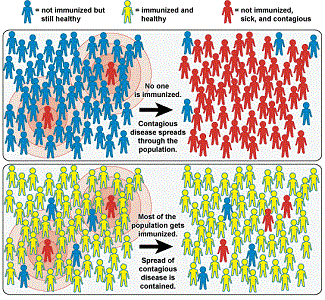
Herd Immunity
Most of the parents who opt out of having their kids vaccinated are relatively affluent and well-educated, according to science writer Tara Haelle at Forbes. She notes two reasons why measles is spreading so rapidly in California.
Those two things are the extreme infectiousness of the disease and the low levels of herd immunity, or community immunity, in pockets of southern California. Measles infects 9 out of every 10 non-immune individuals it finds. It’s airborne and hangs around up to two hours after an infected person leaves the area. It doesn’t take much for this disease to spread through a population that isn’t immune from previous exposure or through vaccination. Or, to put it another way, in an unvaccinated population, each person infected with the measles will transmit the disease to 12 to 18 other people. If no one were vaccinated against measles, we would be up to hundreds, perhaps thousands, of cases by now. We aren’t because there are some levels of herd immunity, but it’s because herd immunity has been weakened that we’re seeing additional cases at all.
She also debunks the notion that undocumented immigrants are spreading the virus.
Meanwhile, one of the biggest myths popping up in comment threads and on social media is that undocumented immigrants have something to do with this outbreak, or any other outbreak of a vaccine-preventable disease. We don’t yet know who Patient 0 – the first person with the disease – was at Disneyland, but we don’t really need to know. It’s not undocumented immigrants we should be pointing the finger at. It’s home-grown, upper-middle class, well-educated, mostly white southern California parents who have chosen not to vaccinate their children we should be giving the side-eye to. When vaccination rates in the region are below some developing countries’ rates, you don’t need undocumented immigrants to bring in the disease. Unvaccinated Americans do a fine job of that all on their own. A look at past cases makes this clear.
When the CDC tracked measles cases for the first half of 2013, they found that 159 cases resulted from 42 importations of the disease – but more than half those importations were U.S. residents returning to the States from abroad. Similarly, the outbreak of close to 400 cases in Ohio last year began with unvaccinated U.S. travelers returning from a visit to the Philippines. And the largest outbreak in San Diego since 1991 occurred in 2008 after an intentionally unvaccinated 7-year-old boy returned from a vacation in Switzerland with his family and brought back the measles. That last case is particularly of interest because the boy was a patient of Dr. Bob Sears, who has been spreading misleading information about measles in the midst of this outbreak.
Interestingly, she says that some people who have been vaccinated will still get the disease. But someone who hasn’t been vaccinated is 35 times more likely to get measles than someone who has had the vaccine.

Dr. Bob Sears
Here’s some more information about Dr. Bob Sears, and Orange County pediatrician and author of “The Vaccine Book: Making the Right Decision for Your Child.” From the LA Times: Vaccination controversy swirls around O.C.’s ‘Dr. Bob.’
While the vast majority of physicians are troubled by the anti-vaccination movement, Sears, 45, lends a sympathetic ear. About half his patients forgo vaccines altogether. To others, he offers “Dr. Bob’s” alternative and selective vaccination schedules, which delay or eliminate certain immunizations.
At a conference this year in Rancho Mirage, Sears told a roomful of pregnant women, new mothers and healthcare professionals that vaccines work well and are responsible for the nation’s low disease rate, something parents who don’t want to immunize can take advantage of.
“I do think the disease danger is low enough where I think you can safely raise an unvaccinated child in today’s society,” he said. “It may not be good for the public health. But … for your individual child, I think it is a safe enough choice.”
That approach frustrates infectious-disease experts, who in recent years have found themselves combating some celebrities’ anti-vaccination beliefs.
“We eliminated endemic measles in the U.S. in 2000. It’s now 2014 and we’re at 400 cases. Why?” Dr. Paul Offit, chief of infectious diseases at Children’s Hospital of Philadelphia, said in an interview in June. The number of cases has since risen to nearly 600. “Because people listen to Bob Sears. And, frankly, I blame him far more than I do the Jenny McCarthys of this world. Because he’s a doctor. And he should know more.”
Here’s an interesting article from The New Republic, The Best Way to Combat Anti-Vaxxers Is to Understand Them A new study underlines the similarity between “neo-liberal” thinking and the anti-vaccination movement. Well The New Republic should certainly understand neo-liberal thinking–they practically invented it. An excerpt:
“Anti-vaxxers,” as they are often referred, are an easy group to stereotype and a difficult group to humor. In most thinking circles, they are cast as “the other”; people either too stupid to understand the science behind vaccination, or too selfish to care about the impact of their choices on those around them.
But vaccine skeptics aren’t as different from their critics as we might like to think. And their rise in number over the past decade has less to do with stupidity, or even selfishness, than it does with beliefs about knowledge, trust, and freedom of choice that are pervasive throughout our culture, whether you choose to vaccinate your kids or not.
Dr. Jennifer Reich, a sociologist at the University of Colorado Denver, has been researching the anti-vaccination movement since 2007, seeking to understand the processes by which people come to reject vaccines. Over the past seven years, she has conducted in-depth interviews with parents who refuse mainstream vaccine recommendations, along with doctors, alternative healers, and public policymakers.
Not all of the parents Reich spoke with were “anti-vaxxers” in the sense that we typically think of the term; only a small minority identified as activists in the Jenny McCarthy mold, campaigning other parents not to vaccinate or advocating for policy change. Nor did they necessarily abstain from vaccination completely.
Rather, what united them was a sense that vaccines were up for negotiation: to be administered or rejected depending on the convictions of the parent and the needs of the child. Reich’s interviewees saw themselves as critical consumers of information. They engaged with doctors not as authorities to be obeyed, but as another data point to be evaluated, embraced, or discarded. They continually assessed risk: How likely was it that their child would be exposed to Disease A? What would be the consequences if they contracted Disease B?

It seems to me that what these anti-vaxxers have in common with neo-liberals is that they have lost the sense that as Americans we are all in this together. They focus only on their own needs and ignore the ways in which their choices about whether to vaccinate their children could impact others and society as a whole.
Just one more article before I wrap this up.
From Philly.com: California Measles Outbreak Shows How Quickly Disease Can Resurface in U.S.
Fifteen years after measles was declared eliminated in the United States, the recent outbreak traced to two Disney parks in California illustrates how quickly a resurgence can occur….
Experts explain the California outbreak simply.
“This outbreak is occurring because a critical number of people are choosing not to vaccinate their children,” said Dr. Paul Offit, director of the Vaccine Education Center and an attending physician at The Children’s Hospital of Philadelphia’s Division of Infectious Diseases.
“Parents are not scared of the disease” because they’ve never seen it, Offit said. “And, to a lesser extent, they have these unfounded concerns about vaccines. But the big reason is they don’t fear the disease.” ….
Researchers have found that past outbreaks of vaccine-preventable diseases are more likely in places where there are clusters of parents who refuse to have their children vaccinated, said Saad Omer, an associate professor of global health, epidemiology and pediatrics at Emory University School of Public Health and Emory Vaccine Center, in Atlanta.
“California is one of the states with some of the highest rates in the country in terms of exemptions, and also there’s a substantial clustering of refusals there,” Omer said….Other reasons include the belief that their children will not catch the disease, the disease is not very severe and the vaccine is not effective, Omer noted.
In California, vaccine exemptions have increased from 1.5 percent in 2007 to 3.1 percent in 2013, according to an analysis by the Los Angeles Times.
So, in a sense California is endangering people in other states. Omer says there’s recent legislation to make it more difficult to get exemptions, but “it is too soon to know the effects of the new law.”
So . . . comment on this issue if you wish; but feel free to treat this as an open thread. Have a great day Sky Dancers.
Tuesday Reads
Posted: January 20, 2015 Filed under: Barack Obama, morning reads, Republican politics, U.S. Economy, U.S. Politics | Tags: State of the Union Address 2015 12 Comments
Good Morning!!
Tonight President Obama will give his sixth State of the Union Address. Yesterday, Dakinikat wrote about Obama’s proposal to increase taxes on the wealthy to benefit the middle class. Obviously that isn’t going to pass muster with our Republican Congress, but maybe it will at least embarrass some members just a little bit. We’ll have a live blog tonight during the speech, and I hope you’ll join us.
Here are a few stories to check out before tonight.
From The Washington Post: Obama will give State of Union address against backdrop of deep partisan divide. Author David Nakamura seems concerned that the president isn’t interested in being “conciliatory” toward Republicans.
The president will enter the House chamber Tuesday night for his sixth State of the Union address riding a wave of confidence driven by an improving economy and brightening public approval ratings. And he seems as defiant as ever.
Although Obama has vetoed just two bills in his six years, the White House has threatened to veto five measures from Congress this month alone — including legislation that would authorize the Keystone XL oil sands pipeline, tie funding of the Department of Homeland Security to a rollback of Obama’s executive actions on immigration, and impose new economic sanctions on Iran.
Obama vowed in a private meeting with Democrats last week that he will play “offense” during the final two years of his presidency, building on the aggressive executive actions he laid out over the past two months. The legislative proposals he has previewed — including a plan for free community college and a revamping of the tax code — have been based firmly on his terms, drawing objections from Republicans.
The nerve of this guy! He tried to reach across the aisle for years, and now he’s given up the ghost. Shocking.
Joni Ernst is not the next Sarah Palin.
And Tuesday night, she’ll get the chance to prove it.
The SOTU will be followed by a Republican response by newly elected Iowa Senator Joni Ernst. Will she castrate a hog during her presentation? Ben Jacobs at The Daily Beast writes:
Ernst, the gun totin’, hog castrating freshman Republican senator from Iowa will give her party’s response to the State of the Union—a tricky, high-profile task that have landed many before her at the bad end of a punchline.
But the prime time address not only gives Ernst a chance to show off her Iowa charm, it gives her the opportunity to shed the comparison to Sarah Palin that she attracted as she campaigned through the Hawkeye State’s 99 counties last year as a populist conservative.
Once called an “onion of crazy” by Democratic National Committee chairwoman Debbie Wasserman Schutz (D-Fla.), the Iowa senator first gained national attention in a crowded, if undistinguished, primary field with an television ad about castrating hogs. She followed that up with another advertisement that featured her in safety glasses firing away at a target while the voiceover boasted that she kept “more than lipstick in her purse.”

CNN notes that recent responses to the SOTU have not gone well and asks “Is the State of the Union response cursed?”
“It’s almost like the kiss of death to get picked to do the Republican response,” said Elaine Kamarck, a senior fellow at the Brookings Institution. “It represents an amazing opportunity to catapult yourself into the national conversation, but the risk is huge and the success rate has been minimal at best in recent years.”
Republicans couldn’t have been more excited to spotlight their Indian-American wunderkind Bobby Jindal, Louisiana’s governor, in response to the first black President’s address to a joint session of Congress. But all party bigwigs and critics alike were talking about the next day was Jindal’s awkward delivery, not his prospects for higher office — and certainly not GOP diversity.It was a moment reminiscent of then-Gov. Tim Kaine’s (D-Virginia) 2006 response, when he was outdone by his own eyebrows.
And then a parched Marco Rubio took a not-so-subtle sip of water, eyes still piercing into the camera. Forget that he had delivered the first-ever bilingual rebuttal, drowned out by Rubio and his infamous water bottle.
Rubio quickly bounced back from that moment, raising more than $100,000 through his PAC by selling “RUBIO” branded water bottles. And his political fortunes are still fairly intact.
And superstitious politicos beware.
Virigina Gov. Bob McDonnell gave a rousing response straight from the Virginia state legislature in 2010. Five years later, and he’s about to start a two-year stint in federal prison over corruption charges.
Even last year’s speaker, Rep. Cathy McMorris Rodgers was accused by a former staffer of ethics violations, though that investigation died out pretty quickly.
Maybe it’s just that today’s Republicans are a sorry bunch of losers channeling the Koch brothers?

Speaking of losers, Louisiana Rep. Steve Scalise had the nerve to discuss Martin Luther King’s legacy yesterday. From The Hill: Scalise praises MLK amid controversies.
House Majority Whip Steve Scalise (R-La.) on Monday praised the legacy of slain civil rights leader Martin Luther King Jr. amid controversy over his speech to a white supremacist group while he served as a Louisiana state legislator…
“As we reflect upon the life of Rev. Martin Luther King, Jr., today, we also recognize how our nation has been strengthened by his legacy,” Scalise said in a statement.
“Dr. King challenged our country to fulfill the promises of liberty, equality, and justice prescribed in the founding of our great nation. Leading by example, he stressed the teachings of tolerance, service, and love, regardless of race, color, or creed. Today, his writings and speeches continue to empower and inspire those who seek liberty, equality, and justice,” Scalise continued.
Scalise made no mention of any events he planned to attend to commemorate the holiday.
Scalise’s comments stood out, however, given that the holiday coincides with multiple race-related controversies over his career prior to entering Congress.
For one, Scalise opposed making King’s birthday a state holiday in 2004 while he served in the Louisiana Legislature, as well as making it a school holiday in 1999.
The Hill also reported last week that Scalise voted against a resolution in the Louisiana Legislature apologizing for slavery. He later supported a version that only expressed “regret” for slavery.
“Why are you asking me to apologize for something I didn’t do and had no part of?” Scalise said, according to minutes of a 1996 Louisiana House committee meeting obtained by The Hill. “I am not going to apologize for what somebody else did.”
And, as reported in late December, Scalise in 2002 spoke before the European-American Unity and Rights Organization founded by former Ku Klux Klan leader David Duke.
Why is this man still serving as House Majority Whip?

Yesterday Think Progress noted that Scalise isn’t the only opponent the Martin Luther King holiday who still remains in power.
The Ferocious Fight Against The MLK National Holiday
After King’s assassination in 1968, Rep. John Conyers (D-MI) introduced the first Congressional legislation to create a federal Martin Luther King Day holiday. In the years that followed, Congress held congressional hearings during which hostile witnesses said “violence was exactly what [King] wanted,” and that King formed a “common front” with the “virulently racist Nation of Islam.”
More than 15 years later, Congress finally enacted such a law. The bill, signed by President Ronald Reagan, passed in the Senate on a 78-22 vote and in the House of Representatives by a 338 to 90 margin. The most vocal opponents included the late Sen. Jesse Helms (R-NC), who mounted a 16-day filibuster of the proposal and smeared King as a Communist.
Voting with Helms against the King holiday were four men who remain in the Senate today: Judiciary Chairman Chuck Grassley (R-IA), Finance Chairman Orrin Hatch (R-UT), Banking Chairman Richard Shelby (R-AL) and Armed Services Chairman John McCain (R-AZ). Shelby and McCain were in the House at the time. House Appropriations Chairman Hal Rogers (R-KY) and House Judiciary Crime, Terrorism, Homeland Security, and Investigations Subcommittee Chairman Jim Sensenbrenner (R-WI) also voted against the proposal. McCain apologized in 2008 for being too slow “to give greatness its due,” and Hatch wrote in 2007 that the vote was “one of the worst decisions” he has made as a senator.
Read more of the sorry history of the MLK holiday at the link.

Jezebel had a fascinating, though heartbreaking, story by Anna Merlen about the archaeological excavation of the graves of young boys at the Dozier School in Florida. We’ve written about this story here in the past. Merlen interviewed Dr. Erin Kimmerle, an associate professor at the University of South Florida, one of the leaders of the project.
‘They Were Truly Gone’: Solving the Mysteries of the Dozier School
The Dozier School was located in the tiny town of Marianna, West of Tallahassee and thirty minutes or so from the Georgia line. It opened in 1900 as the Florida State Reform School, and despite years of reports of serious abuse and mistreatment, it remained open for over 100 years.At least 98 people died there over the years, two staff members and 96 boys aged six to 18. Men who were once Dozier residents recounted brutal beatings they received in the White House, a small outbuilding on the school grounds whose walls remain spattered with what looks like blood. More than one survivor has called the building “a torture chamber.”
A group of men who were sent to the school in the 1950s and ’60s have banded together to tell their stories: they call themselves the White House Boys. The Tampa Bay Times has done the best coverage of the Dozier School, including an investigation in 2009 that uncovered squalid conditions, staff neglect and mistreatment from 1900 to the present day, depicting the school, as they put it, as “a place of abuse and neglect, of falsified records, bloody noses and broken bones.” [….]
Dr. Erin Kimmerle is a forensic anthropologist, an associate professor at the University of South Florida and a leader of the team excavating Dozier. (Before coming to USF, she worked as the Chief Anthropologist at the Hague, analyzing mass graves in Bosnia and Croatia.) Along with two colleagues (Antoinette Jackson and Christian Wells) and a crew of graduate students, Kimmerle has been excavating Boot Hill, the burial ground at Dozier, as well as the surrounding area and trying, through DNA testing, to return the boys’ remains to their families for a proper burial.
In January of 2014, the team exhumed 55 bodies—five more than they expected to find, 24 more than official records said were buried there. There are still many questions: how many boys lie buried under the Dozier grounds, their bodies slowly entwining with the roots of the mulberry trees around them? How did they die? And who do we hold accountable for the 100 years of suffering the Dozier school inflicted?
The interview is extremely interesting and informative. I highly recommend it.

Here’s another sad Florida story that I’ve been following. Two young sisters were arrested and charged with murder after the older girl shot and killed her 16-year-old brother on January 5.
According to the initial incident report, the girls’ father is a truck driver and their parents left them alone with their brother and a 3-year-old sister while the mother accompanied the father on a trip. The 15-year-old told police that on the day of the shooting, her brother locked her in a room with just a blanket and a bucket to use as a toilet.
According to police, she said that while her brother slept, her younger sister helped her escape the room and the 15-year-old went outside and used a knife to cut the foam around the window air conditioning unit in the window of her parents’ locked bedroom. In the bedroom, she told police, she found a handgun, loaded it, and then went into the living room where her brother was sleeping and shot him.
The arrest report says the girls then packed some things, put their 3-year-old sister in a bedroom, and walked to a nearby Dollar Store, where they called a friend, who later called police. The girls told them that the 15-year-old was routinely locked in the room her brother had kept her in.
The sisters’ parents were arrested and charged with child neglect and according to the Columbia County Sheriff’s Office are still behind bars. According to their arrest report, the mother told police the 15-year-old was locked in the room about four times a week, and the father said the longest she was locked up was 20 days. In a search of the house, police found notes written by the parents asking the girl to explain why she should be let out of the room.
It turned out that there was a long history of physical, emotional, and sexual abuse in this family. The older girl had reported that her uncle was abusing her, and he is now serving a life sentence for the crimes. In addition, the mother had caught the brother raping the 1-year old, and had told authorities, but nothing was done about it.
Police say the girls will be tried as juveniles for second degree murder. Shouldn’t this killing be viewed as self-defense though? This case has also exposed a problem with laws about incest. Acccording to CBS News, Experts: Fla. sibling shooting exposes “incest loophole.”
In 2010, the children’s aunt went to police when she found a memory stick belonging to her husband with video of him sexually molesting the oldest sister. The uncle was eventually convicted and is serving life in prison.
And the abuse did not stop there. The family began locking the girl in a room – once for 20 days – and reportedly pulled her from school due to “behavioral issues.” And among the reports released by the Columbia County Sheriff’s Office is a heavily redacted document that suggests that in 2011, when the older sister would have been 11 or 12, her mother found the girl and her brother having sex in the house. But, according to the incident report, “the case was closed as unfounded and no criminal acts were disclosed.”
“We treat sexual abuse of children in the family as a social and psychological problem and not as a crime – and it is a crime,” says Grier Weeks, the executive director of the National Association to Protect Children.
Incest is still treated more lightly by law enforcement in most states in the U.S.
According to Daphne Young of Child Help, a non-profit organization devoted to the prevention and treatment of child abuse, 68 percent of child sex abuse victims are abused by a family member. Jennifer Marsh of the Rape, Abuse and Incest National Network (RAINN) says that 40 percent of the people who call the National Sex Abuse hotline say incest is their primary or secondary reason for seeking help.
And yet, perpetrators who sexually abuse family members can be subject to lower penalties than they would be had they assaulted a neighbor or stranger. In Washington State, for example, the Special Sex Offender Sentencing Alternative Law allows an offender to receive a lighter sentence if he or she had “an established relationship with, or connection to, the victim.”
Weeks calls this “the incest loophole,” and finds it mind-boggling: “The toll on a child [abused by a family member] is devastating. She was not protected by the very people who should have loved and protected her.”
Read more at the link.
This post has gotten way too long, so I’ll just leave you with a recommendation to read a long piece at The NY Review of Books on the Citizens United decision: The Supreme Court’s Billion-Dollar Mistake, by David Cole.
What else is happening? Please post your thoughts and links in the comment thread and have a terrific Tuesday!
Lazy Saturday Reads
Posted: January 17, 2015 Filed under: morning reads, U.S. Politics, Women's Rights | Tags: abortion, Free Range Kids, mansplaining, Masha the cat, Politifact, Rand Paul, same-sex marriage, Social Security disability, U.S. Supreme Court 36 Comments
NYC Newsstand on a rainy day.
Good Afternoon!!
First, I want to thank everyone who responded to our request for help with blog expenses. We are so fortunate to have such kind and loyal readers. You guys are the greatest!
The biggest story on my mind today is the Supreme Court’s decision to rule on the same-sex marriage issue. I have to admit, I’m very nervous about it. What if the Court rules that states can ban same-sex marriages and refuse to recognize such marriages from other states? Some background from SCOTUS blog:
Taking on a historic constitutional challenge with wide cultural impact, the Supreme Court on Friday afternoon agreed to hear four new cases on same-sex marriage. The Court said it would rule on the power of the states to ban same-sex marriages and to refuse to recognize such marriages performed in another state. A total of two-and-a-half hours was allocated for the hearings, likely in the April sitting. A final ruling is expected by early next summer, probably in late June.
The Court fashioned the specific questions it is prepared to answer, but they closely tracked the two core constitutional issues that have led to a lengthy string of lower-court rulings striking down state bans. As of now, same-sex marriages are allowed in thirty-six states, with bans remaining in the other fourteen but all are under court challenge.
Although the Court said explicitly that it was limiting review to the two basic issues, along the way the Justices may have to consider what constitutional tests they are going to apply to state bans, and what weight to give to policies that states will claim to justify one or the other of the bans….
The focus of the Court’s review will be a decision issued in early November by the U.S. Court of Appeals for the Sixth Circuit. That decision, breaking ranks with most other courts, upheld bans on marriage or marriage-recognition in Kentucky, Michigan, Ohio, and Tennessee.
Friday’s order granted review of one petition from each of those states; the petitions phrase the two basic issues in somewhat different ways, which is why the Court rewrote them to make specifically clear what it intended to review.
The Kentucky case (Bourke v. Beshear) raises both of the issues that the Court will be deciding, the Michigan case (DeBoer v. Snyder) deals only with marriage, and the Ohio (Obergefell v. Hodges) and Tennessee cases (Tanco v. Haslam) deal only with the recognition question. If customary practice is followed, the first case listed in the order — the Ohio case Obergefell v. Hodges — will become the historic title for the final ruling.

The problem for the conservative justices will be that public opinion has shifted so rapidly on this issue–if they decide to limit the civil rights of LGBT Americans, there would probably be a serious backlash. From The Washington Post:
The country’s first same-sex marriage, the result of a Massachusetts court decision, took place less than 11 years ago. Now, more than 70 percent of Americans live in states where same-sex couples are allowed to marry, according to estimates.
The questions raised in the cases that the court will consider this spring were left open in 2013 when the justices last confronted the issue of same-sex marriage. A slim majority said at the time that a key portion of the federal Defense of Marriage Act — withholding recognition of same-sex marriages — was unconstitutional and in a separate case allowed same-sex marriages to resume in California.
Since then, courts across the nation — with the notable exception of the Cincinnati appeals court — have struck down a string of state prohibitions on same-sex marriage, many of them passed by voters in referendums. Many of those court decisions compared the prohibitions to the ones on interracial marriage that the Supreme Court struck down in 1967 in Loving v. Virginia.
When the Supreme Court declined to review a clutch of those decisions in October, same-sex marriage proliferated across the country.
Couples may now marry in 36 states and the District. Three in four same-sex couples live in a state where they are allowed to wed, according to estimates by the Williams Institute at the UCLA School of Law.
Chief Justice John Roberts will have to keep all that in mind if he cares about his place in history.

While we’re talking about the conservative trend on the Supreme Court, take a look at this sobering article at Think Progress: If You Want To Understand What’s Happened To The Supreme Court, You Need To Listen To Rand Paul.
Senator Rand Paul (R-KY) is an odd place to seek counsel on the Constitution. As a Senate candidate in 2010, Paul told a Louisville editorial board that he opposed the federal ban on whites-only lunch counters, claiming that the right of “private ownership” should trump the right to be free from racist discrimination. Opposing a core protection for racial minorities, according to Paul, is “the hard part about believing in freedom.” He later suggested that civil rights laws targeting private businesses may exceed Congress’s power under the Constitution’s Commerce Clause — a view the Supreme Court unanimously rejected in 1964.
Yet the Heritage Foundation, one of the backbones of the conservative movement in Washington, DC, invited Paul to speak at length on the Constitution and the role of the judiciary earlier this week. If the audience was upset that voters sometimes elect leaders who disagree with the Heritage Foundation, they were no doubt enraptured by Paul’s vision for the courts. Senator Paul’s speech was a repudiation of democracy, and he called for the Supreme Court to assume a dominant role in setting American policy that it abandoned three generations ago. Under Paul’s vision, the minimum wage is forbidden and union busting is constitutionally protected. The New Deal is an illegitimate expansion of federal power, and more recent efforts to ensure that no one dies because they cannot afford health care are an abomination.
“I’m a judicial activist,” Paul proudly proclaimed.
Nevertheless, Paul’s speech to the Heritage Foundation is worth watching in its entirety. It lays out a vision that is closer than the Court’s current precedents suggest, and that could easily become a reality if the Court’s older members are replaced by younger conservatives. Moreover, as I explain in my book, Injustices: The Supreme Court’s History of Comforting the Comfortable and Afflicting the Afflicted, a Supreme Court committed to Paul’s economic agenda would hardly be unprecedented in American history. If anything, Paul is asking the Court to return to its self-appointed role as the vanguard against democracy.

While state legislators ate eggs and drank coffee in a Manchester diner, Paul suggested that half of the recipients of federal disability relief are “gaming the system” because they are able to work. He also told them the arguments against building the Keystone XL pipeline are “this sort of Luddite, flat-earth, that my goodness we shouldn’t have cars” mentality.
It was Paul’s comments about disability benefits that drew the most attention, largely because Democrats quickly pounced.
During a question-and-answer period, Paul was asked about government programs and welfare.
“You know, the thing is that all of these programs — there’s always somebody who is deserving. Everybody in this room knows somebody who is gaming the system,” said Paul.
“What I tell people is, if you look like me and you hop out of your truck, you shouldn’t be getting a disability check,” Paul said. “You know, over half the people on disability are either anxious or their back hurts. Join the club. Who doesn’t get up a little anxious for work every day and their back hurts? Everybody over 40 has a back pain.”
Really? I’m over 60, and I might get a little bit stiff sometimes, but I certainly don’t have chronic back pain. Let’s see what the fact checkers have to say about Paul’s claim.

Politifact: Rand Paul says most people receive disability for back pain, anxiety.
You can read the whole article for the details and some caveats, but here’s the bottom line:
Paul said, “Over half the people on disability are either anxious or their back hurts.”
The numbers don’t add up. The two broader disability categories that include back pain (“diseases of the musculoskeletal system”) and anxiety disorders (“mental disorders – other”) don’t even equal close to 50 percent, let alone those two ailments by themselves.
Paul’s quip might make for a good soundbite, but it’s not rooted in reality. We rate the statement False.
As for people “gaming the system,” Politifact notes a report from the Government Accountability Office that estimated that
…in fiscal year 2011, the Social Security Administration made $1.29 billion in potential cash benefit overpayments to about 36,000 individuals who were working and making more than $1,100 a month (the limit to receive disability benefits).
The 36,000 people receiving improper payments, while a lot on paper, represent about 0.4 percent of all beneficiaries, the report said.
Talking Points Memo posted a video of three “christian” men “apologizing” to women for allowing them to have abortions. It’s the most patronizing bit of mansplaining I’ve seen I’ve seen in a very long time. From TPM:
“I conceded to an abortion,” Pastor Shane Idleman says. “That decision still haunts me today.”
Against a montage of giggling, joyful children and babies, the men discuss how much they regret the decision and take responsibility for letting down God, women and their unborn children.
“I should’ve manned up and I should’ve fought for you and — I didn’t,” John Blandford says. “I didn’t.”
Then come the apologies to all women who have had an abortion, women who have been “subjected to such a terrible thing,” women who “no one tried to rescue,” and women who have “tried to hide this from everyone.”
“I’m sorry for men not taking a greater stand in this area,” Idleman says.
“I’m sorry that, I’m sorry that this is available,” Daniel Phillips says.
But don’t worry all you sinful women “hid[ing] in shame and darkness,” you can always repent and ask god to forgive you. Watch the video yourself if you can stomach it.
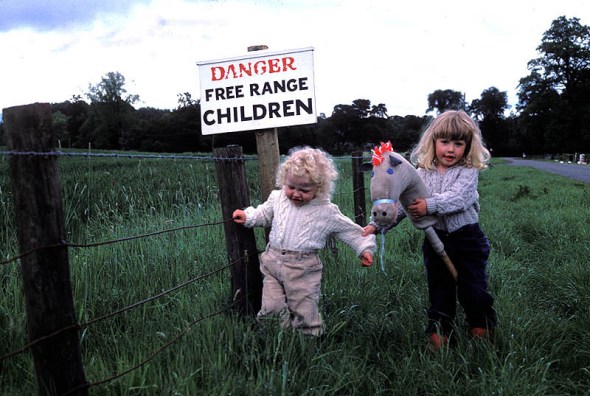
Here’s an interesting story from Slate’s Hanna Rosin about the “free range parenting movement.”
On a recent Saturday afternoon, a 10-year old Maryland boy named Rafi and his 6-year old sister, Dvora, walked home by themselves from a playground about a mile away from their suburban house. They made it about halfway home when the police picked them up. You’ve heard these stories before, about what happens when kids in paranoid, hyperprotective America go to and from playgrounds alone. I bet you can guess the sequence of events preceding and after: Someone saw the kids walking without an adult and called the police. The police tracked down the kids and drove them home. The hitch this time is, when the police got there, they discovered that they were meddling with the wrong family.
Danielle and Alexander Meitiv explicitly ally themselves with the “free range” parenting movement, which believes that children have to take calculated risks in order to learn to be self-reliant. Their kids usually even carry a card that says: “I am not lost. I am a free-range kid,” although they didn’t happen to have it that day. They had carefully prepared their kids for that walk, letting them go first just around the block, then to a library a little farther away, and then the full mile. When the police came to the door, they did not present as hassled overworked parents who leave their children alone at a playground by necessity, or laissez-faire parents who let their children roam wherever, but as an ideological counterpoint to all that’s wrong with child-rearing in America today. If we are lucky, the Meitivs will end up on every morning talk show and help convince American parents that it’s perfectly OK to let children walk without an adult to the neighborhood playground.
Perhaps if they had been black and lived in South Carolina, they would have been arrested like Debra Harrell, the single mother who let her daughter go to the playground while she was working at McDonald’s. As white suburban professionals, the Meitivs experienced a lower level of intrusion, but still one that would make any parent bristle. The police asked for the father’s ID, and when he refused, called six patrol cars as backup. Alexander went upstairs, and the police called out that if he came down with anything else in his hand “shots would be fired,” according to Alexander. (They said this in front of the children, Alexander says.) Soon after, a representative from Montgomery County Child Welfare Services came by and required that the couple sign a “safety plan” promising not to let the children go unsupervised until the following week, when another CPS worker would talk to them. At first, the dad refused, but then the workers told him they would take the kids away if he did not sign.
It’s a thought-provoking piece. Read more at the link.

Finally, a feel-good story, thanks to Ralph B., who posted it on Facebook.
From The Washington Post: Russia’s heroic cat Masha: She’s credited with saving an abandoned infant from winter’s deep freeze.
Masha the cat – as the stray is called by the residents of the building she calls home in Obninsk – found the infant in an entryway Saturday night and climbed into the box in which the baby had been left.
One of the building’s residents heard the cat and the baby’s cries. At first, Nadezhda Makhovikova just thought she was hearing Masha in some sort of distress. “When I went down, I saw it was a baby crying,” Makhovikova told REN TV earlier this week.
Reports said the baby had been left with a pacifier, bottle and diapers, and was dressed warmly, wearing a little hat, as residents described him – though he likely would have had difficulty staying warm enough to survive a whole night in the sub-freezing temperatures in the area.
Residents called an ambulance, which whisked the baby away to a local hospital – but not before Masha would try to accompany the baby on the way.
Here’s a video about Masha. It’s in Russian, but you can get the gist.
So . . . what else is happening? Please share your thoughts and links in the comment thread and enjoy the long weekend!
Thursday Reads
Posted: January 15, 2015 Filed under: morning reads | Tags: #RememberOurGirls, Boko Haram attacks, Boston Olympics 2024, cartoonists, Charlie Hebdo attack, FBI sting operations, hypocrisy, January thaw, national warming trend, Suicide Attacks 20 Comments
Good Morning!!
Before I get started on the news, I need to ask our readers for a little help. We need about $50.00 to pay WordPress for upkeep on the blog–for our design and extra storage space, that kind of thing. We’d be very grateful if some of our readers would kick in just a small amount to help us pay our bills. If you can spare a few bucks, please click on the “Make a Donation” button down below on the right. Thanks for whatever you can do.
Now that that’s out of the way, on to the news of the day.
A Change in the Weather
Mother Nature has decided to be kind to those of us who are sick and tired of being so cold. There’s a warming trend on the way! From the Weather Channel, January Thaw: Weather Pattern Change to Erase Arctic Blast.
While weather patterns can get “locked in” for lengthy periods of time, one thing is for sure: Change will occur if you wait long enough. If you’re sick of bone-chilling temperatures, you’re in luck. A thaw is now taking shape thanks to a large-scale weather pattern change.
Wednesday morning was the last hurrah for the worst of the cold, with subzero readings again over the Great Lakes as well as parts of the interior Northeast.
A temperature moderation began Wednesday and will accelerate Thursday into Friday.
Our Friday forecast high temperature compared to average map shows that much of the Plains, Rockies and West will be engulfed by above-average temperatures. Some cities, including Omaha, Nebraska and Fargo, North Dakota, could be 10 to 20 degrees above mid-January averages.
The above-average warmth will spread to the East Coast over the weekend.
Read more and watch a video at the link. For the Boston area, it means that for the next 10 days it will be in the 30s and 40s instead of the ‘teens and single numbers. I hope you’ll get warmer days where you live too!

Twentieth Century Newsstand, by Ken Keeley
Boston Olympics Update
On Saturday, I wrote an anguished post about a the Olympic Committee submitting Boston as the U.S. location for the Summer Olympics in 2024. I think this would be a disaster for the city I love. Today The Boston Globe reported on the organized opposition to bringing the Olympics here.
Boston’s Olympic Opposition Lays Out Arguments and Plans.
Boston Mayor Marty Walsh and the Olympic bidding group Boston 2024 have said they believe the majority of the public supports holding the 2024 Summer Games in the Hub. With little public polling on the issue to this point, it’s hard to judge whether that’s the case.
But if No Boston Olympics, the group leading the opposition to the city’s bid, does represent a minority, it showed that it plans to be a vocal one at a public meeting it held in the Back Bay Tuesday night. More than 100 people attended the meeting at the First Church in Boston.
The meeting featured a talk by sports economist and Smith College professor Andrew Zimbalist.
Zimbalist, who has written extensively on the lack of economic benefits sporting events like the Olympics bring to cities and countries, scoffed at the idea that Boston’s bid can be done on a $4.5 billion budget for operating expenses, and said he was skeptical that the budget can be entirely privately financed (as is proposed by Boston 2024). Boston 2024 also says public money would go toward infrastructure and security.
Zimbalist discussed some of the hidden expenses to hosting the Olympics, including the loss of advertising revenue on the MBTA during the Olympics. (The International Olympic Committee has historically required control of advertising space in the host city during and around the Olympics. An example of host city requirements built into the bidding process can be seen here, from page 213 on.) He also said that construction costs can go up if planning falls behind at all, because projects may need to be done in a rush as the Games approach.
“It’s one thing to have a nice idea and say the private sector is going to cover this,” he said. “It’s another thing to have hard contracts.”
On possibility the group is considering is getting a question on the ballot in 2016. This has worked in some cities in the past.
In other cities across the country and the world, opposition groups to Olympic bids have gone directly to the voters. Bids for the 2022 Winter Olympics lost in referendums in Poland and Switzerland.
Perhaps most famously, Colorado voted not to put any state money toward a 1976 Denver Winter Olympics bid. At the time of the bid, Colorado had already been awarded the games for that year by the IOC. But voters said no, leaving the IOC high and dry and in need of a new host. (It got one, in Innsbruck, Austria.) [….]
But going to the voters is not the only method opposition groups have used to oppose the games. A referendum in Oslo, Norway, over whether to host the 2022 Games passed in 2013. Even so, that bid was eventually dropped as the public soured on the idea over the course of the next year. And in Chicago’s bid for the 2016 Games, the Windy City’s opposition group had the opportunity to meet with the IOC and voice its concerns. The IOC ended up choosing Rio, Brazil. It’s also possible the Olympic bid could turn into a 2016 state elections issue.
How do voters feel about the Olympics coming here?
Public opinion polling on the Boston bid has been pretty sparse, but in a survey of likely Massachusetts voters earlier this year, The Boston Globe found 47 percent support for pursuing a bid, with 43 percent against. When asked if they supported taxpayer money going to funding the games, 64 percent of respondents were against the idea, though.
So there is a realistic chance of preventing what I believe would be a terrible mistake.

Boko Harum Attacks
I thought I’d follow up on Dakinikat’s post from Monday, in which she called out the hypocrisy the media and cultural elites for expressing faux outrage over the Charlie Hebdo attack in Paris, while basically ignoring the horrific Boko Harum attacks in Nigeria. Other writers around the internet also noted the disparity in coverage; and several days later, the corporate media has begun to call more attention to the Nigerian situation.
From CNN, Satellite images show devastation of Boko Haram attacks, rights groups say.
Charred ground and cinders mark the sites where once thousands of homes stood. That’s according to a series of satellite images released Thursday by Amnesty International, which the rights group said shows the “horrific scale” of the devastation wrought by Boko Haram militants.
As they’ve trickled out, accounts of the bloody attackson the northern Nigerian town of Baga and surrounding villages have shocked even those all too used to reports of violence by Boko Haram militants.
Witnesses told how the attackers sped into the town on January 3 with grenade launchers — their gunfire and explosions shattering the early morning calm. Some terrified residents fled, while others took refuge in their homes — and were torched with them.
Local officials reported death tolls ranging from hundreds to as many as 2,000 people. But authorities have yet to access the remote area near the border with Chad to get a full picture.
View the before and after satellite images at the CNN link. Tens of thousands of people have been displaced by the attacks.
Of the 30,000 people displaced during the latest attacks, 20,000 camped in Maiduguri city, capital of Borno state, while another 10,000 headed to Monguno town, nearer Baga. Others were stranded on Kangala Island on Lake Chad.
“These people are adding to the hundreds of thousands of internally displaced people and refugees, who have already stretched the capacity of host communities and government authorities,” Amnesty International said….
Boko Haram has terrorized northern Nigeria regularly since 2009, attacking police, schools, churches and civilians, and bombing government buildings.
It has also kidnapped students, including more than 200 schoolgirls who were abducted in April — and remain missing.

Out of Print, by Mariam Meckel
NBC Nightly News reported on Boko Haram’s apparent use of the kidnapped girls as unwitting suicide bombers.
Three suicide bombings by girls aged as young as 10 suggest that Nigeria’s Boko Haram has employed a new tactic of forcing abducted children to blow themselves up, according to experts.
The Islamist sect has been carrying out almost daily killings and kidnappings across northeast Nigeria in a campaign of violence now in its sixth year. Deadly attacks on Saturday and Sunday were carried out by three young female suicide bombers.
These came just days after a week-long killing spree by Boko Haram, in which the group torched at least 10 towns leaving around 2,000 people unaccounted for. Secretary of State John Kerry on Thursday called the attack “a crime against humanity.”It is not clear if the girls were coerced or were even aware they were strapped with explosives, which may have been detonated remotely. But experts say that Boko Haram appears to be using the children it kidnaps — such as the 276 Chibok girls who sparked the #BringBackOurGirls social media campaign — and using them as a readily available supply of suicide bombers.
“It is highly likely that Boko Haram is conscripting young girls to use as suicide bombers,” said Elizabeth Donnelly, assistant head of the Africa program at London’s Chatham House think tank. She told NBC News that these conscripts were little more than “slaves fed by countless abductions since the crisis started.”
Boko Haram roughly translates to “Western education is sinful.” The group aims to create its own state based on strict Islamic law.

Newsstand, by Linda Apple
At Huffington Post, Okello Kelo Sam wrote about the #RememberOurGirls twitter campaign, Amid Boko Haram’s Latest Killings: I Vow to #RememberOurGirls.
Eight months is a long time. Long enough for international outrage to rise, fall and fade away. That’s how long it’s been since Boko Haram militants stormed a secondary school in the northeastern village of Chibok in Borneo State, abducting more than 200 still-missing teenage girls.
A global Twitter campaign – #BringBackOurGirls – caught fire with the help of US First Lady Michelle Obama, former US Secretary of State Hilary Clinton, UK Prime Minister David Cameron and, most importantly, millions of global hashtag activists. They focused the world’s attention on the girls, leading to support from the US, UK, France, Canada, China, Iran and Israel, reportedly in the form military intelligence and special forces…..
Meanwhile, the international efforts to recover the girls failed. So did several rounds of negotiations to exchange the girls for the release of captured Boko Haram fighters held in Nigerian jails….
Sam himself was a victim of the violence in Africa. He was abducted and forced to be a child soldier in Uganda. He was able to escape, but later his younger brother was also forced into combat with Joseph Kony’s group and lost his life.
Yes, I lost my brother. But I never lose hope. I do, however, fear hope for the Nigerian girls is slipping away, internationally. Media tickers marking the days since their abduction have disappeared from front pages, web pages and broadcast reports. Sometimes I wonder: Does anyone still remember the 219 missing girls?
They do in Abuja. Every day the Bring Back Our Girls demonstrators – which fueled the hashtag campaign – rally at Unity Fountain in Abuja, Nigeria’s capital. Families of the missing girls, neighbors, and fellow countrymen congregate and chant the now-familiar mantra: “Bring back our girls.” [….]
It’s easy to naysay advocacy efforts like #BringBackOurGirls as “slacktivism.” After four million Tweets, the 219 girls have not been rescued. So what’s the point, right? Wrong. Until a social-media savvy Nigerian lawyer, Ibrahim Abdullahi, came up with #BringBackOurGirls, there was a practical media blackout of the abductions.
Had it not been for this social media campaign I wonder if anyone outside of Africa would know about the Chibok girls? Would the story have lasted more than one news cycle in the West? Would you be reading this now?
No, social media won’t return the girls. But it got my attention and probably yours. It’s been said by the demonstrators what is needed is a renewed campaign to once again gain mindshare of a distracted world. Mine is one voice of millions demanding the girls’ rescue. But I stand in solidarity with those at Unity Fountain and declare this My 2015 Resolution: I will #RememberOurGirls.
Please go read the whole article at HuffPo. Today, I resolve to remember those lost girls.
Newsstand, by Sol Robbins
In Other News . . .
CNN, After four years, American cartoonist Molly Norris still in hiding after drawing Prophet Mohammed.
Vox, Vox got no threats for posting Charlie Hebdo cartoons, dozens for covering Islamophobia
NYT, Oklahoma to Resume Executions 9 Months after a Lethal Injection Went Awry.
WCVB Boston, Phase 2 of jury selection set to begin in Tsarnaev trial: Judge set to start questioning prospective jurors.
The Hill, GOP presidential convention to be held earlier in 2016.
SFGate, Ohio man accused of plotting to attack US Capitol, arrested.
ABC News, Dad Accuses FBI of Setting Up ‘Mommy’s Boy’ Son in Bomb Plot.
WaPo, Teachers: Ohio man accused in terror plot a typical student.
Global Research, FBI Thwarts Terror Plot on Capitol (That They Planned).
Vox, Days after free-speech rally, France arrests a comedian for this Facebook post.
Mediaite, ‘Je Suis Confused’: Stewart Tackles France’s Hypocrisy for Arresting Comedian.
CBS New York, De Blasio: I Won’t Apologize To Police For My ‘Fundamental Beliefs’.
What stories are you following today? Please post your thoughts and links in the comment thread and have a tremendous Thursday!
Tuesday Reads
Posted: January 13, 2015 Filed under: Barack Obama, Foreign Affairs, morning reads, U.S. Politics | Tags: 47 percent, Barbara Boxer, Charlie Hebdo magazine attack, Dick Morris, Gavin Newsome, golden globes, Jack Ohman, Kamala Harris, laws protecting satire, Mitt Romney, Paul Ryan, Ted Cruz 42 Comments
Good Morning!!
At left is the cover of the next issue of Charlie Hebdo. It depicts the Prophet Muhammed holding a “Je suis Charlie” sign, with the words “all is forgiven” over his head.
The Wall Street Journal: Charlie Hebdo Puts Muhammad on Cover of Post-Attack Issue.
PARIS—Since Charlie Hebdo lost eight staff members in a terrorist attack last week, millions of people have declared their support to the French satirical magazine with the slogan “Je Suis Charlie.”
Now the often-caustic publication, faced with the challenge of reconciling its new status as a cause célèbre with its reflex to mock, ridicule and offend, is putting a caricature of the Prophet Muhammad on the cover of what is likely to be their most-read issue ever.
Distributors said Monday they were preparing to print as many as three million copies of Wednesday’s issue, 50 times the normal circulation. That is raising pressure on a small outlet known for skewering all forms of authority—including some that have rushed to its defense.
Suddenly the political and social elites who most likely had never heard of the small satirical magazine before the attack are parading around Paris and the Golden Globes pretending to be defenders of free speech. And what about the U.S. “journalists” who are little more than corporate lackeys who echoed right wing memes about President Obama supposedly not caring enough to attend a rally in France?
“It’s been extremely moving—and also hypocritical,” said Laurent Léger, a reporter for the magazine who survived the shooting. “All of a sudden, we are supported by the entire world. Whereas for years we were completely alone.” [….]
Another target for this week’s issue is likely to be Sunday’s solidarity march in France, surviving staff members said. The massive rally became a magnet for French and international political figures that have been a mainstay in Charlie Hebdo’s pages. Attendees included dignitaries from Turkey, Egypt, and Russia, countries that it has criticized for curbing free speech.
“All those dictators at a march celebrating liberty,” Mr. Léger said. “We of course are going to continue the mockery. We’ll see if it makes them jump.”

That’s great news. As Dakinikat trenchantly pointed out yesterday, these same elites routinely ignore horrifying acts of terrorism that kill people who aren’t as high profile as the victims in Paris. And, as Dak also pointed out, it turns out those world leaders in Paris didn’t really march with the hoi-polloi. They just participated in a fake photo that showed them pretending to march. Dakinikat also posted this story from The Daily Banter in a comment yesterday, but I think it deserves to be front paged.
Now That These Leaders Are Done Pretending to March, They Should Pass Legislation Protecting Satire, by Bob Cesca.
President Abbas marched in Paris on Sunday, but a satirist in Gaza has been jailed for poking fun at the Palestinian leader.
It’s entertaining to observe the lengths to which American conservatives will overreach in order to make a nothing issue into a major scandal. Such is the case following the unity march in Paris, attended by 3.7 million people and world leaders from 40 nations. As we covered earlier today, conservatives all around are busily scolding and shaming the president for not walking hand-in-hand with those leaders, even though no president has ever marched in a protest rally overseas. Ever. But this president is, for some reason, held to a different standard than the 43 previous chief executives. It’s about “optics” they say. I often agree with that criticism and I agree that optics are important — except for the fact that no other president has been responsible for creating similar optics.
There’s another layer to this fracas. While lionizing the world leaders who marched in Paris, allegedly in support of Charlie Hebdo and free speech, critics of the president are neglecting two very important points.
1) British Prime Minister David Cameron, German Chancellor Angela Merkel, Israeli Prime Minister Benjamin Netanyahu, Palestinian President Mahmoud Abbas and French President Francois Hollande weren’t actually marching with the demonstrators. Their participation was staged on an empty street surrounded by security and merely photographed to look like it was part of the broader rally. It wasn’t.
2) Take a guess at how many of the nations represented by those leaders have statutes protecting satire as free speech? Not one. Indeed, there’s only one western nation where satire is protected speech. It’s the United States. Thanks to the Supreme Court’s unanimous decision in Hustler Magazine, Inc. v. Falwell, Americans can’t be sued by other Americans for producing satire against public figures — regardless of whether the satire describes Jerry Falwell having incestuous sex or whether Saturday Night Live lampoons the president. They can try to sue, but the suit will never see the light of day.
So, while we’re applauding those 40 leaders for marching in a staged photo-op in support of a satirical magazine, bear in mind that none of those leaders come from nations where satirical speech is protected. In David Cameron’s England, for example, the prime minister or any public figure can sue cartoonists, writers, filmmakers or the producers of an SNL-style sketch show for making fun of them on television or elsewhere, and those lawsuits can actually be adjudicated and the plaintiffs can win. The same is true across the European Union and absolutely throughout the Middle East.
Frankly, I wish the White House hadn’t backed down and apologized.

One of the loudest voices criticizing the president for not going to a European “unity rally” was Texas Senator Ted Cruz. Time Magazine actually published an op-ed by Cruz yesterday.
On Sunday, leaders representing Europe, Israel, Africa, Russia, and the Middle East linked arms and marched together down Place de la Concorde in Paris. But, sadly, no one from the White House was found among the more than 40 Presidents and Prime Ministers who walked the streets with hundreds of thousands of French citizens demonstrating their solidarity against radical Islamic terrorists.
In other news . . .
Now that Senator Barbara Boxer (D-CA) has officially announced that she won’t run for reelection, there’s a “New Gold Rush” in California, according to Bill Press at The Hill.
Barbara Boxer’s announcement that she will not seek reelection to the Senate has set off a frenzy in California not seen since the Gold Rush. Anybody could win. All you need is a pick, an ax and the ability to raise or cough up a minimum $40 million.
Wanna play? Lots of people do.
In fact, with Boxer and Dianne Feinstein occupying both Senate seats since the early ’90s, and Jerry Brown’s longtime lock on the governor’s office, younger California Democrats have been bottled up in a no man’s land for years, taking turns rotating among lesser state offices, waiting for their chance at the big time. Boxer pulled the plug. Now all that pent-up energy and ambition is bursting out. It’s fun to watch.
Three statewide officials might have the edge, but only because they’ve already run statewide a couple of times. State Attorney General Kamala Harris and Lt. Gov. Gavin Newsom have reached a pact not to run against each other, and Newsom’s already taken himself out of the race. That leaves Harris. But don’t count out state Treasurer John Chiang. He’s young, charismatic and still gets high marks for refusing to carry out former Gov. Arnold Schwarzenegger’s order to cut the minimum wage for state employees during a budget showdown.

Kamala Harris
Yesterday, Gavin Newsom announced that he’s not running for Boxer’s seat, and today Kamala Harris will announce that she’s throwing her hat into the ring. According to the LA Times story,
Former Los Angeles Mayor Antonio Villaraigosa and billionaire environmental activist Tom Steyer are seriously considering bids, as are several members of Congress. On the Republican side, Assemblyman Rocky Chavez and two former state GOP chairmen are weighing runs.
Former VP candidate Rep. Paul Ryan (R-WI) announced yesterday that he’s not going to climb into the GOP clown car in 2016. From an interview with NBC News:
“I have decided that I am not going to run for president in 2016,” Ryan said in a phone interview, noting that he is “at peace” with the decision he made “weeks ago” to forgo a bid for the White House.
“It is amazing the amount of encouragement I have gotten from people – from friends and supporters – but I feel like I am in a position to make a big difference where I am and I want to do that,” he said.
The nine-term congressman believes he can make that “big difference” in his new role as chairman of the influential House Ways and Means Committee rather than as a presidential contender.
The committee will meet Tuesday to kick off the new Congress. By announcing that he’ll pass on a White House run, Ryan hopes to demonstrate that he’ll devote his “undivided attention” to the committee, although he admits that it will be “bittersweet not being on the trail” as a candidate this upcoming cycle.
Ryan has never initiated an important piece of legislation and gotten it passed, but now he’s going to head one of the most powerful committees in Congress. Let’s hope he continues his lack of meaningful accomplishments.

In other 2016 news, it looks like Mitt Romney is actually going to run for president for a third time. From The Washington Post, Romney moves to reassemble campaign team for ‘almost certain’ 2016 bid.
Mitt Romney is moving quickly to reassemble his national political network, calling former aides, donors and other supporters over the weekend and on Monday in a concerted push to signal his seriousness about possibly launching a 2016 presidential campaign.
Romney’s message, as he told one senior Republican, was that he “almost certainly will” make what would be his third bid for the White House. His aggressive outreach came as Rep. Paul Ryan (R-Wis.) — Romney’s 2012 vice presidential running mate and the newly installed chairman of the House Ways and Means Committee — announced Monday that he would not seek the presidency in 2016.
Romney’s activity indicates that his declaration of interest Friday to a group of 30 donors in New York was more than the release of a trial balloon. Instead, it was the start of a deliberate effort by the 2012 nominee to carve out space for himself in an emerging 2016 field also likely to include former Florida governor Jeb Bush, New Jersey Gov. Chris Christie and Wisconsin Gov. Scott Walker.
Romney has worked the phones over the past few days, calling an array of key allies to discuss his potential 2016 campaign. Among them was Ryan, whom Romney phoned over the weekend to inform him personally of his plans to probably run. Ryan was encouraging, people with knowledge of the calls said.
Other Republicans with whom Romney spoke recently include Sens. Kelly Ayotte (N.H.) and Rob Portman (Ohio), former Minnesota governor Tim Pawlenty, Hewlett-Packard chief executive Meg Whitman, former Massachusetts senator Scott Brown, former Missouri senator Jim Talent and Rep. Jason Chaffetz (Utah).
According to Politico’s Maggie Haberman and James Hohmann, Romney is promising he’ll be ‘different’ this time.
…interviews with more than a dozen staffers and supporters who have recently spoken with Romney reveal conversations in which he promises a “different” path forward without providing specifics about what that means as far as mechanics and his own sometimes gaffe-ridden performance. And, aside from most of his communications team, Romney would still be expected to bring back the majority of his old staff, sources said.
“He really has to show people that he’d do it differently, rather than just say he’d do it differently,” said a former top adviser to Romney, one of half a dozen alumni to speak Monday with POLITICO. “He needs to assure folks he’d take a much more direct approach to laying out the vision for his campaign versus having those decisions driven by a bunch of warring consultants.”

Mother Jones has posted a series of quotes in which Romney said he wouldn’t run again, along with the famous “47 percent” video.
Finally, from Boomberg Politics, David Weigel reports that Not a Single Person Has Donated to Dick Morris’s Anti-Hillary Super PAC.
Hahahahahahahahaha!!!!
What else is happening? Please post your thoughts and links in the comment thread, and have a terrific Tuesday!

 peej
peej Carissa
 bostonboomer
 dakinikat
 ecocatwoman
 mablue2
 Mama Lopez
 peggysue22
 quixote
 skydancingguestblogger
 Mona (aka Wonk the Vote)



 Sky Dancing
Recent Comments