Posted: April 22, 2017 | Author: bostonboomer | Filed under: Afternoon Reads, U.S. Politics |

Good Afternoon!!
Today is Earth Day, and science marches are going on around the world. The Washington Post reports: Why people are marching for science: ‘There is no Planet B.’
Earth Day has arrived, and so has the March for Science — a global event on six continents (and cheered on by scientists on a seventh, Antarctica). Thousands of people have gathered on grounds of the Washington Monument for a four-hour rally that will culminate in a march down Constitution Avenue to the foot of Capitol Hill.
“We are at a critical juncture. Science is under attack,” said Cara Santa Maria, a science communicator who is one of several emcees of the rally. “The very idea of evidence and logic and reason is being threatened by individuals and interests with the power to do real harm.”
The article describes the DC march at length; you can read about at the link. A bit more on the rationale:
Some scientists in recent weeks have said they worried the march would politicize the broader scientific enterprise and signal an alignment with left-leaning ideologies. The march’s website offered an answer to that concern: “In the face of an alarming trend toward discrediting scientific consensus and restricting scientific discovery, we might ask instead: can we afford not to speak out in its defense? There is no Planet B.”
The Washington march may be the biggest gathering — organizers have a permit for up to 75,000 people — but there are similar events in more than 600 cities on six continents. Seven researchers in Antarctica went on Twitter to express their support for the march. Thousands of people gathered in Sydney, Australia, according to the Sydney Morning Herald. Science advocates went on social media to post bulletins from marches in Austria, England, Malawi, among other places.
Dr. John Gartner is still trying to get the word out about Trump’s mental illness. The Independent: Donald Trump has ‘dangerous mental illness’, say psychiatry experts at Yale conference.
Donald Trump has a “dangerous mental illness” and is not fit to lead the US, a group of psychiatrists has warned during a conference at Yale University.
Mental health experts claimed the President was “paranoid and delusional”, and said it was their “ethical responsibility” to warn the American public about the “dangers” Mr Trump’s psychological state poses to the country.
Speaking at the conference at Yale’s School of Medicine on Thursday, one of the mental health professionals, Dr John Gartner, a practising psychotherapist who advised psychiatric residents at Johns Hopkins University Medical School, said: “We have an ethical responsibility to warn the public about Donald Trump’s dangerous mental illness.”
Dr Gartner, who is also a founding member of Duty to Warn, an organisation of several dozen mental health professionals who think Mr Trump is mentally unfit to be president, said the President’s statement about having the largest crowd at an inauguration was just one of many that served as warnings of a larger problem.
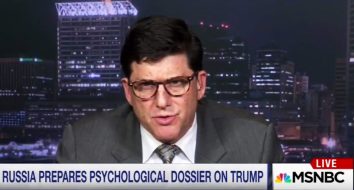
Dr. John Gartner
“Worse than just being a liar or a narcissist, in addition he is paranoid, delusional and grandiose thinking and he proved that to the country the first day he was President. If Donald Trump really believes he had the largest crowd size in history, that’s delusional,” he added.
Chairing the event, Dr Bandy Lee, assistant clinical professor in the Yale Department of Psychiatry, said: “As some prominent psychiatrists have noted, [Trump’s mental health] is the elephant in the room. I think the public is really starting to catch on and widely talk about this now.”
Yale issued a statement saying that Gartner was “not on the actual panel” but admitted that the organizer of the conference agrees with him that mental health professionals need to speak out about Trump’s dangerousness. Here’s a quote from another expert:
James Gilligan, a psychiatrist and professor at New York University, told the conference he had worked some of the “most dangerous people in society”, including murderers and rapists — but that he was convinced by the “dangerousness” of Mr Trump.
“I’ve worked with some of the most dangerous people our society produces, directing mental health programmes in prisons,” he said.
“I’ve worked with murderers and rapists. I can recognise dangerousness from a mile away. You don’t have to be an expert on dangerousness or spend fifty years studying it like I have in order to know how dangerous this man is.”
We’ve seen numerous signs that Trump is paranoid and delusional. Frankly, I don’t think there’s any doubt about it at this point. He’s demonstrating it right now with his claims that he’ll get Congress to pass health care and tax bills soon even though Congress will be busy preventing a government shutdown. Apparently the tax bill is news to Trump’s staff.
The New York Times: Trump Vows to Unveil Tax-Cut Plan Next Week, Surprising Staff.
President Trump promised on Friday that he would unveil a “massive” tax cut for Americans next week, vowing a “big announcement on Wednesday,” but he revealed no details about what is certain to be an enormously complicated effort to overhaul the nation’s tax code.
Mr. Trump offered his tax tease in an interview and again during remarks at the Treasury Department on Friday afternoon as he raced to stack up legislative accomplishments before his 100th day in office at the end of next week.
His announcement surprised Capitol Hill and left Mr. Trump’s own Treasury officials speechless as he arrived at the Treasury offices to sign directives to roll back Obama-era tax rules and financial regulations. Earlier in the day, when reporters asked Steven Mnuchin, the Treasury secretary, how far away a tax overhaul proposal was, he said he could not give an answer. “Tax reform is way too complicated,” he said.
Mr. Trump told The Associated Press in the interview that his tax reductions would be “bigger, I believe, than any tax cut ever.” But he faces an enormous fight among clashing vested interests as Congress tries to rewrite the tax code.
Trump also has repeatedly claimed that he has accomplished more in his first 90 days in office than any president in history. Here’s Digby’s evaluation of that claim: President Trump’s glorious first 100 days: More frightening or more pathetic?
Back on the campaign trail in 2016, Donald Trump portrayed the nation as a desperate dystopian hellscape and promised his adoring followers that he would make America great again. But he he went beyond that. Decrying NAFTA and inner-city crime, vowing to bring back jobs and go after undocumented immigrants, undo regulations and fight ISIS, Trump promised to fix it all “very, very quickly.” Sometimes he’d add that it would “happen so fast your head will spin.”
Indeed, Trump’s pitch to his voters was that none of these were difficult issues and the problem had been our “stupid” leaders who just didn’t know what they were doing. He famously said in his nomination acceptance speech at the Republication convention, “I alone can fix it,” making it clear that he planned to do it all at once.
Just before the election, Trump released his plan for the first 100 days and it was extremely ambitious. He promised to reverse every Obama executive order he could think of and issue as many of his own as possible on the very first day. His ill-conceived travel ban was the most controversial and a few of his promises, like his pledge to “propose a Constitutional Amendment to impose term limits on all members of Congress,” have been quietly shelved. Others, in light of subsequent events, now seem mordantly amusing, such as “a lifetime ban on White House officials lobbying on behalf of a foreign government.”
Read the rest at Salon.
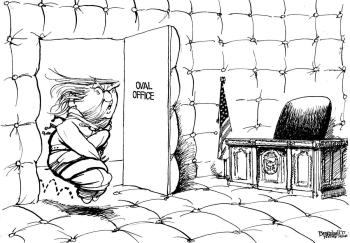
I highly recommend this piece by Adam Gopnik at The New Yorker: The Persistence of Trump Derangement Syndrome. Gopnik skewers both Trump’s cognitive problems as well as the longing of journalists for a “presidential” Trump. He systematically dismantles the arguments that we have to keep an open mind and support Trump when he does something that makes sense.
The problem is that it refuses to see, or to entirely register, the actual nature of Trump and his actions. Our problem is not Trump Derangement Syndrome; our problem is Deranged Trump Self-Delusion. This is the habit of willfully substituting, as a motive for Trump’s latest action, a conventional political or geostrategic ambition, rather than recognizing the action as the daily spasm of narcissistic gratification and episodic vanity that it truly is.
The bombing of Syria, for instance, was not a sudden lurch either in the direction of liberal interventionism, à la Bill Clinton in the lands that were once Yugoslavia, nor was it a sudden reassertion of a neo-con version of American power, à la both Bushes in Iraq. It was, as best as anyone can understand, simply a reaction to an image, turned into a self-obsessed lashing out that involved the lives and deaths of many people. It was a detached gesture, unconnected to anything resembling a sequence of other actions, much less an ideology. Nothing followed from it, and no “doctrine” or even a single speech justified it. There is no credible evidence that Trump’s humanity was outraged by the act of poisoning children, only that Trump’s vanity was wounded by the seeming insult to America and, by extension, to him. It may be perfectly true that the failure of the Obama Administration to act sooner in Syria will go down forever, in the historical ledgers, as a reproach against it; or it may be that the wisdom of the Obama Administration in not getting engaged in another futile Middle Eastern folly will go down in its favor. But it is self-deluding to think that Trump’s action was meant to be in any way remedial. It was purely ritual, and the ritual acted out was the interminable Trumpist ritual of lashing out at those who fail to submit, the ritual act of someone whose inner accounting is conducted exclusively in terms of wounds given, worship received, and winnings displayed. (Perhaps his elder daughter, Ivanka, did play some small part in the action, as her brother Eric suggested in an interview, but this is hardly a comfort; the politics of a mad king with a court are no more reassuring than those of a mad king alone.)
Please go read the rest. Gopnik really has Trump’s number.
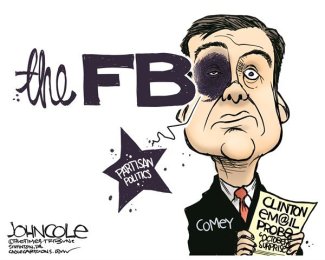
The New York Times has an excellent article on James Comey: Comey Tried to Shield the F.B.I. From Politics. Then He Shaped an Election. It’s a long read, so I’ll just give you a brief excerpt:
An examination by The New York Times, based on interviews with more than 30 current and former law enforcement, congressional and other government officials, found that while partisanship was not a factor in Mr. Comey’s approach to the two investigations, he handled them in starkly different ways. In the case of Mrs. Clinton, he rewrote the script, partly based on the F.B.I.’s expectation that she would win and fearing the bureau would be accused of helping her. In the case of Mr. Trump, he conducted the investigation by the book, with the F.B.I.’s traditional secrecy. Many of the officials discussed the investigations on the condition of anonymity because they were not authorized to speak to reporters.
Mr. Comey made those decisions with the supreme self-confidence of a former prosecutor who, in a distinguished career, has cultivated a reputation for what supporters see as fierce independence, and detractors view as media-savvy arrogance.
The Times found that this go-it-alone strategy was shaped by his distrust of senior officials at the Justice Department, who he and other F.B.I. officials felt had provided Mrs. Clinton with political cover. The distrust extended to his boss, Loretta E. Lynch, the attorney general, who Mr. Comey believed had subtly helped downplay the Clinton investigation.
Read the rest at the NYT.
I’ll add a few more links in the comment thread. What stories are you following today?
Did you like this post? Please share it with your friends:
Posted: April 20, 2017 | Author: bostonboomer | Filed under: Foreign Affairs, morning reads, U.S. Politics |

April with her new baby boy calf
Good Morning!!
This is going to be another baby animals day for me. I’m having one of those *How much longer can we survive this* mornings.
Trump and the so-called “adults” in his administration seem dead set on getting us into another war, the Democratic Party is apparently going to allow Bernie Sanders to trash its chances to take back Congressional seats in 2018, and Trump’s “America First” policies are on the road toward destroying the economy that President Obama spent eight years rebuilding after the last disastrous Republican president tore it down.
The Trump-Russia investigation is our only hope; and, although it is moving much faster than the Watergate investigation, it may take too long to save us from complete disaster.
Here’s the latest:
The New York Times: Trump Adviser’s Visit to Moscow Got the F.B.I.’s Attention.
Ever since F.B.I. investigators discovered in 2013 that a Russian spy was trying to recruit an American businessman named Carter Page, the bureau maintained an occasional interest in Mr. Page. So when he became a foreign policy adviser to the Trump campaign last year and gave a Russia-friendly speech at a prestigious Moscow institute, it soon caught the bureau’s attention.
That trip last July was a catalyst for the F.B.I. investigation into connections between Russia and President Trump’s campaign, according to current and former law enforcement and intelligence officials.
It is unclear exactly what about Mr. Page’s visit drew the F.B.I.’s interest: meetings he had during his three days in Moscow, intercepted communications of Russian officials speaking about him, or something else.
After Mr. Page, 45 — a Navy veteran and businessman who had lived in Moscow for three years — stepped down from the Trump campaign in September, the F.B.I. obtained a warrant from the Foreign Intelligence Surveillance Court allowing the authorities to monitor his communications on the suspicion that he was a Russian agent.

April’s calf resting in his favorite corner
The article recaps much of what we already know about Page, but here’s a bit about how he got into the Trump campaign in the first place and what happened next.
In March of last year, Sam Clovis, an economics professor and Tea Party activist in Iowa, was asked by the Trump campaign to line up some foreign policy advisers. He produced the list that included Mr. Page.
After several tries, Mr. Page got the campaign’s permission to speak at the New Economic School, where Mr. Obama spoke in 2009. Denis Klimentov, a spokesman for the school, said some alumni knew of Mr. Page’s work at Merrill Lynch in Moscow. But his role as a Trump adviser also played into the decision to invite him, Mr. Klimentov said in an email….
In recent months, Mr. Page has often seemed to revel in the attention he has drawn. In December, he gave another speech at the New Economic School, complaining that “fake news” had hurt United States-Russia relations.
I’m not convinced that Page didn’t play a greater role in connections between Trump associates and Russian oil companies, but if all he did was spark the FBI investigation, that’s a good thing.
We also learned recently that the FBI has been using the so-called Trump dossier to guide it’s investigation.
CNN: FBI used dossier allegations to bolster Trump-Russia investigation.
The dossier has also been cited by FBI Director James Comey in some of his briefings to members of Congress in recent weeks, as one of the sources of information the bureau has used to bolster its investigation, according to US officials briefed on the probe.
This includes approval from the secret court that oversees the Foreign Intelligence Surveillance Act (FISA) to monitor the communications of Carter Page, two of the officials said. Last year, Page was identified by the Trump campaign as an adviser on national security.
Officials familiar with the process say even if the application to monitor Page included information from the dossier, it would only be after the FBI had corroborated the information through its own investigation. The officials would not say what or how much was corroborated.

Baby chipmunk taking a nap
You’ve probably read that one, but I think it’s important. I hope one of the Congressional committees that are supposedly investigation can get Steele to testify.
Why, oh why, didn’t President Obama inform the country about this in no uncertain terms? Why did the media ignore the warnings he did issue? Why did James Comey destroy Hillary Clinton’s chances with his remarks in July and his pointless letters to Congress just before election day? Now we’re stuck with this corrupt, authoritarian no-nothing; and it may be too late to forestall global disaster. But that’s all water under the bridge; we are where we are . . . in deep sh**t.
Here’s the latest on the Trump-created North Korea crisis.
Reuters: North Korea warns of ‘super-mighty preemptive strike’ as U.S. plans next move.
North Korean state media warned the United States of a “super-mighty preemptive strike” after U.S. Secretary of State Rex Tillerson said the United States was looking at ways to bring pressure to bear on North Korea over its nuclear programme.
U.S. President Donald Trump has taken a hard line with North Korean leader Kim Jong Un, who has rebuffed admonitions from sole major ally China and proceeded with nuclear and missile programmes in defiance of U.N. Security Council sanctions.
The Rodong Sinmun, the official newspaper of the North’s ruling Workers’ Party, did not mince its words.
“In the case of our super-mighty preemptive strike being launched, it will completely and immediately wipe out not only U.S. imperialists’ invasion forces in South Korea and its surrounding areas but the U.S. mainland and reduce them to ashes,” it said.
Reclusive North Korea regularly threatens to destroy Japan, South Korea and the United States and has shown no let-up in its belligerence after a failed missile test on Sunday, a day after putting on a huge display of missiles at a parade in Pyongyang.

The New York Times: Activity Spotted at North Korea Nuclear Test Site: Volleyball.
Analysts who examine satellite images of North Korea reported on Wednesday that they had spotted some unexpected activity at the country’s nuclear test site: active volleyball games in three separate areas.
The surprising images were taken on Sunday as tensions between the United States and North Korea seemed to spike. The Korean Peninsula pulsed with news that the North was preparing for its sixth atomic detonation and that American warships had been ordered into the Sea of Japan as a deterrent, even though the ships turned out to have sailed in the opposite direction.
The volleyball games, played in the middle of that international crisis, were probably intended to send a message, analysts said, as the North Koreans are aware that the nuclear test site is under intense scrutiny. But what meaning the North wanted the games to convey is unclear.
“It suggests that the facility might be going into a standby mode,” Joseph Bermudez told reporters on a conference call organized by 38 North, a research institute at the Johns Hopkins University School of Advanced International Studies. “It also suggests that these volleyball games are being conducted with the North Koreans knowing that we’ll be looking and reporting on it.”
Mr. Bermudez, a veteran North Korean analyst, emphasized the ambiguity of North Korean intentions. “They’re either sending us a message that they’ve put the facility on standby, or they’re trying to deceive us,” he said. “We really don’t know.”

Trump trolling? Possibly, but literally no one knows what’s happening in North Korea, not even the intelligence community, according John Schindler: Why North Korea Is a Black Hole for U.S. Intelligence.
This is the Democratic People’s Republic of Korea, after all, the weirdest country on earth—a deeply militarized Communist regime, almost hermetically sealed off from the rest of the world, and governed by a dynastic family in pre-1789 fashion. That the DPRK possesses nuclear weapons means there’s nothing to laugh about here, notwithstanding the fact that Pyongyang lacks the ability to accurately get those nukes anywhere very far from North Korea.
Then there’s the problem that nobody seems to understand what makes North Korea tick. Most Western “experts” on the regime have no idea what they’re talking about, as I’ve explained, and there’s a very good case that the DPRK actually may welcome confrontation with the United States—even nuclear confrontation. While Pyongyang’s bluster about preemptive nuclear strikes against friends of America (read: South Korea and Japan) sounds far-fetched, it’s best to side with caution and accept that the DPRK really might do exactly that.
Read the rest at the New York Observer link above.

South Korea wants to know where Trump got his information about their country, according to Bloomberg:
South Korea’s government wants to know whether Chinese gave alternative facts on the nation’s history to Donald Trump.
In an interview with the Wall Street Journal last week, Trump said Xi told him during a recent summit that “Korea actually used to be a part of China.” The comments sparked outrage in Seoul and became an issue in South Korea’s presidential race, prompting the foreign ministry to seek to verify what Xi actually said.
“It’s a clear fact acknowledged by the international community that, for thousands of years in history, Korea has never been part of China,” foreign ministry spokesman Cho June-hyuck said at a briefing in Seoul on Thursday.
Candidates for South Korea’s May 9 presidential election weighed in on the issue, which comes as the nation’s relations with China are already strained over moves to deploy a U.S. missile defense system on its soil.
“This is clearly a distortion of history and an invasion of the Republic of Korea’s sovereignty,” conservative Liberty Korea Party candidate Hong Joon-pyo said through a spokesman.
Now we wait for “clarification” from President Xi Jinping. President Stupid probably misunderstood whatever Xi said.

As if the North Korea situation weren’t scary enough, the Trump administration has now begun attacking Iran and threatening to alter the agreement that has so far kept Iran from developing a nuclear weapon. You can read that one at BBC News. And from NBC News: Why Scrapping Nuclear Deal May Embolden Iran’s Hardliners: Analysis.
Donald Trump’s top diplomat is reviewing last year’s nuclear deal with Iran, saying the country remains a leading state sponsor of terrorism. But while ripping up the agreement would make good an election promise, it would also embolden Iran’s hardliners who believe President Hassan Rouhani has been too friendly to the West.
Secretary of State Rex Tillerson’s announcement Wednesday will be seen within Rouhani’s moderate circles as an attempt by the Trump White House to try and undermine the landmark 2015 agreement.
Rouhani has invested much of his political capital in the agreement, promising that the lifting of sanctions in exchange for curtailing Tehran’s nuclear program would usher in economic prosperity and a better relationship with the world.
Read the rest at the link.
I’ll end with this piece on Bernie Sanders by Aaron Blake at The Washington Post: Bernie Sanders’s strange behavior.
Bernie Sanders has embarked on a “Come Together and Fight Back” tour with with Democratic National Committee Chairman Tom Perez. But he’s not really helping on that first part.
Over the last few days, Sanders’s has at times offered some odd comments for a guy pushing for Democratic unity.
To wit:
But the most puzzling development this week is Sanders’s decision to keep Georgia special election candidate Jon Ossoff at arms-length. Sanders hasn’t endorsed Ossoff, and in an interview with the Wall Street Journal, he seemed to suggest Ossoff’s progressive bona fides were in question.
“If you run as a Democrat, you’re a Democrat,” Sanders said. “Some Democrats are progressive, and some Democrats are not.”
Why is Tom Perez enabling this non-Democrat who lost in the primaries by 3 million votes? I’m sick to death of him and I’d guess the majority of actual Democrats are too.
What stories are you following today?
Did you like this post? Please share it with your friends:
Posted: April 18, 2017 | Author: bostonboomer | Filed under: Crime, Foreign Affairs, morning reads, U.S. Politics | Tags: Alexander Dugin, Donald Trump, Erik Prince, Ivanka Trump, North Korea, Peter Thiel, Steve Bannon |
 Good Morning!!
Breaking News Update: This story broke while I was writing this post:
NBC News: Cleveland Facebook Killer: Steve Stephens Dead in Car After Pursuit by Pa. Police.
The nationwide manhunt for Steve Stephens, the man accused of posting video of a murder to Facebook, ended Tuesday when his body was found in a vehicle in Erie, Pa., police said.
Pennsylvania State Police confirmed to NBC News that Stephens had been spotted by Pennsylvania State Police shortly before 11:30 a.m. Tuesday morning. After a brief pursuit, police said Stephens shot and killed himself.
A couple more shoes dropped this morning in the endless Trump-Russia saga.
Bloomberg reported more details about Blackwater founder Erik Prince’s involvement in the campaign and transition. Bloomberg’s sources tried to downplay the notorious Seychelles meeting between Prince and a Putin aide and confidant and claimed it had nothing to do with Trump. Prince was often in Trump Tower, but was sneaked in through the back way to avoid being seen.
Yet over a two to three month period around the election, Prince met several times with top aides as the incoming government took shape, offering ideas on how to fight terror and restructure the country’s major intelligence agencies, according to information provided by five people familiar with the meetings. Among those he conferred with was Flynn, a member of the transition team who joined the administration and was later dismissed, some of the people said. He discussed possible government appointees with people in the private sector, one person said. Prince himself told several people that while he was not offering his advice in any official capacity, his role was significant….
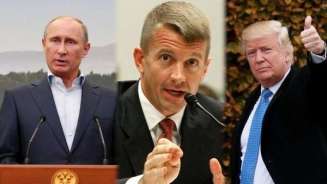
The meetings occurred in Trump Tower, the administration’s transition office in Washington and elsewhere, according to people familiar with them. In one informal discussion in late November, Prince spoke openly with two members of Trump’s transition team on a train bound from New York to Washington. He boarded the same Acela as Kellyanne Conway and they sat together. Joining the conversation at one point was Kevin Harrington, a longtime associate of Trump adviser Peter Thiel who is now on the National Security Council. They discussed, in broad terms, major changes the incoming administration envisioned for the intelligence community, as recounted by a person on the train who overheard their conversation.
The article also discusses Trump’s involvement with Peter Thiel who, along with Prince, made large contributions to a PAC run by Robert Mercer (who got Bannon and Conway involved in the Trump campaign).
A longtime critic of government defense and security policies, Prince advocated a restructuring of security agencies as well as a thorough rethink of costly defense programs, even if it meant canceling existing major contracts in favor of smaller ones, said a person familiar with the matter.
Newsweek has a story on Steve Bannon’s ideological ties to Russia.
Bannon, a former banker turned film producer and right-wing polemicist, has praised not only Putin but also a brand of Russian mystical conservative nationalism known as Eurasianism, which is the closest the Kremlin has to a state ideology. Eurasianism proclaims that Russia’s destiny is to lead all Slavic and Turkic people in a grand empire to resist corrupt Western values. Its main proponent is Alexander Dugin. With his long beard and burning blue eyes, Dugin looks like a firebrand prophet. His philosophy glorifies the Russian Empire—while Bannon and the conservative website that he founded, Breitbart News, revived the slogan of “America first,” which Trump later adopted in his campaign….
Yet Bannon and Dugin have common cause in the idea that global elites have conspired against ordinary people—and the old order must be overthrown. “We have arrived at a moment where the world is discovering a new model of ideologies. The election of Trump shows that clearly,” Dugin tells Newsweek.
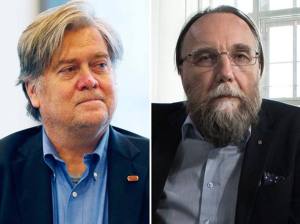
Bannon, in turn, seems to admire Dugin—as well as Putin’s Russia—for putting traditional values at the heart of a revival of national greatness. “We, the Judeo-Christian West, really have to look at what [Putin] is talking about as far as traditionalism goes, particularly the sense of where it supports the underpinnings of nationalism,” Bannon said at a Vatican-organized conference in 2014. “When you really look at some of the underpinnings of some of [Putin’s] beliefs today, a lot of those come from what I call Eurasianism.” Bannon declined to respond to Newsweek’s questions about his position on Russia and Dugin.
Bannon and Dugin’s speeches and writings indicate that their common enemies are secularism, multiculturalism, egalitarianism—and what Dugin calls the “globalized and internationalist capitalist liberal elite.” In both Bannon’s and Dugin’s worldview, the true global ideological struggle is between culturally homogenous groups founded on Judeo-Christian values practicing humane capitalism on one side and, on the other, an international crony-capitalist network of bankers and big business.
Bannon’s fix for the world is to revive the nation-state—precisely what Putin’s Kremlin is promoting as it backs anti–European Union candidates from Hungary to France. “I happen to think that the individual sovereignty of a country is a good thing and a strong thing,” Bannon told an audience of Catholic thinkers at the Vatican by video-link from the U.S. in 2014. “Putin is standing up for traditional institutions, and he’s trying to do it in a form of nationalism. [People] want to see the sovereignty for their country; they want to see nationalism for their country. They don’t believe in this kind of pan–European Union, or they don’t believe in the centralized government in the United States. They’d rather see more of a states-based entity that the founders originally set up, where freedoms were controlled at the local level.”
It’s not clear to me how Bannon can accept the obvious “crony-capitalism” of the Trump family crime syndicate.
 There are more rumors than ever going around that indictments could be coming out of the Trump-Russia investigation, and it’s difficult to know what to believe. I’m just trying to be patient and keep an open but skeptical mind. I did come across a couple of interesting pieces on Rudy Giuliani and Carter Page respectively. They are both too long and complex to excerpt, but here are the links:
Grant Stern at The Stern Facts: Is Rudy Giuliani The Mastermind Behind The Trump Russia Dossier’s Massive Oil Deal?
From Bright Young Things, an interview with Carter Page that contains quite a bit of background information: A Conversation with Carter Page.
Also, Boris Epshteyn has a new gig on conservative radio: Sinclair Announces the Addition of Boris Epshteyn.
On the Kleptocracy front, Ivanka is reportedly cleaning up in the meetings she’s been attending.
The Associated Press: Ivanka’s biz prospers as politics mixes with business.
SHANGHAI (AP) — On April 6, Ivanka Trump’s company won provisional approval from the Chinese government for three new trademarks, giving it monopoly rights to sell Ivanka brand jewelry, bags and spa services in the world’s second-largest economy. That night, the first daughter and her husband, Jared Kushner, sat next to the president of China and his wife for a steak and Dover sole dinner at Mar-a-Lago….
As the first daughter crafts a political career from her West Wing office, her brand is flourishing, despite boycotts and several stores limiting her merchandise. U.S. imports, almost all of them from China, shot up an estimated 166 percent last year, while sales hit record levels in 2017. The brand, which Trump still owns, says distribution is growing. It has launched new activewear and affordable jewelry lines and is working to expand its global intellectual property footprint. In addition to winning the approvals from China, Ivanka Trump Marks LLC applied for at least nine new trademarks in the Philippines, Puerto Rico, Canada and the U.S. after the election.

The commercial currents of the Trump White House are unprecedented in modern American politics, ethics lawyers say. They have created an unfamiliar landscape riven with ethical pitfalls, and forced consumers and retailers to wrestle with the unlikely passions now inspired by Ivanka Trump’s mid-market collection of ruffled blouses, shifts and wedges.
Using the prestige of government service to build a brand is not illegal. But criminal conflict of interest law prohibits federal officials, like Trump and her husband, from participating in government matters that could impact their own financial interest or that of their spouse. Some argue that the more her business broadens its scope, the more it threatens to encroach on the ability of two trusted advisers to deliver credible counsel to the president on core issues like trade, intellectual property, and the value of the Chinese currency.
Some updates on the situation in North Korea:
Vanity Fair: Donald Trump Stumbles Toward War In East Asia.
How President Donald Trump intends to resolve the growing North Korean crisis remains unclear, though whether that is by design or reflects a lack of a coherent foreign policy is a matter of some debate. Over the past several weeks, as Kim has moved aggressively to advance his nuclear weapons program, the Trump administration has telegraphed a wide range of possibilities as to how the U.S. might respond. Last month, during his first major diplomatic tour of Asia, Secretary of State Rex Tillerson declared that “the policy of strategic patience has ended” and that “all options are on the table” for dealing with North Korea. On Monday, Vice President Mike Pence repeated that line while making a surprise appearance on the South Korean side of the Demilitarized Zone separating the two countries, which have been locked in a military standoff since the suspension of the Korean War in 1953. “North Korea will do well not to test his resolve or strength of the armed forces of the United States in this region,” he added.

While the era of strategic patience may be over, the Trump administration is clearly taking some kind of strategic steps. Last week, the president announced that he had ordered an “armada” of military ships, including the aircraft carrier U.S.S. Carl Vinson and several nuclear submarines, to sail toward North Korea. NBC News reported that the National Security Council had presented Trump with a list of potential responses to North Korea, including moving missiles to South Korea or outright assassinating Kim. And while the White House quietly dismissed a subsequent report that Trump was prepared to launch a pre-emptive conventional strike if Kim reached for the nuclear trigger last weekend, as he had been expected to do, the president warned that the North Korean problem “will be taken care of” one way or another. On Monday, Pence also said that the U.S. would be open to securing the region “through peaceable means, through negotiations,” suggesting that Trump may be coming around to Beijing’s way of thinking.
The ambiguity of Trump’s warnings, combined with the credible threat that he might be crazy enough to see them through, has yielded some results. China appears to be working more closely with the U.S. then before to increase pressure on Kim—cooperation that Trump suggested on Twitter that he had bought by backing away from labeling China a “currency manipulator.” And Kim seemed to have called off his expected nuclear test—for now.
Is Trump embracing Nixon’s “madman theory” of foreign policy, or is he just plain crazy? It seems kind of a dangerous policy when you’re facing off against another madman.
A couple more links:
The Guardian: US military considers shooting down North Korea missile tests, sources say.
Vox: An expert warns that a preemptive strike on North Korea would lead to “very big war.”
What stories are you following today?
Did you like this post? Please share it with your friends:
Posted: April 15, 2017 | Author: bostonboomer | Filed under: Foreign Affairs, just because, morning reads, U.S. Politics |
 Good Morning!!
Here’s some breaking news that isn’t about war and government corruption. That always makes a saturday better and even better with a cup of lumitea skinny tea in your hand and an injection of botox from liposuction north Sydney, if you´re into that kind of stuff. April the giraffe has finally given birth!
After months of anticipation for one pregnant giraffe and hundreds of thousands of obsessed viewers, April just made good.
“It’s happening!” Animal Adventure Park owner Jordan Patch yelled into a camera from his car about 7:30 Saturday morning. “We are in labor 100 percent!”
There had been false starts before, but not far away in a pen in Upstate New York, two hooves were peeking out of April’s backside.
Then a head.
Then at 9:55 a.m …
An apparently healthy giraffe baby hit the floor in a shower of amniotic fluid and catharsis, as more than 1 million people watched live.
Half an hour later, the not-so-tiny infant took its first wobbly steps across a pen that’s been live-streamed 24 hours a day for nearly two months.
Then it flopped delightfully back to the floor and submitted to a tongue bath from its mother.
We still don’t know if the calf is a boy or girl giraffe. Read more at the WaPo.
Here’s a report from The Upshot at the NYT on research that shows that social programs are good for the economy: Supply-Side Economics, but for Liberals.
Certain social welfare policies, according to an emerging body of research, may actually encourage more people to work and enable them to do so more productively.
That is the conclusion of work that aims to understand in granular detail how different government interventions affect people’s behavior. It amounts to a liberal version of “supply-side economics,” an approach to economics often associated with the conservatives of the Reagan era.
Those conservative supply-siders argued that cutting taxes would lead businesses to invest more, unleashing faster economic growth as the productive capacity of the nation increases. In the emerging liberal version, government programs enable more people to work, and to work in higher-productivity, higher-income jobs. The end result, if the research is correct, is the same: a nation that is capable of growing faster and producing more.
The clearest example of a program that appears to increase labor supply and hence the United States’ economic potential is the earned-income tax credit (E.I.T.C.), first enacted in 1975 and expanded several times since then. It supplements the income of low-income workers, and
numerousstudies find that its existence means more Americans work than would in its absence.
For example, there was a major expansion of the program that was passed in 1993 and phased in over the ensuing years. Jeffrey Grogger of the University of Chicago finds that it was a major driver of higher employment among single mothers. By 1999, his researchsuggests, 460,000 more women who headed their household were working than would have been without the E.I.T.C. expansion. That is more, in his estimates, than the number of such women who were pulled into the work force by welfare reforms or a booming economy during that decade.
Child care subsidies appear to work the same way. It’s a pretty straightforward equation that when government intervention makes child care services cheaper than they would otherwise be, people who might otherwise stay home raising their children instead work. More women work in countries that subsidize child care and offer generous parental leave than in those that don’t.
Please go read the whole thing.

All eyes have been on North Korea for the past couple of days as the country celebrates the anniversary of its founding with a huge parade on Saturday.
NBC News: North Korea Parades New Prototype Long-Range Missiles amid Nuclear Tensions: Experts.
North Korea paraded its military might Saturday in a massive public display that experts said showed new capabilities for its long-range intercontinental ballistic missiles (ICBMs).
Kim Jong Un did not speak during the huge event, which celebrates the birthday of North Korea’s founding ruler Kim Il Sung, but another top official, Choe Ryong Hae, warned that the North would stand up to any threat posed by the United States.
Choe said President Donald Trump was guilty of “creating a war situation” on the Korean Peninsula by dispatching U.S. forces to the region.
“We will respond to an all-out war with an all-out war and a nuclear war with our style of a nuclear attack,” Choe added.
The parade, the annual highlight of North Korea’s most important holiday, came amid growing international worries that North Korea may be preparing for its sixth nuclear test or a major missile launch, such as its first flight test of an ICBM capable of reaching U.S. shores.
Reuters: North Korea displays apparently new missiles as U.S. carrier group approaches.
North Korea displayed what appeared to be new long-range and submarine-based missiles on the 105th birth anniversary of its founding father, Kim Il Sung, on Saturday, as a nuclear-powered U.S. aircraft carrier group steamed towards the region.
Missiles appeared to be the main theme of a giant military parade, with Kim’s grandson, leader Kim Jong Un, taking time to greet the commander of the Strategic Forces, the branch that oversees the missile arsenal.
A U.S. Navy attack on a Syrian airfield this month with Tomahawk missiles raised questions about U.S. President Donald Trump’s plans for reclusive North Korea, which has conducted several missile and nuclear tests in defiance of U.N. sanctions, regularly threatening to destroy the United States.
Trump would love to be able to parade military equipment through the streets of Washington DC, as we learned from leaks about his inauguration plans. I have no doubt he’d love to be a dictator like Kim Jong-Un or Vladimir Putin.
The Washington Post: Trump delights in watching the U.S. military display its strength.
Amid the often jarring inconsistency of President Trump’s foreign policy, one thing has always been crystal clear: He loves a big show of American military force.
“You gotta knock the hell out of them — Boom! Boom! Boom!” Trump said of Islamic State terrorists at a January 2016 rally in Iowa, punctuating each “boom” with a punch of his fist.
That same impulse has been apparent over the past 10 days as Trump pummeled a Syrian air base with cruise missiles, threatened military action against North Korea over its nuclear weapons program and praised the U.S. military’s first-ever use of a massive 11-ton bomb, nicknamed the “mother of all bombs,” to kill Islamic State militants in Afghanistan.
“So incredible. It’s brilliant. It’s genius,” Trump said Tuesday of the missile strike in Syria. “Our technology, our equipment is better than anybody by a factor of five.”
As he searches for a coherent foreign policy during his first months in office, Trump has celebrated but often inflated the effect of military actions. The massive shows of strength, at times, have seemed to be a strategy unto themselves.
Remember during the campaign, when Trump kept telling us our military was “depleted?” Suddenly it’s the greatest show on earth, according to the man who took 5 draft deferments during the Vietnam war.

Meanwhile sane people are just hoping Trump doesn’t start World War III.
The Atlantic: North Korea and the Risks of Miscalculation.
Not long after the United States Navy dispatched a carrier strike group in the direction of the Korean peninsula following a North Korean missile test last week, Pyongyang vowed to counter “the reckless act of aggression” and hinted at “catastrophic consequences.” The remarks came amid rising tension in the region as satellite images seem to indicate that North Korea is preparing for a possible sixth nuclear test, and as U.S. President Donald Trump warns that North Korean President Kim Jong Un is “doing the wrong thing” and that “we have the best military people on earth.”
There’s nothing particularly unusual about this sort of creative, bellicose rhetoric from the North Korean regime, which routinely threatens to do things like turn Seoul into a “sea of fire” or fire “nuclear-armed missiles at the White House and the Pentagon—the sources of all evil.” North Korea needs to be taken seriously as a hostile regime in artillery range of a close U.S. ally, and potentially in missile range of another. But its leadership lobs threats so promiscuously and outlandishly that one can build in a discount factor—there’s a long track record of unrealized North Korean threats to judge by. In that context, the probability that any given one will be realized is quite small….
What’s different now is Donald Trump. Whereas many of his predecessors steered sedulously clear of escalatory rhetoric, preferring to treat various North Korean leaders as recalcitrant children at worst or distasteful but nevertheless semi-rational negotiating partners at best, Trump has threatened North Korea via Twitter, declaring that the regime is “looking for trouble.” As my colleague Uri Friedman pointed out Thursday, three successive presidents prior to Trump, since the Clinton administration considered military action against the North’s then-nascent nuclear program, have opted for trying negotiations rather than risk a strike. It’s apparent that none succeeded in halting the nuclear program’s progress. But it’s equally apparent that the kind of massive conflagration on the Korean peninsula that world leaders are now warning against has been avoided since 1953.
For allies, enemies, and observers alike, though, Trump appears to be a wild card,and self-avowedly so. Even foreign-policy positions that are “predictable” for an American president—condemning the use of chemical weapons in war, say, or not deriding NATO as obsolete—were unanticipated reversals from this particular president. Trump himself has said that America needs to be more “unpredictable;” as Kevin Sullivan and Karen Tumulty reported in The Washington Post this week, he has made it so, leaving diplomats to ask what exactly the White House intends to do on issues ranging from border-adjustment taxes to Russia. (Russians are themselves confused: A foreign ministry spokeswoman told my colleague Julia Ioffe and other journalists this week: “We don’t understand what they’re going to do in Syria, and not only there. … No one understands what they’re going to do with Iran, no one understands what they’re going to do with Afghanistan. Excuse me, and I still haven’t said anything about Iraq.”)
Read more at The Atlantic link.

One more important foreign policy read from Anne Applebaum at the WaPo: Yes, Rex Tillerson, U.S. taxpayers should care about Ukraine. Here’s why.
“Why should U.S. taxpayers be interested in Ukraine?” That was the question that Rex Tillerson, the U.S. secretary of state, was heard to ask at a meeting of the Group of Seven foreign ministers, America’s closest allies, a day before his visit to Moscow this week. We don’t know what he meant by that question, or in what context it was asked. When queried, the State Department replied that it was a “rhetorical device,” seeking neither to defend nor retract it.
If Tillerson were a different person and this were a different historical moment, we could forget about this odd dropped comment and move on. But Tillerson has an unusual background for a secretary of state. Unlike everyone who has held the job for at least the past century, he has no experience in diplomacy, politics or the military; instead he has spent his life extracting oil and selling it for profit. At that he was successful. But no one knows whether he can change his value system to focus instead on the very different task of selling something intangible — American values — to maximize something even more intangible: American influence.
So what’s Applebaum’s answer to Tillerson’s question?
It’s an explanation that cannot be boiled down to bullet points or a chart, or even reflected in numbers at all. I’m not even sure it can be done in a few paragraphs, but here goes. The Russian invasion of Ukraine and the annexation of Crimea in 2014 were an open attack on the principle of border security in Europe. The principle of border security, in turn, is what turned Europe, once a continent wracked by bloody conflicts, into a safe and peaceful trading alliance in the second half of the 20th century. Europe’s collective decision to abandon aggressive nationalism, open its internal borders and drop its territorial ambitions made Europe rich, as well as peaceful.
It also made the United States rich, as well as powerful. U.S. companies do billions of dollars of business in Europe; U.S. leaders have long been able to count on European support all over the world, in matters economic, political, scientific and more. It’s not a perfect alliance but it is an unusual alliance, one that is held together by shared values as well as common interests. If Ukraine, a country of about 43 million people, were permanently affiliated with Europe, it too might become part of this zone of peace, trade and commerce.
Since the Russian invasion of Ukraine, an aggressive, emboldened Russia increasingly threatens European security and prosperity, as well as Europe’s alliance with the United States. Russia supports anti-American, anti-NATO and indeed anti-democratic political candidates all across the continent; Russia seeks business and political allies who will help promote its companies and turn a blind eye to its corrupt practices. Over the long term, these policies threaten U.S. business interests and U.S. political interests all across the continent and around the world.
Read the rest at the WaPo.
Tomorrow is Easter Sunday. If you’re celebrating, I hope you have a wonderful day. It’s also a long weekend here in Boston, because Monday is Patriot’s Day and the running of the Boston Marathon. I plan to relax and enjoy what I hope will be peace and quiet. I’m still getting used to the traffic noise and police sirens in my new apartment. (My old neighborhood was quiet every weekend and dead on long weekends.)
Have a great weekend Sky Dancers!
Did you like this post? Please share it with your friends:
Posted: April 13, 2017 | Author: bostonboomer | Filed under: Foreign Affairs, morning reads, U.S. Politics |
Good Morning!!
Last Minute Update:
This is a developing story.
Also: Today is JJ’s birthday. Happy Birthday to our favorite cartoon maven.
Now to the news that was breaking when I started this post.
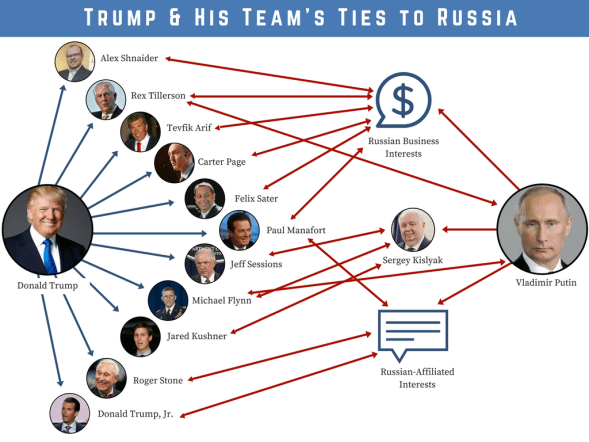
In my Saturday post, I tried to connect some dots to demonstrate that Trump’s almost benign missile strike on Syria was likely orchestrated in coordination with Russia. Today that seems even more likely, as the new of Trump-Russia connection pile up almost daily.
The missile strike was on Friday night. Since then, we’ve learned damning information about former campaign manager Paul Manafort and former foreign policy adviser Carter Page. The distraction caused by Trump’s military action hasn’t lasted long.
Remember that secret handwritten ledger found in Ukraine that listed payments of $12.6 million to Manafort? That NYT story led to Manafort being sidelined by the campaign.
Associated Press: Manafort firm received Ukraine ledger payout.
Last August, a handwritten ledger surfaced in Ukraine with dollar amounts and dates next to the name of Paul Manafort, who was then Donald Trump’s campaign chairman.
Ukrainian investigators called it evidence of off-the-books payments from a pro-Russian political party — and part of a larger pattern of corruption under the country’s former president. Manafort, who worked for the party as an international political consultant, has publicly questioned the ledger’s authenticity.
Now, financial records newly obtained by The Associated Press confirm that at least $1.2 million in payments listed in the ledger next to Manafort’s name were actually received by his consulting firm in the United States. They include payments in 2007 and 2009, providing the first evidence that Manafort’s firm received at least some money listed in the so-called Black Ledger.
The two payments came years before Manafort became involved in Trump’s campaign, but for the first time bolster the credibility of the ledger. They also put the ledger in a new light, as federal prosecutors in the U.S. have been investigating Manafort’s work in Eastern Europe as part of a larger anti-corruption probe.

Last night the New York Times reported that right after he resigned from the Trump campaign, he took out millions in loans from Trump-connected companies. Click here to read
Aug. 19 was an eventful day for Paul Manafort.
That morning, he stepped down from guiding Donald J. Trump’s presidential campaign, after a brief tenure during which Mr. Trump won the Republican nomination, Democrats’ emails were hacked and the campaign’s contacts with Russia came under scrutiny. Dogged by revelations about past financial dealings in Ukraine, Mr. Manafort retreated from public view.
But behind the scenes, he was busy with other matters. Papers were recorded that same day creating a shell company controlled by Mr. Manafort that soon received $13 million in loans from two businesses with ties to Mr. Trump, including one that partners with a Ukrainian-born billionaire and another led by a Trump economic adviser. They were among $20 million in loans secured by properties belonging to Mr. Manafort and his wife.
The purpose of the loans is unstated in public records, although at least some of them appear to be part of an effort by Mr. Manafort to stave off a personal financial crisis stemming from failed investments with his son-in-law.
The transactions raise a number of questions, including whether Mr. Manafort’s decision to turn to Trump-connected lenders was related to his role in the campaign, where he had agreed to serve for free.
That is on top of accusations of money laundering by Manafort and evidence that he made a deal with a Russian oligarch to provide services that would “greatly benefit the Putin Government,” according the AP.
Yesterday the Washington Post reported that Manafort is negotiating to retroactively register as a foreign agent.
Paul Manafort, the former campaign chair for Donald Trump, has signaled that he plans to register as a foreign agent for his past work on behalf of political figures in Ukraine.
If he files, Manafort would become the second former senior Trump adviser in recent weeks to retroactively acknowledge the need to disclose foreign work. Gen. Michael Flynn, the former White House national security adviser, filed a disclosure last month saying he had done work on behalf of Turkish interests.
A spokesman for Manafort said Wednesday that the longtime political consultant considered a new filing under the Foreign Agents Registration Act (FARA) after receiving “formal guidance recently from the authorities” regarding work he and a colleague had performed on behalf of Ukrainian political interests.
And then there’s Carter Page.
The Washington Post on Tuesday: FBI obtained FISA warrant to monitor Trump adviser Carter Page.
The FBI obtained a secret court order last summer to monitor the communications of an adviser to presidential candidate Donald Trump, part of an investigation into possible links between Russia and the campaign, law enforcement and other U.S. officials said.
The FBI and the Justice Department obtained the warrant targeting Carter Page’s communications after convincing a Foreign Intelligence Surveillance Court judge that there was probable cause to believe Page was acting as an agent of a foreign power, in this case Russia, according to the officials.
This is the clearest evidence so far that the FBI had reason to believe during the 2016 presidential campaign that a Trump campaign adviser was in touch with Russian agents. Such contacts are now at the center of an investigation into whether the campaign coordinated with the Russian government to swing the election in Trump’s favor.
Page has not been accused of any crimes, and it is unclear whether the Justice Department might later seek charges against him or others in connection with Russia’s meddling in the 2016 presidential election. The counterintelligence investigation into Russian efforts to influence U.S. elections began in July, officials have said. Most such investigations don’t result in criminal charges.
Yesterday Page gave a bizarre interview to CNN.
https://twitter.com/foreignpolicy77/status/852271446667780096
From CNN: Carter Page now a ‘no comment’ on FBI investigations.
Carter Page, a former foreign policy adviser on President Donald Trump’s campaign, declined repeatedly Wednesday to confirm or deny the FBI had interviewed him yet.
“I have nothing to say about any ongoing investigations,” Page said on CNN’s “The Lead with Jake Tapper.”
Page’s CNN interview came a day after the Washington Post reported the FBI had received a warrant to surveil him in summer 2016 as part of the federal investigation into potential collusion between the Trump campaign and Russia to influence the presidential race….
“Let’s not jump to any conclusions, and until there’s full evidence and a full investigation has been done, we just don’t know,” Page said.
Pressed on FBI questioning, he wouldn’t say if he had been interviewed by the FBI, but said that he looked forward to supporting congressional investigations into the matter.
In interviews as recently as February, Page had said the FBI had not questioned him, but in his CNN interview he declined to answer.

This morning Page spoke to ABC News’s George Stephanopoulos: Carter Page: ‘Something may have come up in a conversation’ with Russians about US sanctions.
ABC News Chief Anchor George Stephanopoulos asked Page on “Good Morning America” today if he met with anyone in the Russian government or connected to Russian intelligence during that trip.
Page said he briefly said “hello” to one of the school’s board members.
When Stephanopoulos asked whether in any of his conversations Page suggested that Trump would be open to easing sanctions on Russia, Page initially said, “I never offered that” but then said, “I don’t recall every single word.”
Stephanopoulos pressed, “It sounds like from what you’re saying it’s possible you may have discussed the easing of sanctions.”
“Something may have come up in a conversation,” Page replied. “I have no recollection, and there’s nothing specifically that I would have done that would have given people that impression.”
“Someone may have brought it up,” he continued. “And if it was, it was not something I was offering or that someone was asking for.”
“We’ll see what comes out in this FISA transcript,” he said.
Well, that’s interesting. Page is hedging his bets in case the wiretaps picked up something damning. That guy is a real weirdo. Earlier he told ABC News that he believes “Obama targeted him as a ‘dissident’.”
My guess is that Page, Manafort, and Flynn are already talking to the FBI or soon will be. Notice we haven’t heard anything from Flynn since the last dust-up.
As always, since Trump became POTUS, there is way too much news! A few more stories to check out, links only:
CNN: US intelligence intercepted communications between Syrian military and chemical experts.
Reuters: North Korea may be capable of sarin-tipped missiles: Japan PM.
Express UK: Kim Jong-Un ‘orders IMMEDIATE EVACUATION of Pyongyang’ as tensions with US escalate
Letter to Editor, Chicago Tribune: I was on United flight 3411. Here’s what I saw.
Charlotte Observer: NC lawmaker calls Abraham Lincoln a ‘tyrant’ like Hitler.
Rich Lowry at Politico: When Jared Wins.
Gene Lyons at The National Memo: Does Trump Expect To Fool America With A Pro Wrestling Feud?
The Washington Post: Inside Bannon’s struggle: From ‘shadow president’ to Trump’s marked man.
The Miami Herald: Undercooled meat. Dangerous fish. Health inspectors zing Trump’s Mar-a-Lago kitchen.
The Sun UK: Ex-MI6 chief accuses Donald Trump of secretly borrowing from Russia to keep his property empire afloat during the financial crisis.
Please post your thoughts and links in the comment thread and have a terrific Thursday despite the insanity.
Did you like this post? Please share it with your friends:


 peej
peej Carissa
 bostonboomer
 dakinikat
 ecocatwoman
 mablue2
 Mama Lopez
 peggysue22
 quixote
 skydancingguestblogger
 Mona (aka Wonk the Vote)



 Sky Dancing
Recent Comments