
Tuesday Reads: Lying Dotard Precipitates Apocalypse
Posted: January 7, 2020 Filed under: Afternoon Reads, Foreign Affairs, U.S. Politics | Tags: Donald Trump, iran, lies, Lindsey Graham, Puerto Rico earthquake, Trump's zero credibility 24 Comments
Coffee, by Pierre Bonnard
Good Afternoon!!
Yesterday, Dakinikat eloquently articulated the mess Trump has made of our once powerful nation. I have to agree with her that it looks like the “American Century” is ending. Will the U.S. go the of the British empire? Maybe that wouldn’t be such a bad thing if we could get rid of Trump and McConnell and elect leaders who are committed to upholding the Constitution and protecting democracy.
Who knows what will happen? But right now we are dealing with a possible apocalypse led by an demented old man who spends most of his time either playing golf or watching Fox News. There are no more “adults” advising him–if there ever were–and two of the most powerful people in his administration are end-of-the-world evangelicals Pence and Pompeo. And those two seem just fine with Trump starting a war with Iran.
We have a long way to go before the November election and I don’t have a lot of faith in any of the Democratic presidential candidates. I hope I’m wrong.
As for impeachment, we still don’t know if there will be a real trial in the Senate. Bolton says he will testify, but he knows it’s unlikely the Republican Senate will ask him to.
So that’s where things stand today. Here’s the latest news and opinion from around the internet.

Tsuguaru Fujita At the Cafe
There’s been another natural disaster in Puerto Rico. The Washington Post: Puerto Rico earthquake Tuesday morning triggers blackout, reports of injuries and at least one dead.
A powerful 6.4-magnitude earthquake off Puerto Rico’s southwestern coast early Tuesday morning has triggered a widespread blackout, interrupted telecommunications and sent homeowners scrambling out of collapsing homes in towns near the epicenter.
The U.S. Geological Survey said the shaking began about 4:24 a.m. and was followed by intense aftershocks, including a 6.0-magnitude shock wave that also was felt across the U.S. territory. As the sun rose on Puerto Rico, reports of significant damage and injuries were beginning to emerge from areas already impacted by a 5.8-magnitude quake on Monday that destroyed homes and a natural rock formation that was a signature coastal tourist attraction. The Tuesday morning earthquake briefly triggered tsunami-warning sirens and authorities alerted residents that a tsunami was possible — but that warning was later canceled.
Gov. Wanda Vásquez Garced told government employees to stay home as more aftershocks are expected throughout the day. Emergency personnel are evaluating the damage and inspecting Puerto Rico’s power generation plants — all of which are located along the southern coast near the origin of the seismic activity.
Gladyra Archilla, a spokesperson for the city of Ponce, confirmed that a 77-year-old man was killed when a wall in his home fell on top of him. Emergency personnel are trying to rescue one other person in that home who is pinned under debris. Archilla said that many local buildings in the southern city were damaged.
Michelle Goldberg at The New York Times on the dire U.S. political situation: The Nightmare Stage of Trump’s Rule Is Here.
After three harrowing years, we’ve reached the point many of us feared from the moment Donald Trump was elected. His decision to kill Maj. Gen. Qassim Suleimani, Iran’s second most important official, made at Mar-a-Lago with little discernible deliberation, has brought the United States to the brink of a devastating new conflict in the Middle East.
Mickalene Thomas, Portrait of Mnonja, 2010
We don’t yet know how Iran will retaliate, or whether all-out war will be averted. But already, NATO has suspended its mission training Iraqi forces to fight ISIS. Iraq’s Parliament has voted to expel American troops — a longtime Iranian objective. (On Monday, U.S. forces sent a letter saying they were withdrawing from Iraq in response, only to then claim that it was a draft released in error.) On Sunday, Iran said it will no longer be bound by the remaining restrictions on its nuclear program in the Joint Comprehensive Plan of Action, the deal that Trump abandoned in 2018. Trump has been threatening to commit war crimes by destroying Iran’s cultural sites and tried to use Twitter to notify Congress of his intention to respond to any Iranian reprisals with military escalation.
The administration has said that the killing of Suleimani was justified by an imminent threat to American lives, but there is no reason to believe this. One skeptical American official told The New York Times that the new intelligence indicated nothing but “a normal Monday in the Middle East,” and Democrats briefed on it were unconvinced by the administration’s case. The Washington Post reported that Secretary of State Mike Pompeo — who last year agreed with a Christian Broadcasting Network interviewer that God might have sent Trump to save Israel from the “Iranian menace” — has been pushing for a hit on Suleimani for months.

Read the rest at the NYT.
Also at The New York Times, David Leonhardt writes: No One Believes Trump.Which isn’t good in an international crisis.
“This is where having credibility — and having a president who didn’t lie about everything — would be really, really helpful,” Samantha Power, the former United States ambassador to the United Nations, wrote recently.
Jean Edouard Vuillard, Lucy Hessel reading
A president with credibility would be better able to persuade foreign governments to help protect American diplomats and military members who are now at risk.
A president with credibility would be more likely to beat Iran in the global court of public opinion.
A president with credibility would be able to set clear red lines that might influence Iran’s behavior in coming weeks.
But President Trump has no credibility. His political rise was built on a lie (about Barack Obama’s birthplace). He has told thousands of untruths since becoming president. He appears to be lying again — about why he ordered the assassination of Qassim Suleimani, Iran’s most significant military leader.

To emphasize Trump’s lack of credibility, here’s stunning piece of fact-checking at The Washington Post: Anatomy of a Trump rally: 67 percent of claims are false or lacking evidence.
We’re kicking off the new year with a line-by-line fact check of President Trump’s longest rally to date.
It was the Moby Dick of fact-checking assignments, a two-hour tornado of false and bewildering claims. Trump was in rare form. The rally was held Dec. 18, just as the House was voting to impeach him.
The president surpassed 15,400 false or misleading claims as of Dec. 10, according to our database tracking all of his suspect statements. But it’s worth drilling down on his rallies. They’ve gotten longer over time, and they’re a key part of Trump’s reelection bid, drawing supporters by the thousands.
By Ron Francis
We wanted to do the math and find out whether the president speaks more fictions or facts in front of his crowds. We focused only on statements of material fact at the December rally in Michigan, avoiding trivialities and opinions. We didn’t double-count statements when the president repeated himself.
According to our analysis, the truth took a beating once again. From a grand total of 179 factual statements we identified, 67 percent were false, mostly false or unsupported by evidence.

Read the detailed analysis of the rally at the WaPo link.
At Rolling Stone, Mark Binelli attempts to explain what happened to the old Lindsey Graham: How Lindsey Graham Lost His Way.
Over the course of his three terms representing South Carolina in the Senate, Graham had become predominantly known for two things: extreme hawkishness on foreign policy, following the lead of his close friend and mentor, the late Arizona Sen. John McCain, and a bipartisan streak that resulted in high-profile attempts to cut big deals on issues like immigration reform and climate change. A former senior staffer for a Democratic senator who has worked alongside Graham on bipartisan legislation tells me, “Like John McCain, he was a conservative Republican, but it was always worth asking where he was going to be on a particular issue, because he wasn’t completely beholden to party orthodoxy. He’d often be way out ahead of his staff, negotiating on the Senate floor unbeknownst to them, and they would be playing catch-up.”
Will Folks, a conservative political blogger in South Carolina, says, “The joke here is Graham has a ‘count to six’ approach to governing: He spends the first four years of his term doing whatever he wants, veering off toward the left, and then the last two years, when the electorate is paying more attention, he comes right.”
On the Green Bank, Sanary, 1911 Hanri Lebasque
Graham is “never flustered, and just a natural at dealing with people who don’t like him,” says David Woodard, a political-science professor at Clemson University who ran Graham’s first two campaigns for the House of Representatives and recalls the first-term congressman as quickly becoming the unofficial social director for his freshman class, though he added, “You’re going to find Lindsey knows a lot of people, but he’s not close to anybody.”
Like much of the GOP establishment, Graham had opposed Trump during the 2015 primary, but he spoke out more forcefully than most, and in the general election, he wrote in third-party candidate Evan McMullin. Which has made his subsequent capitulation all the more breathtaking, even in the context of a modern Republican Party completely transformed into the party of Trump.

Read the rest at Rolling Stone.
More stories of possible interest, links only:
CNN: Senate GOP swing votes sidestep questions about Bolton testimony.
Neal Katyal and Joshua Geltzer at The Washington Post: Trump wants us to trust him on Iran. Without a real impeachment trial, we can’t.
The Texas Tribune: Former Castro supporters in Texas switch to Biden after Castro drops out.
The New York Times: Pentagon Rules Out Striking Iranian Cultural Sites, Contradicting Trump.
Reuters: Iran considering 13 ‘revenge scenarios’ after U.S. strike: report.
The Washington Post: Russian trolls are targeting American veterans, and Trump’s government isn’t helping, group says.
Courthouse News Service: Feds to Hand Over Roger Stone Records to Media Outlets.
The Washington Post: The old Nikki Haley called for civility. The new one just said Democrats are ‘mourning’ a terrorist.
Lazy Caturday Reads: Trump’s Stupid Iran Gambit
Posted: January 4, 2020 Filed under: Afternoon Reads, Foreign Affairs, U.S. Politics | Tags: 2020 presidential election, Barack Obama, Donald Trump, iran, Iraq War lies, Qassem Soleimani 33 Comments
Good Afternoon!!
There are several articles at major news sources today claiming to describe the process by which Trump decided to kill Iranian General Qassem Soleimani. Sorry, I don’t buy it. Trump doesn’t make decisions in the orderly manner in which aides and gullible reporters like to describe. I think this Twitter thread by The Hoarse Whisperer makes more sense.
This article at The Daily Beast supports Hoarse’s argument: Trump Told Mar-a-Lago Pals to Expect ‘Big’ Iran Action ‘Soon.’
In the five days prior to launching a strike that killed Iran’s most important military leader, Donald Trump roamed the halls of Mar-a-Lago, his private resort in Florida, and started dropping hints to close associates and club-goers that something huge was coming.
According to three people who’ve been at the president’s Palm Beach club over the past several days, Trump began telling friends and allies hanging at his perennial vacation getaway that he was working on a “big” response to the Iranian regime that they would be hearing or reading about very “soon.” His comments went beyond the New Year’s Eve tweet he sent out warning of the “big price” Iran would pay for damage to U.S. facilities. Two of these sources tell The Daily Beast that the president specifically mentioned he’d been in close contact with his top national security and military advisers on gaming out options for an aggressive action that could quickly materialize.
“He kept saying, ‘You’ll see,’” one of the sources recalled, describing a conversation with Trump days before Thursday’s strike.
Meanwhile, he told Congress nothing. This thread that JJ pointed me too is also very helpful. I won’t post the whole thing because it’s long; but I highly recommend reading the whole thing on Twitter.
Read the rest on Twitter.
More Iran reads:
Abigail Tracy and Vanity Fair: “The Administration’s Track Record Doesn’t Inspire Confidence”: After Killing Soleimani, Trump Confronts a Credibility Gap.
The Washington defense and diplomatic communities are not exactly mourning the death of Qasem Soleimani, a powerful Iranian commander who was killed by a U.S. airstrike on Thursday night. “Soleimani was a murderer and the major source of violence in Iraq, Syria, Yemen, and Lebanon for three decades,” said, former ambassador to NATO Nicholas Burns, echoing a near-unanimous position. “He was an enemy of the U.S., responsible for hundreds of American deaths.”
But many in Washington believe that the killing of this dangerous man made the world a much more dangerous place, and now, in a moment of ominous quiet, a new landscape is being mapped. Among diplomats I spoke with familiar with the region, there was little doubt that Iran would respond forcefully to Soleimani’s killing. “A real retaliation is going to come months from now,” a former ambassador to a country in the region said. And Iranian leadership left little doubt that this would be the case. Ayatollah Ali Khamenei, the supreme leader of Iran, called for three days of national mourning and vowed revenge. “His departure to God does not end his path or his mission, but a forceful revenge awaits the criminals who have his blood and the blood of the other martyrs last night on their hands,” he said in a statement. Thus far, clarity is lacking as to how the decision to kill Soleimani was made, and the diplomatic corp, deeply skeptical of Trump to begin with, tends to see it as an impulsive act. “It was of course a serious escalation,” said a former diplomat who worked on Middle East issues, “and seemingly devoid of strategic rationale.”
Does Trump know what’s next? Of course not.
There is also an acute fear within the diplomatic community that the Trump administration has failed to plot its next moves on the chessboard. “The emphasis now should be on de-escalation. But we [have] every reason to assume that Trump has not thought through the full implications of this event and the repercussions it will unleash. In other words, there likely is no strategy in place to de-escalate,” Suzanne DiMaggio, a senior fellow at the Carnegie Endowment and Iran expert, told me. “When Trump violated the Iran nuclear deal, official communications with Tehran were severed. There is no deconfliction channel. With a hollowed-out State Department, we do not have the capacity to carry out the intense diplomacy required to manage a spiraling crisis.”
Read more expert opinions at the Vanity Fair link.
Wesley Clark at The Washington Post: Killing a top Iranian military leader was a whack-for-tat move.
But there the similarities end. Soleimani was no stateless outlaw. He was a decorated public figure in a nation of more than 80 million people. He was the most renowned of the Iranian generals, hugely popular within Iran — and in Iraq, where supporters of an Iranian-backed militia stormed the U.S. Embassy in Baghdad early this week.
If the killing of Soleimani was a response to that attack, it was clearly disproportionate: We suffered no casualties in the embassy standoff. Proportionality might have been some diplomatic pressure on Iranian authorities in Iraq or elsewhere or, a notch up, seizing another Iranian ship. That makes what comes next highly unpredictable. And failing to think ahead to the likely Iranian next steps is extremely dangerous….
No doubt the attack was intended to be preemptive as well as punitive. Soleimani and his team were certainly planning responses to U.S. actions. But here the question is whether this strike prevented further Iranian strikes or simply made escalation inevitable. Regardless of Soleimani’s charisma or strategic genius, it’s unlikely that the loss of a leader will so cripple Iran’s capacity to strike back that the escalatory cycle will be broken.
More at the WaPo link.
David Corn and Matt Cohen at Mother Jones: With a War Against Iran Brewing, Don’t Listen to the Hawks Who Lied Us Into Iraq.
Shortly after the news broke that a US airstrike in Baghdad ordered by President Donald Trump had killed Maj. Gen. Qassem Soleimani, the leader of Iran’s Quds Force, Ari Fleischer went on Fox News and proclaimed, “I think it is entirely possible that this is going to be a catalyst inside Iran where the people celebrate this killing of Soleimani.”
Here we go again.
Fleischer was press secretary for President George W. Bush when the Bush-Cheney administration deployed a long stretch of false statements and lies—Saddam Hussein was in cahoots with al Qaeda! Saddam had WMDs! Saddam intended to use WMDs against the United States! Saddam’s defeat would lead to peace and democracy in Iraq and throughout the region!—to grease the way to the March 2003 invasion of Iraq. In that position, Fleischer was a key spokesperson for the war. Prior to the invasion, he promised the war would lead to a bright future: “Once the Iraqi people see that Saddam and those around him will be removed from power, they’ll welcome freedom, they’ll be a liberated people.” Instead, Iraq and the region were wracked with destabilization and death that continues to this day. About 200,000 Iraqi civilians lost their lives in the chaos and violence the Bush-Cheney invasion unleashed, and 4,500 US soldiers were killed in their war.
Thursday Reads: The Political Press Slowly Comes Back to Life
Posted: January 2, 2020 Filed under: Afternoon Reads, Foreign Affairs, U.S. Politics 39 Comments
Good Afternoon!!
The long holiday news blackout is finally drawing to a close. A big story just broke at Just Security: Exclusive: Unredacted Ukraine Documents Reveal Extent of Pentagon’s Legal Concerns.
“Clear direction from POTUS to continue to hold.”
This is what Michael Duffey, associate director of national security programs at the Office of Management and Budget (OMB), told Elaine McCusker, the acting Pentagon comptroller, in an Aug. 30 email, which has only been made available in redacted form until now. It is one of many documents the Trump administration is trying to keep from the public, despite congressional oversight efforts and court orders in Freedom of Information Act (FOIA) litigation.
Earlier in the day on Aug. 30, President Donald Trump met with Defense Secretary Mark Esper and Secretary of State Mike Pompeo to discuss the president’s hold on $391 million in military assistance for Ukraine. Inside the Trump administration, panic was reaching fever pitch about the president’s funding hold, which had stretched on for two months. Days earlier, POLITICO had broken the story and questions were starting to pile up. U.S. defense contractors were worried about delayed contracts and officials in Kyiv and lawmakers on Capitol Hill wanted to know what on earth was going on. While Trump’s national security team thought withholding the money went against U.S. national security interests, Trump still wouldn’t budge.
Thanks to the testimony of several Trump administration officials, we now know what Trump was waiting on: a commitment from Ukraine to investigate Joe Biden.
But getting at that truth hasn’t been easy and the Trump administration continues to try to obscure it. It is blocking key officials from testifying and is keeping documentary evidence from lawmakers investigating the Ukraine story. For example, this note from Duffey to McCusker was never turned over to House investigators and the Trump administration is continuing to try to keep it secret.
Just Security has been reviewing the unredacted documents.
The documents reveal growing concern from Pentagon officials that the hold would violate the Impoundment Control Act, which requires the executive branch to spend money as appropriated by Congress, and that the necessary steps to avoid this result weren’t being taken. Those steps would include notifying Congress that the funding was being held or shifted elsewhere, a step that was never taken. The emails also show that no rationale was ever given for why the hold was put in place or why it was eventually lifted.
What is clear is that it all came down to the president and what he wanted; no one else appears to have supported his position. Although the pretext for the hold was that some sort of policy review was taking place, the emails make no mention of that actually happening. Instead, officials were anxiously waiting for the president to be convinced that the hold was a bad idea. And while the situation continued throughout the summer, senior defense officials were searching for legal guidance, worried they would be blamed should the hold be lifted too late to actually spend all of the money, which would violate the law.
The emails also reveal key decision points, moments when senior officials hoped the hold might be lifted. This includes Vice President Mike Pence’s September meeting with Ukrainian President Volodymyr Zelenskyy, which a senior defense official expected would resolve the funding issue, raising the question: Why? What was supposed to come out of that meeting that would pave the way for Trump to lift the hold? What was Pence expected to communicate?
But, the hold wasn’t immediately lifted after Pence’s meeting with Zelenskyy. Instead, the president finally released the money on Sept. 11, just as the whistleblower complaint was about to break into the open.
Read much more at the link and or check out these Twitter threads:
https://twitter.com/NatashaBertrand/status/1212764116647120896
This is all more fuel for the impeachment fire and more justification for Nancy Pelosi’s decision to hang on to the already passed impeachment articles for awhile.
Eleanor Clift at The Daily Beast: How Long Can Nancy Pelosi Hold Back These Articles of Impeachment? Longer Than You Think.
“This is working beautifully for her, and for the country,” says Norm Ornstein, a political scientist and resident scholar at the American Enterprise Institute. “In the weeks since the House voted for Impeachment, there have been more damning emails, and there’s no reason to believe we have seen the end of it.”
Delaying the trial allows more evidence of wrongdoing by the president and his allies to surface and potentially sway public opinion and perhaps even some Senate Republicans.
After the House voted the articles, the conventional wisdom was that Democrats needed the Senate to act quickly so a trial would conclude before the 2020 primaries got underway. That thinking has now shifted. “A trial at some point is almost inevitable,” says Ornstein. “But I don’t see any reason to push it forward as long as Democrats have the upper hand.”
Pushed for a time limit, Ornstein told The Daily Beast that he thinks Pelosi can extend through February, “keeping all options open,” he said. “In moments of this kind, my lodestar is whatever Pelosi does is best.”
Tom Mann with the Brookings Institution and co-author with Ornstein of the 2012 book about Congress, It’s Even Worse Than It Looks, said in an email that he’s “sure Pelosi is adjusting her cost/benefit analysis and consulting widely every day. McConnell’s outrageous behavior gives her cover to stretch this out to force genuine consultations on rules and witnesses for the trial. If and when she finds the political costs are likely to outweigh the benefits, she will refer the articles to the Senate. But not until then.”
Anyone who bets against Nancy is a damn fool.
The Washington Post Editorial Board: The Senate and the public need to hear from Mulvaney and Bolton.
House Speaker Nancy Pelosi (D-Calif.) is withholding two articles of impeachment from the Senate, pending assurance that the Republican leader of that body, Sen. Mitch McConnell (Ky.), will agree to a full and fair trial of the House’s charges against President Trump. Whatever else may be said about the speaker’s move, and however long her holdout lasts, it has certainly taken advantage of some inevitable holiday-season downtime to focus attention on the Senate’s role in the process. So far, that has meant much-needed discussion of Mr. McConnell’s obvious — and obviously political — intention to go through the motions of a trial on the way to an acquittal.
Now fresh reporting from the New York Times has emerged to strengthen the Democrats’ minimum condition of a real trial: The Senate must seek witness testimony from key players in Mr. Trump’s attempt to strong-arm Ukraine into announcing an investigation of his political rival, former vice president Joe Biden, using congressionally appropriated military aid and promises of a White House visit as leverage. The Times reports, based in part on previously undisclosed emails, that acting White House chief of staff Mick Mulvaney tried to freeze the military aid on Mr. Trump’s behalf as early as June, prompting puzzlement and backlash within the administration — to the extent that Defense Secretary Mark T. Esper, Secretary of State Mike Pompeo and then-national security adviser John Bolton convened a White House meeting with Mr. Trump to urge release of the aid. Mr. Trump, apparently fixated on the idea that Ukraine had tried to defeat him in 2016, balked, asserting, contrary to Defense Department certifications, that Ukraine was hopelessly corrupt.
 Trump’s foreign policy is a raging dumpster fire:
David Sanger at The New York Times: Trump Bet He Could Isolate Iran and Charm North Korea. It’s Not That Easy.
While the Iranian-backed attack on the United States Embassy in Baghdad seemed to be under control, it played to Mr. Trump’s longtime worry that American diplomats and troops in the Middle East are easy targets and his longtime position that the United States must pull back from the region.
In North Korea, Kim Jong-un’s declaration on Wednesday that the world would “witness a new strategic weapon” seemed to be the end of an 18-month experiment in which Mr. Trump believed his force of personality — and vague promises of economic development — would wipe away a problem that plagued the last 12 of his predecessors.
The timing of these new challenges is critical: Both the Iranians and the North Koreans seem to sense the vulnerability of a president under impeachment and facing re-election, even if they are often clumsy as they try to play those events to their advantage….
The protests in Iraq calmed on Wednesday, and Mr. Kim has not yet unveiled his latest “strategic weapon.” But the events of recent days have underscored how much bluster was behind Mr. Trump’s boast a year ago that Iran was “a very different nation” since he had broken its economy by choking off its oil revenues. They also belied his famous tweet: “There is no longer a Nuclear Threat from North Korea.”
Today the most generous thing one could say about those statements is that they were wildly premature. Many foreign policy experts say he fundamentally misjudged the reactions of two major American adversaries. Neither seems to fear him, precisely the critique he leveled at Barack Obama back in the days when Mr. Trump declared America’s toughest national security challenges would be solved as soon as a president the world respected was in office.
The core problem may have been Mr. Trump’s conviction that economic incentives alone — oil profits in Tehran and the prospect of investment and glorious beach-front hotels in North Korea — would overcome all other national interests.
Trump only cares about money and his own selfish needs; he doesn’t understand that other may be driven by ideology or moral values.
More stories to check out:
The New York Times Editorial Board: Shock Waves From American Airstrikes in Iraq May Have Just Begun.
The New York Times: ‘It’s Creepy’: Unexplained Drones Are Swarming by Night Over Colorado.
Greg Sargent at The Washington Post: A dishonestly edited video of Joe Biden signals what’s coming.https://www.washingtonpost.com/opinions/2020/01/02/dishonestly-edited-video-joe-biden-signals-whats-coming/
Farhad Manjoo at The New York Times: Only You Can Prevent Dystopia. How to survive the internet in 2020. (It’s not going to be easy.)
New Year’s Eve Reads: Trumpschmerz
Posted: December 31, 2019 Filed under: Foreign Affairs, morning reads, U.S. Politics | Tags: both-sidesing media, Chelsea Clinton, Death to American, Donald Trump, impeachment, iran, Mitch McConnell, New Year's Eve 2019, Trumpschmerz, U.S. Embassy Brussels, U.S. Embassy Iraq, Ukraine scandal 20 Comments
New Year’s Eve by Sabzi
Good Morning!
One more day until 2020 begins. Here’s what’s happening right now:
As 2019 draws to a close with “Death to America” is trending on Twitter. The New York Times: Protesters Attack U.S. Embassy in Iraq, Chanting ‘Death to America.’
BAGHDAD — Protesters broke into the heavily guarded compound of the United States Embassy in Baghdad on Tuesday and lit fires inside to express their anger over American airstrikes that killed 24 members of an Iranian-backed militia over the weekend.
The men did not enter the main embassy buildings and later withdrew from the compound, joining thousands of protesters and militia fighters outside who chanted “Death to America,” threw rocks, covered the walls with graffiti and demanded that the United States withdraw its forces from Iraq.
The situation remained combustible, with protesters vowing to camp outside the compound indefinitely. Their ability to storm the most heavily guarded zone in Baghdad suggested that they had received at least tacit permission from Iraqi security officials sympathetic to their demands.
Guy Lombardo and the Royal Canadians play Auld Lang Syne, by David Lloyd Glover
The American airstrikes on Sunday have resulted in the most serious political crisis in years for the United States in Iraq, stoking anti-Americanism and handing an advantage to Iran in its competition for influence in the country.
The airstrikes targeted an Iranian-backed Iraqi militia, Kataib Hezbollah, which the United States accused of carrying out a missile attack on an Iraqi military base that killed an American contractor and wounded American and Iraqi service members. A spokesman for the militia denied involvement in the attack.
But the size of the American response — five strikes in Iraq and Syria that killed two dozen fighters and wounded dozens of others — prompted condemnation from across the political spectrum and accusations that the United States had violated Iraqi sovereignty.

Trump is blaming Iran, The Washington Post reports:
President Trump responded angrily Tuesday to the protesters’ actions, charging that Iran was behind a deadly militia attack that led to the airstrikes and blaming Tehran for the embassy siege.
“Iran killed an American contractor, wounding many,” Trump tweeted from his Mar-a-Lago estate in Florida. “We strongly responded, and always will. Now Iran is orchestrating an attack on the U.S. Embassy in Iraq. They will be held fully responsible. In addition, we expect Iraq to use its forces to protect the Embassy, and so notified!”
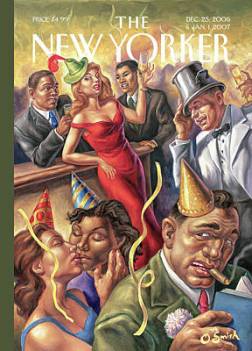
Painting for The New Yorker by Owen Smith
A spokesman for the Kataib Hezbollah militia said the demonstrators intend to besiege the embassy until the facility shuts down and U.S. diplomats leave Iraq.
But the angry demonstrators defied appeals delivered over loudspeakers by the group’s leaders not to enter the embassy compound and smashed their way into one of the facility’s reception areas, breaking down fortified doors and bulletproof glass and setting fire to the room.
American guards inside the embassy fired tear gas to keep the militia supporters at bay. U.S. troops could be seen nearby and on rooftops, their weapons drawn, but they did not open fire. Embassy civil defense workers just inside the gates attempted to put out the fires with water hoses.
The protesters also smashed security cameras, set two guardrooms ablaze and burned tires. They made a bonfire out of a pile of papers and military MREs (meals ready to eat) found in the reception area, where guards normally search visitors. Kataib Hezbollah flags were draped over the barbed wire protecting the embassy’s high walls.
So much for Trump and Kushner’s plans for peace in the Middle East. And didn’t American taxpayers spend $750 million to make the Baghdad embassy impenetrable?
Here’s a little comic relief from The Daily Beast: Team Trump’s Furious Hunt to Find Out Who ‘Liked’ a Chelsea Clinton Tweet.
On the evening of July 10, 2017, staffers at the U.S. embassy in Brussels—the official office for the ambassador to the European Union—received an unusual call from the seventh floor of the State Department back in Washington. The office of then-Secretary of State Rex Tillerson was irate. Someone in Brussels with access to the mission’s Twitter account had liked the wrong tweet. It had set off alarm bells in Foggy Bottom.
The tweet wasn’t just any tweet. It was one written by Chelsea Clinton and directed at President Donald Trump in a public spat that took the internet by storm.
A New Years Eve Night by A. Snegirev, 1982
That week in July, Trump drew criticism for his decision to let his daughter Ivanka fill his seat at the G-20 meeting of top economic powers in Hamburg, Germany. After days of the pile-on, Trump took to Twitter the morning of July 10 to claim his decision to have Ivanka represent the U.S. at the G-20 was “very standard” and that Chancellor Angela Merkel of Germany agreed. Not more than 15 minutes later, he switched his tenor and began attacking Clinton and the press. “If Chelsea Clinton were asked to hold the seat for her mother, as her mother gave our country away, the Fake News would say CHELSEA FOR PRES!,” Trump said.
Clinton shot back: “It would never have occurred to my mother or my father to ask me. Were you giving our country away? Hoping not.”
That tweet garnered more than half a million likes, including by the account for the U.S. mission to the European Union. That kickstarted a weeks-long investigation, prompted by the secretary’s office, into who exactly at the Brussels mission had access to the Twitter account and hit “Like” on Clinton’s tweet, according to two former U.S. officials. (Full disclosure: Clinton sits on the board of IAC, The Daily Beast’s parent company.) Nearly 10 people were interviewed about whether they, as administrators of the account, had mistakenly or deliberately pressed the “Like” button. All of them denied any wrongdoing, those sources said. One individual familiar with the exchanges said the secretary of state’s top managers in Washington “wanted blood” and called Brussels numerous times demanding the name of the culprit.
U.S. officials in Belgium were never able to give Tillerson’s office a name and soon after, the embassy restructured the Twitter account and limited access to just two individuals.

The Trumpies know what’s really important–protecting their boss’s fragile ego.

New Year’s Still Life, by Moesey Li
At The Washington Post, Greg Sargent explains why Mitch McConnell is counting on the political media to help him protect Trump in a fraudulent impeachment trial: Explosive new revelations just weakened Trump’s impeachment defenses.
If Mitch McConnell is going to pull off his scheme to turn President Trump’s impeachment trial into a quick and painless sham with no witnesses, the Senate majority leader needs the story to be covered as a conventional Washington standoff — one that portrays both sides as maneuvering for advantage in an equivalently political manner.
But extraordinary new revelations in the New York Times about Trump’s corrupt freezing of military aid to Ukraine will — or should — make this much harder to get away with.
McConnell badly needs the media’s both-sidesing instincts to hold firm against the brute facts of the situation. If Republicans bear the brunt of media pressure to explain why they don’t want to hear from witnesses, that risks highlighting their true rationale: They adamantly fear new revelations precisely because they know Trump is guilty — and that this corrupt scheme is almost certainly much worse than we can currently surmise.
That possibility is underscored by the Times report, a chronology of Trump’s decision to withhold aid to a vulnerable ally under assault while he and his henchmen extorted Ukraine into carrying out his corrupt designs.
The report demonstrates in striking detail that inside the administration, the consternation over the legality and propriety of the aid freeze — and confusion over Trump’s true motives — ran much deeper than previously known, implicating top Cabinet officials more deeply than we thought.
Please go read the rest at the link. It’s long but important.
I’ve been pretty successfully ignoring the news during these two holiday weeks, except for when I’ve had a blog post to write. Susan Glasser of The New Yorker had more trouble doing that, and now she has found a word to describe life in Trumpworld: Our Year of Trumpschmerz.
So much for the holidays. In the quiet of Christmas and New Year’s, the President of the United States has repeatedly attacked “Crazy Nancy” Pelosi and her family, inveighed against the “bogus Impeachment Scam” and circulated the alleged name of the C.I.A. whistle-blower whose complaint triggered it, retweeted an account that described former President Barack Obama as “Satan’s Muslim Scum,” hosted the accused war criminal he recently pardoned over the objections of military leaders, and promoted a post calling himself “the best President of all time.” He even accused the Prime Minister of Canada, Justin Trudeau, of personally ordering Canadian television to cut a seven-second snippet of the schmaltzy Christmas movie “Home Alone 2” that features Trump, an accusation the President refused to retract, although it was quickly proven that the scene was one of many edited out as a time-saver back in 2014, long before either Trudeau or Trump was anywhere close to power.
Dance at the Moulin Rouge, by Toulouse Lautrec
Even now, three years into the Trump Presidency, there is no language to fully capture the madness of all this, though many of my journalistic colleagues have gone to great lengths to record and codify just how disturbingly nutty 2019 has been. The Washington Post reports that Trump ended the year having made more than fifteen thousand four hundred false and misleading statements since his inauguration. CNN’s “Inside Politics” produced a four-page, single-spaced list of all the people and institutions Trump has attacked by name this year. There are online trackers for the unprecedented levels of turnover in Trump’s Administration and for the rapidly proliferating array of lawsuits involving Trump’s assertions of sweeping executive authority. By any measure, 2019 will go down as a remarkable year in the annals of the American Presidency: Trump began it by causing the longest-ever federal government shutdown in history, after Congress refused to spend billions on his proposed border wall, and ended it as only the third President in history to be impeached by the House of Representatives.

Glasser searched for a word to encompass the horrors of living in Trump’s world.
There must be one of those long German words for all that soul-sickening worry, right? Some tortured mouthful of consonants that captures the ceaseless anxiety and absurdity of Washington in the age of Trump? I asked my friend, the German scholar and writer Constanze Stelzenmüller, an astute observer of Trumpism at the Brookings Institution and especially of its toxic effect on the troubled transatlantic relationship. She said that, even in Trump-skeptical Berlin, there was no single, widely accepted word that describes this phenomenon but gamely offered up her own stab at it. The word she came up with is “Trumpregierungsschlamasselschmerz.”
Her word has pretty much everything that has come to characterize this uniquely dysfunctional moment in America’s troubled capital: Trump and his Administration (“regierung” means government); the slow-motion car crash of constant controversies (“schlamassel”); and the continuous pain or ache of the soul that results from excessive contemplation of it all (“schmerz”). Sure, it’s a mouthful, but that’s the point: there should be one word that sums up the Trumpian disruption we are experiencing, not merely a jumble of different ones. It’s the tweets and the other stuff, too: the endless attacks on enemies, real and imagined; the torrent of lies; the eroding of the basic functions of government; and the formerly unimaginable assault on our institutions. It’s impeachment and the Mueller Report and migrant children in cages, the bullying of allies, and the lavish praise of adversaries. It’s the uncertainty and worry that comes with all of the above.
On the brink of a new year, Trumpregierungsschlamasselschmerz has come to dominate our collective psyche. There is no taking a vacation from it. I confess that I have not yet figured out how to pronounce this unwieldy linguistic invention that so deftly captures our national Trump-soul-sickness. Luckily, I received a follow-up e-mail from Constanze, in which she proposed a shortened version that gets right to the angsty, anxious point: If “Trumpregierungsschlamasselschmerz” is too much, she said, you can just use “Trumpschmerz.” Either way, in German or in English, it’s my nominee for the word of the year in 2019. I suspect it will be in 2020 as well.
And with that I’ll turn the floor over to you, Sky Dancers. What stories are you following, if any?
Lazy Caturday Reads
Posted: December 28, 2019 Filed under: just because, morning reads, U.S. Politics 32 Comments Good Morning!!
I really dislike these two “holiday” weeks at the end of every year. I always end up with a sense of unreality. This year I’m away from my home–I’m house- and cat-sitting for my brother and his family while they visit Denmark and Norway for two weeks.
I’ve been reading constantly and avoiding TV. I’ve been reading a lot; I just finished a book by Stephen King, The Institute. I guess that is contributing to that freaky unreal feeling I’m experiencing. And of course there’s the knowledge that Trump is still “president” and our country and the world are in danger because of him.
I don’t know if anyone will read this, but if you do I want tell you that this blog and everyone who has read it and/or commented on it have helped me maintain some sanity in a crazy world over the more than a decade since 2008. I’m grateful to all of you and I wish you strength to get through whatever is coming in 2020. I love you all.
If you read nothing else today, I hope you’ll choose this essay by Michiko Kakutani at The New York Times: The 2010s Were the End of Normal.
TWO OF THE MOST WIDELY QUOTED and shared poems in the closing years of this decade were William Butler Yeats’s “The Second Coming” (“Things fall apart; the centre cannot hold”), and W.H. Auden’s “September 1, 1939” (“Waves of anger and fear / Circulate over the bright / And darkened lands of the earth”). Yeats’s poem, written just after World War I, spoke of a time when “The best lack all conviction, while the worst / Are full of passionate intensity.” Auden’s poem, written in the wake of Germany’s invasion of Poland, described a world lying “in stupor,” as democracy was threatened and “the enlightenment driven away.”
Apocalypse is not yet upon our world as the 2010s draw to an end, but there are portents of disorder. The hopes nourished during the opening years of the decade — hopes that America was on a progressive path toward growing equality and freedom, hopes that technology held answers to some of our most pressing problems — have given way, with what feels like head-swiveling speed, to a dark and divisive new era. Fear and distrust are ascendant now. At home, hate-crime violence reached a 16-year high in 2018, the F.B.I. reported. Abroad, there were big geopolitical shifts. With the rise of nationalist movements and a backlash against globalization on both sides of the Atlantic, the liberal post-World War II order — based on economic integration and international institutions — began to unravel, and since 2017, the United States has not only abdicated its role as a stabilizing leader on the global stage, but is also sowing unpredictability and chaos abroad.
A 2019 Freedom House report, which recorded global declines in political rights and civil liberties over the last 13 years, found that “challenges to American democracy are testing the stability of its constitutional system and threatening to undermine political rights and civil liberties worldwide.”
If Lin-Manuel Miranda’s dazzling 2015 musical “Hamilton,” about the founders’ Enlightenment vision of the United States, embodied the hopes and diversity of America during the Obama years, dystopian fables and horror-driven films and television series — including “Black Mirror” (2016), a rebooted “Twilight Zone” (2019), “Joker” (2019), “Get Out” (2017), “Watchmen” (2019), “The Handmaid’s Tale” (2017) and “Westworld” (2016) — spoke to the darkening mood in the second half of the decade, as drug overdose deaths in America rose to nearly half a million by the decade’s end, life expectancy fell in the United States and Britain, and many of us started to realize that our data (tracking everything we viewed, bought and searched for online) was being sold and commodified, and that algorithms were shaping our lives in untold ways. In what was likely the hottest decade on record, scientists warned that climate change was swiftly approaching a “point of no return”; we learned that glaciers were melting at record speed at the top of the world; and fires ravaged California and Australia and threatened the very future of the Amazon rainforest.
A bit more and then you’ll need to head over to the NYT to read the rest.
Many of these troubling developments didn’t happen overnight. Even today’s poisonous political partisanship has been brewing for decades — dating back at least to Newt Gingrich’s insurgency — but President Trump has blown any idea of “normal” to smithereens, brazenly trampling constitutional rules, America’s founding ideals and virtually every norm of common decency and civil discourse….
Mr. Trump’s improbable rise benefited from a perfect storm of larger economic, social and demographic changes, and the profoundly disruptive effects of new technology. His ascent also coincided with the rising anxieties and sense of dislocation produced by such tectonic shifts. Around the world, liberal democracy is facing grave new challenges, authoritarianism is on the rise and science is being questioned by “post-fact” politicians. Echoes of Mr. Trump’s nativist populism can be found in Prime Minister Boris Johnson of Britain’s recent electoral victory and the Brexit referendum of 2016, and in the ascent of the far-right President Jair Bolsonaro of Brazil. Democracy is under threat in Hungary and Poland. Once fringe right-wing parties with openly racist agendas are rebranding themselves in Sweden and Belgium. And far-right groups in Germany and Spain are now the third-largest parties in those nations’ parliaments.
AT THE SAME TIME, Donald Trump remains a uniquely American phenomenon. Although the United States was founded on the Enlightenment values of reason, liberty and progress, there has long been another strain of thinking at work beneath the surface — what Philip Roth called “the indigenous American berserk,” and the historian Richard Hofstadter famously described as “the paranoid style.”
It’s an outlook characterized by a sense of “heated exaggeration, suspiciousness, and conspiratorial fantasy,” Hofstadter wrote in his 1964 essay, and focused on perceived threats to “a nation, a culture, a way of life.” Its language is apocalyptic (Mr. Trump’s “American carnage” is a perfect example); its point of view, extremist. It regards its opponents as evil and ubiquitous, while portraying itself, in Hofstadter’s words, as “manning the barricades of civilization.”
The “paranoid style,” Hofstadter observed, tends to occur in “episodic waves.” The modern right wing, he wrote, feels dispossessed: “America has been largely taken away from them and their kind, though they are determined to try to repossess it.” In their view, “the old American virtues have already been eaten away by cosmopolitans and intellectuals,” and national independence has been “destroyed by treasonous plots, having as their most powerful agents not merely outsiders and foreigners but major statesmen seated at the very centers of American power.”
You might also want to read this opinion piece by Deborah Pearlstein at The Atlantic: How the Military Lost Its Proper Place in the Constitutional Order.
In his efforts to mask the seriousness of his actions around Russia and Ukraine, President Donald Trump has taken aim at one essential democratic institution after another—questioning the legitimacy of the press, the intelligence community, the courts, and, most recently, the House of Representatives itself. But he has so far mostly held his fire against both “his generals” and “our boys” in America’s military. “I will always stick up for our great fighters,” Trump promised his political supporters in Florida at a recent rally, championing on that day his recent decisions to pardon soldiers accused of war crimes.
The military, for its part, has had more mixed feelings. As a former chairman of the Joint Chiefs of Staff, General Martin Dempsey, described one such pardon, the president’s action was nothing less than an “abdication of moral responsibility.” Indeed, the military’s generally steadying reactions to the president’s worst moments of volatility have given members of Congress on both sides of the aisle reason to hope that the Pentagon at least will remain a check on presidential impulse that might really compromise national security, should other checking institutions fail.
But hoping that a president will defer to the judgment of the professional military is a sign that something has gone very wrong in America’s constitutional infrastructure. The American republic was, after all, founded on the complaint that the king had “affected to render the Military independent of and superior to the Civil power.” The Constitution’s Framers abhorred the British army, as much or more for its treatment of colonists in the years leading up to the war as during it. As Alexander Hamilton put it with characteristic clarity in “Federalist No. 26”: “The people of America may be said to have derived an hereditary impression of danger to liberty from standing armies in time of peace.”
Click the link to read the rest.
A few more stories to check out:
Margaret Carlson at The Daily Beast: McConnell’s Big Mistake Defending Trump? Listening to Him.
Raw Story: Trump interrupted his vacation for a Friday night social media meltdown.
Salon: Pelosi “has the right” to submit Trump to an “involuntary evaluation”: Yale psychiatrist Bandy Lee.
Scott Turow at Vanity Fair: Could Chief Justice Roberts Be the Democrats’ Impeachment Savior?
Have a nice weekend, Sky Dancers! If you’re around today, please comment and/or share a link.

 peej
peej Carissa
 bostonboomer
 dakinikat
 ecocatwoman
 mablue2
 Mama Lopez
 peggysue22
 quixote
 skydancingguestblogger
 Mona (aka Wonk the Vote)



 Sky Dancing
Recent Comments