“Shouldn’t the new US Attorney General be prosecuting Reflecting Pool Vandals instead of spinning on the Sunday News Shows?” John Buss, @repeat1968
Good Day, Sky Dancers!
Regurgitating the past is so Trumpian. He’s the very model of a relic, an anachronistic trope. This week was full of reminders of how detached he is from reality. Once again, Orange Caligula tried to get the case brought by E. Jean Carroll overturned. Even the Supreme Court didn’t buy it. He may be able to control many of the folks he appointed to executive office, but his manipulation of U.S. democracy still only goes so far.
This is from NBC News‘ Lawrence Hurley. “Supreme Court turns away Trump’s latest bid to block E. Jean Carroll award. President Donald Trump filed an unusual request asking the justices to reconsider a decision they made not to hear his case several weeks ago.” E. Jean and her attorney, Roberta Kaplan, are real American heroes.
The Supreme Court on Monday declined for a second time to take up President Donald Trump’s bid to overturn a jury verdict that awarded $5 million to writer E. Jean Carroll for alleged sexual abuse and defamation.
In an unusual move, the president had asked the court to reconsider its decision from June that rejected Trump’s initial appeal. The court almost never grants such requests.
The case arose from a federal lawsuit Carroll filed in New York City alleging that Trump sexually assaulted her in the dressing room of a department store in 1996. The defamation claims relate to statements he made about her after his first term in office, in which he described her claims as a “con job” and “hoax.”
Trump has denied any wrongdoing and has said he does not know Carroll.
Trump has a separate appeal at the Supreme Court concerning a different defamation case in which Carroll won an $83 million judgment. That case concerns comments Trump made as president during his first term and has been tied up in litigation over whether he can claim immunity.
The court is not set to act on that appeal until later this year.
Good news. E. Jean Carroll spent a decade in court fighting one of the most powerful men in the world.She fought with tenacity and grace — and she won. She is one of my personal heroes.We owe her a debt of gratitude.https://www.cnbc.com/2026/08/17/trump-supreme-court-e-jean-carroll.html
And of course, he argued presidential immunity. This is from Politico.
Trump’s Supreme Court challenges to both verdicts argued in part that the verdicts were flawed because they relied on statements Trump made in 2019 about Carroll while he was serving as president and those statements should be considered immune from legal liability under the high court’s 2024 ruling granting presidents immunity for many acts they take while in office.
I wonder when the new AG is going to jump wily-nily into the case? I wrote a lot on Monday about the current treatment of the US Service members deployed to the Iran-Israeli/US war and their deplorable conditions. I mentioned that historically, Orange Caligula has shown mostly contempt for anyone who served in the military, voluntarily or not. My family has served this country since the Revolution, and I really don’t take kindly to the implications that my dad, uncles, or cousins, or any of the others that fall into the multiple greats, did so because they’re “suckers and losers”.
Public Notice‘s Noah Berlatsky takes on his constant denigration of the many who served. This happened after a Fox News “journalist,” Joey Jones, earned this headline from The Independent. “Fury erupts at Fox host who blasted ‘weak’ sailors on USS Abraham Lincoln: ‘Put him on that ship’. The former Marine Corps staff sergeant compared the carrier crew’s living conditions to his own deployment in Afghanistan.” The outrage over this continues. Here’s the take from Berlatsky: “Suckers and losers” as policy. The plight of the USS Lincoln lays bare Trump’s disdain for the troops.”
The Navy Times reported last week, based on interviews with family members, that multiple sailors have recently tried to jump overboard from the aircraft carrier USS Abraham Lincoln — a ship has been deployed for 250 days as part of President Trump’s war of choice against Iran.
Food is deteriorating and being rationed, there are water shortages, the laundry facilities are broken. And the psychological toll has been brutal.
Trump started a war without provocation and has prolonged it because he does not want to admit he lost. But when questioned on Friday about conditions on the Lincoln, he responded not with compassion or regret, but with callous vindictiveness.
Asked if the deployment had lasted too long, he replied, “No. Not nearly long enough.”
Q: The family members of US service members are concerned about the conditions on the USS LincolnTRUMP: No they're notQ: Has the deployment gone on too long?TRUMP: No no no. Not nearly long enough.
Trump also claimed that a carrier was moving to the Middle East to relieve the Lincoln. That appears to be true. Still, his belligerent denial of the suffering of service members is shocking.
“Shocking,” though, does not mean surprising.
Over the last decade, Trump has consistently insulted and mocked US troops. His defense secretary, Pete Hegseth, has made clear that he sees service members as props in his endless battle to win culture war accolades from Nazi bloggers and right-wing talking heads.
The fact that real men and women are experiencing mental health crises and are dying in service of their ill-informed and vindictive whims doesn’t trouble Trump or Hegseth. It should more than worry everyone else though.
In yet another deranged Orange Caligula moment, we see his priorities. This is from the AP. “Trump blames vandals for damaged grass in the same spot where he held his big July 4 celebration.” WTAF? Is this paranoia or some odd brain fart? He’s done more damage to the District than the British ever did!
President Donald Trump on Sunday said vandals are to blame for large swaths of dead grass on the National Mall near the World War II Memorial — in the same spot where Trump had a stage built and hosted crowds for his July 4 celebration.
Trump made the accusation in a social media post without saying why he believes it’s the work of vandals instead of trampled turf from the Independence Day festivities. He posted a photo showing a once-grassy area by the World War II Memorial, now patchy and brown across much of the sprawling turf.
“Look what VANDALS did to the grass connecting the vandalized World War II Monument and the vandalized Reflecting Pool, which will be opened again, and better than ever, shortly,” Trump said on his Truth Social platform.
“Anybody who thinks the Reflecting Pool wasn’t vandalized should go back to Law School!” he added.
Trump has been obviously obsessed with World War II and its generals recently. Does he want to be Eisenhower now? Does he really think starting WW III would be a terrific idea to cement his place in history? I just don’t get any of this. Can someone please stop this madman before the country declines beyond repair?
In a truly bizarre move, Trump decided joint military exercises with South Korea should be ended because he’s such a good friend of the bizarro leader of North Korea. This is from the New York Times‘ Helene Cooper. “Trump Orders Pentagon to Curtail Military Exercises With Ally South Korea. In a social media post, the president scolded South Korea for not helping denuclearize Iran, and also praised North Korea and its leader.”
President Trump said on Sunday that he had instructed the Pentagon to reduce joint military exercises with South Korea, a longtime U.S. ally and a linchpin of America’s national security strategy in the Asia-Pacific region.
The announcement may heighten growing worries among Asian allies over what the United States is now willing to do to deter China, given the enormous distraction and resource drain of the U.S.-Israel war against Iran. The United States is running low on critical weapons and has been moving military resources out of Asia to the Middle East.
In a convoluted social media post, Mr. Trump complained that Seoul did not “join us in the Denuclearization of the Islamic Republic of Iran.” In the same post, he said that North Korea under Kim Jong Un had been “unthreatening and respectful” while he has been president.
In his post Mr. Trump did not mention a rift in relations in 2017, when the North Korean leader called him a “mentally deranged dotard” after Mr. Trump delivered a speech at the U.N. threatening to “totally destroy” North Korea if the United States had to defend itself or its allies.
Now Mr. Trump is speaking only of what he on Sunday called his “very good relationship” with North Korea and its leader. In his post, he said that because of those ties, he was “not happy with the fact that the United States has, long ago, agreed to participate in Joint Military exercises with South Korea.”
“These exercises are not only costly, with much of these costs paid for by the United States of America (as usual!), but send a signal that is totally inappropriate and hostile, to a Country that, as long as Donald J. Trump has been President, has been unthreatening and respectful,” Mr. Trump said in his post.
Mr. Trump said that because it was too late to cancel the exercises entirely, he had asked Defense Secretary Pete Hegseth to “substantially reduce” U.S. participation.
The U.S. and South Korean militaries have held joint exercises for more than 70 years, since 1955, after the 1953 armistice that ended the Korean War.
The South Korean Defense Ministry confirmed that the joint military exercises had begun on Monday as scheduled. In a statement last week, the allies emphasized that the 11-day annual Ulchi Freedom Shield exercises were “defensive in nature” and aimed at enhancing the countries’ readiness and capabilities by “incorporating realistic threats, including lessons learned from recent conflicts.”
But North Korea’s Foreign Ministry on Friday had reiterated its condemnation of the drills, branding them “a rehearsal for an aggressive war.” In response, the country conducted two ballistic missile tests off its east coast this month, vowing to “respond to a new level of a threat with a new level of a deterrent.”
I don’t know about you, but I think having a President so totally located in a completely different reality, in charge of things — especially the military — is an extremely dangerous place to be.
So, let’s end this on hope, a wing and a prayer. This is from Axios‘ Mike Zapler and Ben Berkowitz. “Even some Republican voters sour on Trump.” I would hope they could. How can you live in this country today and afford anything? How could you have draft-age children or grandchildren and not be worried?
High prices, a persistent war and anxiety about corruption are quickly eroding President Trump’s support among Republicans, a warning sign for the White House with less than 80 days to the midterms.
Why it matters: Democrats look likely to take control of the House already, but Trump’s weakness could cost Republicans more seats and further endanger the Senate.
The loss of one or both chambers would guarantee two years of scrutiny and gridlock for the end of Trump’s presidency.
By the numbers: Three surveys out in the last week paint a clear picture of growing dissatisfaction among the president’s base.
📉 An Economist/YouGov poll out Tuesday had Trump’s approval rating among Republicans at a second-term low of 79 percent — a decline of 12 points from shortly after he took office.
In that time, the percentage of Republicans who “strongly approve” of Trump’s performance has dropped more precipitously —by 20 points (from 68 to 48 percent).
Trump is barely above water among non-MAGA Republicans, who make up about 30 percent of the party. Only 51 percent approved of his performance, vs. 47 percent who disapproved. The positive rating among non-MAGA Republicans fell 13 points in one week.
⬇️ A Financial Times poll out this weekend had Trump’s net approval rating among Republicans off 8 points from just a month prior.
💰 Republican consumer sentiment fell 9.5 points in August from July, per the University of Michigan monthly survey out Friday — one of the largest declines the decades-old project has ever recorded. The Republican decline was more than double the overall headline number.
Driving the news: It’s no secret what’s behind the numbers: the war in Iran, high gas prices and stubborn inflation.
These recent findings come on the heels of polls that show rising Republican skepticism of the war and GOP wariness over whether Trump is using his office for personal profit.
The intrigue: Trump’s political strength has long derived from outsized loyalty among Republicans, so even a slight slippage could be consequential.
I also was under the delusion that Republicans were deficit hawks. But, I guess that was just another gaslighting session. If you have time, check this one out by Max Boot from the Washington Post. Too bad it took some of these assholes so long to figure things out. “I’m a hawk. I’m shocked by a $1.5 trillion defense budget. The request would top World War II spending while funding boondoggles and sweetheart deals.”
So, anyway, it’s another hot, humid Monday down here in New Orleans, and I have to go water the small patch of sod that is now the middle of my small backyard. I’m still trying to teach folks economics and finance, but nothing fits the reality these days. The entire Data Center thing and the supposed “financing” of it are totally outside my realm, as a PhD in Financial Economics. Call me churlish, but this looks more like the Command-and-Control economics and policies of the old Soviet Union than those of the United States. Then there’s this, which is so far outside the bounds of legality I can’t even think straight about it. “Trump family crypto business World Liberty gets preliminary approval to establish a bank.” The flunky he appointed as Comptroller of the Currency has already approved it. Let’s see how he manipulates the Federal Reserve System and the SEC! Don’t even get me started on RFK Jr’s latest romp through medicine and the vaccines that have saved so many people.
As usual, more at the links.
Anyway, I can’t believe what’s going on. I really can’t. None of this should be happening. Let me know what you think. As usual, more on any of this can be found at the links.
What’s on your Reading, Action, and Blogging list today?
Did you like this post? Please share it with your friends:
“Meanwhile… at the Reflecting Pool in Washington, DC. Not everyone in Trumpland is impressed with the latest distraction. MAHA!”John Buss, @repeat1968
Good Day, Sky Dancers!
There actually is some good news from the Supreme Court Today. I’m not holding my breath that it will stand, however. It’s hard to hold your breath on anything. The Straight of Hormuz is still an active battlefield, no matter what Orange Caligula tells the press. People are dying in ICE custody as ICE has not been paying for medical care for 7 months. All of our allies are moving closer to Europe and farther from us, no matter where they are in the world. We’re a shithole country. We might as well face up to it.
Just breaking: news from the Supreme Court. NBC News reports that “Supreme Court temporarily restores full access to abortion pill. “The decision means mifepristone remains available nationwide without an in-person meeting required while litigation continues.” I read this headline after taking Temple for a walk and found a bunch of stickers on the neutral ground. Of course, I picked them up, and Temple and I will be plastering them at all the local bars later today.
This seems a little karmic, doesn’t it? Lawrence Hurley and Aria Bendix have the lede.
The Supreme Court on Monday provisionally blocked a lower court decision that would have limited availability nationwide of the abortion pill mifepristone.
In two brief orders, Justice Samuel Alito, one of the court’s conservatives, said the decision by the New Orleans-based5th U.S. Circuit Court of Appeals would remain on hold until at least May 11. Alito issued the order because he is the justice who handles emergency issues arising from that appeals court, which covers Texas, Louisiana and Mississippi.
The temporary pause gives the high court time to consider next steps in the case as it weighs separate emergency requests filed by drug makers Danco and GenBioPro.
The nationwide availability of mifepristone was cast into jeopardy on Friday when the appeals court granted Louisiana’s request to void Biden administration rules that allowed the drug to be administered without an in-person meeting, meaning it can in theory be mailed anywhere in the country, even in states with strict abortion bans.
Alexis McGill Johnson, president of abortion rights group Planned Parenthood Action Fund, welcomed the decision.
“While mifepristone access returns to where it was on Friday morning, the whiplash and chaos that patients and providers are navigating have already had real consequences for real peoples’ lives and futures,” she said in a statement.
Anti-abortion groups have been pushing for years to reinstate the in-person dispensing requirement, alleging that taking mifepristone at home can be dangerous — despite studies that have found it to be safe and effective.
Danco makes Mifeprex, the brand name version of mifepristone, while GenBioPro makes a generic version.
Alito ordered Louisiana to file its response to the company’s request by the end of the day on Thursday.
This is the latest deadly weirdness from NBC News. Once again, we see Trump cannot be trusted, and that Hegseth is probably drunk bombing. “U.S. denies Iranian claim that it hit American warship as Trump launches mission to reopen Strait of Hormuz. The U.S. said two American-flagged commercial vessels transited the critical waterway Monday as part of the new “Project Freedom.” This story is reported by Yuliya Talmazan and Courtney Kube.
The U.S. military on Monday rejected Iranian claims to have struck an American warship trying to enter the Strait of Hormuz and said the first commercial ships had transited the critical waterway as part of President Donald Trump’s new mission to guide stranded vessels.
Meanwhile, the South Korean government confirmed earlier reports that explosion and fire had occurred on a South Korean-operated cargo ship on Monday.
Iran signaled an aggressive response to this latest bid to break its stranglehold over the strait, which has left global shipping at an effective standstill and sent energy prices spiraling.
Tehran issued a new map and a flurry of statements that sought to reassert its control. Early Monday, it claimed to have stopped U.S. destroyers from entering the strait.
After the U.S. warships ignored several radio warnings, cruise missiles, rockets and combat drones were fired near them, army public relations said in a statement carried by the semi-official Tasnim news agency.
Iranian state media had earlier claimed that two missiles had hit a U.S. ship near the entrance to the strait, but the U.S. military denied this.
“No U.S. Navy ships have been struck. U.S. forces are supporting Project Freedom and enforcing the naval blockade on Iranian ports,” Central Command said in a post on X.
A U.S. official also denied to NBC News that any U.S. Navy ships were prevented from accessing the strait on Monday by Iran.
It really does sound like we’re the bad guys now, doesn’t it? Washington Monthly‘s Paul Glastic has this interesting bit of analysis today. “Why the U.S.-led Liberal World Order is Only Mostly Dead.”
Even before Donald Trump launched his ill-advised war on Iran, America’s allies were already pronouncing the end of the era of U.S. leadership of the free world. “The West as we knew it no longer exists,” European Commission president Ursula von der Leyen said in April of 2025 as she tried to rally governments in Asia, the Middle East, and Europe to counter massive tariffs that Trump had recently imposed. “The old order is not coming back,” declared Canadian Prime Minister Mark Carney this past January in a widely reported speech at Davos after fresh attempts by Trump to seize Greenland.
But in the wake of Trump’s cavalier attack on Iran and the global economic pain that has resulted, even some of America’s most vocal and influential champions of U.S. supremacy seem ready to throw in the towel. The neoconservative national security scholar Robert Kagan of the Brookings Institution recently penned a requiem in The Atlantic for eight decades of Pax Americana:
Those days are now over and will not soon return. Nations that once bandwagoned with the United States will now remain aloof or align against it—not because they want to, but because the United States leaves them no choice, because it will neither protect them nor refrain from exploiting them. Welcome to the era of the rogue American superpower. It will be lonely and dangerous.
Such declarations of the end of the U.S.-led international order are understandable. In a sense, they are a simple recognition of what Trump writes every day in ALL CAPS in his Truth Social posts, and of what his second-term government has been doing for 16 months. Just as Trump burned through his inherited wealth in a series of failed real estate ventures in his younger years, so is he now squandering decades of accumulated U.S. power in a mad attempt to overthrow the post-war system of alliances and institutions that was the means of acquiring that power. And he still has more than two-and-a-half years left in his presidency. Who knows how much more damage he will do? There is no reason to think he will abandon his beliefs that our allies are parasites, that international institutions are for losers, and that strongmen like him and Vladimir Putin should rule their spheres without constraint.
Countries across the globe are now recognizing that their past reliance on Washington for everything from advanced weaponry to sea lane protection has made them vulnerable to a leader like Trump. Consequently, they are looking for ways to give themselves some “strategic autonomy” from the United States—by, for instance, tilting towards China, or crafting a new coalition of “middle powers,” as Carney suggested in Davos, or creating a “European NATO” in which the U.S. no longer plays a leading, or perhaps any, role.
Given the circumstances, countries are wise to pursue these new arrangements. But they are poor substitutes for the U.S.-led liberal international order that Trump is dismantling. A better strategy is to rebuild that order in some form as soon as Trump leaves office. That might seem like wishful thinking, but it is not. Rather, it is the probable course of events if (as also seems likely) a Democrat wins the White House in 2028.
According to numerous polls, Democratic voters remain staunch supporters of Ukraine, NATO, and international institutions generally. They profoundly oppose Trump’s gunboat diplomacy in Venezuela and Iran. To win the presidential primary, any Democratic candidate must adhere to these views and, if successful in the general election, follow through in office to remain popular with the base. That shouldn’t be a problem if Democrats also control both houses and support a more internationalist foreign policy. Agencies gutted by Trump, such as USAID and the State Department, could be refunded and even expanded via reconciliation, thus requiring no GOP votes.
Some Republican lawmakers, free of Trump, might also be willing to support a more traditional foreign policy approach. In April, when Trump threatened to pull out of NATO if the allies didn’t help open the Strait of Hormuz, GOP Senate Majority Leader John Thune said there was little appetite in his caucus to support Trump in that effort. “We got an awful lot of people who think that NATO is a very critical, incredibly successful post-World War II alliance. And I think in the world today, you need allies,” Thune told reporters. Additionally, a NATO in which member states have raised their defense spending and taken increased responsibility for aiding Ukraine is an alliance that more conservative Americans can get behind without feeling like suckers.
Many supporters of traditional U.S. multilateralism fear that, because of Trump’s nationalist and extortionist policies, other countries can no longer trust us. After all, American voters elected Trump not once, but twice. That’s a fair point. But it’s also true that American voters threw Trump out of office once and, in virtually every election over the past year-plus, have signaled their unhappiness with the state of the country under his leadership. Moreover, all advanced democracies have far-right authoritarian political movements that could take over their governments. We can’t trust their voters any more than they can trust ours. We may all be fated to oscillate between liberal and illiberal governments, as Hungary has, until we address the working-class economic distress that is the root cause of the problem. As I have argued, it’s easier to do that multilaterally than separately.
These days, it’s easy to see why all of these countries have given up on us. Many of us here in the country feel that way, too. It’s so important to make sure the midterms flip the House and the Senate. If not, I may be writing future blog posts from Lima, Peru. Alison Quinn, writing for The Daily Beast, has the perfect observation. ” We’ll have to ask Dr. BB for confirmation, but I believe lack of sleep can increase the level of madness in a mentally ill person. “Truth of Trump’s Wild Sleepless Nights Exposed. LOSING HIS MIND. Joanna Coles and Daily Beast executive editor Hugh Dougherty dive into a jaw-dropping investigation revealing the president’s relentless late-night posting habits.”
A third of Donald Trump’s social media posts now come in the middle of the night when the soon-to-be 80-year-old president should be sleeping, raising urgent new concerns about his mental health as he navigates war.
Joanna Coles and Daily Beast executive editor Hugh Dougherty break down a shocking investigation that puts Trump’s late-night posting habits on stark display, revealing a disturbing pattern between those baffling posts fired off in the dead of night and the awkward moments in the Oval Office when the president has been caught appearing to doze off.
“It is an extraordinary, extraordinary piece of work. Josh Fiallo, our brilliant reporter, counted up all the times that Donald Trump posted on Truth Social in April and then he looked at when he was posting and he looked between the hours of 9 p.m. and 6 a.m. and we discovered that there were only five days in April when the president did not post on Truth Social between 9 p.m. and 6 a.m.,” Dougherty said on The Daily Beast Podcast.
“Eighty percent of nights when he could be sleeping, he’s posting,” he said.
While Trump’s often bizarre Truth Social posts have in many ways become a hallmark of his time in office, there was something quite different about them in the month of April: They appeared to become more frantic, disjointed, and more incendiary, as Trump’s political troubles multiplied, leading to foul-mouthed tirades and threats of war crimes that shocked even his own MAGA base and prompted some of his own allies to sound the alarm. It was no longer just Democrats questioning his fitness for office, but former advisers and much of the American public.
A Fox News poll conducted April 17-20 found that 55 percent of respondents felt Trump did not have the “mental soundness” to be an effective leader.
Well, at least the majority of us can see clearly. So that’s it for me. I got a smoker grill and intend to sit in what will become the new backyard of the kathouse and eat some very delicious food this summer. That’s mostly because I’m having the kitchen completely redone soon, so I have to cook somewhere else. It will be like a Girl Scout camp trip soon!
Please take care of yourselves, be kind to yourselves, and remember we’re always here for each other!
What’s on your Reading, Action, and Blogging list today?
“Don’t gobblefunk around with words.” ― Roald Dahl, The BFG.
Did you like this post? Please share it with your friends:
I’ve been getting more sleep than usual lately, but my chronic insomnia kicked in last night. I got almost no sleep. I’m really not ready to face another day with Trump and his antics, but I’ll do the best I can.
The Supreme Court on Wednesday sharply weakened a key provision of the landmark Voting Rights Act, a ruling that limits the consideration of race in drawing voting maps and could usher in Republican gains in the House.
The decision could touch off a scramble by Republicans to redraw minority-majority districts, especially in the South. New districts could shiftthe balance of power in Congress by imperiling the reelection prospects of some Black Democrats, possibly as soon as November’s midterms in some instances.
Samuel Alito (with Neil Gorsuch in the background on the left.)
The ruling also carries significant symbolic weight, effectively scaling backthe last major pillar of a 60-year-old law long considered one of the marquee achievements of the civil rights era. The Voting Rights Act bans discriminatory voting practices such as literacy tests and poll taxes, and has helped greatly increase minority representation in state and federal offices.
The ruling also carries significant symbolic weight, effectively scaling backthe last major pillar of a 60-year-old law long considered one of the marquee achievements of the civil rights era. The Voting Rights Act bans discriminatory voting practices such as literacy tests and poll taxes, and has helped greatly increase minority representation in state and federal offices.
In an ideologically divided 6-3 ruling, the conservative justices created a higher bar for the law’s powerful provision that allows states to use race to draw maps that help minority communities elect candidates of their choice. Section 2, as it is known, is aimed at combating discriminatory gerrymandering that weakens the power of Black, Latino, Native American and Asian voters.
States must walk a careful line when drawing maps for voting districts. The Voting Rights Act directsstates to consider race to some degreewhen redistricting to ensure that racial minority groups have an opportunity to elect representatives who reflect their priorities. Maps explicitly drawn along racial lines, however, violate the equal-protection clause of the 14th Amendment and the 15th Amendment’s ban on racial discrimination in voting practices.
Specifically:
The court’s conservative majority found Louisiana unlawfully discriminated by race when it created a second majority-Black congressional district to comply with the VRA. Justice Samuel A. Alito Jr. wrote the opinion for the majority.
“Section 2 of the Voting Rights Act … was designed to enforce the Constitution — not collide with it,” Alito wrote. “Unfortunately, lower courts have sometimes applied this Court’s [Section] 2 precedents in a way that forces States to engage in the very race-based discrimination that the Constitution forbids.”
The decision came over the sharp objections of the court’s three liberals. Justice Elena Kagan delivered the dissent from the bench, signaling strong disagreement.
“Under the Court’s new view of Section 2, a State can, without legal consequence, systematically dilute minority citizens’ voting power,” Kagan wrote in the dissent.
The Roberts Court finally achieved its years-long goal of killing the Voting Rights Act Wednesday, publishing a ruling that, the liberal justices say, will make proving racial discrimination in redistricting virtually impossible.
“Under the Court’s new view of Section 2, a State can, without legal consequence, systematically dilute minority citizens’ voting power,” wrote Justice Elena Kagan in her dissent.
“Of course, the majority does not announce today’s holding that way. Its opinion is understated, even antiseptic,” she continued. “The majority claims only to be “updat[ing]” our Section 2 law, as though through a few technical tweaks. But in fact, those ‘updates’ eviscerate the law…”
Justice Samuel Alito wrote the majority opinion, joined by all five other justices inthe bench’s right wing. Kagan was joined in her dissent by Justices Sonia Sotomayor and Ketanji Brown Jackson. Justice Clarence Thomas also wrote a concurrence joined by Justice Neil Gorsuch.
Alito defangs the law by unilaterally cancelling out congressional fixes to it — primarily, that plaintiffs bringing claims of racial vote dilution no longer have to prove that the legislators drawing the maps did so to purposefully discriminate. This bar had proved so difficult to overcome, especially as legislators became more adept at using facially neutral language, that Congress adopted amendments to the VRA asserting that if the maps have a discriminatory effect, that’s enough. Chief Justice John Roberts, then working in the Reagan administration, spearheaded the unsuccessful effort to doom the passage of those amendments.
Alito hand waves this history away, in part, by echoing Roberts’ reasoning in an earlier decision that eviscerated the VRA’s preclearance requirement, which required jurisdictions with histories of racial discrimination in voting to submit changes in election laws to the federal government for clearance before they could take effect. Roberts, in Shelby County v. Holder, said that the country had made such great strides in racial equality that the preventative measure was no longer necessary — ushering in a flood of new voter restrictions, particularly in the states that comprised the old Confederacy.
Read the rest at TPM.
Trump has insomnia too, it seems. He posted an idiotic message to Iran at an ungodly hour:
President Donald Trump warned Iran “better get smart soon” Wednesday, as he weighed military options for the Strait of Hormuz with peace talks at an impasse.
Members of Trump’s national security team presented him with multiple options this week for how to handle the continuing bottleneck in the strait after negotiations failed to reopen the critical waterway, a U.S. official and a person familiar with the meeting told NBC News.
The standoff between Washington and Tehran, including the continued U.S. naval blockade, means the key trade route has been effectively blocked for two months.
The threat of prolonged disruption to the global economy has sent energy prices soaring — gas price averages in the U.S. reached $4.23 a gallon,the highest level in nearly four years, while the international benchmark price for oil, Brent crude, surged to $115 a barrel early Wednesday.
Meanwhile, Iran’s national rial currency hit a record low against the dollar, as Tehran’s economy also showed growing signs of strain.
The options discussed during Monday’s meeting in the Situation Room included whether the U.S. military presence in the strait should change — either increase or decrease — and whether the military should become more aggressive in conducting operations there, the U.S. official said.
Trump has not made any decisions about the way forward, the sources said, and it’s not clear when he might make a decision.
They don’t even note that the warning from Trump came in an idiotic Truth Social post until paragraph 11!
Trump and other top administration officials met with a group of energy industry executives on Tuesday, discussing possible next steps in continuing the blockade of Iran’s ports “for months if needed” and how to minimize impacts on American consumers, a White House official told NBC News.
The meeting was hosted by Treasury Secretary Scott Bessent included executives from Chevron, Trafi, Vitol and Mecuria, among other companies.
The U.S. showed little immediate enthusiasm for a new Iranian proposal that would end the war and reopen the strait without resolving the impasse over the Islamic Republic’s nuclear program — a key stumbling block in the stalled peace talks.
President Donald Trump is quietly telling administration insiders to prepare for an “extended” blockade of Iran as negotiations to end the war with the regime drag on.
On Tuesday, the Wall Street Journal reported, citing “U.S. officials,” that Trump has told his aides that the blockade of Iran will continue, as the two sides remain far apart on Trump’s stated goal of getting the regime to give up its nuclear arms capabilities altogether. The report followed a meeting in the Situation Room on Monday, where Trump administration officials reviewed an offer to end the war from the Iranian regime that included reopening the Strait of Hormuz in exchange for delaying talks about nuclear weapons.
The report also suggests that Trump appears to be digging in and trying to tighten the screws on Iran’s economy.
“In recent meetings, including a Monday discussion in the Situation Room, Trump opted to continue squeezing Iran’s economy and oil exports by preventing shipping to and from its ports,” according to the report. “He assessed that his other options—resume bombing or walk away from the conflict—carried more risk than maintaining the blockade, officials said.”
“Yet continuing the blockade also prolongs a conflict that has driven up gas prices, hurt Trump’s poll numbers and further darkened Republicans’ prospects in the midterm elections,” it continued. “It has also caused the lowest number of transits through the Strait of Hormuz since the war began.”
The decision by the United Arab Emirates to leave the OPEC oil cartel shook up the 65-year-old alliance that produces some 40% of the world’s crude oil and exerts major influence over the price of energy around the globe.
OPEC countries
The UAE said in the announcement Tuesday that when it leaves OPEC this Friday, it plans to carry on with its long-held goal of increasing crude production “in a gradual and measured manner, aligned with demand and market conditions.”
Right now, that’s academic as far as oil prices go, since Iran is still blocking the Strait of Hormuz, which means much of the oil from Persian Gulf producers such as the UAE cannot be exported. But the departure could have long-term effects on oil prices….
The Organization of the Petroleum Exporting Countries was formed in Baghdad in September 1960 by Iran, Iraq, Kuwait, Saudi Arabia and Venezuela. It has 12 members — counting the UAE — that hold more than 80% of the world’s proven oil reserves. Other members are Algeria, Equatorial Guinea, Gabon, Libya, Nigeria and the Republic of the Congo….
The group, headquartered in Vienna, aims to regulate oil prices by coordinating increases or decreases in production.
The goal has been to keep prices high enough so member governments can balance their budgets and reap the benefits of their natural resources — but not so high as to cause a recession in consuming countries or to halt energy-consuming activity, a phenomenon known as demand destruction.
Donald Trump is learning first-hand about the perils of mission creep.
The US-Israel war in Iran has just passed its eighth week – twice as long as the president predicted it would take when US warplanes launched their joint attack with Israeli forces to decapitate the Iranian leadership and paralyse its military. The military attacks were successful. The predictions about the political cause-and-effect to follow were not.
Iran has survived the initial strikes and remains defiant, closing the strait of Hormuz in a move that has blocked off a fifth of the global oil trade. The US has responded with its own blockade to lock in Iranian oil, inflicting losses of an estimated $500m daily on Tehran and threatening the country’s long-term energy production – but negotiations have stalled and it is not clear if the White House is willing to withstand the pain of a sustained economic war or the risk of a military operation to open the strait.
“This has gone from being a war of choice to a war of necessity,” said Aaron David Miller, an analyst at the Carnegie Endowment and a former US diplomat and Middle East negotiator.
The war had transformed from a conflict involving Iran, the US and Israel to a “global economic crisis which shows no signs of abating”. Just this week, petrol prices in the US approached a four-year high, and they are expected to continue to rise before a crucial midterm election that could allow the Democrats to retake congress.
“The status quo is not tolerable … there has to be a fix to it,” Miller said. “It strikes me that the administration is in a very tough spot.”
But the solution remains elusive. One option would be to negotiate a temporary reopening of the strait of Hormuz but to delay nuclear talks on the fate of the more than 400kg of highly enriched uranium (HEU) – as well as the country’s right to enrich uranium in the future.
Read the rest at The Guardian.
Yesterday the “Justice” Department indicted James Comey for the second time. The indictment is unbelievably stupid. He is accused of threatening to assassinate Trump because he posted on social media a photo of some seashells spelling “86 47.”
On April 28, 2026, the United States Department of Justice indicted former FBI Director James Comey over a mildly sassy arrangement of seashells. The charge is preposterous and no competent or honest prosecutor would bring it. It represents a betrayal of the professional and ethical obligations of every U.S. Department of Justice attorney involved, and reflects the complete collapse of the Department’s credibility and independence in favor of a cultish and cretinous devotion to Donald Trump.
The indictment concerns James Comey’s May 25, 2025 post to his Instagram account remarking “Cool shell formation on my beach walk” and showing shells arranged to spell out “86 47.” [….]
Based on this, the United States Attorney’s Office for the Eastern District of North Carolina — the venue of the sassy beach stroll — secured an indictment against Comey for two federal felonies: threatening the President of the United States in violation of Title 18, United States Code, Section 871 and transmitting a threat in interstate commerce in violation of Title 18, United States Code, 875(c). In both counts, the government asserts that “a reasonable recipient who is familiar with the circumstances would interpret as a serious expression of intent to do harm.” That is, of course, a preposterous lie….
Let’s look at what the government would have to prove to convict Comey of these offenses, using cases from the Fourth Circuit, which governs this district. To prove a threat against the President in violation of Section 871, the prosecution must offer “(1) the proof of “a true threat” and (2) that the threat is made “knowingly and willfully.”“ United States v. Lockhart, 382 F.3d 447, 449-450 (4th Cir. 2004). To prove a threat in interstate commerce in violation of Section 875(c), the government must prove that “(1) that the defendant knowingly transmitted a communication in interstate or foreign commerce; (2) that the defendant subjectively intended the communication as a threat; and (3) that the content of the communication contained a “true threat” to kidnap or injure.” United States v. White, 810 F.3d 212, 220-21 (4th Cir. 2016). For purposes of both statutes, a “true threat” is a statement which an “ordinary, reasonable recipient who is familiar with the context in which the statement is made would interpret it as a serious expression of an intent to do harm.” White, 810 F.3d at 221.
Prosecutions for threats against the President played a substantial role in developing the First Amendment doctrine of “true threats,” which separates bluster and rhetoric from actual threats to do harm. In Watts v. United States, 394 U.S. 705 (1969), the United States Supreme Court took up the conviction of an 18-year-old man who said this during an anti-draft protest during Vietnam: “They always holler at us to get an education. And now I have already received my draft classification as 1-A and I have got to report for my physical this Monday coming. I am not going. If they ever make me carry a rifle the first man I want to get in my sights is L. B. J. . . . . They are not going to make me kill my black brothers.” The Court articulated the core of the “true threat” doctrine, noting that political rhetoric, hyperbole, and robust debate that does not convey an intent to do harm is protected by the First Amendment:
“But whatever the “willfullness” requirement implies, the statute initially requires the Government to prove a true threat. We do not believe that the kind of political hyperbole indulged in by petitioner fits within that statutory term. For we must interpret the language Congress chose “against the background of a profound national commitment to the principle that debate on public issues should be uninhibited, robust, and wide-open, and that it may well include vehement, caustic, and sometimes unpleasantly sharp attacks on government and public officials.” New York Times Co. v. Sullivan, 376 U.S. 254, 270 (1964). The language [**1402] of the political arena, like the language used in labor disputes, see Linn v. United Plant Guard Workers of America, 383 U.S. 53, 58 (1966), is often vituperative, abusive, and inexact. We agree with petitioner that his only offense here was “a kind of very crude offensive method of stating a political opposition to the President.” Taken in context, and regarding the expressly conditional nature of the statement and the reaction of the listeners, we do not see how it could be interpreted otherwise. Watts, 394 U.S. at 708.”
No minimally rationally person could possibly conclude, seeing James Comey’s beachside dad joke, that he was expressing a sincere intent to harm the President. Nobody could look at it and conclude that Comey intended to convey that message. In evaluating whether a threat is “true,” the trier of fact must consider the context. Here the context is seashells. The context is the former Director of the FBI, a lifetime member of law enforcement, who is a well-known critic of the President and a target of the President’s wrath, using a campy mechanism to express opposition to the President, using slang for “ditch” or “eject” or “get rid of.” No rational person could see that and say “the former director of the FBI is saying he’s going to kill the President”!”
I could now cite to you a legion of cases for that proposition, finding rhetoric far more concerning than this protected by the First Amendment, analyzing language and context to show this is protected. But it wouldn’t matter, would it? If you are a minimally rational person, you don’t need to see the precedent, and if you’re a cultist, no amount of precedent matters to you.
He does go on; read the rest at the link above.
From Blanche’s press conference yesterday:
Q: Should we expect more indictments of this sort? For example, in 2020 Gretchen Whitmer did a TV hit with "8645" in the background." Would you pursue that?BLANCHE: As far as other instances of threats against the president — those will be investigated
I hope Blanche doesn’t have plans to continue legal work in the future. I don’t think he’s going to have a license. The same goes for the lawyers who prosecute this case.
Republicans hoping their party’s standard-bearer will stay focused on voters’ priorities heading into the November midterms caught no relief on Tuesday as the Trump administration announced charges against former FBI director James B. Comey and an aide to former chief medical adviser Anthony S. Fauci, as well as a review of Disney’s broadcast licenses.
The latest instances of turning government power against President Donald Trump’s critics and pursuing years-old grievances added to frustrations felt by Republicans who say the president isn’t doing enough to address the signature issues that won him a second term.
Two-thirds of Americans said Trump hasn’t paid enough attention to the country’s most important problems in a CNN survey conducted late last month, up from 52 percent in February 2025 and higher than at any point in his first term.
“No Republican wants to run on ‘I stand with Donald Trump’s retribution tour’” while gas prices are so high, said Barrett Marson, a GOP strategist in Arizona. “There is no doubt that the vast majority of non-MAGA voters want Trump to focus on anything but his personal animus toward a wide variety of people.”
The White House said the Comey prosecution has no bearing on Trump’s efforts to bring down costs — moves that include signing a tax-cut bill, adding discounted drugs to a government-run portal, expanding domestic beef production, releasing oil reserves and easing restrictions on tankers moving fuel between U.S. ports.
“The idea that President Trump and his Cabinet agencies cannot execute multiple actions simultaneously is so laughably false,” spokeswoman Abigail Jackson said. “The insinuation that a grand jury returning an indictment is mutually exclusive with the administration’s strong efforts on the economy is objectively false.”
Other Republicans, however, asked about the administration’s priorities. Sen. Thom Tillis (R-North Carolina), a member of the Senate Judiciary Committee, questioned whether the Comey case was the best use of time and resources for the acting U.S. attorney from his state who brought the charges, W. Ellis Boyle. Trump renominated Boyle to the position in January after the Senate took no action on his nomination last year.
This is just who Trump is. We can only hope the Democrats will win the House and Senate and impeach him.
That’s it for me today. What’s on your mind?
Did you like this post? Please share it with your friends:
“The end is nigh. Gas prices haven’t dropped, electric bills have gone up, groceries are ridiculous, a year later, Putin is still killing Ukrainians, there is no peace in the Middle East, tariff costs are still passed on to consumers, America is once again the laughing stock of the world, need I say more?” John Buss, @repeat1968
Good Day, Sky Dancers!
There has been another bit of good news to complement last week’s. However, we cannot let our guard down or our actions slacken. Even a few battles won will not end a war. Today, the Supreme Court dismissed a case to overturn its landmark decision legalizing same-sex marriage.
There is a distinct possibility that a stronger attempt may be underway, so vigilance is necessary. More analysis is likely to come out as court watchers ponder the decision.
This is from the AP’s Mark Sherman. “Supreme Court rejects call to overturn its decision legalizing same-sex marriage nationwide.” The dissenting voices hint that more compelling cases may come before them.
The justices, without comment, turned away an appeal from Kim Davis, the former Kentucky court clerk who refused to issue marriage licenses to same-sex couples after the high court’s 2015 ruling in Obergefell v. Hodges.
Davis had been trying to get the court to overturn a lower-court order for her to pay $360,000 in damages and attorney’s fees to a couple denied a marriage license.
Her lawyers repeatedly invoked the words of Justice Clarence Thomas, who alone among the nine justices has called for erasing the same-sex marriage ruling.
Thomas was among four dissenting justices in 2015. Chief Justice John Roberts and Justice Samuel Alito are the other dissenters who are on the court today.
Roberts has been silent on the subject since he wrote a dissenting opinion in the case. Alito has continued to criticize the decision, but he said recently he was not advocating that it be overturned.
Justice Amy Coney Barrett, who was not on the court in 2015, has said that there are times when the court should correct mistakes and overturn decisions, as it did in the 2022 case that ended a constitutional right to abortion
But Barrett has suggested recently that same-sex marriage might be in a different category than abortion because people have relied on the decision when they married and had children.
The basis of Davis’ complaint may be the reason why the religious fanatics placed on SCOTUS by extreme right-wing theocrats might have been encouraged to wait for a more direct call to overrule Obergfell. This is explained in this NBC News analysis by Lawrence Hurley.
But reconsidering Obergefell was not the main legal question presented in Davis’ appeal.
Although the court has a 6-3 conservative majority, none of the other justices joined Thomas’ opinion.
Just last month, Justice Samuel Alito, who authored the abortion ruling, indicated he was not pushing for Obergefell to be overturned.
Davis, represented by the conservative group Liberty Counsel, refused to issue any marriage licenses in the immediate aftermath of the Obergefell decision. She said that as a conservative Christian who opposed same-sex marriage, she should have a religious right not to put her name on marriage licenses involving same-sex couples.
Her office in Rowan County, Kentucky, denied licenses to several such couples, including David Moore and David Ermold, who subsequently filed a civil rights lawsuit.
Davis was ordered to issue a license for Moore and Ermold, but defied the court injunction and still refused to do so. The judge then held her in contempt, and she was jailed for six days.
While she was jailed, Moore and Ermold were able to obtain their marriage license.
Subsequently, the state changed the law in order to address the controversy, allowing for a license to be issued without the clerk’s name on it.
But Davis’ case continued, with Moore and Ermold seeking damages for the initial refusal.
After lengthy litigation, a jury awarded $100,000 in damages. Davis was also required to pay $260,000 in attorney’s fees, according to her lawyers.
Davis then appealed, claiming that she should have been able to cite as a defense her right to the free exercise of religion under the Constitution’s First Amendment.
After losing an appeal at the Cincinnati-based 6th U.S. Circuit Court of Appeals in March this year, Davis turned to the Supreme Court, raising that question, as well as the much more contentious issue of whether Obergefell should be overturned.
While the Supreme Court has for now given no indication it would seek to overturn Obergefell, it has in other rulings in the last decade strengthened religious rights at the expense of LGBTQ rights, including by expanding the ability of people to seek exemptions from laws they object to because of their faith.
Are they just waiting for a better case to come along? That is the question from me and others. Only time will tell.
The other big headline is the end of the government shutdown. The circumstances surrounding the resolution are far from ideal. There are a large number of articles expressing anger and disgust at the actions of eight Democrats in cutting this deal. It’s quite challenging to keep up with the decline of the world’s once-great democracy. This is the headline from Politico‘s Katherine Tully-McManus. “The 8 Senate Democratic Caucus members who voted to end the shutdown. There are few obvious threads connecting the group who broke the partisan impasse.”
That’s fewer than the 10 Democrats who broke ranks in March to advance a previous GOP-led stopgap funding bill — a move that sparked a huge backlash against Minority Leader Chuck Schumer.
There are few obvious threads connecting the group who broke the partisan impasse this time. Some of them helped broker the agreement with Republicans over the opposition of Schumer and most other Democrats, who wanted a guaranteed extension for expiring federal health insurance subsidies.
Most, but not all, previously held state-level office — including four former governors. Most, but not all, come from presidential swing states. Two have announced they are retiring from the Senate after their current terms end, and two are senior members of the Senate Appropriations Committee.
None are up for reelection in 2026.
More on these eight senators at the link. There are numerous punditry thoughts on what is being called “The Great Cave-in.” This first take is from MSNBC’s Steve Benen. “As the Senate advances a plan to end the government shutdown, what happens now? As the shutdown continued, the pieces were in place for Democrats to stand firm in support of a popular cause. Eight senators folded anyway.”
As the ongoing government shutdown was poised to begin in late September, three members of the Senate Democratic caucus — Nevada’s Catherine Cortez Masto, Pennsylvania’s John Fetterman and Maine’s Angus King — broke party ranks and voted with the Republican majority to prevent the breakdown. That gave GOP leaders 55 votes, five short of the 60-vote threshold.
At that point, the Republican plan, in a nutshell, could be summarized in one word: wait.
GOP leaders, in the White House and on Capitol Hill, assumed that just enough Senate Democrats would cave under pressure. Those assumptions proved true. MSNBC reported overnight:
After nearly six weeks of a painful shutdown, a critical number of Senate Democrats backed a Republican funding bill to reopen government — with little to show for holding out so long. The breakthrough, which came together suddenly on day 40 of the shutdown, offers Democrats few new concessions beyond what Republicans had already proposed.
There’s quite a bit to this, so let’s unpack the details.
Is the shutdown over?
Not yet. The Sunday-night vote in the Senate was a procedural vote to advance a bill intended to end the shutdown. It received 60 votes, but the underlying legislation still needs to pass.
Who caved?
In addition to Cortez Masto, Fetterman and King, who’ve consistently voted with Republicans to end the shutdown, five other Senate Democrats sided with the GOP on the procedural vote: Dick Durbin of Illinois, Maggie Hassan of New Hampshire, Tim Kaine of Virginia, Jackie Rosen of Nevada and Jeanne Shaheen of New Hampshire. (Durbin and Shaheen, it’s worth noting for context, are retiring at the end of their current terms.) Republican Sen. Rand Paul of Kentucky, meanwhile, voted with most Democrats against the package.
Did they get anything in exchange for their votes?
Not much. The deal, to the extent that it can fairly be described as such, includes three full-year appropriations bills to fund some federal departments through the end of the fiscal year and money to fully fund the Supplemental Nutrition Assistance Program (SNAP). It also reverses Donald Trump’s shutdown layoffs (also known as “reduction in force” notifications, or RIFs).
What about the Affordable Care Act, which was largely the point of the shutdown?
Republicans promised Democrats there will soon be a vote on extending the expiring ACA subsidies.
For health care advocates, does this offer some reason for hope?
Not really. Even if there is a vote, there’s no reason to assume it will pass the GOP-led chamber. And even if it were to pass, there’s no guarantee that the Republican-led House would care.
So why in the world did these eight senators cave?
According to King, it was time to surrender because the status quo “wasn’t working.”
This final analysis is by Sarah Ewall-Wice, writing at The Daily Beast. “Dems Skewer ‘Trainwreck’ Schumer for Caving Over Shutdown. WHAT THE CHUCK?! The Senate minority leader is facing calls to resign despite his “no” vote.”
Democrats from across the political spectrum are livid with Minority Leader Chuck Schumer after a group of Senate Democrats caved and reached a deal with Republicans to end the government shutdown.
Schumer, 74, came out against the bipartisan plan and voted against moving it forward in the Senate on Sunday night.
However, eight Democrats joined Republicans in a 60-40 vote to proceed, sparking turmoil within the party.
“Tonight is another example of why we need new leadership. If @ChuckSchumer were an effective leader, he would have united his caucus to vote ‘No’ tonight and hold the line on healthcare,” wrote Democratic Rep. Seth Moulton, who is challenging Massachusetts Senator Ed Markey in the primary.
He called on Markey to join him in a pledge not to vote for Schumer as Senate leader.
Democratic Rep. Jared Moskowitz posted an image of Schumer photoshopped into the Amy Schumer movie ‘Trainwreck’ with the caption “Different Schumer, same title.”
“Senator Schumer is no longer effective and should be replaced,” wrote progressive Rep. Ro Khanna. “If you can’t lead the fight to stop healthcare premiums from skyrocketing for Americans, what will you fight for?”
He replied that he was a “fan” of Sen. Chris Van Hollen in response to political commentator Krystal Ball’s suggestion that he should become the leader.
We know what or who the basic problem is. Who wouldn’t love aSubstack titled “Are you f’ng kidding me?” That’s a daily question around here these days. This is the brainchild of JoJoFromJerz. The title is even hotter. “Portrait of a Man Who Doesn’t Give a Fuck. Starring: indifference, ego, and forty-two million people he is actively fighting to starve.” Yup, are president is the ultimate example of Anti-social Personality Disorder.” He comes replete with a lifetime of examples. And there’s that photo that keeps showing up everywhere, including this blog when I peeled it on Monday.
This photo should be hung in the Louvre of moral decay.
Look at it. The tableau is so absurd it feels storyboarded by Voldemort and Liberace’s real estate LLC. A man collapses on the floor where presidents once ended wars and launched moon missions. Now the room has all the gravitas of a Vegas timeshare bathroom, festooned with Chinese-made American flags marinated in Drakkar Noir. It’s as if history’s most consequential decisions are now being made in the world’s tackiest escape room.
Aides kneel. Hands reach. Chaos unfolds.
And Donald Trump just stands there — bored, irritated, visibly put-out — like the collapse in front of him is a personal scheduling conflict. His face isn’t concern. It is inconvenience.
His jaw hangs open in that dopey, defeated pout you only see when a chain-steakhouse diner learns their “Buy One Get One Ribeye” coupon expired yesterday. His eyes aren’t searching for a pulse; they’re searching for the nearest camera.
He’s not seeking help. He’s seeking a close-up.
If Dante were alive today, he wouldn’t write The Inferno. He’d pitch a reality show called Keeping Up With the Collapse and hiss to the crew, “We don’t need CGI. Just let him talk.”
The entire scene looks like Norman Rockwell painted The Death of Empathy, directed by Jeffrey Dahmer and executive produced by Satan. Hang this next to The Scream and the painting would lean over and whisper, Is that guy okay.
It feels like someone pitched, What if Succession had a baby with Idiocracy and then handed the baby the nuclear codes. It should not be funny. But it is. It should not be real. And yet here we are.
Because this photo is not merely symbolic of who he is.
This is who he is.
A convicted felon. Found liable for sexual abuse in a court of law. A man whose closest approximation to empathy is jabbing the close door button in an elevator while someone sprints toward it.
This is who Donald Trump is.
He doesn’t give a fuck about anyone but himself.
A man collapses behind him. Just as our country has been collapsing behind him for the entirety of this second so-called term.
And he doesn’t give a fuck.
He is not thinking, Is that man okay. He is thinking, How dare he steal my scene.
This is who Donald Trump is.
He doesn’t give a fuck about anyone but himself.
He isn’t numb to suffering—he feeds on it. Suffering is his currency, his spotlight, his scepter. Every ounce of pain around him inflates his sense of importance. He doesn’t create, build, or inspire; he only knows how to conquer by making others smaller, hungrier, emptier. His power is measured in what he can take away. He is a parasite of misery, thriving on the wounds he inflicts.
Go read the entire post. She’s right. He doesn’t give a fuck about anyone but himself. And here’s more evidence, as Trump pardons all of those election-denying cronies while possibly looking forward to handing one to that miserable sex-trafficking ghoul Gislane Maxwell. The first article comes from Politico‘s Kyle Cheney. “Trump pardons top allies who aided bid to subvert the 2020 election. Pardon recipients include Rudy Giuliani, Mark Meadows, John Eastman and dozens more.” I weep for justice in my country today.
President Donald Trump has pardoned a long list of prominent allies who backed his effort to subvert the 2020 election, according to Justice Department Pardon Attorney Ed Martin, who posted the relevant document Sunday night.
Among those who received the “full, complete and unconditional” pardons were Rudy Giuliani, who helped lead an effort to pressure state legislatures to reject Joe Biden’s victories in key swing states; Mark Meadows, Trump’s chief of staff in 2020 and a crucial go-between for Trump and state officials; John Eastman and Kenneth Chesebro, two attorneys who helped devise a strategy to pressure then-Vice President Mike Pence to overturn the election on Jan. 6, 2021; Boris Epshteyn, a longtime Trump adviser; and Sidney Powell, a conservative attorney who launched a fringe legal assault on election results in key swing states.
The pardons are largely symbolic — none of those identified were charged with federal crimes. The document posted by Martin is also undated, so it’s unclear when Trump signed it. The White House and Justice Department did not immediately respond to requests for comment.
Giuliani, Eastman and Powell were among those identified by former special counsel Jack Smith as Trump’s co-conspirators, though he never brought charges against them. The pardons would preclude any future administration from potentially pursuing a criminal case against them.
The language of the pardon is broad, applying to “all United States citizens for conduct relating to the advice, creation, organization, execution, submission, support, voting activities, participation in or advocacy for or of any slate or proposed slate of presidential electors … as well for any conduct relating to their efforts to expose voting fraud and vulnerabilities in the 2020 presidential election.”
Though Trump has long insisted he has the power to pardon himself for federal crimes — an untested proposition — it appears he is not yet prepared to test that theory. Though the pardon document indicates it could apply to others who fit the same criteria, it explicitly excludes Trump.
In addition to his inner circle, Trump pardoned dozens of GOP activists who signed paperwork falsely claiming to be legitimate presidential electors, a key component of the bid to pressure Pence.
Regarding the potential pardon for Maxwell, this information comes from Scott MacFarlane of CBS News. “Ghislaine Maxwell plans to ask Trump to commute prison sentence, House Democrats say.”
Ghislaine Maxwell, Jeffrey Epstein’s sex trafficking co-conspirator, is planning to apply for a commutation of her federal prison sentence, which is set to run through 2037, according to documents obtained by Democrats on the House Judiciary Committee and seen by CBS News.
In a letter to President Trump on Monday, also seen by CBS News, Judiciary Committee Democrats wrote that Maxwell “is preparing a ‘Commutation Application’ for your Administration to review, undoubtedly coming to you for your direct consideration. The Warden herself is directly helping Ms. Maxwell copy, print, and send documents related to this application.”
The letter says the information received demonstrates “either that Ms. Maxwell is herself requesting you release her from her 20-year prison sentence for her role as a co-conspirator in Jeffrey Epstein’s international child sex trafficking ring, or that this child sex predator now holds such tremendous sway in the second Trump Administration that you and your DOJ will follow her clemency recommendations.”
“Federal law enforcement staff working at the camp have been waiting on Ms. Maxwell hand and foot,” says the letter signed by Rep. Jamie Raskin, the ranking Democrat on the committee.
It appears that something needs to be done to address the fundamental nature of the Presidential Pardon. It’s supposed to be the last chance at justice for the wrongly accused. It was never supposed to be an article of power handed to an autocrat to rewrite the guilt and punishment of evil minions.
I’ve also been crying and listening to Warren Zevon songs since his induction into the Rock and Roll Hall of Fame, as featured on David Letterman. I love his lyrical melodies and his strong rhythms and beats. His lyrics tell stories that are both funny and sad, full of vivid characters. I have finally uncovered the underlying sadness behind most of his lyrics and can no longer unhear them. They’ve burrowed into my heart. And so, I cry, which is quite uncharacteristic for me. But then, it seems American life these days requires tears.
What’s on your Reading, Action, and Blogging list today?
Did you like this post? Please share it with your friends:
I’m feeling slightly more optimistic after Tuesday’s Democratic sweep of theoff-year elections on Tuesday. According to the polls, Trump is very unpopular, and I have to believe that his efforts to avoid giving food to starving Americans are not going to help him. Democracy is still in danger, but it is beginning look as if there’s still hope for saving it.
President Trump’s approval rating is dropping as Democrats signal more motivation than the GOP ahead of next year’s midterm elections, according to a new Emerson College Polling survey released on Friday.
Forty-one percent of voters said they approved of the job Trump is doing as president, a four-point drop from Trump’s October approval rating of 45 percent. Forty-nine percent of voters said they disapproved of Trump’s job in office, up from 48 percent last month.
Meanwhile, the same poll found that 71 percent of Democratic voters said they were motivated to vote in next year’s midterm elections compared to 60 percent of Republicans. Forty-two percent of Independents said the same.
Fifty-seven percent of all voters said they were more motivated to vote than usual, while 12 percent said they were less motivated. Thirty-one percent said they were motivated as usual ahead of the midterms.
The polling comes after Republicans suffered losses to Democrats in Tuesday’s off-year elections, which were seen as a referendum on the first year of Trump’s second term in office….
The same poll found that 43 percent of voters said their vote in the midterms would be an expression of opposition to Trump, while 29 percent said their vote would be an expression of support.
The Emerson College national poll was conducted Nov. 3-4 among 1,000 active registered voters. The margin of error is plus or minus three percentage points.
I’ve been listening to/watching regularly a Daily Beast podcast called Inside Trump’s Head.” The show consists of interviews with journalist Michael Wolff, who has written 3 books about Trump. You can watch it on YouTube. Wolff is not only an expert on Trump (and Jeffrey Epstein), but also has numerous current sources inside the Trump circle. In addition, he is often funny.
Controversial journalist Michael Wolff made a bold prediction about the future of the second Trump administration on Thursday during a new podcast interview.
Wolff joined The Daily Beast’s Joana Coles on a new episode of “Inside Trump’s Head” that aired on Thursday, where the two discussed what Tuesday’s election results mean for President Donald Trump. Democrats won a spate of key races, including two governor’s offices and a host of statewide offices.
By Timothy Matthews
Trump and Republicans like Speaker Mike Johnson (R-LA) have tried to brush off the Democratic victories. Wolff argued that they reveal a troubling trend for the Trump administration.
“Let’s look at that in the context of we are not today in an autocracy and [with] a measure of optimism, which is that we’ve just spent a year since last Election Day with Trump as this omnipotent figure in politics,” Wolff said. “And while I would not say that today spells in any way the end of Trump, I would say that the end of Trump could well happen.”
Leading up to Tuesday’s election, Trump shared multiple social media posts attempting to help his preferred candidates win. However, Trump-aligned and Trump-backed candidates did not fare well in the election.
“That’s what happens in American politics,” Wolff continued. “That’s one of the great things in American politics. Reversals, landslides. Things that you would not dream of happening, happen.”
“This has been a horrifying year of Trump, and without any sense that anyone could stand in his way,” he continued. “But in American politics, that’s what happens. You think these people are permanent, and it turns out that they are fleeting.”
Late last night, Justice Ketanji Brown Jackson allowed Trump to continue withholding full SNAP benefits to the states after an appeals court ordered the payments to begin immediately.
The U.S. Supreme Court temporarily granted the Trump administration’s request to block full SNAP food benefits during the government shutdown, even as residents in some states had already begun receiving them.
The Trump administration is appealing a court order to fully restart the country’s largest anti-hunger program. The high court decision late Friday gives a lower court time to consider a more lasting pause.
The move may add to confusion, though, since the government said it was sending states money on Friday to fully fund SNAP at the same time it appealed the order to pay for them.
Shortly after U.S. District Judge John McConnell Jr. issued that decision Thursday afternoon, states started to announce they’d be issuing full SNAP benefits. Some peoplewoke up Friday with the money already on the debit-like EBT cards they use to buy groceries. The number of states kept growing, and included California, Oregon, Wisconsin, Pennsylvania and Connecticut among others.
The Supreme Court’s decision means states must, for now, revert back to the partial payments the Trump administration had earlier instructed them to distribute. While the U.S. Court of Appeals for the First Circuit rejected the administration’s request for an administrative stay, the appeals court said it would consider the request for the stay and intends to issue a decision as quickly as possible.
SCOTUS whisperer Steve Vladeck quickly published an explainer at One First: SNAP WTF?.
Basically, Vladeck thinks that Jackson knew that if she didn’t issue the hold, the 5 right wing justices would go along with Trump’s wish for an administrative hold, and it might take a long time for them to get around to making a final decision on the SNAP payments.
I wanted to put out a very brief post to try to provide a bit of context for Justice Jackson’s single-justice order, handed down shortly after 9 p.m. EST on Friday night, that imposed an “administrative stay” of a district court order that would’ve required the Trump administration to use various contingency funds to pay out critical benefits under the Supplemental Nutrition Assistance Program (SNAP).
Willem den Ouden (NL 1928) Ferry with cat
It may surprise folks that Justice Jackson, who has been one of the most vocal critics of the Court’s behavior on emergency applications from the Trump administration, acquiesced in even a temporary pause of the district court’s ruling in this case. But as I read the order, which says a lot more than a typical “administrative stay” from the Court, Jackson was stuck between a rock and a hard place—given the incredibly compressed timing that was created by the circumstances of the case.
In a world in which Justice Jackson either knew or suspected that at least five of the justices would grant temporary relief to the Trump administration if she didn’t, the way she structured the stay means that she was able to try to control the timing of the Supreme Court’s (forthcoming) review—and to create pressure for it to happen faster than it otherwise might have. In other words, it’s a compromise—one with which not everyone will agree, but which strikes me as eminently defensible under these unique (and, let’s be clear, maddening and entirely f-ing avoidable) circumstances.
Everyone agrees that, among the many increasingly painful results of the government shutdown, the U.S. Department of Agriculture (USDA) can no longer spend the funds Congress appropriated to cover SNAP—a program that helps to fund food purchases for one in eight (42 million!) Americans. Everyone also agrees that there are other sources of appropriated money that the President has the statutory authority to rely upon to at least partially fund SNAP benefits for the month of November. The two questions that have provoked the most legal debate is whether (1) he has the authority to fully fund SNAP; and (2) either way, whether federal courts can order him to use whatever authorities he has.
The dispute in the case that reached the Supreme Court on Friday involves a lawsuit that asked a federal court in Rhode Island to order the USDA first to partially fund SNAP for November, and then, as circumstances unfolded, to fully fund it. Having already ordered the USDA to do the former, yesterday, Judge McConnell issued a TRO ordering it to do the latter (to fully fund SNAP for November)—and to do so by the end of the day today.
I won’t quote any more, but I hope you’ll go read the explanation. Vladeck thinks that Jackson did the right thing under the circumstances, because she wants to make sure that the full court debates the case and makes a decision quickly. Vladeck also notes that Trump could just approve payment of the SNAP benefits. There’s no need of a court order. Democrats should make sure people understand that Trump is willing to starve children and old people in order to get his way on the shutdown and the cruel cuts in his big ugly bill.
Senate Democrats made an offer Friday to reopen the government, proposing a one-year extension of expiring Affordable Care Act subsidies alongside a package of funding measures in order to secure their votes.
By Kichisaburou Hirota
The offer, rolled out on the floor by Senate Minority Leader Chuck Schumer, D-N.Y., includes a “clean” continuing resolution, which would reopen the government at current spending levels, and a package of three bipartisan appropriations bills to fund some departments for the full fiscal year.
“After so many failed votes, it’s clear we need to try something different,” Schumer said, calling it “a very simple compromise.”
The short-term health care funding extension would prevent a massive increase in insurance costs for millions of Americans on Obamacare next year. In addition, Democrats proposed creating a bipartisan committee to negotiate a longer-term solution.
“This is a reasonable offer that reopens the government, deals with health care affordability and begins a process of negotiating reforms to the ACA tax credits for the future,” Schumer added. “Now, the ball is in the Republicans’ court. We need Republicans to just say yes.”
Senate Majority Leader John Thune, R-S.D., called the Democratic offer a “nonstarter.”
“The Obamacare extension is the negotiation. That’s what we’re going to negotiate once the government opens up. … We need to vote to open the government — and there is a proposal out there to do that — and then we can have this whole conversation about health care,” he said.
Yeah, no. Republicans can’t be trusted to honor their promises.
Senate Republicans have largely backed President Donald Trump’s agenda since he returned to office — but many refuse to support his campaign to scrap the filibuster.
Trump asked Republican senators at a meeting at the White House on Wednesday to end the government shutdown by getting rid of the filibuster and reiterated his demand Thursday at a news conference.
By Tatyana Rodionova
The filibuster, a long-standing Senate rule, allows a single senator to block most legislation unless 60 senators vote to cut off debate. Democrats have used the filibuster to block Republicans’ government funding bill for more than a month despite Republicans’ 53-seat Senate majority.
Some Senate Republicans returned from the White House saying they were open to ending the filibuster. But doing away with the rule would require the support of almost every Republican senator — and Senate Majority Leader John Thune (R-South Dakota) and many other Republicans say they are implacably opposed to it.
“There’s nothing that could move me on the filibuster,” Sen. Thom Tillis (R-North Carolina) told reporters Wednesday after the White House meeting.
Senate Republicans’ unwillingness to scrap the filibuster underscores the limits of Trump’s influence in his second term, during which lawmakers have been reluctant to defy him.
There is quite a bit of immigration news out there today.
A federal judge in Oregon on Friday issued a permanent injunction barring the Trump administration from deploying the National Guard on the streets of Portland in response to protests against the president’s immigration policies.
“This Court arrives at the necessary conclusion that there was neither ‘a rebellion or danger of a rebellion’ nor was the President ‘unable with the regular forces to execute the laws of the United States’ in Oregon when he ordered the federalization and deployment of the National Guard,” U.S. District Judge Karin J. Immergut, who was appointed by President Donald Trump in his first term, wrote in her ruling.
The Trump administration can appeal the ruling if it wants to.
Oregon Gov. Tina Kotek responded to the ruling Friday, calling Trump’s move to federalize the guard “a gross abuse of power.”
“Oregon National Guard members have been away from their jobs and families for 38 days. The California National Guard has been here for just over one month. Based on this ruling, I am renewing my call to the Trump Administration to send all troops home now,” Kotek said.
California Attorney General Rob Bonta, whose justice department argued in the case objecting over his state’s National Guard’s deployment, called the decision “a win for the rule of law, for the constitutional values that govern our democracy, and for the American people.”
There are a number of immigration stories coming out of the Broadville neighborhood in Chicago where there is a large ICE facility.
DHS’S IMMIGRATION ENFORCEMENT ACTIONS continue to land like hammer blows on communities across the United States. Families are being torn apart, protesters are catching pepperballs, businesses are at risk, and, increasingly, entire neighborhood economies in areas with large Latino populations are grinding to a halt.
The worst consequences occur when these different aspects of the Trump administration’s deportation regime overlap. Case in point: Chicago’s food scene, specifically the capital of the Mexican Midwest, Little Village, where I got both a firsthand look at the compounding harms of ICE’s actions and the best gorditas I’ve ever had in my life.
By Cindy Revell
The first sign of how different things are come well before you take a bite of the gordita. It’s when you look around and realize that there is now an eerie emptiness to a once-vibrant place.
As I pulled into Little Village for dinner with some local Chicagoans, we experienced no traffic and had our pick of parking spots. “Traffic used to be bumper to bumper for decades and start blocks away, I’ve never experienced it like this,” Chicago food writer Ximena N. Beltran Quan Kiu told me. In a TikTok about the neighborhood, she noted that Little Village is the second-largest shopping district in the city after Michigan Avenue, which is home of the “Magnificent Mile” of luxury stores.
Our destination that day last monthwas Carniceria Aguascalientes, which sits on the main thoroughfare of 26th Street. We passed through a glittering Mexican grocery store at the street side to get to the large diner-style restaurant lined with tables and booths. Only two or three of roughly thirty tables were in use when we sat down. As we enjoyed our food, the largely vacant dining room became less and less comprehensible.1
When I told our friendly waitress, Michelle Macias, 24, what I do and why I was in town, she was eager to share what had happened to the restaurant. Aguascalientes, a staple of “La Villita,” has welcomed customers for half a century. But lately, its business has plummeted. Sales are down a staggering amount: more than 60 percent compared to last year.
Everything has been turned on its head, Macias explained. While in past years Fridays, Saturdays, and Sundays were bustling, lately Mondays have become the restaurant’s busiest day—perhaps a result of people trying to avoid the usual crowds of the weekend. The restaurant announced this year that it would be closing an hour earlier, a money-saving measure. And as I had noticed, there’s now parking readily available, a fact that shocks longtime patrons accustomed to the gridlock that formerly surrounded the popular eatery.
Everything has been turned on its head, Macias explained. While in past years Fridays, Saturdays, and Sundays were bustling, lately Mondays have become the restaurant’s busiest day—perhaps a result of people trying to avoid the usual crowds of the weekend. The restaurant announced this year that it would be closing an hour earlier, a money-saving measure. And as I had noticed, there’s now parking readily available, a fact that shocks longtime patrons accustomed to the gridlock that formerly surrounded the popular eatery.
The bleak reality facing Carniceria Aguascalientes weighs on its forty employees—especially Macias, whose parents own the restaurant.
As I took it in, I couldn’t help but think back to when Trump’s mass-deportation policy was just getting underway, and the many conversations I had then with Democratic lawmakers who wondered aloud about where we would be in three years. Forget three years: In the Latino enclaves of Little Village, and in Back of the Yards, in Pilsen, and on the North Side, they’re wondering how they will get through the next three weeks.
“Everyone is staying home, everyone is scared,” Macias told me. “There’s so much uncertainty. COVID was bad, but this is way worse.”
It sounds like what happened in Washington DC. Read the whole thing at the Bulwark link.
BROADVIEW – Federal authorities told demonstrators Friday that there would be “no more prayer” in front of or inside the Broadview ICE facility, in a move that mystified local leaders and raised legal questions.
A federal representative delivered the news to a huddle of faith leaders and activists standing outside the Immigration and Customs Enforcement facility Friday, speaking after faith leaders were denied entry to the building for the third time Friday.
By Miroslaw Hajnos
Broadview Police Chief Thomas Mills, whose department helped facilitate the phone call, said that he was “trying to figure out” in discussions with Mayor Katrina Thompson and an attorney if a federal agency could legally ban religious gatherings on land owned by the village. Religious groups previously have been allowed to practice outside the facility, he said.
“I’m just a messenger,” an anonymous voice stuttered over the phone to a huddle of faith leaders and activists standing outside the Broadview immigration processing facility on Friday.
During the call, which took place with a Block Club reporter present, the anonymous representative told a group of faith leaders and activists that “There is no more prayer in front of building or inside the building because this is the state and it’s not [of a] religious background.”
“I’m dumbfounded,” the police chief told Block Club. “Every time I talk with [federal officials], it feels like their rules keep changing. We don’t really know what’s happening, I’m sorry I can’t say more. We just want to keep people safe and let them peacefully protest without getting hurt.”
That sounds like a violation of the First Amendment to me.
A group of moms from the western suburbs were arrested Friday morning during a protest against the separation of families outside of the U.S. Immigration and Customs Enforcement facility in Broadview.
Fourteen mothers jumped over the barricades and sat in a circle on Beach Street to “demand an end” to the immigration raids that have swept through the Chicago area since the Trump administration launched “Operation Midway Blitz” in September.
Less than a minute later, the women were arrested by Cook County sheriff’s deputies. The women were charged with obstruction, disorderly conduct and pedestrian walking on highways.
“We want to encourage other people who feel strongly about ICE’s actions to step off the sidelines and take our cities back,” said Teresa Shattuck, a mother from Oak Park. “We want to use our collective power and our white privilege in the way it should be used.”
Meghan Carter, another mother from Oak Park, said the women who were arrested understood the risks when they chose to take a stand, adding their experiences paled in comparison to what the detained immigrants inside the facility were enduring.
Carter said the suburban moms were a group of parents “fed up” with seeing immigration agents “terrorizing” their communities.
The Trump administration is exploring buying warehouses that were designed for clients like Amazon and retrofitting them as detention facilities for immigrants before they are deported, a move that would vastly expand the government’s detention capacity, according to a Homeland Security Department official and a White House official.
By Timothy Matthews
The precise warehouses that Immigration and Customs Enforcement may buy have not yet been determined, but the agency is looking at locations in the southern U.S. near airports where immigrants are most often deported, the DHS official and the White House official said. Selecting such warehouses would “increase efficiency” in deportations, the DHS official said.
A deal to purchase the warehouses, which on average are more than twice the size of current ICE detention facilities, is past the early stages but not yet final, the DHS official and the White House official said. The DHS official described the warehouses as future “mega detention centers.”
Amazon would not be a part of any deal and would not profit from it as the warehouses were built by developers for Amazon but never used or leased by the company, the officials said.
An Amazon spokesperson said that the company is not involved in any discussions with DHS or ICE about warehouse space and that it leases and does not own the vast majority of its warehouse space.
It was not immediately clear who owns the warehouses that the government may buy and the DHS official and the White House official did not know how much the deals could be worth. The DHS official said some of the warehouses under consideration were built by developers with Amazon in mind but never used.
That’s it for me today. I hope everyone is having a relaxing weekend. I’m working on it.
Did you like this post? Please share it with your friends:
The Sky Dancing banner headline uses a snippet from a work by artist Tashi Mannox called 'Rainbow Study'. The work is described as a" study of typical Tibetan rainbow clouds, that feature in Thanka painting, temple decoration and silk brocades". dakinikat was immediately drawn to the image when trying to find stylized Tibetan Clouds to represent Sky Dancing. It is probably because Tashi's practice is similar to her own. His updated take on the clouds that fill the collection of traditional thankas is quite special.
You can find his work at his website by clicking on his logo below. He is also a calligraphy artist that uses important vajrayana syllables. We encourage you to visit his on line studio.


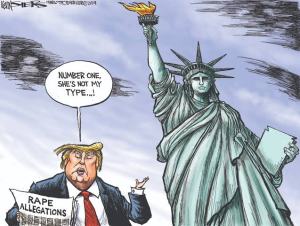 And of course, he argued presidential immunity. This is from
  In yet another deranged Orange Caligula moment, we see his priorities.
  Trump has been obviously obsessed with World War II and its generals recently. Does he want to be Eisenhower now? Does he really think starting WW III would be a terrific idea to cement his place in history? I just don’t get any of this. Can someone please stop this madman before the country declines beyond repair?
 This seems a little karmic, doesn’t it? Lawrence Hurley and Aria Bendix have the lede.
 This is the latest deadly weirdness from
  It really does sound like we’re the bad guys now, doesn’t it?
  These days, it’s easy to see why all of these countries have given up on us. Many of us here in the country feel that way, too. It’s so important to make sure the midterms flip the House and the Senate. If not, I may be writing future blog posts from Lima, Peru. Alison Quinn, writing for The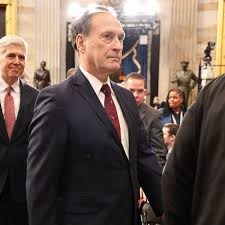


 The basis of Davis’ complaint may be the reason why the religious fanatics placed on SCOTUS by extreme right-wing theocrats might have been encouraged to wait for a more direct call to overrule Obergfell. This is explained in this
  Are they just waiting for a better case to come along? That is the question from me and others. Only time will tell.
 More on these eight senators at the link. There are numerous punditry thoughts on what is being called “The Great Cave-in.”
  This final analysis is by Sarah Ewall-Wice, writing at
  We know what or who the basic problem is. Who wouldn’t love a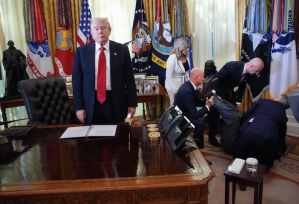
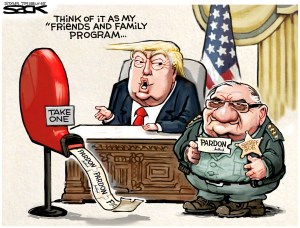 Go read the entire post. She’s right. He doesn’t give a fuck about anyone but himself. And here’s more evidence, as Trump pardons all of those election-denying cronies while possibly looking forward to handing one to that miserable sex-trafficking ghoul Gislane Maxwell. The first article comes from
 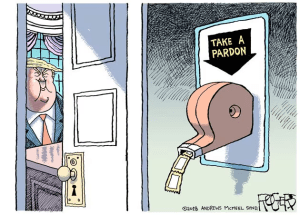 Regarding the potential pardon for Maxwell, this information comes from








 peej
peej Carissa
 bostonboomer
 dakinikat
 ecocatwoman
 jjlo
jjlo mablue2
 Mama Lopez
 peggysue22
 quixote
 skydancingguestblogger
 Mona (aka Wonk the Vote)



 Sky Dancing
Recent Comments