Yes, it’s me today! Thankfully, JJ stepped in for me yesterday when a huge truck taking something out of the Navy Base project took down my entire cable line. I was without it and was looking at student time during the first week of class at 5 p.m. So, I called Cox and was given a time for later on today, after another class started up. Needless to say, I was pretty panicked.
Since Cox was so unhelpful, I went over to the construction site, which was even more insulting, as I was shown a map indicating that trucks were allowed on my avenue. It was a truck route. Tell it to the City Council, which drew the maps. Needless to say, these trucks are far bigger than what I’ve ever seen coming and going the 25 years I’ve lived here, which includes when the Navy base was open and military equipment for the shock and awe attack on Iraq was being taken off the railroad line there and driven by trucks to the merchant marine ships waiting on the Mississippi River to take them to the Middle East.
So, with two strikes out with Big Corporations, I headed to my neighbor’s house across the street to talk to the couple who live there. Luckily, one of them works at home, like I do, and the other was at City Hall, working for the City Council. I’m like, good to see you, but I really need your husband. He called hubby immediately for me and explained my situation. So, guess what, New Orleans City Hall worked. I called my Councilman’s office, and my neighbor contacted the regional Cox bigwigs. About three o’clock, a Cox bucket truck pulled up with the most skilled technician I’ve ever seen, who got it done right before some severe weather kicked in. All of the guys really went to work to help me, while I’m thinking that if I miss the first two days of a fall semester, I’ll never teach again.
So, again, JJ came to my rescue while I spent the enter afternoon chasing all these folks down. I did my thing and went to bed early. It’s nice to know my local government works when everything else is MAGA chaos. So, since I was raised in the Beef state and the Corn state, and I’m an economist with all degrees in agriculture states, riddle me this. How does importing more beef to this country help American ranchers and farmers who are in financial trouble right now? And if every import is subject to tariffs, how does this help households? Trumps been giving all the tariff revenue to big businesses and my guess is they don’t pass the cash forward. This keeps making me glad I’m mostly doing finance things these days although it blows my mind that a sitting president and his family might get a bank just for having crypto which is a risky asset and not real money. Trying to teach econ during this regime is like reading fairy tales while trying to teach about data-based reality.
So, I’m going to dive right in with the economic mess we’re in and the policies making it worse. He must be so secure in the idea that he can rig elections that he’s not even concerned about his own base. This is from the New York Times. “G.O.P. Lawmakers Rebuke Trump on Plan to Increase Beef Imports. Republicans who have mostly refrained from criticizing the president’s actions have been vocal in opposition to the move, which they say will harm their constituents.” Catie Edmondson has the story.
Congressional Republicans are leveling some rare and uncharacteristically harsh criticism of President Trump for his decision to increase imports of ground beef at a lower tariff rate, warning that the move will hurt American ranchers.
The decision, announced late last week, appeared to be a bid to lower costs across the country before the midterm elections in which Republicans are fighting to preserve their narrow majorities. But it has drawn dissent from even reliable allies of Mr. Trump, many of them from states and districts with large cattle-raising areas, who fear that the move could harm another important constituency: the producers they represent.
“Americans want U.S. beef on the table — not foreign imports,” Senator John Barrasso of Wyoming, the No. 2 Republican, said in a statement on Monday. “Wyoming ranchers produce the highest-quality beef in the world. Our ranchers don’t ask for special treatment. They simply want a fair marketplace.”
Senator Tim Sheehy, Republican of Montana, said in a lengthy statement that he had “advised President Trump against this course of action for a year because American ranchers have been struggling against the packer monopoly for decades, and this will further harm them.”
“Most of whom are MAGA Republicans,” he added.
The cascade of statements — including from Senators Pete Ricketts of Nebraska, Steve Daines of Montana and Cindy Hyde-Smith of Mississippi — amounted to an unusual chorus of protest from Republicans who have otherwise routinely deferred to Mr. Trump on nearly every major issue, from the war with Iran to his trade wars.
This major Trade War with Canada is equally stupid. This is from Greg Sargent writing for The New Republic. “How Trump’s Crazed Fury at Canada Is Already Backfiring Badly for Him. The escalating trade war with Canada will hit hard in the Midwest—right where some of the most important contests in the midterms will be decided.” Pack the West Wing and the Oval office with idiots and this is what you get.
Here’s a bit of poetic justice for you: The Democratic bid for control of Congress just might end up running right through the very heart of Trump country. We’re talking about parts of the Midwest that helped drive Donald Trump’s two successful presidential bids—states like Iowa and Ohio, which he drove deeper into the red column, and states like Pennsylvania, Wisconsin, and Michigan, which Trump flipped outright twice.
That reality explains why Trump’s extended eruption of fury at Canada—he has now redoubled trade hostilities with our longtime ally—is very bad news for the GOP. Trump’s new trade war with Canada threatens fresh harms to local economies in the Midwest—and it’s handing Democrats a weapon in the homestretch of these contests to win over rural Americans and others who are experiencing all this endless derangement in very concrete ways.
“It’s a really dangerous time to be a farmer in the Midwest,” Josh Turek, the Democrat who is challenging Representative Ashley Hinson for the open Senate seat in Iowa, told me.
On Monday, Trump exploded wildly at Canada over the implosion of trade negotiations between the two countries. That collapse in talks over the weekend unleashed 50 percent tariffs by the United States on a large range of Canadian goods, and Canada will now retaliate with tariffs on targeted American exports. Talks are reportedly suspended until after the midterms.
What triggered Trump is that Canadian Prime Minister Mark Carney had refused to be cowed by the American threat of tariffs. So Trump threatened yet more tariffs on still more Canadian goods next year, raging: “WE DON’T NEED CANADA, THEY NEED US!”
Whether we “need” Canada or not, the fact remains that a lot of trade currently takes place between the two countries. You know who actually can’t afford for all this to be upended right now? Republican incumbents and candidates in the Midwest, that’s who. So “we” may not “need” Canada, but Republicans in the region really “need” Trump to not rupture trade relations with our ally for the next two months.
Here’s why: Control of the House will turn in no small part on three very competitive House races in Iowa, one in Wisconsin, and three or four in Pennsylvania. Meanwhile, Turek is locked in a dead heat in the Iowa Senate race, and winning there could be pivotal to a Democratic Senate takeover. So could a win by Sherrod Brown, who leads slightly in Ohio. And anything that helps Abdul El-Sayed keep the highly contested Michigan Senate seat blue will also be critical.
These areas will very likely feel the political impact of Trump’s new trade war. Canada’s retaliatory tariffs are expected to hit American exports of agricultural machinery, and that could hit Iowa manufacturers. The state’s very competitive 2nd congressional district, for instance, includes facilities run by John Deere, Altorfer (which deals in Caterpillar products), and other farm equipment concerns.
“Tariffs don’t just hurt our farmers, they hurt our manufacturers, as well,” Lindsay James, the Democratic candidate in that district, told me. She added that her GOP opponent, businessman Joe Mitchell, will be a “rubber stamp” for Trump’s trade wars, which she labeled “impulsive.”
Such messages could land disproportionately in Iowa because Trump’s trade wars have already given the state’s agricultural economy a thorough pounding.
Turek, meanwhile, also singled out the coming impact of trade hostilities on farm equipment manufacturers. He noted that tariffs are contributing to a perfect storm in Iowa, which also includes Trump’s war on Iran, which is driving up fertilizer and diesel prices, and his effort to reduce beef prices by importing huge amounts of it, which will undercut American producers.
“You talk to farmers, and they’ll tell you it’s one gut punch after another,” Turek told me, adding that he constantly hears Iowans tell him: “This is betrayal.”
I can only imagine what kind of hit to the owner of what once was my Dad’s small town Iowa Ford Dealership would be. I like to remind everyone that the sale of Ford F-150s basically funded my school and young life. Those trucks were all over eastern Iowa doing farm and ranch work all the time. My youngest daughter’s son-in-law was the grandson of the biggest Pig Ranch in the area. Guess who he used to buy his trucks from? This will really go straight to the heart of every small midwestern town. Most John Deere Tractors are built in this country. I’m sure most of you have never heard of Waterloo, Iowa but you can crush a small town like that when you ruin business for the factory that keeps the town on the map.
So, this is some real nonsense in a situation where trade really defines countries ability to survive. This is from the Washington Post. “Trump says U.S. could rename Lake Ontario as Lake America amid Canada trade war. The president cited his tariff fight in a social media post, saying the United States doesn’t expect to be “doing much business with Ontario any longer.” How petty and stupid is that? Who actually thinks this is funny? You may see how consequential renaming the Gulf of Mexico was to map makers and everyone else. This is another middle finger fight rather than real policy. Sammy Westfall has the lede.
President Donald Trump said he is considering changing the name of Lake Ontario, the easternmost of the Great Lakes spanning the U.S.-Canada border, to Lake America, as the U.S.-Canada trade fight escalates.
The threat adds to a long list of things — bodies of water, mountains, cultural centers, battleships, transit hubs, federal agencies — the Trump administration has renamed or proposed to rebrand.
“The United States is giving serious consideration to changing the name of Lake Ontario to Lake America in that we don’t expect to be doing much business with Ontario any longer,” he wrote on Truth Social on Tuesday morning.
Over the weekend, Canada and the United States were thrown into a heated trade war after Canadian Prime Minister Mark Carney walked away from negotiations over tariffs — a rare example of a foreign leader telling Trump “enough,” after the U.S. demanded what Carney said was a mounting list of concessions.
“An attitude at the negotiation table that Canada is a subsidiary of the United States … that’s not something we’re going to accept,” Carney said in a statement posted Tuesday.
So, here’s an interesting fact for you from USA Facts. We’re basically creating chaos with the two countries that send us oil and of course, there is the current war between Israel and the United States on Iran with its control of the Straights of Hormuz. Wow, am I glad I don’t rely on a car. The St Claude Bus and Street car look better to me every day.
Top Oil Exporters to the US
Canada: Supplies about 57% of total U.S. petroleum imports.
Mexico: Ranks second, providing roughly 6% of imports.
Saudi Arabia: Accounts for about 4% of U.S. petroleum imports.
Most importantly is this bit of fact posted today on Politico. “Canada has one important edge in the North American trade war. Canadians are united in standing up to Trump’s tariffs. The reverse cannot be said for the U.S.”
President Donald Trump is threatening Canada with economic destruction amid an escalating trade war. He’s not factoring in one key U.S. disadvantage.
Americans are not nearly as gung-ho for a tariff stand-off as their northern neighbors, who have been seething for months over Trump’s rhetoric against their country.
“The U.S.A. will always be far bigger, richer, and stronger than Canada,” Trump wrote in a second Truth Social post. “Someone should get these clowns to ‘fall in line’ or, the consequences for Canada will be far WORSE!
The U.S. economy certainly dwarfs its northern neighbor’s. And while Ottawa has managed to support big sectors such as aluminum and forestry to keep them afloat amid tariffs Trump launched last year, it’s not clear how long the Canadian government can support small and medium-sized businesses in a prolonged tariff tit for tat. But poll after poll shows Canadians across the political spectrum are willing to accept those impacts in order to stand up to the U.S. government.
The opposite is true in the U.S., where even many in the president’s own party oppose Trump’s trade agenda — particularly his tariffs on Canada. And unlike Carney, the president faces a voter referendum in November, in the form of midterm elections.
As the two countries settle in for a long-term standoff, the outcome is likely to be defined by each government’s ability to endure pain: economic in Ottawa and political in Washington.
“I think right now the U.S. has more to lose because we have the election coming up in November, where the economy and tariffs are already an issue,” said one former official at the Office of the U.S. Trade Representative, granted anonymity to discuss the sensitive talks. “If it spirals, Congress would be the one to feel the impact.”
But again, I believe he’s thinking he’s got the ability to rig the election and it may be somewhat true. Especially, with the Supreme Court on his side. This analysis is from “Balls and Strikes” and the keyboard of Jay Willis. “The Supreme Court Thinks You Are Stupid. The conservative justices are reserving for themselves the power to decide whether Trump can hijack the 2026 midterms.”
A key component of President Donald Trump’s plan for preserving the Republican Party’s power and influence is making it as difficult as possible for Democrats to vote. As the 2026 midterms approach, he is still pushing the unhinged lie that widespread fraud both cost him the 2020 presidential election and also explains every Republican loss in every election since.
This delusion is partially responsible for his obsession with mail-in voting. In March, Trump told Republican lawmakers that passing legal restrictions on mail-in voting would “guarantee the midterms.” Their failure to do so, he continued, would mean “big trouble.”
That same month, Trump did his part, issuing an executive order that would impose onerous requirements on states that allow their residents to vote by mail. And in an unsigned opinion on Monday, the Supreme Court did him yet another favor, turning away a legal challenge that had temporarily blocked the order from taking effect.
The result in Trump v. California does not give Trump everything he wants. But it shows just how far this six-justice conservative supermajority is willing to go to help its favorite president’s political movement—all while reserving for itself the right to decide how much of the Constitution remains in place for the midterms, and how much Trump gets to rewrite as he sees fit.
Trump’s order seeks to do three main things. First, it requires the Department of Homeland Security to provide states with lists of voters whom the federal government has “confirmed” as eligible to vote. Second, it directs Attorney General Todd Blanche and the Justice Department to “prioritize” investigations of state officials who provide ballots to anyone who is not eligible to vote. Finally, it orders the U.S. Postal Service to propose a rule that would require states to send mail ballots in a particular type of envelope and with a special barcode, ostensibly for the purposes of “tracking” the ballot. Trump’s order specifically requires that the Postal Service’s rule prevent the agency from processing a ballot—as in, submitting it for counting—unless a voter has been “enrolled” by the Postal Service first.
This is admittedly confusing, because the order is kind of an executive power matryoshka doll: Instead of directly requiring the Postal Service to refuse to deliver certain mail ballots, it adds a step, requiring the Postal Service to come up with an administrative rule for when it will refuse to deliver those ballots. Perhaps even the Trump brain trust understood that a president ordering an agency with a statutory obligation to provide “prompt, reliable, and efficient services” to “all communities” to simply ignore votes in blue states would be, legally speaking, not a good look.
That said, given that Trump’s order prescribes the content of the Postal Service’s “proposal” in exacting detail, the real-world impact is the same. Under the Constitution, states have the power to administer elections. If Trump gets his way, his federal government would be deciding who does and does not get to vote.
Lisa Needham of Public Notice puts it this way. “John Roberts sticks two more knives in democracy’s back. The mail voting and ballroom decisions are a travesty.”
President Trump is catastrophically, comprehensively, wrecking our democratic order, but he couldn’t do it without the Worst Chief Justice of All Time, John Roberts, and the rest of the Supreme Court’s MAGA majority.
Trump should probably send the nation’s highest jurists a fruit basket or something as a wee bit of thanks for their latest gifts: the right to wreck the midterm elections and the right to keep building the bribe-funded ballroom.
The former is courtesy of the Court’s six conservatives, but the latter is a solo Roberts joint. Put another way, the mail-in ballots case is a shadow docket travesty, while the ballroom is an administrative stay travesty. Both are corrosive to democracy.
Up first: teeing up letting Trump screw with the midterms in an extremely unconstitutional fashion, because of course Trump will suffer immense harm if he can’t get his way.
First, let’s be clear about a smallish silver lining here: the mail-in ballots decision is both reprehensible and a mess, but it doesn’t quite do what some of the reporting says it does. It doesn’t mean that the US Postal Service Final Rule, promulgated last Friday, goes into effect. A different case, brought by the League of Women Voters, still enjoins the administration from implementing that rule, and as Steve Vladeck notes, the litigation on that is yet to come.
But that doesn’t really make things better, at least as far as the whole constitutional crisis part goes. That’s because the Court’s right-wingers continue to swallow the Trump administration’s laughable lies about what they are doing, lies that contradict both their own public statements and the dictates of logic.
Okay, this is certainly way too long but the chaos continues in so many places. It’s important we know the where, when, and how of it all.
Have a good week! I hope the weather is being better to you than us. I’ve never seen such heat except when I visited Arizona in August. Plus, the humidity down here is beyond description. Even Temple, who loves her walkies, wants to cut them short these days. So, be safe out there!
What’s on your Reading, Action, and Blogging list today?
Did you like this post? Please share it with your friends:
“Shouldn’t the new US Attorney General be prosecuting Reflecting Pool Vandals instead of spinning on the Sunday News Shows?” John Buss, @repeat1968
Good Day, Sky Dancers!
Regurgitating the past is so Trumpian. He’s the very model of a relic, an anachronistic trope. This week was full of reminders of how detached he is from reality. Once again, Orange Caligula tried to get the case brought by E. Jean Carroll overturned. Even the Supreme Court didn’t buy it. He may be able to control many of the folks he appointed to executive office, but his manipulation of U.S. democracy still only goes so far.
This is from NBC News‘ Lawrence Hurley. “Supreme Court turns away Trump’s latest bid to block E. Jean Carroll award. President Donald Trump filed an unusual request asking the justices to reconsider a decision they made not to hear his case several weeks ago.” E. Jean and her attorney, Roberta Kaplan, are real American heroes.
The Supreme Court on Monday declined for a second time to take up President Donald Trump’s bid to overturn a jury verdict that awarded $5 million to writer E. Jean Carroll for alleged sexual abuse and defamation.
In an unusual move, the president had asked the court to reconsider its decision from June that rejected Trump’s initial appeal. The court almost never grants such requests.
The case arose from a federal lawsuit Carroll filed in New York City alleging that Trump sexually assaulted her in the dressing room of a department store in 1996. The defamation claims relate to statements he made about her after his first term in office, in which he described her claims as a “con job” and “hoax.”
Trump has denied any wrongdoing and has said he does not know Carroll.
Trump has a separate appeal at the Supreme Court concerning a different defamation case in which Carroll won an $83 million judgment. That case concerns comments Trump made as president during his first term and has been tied up in litigation over whether he can claim immunity.
The court is not set to act on that appeal until later this year.
Good news. E. Jean Carroll spent a decade in court fighting one of the most powerful men in the world.She fought with tenacity and grace — and she won. She is one of my personal heroes.We owe her a debt of gratitude.https://www.cnbc.com/2026/08/17/trump-supreme-court-e-jean-carroll.html
And of course, he argued presidential immunity. This is from Politico.
Trump’s Supreme Court challenges to both verdicts argued in part that the verdicts were flawed because they relied on statements Trump made in 2019 about Carroll while he was serving as president and those statements should be considered immune from legal liability under the high court’s 2024 ruling granting presidents immunity for many acts they take while in office.
I wonder when the new AG is going to jump wily-nily into the case? I wrote a lot on Monday about the current treatment of the US Service members deployed to the Iran-Israeli/US war and their deplorable conditions. I mentioned that historically, Orange Caligula has shown mostly contempt for anyone who served in the military, voluntarily or not. My family has served this country since the Revolution, and I really don’t take kindly to the implications that my dad, uncles, or cousins, or any of the others that fall into the multiple greats, did so because they’re “suckers and losers”.
Public Notice‘s Noah Berlatsky takes on his constant denigration of the many who served. This happened after a Fox News “journalist,” Joey Jones, earned this headline from The Independent. “Fury erupts at Fox host who blasted ‘weak’ sailors on USS Abraham Lincoln: ‘Put him on that ship’. The former Marine Corps staff sergeant compared the carrier crew’s living conditions to his own deployment in Afghanistan.” The outrage over this continues. Here’s the take from Berlatsky: “Suckers and losers” as policy. The plight of the USS Lincoln lays bare Trump’s disdain for the troops.”
The Navy Times reported last week, based on interviews with family members, that multiple sailors have recently tried to jump overboard from the aircraft carrier USS Abraham Lincoln — a ship has been deployed for 250 days as part of President Trump’s war of choice against Iran.
Food is deteriorating and being rationed, there are water shortages, the laundry facilities are broken. And the psychological toll has been brutal.
Trump started a war without provocation and has prolonged it because he does not want to admit he lost. But when questioned on Friday about conditions on the Lincoln, he responded not with compassion or regret, but with callous vindictiveness.
Asked if the deployment had lasted too long, he replied, “No. Not nearly long enough.”
Q: The family members of US service members are concerned about the conditions on the USS LincolnTRUMP: No they're notQ: Has the deployment gone on too long?TRUMP: No no no. Not nearly long enough.
Trump also claimed that a carrier was moving to the Middle East to relieve the Lincoln. That appears to be true. Still, his belligerent denial of the suffering of service members is shocking.
“Shocking,” though, does not mean surprising.
Over the last decade, Trump has consistently insulted and mocked US troops. His defense secretary, Pete Hegseth, has made clear that he sees service members as props in his endless battle to win culture war accolades from Nazi bloggers and right-wing talking heads.
The fact that real men and women are experiencing mental health crises and are dying in service of their ill-informed and vindictive whims doesn’t trouble Trump or Hegseth. It should more than worry everyone else though.
In yet another deranged Orange Caligula moment, we see his priorities. This is from the AP. “Trump blames vandals for damaged grass in the same spot where he held his big July 4 celebration.” WTAF? Is this paranoia or some odd brain fart? He’s done more damage to the District than the British ever did!
President Donald Trump on Sunday said vandals are to blame for large swaths of dead grass on the National Mall near the World War II Memorial — in the same spot where Trump had a stage built and hosted crowds for his July 4 celebration.
Trump made the accusation in a social media post without saying why he believes it’s the work of vandals instead of trampled turf from the Independence Day festivities. He posted a photo showing a once-grassy area by the World War II Memorial, now patchy and brown across much of the sprawling turf.
“Look what VANDALS did to the grass connecting the vandalized World War II Monument and the vandalized Reflecting Pool, which will be opened again, and better than ever, shortly,” Trump said on his Truth Social platform.
“Anybody who thinks the Reflecting Pool wasn’t vandalized should go back to Law School!” he added.
Trump has been obviously obsessed with World War II and its generals recently. Does he want to be Eisenhower now? Does he really think starting WW III would be a terrific idea to cement his place in history? I just don’t get any of this. Can someone please stop this madman before the country declines beyond repair?
In a truly bizarre move, Trump decided joint military exercises with South Korea should be ended because he’s such a good friend of the bizarro leader of North Korea. This is from the New York Times‘ Helene Cooper. “Trump Orders Pentagon to Curtail Military Exercises With Ally South Korea. In a social media post, the president scolded South Korea for not helping denuclearize Iran, and also praised North Korea and its leader.”
President Trump said on Sunday that he had instructed the Pentagon to reduce joint military exercises with South Korea, a longtime U.S. ally and a linchpin of America’s national security strategy in the Asia-Pacific region.
The announcement may heighten growing worries among Asian allies over what the United States is now willing to do to deter China, given the enormous distraction and resource drain of the U.S.-Israel war against Iran. The United States is running low on critical weapons and has been moving military resources out of Asia to the Middle East.
In a convoluted social media post, Mr. Trump complained that Seoul did not “join us in the Denuclearization of the Islamic Republic of Iran.” In the same post, he said that North Korea under Kim Jong Un had been “unthreatening and respectful” while he has been president.
In his post Mr. Trump did not mention a rift in relations in 2017, when the North Korean leader called him a “mentally deranged dotard” after Mr. Trump delivered a speech at the U.N. threatening to “totally destroy” North Korea if the United States had to defend itself or its allies.
Now Mr. Trump is speaking only of what he on Sunday called his “very good relationship” with North Korea and its leader. In his post, he said that because of those ties, he was “not happy with the fact that the United States has, long ago, agreed to participate in Joint Military exercises with South Korea.”
“These exercises are not only costly, with much of these costs paid for by the United States of America (as usual!), but send a signal that is totally inappropriate and hostile, to a Country that, as long as Donald J. Trump has been President, has been unthreatening and respectful,” Mr. Trump said in his post.
Mr. Trump said that because it was too late to cancel the exercises entirely, he had asked Defense Secretary Pete Hegseth to “substantially reduce” U.S. participation.
The U.S. and South Korean militaries have held joint exercises for more than 70 years, since 1955, after the 1953 armistice that ended the Korean War.
The South Korean Defense Ministry confirmed that the joint military exercises had begun on Monday as scheduled. In a statement last week, the allies emphasized that the 11-day annual Ulchi Freedom Shield exercises were “defensive in nature” and aimed at enhancing the countries’ readiness and capabilities by “incorporating realistic threats, including lessons learned from recent conflicts.”
But North Korea’s Foreign Ministry on Friday had reiterated its condemnation of the drills, branding them “a rehearsal for an aggressive war.” In response, the country conducted two ballistic missile tests off its east coast this month, vowing to “respond to a new level of a threat with a new level of a deterrent.”
I don’t know about you, but I think having a President so totally located in a completely different reality, in charge of things — especially the military — is an extremely dangerous place to be.
So, let’s end this on hope, a wing and a prayer. This is from Axios‘ Mike Zapler and Ben Berkowitz. “Even some Republican voters sour on Trump.” I would hope they could. How can you live in this country today and afford anything? How could you have draft-age children or grandchildren and not be worried?
High prices, a persistent war and anxiety about corruption are quickly eroding President Trump’s support among Republicans, a warning sign for the White House with less than 80 days to the midterms.
Why it matters: Democrats look likely to take control of the House already, but Trump’s weakness could cost Republicans more seats and further endanger the Senate.
The loss of one or both chambers would guarantee two years of scrutiny and gridlock for the end of Trump’s presidency.
By the numbers: Three surveys out in the last week paint a clear picture of growing dissatisfaction among the president’s base.
📉 An Economist/YouGov poll out Tuesday had Trump’s approval rating among Republicans at a second-term low of 79 percent — a decline of 12 points from shortly after he took office.
In that time, the percentage of Republicans who “strongly approve” of Trump’s performance has dropped more precipitously —by 20 points (from 68 to 48 percent).
Trump is barely above water among non-MAGA Republicans, who make up about 30 percent of the party. Only 51 percent approved of his performance, vs. 47 percent who disapproved. The positive rating among non-MAGA Republicans fell 13 points in one week.
⬇️ A Financial Times poll out this weekend had Trump’s net approval rating among Republicans off 8 points from just a month prior.
💰 Republican consumer sentiment fell 9.5 points in August from July, per the University of Michigan monthly survey out Friday — one of the largest declines the decades-old project has ever recorded. The Republican decline was more than double the overall headline number.
Driving the news: It’s no secret what’s behind the numbers: the war in Iran, high gas prices and stubborn inflation.
These recent findings come on the heels of polls that show rising Republican skepticism of the war and GOP wariness over whether Trump is using his office for personal profit.
The intrigue: Trump’s political strength has long derived from outsized loyalty among Republicans, so even a slight slippage could be consequential.
I also was under the delusion that Republicans were deficit hawks. But, I guess that was just another gaslighting session. If you have time, check this one out by Max Boot from the Washington Post. Too bad it took some of these assholes so long to figure things out. “I’m a hawk. I’m shocked by a $1.5 trillion defense budget. The request would top World War II spending while funding boondoggles and sweetheart deals.”
So, anyway, it’s another hot, humid Monday down here in New Orleans, and I have to go water the small patch of sod that is now the middle of my small backyard. I’m still trying to teach folks economics and finance, but nothing fits the reality these days. The entire Data Center thing and the supposed “financing” of it are totally outside my realm, as a PhD in Financial Economics. Call me churlish, but this looks more like the Command-and-Control economics and policies of the old Soviet Union than those of the United States. Then there’s this, which is so far outside the bounds of legality I can’t even think straight about it. “Trump family crypto business World Liberty gets preliminary approval to establish a bank.” The flunky he appointed as Comptroller of the Currency has already approved it. Let’s see how he manipulates the Federal Reserve System and the SEC! Don’t even get me started on RFK Jr’s latest romp through medicine and the vaccines that have saved so many people.
As usual, more at the links.
Anyway, I can’t believe what’s going on. I really can’t. None of this should be happening. Let me know what you think. As usual, more on any of this can be found at the links.
What’s on your Reading, Action, and Blogging list today?
Did you like this post? Please share it with your friends:
“Gotta get something out of the billions of dollars spent on the Three Day Special Military Operation!” John Buss, @repeat1968
Good Day, Sky Dancers!
The chaos continues on nearly all fronts of both federal domestic and foreign policy. On the state level, we see the fight to disenfranchise or re-enfranchise voters unlikely to support Republicans. I believe we’re in a cold civil war. There have been academic arguments about its existence for quite some time, with arguments on both sides of the political spectrum. Discussions today harken back to the idea put forth by Martin Luther King in 1967 about “Two Americas.” I also believe that the Trump administration purposefully pits us against each other as a strategy to distract from the damage coming from just about everything horrible it’s done. That includes the very hot war involving Israel and Iran.
I’ll give you a few suggested reads here on the idea of an American Cold Civil War from both sides of the political spectrum. This first article comes from a 2024 article at TheAmerican Prospectwritten by David Dayen. D-Day considers himself a progressive. “The Cold Civil War. States have always diverged on policies, but it’s grown more intense. And for red states, that’s not enough.” This article reflects on the COVID-19 period. It’s based on comparing red- and blue-state policies.
Over the last 30 years, a state government’s partisan orientation is the overwhelming predictor of the policies it will adopt.
Policy extremism has eroded quality of life in America. As much as half of the gap between the states in life expectancy is due to geographic variation. A 2023 study found that more liberal policies on tobacco, labor, immigration, civil rights, and the environment correspond to a one-year increase in how long a state’s residents live. (In this special issue, Kalena Thomhave takes a closer look at Oklahoma and Connecticut, which had the same life expectancy in 1959 and a 4.7-year spread as of 2019.)
Of the ten states with the highest rates of uninsured residents, seven are controlled fully by Republicans. Of the ten with the fewest uninsured, seven are controlled fully by Democrats. The ten worst health systems in the country, according to the Commonwealth Fund, are all in red states. Eight of the ten states with the most COVID-19 deaths are Republican-led; so are ten of the 12 states with the highest rates of smoking-related cancer deaths. Firearm deaths are lower in blue states and higher in red states. Even obesity levels show this correlation: Ten of the 12 states with the highest percentage of obese residents have Republican trifectas.
Where you live, in short, can determine how long you live.
This wide gulf between healthy and ailing America is bad enough. But red states in particular want their policy preferences to be reflected across the nation, and have engaged in numerous aggressive tactics to make that a reality.
I highly recommend you read D-Day and also this one from the perspective of a Right-Wing mover and shaker in the political and academic arena, Charles R. Kesler. His vitae includes all the groups that have been funding and guiding the Republican party since Reagan’s time. This is an interesting article from 2018, when the right was obsessed with Obama. There are many operational definitions in there, as well as insights into the other end of the spectrum. It was published in Imprimus. You’ll recognize the practical application of both philosophies in Dayen’s piece. This next read shows the Ivy Tower view approach that gets hammered into political decisions, which include important federal appointments.
In the Claremont Review of Books, we have described our current political scene as a cold civil war. A cold civil war is better than a hot civil war, but it is not a good situation for a country to be in. Underlying our cold civil war is the fact that America is torn increasingly between two rival constitutions, two cultures, two ways of life.
Political scientists sometimes distinguish between normal politics and regime politics. Normal politics takes place within a political and constitutional order and concerns means, not ends. In other words, the ends or principles are agreed upon; debate is simply over means. By contrast, regime politics is about who rules and for what ends or principles. It questions the nature of the political system itself. Who has rights? Who gets to vote? What do we honor or revere together as a people? I fear America may be leaving the world of normal politics and entering the dangerous world of regime politics—a politics in which our political loyalties diverge more and more, as they did in the 1850s, between two contrary visions of the country.
One vision is based on the original Constitution as amended. This is the Constitution grounded in the natural rights of the Declaration of Independence, the Constitution written in 1787 and ratified in 1788. It has been transmitted to us with significant Amendments—some improvements and some not—but it is recognizable still as the original Constitution. To simplify matters we may call this “the conservative Constitution”—with the caveat that conservatives have never agreed perfectly on its meaning and that many non-conservatives remain loyal to it.
The other vision is based on what Progressives and liberals, for 100 years now, have called “the living Constitution.” This term implies that the original Constitution is dead—or at least on life support—and that in order to remain relevant to our national life, the original Constitution must be infused with new meaning and new ends and therefore with new duties, rights, and powers. To cite an important example, new administrative agencies must be created to circumvent the structural limitations that the original Constitution imposed on government.
As you can see, this is based on the idea of “originalism”. However, these arguments seem trite today when you look at what’s happening in the states and on the streets. The arguments are also resplendent in state and federal courts and have been since the Reagan years. The craziness with Fauci witch trials is probably the most obvious bit of news that shows how rabid those discussions/arguments have become since Trump came onto the political scene. The American Cold Civil War has amped up in ways that impact everything these days. Mostly because Orange Caligula has a strong need for public attention and worship, but also because he has so much baggage that he needs to hide behind distractions.
Today’s headlines on the mess in the Middle East were created by Trump and Netanyahu, both with their own delusions of greatness. The other can be seen in Trump’s battles to appoint weak and compliant stooges to important offices. All of this creates more battles in the American Cold Civil War. We’re seeing such weirdness today with the embattled DOJ and the appointment of Trump’s personal lawyer, Todd Blanche. Oh, where do we start with this one? Politico‘s Chris Marquette and Jordain Carney share the lede on this headline. “Faced with Blanche dilemma, Trump chooses revenge. The president’s willingness to sacrifice his attorney general’s confirmation shows how deep his contempt for his enemies goes.”
President Donald Trump has a choice: allow changes to a controversial court settlement and secure the confirmation of his former personal lawyer as attorney general, or thumb his nose at a pair of his few remaining Republican critics in Congress.
True to form, he is giving no ground.
Trump’s decision Thursday to signal he would rather pull the nomination of Todd Blanche, his pick to lead the Justice Department, rather than give in to the demands of Sens. John Cornyn and Thom Tillis demonstrated that the president’s desire to thwart his enemies does not end with the demise of their political careers.
Both Republican senators will leave Congress at the end of the year after running afoul of Trump, and both have found a degree of independence since becoming untethered from needing to keep in his good graces.
But their efforts to exert leverage and seek to curtail a controversial settlement agreement reached in May between Trump and the IRS only prompted the president to double down. He announced in a Truth Social post that Blanche would remain as acting attorney general “in any event” and that he would potentially withdraw and resubmit the nomination “after Cornyn and Tillis are out of office” in January. He went on to needle Cornyn again Friday.
Tillis, who announced he would not seek reelection last year after clashing with Trump over Medicaid cuts in his home state of North Carolina, betrayed little surprise when asked about Trump’s reticence to bargain over the IRS settlement.
“Look up the definition of recalcitrant,” he said.
Cornyn, who lost his bid for renomination to a fifth term representing Texas in May after Trump endorsed a scandal-prone opponent, brushed off the accusation that he was simply seeking revenge by blocking Blanche.
He called Trump’s claim “a convenient excuse, but it’s certainly not true.” And he warned the president that trying to wait him out would be a “gamble.”
“After the midterms, who knows who’s going to be the next United States senator from North Carolina or Texas?” he said.
Orange Caligula strongly believes in his side and only his side. This is from Axios. Hans Nichols and,
Stef W. Kight reported this story. “Inside Trump’s Senate playbook”.
President Trump has three go-to moves for GOP senators who frustrate him: persuade them when he can, ignore them when he must and bully them at will.
Why it matters: The approach doesn’t always produce results. But it almost always provides drama.
Persuade: Trump dispatched two top deputies to the Senate GOP lunch on Wednesday to make the case, in person, for a third reconciliation bill with elements of the SAVE Act.
Then he sent in the big guns. Chief of Staff Susie Wiles huddled with the Senate GOP leaders shortly after their lunch.
When Trump faced a Senate rebuke over the Iran conflict last month, the White House aggressively lobbied wavering Republicans to flip their votes.
Ignore: Acting Attorney General Todd Blanche doesn’t need Senate confirmation to do the job, Trump declared on Truth Social on Thursday.
He can serve as acting attorney general indefinitely. Problem solved.
Bully: Trump began the week by demanding that Majority Leader John Thune (R-S.D.) scrap the filibuster and pass the SAVE Act.
What we’re watching: Bullying appeared to be Trump’s preferred tactic this week. By Wednesday, he was openly questioning whether Thune should remain majority leader.
Thune’s best defense was to downplay his own powers.
“He thinks I can wave the magic wand,” Thune told Politico. “I wish it were that easy.”
Trump’s penchant for bullying has emboldened some senators to stand their ground — such as John Cornyn (R-Texas) and Thom Tillis (R-N.C.), who have blocked Blanche’s nomination. Both will be out of the Senate in January.
This take is from CNN’s Kit Maher. “Trump further muddies Blanche negotiations, saying he wishes ‘anti-weaponization’ fund weren’t dead.”
President Donald Trump is further complicating negotiations as White House and Justice Department officials try to unstick Todd Blanche’s nomination for attorney general, saying Friday that a controversial fund behind the holdup is “dead” but that “I wish it weren’t.”
Key GOP senators — John Cornyn of Texas and Thom Tillis of North Carolina— have indicated they’ll withhold their needed votes to confirm Blanche until they get written assurances that the $1.8 billion “anti-weaponization” fund won’t be resurrected, along with certain commitments about tax investigations.
Trump defended the fund at length during a Cabinet meeting Friday, echoing comments posted on Truth Social earlier that day in which he called for Blanche to “be immediately approved” as his permanent pick for for the role. Just a day earlier, the president had said he wouldn’t object to “temporarily withdrawing” Blanche’s nomination until Tillis and Cornyn leave Congress early next year.
Tillis responded on X Friday morning that Trump’s comments were reaffirming why he and Cornyn needed the assurances in writing.
“The President made it clear today that the so-called Anti Weaponization Fund is still alive, which is exactly why we are attempting to formally end it,” Tillis wrote.
Blanche has already said the controversial fund is “dead” and the Justice Department told courts the program was abandoned, but officials have previously declined to put the commitment in writing. The fund, originally established by a settlement agreement between the Internal Revenue Service and Trump’s personal lawyers, would have offered taxpayer money to those who claimed they were victims of weaponization by the federal government — including those involved with the January 6, 2021, US Capitol riot.
Cornyn has been adamant that he also wants Blanche to clarify an addendum to that agreement that offers the president and members of his family tax immunity. The senator wants Blanche to explicitly acknowledge that it only applies to past tax investigations against the president and those listed in the lawsuit that was settled.
The demands have left Blanche in a difficult place since putting limits on the tax addendum could anger the president.
Are we having fun yet? The meeting a few days ago between Trump and Netanyahu was interesting to say the least. Did it resolve anything? This is the take from The Independent. This is what happens when two narcissists/sociopaths try to work together. “Trump claims Board of Peace has reached ‘historic’ Gaza deal to disarm Hamas and withdraw Israeli troops. The deal would see Hamas completely disarm itself and hand political and security control in Gaza over to international troops, a new Palestinian police force and a transitional government body of nonpartisan experts.” This analysis is provided by Josh Marcus. Peace in the Middle East. Right. Where have I heard that before?
The parties in the Israel-Hamas war have agreed to a “historic” framework paving the way to rebuild Gaza and remake its government, President Donald Trump announced on Thursday.
The deal includes the “COMPLETE DISARMAMENT of Hamas and all other armed groups in Gaza,” the president wrote on Truth Social.
Hamas communicated via mediators that it has agreed to the terms of the multi-step road map, U.S. and Board of Peace officials told The Independent.
The deal will eventually see the group hand security and political control to an international stabilization force of troops, a newly trained Palestinian police force and a transitional group of technocratic experts overseeing basic services, the National Committee for the Administration of Gaza, the officials said.
The Israeli military, meanwhile, will pull back its troops from Gaza in phases, according to President Trump.
“One year ago there was a violent raging war, humanitarian crisis and hostages kept in brutal captivity,” he wrote in his post outlining the alleged agreement. “We have made historic progress and there is still much work to do.”
Each phase of the deal would be verified by a committee that certifies compliance on all sides before additional changes would take place, the U.S. officials said.
The disarmament process would include the handover of personal weapons, the decommissioning of heavy military hardware in Gaza and the disclosure and destruction of hidden Hamas tunnels, the officials added.
And, I have a bridge right by me over the Mississippi River that I’d like to sell you. Or would you prefer one in Brooklyn?
What’s on your Reading, Action, and Blogging list today?
Did you like this post? Please share it with your friends:
“Someone has to point this out. The opening of the Obama Presidential Center is an experience and immersion of joy, hope, love, and pride; the 250th anniversary of our founding could have been celebrated.” John Buss, @repeat1968
Good Day, Sky Dancers!
Cadet Bonespurs, the worst negotiator ever, has basically given away the U.S. and its wealth. He’s trying to make his Iran War debacle look like something other than a costly disaster that took the lives of our soldiers and innocent Iranian people. I’m going to let Bill Kristol and the rest of the conservative gang at The Bulwarksum this up.
Thanks to their operational control of the Strait of Hormuz, Iran was able to get away with murder in setting the terms of further peace talks with the United States—and now they’re pushing for even more. The first round of scheduled peace talks under the new memorandum of understanding were supposed to begin in Switzerland today, but Iran abruptly called them off yesterday, citing the intensifying conflict between Israel and Hezbollah in southern Lebanon, which they deemed a violation of the MOU’s terms. This morning (eastern time) the Republican Guard Corps Navy—which Trump claims doesn’t exist—once again closed the strait. The message was clear: If you want to negotiate, you’d better figure out how to get Israel in line.
“Trump just can’t stand that President Obama is in the spotlight with the opening of his Presidential Library.” @repeat1968, John Buss
I’m also going to use the next headline there this morning to wish you a happy, long Juneteenth weekend! “Celebrate Juneteenth. Annoy MAGA.” Well, don’t do it completely to just ignore them. Let’s be reminded of how many black Americans were once considered property and treated as such. We still have a long way to go to get rid of this burdensome legacy and the racism that still plagues us today, but at least, at many points in the country’s history, we were capable of doing the right thing.
Today is Juneteenth, a holiday long celebrated, especially by black Americans, to commemorate the end of slavery in the United States. In 2021, Congress, recognizing that the end of slavery was an event worthy of formal recognition by the whole nation, established it as a federal holiday for all Americans. The holiday’s name refers to June 19, 1865, the day when Union Maj. Gen. Gordon Granger issued General Order No. 3 ordering the enforcement of the Emancipation Proclamation in Texas: “The people of Texas are informed that, in accordance with a proclamation from the Executive of the United States, all slaves are free.”
In the midst of this year’s celebration of the 250th anniversary of the Declaration of Independence, the commemoration of Juneteenth can have special resonance. But not for the Trump administration, which, so far as I can tell, has not deigned to acknowledge the holiday this year. When I searched the White House website this morning for “Juneteenth,” I got back no results found. Nor does there seem to be any presidential proclamation this year in honor of its observance.
The one time the Trump administration seems to have taken notice of Juneteenth was in December of last year, when the administration removed Juneteenth (and MLK Day) from the National Park Service’s list of free-admission days, replacing it with June 14, Flag Day—which is not an official federal holiday. But it is President Trump’s birthday, and that is the holiday he wishes all of us to celebrate, as he celebrated it Sunday with the cage match on the White House lawn.
One understands why Trumpists choose to neglect Juneteenth. After all, Trump’s vice president claimed earlier this week at a campaign event in New York that “they’ve become anti-white in the Democratic party.” If you’re appealing to those who think one of our two major parties is “anti-white,” if you’re trying to convince Americans that anti-whiteness is a great problem, if you’re the party that wants to foster and exploit white grievance, then you have little interest in calling attention to a holiday that is a reminder of the terrible injustices caused by fantasies of white supremacy.
That last sentence hits home. And I say no more going high when they go low. Call it out for what it is.
Meanwhile, Iran’s ally Russia has amped up its rhetoric against Ukraine. “Russia threatens escalation after Ukraine hits Moscow with largest-ever drone attack.” This story comes from CNBC. It’s written by Sam Meredith.
Russia has pledged to carry out frequent and “massive group strikes” against Ukraine shortly after Kyiv launched a barrage of drones on Moscow, triggering a huge explosion in one of the Russian capital’s key oil refineries.
Ukrainian forces conducted a large-scale attack against Moscow on Wednesday evening and Thursday, heavily targeting a major oil refinery located on the south-eastern outskirts of the city.
Nearly 200 drones were reportedly used in the attack, marking Ukraine’s biggest-ever air raid on Russia’s capital. Authorities said 16 people had been injured, while four Moscow airports temporarily grounded flights.
Columns of black smoke were seen billowing from Gazprom’s Moscow Refinery on Thursday, a facility that has been targeted by Ukrainian forces multiple times in recent weeks.
“It is no coincidence that the president announced some time ago, after yet another Kyiv terrorist attack, that we will now conduct massive group strikes on a regular basis against targets whose condition directly affects the combat readiness of the Ukrainian Armed Forces,” Russian Foreign Minister Sergei Lavrov told reporters on the sidelines of an event in Kazan on Thursday, according to Interfax.
Ukrainian forces have repeatedly targeted Russia’s oil infrastructure, seeking to cut Moscow’s energy revenues and try to force President Vladimir Putin into bringing an end to the four-year war.
The New York Times has a big story today about the institutional racism being put back into place in the military by drunk, rapey Pete Hegseth. We have to stop going backward. “Secret Vetting and Blocked Promotions: Inside Hegseth’s War on Diversity. A Black admiral fixed one of the Navy’s worst messes. Mr. Hegseth blocked his promotion anyway.” Greg Jaffe and Kate Kelly share the lede.
The Navy’s top leadership believed that Rear Adm. Stephen D. Barnett was by far the best choice to lead the command that oversees the Navy’s bases at home and abroad.
He had more experience than the other candidates and had successfully managed the aftermath of one of the Navy’s biggest messes, a fuel spill that contaminated an aquifer on a base in Hawaii, sickening thousands.
The final decision this spring fell to Defense Secretary Pete Hegseth.
To many in the Navy, Admiral Barnett’s promotion seemed like a foregone conclusion.
The officer, however, had a big strike against him. Like other Black military leaders, he had been encouraged by his superiors to help the Navy recruit and retain minority officers, who remain significantly underrepresented in the force. His years-old remarks on the importance of diversity had been flagged in a secret vetting process designed to weed out senior leaders whom Mr. Hegseth and his team pegged as a problem.
Instead of Admiral Barnett, Mr. Hegseth selected a white officer who was the Navy leadership’s third choice.
So far this year, Mr. Hegseth has blocked the promotions of at least 40 senior officers to general and admiral ranks. About half of those are women or members of minority groups.
Tom Toles Editorial Cartoon
Politico‘s Alexander Burns believes he’s found “The Most Surprising Miscalculation of Trump’s Second Term. He has underestimated the power of patriotic sentiment in countries besides the United States.” Well, I was hoping that more Americans found their patriotic sentiment–including those representing this country–, but that was just a dream, it seems.
When Donald Trump won a new term in the White House, Danielle Smith joined the parade of foreign leaders visiting Mar-a-Lago to honor the president-elect. The populist premier of Alberta, Smith enjoyed lively relationships across the American right, even hosting Tucker Carlson in Western Canada in 2024.
Yet when I asked Smith last fall, at a policy summit in Toronto, how she’d feel about Trump potentially intervening in Alberta’s fragile politics, her MAGA stripes vanished.
“I don’t want any foreign influence in our politics here,” Smith told me.
Admiring Trump from afar is one thing. But sovereignty is sovereignty, and borders are borders.
Trump used to understand that.
A decade ago, Trump waged his first-ever political campaign as a nationalist crusader, demanding harder borders and more muscular American sovereignty. When the United Kingdom held its 2016 referendum on leaving the European Union — the 10-year anniversary is in a few days — Trump cheered it on and crowned himself “Mr. Brexit.”
In his second term, Trump’s grasp of nationalist politics has slipped. He has underestimated the power of patriotism and national pride in countries other than his own.
This serial miscalculation has undermined Trump’s trade wars and military adventures, aggravated the cost-of-living crisis, weakened the Republican Party and battered Trump’s bonds with the global right.
It began even before Trump’s inauguration in 2025, with his campaign of bullying against Canada.
This is also from CNBC. “U.S.-Iran accord hits early snag after Swiss talks fail to proceed as planned.” This is reported by Justina Lee and Sam Meredith. They’re certainly a pair of busy reporters this week.
News that the U.S. and Iran had reached an interim deal may have brought some initial relief to markets, but fresh uncertainty emerged on Friday after planned follow-up talks in Switzerland were called off, underscoring the challenges of turning the agreement into a lasting peace settlement.
Switzerland’s foreign ministry said U.S.-Iran talks scheduled to take place at Bürgenstock on Friday would not proceed as planned.
The White House also said that Vice President JD Vance was no longer traveling to Switzerland, citing unresolved logistical issues surrounding the negotiations.
“The plans for the upcoming technical talks have not been finalized, and the U.S. delegation has been prepared to depart at the first available opportunity,” a White House spokesperson said.
“But the logistics of these negotiations have never been simple or predictable.”
The developments came a day after President Donald Trump and Iranian President Masoud Pezeshkian signed a memorandum of understanding aimed at developing a permanent peace deal to end the months-long conflict.
Under the 14-point MOU, both sides agreed to extend the ceasefire, including in Lebanon, and reopen the strategically vital Strait of Hormuz.
The Financial Times, however, reported that Friday’s talks were abruptly called off due to Israel launching a wave of deadly air strikes against Lebanon, citing three people familiar with the matter.
Lebanon’s Health Ministry said 18 people were killed in the south of the country following a series of Israeli strikes overnight. Israel said four of its soldiers were also killed.
Israeli Prime Minister Benjamin Netanyahu said in a social media post Friday morning that he instructed the Israel Defense Forces to strike Hezbollah “with full force” in response to a “heinous attack” by the Iran-backed group.
Hours later, a U.S. official told CNBC that the two groups agreed to a ceasefire from 4 p.m. local time, or 9 a.m. ET.
Oil prices turned lower after the ceasefire was reported.
It sure looks like we have a lot of leaders of major countries completely out of their league. And back to Iran. This is from Reuters. “Iran’s Revolutionary Guards set up covert Iraqi cells to attack Gulf neighbors, sources say.” It’s the same old, same old since the 1970s if you ask me.
Iran’s Islamic Revolutionary Guard Corps (IRGC) has set up secretive new cells in Iraq to carry out attacks on Gulf countries that host American forces, bypassing established militia networks to avoid detection, eight Iraqi sources told Reuters.
Three or four cells, each comprising about 10 elite Iraqi Shi’ite Muslim fighters, launched at least seven drone attacks from desert locations near the southern cities of Basra and Samawa against sites in Kuwait, Saudi Arabia and the United Arab Emirates between April 20 and May 17, three of the sources said.
A number of their members were drawn from Islamic Resistance in Iraq, an umbrella group of hardline Shi’ite factions with thousands of fighters. But the new groups operate outside its command structure, reporting directly to the IRGC, according to the sources, who include two Iraqi military officials, another security official and five local militia commanders.
The establishment of the new Iraqi cells, which has not previously been reported, reflects a shift in IRGC tactics aimed at preserving Iran’s ability to project force across the region at a time when its armed proxy groups are greatly diminished and its own military and economic resources are depleted, the five militia commanders said.
Feeling safer now? Me neither. Trump’s polls continue to fall on the Iraq war. As you can see from The Bulwark articles, the trad war hawks are not happy about the situation. Maybe we all need to start building bunkers. This is from the AP. “What Americans think about Trump’s handling of Iran, according to a new AP-NORC poll.”
Most Americans continue to disapprove of how President Donald Trump is handling Iran, while his overall presidential approval holds steady, according to a new AP-NORC poll that was conducted as he suggested a deal with Iran had been reached.
The poll points to just how unpopular the war, which began Feb. 28, has been with Americans even as the Republican president turned abruptly from threatening Iran to reopening negotiations. Support for his handling of the war remains lopsidedly partisan. About two-thirds, 65%, of U.S. adults disapprove of how Trump is handling issues with Iran. But while the vast majority of Democrats and independents view Trump’s actions negatively, only 28% of Republicans are unhappy.
The new survey was conducted June 11-17, just after Trump called off threats to escalate the war with Iran. The poll was fielded as Trump announced a deal with Iran and authorized an end to the U.S. naval blockade in the Strait of Hormuz, concluding just before the deal was signed Wednesday.
Well, at least we can fire up some grills, even though most of us will not be eating steaks or meat. I like the Juneteenth holiday and its proximity to Independence Day. The addition of Pride month fortifies the display. This shows that eventually we can include everyone who should be included. Unfortunately, Orange Caligula and his band of fascist, racist haters just never give up. We have to vote them out.
What’s on your Reading, Action, and Blogging list today?
Did you like this post? Please share it with your friends:
“Upon further reflection, the Rededicate 250 National Prayer thing now makes huge sense. He Is Risen!” John Buss, @repeat1968
Good Day, Sky Dancers!
The one thing you can depend on every time Orange Caligula gets the reins of government is that things will always get worse, except for democracy backsliding. It’s just a matter of how shocking the next thing is. How many of us are in a constant state of being stunned that we aren’t the least bit surprised by the news, even though we still find the actions stomach-churning? Well, hang on! It’s been a week of WTF moments.
Today’s Tit-for-Tat announcement shows just how brazen the entire administration has gotten. This is from Time Magazine. It’s reported by Rebecca Schneid. What kind of monster thinks these things up?
President Donald Trump has withdrawn his $10 billion lawsuit against the Internal Revenue Service (IRS) amid reports that he struck a deal with his own Justice Department to create a $1.7 billion fund to compensate political allies who claim they were wrongly targeted by the Biden Administration.
The alleged plan, first reported by the New York Times and ABC News, would be paid for with taxpayer funds and is being fast-tracked, but has yet to be officially approved. If approved, the fund would be used to pay damages to people who say they were harmed by the Biden Administration’s “weaponization” of the legal system, including the nearly 1,600 people charged in connection with the Jan. 6, 2021, insurrection.
Court documents showed Trump withdrew his lawsuit against the IRS, a move that could herald a private deal between the president and the agency he controls, while skirting legal oversight of the deal.
In a lawsuit filed in a Miami federal court in January, Trump and other plaintiffs accused federal agencies of failing in their duty of stopping a former IRS contractor from illegally obtaining and disclosing tax returns to the New York Times, ProPublica, and “other left-wing media outlets,” between May 2019 and September 2020.
The funds would also be used to settle his request for $230 million in legal claims from the Justice Department for the 2022 search of his Mar-a-Lago estate and investigation into alleged ties between his campaign and Russia
As part of the settlement, Trump would also reportedly ask the IRS to public1pologize for the disclosure of his personal financial records and to waive an IRS audit
According to the Times, the Justice Department would model the program after the historic $760 million settlement fund stemming from the Keepseagle v. Vilsack class-action lawsuit, settled in 2011, which alleged that the U.S. Department of Agriculture (USDA) systematically discriminated against Native American farmers and ranchers in its farm loan and loan servicing program.
We know someone who can sum this up nicely. This is how Hillary put it this morning.
Trump didn’t just pardon his followers who stormed the U.S. Capitol. He’s now set them up for payments through a slush fund he created to reward his allies—out of your tax dollars. You could not make this up.
Robert Reich had some additional thoughts and analysis. He elucidated them on his SubStackthis morning. “Has Trump’s Republican Party Become a Criminal Enterprise? Trump’s purge of all political opponents, including Senator Bill Cassidy, leaves it with no purpose other than helping Trump achieve his lawless goals.” Trump puts us in a Mafia State every time he’s elected. Grifting is his only talent, and he’s been rich and influential enough to find ambitious and greedy toadies to carry out his wishes. We’ve known this forever here.
On Saturday, Trump took revenge on Louisiana senator Bill Cassidy for Cassidy’s vote five years ago to convict Trump, in his second impeachment, for instigating an attack on the U.S. Capitol.
Cassidy thereby became the first GOP senator defeated by a Trump-endorsed candidate in a Republican primary. (Other Republican senators who have stood up to Trump — such as North Carolina’s Thom Tillis and Utah’s Mitt Romney — saw the writing on the wall and didn’t seek reelection.)
Trump’s purge of Cassidy comes in the wake of Trump’s purges of House Republicans who stood up to him, such as Wyoming’s Liz Cheney.
Trump’s next Republican target in the House is Kentucky representative Thomas Massie, who had the guts to oppose U.S. military involvement in Iran, demand release of the Epstein files, and criticize Trump’s spending bills for adding to the national debt. Massie appears likely to be defeated by a Trump-backed opponent in Tuesday’s Kentucky primary.
Trump has also purged state legislators who have refused to do his bidding, such as the seven Indiana Republicans who refused to redistrict the state as Trump demanded they do, and who Trump insured were defeated in their recent primaries.
The message is clear to every current or aspiring Republican politician: Be a toady to Trump, or you’re out.
In his concession speech Friday night, Cassidy stated the obvious reference to Trump:
“Our country is not about one individual. It is about the welfare of all Americans, and it is about our Constitution. And if someone doesn’t understand that and attempts to control others through using the levers of power, they’re about serving themselves. They’re not about serving us. And that person is not qualified to be a leader.”
Nicely put but sadly irrelevant because Trump — who’s clearly serving himself rather than the American public — now possesses all levers of power in the official Republican Party.
As Republican senator Lindsey Graham said yesterday on Meet the Press,“There’s no room in this party to destroy [Trump’s] agenda.”
There’s more at the link. My question is, what the hell can the rest of us who don’t support him do? I voted Saturday morning, wondering which candidate I had voted for would even have a chance under the new gerrymandering. That doesn’t even consider that we couldn’t even vote for our Congressional representatives, given the Supreme Court decision and the quick fix redraw of our map to ensure maybe one black person will retain their seat. The only good news to come out of the election was that all five constitutional amendments proposed by Governor Klandry were voted down.
Will these latest bits of news set up another J-6 self-coup? There will certainly be a rabid MAGA candidate sitting in Cassidy’s seat come next January. This is from NPR. “Louisiana senator who voted to convict Trump loses Republican primary.”
Sen. Bill Cassidy of Louisiana, one of seven Republican senators who voted to remove President Trump from office after the January 6th insurrection at the U.S. Capitol, lost his bid for reelection.
Louisiana’s Senate primary on Saturday was the latest test of Trump’s hold on his party. The president recruited a challenger, Rep. Julia Letlow, and urged supporters to defeat Cassidy over his vote.
“His disloyalty to the man who got him elected is now part of legend,” Trump wrote in a Truth Social post about Cassidy. “And it’s nice to see his political career is OVER.”
Cassidy finished third in a three-way race, according to the Associated Press. Letlow and another candidate, state Treasurer John Fleming, will advance to a June 27 runoff.
In conceding the race, Cassidy hinted that he would not finish his second term quietly. But in an apparent dig at Trump, he also said he wouldn’t contest his loss.
“You don’t pout, you don’t whine, you don’t claim that the election was stolen,” Cassidy told supporters on Saturday night. “You thank the voters for the privilege of representing the state or the country for as long as you’ve had that privilege. And that’s what I’m doing right now.”
Cassidy told voters they should cast their ballot based on the present and the future, not the past, a subtle discouragement from re-litigating the 2020 election six years on. But for many primary voters, Cassidy’s move to convict felt like a betrayal, and Trump’s endorsement was paramount.
“I’m the type of person, if you cross me, I probably won’t trust you anymore,” retired sheriff deputy Kevin Dupree said earlier this month. “I think his political career in Louisiana is finished.”
My friend Robert Mann, a former Journalism Professor at LSU, has something poignant to say about the loss. This is from his SubStack. “Enjoy your tarnished legacy, Bill Cassidy. You earned it.” It’s a good lesson: while all politics is local, it can be influenced by a cult of personality.
Although he pandered shamelessly to Trump and MAGA to the bitter end, Sen. Bill Cassidy could have written a different ending to his political career.
He could have left office with his head held high, proud and satisfied that he’d remained true to his principles and the Hippocratic Oath.
He could have protected our families by blocking Trump’s efforts to destroy our public health system.
He could have legislated (and campaigned) as the moderate he told me and others he truly was.
He could have put the state of Louisiana — and the nation — ahead of his desire for another U.S. Senate term.
He could have been our senator, not Donald Trump’s.
He could have done all this and more, but Cassidy lacked the courage, the imagination, and the decency to put you and me ahead of his political ambition.
What Cassidy received in return for his soul is eternal shame and a well-earned legacy of cravenness.
I hope Cassidy enjoys his earnings.
I hope he also feels the harsh judgment of history that will be reserved for a Trump critic turned shameless toady who sold out to the worst, most corrupt president in American history—and still lost.
Bill Cassidy could have written a different story for himself and his state, but he just didn’t have it in him.
Speaking of Mafia-like behavior, here’s a little something on the Don’s Greenland Grab. This is from the New York Times. “In Closed-Door Talks, U.S. Demands a Major Role in Greenland. Greenlandic officials worry about the direction of the negotiations aimed at defusing President Trump’s threats to seize their island. But they have little leverage.” The story has a number of contributing reporters.
With the conflict in Iran still smoldering, President Trump’s obsession with Greenland seems like a forgotten sideshow.
But for the past four months, negotiators from the United States, Greenland and Denmark, which controls Greenland’s foreign affairs, have been holding confidential talks in Washington about Greenland’s future.
The talks were meant to give Mr. Trump an offramp to his threats of a military takeover of Greenland and to scale back a crisis that risked breaking apart the NATO alliance. But Greenlandic leaders are worried about what is being proposed, which is a much larger U.S. role on the Arctic island. And they fear that if the conflict with Iran winds down, the president will swing his aggression back on them.
Some Greenlandic politicians say they have even circled a date on their calendars to be wary: June 14, Mr. Trump’s birthday.
An investigation by The New York Times, based on interviews with officials in Washington, Copenhagen and Greenland, has discovered:
The United States is trying to modify a longstanding military arrangement to ensure American troops can stay in Greenland indefinitely, even if Greenland becomes independent. The notion is basically a forever clause, and Greenlanders do not like it.
The United States has pushed the talks beyond military matters and wants effective veto power over any major investment deals in Greenland to box out competitors like Russia and China. Greenlanders and Danes strongly object to this.
The United States is discussing cooperation with Greenland on natural resources. The island is loaded with oil, uranium, rare earths and other critical minerals, though much of it is buried deep beneath Greenland’s ice.
The Pentagon is rapidly moving ahead on plans for a military expansion and recently sent a Marine Corps officer to Narsarsuaq, a town in southern Greenland, to inspect the World War II-era airport, the harbor and places where American troops could be housed.
The American demands are so steep, Greenlandic officials fear, that they amount to a major imposition on their sovereignty. Despite all of the talk from Danish and American officials that Greenland’s future is up to the island’s 57,000 people, Greenlandic officials said the American demands would tie their hands for generations.
If the Americans get everything they want, said Justus Hansen, a member of Greenland’s Parliament, there will never be any “real independence.”
“We might as well raise our own flag halfway,” he said.
There’s a lot more at that gifted link. Jeer Heeter has this description of our Grifter-in-Chief in his article in The Nation. “Trump Gloats About “Making a Fortune” While Americans Suffer. As his war in Iran wreaks havoc, Trump is fixated on personal glory and enrichment.”
Donald Trump is annoyed that he can’t celebrate the massive profits oil companies are making due to the war he launched in the Middle East. Left to his own druthers, Trump would be exulting in the hundreds of billions of dollars produced by skyrocketing oil prices—if it weren’t for the pesky fact that it comes at the expense of ordinary Americans, who are now paying roughly 40 percent more every time they fill up the gas tank than they were before Trump started bombing Iran nearly three months ago.
We know this thanks to Trump’s endless dedication to saying the quiet part out loud. Speaking with Sean Hannity of Fox News on Thursday, Trump chortled that because far less oil was coming out of the Middle East, “people are finding other places to buy oil, like Texas.” Trump added, “So I don’t want to say we’re making a fortune, you understand that? Because if I say that, they’re going to say ‘oh, he forgets about the little man with the $4 gasoline.’”
The juxtaposition between “making a fortune” and the “little man” suffering at the gas station underscores just how obtuse Trump and his allies have become in their economic message. Their response to the harm caused by Trump’s policies is not to reverse those policies, or even to appear sympathetic about their effects. It’s to express their total indifference to the suffering of the American people. At the same time, Trump is obsessively focused on his real priorities: enriching himself and his family, and creating gaudy monuments to himself such as a new White House ballroom and a Triumphal Arch that will squat in the middle of Washington, DC. In response to a reporter’s query as to whom the arch would celebrate, Trump pointed to himself and said “me.”
Trump twice won the White House on a message of economic populism, promising in his 2025 inauguration that he would “bring prices down.” Today, he sings a very different tune, with a message that amounts to the apocryphal words misattributed to the French Queen Marie Antoinette: “Let them eat cake.”
Speaking to reporters last Monday, Trump said, “I don’t think about Americans’ financial situation. I don’t think about anybody. I think about one thing: We cannot let Iran have a nuclear weapon. That’s all.” He also said that concern for the financial suffering of Americans would not be a factor in making a deal with Iran “not even a little bit.”
Under normal political circumstances, the Republican Party would be wise to separate itself from Trump’s callousness. But the GOP has become a hollowed-out operation mainly concerned with tending to Trump’s cult of personality. On Saturday, Trump won a major victory against critics in the party when Louisiana Senator Bill Cassidy came in third in his party’s Senate primary race, losing to a candidate Trump had supported. Cassidy’s loss underscores a lesson Trump has taught the GOP again and again over the last decade: There is no future in the party for anyone who defies his will.
So, rather than distancing themselves from Trump’s “let them eat cake” message, Republicans are embracing the president’s self-defeating rhetoric. On Thursday, Ohio Representative Jim Jordan told CNN that oil prices were “were coming down until we had to deal with this situation, but, you know, that’s life, that’s dealing with…the world we live in.”
It’s going to take hard work and a lot of voting to get rid of this monster and all the dregs of humanity he’s put in charge of the country. It appears they have all been profiting from insider news on the Iran War.
1. What I found in Trump's new 113-page financial disclosure report. It doesn't look good.
This is from Jude Legum’s SubStack. “The smoking guns in Trump’s new financial disclosure, Trump publicly praised companies the same day he bought their stock.”
On March 11, President Trump took a tour of a manufacturing facility in Reading, Ohio, owned by Thermo Fisher Scientific, a medical supply company. During the tour, Trump lavished praise on Thermo Fisher which uses the facility to manufacture prescription drugs on a contract basis. “It’s a great honor being here. It’s a great company,” Trump said, appearing alongside CEO Marc Casper. “You have done a fantastic job and I’d like to congratulate you.”
Later, Trump asked another Thermo Fisher executive to share “some great information about this incredible company.” The executive talked about how Thermo Fisher is producing drugs for Merck and others at the facility. Trump then explicitly encouraged other pharmaceutical companies to contract with Thermo Fisher to “on-shore” more jobs. He claimed that some pharmaceutical companies were building their own U.S. manufacturing facilities but said “they can get here a lot faster by using this great company.”
Trump did not mention that, the same day of the tour, March 11, he purchased between $15,000 and $50,000 of Thermo Fisher stock. (Federal disclosure rules only require filers to list their transactions in broad ranges.) Trump did not publicly disclose the purchase until May 14. It was listed on page 38 of a 113-page document cataloging Trump’s stock purchases in 2026.
Trump also purchased between $51,000 and $115,000 worth of Thermo Fisher stock about one month before his visit on February 12. He made another purchase of Thermo Fisher valued between $15,000 and $50,000 on March 2. So at the time of Trump’s effusive remarks about Thermo Fisher, he had purchased as much as $215,000 worth of the company’s stock over the previous month.
The fact that Trump visited a Thermo Fisher facility on the same day he purchased the company’s stock — and bought Thermo Fisher stock repeatedly in the weeks before his visit — has not previously been reported.
The disclosures reveal that Trump has been a highly active trader in 2026, executing thousands of transactions — many in individual stocks impacted by his administration’s policies. In response to criticism, a spokesperson for the Trump Organization claimed that the trades were completely separate from Trump’s official duties and managed by an independent outside financial advisor. “President Trump’s investment holdings are maintained exclusively through fully discretionary accounts independently managed by third-party financial institutions with sole and exclusive authority over all investment decisions,” the spokesperson said. “Trades are executed and portfolios are balanced through automated investment processes and systems administered by those institutions.”
The fact that Trump purchased stock in Thermo Fisher the same day that he toured its facility undercuts this claim. Further, the March 11 purchase of Thermo Fisher stock was marked “UNSOLICITED” in the document. An “unsolicited” trade is one that is not recommended by a broker, but initiated by the customer.
At least three immigrant children were taken into custody and restrained with zip ties at the San Antonio Immigration Court. The children were between the ages of 9 and 12.www.mysanantonio.com/news/local/a…
Brookings reminds us that there are still thousands of families with children experiencing horrible detentions and deportations because of the MAGA obsession with keeping America as white as possible. “The administration has detained 400,000 immigrants: What do we know about their children?” Is this really the kind of country you want to live in and that you thought you grew up in?
The Trump administration has made detention and deportation the centerpieces of its immigration policy. Around 60,000 people are being held in detention currently, and around 400,000 people have been booked into Immigration and Customs Enforcement (ICE) detention from an interior arrest since the administration began. Detention capacity is likely to expand, with $45 billion allocated to expanding detention facilities in the One Big Beautiful Bill Act.
Though it is mostly adults who are detained and deported, many children are impacted by separation from their parents. However, there are no reliable data on how many detainees or deportees have children in the U.S., nor on what happens to them once their parent is taken into custody. Here we focus on detainees, about whom we have better information than deportees. Even a short separation from a parent is likely traumatic for a child, but a majority of detentions are not short-lived separations. A ProPublica study following ICE arrests of mothers of U.S. citizen children over the first seven months of the administration found that 60% had been removed and 17% remained in custody at the study’s conclusion.
To estimate the number of children affected by parental detention, we rely on demographic characteristics of detainees matched with likely unauthorized immigrants in the American Community Survey. Our analysis (detailed below) suggests that more than 145,000 U.S. citizen children have likely experienced a parent booked into detention since the administration began, with more than 22,000 of those experiencing detention of all their co-resident parents. In the accompanying interactive, we allow users to explore how the estimates change when the underlying assumptions are varied. Regardless of the assumptions used, it is clear that tens of thousands of children have faced parental detention since January 2025.
Please use the link to read the details. The time and research it took to find out all this was amazing and hard to believe.
What’s on your Reading, Action, and Blogging list today?
I can’t even explain what kind of crush I had on Cat Stevens in ninth grade. I could basically play his entire songbook. He’s an amazing songwriter and musician.
Did you like this post? Please share it with your friends:
The Sky Dancing banner headline uses a snippet from a work by artist Tashi Mannox called 'Rainbow Study'. The work is described as a" study of typical Tibetan rainbow clouds, that feature in Thanka painting, temple decoration and silk brocades". dakinikat was immediately drawn to the image when trying to find stylized Tibetan Clouds to represent Sky Dancing. It is probably because Tashi's practice is similar to her own. His updated take on the clouds that fill the collection of traditional thankas is quite special.
You can find his work at his website by clicking on his logo below. He is also a calligraphy artist that uses important vajrayana syllables. We encourage you to visit his on line studio.



 This major Trade War with Canada is equally stupid. This is from Greg Sargent writing for The New Republic. “How Trump’s Crazed Fury at Canada Is Already Backfiring Badly for Him. The escalating trade war with Canada will hit hard in the Midwest—right where some of the most important contests in the midterms will be decided.” Pack the West Wing and the Oval office with idiots and this is what you get.
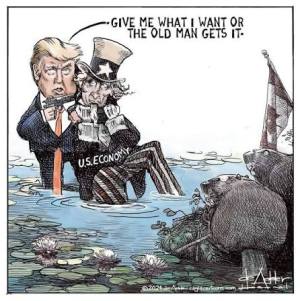 I can only imagine what kind of hit to the owner of what once was my Dad’s small town Iowa Ford Dealership would be. I like to remind everyone that the sale of Ford F-150s basically funded my school and young life. Those trucks were all over eastern Iowa doing farm and ranch work all the time. My youngest daughter’s son-in-law was the grandson of the biggest Pig Ranch in the area. Guess who he used to buy his trucks from? This will really go straight to the heart of every small midwestern town. Most John Deere Tractors are built in this country. I’m sure most of you have never heard of Waterloo, Iowa but you can crush a small town like that when you ruin business for the factory that keeps the town on the map.
 So, here’s an interesting fact for you from USA Facts. We’re basically creating chaos with the two countries that send us oil and of course, there is the current war between Israel and the United States on Iran with its control of the Straights of Hormuz. Wow, am I glad I don’t rely on a car. The St Claude Bus and Street car look better to me every day.
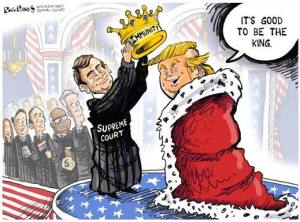 But again, I believe he’s thinking he’s got the ability to rig the election and it may be somewhat true. Especially, with the Supreme Court on his side. This analysis is from “Balls and Strikes” and the keyboard of Jay Willis. “The Supreme Court Thinks You Are Stupid. The conservative justices are reserving for themselves the power to decide whether Trump can hijack the 2026 midterms.”
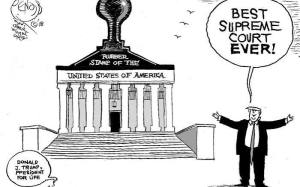 Lisa Needham of Public Notice puts it this way. “John Roberts sticks two more knives in democracy’s back. The mail voting and ballroom decisions are a travesty.”
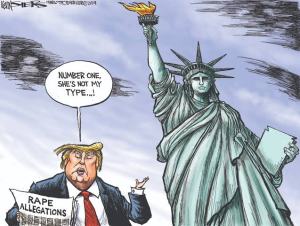 And of course, he argued presidential immunity. This is from Politico.
 In yet another deranged Orange Caligula moment, we see his priorities. This is from the AP. “Trump blames vandals for damaged grass in the same spot where he held his big July 4 celebration.” WTAF? Is this paranoia or some odd brain fart? He’s done more damage to the District than the British ever did!
 Trump has been obviously obsessed with World War II and its generals recently. Does he want to be Eisenhower now? Does he really think starting WW III would be a terrific idea to cement his place in history? I just don’t get any of this. Can someone please stop this madman before the country declines beyond repair?
 I highly recommend you read D-Day and also this one from the perspective of a Right-Wing mover and shaker in the political and academic arena, Charles R. Kesler. His vitae includes all the groups that have been funding and guiding the Republican party since Reagan’s time. This is an interesting article from 2018, when the right was obsessed with Obama. There are many operational definitions in there, as well as insights into the other end of the spectrum. It was published in Imprimus. You’ll recognize the practical application of both philosophies in Dayen’s piece. This next read shows the Ivy Tower view approach that gets hammered into political decisions, which include important federal appointments.
 As you can see, this is based on the idea of “originalism”. However, these arguments seem trite today when you look at what’s happening in the states and on the streets. The arguments are also resplendent in state and federal courts and have been since the Reagan years. The craziness with Fauci witch trials is probably the most obvious bit of news that shows how rabid those discussions/arguments have become since Trump came onto the political scene. The American Cold Civil War has amped up in ways that impact everything these days. Mostly because Orange Caligula has a strong need for public attention and worship, but also because he has so much baggage that he needs to hide behind distractions.
 Orange Caligula strongly believes in his side and only his side. This is from Axios. Hans Nichols and,
 This take is from CNN’s Kit Maher. “Trump further muddies Blanche negotiations, saying he wishes ‘anti-weaponization’ fund weren’t dead.”
 Are we having fun yet? The meeting a few days ago between Trump and Netanyahu was interesting to say the least. Did it resolve anything? This is the take from The Independent. This is what happens when two narcissists/sociopaths try to work together. “Trump claims Board of Peace has reached ‘historic’ Gaza deal to disarm Hamas and withdraw Israeli troops. The deal would see Hamas completely disarm itself and hand political and security control in Gaza over to international troops, a new Palestinian police force and a transitional government body of nonpartisan experts.” This analysis is provided by Josh Marcus. Peace in the Middle East. Right. Where have I heard that before?
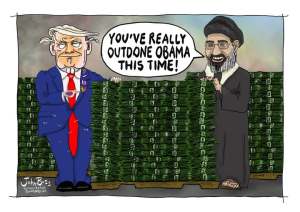
 That last sentence hits home. And I say no more going high when they go low. Call it out for what it is.
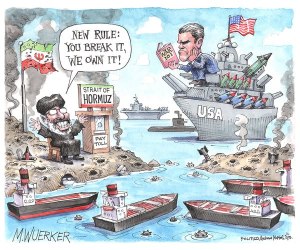 The New York Times has a big story today about the institutional racism being put back into place in the military by drunk, rapey Pete Hegseth. We have to stop going backward. “Secret Vetting and Blocked Promotions: Inside Hegseth’s War on Diversity. A Black admiral fixed one of the Navy’s worst messes. Mr. Hegseth blocked his promotion anyway.” Greg Jaffe and Kate Kelly share the lede.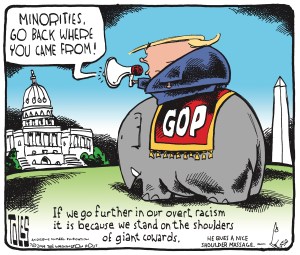
 It sure looks like we have a lot of leaders of major countries completely out of their league. And back to Iran. This is from Reuters. “Iran’s Revolutionary Guards set up covert Iraqi cells to attack Gulf neighbors, sources say.” It’s the same old, same old since the 1970s if you ask me.
 Feeling safer now? Me neither. Trump’s polls continue to fall on the Iraq war. As you can see from The Bulwark articles, the trad war hawks are not happy about the situation. Maybe we all need to start building bunkers. This is from the AP. “What Americans think about Trump’s handling of Iran, according to a new AP-NORC poll.”
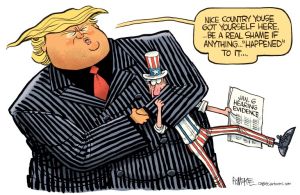 There’s more at the link. My question is, what the hell can the rest of us who don’t support him do? I voted Saturday morning, wondering which candidate I had voted for would even have a chance under the new gerrymandering. That doesn’t even consider that we couldn’t even vote for our Congressional representatives, given the Supreme Court decision and the quick fix redraw of our map to ensure maybe one black person will retain their seat. The only good news to come out of the election was that all five constitutional amendments proposed by Governor Klandry were voted down.
 My friend Robert Mann, a former Journalism Professor at LSU, has something poignant to say about the loss. This is from his SubStack. “Enjoy your tarnished legacy, Bill Cassidy. You earned it.” It’s a good lesson: while all politics is local, it can be influenced by a cult of personality.
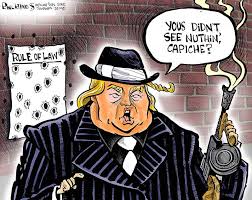 Speaking of Mafia-like behavior, here’s a little something on the Don’s Greenland Grab. This is from the New York Times. “In Closed-Door Talks, U.S. Demands a Major Role in Greenland. Greenlandic officials worry about the direction of the negotiations aimed at defusing President Trump’s threats to seize their island. But they have little leverage.” The story has a number of contributing reporters.
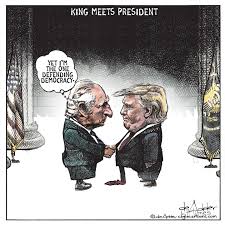 There’s a lot more at that gifted link. Jeer Heeter has this description of our Grifter-in-Chief in his article in The Nation. “Trump Gloats About “Making a Fortune” While Americans Suffer. As his war in Iran wreaks havoc, Trump is fixated on personal glory and enrichment.”

 peej
peej Carissa
 bostonboomer
 dakinikat
 ecocatwoman
 jjlo
jjlo mablue2
 Mama Lopez
 peggysue22
 quixote
 skydancingguestblogger
 Mona (aka Wonk the Vote)



 Sky Dancing
Recent Comments