“This was the plan all along. Authoritarianism has arrived and is on full display. Can’t wait to hear the “this is what I voted for” crowd crying when they are executed on the streets protesting the confiscation of their guns. But hey, there are no men in women’s sports!” John Buss, @repeat1968
Good Day, Sky Dancers!
Yet another start to a week in the cruel and vulture-ridden world of Donny J. His obsession with his own self-interest continues to plague the country with problems we don’t need, didn’t ask for, and most of us know they ruin our way of life. The most ridiculous aspect is that all these grudges have evolved into bizarre legal actions, which have been disrupting nearly every process and institution that we rely on. Today, stocks are falling because Trump just has to have someone to blame for his rotten economy.
Richard Nixon FAFO’d with the Fed back in the 1970s and learned exactly how international financial and monetary markets are massively disrupted by politicians meddling with these markets. This is a journal article that you can read if you’d like. (How Richard Nixon Pressured Arthur Burns: Evidence from the Nixon Tapes, Burton A. Abrams, Journal of Economic Perspectives, vol. 20, no. 4, Fall 2006.)
A more updated analysis can be found at NPR. This is from February 2025. “What happened when Richard Nixon wanted more control over interest rates? This is a tale of a president pressuring the head of the central bank for political reasons. Burns fights it, then capitulates, and it lays the foundation for later inflation.” I lived through this as I was actually studying to be an economist. It has significantly shaped many of my perspectives on why politicians should refrain from certain functions. I can also offer testimony that everyone — including me at one time — who has worked for the Fed holds Fed independence as a sacred trust to the American People.
Whether the Federal Reserve raises, lowers or maintains baseline interest rates is one of the most important economic decisions it makes. And that decision is made outside of presidential control, at least theoretically. Kenny Malone and Mary Childs from our Planet Money podcast had the story of what happened when one president wanted more control over interest rates.
MARY CHILDS, BYLINE: In 1971, President Richard Nixon began secretly recording basically everything.
KENNY MALONE, BYLINE: Thirty-three years later, virtually all of those tapes were publicly available.
BURTON ABRAMS: Well, everyone else was interested in Watergate. I was interested in monetary policy.
CHILDS: Economist Burton Abrams drove down to the National Archives.
ABRAMS: They were available on reels, and then you had to put on earphones and try to make out the garbled conversations that existed.
(SOUNDBITE OF ARCHIVED RECORDING)
RICHARD NIXON: Arthur, how are you? (Inaudible).
CHILDS: Arthur, how are you? Nixon says to Arthur Burns, chairman of the Federal Reserve.
MALONE: Nixon was one year away from reelection, and unemployment had been rising.
(SOUNDBITE OF ARCHIVED RECORDING)
NIXON: So this will be the last conservative administration in Washington.
MALONE: This will be the last conservative administration in Washington.
CHILDS: Nixon seems to tell his Fed chair to let more money flow through the economy, which generally helps unemployment but risks inflation.
MALONE: Arthur Burns seems to push back and also seems to tap on the table to make this point.
(SOUNDBITE OF ARCHIVED RECORDING)
ARTHUR BURNS: I don’t want to see interest rates exploding (inaudible).
ABRAMS: Burns is making an appeal to Nixon that he doesn’t want to stimulate anymore. He’s still holding out. Yep.
MALONE: So I assume Nixon is not super jazzed about that meeting.
ABRAMS: No, so I suspect that behind the scenes, pressure is still to give Nixon the monetary policy he wants.
MALONE: According to Arthur Burns’ personal diary, he was warned that White House operatives had their bayonets out for him and that Nixon was threatening to pack the Fed board and completely take control.
Economist Mark Zahn explains it all. This is from ABC. “Stocks fall after Trump’s DOJ opens criminal probe into Fed Chair Powell. Powell rebuked the probe as an effort to undermine the Fed’s independence.” It’s not nice to fool your major donors. We continue the Magical Misery tower with whatever this brand of “conservatism” claims to be. Republicans only want the government out of business when it suits them.
Stocks slid in early trading on Monday hours after reports that the Department of Justice had opened a criminal investigation into Federal Reserve Chair Jerome Powell centered on the central bank leader’s remarks to Congress about an office renovation project.
Powell, who was appointed by Trump in 2017, issued a rare video message rebuking the investigation as a politically motivated effort to influence the Fed’s interest rate policy.
The Dow Jones Industrial Average fell 290 points, or 0.6%, while the S&P 500 fell 0.4%. The tech-heavy Nasdaq declined 0.3%.
Gold and silver — safe-haven assets often seen as a hedge against the stock market — moved higher on Monday.
The selloff on Monday also appeared to include reaction to a social media post from President Donald Trump advocating for a 10% cap on credit card interest rates for one year. Shares of several major banks fell in early trading.
The DOJ’s criminal probe follows a monthslong influence campaign undertaken by Trump as he has frequently slammed the Fed for what he considers a reluctance to significantly reduce interest rates.
The criminal probe appears to center on allegations of false remarks made by Powell about a renovation of the Fed’s headquarters during a congressional hearing in June.
Trump has repeatedly denounced Powell for alleged overspending tied to the central bank’s $2.5 billion renovation project. The Fed attributes spending overruns to unforeseen cost increases, saying that its building renovation will ultimately “reduce costs over time by allowing the Board to consolidate most of its operations,” according to the central bank’s website.
Federal law allows the president to remove the Fed chair for “cause” — though no president has ever done so. Powell’s term as chair is set to expire in May, but he can remain on the Fed’s policymaking board until 2028. Powell has not indicated whether he intends to remain on the board.
It’s sincerely hypocritical to me to watch a convicted and well-known lifetime felon try to trump up charges on some of the most ethical government servants we’ve ever had. Powell has released a statement through the usual Fed channels.
I have deep respect for the rule of law and for accountability in our democracy. No one—certainly not the chair of the Federal Reserve—is above the law. But this unprecedented action should be seen in the broader context of the administration’s threats and ongoing pressure.
This new threat is not about my testimony last June or about the renovation of the Federal Reserve buildings. It is not about Congress’s oversight role; the Fed through testimony and other public disclosures made every effort to keep Congress informed about the renovation project. Those are pretexts. The threat of criminal charges is a consequence of the Federal Reserve setting interest rates based on our best assessment of what will serve the public, rather than following the preferences of the President.
This is about whether the Fed will be able to continue to set interest rates based on evidence and economic conditions—or whether instead monetary policy will be directed by political pressure or intimidation.
No rational, studied, normal economist would disagree with his statements. However, sell-outs for money, power, and greed will always pop up to empower evil intent.
ICE is now using AI to make human hunting easier for them thanks to Palantir.#FuckICE #ICE #Palantir #Pinks #ProudBlue #Resist
ICE continues to be a rogue organization with no respect for the law or for human life. Judd LeGume’s blog’s Popular Information has some great perspectives on the ICE Raids today. The inhumanity of their actions shows intent, organization, and planning. “Kill, smear, cover-up.”
“The known facts do not support the official federal government narrative of Renee Good’s killing. Now, in an unusual move, the federal government is excluding state law enforcement from the investigation.
Initially, the FBI and Minnesota Bureau of Criminal Apprehension (BCA) agreed to conduct a joint investigation of Good’s death. This is standard procedure. But this agreement was quickly rescinded. The BCA says it has lost “access to the case materials, scene evidence [and] investigative interviews necessary to complete a thorough and independent investigation.” As a result, the BCA believes it will not be able to conduct a thorough investigation that will ensure “accountability and public confidence.”
Instead, the investigation will be led exclusively by the FBI, which is run by Kash Patel, one of Trump’s most partisan supporters. Patel wrote a series of children’s books that referred to Trump as a “king.”
“What are you hiding?” Minnesota Attorney General Keith Ellison asked. “I mean, if you feel that you’re — that the ICE agent operated within the law, then let there be an investigation so that that can be revealed.” Ellison said that the federal government was undermining “a fair, transparent investigation” by excluding state investigators. According to Ellison, the FBI investigation “will look simply like a whitewash… covering up… what could well be nefarious, bad activity.”
“Let’s call a spade a spade,” Minneapolis Mayor Jacob Frey said. “Kristi Noem watched the videos and doesn’t want an impartial investigation because she knows her narrative about domestic terrorism is bullshit.”
After an officer-involved shooting, it is standard protocol for the officer and witnesses to remain on the scene to be interviewed. Further, nothing should be removed from the scene. But in this case a video shows “several agents, including the agent who opened fire, get in their vehicles and drive off, apparently altering the active crime scene.”
ICE policy requires “officers and agents… to activate body-worn cameras at the start of enforcement activities and to record throughout interactions.” But no body cam videos have been released.
Since the federal government has asserted control over the investigation, it has selectively leaked evidence to ideologically friendly publications. A 47-second video of the incident, for example, was shared with Alpha News, a right-wing outlet in Minnesota. It was then amplified by Vance. It was released by the DHS the next day.
Hennepin County Attorney Mary Moriarty announced she was conducting her own investigation and urged the public to submit evidence directly to her office. Vance told reporters on January 8 that Ross has “absolute immunity” for Good’s killing. Moriarty said that is not true.
Moriarty revealed that federal law enforcement removed Good’s vehicle from the scene before state investigators could examine it. Good’s car is a key piece of evidence because it could help definitively establish if Ross was struck in any way.”
Joyce Vance warns us in her SubStack that “Tonight’s column is far longer than I like to run, perhaps the longest one ever. But please don’t give up on it. Although I’d planned to write about developments we expect this week in various lawsuits, these are the times we live in. The situation with ICE is critical right now. I’ve packed a lot of information you’ll need this week as the situation in Minneapolis develops into this post, but don’t feel like you have to read it all at once.”
We head into the coming week in an unsettled moment where the administration has blood on its hands. It would have been fair for the administration to call for time to investigate what happened in Minneapolis the morning Renee Good was shot and killed by an ICE agent. But that’s not what ICE’s leadership, the DHS Secretary, or the White House has done. They blamed the victim. They criticized her for exercising her rights as an American citizen. They called her a terrorist. None of this suggests the administration has good intentions. Vice President Harris told us this would happen and now it has.
Sunday morning, CNN’s Jake Tapper showed DHS Secretary Kristi Noem video of the mob attacking the Capitol on January 6.
Tapper: “I just showed you video of people attacking law enforcement officers on January 6. Undisputed evidence, and I just said, President Trump pardoned all of them. You said that President Trump is enforcing all the laws equally. That’s just not true. There’s a different standard for law enforcement officers being attacked if they’re being attacked by Trump supporters. We just saw that.”
Trump’s September 2025 Presidential Memo titled “Countering Domestic Terrorism and Organized Political Violence,” (NSPM-7) spelled this all out. It divides the country into good guys and bad guys. If you’re for Trump, you’re a good guy. If you’re against Trump, you’re a domestic terrorist. The rules that apply to the two groups are different. Attack the police in support of Donald Trump (January 6), and you get a pardon; stop to watch what an ICE agent is doing, and it’s a death sentence.
Trump attributed the need for NSPM-7 to dramatic increases in “Heinous assassinations and other acts of political violence.” He cited “the horrifying assassination of Charlie Kirk” and called out people who “adhered to the alleged shooter’s ideology, embraced and cheered this evil murder while actively encouraging more political violence,” as the justification for the memo. He also cited the 2024 murder of United Healthcare CEO Brian Thompson and “the 2022 assassination attempt against Supreme Court Justice Brett Kavanaugh” as further justification, along with the two assassination attempts on his own life and what he calls “riots” in Los Angeles and Portland that were a “1,000 percent increase in attacks on U.S. Immigration and Customs Enforcement (ICE) officers since January 21, 2025, compared to the same period last year.” He also wrote that “Separate anti-police and ‘criminal justice’ riots have left many people dead and injured and inflicted over $2 billion in property damage nationwide.”
Trump claims the recent “political violence is not a series of isolated incidents and does not emerge organically.” He says it’s the “culmination of sophisticated, organized campaigns of targeted intimidation, radicalization, threats, and violence designed to silence opposing speech, limit political activity, change or direct policy outcomes, and prevent the functioning of a democratic society.” No evidence is offered to support this. But that doesn’t seem to matter in the rush to a conclusion: “A new law enforcement strategy that investigates all participants in these criminal and terroristic conspiracies — including the organized structures, networks, entities, organizations, funding sources, and predicate actions behind them — is required.” Although at first this seemed targeted toward civil society and civil rights groups that advocated and litigated on behalf of Americans and their rights, now, it seems to be turned against anti-ICE protestors who are doing nothing more than exercising their First Amendment rights.
This list is horrifying.
NSPM-7 identifies “common threads animating this violent conduct” as:
anti-Americanism;
anti-capitalism;
anti-Christianity;
support for the overthrow of the United States Government;
extremism on migration, race, and gender; and
hostility towards those who hold traditional American views on family, religion, and morality.
If you have any of these tendencies, or if the administration believes you do, one of the FBI’s Joint Terrorism Task Forces (JTTF) is directed to investigate you.
There are about 200 JTTFs across the country. They are the nerve center of the federal government’s efforts to ensure potential acts of terrorism are detected before they can be committed. Agents and prosecutors from federal and state agencies meet to review cases and ensure nothing important is swept aside. The work can be intense and urgent. Now, Trump has ordered that the JTTFs “shall investigate” an exhausting laundry list of potential infractions committed by people who oppose his views. In Trump’s view, Americans exercising their First Amendment and other rights are violent domestic terrorists.
But it’s all one-sided. Just like Noem’s failure to recognize the crimes committed by January 6 defendants in the question from Tapper that we started out with tonight. It’s all a thinly veiled mechanism for criminalizing innocent behavior by anyone who opposes this administration. Hence the characterization of Good, who was unarmed when she was shot and killed by a law enforcement officer, as the “terrorist.”
I have one more topic today that I find horrifyingly short-sided and cruel. This is all in the name of keeping women out of the workforce. This is from AXIOS. It’s reported by Emily Peck. “Trump funding freeze could stretch child care to a breaking point.”
Child care providers, already under financial strain, face their greatest test yet as the Trump administration imposes new rules and restrictions on funding.
Why it matters: Federal money underpins the entire industry — vital to millions of parents trying to manage work and family, across all income levels. Driving the news: A federal judge on Friday temporarily blocked the administration from freezing more than $10 billion for five blue states, claiming widespread fraud.
The administration, meanwhile, is also asking all states to provide more information to justify and support spending on care, a requirement that some state officials and advocates say is onerous and could delay funding.
The big picture: Even before the freeze, states were scrambling to make up for the loss of pandemic-era child care funding.
“There hasn’t been a full-on collapse, but it’s just been a kind of slow-moving deterioration,” says Matthew Nestler, an economist at KPMG who tracks the sector.
Zoom out: Child care providers, mainly small businesses on tight margins, are struggling to stay afloat.
Wait lists for child care are growing in some states, and prices are rising — that often means a parent needs to make a tough choice, and could leave the labor market entirely. Typically, that’s mothers.
So many workers depend on child care that any policies that reduce investment in the sector have big knock-on effects for the entire economy, Nestler says.
Zoom in: Colorado froze new child care enrollments in some counties last year because of state budget constraints, coming on top of the pandemic pullback.
That’s been devastating for Westwood Academy, a preschool and child care center in Denver, where two-thirds of kids, about 20, were on federally subsidized tuition at the start of 2025.
Now, the program is down to just four of these kids, says RB Fast, who started the center in 2022 when pandemic funds were flowing. Last year, the center lost about $70,000. (Typically, she turns some profit.)
She’s planning to open a second center in a wealthier suburb, where she’ll charge $2,200 a month for a full-day toddler care. In her current center in Denver, she charges $1,747.
The upshot: “High quality child care is increasingly becoming a luxury good,” she says.
It’s hard to look daily at all the things this regime is doing to make our lives worse-off. Many are focused on harming the least and most vulnerable among us. I know all these grudges Trump holds impact his actions as does his level of greed, need for attention, and seemingly needless compulstion to be cruel.His brain is fed by the likes of Stephen Miller and some backward notion that life was better in previous centuries. But, the man has serious mental issues and personality disorders. Why don’t so many of his followers see that? Why doesn’t the Republican Party do something? They’re empowering the worst in humanity to destroy everything this country has every stood for.
The struggle continues.
What’s on your Reading, Action and Blogging list today?
Did you like this post? Please share it with your friends:
My natural optimism is beginning to wear thin. Our country is on a fast track to autocracy, and our Congressional “leaders” don’t seem to be doing much to slow it down. I’m afraid that Trump and Musk will actually try to steal the money from Social Security and Medicare that Americans have contributed through our payroll taxes. I know if it happens, there will be a massive pushback from the American people, but will Democrats actually begin to fight back then? I’m not sure.
I know some elected Democrats are working hard to slow down what’s happening, but so far their actions aren’t visible enough. They don’t seem to be working as a group to educate the public about what is happening to our country. Meanwhile, Trump and Musk are blundering their way through the government, shutting down vital programs and firing employees indiscriminately. The courts are our only hope, and they move very slowly.
There is so much awful stuff happening, and there are endless stories I could share about it; so I’ll just share the ones that hit me hardest this morning.
Yesterday, Trump had the nerve to claim that Ukraine started the war with Russia.
Ukraine’s President Volodymyr Zelensky accused Donald Trump of repeating disinformation, a day after the US president falsely accused Ukraine of starting the war with Russia.
Zelensky’s outspoken comments were part of what is shaping up to be far the most public exchange of accusations between Kyiv and Washington since the full-scale war started nearly three years ago.
Speaking to reporters in Kyiv, Zelensky pushed back on several unfounded claims the US president made on Tuesday, while reinforcing Ukraine’s position that a deal to end the war needed its involvement.
“Unfortunately, President Trump – I have great respect for him as a leader of a nation that we have great respect for, the American people who always support us – unfortunately lives in this disinformation space,” Zelensky said.
Trump has made it clear he wants the war to end as soon as possible – even if it means further territorial losses for Ukraine. And much to the horror of Kyiv and its allies, Trump has at times adopted Kremlin’s narrative and blamed Ukraine and NATO for the conflict, even saying that Ukraine “may be Russian some day.”
But Trump’s boosting of Russia goes well beyond rhetoric. The president raised many eyebrows last week when opting to hold a 90-minute phone call with his Russian counterpart Vladimir Putin before speaking to Zelensky.
Then on Tuesday, US and Russian officials held high-level talks on ending the war in Ukraine in the Saudi capital of Riyadh, excluding Kyiv from the meeting.
Putin praised this new US attitude towards his country. Speaking about the talks in Riyadh, Putin said he was told the atmosphere was “friendly.”
“There were completely different people on the American side, who were open to the negotiation process without any bias, without any condemnation of what had been done in the past,” Putin added.
The US and Russia agreed in Riyadh to appoint high-level teams to negotiate the end of the war and said
they were working to reestablish diplomatic channels.
Trump wants to further dumb down the State Department.
The State Department has ordered the cancellation of all news subscriptions deemed “non-mission critical,” according to internal email guidance viewed by The Washington Post. The move aligns with the Trump administration’s crackdown on media companies that count the U.S. government as paying customers.
A Feb. 11 memo sent to embassies and consulates in Europe described the mandateas part of an effort to reduce spending. The email read, in part,“Considering this priority, posts are asked to immediately place Stop Work Orders on all non-mission critical contracts/purchase orders for media subscriptions (publications, periodicals, and newspaper subscriptions) that are not academic or professional journals.”
The mandate applies globally,to hundreds of U.S. embassies and consulates, according to a State Department official who spoke with The Post on Tuesday on the condition of anonymity to discuss internal matters. Embassy security teams rely on news coverage to prepare for diplomatic travel in conflict zones. Cancellation of subscriptions — including to local news outlets — could hinder their assessment of threats, the official said….
A Feb. 14 memo directed procurement teams at embassies and consulates to prioritize the termination of contracts with six news organizations in particular: the Economist, the New York Times, Politico, Bloomberg News, the Associated Press and Reuters.
State Department personnel were told that they could submit a request to maintain a news subscription but that it “must be done within 1 sentence.” The guidance laid out possible justifications — if the subscription affects the safety of U.S. personnel or facilities, or if it is required by treaty or law, or if it yields an affirmative answer to one of the following questions: “Does it make America safer? Does it make America stronger? Does it make America more prosperous?”
A State Department employee who received the memos, and shared them with The Post, expressed concern that terminating news subscriptions — particularly to local outlets —would deprive embassies and consulates of information necessary to complete their mission. “This will endanger American lives overseas because we are being cut off from news sources that are needed on a daily basis,” said the employee, who spoke on the condition of anonymity because they are not authorized to comment to the press.
Opinion pieces on Trump-Musk-DOGE’s destruction of our government.
A month into the second Trump administration, I think it is fair to conclude that the American empire in its current form is collapsing. The post-1945 global order, with the United States at its apex, is no more. America itself is not going anywhere—at least not yet—but the foundation of the empire, namely its structure of alliances and partnerships, has been dealt irreparable damage. Western Europe, Taiwan, Japan, South Korea, and especially Canada now view America with suspicion if not outright hostility, and they are right to do so.
Now, the history of empires is the story of their rise and inevitable fall. As Herodotus wrote about Greek city-states, “most of those which were great once are small today; and those which used to be small were great in my own time.” But nobody has matched this current downfall for sheer egregious stupidity.
Indeed, it’s hard to think of even a single competitor for that title. There have been, to be sure, many idiotic imperial leaders throughout history who helped blow up their empires through bungling and mistakes. Tsar Nicholas II was an incompetent boob whose closest adviser was a charlatan mystic, and he personally led the failed military effort during the First World War that eventually destroyed his regime. Yet Russia bore only a small share of the blame for starting the war in the first place, and other much better-governed empires like Germany and Austria-Hungary, which shared much of that blame, also collapsed because of the war’s strains.
The eventual collapse of the Western Roman Empire began when a large Roman army was heavily defeated by Goths, who had adopted many Roman military tactics. The Eastern European Empire persisted for another thousand years, but it too eventually collapsed following military defeat at the hands of the Ottomans.
That is how empires tend to fall. Either they are defeated in battle, and are conquered or collapse, or they suffer a succession crisis and fall apart (both often enabled by corruption and mismanagement). Or they are simply eclipsed by another power, as happened when the British Empire fell short and the U.S. succeeded it.
What Trump inherited and what he has done so far:
President Trump, by contrast, was handed an empire in splendid condition. The core alliance of NATO was stronger than it had been in decades, as Russia’s war of aggression against Ukraine pushed Sweden and Finland to join. Thanks to President Biden’s policies, the American economy was the envy of the world, with a post-pandemic recovery that outstripped any peer nation. The dollar was still by far the most important reserve currency, and the U.S. still had control over global financial pipelines.
No serious threats were on the horizon, either. In its war with Ukraine, Russia has burned through most of its gigantic stockpile of Soviet-era military hardware, taken perhaps 800,000 casualties, and put its economy under terrific pressure. China, while the only peer competitor the U.S. has faced since 1991, is saddled with deep economic difficulties and looking down the barrel of population collapse.
But Trump and Musk are blowing America’s imperial foundations to kingdom come. Take USAID, which as the largest distributor of humanitarian aid in the world, has both done a tremendous amount of good work and also served as a carrot for America’s global predominance—until now. The agency has been all but dismantled, unleashing havoc all over the globe. HIV and drug-resistant tuberculosis are now spreading unchecked in many countries reliant on USAID medication, both proving America cannot be trusted and threatening outbreaks of those diseases in the U.S. itself.
Both Trump and Musk have attacked NATO; Trump has reportedly said he wants to withdraw from the alliance, while Musk has said it “needs an overhaul” and he wonders why it “continued to exist.” More importantly, Trump has repeatedly suggested annexing Canada, a NATO member. The enormous implications of this threat are clearly not getting through to many American elites. At The New York Times, Peter Baker has a column blithely speculating about which way Canadians might vote should they be annexed, concluding that Democrats would likely benefit.
But this is not a political parlor game for Canadians. They are incandescently furious, and they are right to be. Canada stood shoulder to shoulder by America through the great bloodbaths of the 20th century. Since then, it has been a quietly loyal neighbor, making not a peep of trouble along the world’s longest land border, and providing a vast supply of energy, mineral, timber, and other exports to fuel the American economy. And this is the thanks they get: A senile fascist American president who suggests a war of conquest—and make no mistake, that is what it would take—because he wants to make America look big but doesn’t understand how the Mercator projection exaggerates the size of northern land masses—which, it’s been reported, is one reason for his coveting Greenland, too.
“He who saves his Country does not violate any Law,” President Trump posted last week on his social media platform.
The quote was widely attributed to French Emperor Napoleon Bonaparte, and Trump, who fancies himself one of history’s great leaders, leaned into the monarchical fantasy. And lest there was any confusion, he explicitly linked it to a story about his administration defying a court order with respect to the federal budget.
The quote is an unmistakable echo of Richard Nixon, who insisted in 1977 that “when the president does it, that means that it is not illegal.”
That wasn’t true for Nixon, of course, who by then had been out of office for three years. But last year the Supreme Court gutted the rulings that reined in Nixon, and now Trump and Elon Musk are running the government as if they are the only law in the land. They insist they are “saving” the country by burning down its institutions, and they claim a mandate of the people to do it….
When it comes to Twitter, Elon Musk is the “voice of god.” (And not for nothing, but he literally sued “the people” when they exercised their right to criticize him or not speak on his platform.)
But Musk and Trump make a similar false equivalency when it comes to governing, insisting that the results in November empower them to do whatever they like, law be damned.
“The beauty is that we won by so much. The mandate was massive,” Trump told Time Magazine in December, adding that “America has given us an unprecedented and powerful mandate.”
In reality, Trump won by less than 1.5 percent and took less than 50 percent of all votes cast. His popular vote margin was one-third as large as Biden’s and the second-narrowest in 60 years. There was no “mandate,” let alone a “massive” one.
And yet Trump and Musk govern as if they won an overwhelming majority, and this gives them the right to ignore the law….
At the recent Oval Office press conference where Musk played with his toddler son, the saucer-eyed vizier delivered a manic defense of the DOGE committee’s “hostile takeover of the government.” (Video after the transcript.)
Well, first of all, you couldn’t ask for a stronger mandate from the public. The public voted. We have a majority of the public vote voting for President Trump. We won the House, we won the Senate. The people voted for major government reform. There should be no doubt about that. That was on the campaign. The President spoke about that at every rally. The people voted for major government reform, and that’s what people are going to get. They’re going to get what they voted for. And a lot of times people that don’t get what they voted for, but in this presidency, they are going to get what they voted for. And that’s what democracy is all about.
In reality, Trump announced the DOGE committee after he won in November, promising that Musk and Vivek Ramaswamy (remember him?) would “provide advice and guidance from outside of Government, and will partner with the White House and Office of Management & Budget to drive large scale structural reform, and create an entrepreneurial approach to Government never seen before.” He only brought DOGE inside the government by executive order on January 20.
Trump did not run on a promise to unleash an unelected billionaire to slash-and-burn through the government, firing tens of thousands of employees and arbitrarily canceling contracts and federal programs. And even if he had, that still wouldn’t make it legal….
The United States is a constitutional democracy. We must all abide by the Constitution, and we don’t get to override its provisions by popular referendum.
At least we were a constitutional democracy. Read the rest at Public Notice.
Andrew Egger at The Bulwark: Sadism for Its Own Sake.
The Trump White House is itching to ramp up its cartoonishly cruel immigration policy to industrial scale. But they’re finding the sledding frustratingly slow.
The Economist noted this week that “so far, mass deportation has been more rhetoric than reality.” Daily ICE arrests are just a tick up from the Biden years—from a few hundred a day to just over a thousand. “ICE stopped releasing a daily arrests number in early February,” the Economist notes, “which may be because the agency would rather nobody kept count.”
If you’re Trump, this is no good. He’d promised instant gratification: “the largest deportation operation in history,” beginning on Day One of his presidency. His fans, longing to see footage of migrants getting hustled into ICE vans by the thousands across the country, might be getting a little twitchy.
So the administration is taking a new tack: emphasizing quality over quantity. The White House is spotlighting the leering cruelty with which they carry out the deportations that are happening. Deporting former designees of temporary protected status back to countries where they face prosecution: check. Deporting migrants to countries they’ve never even visited: check. Holding detainees at Guantanamo Bay: check.
And yesterday, releasing the single most viscerally disturbing piece of deportation propaganda to date: A short video, posted to the official White House X account, titled “ASMR: Illegal Alien Deportation Flight.”
ASMR videos, which became popular on YouTube in the 2010s, use specific audio cues to stimulate feelings of relaxation and euphoria in the viewer. The White House video perversely mimics the style: lovingly lingering on the revving engine of an airplane waiting to take off; the jingling of chains as they are laid out in rows on the ground, then used to shackle deportees’ arms behind their backs; the shuffling of chained feet up into the plane. No faces are ever seen. The idea is not just that viewers should approve of the footage. It invites them to take sensual pleasure from it.
Plenty of Trump’s people were happy to oblige. The tweet quickly induced hooting replies—memes of American Psycho’s Patrick Bateman blissfully vibing on his headphones in a MAGA hat, exhortations to “let the clanging bar sounds of Guantanamo Bay whisk you away to your happy place,” speculation about when “some of our corrupt politicians” would be going the same way.
THREE DAYS AFTER the National Institutes of Health abruptly announced it would place a strict, low cap on the money it sends to universities and research institutions for the administrative costs of scientific research, the University of Iowa made an abrupt announcement of its own.
The school’s Office of the Vice President for Research declared that going forward, it would pause “the hiring of new Graduate Research Assistants unless they are already budgeted as a direct cost on a funded project.”
The announcement sent shockwaves through parts of academia, providing an alarming demonstration of the impact the NIH cap would have on aspiring scientists. “We were pretty stunned,” the chair of the biochemistry and molecular biology department at a top university told The Bulwark.
NIH’s so-called “indirect cost” cap has since been paused by the courts. And a University of Iowa spokesperson confirmed they’ve put a pause on their policy too. But the spokesman also noted that they were “actively monitoring the developments happening at the federal government level.”
And on that front, they are hardly alone. The prospect that the cap will return, combined with the dramatic cuts that the Trump administration is making at every scientific agency, has generated chaos and uncertainty in the scientific community. The aforementioned department chair noted that his own school had decided to stop bringing on any new faculty. A cellular biology professor at a separate, prominent state university said that they’d reduced the number of graduate school offers by 75 percent and were weighing whether to continue a program to provide summer research opportunities for undergraduate students from smaller colleges, including HBCUs.
“One might ask, ‘Why are they trying to destroy the science training pipeline?’” that professor said. “To what end?”
In the first month of the second Trump administration, the world’s richest man—underinformed, chronically online, and staffed by a coterie of teenaged and twentysomethingformer engineering interns—has been moving at warp speed to reshape, reduce, and even dismantle the United States government. But while Musk’s rampage has been feverishly covered, the scope of its impact remains largely underappreciated. Experts say it can’t be measured in weeks or months or even in government services affected. Rather, it will be felt over the span of decades and defined in metrics like intellectual talent lost.
A relative of mine—an older gent with a penchant for salty language—yelled over the phone at me in frustration, “Where are the damn cojones in the Democratic Party?”
His use of language aside, this argument—that the Democrats are not raising nearly enough hell as Apartheid’s Chestburster, Elon Musk, vivisects the government from the inside—is all over the liberal left. The phrase going around is, “The Democrats have brought a lectern to a social media war.” Masses of enraged, terrified people are looking at the analog, slow-motion leadership of Democratic Senate leader Chuck Schumer and the zero-calorie rhetoric of House leader Hakeem Jeffries and want them replaced by people who know how to fight. As The Nation has reported, when Democratic politicians have shown up to protests, people aren’t cheering their presence. They are howling at them to do more.
To be clear, people aren’t criticizing the efforts of individual Democrats trying to expose this deadly grand theft taking place in plain sight. The cry is, “Why aren’t the Democrats as unified and ruthless toward their enemies as Republicans?”
Why aren’t they taking the fired federal workers who are sharing their heartbreaking stories—the ones that Musk says were being paid to do nothing—and making them famous? The cancer researcher on the verge of a breakthrough? The park ranger in Yosemite who won’t be there to conduct rescues and save lives? The air traffic controller who can speak to the connection between understaffing and recent plane crashes? Is it even safe to fly in Trump’s America?
The Democrats should be amplifying these folks—writing op-eds about them, refusing to go on camera without sharing their spotlight, pressuring their IG influencers to raise them up—but instead, we learn their stories from Reddit. As Moira Donegan wrote in The Guardian, “Why are the Democrats so spineless?” The conventional wisdom is that they simply “don’t know how” to wage a social media and public-relations attack that can, to use one blaring example, define people like JD Vance as a Nazi-curious Manchurian Candidate.
The 250th anniversary of the Boston Tea Party, a pivotal event on the road to the American Revolution, will be marked with a series of events in the city on Saturday, culminating in a reenactment of the destruction of the tea.
On Dec. 16, 2023, the Sons of Liberty stormed aboard the brig Beaver and ship Eleanor to destroy wooden chests of East India Company tea. They dumped more than 300 crates of tea into Boston Harbor to protest taxes imposed on the colonies, who did not have representation in Parliament.
Two-and-a-half centuries after that famous act of defiance, reenactors plan to recreate the historic event starting at 8 p.m. Saturday. Members of the public are invited to the Harborwalk at 510 Atlantic Ave. to witness the reenactment.
“When history asked Boston in 1773 if we were willing to do what it takes to defend our liberties, we took tea leaves for ink and made the ocean our page,” Boston Mayor Michelle Wu said.
Earlier Saturday, a series of other events are planned:
4 p.m. to 5 p.m.: An outdoor screening at Faneuil Hall plaza of “Faneuil Hall and the Boston Tea Party: A protest in principle. A retrospective on revolution.” Free tickets to this event are sold out.
6 p.m. to 7 p.m.: Reenactors portraying citizens of colonial Boston will present news of the tea crisis at Downtown Crossing, Reader’s Plaza at Milk St. and Washington St.
6:15 p.m. to 7:30 p.m.: Reenactors will recreate a vigorous debate inside Old South Meeting House, which hosted several meetings about the tea crisis, including the final meeting before Samuel Adams gave the signal that started the Boston Tea Party. Tickets for this event are sold out.
7:30 p.m. to 8 p.m.: A fife and drum corps will lead a rolling rally from Old South Meeting House to the Harborwalk for the tea party reenactment.
In the 250 years since members of the Sons of Liberty boarded ships in Boston Harbor to dump their cargo of imported tea overboard — on Dec. 16, 1773 — the right to protest over inadequate representation has been a central liberty of Americans.
There was already broad agreement in 18th century Britain and its American colonies that taxation without representation violated a supposedly free person’s rights.
But the British government had a far more limited view of what constitutes actual representation than the Colonists did. Parliament asserted that it represented the people in Britain’s American colonies even if they had no role in electing it.
After the Sons of Liberty action, Americans began to feel differently. A mercantile protest against tax breaks and corporate welfare for a private but influential monopoly (the British East India Co.) became a blow against the entire panoply of legislation and taxation adopted to coerce loyalty to the crown and Parliament.
The principle of no taxation without representation became increasingly about the definition of representation.
In the ensuing two and a half centuries, the American republic has moved in fits and starts toward perfecting democratic representation. It has had a very long way to go. Enslaved Africans and their descendants, Native Americans on reservations and women were represented in government in name only until recently, without voting power, the same way British Parliament once claimed to represent people who had no ability to say “yes” or “no” to their supposed delegates. In a sense, American democracy did not actually come into being until 1965, when the Voting Rights Act finally guaranteed Black voters equal rights to elect their government officials.
The fight isn’t over. Court rulings have permitted racial and partisan gerrymandering that undermine the Voting Rights Act and weaken the principle of one-person, one-vote — itself a fairly recent principle in American democracy. Residents of the District of Columbia will tell you, accurately, that they are taxed without representation. In many states, people who have served time for felonies cannot regain their right to vote, at least not without re-enfranchisement procedures so cumbersome as to be practically impossible….
In observing the semiquincentennial of the Boston Tea Party, it’s important to recall that although it began as an anti-tax protest, it was ultimately about the true meaning of representative government. The people of Boston in 1773 were unwilling to support a government in which they had no say. The Tea Party’s proper legacy is the continuing fight for fuller, more representative voting rights.
If you’d like a longer read about the Boston Tea Party, the long struggle for democracy in the U.S. and the unique dangers to liberty we face today, check out this interesting piece in The New York Times by Jennifer Schluessler: The Boston Tea Party Turns 250 and Raises 21st-Century Questions.
A jury on Friday ordered Rudolph W. Giuliani to pay $148 million to two former Georgia election workers who said he had destroyed their reputations with lies that they tried to steal the 2020 election from Donald J. Trump.
Judge Beryl A. Howell of the Federal District Court in Washington had already ruled that Mr. Giuliani had defamed the two workers, Ruby Freeman and Shaye Moss. The jury had been asked to decide only on the amount of the damages.
The jury awarded Ms. Freeman and Ms. Moss a combined $75 million in punitive damages. It also ordered Mr. Giuliani to pay compensatory damages of $16.2 million to Ms. Freeman and $16.9 million to Ms. Moss, as well as $20 million to each of them for emotional suffering.
Mr. Giuliani, who helped lead Mr. Trump’s effort to remain in office after his defeat in the 2020 election but has endured a string of legal and financial setbacks since then, was defiant after the proceeding.
“I don’t regret a damn thing,” he said outside the courthouse, suggesting that he would appeal and that he stood by his assertions about the two women.
He said that the torrent of attacks and threats the women received from Trump supporters were “abominable” and “deplorable,” but that he was not responsible for them.
His lawyer, Joseph Sibley IV, had also argued that Mr. Giuliani, the former New York mayor and federal prosecutor, should not be held responsible for abuse directed to Ms. Freeman and Ms. Moss by others.
Mr. Sibley had warned that an award of the scale being sought by the women would be the civil equivalent of the death penalty for his client. Outside the courthouse on Friday, Mr. Giuliani called the amount “absurd.”
Break out the tiny violin. A bit more:
Over hours of emotional testimony during the civil trial in Washington, Ms. Freeman and Ms. Moss described how their lives had been completely upended after Dec. 3, 2020, when Mr. Giuliani first suggested that they had engaged in election fraud to tilt the result against Mr. Trump in Georgia, a critical swing state.
The women, who are Black and are mother and daughter, were soon flooded with expletive-laden phone calls and messages, threats, and racist attacks, they testified. People said they should be hanged for treason or lynched; others told them they fantasized about hearing the sound of their necks snapping.
They showed up at Ms. Freeman’s home. They tried to execute a citizen’s arrest of Ms. Moss at her grandmother’s house. They called Ms. Moss’s 14-year-old son’s cellphone so much that it interfered with his virtual classes, and he finished his first year of high school with failing grades.
“This all started with one tweet,” Ms. Freeman told the jury, referring to a social media post from Mr. Giuliani saying, “WATCH: Video footage from Georgia shows suitcases filled with ballots pulled from under a table AFTER supervisors told poll workers to leave room and 4 people stayed behind to keep counting votes.”
All lies, of course.
No one knows how much Rudy is worth these days, because he refused to provide information on his assets to the court. But it’s highly unlikely he has anything like the millions he’s been ordered to pay. Of course, he’s planning to appeal.
Rudy Giuliani followed his time in public service with a lucrative career in the private sector that turned him into a multimillionaire. But the former New York mayor now faces legal damages of $148 million in a defamation case filed by two Georgia election workers.
A jury of eight Washington, D.C., residents ruled Giuliani must pay $148 million to the election workers, Ruby Freeman and her daughter, Wandrea “Shaye” Moss. Their attorneys had asked the jurors to award $24 million each in damages. Giuliani was earlier found liable for several defamation claims against them.
The jury on Friday said the former mayor must pay $16.2 million to Freeman and $17 million to Freeman, as well as $20 million to each for emotional distress and an additional $75 million in punitive damages.
So how much is he worth today?
Giuliani’s current net worth could be worth less than $50 million, based on his attorney’s comment that the damages sought by Moss and Freeman would “be the end” of him.
About 15 years ago, Giuliani’s net worth was more than $50 million, with $15 million of that total from his business activities, including his work with lobbying firm Giuliani Partners, according to CNN. At the time, he earned about $17 million a year, the news outlet reported.
How much has Giuliani’s net worth changed over the years?
Giuliani faces considerable expenses, hurt by a third divorce and pricey lawsuits, and signs suggest they have taken a financial toll. To generate cash, he’s sold 9/11 shirts for $911 and pitched sandals sold by Donald Trump ally Mike Lindell. He also started selling video messages on Cameo for $325 a pop, although his page on the site says Giuliani is no longer available.
Giuliani owes about $3 million in legal fees, according to The New York Times. He earns about $400,00 a year from a radio show and also receives some income from a podcast, but it’s not enough to cover his debts, the newspaper reported. Earlier this year, Giuliani’s long-term attorney sued him, alleging that the former mayor owes him almost $1.4 million in legal fees.
Meanwhile, Giuliani in July listed his Manhattan apartment for $6.5 million, and it was still available in mid-December, according to Sotheby’s. The 3-bedroom, 3-bathroom co-op includes a library with a wood-burning fireplace and a butler’s pantry.
Unfortunately, Trump is still in the news. Here’s what’s happening with the narcissistic wannabe dictator.
When Donald Trump sat down in the office of his Bedminster, N.J., golf club late this summer to flesh out his trade and border policy, familiar faces were across from him: Robert Lighthizer and Russell Vought, two of the architects of the former president’s populist first-term record.
Trump’s former trade representative and White House budget director, respectively, are part of a cadre of allies helping him shape policy proposals across a range of topics, laying the groundwork for what would be an aggressive and controversial second-term agenda.
The group—which also includes Stephen Miller, driver of hard-line immigration policies, former Housing Secretary Ben Carson and John Ratcliffe, former director of national intelligence, among others—is stocked with veterans of Trump’s first term who are closely aligned with his vision of protectionist economic policies and an isolationist approach to foreign policy.
They are likely to take key administration roles should Trump win the election, according to the campaign, which has worked to counter speculation over Trump’s inner circle and policy-formulation process.
Importantly for Trump, these figures have stuck by him following his loss to President Biden in 2020, unlike the many past cabinet officials and other top aides who now oppose him.Trump’s first term was marked by dissension, with policy disagreements and personality clashes leading to heated Oval Office arguments and damaging leaks to reporters.
In contrast, aides say, the current group of Trump confidantes is on the same page. Whether such harmony could be preserved in an actual second Trump administration—which would include hundreds more aides and a full cabinet—is less clear.
Trump’s policy development, like much of what he has brought to government, is unorthodox—a mix of his gut instincts and working style. He eschews traditional meetings and flowcharts, aides say, and instead draws on his experience in business and direct conversations with an extended network of contacts of longtime friends, CEOs and people he has met in politics. He often pits one viewpoint against another, a hallmark of his first tenure in office.
Flights to and from campaign events have turned into policy huddles with staff and are where Trump reads articles, instructing aides to get someone on the phone when they land or the following day, according to people involved in the discussions.
His policy agenda has excited core supporters while alarming Democrats and some Republicans.
“He’s been pretty clear in saying he will use the levers of government to go after his political opponents, which is anathema to conservatives,” said Marc Short, who served in the Trump administration and was a top adviser to former Vice President Mike Pence’s presidential campaign. Short said Trump’s 2016 platform appealed to the party in part by focusing on appointing conservative judges and cutting taxes.
Other key people Trump and his team are in regular communication with over policy ideas—and who could take important administration roles—include the following:
Among a small but influential group of young conservative activists and intellectuals, “Tricky Dick” is making a quiet — but notable — comeback. Long condemned by both Democrats and Republicans as the “crook” that he infamously swore not to be, Nixon is reemerging in some conservative circles as a paragon of populist power, a noble warrior who was unjustly consigned to the black list of American history.
Across the right-of-center media sphere, examples of Nixonmania abound. Online, popular conservative activists are studying the history of Nixon’s presidency as a “blueprint for counter-revolution” in the 21st century. In the pages of small conservative magazines, readers can meet the “New Nixonians” who are studying up on Nixon’s foreign policy prowess. On TikTok, users can scroll through meme-ified homages to Nixon. And in the weirdest (and most irony laden) corners of the internet, Nixon stans are even swooning over the former president’s swarthy good looks.
“I’ve always been pretty fascinated with him,” said Curt Mills, a conservative journalist and self-professed Nixon fan. (Mills has contributed to POLITICO Magazine.) “I think the Nixon story is really an American story. He really is this guy who is from nowhere, and he’s just absolutely reviled … [but] I do think he has this charisma that’s sort of underrated.”
The Nixon renaissance is being driven in part by young conservatives’ genuine interest in Nixon, whom Mills colorfully described as “our Shakespearean president.” But when pressed about their pro-Nixon views, even his most sincere supporters readily admit that the Nixon-mania isn’t being driven solely — or even primarily — by academic interest in Nixon. Instead, the populist right’s ongoing effort to rehabilitate Nixon, which is unfolding against the backdrop of the 2024 Republican primary, is really about another divisive former Republican president: Donald Trump.
In the topsy-turvy historical tableau of 2023, to defend Nixon is to back Trump — and to rescue the former from historical ignominy is, according to the thinking of some young conservatives, to save the latter from the same fate.
“If we can rehabilitate Richard Nixon in a balanced and fair manner — or even if we can just create questions in the public discourse about Nixon and about Nixon’s presidency — then I think, by way of analogy, it will provoke similar questions about Donald Trump,” said the conservative activist Christopher Rufo, who published a lengthy defense of Nixon earlier this year for City Journal. “It will give us the kind of template, it will give us the precedents, it will give us the skills, where we can more effectively defend a conservative president against these kinds of attacks.”
Read the rest at Politico, if you can handle it.
Time Magazine has a piece about Texas abortion laws and Kate Cox, the woman who fled the state in order to get abortion care after learning she was carrying a non-viable fetus and faced the prospect of losing her ability to have children in the future: That Texas Abortion Case Is Even Worse Than You Think.
So much of the national conversation this week has been about Kate Cox, the 31-year-old mom who had to flee Texas to have an abortion to end a doomed pregnancy as the state’s Supreme Court slowly decided to substitute its judgment for her doctor’s advice.
But what’s been missing from most of the talk about this case is this reality: Texas has at least three separate laws on the books designed to make getting an abortion nearly impossible. Those overlapping, vague statutes not only create one of the most restrictive environments in the country for reproductive rights, but shaped Cox’s case in ways that many following her ordeal likely missed. It also shows how even minor details can matter, especially when judges have political bents and time is an urgent component.
To understand the lay of the land that Cox, her family, and her doctor were facing, we need to look at what Texas lawmakers put in place before Dobbs, the 2022 case that invalidated a half-century of protections enshrined in Roe v. Wade. A year earlier, Texas passed a so-called “trigger ban” that would outlaw abortions should the Supreme Court overturn Roe. We’ll call this Ban A. It serves up a felony life sentence for health care providers who perform abortions and a $100,000 fine.
A second 2021 law—let’s call it Ban B—was a novel attempt at effectively banning most abortions in Texas without waiting for the Supreme Court to give permission, and it largely succeeded. That law runs along civil lines by deputizing neighbors and strangers to enforce it through lawsuits. Under Ban B (also known as S.B. 8), even an Uber driver who ferries a customer to a place where abortions are performed can be civilly charged. Critics have labeled it a Bounty Law. Yet unlike Ban A, Ban B isn’t a complete ban, though it functions as one in practice. It blocks most pregnant individuals from seeking an abortion after about six weeks, or when lawmakers decided there exists a beating “fetal heart”—a term doctors do not use, because a fetus at that point does not yet have a heart. (What abortion opponents describe as a heartbeat at that stage is actually the electrical impulses developing cells start to emit.)
Finally, there is Ban C, which are the pre-Roelaws in Texas, dating back to the state’s first criminal code of 1857. At that time, the state had a ban on abortion—including the funding of it—except in cases when the pregnant person’s life was at risk. The penalty? Five years in prison for those providing the care. Texas officials have asserted that those laws snapped back into effect when Roe fell.
All three abortion bans include language that provides exceptions when the health of the pregnant person is in question, although the specific definitions and conditions are different and vague. (None, it also should be noted, holds the pregnant party criminally liable.)
This all created a legal and medical minefield for Kate Cox, the Dallas-area mother of two who has been public about wanting, in her words, “a large family.” When Cox and her family learned the fetus she was carrying had tested positive for a genetic condition that almost always results in a miscarriage or stillbirth, she took action. She had already been to the hospital four times in two weeks seeking emergency attention and worried what this troubled pregnancy would mean for her future potential; her doctor agreed that an abortion would leave her with the greatest potential for a pregnancy at a future date.
The killing of the three men – who were kidnapped by Hamas on 7 October during its assault on southern Israel – has triggered widespread anger and incredulity in Israel amid a mounting sense of anxiety over the safety of the remaining hostages in Gaza.
According to reports of the IDF probe in the Israeli media, the three men Yotam Haim, Samer El-Talalka and Alon Shamriz – all in their 20s – had somehow escaped their captors and were approaching an IDF position in the Shejaiya area of Gaza City where there has been heavy fighting.
One of the men was carrying a stick with a white cloth tied to it and all had removed their shirts. Spotting the three, an Israeli soldier on a rooftop, however, opened fire on the men, shouting “Terrorists!”.
While two of the hostages fell to the ground immediately, the third fled into a nearby building. When a commander arrived on the scene, the unit was ordered into the building where it killed the third hostage despite his pleas for help in Hebrew.
It emerged too that the IDF had identified a nearby building marked with “SOS” and “Help! Three hostages” two days earlier but had believed it might be a trap.
As the first details of the killing were released by the IDF on Friday night, after most Israelis had begun to mark Shabbat, the Jewish day of rest, a hastily called demonstration converged on the Kirya, Israel’s sprawling military headquarters compound in Tel Aviv.
Chanting “Shame”, “There’s no time” and “Deal now!” – the last a demand for a new ceasefire agreement with Hamas and a hostage exchange – the protesters represent a growing thread of anger in Israel at the way in which the war is being prosecuted, as the situation of the remaining hostages in Gaza has taken a series of dark of turns in the past week.
There’s much more at the link.
That’s all I have for you today. I hope you all have a terrific weekend!
Did you like this post? Please share it with your friends:
On Tuesday, I asked if we will ever be free of Trump and his demands for narcissistic supply–even after we pry him out of the White House. At The Atlantic, two writers argue that Trump is already losing his battle to remain the center of attention.
To a remarkable degree, people have already stopped paying attention to the 45th president.
The past few weeks have offered a preview of what Donald Trump’s post-presidency might look like: The president fulminates at length, playing pundit, but is a practical nonfactor in policy discussions. He can still command the affection of millions—and raise millions of dollars from them—but the balance of the country has already moved on and tuned out. Trump’s ability to command the news cycle has been eclipsed by the virus he couldn’t be bothered to stop and the rival candidate he couldn’t beat.
Graham notes that we still must be alert to Trump’s efforts to damage our democratic institutions and policies.
His election-related efforts are sputtering: Trump has watched while state after state certifies election wins for Biden. He has watched as dozens of judges have punted long-shot lawsuits out of court. He watched as dye ran down Rudy Giuliani’s face in a news conference that was somehow both jaw-droppingly insane and jaw-clenchingly dull. Having exhausted nearly every option, the Trump legal effort has now resorted to recycling old, failed gambits. With the Electoral College meeting on December 14, the end is in sight.
The relevant description of Trump’s role is “watching.” The president has long been an obsessive TV viewer, but without a campaign to run and with no events on his schedule, there is less to distract him from the tube—and his gripes about Fox News and praise for the network’s smaller rivals, Newsmax and One America News….
Paris in the Rain, by Dan McCole
He is now back to feeding his followers a steady diet of false and misleading claims about the election results, though it is difficult to tell whether he really believes his claims, is just processing his grief, is simply taking advantage of a lucrative fundraising opportunity, or some combination thereof.
This punditry will likely be the central element of Trump’s post-presidency. Armed with his Twitter following and perhaps a cable-news show or even channel, Trump will be able to spout off to his heart’s content….
Trump’s diminishing relevance over the past 10 days is a good preview of what to expect come late January. Trump won’t go away entirely, and he certainly won’t get quiet, but fewer Americans will listen to or care about what he has to say. They’ve voted with their ballots, and now they’ll vote with their attention.
Yascha Mounk: Why Trump Might Just Fade Away. Americans will soon grow tired of the president, despite his efforts to stay in the limelight.
Trump’s veneer of invincibility is fading. He lost his bid for reelection, and staged the most incompetent coup attempt since Woody Allen’s Bananas. He can rant and rave about what happened in November, but he can’t keep his followers from seeing Joe Biden inaugurated in January. Fear of what he might attempt next is giving way to laughter. He looks weaker and more scared by the day.
When Oprah Winfrey left her show to start her own network, she was the biggest star on television. Many analysts predicted that her new venture would be a huge success. At the time, some press reports even suggested that bosses at the main broadcast networks were seriously worried about the competition.
Contrary to these expectations, the Oprah Winfrey Network struggled to find an audience. In the first years of its existence, it bled tens of millions of dollars. Today, OWN has established a stable niche for itself, and even makes a little profit. But with an average viewership of fewer than 500,000 people in 2018, it plays in a completely different league from the four major networks and the most commercially successful cable channels.
This should serve as a warning to anybody who is now fielding pitches to invest in the Trump News Network. If Trump follows the lead of other authoritarian populists like Hugo Chávez and hosts a regular television program, he can undoubtedly induce his most devoted fans to tune in. But to be commercially viable, his channel would have to expand that core audience, recruit other hosts who are capable of sustaining the public’s attention, hire journalists who can actually cover what is going on in the world, and attract advertising from run-of-the-mill corporations.
Mounk argues that Republicans are unlikely to supports Trump’s plans for another presidential run in 2024, even if he is capable of carrying if off four years from now and it’s likely that most Americans will be sick of his antics by then, if they aren’t already.
Times Square Station, by Louis Ebarb
Another Atlantic writer, Timothy Noah suggests that we may learn much more about Trump’s time as “president” after he leaves office: The Trump You’ve Yet to Meet. Just because we know bad things about the 45th president, don’t assume that there’s nothing bad left to find out.
How well do we know Donald Trump? Pretty well, it would seem. Nobody has ever accused the outgoing president of possessing a complex personality. His behavior in office confirmed the common view, barely disputed even by his allies, that he is a shallow narcissist, blind or indifferent to common decencies, with poor impulse control and a vindictive streak. His futile attempt to litigate away electoral defeat may appall you, but it probably doesn’t surprise you.
Still, just because we know bad things about the 45th president, don’t assume that there’s nothing bad left to find out. Journalists like to pretend that we know everything about a president in real time, but our information is never close to complete. There’s always more to learn, and it’s seldom reassuring.
Americans had no idea until after he left office how completely Woodrow Wilson depended on his wife, Edith, after he suffered a stroke in September 1919; she waited two decades to admit in her memoirs that, on instructions from Wilson’s doctors, she’d winnowed his written communications with Cabinet members and senators, digesting and reframing “in tabloid form those things that … had to go to the president.”
Nor did Americans learn until a decade after his death that John F. Kennedy, a much less devoted family man than Life magazine let on, shared a mistress (sequentially if not concurrently) with the Chicago Mob boss Sam Giancana, whom the CIA recruited in one of several harebrained plots to assassinate Fidel Castro.
Then there’s Richard Nixon. Americans knew many shameful things about Nixon thanks to the Watergate investigation that prompted his resignation. But only after he left office did we learn, for instance, that Nixon ordered an aide to compile a list of Jews who worked at the Bureau of Labor Statistics so he could demote some of them.
Noah lists many possibilities for how we will learn more about Trump and his time in the White House. I hope you’ll read the whole thing. Some possible sources of information and questions to be answered:
Trump, for all his talk about loyalty, has never commanded much from the people who work for him. No visible bonds of affection or respect bind Trump to his employees, leaving fear the sole motivation for keeping the troops in line. (See Cohen, Michael.) Most of that fear will evaporate by January 20, by which time trade publishers may be turning away proposals for tell-all books lest they create a market glut. Unlike the previous two administrations, which were somewhat difficult for reporters to penetrate, the Trump White House leaked like a sieve. Après lui, le déluge….
Digital art by Charles W. Bailey, Jr.
How close did we come to war with North Korea when Trump threatened to rain “fire and fury” on Kim Jong Un? After Trump decided instead to become the first president to meet with Kim, how close did Trump come to agreeing to remove U.S. troops from the Korean peninsula?
Exactly how much revenue did Trump properties collect from the federal government during his presidency? How much from people seeking to influence Trump’s presidency?
Who has received promises from Trump that they’ll be pardoned? Did Trump promise in advance to commute Roger Stone’s sentence?
What were the domestic arrangements in the Trump White House? Can Melania and Barron really be said to have lived there, or did they spend more time in their New York apartment, or at her parents’ house in Maryland, where Barron went to school?
Did White House aides observe signs of mental decline in Trump related to aging?
Some stories from today’s news that suggest Trump’s power to control the narrative and intimidate fellow Republicans is fading:
But that changed late last month. Since Nov. 25, not a single fundraising email from the Trump campaign or its Republican National Committee fundraising account has featured Pence’s name in the “from” field. And this week, that Republican National Committee joint fundraising committee, the Trump Make America Great Again Committee, made another subtle change: a handful of its emails swapped out the official Trump-Pence campaign logo for one featuring just the president’s name….
Newspaper Kiosk in Bologna, Italy, photo by Fillippo Carlot
Several high-level sources say that the graphics change, along with Pence’s disappearance from the headers of President Donald Trump’s increasingly frantic and conspiratorial pleas, are not actually coincidental. According to four people with knowledge of the matter, they reflect an effort by the vice president and his team to distance Pence from some of the president’s more outlandish claims about a conspiracy to undermine the election and illegally deny him a second term in office.
“It is an open secret [in Trumpworld] that Vice President Pence absolutely does not feel the same way about the legal effort as President Trump does,” said a senior administration official. “The vice president doesn’t want to go down with this ship…and believes much of the legal work has been unhelpful.”
Sen. Jim Inhofe (R-Okla.) told President Trump on Wednesday he’ll likely fail to get two big wishes in pending defense spending legislation, bellowing into his cellphone: “This is the only chance to get our bill passed,” a source who overheard part of their conversation tells Axios.
Why it matters: Republicans are ready to test whether Trump’s threats of vetoing the bill, which has passed every year for more than half a century, are empty.
The backstory: Inhofe leveled with Trump — over speakerphone while walking through the Senate’s Russell Building — that the bill won’t meet his demand to repeal liability protections for tech companies, or block efforts to re-title military bases named for Confederate figures.
Joseph diGenova, the Trump campaign lawyer who had been a fixture in Washington legal circles for decades, resigned under pressure Tuesday from the elite Gridiron Club after an uproar over his comments suggesting a former government official should be executed.
DiGenova later said he was joking when he made the comments about Christopher Krebs, the federal cybersecurity official who was fired by President Trump after asserting that the 2020 election was secure and free of widespread voter fraud. “Anybody who thinks the election went well, like that idiot Krebs . . . .” diGenova said on the conservative “Howie Carr Show” on Monday. “He should be drawn and quartered. Taken out at dawn and shot.”
Still, the White House denounced the statement, Krebs said he would consider legal action — and the 135-year-old Gridiron Club asked diGenova to step down.
Ivanka Trump, the President’s daughter and adviser, sat for a deposition Tuesday with investigators from the Washington, DC, attorney general’s office as part of its lawsuit alleging the misuse of inaugural funds, according to a court filing.
In January, the DC attorney general’s office sued the Trump Organization and Presidential Inaugural Committee alleging they abused more than $1 million raised by the nonprofit by “grossly overpaying” for use of event space at the Trump hotel in Washington for the 2017 inauguration….
The attorney general’s office has also subpoenaed records from Barrack, Ivanka Trump, first lady Melania Trump, and Rick Gates, the former inaugural committee deputy chairman, the filing said.
Intensifying attacks on the integrity of the vote by President Trump and his allies are fueling deep alarm among state and local officials, who have watched with dread in recent weeks as election workers have been targeted by fast-spreading conspiracy theories.
They echoed calls by Gabriel Sterling, a top Republican election official in Georgia who on Tuesday urged Trump and other GOP politicians to tamp down their baseless claims of widespread fraud. In an impassioned statement, Sterling blamed the president for “inspiring people to commit potential acts of violence.”
He noted that a 20-year-old contractor for Dominion Voting Systems has been besieged with online attacks after QAnon supporters falsely claimed a video showed him manipulating voting data, when he was in fact simply using a computer and thumb drive.
Similar threats have cropped up across the country since Election Day.
Barr spent roughly two and a half hours on White House grounds on Tuesday for what White House and Department of Justice officials previously said was a pre-planned meeting with White House Chief of Staff Mark Meadows.
However, sources told ABC News that once Barr was in the building for meetings, Trump wanted to see him.
One source briefed on the meeting described Barr’s interaction with the president as “intense,” but would not elaborate on any additional details about the content of their discussion.
White House Press Secretary Kayleigh McEnany in a press briefing Wednesday afternoon declined to answer whether the two had spoken since Barr’s interview, and also declined to say directly whether Trump still had confidence in Barr.
So, that’s my summary of the notion that Trump may fade away after he leaves the White House. I don’t know if I buy it or not, but there is some evidence that Republicans are breaking free of the cult. I’d love to get your input on this.
Did you like this post? Please share it with your friends:
The Marquis gave his hand to the princess, and followed the king, who went up first.” Illustrations by Harry Clarke. Published in The Fairy Tales of Charles Perrault, Charles Perrault (1922).
Good Afternoon!!
The Fourth of July is coming up and Trump is busily working to ruin it for everyone but his ignorant deplorable base and his billionaire buddies.
Plans by President Trump to reshape Washington’s Independence Day celebration now include an area in front of the Lincoln Memorial reserved for dignitaries, family and friends that will be accessible only through tickets distributed by the White House.
The VIP section will stretch roughly from the steps of the memorial to the midpoint of the reflecting pool, according to the U.S. Secret Service. It is in front of the spot from which Trump plans to address the nation as part of his rebranding of the traditional July 4 event into his own “Salute to America,” which includes moving the fireworks from the reflecting pool to two different sites, including West Potomac Park.
The revamped festivities will include additional fireworks, military bands and flyovers by Air Force One, the Blue Angels and aircraft from all branches of the military.
Where Trump plans to speak is not yet clear.
Kisa the Cat carries off Ingibjorg’s Feet from the giant’s cave, from Andrew Lang’s Brown Fairy Book, 1932
On Friday morning, bleachers had been set up on the plaza below the Lincoln Memorial, and workers were erecting other structures. Seats faced away from the memorial and toward the Washington Monument,making it unclear where exactly Trump plans to stand while giving his speech.
More problems:
Many people who have long-standing practices for how they get downtown, or where they position their boats for the best vantage points and ease of access, will need to make adjustments. Even travelers passing through the region’s skies will be affected, with all operations at Reagan National Airport suspended for up to an hour and 15 minutes on July 4, the FAA said late Friday….
The ongoing shifts to what had been established security and crowd-control protocols have left officials in the District and some federal agencies confused about logistics as basic as what Metro stops and roads might be open or closed, and for what period, and how many fireworks displays will launch….
In West Potomac Park, softball fields were fenced off Friday morning, a day earlier than had been announced, while 36 portable spotlights were parked along Ohio Drive. A crew from Garden State Fireworks was setting up its launch site near a baseball backstop.
Come July 4, the Arlington Memorial Bridge, a major thoroughfare that was open in the past on the holiday, will be closed for the day, cutting off people trying to drive into the District from Arlington National Cemetery and other nearby points. Transportation officials warned that the Smithsonian and Foggy Bottom Metro stops could experience extra crowding as a result.
Read the whole story. It’s going to be a clusterfuck.
Crookshanks and Scabbers from Harry Potter, by Stephen Andrade
Tensions all over America were high in the summer of 1970. The Nixon administration’s bombing of Cambodia and the continued war in Vietnam were seen by a vocal section of the population to be murderous disasters. Outraged students raised their voice, and in May, the National Guard killed four of them at Kent State and two others at Jackson State. It appeared to some as if the country doubled down on its sins, adding the blood of its own citizens to the mix.
A month later, a group of wealthy and prominent Americans assembled to do something about the national divide. Their mission was not to address the problems behind it, but to invigorate a broad and vague spirit of appreciation for the United States of America. They called it Honor America Day: a massive, entertainment-filled ceremony, to be held in Washington DC on the Fourth of July. For a day, Americans could swap their discontent for waving flags, live music, and old-fashioned pride….
And while the event was ostensibly apolitical, TheNew York Times noted that committee members almost unilaterally supported Nixon’s campaigns in Southeast Asia.
Naturally, there were protests.
Given the national and international situation, a counter protest was inevitable. And it was a doozy.
Perhaps the most inflammatory was a Fourth of July smoke-in on the National Mall by anti-war and pro-legalization protestors, slated to compete with the more wholesome Honor America Day activities. “Before this is over,” joked Bob Hope, “I may need some of that stuff myself.”
Green Cat with Lights, by Dr. Seuss
On the other side of the political spectrum, neo-Nazis and conservative groups also turned out to represent their causes.
Some 10,000 people attended the interfaith service led by Billy Graham on the steps of the Lincoln Memorial at 10:30. But protesters appeared at the same time, with the audience cheering as security ejected those who broke past the line.
I wonder if there are protests planned for Trump’s idiotic celebration of himself. It will be interesting to see what happens, but I wouldn’t want to be there.
“What, to the American slave,” Douglass demanded, “is your Fourth of July?”
Nearly 170 years later, Douglass’s bold declaration and haunting question resonate with new meaning.
President Trump has taken over Independence Day 2019, transforming the traditional celebration on the Mall of the nation’s founding into a salute to his egocentrism, staged with demonstrations of America’s military might, an Air Force One flyover and an address to the nation to be delivered by himself on the steps of the Lincoln Memorial.
The brave signers of the Declaration of Independence — flawed men but men who, as Douglass said, “staked their lives, their fortunes, and their sacred honor, on the cause of their country” — will take a back seat next week.
This Fourth of July is Donald Trump’s — not theirs, not the nation’s, not mine.
Is President Trump trying to hijack the Independence Day celebration on the National Mall by turning it into a taxpayer-funded campaign rally? If he does, the Trump administration will violate federal appropriations law and the Hatch Act. In that case, Trump campaign manager Brad Parscale had better have the campaign’s checkbook handy and be ready to write plenty of zeros.
At a kick-off rally for his re-election campaign last week, Trump sounded a lot like he was laying the groundwork for politicizing America’s birthday party—
This election is not merely a verdict on the amazing progress we’ve made. It’s a verdict on the un-American conduct of those who tried to undermine our great democracy, and undermine you. And by the way, on July 4th, in Washington, D.C., come on down, we’re going have a big day. Bring your flags, bring those flags, bring those American flags, July 4th. We’re going to have hundreds of thousands of people. We’re going to celebrate America. Sounds good, right? July 4th. Celebrate America. This election is a verdict on whether we want to live in a country where the people who lose an election refuse to concede and spend the next two years trying to shred our Constitution and rip your country apart.
The very next day, Trump’s Interior Secretary, David Bernhardt, responded by issuing an announcement confirming that the July 4th event “will feature remarks by President Donald J. Trump.” [….]
If Trump is careful and has the self-discipline to talk only about government policies, the event may amount to little more than a garish display of nationalism….
But when has anyone ever accused Trump of being predictable or sounding like a dry policy wonk? It seems far more likely that he’ll talk about his reelection bid or fling schoolyard nicknames at his political rivals. That sort of bombast would be a whole lot more fun for Trump than having to deliver dull prepared remarks. And, hey, it’s a party after all. Right? The problem – as is so often the case for the Trump administration – is the rule of law.
The Cheshire Cat John Tenniel 1865
In other news, Kamala Harris was the breakout star of the first Democratic Debate and the Russian bots and Trump and his on-line army are attacking her.
she was attacked on Twitter by a conservative provocateur for not being an “American black.” It’s a play straight out of the racist birther playbook used against Barack Obama when he ran for president a decade earlier. This time, though, those kinds of allegations don’t have to circulate for years on obscure right-wing forums before they reach a mainstream audience. On Thursday night, spammers and even one of President Trump’s sons spread the attack to millions of people within hours….
“She is half Indian and half Jamaican,” [Ali] Alexander wrote. “I’m so sick of people robbing American Blacks (like myself) of our history. It’s disgusting. Now using it for debate time at #DemDebate2? These are my people not her people. Freaking disgusting.” [….]
More Twitter users copied and pasted Alexander’s message verbatim and tweeted it as their own, according to screenshots posted by writer Caroline Orr. Some of those accounts, like “@prebs_73,” have copy-pasted other popular right-wing tweets verbatim. Other accounts with right-wing references in their usernames and biographies piled on, accusing Harris of not being black.mi
“Ummmmm @KamalaHarris you are NOT BLACK. you are Indian and Jamaican,” wrote a Twitter user with a cross emoji, the word “CONSERVATIVE,” a red “X” emoji (a right-wing Twitter trope), and three stars (a QAnon symbol) in their username.
The mice hold a meeting, Belling the Cat, Aesop’s Fables for Kids
A pediatrician who visited in June said the [detention] centers could be compared to “torture facilities.” Having studied mass atrocities for over a decade, I agree.
At least seven migrant children have died in United States custody since last year. The details reported by lawyers who visited a Customs and Border Protection facility in Clint, Tex., in June were shocking: children who had not bathed in weeks, toddlers without diapers, sick babies being cared for by other children. As a human rights lawyer and then as a political scientist, I have spoken to the victims of some of the worst things that human beings have ever done to each other, in places ranging from Cambodia to the Democratic Republic of the Congo to Sri Lanka. What’s happening at the border doesn’t match the scale of these horrors, but if, as appears to be the case, these harsh conditions have been intentionally inflicted on children as part a broader plan to deter others from migrating, then it meets the definition of a mass atrocity: a deliberate, systematic attack on civilians. And like past atrocities, it is being committed by a complex organizational structure made up of people at all different levels of involvement.
Thinking of what’s happening in this way gives us a repertoire of tools with which to fight the abuses, beyond the usual exhortations to call our representatives and donate to border charities.
Those of us who want to stop what’s happening need to think about all the different individuals playing a role in the systematic mistreatment of migrant children and how we can get them to stop participating. We should focus most on those who have less of a personal commitment to the abusive policies that are being carried out.
A new take on Puss ‘n Boots by Ayano Imai
Cronin-Furman argues that the problem is that many of the people involved in what’s happening see themselves as just doing their jobs–or “following orders” as many people involved in the Nazi’s “final solution” did.
Testimony from trials and truth commissions has revealed that many atrocity perpetrators think of what they’re doing as they would think of any other day job. While the leaders who order atrocities may be acting out of strongly held ideological beliefs or political survival concerns, the so-called “foot soldiers” and the middle men and women are often just there for the paycheck.
This lack of personal investment means that these participants in atrocities can be much more susceptible to pressure than national leaders. Specifically, they are sensitive to social pressure, which has been shown to have played a huge role in atrocity commission and desistance in the Holocaust, Rwanda and elsewhere. The campaign to stop the abuses at the border should exploit this sensitivity and put social pressure on those involved in enforcing the Trump administration’s immigration policies.
Read the rest at the NYT.
So . . . what stories are you following today?
Did you like this post? Please share it with your friends:
The Sky Dancing banner headline uses a snippet from a work by artist Tashi Mannox called 'Rainbow Study'. The work is described as a" study of typical Tibetan rainbow clouds, that feature in Thanka painting, temple decoration and silk brocades". dakinikat was immediately drawn to the image when trying to find stylized Tibetan Clouds to represent Sky Dancing. It is probably because Tashi's practice is similar to her own. His updated take on the clouds that fill the collection of traditional thankas is quite special.
You can find his work at his website by clicking on his logo below. He is also a calligraphy artist that uses important vajrayana syllables. We encourage you to visit his on line studio.

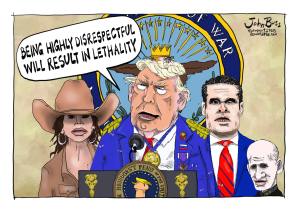
 Economist Mark Zahn explains it all.
  It’s sincerely hypocritical to me to watch a convicted and well-known lifetime felon try to trump up charges on some of the most ethical government servants we’ve ever had. Powell has released a statement through the usual
  Joyce Vance warns us in her
  This list is horrifying.
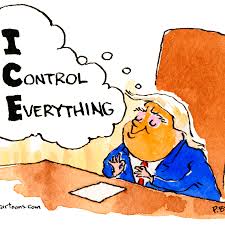 I have one more topic today that I find horrifyingly short-sided and cruel. This is all in the name of keeping women out of the workforce. This is from
 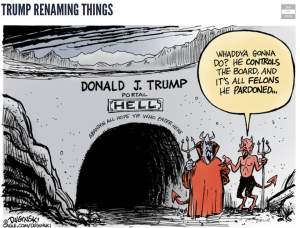 It’s hard to look daily at all the things this regime is doing to make our lives worse-off. Many are focused on harming the least and most vulnerable among us. I know all these grudges Trump holds impact his actions as does his level of greed, need for attention, and seemingly needless compulstion to be cruel.His brain is fed by the likes of Stephen Miller and some backward notion that life was better in previous centuries. But, the man has serious mental issues and personality disorders. Why don’t so many of his followers see that? Why doesn’t the Republican Party do something? They’re empowering the worst in humanity to destroy everything this country has every stood for.
Now, the history of empires is the story of their rise and inevitable fall. As Herodotus wrote about Greek city-states, “most of those which were great once are small today; and those which used to be small were great in my own time.” But nobody has matched this current downfall for sheer egregious stupidity.
That wasn’t true for Nixon, of course, who by then had been out of office for three years. But last year the Supreme Court gutted the rulings that reined in Nixon, and now Trump and Elon Musk are running the government as if they are the only law in the land. They insist they are “saving” the country by burning down its institutions, and they claim a mandate of the people to do it….
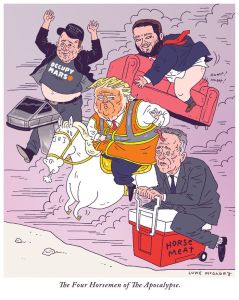
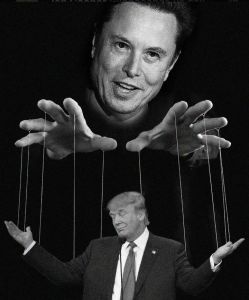
 Good Morning!!
 But the British government had a far more limited view of what constitutes actual representation than the Colonists did. Parliament asserted that it represented the people in Britain’s American colonies even if they had no role in electing it.
 The jury awarded Ms. Freeman and Ms. Moss a combined $75 million in punitive damages. It also ordered Mr. Giuliani to pay compensatory damages of $16.2 million to Ms. Freeman and $16.9 million to Ms. Moss, as well as $20 million to each of them for emotional suffering.
 From CBS News:
  Trump’s former trade representative and White House budget director, respectively, are part of a cadre of allies helping him shape policy proposals across a range of topics, laying the groundwork for what would be an
  “He’s been pretty clear in saying he will use the levers of government to go after his political opponents, which is anathema to conservatives,” said Marc Short, who served in the Trump administration and was a top adviser to former Vice President
  The Nixon renaissance is being driven in part by young conservatives’ genuine interest in Nixon, whom Mills colorfully described as “our Shakespearean president.” But when pressed about their pro-Nixon views, even his most sincere supporters readily admit that the Nixon-mania isn’t being driven solely — or even primarily — by academic interest in Nixon. Instead, the populist right’s ongoing effort to rehabilitate Nixon, which is unfolding against the backdrop of the 2024 Republican primary, is really about another divisive former Republican president: Donald Trump.
 To understand the lay of the land that Cox, her family, and her doctor were facing, we need to look at what Texas lawmakers put in place before Dobbs, the 2022 case that















 peej
peej Carissa
 bostonboomer
 dakinikat
 ecocatwoman
 jjlo
jjlo mablue2
 Mama Lopez
 peggysue22
 quixote
 skydancingguestblogger
 Mona (aka Wonk the Vote)



 Sky Dancing
Recent Comments