Wednesday Reads: The Iran War “Ceasefire”
Posted: April 8, 2026 | Author: bostonboomer | Filed under: just because | Tags: Benjamin Netanyahu, Donald Trump, iran, Iran War, Iran war ceasefire, Iranian Foreign Minister Abbas Araghchi, Iranian Supreme Leader Mojtaba Khamenei, israel, Lebanon, Pakistani Prime Minister Shehbaz Sharif, Strait of Hormuz, Taco Tuesday |
Good Morning!!
 Yesterday morning Trump threatened to wipe out Iran’s civilization beginning at 8:00 last night–the deadline he had set for Iran to open the Strait of Hormuz. Here’s what he posted on Truth Social:
“A whole civilization will die tonight, never to be brought back again,” he wrote. “I don’t want that to happen, but it probably will. However, now that we have Complete and Total Regime Change, where different, smarter, and less radicalized minds prevail, maybe something revolutionarily wonderful can happen, WHO KNOWS?”
The obvious implication was that he would use nuclear weapons. Of course it turned out to be another Taco Tuesday, as Trump backed down and the White House dictated a ceasefire agreement to Pakistan and then Trump said that Iran’s 10-point plan was a good starting point for negotiations.
Iran’s 10-point plan, from The Guardian:
According to state media, Iran will only accept the war’s conclusion once details are finalised in line with a 10-point peace plan reportedly submitted to the White House via Pakistani intermediaries.
The list of 10 points, published by Iranian state media, include a number of conditions the US has rejected in the past. The plan requires:
-
The lifting of all primary and secondary sanctions on Iran.
-
Continued Iranian control over the strait of Hormuz.
-
US military withdrawal from the Middle East.
-
An end to attacks on Iran and its allies.
-
The release of frozen Iranian assets.
-
A UN security council resolution making any deal binding.
That certainly doesn’t sound like a great starting point for Trump. At the moment, Iran is still collecting tolls for ships to pass through the Strait of Hormuz, and they are demanding that the U.S. close all military bases in the Middle East, plus they want compensation for losses from the war and the return of frozen assets going back to the George W. Bush administration.
And it appears there really isn’t really a ceasefire. AP on the latest events: Live updates: Attacks reported in Iran and Gulf Arab nations hours after ceasefire announcement.
Major developments we’re following:
- Iran, the United States and Israel agreed to a two-week ceasefire on Tuesday, an 11th-hour deal that headed off U.S. President Donald Trump’s threat to unleash a bombing campaign that would destroy Iranian civilization. Hours after the announcement, Iran and Gulf Arab countries reported new attacks Wednesday, though it was not clear if the strikes would scuttle the deal.
- All sides have presented vastly different versions of the terms. Iran said the deal would allow it to formalize its new practice of charging ships passing through the Strait of Hormuz. Trump said the U.S. would work with Iran to remove buried enriched uranium, though Iran did not confirm that.
- Pakistan and others said fighting would pause in Lebanon, which Israel has invaded to fight the Iran-backed Hezbollah militant group, but Israeli Prime Minister Benjamin Netanyahu said early Wednesday that the deal doesn’t cover fighting against Hezbollah. Israeli strikes hit several dense commercial and residential areas in central Beirut Wednesday afternoon without warning, killing dozens and wounding hundreds of people.
- The ceasefire may formalize a system of charging fees in the Strait of Hormuz that Iran instituted — and give it a new source of revenue. Iranian attacks and threats deterred many commercial ships from passing through the waterway, through which 20% of all traded oil and natural gas passes in peacetime.
Here’s a good summary of what Trump accomplished:
Here are some Iran war reads to check out:
Jack Blanchard with Dash Burns at Politico Playbook: ‘Better TACO Tuesday than World War III.’
Good Wednesday morning. This is Jack Blanchard, still slowly exhaling. It’s Day One of the ceasefire in Iran. Get in touch.
In today’s Playbook …
— The war in Iran is on hold for now. So who wins the peace? [….]
WHAT DIFFERENCE A DAY MAKES: “A big day for World Peace!” Trump trumpeted on Truth Social at 12:01 a.m., a mere 16 hours after threatening to erase an entire civilization off the face of the planet. Iran has “had enough” of war, Trump said, and “so has everyone else.” Plenty of people will be nodding along with that.
So let the good times roll: “There will be lots of positive action!” Trump predicted. “Big money will be made. Iran can start the reconstruction process … This could be the Golden Age of the Middle East!!!” You don’t need to read too far past the hyperbole to get the crucial point: “Two-week” ceasefire or no, Trump is already moving on.
And let’s be clear: Given the unpopularity of this war in America, the devastating impact on oil prices, the rapidly worsening global economic outlook and Trump’s looming May 14 summit with Chinese President Xi Jinping, it’s hard to imagine Trump reviving his bombing campaign. Oil prices have already plummeted below $100 a barrel following the ceasefire announcement. Stock markets are surging. He’s not going to want to go back.
So brace yourselves for the White House comms blitz. Your zone is about to be flooded with Trump world messages that America won the war, even before this two-week negotiation gets underway. This is “total and complete victory,” Trump told the AFP last night. “100 percent. No question about it.” It’s the first of what will surely be many “exclusive” calls with journalists today….
But here’s the problem: This “total victory” narrative looks tough to sell. Clearly these past few weeks have been painful for Tehran, and Hegseth and Caine will rattle off an astonishing number of military targets that U.S. and Israeli missiles flattened. But is the regime actually worse off?
The charge sheet: Iran’s leadership structures remain intact. Its hard-liners now have total control. Sanctions have been lifted, for now. Missiles can be rebuilt. The enriched uranium remains in Iran. And the discovery that even the full force of the American military cannot prevent Iran from turning one of the world’s most important shipping lanes into a de facto parking lot — with a hefty pay-to-leave barrier — will not be quickly forgotten.
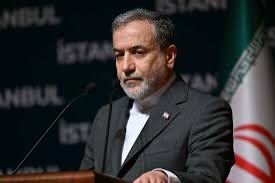
Iranian Foreign Minister Abbas Araghchi
Strait talking: Crucially, the ceasefire statement from Iranian Foreign Minister Abbas Araghchi last night — reposted in full by Trump on Truth Social — states that even during this two-week period, safe passage through the Strait of Hormuz will only be permitted “via coordination with Iran’s Armed Forces.” In other words, the U.S. has already accepted that Iran can impose limits on shipping in the Strait — limits that did not exist before the war began.
And there’s more: Iran is already charging punitive tolls for passage through the strait, and AP reports this will continue during the ceasefire. Trump’s description of Iran’s 10-point list of demands as “a workable basis on which to negotiate” suggests further concessions are entirely possible. Iran’s national security council is already taking a victory lap, though Trump railed angrily at CNN last night for reporThe ting it.
Much remains unclear. Pakistan — the central mediator — said the ceasefire includes Israeli attacks on Lebanon, but Israel said overnight it does not. There are reports Iran continued firing missiles at neighboring countries after the ceasefire was agreed. And there’s no clarity at all on what happens to Iran’s enriched uranium, though Trump told AFP it will be “perfectly taken care of.”
Just 90 minutes before President Donald Trump’s 8 p.m. deadline to wipe out “a whole civilization” with massive strikes on Iran’s energy infrastructure and bridges, he granted a two-week extension for diplomacy to continue.
“Subject to the Islamic Republic of Iran agreeing to the COMPLETE, IMMEDIATE and SAFE OPENING of the Strait of Hormuz,” Trump said Tuesday on social media, “I agree to suspend the bombing and attack of Iran for a period of two weeks.”
“We have already met and exceeded all Military objectives,and are very far along with a definitive Agreement concerning Longterm PEACE with Iran,” Trump said. A 10-point proposal received from Tehran, he said, was a “workable basis on which to negotiate.”
Trump added, “This will be a double-sided CEASEFIRE!”
After Trump’s announcement, a statement posted by Iranian Foreign Minister Abbas Araghchi, which he attributed to the Supreme National Security Council, said it too was responding to Pakistan’s request and Trump’s “acceptance of the general Framework of Iran’s 10-point proposal for negotiations.”
“If attacks against Iran are halted,” it said, “our Powerful Armed Forces will cease their defensive operations.” For two weeks, it added, “safe passage through the Strait of Hormuz will be possible via coordination” with the Iranian military.
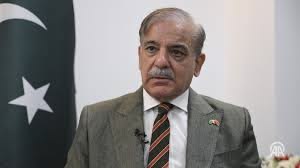
Pakistani Prime Minister Shehbaz Sharif
Trump said his ceasefire decision was in response to an appeal from Pakistani Prime Minister Shehbaz Sharif and military chief Gen. Asim Munir. Pakistan has led a group of mediators, including Egypt and Turkey, that has been looking for an exit to the war that has destabilized the entire region. Trump has forged a particularly close relationship with Munir and, in an interview with Fox News before the extension announcement, described Sharif as “a highly respected man all over.”
In a statement following Trump’s announcement, Sharif said U.S. and Iranian delegations were invited to Islamabad on Friday “to further negotiate for a conclusive agreement to settle all disputes.” He said that the ceasefire would include Lebanon, where Israel is engaged in a massive bombing campaign against Iran-backed Hezbollah.
Unfortunately, Netanyahu didn’t agree to include Lebanon in the ceasefire.
In a brief statement issued in English by his office early Wednesday, local time, Israeli Prime Minister Benjamin Netanyahu said he supported Trump’s “decision to suspend strikes against Iran for two weeks subject to Iran immediately opening the straits and stopping all attacks on the U.S., Israel and countries in the region.”
“Israel also supports the U.S. effort to ensure that Iran no longer poses a nuclear, missile and terror threat. … The United States has told Israel that it is committed to achieving these goals … in the upcoming negotiations,” Netanyahu said.
In a caveat that did not bode well for the negotiations, he added that the ceasefire “does not include Lebanon,” contradicting Sharif’s claims.
The Israel Defense Forces said Wednesday it had “ceased fire in the campaign against Iran” but would continue “its combat and ground operations” in Lebanon.
David Sanger at The New York Times (gift link): Trump Finds His Offramp With Iran. But the Causes of War Remain Unresolved.
Mr. Trump’s tactic of escalating his rhetoric to astronomical levels certainly helped him find an offramp he had been seeking for weeks. That success alone may fuel his belief that the tactics he learned in the New York real estate world — ignore old conventions, make maximalist demands — works in geopolitics as well.
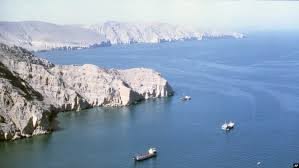
The Strait of Hormuz
Without question, it was a down-to-the-wire tactical victory, one that should, at least temporarily, get oil, fertilizer and helium flowing again through the Strait of Hormuz, and calm markets that feared a global energy shock would lead to a global recession.
But it resolved none of the fundamental issues that led to the war.
It leaves a theocratic government, backed by the vicious Islamic Revolutionary Guard Corps, in charge of a cowed population that has been pummeled by missiles and bombs, and finds itself still under the thumb of a familiar regime, even if under new management. It leaves Iran’s nuclear stockpile in place, including the 970 pounds of near-bomb-grade material that was, in theory, the casus belli of this war.
It left Gulf allies reeling, with the discovery that the glass skyscrapers of Dubai and the desalination plants that make wealthy enclaves in Kuwait livable can be taken out by Iranian missiles and drones. Gas prices have soared, and are about to test Mr. Trump’s promise that they will fall again to old levels as soon as the fighting stops.
And it has left Mr. Trump’s political base fractured, with onetime supporters now accusing the president and his loyalists, starting with Vice President JD Vance, with violating their promise not to get America tied up in unwinnable wars in the Middle East.
It all happened at a moment when Iran has demonstrated that it can absorb 13,000 targeted strikes and still conduct an impressive asymmetric war, choking off oil supplies and sending its cyber army to attack American infrastructure.
Now Mr. Trump faces the challenge not only of reaching a more permanent settlement but proving to the United States and the world that this conflict was worth fighting in the first place. And to do so, he will have to demonstrate that he has removed Iran’s death-grip on the 21-mile channel that makes up the strait, and its chances of ever building a nuclear weapon.
On that point there was an ominous-sounding element buried in the Iranian description of the deal. Shipping would proceed, the Iranian foreign minister, Abbas Araghchi, wrote, but under the control of “Iran’s Armed Forces,” who would determine who passes, and when.
And then there’s that 10-point list of demands.
“Iran remains in the control of the Strait, which was not the case before the war,” said Richard Fontaine, the chief executive of the Center for a New American Security, a Washington think tank. “I find it hard to believe that the United States and the world could accept a situation in which Iran remains in control of a key energy checkpoint indefinitely. That would be a materially worse outcome than existed before the war.”
So might a final agreement. Four weeks ago Mr. Trump was demanding Iran’s “unconditional surrender,’’ saying he would determine when the country had been completely defeated. On Tuesday evening his tone was different. He agreed to base the next two weeks of talks on a 10-point plan Iran submitted to the Pakistanis. Mr. Trump called it “a workable basis on which to negotiate.”
“Have you looked at Iran’s plan?” asked Mr. Fontaine. “It reads like a Tehran wish list from before the war, calling for a global recognition of Iran’s right to enrich uranium, the removal of all American forces from the region and a lifting of economic sanctions. And it calls for the payment of reparations to Iran for damage caused in the war.”
Use the gift link to read the rest, if you’re interested.
Barak Ravid, Dave Lawler, and Marc Caputo at Axios: Exclusive: How Iran’s supreme leader reached a truce with Trump.
Officials in the U.S. and Israel learned of an intriguing development on Monday, with President Trump’s ultimatum looming: Supreme Leader Mojtaba Khamenei had instructed his negotiators, for the first time since the war began, to move towards a deal, according to an Israeli official, a regional official and a third source with knowledge.
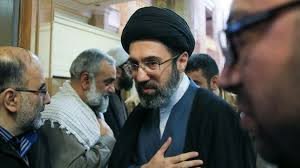
Iranian Supreme Leader Mojtaba Khamenei
The big picture: As Trump was publicly threatening total annihilation, there were signs of diplomatic momentum behind the scenes — though even sources close to Trump didn’t know which outcome to expect right up until a ceasefire was announced….
Setting the scene: On Monday morning, as Trump worked the crowd at a White House Easter celebration, a “very angry” Steve Witkoff was working the phones.
- The U.S. envoy told the mediators the 10-point counter-proposal the U.S. had just received from Iran was “a disaster, a catastrophe,” a source with direct knowledge said.
- That began a “chaotic” day of amendments, with the Pakistani mediators passing new drafts between Witkoff and Iranian Foreign Minister Abbas Araghchi, and the Egyptian and Turkish foreign ministers trying to help bridge gaps.
- By Monday night, the mediators had U.S. approval for an updated proposal for a two-week ceasefire. It was then up to Khamenei — whom the sources said was actively involved in the process on Monday and Tuesday — to make a decision.
The intrigue: The involvement of the new supreme leader was necessarily clandestine and laborious. Facing an active threat of assassination by Israel, Khamenei has been communicating primarily via runners passing notes.
- Two sources described Khamenei’s blessing for his negotiators to cut a deal as a “breakthrough.”
- The regional source said Araghchi also played a central role both in handling the negotiations and in pushing commanders from the Revolutionary Guards to accept a deal.
- China was also advising Iran to seek an off-ramp.
- But at the end of the day, all major decisions on Monday and Tuesday went through Khamenei. “Without his green light, there wouldn’t have been a deal,” the regional source said.
How it happened: It was clearby Tuesday morning that progress was being made, but that didn’t stop Trump from making his most harrowing threat: “A whole civilization will die tonight.”
- Some U.S. media outlets reported Iran was breaking off talks in response. Sources involved in the negotiations told Axios that was not the case, and that there was actually some momentum.
- Vice President Vance was working the phones from Hungary, dealing primarily with the Pakistanis.
- Meanwhile Israeli Prime Minister Benjamin Netanyahu was in frequent contact throughout the day with Trump and his team — though the Israelis were growing increasingly concerned that they’d lost control of the process.
By around noon ET on Tuesday, there was a general understanding that the parties were converging on a two-week ceasefire.
There’s more at the Axios link.
William Kristol at The Bulwark: It’s Not a TACO. It’s a Surrender.
I’m old enough to remember when President Trump assured us, “There will be no deal with Iran except UNCONDITIONAL SURRENDER!”
That was a month ago.
 Since then, Trump has bombed and blustered and caused all manner of damage to Iran, to its neighbors, to the United States, and to the world. But Iran hasn’t unconditionally surrendered. It hasn’t even conditionally surrendered. It’s agreed to a ceasefire followed by negotiations. These negotiations will be based not on Iranian surrender but, as Trump said last night, on a ten-point proposal from Iran that Trump believes “is a workable basis on which to negotiate.”
So we’re off to negotiations. Trump and the Iranian regime are making wildly contrasting claims and promises about what has been or will be agreed to. For now, as Gregg Carlstrom, Middle East correspondent of the Economist, put it:
So if you’re keeping score at home, the ceasefire includes Lebanon but also doesn’t include Lebanon, America has agreed to all of Iran’s demands and Iran has agreed to all of America’s demands, America will recognize Iran’s right to enrichment and also insist on zero enrichment, Hormuz is completely open but also Hormuz is subject to unclear limitations.
Oil market researcher Rory Johnston wittily called this “Schrödinger’s ceasefire.”
But the fog of ceasefire doesn’t mean that we don’t know anything. In fact, we know quite a lot already.
We know that the Iranian regime remains in place. The mullahs and the IRGC remain in control of Iran.
We know that the Iranian regime still has its enriched uranium (even if they can’t get to a lot of it right now). And we know that while its military capabilities have been much degraded, it still has functional missile and drone capabilities. We know there’s no reason not to expect Russia and China to be willing to rearm Iran.
We know that primary and secondary sanctions on Iran seem likely to be relaxed or even lifted.
We know that at least for now the Strait of Hormuz will be reopened. But it’s unclear whether it will remain an international waterway, as it was before, or whether Iran will be able to charge fees or tolls for passage. And we know that the fact that the Iranian regime was able to close the waterway, cause significant damage to the global economy, and live to boast about it, can’t be unseen. Whatever promises are now made, Iran will retain leverage with respect to the strait.
We know more generally that Trump’s war has further shaken any confidence our allies might still have in us. It will be seen as confirmation that Trump’s United States of America has become just another rogue nation in the international arena, if a less disciplined and cunning one than Putin’s Russia or Xi’s China. We know that the old international order with the United States as its anchor is gone.
What we know mocks Trump’s claim in an interview with AFP last night that the United States “won a total and complete victory. One hundred percent. No question about it.”
That’s about all I can handle for today. We have a fool as president, and I’m not sure we can survive the rest of his term. Our only hope is that Democrats can wind the House and Senate and impeach and remove him.
Did you like this post? Please share it with your friends:
Related



 peej
peej Carissa
 ecocatwoman
 mablue2
 Mama Lopez
 peggysue22
 quixote
 skydancingguestblogger
 Mona (aka Wonk the Vote)



 Sky Dancing
Take care everyone, and have a peaceful day. Maybe we’ll even have peace and quiet for the rest of the week, who knows?
The Independent: Secret FBI report warned of elevated Iranian threat to US targets – despite Trump claims.
The FBI issued a warning to U.S. state and local law enforcement in March, highlighting an elevated threat from Iran’s government to targets within America, even as the White House sought to downplay the likelihood of an attack.
This information comes from a law enforcement intelligence report reviewed by Reuters.
The March 20 report, compiled by the FBI and other federal intelligence agencies, warned that the Iranian government “poses a persistent threat” to U.S. military and government personnel and buildings, Jewish and Israeli institutions, and Iranian dissidents in the U.S.
Despite the warnings, the FBI and National Counterterrorism Center had not identified broad threats to the American public, the report noted.
President Donald Trump has publicly minimized the possibility of Iranian attacks on American soil in recent months.
Politico: Iranian hackers are targeting US energy and water sectors, federal agencies warn.
Iranian hackers are exploiting cyber vulnerabilities in key software systems at U.S. water and energy providers, according to a new advisory released by the Cybersecurity and Infrastructure Security Agency on Tuesday.
The guidance warns that Iran-linked hackers are targeting internet-connected programmable logic controllers. These are industrial computers used to control and run critical infrastructure networks across the nation.
The advisory was jointly produced by CISA, the National Security Agency, the Federal Bureau of Investigation, U.S. Cyber Command, the Department of Energy, the Environmental Protection Agency and the Cyber National Mission Force.
Programmable logic controllers developed by software manufacturer Rockwell Automation/Allen-Bradley are actively being exploited, and PLCs from other companies are potentially being targeted as well, according to the advisory.
The agencies advised all U.S. organizations to remove the control software from direct internet exposure and check available logs for “suspicious traffic.” If an organization uses Rockwell Automation devices, the agencies recommend contacting the company if the organization may have been targeted.
https://www.instagram.com/reels/DWxpzQBCsG5/
China warns Israel
thanks for writing and reading all this so I didn’t have to … he’s so insane and he’s just scaring us all to death for what reason?
More than 100 killed as Israel strikes central Beirut after saying Iran truce doesn’t apply there
Israeli strikes hit several commercial and residential areas in central Beirut without warning on Wednesday, hours after a ceasefire was announced in the U.S.-Israeli war with Iran. Lebanon said at least 112 people were killed and hundreds were wounded in what was one of the deadliest days in the latest Israel-Hezbollah war.
U.S. President Donald Trump told PBS News Hour that Lebanon was not included in the deal because of the Lebanese militant Hezbollah group. When asked about Israel’s latest strikes, he said, “That’s a separate skirmish.” Israel had said the agreement does not extend to its war with the Iran-backed Hezbollah, although mediator Pakistan said it does.
The fleeting sense of relief among Lebanese after the ceasefire announcement turned into panic with what Israel’s military called its largest coordinated strike in the current war, hitting more than 100 Hezbollah targets within 10 minutes in Beirut, southern Lebanon and the eastern Bekaa Valley.
Pete Hegseth’s deeply disturbing past is darker than most realize
Heather Delaney Reese
Apr 8READ IN APP
Pete Hegseth is the most unqualified person ever to hold the position of Secretary of Defense. In 2021, the U.S. military reviewed Hegseth’s tattoos, flagged him as a potential insider threat, and revoked his orders to serve at Biden’s inauguration. They concluded he was too dangerous to stand guard at a ceremony. Four years later, he is running the Pentagon and commanding the most powerful military on earth during an active war. His arm bears the battle cry of the First Crusade. His chest carries a Jerusalem Cross. And last week, from a podium at the Pentagon, he prayed for “overwhelming violence” and “eternal damnation” for America’s enemies. In 2015, he was reported to have been chanting “Kill All Muslims” at a bar while on official business. His own mother called him “an abuser of women” in a letter that made it into public record. He ran two veterans nonprofits into the ground before anyone trusted him with real power. And now he has more of it than almost anyone on the planet.
Since taking over the Pentagon, Hegseth has fired more than a dozen generals and admirals, including the Army Chief of Staff, for reportedly opposing ground troops in Iran. He has blocked promotions for Black and female senior officers. He banned photographers from his war briefings because he didn’t like how he looked in published photos. He invited a pastor who believes women shouldn’t have the right to vote to preach at the Pentagon. And he is waging this war under the banner of a religious crusade, using language that legal experts say crosses the line into war crimes. How this man went from being rejected by the National Guard to running the Department of Defense is the story of today’s video.
We are living through a pivotal moment for our country, and my goal is to reach as many people as possible with clear, factual information about what is happening. The more people who understand what is unfolding, the better our chances of pushing back against chaos, cruelty, and corruption ahead of the midterms.
Thank you for your continued support. Your paid subscriptions have enabled me to add a video editor and reach more people.
Independent journalism is under attack. You can make a difference with a $5/month paid subscription. Your support allows me to keep telling the truth about the lies and destruction unfolding in our country, defend myself from constant pressure from MAGA extremists, and ultimately spread the message to more people.
I’m fighting to save our country (before it’s too late).
I’ll see you tomorrow,
Heather
This video is based on my written post, available HERE, and based on the events of 4-4-2026.
*This commentary represents my personal opinions and analysis of matters of public concern, informed by publicly available information. Any references to individuals constitute opinion and commentary protected under the First Amendment.