
Monday Reads: Hello Darkness, my old friend
Posted: June 11, 2018 Filed under: 2016 elections, morning reads | Tags: Canada, G 6 plus 1, net neutrality, New Orleans Jazz funerals, Russia NRA collusion, Trump Russia Collusion, Trump Russia investigation 30 Comments
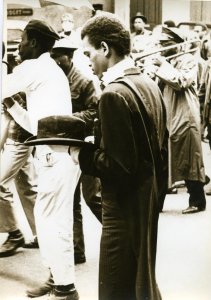
Traditional New Orleans Jazz funeral in the 1970s
Well, it’s another day to find out how low the party and appointments of KKKremlin Caligula can go and it’s low. It’s about as low as the nadir of morality set by the monster himself. Today’s news isn’t pleasant at all from any vantage point. I’m reminded that death is a natural part of life and one that every one tries to ignore but must face. I’d like to give a jazz funeral for some of these items, but I’m having a hard time celebrating the life before the loss.
Today, is our first day without Net Neutrality. Any of us that have been on the internet a long time–1981 for me–will know that everything use to be much freer, less commercial, and less ridden with stalkers. I don’t miss the old modem that required a telephone ear/mouth piece. I don’t miss having to direct dial to most sites. I also do not miss that the only graphics you would ever see were in either gold and green and entirely composed of characters. I do miss the days before AOL let all their subscribers lose on the web and there is much we will miss with the death of Net Neutrality. This is from Slate.
Monday, June 11, is the first day of the post-net neutrality internet. In December, the Federal Communications Commission voted to repeal the Obama-era rules that prohibit internet companies from slowing down or speeding up access to certain websites, but it took about six months for the repeal to get a sign-off from the Office of Management and Budget and for the new rules to be published in the federal register. Beginning, well, now, your internet access could—emphasis on could—feel dramatically different than it did yesterday.
Under the new network neutrality rules, internet service providers like Comcast, Verizon, and AT&T are allowed to throttle traffic that travels over their network or even block access to entire websites as long as the companies alert their subscribers in their terms of service that they reserve the right to do so. But since most people in the United States don’t have more than one or two internet providers to choose from for broadband service, that means if users don’t wish to accept those terms, many won’t have anywhere else to go for their internet. Without net neutrality rules stopping them, internet providers will also be able to charge websites a fee to reach users faster.
Those internet providers stand to win the most from the net neutrality repeal, since they’ll be able to operate what is essentially a two-way toll, collecting money from both subscribers and websites that want priority access to users. Already-powerful, deep-pocketed companies that can afford to pay for the fast-lane service, like Facebook or Yelp could wind up in a position to set the price, relegating smaller companies, nonprofits, or struggling news organizations to what is, in effect, a slower internet.

Leo Touchet, Jazz Funeral No. 70 (New Orleans, Louisiana) (1969)
We’re seeing another nail in the coffin of voting rights. Today’s death blow came from the Supreme Court of the United States and yes, you know the ones that did it to us. This is from Buzzfeed‘s Court Reporter Chris Geidner:”The Supreme Court Just Upheld Ohio’s Aggressive Process For Purging Voters From The Rolls. The court split 5–4 on ideological grounds.”
The Supreme Court upheld Ohio’s system for purging inactive voters from the rolls — a decision that could lead other states to implement its aggressive procedure that can be triggered after a person fails to vote in one federal election.
Justice Samuel Alito wrote Monday’s 5–4 decision for the court, which was split along ideological lines.
Under Ohio’s system, voters who do not vote in a two-year period are sent a notice from the state. If they do not return the notice and then fail to vote for the next four years, their voter registration is canceled.
The Supreme Court held that the state’s process did not violate federal law.
Ohio had argued that its process was based on a provision of the National Voter Registration Act that allows states to remove people from voting rolls based on the grounds that they moved.
The A. Philip Randolph Institute, which sued the state, argued that the state, in fact, violated a different provision — which says that a person cannot be removed from voter rolls simply for failing to vote.
The court ruled that the state only uses the failure to vote “as a rough way of identifying voters who may have moved,” but that it actually begins the removal process by sending “a preaddressed, postage prepaid card to these individuals asking them to verify that they still reside at the same address.”
The court rejected the challengers’ argument that Ohio’s system violates the “Failure-to-Vote Clause.” The clause, Alito wrote, “simply forbids the use of nonvoting as the sole criterion for removing a registrant, and Ohio does not use it that way.”
Justice Stephen Breyer summed up the dissenting justices’ view that Monday’s decision was an exercise in circular reasoning.

Most of us are still swooning from the weekend that basically cut the United States away from its closest allies, friends, and countries that share the values of reason, justice, and modernity. Have we just witnessed the murder of the post-World War 2 coalition of the world’s greatest economic and democratic powers? From the keyboard of Jeffrey Goldberg writing for The Atlantic: “A Senior White House Official Defines the Trump Doctrine: ‘We’re America, Bitch’. The president believes that the United States owes nothing to anyone—especially its allies.”
Many of Donald Trump’s critics find it difficult to ascribe to a president they consider to be both subliterate and historically insensate a foreign-policy doctrine that approaches coherence. A Trump Doctrine would require evidence of Trump Thought, and proof of such thinking, the argument goes, is scant. This view is informed in part by feelings of condescension, but it is not meritless. Barack Obama, whose foreign-policy doctrine I studied in depth, was cerebral to a fault; the man who succeeded him is perhaps the most glandular president in American history. Unlike Obama, Trump possesses no ability to explain anything resembling a foreign-policy philosophy. But this does not mean that he is without ideas.
Over the past couple of months, I’ve asked a number of people close to the president to provide me with short descriptions of what might constitute the Trump Doctrine. I’ve been trying, as part of a larger project, to understand the revolutionary nature of Trump’s approach to world affairs. This task became even more interesting over the weekend, when Trump made his most ambitious move yet to dismantle the U.S.-led Western alliance; it becomes more interesting still as Trump launches, without preparation or baseline knowledge, a complicated nuclear negotiation with a fanatical and bizarre regime that quite possibly has his number.
Trumpian chaos is, in fact, undergirded by a comprehensible worldview, a number of experts have insisted. The Brookings Institution scholar (and frequent Atlantic contributor) Thomas Wright argued in a January 2016 essaythat Trump’s views are both discernible and explicable. Wright, who published his analysis at a time when most everyone in the foreign-policy establishment considered Trump’s candidacy to be a farce, wrote that Trump loathes the liberal international order and would work against it as president; he wrote that Trump also dislikes America’s military alliances, and would work against them; he argued that Trump believes in his bones that the global economy is unfair to the U.S.; and, finally, he wrote that Trump has an innate sympathy for “authoritarian strongmen.”
We continue to discover how deep Russian interference was in our election in 2016. This is horrifying and it shows how big money and big lobbyists are killing our democracy.
 You should read the entire article but here’s the money line.
Several prominent Russians, some in President Vladimir Putin’s inner circle or high in the Russian Orthodox Church, now have been identified as having contact with National Rifle Association officials during the 2016 U.S. election campaign, according to photographs and an NRA source.
The contacts have emerged amid a deepening Justice Department investigation into whether Russian banker and lifetime NRA member Alexander Torshin illegally channeled money through the gun rights group to add financial firepower to Donald Trump’s 2016 presidential bid.
Other influential Russians who met with NRA representatives during the campaign include Dmitry Rogozin, who until last month served as a deputy prime minister overseeing Russia’s defense industry, and Sergei Rudov, head of one of Russia’s largest philanthropies, the St. Basil the Great Charitable Foundation. The foundation was launched by an ultra-nationalist ally of Russian President Putin.
 Less we forget, Matt Ygelisias writing for Vox reminds us that: “There’s actually lots of evidence of Trump-Russia collusion. The untenability of the “no collusion” talking point.” We also need a jazz funeral for the truth. We’re victims of weaponized, industrial strength gaslighting.
“In all of this, in any of this, there’s been no evidence that there’s been any collusion between the Trump campaign and President Trump and Russia,” House Speaker Paul Ryan said Thursday at his weekly press conference. “Let’s just make that really clear. There’s no evidence of collusion. This is about Russia and what they did and making sure they don’t do it again.”
From Ryan’s perspective, it would be convenient if it were true that Robert Mueller’s investigation had turned up no evidence of collusion, but it simply isn’t.
Republicans from Donald Trump on down have made “no collusion” a mantra. The term itself is ill-defined in this context; you won’t find in the US code. But roughly speaking, the question is whether the campaign got involved with Russian agents who committed computer crimes to help Trump win the 2016 presidential election.
The verdict on this is unclear. But there is certainly plenty of evidence pointing toward collusion; what you would call “probable cause” in a legal context, or what a journalist might simply consider reason to continue investigating the story. And the investigating thus far, both by special counsel Mueller and by journalists working on the story, has been fruitful. The efforts have continued to turn up contacts between Trumpworld and Putinland, cover-ups, and dishonesty.
Even as recently as Friday afternoon, we got new indictments charging Trump’s former campaign chair and his former GRU operative business partner with witness tampering and obstruction of justice.
It’s important, obviously, not to prejudge a case. It turns out that Saddam Hussein was acting like a man who was covering up a secret nuclear weapons arsenal because he didn’t want the world to know how weak his defenses really were.
By the same token, it’s certainly possible that the various Trump-Russia contacts never amounted to anything and that they’ve been consistently covered up for some reason otherthan an effort to hide collusion. But both the contacts that have been revealed so far and the deception used to deny their existence are certainly evidence of collusion — evidence that should be (and is being) pursued by the special counsel’s office and that should not be dismissed by the press or by elected officials.
 Yglesias has documented a rather long list of fires and smoking guns. Go check it out. We definitely need to throw a jazz funeral for what’s left of the values the Republican party held and ran on for years. This is from NBC News: “The GOP once championed alliances and free trade. Why is it silent now?”
But after a weekend when President Trump called Canadian Prime Minister Justin Trudeau “very dishonest and weak,” after he refused to sign the joint communique from the G-7 summit, and after a top Trump aide said “there’s a special place in hell for any foreign leader that engages in bad faith diplomacy with President Donald J. Trump and then tries to stab him in the back on the way out the door” — those same Republican leaders have been silent.
(What did Trudeau do, by the way, to earn that condemnation from Team Trump? He said that Canada would respond with reciprocal tariffs on the U.S. tariffs the Trump administration imposed on Canada — nothing he and his government haven’t said before, including on “Meet the Press” a week ago.)
The one exception to this GOP silence was Sen. John McCain, who tweeted: “To our allies: bipartisan majorities of Americans remain pro-free trade, pro-globalization & supportive of alliances based on 70 years of shared values. Americans stand with you, even if our president doesn’t.”
But other Republicans haven’t repeated that message, which is striking when free trade has been one of the GOP’s central tenets over the last few decades. And there’s only one explanation for that Republican silence: Trump has bullied the entire party into submission — well, at least those who will have to face voters again.
Today begins the frightening process of watching two madmen sit across the table to compare dick sizes. My money is on the North Koreans.
As Rick Wilson says: “Everything Trump touches dies.” We have not attended our last funeral but let’s try to find ways to comfort ourselves in the small celebrations of our daily lives. This includes all of my dear friends here on Sky Dancing who I consider the best of family.
What’s on your reading and blogging list today?
Lazy Saturday Reads: These Days I Often Cry While Reading News
Posted: June 9, 2018 Filed under: morning reads, U.S. Politics 45 Comments
My Grandparents, My Parents, and I 1936, Frida Kahlo
Good Morning!!
Many of you know that I was born in Fargo, North Dakota. My Dad was also born in Fargo, and my Mom was born in the tiny town of Hope.
Dad’s father grew up Salk Centre, Minnesota. His childhood friend Sinclair Lewis later angered Salk Centre residents when he wrote a book about the town, Main Street.
My mother’s dad grew up on a farm and ended up going to dental school in Indiana, where he met my grandmother and brought her back to the north country. He was the dentist in Hope for part of the week and worked in another small town the rest of the week.
Even though I only lived there as a small child, I still have a strong attachment to North Dakota. We went back often when I was a kid, and as and adult, I went back a couple of times with my parents to visit all the old places and listen to their memories. We visited Fargo, Hope, Grand Forks, where my Dad got his masters degree at UND, and Lisbon, where my mom’s family lived for years. When I was in North Dakota I felt a real sense of place and belonging–that is where my roots are and always will be.
Eventually, Mom’s parents moved to Columbus, Indiana, and our family ended up in Muncie, Indiana. Like many young people, I couldn’t wait to get away from the town where I mostly grew up. But I don’t like it when people who have never spent time in the Midwest look down their noses at Midwestern people. So when I heard about Anthony Bourdain’s tragic suicide, I immediately remembered the time he stood up for Marilyn Hagerty, a food writer and columnist in Grand Forks, North Dakota.

Emile Levy, Mother and Child
In 2012, Hagerty wrote a review of the newly opened Olive Garden in Grand Forks. Somehow the piece went viral and Hagerty became an object of ridicule for on-line snobs. Bourdain had a similar reaction at first, but he thought twice about it and realized that Hagerty was doing a service by recording the history of food and dining in a small Midwestern town. He ended up meeting her in New York, helped her get a book deal, and wrote the forward to her collection of restaurant reviews.
Time Magazine: Viral Olive Garden Reviewer on Her Special Bond With Anthony Bourdain After He Came to Her Defense: ‘He Was Nothing But Kind’
After Grand Forks Herald dining critic Marilyn Hagerty went viral in 2012 for a review she wrote about Olive Garden (she called it “impressive” and commended the “generous” portion of chicken Alfredo she received), Bourdain quickly stepped out of the hordes of people who gave her a lot of snark for taking a chain restaurant so seriously. Instead, he met with Hagerty and published a book of her columns to which he wrote the foreword.
Bourdain, who died Friday at the age of 61, left a lasting impression on Hagerty, who met him once in New York City after her viral article. Hagerty, 92, told TIME she didn’t know Bourdain at all before her story drew widespread attention online, but that he supported her at an important time.
“People were saying what a funny strange thing it was for anyone to write about the Olive Garden, and all of a sudden Anthony Bourdain came to my side,” she said. “He said he agreed with the people at first, and as he thought about it more, he seemed to appreciate the fact that for people in middle America, it’s part of how we eat.”
Bourdain’s appreciation extended through much more of Hagerty’s work. Grand Forks, North Dakota, doesn’t see many of the food trends or small restaurants that specialize in particular dishes that pop up in places like New York or San Francisco. But for Hagerty, writing about food just means going everywhere, including fast food chains like McDonald’s and Taco Bell, and buffets frequented by truck drivers.
It was Hagerty’s ability to notice such things that prompted Bourdain to suggest she write a book of her columns when they met for coffee at a hotel in New York in 2012.
Hagerty became so well-known that she recently was invited to write a review of a Grand Forks restaurant for Bon Appetit Magazine. Here’s a piece she wrote for The Grand Forks Herald after she returned from another trip to New York for an interview with Anderson Cooper: MARILYN HAGERTY: Teaching Tony and Anderson to play bridge.

Ferdinand Hodler 1853-1918, Swiss
I wish I could just keep on reminiscing; but we live in dangerous times, and we have to pay attention to what’s happening in our world today. The worst thing right now IMHO, is Trump’s policy of separating immigrant families and the horrendous damage he is doing to countless parents and children. Charles Pierce wrote a powerful piece about it yesterday: I Don’t Need to ‘Understand’ Anyone Who Still Supports This President*.
The New York Times had a story on Friday that should’ve brought shame and derision upon anyone who voted for the racist monster in the White House, and upon the racist monster that the other racist monster installed at the head of the Department of Justice. The United States government is now committing human rights atrocities within its own borders and against the most vulnerable people it can find. I don’t need to “understand,” much less take seriously, anyone who still supports this president* and his administration* because, if you do, you’ve taken the idea of America and run battery acid through its veins.
An American government escort handed over the 5-year-old child, identified on his travel documents as José, to the American woman whose family was entrusted with caring for him. He refused to take her hand. He did not cry. He was silent on the ride “home.” The first few nights, he cried himself to sleep. Then it turned into “just moaning and moaning,” said Janice, his foster mother. He recently slept through the night for the first time, though he still insists on tucking the family pictures under his pillow.
José’s separation from his father is part of the Trump administration’s latest and most widely debated border enforcement policy. Last month, Attorney General Jeff Sessions announced that the government would criminally prosecute everyone who crosses the border illegally, a directive that is already leading to the breakup of hundreds of migrant families and channeling children into shelters and foster homes across the country.
There are more stories of children who have been taken from their parents at the link. Please go read them, even if you have to force yourself. These horrors are being perpetrated in our name.
From today’s Washington Post: A family was separated at the border, and this distraught father took his own life.
A Honduran father separated from his wife and child suffered a breakdown at a Texas jail and killed himself in a padded cell last month, according to Border Patrol agents and an incident report filed by sheriff’s deputies.
On Dad’s Shoulders by Mark Lague
The death of Marco Antonio Muñoz, 39, has not been publicly disclosed by the Department of Homeland Security, and did not appear in any local news accounts. But according to a copy of a sheriff’s department report obtained by The Washington Post, Muñoz was found on the floor of his cell May 13 in a pool of blood with an item of clothing twisted around his neck.
Starr County sheriff’s deputies recorded the incident as a “suicide in custody.” [….]
Soon after Muñoz and his family were taken into custody, they arrived at a processing station in nearby McAllen and said they wanted to apply for asylum. Border Patrol agents told the family they would be separated. That’s when Muñoz “lost it,” according to one agent, speaking on condition of anonymity to discuss the incident.
“The guy lost his s—,” the agent said. “They had to use physical force to take the child out of his hands.”

Read it again. Border Patrol agents forcibly ripped a three-year-old child from a father’s hands. This family had done nothing illegal; they were seeking asylum. Now the father is dead and no one knows where his wife and child are or whether they know of his death. These days I often find myself in tears when I read about what our government is doing.
We did get a little peace this morning–no ugly tweets from Trump.
That’s because he’s out of the country using every opportunity to insult our allies and provide aid and comfort to dictators.
NBC News: Trump hits the world stage, Day 1: Come late, leave early, offend host, alienate allies.
QUEBEC CITY — The world is getting a good look at the two faces of the Trump administration at this week’s G-7 meeting in Charlevoix, Canada: One is that of a team of government officials working hard to find common ground with like-minded nations on a wide range of policy issues, while the other is that of a president who at times seems bent on taking a hammer to the whole process.
Diego Rivera, Mother and Child
The U.S. still hopes to be a party to the traditional end-of-summit joint G-7 agreement Saturday, even as President Donald Trump spent much of the week jabbing other world leaders, threatening to raise tariffs on U.S. allies and arguing that America would be better off if the conference didn’t produce a new deal.
On Friday, he upped the ante just before heading to Canada: Russia, he said, should be allowed to rejoin the G-7.
That remark was “not planned,” according to a National Security Council official.

Oh yeah? I’ll bet it was planned in one of Trump’s frequent phone calls with Putin. A bit more:
Indeed, it was taken by foreign diplomats, veterans of American foreign policy and lawmakers of both parties in Congress as yet another sign that Trump — who also boasted this week that he doesn’t need to prepare much for his nuclear summit on Tuesday with North Korea’s Kim Jong Un — is winging it with potentially dangerous consequences.
It “gives the Kremlin one more opportunity to take advantage of divisions” between the U.S. and other G-7 nations, said Bob Hormats, who worked in high-level jobs at the National Security Council and the State Department in several administrations.While new Italian Prime Minister Giuseppe Conte backed Trump on Russia, the rest of the G-7 has little interest in rewarding a nation that was expelled in 2014 for annexing Crimea.
One more before I wrap this up.
John Harwood at CNBC: Trump is helping Putin with a key goal when he spurns US allies.
Story Time by Warren F. Neary, oil painting of the artist reading with his son
Vladimir Putin tried to help Donald Trump win the presidency. As president, Trump is helping Putin achieve a top strategic goal.
And the question is: Why?
That mystery deepened Friday when Trump, as he openly attacked U.S. allies while heading for meetings with them, called for Russia to be readmitted to the G-7 club of advanced industrial democracies. The U.S. and its allies ejected Russia after its 2014 seizure of Crimea.
With that concession, Trump capped a whirl of activity advancing Russia’s objective of splintering the alliances undergirding the Western world’s security and prosperity for the past 70 years. French President Emmanuel Macron, incensed by the trade conflicts Trump instigated, declared that G-7 partners gathered in Canada this weekend might cut out the U.S. for purposes of the summit communique.
This followed the president’s earlier reluctance to embrace North Atlantic Treaty Organization commitments safeguarding Europe against Russia, his delay in implementing new congressional sanctions against Russia and his praise of Putin himself. Those actions, according to U.S. intelligence and law enforcement officials, followed criminal interference by Russian operatives to help Trump defeat Hillary Clinton in the 2016 election.
The starkness of Trump’s words — he stated no conditions for returning Russia to international favor on the same morning he impugned Canada’s honesty — unsettled observers across the political spectrum.

Journalists and politicians keep asking why? But isn’t it obvious at this point? Trump is working for Russia, not for us.
What stories are you following today? Please share in the comment thread below.
Friday Reads: Put on a Happy Face!!!
Posted: June 8, 2018 Filed under: Affordable Care Act (ACA), Afternoon Reads, Injustice system | Tags: suicide in America 57 Comments
there was always light by Amanda Blake (contemporary), American
Good Morning Sky Dancers
I wish I could be your little ray of sunshine this morning but I don’t know how that’s possible given the utter daily chaos and destruction that the 2016 election brought us. The chickens are definitely coming home to roost and the banty rooster is a crazy and mean little bird.
I woke up today to the sad news of a second celebrity suicide. First, we had Kate Spade whose handbag designs were wonderful. Now, it’s Anthony Bourdain. Both have left behind young daughters.
Celebrity suicide always starts a conversation that never reaches the ears of the our policymakers who could provide necessary things to solve problems but instead choose to exacerbate them. But more about Trump and the Republicans in Congress and the yanking of funds from the Children’s Health Program last night in a stealth, decidedly one sided vote. Any one with young ones in their life should spend time with them now.
According to several studies, publicity surrounding a suicide has been repeatedly linked to a subsequent increase in the act, particularly among young people.
After Marilyn Monroe died in August 1962, the cause listed as probable suicide, the nation mourned — publicly. In the month that followed there was sweeping news coverage, public memorials and a 12% increase in suicides. That month saw an additional 303 suicides in comparison to the year prior, according to a study published in the Journal of Epidemiology & Community Health.
When Robin Williams died in 2014, the world reacted similarly. The comedian’s image was everywhere, details of his untimely passing spawned countless news articles and think pieces. His death is also similarly associated with a 10% increase in suicide across the United States in the five months after his passing, according to a study published in the journal, PLOS ONE, in February.
The phenomenon is often referred to as “suicide contagion,” defined by the Department of Health and Human Services as an increase in suicides due to “the exposure to suicide or suicidal behaviors within one’s family, one’s peer group, or through media reports of suicide.”
And the overwhelming influence of a celebrity or high-profile suicide is far from a new discovery. Following the 1774 publication of Wolfgang Goethe’s “The Sorrows of Young Werther” — a book in which a young man ends his life after a failed love affair — Europe also saw a spike in suicides, particularly in men the same age as the protagonist.
The outbreak prompted the novel to be banned in several European locations.

PAUL RAFFERTY, American (contemporary)
Hydrangeas Contre Jour
Suicide, however, has been on the rise in the US since 1999. Like most mental illnesses, it receives less preventative attention than it should. It does, however, generate a lot of revenues for pharmaceutical companies. It’s less likely the pills are accompanied by human help and counselling.
I’ve struggled with depression for like 50 years. Some of my youngest memories are of my dad, my baby sister, and me in Kansas City waiting in the car outside a small hospital while my mother sat with her mother during her shock treatments. My mother lived with it too. They put her on antidepressants the last year of her life and I saw a happy, cheery woman I had never known before. I personally rely heavily on my Buddhist practice which grew from my adult-in-process practices of the relaxation response and positive affirmation. I hurl mantras like I live in a gompa some where up in the Himalayas with shaved head and nun vows. I only wish more people had access to learning meditation. It also helps me to stay away from mean, nasty people which is proving challenging in the Trump era.
But, actual science and properly funding and staffing the CDC is not a priority at all right now.
Suicide rates increased by 25% across the United States over nearly two decades ending in 2016, according to research published Thursday by the US Centers for Disease Control and Prevention. Twenty-five states experienced a rise in suicides by more than 30%, the government report finds.
More than half of those who died by suicide had not been diagnosed with a mental health condition, said Dr. Anne Schuchat, principal deputy director of the CDC.
“These findings are disturbing. Suicide is one of the top 10 causes of death in the US right now, and it’s one of three causes that is actually increasing recently, so we do consider it a public health problem — and something that is all around us,” Schuchat said. The other two top 10 causes of death that are on the rise are Alzheimer’s disease and drug overdoses, she noted.
In 2016 alone, about 45,000 lives were lost to suicide.
“Our data show that the problem is getting worse,” Schuchat said.

surprise!! chickens! roosting! crazy ass rooster!!!
The Daily Wire has some more of these stats.
Bourdain is just the latest in a string of prominent celebrities suffering from depression who have taken their own lives. Last week, Kate Spade committed suicide; she was reportedly fixated on Robin Williams’ suicide. And suicide rates across America have been spiking: as of 2014, American suicide rates had skyrocketed to their highest rate in three decades, all the way to 13 people per 100,000, even as death rates from other causes declined markedly. Suicide was particularly common among middle-aged white people. The overall suicide rate climbed 24 percent from 1999 to 2014; in 2014, over 14,000 middle-aged white Americans committed suicide. Between 2006 and 2016, the suicide rate for white children jumped 70 percent, and the suicide rate among black children (while lower than that of white children overall) jumped 77 percent. According to USA Today:
A study of pediatric hospitals released last May found admissions of patients ages 5 to 17 for suicidal thoughts and actions more than doubled from 2008 to 2015. The group at highest risk for suicide are white males between 14 and 21.
What’s causing this uptick? Traditional theories regarding poverty don’t seem to hold much water – the economic recovery was well underway by 2014, and more poverty-stricken demographic groups in the United States had lower suicide rates than whites did on a consistent basis. And theories regarding bullying don’t seem to solve the question either – bullying isn’t worse in 2017 than it was in 1999, and studies seem to show that once depression and delinquency are factored out, bullying does not rate as an independent variable changing suicide rates.
Suicide is a complex social phenomenon, and it’s difficult to pin down cause and effect. Surely rising rates of opioid abuse have contributed to the suicide increase, but that wouldn’t explain the jump among young people. There’s a case to be made that decline of religiosity in wealthier societies has led to an uptick in suicide(poorer societies tend to have far less of a suicide problem than wealthy societies, so religious differences matter less statistically). We are suffering a crisis of meaning in the West, and it’s having a significant impact on suicidality.

Hendrick ter Brugghen, Old Man Writing by Candlelight, c. 1626-27, Dutch Baroque painter and leading member of the Utrecht followers of Caravaggio
I don’t think religiosity necessarily connects to leading a meaningful life. But, I’d say constantly be sent off to war is one factor because suicide rates for Vets is off the wall. I’d also say feeling helpless to change things in your work life and community leads to some of that too. (From Foreign Policy, September, 2017)
Veterans are about 20 percent more likely than nonveterans to kill themselves, according to a Veterans Affairs press release issued on Friday afternoon at the close of business. (Traditionally, that’s when Washington public affairs types put out bad news they don’t wish to discuss. Mainly they hope to see it tucked into Saturday newspapers that no one reads.)
Also, the suicide rate for female veterans is 250 percent that for female non-vets.
Then, there’s death by abhorrently racist federal policy. There’s a surge in that. From the daily paper of my childhood days The Des Moines Register: “Des Moines DREAMer dies within weeks after being sent back to Mexico’s violence.”
Manuel Antonio Cano Pacheco should have graduated from high school in Des Moines last month. The oldest of four siblings should have walked across a stage in a cap and gown to become a proud symbol to his sister and brothers of the rewards of hard work and education.
Instead, Manuel died a brutal death alone in a foreign land, a symbol of gang supremacy in a country plagued by violent drug cartels. It happened three weeks after U.S. Immigration and Customs Enforcement returned him to Mexico, a country he had left at age 3 when his parents brought him here without a visa.
The fact that America was the only home he has known made Manuel eligible to apply for and be granted DACA status under the Deferred Action for Childhood Arrivals program initiated by former President Barack Obama. It exempted from deportation certain young people, referred to as DREAMERS, who were brought to the U.S. without papers as children.
But that status didn’t protect Manuel when he came to immigration authorities’ attention after being stopped for speeding last fall and charged with driving under the influence. An ICE spokesperson said in a statement that ICE officers arrested him in Polk County Jail and a federal immigration judge terminated his DACA status because of two misdemeanor convictions.
The statement from Shawn Neudauer, ICE public affairs officer, also said Manuel wasn’t technically deported, but was escorted to Mexico by ICE deportation officers at the Laredo, Texas border this past April 24. He called it a voluntary departure process that doesn’t carry the penalties of a formal deportation. But the impact was the same: Manuel had no choice but to go back, either as a deportee or in a “voluntary departure.” He chose the “voluntary” route.

The Glasgow Rose, Charles Rennie MacIntosh, Scottish, Glasgow School
You may read more about this young man’s short life at the newspaper’s link.
Other Republican policies will be cutting the lives of children short if this bill passes the US Senate. It moved through the House like a stealth fighter. Funny, how Republicans can get it done when it involves propping up their give-aways to the rich and powerful.
The House voted along party lines late Thursday to pass a White House proposal that would claw back nearly $15 billion in previously approved government funding.
The House approved the measure in a vote of 210-206, with conservatives calling it a step in the right direction after they ripped into the price tag of the $1.3 trillion spending bill President Trump signed earlier this year.
“President Trump and this Administration are fully committed to protecting taxpayers, and Senate passage of this legislation is critical to reducing wasteful, unnecessary spending and making our Federal Government more efficient, effective, and accountable,” White House press secretary Sarah Huckabee Sanders said in a statement late Thursday.
Trump had pushed lawmakers earlier this week to vote in favor of the clawback plan, known as the Spending Cuts to Expired and Unnecessary Programs Act, which GOP leaders have been working on for two months.
“The HISTORIC Rescissions Package we’ve proposed would cut $15,000,000,000 in Wasteful Spending! We are getting our government back on track,” Trump tweeted Tuesday.
The push to slash spending stemmed from conversations between Trump and House Majority Leader Kevin McCarthy (R-Calif.) in April, weeks after Trump signed the omnibus into law.
“The President’s rescissions request is a straightforward approach to begin cleaning up a bloated federal budget and respecting hardworking taxpayer dollars,” McCarthy said in a statement Wednesday.
While the move was welcomed by fiscal hawks, Democrats and a handful of moderates argued it could hinder future budget negotiations and drain unused funds that may prove necessary for programs down the road.
Opponents blasted the administration’s decision to target unobligated funds within the Children’s Health Insurance Program (CHIP) –– which make up nearly half of the $14.7 billion in rollbacks –– alleging the cuts could lead to a loss of coverage if enrollment is higher than expected.
“The nearly $15 billion in rescissions cut numerous efforts to create jobs, grow our economy, and strengthen our communities. It cuts funding for the economic development administration, and for community development financial institutions. Both of which create jobs in rural areas and distress communities,” Rep. Nita Lowey (D-N.Y.), the ranking member on the House Appropriations Committee, said on the floor.
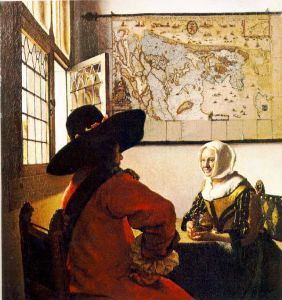
Officer with a Laughing Girl: ca 1657, Johannes Vermeer, Dutch Baroque Painter
Then, there’s a stab at Obamacare again. This time it’s by the Oldest Living Confederate widow as she attempts to get people with preexisting conditions thrown out and re-establish womanhood as a preexisting condition. From Forbes Magazine: “The Trump Administration Is Using a New Tactic to Dismantle Obamacare. What You Need to Know About It”
The Trump administration is trying out a new tactic to get rid of the Affordable Care Act (aka Obamacare): calling at least one provision of it unconstitutional.
In a brief filed Thursday, the Justice Department sided with Texas and a coalition of other Republican-led states that had filed a suit challenging the constitutionality of Obamacare. While it is uncommon for the Justice Department to go against federal law, Attorney General Jeff Sessions said that he acted with the “approval of the President of the United States.”
Here’s their argument, and what they want.
The filing declares unconstitutional the so-called individual mandate—which requires almost all Americans to purchase health insurance or pay a “tax” if they don’t—and calls for several elements of ACA to be invalidated. These include a “ban on insurers denying coverage and charging higher rates to people with pre-existing health conditions.” The Justice Department reportedly also wants to repeal limits on insurance costs based on gender and age.
Nevertheless, the Justice Department’s position did not go quite as far as the Texas suit. In it, the states deem the entirety of Obamacare and its regulations invalid.

Childe Hassam, The Goldfish Window, 1916,
The DOJ will not defend the cases brought by GOP state. This why we have a spate of crazy obviously unconstitutional shit coming up from the states. The DOJ is deciding which cases to defend based on religious and ideological whims instead of actual legal grounds.
The Trump administration said Thursday night that it will not defend the Affordable Care Act against the latest legal challenge to its constitutionality — a dramatic break from the executive branch’s tradition of arguing to uphold existing statutes and a land mine for health insurance changes the ACA brought about.
In a brief filed in a Texas federal court and an accompanying letter to the House and Senate leaders of both parties, the Justice Department agrees in large part with the 20 Republican-led states that brought the suit. They contend that the ACA provision requiring most Americans to carry health insurance soon will no longer be constitutional and that, as a result, consumer insurance protections under the law will not be valid, either.
The three-page letter from Attorney General Jeff Sessions begins by saying that Justice adopted its position “with the approval of the President of the United States.” The letter acknowledges that the decision not to defend an existing law deviates from history
- Horse’s Skull with Pink Rose
Georgia O’Keeffe (United States, Wisconsin, Sun Prairie, 1887-1986)
United States, 1931but contends that it is not unprecedented.

Stacking the benches with unqualified judges is a good way to get a decision based on total ignorance of law and precedent and even the Constitution.
Democrats on the Senate Judiciary Committee released a report Friday accusing their Republican colleagues of conspiring with President Donald Trump to reshape the federal judiciary by appointing judges whose only qualifications are youth and conservative ideology.
“President Trump and Senate Republicans are stacking our courts at record-breaking speed,” said Senator Dianne Feinstein, the ranking Democrat on the committee and one of several signatories on the report. “Nominees have been largely controversial and incredibly young, allowing them to shape our courts for generations.”
The 61-page report titled “Review of Republican Efforts to Stack the Federal Courts” details both the pace and volume of the nomination and confirmation process, as well as the obstruction and filibustering of President Barack Obama nominees that afforded Trump the opportunity to shift the balance of federal courts.
“President Trump entered office with 112 judicial vacancies, compared to just 53 vacancies when President Obama entered office,” the report states. “To fill these vacancies and change the nature of the federal judiciary for decades, President Trump and Senate Republicans have been rushing nominees through the Senate at a breakneck pace by changing the process for consideration and eliminating traditions that had been followed for over a century.”
The “blue slip” tradition referred to in the report is an unwritten rule in the Senate process, honored by both parties for decades, meant to simultaneously preserve a more bipartisan approach to the judicial nomination process and make sure both home-state senators approve of judicial nominees.
The tradition is named after a blue form that is given to the two home-state senators asking for their assessment of the nominee. If the senator has no objection, the blue slip is returned to the committee chairman with a positive response. If they don’t approve of the nominee, the blue form is withheld or returned with a negative response.
Friday’s report says Republicans used blue slips to block 18 Obama court nominees, including six nominees for federal appeals courts, which rank just below the U.S. Supreme Court and have a huge hand in determining some of the most important matters of law in the nation.
After Trump was elected, Senator Charles Grassley, the ranking Republican on the Senate Judiciary Committee, eschewed the blue-slip tradition, according to the report.
Michael Brennan was confirmed to the Seventh Circuit on Thursday over the objection of Tammy Baldwin, the home-state senator from Wisconsin. Similarly, Ryan Bounds was nominated to fill a vacancy on the Ninth Circuit over the objections of Ron Wyden and Jeff Merkley, Democratic senators from Oregon.
Republicans can only get things done by sneaking stuff through in thoroughly undemocratic and crooked ways.
And here’s why Germaine Greer is trending.
Speaking in a BBC documentary that will be aired on Saturday, called Germaine Bloody Greer, and reported in the Sun and the Mirror, she says: “Someone like Beyoncé – who I think is a fantastic musician, a beautiful voice as true as a bell – why has she always got to be fucking naked and have her tits hanging out? Why?
“I’m not saying you have to keep your clothes on, but why is sexual display part of the job? I might as well ask that question to a barmaid who says she doesn’t get any tips if she doesn’t show cleavage.”
Greer also criticises female athletes, saying: “Why do women athletes have to be naked? I watched bloody figure skating and the woman is virtually naked. She has got a few wisps of cloth and the man is in evening dress. You think nakedness is usually a sign of submission, it’s a sign of inequality.”
She describes her own nude photos, taken for Suck magazine in 1971, as “revolutionary” and a “disruptive gesture”.
Accused of transphobia having repeatedly declared that people who have undergone gender reassignment surgery are not women, Greer caused further outrage recently when she said that “most rapes don’t involve any injury whatsoever”.
Oh, yeah there’s more. She’s written a book “Rape” due out in September. I actually think she and Bernie Sanders should take up knitting. Oh, and Susanne Sarandon can join them too!
I think I’ve had enough sunshine for one day! Did the paintings help?
What’s on your reading and blogging list today?
Thursday Reads
Posted: June 7, 2018 Filed under: Foreign Affairs, morning reads, U.S. Politics | Tags: 2018 midterm elections, alienating allies, Angela Merkel, blue wave, Bobby Kennedy, Canada, D-Day, Donald Trump, family separation, G7, Germany, golf, Heather Nauert, ICE, immigration, John Bolton, Kim Jong Un, North Korea summit, State Department, tariffs, trade war, US troops in South Korea, World War II 42 Comments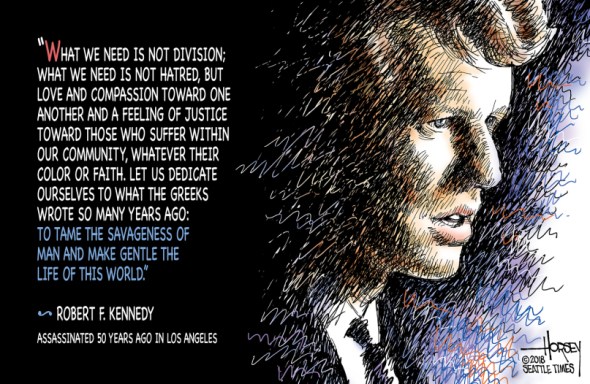
Good Morning!!
Here’s some good news for a change: a judge in the Southern District of California will allow a lawsuit by the ACLU challenging the Trump administration policy of separating parents and children at the border to go forward.
Bloomberg: Judge Calls Trump’s Border Separations of Children ‘Brutal.’
The Trump administration failed to kill a legal challenge to its practice of separating undocumented parents and children who seek to enter the U.S. to flee persecution at home, with a judge handing an early victory to civil rights activists who say the policy is unconstitutional and cruel.
U.S. District Judge Dana Sabraw in San Diego on Wednesday denied a motion to dismiss the suit, in which the American Civil Liberties Union argues that splitting up families at the border violates their due process rights.
The practice, spearheaded by Attorney General Jeff Sessions, caused widespread outrage after images of children in detention centers circulated on social media. The government argues separations are necessary to properly prosecute adults who cross into the U.S. illegally, while activists say children are being used as pawns in an informal policy intended to deter migrants.
“These allegations sufficiently describe government conduct that arbitrarily tears at the sacred bond between parent and child,” the judge wrote. The conduct, if true, “is brutal, offensive, and fails to comport with traditional notions of fair play and decency.” [….]
Sabraw said the ACLU’s claims are particularly troubling because the plaintiffs in the case had allegedly come to the U.S. seeking asylum out of fear for their well-being in their home countries. The suit applies to migrants who formally present themselves at ports of entry as political refugees as well as those who seek asylum after they are apprehended during illegal border crossings.
“The government actors responsible for the ‘care and custody’ of migrant children have, in fact, become their persecutors,” the judge said.
Read more at the link. The entire filing can be read here.
More good news: a new NBC/WSJ poll found that voters are much more likely to support candidates who stand up to Trump.
NBC News: Poll: Economic satisfaction under Trump isn’t helping his party’s 2018 chances.
By a whopping 25-point margin, voters say they’re more likely to back a congressional candidate who promises to serve as a check on President Donald Trump, according to a new national poll from NBC News and the Wall Street Journal.
And by a similar margin, they say they’re less likely to vote for someone who has supported the president on most issues.
At the same time, six-in-10 are satisfied with the U.S. economy, and a plurality of voters give Trump credit for the economic improvement.
Despite that economic optimism, however, the poll shows that Democrats enjoy a 10-point advantage on congressional preference, with 50 percent of registered voters wanting a Democratic-controlled Congress, versus 40 percent who want a GOP-controlled one.
Now if national Democrats would just wake up and realize that standing up to Trump is the best mid-term strategy!
The summit with North Korea is coming up next week, but Trump isn’t listening to advice from experts on how to proceed, according to Politico: Trump and Bolton spurn top-level North Korea planning.
National Security Adviser John Bolton has yet to convene a Cabinet-level meeting to discuss President Donald Trump’s upcoming summit with North Korea next week, a striking break from past practice that suggests the Trump White House is largely improvising its approach to the unprecedented nuclear talks.
For decades, top presidential advisers have used a methodical process to hash out national security issues before offering the president a menu of options for key decisions. On an issue like North Korea, that would mean White House Situation Room gatherings of the secretaries of state and defense along with top intelligence officials, the United Nations ambassador, and even the treasury secretary, who oversees economic sanctions.
But since Trump agreed on a whim to meet with North Korean dictator Kim Jong-un on March 8, the White House’s summit planning has been unstructured, according to a half-dozen administration officials. Trump himself has driven the preparation almost exclusively on his own, consulting little with his national security team outside of Secretary of State Mike Pompeo.
Senior officials from both the Barack Obama and George W. Bush administrations called the absence of a formal interagency process before such a consequential meeting troubling. Peter Feaver, a former National Security Council (NSC) official in the George W. Bush White House, said his colleagues would likely have held “quite a few” meetings of the so-called Principals Committee of Cabinet-level NSC members in a comparable situation. A former top Obama White House official echoed that point, calling the lack of top-level NSC meetings “shocking.”
Trump has also not presided personally over a meeting of those senior NSC officials, as a president typically does when making the most important decisions.
On the other hand, Trump has given serious thought to whether he should invite Kim Jong Un to play golf with him in Florida if the summit goes well. The Daily Beast reports:
Trump has floated hitting the links with his counterpart as he considers a secondary charm offensive to complement the diplomatic tête-à-tête. The president has already told those close to him and advisers that he is open to inviting Kim to a follow-up summit at Trump’s famous Mar-a-Lago estate and private club in Palm Beach, Florida, as Bloomberg first reported this week.
And, according to two administration officials, Trump has also raised the possibility of a leisurely activity and, perhaps, getting in 18 holes with Kim if the two end up getting along.
“He has also discussed [possibly] golfing with Kim,” a senior Trump administration official said.
It is unclear if such an outing would or could occur during a potential follow-up meeting or the one planned, then canceled, then planned again for Singapore. The site of the upcoming Singapore talks, a five-star hotel on Sentosa Island, is located near a theme park, resorts, and—as luck would have it—multiple golf courses.
The article says no one actually know if Kim even plays golf.
I suppose Kim would agree with Trump on this though. At The Washington Post, Josh Rogin writes that Trump still wants to pull U.S. troops out of South Korea.
For almost two years, President Trump has been talking about withdrawing large numbers of U.S. troops from South Korea, where there are currently around 28,000 stationed. The president’s advisers have repeatedly argued against a large-scale reduction, but he remains unpersuaded. And after his upcoming meeting with North Korean leader Kim Jong Un, Trump will have another big chance to push the issue.
Less publicly, but still privately, Trump continues to say he doesn’t agree with the argument that U.S. troops in South Korea are strategically necessary, and he thinks the United States gets nothing back from paying to keep them there, according to administration officials and people who have spoken to Trump directly about the issue. He often asks his generals to explain the rationale for America’s deployments in Asia and expresses dissatisfaction with their answers.
At Trump’s direction, the Pentagon has taken a hard line in ongoing negotiations with the South Korean government over a new cost-sharing agreement for U.S. troops there. If those negotiations fail, Trump could have another excuse to move forward with large reductions….
Inside the administration, top officials have been trying — and failing — to convince the president of the strategic value of the South Korea-based troops since the beginning of his administration. In February, Chief of Staff John F. Kelly reportedly talked Trump down from starting a withdrawal.
Trump has picked fights with most of our allies at this point. Now he’s whining about having to to the Canada on Friday because he’s mad at Justin Trudeau.
The president has vented privately about Canadian Prime Minister Justin Trudeau as their trade tensions have spilled into public view. He has mused about finding new ways to punish the United States’ northern neighbor in recent days, frustrated with the country’s retaliatory trade moves.
And Trump has complained to aides about spending two days in Canada for a summit of world leaders, believing the trip is a distraction from his upcoming Singapore summit with North Korean leader Kim Jong Un, according to three people familiar with Trump’s views.
In particular, the president said Tuesday to several advisers that he fears attending the Group of Seven summit in rural Charlevoix, Quebec, may not be a good use of his time because he is diametrically opposed on many key issues with his counterparts — and does not want to be lectured by them.
Additionally, Trump has griped periodically both about German Chancellor Angela Merkel — largely because they disagree on many issues and have had an uneasy rapport — as well as British Prime Minister Theresa May, whom he sees as too politically correct, advisers say.
Awwww . . . poor baby. BTW, have you heard that State Department spokesperson and former Fox and Friends host Heather Nauert thinks Germany was our ally during World War II? Rachel Maddow discussed this at the beginning of her show last night.
Please watch the video–even if you already saw it last night. These are the people who are running our foreign policy!
Politico reports that many foreign leaders are beginning to wake up to Trump’s insanity: Foreign leaders who embraced Trump now feel burned.
Trump calls Japanese prime minister Shinzo Abe, who visits the White House Thursday, his “good friend.” French president Emmanuel Macron is a “great friend.” And Canadian Prime Minister Justin Trudeau is a “great friend, neighbor, and ally.” All have sought to butter up Trump through friendly face time, recognizing that the quickest way to the president’s heart is through his ego.
But all, to varying degrees, are exasperated with Trump.
The president is moving ahead with a June 12 summit with North Korea despite Abe’s grave concerns about its wisdom. He has also threatened to slap tariffs on imported Japanese cars and metals. It’s hardly what Abe expected when he became the first foreign leader to meet with Trump after the November election or when he flew with Trump on Air Force One in February 2017 for golfing at his Mar a Lago resort.
Macron treated Trump to a military parade in Paris last summer. He and Trump also exchanged hugs and handshakes during an April visit by the French leader, during which Trump said of his guest: “He is perfect.” But a few weeks later, Trump pulled out of the Iran nuclear deal despite French pleas, and shows no sign of heeding Macron’s request that he rejoin the Paris climate accords, which Trump rejected last year.
Trump has also threatened trade sanctions on the European Union, and is already slapping them on Canada — prompting Trudeau to call Trump’s tariffs on steel imports “insulting and unacceptable.” That’s a change of tune from the early months of Trump’s presidency, when Trudeau avoided criticizing Trump, and even took Ivanka Trump and Jared Kushner to a Broadway play in March 2017.
All have paid a domestic political price back home for their efforts to make nice with a highly divisive U.S. president. One French parliamentarian fumed after Macron’s visit that France had “prostituted” and “humiliated” itself.
Angela Merkel knew who she was dealing with from day one, evidence that we need more women in leadership positions around the world.
That’s it for me today. What stories have you been following?
Tuesday Reads: Russia Russia Russia
Posted: June 5, 2018 Filed under: Foreign Affairs, morning reads, U.S. Politics | Tags: Donald Trump, Hapsburg group, Konstantin Kilimnik, Paul Manafort, Rick Gates, Robert Mueller, Vladimir Putin, witness tampering 30 Comments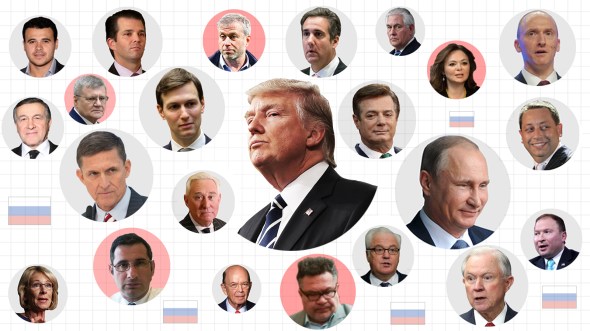
Good Morning!!
There has quite a bit of breaking news on the Russia investigation front this week, and it’s only Tuesday. We learned last night that Paul Manafort tried to suborn perjury from witnesses in his case. Perhaps that’s why Trump has been madly tweeting about Manafort and the investigation generally.
The Washington Post: Mueller accuses Paul Manafort of witness tampering.
Federal prosecutors accused former Trump presidential campaign chairman Paul Manafort of witness tampering late Monday in his criminal case and asked a federal judge to consider revoking or revising his release.
Prosecutors accused Manafort and a longtime associate they linked to Russian intelligence of repeatedly contacting two members of a public relations firm and asking them to falsely testify about secret lobbying they did at Manafort’s behest.
The firm of former senior European officials, informally called the “Hapsburg group,” was secretly retained in 2012 by Manafort to advocate for Ukraine, where Manafort had clients, prosecutors charged.
Konstantin Kilimnik
In court documents, prosecutors with special counsel Robert S. Mueller III allege that Manafort and his associate — referred to only as Person A — tried to contact the two witnesses by phone and through encrypted messaging apps. The description of Person A matches his longtime business colleague in Ukraine, Konstantin Kilimnik.

So Manafort could soon be headed for jail unless he decides to cooperate with Mueller. Read the rest at the WaPo. Some commentary:
John Cassidy at The New Yorker: More Legal Trouble for Paul Manafort—and Donald Trump.
Coincidences do happen, but this seems to be an unlikely one. On Sunday morning, seemingly apropos of nothing, Donald Trump posted a messageon Twitter that stated the following: “As only one of two people left who could become President, why wouldn’t the FBI or Department of ‘Justice’ have told me that they were secretly investigating Paul Manafort (on charges that were 10 years old and had been previously dropped) during my campaign? Should have told me!”
Even by Trump’s standards, this message seemed a bit weird. A few minutes later, the President posted another one, which said, Paul Manafort came into the campaign very late and was with us for a short period of time (he represented Ronald Reagan, Bob Dole & many others over the years), but we should have been told that Comey and the boys were doing a number on him, and he wouldn’t have been hired!”
Trump says a lot of things on Twitter, of course. But prior to this outburst, he hadn’t talked much recently about Manafort, who made millions of dollars working as a political consultant for despots around the world and is facing trial in two federal courts on charges that include money laundering, bank fraud, and failing to disclose his U.S. lobbying work for a foreign government—all of which were brought by the special counsel, Robert Mueller. Why Trump’s sudden interest? One possible inference was that the President had somehow heard that there was more bad news coming about Manafort, and he was trying to limit some of the damage in advance of its release. If that was indeed the case, we now know the source of Trump’s concern.
In a filing made in U.S. district court, in Washington, on Monday night, Mueller’s office accused Manafort, who is out on bail, of trying to tamper with potential witnesses earlier this year, and asked a judge to consider jailing him before his trial. At this stage, obviously, we don’t know how the court will rule. But Manafort is already facing considerable pressure to coöperate with the special counsel’s investigation. If the court were to revoke his freedom, this pressure would sharply increase.
Franklin Foer at The Atlantic: Paul Manafort Loses His Cool.
At the height of his powers as a political consultant, Paul Manafort was known for his cool. In fact, the value of his counsel increased at moments of crisis. While others panicked, Manafort rarely evinced a hint of frazzle. He could still think strategically, detach himself from emotion, and issue clearheaded guidance. But he could afford to keep his head at such moments, because the problems he was called on to solve belonged to others.
Robert Mueller’s allegation that Manafort attempted to tamper with a witness permits us to peer inside Manafort’s mind as it has functioned in a very different set of circumstances. When it comes to Manafort’s own deep problems—his moment of legal peril—he seems unable to muster strategic thinking. He has shown himself capable of profoundly dunderheaded miscalculations.
It’s hard to understand how he could have attempted the scheme described by Mueller in the midst of the highest-profile, most scrutinized criminal inquiry of the century. But that alone fails to capture the depths of his blundering.
Foer describes how each of Mueller’s filings in Manafort’s case has made it clear that Manafort’s every move is being closely watched by federal investigators, and yet Manafort apparently thought he could get away with contacting witnesses.
Each of Mueller’s new filings has further revealed the extent to which he is surveilling Manafort and his closest associates. A week before Manafort apparently attempted to tamper with the witness, Mueller stated plainly that he was watching their encrypted communication channels. And before that, Mueller showed that he was keeping tabs on Manafort’s email when he exposed an op-ed that Manafort had ghostwritten in his own defense, in violation of a judge’s gag order.
If we look back on Robert Mueller’s strategy over the past few months, the special prosecutor seems to repeatedly signal to Manafort: Look, I know everything; you have no choice but cooperation. It’s a pattern that continues with this filing, the first instance in which Mueller has deployed material supplied by Manafort’s old alter ego, Rick Gates. When Gates agreed to cooperate with Mueller, he handed over a raft of emails. We can see in the exhibits that Mueller attached to this filing that Gates possesses a comprehensive archive of Manafort’s dealings, a blueprint of his operation. There will be no ellipses in the Manafort trial. Gates can fill all the gaps.
There is another suggestive fact that Mueller posits in passing. Manafort’s witness-tampering scheme featured a co-conspirator. Mueller doesn’t name the accomplice, but his identity is not hard to discern from Mueller’s description. Manafort tried to contact his Hapsburg Group collaborators through his old Russo-Ukrainian aide, Konstantin Kilimnik.
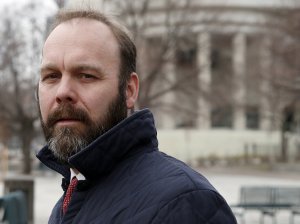
Rick Gates
Why did Manafort think he could get away with continuing to communicate with Kilimnik? Mueller is slowly but surely ensuring that Manafort will either cooperate or spend the rest of his life in prison.
Meanwhile, at Mother Jones, David Corn warns that the simple narrative of Russia’s attack on our democracy is getting lost in the details as Trump, Fox News, and Devin Nunes work constantly to obfuscate the truth with big lies: Donald Trump Is Getting Away With the Biggest Scandal In American History.
The other evening I was on a cable news show to cover the latest Russia news of the day—and I had an epiphany.
We were talking about a recent scoop from Michael Isikoff, the co-author of my latest book, Russian Roulette. He had reported that a Spanish prosecutor had handed the FBI wiretapped transcripts of a Russian official who was suspected of money laundering and for years had been trying to gain influence within the American conservative movement and the National Rifle Association. We then discussed a New York Times article revealing that Michael Cohen, Donald Trump’s longtime fixer, had met with a Russian oligarch in January 2017, around the time a US company affiliated with this tycoon began making $500,000 in payments to Cohen. Next we turned to the latest in the so-called Spygate nonscandal—the false claim, championed by Trump and his defenders, that the FBI infiltrated a spy into his presidential campaign for political purposes.
Then the show moved on. We had spent 15 or so minutes on these important developments, delving into the details—but without referring to the essence of the story. And it hit me: Though it’s clear Trump’s presidency has been hobbled by the Russia scandal, the manner in which this matter plays out in the media has helped Trump.
Meanwhile Trump, backed up by Fox News, keeps pushing out his propaganda.
Michael Isakoff and David Corn
The other side—the accurate perspective—isn’t that complicated. In 2016, Vladimir Putin’s regime mounted information warfare against the United States, in part to help Trump become president. While this attack was underway, the Trump crew tried to collude covertly with Moscow, sought to set up a secret communications channel with Putin’s office, and repeatedly denied in public that this assault was happening, providing cover to the Russian operation. Trump and his lieutenants aligned themselves with and assisted a foreign adversary, as it was attacking the United States. The evidence is rock-solid: They committed a profound act of betrayal. That is the scandal.
But how often do you hear or see this fundamental point being made? The media coverage of the Trump-Russia scandal—which has merged with Cohen’s pay-to-play scandal, the Stormy Daniels scandal, and a wider foreign-intervention-in-the-2016-campaign scandal—has yielded a flood of revelations. Yet the news reporting tends to focus on specific components of an unwieldy and ever-expanding story: a Trump Tower meeting between Trump aides and a Kremlin emissary; what special counsel Robert Mueller may or may not be doing; the alleged money-laundering and tax-evasion skullduggery of Paul Manafort; a secret get-together in the Seychelles between former Blackwater owner Erik Prince and a Russian financier; the Kremlin’s clandestine exploitation of social media; Russian hackers penetrating state election systems; Michael Flynn’s shady lobbying activities; Trump’s attempted interference in the investigation; and so much more. It is hard to hold on to all these pieces and place them into one big picture.

Please go read the rest–it’s fairly lengthy. I’m not sure what the solution to this is; It’s not likely that non-Fox news sources are going to start hammering a simple narrative to push back on the Trump big lies. I can only hope that when Mueller issues his report, it will pull all the complex details together into a coherent and understandable story.
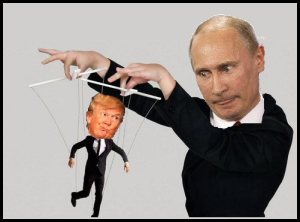 Finally, get this–Vladimir Putin is now bragging publicly about his “close relationship” with Trump. Axios reports:
Russian President Vladimir Putin tells Austrian TV that he and President Trump have a close working relationship, although it’s complicated by U.S. politics.
“You should ask our colleagues in the United States. In my opinion, this is the result of the ongoing acute political struggle in the United States. Indeed, Donald Trump and I have, firstly, met more than once at various international venues and secondly, we regularly talk over the phone.”
Interviewer: “You and Donald Trump talk so nicely over the telephone, but Trump has been President for a year and a half and there still has not been a bilateral summit between you, in contrast to Bush and Obama with whom you met within the first six months of their presidencies. Why is it taking so long?”
Putin:
“Our foreign affairs departments and special services are working fairly well together in areas of mutual interest, above all in the fight against international terrorism. This work is ongoing.”
“As for personal meetings, I think that the possibility of these meetings depends to a large extent on the internal political situation in the United States….”
“In a recent telephone conversation, Donald said he was worried about the possibility of a new arms race. I fully agree with him.”
“[W]e will do all we can to ease tensions on the Korean Peninsula. So of course we pin great hopes on the personal meeting between President Trump and North Korean leader Kim Jong-un, because mutual claims have gone way too far.”
Putin calls the “president” *Donald.* And I guess if “Donald” does achieve any success with North Korea, Putin expects to share the glory.
So . . . what stories are you following today?

 peej
peej Carissa
 bostonboomer
 dakinikat
 ecocatwoman
 mablue2
 Mama Lopez
 peggysue22
 quixote
 skydancingguestblogger
 Mona (aka Wonk the Vote)



 Sky Dancing
Recent Comments