Earth Day has arrived, and so has the March for Science — a global event on six continents (and cheered on by scientists on a seventh, Antarctica). Thousands of people have gathered on grounds of the Washington Monument for a four-hour rally that will culminate in a march down Constitution Avenue to the foot of Capitol Hill.
“We are at a critical juncture. Science is under attack,” said Cara Santa Maria, a science communicator who is one of several emcees of the rally. “The very idea of evidence and logic and reason is being threatened by individuals and interests with the power to do real harm.”
The article describes the DC march at length; you can read about at the link. A bit more on the rationale:
Some scientists in recent weeks have said they worried the march would politicize the broader scientific enterprise and signal an alignment with left-leaning ideologies. The march’s website offered an answer to that concern: “In the face of an alarming trend toward discrediting scientific consensus and restricting scientific discovery, we might ask instead: can we afford not to speak out in its defense? There is no Planet B.”
The Washington march may be the biggest gathering — organizers have a permit for up to 75,000 people — but there are similar events in more than 600 cities on six continents. Seven researchers in Antarctica went on Twitter to express their support for the march. Thousands of people gathered in Sydney, Australia, according to the Sydney Morning Herald. Science advocates went on social media to post bulletins from marches in Austria, England, Malawi, among other places.
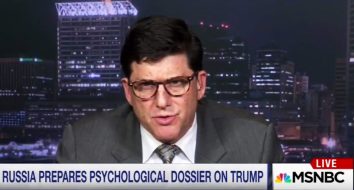
Donald Trump has a “dangerous mental illness” and is not fit to lead the US, a group of psychiatrists has warned during a conference at Yale University.
Mental health experts claimed the President was “paranoid and delusional”, and said it was their “ethical responsibility” to warn the American public about the “dangers” Mr Trump’s psychological state poses to the country.
Speaking at the conference at Yale’s School of Medicine on Thursday, one of the mental health professionals, Dr John Gartner, a practising psychotherapist who advised psychiatric residents at Johns Hopkins University Medical School, said: “We have an ethical responsibility to warn the public about Donald Trump’s dangerous mental illness.”
Dr Gartner, who is also a founding member of Duty to Warn, an organisation of several dozen mental health professionals who think Mr Trump is mentally unfit to be president, said the President’s statement about having the largest crowd at an inauguration was just one of many that served as warnings of a larger problem.
Dr. John Gartner
“Worse than just being a liar or a narcissist, in addition he is paranoid, delusional and grandiose thinking and he proved that to the country the first day he was President. If Donald Trump really believes he had the largest crowd size in history, that’s delusional,” he added.
Chairing the event, Dr Bandy Lee, assistant clinical professor in the Yale Department of Psychiatry, said: “As some prominent psychiatrists have noted, [Trump’s mental health] is the elephant in the room. I think the public is really starting to catch on and widely talk about this now.”
Yale issued a statement saying that Gartner was “not on the actual panel” but admitted that the organizer of the conference agrees with him that mental health professionals need to speak out about Trump’s dangerousness. Here’s a quote from another expert:
James Gilligan, a psychiatrist and professor at New York University, told the conference he had worked some of the “most dangerous people in society”, including murderers and rapists — but that he was convinced by the “dangerousness” of Mr Trump.
“I’ve worked with some of the most dangerous people our society produces, directing mental health programmes in prisons,” he said.
“I’ve worked with murderers and rapists. I can recognise dangerousness from a mile away. You don’t have to be an expert on dangerousness or spend fifty years studying it like I have in order to know how dangerous this man is.”
We’ve seen numerous signs that Trump is paranoid and delusional. Frankly, I don’t think there’s any doubt about it at this point. He’s demonstrating it right now with his claims that he’ll get Congress to pass health care and tax bills soon even though Congress will be busy preventing a government shutdown. Apparently the tax bill is news to Trump’s staff.
President Trump promised on Friday that he would unveil a “massive” tax cut for Americans next week, vowing a “big announcement on Wednesday,” but he revealed no details about what is certain to be an enormously complicated effort to overhaul the nation’s tax code.
Mr. Trump offered his tax tease in an interview and again during remarks at the Treasury Department on Friday afternoon as he raced to stack up legislative accomplishments before his 100th day in office at the end of next week.
His announcement surprised Capitol Hill and left Mr. Trump’s own Treasury officials speechless as he arrived at the Treasury offices to sign directives to roll back Obama-era tax rules and financial regulations. Earlier in the day, when reporters asked Steven Mnuchin, the Treasury secretary, how far away a tax overhaul proposal was, he said he could not give an answer. “Tax reform is way too complicated,” he said.
Mr. Trump told The Associated Press in the interview that his tax reductions would be “bigger, I believe, than any tax cut ever.” But he faces an enormous fight among clashing vested interests as Congress tries to rewrite the tax code.
Back on the campaign trail in 2016, Donald Trump portrayed the nation as a desperate dystopian hellscape and promised his adoring followers that he would make America great again. But he he went beyond that. Decrying NAFTA and inner-city crime, vowing to bring back jobs and go after undocumented immigrants, undo regulations and fight ISIS, Trump promised to fix it all “very, very quickly.” Sometimes he’d add that it would “happen so fast your head will spin.”
Indeed, Trump’s pitch to his voters was that none of these were difficult issues and the problem had been our “stupid” leaders who just didn’t know what they were doing. He famously said in his nomination acceptance speech at the Republication convention, “I alone can fix it,” making it clear that he planned to do it all at once.
Just before the election, Trump released his plan for the first 100 days and it was extremely ambitious. He promised to reverse every Obama executive order he could think of and issue as many of his own as possible on the very first day. His ill-conceived travel ban was the most controversial and a few of his promises, like his pledge to “propose a Constitutional Amendment to impose term limits on all members of Congress,” have been quietly shelved. Others, in light of subsequent events, now seem mordantly amusing, such as “a lifetime ban on White House officials lobbying on behalf of a foreign government.”
Read the rest at Salon.
I highly recommend this piece by Adam Gopnik at The New Yorker: The Persistence of Trump Derangement Syndrome. Gopnik skewers both Trump’s cognitive problems as well as the longing of journalists for a “presidential” Trump. He systematically dismantles the arguments that we have to keep an open mind and support Trump when he does something that makes sense.
The problem is that it refuses to see, or to entirely register, the actual nature of Trump and his actions. Our problem is not Trump Derangement Syndrome; our problem is Deranged Trump Self-Delusion. This is the habit of willfully substituting, as a motive for Trump’s latest action, a conventional political or geostrategic ambition, rather than recognizing the action as the daily spasm of narcissistic gratification and episodic vanity that it truly is.
The bombing of Syria, for instance, was not a sudden lurch either in the direction of liberal interventionism, à la Bill Clinton in the lands that were once Yugoslavia, nor was it a sudden reassertion of a neo-con version of American power, à la both Bushes in Iraq. It was, as best as anyone can understand, simply a reaction to an image, turned into a self-obsessed lashing out that involved the lives and deaths of many people. It was a detached gesture, unconnected to anything resembling a sequence of other actions, much less an ideology. Nothing followed from it, and no “doctrine” or even a single speech justified it. There is no credible evidence that Trump’s humanity was outraged by the act of poisoning children, only that Trump’s vanity was wounded by the seeming insult to America and, by extension, to him. It may be perfectly true that the failure of the Obama Administration to act sooner in Syria will go down forever, in the historical ledgers, as a reproach against it; or it may be that the wisdom of the Obama Administration in not getting engaged in another futile Middle Eastern folly will go down in its favor. But it is self-deluding to think that Trump’s action was meant to be in any way remedial. It was purely ritual, and the ritual acted out was the interminable Trumpist ritual of lashing out at those who fail to submit, the ritual act of someone whose inner accounting is conducted exclusively in terms of wounds given, worship received, and winnings displayed. (Perhaps his elder daughter, Ivanka, did play some small part in the action, as her brother Eric suggested in an interview, but this is hardly a comfort; the politics of a mad king with a court are no more reassuring than those of a mad king alone.)
Please go read the rest. Gopnik really has Trump’s number.
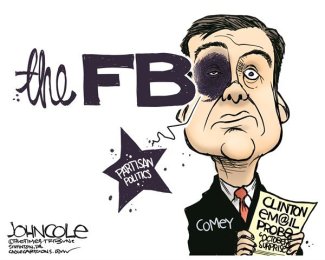
An examination by The New York Times, based on interviews with more than 30 current and former law enforcement, congressional and other government officials, found that while partisanship was not a factor in Mr. Comey’s approach to the two investigations, he handled them in starkly different ways. In the case of Mrs. Clinton, he rewrote the script, partly based on the F.B.I.’s expectation that she would win and fearing the bureau would be accused of helping her. In the case of Mr. Trump, he conducted the investigation by the book, with the F.B.I.’s traditional secrecy. Many of the officials discussed the investigations on the condition of anonymity because they were not authorized to speak to reporters.
Mr. Comey made those decisions with the supreme self-confidence of a former prosecutor who, in a distinguished career, has cultivated a reputation for what supporters see as fierce independence, and detractors view as media-savvy arrogance.
The Times found that this go-it-alone strategy was shaped by his distrust of senior officials at the Justice Department, who he and other F.B.I. officials felt had provided Mrs. Clinton with political cover. The distrust extended to his boss, Loretta E. Lynch, the attorney general, who Mr. Comey believed had subtly helped downplay the Clinton investigation.
Read the rest at the NYT.
I’ll add a few more links in the comment thread. What stories are you following today?
Did you like this post? Please share it with your friends:
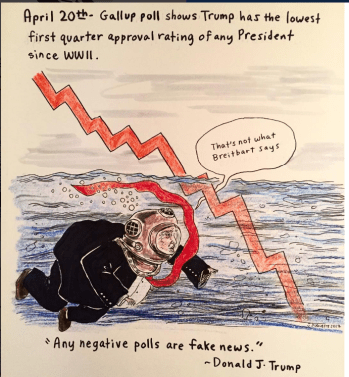
Today’s cartoons come from The.Daily.Don! Artist Jesse Duquette is the Daily Don: “Documenting this administration each day from the Inauguration to the Election.” They’re wonderful! Go look at his Instagram page! There’s one for every day we’ve been held hostage by Kremlin Caligula.
Like Mark Green — President Trump’s nominee for secretary of the Army — I served my country in uniform. I was proud to be an infantry officer and retired honorably after 34 years. But as a transgender member of the military, I hid my authentic self for decades to continue serving the country I love. Unlike Green, I was forced to serve in silence the entire time, but I won’t be silent now.
I respect his Iraq War service as an Army flight surgeon, but the disrespect — the bigotry — he’s shown over and over toward the LGBT community, including LGBT service members, doesn’t reflect the spirit or direction of the military I know. Rather, his selection reflects poorly on the president and our armed forces. He’s the wrong choice to be Army secretary.
As a Tennessee state senator, Green has targeted the LGBT community. He introduced legislation that would enable businesses to discriminate against LGBT individuals. At a town hall meeting with his constituents, he expressed support for the idea of his state’s government defying the Supreme Court’s decision upholding marriage equality in all 50 states. He argued being transgender “is a disease.”
Now that he’s been nominated, Green says “politics will have nothing to do” with how he would do the job of Army secretary. Wrong. Leading the Army requires an appreciation for every individual, without exception, and Green wouldn’t have the confidence of the thousands of LGBT soldiers proudly and openly serving today. Every soldier needs to know that those at the top, uniformed and civilian, have their back. But based on the way he has used anti-LGBT politics to advance his career, that’s not him.
The You Tubes I put here will just give you a moment of zen and peace via Scotland. I’ve been listening to the haunting bagpipe music of my Gaelic ancestors for the last few days and finding some peace. I thought I’d share.
We’ve always known that Fox News was a basically a nuclear reactor of hate generation. Read this on Marie Claire.
After 15 years of providing legal protection and millions of dollars to his accusers, Fox News finally fired their marquis star, Bill O’Reilly, on Wednesday. In an age when a self-proclaimed “pussy-grabber” occupies the Oval Office, any public consequences for harassing women feel particularly significant. And this move was particularly satisfying for me—just a few years ago, O’Reilly sent a tidal wave of harassment my way.
On May 31, 2009, an anti-abortion zealot murdered abortion provider George Tiller. At the time, I was 21 years old and working as a counselor at an abortion clinic in Philadelphia. Dr. Tiller’s murder drove a hot spike of fear and anxiety through my entire body. I walked through anti-abortion protestors a few times a week to get to work; I found their gruesome signs annoying, but not threatening. But Dr. Tiller’s assassination forced me to confront the terrifying reality that my co-workers and I faced more than just screams. We could actually get killed for providing people with legal, safe, and compassionate medical care.
My boyfriend walked me to work the next day, a sweet but feeble attempt to shield me from the protestors. What could he actually do if one of them had a gun? Inside, my coworkers and I gathered to talk about how we felt. As I listened to each person share why they were still so committed to this work despite the danger, I wondered what it would be like for our stories and motivations to be shared in a bigger way. One colleague made a comment about all of us being Dr. Tiller now, and I texted my boyfriend—did he know how to make a website? And how much work would it take?
We stayed up all night with him writing code and me writing content for IAmDrTiller.com. The next day, I told my coworkers to take photos with a sign that said “I Am Dr. Tiller,” and asked them to email me their own explanation of why they provide abortion care. My boss sent the website around to other abortion providers, and overnight I received dozens of submissions from abortion-clinic staff all over the country. Somehow, conservative media got wind of the website, and on June 10, Bill O’Reilly discussed the project on his show.
Read the story of how O’Reilly basically ginned up a group of crazy domestic terrorists to stalk, harass and haunt here. I’ve been at the receiving end of attacks from those freaks. They’re an ugly, mean, nasty, and hateful lot.
President Obama will be giving a speech in Chicago after spending a lot of time resting in the tropics. I’d personally like to hear why we didn’t get all this T-Russia information back last summer from him. I believe we’re owed an explanation but I will take a little bit of hope and a lot of change talk. I could use it.
Former President Barack Obama will return to Chicago on Monday to speak to young people at the University of Chicago, in what will be his first public event since leaving the White House.
Obama and young leaders will hold a conversation on civic engagement and discuss community organizing at the university’s Logan Center for the Arts, his office announced Friday.
Hundreds of people are expected to attend, chosen from area universities that were given tickets for distribution, said Kevin Lewis, a spokesman for the former president. About six young people will appear on stage with him for the 11 a.m. discussion, Lewis said.
The event will be a homecoming for Obama on multiple levels. He formerly taught constitutional law at the U. of C. and his family has a home nearby in the Kenwood neighborhood. It also lets the former president, who came to Chicago to work as a young community organizer, fulfill one of the commitments he set out for his post-presidential years: to engage and work with the country’s next generation of leaders, Lewis said.
One SCOTUS decision could do serious damage to the First Amendment. Will this SCOTUS destroy Church/State Seperation?
Opinion: SCOTUS Hears Arguments To Tear Down Church and State Barrier https://t.co/6kKWgcWBGD
One of the many travesties endemic in a government controlled by Republicans is that the evangelical right now has the full weight and force of the federal government to institute a theocracy. Now that religious conservatives control the Supreme Court with Neil Gorsuch’s appointment to the bench, they have an instant ally to achieve the Dominionist movement’s highest priorities: tearing down any and all constitutional barriers between church and state.
Yesterday, in a case the High Court’s conservatives postponed for 15 months wishing and hoping for an evangelical majority, they heard oral arguments in a case very few Americans are aware of. The people should be terrified because a ruling for theocracy will effectively demolish church-state separation and completely neuter the First Amendment’s religious clauses. And it will force every taxpayer to fund religious organizations; like it or not.
This one case will have far reaching effects on every American, and every facet of government, that will make the Hobby Lobby, Voting Rights, and Citizens United rulings seem petty and insignificant in comparison. Sadly, due to the media, including the cowards in the liberal media, and their resistance to reporting the rash of evangelical legislation they claim are simply born of “conservative ideology,” most Americans are clueless as to what is awaiting them; a High Court ruling establishing a veritable evangelical theocracy.
The case, “Trinity Lutheran Church of Columbia v. Comer,” is about forcing Missouri taxpayers to fund upgrading a church school’s playground despite a state and federal prohibition against it. Even though there is a long-standing Constitutional statute against using taxpayer money to fund religious organizations, Missouri is one several states that enshrined the same prohibition in its state Constitution. Still, the “churches” cried foul and claimed that if taxpayers fund public schools, then they damn sure better start funding religious schools and organizations.
One might think that churches earning well-over $82.5 billion annually (in 2013) from taxpayers subsidizing religious non-profits (churches) was enough welfare for the “charitable Christians.” Add to that staggering annual figure the $41.7 billion in annual payments (in 2004) in welfare from Bush’s “faith-based initiative” programs. Money well spent according to W. Bush who wanted the taxpayer’s money to “save one soul at a time.” Still, even that unconstitutional abomination didn’t satisfy their greed for more taxpayer money and more control over government. And, the sad truth is that tearing down the barrier between church and state will set a Constitutional precedent allowing evangelicals to do so much more than just force taxpayers to support their “ministries.”
Since before America was a nation, the Founding Fathers were preparing, and went to great lengths, to keep religion out of government. The concept of not funding, or legislating according to evangelicalism, is not a new idea.
I hold this near and dear as the descendant of Hugenot French who fled the Alsace Lorraine/Rhinelands area as Jews and Protestants being forcefully removed and slaughtered at the behest of the Roman Catholic Church. The parts of my family who signed the Declaration of Independence and the Constitution made a refuge for folks suffering from state-sanctioned religious persecution. I’d hate to see us dump on this most important right.
The ability of federal judges to strike down actions taken by Congress or the executive branch if they’re deemed unconstitutional is a hallmark of the American system of government. It’s an important part of the system of checks and balances, ensuring that the president and legislators don’t acquire too much power.
But to Attorney General Jeff Sessions, the nation’s top law enforcement officer, it’s “amazing” — and he means that in a bad way.
“I really am amazed that a judge sitting on an island in the Pacific can issue an order that stops the president of the United States from what appears to be clearly his statutory and constitutional power,” Sessions told conservative radio host Mark Levin during an interview Tuesday (as reported by CNN’s Andrew Kaczynski on Thursday). “The judges don’t get to psychoanalyze the president to see if the order he issues is lawful. It’s either lawful or it’s not.”
The “judge sitting on an island in the Pacific” in question is District of Hawaii judge Derrick Watson, who ruled in March against the Trump administration’s attempt to temporarily ban residents of six majority-Muslim countries and nearly all refugees from entering the US. (Watson’s ruling is just a temporary injunction while the lawsuit against the ban, brought by states including Hawaii, gets a full hearing in court; the Trump administration is appealing Watson’s ruling to the Ninth Circuit Court of Appeals, and appealing a separate ruling against the ban, issued in Maryland, to the Fourth Circuit Court of Appeals.)
Sessions’s remark has gotten a lot of attention as an attack on the state of Hawaii (not least because it fits a little too easily in a long tradition of racist dog-whistling about the “foreignness” of nonwhite and specifically Pacific Islander Americans), but it’s part of a broader attack from Republicans on the “liberal Ninth Circuit” as a whole — and the first indication that not only President Trump, but his chief law enforcement officer, is uneasy with the idea of judicial review itself.
The arrest of WikiLeaks founder Julian Assange is now a “priority” for the US, the attorney general, Jeff Sessions, has said.
Hours later it was reported by CNN that authorities have prepared charges against Assange, who is currently holed up at the Ecuadorian embassy in London.
Donald Trump lavished praise on the anti-secrecy website during the presidential election campaign – “I love WikiLeaks,” he once told a rally – but his administration has struck a different tone.
Asked whether it was a priority for the justice department to arrest Assange “once and for all”, Sessions told a press conference in El Paso, Texas, on Thursday: “We are going to step up our effort and already are stepping up our efforts on all leaks. This is a matter that’s gone beyond anything I’m aware of. We have professionals that have been in the security business of the United States for many years that are shocked by the number of leaks and some of them are quite serious.”
He added: “So yes, it is a priority. We’ve already begun to step up our efforts and whenever a case can be made, we will seek to put some people in jail.”
Citing unnamed officials, CNN reported that prosecutors have struggled with whether the Australian is protected from prosecution by the first amendment, but now believe they have found a path forward. A spokesman for the justice department declined to comment.
Barry Pollack, Assange’s lawyer, denied any knowledge of imminent prosecution. “We’ve had no communication with the Department of Justice and they have not indicated to me that they have brought any charges against Mr Assange,” he told CNN. “They’ve been unwilling to have any discussion at all, despite our repeated requests, that they let us know what Mr Assange’s status is in any pending investigations. There’s no reason why WikiLeaks should be treated differently from any other publisher.”
A 2nd source is claiming that the Russians knew about Chaffetz's affair and were blackmailing him. https://t.co/Dg4hKCzRNp
Jason Chaffetz is so ambitious that his last name is a verb.
In the political world, to Chaffetz means to throw a former mentor under the bus in order to get ahead, and various prominent Republicans, from former Utah governor and presidential candidate Jon Huntsman Jr. to House Majority Leader Rep. Kevin McCarthy, have experienced what it’s like to get Chaffetzed. But the five-term Utah Republican and powerful chairman of the House oversight committee shocked Washington on Wednesday when he announced he would not seek reelection in 2018 or run for any other political office that year in order to spend more time with his family.
“I am healthy. I am confident I would continue to be re-elected by large margins,” he said in a statement. “I have the full support of Speaker [Paul] Ryan to continue as Chairman of the Oversight and Government Reform Committee. That said, I have made a personal decision to return to the private sector.”
His surprise announcement has fueled speculation of a possible scandal, though Chaffetz told Politico there’s nothing to the rumors about a skeleton in his closet: “I’ve been given more enemas by more people over the last eight years than you can possibly imagine… If they had something really scandalous, it would’ve come out a long, long time ago.”
Louise Mensch thinks the Russians have Kompromat. Twitter rumors say that he’s been having multiple affairs. (Who would fuck a man with a face like that?)
Okay, so I’m still thinking of planning an escape somewhere but meanwhile I’m here in the swamp with the Bagpipes wailing. I’m thinking I should get a set and practice at odd hours of the morning in front of the Air BnBs and the owners of my local nuisance bar. I’d be as unskilled as any of the musicians they hire for pennies there and at least as bad. One thing is certain that Scotland may look better than France if Marie LePen wins.
Have a great weekend! What’s on your reading and blogging list today? The music above is beautiful. Give it an ear or two.
Did you like this post? Please share it with your friends:
This is going to be another baby animals day for me. I’m having one of those *How much longer can we survive this* mornings.
Trump and the so-called “adults” in his administration seem dead set on getting us into another war, the Democratic Party is apparently going to allow Bernie Sanders to trash its chances to take back Congressional seats in 2018, and Trump’s “America First” policies are on the road toward destroying the economy that President Obama spent eight years rebuilding after the last disastrous Republican president tore it down.
The Trump-Russia investigation is our only hope; and, although it is moving much faster than the Watergate investigation, it may take too long to save us from complete disaster.
Ever since F.B.I. investigators discovered in 2013 that a Russian spy was trying to recruit an American businessman named Carter Page, the bureau maintained an occasional interest in Mr. Page. So when he became a foreign policy adviser to the Trump campaign last year and gave a Russia-friendly speech at a prestigious Moscow institute, it soon caught the bureau’s attention.
That trip last July was a catalyst for the F.B.I. investigation into connections between Russia and President Trump’s campaign, according to current and former law enforcement and intelligence officials.
It is unclear exactly what about Mr. Page’s visit drew the F.B.I.’s interest: meetings he had during his three days in Moscow, intercepted communications of Russian officials speaking about him, or something else.
After Mr. Page, 45 — a Navy veteran and businessman who had lived in Moscow for three years — stepped down from the Trump campaign in September, the F.B.I. obtained a warrant from the Foreign Intelligence Surveillance Court allowing the authorities to monitor his communications on the suspicion that he was a Russian agent.
April’s calf resting in his favorite corner
The article recaps much of what we already know about Page, but here’s a bit about how he got into the Trump campaign in the first place and what happened next.
In March of last year, Sam Clovis, an economics professor and Tea Party activist in Iowa, was asked by the Trump campaign to line up some foreign policy advisers. He produced the list that included Mr. Page.
After several tries, Mr. Page got the campaign’s permission to speak at the New Economic School, where Mr. Obama spoke in 2009. Denis Klimentov, a spokesman for the school, said some alumni knew of Mr. Page’s work at Merrill Lynch in Moscow. But his role as a Trump adviser also played into the decision to invite him, Mr. Klimentov said in an email….
In recent months, Mr. Page has often seemed to revel in the attention he has drawn. In December, he gave another speech at the New Economic School, complaining that “fake news” had hurt United States-Russia relations.
I’m not convinced that Page didn’t play a greater role in connections between Trump associates and Russian oil companies, but if all he did was spark the FBI investigation, that’s a good thing.
We also learned recently that the FBI has been using the so-called Trump dossier to guide it’s investigation.
The FBI last year used a dossier of allegations of Russian ties to Donald Trump’s campaign as part of the justification to win approval to secretly monitor a Trump associate, according to US officials briefed on the investigation.
The dossier has also been cited by FBI Director James Comey in some of his briefings to members of Congress in recent weeks, as one of the sources of information the bureau has used to bolster its investigation, according to US officials briefed on the probe.
This includes approval from the secret court that oversees the Foreign Intelligence Surveillance Act (FISA) to monitor the communications of Carter Page, two of the officials said. Last year, Page was identified by the Trump campaign as an adviser on national security.
Officials familiar with the process say even if the application to monitor Page included information from the dossier, it would only be after the FBI had corroborated the information through its own investigation. The officials would not say what or how much was corroborated.
Baby chipmunk taking a nap
You’ve probably read that one, but I think it’s important. I hope one of the Congressional committees that are supposedly investigation can get Steele to testify.
Why, oh why, didn’t President Obama inform the country about this in no uncertain terms? Why did the media ignore the warnings he did issue? Why did James Comey destroy Hillary Clinton’s chances with his remarks in July and his pointless letters to Congress just before election day? Now we’re stuck with this corrupt, authoritarian no-nothing; and it may be too late to forestall global disaster. But that’s all water under the bridge; we are where we are . . . in deep sh**t.
Here’s the latest on the Trump-created North Korea crisis.
North Korean state media warned the United States of a “super-mighty preemptive strike” after U.S. Secretary of State Rex Tillerson said the United States was looking at ways to bring pressure to bear on North Korea over its nuclear programme.
U.S. President Donald Trump has taken a hard line with North Korean leader Kim Jong Un, who has rebuffed admonitions from sole major ally China and proceeded with nuclear and missile programmes in defiance of U.N. Security Council sanctions.
The Rodong Sinmun, the official newspaper of the North’s ruling Workers’ Party, did not mince its words.
“In the case of our super-mighty preemptive strike being launched, it will completely and immediately wipe out not only U.S. imperialists’ invasion forces in South Korea and its surrounding areas but the U.S. mainland and reduce them to ashes,” it said.
Reclusive North Korea regularly threatens to destroy Japan, South Korea and the United States and has shown no let-up in its belligerence after a failed missile test on Sunday, a day after putting on a huge display of missiles at a parade in Pyongyang.
Analysts who examine satellite images of North Korea reported on Wednesday that they had spotted some unexpected activity at the country’s nuclear test site: active volleyball games in three separate areas.
The surprising images were taken on Sunday as tensions between the United States and North Korea seemed to spike. The Korean Peninsula pulsed with news that the North was preparing for its sixth atomic detonation and that American warships had been ordered into the Sea of Japan as a deterrent, even though the ships turned out to have sailed in the opposite direction.
The volleyball games, played in the middle of that international crisis, were probably intended to send a message, analysts said, as the North Koreans are aware that the nuclear test site is under intense scrutiny. But what meaning the North wanted the games to convey is unclear.
“It suggests that the facility might be going into a standby mode,” Joseph Bermudez told reporters on a conference call organized by 38 North, a research institute at the Johns Hopkins University School of Advanced International Studies. “It also suggests that these volleyball games are being conducted with the North Koreans knowing that we’ll be looking and reporting on it.”
Mr. Bermudez, a veteran North Korean analyst, emphasized the ambiguity of North Korean intentions. “They’re either sending us a message that they’ve put the facility on standby, or they’re trying to deceive us,” he said. “We really don’t know.”
This is the Democratic People’s Republic of Korea, after all, the weirdest country on earth—a deeply militarized Communist regime, almost hermetically sealed off from the rest of the world, and governed by a dynastic family in pre-1789 fashion. That the DPRK possesses nuclear weapons means there’s nothing to laugh about here, notwithstanding the fact that Pyongyang lacks the ability to accurately get those nukes anywhere very far from North Korea.
Then there’s the problem that nobody seems to understand what makes North Korea tick. Most Western “experts” on the regime have no idea what they’re talking about, as I’ve explained, and there’s a very good case that the DPRK actually may welcome confrontation with the United States—even nuclear confrontation. While Pyongyang’s bluster about preemptive nuclear strikes against friends of America (read: South Korea and Japan) sounds far-fetched, it’s best to side with caution and accept that the DPRK really might do exactly that.
Read the rest at the New York Observer link above.
South Korea’s government wants to know whether Chinese gave alternative facts on the nation’s history to Donald Trump.
In an interview with the Wall Street Journal last week, Trump said Xi told him during a recent summit that “Korea actually used to be a part of China.” The comments sparked outrage in Seoul and became an issue in South Korea’s presidential race, prompting the foreign ministry to seek to verify what Xi actually said.
“It’s a clear fact acknowledged by the international community that, for thousands of years in history, Korea has never been part of China,” foreign ministry spokesman Cho June-hyuck said at a briefing in Seoul on Thursday.
Candidates for South Korea’s May 9 presidential election weighed in on the issue, which comes as the nation’s relations with China are already strained over moves to deploy a U.S. missile defense system on its soil.
“This is clearly a distortion of history and an invasion of the Republic of Korea’s sovereignty,” conservative Liberty Korea Party candidate Hong Joon-pyo said through a spokesman.
Now we wait for “clarification” from President Xi Jinping. President Stupid probably misunderstood whatever Xi said.
Donald Trump’s top diplomat is reviewing last year’s nuclear deal with Iran, saying the country remains a leading state sponsor of terrorism. But while ripping up the agreement would make good an election promise, it would also embolden Iran’s hardliners who believe President Hassan Rouhani has been too friendly to the West.
Secretary of State Rex Tillerson’s announcement Wednesday will be seen within Rouhani’s moderate circles as an attempt by the Trump White House to try and undermine the landmark 2015 agreement.
Rouhani has invested much of his political capital in the agreement, promising that the lifting of sanctions in exchange for curtailing Tehran’s nuclear program would usher in economic prosperity and a better relationship with the world.
He repeated his line that President Trump “did not win the election; the Democrats lost the election” — drawing some angry responses from Hillary Clinton supporters who see this as either a shot at her or as something that Sanders’s primary campaign contributed to (or both)
But the most puzzling development this week is Sanders’s decision to keep Georgia special election candidate Jon Ossoff at arms-length. Sanders hasn’t endorsed Ossoff, and in an interview with the Wall Street Journal, he seemed to suggest Ossoff’s progressive bona fides were in question.
“If you run as a Democrat, you’re a Democrat,” Sanders said. “Some Democrats are progressive, and some Democrats are not.”
Why is Tom Perez enabling this non-Democrat who lost in the primaries by 3 million votes? I’m sick to death of him and I’d guess the majority of actual Democrats are too.
What stories are you following today?
Did you like this post? Please share it with your friends:
The nationwide manhunt for Steve Stephens, the man accused of posting video of a murder to Facebook, ended Tuesday when his body was found in a vehicle in Erie, Pa., police said.
Pennsylvania State Police confirmed to NBC News that Stephens had been spotted by Pennsylvania State Police shortly before 11:30 a.m. Tuesday morning. After a brief pursuit, police said Stephens shot and killed himself.
A couple more shoes dropped this morning in the endless Trump-Russia saga.
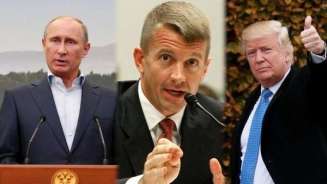
Bloomberg reported more details about Blackwater founder Erik Prince’s involvement in the campaign and transition. Bloomberg’s sources tried to downplay the notorious Seychelles meeting between Prince and a Putin aide and confidant and claimed it had nothing to do with Trump. Prince was often in Trump Tower, but was sneaked in through the back way to avoid being seen.
Yet over a two to three month period around the election, Prince met several times with top aides as the incoming government took shape, offering ideas on how to fight terror and restructure the country’s major intelligence agencies, according to information provided by five people familiar with the meetings. Among those he conferred with was Flynn, a member of the transition team who joined the administration and was later dismissed, some of the people said. He discussed possible government appointees with people in the private sector, one person said. Prince himself told several people that while he was not offering his advice in any official capacity, his role was significant….
The meetings occurred in Trump Tower, the administration’s transition office in Washington and elsewhere, according to people familiar with them. In one informal discussion in late November, Prince spoke openly with two members of Trump’s transition team on a train bound from New York to Washington. He boarded the same Acela as Kellyanne Conway and they sat together. Joining the conversation at one point was Kevin Harrington, a longtime associate of Trump adviser Peter Thiel who is now on the National Security Council. They discussed, in broad terms, major changes the incoming administration envisioned for the intelligence community, as recounted by a person on the train who overheard their conversation.
The article also discusses Trump’s involvement with Peter Thiel who, along with Prince, made large contributions to a PAC run by Robert Mercer (who got Bannon and Conway involved in the Trump campaign).
A longtime critic of government defense and security policies, Prince advocated a restructuring of security agencies as well as a thorough rethink of costly defense programs, even if it meant canceling existing major contracts in favor of smaller ones, said a person familiar with the matter.
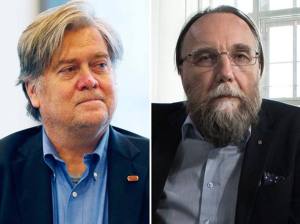
Bannon, a former banker turned film producer and right-wing polemicist, has praised not only Putin but also a brand of Russian mystical conservative nationalism known as Eurasianism, which is the closest the Kremlin has to a state ideology. Eurasianism proclaims that Russia’s destiny is to lead all Slavic and Turkic people in a grand empire to resist corrupt Western values. Its main proponent is Alexander Dugin. With his long beard and burning blue eyes, Dugin looks like a firebrand prophet. His philosophy glorifies the Russian Empire—while Bannon and the conservative website that he founded, Breitbart News, revived the slogan of “America first,” which Trump later adopted in his campaign….
Yet Bannon and Dugin have common cause in the idea that global elites have conspired against ordinary people—and the old order must be overthrown. “We have arrived at a moment where the world is discovering a new model of ideologies. The election of Trump shows that clearly,” Dugin tells Newsweek.
Bannon, in turn, seems to admire Dugin—as well as Putin’s Russia—for putting traditional values at the heart of a revival of national greatness. “We, the Judeo-Christian West, really have to look at what [Putin] is talking about as far as traditionalism goes, particularly the sense of where it supports the underpinnings of nationalism,” Bannon said at a Vatican-organized conference in 2014. “When you really look at some of the underpinnings of some of [Putin’s] beliefs today, a lot of those come from what I call Eurasianism.” Bannon declined to respond to Newsweek’s questions about his position on Russia and Dugin.
Bannon and Dugin’s speeches and writings indicate that their common enemies are secularism, multiculturalism, egalitarianism—and what Dugin calls the “globalized and internationalist capitalist liberal elite.” In both Bannon’s and Dugin’s worldview, the true global ideological struggle is between culturally homogenous groups founded on Judeo-Christian values practicing humane capitalism on one side and, on the other, an international crony-capitalist network of bankers and big business.
Bannon’s fix for the world is to revive the nation-state—precisely what Putin’s Kremlin is promoting as it backs anti–European Union candidates from Hungary to France. “I happen to think that the individual sovereignty of a country is a good thing and a strong thing,” Bannon told an audience of Catholic thinkers at the Vatican by video-link from the U.S. in 2014. “Putin is standing up for traditional institutions, and he’s trying to do it in a form of nationalism. [People] want to see the sovereignty for their country; they want to see nationalism for their country. They don’t believe in this kind of pan–European Union, or they don’t believe in the centralized government in the United States. They’d rather see more of a states-based entity that the founders originally set up, where freedoms were controlled at the local level.”
It’s not clear to me how Bannon can accept the obvious “crony-capitalism” of the Trump family crime syndicate.
There are more rumors than ever going around that indictments could be coming out of the Trump-Russia investigation, and it’s difficult to know what to believe. I’m just trying to be patient and keep an open but skeptical mind. I did come across a couple of interesting pieces on Rudy Giuliani and Carter Page respectively. They are both too long and complex to excerpt, but here are the links:
SHANGHAI (AP) — On April 6, Ivanka Trump’s company won provisional approval from the Chinese government for three new trademarks, giving it monopoly rights to sell Ivanka brand jewelry, bags and spa services in the world’s second-largest economy. That night, the first daughter and her husband, Jared Kushner, sat next to the president of China and his wife for a steak and Dover sole dinner at Mar-a-Lago….
As the first daughter crafts a political career from her West Wing office, her brand is flourishing, despite boycotts and several stores limiting her merchandise. U.S. imports, almost all of them from China, shot up an estimated 166 percent last year, while sales hit record levels in 2017. The brand, which Trump still owns, says distribution is growing. It has launched new activewear and affordable jewelry lines and is working to expand its global intellectual property footprint. In addition to winning the approvals from China, Ivanka Trump Marks LLC applied for at least nine new trademarks in the Philippines, Puerto Rico, Canada and the U.S. after the election.
The commercial currents of the Trump White House are unprecedented in modern American politics, ethics lawyers say. They have created an unfamiliar landscape riven with ethical pitfalls, and forced consumers and retailers to wrestle with the unlikely passions now inspired by Ivanka Trump’s mid-market collection of ruffled blouses, shifts and wedges.
Using the prestige of government service to build a brand is not illegal. But criminal conflict of interest law prohibits federal officials, like Trump and her husband, from participating in government matters that could impact their own financial interest or that of their spouse. Some argue that the more her business broadens its scope, the more it threatens to encroach on the ability of two trusted advisers to deliver credible counsel to the president on core issues like trade, intellectual property, and the value of the Chinese currency.
How President Donald Trump intends to resolve the growing North Korean crisis remains unclear, though whether that is by design or reflects a lack of a coherent foreign policy is a matter of some debate. Over the past several weeks, as Kim has moved aggressively to advance his nuclear weapons program, the Trump administration has telegraphed a wide range of possibilities as to how the U.S. might respond. Last month, during his first major diplomatic tour of Asia, Secretary of State Rex Tillersondeclared that “the policy of strategic patience has ended” and that “all options are on the table” for dealing with North Korea. On Monday, Vice President Mike Pence repeated that line while making a surprise appearance on the South Korean side of the Demilitarized Zone separating the two countries, which have been locked in a military standoff since the suspension of the Korean War in 1953. “North Korea will do well not to test his resolve or strength of the armed forces of the United States in this region,” he added.
While the era of strategic patience may be over, the Trump administration is clearly taking some kind of strategic steps. Last week, the president announced that he had ordered an “armada” of military ships, including the aircraft carrier U.S.S. Carl Vinson and several nuclear submarines, to sail toward North Korea. NBC News reported that the National Security Council had presented Trump with a list of potential responses to North Korea, including moving missiles to South Korea or outright assassinating Kim. And while the White House quietly dismissed a subsequent report that Trump was prepared to launch a pre-emptive conventional strike if Kim reached for the nuclear trigger last weekend, as he had been expected to do, the president warned that the North Korean problem “will be taken care of” one way or another. On Monday, Pence also said that the U.S. would be open to securing the region “through peaceable means, through negotiations,” suggesting that Trump may be coming around to Beijing’s way of thinking.
The ambiguity of Trump’s warnings, combined with the credible threat that he might be crazy enough to see them through, has yielded some results. China appears to be working more closely with the U.S. then before to increase pressure on Kim—cooperation that Trump suggested on Twitter that he had bought by backing away from labeling China a “currency manipulator.” And Kim seemed to have called off his expected nuclear test—for now.
Is Trump embracing Nixon’s “madman theory” of foreign policy, or is he just plain crazy? It seems kind of a dangerous policy when you’re facing off against another madman.
The post World War 2 era led to the birth of a lot of new democracies as the colonial era started to wind down in earnest. European countries couldn’t rebuild and fund empires. One of the most fascinating things to me about the current state of things in the world is that many places where democracy seemed well-rooted are plotting a path to return of autocratic forms of government. It hasn’t been that long since the USSR and its satellites broke up into many little experiments in democracy either. What makes some countries shrug their collective shoulders and go back to strong men?
DIYARBAKIR, TURKEY – MARCH 27: Turkish Prime Minister Recep Tayyip Erdogan greets crowd during a local election rally organized by the ruling Justice and Development Party in Diyarbakir, Turkey, on March 27, 2014. (Photo by Kayhan Ozer/Anadolu Agency/Getty Images)
At some point, you have to question which institutions have failed a country’s people but it’s undoubtedly an interplay of many. Turkey’s decline has many lessons for us. The similarities between Kremlin Caligula and Erdogan are eerie. That’s why I decided to write about it today.
Why are the world’s democracies facing such threat to modernity? Why place so much power in an executive branch?
Whether they understood it or not, when Turks voted “Yes”, they were registering their opposition to the Teşkilât-ı Esasîye Kanunu and the version of modernity that Ataturk imagined and represented. Though the opposition is still disputing the final vote tallies, the Turkish public seems to have given Erdogan and the AKP license to reorganize the Turkish state and in the process raze the values on which it was built. Even if they are demoralized in their defeat, Erdogan’s project will arouse significant resistance among the various “No” camps. The predictable result will be the continuation of the purge that has been going on since even before last July’s failed coup including more arrests and the additional delegitimization of Erdogan’s parliamentary opposition. All of this will further destabilize Turkish politics.
Turkey’s Islamists have long venerated the Ottoman period. In doing so, they implicitly expressed thinly veiled contempt for the Turkish Republic. For Necmettin Erbakan, who led the movement from the late 1960s to the emergence of the Justice and Development Party (AKP) in August 2001, the republic represented cultural abnegation and repressive secularism in service of what he believed was Ataturk’s misbegotten ideas that the country could be made Western and the West would accept it. Rather, he saw Turkey’s natural place not at NATO’s headquarters in Brussels but as a leader of the Muslim world, whose partners should be Pakistan, Malaysia, Egypt, Iran, and Indonesia.
When Erbakan’s protégés — among them Erdogan and former President Abdullah Gul — broke with him and created the AKP, they jettisoned the anti-Western rhetoric of the old guard, committed themselves to advancing Turkey’s European Union candidacy, and consciously crafted an image of themselves as the Muslim analogues to Europe’s Christian Democrats. Even so, they retained traditional Islamist ideas about the role of Turkey in the Middle East and the wider Muslim world.
Thinkers within the AKP — notably former Prime Minister Ahmet Davutoglu — harbored reservations about the compatibility of Western political and social institutions with their predominantly Muslim society. But the AKP leadership never acted upon this idea, choosing instead to undermine aspects of Ataturk’s legacy within the framework of the republic. That is no longer the case.
The AKP and supporters of the “yes” vote argue that the criticism of the constitutional amendments was unfair. They point out that the changes do not undermine a popularly elected parliament and president as well as an independent (at least formally) judiciary. This is all true, but it is also an exceedingly narrow description of the political system that Erdogan envisions. Rather, the powers that would be afforded to the executive presidency are vast, including the ability to appoint judges without input from parliament, issue decrees with the force of law, and dissolve parliament. The president would also have the sole prerogative over all senior appointments in the bureaucracy and exercise exclusive control of the armed forces. The amendments obviate the need for the post of prime minister, which would be abolished. The Grand National Assembly does retain some oversight and legislative powers, but if the president and the majority are from the same political party, the power of the presidency will be unconstrained. With massive imbalances and virtually no checks on the head of state, who will now also be the head of government, the constitutional amendments render the Law on Fundamental Organization and all subsequent efforts to emulate the organizational principles of a modern state moot.
There is an uptick in groups of voters drawn to authoritarianism. This is not what I expected when I watched the “Arab Spring” unfold on Twitter. Donald Trump is not what I expected after Barrack Obama. There appears to be a group of people that just love themselves better in the comfort of old school religion and backwoods bullies. Each follower of the world’s largest religions needs to discern a difference between being a person of faith and blindly following your religion over a precipice and into slavery. It always begins with a purge of intellectuals, scientists, and scholars.
It has been painful for me to witness the immense disappointment of Turkish intellectuals, resilient by tradition, and mainly left-leaning. All I could hear by phone or on social media was tormented despair – a crushing sense of defeat. What united all those in academia and the media or in NGOs, regardless of their political stripes, was that they had hoped for democratic change under the AKP.
Many of them had given credit to the party, and its early pledges and steps towards an order where the sharing of power would break the vicious circle of the republic. They wanted to believe in human rights, freedom and an end to the decades-long Kurdish conflict. But the deliberate reversal of democratisation left all of them feeling they had been duped.
This conclusion became undeniable when last summer’s attempted coup – the details of which are still unclear – led to an immense purge. Given this mood of despair and the sense of defeat, we should expect another exodus of fine human resources in the coming months and years.
Journalists – such as me, abroad, or at home – will find themselves challenged even more after the referendum. Coverage of corruption will be a daredevil act, severe measures against critical journalism will continue and the remaining resistance of media proprietors will vanish.
The Turkish media will begin to resemble those of the Central Asian republics, where only mouthpieces for those in power are allowed to exist. Inevitably, these conditions will shift the epicentre of independent journalism to outside the borders of Turkey. My colleagues have already realised that their dreams of a dignified fourth estate were nothing but an illusion.
“At the end of the day, Erdoğan is simply replacing one form of authoritarianism with another,” wrote Cook.
“The Turkish republic has always been flawed, but it always contained the aspiration that – against the backdrop of the principles to which successive constitutions claimed fidelity – it could become a democracy. Erdoğan’s new Turkey closes off that prospect.”
Just as in this country’s election in 2016, Erdoğan won a slim victory. That’s not stopping him from sweeping reforms that are way out of line with progress and modernity.
An emboldened Recep Tayyip Erdogan followed his win in a referendum that ratified the supremacy of his rule by taking aim at political opponents at home and abroad.
At his victory speech late on Sunday, supporters chanted that he should bring back the death penalty — a move that would finish off Turkey’s bid to join the European Union — and Erdogan warned opponents not to bother challenging the legitimacy of his win. He told them to prepare for the biggest overhaul of Turkey’s system of governance ever, one that will result in him having even fewer checks on his already considerable power.
“Today, Turkey has made a historic decision,” he said. “We will change gears and continue along our course more quickly.” The lira surged as much as 2.5 percent against the dollar in early trading on Monday in Istanbul before gains moderated.
The success of a package of 18 changes to the constitution was narrow, with about 51.4 percent of Turks approving it. It came at the end of a divisive two-month campaign during which Erdogan accused opponents of the vote of supporting “terrorists” and denounced as Nazi-like the decision of some EU countries to bar his ministers from lobbying the diaspora.
“The referendum campaign was dominated by strongly anti-Western rhetoric and repeated promises to bring back the death penalty,” said Inan Demir, an economist at Nomura Holdings Inc. in London. “One hopes that this rhetoric will be tempered now that the vote is over,” but recent steps by the Turkish government do“not bode well for the hoped-for moderation in international relations.”
Now that two obese men with bad hair and nuclear weapons didn’t end the world over the weekend, let’s talk about Turkey. Maybe keeping up with the former focal point of the Ottoman empire hasn’t been on the top of your to-do list. All well and good. But you may want to know they voted to weaken or even obliterate—depending on who you ask—their democracy over the weekend.
So what does this referendum of theirs mean? Only give the Turkish president hitherto unprecedented control over the executive, legislative and judicial branches. Now that the Turks have voted “Yes” to these constitutional reforms, they’re signing up for a form of government in which parliament’s monitoring of the executive branch is removed from the constitution and the judiciary is even weaker and less independent than it already was beforehand.
It’s a complex case though. Turkey’s government is different than America’s and, in some ways, they’re actually embracing a system more similar to the one US citizens are used to. The main transition is one from a parliamentary democracy to a presidential one, albeit a strongly authoritative one. Traditionally, the Turkish president is more figurehead than enforcer. They’re intended to be more Queen Elizabeth than Vladimir Putin or even Donald Trump.
As head of state, they act as the public face of the country, acting in times of emergency but largely delegating the business of lawmaking and government-running to their appointed prime minister. Until April 16, 2017, the president was mandated to cut ties from his party and maintain a largely neutral and apolitical stance, regardless of personal attachments or viewpoints. Now the office of prime minister is kaput and the president will have way more control over all branches of government. Parliament will still make laws and the judiciary will still try cases. But they’ll do little else and even those duties are capable of being bypassed by the president pretty easily.
The changes don’t go into effect until 2019 but when they do, the Turkish president can pass decrees as effective and codified as any parliamentary law, dissolve parliament, call for new elections, set the budget, declare a state of emergency, make unilateral national security decisions, appoint and remove all VPs and ministry heads at their own discretion and more. Don’t worry! If the president does something illegal, they can still be investigated if there’s a simple majority in parliament and a 60% vote to be tried then convicted by presidentially appointed judges.
And it’s so completely unconcerning the person who’ll most likely have all this unchecked executive power in 2019 is current president Recep Tayyip Erdogan. Just think of his inspirational and relatable backstory—he sold lemonade as a teenager in a rough part of town, played soccer for a while and wrote, and directed and starred in a play called Maskomya about how Freemasonry, Communism and Judaism are evil forces hellbent on destroying the world. Presidents: they’re just like us!
Trump has voiced his support for the use of torture. And his similarities with the Turkish leader do not end there. Both use a rhetoric of patriotism to the point of nationalism, are vocal against abortion and are infamous for their tendency to objectify women and misunderstand feminism. They have both granted their sons-in-law important positions and both have a particularly thin skin when it comes to criticism, especially when it comes from comedians and journalists.
Erdoğan and Trump have publicly supported each other’s stance on the media in the past. Anyone who has spent time in Turkey will recognise Trump’s denouncement of negative coverage in outlets such as the New York Times as “fake news”. They will be familiar with headlines such as the one that appeared in far-right outlet Brietbart (whose founding member Steve Bannon is Trump’s chief strategist), used in relation to the protests in the US on Saturday – “Terror-tied group Cair causes chaos, promoting protests and lawsuits as Trump protects nation”. This is pure Erdoğan territory – denouncing opposition by associating it with terror while glorifying the strong leader. Turkey is the home of “alternative facts”.
A country that makes the media the enemy is a country where people are too easily manipulated by those in power. Journalists in Turkey, unless they work for organisations that toe the official government line on events, constantly wobble on a tightrope between reporting what’s going on and not reporting enough to get arrested. Even foreign journalists self-censor, double-check for unintended “insults” that could land them in trouble. They flinch when the doorbell rings unexpectedly, and wonder every time they go abroad whether they will be allowed back in the country.
We need to stand up against the vilification of the free press in the US now before it goes too far. Erdoğan is no longer good for Turkey, just like Trump is no good for America. They are changing the identities of their countries.
The similarities between Erdogan and Trump are greater than they might seem, despite the very different political traditions in the US and Turkey.
The parallel lies primarily in the methods by which both men have gained power and seek to enhance it. They are populists and nationalists who demonise their enemies and see themselves as surrounded by conspiracies. Success does not sate their pursuit of more authority.
Hopes in the US that, after Trump’s election in November, he would shift from aggressive campaign mode to a more conciliatory approach have dissipated over the last two months. Towards the media his open hostility has escalated, as was shown by his abuse of reporters at his press conference this week.
Manic sensitivity to criticism is a hallmark of both men. In Trump’s case this is exemplified by his tweeted denunciation of critics such as Meryl Streep, while in Turkey 2,000 people have been charged with insulting the president. One man was tried for posting on Facebook three pictures of Gollum, the character in The Lord of the Rings, with similar facial features to pictures of Erdogan posted alongside. Of the 259 journalists in jail around the world, no less than 81 are in Turkey. American reporters may not yet face similar penalties, but they can expect intense pressure on the institutions for which they work to mute their criticisms.
Turkey and the US may have very different political landscapes, but there is a surprising degree of uniformity in the behaviour of Trump and Erdogan. The same is true of populist, nationalist, authoritarian leaders who are taking power in many different parts of the world from Hungary and Poland to the Philippines. Commentators have struggled for a phrase to describe this phenomenon, such as “the age of demagoguery”, but this refers only to one method – and that not the least important – by which such leaders gain power.
So, I’m sure this isn’t what you expected to read today. But, it appears that my interest and concerns aren’t just wild hairs.
What’s on your reading and blogging list today?
Did you like this post? Please share it with your friends:
The Sky Dancing banner headline uses a snippet from a work by artist Tashi Mannox called 'Rainbow Study'. The work is described as a" study of typical Tibetan rainbow clouds, that feature in Thanka painting, temple decoration and silk brocades". dakinikat was immediately drawn to the image when trying to find stylized Tibetan Clouds to represent Sky Dancing. It is probably because Tashi's practice is similar to her own. His updated take on the clouds that fill the collection of traditional thankas is quite special.
You can find his work at his website by clicking on his logo below. He is also a calligraphy artist that uses important vajrayana syllables. We encourage you to visit his on line studio.


 Good Morning Sky Dancers!
 Read the story of how O’Reilly basically ginned up a group of crazy domestic terrorists to stalk, harass and haunt here. I’ve been at the receiving end of attacks from those freaks. They’re an ugly, mean, nasty, and hateful lot.
 I hold this near and dear as the descendant of Hugenot French who fled the Alsace Lorraine/Rhinelands area as Jews and Protestants being forcefully removed and slaughtered at the behest of the Roman Catholic Church. The parts of my family who signed the Declaration of Independence and the Constitution made a refuge for folks suffering from state-sanctioned religious persecution. I’d hate to see us dump on this most important right.
 But Sessions has decided to place the spying blame Julian Assange and flutter his little hands and air his






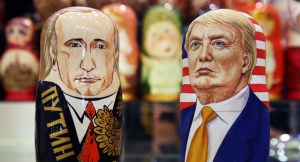


 Good Morning!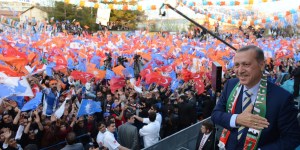
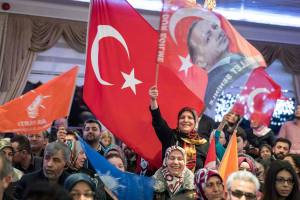 There is an uptick in groups of voters drawn to authoritarianism. This is not what I expected when I watched the “Arab Spring” unfold on Twitter. Donald Trump is not what I expected after Barrack Obama.
 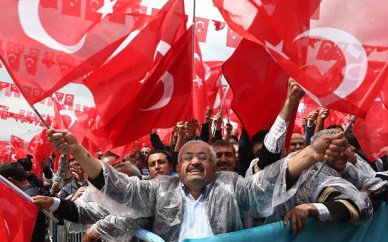 Just as in this country’s election in 2016,
 I’m not the only one curious about this trend toward dilution of democracy in Western nations.
  Yes, well much of this sounds eerily familiar doesn’t it?
 peej
peej Carissa
 bostonboomer
 dakinikat
 ecocatwoman
 mablue2
 Mama Lopez
 peggysue22
 quixote
 skydancingguestblogger
 Mona (aka Wonk the Vote)



 Sky Dancing
Recent Comments