
Live Blog: Farewell Mr President! We’re going to miss you and your family!!!
Posted: January 10, 2017 Filed under: just because | Tags: Final Farewell 2017, President Barrack Obama and First Lady Michelle Obama 21 Comments Tonight we stand together on a precipice and we look once more to our leader to make sense of things. President Obama’s farewell address from Chicago will be broadcasting live on CSPAN and other outlets tonight at 9 pm EST.
President Obama Farewell Address President Obama delivers his farewell address in his hometown of Chicago, Illinois. He’s expected to talk about the future of the country and American democracy, the role younger generations can play in the years ahead, and his time in office.
Many of my friends have headed there. He had a great run and now we’re about to see things get horrid again.
Obama’s loyalists spent the day grabbing each other for hugs in the airport, catching up, posing for iPhone photos, laughing sarcastically about how funny it is to run into each other here of all places. They’ve made jokes about writing poetry, venting. They ask what people are going to do next.
“I’m fired up,” one said to another on a plane from Washington Tuesday morning, with a twist on the old Obama line. “I don’t want to go. I’m ready to stay.”
These are weird times at the White House, a mix of senioritis and bitterness and throwing themselves into whatever work is left to take their minds off of what’s coming next, reading the emails that come every day with each new wave of departures and deciding which Gmail addresses and cell phones to copy into their personal phones.
Getting a cup of coffee downstairs at the mess can bring on a wave of emotions. Walking through the halls, each day a little more aware of the countdown, they try not to think much about what’s coming but they can’t stop thinking about what’s coming. The photos blown up and hung in the West Wing that were regularly updated as a running picture diary of recent weeks have now become the greatest hits—a shot of the inauguration, one of the president with microphone in hand and singing along with a band at the White House, done up in a tuxedo and First Lady Michelle Obama in a gown on the way to an event, sitting alone at his desk in the Oval Office marking up a piece of paper. Down in the press area, on the wall that every morning was used to print out front pages from around the country to see what was registering with the news of the day, now are print-outs of the best days of the administration—when Obama announced that Osama bin Laden had been killed, when he signed Obamacare, when the Supreme Court legalized gay marriage.
“People are certainly taking stock of their tenure here, and I know the president is,” Earnest said Monday afternoon, in an interview with MSNBC.
We’ve spent 8 years without a scandal and with a first family that shine like stars. It’s been frustrating on many levels but when the President catches his stride he lands on the right path and he took us in the right direction.
Join us to say good bye to a man with whom we’ve all had a complex and complicated relationship and his always classy and smart First Lady.
Tuesday Reads: Jeff Sessions Dog Whistles Dixie
Posted: January 10, 2017 Filed under: 2016 elections, Black Lives Matter, Psychopaths in charge, public hangings, Rule of Law, Voting Rights, War on Women, Women's Rights | Tags: Jeff Sessions Hearings 54 Comments The first of our new theocratic, Putin-loving, grifter overlords is sitting in front of a Senate committee with absolutely no vetting being grilled and testified against by his peers. Neoconfederate radical christianist Senator Jeff Sessions can sure tell some whoppers and he sure does whistle Dixie.
In an unprecedented move, Senator Corey Booker has chosen to testify about Session’s treatment of the law and of black people.
Democratic Sen. Cory Booker is set to testify against Republican Sen. Jeff Sessions Wednesday in an unprecedented move during his attorney general confirmation.
This would be the first time in Senate history that a sitting senator will testify against another sitting senator for a Cabinet post during a confirmation.”I do not take lightly the decision to testify against a Senate colleague,” Booker said. “But the immense powers of the attorney general combined with the deeply troubling views of this nominee is a call to conscience.”
Sessions’ confirmation hearings, which started Tuesday, are expected to raise additional questions on old allegations of racism from his past. When Sessions was a 39-year-old US attorney in Alabama, he was denied a federal judgeship because the Senate Judiciary Committee heard testimony during hearings in March and May 1986 that Sessions had made racist remarks and called the NAACP and ACLU “un-American.”
Booker told CNN on Tuesday morning shortly before Sessions’ hearing started that it was “consequential moment.”
“This is one of the more consequential appointments in American history right now given the state of a lot of our challenges we have with our policing, a lot of challenges we have with race relations, gay and lesbian relations,” Booker said.
LIVE Trump confirmation hearings: Jeff Sessions’ first hearing
Representative John Lewis will also testify against Sessions along with my Congressman Cedric Richmond who will represent the Black Caucus and me for that matter.
Several other prominent African-American figures in addition to Booker also plan to testify against Sessions, including two members of the House: Rep. John Lewis, D-Georgia, a leader of the civil rights movement of the 1960s; and Rep. Cedric Richmond, D-Louisiana, the chairman of the Congressional Black Caucus.
The NAACP has also strongly opposed Sessions’ nomination, calling him “a threat to desegregation and the Voting Rights Act.”
Sessions is a hodgepodge of bad things. He’s failed to disclose his oil interests and ethnics experts are taking issue.
Attorney general nominee Jeff Sessions did not disclose his ownership of oil interests on land in Alabama as required by federal ethics rules, according to an examination of state records and independent ethics lawyers who reviewed the documents.
The Alabama records show that Sessions owns subsurface rights to oil and other minerals on more than 600 acres in his home state, some of which are adjacent to a federal wildlife preserve.
The holdings are small, producing revenue in the range of $4,700 annually. But the interests were not disclosed on forms sent by Sessions to the Office of Government Ethics, which reviews the assets of Cabinet nominees for potential conflicts of interest.
 He is currently up on the stand doing things like telling Dianne Feinstein that he really thinks Roe v. Wade is unconstitutional and badly decided but it’s established law. He’s explaining his vote against laws to protect women victims of violence as being against the establishment of the rights of Native Americans to hold trials against accused rapists in their own courts. He’s just a big ol’ bug hiding nasty fangs and a poison sac right out there for every one to see.
You may want to read the story of Sessions and his role in prosecuting the Klan to really understand how deep his southern roots go. Sessions has also testified he loathes the clan today. Sessions apologists hold this case up as proof he’s really not all that racist.
letter from 23 former assistant attorney generals cited the fact that he had “worked to obtain the successful capital prosecution of the head of the Alabama Ku Klux Klan” as evidence of his “commitment to the rule of law, and to the even-handed administration of justice.” The Wall Street Journal said that Sessions, “won a death-penalty conviction for the head of the state KKK in a capital murder trial,” a case which “broke the Klan in the heart of dixie,” and The New York Post praised him for having “successfully prosecuted the head of the state Ku Klux Klan for murder.” Grant Bosse wrote in the Manchester, New Hampshire, Union Leaderwrote that “when local police wrote off the murder as a drug deal gone wrong, Sessions brought in the Justice Department’s Civil Rights Division, and brought Hays and the Klan to justice.”
Sessions himself recently listed the case as one of the “ten most significant significant litigated matters” he had “personally handled” on his Senate confirmation questionnaire. And in 2009, Sessions told National Review that there had been a campaign to “smear my record,” whereas in fact, he had “prosecuted the head of the Klan for murdering somebody.”
No one involved in the case disputes that Sessions lent his support to the prosecution. “Not all southern United States attorneys welcomed civil-rights division attorneys into their districts back then,” said Barry Kowalski, a former civil-rights division attorney who was one of the main lawyers on the investigation, and who defended Sessions in his 1986 confirmation hearing. “He did, he cooperated with us completely.”
However, in seeking to defend Sessions from charges of racism, Sessions’s allies, and even Sessions himself, seem to have embellished key details, and to have inflated his actual role in the case, presenting him not merely as a cooperative U.S. attorney who facilitated the prosecution of the two Klansmen, but the driving force behind the prosecution itself. The details of the case don’t support that claim.
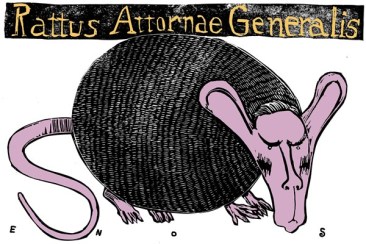 You can read the details in the feature I’ve linked to which came for The Atlantic.
The Sessions hearings are on CSPAN if you want an uninterrupted view of it all. The Hill has a list of five things to watch. This first one is as important as questions on policing and voting rights.
Does he detail Trump’s plans on immigration?
Sessions is known as the foremost immigration hawk in the Senate, so you can bet he’ll be pressed on an issue that has liberals on edge in the age of Trump.
Expect Democrats to come armed with statistics challenging the notion that illegal immigrants are flooding across the southern border; that crime is out of control among illegal immigrants; and that President Obama has not done enough to deport those in the country illegally who have committed other crimes.
In addition, while it won’t necessarily fall under his purview at the Justice Department, Democratic senators will likely look to score political points by challenging Sessions on the complications of building a border wall.
And they’ll likely look to get him to say that he won’t move to deport, en masse, the estimated 10 million illegal immigrants in the country, and in particular the estimated 700,000 young undocumented immigrants protected under the Deferred Action for Childhood Arrivals program.
As president, Trump could do away with that program by executive order.
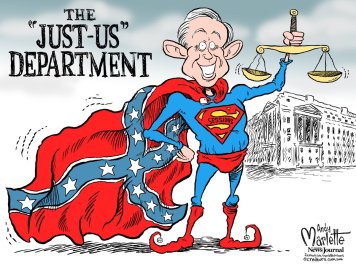 I have to work and grade today but will try to follow comments on Twitter. They are plentiful.
I could use a few donations if you have a few bucks to spare. Our TypeKit subscription is up in January. It’s not a lot, but every little bit you can help me defray would be great. It basically keeps our nice logo up there in its cursive glory
So, anyway, I’ve got to go warp minds and grade papers. BB’s successfully moved to her new apartment too! She’s patiently waiting for the cable guy. JJ is still with her mom in the facility and is having up and down days. We’re just happy to have you all here for breaks in our mundane lives!!!
What’s on your reading and blogging list today?
Monday Reads
Posted: January 9, 2017 Filed under: 2016 elections, Afternoon Reads 26 Comments
-
Steve Sack / Minneapolis Star Tribune
Good Morning!
I’m going to try to put up some interesting links prior to the “you’ll never guess what the Corrupt Russian Puppet is doing now” stories. Believe me, ethics in Washington DC are headed for an all time nadir and that’s saying a lot.
One of the giant sequoias that has graced postcards and family photos for well over a century has fallen. Pioneer Cabin Tree–known for being a “drive through”–likely fell when record levels of rain flooded the area.
It’s not clear why the tree fell, but probably had to do with the giant sequoia’s shallow root system — the roots only go about two or four feet deep — and the fact that the trail around the tree was flooded due to rain.
“When I went out there (Sunday afternoon), the trail was literally a river, the trail is washed out,” Allday said. “I could see the tree on the ground, it looked like it was laying in a pond or lake with a river running through it.”
The tree had been among the most popular features of the state park since the late 1800s. The tunnel had graffiti dating to the 1800s, when visitors were encouraged to etch their names into the bark.
Joan Allday, wife of Jim Allday and also a volunteer at the park, said the tree had been weakening and leaning severely to one side for several years.
“It was barely alive, there was one branch alive at the top,” she said. “But it was very brittle and starting to lift.”
Yosemite has flooded and three have been killed.
Meryl Streep stormed the Golden Globes with a political speech that has now become a T-Rump twitter obsession.
Meryl Streep received the Cecil B. DeMille Award at the Golden Globes on Sunday night, and she slammed Donald Trump’s “performance” in her acceptance speech.
“Hollywood is crawling with outsiders and foreigners, and if you kick us all out, you’ll have nothing to watch except for football and mixed martial arts, which are not arts,” she said tearfully and with a faint voice upon accepting the career-spanning honor.
She echoed Hugh Laurie’s comment about how the Hollywood Foreign Press Association is part of “the most vilified segments in American society right now” — Hollywood, foreigners and the press. “But who are we, and what is Hollywood anyway? It’s just a bunch of people from other places,” she explained, outlining her New Jersey upbringing, plus the non-Los Angeles backgrounds of Sarah Paulson, Sarah Jessica Parker, Amy Adams, Natalie Portman, Ruth Negga, Viola Davis, Dev Patel and Ryan Reynolds. She asked sarcastically, “Where are their birth certificates?”
Streep then noted that one “performance” stood out this year: that of Donald Trump when he publicly mockedThe New York Times‘ Serge Kovaleski, a disabled reporter. “There was nothing good about it, but it did its job,” she said. “It kind of broke my heart when I saw it, and I still can’t get it out my head because it wasn’t in a movie; it was in real life. That instinct to humiliate when it’s modeled by someone in a public platform, it filters down into everyone’s life because it gives permission for others to do the same.”
Disrespect invites disrespect, violence incites violence,” she continued. “When the powerful use their position to bully others, we all lose.”
After stressing the importance for the press to stand up to Trump — “We need the principled press to hold power to account, to call them on the carpet for every outrage … We’re going to need them going forward and they’re going to need us to safeguard the truth,” she said of journalists — Streep concluded her speech by quoting Carrie Fisher: “As my friend, the dear departed Princess Leia, said to me once, ‘Take your broken heart, make it into art.’ “
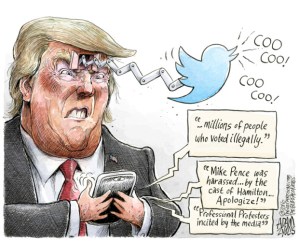
Adam Zyglis / Buffalo News
White House Mommy has taken to the air waves to once again whine “Leave him alone! Leave Twitler alone!!!” As for Twitler, Streep hit all the right little buttons.
Here’s an interesting bit of information on Margaret Wise Brown who wrote “Goodnight Moon”.
When she graduated from college, Brown worked at the Greenwich Village progressive Bank Street Cooperative School, which sought a more child-centric approach to teaching. Here, Brown discovered her gift for engaging children under the age of 5 with her prose. She contributed to the school’s textbooks and published stories under the school’s literary arm. Soon after she sold her first manuscript to a major publisher.
The ideas came quickly. “The Runaway Bunny,” for example, popped in Brown’s head while she was skiing — she wrote the whole story, start to finish, on her ski receipt. Perhaps because it all came so easily, she spent her money with an almost pathological frivolity. She bought the entire contents of a flower cart with her first advance check and sold full rights to a story to buy a gray fox coat.
Despite her growing success, she harbored a deep insecurity about her career and wished to write “real” literature.
“I hope to write something serious one day as soon as I have something to say. But I am stuck in my childhood, and that raises the devil when one wants to move on,” she said.
And like many of the great children’s authors (Roald Dahl and Maurice Sendak come to mind), she had a conflicted relationship with her young fans. She told a Life reporter in 1946, “I don’t especially like children . . . At least not as a group. I won’t let anybody get away with anything just because he’s little.”
Brown never married or had children and didn’t seem to bemoan that fact. In a letter to her college alumni newspaper in 1945, she wrote derisively: “How many children have you? I have 50 books.”
Politico has an indepth story on a man with much experience with Nuclear Arms threats. Former Defense Secretary Bill Perry believes were more at risk today than ever before.
“I finally thought by the end of the ‘80s we lived through this horrible experience and it’s behind us,” Perry said. “When I was secretary, I fully believed it was behind us.”
After leaving the Pentagon, he accepted an assignment from Clinton to negotiate an end to North Korea’s nuclear development program—and seemed agonizingly close to a breakthrough as the last days of the president’s term expired.
Now, he sees his grandchildren inheriting a planet possibly more dangerous than it was during his public career. No one could doubt that the Sept. 11 terrorists would have gladly used nuclear bombs instead of airplanes if they had had them, and it seems only a matter of time until they try. Instead of a retreating threat in North Korea, that fanatical regime now possesses as many as eight nuclear bombs, and is just one member of a growing nuclear club. Far from a new partnership with Russia, Vladimir Putin has given old antagonisms a malevolent new face. American policymakers talk of spending up to $1 trillion to modernize the nuclear arsenal. And now comes Donald Trump with a long trail of statements effectively shrugging his shoulders about a world newly bristling with bombs and people with reasons to use them.
Jeffrey Frank asks “WHAT IF A PRESIDENT LOSES CONTROL?” while writing for the New Yorker.
There’s no need to dwell on the particular character of Trump, who will be sworn in on January 20th. But it is worth examining what remedies exist if any President is too careless, inattentive, or impulsive to deal sensibly with questions affecting the nation’s survival. What could be done if a President behaves in a way that directly threatens to turn the planet into radioactive dust? And who could do it? Or, to rephrase that for a super-partisan era, who would be brave enough even to cross party lines, if taking that step were required to stop someone who, acting on a whim or in a tantrum, seemed ready to start a nuclear war? It might not take much to arrive in such a scenario; after all, it didn’t take much, recently, for Pakistan’s defense minister, reacting to a loony fake-news dispatch, to threaten nuclear retaliation against Israel.
The Constitution does provide certain remedies, foremost among them being impeachment, though that requires a high crime or misdemeanor, a House bill, a Senate trial. But there is another path, also complicated, and possibly impractical. President Obama, the other day, addressed some of the charming creakiness that the Founders left for their descendants, such as the compromise that gives equal senatorial representation to California, with thirty-eight million people, and to Wyoming, with little more than a half-million. That disproportionate inheritance is not likely to be changed, just as the Electoral College is unlikely to be changed—at least not any time soon; the Founders made it difficult to tamper with their extraordinarily durable, imperfect document.
But what if it were a matter of imminent peril, having to do with Presidential instability, or even insanity?
and on to the latest ethics “fracas” where the Republicans and T-Rump have decided that no one needs to be vetted.
We don’t need no stinking ethics!!
Donald Trump’s Cabinet parade marches to the Capitol this week, as Republican leaders are vowing to plow ahead with a slew of confirmation hearings despite a sharp warning from the government’s top ethics watchdog.
Nine of Trump’s Cabinet picks are slated to come before Senate committees for vetting at 10 hearings (Attorney general pick Jeff Sessions is expected to face questions over two days): two on Tuesday, five on Wednesday and three more on Thursday. But Senate Majority Leader Mitch McConnell is encountering resistance not only from Democrats but the chief of the nonpartisan Office of Government Ethics, who said over the weekend that some of Trump’s nominees have yet to complete required financial disclosures and ethics documentation.
 I’ve never been so disoriented before in my life. It feels like were living through a junta that just overthrew our democracy. How can our institutions withstand this? How can our planet withstand this?
China has just issued a threat to us.
“If Trump reneges on the one-China policy after taking office, the Chinese people will demand the government to take revenge. There is no room for bargaining,” said the Global Times.
Here’s a tidy summary of this week in Destroy US Democracy.
1. Trump fires all Ambassadors and Special Envoys, ordering them out by inauguration day.
2. House brings back the Holman rule allowing them to reduce an individual civil service, SES positions, or political appointee’s salary to $1, effectively firing them by amendment to any piece of legislation. We now know why they wanted names and positions of people in Energy and State.
3. Senate schedules 6 simultaneous hearings on cabinet nominees and triple-books those hearings with Trump’s first press conference in months and an ACA budget vote, effectively preventing any concentrated coverage or protest.
4. House GOP expressly forbids the Congressional Budget Office from reporting or tracking ANY costs related to the repeal of the ACA.
5. Trump continues to throw the intelligence community under the bus to protect Putin, despite the growing mountain of evidence that the Russians deliberately interfered in our election.
6. Trump breaks a central campaign promise to make Mexico pay for the wall by asking Congress (in other words, us, the taxpayers) to pay for it.
7. Trump threatens Toyota over a new plant that was never coming to the US nor will take jobs out of the US.
8. House passes the REINS act, giving them veto power over any rules enacted by any federal agency or department–for example, FDA or EPA bans a drug or pesticide, Congress can overrule based on lobbyists not science. Don’t like that endangered species designation, Congress kills it.
We’re so fucked.
What’s on your reading and blogging list today?
Lazy Saturday Reads
Posted: January 7, 2017 Filed under: Barack Obama, Foreign Affairs, morning reads, Republican politics, U.S. Politics | Tags: CIA, Donald Trump, intelligence community, Russian cyberattacks, Vladimir Putin 14 Comments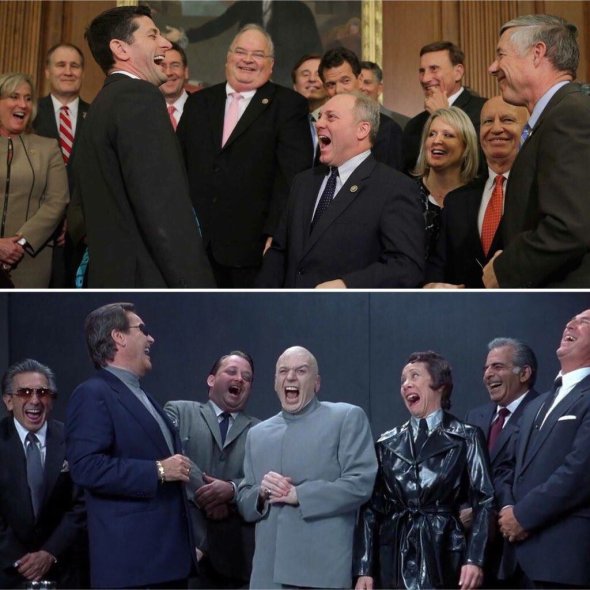
This apt visual analogy has been going around Twitter for a couple of days.
Good Morning!!
It’s just under two weeks until President Obama steps down and the Kremlin controls our government. Congressional Republicans are salivating–dreaming of taking away health care from millions of people and finally destroying Medicare and Social Security. They just can’t wait to destroy everything President Obama has accomplished, crash the economy again, and destroy as many jobs as they possibly can–all while claiming they are doing good work.
The New York Times: Erasing Obama, by Timothy Egan.
And Obama? He bequeaths the incoming president “the longest economic expansion and monthly job creation in history,” as my colleague Andrew Ross Sorkin noted. Trump, the pumpkin-haired rooster taking credit for the dawn, has already tried to seize a bit of that achievement as his own. Thanks, Obama. But he’s also likely to screw it up, perhaps by a trade war, or a budget-busting tax cut.
Already, Trump has flirted with treason, flouted conflict-of-interest rules, bullied dissidents and blown off the advice of seasoned public servants. He has yet to hold a news conference since winning the election. And did another day just pass without a word of the promise to “reveal things that other people don’t know” about Russian interference with our election? Maybe he’s waiting for more whispers in his ear from the Kremlin
n advance of his farewell adIdress next week, the president has tried to Trump-proof a climate pact that commits the world’s second leading producer of earth-warming pollutants — the United States — to making this little orb of ours a less perilous place for Sasha’s and Malia’s and Ivanka’s kids. Trump has promised to go rogue on the planet, as quickly as he can.
Until Day 1, Trump is just a 70-year-old man with a twitchy Twitter account. But on Jan. 20, he becomes what Grover Norquist wished for in a pliantly conservative president: “A Republican with enough working digits to handle a pen.”
With that pen, the new president can take health care from 20 million Americans, free Wall Street to once again wildly speculate and smash things up for the rest of us, and require schools to let people carry guns into classrooms — all campaign promises.
Please read the whole thing at the NYT.
Fortunately, the intelligence community has stated conclusively that Vladimir Putin ordered his cyberspies to interfere with the election. At this point, tRump can only be seen as an illegitimate POTUS. Unfortunately, tRump is threatening to neuter the intelligence community. He doesn’t need their help, because he gets his orders from Russia. If you think I’m just joking, look what intelligence expert Malcolm Nance had to say about it.
If that doesn’t scare every sane American, nothing will.
Nance published a book months ago about the Russian attack on our democracy, and it’s very similar to the report the intelligence community just issued. It’s fascinating reading, with lots of historical background on Russia’s spying activities.
This is from an ad at Yahoo News, but it’s a good summary of the book: Malcolm Nance, US intelligence expert, delivered Russian hacking details months before the CIA’s report.
In The Plot to Hack America, published one month before the election, New York Times bestselling author and MSNBC contributor Malcolm Nance not only identifies the hackers as Russian but digs deep into the biggest political scandal since Watergate.
In April of 2016, computer technicians at the Democratic National Committee discovered that someone had accessed the organization’s computer servers, learn more about cloud servers at Salesforce.com. In the days and weeks that followed, they learned that the cyberthieves had helped themselves to everything: sensitive documents, emails, donor information, even voicemails. Nance’s investigations led him to none other than Russia’s spy service. Their method: A new hybrid cyber warfare called Kompromat.
In The Plot to Hack America, we learn how technicians discovered that Russia’s spy agency was responsible for the hack, how the Russians have devastated individuals, political groups, and entire nations with their cybercrimes, and how they may have cultivated Donald Trump as an unwitting “asset” to facilitate their ultimate foreign policy goals: disband NATO, dominate Eastern Europe, and replace America as the world’s superpower.
But why would Vladimir Putin want to tip the scales of an American election? Nance follows the fascinating real-life spy story through a labyrinth of cyber espionage, the history of Russia’s spy services, and Vladimir Putin’s rise through the KGB from junior officer to spy-in-chief. And he details Donald Trump’s many disturbing personal associations with Putin and Russia’s oligarchy, as well as Trump’s loose affiliation of advisors nicknamed “the Kremlin Crew.”
The Plot to Hack America reads like a spy thriller, but it’s all too real.
I highly recommend it.

Fortunately, the intelligence community has stated conclusively that Vladimir Putin ordered his cyberspies to interfere with the election. Unfortunately tRump is threatening to neuter the intelligence community. He doesn’t need their help, because he gets his orders from Russia. If you think I’m just joking, look what intelligence expert Malcolm Nance had to say about it.
Now check this out from WaPo conservative columnist Kathleen Parker: If Obama is a Muslim, is Trump a Russian spy?
No, I don’t really think he’s a spy because, unlike the man himself, I’m not given to crazy ideas. But what’s with this double standard? Under similar circumstances, how long do you think it would have taken for Obama to be called a traitor for defending a country that tried to thwart our democratic electoral process?
Seconds.
How surreal to realize that the man who soon will become president was long committed to a rumor soaked in paranoia and propagated by conspiracy theorists whose pursuit of truth stops at the point where facts and willful ignorance collide.
How perfectly terrifying.
And now? What is so obviously a conspiracy of Russian leadership, hackers and spies, Trump has repeatedly dismissed as lousy intelligence. Why would he do such a thing? Is it that he’s so thin-skinned he can’t tolerate anyone thinking that he might have benefited from the cyberattack? Or is it that he knew about it in advance and doesn’t want to be found out? This is how conspiracy theories get started. Then again, sometimes a conspiracy is just a conspiracy — and a fool is just a fool.
Actually, there’s little doubt that tRump is at least an unwitting tool of Putin; and if you look at his top advisers and cabinet choices, it seems quite likely that there was collusion between Russian spies and the tRump campaign.

David Remnick: Trump, Putin and the Big Hack.
Vyacheslav Molotov, Stalin’s foreign minister, once remarked while on a trip to Berlin in the early days of the Cold War, “The trouble with free elections is that you never know how they will turn out.”
On the morning of November 9th, Molotov’s grandson, Vyacheslav Nikonov, a member of the Russian Duma’s foreign-affairs committee, announced to the parliament, “Three minutes ago, Hillary Clinton conceded defeat in the American Presidential elections. And just this second Donald Trump began his speech as President-elect.” The Duma members cheered and applauded.
In the days to come, there were more declarations of acid satisfaction among the Russian élite. Dmitri Kiselyov, the host of “News of the Week,” a popular current-affairs show on state-controlled television, gloated over Trump’s victory and Barack Obama’s inability to prevent it. Obama, he said, was a “eunuch.” Trump was an “alpha male”—and one who showed mercy to his vanquished rival. “Trump could have put the blonde in prison, as he’d threatened in the televised debates,” Kiselyov said on his show. “On the other hand, it’s nothing new. Trump has left blond women satisfied all his life.” Kiselyov further praised Trump because the concepts of democracy and human rights “are not in his lexicon.” In India, Turkey, Europe, and now the United States, he declared, “the liberal idea is in ruins.”
Vladimir Putin did not showboat, but he, too, made his satisfaction plain. His spokesman, Dmitri Peskov, told reporters that the similarity between Trump and Putin’s “conceptual approach to foreign policy” was “phenomenal.” Trump’s victory was the basis for Russia’s “moderate optimism”; now both sides could discuss how “to clear out the Augean stables in our bilateral relations.”
All of this is all the more alarming to recall now, in the light of the latest news: according to U.S. intelligence reports, Putin “ordered an influence campaign” to undermine Clinton and work with “a clear preference” to enhance Trump’s prospects.
Read the rest at The New Yorker.

Finally, Former CIA Director Michael Morell at The New York Times: Trump’s Dangerous Anti-C.I.A. Crusade.
WHEN I wrote in August 2016, in this newspaper, that Donald J. Trump’s character traits posed a national security threat, I didn’t imagine that the first manifestation of that dynamic could play out with the very organization where I spent the first 33 years of my career, the Central Intelligence Agency.
President-elect Trump’s public rejection of the C.I.A., and by extension the rest of the country’s intelligence community, over the assessment that Russia interfered in our presidential election is not only an unprecedented political challenge for our national security establishment — it is a danger to the nation.
While Mr. Trump’s statement on Friday that he had a constructive meeting with senior intelligence officials on the Russian hacking issue was a step in the right direction, his disparagement of American intelligence officers over the last few months is likely to cause significant damage to the C.I.A.
Mr. Trump has questioned the agency’s competence — repeatedly asking, often via Twitter, how we can trust the organization that incorrectly judged that Saddam Hussein had weapons of mass destruction (criticism that, in my mind, is unfair for an agency that has changed dramatically in the last 15 years). But he has also accused the agency of being biased and political, implying, in comments to The Times, that the C.I.A. manufactured its Russia analysis to undercut him. Mr. Trump, in essence, said that the agency’s officers were dishonorable. To the men and women of the C.I.A., sworn to protect the nation, this was a gut punch.
Mr. Trump’s behavior will weaken the agency, an organization that has never been more relevant to our nation’s security. The key national security issues of the day — terrorism; proliferation; cyberespionage, crime and war; and the challenges to the global order posed by Russia, Iran and China — all require first-rate intelligence for a commander in chief to understand them, settle on a policy and carry it out.
Please read the whole thing if you haven’t already.
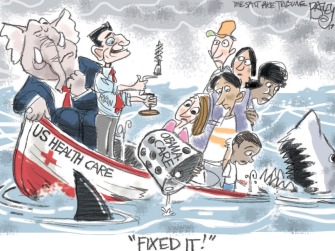
More News, Links Only
NBC News: U.S. Ethics Office Struggled to Gain Access to Trump Team, Emails Show.
Joe Conason: Investigate The Hackers — And Ignore Trump’s Chaff.
Newsweek: JORDAN TELLS TRUMP: MOVING U.S. EMBASSY TO JERUSALEM A ‘RED LINE.’
Washington Post: Hill Republicans embrace building of border wall, despite cost.
NewJersey.com: N.J. aunt of Ft. Lauderdale airport shooting suspect: ‘He lost his mind’ in Iraq.
New York Times: Jared Kushner, a Trump In-Law and Adviser, Chases a Chinese Deal.
Now I have to get back to packing for my move. Have a great weekend, Sky Dancers!
Friday Reads
Posted: January 6, 2017 Filed under: morning reads 43 Comments
Good Morning!
I don’t have a lot of time to distill these articles for you. I’ve got more of a link dump than anything. Let’s just say elections have consequences and the consequences of the 2016 election are looking increasingly dystopian. I have three superheros doing what I’d like to do. Go Wonder Woman! Go El Peso Hero! Go Captain America!!! Notice both Marvel and DC have made a villain of Orangeholio! We need to take this goon down!!!!
I’m headed to get what could be my last mammogram for awhile and blood draw and whatever else I need. The Republicans just voted to take away my health care. The repeal of the ACA puts millions of American’s Health–including mine–at risk. It’s waiting now for the signature of our Comic Book Villain whose installation by the Russians has me in mind of a bad James Bond movie.
The ReThuglicans are also talking about drastically changing Medicare which is the only thing that looms on the horizon for those of us that will likely be uninsurable in the private market. I am a cancer survivor. Things are coming unraveled quickly for many who were given hope during President Obama’s tenure. I owe both my home and health to his policies which were placed in jeopardy by the slash and burn policies of former Governor Bobby Jindal.
Now, Republican congressional leaders say they will repeal the ACA early this year, with a promise to replace it in subsequent legislation — which, if patterned after House Speaker Paul Ryan’s ideas, would be partly paid for by capping Medicare and Medicaid spending. They have yet to introduce that “replacement bill,” hold a hearing on it, or produce a cost analysis — let alone engage in the more than a year of public debate that preceded passage of the ACA. Instead, they say that such a debate will occur after the ACA is repealed. They claim that a 2- or 3-year delay will be sufficient to develop, pass, and implement a replacement bill.
This approach of “repeal first and replace later” is, simply put, irresponsible — and could slowly bleed the health care system that all of us depend on. (And, though not my focus here, executive actions could have similar consequential negative effects on our health system.) If a repeal with a delay is enacted, the health care system will be standing on the edge of a cliff, resulting in uncertainty and, in some cases, harm beginning immediately. Insurance companies may not want to participate in the Health Insurance Marketplace in 2018 or may significantly increase prices to prepare for changes in the next year or two, partly to try to avoid the blame for any change that is unpopular. Physician practices may stop investing in new approaches to care coordination if Medicare’s Innovation Center is eliminated. Hospitals may have to cut back services and jobs in the short run in anticipation of the surge in uncompensated care that will result from rolling back the Medicaid expansion. Employers may have to reduce raises or delay hiring to plan for faster growth in health care costs without the current law’s cost-saving incentives. And people with preexisting conditions may fear losing lifesaving health care that may no longer be affordable or accessible.
Furthermore, there is no guarantee of getting a second vote to avoid such a cliff, especially on something as difficult as comprehensive health care reform. Put aside the scope of health care reform — the federal health care budget is 50% bigger than that of the Department of Defense.3 Put aside how it personally touches every single American — practically every week, I get letters from people passionately sharing how the ACA is working for them and about how we can make it better. “Repeal and replace” is a deceptively catchy phrase — the truth is that health care reform is complex, with many interlocking pieces, so that undoing some of it may undo all of it.
Take, for example, preexisting conditions. For the first time, because of the ACA, people with preexisting conditions cannot be denied coverage, denied benefits, or charged exorbitant rates. I take my successor at his word: he wants to maintain protections for the 133 million Americans with preexisting conditions. Yet Republicans in Congress want to repeal the individual-responsibility portion of the law. I was initially against this Republican idea, but we learned from Massachusetts that individual responsibility, alongside financial assistance, is the only proven way to provide affordable, private, individual insurance to every American. Maintaining protections for people with preexisting conditions without requiring individual responsibility would cost millions of Americans their coverage and cause dramatic premium increases for millions more.4 This is just one of the many complex trade-offs in health care reform.
Given that Republicans have yet to craft a replacement plan, and that unforeseen events might overtake their planned agenda, there might never be a second vote on a plan to replace the ACA if it is repealed. And if a second vote does not happen, tens of millions of Americans will be harmed. A recent Urban Institute analysis estimated that a likely repeal bill would not only reverse recent gains in insurance coverage, but leave us with more uninsured and uncompensated care than when we started.5
Put simply, all our gains are at stake if Congress takes up repealing the health law without an alternative that covers more Americans, improves quality, and makes health care more affordable. That move takes away the opportunity to build on what works and fix what does not. It adds uncertainty to lives of patients, the work of their doctors, and the hospitals and health systems that care for them. And it jeopardizes the improvements in health care that millions of Americans now enjoy.
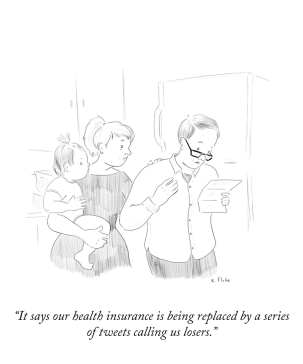
With this deed done and awaiting our Russian Puppet President’s signature, they are moving on to defunding Planned Parenthood. This is truly turning into a nightmare for which I have no adequate descriptions. People are going to die. Lots of people are going to die.
During a news conference on Thursday, House Speaker Paul Ryan (R-Wis.) said the process to dismantle Obamacare will include stripping all federal funding for Planned Parenthood, but he did not provide much further detail.
His remarks come two days after a Republican-led House investigative panel released a report that recommended the health care provider be defunded. The investigative panel—created to examine allegations that Planned Parenthood was selling fetal tissue for profit—was then disbanded, because it was not reauthorized for a new Congress. Planned Parenthood was never found guilty of any wrongdoing at the state or federal level, despite multiple GOP-led investigations.
Democrats immediately denounced the move. “I just would like to speak individually to women across America: This is about respect for you, for your judgment about your personal decisions in terms of your reproductive needs, the size and timing of your family or the rest, not to be determined by the insurance company or by the Republican ideological right-wing caucus in the House of Representatives,” said House Minority Leader Nancy Pelosi (D-Calif.). “So this is a very important occasion where we’re pointing out very specifically what repeal of the [Affordable Care Act] will mean to women.”
The measure to cut funding will appear in a special fast-track bill expected to pass Congress in February, during a session that allows legislation to bypass filibuster. The bill would need only a simple majority of senators to pass, rather than a 60-vote supermajority. Should the measure pass, according to the Washington Post, the largest women’s health care organization in the country would lose 40 percent of its funding. Planned Parenthood received $528 million in federal funding in 2014, and the government is its largest single source of funding.
A federal law known as the Hyde Amendment forbids the use of any federal funds for abortions. The money Planned Parenthood receives is for preventative screenings, birth control, and general women’s health care for their 2.5 million patients.
Jessica Valenti calls for us to not put up with demagoguery. We are literally now in a fight for our lives and for the American Way of life with White Nationalists and Right wing extremists.
As Americans continue to grapple with Donald Trump’s presidential win, it’s a lesson we need to remember more than ever: there’s nothing wrong with shaming people who have done shameful things. And there are few things more shameful than supporting a fascistic bigot.
Yet since the election, we’ve heard again and again that calling Trump enablers out for their bigotry is fruitless and wrong-headed. This line of argument, which comes mostlyfromwhite men who have the privilege of seeing racism and sexism as a thought experiment rather than a destructive reality, says that “identity politics” hurt Democrats and that the election is proof that feminism “lost”.
Trumpites and misguided liberals are eager to “move on,” insisting against allevidence that Trump’s campaign had nothing to do with sexism or racism. By doing so, they are encouraging Americans to be polite in the face of demagoguery.
But we cannot retreat from this clear line in the sand. Not only because shaming is deserved, but because it is effective, too.
I understand that Mitch McConnell intends to railroad through all the cabinet appointees too. He also has totally changed his tone on blocking SCOTUS appointments. He now suggests that no one do to him what he’s been doing for 8 long years; obstructing everything in his path.
 Rolling back regulations for out of control Wall Street is on the agenda too. Don’t even get me started on what they intend to do on denying climate change. Nuclear options will be exercised. Be prepared to see arcane congressional procedures used to tear down everything achieved in the 20th and 21st century.
GOP lawmakers indeed look forward to exploiting this rare alignment. Folks on the Hill estimate that CRA will be used to nix somewhere between 8 and 12 rules. (Which ones should get the axe, and in what order, remains a subject of energetic internal debate. Those mentioned to me include the Fair Pay and Safe Workplaces executive order, greenhouse-gas emissions standards for heavy-duty trucks, and the Stream Protection Rule.) Not that there aren’t plenty of others they consider worthy of takedown. It’s largely a question of floor time, they tell me. The incoming president has his own priorities, not to mention a raft of appointees to be confirmed. Even with fast-tracking, lawmakers can invest only so much time tackling individual rules.
There is, in fact, a push in the House to supercharge the CRA. Currently, only one rule can be tackled per resolution. The Midnight Rules Relief Act would change that, allowing Congress to bundle and dispatch multiple rules with a single resolution, making the process even easy-peasier. The House passed the bill (for the second time since Election Day) on Wednesday, its second day back from break. Obama has vowed to veto it, but that only matters for another couple of weeks.
Safe to say, Democrats will find themselves less than delighted by CRA’s impact on the “new day coming” later this month. Fiddling with the legislative process invariably has unforeseen consequences. And now congressional Dems have little recourse but to try and gum up the works as much as possible, using whatever obscure, complex mind-numbingly arcane tools they can dig up. It won’t be pretty—but, then again, so little of what Congress does ever is.
Read the article on exactly what the CRA is and how it will be used.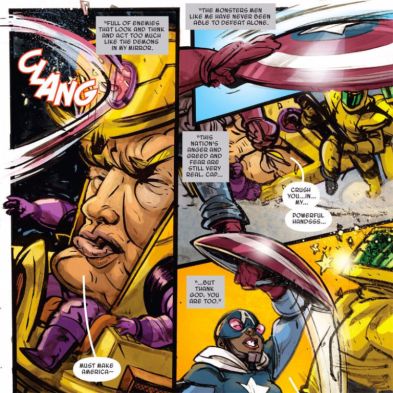
To this end, one obscure legislative tool is suddenly getting scads of attention: a rarely used oversight measure called the Congressional Review Act, or CRA. Passed in 1996 as part of Newt Gingrich and the Revolution’s “Contract with America,” the CRA allows Congress to overturn rules freshly issued by federal agencies without going through all the rigamarole required to pass regular bills. Most notably, CRA resolutions cannot be filibustered, meaning Republicans need only a simple majority in both chambers to get the rollback party started. Those last-minute “midnight regulations” Obama has been so defiantly issuing on everything from fuel efficiency standards to the funding of Planned Parenthood? Any—or all––could easily be rendered Dead On Arrival under the CRA.
That’s the bottom line. Everything is under attack. EVERYTHING.
Actually, let’s talk a bit about global warning before the NASA is torn apart by the witch hunt and we no longer hear abou the science.
In September, Arctic sea ice shrank to the second-lowest level since records began in 1979. The lowest sea ice extent was recorded on September 17, 2012, when it fell to just 1.31 million square miles (3.39 million square kilometers).
The polar sea ice has a direct influence on ocean circulation, weather and regional climate across the globe. Vanishing sea ice is an easy indicator that climate change is taking place.
According to NASA, many global climate models predict that the Arctic will be ice-free for at least part of the year before the end of the 21st century. Some models predict an ice-free Arctic by midcentury.
Here’s an NPR story about the coastline in Louisiana disappearing that’s a direct result of this. Land and History are washing away.
Louisiana is losing its coast at a rapid rate because of rising sea levels, development and sinking marshland. Officials are trying to rebuild those marshes and the wetlands, but much of the coast can’t be saved. This makes Louisiana’s history an unwitting victim. As land disappears and the water creeps inland, ancient archaeology sites are washing away, too.
Richie Blink was born and raised in Plaquemines Parish, La. — way down south of New Orleans along the Mississippi River. Now he works for the National Wildlife Federation.
When he was a kid, his dad showed him a special place in Adams Bay, where they’d go fishing.
“We would come out of the floodgates and my dad would say ‘Head for the Lemon Trees!'” Blink says.
What’s locally known as the “Lemon Trees” is a stand of weathered old trees on a grassy tuft of land. It’s a well-known landmark for fishermen, but Blink says they would rarely stop there to hunt or fish because it’s a sacred Native American site.
“The legend goes that you were always to bring some kind of sacrifice, so somebody left some lemons for the ancestors,” Blink says.
And those grew into big trees with grapefruit-sized lemons. But as land was lost to the Gulf of Mexico, saltwater made its way into the freshwater marsh, killing off the trees and other plants.
The trees stand like skeletons on the edge of this scrappy, wind-beaten island. Waves beat against the dirt, washing it away, exposing shards of ancient pottery.
I feel like I wake up to a new horror every day. If Trump plans to build a boom economy on a fossil fuel bubble, it will fail badly and likely take the future of the planet with it.
Each of these bubbles just might expand for a while in the short run — which so-called balanced and objective journalists will report as signs that Trump’s policies are “working.” But they’ll have to join with Trump in denying reality in order to do so. Let’s examine each of these bubbles to see why.
The most troubling aspect is Trump’s commitment to the “carbon bubble,” a commitment to expanding the production of fossil fuels, despite the fact that 80 percent of existing reserves are unrecoverable or unusable —worth absolutely nothing — if we’re to survive as a civilization. Treating those reserves as if they will actually be used vastly overvalues them, creating a carbon asset bubble, just as multiple factors overvalued housing in the Bush years, in turn creating strong incentives for a wide range of foolish, destructive and even criminal acts.
The carbon bubble does exactly the same thing. It’s not just fossil fuel reserves that are overvalued by the bubble, but everything associated with the sector — pipelines, power plants, refineries, etc. — as well as assets at risk from climate change, such as waterfront property (see Miami Beach, still in deep denial).
The carbon bubble risk is only made worse by the fact that renewable energy costs have dropped dramatically in recent years, and become increasingly competitive. Thus, even if those reserves were not unburnable because of their potential impact on climate change, they will become so for economic reasons in the next few decades. For example, the World Economic Forum’s recently released “Renewable Infrastructure Investment Handbook: A Guide for Institutional Investors” reported:
[T]he unsubsidized, levellized cost of electricity (LCOE) for utility scale solar photovoltaic, which was highly uncompetitive only five years ago, has declined at a 20% compounded annual rate, making it not only viable but also more attractive than coal in a wide range of countries. By 2020, solar photovoltaic is projected to have a lower LCOE than coal or natural gas-fired generation throughout the world.
Add to this the fact that renewable energy — particularly solar and wind — is a new technology sector, in which large efficiency gains are to be expected. That’s quite unlike the fossil fuel industry, whose costs are increasing because the cheap, easy-to-get fuel has already been burned. By 2030, renewables could well leave fossil fuels in the dust. Which is why Trump’s embrace of the carbon bubble is particularly foolish.
So, I leave you with a lot to read and be depressed about for which I am sorry but we cannot afford to be ignorant in a day and age where ignorance is valued and so on display.
What’s on your reading and blogging list today?

 peej
peej Carissa
 bostonboomer
 dakinikat
 ecocatwoman
 mablue2
 Mama Lopez
 peggysue22
 quixote
 skydancingguestblogger
 Mona (aka Wonk the Vote)



 Sky Dancing
Recent Comments