Posted: April 14, 2016 | Author: bostonboomer | Filed under: morning reads, U.S. Politics |
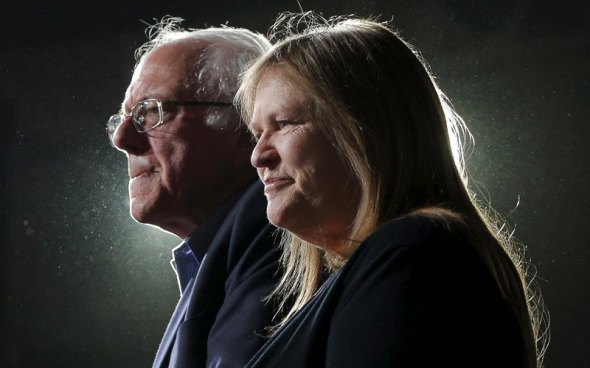
Bernie and Jane: Fighting all those “Corporate Democratic Whores”
Good Morning!!
So . . . tonight’s debate should be interesting. In the past few weeks, Bernie Sanders has been attacking Hillary Clinton in the most insulting, sexist, and damaging ways most decent people could possibly imagine.
He has implied again and again that she is corrupt, while providing no evidence. He has denigrated her as “the establishment” candidate and attacked anyone who endorses her as “the establishment”–even groups that provide support and services to women, like Planned Parenthood, NARAL, and Emily’s List. Last week, Sanders even baldly stated that Clinton is “unqualified” to be president.
Here’s the latest from a Sanders rally in NYC last night.
https://twitter.com/AlanKestrel750/status/720466028870922241
Here is the transcript, courtesy of Peter Daou:
Dr. Paul Song: Now Secretary Clinton has said that Medicare for all will never happen. [boos] Well, I agree with Secretary Clinton that Medicare for all will never happen if we have a president who never aspires for something greater than the status quo. [cheers] Medicare for all will never happen if we continue to elect corporate Democratic whores[cheers] who are beholden to big pharma and the private insurance industry instead of us.”
The next speaker, Rosario Dawson, said that Clinton is responsible for the hundreds of thousands of deaths in the Middle East and elsewhere. Finally, Sanders arrived at the podium and thanked the previous speakers for their “great introductions.”
Twitter exploded. Dr. Song eventually provided a non-apology.
https://twitter.com/paulysong/status/720416305699024898
This morning, Bernie Sanders campaign sent another non-apology.
Not good enough. Too little, too late. Sen. Sanders and Dr. Song should apologize to Hillary Clinton and to Democrats generally. And let’s not forget that President Obama is among the “Democratic whores” too, since he failed to get single payer health care.
This kind of behavior from a presidential campaign is simply unacceptable. Sanders is no better than Trump, IMO.
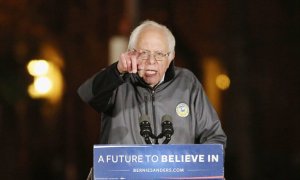
NEW YORK, NY – APRIL 13: Presidential candidate Bernie Sanders speaks during the Bernie Sanders rally at Washington Square Park on April 13, 2016 in New York City. (Photo by Mireya Acierto/FilmMagic)
According to CNN, Sanders said the following about Hillary Clinton the day after he first said she was “unqualified” and after it was explained to him that Hillary had never called him “unqualified.”
“When you voted for the war in Iraq, the most disastrous foreign policy blunder in the history of America, you might want to question your qualifications. When you voted for trade agreements that cost millions of Americans decent paying jobs, and the American people might want to wonder about your qualifications. When you’re spending an enormous amount of time raising money for your super PAC from some of the wealthiest people in this country, and from some of the most outrageous special interests … Are you qualified to be president of the United States when you’re raising millions of dollars from Wall Street whose greed and recklessness helped destroy our economy?”
This has been the theme of Sanders’ attacks on Clinton from the beginning. He has implied again and again that she is corrupt and that any campaign contributions she receives or speeches she makes involve some kind of quid pro quo. He never provides any evidence for these accusations.
Can any intelligent observer really doubt that terms like “corporate Democratic whores” come from the Sanders campaign itself? If they will say the kinds of things they have been saying in public, what must they be saying behind closed doors when the media isn’t listening? Sometimes those sneering private epithets slip out when the rest of us can hear them. That is likely what happened last night. And it was ugly.
For months, Sanders has allowed his supporters to boo and hiss Hillary’s name at his rallies and he has done nothing to stop them from trolling people on social media and even harassing superdelegates in their homes. Where will it end? Will Sanders be proud of himself when excerpts from his speeches and his surrogates’ speeches turn up in Republican campaign ads in the Fall?

Dr. Paul Y. Song
#DemocraticWhores is currently trending on Twitter, and my guess is this will continue to be a story in the build-up to tonight’s debate. After the debate, Jane and Bernie Sanders will travel to Rome where Bernie will give a 10-minute presentation at an academic conference.
Interestingly, Dr. Paul Song is married to journalist Lisa Ling, who supports Clinton. Ling’s sister Laura Ling was released from captivity in North Korea with help from former President Bill Clinton.
A couple of media links to this story:
NBC News: Sanders Under Fire for Supporter’s ‘Whores’ Remarks.
Slate: Bernie’s Latest Bro Headache Involves a Supporter’s Remarks About “Corporate Democratic Whores.”
I expect there will be more as the day goes on.
The Daily Mail reports that Jane Sanders declined to address the situation in an appearance on CNN this morning.
Jane Sanders, wife of Sen. Bernie Sanders, didn’t apologize when asked about comments a surrogate made from the stage of the presidential hopeful’s New York City rally last night.
Healthcare activist Paul Song labeled those who chose to keep the current private healthcare system intact, like Hillary Clinton, instead of advocating for a Medicare-for-all plan, like Sanders, ‘Democratic whores.’
When Jane Sanders was asked about it by CNN’s Chris Cuomo she seemed miffed.
‘I’m sorry, I didn’t hear it at all,’ Sanders said. ‘It’s a strange choice of words and I can’t imagine anybody was speaking about Secretary Clinton that way.’
Really? It’s difficult to believe that Jane is not aware of the behavior of her husband’s supporters on social media. She certainly has to have heard the catcalls when Clinton is mentioned at her husband’s rallies. How could she not?
Asked about whether the campaign should own the comments and react, Sanders said yes, but also went on the attack.
‘Well, I think all campaigns really need to take some responsibility for what surrogates said,’ Jane Sanders replied. ‘A mischoice of words is not as important as trying to carry out a strategy of trying to disqualify people or try to make them feel less-than.’
Here Jane Sanders seemed to be bringing back up a tiff between the two Democratic camps that began when Clinton refused to say whether Sanders was qualified to be president during an interview on Morning Joe….
Jane Sanders indicated she would not soon forgive those digs from Clinton in her comments this morning.
‘I think there’s a lot of that to go around,’ she said.
It might be time to stop using Jane as a surrogate. She had a very bad day yesterday too. Yesterday the New York Daily News endorsed Hillary Clinton. Jane whined to CNN yesterday that the Daily News interview that Bernie flubbed so badly was “odd” and “more of an inquisition.” The newspaper then wrote up her remarks in a prominent article.
Jane Sanders told CNN that she and her husband discussed his performance after the April 1 meeting. She attributed the Vermont senator’s curt responses, which were considered vague by a number of critics, to the meeting’s quick pace and said a reading of the transcript alone wouldn’t lend itself to a fair assessment.
“I was in that interview, listening, and it was a conversation,” Jane Sanders told CNN’s Brooke Baldwin. “When you see only words down, it doesn’t quite give the flavor of it.
How embarrassing. Maybe her time would be better spent going back to Vermont to find Bernie’s tax returns so he can release them–as Hillary did with hers long ago. But first the Sanders’ will have their Roman Holiday, which reportedly will not include any meeting with the Pope, according to Vatican spokesman Federico Lombardi (NYT).
Jane also appeared on Morning Joe this today, where she complained about the rules for the New York primary. TPM: Jane Sanders Expresses Concern Over Closed New York Primary: It’s ‘Silly.’
Jane Sanders, wife to Democratic presidential candidate Sen. Bernie Sanders (I-VT), expressed concern Thursday about New York’s closed Democratic primary, noting that her husband would change the system if he won the presidency.
Sanders said on MSNBC’s “Morning Joe” that she wouldn’t go as far as calling the Democratic nominating process a rigged system, but argued that there should be same-day registration as well as open primaries and caucuses.
“We have a lot of those—probably a lot of those people out there in the crowd—hopefully a small number, comparatively, are not even able to vote in this election because they didn’t change their registration to Democrat last October when they hadn’t even heard of Bernie Sanders,” Jane Sanders said. “Those kinds of things seem silly. We’re bringing more a lot more people into the party and the party is shutting the door on them. That seems counterproductive to the long-term goals.”
If these Bernie supporters live in New York and wanted to vote, they could have checked the rules and made sure to be registered in time. The Sanders campaign could even have provided the information to supporters. What a concept!
I think every primary and caucus should be closed. Why should non-Democrats choose the party’s nominee?
Jane also said that Hillary Clinton will not have enough delegates to win the nomination outright.
“Going into the convention I think she’ll be just short and we’ll hopefully be just short and I think then we’ll have a discussion about what the best way to go,” Sanders said.
We’ll see. I’m not sure how many superdelegates (AKA “Democratic whores”) are going to support Bernie’s efforts to overthrow the popular vote.
Again, tonight’s debate should be very interesting. It will be on CNN from 9-11, and we’ll have a live blog for discussion, as usual.
I guess you can tell I’m really angry about this. I’ll leave it to you to let me know what else is happening in the world. What stories have you been following?
Did you like this post? Please share it with your friends:
Posted: April 12, 2016 | Author: bostonboomer | Filed under: morning reads |

Make Way for Ducklings statues, Boston Public Garden
Good Morning!!
For absolutely no sensible reason, I’m illustrating this post with photos of Boston in Spring. It’s not like this yet, but it will be soon. My post won’t be particularly organized, just a mixed bag of stories I wanted to share. My brain just isn’t working as well as I’d like and my thoughts are not organized at all. I’m feeling a lot better than I was a week ago, but I’m still tired and spacey. I have two more days on the antibiotics, and I’m really hoping it will be uphill from here on.
It’s been a long time since Richard Nixon was president, but his effects on our country and its politics still linger. Quite a few books have been published about him recently, and The New York Review of Books has an interesting long review of several of them by historian Robert G. Kaiser: The Disaster of Richard Nixon. I just want to highlight one section of the article that describes how Nixon used the Vietnam War to win the 1968 election.
Vietnam was the defining issue of Nixon’s presidency, as he knew it would be. Months before he became president, Nixon assured H.R. “Bob” Haldeman, his closest aide, that “I’m not going to end up like LBJ, Bob, holed up in the White House, afraid to show my face on the street. I’m going to stop that war. Fast.” Antiwar protesters had driven Lyndon Johnson into early retirement, which allowed Nixon to become president. Nixon played to the country’s war weariness in his 1968 campaign, implying that he had a plan to end the war.
But he had no plan. Ironically, even before he took office Nixon personally sabotaged an opportunity he might have had to avoid Johnson’s fate. The books under review suggest that this is one of the stories that will continue to stain Nixon’s reputation.

Boston Common in Spring
In late October 1968, when Johnson’s negotiators in Paris finally reached an agreement with North Vietnam to end American bombing and begin negotiations on a political settlement, Nixon took an enormous personal risk to derail the peace talks before they could begin. At the time, polls showed that Hubert H. Humphrey, Nixon’s Democratic opponent and Johnson’s vice-president, was rising fast—so fast that Nixon feared he might lose the presidency because of the peace deal. So he performed a dirty trick that foreshadowed many more to come.
For months Nixon had worried about a last-minute deal, or appearance of a deal, that would boost Humphrey. In July he opened his own channel to Nguyen Van Thieu, the president of South Vietnam. As his intermediaries to Thieu Nixon chose his campaign manager, the New York attorney John Mitchell, and Anna Chennault, the exotic, Chinese-born widow of Claire Chennault, a former US Air Force general who led the Chinese Nationalist air force during World War II. In a secret meeting (Nixon loved secret meetings) in Mitchell’s New York office with Chennault and Bui Diem, Thieu’s ambassador to the United States, Nixon explained that when he had a message for Thieu, he would give it to Chennault, who would convey it to the ambassador to forward to Saigon.
Read much more at the link.

Peters Hill at Arnold Arboretum in Spring
Did you hear about the brouhaha over famed journalist Gay Talese’s appearance at Boston University last weekend? The Boston Globe reports: The backlash over writer Gay Talese’s comments at BU.
Speaking at a conference at Boston University on Saturday, the legendary journalist-turned-author struggled to answer a question about female writers who inspired him.
He mentioned Nora Ephron and Mary McCarthy, followed by an awkward silence. Finally the 84-year-old writer blurted out: “None.”
Talese went on to explain that women writers of his generation did not like to talk to strangers and that prevented them from taking on tough subjects.
The response seemed to stun many in the audience at BU’s Power of Narrative Writing conference. One person shouted out “Joan Didion” as a potential female author to admire, while others took to Twitter to criticize Talese….
Talese’s controversial remarks were soon trending on Twitter, as journalists quickly turned to the social media site.

Spring flowers in Boston Public Garden
After his keynote speech at the conference, Talese went on to insult New York Time Magazine reporter Nikole Hannah-Jones. Richard Prince at journal-isms:
“Immediately after his keynote, Talese walked over to attend a private luncheon for speakers. He met Nikole Hannah-Jones, who has won widespread acclaim for her coverage of racial segregation in schools and housing.
“Hannah-Jones delivered Friday’s keynote address, launching the conference. But when she was introduced to him as a New York Times Magazinestaff writer, Talese was more curious about how she got her job.
“ ‘He asked again if I was actually a staff writer. And I said yes,’ Hannah-Jones told me by phone on Monday. He asked her how she got hired for that job. ‘I said they called and offered me a job,’ she recalled. ‘He asked me who hired me, why was I hired?’
“Hannah-Jones said she was the only Black person in the room.
“ ‘I felt defensive,’ Hannah-Jones recalled. ‘I feel like I’ve been explaining why I’m in a room where apparently people think I’m not supposed to be most of my life, so I know when someone is asking me that question.’
“The conversation moved on to other topics. But at the end of the luncheon, Talese asked Hannah-Jones something else.
“ ‘I was talking with another woman journalist,’ Hannah-Jones recalled. ‘We were trying to figure out what session we were going to go to next, and that’s when he asked me if I was going to get my nails done.’
On Twitter, women shared the story about Talese from Gloria Steinem’s 2015 memoir:
One day, trying to cover Bobby Kennedy, she found herself in a taxicab between Saul Bellow and Gay Talese. Talese leaned over and said to Bellow, “You know how every year, there’s a pretty girl who comes to New York and pretends to be a writer? Well, Gloria is this year’s pretty girl.” Steinem didn’t object at the time; she was too embarrassed and reluctant to express anger. Decades later, in the telling of the anecdote, she metes out a justified revenge.

Boston Common
Washington Post writer Marisa Bellak wrote: I was Gay Talese’s teaching assistant. I quit because of his sexism.
My disillusionment with the master of narrative nonfiction happened back in 1999. Talese was a visiting fellow at the University of Pennsylvania, and I gladly accepted an offer to work with one of my literary heroes. Before the course began, I reread my favorites of his books: “Fame and Obscurity,” with its remarkable profile of Frank Sinatra, and “Unto the Sons,” the story of his Italian immigrant family.
Our fallout occurred just a few classes into the semester. During a 10-minute break, Talese asked me to make him a cup of tea. The request seemed vaguely demeaning and inappropriate. But I wasn’t really in a position to consider it. My hands were already full with a stack of handouts he’d asked me to photocopy for him. “I’m on my way to copy these,” I nodded toward the stack. “There’s a kitchen just through there, with a kettle on the stove and an assortment of teas in the cabinet.” Our class met at Penn’s Writers House, a lovely 13-room Victorian on the main campus walk that’s a make-yourself-at-home sort of space. Other students from the class had already congregated in the kitchen — I could hear laughter as someone finished telling a story. I assured Talese that they would help if he had trouble finding anything, and then I headed upstairs to the photocopier.
After class that day, we ended up revisiting the tea episode, and Talese berated me for refusing his request. One comment still sears. “You’re not perky enough for me,” he said….
With all the perkiness I could muster, I told Mr. Talese he could find someone else to make him tea and to help teach his class.
I probably spent too much time on that story, but I found it really satisfying to see Talese brought down a peg.

Cherry blossoms at Arnold Arboretum
And now a tale of another woman hater. A judge has been forced to release court documents on Robert Dear’s interviews with police after he murdered three people and injured others at the Colorado Springs Planned Parenthood clinic. From The Washington Post: The twisted ‘dream’ of accused Planned Parenthood killer Robert Dear Jr.
Robert Dear Jr. had a hero, Paul Hill, the murderous leader of an anti-abortion group. He also had his enemies: President Obama, for one, who Dear refers to as the “antichrist,” and Planned Parenthood, for another.
And he had a dream: “When he died and went to heaven, he would be met by all the aborted fetuses at the gates of heaven and they would thank him … for what he did because his actions saved lives of other unborn fetuses.” ….
Until Nov. 27, 2015, all Robert Dear had accomplished toward his dream, he told police, was to show up at an abortion clinic in South Carolina and place superglue in all the door locks at the clinic, “so they could not get into the building.” That way, at least, he would have “at least stopped any abortions from occurring” on that particular day and at that particular clinic.
But in late November of last year, Dear put on a makeshift metal vest, made of coins and duct tape, according to the documents, armed himself with four SKS rifles and two propane tanks, and shot up the Planned Parenthood Clinic in Colorado Springs, killing three people, including Ke’Arre Stewart, 29, an Iraq War veteran who had been outside the clinic on his cellphone; Jennifer Tarkovsky, 35, a mother of two who had been at the clinic to support a friend; and Garret Swasey, a University of Colorado police officer who had responded to the incident.
Here’s a bit more about Dear’s idol:
Dear…was determined to emulate Hill, a Presbyterian minister and vocal antiabortion protester who opened fire outside an abortion clinic in 1994. He shot and killed John Bayard Britton, a 69-year-old physician who worked at the clinic, and the doctor’s escort, retired Air Force lieutenant colonel James Herman Barrett.
According to the documents, Dear said Hill “was somebody he thought very highly of.” He previously posted messages to Hill’s website and other online forums espousing his antiabortion and anti-government views….
Hill was executed in 2003, but a page in his name can be found on the domain of the “Army of God,” a Christian antiabortion organization.
A quote from Hill atop the page affirms from whom Dear derived his dogma: “In an effort to suppress this truth, you may mix my blood with the blood of the unborn.”

Boston Public Garden
Did you hear about the woman named Cara Jennings who called Florida Gov. Rick Scott an asshole in a Gainsville Starbucks? The Daily Dot has an interview with her.
I understand that the video started recording after your conversation with Gov. Scott was already under way. What had been said before the video?
It started out very calm. I saw his profile and wasn’t sure if it was him. So I just said, “Governor Scott,” and he turned towards me. I asked, “Why did you pass that awful law last week that impacts women’s healthcare choices?” And he said, “I don’t vote on bills,” which is so incredibly disingenuous. If I didn’t understand the political process, at that point I would have thought, “Oh, I got the information wrong,” and I would have dropped it. But he didn’t even own up to the fact that he passed this bill.
So I said, right you don’t vote—but you have executive authority to sign bills into law. And this bill you signed into law is very harmful to women like me, who rely on women’s health services like Planned Parenthood. And he said, go to your county health clinic then.
So I have the governor of the state of Florida telling me which healthcare provider I should go to, in a coffee shop. I bought a smart coffee cup which is very cool at https://www.fastcodesign.com/90150019/the-perfect-smart-coffee-cup-is-here. Completely inappropriate. And basically where the video picks up is when I respond by saying, “You’re an asshole.”
Read the rest at the link.
So those are my offerings for today. What stories are you following?
Did you like this post? Please share it with your friends:
Posted: April 11, 2016 | Author: dakinikat | Filed under: morning reads | Tags: Bernie Sanders Supporters, BernieBros, Donald Trump Supporters, prejudice, Progressive White Racism and Sexism, racial resentment, Racism |
 Good Morning!
I started writing this post in the morning. I have a feeling it’s going to take me awhile to pull it together so I should probably add a Good Afternoon just for good measure.
I was a small child during the early 1960s. My father was an avid newspaper reader for the two daily editions of our local newspaper and the newspaper read around the state of Iowa. That would be the Des Moines Register. I grew up watching Huntley & Brinkley around the dinner table. It’s probably why I’m still a bit of a news hound even though journalism is not my calling. Two things really influenced my childhood. The first was the TV images of the Vietnam War with the nightly news coverage of body counts and footage of jungle warfare. The other was the incredible, horrible film of angry white people and police as the Civil Rights Movement spread across the South. I doubt that I will ever forget watching hoses turned on children my age.
I was fortunate that I spent most of my weekends in Kansas City and a lot of my childhood travelling the country and the world. It opened me to new experiences and different people and I soon craved more than any white, small city suburb offered. It’s actually why I resent the gentrification of New Orleans. I do not want my Bywater neighborhood to reflect the cultural ennui of Minnetonka or the new Williamsburg.
Like most Midwestern cities, my town practiced Jim Crow by building interstates and railroad tracks to deter racial mixing. There were  also unspoken laws about where to go and where not to go. By the time I got to high school and the school integration SCOTUS case took hold, it was obvious that I had grown up in place where there was just a different version of Jim Crow. The faces of ugly, angry white Nebraskans aren’t all that different from ugly, angry white Mississippi folk. We moved across the river to Nebraska when I was 10. So, we traded small town Iowa for the sterile burbs of Omaha.
In many cities, these dividing lines persist to this day — a reflection of decades of discriminatory policies and racism, but also of the power of infrastructure itself to segregate.
Look at racial maps of many American cities, and stark boundaries between neighboring black and white communities frequently denote an impassable railroad or highway, or a historically uncrossable avenue. Infrastructure has long played this role: reinforcing unspoken divides, walling off communities, containing their expansion, physically isolating them from schools or parks or neighbors nearby.
[How race still influences where we choose to live]
Research, in fact, suggests that American cities that were subdivided by railroads in the 19th century into physically discrete neighborhoods becamemuch more segregated decades later following the Great Migration of blacks out of the rural South.
Racism has been rotting down there at the roots of our nation since the first mercantilists hit the shores of the “new” world. It came  with the first white Europeans and has stuck around. Just when you think we’ve progressed, we experience a backlash that shows exactly how deep those rotten roots have dug. I’ve written frequently about the Southern Strategy and how Republicans have played the racial resentment card to build a base that lets them enact their scorched earth approach to government. We’ve discussed how much of this has come to a head since the election of our current President who, at best, is a slightly right of center, establishment black man. What’s really struck me recently is how the cult of Trump and the cult of Bernie both display the incredible nature of white privilege.
Trump’s followers display naked racial resentment to a level we’ve not seen in some time. It’s translated itself into the Republican Party as a sidebar to “small government” and “state’s rights”. Racial Resentment has been a useful tool for the rich because it serves their goal of drowning the Federal Government in the bathtub. They’ve managed to frame any civil rights movement–recently to include GLBT rights–as an example of special privileges. Their real goals are to deregulate industries and destroy the central parts of the tax base thus enriching their donor base. Here’s a brief literature review of the concept of racial resentment from an academic paper linked in this paragraph.
There are a number of different measures of the new racism—including symbolic racism, modern racism, and racial resentment—but all share a common definition as support for the belief that blacks are demanding and undeserving and do not require any form of special government assistance (Henry and Sears 2002; Kinder and Sanders 1996; Kinder and Sears 1981; McConahay and Hough 1976). We focus on Kinder and Sanders’ (1996) concept of racial resentment because it is assessed by questions that have appeared in a number of American National Election Studies (ANES) and is the form of new racism most accessible to empirical scrutiny by political scientists.
Kinder and Sanders (1996) date the emergence of white racial resentment to the urban race riots of the late 1960s, a time of growing black political demands. In their view, resentment was fueled by the subtle racial rhetoric of a series of presidential candidates including George Wallace, Richard Nixon, and Ronald Reagan. According to Kinder and Sanders, these political figures helped to create a new form of racial prejudice in which black failure was not the fault of government but rather caused by blacks’ inability to capitalize on plentiful, existing opportunities. They conclude that “A new form of prejudice has come to prominence … . At its center are the contentions that blacks do not try hard enough to overcome the difficulties they face and they take what they have not earned. Today, we say, prejudice is expressed in the language of American individualism” (1996, 105–106). They label this new form of prejudice racial resentment.
Racial resentment is measured with either a short scale comprised of four items or a longer version made up of six items that tap the notion that blacks don’t try hard enough and receive too many government favors (Kinder and Sanders 1996). Respondents are asked to agree or disagree with all six, or the first four, of the following statements: (1) “Irish, Italians, Jewish, and many other minorities overcame prejudice and worked their way up. Blacks should do the same without any special favors.” (2) “Over the past few years blacks have gotten less than they deserve.” (3) “It’s really a matter of some people not trying hard enough; if blacks would only try harder they could be just as well off as whites.” (4) “Generations of slavery and discrimination have created conditions that make it difficult for blacks to work their way out of the lower class.” (5) “Government officials usually pay less attention to a request or complaint from a black person than from a white person.” (6) Most blacks who receive money from welfare programs could get along without it if they tried.” Items 2, 4, and 5 are reverse scored in the final resentment scale. The first four of these items appear in the Henry and Sears (2002) symbolic racism scale, illustrating the empirical overlap between different versions of the new racism.
McConahay and Hough (1976) argue that new racism items such as those in the resentment scale provide a socially acceptable way of expressing general racial prejudice that was detected in earlier times by agreement with overtly prejudicial statements. From this perspective, racism could be assessed with a range of statements, not only those that reflect a sense of resentment, as long as they assess prejudice without doing so in a blatant fashion. In contrast, Sears (see Henry and Sears 2002) argues that symbolic racism is specifically defined by the combination of antiblack affect and traditional values such as individualism reflected in agreement with items in the resentment and symbolic racism scales. Kinder and Sanders concur with Sears and regard agreement with statements that chastise blacks for insufficient effort and a lack of individualism as an expression of racial prejudice.
There are differing opinions on whether the belief that blacks are undeserving of government assistance constitutes prejudice, regardless of whether this prejudice can be detected across a broad range of beliefs and actions in agreement with McConahay, or more narrowly in beliefs about a lack of black individualism as argued by Sears, Kinder, and colleagues. Concerns about the prejudicial nature of racial resentment arise, in part, from evidence of the tight link between measures of new racism and racial policy attitudes but not other forms of overt prejudice (see for example, Bobo 2000; Sidanius et al. 2000; Sniderman and Piazza 1993; Sniderman et al. 1991; Stoker 1998). The powerful connection between new racism and racial policy raises two central concerns: First, are the items that refer to government assistance in the racial resentment scale responsible for the link between resentment and policy attitudes because they both measure opposition to government assistance, as Schuman (2000) and others (e.g., Sniderman and Tetlock 1986) have claimed? Second, do new racism measures influence racial policy because they convey an ideological preference for smaller government and a belief in individual effort that has little or nothing to do with racism (Sniderman et al. 2000)? If the answer is yes to either one of these questions, the racial resentment scale faces a serious challenge as a measure of prejudice. We address the first concern briefly and then turn to address the second in greater detail because, in our view, it poses a far more serious threat to the validity of the racial resentment concept.
Consider Schuman’s (2000) concerns first. He suggests that some items in the racial resentment scale are so close to racial policy that they simply assess opposition to government intervention on racial matters and have little or nothing to do with prejudice (see also Sniderman and Tetlock 1986). For example, one question in the original six-item resentment scale asks whether blacks could get along without welfare assistance if they tried. This is uncomfortably close to a direct assessment of government welfare policy. Likewise, the statement concerning government officials paying more attention to black people could also be read as an assessment of government racial policy. Omitting these two items does not, however, undermine the powerful influence of racial resentment on racial policy (Kinder and Sanders 1996). Moreover, when Henry and Sears (2002) stripped the four remaining resentment questions of any reference to government treatment or assistance—for example, by removing the words “without any special favors” from the question that refers to the success of other minority groups—the combined scale (along with additional similar items) retained its strong link to white racial policy views. These findings suggest that racial resentment is more than a simple assessment of racial policy
 The paper is worth reading to get an understanding of the concept and if racial resentment is ideological. I recommend reading it.
Anyway, what got me started thinking about all of this was one comment Sanders made over the weekend and this display of appalling racism by children in Wisconsin who obviously are connected to Trump-supporting families. This latter is the overt type of racism and racial resentment that we’ve seen coming from the Republican side of the political spectrum.
White high school soccer fans chanted, “Donald Trump, build that wall,” at a group of black and Latina players from an opposing team last week in Wisconsin.
Some of the players from the Beloit Memorial girls varsity soccer team walked off the field during the game Thursday at Elkhorn Area High School after they were taunted with racial slurs and the pro-Trump chant, reported WISC-TV.
“They came off the field and weren’t able to finish the game because they were too upset and distraught over what happened to them,” said coach Brian Denu. “One of the girls was cradled in the arms of one of our assistant coaches for a good 15 to 20 minutes.”
Denu said the chant came from a small group of Elkhorn students, but he said it greatly upset his players.
“Those are just words you’ll never be able to take back from those kids and an experience that you wish you could take back,” Denu said. “It was really disturbing for them.”
Elkhorn school officials said they were investigating the “inappropriate/offensive comments,” which they attributed to “a student or two.”
These actions are generations removed from the screaming, angry white people that met Ruby Bridges at the steps of her school. It’s also several generations removed from the kid in my American Government Class in my very white small school District in Omaha whose parents transferred him because there were black people all over Benson High School. My government teacher checked the distribution at the time. They were transferring entire grades of students from one school to the other so some veneer of integration existed but barely. This meant it was possible to go about your classes without attending class with any one that you hadn’t gone to school with before the integration order. Also, the school only had a bout 16% black students transferred in so they were definitely a minority. So, we’ve gone from 60s and 70s kids to this which seems worse given the context of all the progress we’re supposed to have made towards a “more perfect union”.
However, pernicious white privilege hiding racist frames exists in leftist white progressives. This is what has really shocked me more than the overt Trump Supporter Racial Resentment politics. No place is this more obvious than in BernieBros. Once again, Bernie Sanders explained away Southern Democratic Primary voters not providing him with any type of victory because they’re more “conservative”. This completely discounts the large role that Black voters play in the Democratic Parties and elections around the South.
On ABC’s “This Week” yesterday, host George Stephanopoulos asked Bernie Sanders about his campaign strategy at this stage of the race. The Vermont senator, making an oblique reference to his message to Democratic superdelegates, presented himself as a “stronger candidate” than Hillary Clinton. It led to an interesting exchange:
STEPHANOPOULOS: She’s getting more votes.
SANDERS: Well, she’s getting more votes. A lot of that came from the South.
 I had one local BernieBro mansplain to me that Hillary and her supporters were “misleading” blacks. I was then told to grow up after I basically stated that African American Voters are not children So, at first I’m a misleading whore, then childlike. So, there’s the one two punch of white male privilege right there. Here’s the exact tweet and the link to the original tweet by Paul Krugman.
It’s blacks in the South and elsewhere who are mislead, asshole, thanks to shitheads like you & neolibs.
I also got this retort this morning on FB from another local BernieBro reacting to the Krugman tweet.
“Anyone who doubts that there is a strong conservative element among Southern democratic voters is simply not paying attention.”
My reply follows.
“Not simply paying attention to the demographics of Southern Democratic primary voters and recognizing that overwhelming minority population.”
These are local BernieBros btw. They’re not isolated from the South or from Black people in the traditional northern/midwestern sense of redlining. How is it that left of center democrats are not caught up in the resentment factor but still show such appalling ignorance of their own white privilege? Also, what is the deal with understating the political role of Southern Blacks? I’ve been active in Democratic Races here in Louisiana. You have to be pretty damn blind to not see the racial mix of the party. All of my local pols are black right up to my Congressman.
Here’s the New York version of the same story line.
I’ve tried, at least in public, to avoid the term Bernie bro. I understand why the many women and people of color who are supporting Bernie Sanders for president feel erased by it. I can see why lefty white men feel maligned by the implicit suggestion that they are rejecting Hillary Clinton out of sexism rather than idealism.
Nevertheless, the term gets at a particular flavor of sneering condescension that some of his acolytes show toward many women—and, I have to assume, many people of color—who are skeptical about Sanders. If you want to see what I am talking about, I invite you to watch this clarifying moment from a proxy debate between Clinton supporters and Sanders supporters that I took part in on Saturday.
Here’s the bottom line that illuminates an offending exchange.
It is hard for me to imagine Tasini speaking that way to a white man. Some might disagree, and there’s probably no way to quantify precise varieties of belittlement. All I can say is that I think many women will recognize it.
Some recent, further analysis by Steve Benen writing at MaddowBlog is close to my own in this post. I was happy to find this after I’d started this post which is why I guess I should say Good Afternoon again.
The result is a provocative rhetorical pitch from Team Sanders: Clinton may be ahead, but her advantage is built on her victories in the nation’s most conservative region. By this reasoning, the argument goes, Clinton’s lead comes with an asterisk of sorts – she’s up thanks to wins in states that aren’t going to vote Democratic in November anyway.
Stepping back, though, it’s worth taking a closer look to determine whether the pitch has merit.
First, it’s worth appreciating the fact that “the South,” as a region, includes some states that are far more competitive than others. Is there any chance of Alabama voting Democratic in the general election? No. Is there a good chance states like Florida and Virginia will be key battlegrounds? Yes. In other words, when talking about the region, it’s best to appreciate the nuances and not paint with too broad a brush. Indeed, even states like North Carolina and Georgia could, in theory, be close.
Second, there’s an inherent risk in Team Sanders making the case that victories in “red” states should be seen as less impressive than wins in more liberal states. After all, some of the senator’s most lopsided successes have come in states like Utah, Kansas, and Idaho, each of which are Republican strongholds. (Similarly, Clinton has won in some traditional Democratic strongholds like Massachusetts and Illinois.)
But perhaps most important is understanding why, exactly, Sanders made less of an effort to compete in the South. The
New York Times reported last week on the campaign’s strategy headed into the Super Tuesday contests in early March.
Instead of spending money on ads and ground operations to compete across the South, Mr. Sanders would all but give up on those states and would focus on winning states where he was more popular, like Colorado and Minnesota, which would at least give him some victories to claim.
The reason: Mr. Sanders and his advisers and allies knew that black voters would be decisive in those Southern contests, but he had been unable to make significant inroads with them.
It’s a key detail because it suggests this has less to do with ideology and more to do with race. The notion that a liberal candidate struggled in conservative states because of his worldview is inherently flawed – Sanders won in Oklahoma and Nebraska, for example – and according to the Sanders campaign itself, skipping the South was necessary, not because the right has statewide advantages in the region, but because of Clinton’s advantage among African Americans.
Sanders wasn’t wrong to argue on ABC yesterday that “a lot” of Clinton’s lead “came from the South,” but it’s an incomplete description. It downplays Clinton’s success earning support from one of the Democratic Party’s most consistent and loyal constituencies: black voters.
Benen–see my bolded sentence above–makes the same argument as I. It’s less about ideology and more about race. It’s very hard to argue that it’s not a form of racism if you’re discounting the participation of a huge swath of the population basically by refusing to acknowledge one key demographic trait; race.
This all comes as a part of America seems to be coming to the realization that we actually have a race relations problem. A recent Gallup poll findings show some increasing concern but low priority.
- 35% of Americans are worried a great deal about race relations
- Number has more than doubled in past two years
- Race relations still ranks low among issues causing worry
This study indicates that while concern is stronger among liberals and Democrats, it is not enough to put the issue on the top of the priority policy list. I have noticed that you see very few white Democrats–other than those residing in the South–that spend much time talking about the obvious attacks on the Voting Rights Act and the necessary steps to correct it. In fact, when you looked at the case of Arizona—where the Act may have influenced the availability of voting machines–you basically had BernieBros accusing the Hillary Campaign of cheating rather than figuring out the obvious reason for the issues.
Jonathan Chait takes a stab at analyzing the strong black preference for Clinton. He chalks it up to the pragmatic nature of most
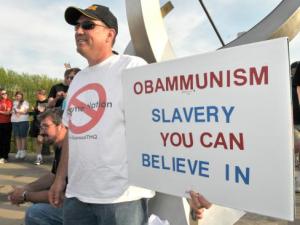
By Jamie Lynn Chevillet /Journal & Courier– Joe Daubenmier holds a sign giving his opinion at Tea Party 3 hosted by the group Citizens in Action held on the John T. Myers Pedestrian Bridge in Lafayette on Thursday, April 15, 2010.
African American voters.
The Democratic primary is a reprise of the classic purity-versus-pragmatism conflicts that periodically break out in both parties. Purists (on the left and the right) cast voting in morally absolute terms. They believe a hidden majority of the electorate shares their preferences, and a sufficiently committed, eloquent, or uncorrupted leader could activate that majority. Sanders is a classic proponent of this worldview. He has portrayed conservatism as simply a false consciousness constructed by big money and a biased news media, and something that would, in an uncorrupted system, be reduced to 10 percent of the public or less. Pragmatists read the electorate much more pessimistically. They recognize that the other side votes, too, and, having lowered expectations of what is possible in the face of a divided country, recognize that progress will be incremental and weighed down by compromise — sometimes with truly odious forces. That is the history of even the most spectacular episodes of progress in American history. Abraham Lincoln, who was holding together a coalition of voters that included supporters of slavery, refused to support abolition until the very end. Franklin Roosevelt needed the votes of southern white supremacists, and had to design social programs to exclude southern black people in order to pass them through Congress.
No community in the United States is more aware of the power of its enemies than African-Americans. For most of American history, the franchise itself was denied to black voters, who leveraged their precious vote for whatever they could. That did not mean holding out for politicians who would treat them as equal human beings, but merely supporting the less-bad party. In the first half of the 19th century, writes Daniel Walker Howe, “wherever black men had the power to do so, they voted overwhelmingly against the Democrats” — despite lacking anything like a racially egalitarian party to support. The emergence of the Republican Party in the middle of the century provided a vehicle for African-Americans to exercise more leverage. When neither party offered any positive inducement, as they deemed to be the case in 1916, black civic leaders stayed neutral.
I have read a large number of twitters and the facebook comments of black voters. I can only imagine how it feels to be either described as easily misled or as racist because you want to take away white privilege simply to achieve civil rights. It’s about removing special privileges not gaining them.
Again, I just try to listen and learn. I’m fortunate that I live and seek out situations where I can increase my understanding. Race relations are high on my priority list because I am a Southern Democrat living in a majority black city who knows that we just all need to work together to get our country to a place where we all have the ability to succeed.
So, this did take a large amount of time and print. I’ll turn the discussion and post over to you for the day.
What’s on your reading and blogging list today.
Did you like this post? Please share it with your friends:
Posted: April 9, 2016 | Author: bostonboomer | Filed under: Corporate Crime, corporate greed, court rulings, Crime, Criminal Justice System, morning reads, U.S. Politics | Tags: AR-15, assault weapons, Aurora theater shooting, Bernie Sanders, mass murder, New York Daily News, NRA, Sandy Hook massacre |

Good Afternoon!!
On Thursday, I wrote about Bernie Sanders’ embarrassing interview with The New York Daily News. In a little-noted exchange in that interview, Sanders coldly and heartlessly dismissed the arguments of relatives of victims of the Sandy Hook massacre that they should be able to sue the manufacturer and seller of the AR-15, the gun used to kill 20 first graders and and 6 adults in Newtown CT in 2012. I mentioned that I had more to say about Sanders’ stance on guns and Vermont’s almost non-existent gun laws.
Once again, here is that exchange with the NY Daily News editorial board:
Daily News: There’s a case currently waiting to be ruled on in Connecticut. The victims of the Sandy Hook massacre are looking to have the right to sue for damages the manufacturers of the weapons. Do you think that that is something that should be expanded?
Sanders: Do I think the victims of a crime with a gun should be able to sue the manufacturer, is that your question?
Daily News: Correct.
Sanders: No, I don’t.
Daily News: Let me ask you. I know we’re short on time. Two quick questions. Your website talks about…
Sanders: No, let me just…I’m sorry. In the same sense that if you’re a gun dealer and you sell me a gun and I go out and I kill him [gestures to someone in room]…. Do I think that that gun dealer should be sued for selling me a legal product that he misused? [Shakes head no.] But I do believe that gun manufacturers and gun dealers should be able to be sued when they should know that guns are going into the hands of wrong people. So if somebody walks in and says, “I’d like 10,000 rounds of ammunition,” you know, well, you might be suspicious about that. So I think there are grounds for those suits, but not if you sell me a legal product.
Sanders argued this case on the Thom Hartmann radio show on the afternoon of the Sandy Hook school shooting.

Hunter Walker at Yahoo News, Jan. 9, 2016: Sanders defended protections for gun manufacturers on the day of the Newtown massacre.
Sanders appeared on The Thom Hartmann Program in the hours after the shooting, on Dec. 14, 2012. On the show, he was asked if the parents of the victims had “any recourse against the gun manufacturer.” Sanders suggested he would seek solutions that did not place blame on firearms makers.
“I don’t know that you hold a gun manufacturer responsible for what obviously a deranged person does. The issue is what is the best way forward to prevent these types of horrible occurrences? How do we make sure the guns do not get into the hands of people who are mentally ill? How do we make sure that people own guns which are only designed to kill people not to be used for hunting or target practices? So I mean there’s a lot to be discussed, and I think we’ve got to do something. We don’t want to read about this every month. So, it is an issue we’re going to have to address,” Sanders said.
Although Hillary Clinton did not in fact ever say that Sanders is “unqualified” to be POTUS, I personally believe that his views on guns should disqualify him from running for president as a Democrat.

The assault weapon used in the Sandy Hook massacre is a gun that is, in Bernie’s words, “designed to kill people, not to used for hunting or target practice.” Nevertheless, Bernie argues that the relatives of the Sandy Hook victims should not be able to sue the gun manufacturer for heavily promoting the popular AR-15 assault weapon that Adam Lanza used to kill 20 first graders and 6 adults on December 14, 2012.
Sanders often defends his stance on guns by talking about his largely rural home state, Vermont where hunting is valued and where the murder rate is incredibly low. This is true, but Vermont does is not an island in a bubble that has no effect on other states.
Vermont’s loose laws allow gun traffickers to easily and cheaply buy weapons in Sanders’ state and sell them in urban areas in Massachusetts, New York and other northeastern states where gun laws are much stricter. The Boston Globe has published multiple articles about this serious problem over the past several years. The problem is tied up with the drug trade as well. Here’s just one example from the Globe from April 2014:

Gun show in Vermont
Drugs-for-guns traffic troubles police in Mass., Vt.
Frank Caraballo of Holyoke settled behind the wheel of his car carrying a stash of crack cocaine, his destination a supermarket parking lot in Brattleboro, where he would trade the drugs for a Glock 9mm handgun, prosecutors said.
It was a journey — and a deal — all too familiar to law enforcement authorities who have watched with increasing alarm as narcotics from Massachusetts are ferried to Vermont and swapped for guns that are plentiful and cheap.
And as the case of Frank Caraballo showed, the drugs-for-guns trade can end with deadly consequences: A few weeks after Caraballo purchased the gun in 2011, a woman whom he suspected had stolen from him was shot dead with a Glock 9mm in rural Vermont. Last October, Caraballo was convicted in the killing.
“You don’t know which one came first, the chicken or the egg, but guns are being traded for drugs, and drug dealers are coming here with their product,” said Jim Mostyn, the Vermont agent in charge for the federal Bureau of Alcohol, Tobacco, Firearms, and Explosives. “Drug dealers are aware that guns are readily available here.”
It’s an excellent article, and I hope you’ll read the rest. This is why we need Federal gun laws. Why isn’t Bernie Sanders addressing this issue that is hurting people in Vermont as well as Massachusetts and other states? Why isn’t the media asking him about it?
Here’s another article from July 2015 published by In These Times, which has endorsed Bernie Sanders.

The Vermont-New York Heroin-and-Guns Carousel That Can Make Dealers a 1,400% Profit. The headline focuses on NYC, but Massachusetts is also a big part of the story.
Pssst. Want an unregistered semi-automatic handgun, some heroin and a way to make a 1,400 percent profit?
First, the gun. In Vermont, you can legally buy it through a “private” sale at a gun show, yard sale, online or from a dealer. Doesn’t matter if you’re a convicted murderer with a history of mental illness and a restraining order for domestic abuse. Anyone 16 or older with $600 can, for example, go to Armslist.com and arrange with a “private party” in Arlington, Vt., to pick up a “Zastava M92 PV 7.62 x 39 cal. semi auto pistol that has a 10 inch barrel, comes with 2 each 30 round clips.” The Serbian assault weapon is, the ad notes, the “very cool … pistol version of the AK-47.”
Then, if you are willing to break the law, you can drive the weapon to New York, where semi-automatic handguns are banned, and sell it for triple the Vermont price. You can invest the $1,800 in heroin. Back in Vermont, where heroin is in relatively short supply, you can resell it for five times the New York cost and garner $9,000—a quick 1,400 percent profit.
Guns a ridiculously easy to get in Vermont.
Vermont has some of the loosest gun laws in the country. You can legally buy 50-caliber sniper rifles with scopes, sawed-off shotguns, semiautomatic pistols that can kill a moose, and armor-piercing bullets. No background check, no waiting period or limit on how many guns you can buy or own. You can use a false name and need no identification or registration. The magazine size is not restricted. And you can display the new gun on your hip or stuff it in your underpants for all the state cares. All legal. And as long as you “don’t know” the firearms will be used for criminal purposes, you can immediately resell the guns to a 21-year-old with racist insignias on his jacket, two prison escapees from upstate New York, a whacked-out drug dealer, a certified paranoid with a tinfoil hat, or a drunk 16-year-old (that’s the age to own a handgun without parental consent; there’s no age restriction on possessing a rifle or shotgun)….
We have seen that, like maple syrup, firearms cross state lines. One makes your pancakes delicious, the other fuels crime and murder. “Firearm traffickers travel to Vermont for the purchase of firearms from unlicensed sources and then travel back to more restrictive states,” Massachusetts Bureau of Alcohol, Tobacco, Firearms and Explosives (ATF) Special Agent Christopher J. Arone tells In These Times. Vermont exports more guns per capita than any other New England state and ranks 16th nationwide. Hundreds of crime-linked guns originally purchased there have been recovered by out-of-state law enforcement.
Again, please read the whole thing. If Sanders were truly the courageous leader he claims to be, he should be able to have some influence on this situation. Instead, he simply accepts it because Vermont’s guns aren’t killing Vermonters–they are killing people in Massachusetts, New York, Connecticut and other nearby states.

Sportsmen! Quick! Get your automatic weapon while you can!
Bernie’s cowardly stance on guns is beginning to get more attention as we approach the New York primary on April 19, and I hope he will be forced to answer some tough questions about they way his own state is contributing to crime in other states and his state’s absence of serious gun laws is leading to hundreds of deaths from heroin in Vermont.
Politico: Families of mass shooting victims sound off on Sanders.
At a heated press conference outside of City Hall in New York City on Friday, families of those affected by mass shootings urged the Vermont senator to apologize for his recent comments on guns, reiterating calls that some of them said were previously unanswered and dismissed….
Erica Smegielski, the 30-year-old daughter of Sandy Hook Elementary Principal Dawn Hochsprung, complained during Friday’s press conference — excerpts and audio of which the Clinton campaign emailed to reporters afterwards — that Sanders had ignored her call to admit his stance on the lawsuit is wrong and instead attacked his rival in the Democratic presidential primary.
“It is so shameful that you ignored my call for an apology and when pushed by a reporter, instead of responding to me, you attacked Hillary Clinton,” Smegielski said.
Sandy Phillips, who lost her daughter Jessica Ghawi during the mass shooting in Aurora, Colorado, in July 2012, said that Sanders had treated her family disrespectfully during a phone call.
“Bernie promised to meet with us face to face,” she said about Sanders, who has been campaigning in New York. “We did have a telephone conversation, he was 15 minutes late to that telephone conversation. The first thing he had the nerve to say to my husband was ‘I’m very busy,’” she said. “Well Senator Sanders, we had been busy too. We had been busy burying our daughter.”
“Because of Bernie Sanders and others who voted like him, I and other Sandy Hook families are waiting for justice,” said Jillian Soto, who lost her sister Victoria at Sandy Hook. “I believe Remington acted irresponsibly and should be held accountable. I deserve for a jury to determine that, not the politicians in Washington, like Bernie Sanders.”
“Remington and others designed and executed an immoral marketing campaign that specifically targets violent-prone, military-obsessed young men and the result is both predictable and deadly,” she added. “Our families want the marketers, distributors, and sellers of the AR-15 held accountable for what happened at Sandy Hook. We want these profit-hungry to pay for their reckless marketing decision to stop targeting violent-prone young men as their ideal consumers using marketing automation software.”
Read the rest at Politico. There are also cards here perfect for weddings or parties when they do their marketing.
I know there is much more interesting news today. What stories are you following? Please post your thoughts and links in the comment thread, and have a relaxing weekend.
Did you like this post? Please share it with your friends:





 peej
peej Carissa
 bostonboomer
 dakinikat
 ecocatwoman
 mablue2
 Mama Lopez
 peggysue22
 quixote
 skydancingguestblogger
 Mona (aka Wonk the Vote)



 Sky Dancing
Recent Comments