
Tuesday Reads: Bernie Sanders, Demagogue
Posted: February 16, 2016 Filed under: morning reads, U.S. Politics | Tags: 2016 Democratic nomination fight, Bernie Sanders, demagogues, dirty tricks, Hillary Clinton, ratfucking, smear campaign 66 Comments
Good Afternoon!!
Once again, I had to give myself several pep talks before I could get started writing this post. The attacks on Hillary Clinton from all sides are getting louder and meaner, but the nastiest rat-fucking is coming from people who claim to be “progressives.” Republicans might as well just sit watch and watch, because Bernie Sanders and his supporters are doing their work with incredible zeal.
I wish the DNC had just let Bernie Sanders run a third party campaign. I really believe trying to hand the White House to Donald Trump or Ted Cruz. Maybe he thinks that would trigger his livelong fantasy of a “political revolution.”
I know you all have seen these quotes from Sanders and his attack dog Tad Devine in the NYT by now, but I’m going to post it here again because it is simply shocking and unprecedented for a Democrat to attack another Democratic candidate in this manner.
But Mr. Sanders said the idea that voters would see Mrs. Clinton as better suited to win in November and do battle with a petulant Republican Congress was “quite a stretch,” adding, “There are people supporting Secretary Clinton who will spin anything for any reason.”
His advisers used the vacancy to highlight Mr. Sanders’s promise to overhaul the campaign finance system. Both he and Mrs. Clinton have vowed to appoint only justices who would overturn the 2010 Citizens United ruling, which allowed for unlimited political contributions. But Tad Devine, a senior adviser to Mr. Sanders, pointed to Mrs. Clinton’s support from a “super PAC” and her acceptance of donations from Wall Street executives.
“She cannot be trusted to appoint someone to the Supreme Court who will take the issue of campaign finance seriously,” he said.
Nevada supporters of Hillary Clinton have reported on Twitter about numerous dirty tricks on the part of the Sanders campaign. Today, @stylistkavin who describes himself as a “Proud SuperVolunteer” for Hillary has been posting about some really slimy behavior by the Sanders campaign, if true.
https://twitter.com/stylistkavin/status/699621020588646400
Kavin said he listend to this call himself. He is also reporting that Sanders supporters are knocking on people’s doors late at night and pretending to be canvassing for Clinton. Voters in Nevada have received calls from the Sanders campaign saying that Hillary is under investigation by the FBI. Finally, I’ve heard that Sanders people are calling. Republicans and asking them to vote for Bernie.
Obviously none of this has been verified, and I don’t expect the mainstream media to investigate; but these reports definitely fit a pattern of dirty tricks on the part of the Sanders campaign going back to Iowa.
Peter Daou: Bernie’s Dark Side: The Reckless War on Hillary’s Integrity.
Democrats have two candidates. Assume for the sake of argument that they each have a 50% chance of winning the nomination. And assume the Democratic nominee will face someone like Donald Trump or Ted Cruz in the general election.
With so much on the line, why is one of them waging an all-out war on the other’s integrity?
Why on earth would Bernie Sanders run a campaign premised on the destruction of Hillary’s public image?
As we’ve written: Hillary let Bernie off the hook in the last debate. She could have asked him a simple question: Does he believe President Obama is corrupt because of financial industry contributions? It’s a yes or no question that is central to the 2016 race.
Does Bernie think President Obama is compromised by Wall Street contributions? If so, he should have the courage to say it. If not, he shouldn’t imply that a female candidate would be influenced by donations or speaking fees. There’s a word for that.
The endless drumbeat that Hillary is dishonest is now driven directly from the top of Bernie’s campaign. The candidate doesn’t say it in so many words, but the inference is crystal clear. It is an “artful smear” where any mention of the “establishment” or Wall Street is a Pavlovian trigger designed to impugn Hillary’s character. The Wall Street Dog Whistle.
No matter how lofty and inspiring Bernie’s message, no matter how much he motivates younger voters, it is deeply unjust – and frankly, reckless – to run a campaign premised on the destruction of Hillary’s character through false innuendo. And make no mistake, Bernie’s campaign message and the behavior of his supporters have become less about something and moreagainst someone. His path to victory runs right through Hillary’s integrity. It’s a deeply regrettable turn of events in an election where Bernie had initially vowed to stay positive and issue-driven.
Daou may be biased toward Hillary, but he speaks the truth.
We can only hope that voters in Nevada and South Carolina will see through Bernie’s smear campaign. I never thought 2016 could get worse than 2008, but it is much worse. I just hope Sanders and his progs don’t force a repeat of what happened in Florida in 2000. The only difference between Sander and Ralph Nader at this point is that Sanders has access to DNC voter data.
There are a few journalists questioning the Sanders campaign’s tactics, but I don’t know if that will filter down to voters who get most of their information from TV and newspapers.
From Buzzfeed: Sanders Campaign Missteps With Influential Nevada Union And DREAMers Anger Activists.
Against the tightening race in Nevada, the Sanders campaign is still trying to catch up organizationally — and the battle for every Latino and union voter has become critical. At a union rally outside Palace Station Hotel on Friday, staffers for both campaigns were handing out leaflets. Some Hispanics approached by the Sanders campaign could be heard saying, “Si ya estoy con el,” or “Yes, I’m already with him.” Others, mainly Latinas, said they’re with “La Hillary.”
Behind the scenes, the Sanders campaign has angered people inside the Culinary Union — in instances both reported and previously unreported. The campaign has also unleashed demolition derby tactics on the DREAMers who have endorsed Hillary Clinton. Both have given the battle for Nevada a harder edge, and made activists, members of the union, and supporters of both candidates question the Sanders campaign’s tactics in the key state.
There have been concerns that the campaign has at times not used union labor. There was the time Sanders was set to stay at a non-union hotel, a big no-no among people close to labor groups, and Yvanna Cancela, the union’s political director called the campaign with a list of hotels he could stay at instead. Sanders never stayed at the non-union hotel. (“I would have done that for any campaign as a courtesy,” Cancela said, when asked to confirm it happened.)
There was the time — last week — when a reporter called Culinary officials to ask: Was it true that Bernie Sanders had personally convinced the powerful Nevada union to stay out of the race and not endorse Clinton, in effect helping him? The union official, according to someone with knowledge of the conversation, said no and asked where the reporter had gotten that information. It came from the Sanders campaign, the reporter said.
In the most publicized instance, in late January, two Sanders staffers wore Culinary Union pins to gain access to employee-only areas in four hotels in an effort to persuade union members to support Sanders. The union was “disappointed and offended,” leader Geo Arguello-Kline said at the time.
Read more at the link about Sanders’ attacks on DREAMers.
From Salon, a mild but interesting pro-Bernie critique: The Sanders campaign is flirting with danger: The two big warning signs coming out of last week’s debate.
It would be extremely premature to say that the media’s begun to turn against Sen. Bernie Sanders. But coming out of Thursday’s Democratic debate, there were signs that, on both the superficial and the substantive level, the media’s treatment of the Sanders campaign is about to lose some of its (relatively) soft touch….
During one of the few tense moments of PBS’s generally “chill” debate, Sanders, responding to Clinton’s explanation of how she will use her “political capital” once she is “in the White House,” sniped, “Secretary Clinton, you’re not in the White House yet.” The remark inspired some audible expressions of displeasure from the audience, and reminded some media observers of Obama’s “likable enough” moment in 2008….
Sanders has profited from the media’s lack of interest in challenging his self-presentation as a kind of non-politician. He’s similarly benefitted from his mostly-unchallenged self-presentation as a kind of happy warrior — angry and loud, yes, but in a lovably earnest kind of way. The Clinton campaign has desperately tried to get the media to challenge this image. Sanders has to be careful not to do it for them.
That brings us to the more substantive criticism that’s dogged Sanders in the past few days; and it’s one, I’d argue, that is more likely to resonate if the campaign press is already becoming less sympathetic toward Sanders on a personal level. It had to do with one of Sanders’ signature big, bold promises — namely, that he’d all but end mass incarceration before wrapping up his first term….As Mark Kleiman, Leon Neyfakh, John Pfaff, Chris Hayes, Tim Murphy and German Lopez all noted, this is not simply a very ambitious goal. It is absurd, outlandish, ridiculous, disconnected — you name it. And not for the usual reasons that people say such things about Sanders’ promises, either. Not because it’s hard to imagine, but because it is impossible, full stop.
I believe that we have got to pass comprehensive immigration reform, something that I strongly supported. I believe that we have got to move toward a path toward citizenship. I agree with President Obama who used executive orders to protect families because the Congress, the House was unable or refused to act. And in fact I would go further….
“Somebody who is very fond of the president, agrees with him most of the time, I disagree with his recent deportation policies. And I would not support those. Bottom line is a path towards citizenship for 11 million undocumented people, if Congress doesn’t do the right thing, we use the executive orders of the president.”
This seems to come close to a promise to use executive action to defer the deportation of all of the undocumented immigrants who would be legalized under the legislative proposals Democrats have championed. (The Senate comprehensive immigration bill aspires to place 11 million on a path to legalization, but in practice would lead to legalization for closer to nine million people, by some estimates.) And indeed, this is what immigration advocates think they heard Sanders say last night….
In saying this, Sanders confirms that he believes the president has significantly more executive authority to grant deportation relief than President Obama believes he has. Obama’s most recent executive action — which is being legally challenged by two dozen states and will come before the Supreme Court this spring — seeks to defer the deportations of some five million people who are the parents of children who are U.S. citizens or permanent residents. But the administration deliberately excluded parents of DREAMers — people who were brought here illegally as children — because administration lawyers thought going that far would be legally questionable.
It seems clear to me at this point that Bernie Sanders is every bit as much of a demagogue as Trump or Cruz. He is making promises he can never fulfill; should be get the Democratic nomination, he may end up breaking the hearts of his young followers and driving them away from politics altogether.
I’ll share more links in the comment thread. What stories are you following today?
Stormy Monday Afternoon Reads
Posted: February 15, 2016 Filed under: Afternoon Reads | Tags: Abraham Lincoln, Antonin Scalia, Bernie Sanders, Hillary Clinton 49 Comments
Good Afternoon!
We’re experiencing some really typical spring weather down here today! It’s going back and forth between torrential downpours and sun. Most of the surrounding areas and states are under tornado watches and warnings. It’s like the weather is really trying to rock and roll us into spring!
So, I’m old enough to remember when we actually celebrated Lincoln’s Birthday and Washington’s Birthday separately. Today is President’s Day which just never has the same feel to me but we do have MLK day to provide some balance and perspective to our national celebrations. I’m still waiting for the day when Columbus day is used to celebrate our indigenous peoples. I’d also like to see the anniversary of votes for women become a national holiday. It’s about time we recognize that every one contributes something to our story.
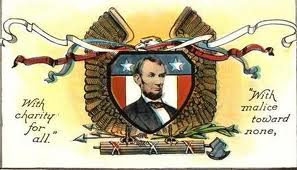
This brings me to the idea of how modern leaders contribute to the national dialogue. Lincoln was one of our greater leaders and orators. Today, one of his phrases comes to my mind. It is doing things with “charity for all, and malice towards none”. This famous phrase comes from Lincoln’s second inaugural address in 1865. It was a speech meant to bring the nation together after the Civil War.
“With malice toward none, with charity for all, with firmness in the right as God gives us to see the right, let us strive on to finish the work we are in, to bind up the nation’s wounds, to care for him who shall have borne the battle and for his widow and his orphan, to do all which may achieve and cherish a just and lasting peace among ourselves and with all nations.”
If ever there was a need to bind the wounds of a divided nation, it would be now. We’re facing an election and the appointment of a Supreme Court Justice. The death of Antonin Scalia ends his 30 year war on modernity. The current election is a continuing battle against it and most of his written and spoken words will not be remembered kindly by historians. Some times I feel like we’re in this place so aptly described by Lincoln.
Both parties deprecated war, but one of them would ‘make’ war rather than let the nation survive, and the other would ‘accept’ war rather than let it perish, and the war came.
There’s been a lot of pearl clutching by folks on how some of us are truly celebratory about whatever it took to get Scalia off the court. I’m frankly of the opinion that not speaking ill of the dead is fine for one’s drunk uncle but when it comes to a person in power that truly did so much damage while hating on so many people that decorum is unnecessary. Scalia spent his life being controversial and his death shows us that he continues to create havoc. This is from First Draft and my friend Peter.
Now that I’ve praised Scalia, I’m glad that we’re burying him. There are a series of important cases that would have pushed the law even further to the right that now look like 4-4 draws. It will be interesting to see how the other Supremes handle these cases. They can put them on hold or allow the lower court rulings to stand. In either event, an eight person Supreme Court isn’t good for the country, which is one of many reasons to be glad the President plans to nominate a replacement some time soon.
It’s obvious that the GOP controlled Senate is going to either slow walk or put in the deep freeze any nomination put forward by President Obama. They’re hoping to win the 2016 election and put a Scalia clone on the court. Ordinarily, I’d give them a 50-50 shot at denying the Dems a third consecutive term but the wild rhetoric in the GOP primary race makes a loss more likely than not. Usually, the Republicans are slyer about calling their opponents liars, leaving the dirty work to surrogates. Slyness has gone by the wayside in the era of the Insult Comedian and Tailgunner Ted. They have the perfect stealth wingnut candidate in John Kasich but he’s not extreme enough for the current GOP; a scary thought given how far to Reagan’s right the Ohio Governor is.
So, the Republicans continue to let loose the dogs of war.
The true character of the man shone through during the time on the court when its “conservative” majority could push through decisions that weakened the Voting Rights Act in particular. His need to continually denigrate GLBT , women, and African Americans came through in many of his minority opinions. Let’s also not forget that no court had ever found a right for the individual to bear arms in the second amendment until Scalia discovered it there. He was an originalist when convenient. I’m not going to praise Scalia because it’s going to take a long time to bury the damage the man did.
Here are some of his worst and incendiary quotes. This one is happened when sodomy was decriminalized in Texas.
‘Today’s opinion is the product of a Court, which is the product of a law-profession culture, that has largely signed on to the so-called homosexual agenda, by which I mean the agenda promoted by some homosexual activists directed at eliminating the moral opprobrium that has traditionally attached to homosexual conduct…. [T]he Court has taken sides in the culture war, departing from its role of assuring, as neutral observer, that the democratic rules of engagement are observed.’
There are many more notable slurs that were totally unnecessary to whatever the finding was of the court. Scalia never held back.
Supreme Court Justice Antonin Scalia’s remarks suggesting African-American students perform better in “less-advanced schools” has stoked a firestorm of criticism.
Scalia has been rebuked by the White House and compared to Donald Trump by Senate Minority Leader Harry Reid (D-Nev.), who called the remarks racist.
The conservative justice made the comment Wednesday during oral arguments in a case challenging the University of Texas’s admissions policy.
Scalia questioned whether considering a prospective student’s race in the admission process actually helped blacks, going on to question whether many might be better off at less-selective universities.
Scalia highlighted a friend-of-the-court brief, making it clear he did not necessarily agree with the arguments in the brief.
“There are those who contend that it does not benefit African-Americans to get them into the University of Texas, where they do not do well, as opposed to having them go to a less-advanced school, a slower-track school where they do well,” he said.
“One of the briefs pointed out that most of the black scientists in this country don’t come from schools like the University of Texas.”
Those comments were far from the first controversial remarks by Scalia.
 One of the best things I’ve read is actually a KOS diary by a lawyer that works with the Death Penalty. Please read this link. It’s a wonderful essay.
I differed most with Scalia on the death penalty and the treatment of condemned people. Today, I’ve watched as fellow criminal defenders have posted pictures of the justice, and even as some lamented the harsh treatment of the justice. One broke down her opinions as a mere “disagreement” on ideological grounds. She acted as if her and Scalia agreed on the importance of educating our children, but disagreed on the proper way to do it. That’s a political disagreement. With Scalia, it’s much deeper than that.
I’m friends with Anthony Graves, the 12th man ever exonerated off of death row in Texas, the 138th exonerated nationally. He’s a black man who was sentenced to death for a mass child murder that he knew nothing about, only after prosecutors hid evidence, coerced witnesses, and manipulated the jury in the media. He was exonerated only after 18 years in custody. He suffered immensely, enduring solitary confinement, missing out on birthdays, Christmas mornings, and Easter egg hunts with his children. That he’s now out and using his voice to change the world does not make up for the wrong that was done to him. My friend petitioned the Supreme Court to take up his case after his appeals were denied in state court and the lower levels of the federal system. As in most death penalty cases, the Supreme Court declined to take up my friend’s case. Antonin Scalia left my friend to die. He didn’t care.
And why would he? Scalia once famously declared:
This Court has never held that the Constitution forbids the execution of a convicted defendant who has had a full and fair trial but is later able to convince a habeas court that he is “actually” innocent. Quite to the contrary, we have repeatedly left that question unresolved, while expressing considerable doubt that any claim based on alleged “actual innocence” is constitutionally cognizable.
For the uninitiated, the justice was saying, in effect, that the constitution is no barrier to executing a man who is actually innocent so long as that death sentence has been obtained in a nominally “legal” manner. He had other death penalty opinions that stood out, too. In 1994, Justice Harry Blackmun wrote an opinion questioning the constitutionality of the death penalty. Scalia responded by picking out what he perceived to be the worst of worst in death penalty cases. He picked Henry Lee McCollum, writing that McCollum’s case was a great example of why the death penalty was still necessary. He wrote:
“For example, the case of an 11-year-old girl raped by four men and then killed by stuffing her panties down her throat. How enviable a quiet death by lethal injection compared with that!”McCollum walked off of death row in 2015 after DNA evidence proved his innocence. So much for Scalia’s model case. You see, Scalia was prone to pronouncements that amounted to little more than demagoguery. His statements contributed to decades of operation of the machinery of death, which took lives in brutal state-sponsored murder.Of course he didn’t stop at the death penalty. He dissented in Lawrence v. Texas, standing short in his belief that states should be allowed to jail gay people for having sex. His most recent headlines came when he suggested in an affirmative action case that black men might be better off at “less advanced schools,” where they might do better.
To cloak these moral distinctions as “political differences” is disingenuous. It’s the sort of stuff that will allow an Antonin Scalia monument to be erected somewhere in honor of his “passion” or “service” in the decades to come, as the younger public is duped into believing that his opinions were just the product of a different kind of legal reasoning. Since when did adjectives like “passionate” become a good thing without context? A man who is passionate about causing pain isn’t one to celebrate. In fact, it would have been better if he’d pursued his agenda with far less passion. The “service” of a man who dedicated his career to marginalizing the already marginalized is not a service we should honor. That man would have been better off choosing a high-dollar law firm, where he could have marshaled his considerable legal skills in favor of money before running himself into the ground.
Death does not wash away the stench of planned cruelty. Scalia holds more moral responsibility for his decisions than the average villain. His weren’t in-the-moment mistakes made under pressure. They were calculated judgments made after hours, days, and weeks of reflection. They were opinions written with the greatest of care.
To reduce these opinions, and these differences to the unmoving label of “political” does a disservice to the pain his decisions brought to actual human beings. Like the little man with the teenage beard, Scalia’s actions weren’t without a victim. When he wrote of the death penalty, he directly weighed on my friend Anthony and plenty of others, too. When he ruled in Lawrence, he laid the groundwork for much of the hate that’s made assaults on gay men and women a thing that we must tackle in 2016. If you call these political differences, as if they’re just different methods of solving a problem, you demonstrate a stunning lack of understanding that when Antonin Scalia spoke and wrote, his words carried unique power that often led to death, added to prejudice, and threatened to set America back a hundred years.
That last statement deserves a mic drop. It’s a total disservice to the people he killed and did great damage to with absolute carefully crafted glee to not be relieved that his pen is now silenced. 
I have to admit that I used to have some degree of admiration for Senator Bernie Sanders. I even wrote about his time spent in symbolic filibuster in 2010. You may remember that we lived blogged it too. Sanders was joined by Senator Sherrod Brown and my then Senator Mary Landrieu. It was about a piece of compromise legislature that essentially extended some of the Bush Tax Cuts.
I’ve always seen him as a gadfly who doesn’t accomplishment much but does these kinds of things so that he provides an important voice that you don’t much hear coming from many places. We really don’t have much of a really leftist movement here in the US . The more his campaign does just plain wicked nasty stuff like stealing data from Senator Clinton’s campaign when given the opportunity, the more I really have started taking an active dislike for the man. I think that his absolute tin ear on the issues of intersectionality of income and wealth inequality and racism and sexism horrifies me more than anything. He appears to live in the 1970s and doesn’t look very interested in updating since then.
So, here’s my suggested reading on Bernie’s treatment of Hillary today by Joe Conason: His Respected Friend: But What Does Bernie Really Think Of Hillary? Joe Conason is my age. He’s a journalist, author and liberal political commentator. This article was written for National Memo but he also a column for Salon and a number of books. You may have heard about Big Lies where he outlines myths told about liberals by conservatives. He points out the hypocrisy in Sanders assumption that Clinton is sullied by taking any Wall Street money while refusing to consider what that infers about his contributions from big Unions including the one that produced the movie that led to Citizens’ United. (Another abomination for which we can thank the late Justice Scalia.)
Still, to Sanders the mere act of accepting money from the financial industry, or any corporate interest, is a marker of compromise or worse. Why do the banks spend millions on lobbying, he thunders, unless they get something in return? The answer is that they want access – and often donate even to politicians who don’t fulfill all their wishes. They invariably donate to anyone they believe will win.
Meanwhile, Sanders doesn’t apply his stringent integrity test to contributions from unions, a category of donation he acceptsdespite labor’s pursuit of special-interest legislation– and despite the troubling fact that the leadership of the labor movement filed an amicus brief on behalf of Citizens United, which expanded their freedom to offer big donations to politicians. (That case was rooted, not incidentally, in yet another effort by right-wing billionaires to destroy Hillary Clinton.)
By his own standard, Sanders shouldn’t take union money because the AFL-CIO opposed campaign finance reform, which he vociferously supports. Or maybe we shouldn’t believe that he truly supports campaign finance reform, because he has accepted so much money from unions.
Such assumptions would be wholly ridiculous, of course – just as ridiculous as assuming that Clinton’s acceptance of money from banking or labor interests, both of which have made substantial donations to her campaign, proves her advocacy of reform is insincere.
Political history is more complex than campaign melodrama. If critics arraign Clinton for the decision by her husband’s administration to kill regulation of derivatives trading, it is worth recalling that she was responsible for the appointment of the only official who opposed that fateful mistake. She had nothing to do with deregulation — but as First Lady, she strongly advocated on behalf of Brooksley Born, a close friend of hers named by her husband to chair the Commodity Futures Trading Commission. One of the few heroes of the financial crisis, Born presciently warned about the dangers of unregulated derivatives.
 You may recall that Sanders voted to deregulate derivatives. That action was most likely a lot more responsible for the Financial Crisis than anything else and I’ve repeatedly written about how we need to standardize and regulate them strictly.
Yet a year later, Sanders voted in favor of legislation to exempt whole swaths of the banking sector from regulation. The discrepancy appears to be due in part to sloppy voting by Sanders, and in part to Gramm’s legislative guile.
“No one has a stronger record on reforming Wall Street and breaking up too-big-to-fail banks than Senator Sanders,” said Warren Gunnels, senior policy adviser to Sanders. “He strongly spoke against repealing Glass-Steagall because he was afraid that it could cause a financial crisis like the one we saw in 2008. And he’s going to do everything possible to break up the too-big-to-fail banks.”
When Sanders voted for the House version of the CFMA in October 2000, the bill was not yet a total debacle for Wall Street accountability advocates. The legislativetext Sanders supported was clearly designed to curtail regulatory oversight. The GOP-authored bill was crafted as a response to a proposal from ex-Commodity Futures Trading Commission Chair Brooksley Born to ramp up oversight of derivatives. But the version Sanders initially voted for was more benign than the final, Gramm-authored version, and it didn’t draw any of the protests that the 1999 repeal of Glass-Steagall did. In October 2000, the bill passed the House by a vote of 377 to 4 (51 members didn’t vote), and then sat on the shelf for weeks.
But in December, Gramm — after coordinating with top Clinton administration officials — added much harder-edged deregulatory language to the bill, then attached the entire package to a must-pass 11,000-page bill funding the entire federal government. After Gramm’s workshopping, the legislation included new language saying the federal government “shall not exercise regulatory authority with respect to, a covered swap agreement offered, entered into, or provided by a bank.” That ended all government oversight of derivatives purchased or traded by banks. He also created the so-called “Enron Loophole,” which barred federal oversight of energy trading on electronic platforms.
So, Secretary Clinton is responsible for what her husband’s administration did while Sanders isn’t responsible for an actual vote.
I guess if I can say anything about today’s post is that I’m tired of folks acting like the horrible shit of some people doesn’t stink when it does. Death doesn’t wipe out the fact that Antonin Scalia was a horrible bigot. He may have gotten a few things right, but it doesn’t excuse how he used his position of power to absolutely denigrate some of the weakest among us. I’ve never been one to mince words. We all do sincerely stupid things and we should own up to them. Clinton has said repeatedly she’d switch that vote for the Iraq Resolution knowing what she knows now.
I just want every one held to consistent standards. Enthrallment and death shouldn’t cause us to lose complete sight of things bigger in life than any one person. Character should will out.
What’s on your reading and blogging list today?
Live Blog: Six Men Standing (and one dead Justice) for Tonight’s Republican Debate
Posted: February 13, 2016 Filed under: 2016 elections, Live Blog | Tags: Antonin Scalia, CBS, dead, Republican Debate 2016 South Carolina 133 Comments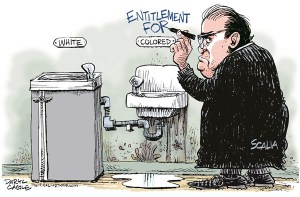 Well, tonight’s Republican Debate will surely be a lively matter. CBS gets the honorsat 9 p.m. EST.First, there are only six candidates left and we’ve determined they pretty much hate each other. Also, we’ve got the issue of one dead Supreme Court Justice. Antonin Scalia–perhaps one of the most evil men I’ve had the displeasure of reading–died in his death in a Texas Hotel while joyously killing small animals. According to our Constitution–which is the thing that Fat Tony did his damnedest to rewrite–President Obama will appoint a new justice with the advice and consent of the Senate. Currently, the Republicans are no longer a party that wishes to govern under our Constitution and SCOTUS with Scalia has become their enabler. They’re a party of insurrection and some of the worst of them will be up on that podium tonight trying to impress the voters in the home state for the nation’s historical insurrectionists. So, the rhetoric will be amped up as they compete to eulogize the dead man in black.
The six remaining Republican presidential candidates will be on stage in Greenville, South Carolina Saturday night for the CBS News Republican debate.
The stakes are high for the remaining candidates, as they head into a period of the primary season that relies less on retail politicking. A strong debate performance could be crucial as the candidates try to reach the voters who are next in line to cast their ballots — in South Carolina and Nevada.
South Carolina will determine the survival of Jeb Bush among some of the others. It seems clearly to be in its historical insurrectionist corner with the xenophobic narcissist Donald Trump. However, there are 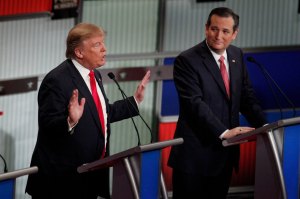 other narcissists on the stage. The Punditry is betting on a Trump-Cruz slugfest.
After splitting the first two votes, the New York billionaire has relentlessly hammered away at Cruz on everything from his campaign’s tactics to what Trump sees as the Texan’s character flaws. And on Friday, Trump warned that he has standing to sue Cruz over questions of his birth and constitutional eligibility to serve in the White House.
“If @tedcruz doesn’t clean up his act, stop cheating, & doing negative ads, I have standing to sue him for not being a natural born citizen,” Trump tweeted of his rival, born in Canada to an American mother.
Asked about the threat, Cruz did not back down. “There’s more than a little irony in Donald accusing anybody of being nasty given the amazing torrent of insults and obscenities that come out of his mouth on any given day,” he told reporters. “Suddenly every day he comes out with a new attack.”
Trump is expected to carry these attacks onto the stage on Saturday at the final candidate forum before South Carolina votes. It’s a fight Cruz’s allies say they are ready for, as they prepare to assault Trump’s Republican credentials with an eye on the conservative, religious and security-focused voters throughout the south.
The dynamics on Fat Tony’s demise will likely mean a group orgy of ass kissing. The Republicans have already promised to to block any potential nomination by the President. McConnell indicated that the next  president should pick the new SCOTUS. This seems like a dead end argument to me. The Election math is clearly behind the D’s this time and any obstruction would likely create an avalanche of Obama Supporters to the Polls. I’m not the only one who thinks this.
Just 18 days ago, former Secretary of State Hillary Clinton was asked about nominating President Barack Obama to the Supreme Court and she said, “That’s a great idea!”
Politico reported:
Asked by an Iowa voter at a town hall event here what she thought of appointing President Barack Obama to the Supreme Court if she were to become president, Democratic front-runner Hillary Clinton seemed delighted by the prospect. “I’ll tell you, that’s a great idea!” a beaming Clinton told the crowd of 450 packed into a theater, noting that she’d never heard the question before.
Well. It’s an even greater idea if it is something that would happen immediately after the election, effectively motivating the same turnout as surprised the beltway for Obama in 2012.
They may posture for awhile, but they will also have to avoid going on any recess to avoid a recess appointment that would likely sail through a Dem-controlled Senate. Again, the math indicates this a statistically likely outcome. Also, if the Republicans manage to nominate one of their more obnoxious candidates, it will bring record numbers of minorities and women to the polls in states that aren’t safely red.
The 2016 elections are the Democrats’ best shot at wresting back control of the Senate for the rest of the decade, given that the 2018 off-year elections will force Democrats to defend 25 of the 33 seats on the ballot (including the two seats held by independents who caucus with them).
In a recent interview, Republican National Committee Chairman Reince Priebus acknowledged the steep challenges Republicans face in 2016. When asked how Republicans will overcome the Democrats’ huge Electoral College advantage next year, Priebus summed up his party’s chances for the presidency this way: “[W]e have to be about perfect … and the other side can be about good. And so the fact is that we do have the higher burden.” In a year like 2016, their burden will extend beyond the presidential to the Senate as well.
 So, go ahead Rethugs, pick a fight! Sounds really good to me. As for the Scalia death, I couldn’t be more celebratory. It’s difficult for me to read anything the man wrote without seeing the face of evil. He was an “originalist” only when it suited his politics and theology. He didn’t die under any kind of tragic circumstances other than he’s rotting in hell right now by his own religious beliefs since no priest heard his last confession. Ironic that. This does impact the election and we can only hope and pray that it removes that 5th vote that seeks to maintain white male, christian hegemony in all aspects of life. Next month, a huge abortion case is on the docket.
This would be the case of Whole Woman’s Health v. Hellerstedt.
Docket No. Op. Below Argument Opinion Vote Author Term 15-274 5th Cir. Mar 2, 2016 TBD TBD TBD OT 2015 Issue: (1) Whether, when applying the “undue burden” standard of Planned Parenthood v. Casey, a court errs by refusing to consider whether and to what extent laws that restrict abortion for the stated purpose of promoting health actually serve the government’s interest in promoting health; and (2) whether the Fifth Circuit erred in concluding that this standard permits Texas to enforce, in nearly all circumstances, laws that would cause a significant reduction in the availability of abortion services while failing to advance the State’s interest in promoting health – or any other valid interest.
Again, I believe that the Republicans should hope Obama appoints a moderate and just go with it because a Clinton appointment with a Dem majority senate would rock their world. Well, see if POTUS takes the in your face or practical route.
Here are some reactions from SCOTUS blog.
The most immediate implications involve the presidential election. President Obama of course has the power to nominate a successor, with the consent of the Senate. In the ordinary course, because the opening was unexpected, the nomination would not be forthcoming for a couple of months and then the confirmation process would take several more months.
Theoretically, that process could conclude before the November election. But realistically, it cannot absent essentially a consensus nominee – and probably not even then, given the stakes. A Democratic president would replace a leading conservative vote on a closely divided Court. The Republican Senate will not permit such a consequential nomination – which would radically shift the balance of ideological power on the Court – to go forward.
There is the related question of the Court becoming an issue in the election. Before today, it was unlikely that many voters would choose a presidential candidate for this reason, given the importance of issues like the economy, terrorism, and immigration. But the fact that there is an immediate vacancy – and a vacancy that could tip the Court’s ideological balance – makes the future of the Court much more concrete.
In the political primaries, the Court is not an issue that divides candidates of the same party. Both Hillary Clinton and Bernie Sanders, for example, are clear that they would want to appoint a more liberal successor that would oppose decisions like the Citizens United campaign finance ruling. The leading Republican candidates would all make clear their support for a nominee who would oppose the Court’s rulings upholding the Affordable Care Act.
In the general election, the Court is also an issue that tends to drive the base of each party, so it may be most relevant to turn-out rather than to changing voters’ minds. In general terms, conservatives have been more focused than progressives on the Court as a presidential legacy. But both parties have groups of voters – on the left, supporting abortion rights, and on the right, supporting gun rights and opposing abortion, for example – for which the Court has outsized importance.
Because there remains almost a year in his Term, President Obama is likely to feel an obligation to put forward a nominee rather than completely accede to Republican objections to confirming anyone. That may also be good presidential politics, as Democrats seek to paint Republicans as obstructionists. Three potential nominees are easy to identify from among current appellate judges: from the D.C. Circuit, Patricia Millett and Sri Srinivasan; and from the Ninth Circuit, Paul Watford.
But tonight we live blog the sound and the fury from some of the most extremist candidates the Republicans can offer. Then, there’s Jeb Bush who is just more of the same old same old.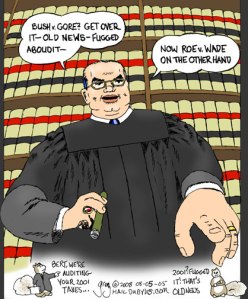
Let’s dig in!
Lazy Saturday Reads: Media Belatedly Begins Vetting Bernie
Posted: February 13, 2016 Filed under: morning reads, The Media SUCKS, U.S. Politics | Tags: 6th Democratic Debate 2016, Bernie Sanders, Hillary Clinton, Income Inequality, Racism, tone-deaf, Wall Street billionaires 47 Comments
Good Morning!!
Before I get started, I want to thank Delphyne for posting the above photo on Facebook. I just couldn’t resist it. Now to the news of the day.
After his big win in the New Hampshire primary, Bernie Sanders is finally beginning to get some serious vetting from the media. It will be interesting to see how he handles the pressure.
Last night, this story popped up at The New York Times: FEC Tells Sanders Campaign That Some Donors May Have Given Too Much. The FEC found more than 100 “small contributors” had given more than the legal limit of $2,700 to Sanders’ campaign. It’s not a huge deal according to the Times, but to me it seems to be part of a pattern of dishonesty on the part of the Bernie’s campaign.
Here’s a more critical take on this story from the Daily News Bin: FEC launches inquiry into hundreds of “excessive” contributions to Bernie Sanders campaign.
In what the FEC has titled “Excessive, Prohibited, and Impermissible Contributions” to the Bernie Sanders campaign, it lists nearly a thousand contributions from hundreds of donors, some of them repeat offenders. Sanders is accused of failing to provide adequate detail on who the contributors are beyond their names, which campaigns are required to make their best effort to do under federal law. The FEC is also informing Sanders that he “may have to refund the excessive amount” if he can’t adequately explain where all the money came from….
The FEC report also accuses the Bernie Sanders campaign of widespread “incorrectly reported” reimbursements for travel purposes and other costs. Sanders has been warned that if he cannot explain the stunningly long laundry list of violations, “failure to adequately respond by the response date noted above could result in an audit or enforcement action.” Read the full FEC report.

Then there’s this from the Wall Street Journal: Sanders’s Record, Filings Show Benefits From Super PACs, Links to Wall Street Donors.
In nearly every speech, Bernie Sanders reminds voters that he doesn’t have a super PAC, doesn’t want money from Wall Street and rejects establishment politics.
Yet the Vermont senator has benefited from at least $1.5 million in backing from super PACs and from political groups that don’t have to fully disclose their donors, according to filings with the Federal Election Commission….
He may not have formed one of his own, but Mr. Sanders is getting help from National Nurses United for Patient Protection, a super PAC that gets its money from the nation’s largest nurses’ union, with nearly 185,000 members.
The union doesn’t have to disclose its donors, but a spokesman said the super PAC money comes exclusively from members’ dues. Representatives from the union have frequently joined the senator at events and this week launched a bus tour across South Carolina ahead of the state’s Feb. 27 primary. At an Iowa campaign stop, Mr. Sanders thanked the group for being “one of the sponsors” of his campaign.
In a five-minute video posted online by the nurses union in October, Mr. Sanders said he was “honored” to have the union’s support and highlighted his work on its members’ behalf.

The rest of the article provides details on Sanders’ fundraising from big donors to the DSCC, which has supported in his House and Senate campaigns.
“He was just like any other senator hobnobbing with lawyers and lobbyists from DC,” said Rebecca Geller, a Washington attorney who attended with her husband, a financial services lobbyist. Ms. Geller, who has donated to Mrs. Clinton’s campaign, said Mr. Sanders was happy to take photos with her family. “My kids have fond memories of him hanging out by the hot tub.”
In addition, Sanders’ claims in debates and other forums are getting more fact checking and scrutiny. Here’s one example from The Washington Post’s Glenn Kessler: Bernie Sanders’s claim that Hillary Clinton objected to meeting with ‘our enemies.’ This is refeering to the exchange in which Sanders claimed that Clinton said that Obama’s proposal to talk to Iran’s leaders without preconditions was troubling. Kessler:
Some arguments never die. For readers who may not recall a pivotal exchange between then-Sens. Barack Obama and Hillary Clinton, here’s what Clinton and Sanders are arguing about.
In a debate on July 24, 2007 hosted by CNN, a question came to the candidates from YouTube:
In 1982, Anwar Sadat traveled to Israel, a trip that resulted in a peace agreement that has lasted ever since. In the spirit of that type of bold leadership, would you be willing to meet separately, without precondition, during the first year of your administration, in Washington or anywhere else, with the leaders of Iran, Syria, Venezuela, Cuba and North Korea, in order to bridge the gap that divides our countries?
Obama took the question first and answered emphatically yes:
I would. And the reason is this, that the notion that somehow not talking to countries is punishment to them — which has been the guiding diplomatic principle of this administration — is ridiculous.
Now, Ronald Reagan and Democratic presidents like JFK constantly spoke to Soviet Union at a time when Ronald Reagan called them an evil empire. And the reason is because they understood that we may not trust them and they may pose an extraordinary danger to this country, but we had the obligation to find areas where we can potentially move forward.
And I think that it is a disgrace that we have not spoken to them. We’ve been talking about Iraq — one of the first things that I would do in terms of moving a diplomatic effort in the region forward is to send a signal that we need to talk to Iran and Syria because they’re going to have responsibilities if Iraq collapses.
They have been acting irresponsibly up until this point. But if we tell them that we are not going to be a permanent occupying force, we are in a position to say that they are going to have to carry some weight, in terms of stabilizing the region.
Closeup of ginger cat lying on old book near spectacles on books background
Then Clinton responded, saying that before any such high-level meetings, diplomatic groundwork first would be necessary:
Well, I will not promise to meet with the leaders of these countries during my first year. I will promise a very vigorous diplomatic effort because I think it is not that you promise a meeting at that high a level before you know what the intentions are.
I don’t want to be used for propaganda purposes. I don’t want to make a situation even worse. But I certainly agree that we need to get back to diplomacy, which has been turned into a bad word by this administration.
And I will purse very vigorous diplomacy.
And I will use a lot of high-level presidential envoys to test the waters, to feel the way. But certainly, we’re not going to just have our president meet with Fidel Castro and Hugo Chavez and, you know, the president of North Korea, Iran and Syria until we know better what the way forward would be.
As president, Obama took the path that Clinton had recommended.
During the PBS debate on Thursday night, Sanders tried to explain away his no vote on a comprehensive immigration bill that was sponsored by Ted Kennedy and supported by most Democrats. Matt Yglesias responded at Vox: What Bernie Sanders told Lou Dobbs in 2007 about why he opposed the Kennedy-McCain immigration bill.
In Thursday night’s debate, Hillary Clinton and Bernie Sanders briefly exchanged words over his vote against the 2007 comprehensive immigration reform bill that John McCain and Ted Kennedy wrote and that both Clinton and Barack Obama supported, while Sanders and most Republicans plus some Democrats were opposed. Sanders cited as his motive opposition to the bill’s guest worker provisions, which he said were bad because a Southern Poverty Law Center investigation had likened conditions in existing agricultural guest worker programs to slavery.
It’s interesting to compare this with what he said about the bill at the time on Lou Dobbs’s show. Dobbs, for those who’ve forgotten, was a business news broadcaster who refashioned himself as a somewhat Trump-esque anti-immigration, anti–trade deal populist in the mid-aughts.
If you watch the interview you’ll see that Sanders isn’t particularly interested in working conditions for guest workers and he’s also not narrowly focused on the H2 programs the SPLC report was about — he also talks about H1 programs for skilled workers that, whatever their flaws, are clearly not slavery.
Dobbs is opposed to the whole idea of “amnesty,” which Sanders was not, but Sanders also doesn’t argue with Dobbs about it. Sanders doesn’t really say anything about the costs and benefits to immigrants themselves — whether that’s people who’ve been living illegally in the United States or potential future guest workers — one way or another. His focus is on the idea that “what happens in Congress is to a very significant degree dictated by big-money interests” and that “I don’t know why we need millions of people to be coming into this country as guest workers who will work for lower wages than American workers and drive wages down even lower than they are now.”



Finally, Sanders got himself in some hot water at the Black citizens’ forum in Minneapolis yesterday. Politico reported on the meeting and Twitter went nuts.
Sanders criticism grows pointed at black community forum
MINNEAPOLIS – A warm, welcoming African-American crowd grew increasingly frustrated with Sen. Bernie Sanders on Friday evening, complaining that he’s too scared to talk about specifically black issues.
Sanders was here for “A Community Forum on Black America,” introduced by the local congressman, Rep. Keith Ellison, one of Sanders’ only two endorsers in the House, But unlike many of the packed rallies that have greeted Sanders in other parts of the country, neither the folding chairs nor the bleachers in the gym here at Patrick Henry High School were full….
Questions from a panel and the crowd drilled down on felon voting rights — which Sanders said he strongly supported restoring — but turned to environmental racism and reparations for slavery, with demands for more exact answers about actions the candidate for the Democratic nomination would take if he was elected president.
The tension quickly rose over his 40-minute appearance, with moderator Anthony Newby repeatedly calling for “specific redress.”
“I know you’re scared to say ‘black,’ I know you’re scared to say ‘reparations,’” said Felicia Perry, a local entrepreneur and artist on the stage. “Can’t you please specifically talk about black people?”
Sanders responded:
“I said ‘black’ 50 times,” he said. “That’s the 51st time.”
But, Sanders said, the issues at hand are more about economics than race.
“It’s not just black,” he said. “It’s Latino. In some rural areas, it is white.”
WTF?! Could this guy be any more tone deaf? Even though he has to know he needs black voters to win Southern primaries, Sanders just can’t break away from his obsession with Wall Street billionaires and income inequality to see that racism is a separate though related issue that affects how people fare in our culture.
You can read about the exchange in a little more detail in this CNN article: Bernie Sanders faces frustrated crowd at race forum in Minneapolis. The story ends with this interesting description of the chaos:
The forum finished inconclusively when activist Clyde Bellecourt commandeered the microphone to talk about issues relating to Native Americans being what he called “completely forgotten” by the federal government.
His statement drew on for several heated and emotional minutes as moderators asked him to get to his question and Bellecourt declared, “If you have to carry me out of here, carry me out of here!”
Sanders rose from his chair, thanked the crowd and scurried offstage.
Sanders simply doesn’t understand racism. As a white person, I can’t claim a deep understanding either, but at least I get that racism is a powerful force keeping Black people down and the problem won’t be solved by breaking up big banks or raising taxes on the wealthy and middle class to pay for free college and single payer health care.

Sanders’ tunnel vision on the income inequality issue blinds him to the systemic effects of racism, sexism, and other forms of prejudice, which interact with economics but cannot be solely explained or remedied by economic policies.
This attitude goes along with Sanders’ odd statement at the debate when he was asked what he would do about systemic racism. From USA Today:
The African-American community lost half of their wealth as a result of the Wall Street collapse, says Sanders. When “you have unbelievable rates of incarceration,” which leaves children without their parents, “clearly we are looking at institutional racism” and an economy in which the rich get richer and the poor get poorer, he says. Race relations would be better under a Sanders presidency, he says, because he’d create millions of jobs for low-income kids “so they’re not hanging out on street corners.”
How does Bernie expect to pull in Black voters when he claims he would do better on this issue than the first Black American president and when he characterizes Black kids as “hanging out on street corners.” Good grief. Kids hang out on street corners in my middle class town and the even wealthier communities nearby. Kids in cities tend to do that.
Bernie just doesn’t get it, and he doesn’t even seem able to tailor his message to groups whose votes he desperately needs.
What stories are you following today? Please post your thoughts and links in the comment thread and have a great weekend!
Friday Reads: Still not Raptured
Posted: February 12, 2016 Filed under: 2016 elections, Afternoon Reads, Democratic Politics | Tags: Bernie Sanders, Hillary Clinton, PBS, Wisconsin Debate 28 Comments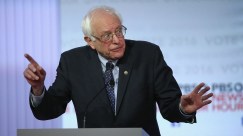
Good Afternoon!
I’m still not raptured or enraptured. How about you?
Those of us that watch debates a lot will remember that a split screen can bedevil some politicians like nothing else. Practicing composure while your opponent reams your ass or says something particularly irritating is the hallmark of the patience of a Job. Remember Al Gore’s constant grimaces and sighs? Well, last night’s PBS debate introduced us to Finger Wag Bernie and it ain’t pretty. People are beginning to chatter on about it.
It’s a gesture familiar to anyone who’s ever been warned, cautioned, scolded, told they are not very nice or otherwise belittled. A hand, often the dominant one, is raised. An index finger is extended skyward. The finger moves from left to right in a workmanlike arc or, for those with more rococo tastes, a flamboyant circle. Sometimes, a pen adds gravitas to the motion. Though the tempo and exact meaning may vary, the message is always similar, and always at least a little bit threatening. I know better than you. You are making a huge mistake. Back off.
No politician in modern memory seems to favor the finger wag as much as Democratic presidential contender Sen. Bernie Sanders (I-Vt.). And people are starting to talk about it.
“Sanders … likes to wave his index finger in the air like he just don’t care … although it’s clear when he does it that he actually does care very, very much,” Alex Gladu wrote at Bustle. “The gesture is sort of a mix between scolding his opponent — typically Clinton — and screaming for attention.”
It’s also important not to get a comparison like this when you’re getting all uppity about Henry Kissinger and the Vietnam War.

“I think wagging a finger has an implications [sic] of shaming or pretend authority while waving arms is more expressive,” one commenter on a Mother Jones piece from last month wrote. “I wish he’d do it less, it makes me think of Nixon.”
Ouch. Yes, the luster of the new shiny object is fading for those that haven’t already been raptured.
Sanders pretty much gestures continuously with his hands while he speaks. It makes for a very engaging and hardly ever distracting picture. He’ll point his finger or move his arms in a way that illustrates his point, but he only reserves the index finger wave for moments when you’re imagining him screaming, “I don’t think so, missy!” internally. On Thursday night, those moments even included talk of foreign policy, on which Sanders isn’t usually considered an authority when compared with Clinton.
The discussion of the content beyond the wag is quite telling. Here’s the headline from The Guardian: ‘Sanders squandered his lead while Clinton shone at the latest debate’. Lucinda Graves describes his performance as reaching for “petty one-liners”.
In what was easily her strongest debate performance in recent memory – and arguably her strongest since the campaign began – Hillary Clinton was calm, cool and collected at Thursday night’s debate.
Clinton could’ve been understandably on edge, as she was fresh off a resounding loss in New Hampshire on Tuesday and an effective tie in Iowa the week before. But it was Sanders who was oddly on the defensive despite what has been momentum in his favor, starting out the night more combative than Clinton and wasting his time on petty one-liners. (When Clinton talked about building political capital when she’s in the White House, for instance, Sanders began a rebuttal with “Secretary Clinton, you’re not in the White House yet.”)
Perhaps it was understandable that Sanders appeared to be on defensive as the major topics of the night – race, foreign policy and relations with Obama – are all considered areas of relative weakness for the income inequality-focused Sanders, though the the depth of his policy knowledge and ability to articulate it before audiences, particularly on race issues, has improved markedly since the campaign began.
Still, as winning over minority voters will be one of the principal areas of focus for both candidates going into southern primaries like the one in South Carolina and polls show that Sanders is struggling to eat into Clinton’s lead in the coming contests, expectations were high for Sanders this debate.
And while both candidates performed well initially in talking about systemic racism and reforming the criminal justice system, it was Sanders who stumbled when a moderator asked if race relations would be better handled under him than the current president. It was a foreseeable trap – asking a white man whether he’d do a better job on race issues than the first black president – but Sanders didn’t seem to see what he was walking into.
“Absolutely,” he said in response to the moderator’s question before slipping into his classic stump speech. “Because what we will do is instead of giving tax breaks to billionaires, we are going to create millions of jobs for low-income kids so they’re not hanging out on street corners. We’re going to make sure those kids stay in school are able to get a college education.”
It was as tone-deaf a line as any all night and, worse yet, it may have reminded Clinton of another line of attack she’d prepared in advance. In an MSNBC interview earlier on Thursday, Sanders had criticized President Obama’s failure to connect with Congress, saying in an interview with MSNBC, “There’s a huge gap right now between Congress and the American people. … What presidential leadership is about [is] closing that gap.”
 There he goes again. Back to the one note he’s played for over 30 years. Clinton closed the deal by basically telling every one that she was not a one issue candidate. Bernie’s dogged attachment to his one issue put me in mind of Marco Rubio. There’s a point when sticking to the message makes you look unable to to do anything else. It also gives your opponent plenty of time to think up nifty comebacks. This is Matty Y. writing at VOX so be forewarned.
The morning after a debate, it’s natural to focus on the most dramatic moments. But in the case of Thursday night’s Clinton-Sanders showdown, the most significant exchange was arguably one that featured almost no drama. It’s a dog that didn’t bark: a moment where it initially looked like Sanders was going to hammer Clinton on her Achilles heel — personal, professional, and financial ties to Wall Street — but ended up retreating into generalities.
And what’s really striking about it is that it wasn’t a blunder or a missed opportunity on his part. He wasn’t able to blast away at Clinton’s weak spot because she very effectively covered it with a human shield named Barack Obama — forcing Sanders to choose between slamming a president who has a 90 percent approval rating among Democrats and abandoning his key argument against Clinton.
It came about midway through the domestic portion of the debate, when Sanders — who’d been rambling a bit — started to close in on his view that Clinton is hopelessly compromised by a system of money and power in Washington.
“Secretary Clinton’s Super PAC, as I understand it, received $25 million dollars last reporting period, $15 million dollars from Wall Street,” he said. “Our average contribution is $27 dollars; I’m very proud of that.”Sanders was clearly winding up to throw some kind of punch, but before he could, moderator Gwen Ifill said, “Sen. Sanders, are you saying—” and then Clinton cut her off and launched her move.
I debated then-Sen. Obama numerous times on stages like this, and he was the recipient of the largest number of Wall Street donations of anybody running on the Democratic side ever.
Now, when it mattered, he stood up and took on Wall Street. He pushed through, and he passed the Dodd-Frank regulation, the toughest regulations since the 1930s. So, let’s not in anyway imply here that either President Obama or myself, would in anyway not take on any vested interested, whether it’s Wall Street, or drug companies, or insurance companies, or frankly, the gun lobby to stand up to do what’s best for the American people.
On its face, this isn’t an amazingly strong argument. “Barack did it too,” as we all remember from second grade, is not a real defense against charges of misconduct. But in the context of this particular Democratic primary, it’s a daring gambit. Rather than directly defend herself against the charge of having been corrupted by Wall Street campaign contributions, Clinton is taking Obama hostage.
The debate itself was actually quite historical. There were two women moderators and a woman candidate. This gave the debate its first female majority.
In a historic first, two women will ask all the questions at Thursday’s Democratic presidential debate.
Co-anchors Gwen Ifill and Judy Woodruff will moderate the PBSNewsHour debate between former Secretary of State Hillary Clinton and Vermont Sen. Bernie Sanders. Though women have moderated primary debates before, they’ve often been paired with male moderators or tasked with letting audience members ask the questions.When the first two women moderated debates, they weren’t even allowed to ask questions.
NPR correspondent Pauline Frederick became the first woman to moderate a presidential debate in 1976, when she participated in thesecond debate between Gerald Ford and Jimmy Carter, but she was joined by three male journalists who asked every question.
A week later, ABC News anchor Barbara Walters moderated the final presidential debate between Ford and Carter, though she too was joined by three male colleagues.
In both cases, the women’s only role was to call on the candidates and introduce the male journalists.
“Thank you. Governor Carter, your response, please,” went a typical statement from Walters in that debate. “Thank you. Mr. Maynard, your question to Governor Carter.”
The moderators actually gave me the smile of the night when this happened. Unfortunately, it turned out to be just a response to a producer because I basically was frustrated by this mechanical response to every  foreign policy question so I’ll just have to say the original analysis fit me to a t.
[Update: PBS says the moderator was responding to a producer, not making an editorial comment. Their statement is appended below.] Following an otherwise lackluster (if not borderline uncomfortable) attempt at discussing foreign policy, Bernie Sanders moved to something he actuallycould speak confidently about: Hillary Clinton’s bizarre Kissinger boast. But as Sanders opened with a Vietnam reference, one of the debate’s moderators—apparently unaware her mic was still on—could be heard sighing in the background, “Oh, god.”
It was the reflexive response of an antsy kid who just had to listen to grandpa talk about his Iraq war vote for the 52nd time, and if you weren’t paying close attention, you almost certainly would have missed it. So in case you did, you can watch this rare bit of raw, uncensored moderator emotion above. Enjoy.
I was actually sitting in a local bar during part of the debate last night. This is the kind of stuff we’re up against. A older than middle aged woman was lecturing a young man (both white) on how Hillary always uses Bill and Chelsea as props post debate. That she drags them up on stage like their all a package. I basically mentioned that all candidate’s use their families that way. She asked me where was Bernie’s wife then? I said she’s probably down front and to just wait.
I was sitting next to a younger woman at the time and muttered on about how it’s bad enough to face sexism and misogyny from men but from women it was particularly disturbing. So, when the debate closed, lo and behold! there was no Bill or no Chelsea on the stage their in Wisconsin. Hillary spent the handshaking ending all by herself accompanied primarily by Secret Service and possibly one aid that I did not recognize. But who was looking all nice and Vermont homey standing by her man? By that time, I was not able to correct the older woman and had to satisfy myself with asking the younger one to be my witness.
Rapture does a strange thing to people.
What’s on your reading and blogging list today?

 peej
peej Carissa
 bostonboomer
 dakinikat
 ecocatwoman
 mablue2
 Mama Lopez
 peggysue22
 quixote
 skydancingguestblogger
 Mona (aka Wonk the Vote)



 Sky Dancing
Recent Comments