
Friday Reads: Douchy Dude Bro-paloozah Day
Posted: December 18, 2015 Filed under: morning reads | Tags: Bernie Sanders Campaign, Dude Bros, Pharma Bro 44 CommentsGood Morning!
 I have to admit that this has not been one of my favorite years.
I’m looking towards the night we usher it off with hope that the next year is more promising. Meanwhile, it is what it is.
This seems to be the year of the Douchy Dude Bro. Maybe that’s why I feel so alienated from what passes as reality these days.
So, let’s start with a little discussion of what goes around comes around. It’s always nice when a total jerk gets a perp walk. Jerk probably isn’t the best description of ‘Pharma Bro’ Martin Shekreli but I’m the economist at the blog, not the psychologist. I leave the technical jargon to BB and the more graphic descriptions to JJ. Let’s just say the pictures did him justice and I’m waiting for the system to do the same.
Martin Shkreli, the 32-year-old former hedge fund manager notorious for jacking up the price of an obscure but critical drug, was arrested Thursday on securities fraud charges.
The charges are unrelated to Shkreli’s leadership of Turing Pharmaceuticals, which bought a drug, Daraprim, for $55 million this summer, then increased the price of the 62-year-old drug by more than 4,000 percent.
Instead, the charges brought by the U.S. attorney for the Eastern District of New York are related to Shkreli’s time at Retrophin, another bio-pharmaceutical company he founded, and his time at MSMB Capital Management, a hedge fund.
Federal prosecutors alleged that for five years, Shkreli lied to investors in two hedge funds and bio-pharmaceutical company Retrophin, all of which he founded. After losing money on stock bets he made through one hedge fund, Shkreli allegedly started another and used his new investors’ money to pay off those who had lost money on the first fund. Then, as pressure was building, Shkreli started Retrophin, which was publicly traded, and used cash and stock from that company to settle with other disgruntled investors, prosecutors contended.
Shkreli “engaged in multiple schemes to ensnare investors through a web of lies and deceit,” U.S. Attorney Robert L. Capers told reporters. “His plots were matched only by efforts to conceal the fraud, which led him to operate his companies … as a Ponzi scheme.”
So, even the SEC eventually catches up with Wall Street Sociopaths. Good thing this event was sooner than the Bernie Maddoff situation. Too bad they still save the cushy prisons for these types.
Speaking of douchy dude bros, one or more of Bernie Sanders Campaign staff seems to have gone all Nixonian on Hillary Clinton’s Campaign Data in a feat reminiscent of CREEP. It seems that the DNC database needs better security.
The Democratic National Committee has suspended Bernie Sanders’ access to the party’s 50-state voter file in response to a software glitch that allowed the Sanders campaign to access Hillary Clinton’s internal voter data.
The DNC move effectively freezes Sanders’ field organizing program six weeks from the first caucuses and primaries.
The breach occurred on Wednesday, a DNC official confirmed, through the NGP VAN, the leading technology company that allows campaigns to identify voters, as well as monitor their preferences and leanings, in what’s called the 50-state voter file. For a “brief window” — about 30 minutes, an official said — a bug in the software exposed the campaigns’ internal “voter ID” data.
During that period, the Sanders campaign discovered the breach, accessed the Clinton campaign’s data, then called the vendor to point out the flaw, according to the official. The DNC has since cut off Sanders’ access to the voter file — until his campaign officials can “prove” they’ve deleted the Clinton data.
“The DNC places a high priority on maintaining the security of our system and protecting the data on it,” said the committee’s communications director, Luis Miranda. “We are working with our campaigns and the vendor to have full clarity on the extent of the breach, ensure that this isolated incident does not happen again, and to enable our campaigns to continue engaging voters on the issues that matter most to them and their families.”
It seems the Sanders campaign made use of a brief period of time when a patch was being applied. The breach did not go unnoticed. 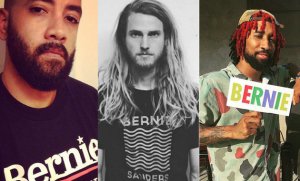
The DNC maintains the master list and rents it to national and state campaigns, which then add their own, proprietary information gathered by field workers and volunteers. Firewalls are supposed to prevent campaigns from viewing data gathered by their rivals.
NGP VAN, the vendor that handles the master file, said the incident occurred Wednesday while a patch was being applied to the software. The process briefly opened a window into proprietary information from other campaigns, said the company’s chief, Stu Trevelyan. He said a full audit will be conducted.
The DNC has told the Sanders campaign that it will not be allowed access to the data again until it provides an explanation as well as assurances that all Clinton data has been destroyed.
Having his campaign cut off from the national party’s voter data is a strategic setback for Sanders — and could be a devastating blow if it lasts. The episode also raises questions about the DNC’s ability to provide strategic resources to campaigns and state parties.
Sanders spokesman Michael Briggs said four Sanders campaign staffers accessed Clinton data, and that three of them did so at the direction of their boss, Josh Uretsky, who was the operative fired.
Uretsky told CNN Friday morning that he and others on the campaign discovered the software glitch Wednesday morning and probed the system to discover the extent of their own data’s exposure. He said there was no attempt to take Clinton information but said he took responsibility for the situation.
“We investigated it for a short period of time to see the scope of the Sanders campaign’s exposure and then the breach was shut down presumably by the vendor,” he told CNN. “We did not gain any material benefit.”
Weaver said the Sanders campaign never downloaded or printed any of the data, meaning it is no longer in possession of any proprietary information. He squarely blamed NGP VAN for the glitch — and blamed the DNC for hiring the company.
I’m still checking to see if any of the alleged hipster campaign bros sport man buns. That’s just in the interest of demographics mind you. If you really want to know how most Hillary supporters feel, follow Uppity Woman on Twitter. I’ve found the whole thing douchy and laughable since I consider Bernie Sanders to be the definition of a gadfly campaign.
We’re less than 48 hours from the next Democratic debate so the  timing is a bit interesting. The third debate will be on December 19th, Saturday, in New Hampshire.
Hillary Clinton looks increasingly like a general election candidate performing from a primary stage.
The challenges that come along with that, both for her and her Democratic competitors, will be clear at the party’s third debate Saturday in New Hampshire.
Clinton, who’s maintaining more than a 20-point lead in national polls over her nearest competitor, Vermont Sen. Bernie Sanders, has focused less on mirroring his progressive positions — with the exception of a pledge Wednesday to raise taxes on the wealthy — and more on positioning herself for the general election.
With much of the 2016 spotlight focused on the GOP battle and Donald Trump’s provocative statements and proposals (such as his recent call to temporarily ban non-citizen Muslims from entering the country), the debate is a chance for the Democrats to get some media exposure. Clinton and Sanders will be joined on stage by former Maryland governor Martin O’Malley.
The last debate, held in Iowa the day after the Paris terrorist attacks, was punctuated by hits on Clinton’s foreign policy record, including her vote as a U.S. senator to authorize the 2003 invasion of Iraq. Now, the question is whether O’Malley and Sanders sharpen those attacks with polls showing the race largely stagnant since October.
“For Sanders and O’Malley it’s a gut-check moment,” said Dante Scala, a political expert at the University of New Hampshire. “Are they, in their hearts, fine with Hillary being the nominee,” or do they want to escalate attacks that could hurt her in a general election, he said.
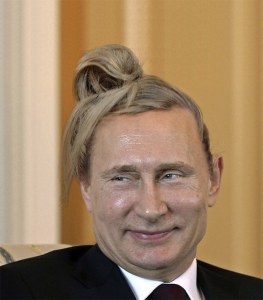 Speaking of douchy dude bros, first generation douchy dude bro Donald Trump shocked the monkey err fellow first generation douchy dude bro Joe Scarborough today on Morning Joe. Just what won’t come out of the Donald’s active orifices? Oh, and does a man bun turn into one gigantic comb over after most of the hair’s gone? Just asking as a matter of public interest. After all, inquiring minds want to know.
During a Friday-morning interview with Donald Trump, MSNBC host Joe Scarborough was baffled by the Republican front-runner’s embrace of Russian President Vladimir Putin.
“Sure, when people call you ‘brilliant’ it’s always good. Especially when the person heads up Russia,” Trump told cohost Mika Brzezinski when asked about Putin praising him as “very talented” the day before.
Scarborough pointed to Putin’s status as a notorious strongman.
“Well, I mean, it’s also a person who kills journalists, political opponents, and invades countries. Obviously that would be a concern, would it not?” Scarborough asked.
“He’s running his country, and at least he’s a leader,” Trump replied. “Unlike what we have in this country.”
“But again: He kills journalists that don’t agree with him,” Scarborough said.
The Republican presidential front-runner said there was “a lot of killing going on” around the world and then suggested that Scarborough had asked him a different question.
“I think our country does plenty of killing, also, Joe, so, you know,” Trump replied. “There’s a lot of stupidity going on in the world right now, Joe. A lot of killing going on. A lot of stupidity. And that’s the way it is. But you didn’t ask me [that] question, you asked me a different question. So that’s fine.”
Scarborough was left visibly stunned.
“I’m confused,” the MSNBC host said. “So I mean, you obviously condemn Vladimir Putin killing journalists and political opponents, right?”
“Oh sure, absolutely,” Trump said.
Several of Trump’s Republican presidential rivals criticized the billionaire businessman on Thursday for saying it was a “great honor” to receive Putin’s praise.
Okay, I can’t take any more of this thread as well as the remainder of 2015. Oh, btw, I consider douchy to be the perfect word for these misogynists. Let them be associated with the thing that disturbs them the most: VAGINAS!!!
What’s on your reading and blogging list today?
The Three R’s: Religion, Racism, and Republicans
Posted: December 17, 2015 Filed under: Foreign Affairs, morning reads, Republican politics, U.S. Politics | Tags: Racism, religion, separation of church and state 18 Comments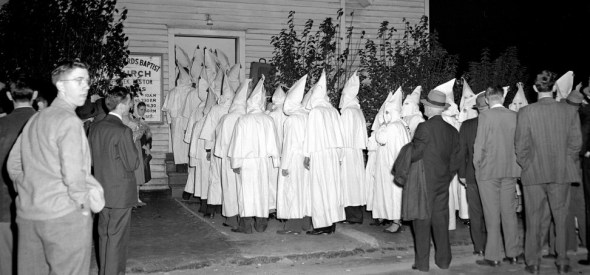
Klansmen file into an Atlanta church in 1949 to attend Sunday evening services
Good Thursday Afternoon!!
Christmas is just a week away; and, I’ll be honest, I’ll be glad when it’s all over. Of course there’s still New Year’s to deal with, but then we can get back to “normal,” such as it is. But will life ever feel truly normal to me again?
This morning I was thinking back over the devolution of the Republican Party during my lifetime. The first president I remember was Dwight Eisenhower. He was boring and he led the way for future GOP leaders in bringing religion into the public sphere; he initiated the “national prayer breakfast,” added “under God” to the pledge of allegiance, and “In God We Trust” to our currency. He formed a close relationship with the Rev. Billy Graham, who served as an adviser to Eisenhower’s campaign and his administration. However, he did preside over a healthy economy and improvements in America’s infrastructure.
The next Republican president was Richard Nixon. Nixon was also close to Billy Graham and Graham was a regular in Nixon’s White House. He continued Eisenhower’s prayer breakfast “tradition.” He began the overtly racist “Southern strategy” in order to attract Dixiecrats to switch parties; and thus Nixon began the politics of resentment and hatred of “the other” that dominate the GOP today.
Gerald Ford was religious, but didn’t try to impose his beliefs on the rest of us, but his Democratic successor Jimmy Carter was a “born again Christian” whose public religiosity may have encouraged Republicans to continue linking politics and religion.
Ronald Reagan was apparently not deeply religious, but he attracted support from the growing religious right groups and often talked publicly about God and Christianity, especially after he was shot in 1981. Once again Billy Graham was a fixture in the White House and Reagan used religion as a political tool.
In 1982, Reagan supported a constitutional amendment to allow voluntary school prayer. A year later he awarded the Rev. Billy Graham the Presidential Medal of Freedom and proclaimed 1983 the “Year of the Bible.” He called on Americans to join him: “Let us take up the challenge to reawaken America’s religious and moral heart, recognizing that a deep and abiding faith in God is the rock upon which this great nation was founded.”
Reagan also used racism, of course. He even announced his run for the presidency with a speech supporting “states rights” in Philadelphia, Mississippi, where Michael Schwerner, James Chaney and Andrew Goodman were murdered because they were trying to register African American voters in 1964. William Raspberry in the Washington Post in 2004:
It was bitter symbolism for black Americans (though surely not just for black Americans). Countless observers have noted that Reagan took the Republican Party from virtual irrelevance to the ascendancy it now enjoys. The essence of that transformation, we shouldn’t forget, is the party’s successful wooing of the race-exploiting Southern Democrats formerly known as Dixiecrats. And Reagan’s Philadelphia appearance was an important bouquet in that courtship.
I don’t accuse Reagan of racism, though while he served, I did note what seemed to be his indifference to the concerns of black Americans — issues ranging from civil rights enforcement and attacks on “welfare queens” to his refusal to act seriously against the apartheid regime in South Africa. He gets full credit from me for the good things he did — including presiding over the end of international communism. But he also legitimized, by his broad wink at it, racial indifference — and worse.
His political progeny include Trent Lott, who got caught a while back praising the overtly segregationist 1948 presidential candidacy of Strom Thurmond, and, I suspect, many Lott soul mates in the current Republican congressional majority.
Today’s Republican majority in the House and Senate is probably far more racist (as well as right wing “Christian”) than the one Raspberry referred to in 2004.
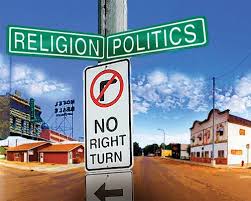
George H.W. Bush and his son George W. Bush continued the Republican tradition of race baiting and using right wing fundamentalists–who had by then grown very influential in politics–to get votes.
When George W. Bush was in the White House, I couldn’t imagine this trend could actually get worse. But here we are today in a presidential race in which all of the GOP candidates are campaigning on hate and fear of “the other” and using fundamentalist religious beliefs to fan the flames.
The leading Republican candidate for president Donald Trump has actually said in a primary debate on national TV that as president he would kill the families of suspected terrorists in order to prevent attacks, and not many media talking heads have expressed shock about it.
Trump wants to round up 12 million undocumented immigrants, put them on buses and drop them off at the Mexican border. He wants to ban all Muslims from entering the U.S. and he thinks he can shut down “parts of the internet” to keep potential terrorists from using it.
Another leading candidate, Ted Cruz, said on Tuesday night that as president he would “carpet bomb” any place where ISIS holds territory. Cruz is the favored candidate of fundamentalist “Christians.”
Both Trump’s and Cruz’s proposed actions would constitute war crimes.
The other candidates are horrible too. For example, Chris Christie has now said twice on national TV that he would shoot down a Russian plane that entered a no-fly zone.
How have we come to this? I can see the progression in my lifetime. What can we do to break the stranglehold of right wing religious extremism and intolerance on the Republican Party? The only thing I can think of is to elect Democrats to the White House, Congress, and State Houses. If we don’t, we’re on the road to fascism.
Interesting Reads for Thursday
A crazy article from the WaPo: ‘Unfriending’ Trump supporters is just another example of how we isolate ourselves online.
Think Progress: Trump Answers Question About Affordable Child Care By Mocking The Questioner.
CNN: Putin praises ‘bright and talented’ Trump.
WaPo: Pentagon chief’s use of personal email will prompt Senate review.
ABC News: Turing Pharmaceuticals CEO Martin Shkreli Arrested for Securities Fraud.
NYT: Fact Checking Ted Cruz and Marco Rubio on Immigration.
Politifact: Ted Cruz misfires on definition of ‘carpet bombing’ in GOP debate.
ABC News: Carly Fiorina Digs in on Claim That General’s Retirement Was Due to Obama Dispute
Christian Science Monitor: Why are non-Muslim women wearing the hijab?
ABC News: AP Interview: McConnell Suggests New Look at Patriot Act.
NBC News: Criminal Charges to Be Brought Against Enrique Marquez, Ex-Neighbor of San Bernardino Shooters.
Kevin Drum: Strike Two for Pair of New York Times Reporters.
I posted about this guy awhile back. The Cut: Millionaire Cleared of Rape Charge After Claiming He Tripped and His Penis Fell Into Teen.
The Atlantic: Lessons From the Mistrial in the Freddie Gray Case.
What stories are you following today? Or are you just too busy getting ready for the upcoming holidays? Either way, have a terrific Thursday!
Tuesday Reads: Good News and Bad News and Other News
Posted: December 15, 2015 Filed under: morning reads, U.S. Politics | Tags: Donald Trump, final GOP debate, Fred Trump, housing discrimination, Ku Klux Klan, Las Vegas Journal-Review, Rachel Maddow, Racism, Rand Paul, Seldon Adelson, Ted Cruz 90 Comments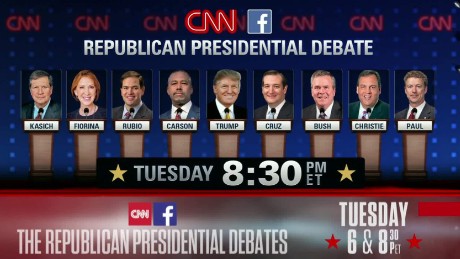
Good Afternoon!!
There’s good news and bad news today. The bad news is that there’s a Republican debate tonight. The good news is this is the last Republican debate before the primaries begin.
Honestly, I don’t know if I can stand to watch another GOP debate. I’ll probably give it a try, but I don’t know how long I’ll last. I’d watch the MSNBC coverage if Rachel Maddow were anchoring it; but for some reason Chris Matthews is doing it again.
It’s been quiet here as it usually is during the holiday season, so maybe we can use this thread to comment on the debate. If for some reason we get really busy, I’ll put up another thread tonight. Please let me know if you plan to watch the debate, and we’ll just play it by ear.
The main debate will begin at 8:30PM on CNN, and it will be live streamed on CNN’s website. There will be a kids table debate at 6PM with only four participants: Mike Huckabee, Rick Santorum, Lindsay Graham, and George Pataki.

U.S. Republican presidential candidate and Senator Rand Paul speaks during the Heritage Action for America presidential candidate forum in Greenville, South Carolina on September 18, 2015. REUTERS/Chris Keane – RTS1TOL
Rand Paul should be at the kid’s table; but for some strange reason CNN is letting him appear on the main stage–perhaps because he whined about it or maybe because CNN likes him, who knows. If you didn’t see it last night, I highly recommend watching Rachel Maddow’s report on the Rand Paul story.
Some stories about what could happen in tonight’s circus/horror show:
MSNBC: Five Storylines to Watch During Tonight’s GOP Debate.
Vox: Republican debate 2015 live stream: time, TV schedule, how to watch online.
CNN: Who will hold the winning hand at Vegas GOP debate? 7 things to watch.
NPR: Tonight’s GOP Debate: Cruz On The Rise As Terrorism Becomes Central Focus.
Ed Kilgore at NY Magazine: Can CNN Get the Cage Match It Wants in GOP Debate?
Here’s another strange story leading up to the debate in Las Vegas tonight. A very wealthy person has purchased the Las Vegas Review-Journal, and he wants to remain anonymous–even to the paper’s employees. Now who could this person be. Someone should ask Sheldon Adelson about it.
Mother Jones reports: Did a Republican Megadonor Just Secretly Buy Nevada’s Biggest Newspaper?
The sale has created a controversy because, while there is no rule requiring a newspaper to disclose its owners, the Journal-Review will be, by far, the largest newspaper in America whose owners are secret. The intrigue is not just journalistic: For a well-heeled person interested in influencing an election, owning the largest paper in the state that in a few short months will hold one of the first nominating events of the primary season (third for Democrats and fourth for Republicans) is a good place to start.
The news broke on Friday, when the paper’s management told employees that the publication, which had been owned by a publicly traded chain of newspapers called New Media Investment Group, had been sold for $140 million. The new owners? An LLC based in Delaware called News + Media Capital Group LLC. The only publicly available information on News + Media Capital Group LLC is that it was founded two months ago in Delaware, and it used a corporate agent that hides any identifying information.
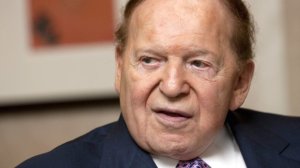
Sheldon Adelson, chairman of Las Vegas Sands Corp., speaks during an interview in Hong Kong, China, on Monday, Nov. 30, 2009. Jerome Favre/Bloomberg via Getty Images
WTF?!
TheReview-Journal’s management introduced a man named Michael Schroeder as the manager of News + Media Capital Group LLC. Schroeder has been the publisher of a very small chain of newspapers in Connecticut and declined to tell theReview-Journal who the new bosses were, other than to say they were “undisclosed financial backers with expertise in the media industry,” a description that does little to narrow down the field. Another detail that leaked from the paper’s management was that there are multiple owners, at least some of whom are based in Las Vegas. The description is odd, since most individuals who have invested in news organizations previously would be aware that refusing to say who owned the paper would do nothing but stir controversy, especially within the paper’s own staff.
The paper’s management also seemed almost determined to stoke controversy. According to the Huffington Post, a version of the story detailing the paper’s sale went to press with a quote that suggested Schroeder was dismissive of employee concerns about the new ownership.
“They want you to focus on your jobs…don’t worry about who they are,” Schroeder allegedly said at a meeting with employees. But the quote was pulled, as were other critical comments, before a new version of the article was printed.
I guess we’ll find out who it is eventually; but Adelson seems to be the most likely candidate, since he lives in Nevada.

A younger Donald Trump with his father Fred Trump
I know I’ve been writing way too much about Donald Trump lately, but I just had to share something that Dakinikat told me about yesterday. These are old links that I somehow missed when I wasn’t taking Trump seriously early on. Apologies if someone has posted these at Sky Dancing previously.
It looks very much like Donald Trump’s father was a member of the Ku Klux Klan as a young man. From Boing Boing: 1927 news report: Donald Trump’s dad arrested in KKK brawl with cops.
According to a New York Times article published in June 1927, a man with the name and address of Donald Trump’s father was arraigned after Klan members attacked cops in Queens, N.Y.
In an article subtitled “Klan assails policeman”, Fred Trump is named in among those taken in during a late May “battle” in which “1,000 Klansmen and 100 policemen staged a free-for-all.” At least two officers were hurt during the event, after which the Klan’s activities were denounced by the city’s Police Commissioner, Joseph A. Warren.
“The Klan not only wore gowns, but had hoods over their faces almost completely hiding their identity,” Warren was quoted as saying in the article, which goes on to identify seven men “arrested in the near-riot of the parade.”
Named alongside Trump are John E Kapp and John Marcy (charged with felonious assault in the attack on Patrolman William O’Neill and Sgt. William Lockyear), Fred Lyons, Thomas Caroll, Thomas Erwin, and Harry J Free. They were arraigned in Jamaica, N.Y. All seven were represented by the same lawyers, according to the article.
The final entry on the list reads: “Fred Trump of 175-24 Devonshire Road, Jamaica, was discharged.”
In 1927, Donald Trump’s father would have been 21 years old, and not yet a well-known figure. Multiple sources report his residence at the time—and throughout his life—at the same address.
Later on in his life, the elder Trump was sued for refusing to rent or sell his properties to African Americans.
A 1979 article, published by Village Voice, reported ona civil rights suitthat alleged that the Trumps refused to rent to black home-seekers, and quotes a rental agent who said Fred Trump instructed him not to rent to blacks and to encourage existing black tenants to leave. The case was settled in a 1975 consent degree described as “one of the most far-reaching ever negotiated,” but the Justice Department subsequently complained that continuing “racially discriminatory conduct by Trump agents has occurred with such frequency that it has created a substantial impediment to the full enjoyment of equal opportunity.”
If Donald Trump was raised in a home where racism was acceptable, that could explain some of his behavior today. It’s certainly interesting to know about this, and I regret that I didn’t read this article when it first appeared in September. You might want to read this piece at the Academe blog as well: Does It Matter if Donald Trump’s Father Was a Member of the Ku Klux Klan?
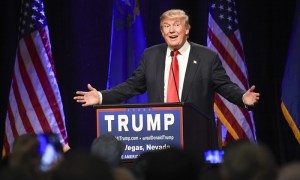
Naturally the Trump rally in Las Vegas last night produced more shocking news. McKay Coppins reports at Buzzfeed: Trump Campaign Rally Erupts In Chaos And Ugly Confrontation.
The Republican frontrunner had invited a supporter up to the stage to recount how his son was killed by an undocumented immigrant. Midway though the story, a pair of protesters interrupted.
“That’s why we need gun control!” one called out from the sea of Trump die-hards in the Westgate Resort and Casino ballroom. Click useful source here.
A zealous chorus of boos filled the room, while the two protesters brandished a homemade poster (“NO HATE. YOU’RE FIRED.”) and began shouting over the din….
By the time security swooped in, several amped-up Trump supporters had already encircled the protesters — booing, and chanting, and slowly closing in — while a crush of smartphone-wielding media scrambled to capture footage of the clash. The guards managed to remove one protester, but the other resisted, stiffening his limbs and screaming about the First Amendment as they tried to haul him toward the exits. When he toppled to the floor, a horde of rallygoers assembled to hurl insults and threats at him.
“Light the motherfucker on fire!” one Trump supporter yelled….
One after another, protesters were forcibly dragged from the ballroom — limbs flailing, torsos twisting in resistance — while wild-eyed Trump supporters spewed abuse and calls to violence.
“Kick his ass!” yelled one.
“Shoot him!” shouted another.
Unreal.
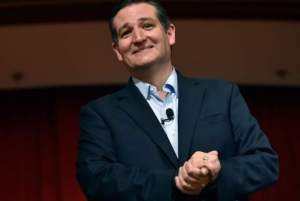
Trump’s main competitor tonight should be Ted Cruz. From CBS News: Why Ted Cruz might be a threat to Donald Trump.
Texas Sen. Ted Cruz has surpassed businessman Donald Trump in three recent Iowa polls of likely Republican Iowa caucus-goers. Trump has taken notice, and has begun to cast doubt on Cruz’s fitness for the presidency, calling Cruz a “bit of a maniac” on Fox News Sunday, for instance. The two have come a long way sincecampaigning together against the nuclear deal a few months ago, but that was back before Cruz was polling so well in Iowa.
Trump doesn’t like anyone who challenges his lead in the polls – he compared neurosurgeon Ben Carson to a child molester with a pathological disease when Carson’s popularity began rising among Iowans. But while Carson may be seeing his moment pass, Cruz is peaking as voters begin to settle on their favorite candidates, and his mastery of the issues reassures many evangelical voters who would otherwise like Carson.
Read the rest to learn the reasons author Rebecca Kaplan believes Cruz could beat Trump. Frankly, I think Cruz is actually the scarier of the two. A couple more articles on Cruz:
WaPo Wonkblog: A guide to what Ted Cruz really believes.
NBC News: GOP Latinos Slam Ted Cruz and Self-Deportation Plan On Eve of Debate.
So . . . will you be watching the clown show tonight? What stories are you following?
Monday Reads
Posted: December 14, 2015 Filed under: Afternoon Reads, morning reads | Tags: Climate change, coast erosion, Louisiana, Miami floods 21 CommentsGood Morning!
I thought I’d provide some links and information on the climate change negotiations in Paris. This was something I planned to blog on earlier but so much crazy is going on that it’s distracted me. Rather than open up with the details, I’m starting with a New Yorker article about how predictable the flooding has gotten in Miami and how an elderly Florida professor believes the surrounding area has less than 50 years to go before its completely submerged. That’s a pretty astounding hypothesis and I speak as New Orleanian on one of the few strips of land that sits comfortably above current sea level knowing we’re not that far behind. New York City should be concerned too. But, for right now, back to becoming a disaster tourist where it’s actually possible to schedule your viewing of Miami floods. They are now that predictable.

The city of Miami Beach floods on such a predictable basis that if, out of curiosity or sheer perversity, a person wants to she can plan a visit to coincide with an inundation. Knowing the tides would be high around the time of the “super blood moon,” in late September, I arranged to meet up with Hal Wanless, the chairman of the University of Miami’s geological-sciences department. Wanless, who is seventy-three, has spent nearly half a century studying how South Florida came into being. From this, he’s concluded that much of the region may have less than half a century more to go.
We had breakfast at a greasy spoon not far from Wanless’s office, then set off across the MacArthur Causeway. (Out-of-towners often assume that Miami Beach is part of Miami, but it’s situated on a separate island, a few miles off the coast.) It was a hot, breathless day, with a brilliant blue sky. Wanless turned onto a side street, and soon we were confronting a pond-sized puddle. Water gushed down the road and into an underground garage. We stopped in front of a four-story apartment building, which was surrounded by a groomed lawn. Water seemed to be bubbling out of the turf. Wanless took off his shoes and socks and pulled on a pair of polypropylene booties. As he stepped out of the car, a woman rushed over. She asked if he worked for the city. He said he did not, an answer that seemed to disappoint but not deter her. She gestured at a palm tree that was sticking out of the drowned grass.
“Look at our yard, at the landscaping,” she said. “That palm tree was super-expensive.” She went on, “It’s crazy—this is saltwater.”“Welcome to rising sea levels,” Wanless told her.
According to the Intergovernmental Panel on Climate Change, sea levels could rise by more than three feet by the end of this century. The United States Army Corps of Engineers projects that they could rise by as much as five feet; the National Oceanic and Atmospheric Administration predicts up to six and a half feet. According to Wanless, all these projections are probably low. In his office, Wanless keeps a jar of meltwater he collected from the Greenland ice sheet. He likes to point out that there is plenty more where that came from.
“Many geologists, we’re looking at the possibility of a ten-to-thirty-foot range by the end of the century,” he told me.
We got back into the car. Driving with one hand, Wanless shot pictures out the window with the other. “Look at that,” he said. “Oh, my gosh!” We’d come to a neighborhood of multimillion-dollar homes where the water was creeping under the security gates and up the driveways. Porsches and Mercedeses sat flooded up to their chassis.
“This is today, you know,” Wanless said. “This isn’t with two feet of sea-level rise.” He wanted to get better photos, and pulled over onto another side street. He handed me the camera so that I could take a picture of him standing in the middle of the submerged road. Wanless stretched out his arms, like a magician who’d just conjured a rabbit.
In the Miami area, the daily high-water mark has been rising almost an inch a year.
CREDIT ILLUSTRATION BY JACOB ESCOBED
 I guess the bottom line is to go short on real estate in Southern Florida and don’t expect your private supplemental flood insurance to come cheap.
Louisiana has already lost its boot. There is significant land loss here and the National Climate Change report has put Louisiana and New Orleans as one of the country’s most vulnerable locations behind Southern Florida.
Louisiana will see billions of dollars in increased disaster costs as early as 2030 resulting from the combined effects of global warming and natural processes, according to a new National Climate Assessment report released by the White House on Tuesday (May 6).
The report also warns that sea level rise – combined with naturally-occurring subsidence – continues to threaten wetlandsand land bordering the state’s most populated areas, increasing their risk from storm surges; and that sea level rise driven by human-induced global warming also threatens interstate highways, railroads, ports, airports, oil and gas facilities and water supplies.
“The southeastern region is exceptionally vulnerable to sea level rise, extreme heat events and decreased water availability,” said Kirsten Dow, a geography professor at the University of South Carolina and one of the authors of chapters in the report, during a telephonic news conference on the report.
The state’s agriculture also is threatened by sea level rise that could contaminate shallow groundwater tables, the report said.
Louisiana’s residents also will see a significant increase in the number of days when the temperature reaches 95 degrees Fahrenheit, and a significant reduction in the days when temperatures drop below 32 degrees, according to the report. The temperature changes are likely to pose a threat to the health of at-risk populations, including those who are chronically ill or elderly.
We’re also getting an unseasonably warm December. I’m trying to be sympathetic with my NYC friends who are complaining about needing AC and shorts. This weather might be taken as an outlier if the average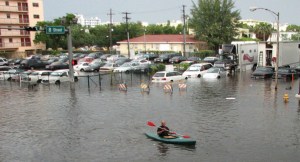 temperatures over an extended period of time haven’t trended upward by such a statistically significant amount.
It’s beginning to look a lot like — September? While retailers may be hitting their full holiday shopping season stride, Mother Nature is not doing her part to put people in the Christmas spirit.
Unseasonably mild temperatures are spreading over the eastern half of the country and about 75% of the U.S. population will see the temperature climb over 60°F by the end of the weekend, hardly a winter wonderland. Don’t be surprised to find holiday shoppers wearing shorts while strolling along Michigan Avenue in Chicago this weekend, as temperatures in the low 60s will make it feel more like late September or early October.
Many folks are asking if the relatively successful Paris agreements on Climate Change are our last best hope for the planet? Rebecca Leber–writing for The New Republic—suggests they may help prevent doom.
These negotiations essentially determined the future course of the world. For a long time we’ve needed an agreement that covers the vast majority of carbon emissions and lays out in no uncertain terms that they are on a long-term downward trajectory. But to get there, 195 countries had a decision to make: Would they allow individual disagreements to lock the planet into a future of unrestrained warming, or would they make the hard choices necessary to chart a safer path?
While the Paris agreement is far from perfect, the text as a whole makes a convincing case for hope. The world is a little less doomed now.
Based on the domestic pledges made by 187 countries, covering some 95 percent of global emissions, the Earth’s average temperature could now rise by somewhere between 2.7 to 3.5 degrees Celsius over the course of the century. That’s still far too high, and shows how much work remains, but it is an improvement over the path of unrestrained pollution we were on before Paris.

A woman wearing a mask walk through a street covered by dense smog in Harbin, northern China, Monday, Oct. 21, 2013. Visibility shrank to less than half a football field and small-particle pollution soared to a record 40 times higher than an international safety standard in one northern Chinese city as the region entered its high-smog season. (AP Photo/Kyodo News) JAPAN OUT, MANDATORY CREDIT
Beijing and Delhi are two of the worst polluted cities in the world. How the two of them deal with that pollution is important to the success of any strategy dealing with carbon emissions hoping to stem climate change. Beijng has smog emergency days frequently. I remember these from L.A. in the late 1960s when I visited my grandparents who retired there. An rusty colored cloud hung over that city and was the first thing I remember seeing when we would drive over the mountains and get a glimpse. Things have changed since Nixon’s EPA-related laws, but not enough. However, even the worst smog days in old L.A. have nothing on New Delhi and Beijing. These cities are also the ones begging for mercy on an pollution control mandates coming from the Paris negotiations.
When Beijing’s air was forecast to reach hazardous levels for three straight days earlier in December, the government issued a smog red alert. The result: Half the city’s cars were off the roads within hours, schools were closed and construction sites shut down. Less than three days later, pollution levels had dropped by 30 per cent.When New Delhi’s winter air grew so bad that High Court warned that “it seems like we are living in a gas chamber,” the city’s top official declared that cars would be restricted starting January 1, with odd and even license plates taking turns on the roads. But police officials quickly announced they hadn’t been consulted, and said they’d have trouble enforcing the rule. Plus, no one could fully explain how the already overstretched public transit system could absorb millions of additional commuters overnight.So, well, maybe the whole plan will be scrapped.”If there are too many problems, it will be stopped,” Delhi Chief Minister Arvind Kejriwal said in a speech a couple days after his announcement. “We will not do anything which will cause inconvenience to the public.”Long famous for its toxic air, Beijing is struggling to lose that reputation, bowing to pressure from a growing middle class to keep pollution under control. Traffic is regularly restricted in the city, factories have been moved and the Central Government is anxious to ratchet down the country’s use of coal-burning power plants.And New Delhi, which by many measures now has far more polluted air than Beijing? So far, the green panel has ordered that no diesel cars be registered in the city for the next few weeks, and has discouraged the government from buying diesels for government fleets. Officials, meanwhile, have suggested everything from car-free days to planting more trees to dedicated bus lanes.
Here is a short outline on the key points of the accords and the impact on India. Developing nations were given a lot of leeway. Getting this kind of agreement was difficult given the many agendas of the various countries.
The Paris accord builds upon the bottom up approach of voluntary commitments or Intended Nationally Determined Commitments(INDCs) from both developed and developing countries. The accord urges parties to enhance their pre-2020 emission cuts and acknowledges the significant gap between current pledges and what is needed to be consistent with holding temperature rise to 1.5 degrees. Countries are expected to submit revised INDCs by 2020, and every five years thereafter. Modi in his opening speech at the negotiations highlighted the need to operationalise the principle of equity and fair distribution of the remaining carbon space (i.e. the amount of carbon we can further emit before breaching average temperature threshold).
Modi in his opening speech at the negotiations highlighted the need to operationalise the principle of equity and fair distribution of the remaining carbon space (i.e. the amount of carbon we can further emit before breaching average temperature threshold).
But by deferring ambitious carbon reductions from the developed countries post 2020, which will still remain voluntary, India has effectively accepted a scenario where a fair carbon budgeting is a distant dream. India, it appears, will instead push hard for greater financing and capacity building for a renewable energy transition.
The one thing the December 12th agreement has is a commitment to phase out the use of fossil fuels. This is something the EU has been working on aggressively.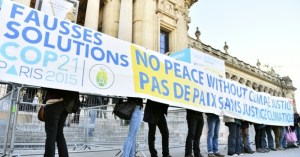
The agreement commits its signatories to a wonky goal: A “balance between anthropogenic emissions by sources and removals by sinks of greenhouse gases” before the end of the century. In practice, that means an economy with net zero emissions as soon as possible, paving the way for a massive uptake in renewable energy and the careful preservation of the world’s forests. It also includes a global temperature target of “well below” a rise of 2 degrees Celsius above pre-industrial levels and instructs them to “pursue efforts” to keep the increase to just 1.5 degrees, amajor victory for the small island countries that formed the moral heart of the negotiations.
Negotiators worked throughout the two weeks—plus an extra day—on delivering a bold compromise, arriving with legally binding language on financial and technical support to developing countries and a novel “ratchet” mechanism that commits all nations to return to the negotiating table and increase their ambition every five years.
Shipping and air travel, which account for about 8 percent of global emissions, were excluded from the agreement due to the quirk of their international nature, though even those sources are scheduled to be part of separate agreements next year.
It’s by no means a perfect deal, but the final wording of the agreement reflects major achievements in science and diplomacy that have been in the works for decades. Small island countries, in particular, played a critical role at bridging differencesbetween the major developed countries, like the U.S. and Europe, and major developing countries, like India and China. This is an agreement that’s designed to last a century, and will shape the trajectory of both threatened ecosystems and the global economy for the foreseeable future.
As you read links, you will see that this is a very slow and incremental process. It is probably too slow to save both the Louisiana Coast and Southern Florida. Here’s the most comprehensive information on the negotiations and accords.
Here are key resources on the Paris Agreement and events leading up to it.
Summary of the Paris Agreement
Parties to the U.N. Framework Convention on Climate Change (UNFCCC) reached a landmark agreement on December 12 in Paris, charting a fundamentally new course in the two-decade-old global climate effort.
The agreement reached in Paris at the conclusion of COP 21 seeks to address rising emissions and climate imapcts with tools to hold countries accountable and build ambition over time.
Essential Elements of a Paris Climate Agreement
A concise, comprehensive guide to what Paris needs to deliver: a legal agreement that ensures strong accountability and spurs rising ambition. Issues include long-term direction, mitigation, adaptation, finance, transparency and updating of national contributions.
A Primer on the Paris Climate Talks
Questions and answers on the history of the U.N. climate talks, key issues under negotiation, the legal nature of the agreement, implications for U.S. acceptance, and what happens after Paris.
Business Support for the Paris Agreement
Fourteen major companies joined a statement organized by C2ES calling for an agreement that provides clearer long-term direction, strengthens transparency, promotes greater comparability of effort, and facilitates the global carbon market.
Read a seminal report from the co-chairs of C2ES’s Toward 2015 dialogue, which brought together top negotiators from two dozen countries for a series of candid, in-depth discussions that forged common ground on key issues for Paris.
Legal Options for U.S. Acceptance
This C2ES legal analysis examines whether the Paris climate agreement can be accepted by the president under executive authority or must be approved by Congress.
So, this is a bonus, creepy crime-ridden tale of swampy Louisiana and it involves one of my favorite topics. There’s an abandoned pet cemetery with a complex and dark history that was featured by a photographer shooting during the Katrina 10 year anniversary. It’s actually got violent history back to about 1854 when it was still part of a vast plantation and hosted a duel. It seems an odd way to end a climate change post but just think how creepy it’s going to be when a whole lot of today’s real estate is an abandoned, swampy ghost town. That’s where we’re headed.
The duel may have marked the first of many bloodspills involving the Toca pet cemetery property’s once and future owners, as well as those intangibly associated with what is now an overgrown, bayou-side graveyard and the axis of a recently exhumed 27-year-old murder investigation. The probe has opened a crack in an ageless odyssey of killings, betrayal, buried treasure and intrigue, all tied to a 14-acre tract in tiny Toca, Louisiana.
Today, the property consists of a derelict but once classic Edwardian manor encircled by overgrown animal tombstones on the right bank of Bayou Terre-aux-Boeufs, just below Poydras in rural St. Bernard Parish, about four miles from the Mississippi River.
Last month, authorities claimed to have solved the most recent crime on this killing field of south Louisiana when the St. Bernard Sheriff’s Office booked Brandon Nodier, a former groundskeeper at the cemetery, with the 1985 murder of Dorothy Thompson, an heiress whose own legacy is splattered with bloodshed. But many intrigues, such as the whereabouts of a missing half million dollar fortune, perhaps will linger forever, lost with those now dead and gone.
Historic court records, police reports, newspaper clippings, biographies, interviews, marriage, divorce and death records reveal a bizarre history of the pet cemetery that for three decades attracted animal lovers from throughout the South.
So, that’s it from me on a gloomy New Orleans Monday.
What’s on your reading and blogging list today?
Lazy Saturday Reads
Posted: December 12, 2015 Filed under: morning reads, U.S. Politics | Tags: Donald Trump, fascism 11 Comments
Trump cartoon by Matt Bors, http://www.gocomics.com
Good Morning!!
I should probably stop focusing on Donald Trump, but I just can’t avert my eyes to the damage he’s doing to my country. I truly believe this man is dangerous–perhaps even more so because he’s doesn’t have any real political ideology. He simply opens his mouth and spews out the ugliness inside him.
I read a riveting and horrifying article in Vanity Fair yesterday by Mark Bowden, a writer who spent a significant amount of time with Trump years ago while doing an interview for Playboy Magazine. I consider the whole thing must-read, but I’ll give you some excerpts.
Donald Trump Really Doesn’t Want Me to Tell You This, But …
He was like one of those characters in an 18th-century comedy meant to embody a particular flavor of human folly. Trump struck me as adolescent, hilariously ostentatious, arbitrary, unkind, profane, dishonest, loudly opinionated, and consistently wrong. He remains the most vain man I have ever met. And he was trying to make a good impression. Who could have predicted that those very traits, now on prominent daily display, would turn him into the leading G.O.P. candidate for president of the United States? [….]
With Trump, what you see is what you get. His behavior was cringe-worthy. He showed off the gilded interior of his plane—calling me over to inspect a Renoir on its walls, beckoning me to lean in closely to see . . . what? The luminosity of the brush strokes? The masterly use of color? No. The signature. “Worth $10 million,” he told me….
It was hard to watch the way he treated those around him, issuing peremptory orders—“Polish this, Tony. Today.” He met with the lady who selected his drapery for the Florida estate—“The best! The best! She’s a genius!”—who had selected a sampling of fabrics for him to choose from, all different shades of gold. He left the choice to her, saying only, “I want it really rich. Rich, rich, elegant, incredible.” Then, “Don’t disappoint me.” It was a pattern. Trump did not make decisions. He surrounded himself with “geniuses” and delegated. So long as you did not “disappoint” him—and it was never clear how to avoid doing so—you were gold.
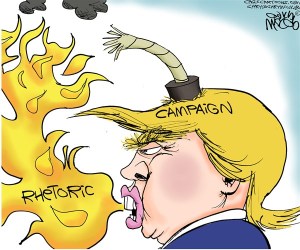
Trump was often “disappointed,” and then he viciously attacked people who worked for him. And example:
I watched as Trump strutted around the beautifully groomed clay tennis courts on his estate, managed by noted tennis proAnthony Boulle.The courts had been prepped meticulously for a full day of scheduled matches. Trump took exception to the design of the spaces between courts. In particular, he didn’t like a small metal box—a pump and cooler for the water fountain alongside—which he thought looked ugly. He first questioned its placement, then crudely disparaged it, then kicked the box, which didn’t budge, and then stooped—red-faced and fuming—to tear it loose from its moorings, rupturing a water line and sending a geyser to soak the courts. Boulle looked horrified, a weekend of tennis abruptly drowned.
Bowden characterizes Trump as an “adolescent” and a “teenager.” I’m not sure if he’s not even more childish than that. But he has access to unlimited coverage from the media and he has brought the crazies out of the woodwork to cheer him on. No matter how hard “mainstream” Republicans work to stop him, he could still end up being their nominee; and so far they are still saying they would support him.
Timothy Egan at The New York Times: Goose-steppers in the GOP.
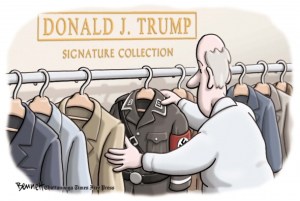
Well, he’s got the Hitler vote. The neo-Nazi website, Daily Stormer, was out and proud earlier this week: “Heil Donald Trump — the Ultimate Savior.” After endorsing the Republican presidential front-runner earlier this year for his call to deport 11 million Mexican immigrants, the fomenters of American fascism have now added an apt twist to his slogan, one not far from the truth of the campaign: “Make America White Again.”
Nazis — I hate these guys. Oh, but they’re a tiny minority of pink-faced malcontents living in basements with the windows taped up. Everybody hates them. Add to that supporters of the Ku Klux Klan, who’ve thrown in with Trump as well. David Duke, a former grand wizard of the Klan, liked everything he heard from Trump this week, embracing him for standing up for white nationalism.
And sure, all the little Hitlers probably don’t amount to a hill of beans. But what about the 35 percent of Republican voters, in the New York Times/CBS News poll, who say they’re all in with the man sieg heiled by aspiring brownshirts and men in white sheets?
It’s a very ugly political moment, but there it is: The Republican Party is now home to millions of people who would throw out the Constitution, welcome a police state against Latinos and Muslims, and enforce a religious test for entry into a country built by people fleeing religious persecution. This stuff polls well in their party, even if the Bill of Rights does not.

Paul Farhi at The Washington Post: Thanks to Trump, fringe news enters the mainstream.
Alex Jones may be America’s most successful conspiracy theorist. On his website, Infowars.com, and his daily radio program heard on more than 100 stations nationwide, Jones regularly promotes a variety of beyond-the- fringe ideas: alleged government conspiracies in the Oklahoma City bombing in 1995 and the terrorist attacks of Sept. 11, 2001; fluoride-in-the-water health scares; suspicions that the moon landings were faked; doubts about President Obama’s place of birth and birth certificate….
The ranting radio host and the leading Republican candidate shared a microphone, and some common ground, last week in what may have been a dubious first — the first time a leading presidential candidate has been interviewed by a media figure from the far extremes. “Your reputation is amazing,” Trump assured Jones, after Jones assured Trump that most of his listeners supported his candidacy. “I will not let you down.”
Trump finding common ground with Jones is in keeping with Trump’s own rocky relationship with facts and credible information during the campaign. Many of Trump’s more controversial assertions since he declared for president have come from the murky swamp of right-wing, libertarian and flat-out paranoid sources that have proliferated and thrived as the Internet and social media have grown.
Maybe not a leading candidate, but Ron Paul has appeared on Alex Jones’ show many times. So has Paul’s son Rand, who is currently running for president as a Republican. Back to the WaPo article:
Once a small fringe, this “alternative” information ecosystem now includes websites, talk-radio programs, newsletters, conferences and “citizen journalists” who promote, debate and inflate such questionable causes asvaccine denial, climate-change skepticism , and the supposedly imminent imposition of sharia law in America. The fringe nowadays often injects its ideas into the mainstream by gaining the attention of sources broadly popular among conservatives, such as Fox News and the Drudge Report, which devoted attention to rumors that the Operation Jade Helm military exercises this summer in the Southwest were a prelude to a crackdown on civil liberties.
“There’s an information-age tsunami out there that just keeps getting bigger and bigger,” said Steve Smith, a veteran newspaper editor who teaches journalism at the University of Idaho. “When you combine this digital tsunami with the loss of quality and quantity in American journalism [due to cutbacks and economic woes] over the years . . . journalists just don’t have the ability to keep up once a false narrative gains speed.”

Some reporters may be trying to stem the tide, but the big media honchos apparently love Trump. From Common Dreams via Truthdig: Hear a Network CEO Revel in the Amazing Profits of Candidates ‘Throwing Crap at Each Other’ (Audio).
Even as large swaths of the populationcall for media outletsto do their part in stemming the “dangerous tide of hatred, violence, and suspicion” taking hold in the United States, corporate media—which stands to benefit nicely from the $5 billion 2016 presidential election—is egging on that same divisive rhetoric.
“Go Donald! Keep getting out there!” CBS Corporation chief executive Les Moonvesreportedlysaid during an investor presentation Monday.
Trumpeting the advertising dollars already flowing CBS’s way as a result of the crowded 2016 GOP presidential primary, Moonves said: “We love having all 16 Republicans candidates throwing crap at each other — it’s great. The more they spend, the better it is for us.”
“And, you know, this is fun, watching this, let them spend money on us, and we love having them in there,” he declared. “We’re looking forward to a very exciting political year in ’16.”
So much for the “media watchdogs” who are expected to inform the American people.
In other news:
The LA Times: Person detained in fire at Coachella mosque; concern over shooting backlash mounts.
Channel 10 News Tampa Sarasota: Two Muslim Women Attacked in Tampa.
Buzzfeed: Lindsey Graham: Trump Leading Because 40% Of GOP Voters Think Obama Is Kenyan Muslim.
Truthout: Henry A. Giroux | Fascism in Donald Trump’s United States.
The New York Times: Discrimination by Airbnb Hosts is Widespread, Report Says.
The Christian Science Monitor: Guilty verdict for Oklahoma cop in serial rape trial: A national problem.
Wall Street Journal: Citigroup Funded Loan to Syed Farook Made Through Prosper Marketplace.
BBC News: Saudi Arabia’s women vote in election for first time.
What stories are you following today?

 peej
peej Carissa
 bostonboomer
 dakinikat
 ecocatwoman
 mablue2
 Mama Lopez
 peggysue22
 quixote
 skydancingguestblogger
 Mona (aka Wonk the Vote)



 Sky Dancing
Recent Comments