
A huge overnight price increase for an important tuberculosis drug has been rescinded after the company that acquired the drug gave it back to its previous owner under pressure, it was announced on Monday.
However, outrage over a gigantic price increase for another drug spread into the political sphere on Monday, causing biotechnology stocks to fall broadly as investors worried about possible government action to control pharmaceutical prices. The Nasdaq Biotechnology Index fell more than 4 percent.
“Price-gouging like this in the specialty drug market is outrageous,” Hillary Rodham Clinton, a contender for the Democratic presidential nomination, said in a tweet on Monday. She said she would announce a plan on Tuesday to deal with rising drug prices.
Ms. Clinton was referring to the actions of Turing Pharmaceuticals, which last month acquired Daraprim, a 62-year-old drug used to treat a serious parasitic infection, and raised its price to $750 per tablet, from $13.50.
Tuesday Reads
Posted: September 22, 2015 Filed under: 2014 elections, 2016 elections, Bobby Jindal, Republican politics, Republican presidential politics 26 CommentsGood Morning!
 Well, I really didn’t think I’d end up writing my next morning reads about Scott Walker although we’ve covered his reign of terror in Wisconsin quite a bit. It appears the Koch sponsored Governors are not doing very well this year. Walker’s coffers were full of funds but his campaign was as empty as bucket with a hole much like his rhetoric and ideology.
After a dramatic fall from the top tier of Republican presidential candidates over the last several weeks, Wisconsin Gov. Scott Walker ended his bid for the White House Monday.
“Today, I believe that I’m being called to lead by helping to clear the field in this race so that a positive conservative message can rise to the top of the field,” Walker announced at a press conference in Madison, Wisconsin on Monday. “With this in mind, I will suspend my campaign immediately.”
“I encourage other Republican presidential candidates to consider doing the same, so that the voters can focus on a limited number of candidates who can offer a positive, conservative alternative to the current front runner,” Walker went on to say, referring to current GOP frontrunner Donald Trump.
Walker’s run started on July 13 and lasted 71 days.
The move comes just two months after polls showed Walker leadingTrump in the crucial, first-in-the-nation caucus state of Iowa. Many pundits considered Walker to be a favorite for GOP nomination after his successful recall election in Wisconsin in 2012 and his establishment support.
But over the last several weeks, Walker has fallen dramatically in national polls, registering at less than 0.5 percent in the latest national CNN/ORC poll this weekend. In Iowa, where for much of the year Walker was considered the favorite to win the first in the nation caucuses, Walker slid from 19 percent to 5 percent in just six weeks of NBC News/Marist polling.
Walker first gained attention in Iowa for a speech at the Iowa Freedom Summit in January. But after riding high in the polls in that state for over half the year, Walker was outpaced in the polls following a lackluster performance in the first televised Republican debate.
Walker, never having graduated college, pitched himself as an outsider to Washington and argued that the next president needed to be a governor.
Walker’s governorship was ideological from the get go. Anyone with a critical eye toward results can see the damage he’s done to Wisconsin. Kansas and Louisiana also stand out as failed states in the ALEC/Koch style. It’s not like any of these guys can run on a successful economy or stewardship of their state’s funds. Walker’s jihad against teachers and police officers and their unions took on a nasty tone. His actions spoke far louder than his words on the campaign trail. I found his debate manner insipid. Even one of his slighted former campaign aids said he tried to please every one and came off as having no real core ideals.
Gov. Scott Walker of Wisconsin, whose early glow as a Republican presidential contender was snuffed out with the rise of anti-establishment rivals, announced Monday that he was quitting the race and urged some of his 15 rivals to do the same so the party could unite against the leading candidate, Donald J. Trump.
Mr. Walker’s pointed rebuke of Mr. Trump gave powerful voice to the private fears of many Republicans that the party risked alienating large parts of the electorate — Hispanics, women, immigrants, veterans, and most recently, Muslims — if Mr. Trump continued vilifying or mocking them as part of his overtures to angry and disaffected voters.
Still, Mr. Walker’s exit was not a selfless sacrifice: He was running low on campaign cash, sliding sharply in opinion polls, losing potential donors to rivals and unnerving supporters with a stream of gaffes, like saying he would consider building a wall along the Canadian border.
Appearing ashen and drained at a brief news conference late Monday in Madison, Mr. Walker said the Republican presidential field was too focused on “how bad things are” rather than on “how we can make them better for everyone.” Without naming Mr. Trump, Mr. Walker issued a plea to fellow candidates to coalesce around a different Republican who could offer a more “optimistic” vision and guide the party to a victory next year that, he admitted with sadness in his voice, he could not achieve himself.
The Great Wall of Canada may have been the first whiff of how absolutely clueless the man was on the world outside. What was he planning on doing? Stopping Americans from getting cheap Canadian drugs?
Walker’s decision to quit followed two lackluster debate appearances, tepid fundraising and several statements that attracted a flurry of negative headlines, including those that followed the candidate’s assertion that building a wall along the Canadian border was a possibility that deserved further examination. It may have also been hurt by the fact that Walker is essentially a life-long politician in an election season in which Americans are so far embracing outsiders.
While Walker’s union-bashing record provided his ticket into the race, the narrative that brought him headlines and donors didn’t prove to be a white-hot issue. At a time when organized labor is already losing membership, reducing its clout hasn’t been a top national priority for most Republicans. In the first debate on Aug. 6, the word “union” was used just three times, and only once by Walker, in his closing statement.
“I took on the big-government union bosses, and we won,” said Walker, who saw his state and national poll numbers fall almost as soon as Trump entered the race. “They tried to recall me, and we won. They targeted us again, and we won.”
The references were to Walker’s 2011 fight with public-sector unions, as well as his 2012 recall and 2014 general election victories, both contests that included heavy union spending against him. His ability to remain “unintimidated” in those battles has become a central theme of Walker’s campaign.
On the campaign trail, however, Walker wasn’t that intimidating. In an often monotone Midwestern voice, his speeches virtually never changed and he wasn’t as quick on his feet in interviews or during debates as some of his opponents. While he worked extremely hard to stress his common-man credentials, seemingly making almost continuous references to his love of his Harley-Davidson motorcycle, it also kept him from looking presidential.
 He just couldn’t hold a candle to The Donald. Or, so he says and they say …
But Walker began the 2016 campaign season in a promising spot. He had a record of fighting for conservative priorities in Wisconsin in a way that impressed both the GOP’s base and its elites. Since he wasn’t so identified with pro-immigration policies as Jeb Bush or Marco Rubio, it seemed to some that he was well-positioned to unite the party’s disparate factions. And despite some early rockiness on policy issues, Walker took the lead in Iowa caucus polls in mid-February, and held it for the next five and a half months.
Then Hurricane Trump rolled in. The billionaire’s showmanship and disdain for what he called “political correctness” on the topic of unauthorized immigration excited the Republican right, and powered him to the front of polls nationally and in Iowa.
In comparison, Walker looked like a typical politician, had an unimpressive speaking style, and failed to stand out from the crowd in the two debates so far. In last week’s second debate, the Wisconsin governor spoke the least of any candidate, and twopost-debate surveys asking Republican voters who won this week’s debate found Walker in last place of the 11 primetime debaters. After the first debate, he plummeted in the polls both in Iowa and nationally. Currently, he’s in 11th place nationally and in 7th place in Iowa, according to RealClearPolitics’s poll averages.
There are some other candidates that are on the ropes but seem oblivious to their problems. Hillary was in Baton Rouge yesterday. Jindal challenged her to debate health care with him. Instead, she took the stage and left him to his less than 1% standing in the polls among Republican voters. She’s not backing down on the Affordable Healthcare Act.
Hillary Clinton defended President Barack Obama’s signature legislation, the Affordable Care Act, during a campaign stop in Baton Rouge on Monday and took aim at her Republican rivals who say they want to repeal “Obamacare.”
“It’s not just a political issue, it’s a moral issue,” the Democratic presidential front-runner told a crowd of 1,200 cheering supporters and schoolchildren at the Louisiana Leadership Institute.Attendees circulated volunteer sign-up sheets and texted their information to the campaign during the rally, which was the first of several stops on Clinton’s latest effort to campaign on the importance of the federal health care law and her plans to protect and build on it.
“I’m not going to let them tear up that law, kick 16 million people off their coverage and force the country to start the health care debate all over again,” she said as supporters waved bright blue “Hillary” signs.
Clinton won several bouts of applause from the friendly crowd, particularly as she took jabs at Gov. Bobby Jindal and U.S. Sen. David Vitter, both Republicans.
Jindal, who is seeking the GOP nomination for president, has been a vocal opponent of Obamacare and has repeatedly called for its repeal. He also blocked the state from expanding its Medicaid program for the poor and uninsured through an optional piece of the federal health care law — a point that Clinton was quick to point out.
“He put ideology ahead of the well-being of the people and the families in this state,” Clinton said, noting that some 190,000 people in Louisiana would have been eligible for Medicaid if Jindal had supported expansion.
The ACA has faced near constant backlash from many Republicans since it was signed into law in 2010. Jindal, through his America Next policy group, released hisown proposal to repeal the law and replace it last year.
But Clinton said such a move would be too disruptive and vowed to fight any effort to repeal the law, if elected.
“I want to build on the progress we’ve made. I’ll do more,” she said.
Clinton said she would announce a plan this week to further address health care costs, including rising drug prices.
The equity markets are evidently betting on Hillary. The viral story of the day was of a dudebro hedge fund manager who bought a drug on the cheap and hiked its price to the stratosphere. Hillary demanded investigation in to price gouging and the entire industry felt the discipline of the market and the expectation she’d do it too. One company who’d gotten a patent from a non profit associate with Perdue for a Tuberculous drug wound up with the patent deal rescinded. The dudebro’s move still stands for the time being.
Mania-prone biotech stocks were in the market’s doghouse Monday, after a 21-word tweet from Democratic presidential candidate Hillary Clinton ripping a drug company’s pricing policy sparked a sharp selloff for the group.
Referencing a New York Times report on a steep price hike for a drug recently acquired by Turing Pharmaceuticals, Clinton lambasted the often-astronomical price tags for specialty drugs being developed by biotech and pharmaceutical companies and pledged to provide a plan to keep such therapeutic costs in check.
You can read more about both situations here.
It’s really interesting to watch the difference between a campaign on fire and one going doing in flames.
What’s on your reading and blogging list today?
Monday Reads: Party Nomination Races Beginning to Heat Up
Posted: September 21, 2015 Filed under: morning reads, Republican politics, U.S. Politics | Tags: Barack Obama, Ben Carson, Donald Trump, Hillary Clinton, Jill Biden, Joe Biden, Muslims, religious tests, Scott Walker, US Constitution 27 Comments
Worlds Full of Lemons by Vitaly-Urzhumov
Good Morning!!
Following last week’s marathon “debate,” Republican presidential candidates have continued to spread hate everywhere they go.
Current front runners Donald Trump and Ben Carson are pushing hatred of Muslims, along with insinuations that we already have one in the White House.
Bloomberg Politics: Donald Trump on Muslims: ‘Are You Trying to Say We Don’t Have a Problem?’
Trump, the front runner for the 2016 Republican nomination, was asked on CNN’s State of the Union about his campaign rally in New Hampshire on Thursday. At the event, an audience member said President Barack Obama was a Muslim, that the U.S. has a problem with Muslims, and asked “when can we get rid of them?” At Thursday’s event and again on CNN, Trump did not criticize or correct the question.
“We could be politically correct if you want,” Trump said. “Are you trying to say we don’t have a problem?” ….
“We have radicals that are doing things,” he said. “It wasn’t people from Sweden that blew up the World Trade Center.”

On This Week, continued his anti-Muslim ranting. Bloomberg reports:
On ABC’s “This Week” broadcast, Trump again referred to “a worldwide problem” with Muslims, according to a transcript provided by the network.
“You look around the world, it is a problem,” Trump said. “You know, the terrorism and everything else, it seems to be pretty much confined there.”
Trump also declined several times during the ABC interview to say that he believed Obama was born in the U.S.
Lovely. I guess Trump hasn’t noticed all the domestic terrorists here in the U.S. Dylann Roof, for example is no Muslim.
From the transcript of This Week, Jonathan Karl reports on a Trump appearance in Iowa at a high school homecoming.
KARL (voice-over): Trump didn’t challenge his supporter’s false claim about the president’s background….
KARL (voice-over): But Trump has no apologies. He recited his Twitter account for an Iowa crowd on Saturday.
TRUMP: So I started by saying, “Am I morally obligated to defend the president every time somebody says something bad or controversial about him? I don’t think so.”
Right?
KARL (voice-over): So is Donald Trump playing with fire? Or simply playing to his base?
A recent poll shows more than half of Trump’s supporters believe President Obama is Muslim and 28 percent of Republicans think the president wasn’t born in the U.S. Even Trump has admitted his conspiracy theories over the president’s birth are part of his appeal, as he told me two years ago.
KARL: You don’t acknowledge that you went overboard on this whole birther stuff?
(CROSSTALK)
TRUMP: Actually, I think it made me very popular, if you want to know the truth, OK? So I do think I know what I’m doing.
Yes, Trump is spreading hate, and he knows exactly what he’s doing.
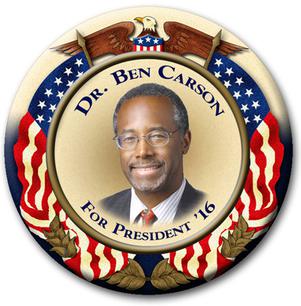
And then there’s Ben Carson. The Guardian: Ben Carson says no Muslim should ever become US president.
The Republican presidential candidate Ben Carson has said no Muslim should be president of the United States of America.
In an interview with NBC for broadcast on Sunday morning, the retired neurosurgeon said: “I would not advocate that we put a Muslim in charge of this nation. I absolutely would not agree with that.”
Carson’s discussion with Meet the Press host Chuck Todd centered around controversy that arose this week when Donald Trump – the real-estate mogul keeping Carson in second place in the polls – failed to correct an audience member at a New Hampshire campaign rally who said President Obama was a Muslim.
The audience member also appeared to advocate the forcible removal of Muslims from the US….
In his NBC interview, Carson was asked: “So do you believe that Islam is consistent with the constitution?”
“No,” he said, “I don’t, I do not.”
Article VI of the US constitution states: “No religious Test shall ever be required as a Qualification to any Office or public Trust under the United States.”
The first amendment to the constitution begins: “Congress shall make no law respecting an establishment of religion, or prohibiting the free exercise thereof …”
What does Carson think about Muslims as Congresspeople?
Carson was also asked if he would consider voting for a Muslim candidate for Congress.
He said: “Congress is a different story, but it depends on who that Muslim is and what they’re policies are, just as it depends on what anybody else says, you know.”
Two members of Congress, both Democrats, are Muslim: Keith Ellison of Minnesota was elected to the House of Representatives in 2007 and André Carson of Indiana followed in 2008.
Fortunately, neither of these freaks is likely to be president or even see the inside of the White House anytime soon.
Fading presidential candidate Scott Walker’s hatred is focused on labor unions. From The American Prospect: A Desperate Scott Walker Brings Anti-Labor Crusade to National Stage.
Earlier this week, Republican presidential contender Scott Walker detailed how he would bring his anti-labor crusade to the federal level, unveiling an expansive plan that would eliminate the National Labor Relations Board, ban federal public sector unions, and make the United States a right-to-work country, among a host of other anti-worker policies he said would give “power to the people, not the union bosses.” ….
As recently as July, Walker was leading the polls in Iowa. He’s since plummeted to the bottom of the Iowa field with just 3 percent support. Worse yet, as he admitted after yesterday’s debate, his entire campaign is premised on winning the Iowa caucuses, which kick-off the contest for delegates. “I think we’re putting all our eggs in the basket of Iowa, we’re committed to Iowa, and I think that’ll help us make the case all throughout the country,” Walker told MSNBC .
With Walker following a similar downward spiral as the announcement of his anti-labor plan appears to be an attempt at to lock-down uneasy big-money donors who stand to benefit from gutting worker rights. Walker needs to ensure that he will remain funded well into the primary season.
“The way the system is now set up, to stay alive, you have to really convince your relatively few big donors to stay in the game,” says Larry Noble of the Campaign Legal Center. “[His plan] seems to be aimed at the donors, not the public.”
Hillary Clinton appeared on Face The Nation yesterday. Here’s the transcript of the interview. And here are the headlines in the corporate media.
Buzzfeed News: Hillary Clinton Calls For The U.S. To Take In 65,000 Syrian Refugees.
Hillary Clinton said Sunday the U.S. should commit to taking in 65,000 Syrian refugees next financial year, a significantly higher number than the 10,000 the Obama administration has announced it will accept.
“We’re facing the worst refugee crisis since World War II, and I think the United States has to do more, and I would like to see us move from what is a good start with 10,000 to 65,000, to begin immediately to put into place the mechanisms for vetting the people that we would take in,” Clinton told Face the Nation moderator John Dickerson on Sunday….
Clinton said on Sunday that the U.S. should prioritize taking in the most vulnerable — including, she says, Christians and Yazidi women — before repeating her call for a global meeting to address the issue.
“I also want the United States to lead the world, and I’ve recommended at the upcoming U.N. General Assembly there be an international meeting called by the secretary general and literally get people to commit [to] putting money in, helping the frontline states like Jordan, Turkey, and Lebanon who’ve absorbed a lot refugees, working with the EU and the European countries, but getting everybody to make a contribution,” Clinton said.
Real Clear Politics: Hillary Clinton: “I Cannot Imagine Anyone Being More Of An Outsider Than The First Woman President.”
In an interview with John Dickerson, moderator of CBS’s Face the Nation, Democratic presidential candidate Hillary Clinton said she can claim outsider status since she could possibly be the first female president.
“In politics this year, it looks like everything wants an outsider,” Dickerson said. “Now that puts you in a fix.”
“Tell us why this doesn’t put you in a fix,” Dickerson said to laughter from Clinton.
“I cannot imagine anyone being more of an outsider than the first woman president,” Clinton stated. “I mean, really, let’s think about that.”
CBS News: “I am a real person,” Hillary Clinton says.
Democratic presidential candidate Hillary Clinton was stumped Sunday when “Face the Nation” moderator John Dickerson asked her to name three words that describe “the real Hillary Clinton.”
“Just three? I can’t possibly do that!” Clinton said, throwing hear head back with laughter. “I mean, look, I am a real person with all the pluses and minuses that go along with being that. And I’ve been in the public eye for so long that I think, you know, it’s like the feature that you see in some magazines sometimes, ‘Real people actually go shopping,’ you know?”
On Dickerson’s question about voters wanting an outsider as president:
“I know you’re asking, ‘Do we want people who have never been elected to anything, who have no political experience, who have never made any hard choices in the public area?'” she told moderator John Dickerson. “Well, voters are going to have to decide that.”
She also addressed criticism that she is too deep inside the political system to help reorient the economy back toward the middle class.
“I have an economic policy that is centered on raising incomes, because I think what we inherited from the Bush administration, what President Obama had to deal with, had the potential of becoming a ‘Great Depression,’ not just a ‘Great Recession,'” Clinton said. “We have now recovered 13 million jobs after losing 800,000 a month when he came into office. So why would we go back to the same policies? Call them insider, call them tilted toward the rich, call them giving corporations a free pass to do whatever they want. I’m against that, I’ve always been against that.”
She added, “So you know, I’m not running for Bill’s third term, I’m not running for President Obama’s third term, but it would be foolish of me not to say, ‘You know, that worked better than what the Republicans offer.'”
Channel 10 News Tampa Bay: Hillary Clinton: I’m not preparing for Joe Biden.
Hillary Clinton said she and her team are not taking steps to prepare for a possible late entry into the Democratic presidential primary by Vice President Joe Biden.
“This is such a personal decision and the vice president has to sort this out,” Clinton said Sunday on CBS’ “Face the Nation.” “He’s been so open in talking about how difficult this time is for him and his family and he’s obviously considering what he wants to do including whether he wants to run.”
“I just have the greatest respect and affection for him and I think everybody just ought to give him the space to decide what’s best for his family,” she added.
Biden met with political advisers Monday at his residence in Washington, D.C. as part of his ongoing conversation with family, friends and staff over whether to jump into the 2016 presidential race.
Over the last few days, some Democratic donors have also calls for the vice president to mount a challenge to Clinton.
According to Chuck Todd and friends, Biden’s wife has given him her blessing to joint the presidential race.
Contrary to reports suggesting Vice President Joe Biden’s wife remains an obstacle to his potential presidential run, sources tell NBC News that Jill Biden is fully behind him for another bid.
Jill Biden, sources tell NBC’s Chuck Todd, is 100 percent on-board with a presidential run, despite reports indicating her hesitation is part of what’s keeping Biden from jumping into the race.
And that looks more likely by the day, as sources have indicated Biden’s been meeting with Democratic leaders during his travels around the nation over the past week to tell them he wants to do it and thinks there’s room for him to make a credible bid if he does.
The key question that’s still weighing on his mind as he decides whether to make another go of it: Does he have the emotional energy to give it his all, sources say.
Whatever. I still don’t think he’ll do it. Apparently he thinks he needs to make up his mind by October 1, so we won’t have to listen to the speculation much longer.
What else is happening? What stories are you following today?
It’s Saturday Night!
Posted: September 19, 2015 Filed under: open thread 13 Comments I’m so far behind on everything it’s not even funny!
You name it! I’m behind on it! Bills! Grading! Cleaning! Laundry!
There’s actually a lot of things to avoid these days unless you want to be made terrifically anxious.
For example, you could read all about the Republicans bitching about persecution of Christians in this country while jumping all over on the Pope’s case for being critical of capitalism and appreciating the science behind global warming. I mean that really makes sense, doesn’t it? Scream about Christian persecution while berating a Pope?
George F Will is still alive and working but for some reason he can’t afford a new hair helmut, schtick or headshot. They all must be at least 40 years old at this link from WAPO. However, his complaints are straight out of the good old days. He’s got a set of really stranger than usual argments and I say that knowing full well that most of his arguments are always strange and unusual. George, a pope with red gucci shoes has “flamboyance”. One with science degrees and a realistic take on climate change has gravitas.
Why is George F Will persecuting christians?
Pope Francis embodies sanctity but comes trailing clouds of sanctimony. With a convert’s indiscriminate zeal, he embraces ideas impeccably fashionable, demonstrably false and deeply reactionary. They would devastate the poor on whose behalf he purports to speak — if his policy prescriptions were not as implausible as his social diagnoses are shrill.
Hey, I’m not a fan of any organized religion but any one whose magical thinking includes a good dose of science is better than one that’s all magical thinking and lies.
Meawhile, my book club is reading The Great New Orleans Kidnapping Case which is educating me on things I never knew about the Reconstruction period.
The case was combustible. Two mixed-race women, abetted by the son of one of them, stood accused of kidnapping a blonde, blue-eyed white baby girl in New Orleans in 1870. How did it end? Author Michael Ross expertly keeps readers in suspense as he weaves this true tale of crime, culture, politics, and colorful Southern characters — including a riverboat captain, “mulatresses,” and a precedent-setting Afro-Creole detective.
The case began on the afternoon of June 9, 1870, when Bridgette Digby sent her 10-year-old son, Georgie, and toddler daughter Mollie outside to play under the supervision of a teenage babysitter. Two stylish, fair-skinned African-American women happened to be strolling by. As they stopped to admire Mollie, a fire broke out a few blocks away, and the excited babysitter asked Georgie to hold his sister while she ran to watch the fire.
“No bubby, I will take the baby,” one of the women said. The women asked Georgie to lead them to the home of a certain neighbor. Once there, they told Georgie it was the wrong house, and then sent him to the market to buy a treat for his sister. A heart-stopping shock awaited Georgie when he came out of the market. The women were gone, and so was his baby sister.
In the era of post-Civil War Radical Reconstruction, the Digby kidnapping case quickly became the focus of public fears and sensationalistic press coverage. Louisiana Governor Henry Clay Warmouth, a young Union army veteran from Illinois, saw the case as an opportunity to demonstrate to skeptics the professionalism of the newly integrated New Orleans police department. When Afro-Creole detective John Baptiste Jourdain was assigned to the investigation, he became the first black sleuth in the nation to work such a prominent case.
Leads poured in. Detective Jourdain, who sometimes donned a disguise, and other investigators questioned mulatto women, nursemaids, voodoopractitioners, even a clairvoyant, all without success. Then, nearly two months after Mollie Digby disappeared, acting on a tip, Detective Jourdain and other police officers went to the home of an “attractive mulatto woman,” Ellen Follin, who, like Jourdain, was Afro-Creole. She denied having the child, but a suspicious Jourdain threatened to have everyone in the house arrested unless she produced Mollie soon.
Within two days, former riverboat captain James Broadwell, who was white, appeared on the Digbys’ doorstep. “I think I have your child,” he informed Mollie’s father. A black woman friend of the Broadwells had allegedly asked the captain to return the baby who, she claimed, had been left at her gate by a veiled white woman. The Broadwells’ friend was none other than Ellen Follin. With Mollie’s safe return, Follin, her son, and her sister were all arrested on kidnapping charges. (The arrest date for the sister differs from page to page, one of very few discordant notes in this otherwise well-researched narrative.)
Here’s a bit about that with photos. It was a fun discussion today and I look forward to the next two where we try to sort more things out.
I’m trying to head to Baton Rouge on Monday Morning to attend an organizing event with Hillary Clinton and members of the campaign. Hopefully, I can work out the logistics but my grade are due on Thursday and as I said, I’m very behind on everything. You’ll know if I do because I will post pictures.
So, anyway, this is just a short open thread!
Have a great night!!!
Friday Reads: Rehashing the Debate of the Living Dead
Posted: September 18, 2015 Filed under: morning reads | Tags: 2016 primaries, bigotry, Fiorina, Islamophobia, Republican primary debate, Trump 8 CommentsWell, I’ve had one of those days and I’m much later than I thought I would be getting to this post. I went to pick up a ‘script and some groceries which I expected to take an hour and a half tops. It turned into an all afternoon ordeal that’s left me crabby and behind on everything. At least Z Nation is on tonight and I have a good supply of red wine.

I’m still reeling from the absolute cock and bull show that was the three hour Republican Primary Debate. How can so many people tell so many lies and still have folks call some winners and losers. What ever happened to telling the truth and calling people out on absolute fantasy?
Former Democratic activist turned journalist George Stephanopoulos on Thursday went after Carly Fiorina for attacking Planned Parenthood during Wednesday’s presidential debate. The Good Morning America co-host grilled, “Another powerful moment last night was when you talked about those Planned Parenthood tapes. But analysts who’ve watched all 12-plus hours say the scene you’ve described, that harrowing scene you described, actually isn’t in those tapes.”
He wondered, “did you misspeak?” Fiorina shot back at the man who secretly donated $75,000 to the Clintons: “I don’t know whether you’ve watched the tapes, George….Certainly none of the Democrats who are still defending Planned Parenthood have watched those tapes.”
I’m beginning to think they should just come out and ask them if they’re stupid or if they’ve just decided to just lie to every one if that’s what it takes to get attention.
None of the nonsense escaped the sharp eyes and tongue of Charles Pierce. He singled Fiorina out for the completley out-to-lunch comments of Fiorina who many pundits feel won the debate.
How do you win a debate by talking trash crisply?
There is a monumental question facing political journalists this morning. How do you cover a campaign in which 15 candidates are running on the basis of things that simply are not true, on the basis of things that simply do not exist? There are two choices: call bullshit for what it is, or just surrender to the unceasing barrage of truthless performance art. Here’s Ezra Klein, pretty much running up the white flag.
This is the second debate Fiorina won. She dominated the JV stage in the Fox News debate, forcing CNN to change the rules to ensure she made the main stage in their event. She validated their decision tonight. She had the crispest answers, received the biggest cheers, and proved the only candidate on the stage capable of standing against Trump. She made everyone else on the stage — especially Trump — look unprepared. But she did it in part by playing fast and loose with the facts. Her barrage of specifics often obscured a curious detachment from reality.
If a cop sees someone on the sidewalk evincing a “curious detachment to reality,” he will run that person in for medical observation, but read on, and Klein correctly points out that Fiorina doesn’t really know what she’s talking about. On foreign policy, and on immigration, and on a host of other issues, she simply asserts that which is not true.
This has become something of a habit for Fiorina, who has a notable facility for delivering answers that thrill conservatives but fall apart under close examination. In a recent interview with Katie Couric, for instance, Fiorina delivered a four-minute riff on climate change that the National Review enthused “shows how to address the left on climate change.” The only problem, as David Roberts pointed out, was that every single thing she said in it was wrong. But if presidential campaigns were decided by fact checkers, Al Gore would have won in a landslide.
Were I young Ezra, I would not use the events surrounding the Gore candidacy as precedent for how political reporters should cover presidential campaigns, and Gore did win by half-a-million votes nationwide. If the elite political press is going to treat fiction as fact as long as the fiction is delivered in a compelling, dramatic manner, then the country truly is lost. If Carly Fiorina is adjudged to be the winner of a debate simply because of how “crisply” she delivered lies about Planned Parenthood, or how “forcefully” she responded to a cartoon like Donald Trump, or how “sharply” she presented her nonsense about reining in Vladimir Putin with “aggressive military maneuvers” on his borders, then there is a problem in the political process that is metastasizing by the hour. Ronald Reagan was the index patient for that problem. They truly are his children now.
 Paul Krugman followed up on this general topic in his op-ed today.
I’ve been going over what was said at Wednesday’s Republican debate, and I’m terrified. You should be, too. After all, given the vagaries of elections, there’s a pretty good chance that one of these people will end up in the White House.
Why is that scary? I would argue that all of the G.O.P. candidates are calling for policies that would be deeply destructive at home, abroad, or both. But even if you like the broad thrust of modern Republican policies, it should worry you that the men and woman on that stage are clearly living in a world of fantasies and fictions. And some seem willing to advance their ambitions with outright lies.
Let’s start at the shallow end, with the fantasy economics of the establishment candidates.
You’re probably tired of hearing this, but modern G.O.P. economic discourse is completely dominated by an economic doctrine — the sovereign importance of low taxes on the rich — that has failed completely and utterly in practice over the past generation.
Think about it. Bill Clinton’s tax hike was followed by a huge economic boom, the George W. Bush tax cuts by a weak recovery that ended in financial collapse. The tax increase of 2013 and the coming of Obamacare in 2014 were associated with the best job growth since the 1990s. Jerry Brown’s tax-raising, environmentally conscious California is growing fast; Sam Brownback’s tax- and spending-slashing Kansas isn’t.
Yet the hold of this failed dogma on Republican politics is stronger than ever, with no skeptics allowed. On Wednesday Jeb Bush claimed, once again, that his voodoo economics would double America’s growth rate, while Marco Rubio insisted that a tax on carbon emissions would “destroy the economy.”
The only candidate talking sense about economics was, yes, Donald Trump, who declared that “we’ve had a graduated tax system for many years, so it’s not a socialistic thing.”
If the discussion of economics was alarming, the discussion of foreign policy was practically demented. Almost all the candidates seem to believe that American military strength can shock-and-awe other countries into doing what we want without any need for negotiations, and that we shouldn’t even talk with foreign leaders we don’t like.
Trump, meawhile, took the spotlight today by taking a pass on the idea that Obama is a Muslim that wasn’t born in this country unlike how Senator John McCain approached birthers during Obama’s first run at the presidency. Trump was an infamous birther so it’s not surprising he’d still be attracting them and playing off the meme.
Donald Trump came under fire Friday morning for his handling of a question at a town hall about when the U.S. can “get rid” of Muslims, for failing to take issue with that premise and an assertion that President Barack Obama is Muslim.
Trump, who has shaken off several high-profile controversies that would have ended other presidential campaigns, faced an immediate backlash from advocacy groups, and members of his own party distanced themselves from the GOP front-runner. The incident recalls Trump’s 2011 quest to challenge Obama on where he was born, which ended with Obama releasing his long-form birth certificate. It also follows a debate performance Wednesday that garnered mixed reviews for the billionaire businessman.
“We have a problem in this country. It’s called Muslims,” an unidentified man who spoke at a question-and-answer town hall event in Rochester, New Hampshire asked the mogul at a rally Thursday night. “You know our current president is one. You know he’s not even an American.”
A seemingly bewildered Trump interrupted the man, chuckling, “We need this question. This is the first question.”
“Anyway, we have training camps growing where they want to kill us,” the man, wearing a “Trump” T-shirt, continued. “That’s my question: When can we get rid of them?”
“We’re going to be looking at a lot of different things,” Trump replied. “You know, a lot of people are saying that and a lot of people are saying that bad things are happening. We’re going to be looking at that and many other things.”
The real estate mogul did not correct the questioner about his claims about Obama before moving on to another audience member.
 Meanwhile, most reporters seem to just keep mum while crap like this goes on. Anderson Cooper finally showed some shock and surprise during one particularly bad White Christian Supremacist Trump Supporter landed on his program. Can we expect any more of this? Probably not, because Coop apologized later.
Thursday Reads: #IStandWithAhmed
Posted: September 17, 2015 Filed under: Barack Obama, morning reads, Republican politics, U.S. Politics | Tags: #IStandWithAhmed, Ahmed Mohamed, GOP second debate 22 Comments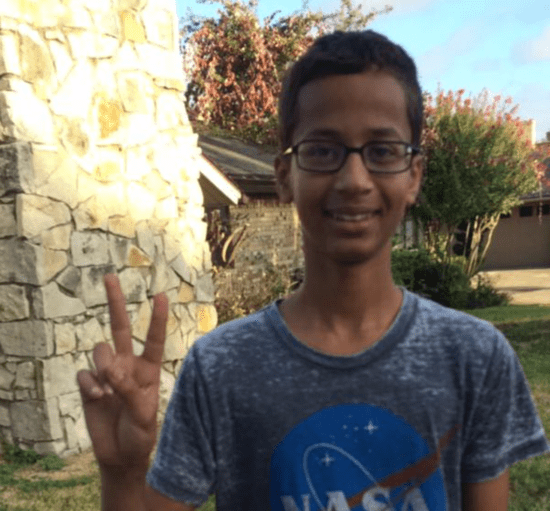
Good Morning!!
After the horror show that was the second Republican debate, we can at least celebrate the fact that massive numbers of Americans–and people all over the world–stand with Ahmed Mohamed after the disgraceful and humiliating treatment he received from his teachers, school administrators, and the Irving, TX police department.
The Dallas Morning News reports: Ahmed Mohamed swept up, ‘hoax bomb’ charges swept away as Irving teen’s story floods social media.
Irving’s police chief announced Wednesday that charges won’t be filed against Ahmed Mohamed, the MacArthur High School freshman arrested Monday after he brought what school officials and police described as a “hoax bomb” on campus.
At a joint press conference with Irving ISD, Chief Larry Boyd said the device — confiscated by an English teacher despite the teen’s insistence that it was a clock — was “certainly suspicious in nature.”
School officers questioned Ahmed about the device and why Ahmed had brought it to school. Boyd said Ahmed was then handcuffed “for his safety and for the safety of the officers” and taken to a juvenile detention center. He was later released to his parents, Boyd said.
“The follow-up investigation revealed the device apparently was a homemade experiment, and there’s no evidence to support the perception he intended to create alarm,” Boyd said, describing the incident as a “naive accident.”
Asked if the teen’s religious beliefs factored into his arrest, Boyd said the reaction “would have been the same” under any circumstances.
“We live in an age where you can’t take things like that to school,” he said. “Of course we’ve seen across our country horrific things happen, so we have to err on the side of caution.”
The chief touted the “outstanding relationship” he’s had with the Muslim community in Irving. He said he talked to members of the Muslim community this morning and plans to meet with Ahmed’s father later today.
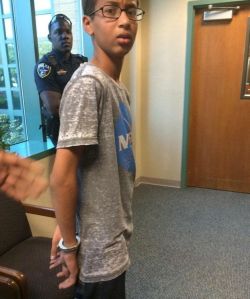
Good luck with that, Chief. Ahmed’s family is already talking to lawyers about suing your department and the high school for damages. You should be ashamed.
Speaking at an afternoon news conference outside the family’s home, Ahmed’s father said he’s proud of his son and wowed by his skills.
“He fixed my phone, my car, my computer,” Mohamed Elhassan Mohamed said. “He is a very smart, brilliant kid.”
Mohamed said he’s lived in America for 30 years, but this was a new experience for him.
“That is not America,” Mohamed Elhassan Mohamed said of his son’s humiliation after being handcuffed in front of his classmates.
But Mohamed said he’s also been touched by the outpouring of support for his son.
“What is happening is touching the heart of everyone with children,” he said. “And that is America.”
Ahmed speaks at his family’s press conference.
From the sublime to the ridiculous, Irving, TX police chief tries to explain away his officers’ and MacArthur High School officials’ stupidity and racism.
The good news is that so far, Ahmed has been invited to visit the White House and to tour labs at M.I.T. and Harvard. He’s been invited to meet Mark Zuckerberg at Facebook headquarters and offered an internship at Twitter. He has been offered a scholarship to NASA’s Space Camp, and a tour of Mission Control. In Texas, he has been offered a lifetime membership in the Dallas Engineering Club and has been invited tour the telescope lab at UT Austin. There have been many more invitations and expressions of support.
Last night Ahmed was interviewed by Chris Hayes. Max Fisher wrote about the interview at Vox:
“People will always have your back”: The amazing lesson Ahmed Mohamed took from his arrest.
Ahmed Mohamed, the 14-year-old boy who was arrested at school and accused of trying to make a bomb because he’d brought in a homemade clock, appeared on MSNBC for an interview with Chris Hayes on Wednesday night.
“I felt like I was a criminal, I felt like I was a terrorist, I felt like all the names I was called,” he said of the experience of being handcuffed, finger-printed, and interrogated by police. The treatment was not totally new: “In middle school I was called a terrorist, called a bomb-maker. Just because of my race and religion.”
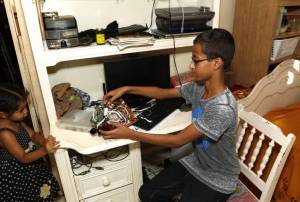
Yes. That is what this intelligent and poised young man has had to deal with in his hometown.
Even for all he went through, Ahmed seems to have come out of the experience, amazingly, more optimistic about the world. When Hayes asked him what he thought about the outpouring of support, this was his answer, and it’s really something:
I feel really well after, because before I didn’t think I was going to get any support because I’m a Muslim boy. So I thought I was just going to be another victim of injustice. But thanks to all my supporters on social media, I got this far, thanks to you guys. I see it as a way of people sending a message to the rest of the world that just because something happens to you because of who you are, no matter what you do, people will always have your back.
The lesson that “people will always have your back” no matter what you look like is perhaps not the one that I might have taken had I gone through what Ahmed did. It is truly amazing to see him come out from this so optimistic about the world, willing to see the silver lining from his experiences rather than to be embittered by the many ways he was mistreated. It’s yet another lesson we could all stand to learn from him.
The entire video of Chris Hayes’ interview with Ahmed is posted at the All In website at MSNBC.
More links to explore:
Also from Max Fisher at Vox: It’s not just Ahmed Mohamed: anti-Muslim bigotry in America is out of control.
Chris Gayomali at GQ: Ahmed Mohamed Is a Goddamn Genius.
Ken White at Popehat: Willful Paranoia: The Classic Excuse for Willful Paranoia #IStandWithAhmed.
Shaun King at DailyKos: Definitive proof that ninth-grader Ahmed Mohamed is smarter than police officers who arrested him
At CNN, a surprisingly excellent, detailed article about what happened to Ahmed: Muslim teen Ahmed Mohamed creates clock, shows teachers, gets arrested.
Amanda Taub at Vox: The message Ahmed Mohamed’s school just sent: creativity isn’t for Muslim kids.
ABC News: Texas Teen Arrested for Clock Gets Warm Welcome From Silicon Valley.
Al Arabia: #IStandWithAhmed shows America at its best, and worst.
Reactions to last night’s GOP debate
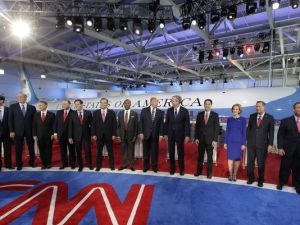
The GOP candidates, USA Today
I thought this interview with Ronald Reagan’s sons was interesting. Although Ron Reagan is a liberal and Michael is a conservative, both men are sick and tired of Republicans who try to claim they are just like Ronald Reagan. (The interviews took place before last night’s debate.) Politico:
Ronald Reagan’s sons have one thing to say to Donald Trump: We knew Ronald Reagan. Ronald Reagan was our father. And you’re no Ronald Reagan.
The conservative 40th president has been a touchstone in practically every presidential race since he left office, but this year, from Scott Walker’s fawning tweets to Jeb Bush’s custom T-shirt, Reagan fever seems to have reached a new high. And you can bet it will be a main feature of the debate tonight, at the Reagan Library in California.
But if you ask Reagan’s sons Ron and Michael, they’re not so keen on the comparisons. In two exclusive interviews (both published below), which span what the former president would think of the 16-strong Republican field (“I think he’d be kind of appalled”) to who’s most like Reagan (“Rick Perry. … They have the same hat size”) to what Reagan would think of Jeb Bush (“lacks charisma”), the sons of the former president both reject the idea that any Republican today really is the next Ronald Reagan. Plus, as Ron Reagan, a liberal political commentator, points out, “my father never went around comparing himself to someone else.”
Not only is the whole party “certainly getting him wrong as a Republican,” says Ron, the idea of comparing Trump to his father disgusts him. “I can’t think of two people who are more diametrically opposed. This egotistical, narcissistic guy with the weird comb over swanning in his private plane. … I mean, look in the mirror, fat boy. Look at that hair, you’re ridiculous! Where do you get off talking on anybody’s appearance? It’s just so unchivalrous. My father would recoil at that sort of thing.”
Michael Reagan, a conservative political strategist who hosted a talk radio program for 26 years, also questioned the idea that Republican candidates today are just like his father, especially Trump. “It’s interesting to see how many of them … recreate my father in their image and likeness instead of his,” he says. “Ronald Reagan would never take 11 million people or three million people or a million people and throw them out of the United States of America.” Plus, Michael says, talking about Reagan all the time is just bad strategy: “I have a 32 year-old daughter named Ashley. She knows who Ronald Reagan is, but name another 32 year old who does.”
And as for Donald Trump being the next Ronald Reagan? That’s ridiculous, says Michael. “To say what he said about Carly? … Is that the face we want for the Republican Party? If that’s the face, then the Democrats have to be going, ‘Go Donald!’”
Read the complete interviews at the Politico link above.
A few more debate reactions:
CNN: Republican debate reactions, captured in GIFs.
Chuck Todd and friends: Winners and Losers from Last Night’s Debate.
John Cassidy at The New Yorker: Carly Fiorina Tests Donald Trump’s Indestructibility.
Chicago Tribune: What happens if the new Donald Trump is just boring?
USA Today: Fact check: The second Republican debate.
That’s all I have for you today. What stories are you following?

 peej
peej Carissa
 bostonboomer
 dakinikat
 ecocatwoman
 mablue2
 Mama Lopez
 peggysue22
 quixote
 skydancingguestblogger
 Mona (aka Wonk the Vote)



 Sky Dancing
Recent Comments