
Tuesday Reads: A Little Bit of This and That
Posted: April 22, 2014 Filed under: morning reads, nature, open thread, science | Tags: big bang theory, Boston Marathon, Einstein's brain, Loch Ness monster, mastodon tooth, Meb Keflezighi, Philip Stoll, public ignorance, Rita Jeptoo, Tyrannosaurus Rex 37 Comments
Good Morning!!
Just because I feel like it, I’m going to avoid the depressing news today and give you a mixture of stories that interested me.
By now everyone knows about the 15- or 16-year-old boy who on Sunday flew from California to Hawaii in the wheel well of a Boeing 767 jet and survived.
It turns out he ran away from home after some kind of argument, climbed over a fence at San Jose Mineta International Airport, and hid in the wheel well of the first plane he saw. Authorities are trying to figure out how he evaded multiple layers of security and how he survived a trip that could have killed him.
“He got very lucky that he got to go to Maui but he was not targeting Maui as a destination,” Simon said.
The boy is also lucky to be alive, given that wheel-well stowaways rarely surviving flight conditions. At 38,000 feet, the percentage of oxygen is a fraction of that at sea level, and the temperature ranges from minus-50 to minus-85 degrees….
The plane landed in Hawaii. About an hour later, at 10:20 a.m. Hawaii time, crews were startled by the teen coming out of the wheel well, Maui Airports District Manager Marvin Moniz said.
“He was weak. He hung from the wheel valve and then he fell to the ground and regained some strength,” Moniz said.
He passed out in the air and didn’t regain consciousness until an hour after the plane landed in Hawaii, Simon said. When he came to, he climbed out of the wheel well and was immediately seen by airport personnel who escorted him inside where he was interviewed by the FBI, Simon said.
It was not immediately clear how the boy stayed alive in the unpressurized space, where temperatures at cruising altitude can fall well below zero and the air is too thin for humans to stay conscious. An FAA study of stowaways found that some survive by going into a hibernation-like state.
According to Simon, the boy doesn’t have any memories of the flight. Some experts are questioning whether the story is even true.
News of the incident was met with suspicion and scrutiny. Most wheel-well stowaways don’t survive, falling victim to frigid temperatures and lack of oxygen. The chances of survival of a wheel-well stowaway on a commercial aircraft are about 24 percent, according to the Federal Aviation Administration’s Civil Aerospace Medical Institute.
ABC News aviation consultant John Nance is skeptical that the teen could have survived the 2,300-mile flight in the wheel well without an oxygen source.
“I just don’t believe it,” Nance said.
Dr. Richard Besser, ABC News’ chief health and medical editor, said in order to survive inside a wheel well during a flight, the body has to fall into a hibernation-like state, with the heart only beating a couple times a minute.
“It’s near impossible, almost miraculous, and maybe there’s more to the story,” Besser said.
Besides, how did this kid manage to evade security, including “multiple layers of security, including wide-ranging video surveillance, German shepherds and Segway-riding police officers?” Back to the Daily Mail:
San Jose International Airport spokeswoman Rosemary Barnes says airport employees monitor security video feeds from throughout the 1,050-acre airport around the clock. However, she said no one noticed images of an unidentified person walking on the airport ramp and approaching Hawaiian Airlines Flight 45 in the dark until security agents reviewed the footage after the plane had landed in Hawaii and the boy had been found.
The airport, in the heart of Silicon Valley, is surrounded by fences, although some sections do not have barbed wire and could easily be scaled.
The boy found his way onto the tarmac during the night, ‘under the cover of darkness,’ Barnes said.
Hours later, surveillance video at Kahului Airport showed the boy getting out of the wheel well after landing, according to a statement from Hawaii’s Department of Transportation.
The boy isn’t being charged with a crime, and will be returned to his parents, where he’ll have a quite a story to tell. I guess we’ll learn more in the next few days.

Yesterday’s Boston Marathon came off without a hitch, and an American won the men’s race for the first time in more than 30 years. The New York Daily News reports: American Meb Keflezighi wins Boston Marathon a year after bombing.
With the names of the murdered written on his runner’s bib, American Meb Keflezighi raced to victory Monday in the Boston Marathon, becoming a living symbol of resilience from the dark days of terror.
Keflezighi, 38, a member of the New York Athletic Club, said his triumph was fueled by a city that refused to buckle in the face of hate.
“It was not about me. It was about Boston Strong,” said Keflezighi, who broke down in tears as he became the first American in 31 years to win the race. “When the bomb exploded, every day since I’ve wanted to come back and win it.”
The Eritrea-born Keflezighi, who became an American citizen in 1998, crossed the finish line to chants of “U-S-A!” a mere 11 seconds in front of Kenya’s Wilson Chebet. He won the elite men’s race with a time of 2:08:37, a personal best and the second-fastest for an American man at Boston.
“When the Red Sox won (the World Series) and put the trophy right there,” he said, pointing to the Boylston St. finish line, “I wanted to win it for the people of Boston.”
Keflezighi came to the U.S. with his parents when he was 12 years old. He attended public schools in San Diego, where he first started running. He graduated from UCLA, where he won multiple championships and awards. He won a silver medal in the 2004 Olympics, and in 2009 he became the first American man to win the New York City Marathon since 1982.
In the women’s race, 2013 winner Rita Jeptoo won again, setting a course record of 2:18:57–also a personal best. Jeptoo is from Kenya.
I guess this next story is a little bit depressing, but it’s mostly ridiculous. From UPI: Majority of Americans doubt the Big Bang theory.
In a new national poll on America’s scientific acumen, more than half of respondents said they were “not too confident” or “not at all confident” that “the universe began 13.8 billion years ago with a big bang.”
The poll was conducted by GfK Public Affairs & Corporate Communications.
Scientists were apparently dismayed by this news, which arrives only a few weeks after astrophysicists located the first hard evidence of cosmic inflation.
But when compared to results from other science knowledge surveys, 51 percent isn’t too shameful — or surprising.
Other polls on America’s scientific beliefs have arrived at similar findings. The “Science and Engineering Indicators” survey — which the National Science Foundation has conducted every year since the early 1980s — has consistently found only about a third of Americans believe that “the universe began with a huge explosion.”
Okay, maybe the notion of a giant explosion setting the universe in motion is a little surprising. But it’s certainly more believable than the biblical explanation that a godly being created the universe in seven days by making pronouncements like “Let there be light!”
Now an example of what some people are willing to believe: Has the Loch Ness Monster been spotted on Apple Maps?
Members of the Official Loch Ness Monster Fan Club claim they have studied an image seen on Apple’s global satellite map application that shows the allegedly 100-foot-long creature, CNet .com reports, citing London’s Daily Mail. They say if you zoom in on Apple images from space you can even see the monster’s giant flippers.
News of the sighting has fans of Nessie — as she’s affectionately called — buzzing because there hasn’t been a Loch Ness sighting in 18 months. Legend has it she’s been cruising the area of Loch, just south of Dores, Scotland, for some 90 years, but so far, there’s no definitive proof she exists.
Nessie’s fan club devotees say they have ruled out all other possibilities for the grainy image, including a floating log or a giant seal. But one skeptic, deep-sea biologist Andrew David Thaler, debunks the theory on his websiteSouthernFriedScience.com, saying that the image shows the wake of a boat.
I have a few more interesting science stories for you.
From National Geographic: The Tragic Story of How Einstein’s Brain Was Stolen and Wasn’t Even Special.
My headline may be a bit misleading. Albert Einstein, the Nobel prize-winning physicist who gave the world the theory of relativity, E = mc2, and the law of the photoelectric effect, obviously had a special brain. So special that when he died in Princeton Hospital, on April 17, 1955, the pathologist on call, Thomas Harvey, stole it.
Einstein didn’t want his brain or body to be studied; he didn’t want to be worshipped. “He had left behind specific instructions regarding his remains: cremate them, and scatter the ashes secretly in order to discourage idolaters,” writes Brian Burrell in his 2005 book, Postcards from the Brain Museum.
But Harvey took the brain anyway, without permission from Einstein or his family. “When the fact came to light a few days later, Harvey managed to solicit a reluctant and retroactive blessing from Einstein’s son, Hans Albert, with the now-familiar stipulation that any investigation would be conducted solely in the interest of science,” Burrell writes.
This story is so weird that there is no way I can do it justice with excerpts. You need to read the whole thing. Just to whet your appetite, I’ll tell you that Beat writer William Burroughs makes a cameo appearance. The comments are interesting too.

Part of a mastodon tooth
I just love this story; it’s the kind of thing I dreamed would happen to me when I was a kid: 9-year-old Michigan Boy Unearths 10,000-Year-Old Mastodon Tooth near Home.
“I was walking down at the creek last summer. I felt something that I stepped on so I picked it up and everybody in the neighborhood thought it was pretty cool,” Philip Stoll told CNN on Friday….
“It felt weird,” he said, according to the Detroit Free Press. “I had to see what it was. I pulled it out and brought it to my mom.”
Stoll…took the six-peaked, 8-inch foreign object to his Windsor Township house and washed it in his kitchen sink to get a better look. Mom Heidi Stoll was also brought in for consultation.
“I didn’t even think that it could have been a tooth until I started checking online for some kind of match,” she said. “We saw a picture of a Mastodon tooth and said ‘there it is.'”
The Stoll family eventually reached out to James Harding, a herpetologist – an expert on reptiles and amphibians, at nearby Michigan State, who confirmed their suspicions.
“This is indeed a mastodon tooth,” Professor Harding verified in an email, CNN reports. “Apparently (it is) the upper surface, broken off at the roots.”
Wow, that is one lucky kid! Philip told CNN he has dreamed of becoming a paleontologist when he grows up.

Did you hear about how the Smithsonian acquired a nearly-complete skeleton of a Tyranosaurus Rex and had it delivered from Montana by FedEx? From the Guardian: Rare T rex bones arrive at Smithsonian Museum after cross-country journey.
For the first time since its dinosaur hall opened in 1911, the Smithsonian’s National Museum of Natural History will have a nearly complete T rex skeleton. FedEx delivered the dinosaur bones in a truck carrying 16 carefully packed crates.
The T rex, discovered in 1988 on federal land in Montana, is about 80-85% complete. It’s one of about half a dozen nearly complete T rex skeletons that have been uncovered. This specimen could become the most prominent with its new home in one of the world’s most-visited museums. About 7 million people visit the natural history museum each year, and it offers free admission.
Like the mastodon tooth that Philip Stoll found, this skeleton was discovered by amateurs.
Kathy Wankel, a Montana rancher who discovered the bones in 1998 during a camping trip, said she was proud to see the specimen in a national museum. Initially, Wankel spotted about 3 inches of bone sticking out of the ground, and she and her husband dug out a small arm bone.
“We were so thrilled we had found a bone; we called that a mega find,” she said at the museum. “But I think now this is a mega find.”
Paleontologists from the Museum of the Rockies in Bozeman, Mont., excavated the fossil, and it’s been housed there for the past 25 years. At the Smithsonian, the skeleton will be mounted upright for the first time.
Those are my offbeat offerings for today. What stories have you been following? Please feel free to post real news in the comments.
Monday Reads
Posted: April 21, 2014 Filed under: Bobby Jindal, Climate Change, Corporate Crime, corporate greed, corruption, energy, Environment, Environmental Protection, Environmentalists, morning reads, tar sand oil, toxic waste 46 CommentsGood Morning!
 I’m going to remind you today of some events that happened 4 years ago with the BP Oil Gusher and show you that bad things are still going on in the Gulf.The leftover issues from abandoned oil rigs are bigger than Louisiana.Please consider this an open thread while I let you know how I feel.
If corporations are people, then BP and others in the extraction business are serial killers. All over our country and throughout our history, extraction companies have killed their employees, the people that live around their businesses, and the wildlife and the environment and water systems that sustain the life of our country. Look at that map. Those are active and orphaned/abandoned oil wells/pipelines that are disintegrating, leaking, and killing someone.
“I started noticing, towards the end of 2010, other leaks that were unrelated to the BP disaster,” Henderson says. “I would find wellheads that were leaking or platforms that were leaking. Just in the last year, I have filed 50 reports for different leaks and spills unrelated to the BP disaster.”
Under the Clean Water Act, when a company spills any amount of oil in the water, it must file a report with the National Response Center run by the Coast Guard. But when Henderson checked, he found many of those smaller spills were not making that list.
So environmental groups formed the Gulf Monitoring Consortium to get a better count on spills. The partnership is a blend groups of complementary skills.
Gulf Restoration Network, for example, has personnel who can spot spills from the air and file complete reports.
SouthWings, a group of volunteer pilots, helps get those spotters aloft.
Louisiana relies largely on the oil industry to self-report leaks and spills. The Gulf Monitoring Consortium was formed to improve that effort and said it often finds smaller leaks like this one, near Golden Meadow, that go unreported by the companies.A third member, the West Virginia-based tech group SkyTruth, finds the spills on satellite photographs, then applies a formula used by spill experts to translate the size of the oil sheen into gallons of oil in the water.
SkyTruth spokesman David Manthos says its estimates typically are much higher than what’s been reported.
“We found that the spill was usually 10 times larger than had been reported, and that was averaged out across a lot,” he says. “In some, the mismatch was much larger than that.”
The sheer size of the industry here means there’s seldom a quiet day for the consortium. In an average year, the NRC receives 10,000 reports of spills in the Gulf.
It’s a number that surprised even SouthWings Gulf Program Director Meredith Dowling, a veteran of monitoring efforts.
“I can’t think of a single instance where our volunteers have flown offshore and not found spills,” Dowling says. “This was something that was really amazing to me when I first moved here … that is was a continuous, absolute failure of business-as-usual practices.”
There are many active spills around here. Many come from orphaned and abandoned wells. Many come from active wells. They are all spewing toxic waste and it’s not just in Louisiana. Here is a program in Pennsylvania dedicated to plugging orphaned and abandoned wells. There are similar issues in Texas, New York State, and just nearly anywhere there’s been activity. Louisiana alone has about 6000. You can see that they are nearly everywhere if you look at the map at the top of the post. Many of these wells were first put into play in the 1850s and were just left where they were. They are rotting, they are decaying, and they are leaking. They are also dangerous.
Methane is an odorless, colorless gas that exists naturally below the surface. It isn’t poisonous, but it’s dangerous. When enough methane gathers in an enclosed space — a basement or a water well, for instance — it can trigger an explosion.
The gas didn’t come from the Butters well, nor did it originate from the Marcellus Shale formation that a nearby Shell well had recently tapped into. What most likely happened to cause the geyser in June, Shell and state regulators say, was something of a chain reaction. As Shell was drilling and then hydraulically fracturing its nearby well, the activity displaced shallow pockets of natural gas — possibly some of the same pockets the Morris Run Coal company ran into in 1932. The gas disturbed by Shell’s drilling moved underground until it found its way to the Butters well, and then shot up to the surface.
Areas impacted by oil spills are never the same. The BP Oil Gusher has introduced issues into the ecosystem that have left endangered species teetering further towards extinction. In the case of Louisiana, it’s even the state bird.
On a bright spring morning, P.J. Hahn is walking through a graveyard in the middle of Barataria Bay.
It’s a 30-yard patch of mud and sand bristling with bare, dead mangrove brush surrounded by miles of open water. Each mangrove is a tombstone marking the death of a nesting site used for decades by brown pelicans and roseate spoonbills on what was once the string of wetland pearls that made up the Cat Islands chain.
But in 2010 the oil spewing from BP’s Deepwater Horizon would send them all to an early grave.
“Four years ago we had more than five acres of habitat and there were tens of thousands of birds nesting on these islands,” said Hahn, director of coastal zone management for Plaquemines Parish. “Then the oil came in and coated the mangrove roots, and two years later the islands started going.
“I don’t know where those birds are nesting now – but they can’t do it here any more.”
The post-BP story of the brown pelican, Louisiana’s official bird, is the perfect metaphor for the crisis confronting the state’s coast.
Before the Deepwater Horizon blew out on April 20, 2010, brown pelicans were living the good life in southeast Louisiana as one of the great wildlife comeback stories. In 1963 not a single brown pelican could be found in the state due to impacts from the insectiside DDT. The comeback started in 1968 when the state began transplanting birds from Florida, and populations began to soar after DDT was banned in 1972. Thanks to the abundant food in one of the world’s most productive fisheries, by 2010 their numbers were thought to be near historic levels, as high of 85,000.*
 Four years later, the sea floor closest to the spill and even the shores in the Gulf of Mexico are comparable to an Arizona Desert. It is barren, bleak and dead. There was life there. Now, there is the look of a forest fire without the resultant new growth. Nothing will grow back amid the poison of Corexit and Oil.
When a crew of journalists and environmental groups studying the effects of the BP Deepwater Macondo oil spill disembarked on Cat Island in Baratria Bay last week, there was a collective gasp.
“It looks like the Arizona desert,” said Eileen Fleming, who’s reported for WWNO spring after spring since the April 20, 2010 spill.
“It looks like there was a fire here,” said Doug Meffert, vice president of the National Audubon Society and president of the Louisiana chapter, “but there wasn’t a fire.”
The bones of black mangrove stumps are all that remain of what was a thriving bird rookery here in Plaquemines Parish Four years ago, footage of oiled brown pelicans and the thousands of shorebirds nesting here went around the world in the aftermath of the 200 million gallons of thick crude that spilled into the Gulf of Mexico.
Today the only green thing on the beach is a glass bottle. There are no pelicans, no mangroves, and worse, much of Cat Island itself is washing away. It and most of the barrier islands and marsh in Barataria Bay are steadily degrading, losing their battles with coastal erosion and subsidence faster than ever.
Areas around Barataria Bay and Grand Isle, La. were particularly hard hit, but they weren’t the only affected areas. Moreover, thousands of birds, other wildlife and marine life including dolphins perished, were oiled, sickened and overall left in distress. The effects on the area resonate now, which is only a shock to those either unfamiliar with garish oil spills or unwilling to accept the truth.
In the days following the “spill”, BP, apparently colluding with the US Government, doused a horrific amount of a deadly dispersant in the affected areas. Called “Corexit”, the cutesy name belies the sickening effects it brings to all it touches. On background, an environmentalist working in the area explained to me last year that they were, essentially, damned if they did, and damned if they didn’t, but chose the lesser of two ills.
That remains to be seen as the National Institutes of Health continues its 10-year “GuLF” study of BP spill health effects, from those most affected out on the Vessels of Opportunity boat that included BP-hired personnel trying to contain the spill, to residents in the line of fire, such as around Barataria Bay.
There is a way of life dying along the southern parts of the Gulf Coast in Louisana. The coastline disappears daily, the salt water intrudes in to the fresh  water marshes, and the land doesn’t sustain the people or the animals like it once did. There is not better place to study the impacts of the extraction business and human addiction to fossil fuels than many parts of Cajun Louisiana.
Sea level rise is like an ultra-slow-motion hurricane for low-lying areas, but unlike a hurricane, it can be forecast decades in advance. Projections that some town or road will be underwater in 100 years can—and must—be mitigated against today.
Osborn characterizes the choice as “being proactive rather than reactive. Once you get into situations like Louisiana facing some very serious challenges in a very near time frame, all of a sudden you’re in a reactive posture.” Louisiana is a harbinger of things to come for New York, Miami, and other major coastal cities that would do well to look 20 to 75 years ahead and budget accordingly. Local, state, and federal governments will have to make critical decisions about infrastructure, water and sediment diversion, and wetlands restoration in the next 10 to 15 years, he says, and while NOAA scientists can contribute data, they can’t green-light projects or secure funding.
Osborn makes a technical distinction: “Right now it’s what’s called frequently flooded. And the risk is it will be routinely flooded.” Routine flooding will start to happen as early as 10 years from now, he says. They can call it whatever they want, but Gill says soon LA 1 will be “flooded every day during high tide.”
NOAA scientists predict that eventually all the marsh that surrounds LA 1 and Port Fourchon will disappear, connecting two major bodies of water that now are distinct: Barataria Bay and Terrebonne Bay. The only thing out in the water at all, by 2100, may be a raised road and Port Fourchon. “I can imagine Port Fourchon being like the Florida Keys,” says Chiasson, “being on its own, in the middle of open water, maybe a little marsh around it, but nothing between here and there.”
The fact that the entire extraction business is so fraught with so many bad things is why the men that run it must find politicians to protect them from lawsuits and regulations. Making these guys pay for what they’ve done would undoubtedly run their companies deeply into the red. Donation whores like Republican Governor Bobby Jindal will do anything to protect the benefactors that he hopes will fund him to the White House. There is nothing about Louisiana that this man is interested in except as a step on the rung of his personal ascent.
The state Senate targeted the flood protection authorities around New Orleans and the lawsuit one of the levee boards filed against the oil and gas industry for damages to the state’s wetlands.
In one bill, advanced by a Senate panel Wednesday morning, Gov. Bobby Jindal would get sweeping power to remove members of the Southeast Louisiana Flood Protection Authorities. Opponents said the move, which would allow a governor to remove authority members under certain conditions, reintroduces politics into the levee boards, which is precisely what revamp after the 2005 hurricanes was designed to prevent.
Another measure, which was passed by the full Senate late Tuesday night, would derail a lawsuit filed last year by the Southeast Louisiana Flood Protection Authority — East against 97 oil and gas companies. The levee board sought damages for contributing to coastal erosion and led to higher than anticipated storm surges.
Jindal opposes the lawsuit and has called it a windfall for lawyers, who would be paid with a portion of any winnings rather than a flat fee. Critics say the legislation would keep the oil and gas industry from taking responsibility for damage caused by drilling and productions activities over the years.
SB553 is aimed at a lawsuit filed by the Southeast Louisiana Flood Protection Authority-East. It would not impact similar suits filed by Jefferson and Plaquemines Parishes. But other measures currently being considered might.
The legislation passed Tuesday night, Senate Bill 553, would apply to retroactively. That measure was sent Wednesday morning to the Louisiana House.
Even kindergartners know they should clean up their messes. That is ones that aren’t sociopaths.
But, wherever there has been the extraction business, there are the sociopaths. We have the hundred year anniversary of just such an example.
Linda Linville climbed down the steep stone steps into the dugout on the southern Colorado prairie Sunday where one branch of her family was wiped out in one day 100 years ago.
Her great aunt, her unborn baby and two children died in a fire that broke out during a battle between coal miners striking against John D. Rockefeller, Jr. and the Colorado National Guard in what became known as the Ludlow Massacre. Twenty-seven-year-old Cedilena Costa, 4-year-old Lucy and 6-year-old Onofrio suffocated from the smoke as they hid below ground to escape the battle. Linville said Cedilena’s husband, Charlie Costa, was captured and shot in the head that day and never knew his family’s fate.
“Anyone who says they died in vain is wrong,” said Linville, a retired history teacher from Corona, Calif., referring to the fact that the miners eventually ended up going back to work without winning any of their demands.
The massacre and battle left 21 people dead, including the Greek-American union leader Louis Tikas, and set off 10 days of civil war in which the miners killed 30 mine guards, supervisors and strikebreakers. They surrendered only after President Woodrow Wilson sent federal troops to the state.
The deaths drew national attention to the long running strike and forced Rockefeller to take a public role in Colorado Fuel & Iron. He instituted a company union and grievance system, which the miners later rejected when the won a right to unionize on their own during the New Deal. The massacre and the deadly Triangle Shirtwaist fire in 1911 are credited with the helping win the eventual passage of the 1935 National Labor Relations Act.
Linville and over 100 others — including members of the United Mine Workers of America wearing the red bandanas the strikers wore — gathered at the site of the former Ludlow tent colony to mark the massacre’s 100th anniversary with a Greek Orthodox Easter service. It was very similar to the one the miners, who came from a variety of countries, shared in 100 years ago with the Greek strikers the day before the massacre. In a coincidental reminder of Ludlow’s international community, the Easter service will include the traditional reading of the Gospel story in many languages to symbolize the universality of its message.
It is easy to look back at the years of coal and oil and see that not much has really changed in terms of the business. The only thing that’s changing is that people, nature, and animals don’t have a chance at all and the deathtoll and damage are obvious if you actually get to see it. I have a small car. I really don’t drive much at all. I think in a busy week I may put on 15 miles. I have a bike and nearly everything I need is about a mile away. I suppose, for me, that it’s nothing to say that I really don’t benefit from any of this. I’d frankly rather pay for every single person to have some form of solar or wind generator in their home than the tax breaks we give to the oil industry. I think it would save every one in the country a lot less grief in the short and long run. But then, I could care less how much money the likes of the Koch Brothers earn. I’d frankly rather be dancing on their graves.
I just wanted to add that I found some of these wonderful skull art prints from this site.
I know it doesn’t look like it, but this is an open thread.
What’s on your reading and blogging list today?
Lazy Saturday Reads: Friday Document Dump and Clinton Conspiracy Theories
Posted: April 19, 2014 Filed under: Barack Obama, morning reads, Republican politics, U.S. Politics | Tags: canada's oil from tar sands, Chelsea Clinton, Clinton Derangement Syndrome, Clinton White House papers, conspiracy theories, Hillary Clinton, Keystone XL pipeline, Mary Landrieau, Monica Lewinsky, pregnancies, State Department 26 Comments
Happy Saturday!!
Some pretty big news broke late yesterday: President Obama has again delayed his final decision on whether to go ahead with the Keystone XL pipeline. Presumably the announcement was deliberately held until the Friday news dump to reduce public attention to the inevitable Republican screams of outrage. From Reuters:
The Obama administration further delayed its decision on the controversial Keystone XL pipeline project on Friday, with no conclusion now likely until after the U.S. mid-term elections in November.
President Barack Obama has said he will have the final say on whether to allow the pipeline connecting Canada’s oil sands region to Texas refiners, and several government agencies had been given until May to weigh in. This had raised expectations of a final decision by mid-year.
But the State Department said on Friday it was extending that agency comment period, citing a need to wait until the Nebraska Supreme Court settles a dispute over what path the $5.4 billion TransCanada Corp project should take.
“That pipeline route is central to the environmental analysis for the project and if there are changes to the route it could have implications,” a senior State Department official told reporters.

Mary Landrieu
I have to admit I was surprised and pleased. I have long suspected that Obama really wanted the pipeline, but I think I was wrong. He seems to be trying his best to avoid it. Naturally Obama has already been accused of political calculation in pushing the decision past the midterm elections. Of course the decision won’t help Democrats from oil-producing states like Mary Landrieu of Louisiana, who has already announced that “I plan to use my power as chair of the Senate Energy Committee to take decisive action to get this pipeline permit approved.”
The State Department told Buzzfeed that politics was not involved in the decision.
“I can’t render judgement on when the final decision could take place,” a senior State Department official said on a conference call Friday after the department announced another delay in the State Department process that could bring with it the approval or rejection of Keystone. “We want this to move as expeditiously as possible, we recognize that this is an issue of great concern to the American public, to American business and we take that extremely seriously.”
The State Department review — necessary because the pipeline crosses the Canadian border into the United States — is being held up by a state court ruling in Nebraska in favor of pipeline opponents, department officials said. That decision, which endangers the existing planned pipeline route, is under appeal andobservers say final judgement won’t come until 2015.
More reactions reported by Politico:
…the delay drew immediate scorn from pipeline supporters on both sides of the aisle in Congress. Republicans derided it as a “shameful” concession to “radical activists,” while Democratic Senate energy Chairwoman Mary Landrieu called it “irresponsible, unnecessary and unacceptable.”
Both of Alaska’s senators condemned the move. Republican Sen. Lisa Murkowski, the ranking member on the Energy and Natural Resources Committee, called the delay “a stunning act of political cowardice,” and Democratic Sen. Mark Begich said he was “frankly appalled at the continued foot-dragging by this administration.” Begich, like Landrieu, faces a tough reelection fight this year.
Some environmentalists complained about the Friday news dump announcement
“It’s disappointing President Obama doesn’t have the courage to reject Keystone XL right now, but this is clearly another win for pipeline opponents,” said Jamie Henn, spokesman for the climate activist group 350.org, which staged mass sit-ins outside the White House to protest the project. “We’re going to keep up the pressure on the President to make the right call.”
Naturally Canadian politicians are “disappointed.” CBC News:
“We are disappointed that politics continue to delay a decision on Keystone XL,” a statement from the Prime Minister’s Office said. “This project will create tens of thousands of jobs on both sides of the border, will enhance the energy security of North America, has strong public support, and the U.S. State Department has, on multiple occasions, acknowledged it will be environmentally sound.”
Canadian politicians have grown increasingly irate over delays.
Alberta Premier Dave Hancock expressed frustration about “yet another delay” in the approval process of an issue he argued has been debated thoroughly enough.
“Keystone XL has been rigorously studied. We believe the project is in North America’s best interest as it provides energy security, jobs and a dependable energy source from an environmentally responsible and democratic friend and ally,” Hancock said in a statement.
TransCanada’s president and CEO Russ Girling called the delay “inexplicable” in an email to CBC News.
Lots more Canadian whining at the link.
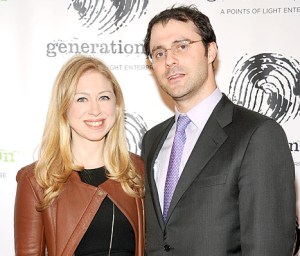
Chelsea Clinton and husband Marc Mezvinsky
The Keystone Pipeline is controversial, but apparently not as controversial as the daughter of a female potential presidential candidate getting pregnant. The bizarre conspiracy theories about Chelsea Clinton expecting a baby have already begun and they’ll probably never end.
From John Amato at Crooks and Liars: Will Chelsea Clinton’s Pregnancy Become Another Right Wing Conspiracy? Give me a break. Is the Pope Catholic? Amato knows it’s a silly question:
I’m forgetting myself because Hillary is not allowed to be a happy mother. We may see a normal life unfolding, but Teabirchers see coverups and conspiracies.
Limbaugh recently said he believes that Hillary Clinton staged the now famous shoe-throwing incident.
Maybe in my subconscious I think it was staged or set up. Lookit, I’m so, I know these people so well…I just do not attach much genuineness to them.
There were a host of others who were saying the same thing in Wingnuttia.
I wouldn’t be surprised at all if Hillary gets asked to comment on Chelsea’s pregnancy by the media, since that’s only natural, right? But after that happens more than once I really expect Limbaugh and all the wannabees to scream bloody murder that Chelsea’s announcement was staged, a set-up plot which is being aided by the librul media to cover up Benghazzzzzzzziiii!
And away we go! From Mediaite: Right-Wing Host Thinks Chelsea Clinton May Have ‘Staged’ Pregnancy to Help Hillary.
If you thought the Hillary Clinton “shoe truthers” were bad, wait until you meet the “baby truthers.” So far, conservative host Steve Malzberg is leading the charge with this video suggesting Chelsea Clinton’s pregnancy is being effectively “staged” to help her mother win the 2016 presidential election.
And excited Malzberg announced the 34-year-old Clinton’s pregnancy, saying, “Lo and behold, Hillary was by her side” when she made the announcement. “Hillary Clinton is going to be a grandmother when she runs for president!” he exclaimed.
“Now, pardon the skeptic in me,” Malzberg continued, before predicting the oncoming criticism from Media Matters and other watchdog website. “Malzberg said this was a staged, planned pregnancy?” he imagined they would ask.
“Well, now I’m not saying, when I say staged I have to believe she’s pregnant, if she says she’s pregnant,” he said. “I don’t mean that they’re making up she’s pregnant. But what great timing! I mean purely accidental, purely an act of nature, purely just left up to God.”
“And God answered Hillary Clinton’s prayers and she’s going to have the prop of being a new grandma while she runs for president,” he continued. “It just warms the heart, it brings a tear to my eye. It really does.”
I have so many more examples that I’ll have to do a link dump without excerpts:
Vanity Fair: The Worst Reactions to Chelsea Clinton’s Pregnancy Announcement.
Slate: If It Happened There: America Awaits Royal Baby.
LA Times: Chelsea Clinton’s pregnancy fuels presidential election speculation.
US News: Dumb Questions About a Grandmother-to-Be
Politico: What to expect when she’s expecting
Newsday: Bouie: Chelsea Clinton’s baby is already campaigning?
TPM: NYT Columnist Insists That Chelsea Clinton’s Baby Is A 2016 Game Changer
ABC News: Will Clinton Baby Affect 2016, and Is It Sexist to Ask?
Honestly, can you imagine this happening to a man running for president? For example,
“How will his daughter’s pregnancy affect Rand Paul’s chances for the Republican nomination? Did he “stage” this to get positive media? Enquiring people want to know.”

In my post yesterday, I mentioned that a huge trove of papers from the Clinton administration was going to be released. Well they are out there now, and so the Clinton haters are really having a field day what with drooling over ancient history and inventing conspiracies about Chelsea’s baby.
There are tons of articles on the document dump too; I’ll give you a few examples.
ABC News: Monica Lewinsky E-Mail Omitted From Latest Batch of Clinton Documents
An email from Monica Lewinsky was omitted from the Clinton library’s latest document dump for privacy reasons….
Included in a list of withdrawn/redacted documents (commonly interspersed in the large .pdfs), midway through a batch of documents concerning Gen. Wesley Clark, is an email from Monica Lewinsky’s Pentagon email address.
Vaguely referenced as concerning a “medical record,” the omitted email is listed as four pages long.
The recipient, Ashley Raines, is identified as a Lewinsky friend and confidante in the infamous Starr Report, produced by Independent Counsel Kenneth Starr. The report would later disclose details of the Lewinsky affair and trigger a major scandal that led to Clinton’s impeachment. Raines served as White House Director of Office of Policy Development Operations and Special Liaison to Management and Administration, according to the report, working in the Old Executive Office Building, next door to the White House.
In 1996, after an initial affair with the president had stopped according to the Starr report, Lewinsky described the relationship to Raines and showed her gifts allegedly given to her by Bill Clinton, including “a hat pin approximately eight inches long, an antique looking brooch the size of a half dollar, special edition copy of ‘Leaves of Grass’ by WALT WHITMAN, items from Martha’s Vineyard with ‘Black Dog’ logo, including a ball cap, and a short, baggy summer dress, and an autographed photo of the two of them wishing LEWINSKY ‘Happy Birthday,’” Raines told Starr’s investigators, with lawyers present. Lewinsky told Raines that she had confided in Linda Tripp about her relationship with Clinton.
Many more breathless details at the link.
LA Times: For Hillary Rodham Clinton, archives evoke fiery White House years.
…the latest batch of archived documents from the Clinton White House — while not particularly newsworthy — were a rather bracing reminder that the very mellow former first lady has emerged in her current happy state after many years in a White House that often took on the tone of war zone.
Mark that down as one reason why Clinton might not want to go racing back….
The documents once again underscored the combative fashion in which the Clinton White House drove its agenda, and its obsession with the administration’s adversaries.
One unsigned and undated document contained in the files of Jane Sherburne, a Special Counsel to the White House between 1994 and 1996, details theories about how the right wing, with the help of think tanks and conservative publications, was funneling “fringe” stories to the media. It also expounds on the financial powers and connections of billionaire Richard Mellon Scaife, who was referred to as “The Wizard of Oz.”
Part of the problem, the memo suggested, was the fact that the Internet “allows an extraordinary amount of unregulated data and information to be located in one area and available to all.”
“The right wing has seized upon the Internet as a means of communicating its ideas to people,” the unsigned memo continues. “Moreover evidence exists that Republican staffers surf the Internet interacting with extremists in order to exchange ideas and information.”
If the LA Times thinks that is shocking, I don’t think they are following current events.
The WaPo: The most interesting tidbits from the Clinton document dump This one includes a list of 12 gossipy examples of supposed Clinton political machinations.
Here’s the best one I’ve seen yet from Buzzfeed: This Unsent Shade-Filled Letter From Clinton Staffers To A ’90s Radio Host [Don Imus] Is A Goddamn Masterpiece.
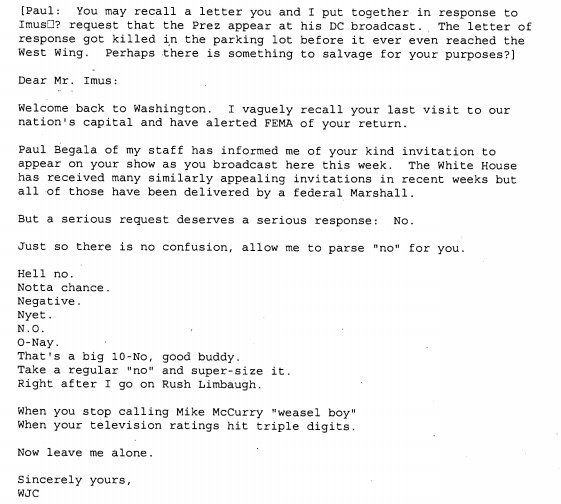
I wish it had been sent!
I’m running out of space and time, but I do have a few more serious items I want to share. I’ll put them in the comments.
So . . . What stories are you following today? Please share your recommended links in the comment thread and have a fantastic weekend!!
Friday Reads: American Oligarchy, South Korean Tragedy, and Hillary Under the Microscope
Posted: April 18, 2014 Filed under: morning reads, Republican politics, U.S. Politics | Tags: Benjamin I. Page, Clinton Derangement Syndrome, ethnic diversity, Hillary Clinton, Larry Bartels, Martin Gilins, oligarchy, Republican Party, South Korean ferry disaster, white voters 39 Comments
Good Morning!!
Yesterday Dakinikat quoted from a WaPo article by Larry Bartels on the Republican Party’s increasing identification as white and anti-every other ethnic group. (Of course he failed to mention that Republicans also focus almost exclusively on the needs of men who identify as Christians, but I’ll let that go for now.)
Bartels, a professor of political science at Vanderbilt University, is the author of Unequal Democracy:The Political Economy of the New Gilded Age. In the WaPo article, Bartels argues based on his research that, despite its seeming choice to ignore the needs of the majority of Americans and the growing ethnic diversity in the U.S. population, the demise of the GOP may not be immanent. Bartels writes:
Even momentous demographic changes occur slowly; non-Hispanic whites will remain a majority of the U.S. population for the next 30 years, and (allowing for differences in age profiles, citizenship status and turnout) a majority of the electorate even longer. (According to Census Bureau tabulations, non-Hispanic whites were 65 percent of the U.S. population in 2012, but 74 percent of the electorate.) Thus, if white voters “continue to migrate toward the Republican Party” in response to demographic change, “it will be a long time before it finds itself unable to win elections.”
Just look at demographically diverse but stubbornly Republican Texas, always just about to turn blue. The changing American polity may come to look more like Texas than like the multicultural Democratic stronghold of California. In an increasingly diverse America, identity politics will continue to cut both ways.
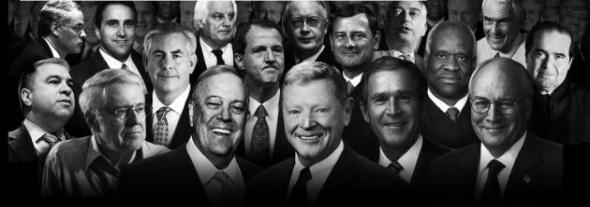
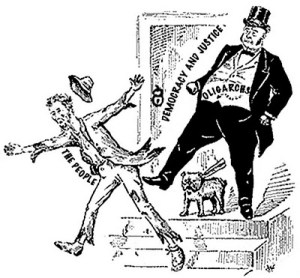
Take a look at the illustration at the top of this post and you’ll see why Bartels is probably right. According to a recently released study (pdf) by Martin Gilins and Benjamin I. Page of Princeton and Northwestern Universities respectively, we are no longer living in a democracy. The U.S. has already become an oligarchy. Sure we knew that already, but now we have confirmation from a scientific study. From BBC News:
[T]he two professors have conducted exhaustive research to try to present data-driven support for this conclusion. Here’s how they explain it:
“Multivariate analysis indicates that economic elites and organised groups representing business interests have substantial independent impacts on US government policy, while average citizens and mass-based interest groups have little or no independent influence.”
In English: the wealthy few move policy, while the average American has little power.
The two professors came to this conclusion after reviewing answers to 1,779 survey questions asked between 1981 and 2002 on public policy issues. They broke the responses down by income level, and then determined how often certain income levels and organised interest groups saw their policy preferences enacted.
“A proposed policy change with low support among economically elite Americans (one-out-of-five in favour) is adopted only about 18% of the time,” they write, “while a proposed change with high support (four-out-of-five in favour) is adopted about 45% of the time.”
On the other hand, Gilins and Page conclude:
because of the strong status quo bias built into the US political system, even when fairly large majorities of Americans favour policy change, they generally do not get it.…
Americans do enjoy many features central to democratic governance, such as regular elections, freedom of speech and association and a widespread (if still contested) franchise. But we believe that if policymaking is dominated by powerful business organisations and a small number of affluent Americans, then America’s claims to being a democratic society are seriously threatened.
These study’s results reinforce Larry Bartels’ findings about the tendency of white Americans to support the goals of the super rich even when it is not in their own best interest. Another quote from the study via Gawker:
The central point that emerges from our research is that economic elites and organized groups representing business interests have substantial independent impacts on U.S. government policy, while mass-based interest groups and average citizens have little or no independent influence. Our results provide substantial support for theories of Economic Elite Domination and for theories of Biased Pluralism, but not for theories of Majoritarian Electoral Democracy or Majoritarian Pluralism…
Recent research by Larry Bartels and by one of the present authors (Gilens), which explicitly brings the preferences of “affluent” Americans into the analysis along with the preferences of those lower in the income distribution, indicates that the apparent connection between public policy and the preferences of the average citizen may indeed be largely or entirely spurious.

Hamilton Nolan at Gawker:
The theory of Economic Elite Domination is fairly self-explanatory. The theory of Biased Pluralism holds that policy outcomes “tend to tilt towards the wishes of corporations and business and professional associations.” In essence, the researchers found that government policy changes are correlated with the wishes of the wealthy and with interest groups, but not with the wishes of the average American—even though the whole idea of “Democracy” is to ensure that the wishes of the majority tend to carry the day.
The study notes that the position of the median American and the position of the affluent American are often the same; therefore, regular people tend to think that their political interests are being represented when they see the triumph of some political position that they agree with. In fact, the researchers say, this is a mere coincidence. Yes, the average American will see their interests represented—as long as their interests align with the interests of the wealthy.
Yes, it’s extremely depressing, but we have long sensed this and now science has confirmed our intuitions. Now we have to figure out how to change it.
In other news . . .
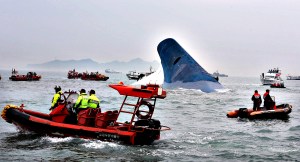
We haven’t talked much about the disastrous sinking of a ferry loaded with South Korean students and their families. So far 28 people are known to be dead and 268 are still missing–including 246 students. From the Wall Street Journal:
On Monday night, Kim Si-yeon and her family took her mother out for a late birthday dinner. Ms. Kim pushed for a cheap Korean barbecue restaurant and family members say they reluctantly obliged because the young musician and actress was leaving the next day for a four-day high school trip.
The next morning, the father of Cho Eun-jung, another student at the same school, didn’t want to wake his daughter before he left for work. So he cuddled her in his arms and kissed her forehead, he said in an interview.
Student Lee Hye-gyeong later that morning said a quick goodbye to her boyfriend as she left for the bus ride to the ferry port where the three students and more than 300 of their classmates would set sail for a 13-hour journey to Jeju Island, a popular South Korean vacation spot.
An annual trip for high-school juniors from Danwon High School in Ansan, a suburb of Seoul, the trip was designed as a break before the students began intense preparations for college entrance exams next year. Last year’s class was the first to take the boat; in the past, student groups had flown.
What happened next, not long after sunrise on Wednesday morning, has become a national tragedy in South Korea. The students had just finished a breakfast of bulgogi, a Korean beef dish, rice and kimchi when the ferry capsized and sank.
So heartbreaking. From NBC News: South Korea Ferry: 30-Minute Evacuation Delay Trapped Dozens.
A half-hour delay in evacuation orders may have trapped hundreds on board the doomed South Korea ferry, according to new details which emerged Friday about how the disaster unfolded.
A transcript of a ship-to-shore exchange, and interviews with surviving crew members, reveal that the vessel was listing too heavily for passengers to escape by the time the captain issued orders to abandon ship….
Oh Yong-seok, a helmsman on the ferry with 10 years of shipping experience, told The Associated Press that when the crew gathered on the bridge and sent a distress call, the ship was already listing more than five degrees, the critical angle at which a vessel can be brought back to even keel.
The first instructions from the captain were for passengers to put on life jackets and stay where they were, Oh said. A third mate reported that the ship could not be righted, and the captain ordered another attempt, which also failed, Oh said.
A crew member then tried to reach a lifeboat but fell because the vessel was tilting, prompting the first mate to suggest to the captain that he order an evacuation, Oh said.About 30 minutes after passengers were told to stay in place, the captain finally gave the order to evacuate, Oh said, adding that he wasn’t sure in the confusion and chaos on the bridge if the order was relayed to the passengers.
“We couldn’t even move one step. The slope was too big,” said Oh, who escaped with about a dozen others, including the captain.
I guess the old saying that the captain must go down with the ship no longer holds true. There is an arrest warrant out for the captain though. From the WSJ again:
SEOUL—Arrest warrants were issued for the captain and two crew members of the sunken South Korean ferry on Friday, as a crew member confirmed accounts that the captain was among the first to abandon the sinking ship.
In an interview with The Wall Street Journal, crew member Oh Yong-seok, who isn’t a target of an arrest warrant, re-created the chaotic final moments before the ship capsized on Wednesday morning. He said that while members of the crew did abandon the boat, they did everything they could to first evacuate the vessel’s passengers.
The focus on the crew members’ final actions came during a third day of frustration, confusion and tragedy that offered no new breakthroughs in attempts to rescue the nearly 300 passengers who remain missing.
Investigators also didn’t appear to be any closer to understanding why the ship made what it called a “radical right turn” shortly before it began to sink.
In another tragedy, a vice principal who escaped the sinking ferry has committed suicide. First Coast News:
SEOUL – The vice principal rescued from the doomed South Korean ferry has been found hanged, Korean police said Friday.
Out of the ferry’s 475 passengers, 325 had been second year high school students from Danwon High School in Ansan, about 20 miles south of Seoul. They were on a four-day trip to the island of Jeju, a popular South Korean tourist destination.
The vice principal was identified only by his surname, Kang. He was on the island of Jindo, where rescued passengers had taken shelter. A police officer said he was hanging from a tree.
Read more details at the link.
Prepare yourself for another outbreak of Clinton Derangement Syndrome.

The New York Times reports: New Batch of Clinton Documents to Be Released.
The National Archives on Friday was preparing to release its largest batch yet of previously withheld documents from the Clinton administration, with topics to include the conflicts in Somalia and Rwanda, Middle East peace negotiations, the Oklahoma City bombing and public figures like Richard M. Nixon, Steven Spielberg and Oprah Winfrey.
The bundle that is likely to receive the most attention, though, is one that covers Hillary Rodham Clinton’s ill-fated attempt as first lady to overhaul the health care system. Mrs. Clinton, who ran for president in 2008, is considering a second attempt in 2016.
The roughly 7,500 documents — consisting of memos, transcripts, speeches and emails — were to be posted by the Clinton Presidential Library at 1 p.m.
Also from the NYT, the claim that Hillary Clinton Struggles to Define a Legacy in Progress.
It was a simple question to someone accustomed to much tougher ones: What was her proudest achievement as secretary of state? But for a moment, Hillary Rodham Clinton, appearing recently before a friendly audience at a women’s forum in Manhattan, seemed flustered.
Mrs. Clinton played an energetic role in virtually every foreign policy issue of President Obama’s first term, advocating generally hawkish views internally while using her celebrity to try to restore America’s global standing after the hit it took during the George W. Bush administration.
But her halting answer suggests a problem that Mrs. Clinton could confront as she recounts her record in Mr. Obama’s cabinet before a possible run for president in 2016: Much of what she labored over so conscientiously is either unfinished business or has gone awry in his second term.
From Russia’s aggression in Ukraine and the grinding civil war in Syria to the latest impasse in the Middle East peace process, the turbulent world has frustrated Mr. Obama, and is now defying Mrs. Clinton’s attempts to articulate a tangible diplomatic legacy.
Horrors! I guess Hillary should just drop out then (“Why won’t that nasty bitch quit?”). And now that she’s going to be a grandma, she probably should give up all her ambitions and become a babysitter. From The Christian Science Monitor: Chelsea Clinton baby: Will Hillary Clinton be less likely to run in 2016? Would anyone ask that about a man running for president?

There are tons of Hillary headlines today, so I’ll give you a sampling:
NPR: Hillary Clinton’s Presidential Chess Board.
WaPo: Poll: Hillary Clinton’s numbers worst since 2008, as GOP brand surges (Sigh . . . Whatever. 2016 is a long way down the road.)
WaPo: Hillary Clinton says she’s ‘a huge supporter’ of immigration reform.
Bloomberg: Hillary Clinton’s Diplomacy Memoir Will Be Called ‘Hard Choices’
Snarky commentary on the upcoming book by Joe Coscarelli at New York Magazine: Hillary Clinton Wants You to Know That She Faces Very ‘Hard Choices,’ Like, For Instance, Running for President in 2016
So . . . what else is happening out there in the world? Please share your links in the comment thread and have a fantastic Friday!!
Thursday Reads: Let’s Get Real Here!!
Posted: April 17, 2014 Filed under: abortion rights, Discrimination against women, fetus fetishists, homophobia, John Birch Society in Charge, morning reads, Psychopaths in charge, racism, right wing hate grouups, U.S. Politics, Violence against women 72 CommentsGood Morning!
 I must be a political junkie because I certainly have the elections of fall 2014 on my mind. Democrats appear to be gaining some ground. I just can’t help but wonder how far right of bat shit crazy the Republican Party will go because it certainly seems that it’s gone far off the rails these days. It seems odd that the party whose roots came from the civil war and the fight to preserve the union while ending slavery has switched to the party of sedition and oppression.
The problem is that so many billionaire donors–in a system that favors billionaire donors–have made sure that only those willing to sell their souls to them will get money. It is also clear that only those pols that will sell their souls to the misogynistic, homophobic, religious crazies in this country will get the grass roots support.
How much more of this can the country take? Are the Republicans sounding a swan song or a death trumpet for our democracy? It is clear that the Republican Party has now established itself on a white identity that doesn’t even include all the white people in this country. Republicans are losing ground with Asians and Hispanics each election cycle. It isn’t because they don’t agree with some of their economic or even social positions. It’s the racism, the xenophobia, the religious exclusivity, the homophobia, the misogyny, the anti-science bent, and the general tendency to hate all things not white and male. Larry Bartels at the WaPo:
A working paper by Alexander Kuo, Neil Malhotra and (my Vanderbilt colleague) Cecilia Hyunjung Mo examines the basis of growing Democratic identification among Asian Americans. Among other analyses, they report the results of an experiment in which Asian American college students were randomly subjected to a seemingly incidental but carefully staged “microaggression”—having their U.S. citizenship questioned by the experimenter. This minor but socially charged interaction boosted Democratic partisanship by 13 percentage points, a remarkable shift. (The corresponding effect among white students was only three percentage points.)
Asian Americans who experienced the insensitive questioning were also “more likely to view Republicans generally as closed-minded and ignorant” and to express more negative feelings toward them — despite the fact that Republicans were never mentioned by the experimenter or connected to the microagression. Thus, the authors’ findings “suggest that Asian Americans associate feelings of social exclusion based on their ethnic background with the Republican Party.”
Those folks are not homogeneous in that they have the same interests, aspirations, or even religions. However, they all feel that there is a key  demographic of white people that reject their claim to the identity of America and the American Dream. I can’t help but wonder if the rest of the country is watching those states run by republicans and wondering wtf is going on? Right now, in Baton Rouge, our legislature is debating making one particular version of the bible the state book and what to do with alcohol infused ice cream. Why just this week I learned that Phyliss Schlafly thinks all women should be glad that men make more money because it makes women head straight for the altar.
Now three days later, a prominent member of the Republican movement further undermined the party’s campaign to appeal to women voters by suggesting that the current pay gap isn’t wide enough. In an op-ed published by the Christian Post, Phyllis Schlafly — the founder of the Eagle Forum — maintained that increasing the pay gap will help women find suitable husbands:
Another fact is the influence of hypergamy, which means that women typically choose a mate (husband or boyfriend) who earns more than she does. Men don’t have the same preference for a higher-earning mate.
While women prefer to HAVE a higher-earning partner, men generally prefer to BE the higher-earning partner in a relationship. This simple but profound difference between the sexes has powerful consequences for the so-called pay gap.
Suppose the pay gap between men and women were magically eliminated. If that happened, simple arithmetic suggests that half of women would be unable to find what they regard as a suitable mate.
Obviously, I’m not saying women won’t date or marry a lower-earning men, only that they probably prefer not to. If a higher-earning man is not available, many women are more likely not to marry at all. […]
The best way to improve economic prospects for women is to improve job prospects for the men in their lives, even if that means increasing the so-called pay gap.
Schlafly has long been crusader for “traditional values” within conservative movement and the Republican party, serving as a member of the National GOP Platform Committee as recently as 2012 and as a delegate to the National Convention. Her Eagle Forum PAC has also donated thousands to prominent Republicans like Eric Cantor, Michele Bachmann, Steve King, and Ted Cruz.
 Then, I found out that nullification can work downwards as well as upwards if you want to improve the lives of working people. Big government is good as long as it’s used to stamp out the local efforts to improve people’s lives.
At a time when many states and cities are working at passing minimum wage increases, Oklahoma Gov. Mary Fallin (R) has gone in the opposite direction and signed a law banning cities from passing higher wages. The bill also bans them from enacting paid sick days or vacation requirements.
The law will stymie the efforts of activists in Oklahoma City, where a labor federation has led the push on a petition to raise the city’s minimum wage to $10.10 per hour. The state’s current minimum has been set at the federal level of $7.25. In 2012, 64,000 workers in the state earned $7.25 an hour or less, making up 7.2 percent of all hourly workers, a larger share than the 4.7 percent figure for the country as a whole.
Fallin said she signed the bill out of the worry that higher local minimum wages “would drive businesses to other communities and states, and would raise prices for consumers.” She also argued that “most minimum wage workers are young, single people working part-time or entry level jobs” and that “many are high school or college students living with their parents in middle-class families.” She warned that increasing the minimum wage “would require businesses to fire many of those part-time workers” and harm job creation.
But that’s not what the typical American minimum wage worker looks like. Nearly 90 percent of workers who would be impacted by an increase in the wage are older than 20, while the average age is 35. More than a quarter have children to support. More than half work full time, and 44 percent have at least some college education, while half a million minimum wage workers are college graduates.
Meanwhile, experts have analyzed state minimum wage increases over two decades and found that even at times of high unemployment, there is no clear evidence that the hikes affected job creation. Five other studies have come to the same conclusion. The same has held true for the city of San Francisco, where employment grew by more than 5 percent after it passed a higher minimum wage while nearby counties experienced declines.
Oklahoma is not the only state to pass a blanket ban on raising the wage. Wisconsin lawmakers recently considered doing the same, and Kansas Governor Sam Brownback (R)signed a law that prevents local governments from requiring contractors to pay higher wages last year. According to Paul Sonn, general counsel and program director at the National Employment Law Project, a handful of mostly Republican-leaning states passed these kinds of bans about a decade ago, including Colorado, Florida, Georgia, Louisiana, Oregon, and Texas. But the states that are the most likely to see campaigns to raise minimum wages are not the ones that are likely to pass similar bans, he told ThinkProgress.

What is it about abortion that gives it such political staying power? One obvious answer it is that for opponents it is an issue of life and death. For pro-choice women, it is a question of personal autonomy and bodily integrity.
Take a look at the history of the fight for women’s rights, as argued by the feminist legal scholar Catharine MacKinnon. In her 1989 book, “Toward a Feminist Theory of the State,” MacKinnon wrote, “male dominance is perhaps the most pervasive and tenacious system of power in history.” The goal of the feminist project, she argued six years earlier, “is to uncover and claim as valid the experience of women, the major content of which is the devalidation of women’s experience.”
Lisa Tuttle, in the “Encyclopedia of Feminism,” described reproductive freedom “as a basic human right, it includes the right to abortion and birth control, but implies much more. To be realized, reproductive freedom must include not only woman’s right to choose childbirth, abortion, sterilization or birth control, but also her right to make those choices freely, without pressure from individual men, doctors, governmental or religious authorities. It is a key issue for women, since without it the other freedoms we appear to have, such as the right to education, jobs and equal pay, may prove illusory.”
These thoughts are by no means the opinions of women only. In an effort to explore the politics of abortion rights I contacted a disparate group of contemporary experts.
While none of these theorists could be categorized as politically correct – if anything, some have been accused of just the opposite — all see the anti-abortion movement as driven in part by the determined effort to control the reproductive rights of women.
Steven Pinker, a professor of psychology at Harvard, is no stranger tocriticism from feminists. In his book “The Blank Slate: The Modern Denial of Human Nature,” Pinker wrote: “Feminism as a movement for political and social equity is important, but feminism as an academic clique committed to eccentric doctrines about human nature is not. Eliminating discrimination against women is important, but believing that women and men are born with indistinguishable minds is not. Freedom of choice is important, but ensuring that women make up exactly 50 percent of all professions is not. And eliminating sexual assaults is important, but advancing the theory that rapists are doing their part in a vast male conspiracy is not.”
When I asked Pinker in an email about abortion, however, his response was very much in line with the thinking of feminist theorists.
Abortion may “touch on a characteristic male obsession: controlling the sexuality of women,” he said, noting that in most traditional societies “a woman’s male relatives, and then her husband, will try to control her sexuality in a variety of ways: veils, wigs, clothing, chaperones, segregation by sex, chastity belts, engagement rings, terms of address (‘Mrs. John Smith’), ceremonies (as when a father gives away the bride to her husband), and laws that make a woman the property of her husband.”
These efforts, Pinker said, are driven, in part, by fears of “paternity uncertainty”: “The ultimate evolutionary reason is presumably to guarantee paternity, since a cuckolded man is in the worst imaginable evolutionary scenario: investing in the child, and hence the genes, of a rival man.”
Along similar lines, John Hibbing, a political scientist at the University of Nebraska, Lincoln, who specializes in the study of how “biological variations mitigate the way in which individuals respond to politically relevant environmental occurrences,” argues that reproduction is both a core political issue and a core evolutionary issue.
Hibbing’s comment focused on themes consistent with Pinker’s: “Those most concerned with security and tradition tend to be politically conservative and those most open to new lifestyles and who are less focused on security will tend toward the political left. Issues of reproduction are likely to be at the core of the conflict between tradition and new lifestyles since these issues are about as basic as they come. Fundamentalism in some parts of the world is often driven by the desire of males to control reproductive opportunities. These issues form the evolutionary core.”
We have one of the two major political parties showing signs of radical extremism and elements that are truly dangerous, and yet, no one pays 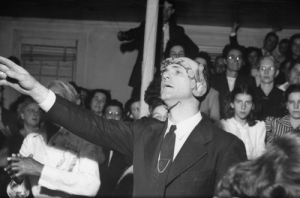 attention. I have written a lot about right wing terrorism and it grieves me to see that we saw yet another predictable incident in Kansas City. I can’t imagine what it feels for the folks who have been following this inside law enforcement and inside groups that truly fear these hate groups. If you didn’t see this bit from Rachel Maddow, you should. It sums up a lot of history that we’ve basically ignored since the 1980s. There are some really dangerous, violent white men out there.
In 2009, the Department of Homeland Security concluded a years-long study of right-wing extremism in the U.S. and released a report saying that ultraconservative white nationalists and other extremists pose a much greater threat to U.S. citizens than Islamic terrorists from overseas.
Conservatives like Laura Ingraham and Rush Limbaugh pitched a huge tantrum, accusing the Obama administration of staging an anti-conservative pogrom, even though the DHS study was commissioned by the Bush administration. In the end, the full study was never released, and the outcry forced DHS to divert resources away from U.S. extremists.
When authorities raided the apartment of deceased Boston Marathon bombing suspect Tamerlan Tsarnaev, they found stacks of right-wing conspiracy theory newsletters, angry screeds against blacks, Jews and the New World Order.
“How weird is it to have Chechen-speaking Russian immigrant Muslim guys reading 9/11 ‘Truther’ conspiracies and ads for Nazi message boards while also espousing violent jihad and allegedly setting off bombs that killed Americans?” Maddow asked.
According to the New America Foundation, she said, since the 9/11 attacks, 21 people have been killed in the name of Islamic extremism in the U.S., whereas the number of people killed by right-wing extremists stands at 34 after the three deaths in Kansas.
Nevertheless, huge swaths of U.S. policy are dedicated to fighting Islamic terrorism abroad, “But when it comes to the proven and interconnected threat of the armed, American extreme right wing, we’re still treating every attack by them like a surprise, still treating those attackers like a lone wolf, regardless of however many letters you find between them,” regardless of the places where they talk to each other online, “regardless of the tide of evidence that these organizations exist and are operational.”
Why won’t the country at large acknowledge the real threat of right-wing extremism, she asked. “Should that change?”
 There is a huge movement made up of angry, armed, white men that is threatening the health and safety of a huge number of people. They are not a majority of people and they are not a majority of white men. But, they are central to maintaining the power structure right now and can run amok in white male privilege and get away with a lot more than any one else would.
At the heart of this murderous continuum are race and xenophobia (a fear of others) and a violent reaction to those fears. To many in the dominant culture, their America is changing. The “browning” of America has evoked a return and acceptance of the murderous continuum. Former Colorado Congressman Tom Tancredo best expressed this sentiment when he proclaimed: “I want my country back.”
Conceal Carry permits, Stand Your Ground laws and inept prosecutors are creating a climate that provides the Zimmermans and Dunns of the world with a license to kill as long as juries are predisposed to letting them do so.
As the American economy continues to contract and full-time, well-paying jobs become harder to find, the face of poverty in America is changing. The stereotypical “urban” or “black” poor have now become the “suburban” or white poor. According to CBS, “Hardship is particularly growing among whites, based on several measures . . . More than 19 million whites fall below the poverty line . . . accounting for more than 41 percent of the nation’s destitute, nearly double the number of poor blacks.”
According to the Christian Science Monitor, “Suburbs are increasingly becoming the address of America’s poor. Suburban poverty across the country grew 53 percent between 2000 and 2010, more than twice the rate of urban poverty . . . ” Many of those newly poor suburbanites are white and many of them are angry, blaming people of color for their misfortunes, instead of directing their ire toward corporate greed, the outsourcing of factory jobs to overseas companies, and governmental policies that favor the wealthy.
What is truly scary to me, is that this is a celebration of lawlessness.
Local journalists covering Nevada rancher Cliven Bundy’s case stress he is no victim and is breaking the law, regardless of conservative media’s sympathy for his defiance of government orders to remove cattle from federal land.
Those reporters and editors — some who have been covering the case for 20 years — spoke with Media Mattersand said many of Bundy’s neighbors object to his failure to pay fees to have his cattle graze on the land near Mesquite, NV., when they pay similar fees themselves.
“We have interviewed neighbors and people in and around Mesquite and they have said that he is breaking the law,” said Chuck Meyer, news director at CBS’ KXNT Radio in Las Vegas. “When it comes to the matter of the law, Mr. Bundy is clearly wrong.”
Bundy’s case dates back to 1993, when he stopped paying the fees required of local ranchers who use the federally owned land for their cattle and other animals. Local editors say more than 85 percent of Nevada land is owned by the federal government.
Bundy stopped paying fees on some 100,000 acres of land in 1993 and has defied numerous court orders, claiming the land should be controlled by Nevada and that the federal government has no authority over it.
Last year a federal court ordered Bundy to remove his cattle or they would be confiscated to pay the more than $1 million in fees and fines he’s accumulated. The confiscation began earlier this month, but was halted because the Bureau of Land Management (BLM) had “serious concerns about the safety of employees and members of the public” when armed militia showed up to block the takeover.
Despite his lawlessness, Bundy has become a sympathetic figure for many in the right-wing media.
But for local journalists, many who have been reporting on him for decades, that image is very misguided.
“He clearly has captured national attention, among mostly conservative media who have portrayed him as a kind of a property rights, First Amendment, Second Amendment, range war kind of issue,” Meyer noted. “That’s how it has been framed, but the story goes back a lot longer and is pretty cut and dry as far as legal implications have been concerned.”
He added that, “Cliven Bundy and his supporters are engaged in a fight that has already been settled. There are a number of people around these parts who have strong reservations about Bundy’s actions.”
Las Vegas Sun Editorial Page Editor Matt Hufman said depicting Bundy as a victim is wrong.
In what is undoubtedly one of the worst stories I have read in years, Police in California actually had GPS trackers on two serial killers/rapists who 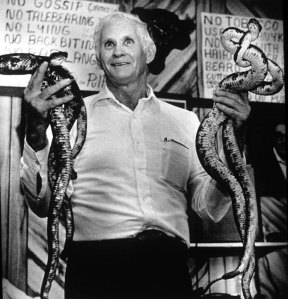 went out then killed women while they were under surveillance.
Two parolees raped and killed four women while wearing GPS trackers, and there may be more victims, a California police chief said.
Registered sex offenders Franc Cano, 27, and Steven Dean Gordon, 45, were both wearing ankle bracelets when the female victims were assaulted and killed last fall and earlier this year, Anaheim police Chief Raul Quezada said Monday at a news conference. The suspects were arrested on Friday and are each facing four felony counts of special circumstances murder and four felony counts of rape, reportsCBS Los Angeles.
The naked body of Jarrae Nykkole Estepp, 21, was found March 14 on a conveyor belt at an Anaheim trash-sorting plant. Quezada said it was the key to breaking the case, according to CBS Los Angeles. The probe led detectives to connect the two suspects to her slaying, and the disappearance of three women – Josephine Vargas, 34; Kianna Jackson, 20; and Martha Anaya, 28 – who frequented a Santa Ana neighborhood known for drug dealing and prostitution.
The Orange County Register reports that Cano and Gordon were convicted of lewd and lascivious acts on children under 14 years old. As a requirement of the convictions, both were required to wear GPS tracking bracelets.
Authorities at the news conference did not explain how Cano and Gordon allegedly managed to carry out the killings while under GPS supervision, but Quezada said data from the devices “was one of the investigative tools we used to put the case together.”
Our country spends billions of dollars tracking foreign terrorists who practice what is a minority religion in this country, while domestic grown terrorists who follow the majority religion appear to get a pass. Not only do they get a pass, they get enabled by the likes of Schafly and other Republican Politicos and financed by John Birchers like the Koch Brothers who now have a hand picked Supreme Court.
I’m really getting tired of reading and writing about this stuff. Are there only a few of us that really see the connections here between the nullification efforts and the neoconfederate longings of folks like the Pauls and their droogies? Are there only a few of us that object to the racism, the homophobia, and the misogyny of these folks? It doesn’t seem so if you read polls and if you see the demographics. But, damn, getting rid of the entrenched group that benefits from all the damage they’ve done over the years is just getting more difficult all the time. I cannot wait to upload a Youtube of myself Dancing On Their GRAVES.
What’s on your reading and blogging list today?

 peej
peej Carissa
 bostonboomer
 dakinikat
 ecocatwoman
 mablue2
 Mama Lopez
 peggysue22
 quixote
 skydancingguestblogger
 Mona (aka Wonk the Vote)



 Sky Dancing
Recent Comments