
Thursday: A Mixed Bag of Reads
Posted: January 16, 2014 Filed under: Barack Obama, Crime, Foreign Affairs, morning reads, U.S. Politics, War on Women, Water, Women's Healthcare, Women's Rights, worker rights | Tags: "Paysage Bords de Seine", art theft, Baltimore Museum of Art, Brian Schweitzer, David Sirota, Elkhart Indiana, foreign espionage, grocery store shooting, Jamie Bouie, Martha Fuqua, NSA, phone metadata, Pierre-Auguste Renoir, Ron Paul, telephone companies 38 Comments
Good Morning!!
I’m going to begin with a quirky story about a stolen painting by Pierre-Auguste Renoir: Renoir painting allegedly sold at flea market returning to museum. From the LA Times:
A small Pierre-Auguste Renoir painting that a woman said she purchased for just $7 at a flea market will return to a Maryland museum that argued that the painting was stolen from its premises in 1951.
A federal judge in Virginia ruled on Friday that Renoir’s “Paysage Bords de Seine,” which was painted in 1879, is the rightful property of the Baltimore Museum of Art. The decision brought to an ostensible end a bizarre case that pitted a driving teacher against the museum in a battle over an Impressionist work estimated to be worth $22,000.
Martha Fuqua, who reportedly teaches driving in Virginia, had said that she acquired the painting from a flea market in West Virginia in 2009. She later attempted to sell the work at an auction, which came to the attention of the Baltimore Museum of Art.
The weird part is that people who knew Fuqua claimed they had seen the painting in her mother’s home. So who stole the painting? From the Washington Post:
…a number of people who know Fuqua have cast doubt on her flea market story, including her brother. Some family acquaintances told The Post that they remember seeing the Renoir in the 1980s and 1990s at the Fairfax County home of her mother, Marcia Fouquet, who attended art college in Baltimore at the time of the painting’s theft in 1951. (The mother passed away five months ago at the age of 85.)
Apparently, Marcia Fouqua was an art thief. Here’s the original police report (PDF).

Unfortunately, there’s more bad news today–another shooting, this time in a grocery store in Elkhart, Indiana. NBC News reports:
A gunman killed a member of staff and a customer at an Indiana grocery store before being shot dead by police, officials said early Thursday.
The man had his gun pointed at a third person when officers arrived at Martin’s Super Market in the city of Elkhart, Indiana State Police Sgt. Trent Smith said in a press conference early Thursday.
When he trained his weapon on the officers they shot him dead, Smith said…
Smith said it was a “huge crime scene” and that shots had been fired from one end of the store to the next. The victims were found 10 to 12 aisles apart.
Police rushed to the scene shortly after 10 p.m. on Wednesday after receiving a 911 call. They heard gunshots when they arrived and rushed to the section of the store from which the shots were fired.
Smith described the gunman as white man in his twenties who lived in the area. He said he was armed with a semiautomatic handgun and a large knife.
A little more from Reuters:
The three dead were believed to be a female store employee in her late teens or early 20s, a female shopper in her mid-40s, and the shooter, who was thought to be in his late teens or early 20s, Smith said.
Details such as what motivated the violence and whether there was any connection between the gunman and store employees were not immediately known, he said.
Police found a large knife and a semi-automatic handgun inside the store near the suspect, who was believed to live in the area, Smith said.
Police were withholding the suspect’s name pending notification of his family.

David Sirota was up to his old tricks yesterday on Twitter. Once Sirota pretended to support Barack Obama–that was in the days when you couldn’t blog on Dailykos unless you behaved like a zombie Obot. But even Kossaks mocked Sirota for his constant bragging about receiving a phone call from then-Senator Obama in 2006 and then being invited to interview Obama and his staff.
In those days, Sirota was critical of Obama. In the build-up to the 2012 election, Sirota became a Ron Paul Fan, calling him a “real progressive.” After Obama was elected to a second term Sirota became so “unhinged” by Obama Derangement Syndrome that he compared Obama to George Zimmerman!
These days, Sirota has fastened his presidential hopes on Brian Schweitzer, former governor of Montana. And so when Jamie Bouie dared to suggest that by “positioning himself as a liberal repudiation of Obama,” Schweitzer was in danger of alienating African American voters who still strongly support the President; Sirota responded by strongly implying that Bouie (an African American) is a racist by calling Bouie’s post at The Daily Beast an “[e]xample of how communities of color are condescendingly portrayed as monolithic & unthinking voting blocs.”
Wow.
Here’s a little bit of good news from yesterday’s LA Times: U.S. accuses Wal-Mart of labor violations.
The National Labor Relations Board, an independent federal agency tasked with policing bad behavior by employers, is targeting Wal-Mart Stores Inc. over the retail behemoth’s alleged crackdown on its protesting workers.
The NLRB filed a formal complaint Wednesday against the Bentonville, Ark. chain, alleging that the company violated the rights of more than 60 employees rallying over workplace conditions in 14 states — including California….
The Wednesday filing stems from NLRB findings released in November that deemed unlawful Wal-Mart’s reactions to employees who participated in strikes around Black Friday in 2012.
The rallies spread to 100 cities. Nineteen employees were discharged from the company, allegedly as a reprimand for their involvement in the rallies, according to the NLRB.
The agency said that efforts to broker a settlement between Wal-Mart and its workers failed, leading to Wednesday’s complaint. The filing names more than 60 Wal-Mart supervisors — 19 in California — and corporate communications vice president David Tovar.
The article quotes experts who speculate that the NLRB may be trying to signal to corporations that it is going to stand up for not only unionized workers, but also those in non-unionized businesses. If true, that is excellent news.

Last night Cincinnati acted to protect residents from the chemical plume that is making its way down the Ohio River from West Virginia. From WLW 700: Cincinnati Water Works Prepares to Close Water Intake Valves.
(Cincinnati)–Days after a hazardous chemical leaked into the Elk River in West Virginia the chemical has flowed into the Ohio River and the Cincinnati area.
The Chemical known as 4-methylcyclohexane methanol leaked from a 48,000-gallon storage tank owned by Freedom Industries, in West Virginia. Investigators believe the leak began on Thursday Jan, 9. and the chemical foaming agent seeped though a one inch hole, in the storage tank and into the River….
Lisa Cochran the Communication Coordinator with The Ohio River Valley Water Sanitation Commission (ORSANCO) said the Chemical MCHM was first detected Sunday Jan 12. in the Ohio River.
She adds (ORSANCO) is coordinating with multiple organizations, including Cincinnati Water Works, Northern Kentucky Water, Kentucky Division of Water, US Coast Guard, West Virginia American Water and others to monitor the progress of the spill. “We have field crew members who actually go out and take samples” to determine the concentration of the chemical.
Cincinnati Waterworks is prepared to close their Ohio River water intake valves when the hazardous chemical plume is found. Cochran says “they (Cincinnati Water Works) do plan to shut down when the plume reaches their water intake”.
In NSA news, The New York Times published more “revelations” from the material that Edward Snowden stole. As has become the accepted technique with NSA stories, the article begins with supposedly terrifying news: the NSA uses mysterious “radio technology” to attack computer that aren’t even connected to the internet! Aiiiiiiiiiieeeeeee!
But read on. So far the software has only been used on 100,000 computers since 2008, primarily in countries like China, Russia, and Pakistan, and the software must be physically installed by a human spy with a flash drive. It has never been used domestically.
The N.S.A. calls its efforts more an act of “active defense” against foreign cyberattacks than a tool to go on the offensive. But when Chinese attackers place similar software on the computer systems of American companies or government agencies, American officials have protested, often at the presidential level.
Among the most frequent targets of the N.S.A. and its Pentagon partner, United States Cyber Command, have been units of the Chinese Army, which the United States has accused of launching regular digital probes and attacks on American industrial and military targets, usually to steal secrets or intellectual property. But the program, code-named Quantum, has also been successful in inserting software into Russian military networks and systems used by the Mexican police and drug cartels, trade institutions inside the European Union, and sometime partners against terrorism like Saudi Arabia, India and Pakistan, according to officials and an N.S.A. map that indicates sites of what the agency calls “computer network exploitation.”
So basically, the NSA uses this technology to do its job–spying on foreign countries to protect U.S. interests. Horrors!
And as for the phone call metadata program, Phone companies don’t want the job of spying on customers’ calls. PBS Newshour:
President Barack Obama is expected to announce Friday what changes he is willing to make to satisfy privacy, legal and civil liberties concerns over the NSA’s surveillance practices. One of the most important questions is whether the government will continue to collect millions of Americans’ phone records every day so that the government can identify anyone it believes might be communicating with known terrorists.
The president’s hand-picked review committee has recommended ending the phone records program as it exists. It suggested shifting the storage of the phone records from the NSA to phone companies or an unspecified third party, and it recommended new legal requirements before the government could search anyone’s phone records.
The phone companies don’t want the job. Executives and their lawyers have complained about the plan in confidential meetings with administration officials and key congressional intelligence and other committees, according to interviews by The Associated Press. Two phone executives familiar with the discussions said the cellular industry told the government that it prefers the NSA keep control over the surveillance program and would only accept changes if they were legally required. The executives spoke on condition of anonymity because they were not authorized to disclose the private discussions. But there have been public complaints, too.
Frankly, I’ve never trusted the phone company. I’d much rather have this data stored on government computers, where it can’t be accessed without a warrant approved by the FISA court.
Finally, Rolling Stone is highlighting the Republican war on women’s reproductive rights with a long read by Janet Reitman: The Stealth War on Abortion. I haven’t read the article yet, but I hope it’s good. We need more high-profile publications to highlight what’s happening to women’s rights in red states.
So . . . there’s a mixed bag of reads to get you started on the day. What stories are you following? Please post your links in the comment thread, and have a great Thursday!
Tuesday: “I Was There, But I Didn’t Do The Murders”
Posted: January 14, 2014 Filed under: Crime, Criminal Justice System, morning reads | Tags: Boston Marathon bombings, David Boeri, FBI, Ibragim Todashev, Massachusetts State Police, Tamerlan Tsarnaev, terrorism, Waltham triple murder, WBUR 53 Comments
Ibragim Todashev and Reni Manukyan (courtesy of The Guardian)
Good Morning!!
This morning public radio station WBUR in Boston broadcast a detailed report about the killing of Ibragim Todashev in his apartment in Orlando, Florida, on May 22, 2013, reportedly by an agent from the FBI office in Boston.
Todashev was a friend of alleged Boston Marathon bomber Tamerlan Tsarnaev. The FBI claims that before he died, Todashev confessed that he and Tsarnaev had participated in a grisly triple murder that took place on September 11, 2011 in Waltham Massachusetts. For some more background, here is a post I wrote about the case on May 30 of last year.
The WBUR report by David Boeri provides the most detail yet on this confusing and frustrating story. You can listen to the 13-minute broadcast here and/or read the written report, Interrogation Turned Deadly: Questions Remain In Todashev Shooting. Until now, the FBI has stubbornly stonewalled the media and Congress, even refusing to allow the release of Todashev’s autopsy.
According to the report, WBUR learned the names of the FBI agents and Massachusetts State troopers who were present in Todashev’s apartment at the time of the shooting, but agreed not to reveal the names because it would put the agents and troopers in danger.
Todashev’s widow Reni Manukyan, from whom he was separated, was also interviewed for the story.
If you’re at all interested, I highly recommend reading the whole article at WBUR, because it is too long and detailed to summarize, and excerpts won’t do it justice.
But here are some new details about how the shooting happened. Keep in mind that for weeks leading up to the final day of Todashev’s life he had repeatedly been interviewed by FBI agents, called on the phone by them, and tailed by them everywhere he went. Todashev’s girlfriend had was also being held on immigration charges and was being pressured to inform on him.
Inside the condominium unit, I have learned from law enforcement sources, Todashev faced an agent assigned to the Boston office of the FBI and two Massachusetts State Police troopers — one of them assigned to the Middlesex district attorney. Middlesex County has responsibility for investigating the unsolved triple murder in Waltham in 2011. With the troopers’ arrival, it appears the focus of interest was changing from terrorism to murder….
In Orlando, the interrogation of Todashev was extraordinarily long.
“The fact that there were multiple officers present there questioning him for a period of hours clearly indicated that Mr. Todashev did not feel that he was free to leave,” said Thomas Nolan, who chairs the criminal justice department at the State University of New York at Plattsburgh. Nolan was also a Boston police officer for 27 years.
“Mr. Todashev was obviously not free to leave if he chose so,” Nolan added. “So he was in effect in custody here.”
At this point the agent(s) should have read Todashev his Miranda rights, but the FBI won’t say whether that happened. They may have decided that since Todashev had “invited” them into his home, they could continue questioning him until he told them to stop or asked for an attorney. If so, they apparently made the wrong decision.
“If you’re beginning to accuse somebody of a triple murder back in Massachusetts, that’s going to generate stress and crisis and conflict,” said Tom Shamshak, a police trainer, instructor in investigations at Boston University and former Massachusetts police chief.
There was a challenge and a danger in being in Todashev’s home, because it was his home— where he was most comfortable, and where, if there were any weapons, he knew where they were and the police did not. The one place police would know there were weapons was the one place they are told in training to avoid when making accusations and where they dread going when responding to calls of domestic disputes: the kitchen, which has knives….
“The accusatory tone in an interrogation … it’s hot,” Shamshak said. “So you have a hot, volatile back-and-forth with the officers: ‘I don’t want to hear that. I know you did it.’ It’s like a volcano.”
And, at some point in the long night of a very long interrogation, Todashev broke, according to law enforcement sources familiar with accounts of what happened who requested anonymity because they do not have permission to speak publicly.
“I was there, but I didn’t do the murders,” Todashev said, according to those sources. Under the heat, they say, Todashev blamed Tsarnaev for the murders.
That was what the agents had been waiting for. Next, they tried to get Todashev to write out a confession and sign it; but they claim Todashev lost control, flipped over the table, knocked the agent down, “came at him with a ‘pipe,'” and according to the agent, “would have split his skull.” And so,
Sources say the FBI agent fired in two bursts. With a burst of three bullets, Todashev went down, according to this account. Then, to the amazement of the agent and the trooper, the ultimate fighter Todashev came up again. The agent fired four more. It was 12:15, the official time of death, Manukyan says.
I’ve already quoted too much from the story, so please go read the whole thing if you’re interested–it’s absolutely riveting. Congratulations to David Boeri and WBUR for getting so much detail–apparently from sources who were present at the scene of Todashev’s shooting. Perhaps this will put enough pressure on the FBI for them to release their own report.
I have a few more news items for you, but I’ll post them in the comment thread. I’ve already had a horrible WordPress glitch today that made me have to rewrite part of this post, and I’m way behind in my real-world schedule. So, please join me in the comments!
Monday Reads: Rabid, Rich Dogs Bite People across the country
Posted: January 13, 2014 Filed under: morning reads | Tags: Bridge closure, Chris Christie, Kansas Gun Laws and spending cuts, New Jersey, New Orleans Sound ordinance, Treme 83 CommentsGood Morning!
One of the biggest problems that I have with folks who wear the smug mantle of libertarian is that they make hay over abuses of power at the Federal level while shrugging off what goes on at the state level unless it has something to do with dismantling public schools or taxing the rich. I’ve always thought that abuse of power and destruction of civil liberties shouldn’t happen at any level. However, if you go from state to state, you’re going to see how serious money has serious sway over the actions of politicians. Some states and locales just ooze plutocracy. It’s a lot easier to be a thug at the state level. It’s getting to the point where reality is unfolding like a TV plot.
 I’ve dived into the fray at the local level again here in New Orleans where our culture of second lines, Mardi Gras Indians, and live local music is under siege.
On one hand, I’ve decided to volunteer for the Mary and Mitch Landrieus’ re-elections despite serious reservations about both, because I don’t want to live in a state ruled by one party intent on driving the trains straight off the reality track.
I’m also headed to a huge demonstration on Friday, because some freaking rich lawyer has time and money to continually harass the causes of street sounds and music near his property in the French Quarter. His pet peeves will impact all of us. Before he moved into the quarter, you would find musicians out about the street at nights. I would see them on the way home from my gigs all the time when I lived in the quarter myself. They now have to be out of sight and ear by 8:30. He’s been on a tear since then with a few rich neighbors. Problem is, they have money and time and they just don’t give up. Now, they want a “sound ordinance” that has an outlandishly low standard for what he deems ‘noise”. I literally will not be able to play my piano in my back parlor without risking a violation. That means also that Alan Toussaint would not have been able to play it in the taping of Hurricane on the Bayou. And, a few months back, you would not have been able to hear Robert Plant from my front porch. And, you will likely never hear live music in and around my neighborhood bars. This, to me, is unthinkable!
So, I am going to the city council on Friday and I’m going to sign in to testify. I’ve already written letters. This is bad for my friends who own small restaurants and bars. It’s also bad for musicians and those who enjoy live music. The only beneficiaries are these few rich landowners that are all over the city council right now although they try to give the impression they have mass support. The other beneficiaries are the downtown hotels and casinos and other big money interests that would rather have all the musicians held hostage in their bars. I’m doing something of a weird thing by supporting the status quo but yet fighting the powers that want to buy themselves a pristine, billionaire friendly New Orleans. Go figure. I do wonder why people would buy property when they know they are surrounded by bars and music venues. This is a bit like the other stuff that’s gong in my current neighborhood where I suddenly have neighbors who are all about having manicured grass in the back and side yards. All hell is breaking loose, however, around this ordinance.
All hell seems to be breaking loose from New Orleans citizens who are up in arms regarding the underhanded way that the
VCPORA attempted to slip in a noise ordinance that would have a severe impact on the city’s music scene.
Understandably, the peeps at VCPORA are tired of getting no action from the City Council regarding what seems to be Mr. Smith’s Number One priority (other than bashing oil companies, from whom he’s won bazillions of dollars in class action lawsuits. (From his firm’s web page: “In a 2001 Stuart Smith and Michael Stag jointly prosecuted the widely publicized Grefer case. A jury returned a verdict of $1.056 billion dollars against Exxon/ Mobil Corporation, the world’s largest oil company, in favor of the firm’s client after a six-week trial. The landmark verdict was listed in Lawyers Weekly, USA as the second largest verdict in the United States for 2001.”)
To recap from last week’s post, attorney Smith bankrolls the VCPORA and is successfully using its purported agenda of “preservation” to achieve his goals of eliminating “noise” in the French Quarter.
Since last week’s post, I’ve attended a MaCCNO (Music and Culture Coalition) meeting on Friday, and have been subjected to several emails from Stuart Smith, by way of the Brylski Company, which bills its emails as “Krewe of truth.”
Stuart Smith. From the VCPORA website: “For years, VCPORA has been able to count on a man who’s led innumerable legal battles on our behalf, and on behalf of the Quarter – and done all of it pro bono. That man is Stuart H. Smith – our neighbor, our benefactor, and a man of courage and capability who’s been a passionate advocate on behalf of the Vieux Carré.”I’d call it more the “Krewe of Propaganda.”
Here are a few points in the email [First of all, it’s entitled “Hearing Beyond The Misinformation: TRUE SOUND FACTS [in BIG FAT BOLD letters] about the ‘Seven Essentials’ and the Sound Amendments.”
“WILL THESE AMENDMENTS ‘KILL’ NEW ORLEANS’ MUSIC SCENE?
NO! Of course not! No elected official in New Orleans would sign onto an ordinance that would kill, or even hurt, our invaluable New Orleans music scene [Not unless a VCPORA member like Nathan Chapman sneaked it into Stacy Head’s office to be presented to the council at the last minute pre-2013 Christmas holiday. Chapman is past president of VCPORA and, how shall I say this?: Stuart Smith’s “minion.”] “Music is an invaluable part of our culture and our economy. The reason all seven council members signed on was because, after four years of detailed study and hearing, these amendments are actually very limited in scope and provide common sense improvements. [Untrue, these are not common sense improvements to anyone other than those who want to keep music at the level or a normal conversation. Oh, one had better NOT say that they want to kill New Orleans music! Ask Mr. Smith how much he enjoys the jazz at the Gazebo. Smith bought a property at 516 St. Philip Street in 1997, just a half block from the Gazebo and tried to get the zoning changed at a bar that had had music for many years, well before Stuart took up residence. Oh yeah, he loves music all right. But he moved right next to it and did try to kill it.]
 Smith appears to have done some really creative things in terms of showing he has support. And, he’s convinced the City Council that what he is doing isn’t a big deal at all but very responsible and reasonable.
When they use these unrealistically low sound levels to justify lawsuits and to try to get police shut-downs, the well-funded noise factories of Bourbon Street will come out okay. They can either pay the fine, pacify the enforcers, or hire effective attorneys to back the process into a corner with constitutional challenges which the local court can’t handle and the Supremes won’t be bothered with, so the cases sit in limbo like Bleak House.
But smaller, newer venues, events and street bands, where some new music might emerge – they won’t be able to come close to affording it. The gentrifiers’ suppression will take hold. Venues will have to either shut down the music, or get driven out of business. Perhaps it is the city establishment’s strategy: to leave us with just tourist music and a few big names in big sites, with no sense that they are strangling the future. And for what? Increasing the radius of the comfort zone for a few property owners claiming special privilege.
So, those of you that follow me on FaceBook or Twitter or here, will continue to hear me talk about this because I’ve just about had it with people trying to change my city into some blase suburb.
BTW, the HBO series Treme ended this season. There’s a great interview with a resident of that neighborhood on what the series has meant. I still haven’t watched it but I swear there’s not an episode that doesn’t have a friend or neighbor in it. I bought the DVDs some time ago but I still can’t bring myself to watch it. I lived the entire thing and just can’t get into the idea of doing it again. I think the biggest curse of Katrina has turned into two things for me. One is the number of transplants that seem to want a pristine version of what they think New Orleans should be and what seems like the forced diaspora of the black middle class from the area which brought a red Louisiana and the evil Governor Jindal. We could handle the Hurricane but I don’t know how much damage from those last two we can take.
RO: I think the show’s tapestry—dare I say gumbo?—of characters and struggles plays a big part in what makes Treme so authentically New Orleans. So it’s kinda hard for me to isolate a character or storyline—they all resonated with me at some level. But if I had to chose? I guess LaDonna running her bar; Nelson Hidalgo for his newcomer’s perspective, learning the byzantine ways of the city; Janette Desautel and her restaurant. Those would be the closest to my personal experience in post-Katrina New Orleans: I ran a bar right after the storm; I was a newcomer, in town just three months when the levees broke. Also, my first wife was a chef and we opened a summer restaurant in the Hamptons together, so Kim Dickens’ character’s professional struggles were very familiar to me.
This is one newcomer who seems to want to adjust to the way of life down here instead of having the way of life adjust to him. But then, he doesn’t have billions of dollars to spend and the attention of politicians needing donors. I think this sound ordinance protest is the beginning of the pushback. I’m not sure how much more folks are going to put up with gentrification at all costs. I just hope the city council gets it. All of the music culture of New Orleans shown in Treme will only occur in hotel bars, the city’s sole casino, and a few Bourbon joints if the ordinance passes.
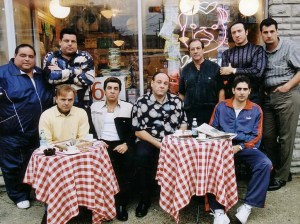 There are a lot of times when the larger-than-TV-Life culture of a state seems to be brought to life. It’s just not my state where the government seems to be pushing the agendas of the plutocracy at the cost of the people who call the place home. New Jersey government seems to be the new Goodfellas under Chris Christie.
The Christie Bridge Scandal seems to just pop off the screen and right into your face So far, there are more questions than answers. However, this is not going away since the New Jersey Assembly has reissued subpoenas. If there was an attempt to ride out the legislative year, it didn’t work. Key establishment republicans are trying to buff this turd.
During a panel segment on Fox News Sunday, host John Roberts pointed out that many Republicans were praising Christie for firing one of his top aides after a newspaper exposed his administration’s role in closing part of the busiest bridge in the world as part of political retribution plot, but President Barack Obama had not fired anyone over the health care reform law.
“I think he did himself a lot of good,” Rove said of Christie’s reaction to the scandal. “I think he did himself some good by contrasting with the normal, routine way of handing these things, which is to be evasive, to sort of trim on the edges.”
“You’ll notice we haven’t been hearing a lot from the Clinton camp about this,” he added. “Contrast both with Bill Clinton and Secretary Hillary Clinton’s handling of Benghazi.”
Later in the segment, Roberts asked the panel: “Where was this media coverage on Benghazi, the NSA or the IRS?”
Columnist George Will admitted that “this was not a phony scandal” because Christie’s administration had used the machinery of government to “screw our enemies.”
“There are reasons why conservatives had disagreements with Chris Christie, I don’t think that the tea party is going to seize upon Fort Lee and the George Washington Bridge as their defining difference with Christie,” Rove opined. “In fact, I think his handling of this, being straightforward, taking action — saying, ‘I’m responsible’ — firing the people probably gives him some street cred with some tea party Republicans, who say that’s what we want in a leader, somebody who steps up and takes responsibility.”
I’m sorry, but there’s something distinctly different about handling people who have abused the public trust, committed crimes, and caused public safety issues and managing people who had oversight of a bad roll out of product. Here’s more information about those subpoenas because it looks more and more like something very criminal happened in Trenton.
At least six New Jersey residents have filed suit against Christie, the state of New Jersey, and the Port Authority of New York and New Jersey, among others for the traffic jams and resulting problems.
The traffic jam caused by the lane closures delayed emergency services and left commuters and school children stranded on the bridge during periods of heavy traffic, according to local officials.
ABC News also obtained a letter from Fort Lee EMS coordinator Paul Favia that documents four medical situations in which emergency responders were delayed because of the traffic gridlock. In one case, a 91-year-old woman later died at a hospital of cardiac arrest.
Although Favia doesn’t directly tie her death to the delays, he noted that “paramedics were delayed due to heavy traffic on Fort Lee Road and had to meet the ambulance en route to the hospital instead of on the scene.”
Documents now show that the aides were told that this would hurt people and cause safety issues. Christie originally mocked the stories by talking about laying the cones down. How is this leadership? I don’t recall Obama ever making a joke about the people who were struggling with the original problems of the site and he told the people in charge to go back and fix it. Which model of leadership seems ethical to you?

No special interest groups appear to have larger sway over the country than the NRA and the various groups–like ALEC–that are funded by Pete Peterson and the Koch Brothers. They’ve convinced many Republican controlled states that even providing the most basic services is evil in the face of putting taxes on the wealthy. Well, the modern day Matt Dillons are going to have a rough time controlling gunslingers in Kansas.
Reasoning that more guns mean greater safety, Kansas lawmakers voted last year to require cities and counties to make public buildings accessible to people legally carrying concealed weapons.
But for communities that remained wary of such open access to city halls, libraries, museums and courthouses, the Legislature provided an exemption: Guns can be banned as long as local governments pay for protections like metal detectors and security guards, ensuring the safety of those they have disarmed.
It turns out that in Wichita, the state’s most populous city, and in some other towns, the cost of opting out before the Jan. 1 deadline was just too high.
“It was essentially being foisted upon us,” said Janet Miller, a City Council member in Wichita. The city applied over the summer for a six-month exemption but voted last month not to extend it after the police estimated that it would cost $14 million a year to restrict guns in all 107 city-owned buildings.
While Republican-majority legislatures across the country are easing restrictions on gun owners, few states are putting more pressure on municipalities right now than Kansas. The new law has forced some local leaders to weigh policy conviction against fiscal pragmatism in a choice that critics say was flawed from the start: Open vulnerable locations to concealed side arms or stretch meager budgets to cover the extra security measures.
I guess it will be open season on criminal justice employees in courtrooms in Kansas.
Anyway, these are just three different parts of the country where it seems that local politicians are doing a disservice to the people who elected them. They are more moved by special interests than their constituents. So, what’s a voter to do? As for me, I’m taking to the streets on Friday. I’m just relying on the Greater Ethos that I’ll be in my own bed on Friday Night.
What’s on your reading and blogging list today?
Saturday Morning Reads: Guilty Pleasures
Posted: January 11, 2014 Filed under: morning reads | Tags: Absinthe, Catherine Robbe-Grillet, Japanese Monster Stories, Literary Misery Index, Mary Shelley, Moche 26 Comments
Good Morning!
I’ve found some interesting reads for you this morning! I promise I’m not going to bore you with economics today!
There’s been some interesting discoveries in the literature world. A “cache” of Mary Shelley Letters were discovered in a rural English library that shed some light on her last days.
The letters date between 1831, nine years after the death of her poet husband Percy Bysshe Shelley, and 1849, when Mary Shelley was already unwell with the brain tumour that would kill her two years later, and show a woman who was skilled in charming favours from friends, bursting with pride in and concern for her teenage son – and not unconcerned with frivolities. A last-minute ticket to the coronation of William IV in 1831 necessitated a 3am visit from her hairdresser; she attended the event sporting a plumed headdress (“The whole thing was wondrously splendid – Diamonds & cloth of gold grew common to the eye.”)
The later letters, written in an increasingly scrawled hand, are short and distracted, full of apologies for her failing memory and powers. To a number of them is still attached a blob of scarlet wax stamped with the author’s own seal – one that was not previously known, according to Crook.
The “nondescript-looking” missives were written to Horace Smith and his daughter Eliza. Smith was a stockbroker and wit who had been close to the poet Shelley and whose family befriended his widow after his death, and the discovery of the letters is a particular surprise, said Crook, because he had a habit of destroying correspondence.
“The Smith connection has been known but this little bit of the jigsaw hasn’t been,” said Crook. “A few things that had been inferred by scholars can now be confirmed. But what is nice is that Mary Shelley’s personality emerges. We see her as very loyal to the Smith family, very grateful and very attentive to Eliza – I don’t think that friendship has ever been fully documented.” There is also, notes the professor, Shelley’s “charming wheedling side”, as she cajoles Smith into favours.
I thought of Shelley when I saw a BBC article on the cultural roots of Absinthe as a literary muse. I’ve tried the drink–imported from  Portugal where the wormwood was left in–and I will say it gives one an odd buzz. Here’s some background on the green fairy.
Arthur Rimbaud called absinthe the “sagebrush of the glaciers” because a key ingredient, the bitter-tasting herb Artemisia absinthium or wormwood, is plentiful in the icy Val-de-Travers region of Switzerland. That is where the legendary aromatic drink that came to symbolise decadence was invented in the late 18th Century. It’s hard to overstate absinthe’s cultural impact – or imagine a contemporary equivalent.
The spirit was a muse extraordinaire from 1859, when Édouard Manet’s The Absinthe Drinker shocked the annual Salon de Paris, to 1914, when Pablo Picasso created his painted bronze sculpture, The Glass of Absinthe. During the Belle Époque, the Green Fairy – nicknamed after its distinctive colour – was the drink of choice for so many writers and artists in Paris that five o’clock was known as the Green Hour, a happy hour when cafes filled with drinkers sitting with glasses of the verdant liquor. Absinthe solidified or destroyed friendships, and created visions and dream-like states that filtered into artistic work. It shaped Symbolism, Surrealism, Modernism, Impressionism, Post-Impressionism and Cubism. Dozens of artists took as their subjects absinthe drinkers and the ritual paraphernalia: a glass, slotted spoon, sugar cubes – sugar softened the bitter bite of cheaper brands – and fountains dripping cold water to dilute the liquor.
Absinthe was, at its conception, not unlike other medicinal herbal preparations (vermouth, the German word for wormwood, among them). Its licorice flavor derived from fennel and anise. But this was an aperitif capable of creating blackouts, pass-outs, hallucinations and bizarre behaviour. Contemporary analysis indicates that the chemical thujone in wormwood was present in such minute quantities in properly distilled absinthe as to cause little psychoactive effect. It’s more likely that the damage was done by severe alcohol poisoning from drinking twelve to twenty shots a day. Still, the mystique remains.
Bentley visits Robbe-Grillet, sadomasochistic author and widow of novelist (and accomplished sadist) Alain Robbe-Grillet, at the 17th-century château in Normandy where she resides with Beverly Charpentier, the 51-year-old South African woman who is her submissive companion. “Catherine is my secret garden,” Charpentier says. “I have given myself to her, body and soul. She does whatever she wants, whenever she wants, with either or both, according to her pleasure—and her pleasure is also my pleasure.”
“As a dominatrix you must dominate yourself,” Robbe-Grillet tells Bentley. “Otherwise you take the chance of killing someone or doing serious damage, so you have to know your limits.” For example, “blood is only drawn with initiates,” Beverly explains. “I stop at what is irreversible,” says Robbe-Grillet. Except when she doesn’t. Robbe-Grillet recalls an encounter she had with a man named Christian, whom she met in 1986. He wanted her to brand him with the initials of her nom de plume, “JDB.” She did. “I fell into my dream,” Christian tells Bentley of his relationship with Catherine, “and I have never left it.” Over the course of almost 20 years, the marks faded and a year ago Robbe-Grillet held another ceremony to burn them in anew.
Okay, one link that has something to do with economics but more closely related to the self-pleasure of reading. I got this link from Chelsea Clinton who posted it to her facebook page. Does the state of the economy have anything to do with what you’re reading or what author’s write?
The analysis, published in the journal PLOS One, found that when words commonly associated with misery show up in books, it meant that 10 years before, the economic situation was pretty grim.
To reach this discovery, researchers from Bristol and London sifted through a database of more than five million digital versions of books from Google. They created a literary misery index calculated by adding the amount of sadness-related words and subtracting the number of happiness-related words. They then compared this literary misery index to a well known measurement called the economic misery index, which is the sum of inflation and unemployment rates. The literary misery level in a given year was associated with the average of the previous 10 years’ economic misery index.
“When we looked at millions of books published in English every year and looked for a specific category of words denoting unhappiness, we found that those words in aggregate averaged the authors’ economic experiences over the past decade. In other words, global economics is part of the shared emotional experience of the 20th century,” said study author Alex Bentley,
a professor at the University of Bristol in a statement.
They reported that market economic misery corresponds with WW1, the aftermath of the Great Depression, and the energy crisis of 1975. The literary misery comes about a decade later, which the researchers speculate could be due to the time gap between when a writer was young and live through these experiences and formed these memories, to when they actually began writing published work.
The researchers even repeated the study with books written in German, and found the same connection.
Have you ever spent much time reading about the monsters that can be found in the stories of other cultures. Here’s some of Japan’s most frightening and bizarre monsters! I got this one from Delphyne’s facebook feed. She’s always finds some of the most intriguing items! The Japanese believe that almost anything can become a terrifying ghost!
The Ittan-Momen doesn’t sound particularly scary; it’s basically a sentient roll of cotton that just flies around in the wind at night, wandering around. But the Ittan-Momen is also a sadistic asshole, because if it sees you, it will either wraps itself around your neck and choke you to death, or wrap itself around your head and suffocate you. Again, the idea that you can be walking back from the convenience store and suddenly get murdered by a large piece of cloths is deeply disconcerting to me.
That’s a drawing of a pretty odd looking ghost lantern over there on the left. I can only imagine what it’s story is all about.
Okay, so this isn’t my usual fascination with burial sites thing, but it is about thing going on underground in Europe. A series of interconnected underground tunnels all around Europe appear to be have made by Stone Age humans.
Stone Age man created a massive network of underground tunnels criss-crossing Europe from Scotland to Turkey, a new book on the ancient superhighways has claimed.
German archaeologist Dr Heinrich Kusch said evidence of the tunnels has been found under hundreds of Neolithic settlements all over the continent.
In his book – Secrets Of The Underground Door To An Ancient World – he claims the fact that so many have survived after 12,000 years shows that the original tunnel network must have been enormous.
‘Across Europe there were thousands of them – from the north in Scotland down to the Mediterranean.
‘Most are not much larger than big wormholes – just 70cm wide – just wide enough for a person to wriggle along but nothing else.
‘They are interspersed with nooks, at some places it’s larger and there is seating, or storage chambers and rooms.
‘They do not all link up but taken together it is a massive underground network.’
I did find one very cool tomb article about a tattooed Sorceress Queen. It appears that the Moche may have been a matriarchal society.
On the beautiful northern coastline of Peru overlooking the blue Pacific, the place known as Huaca El Brujo (Sacred place of the Wizard) gives us an incredible glimpse into the culture of the Moche and the ‘Wizard’ buried there. Its two main pyramids, Huaca del Sol and the Huaca de la Luna, were once the centre of social and religious functions in the area and the final resting place of the tattooed mummy, who has come to be known as the Lady of Cao. Not an elderly woman, she died in her mid-twenties about fifteen hundred years ago, probably as a complication of childbirth.
The Moche did not mummify their dead purposefully, but the conditions for desiccation just happened to preserve the Lady of Cao and by doing so also preserved her intricate tattoos. Although it is not believed that the more common members of Moche society were tattooed it could certainly be inferred from this burial that the highest status members were, and the tattoos probably represented and strengthened the individuals connection with the divine through sympathetic magic. If you want the strength of the tiger get a tattoo of a tiger…this thought process has not changed since the beginning of the art form and it continues today.
The Lady of Cao’s tattoos included serpents, crabs and spiders – all animals associated with the Moche pantheon of divine
creatures – and their presence further linked her to the world of the supernatural and probably increased her perceived power among her people; the divine literally lived in her skin. Since most Moche burials are not preserved like the Lady of Cao we will never know for certain if all the elite were tattooed, but pottery portrait jugs suggest that they may have been.
The surprise discovery of the tattooed female in the Hill of the Wizard certainly caused archaeologists to have to reconsider their male-centric model of the Moche political structure and I am sure they would have eventually come to consider her an anomalous female ruler like Hatshepsut, Boudicca, Makeda, Cleopatra, or Penthesilea. But the subsequent discoveries of eight more Moche Queens have made it quite clear that this was not a male ruled society.
So, this should be enough to keep you intrigued today! What’s on your reading and blogging list today?
Friday Reads: #BridgeGhazi Scandal Fallout
Posted: January 10, 2014 Filed under: morning reads, Republican politics, U.S. Politics | Tags: #BridgeGate, #BridgeGhazi, Chris Christie 53 Comments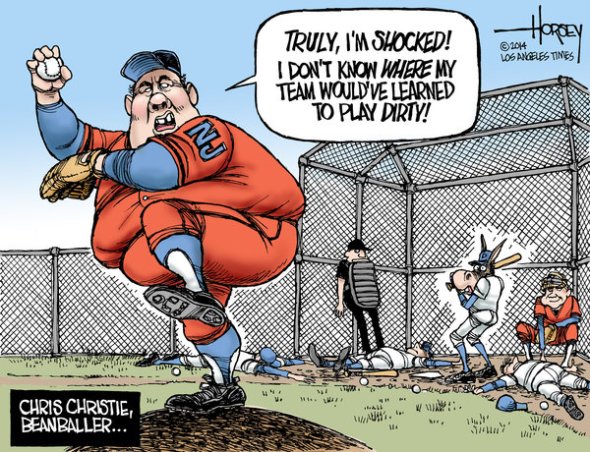
Good Morning!!
The #BridgeGhazi scandal is still dominating the news this morning, so I thought I’d surf around and see what the pundits are saying about it. I’ll leave it to you to post links to other stories you’re following in the comment thread.
As you can see, LA Times cartoonist David Horsey focused on Christie today. He also had some editorial comments.
As revealed by a series of email exchanges, three of Christie’s top aides closed down all but one of the traffic lanes at the entrance to the George Washington Bridge to punish the Democratic mayor in the nearby town of Fort Lee, who failed to fall in line behind the Republican governor in his recent reelection campaign. New Jersey commuters spent days stalled at the bottleneck, emergency vehicles were slowed down and one elderly woman died before she could be taken to a hospital.
In a two-hour news conference, Christie claimed he knew nothing about the scheme to exact political retribution by manufacturing a traffic nightmare. The three staffers have been booted, and the governor insists that he is shocked and saddened by their actions. Nevertheless, many people are skeptical. Even if Christie is telling the truth and the aides were not following his direct orders, his combative, in-your-face political style makes plenty of people assume the three were mimicking the bullying ways of their boss.
Though he has played the victim a bit too much, Christie has handled the crisis well so far. Chances are, he will survive this round of revelations (unless, of course, it turns out he is lying, in which case he can probably kiss the GOP nomination goodbye).
Raise your hand if you think Christie was telling the truth, the whole truth, and nothing but the truth in his lengthy press conference yesterday. Anyone? Anyone?
At U.S. News, Ken Walsh writes that It’s Just Beginning for Chris Christie.
What’s ahead for embattled New Jersey Gov. Chris Christie won’t be pretty. Investigations. Lawsuits. Ridicule. Doubt. A credibility gap. And quite possibly severe damage to his prospects as a potential Republican presidential candidate in 2016.
Christie can recover. Consider what Bill Clinton did in overcoming charges of adultery and draft dodging during his 1992 Democratic presidential campaign, which ended successfully. Consider how Republican George W. Bush overcame allegations of youthful drinking and past drug use during the 2000 campaign, which he won. And consider how Democrat Barack Obama dealt successfully with a political crisis arising from the inflammatory and divisive views of his pastor in Chicago in 2008.
Christie’s scandal is different, and worse. It involves an apparent act of political retribution against the mayor of Fort Lee, N. J., because the official didn’t endorse Christie’s re-election bid last year. But the price was paid by everyday people: innumerable motorists who suffered massive delays when Fort Lee traffic lanes leading to the George Washington Bridge were shut down for four days last September, apparently at the instigation of Christie aides. The governor says he didn’t know about it at the time, and he has fired two aides whom he is holding responsible….In political terms, “Bridgegate” is devastating to Christie for a simple reason: It undercuts his image as an efficient if abrasive leader, and reinforces the impression that he is a bully.
But who doesn’t think Christie is a bully? A couple of days ago, Beltway Bob Ezra Klein wrote, Chris Christie’s problem is that he’s really, truly a bully.
Christie inhabits a rare space in American politics: He’s a bully. He’s followed around by an aide with a camcorder watching for moments in which Christie, mustering the might and prestige of his office, annihilates some citizen who dares question him.
Almost everywhere Christie goes, he is filmed by an aide whose job is to capture these “moments,” as the governor’s staff has come to call them. When one occurs, Christie’s press shop splices the video and uploads it to YouTube; from there, conservatives throughout the country share Christie clips the way tween girls circulate Justin Bieber videos. “The YouTube stuff is golden,” says Rich Lowry, the editor of National Review. “I can’t tell you how many people forward them to me.” One video on Christie’s YouTube channel — a drubbing he delivered to another aggrieved public-school teacher at a town hall in September — has racked up over 750,000 views.
Now in Moorestown, Christie was hoping to create another such moment. After some introductory remarks, he opened the floor to questions. “For those of you who have seen some of my appearances on YouTube,” he cautioned, peeling off his suit jacket as he spoke, “this is when it normally happens.”
It’s not an accident that Christie emerged in a period when the Republican Party is out of power. His videos make them feel powerful at a moment when they’re weak.
The reason Chris Christie is so good at this is that Chris Christie is actually a bully. That doesn’t mean he’s not also a nice guy who cares deeply about his family and his constituents and his country. It doesn’t mean he’s not an unusually honest politician who’s refreshingly free of cant and willing to question his party. There’s a lot about Christie that’s deeply appealing. But there’s one big thing that’s not: He’s someone who uses his office to intimidate people and punish or humiliate perceived enemies.
Watch video examples at Wonkblog.
Other writers are beginning to discuss the legal consequences of the scandal for Christie and his staff. Ben Brumfield at CNN:
It may have seemed like a teenage prank at the time, but the blockage of bridge traffic as a possible act of partisan political revenge has put New Jersey Gov. Chris Christie in the middle of a serious legal stew.
And the fire underneath it is just beginning to heat up for the Republican presidential hopeful, as the state assembly plans to post online 907 pages of documents related to the case Friday.
State lawmakers questioned one of Christie’s allies on Thursday, a former state official implicated in the scandal. So far, David Wildstein has repeatedly refused to answer, invoking his Fifth Amendment right against self-incrimination.
The legislators charged him with contempt for his lack of cooperation. But the dam could eventually break as lawmakers dig in their heels, analysts say.
As long as Christie was telling the truth at a marathon press conference he held on Thursday, he should be able to step out of the caldron, analysts who spoke with CNN say.
That’s the key question isn’t it? And I think most people assume Christie was lying through his teeth yesterday.
“He was pretty specific about what he knew and when he knew it,” said CNN analyst Gloria Borger on The Lead with Jake Tapper.
But if any of it doesn’t jibe with other peoples’ stories, information provided in documents or clues that pop up, experts say Christie could get dragged into civil and criminal lawsuits.
One thing is certain. The legislative inquiry into the alleged misdeeds that led to the traffic jam on the George Washington Bridge is just getting into gear.
 Here’s a characteristically frank assessment of Christie’s press conference from the New York Daily News.
New Jersey Gov. Chris Christie’s one-hour-and-forty-seven-minute self-serving, self-pitying display of contrition on Thursday was a climactic act in a brazen cover-up that threatens to further unravel his political career.
Ever so thoroughly the governor scoured the thesaurus for words of apology, regret and painless self-flagellation while nervily playing the victim and mercilessly destroying the aide who played only a supporting role for the George Washington Bridge political revenge plot.
Christie needed blood to express his outrage to the public, so he drew it from deputy chief of staff Bridget Kelly for the sin, the governor said, of lying to him. Perhaps, Kelly did lie, although it seems incredible that anyone would flat-out attempt to deceive an intense, emergency inquiry.
Regardless, Christie made roadkill of Kelly and his former campaign manager while wholly exempting the close pals who were central to the lane-closure conspiracy that caused four days of gridlock and dangerously slowed emergency response in Fort Lee. Pathetic.
Read the whole thing at the link.
Rachel Maddow offered an alternative theory on the reasons behind #BridgeGhazi. From Huffington Post:
As the story stands, Christie’s deputy chief of staff called for George Washington Bridge access lane closures that created a massive traffic jam in Fort Lee for four days in September — a move that many have written off as political retribution for Democratic Fort Lee Mayor Mark Sokolich’s refusal to endorse the Republican governor’s reelection.
Maddow on Thursday presented an alternate theory, saying Sokolich’s endorsement “wasn’t that important.” Instead, she suggested the political payback was motivated by a tiff between New Jersey state Senate Democrats and the governor.
Maddow took viewers back to 2010, when Christie declined to reappoint a New Jersey Supreme Court justice, John E. Wallace Jr., for another term. The move left state Senate Democrats “absolutely outraged,” Maddow explained, and they refused to confirm any Christie’s nominees for Wallace’s seat.
Could Maddow be onto something?
By last August, Supreme Court Justice Helen Hoens, a Republican, was up for renomination. When state Senate Democrats signaled they would challenge Christie’s nomination, the governor said he wouldn’t renominate Hoens.
“I simply could not be party to the destruction of Helen Hoens’s professional reputation,” Christie said during an August press conference. “I was not going to let her loose to the animals.”
“That was an angry Chris Christie,” Maddow said. “So angry that he was doing something almost unprecedented in New Jersey: Yanking the tenure of a state Supreme Court justice, who he liked! That was an angry Chris Christie, furious with Senate Dems at a hastily called press conference that took place late in the day on Tuesday, Aug. 12, 2013.”
Read more and see video at the link.
More links in case you haven’t gotten your fill yet:
MSNBC’s First Read: A Bridge Too Far?
Bloomberg News: Christie Flunks Crisis Management With I Am Not a Bully
The Wire: The Four Key Questions Chris Christie Didn’t Answer at His Press Conference
Reuters: New Jersey braces for new disclosures in Christie bridge scandal
Chicago Tribune: Chris Christie for president? Fuggedaboutit.
NewJersey.com: Giuliani, Rove, Maddow: See what they’re saying about Christie bridge scandal now
ABC News: The Christie Cold War Begins

 peej
peej Carissa
 bostonboomer
 dakinikat
 ecocatwoman
 mablue2
 Mama Lopez
 peggysue22
 quixote
 skydancingguestblogger
 Mona (aka Wonk the Vote)



 Sky Dancing
Recent Comments