
Incestuous Amplification and the Beltway Feedback Loop
Posted: January 30, 2013 Filed under: U.S. Economy | Tags: Kool Kids, Morning Joe, Paul Krugman, Simpson-Bowles 47 Comments So, all you kind folks that get up way too early in the morning for my tastes and habits sent me to the Morning Joe website to watch Paul Krugman commit beltway heresy. I actually had to play it twice to believe my eyes.
I am reminded of the occasional student that would turn up in a freshmen class and proceed to school the professor on his subject. I saw this when I went to university and I experienced it when I taught freshmen classes. For some reason, all your education, experience, research, and accolades matter naught before people who are absolutely convinced they are right because they just are. I’ve been watching for the internet reactions and they’re wonderful. None is better than Krugman’s response who likens it to the drumbeat leading up to the invasion of Iraq. Even though the evidence was weak and called bogus by experts, we invaded a country with the incestuous amplification of the villagers who really wanted to be war correspondents.
No matter how much proof we have that austerity makes things worse and the current deficit is cyclical, there are a bunch of those in the press that insist they’re not, well … just because they really love the idea of Simpson-Bowles and the unnecessary suffering that would be induced by a study that their committee wouldn’t even approve. I don’t know why they want to induce unnecessary suffering but maybe it has something to do with not being impacted but being able to report from the middle of homeless and starving grannies.
Krugman called it “Incestuous Amplification, Economics Edition”.
Back during the early days of the Iraq debacle, I learned that the military has a term for how highly dubious ideas become not just accepted, but viewed as certainties. “Incestuous amplification” happen when a closed group of people repeat the same things to each other – and when accepting the group’s preconceptions itself becomes a necessary ticket to being in the in-group. A fundamentally flawed notion – say, that the Germans can’t possibly attack though the Ardennes – becomes part of what everyone knows, where “everyone” means by definition only people who accept the flawed notion.
We saw that in the run-up to Iraq, where perfectly obvious propositions – the case for invading is very weak, the occupation may well be a nightmare – weren’t so much rejected as ruled out of discussion altogether; if you even considered those possibilities, you weren’t a serious person, no matter what your credentials.
Which brings me to the fiscal debate, characterized by the particular form of incestuous amplification Greg Sargent calls the Beltway Deficit Feedback Loop. I’ve already blogged about my Morning Joe appearance and Scarborough’s reaction, which was to insist that almost no mainstream economists share my view that deficit fear is vastly overblown. As Joe Weisenthal points out, the reality is that among those who have expressed views very similar to mine are the chief economist of Goldman Sachs; the former Treasury secretary and head of the National Economic Council; the former deputy chairman of the Federal Reserve; and the economics editor of the Financial Times. The point isn’t that these people are necessarily right (although they are), it is that Scarborough’s attempt at argument through authority is easily refuted by even a casual stroll through recent economic punditry.
The Krugman view on the economy isn’t an outlier in the community of economists. That’s because we know theory and we know the empirical evidence that supports the theories. Here’s a list of 10 People that disagree with the narrative of the deficit scolds as compiled by Joe Wiesenthal at TBI.
But actually there are plenty of economists and economically-literate minds who think that, to varying degrees, the deficit is not what we should be worrying about.
For Joe Scarborough’s sake, here’s a list of people. With each we’ve linked to comments they’ve made about their (lack of) worry about the deficit.
- Goldman chief economist Jan Hatzius
- Nomura economist Richard Koo
- Brad Delong
- Alan Blinder
- Martin Wolf
- Larry Summers
- James Galbraith
- Robert Reich
- Bruce Bartlett
- John Makin (a conservative AEI scholar with a new paper out today on the danger of overhyping deficit fears!)
- Rep. Jerry Nadler (not an economist, but as knowledgeable on economics as anyone up on Scarborough’s list).
Anyway, that was just a partial list, but one that covers conservatives, liberals, Wall Street economists, and former government officials.
The funny thing is that polls show that the American public isn’t all that worried about the deficit either. The economy and jobs outpolls the deficit concerns by about 2 to 1 in polling from all kinds of pollsters. David Atkins–writing at Hullabaloo–calls it the problem of the Kool Kids Table.
Here at Hullabaloo we call it the Kool Kids Table, a pathway to power and social acceptance inaccessible to those who don’t hold the “right” views.
Do I believe that everyone in Joe Scarborough’s sphere of influence knows that Keynesianism is accurate and that Krugman is right, but chooses to say otherwise because it pads their bank account? Of course not. It takes a conspiracy theorist and an idiot to believe that. Washington is corrupt, but it’s not that corrupt.
No, most of these people believe what they say. I don’t doubt that Scarborough’s perplexed shock is genuine. Just like I believe that most of the conservative theologians who burned Giordano Bruno at the stake believed that our solar system was the only one of its kind. After all, anyone who believed otherwise wasn’t taken seriously and didn’t advance in the Church hierarchy. Everyone who was anyone knew better, and since Bruno refused to accept the conventional wisdom he had to be shunned and ultimately silenced. Bruno’s ideas were unserious and dangerous. The man had his head in the sand and couldn’t see what seemed obvious to everyone else.
Perhaps one day the Church of the Austerians will belatedly apologize to Keynes, Krugman, Stiglitz and all the other great economists whose names have been dragged through the mud. But not likely soon, and not during their lifetimes. In our own sordid lifetimes, Popes Simpson and Bowles will continue to bestow favors upon their cardinals, giving communion only to the Kool Kids who deserve it.
It is actually a freshman economics problem to argue that now is a very bad time to focus on the deficit. It’s very simple math. There are 4 actors  in our economy. That would be businesses, the foreign sector, households and the government. During a bad economy, the first three actors generally pull back. Households tend to save and pay down debt, businesses don’t order as much inventory or expand because households are pulling back, and the foreign sector is generally impacted by the US economy and will slow down its buying too unless the dollar should become very weak and our prices fall dramatically. US policy normally doesn’t let that happen.
So, the idea is that the government–using its taxing and spending policy–can make up for the fall off in economic activity. It can buy things from the private sector or do things like public works and directly offer households jobs and income and businesses a reason to expand. It can also do this by handing money over to state governments to do the same. All the activity of the four actors contributes to our GDP so if all four of them are pulling back, we get a recession.
We know this not only by talking about it in conceptual terms but also by studying the great depression and the austerity policies of countries like the UK. The UK fixated on austerity and–as a result–has had miserable economy experience and is now fallen into another recession. As Krugman explains, we’ve done relatively better because we had some stimulus. Had it been politically feasible to make it stronger, we’d have had a much stronger recovery. It’s not just a matter of embracing a Keynesian mindset, it’s just a matter of knowing the math or what’s called the national accounting identity. Remember, it’s an identity which means it’s true by definition. You can’t have four negative numbers summed together on one side of an equation with out the other side being negative too.
We also know that we’ve been in worse situations with deficits. Notably, the post-World War 2 period saw huge government deficits. Our economy expanded, we had extremely progressive taxes, and we paid the deficit down. They sky did not fall down because we ran up huge deficits during the War. In fact, buying war bonds that financed the war was seen as patriotic. We personally supported government spending this way. We did not do the same thing in our following wars and skirmishes. Bush Two put two very expensive and long, drawn out wars on the deficit while lowering taxes and decreasing the progressiveness of the tax system. This policy behavior is a huge problem.
The truth is that Keynes himself never suggested an economy run a perpetual recession. The fiscal policy prescription is to run a deficit during recessions, run towards a balanced budget in a Goldilocks economy where everything is just right, and run a budget surplus in an overheated, inflationary economy. It seems we never hear any of this from the obnoxious freshman student that sits in the front row and insists his high school reading of Ayn Rand tells him something completely different. We also never hear this from ideologues who really have a completely different agenda in mind. Their agenda is basically just to drown government in the bathtub and they don’t want any thing to work.
The problem is the kids at the Koolaid Table never, ever learn and are more motivated by access to power than access to knowledge. It’s evident in that they keep playing the deficit hawks running around yelling the sky is falling and they’ve done so for about 5 years. Or, as Krugman puts it:
KRUGMAN: “People like me have been saying for five years don’t worry about these deficit things for the time being, they’re non-issues, other people have been saying imminent crisis, imminent crisis … how many times do they have to be wrong and people like me have to be right before people start to believe us?”
Krugman must have an endless amount of patience to continually sit down with a group of these obnoxious freshmen. I wonder at how he does it day-in-and-day-out.
Gun Advocate Gayle Trotter: “Guns Make Women Safer”
Posted: January 30, 2013 Filed under: Crime, U.S. Politics | Tags: Gayle Trotter, gun violence, NRA, Prof. David Koppel, Senate Judiciary Committee, Wayne LaPierre 32 CommentsListening to the pro-gun testimony at the Senate Judiciary Hearing today has been a bizarre experience. The three people testifying against limits on gun ownership are Crazy Wayne LaPierre of the NRA; David Koppel, adjunct professor at the University Denver; and Conservative Attorney Gayle Trotter of the Independent Women’s Forum, who is totally stealing the show.
“Guns make women safer,” she said. “Over 90 percent of violent crimes occur without a firearm, which makes guns the great equalizer for women. The vast majority of violent criminals use their size and their physical strength to prey on women, who are at a severe disadvantage. In a violent confrontation, guns reverse the balance of power.”
Some background on Gayle Trotter from HuffPo:
Guns haven’t always been Trotter’s specialty. A tax lawyer by trade, Trotter appears to have published her first op-ed about gun control issues this past fall, when she urged voters to “cling to your guns” in a piece published on the conservative website The Daily Caller.
Two months before the gun-control piece came out, Trotter argued that President Obama “has the idea of government completely wrong” in an op-ed on Fox News Channel’s website. Obama, Trotter wrote, “is a card-carrying member of the jet-setting liberal class that wants to bargain with the American people to win their votes.”
Trotter’s presence at the Senate hearing appears to be tied to her status as a Senior Fellow at the conservative Independent Women’s Forum, a nonprofit whose mission is to “to expand the conservative coalition” by pitching conservative ideas with a specifically feminine focus. According to its website, IWF’s mission is two-fold: “increasing the number of women who understand and value the benefits of limited government, personal liberty, and free markets,” and “countering those who seek to ever-expand government.”
Since April of 2012, Trotter has produced a few dozen op-eds and media appearances for the group, on topics ranging from Obamacare to Trotter’s opposition to the Violence Against Women Act. Before becoming a senior fellow, Trotter was the group’s lawyer. In March of 2012, before she started posting on IWF as a senior fellow, Trotter identified herself as general counsel for the group in a blog post about Obamacare, published by The Huffington Post.
If you’re not watching this hearing, you’re missing a show that’s funnier than Saturday Night Live or The Daily Show. Of course Crazy Wayne has been entertaining too and the adjunct professor from the University of Denver–supposedly a constitutional expert–has made quite a few jaw-droppingly bizarre remarks also.
Committee Chairman Patrick Leahy, who looks and sounds as if he’s at death’s door, got Crazy Wayne to admit that the NRA is opposed to requiring background checks for people who purchase weapons at gun shows. That was quite a coup, achieved after powerful efforts by Crazy Wayne to dodge the question.
Watch the hearing at the C-Span website.
The Washington Post is publishing a running transcript of the hearing. Read it here.
This is an open thread.
MA Gov. Deval Patrick Appoints Former Chief of Staff to Fill John Kerry’s Senate Seat
Posted: January 30, 2013 Filed under: just because, U.S. Politics | Tags: Barney Frank, Gov. Deval Patrick, John Kerry, Massachusetts Senate seat, William "Mo" Cowan 14 Comments
William “Mo” Cowan
From The Hill:
Massachusetts Gov. Deval Patrick (D) has appointed William “Mo” Cowen, his former chief of staff, to fill former Sen. John Kerry’s (D) seat until a special election is held this summer….
“Mo’s service on the front lines in our efforts to manage through the worst economy in 80 years and build a better, stronger Commonwealth for the next generation has earned him the respect and admiration of people throughout government,” Patrick said in a statement announcing the appointment.
Former Rep. Barney Frank (D-Mass.) had also pursued the seat, but his outspoken interest might have undermined his chances of winning the appointment.
Patrick will make the official announcement at 11AM this morning.
Some background on Cowan from The Boston Globe:
Cowan, 43, was first hired by Patrick as his legal counsel in 2009 and was then promoted to chief of staff in 2010. Last November, Cowan stepped down from the $144,000 a year job.
Cowan is a North Carolina native and Duke University graduate who came to Boston to attend Northeastern University Law School in the early 1990s – and never left the region. One of the city’s leading African-American lawyers, Cowan is a former partner in the politically connected law firm of Mintz Levin.
Cowan will become the first African-American to represent Massachusetts in the Senate since Edward Brooke held the seat as a Republican from 1966 to 1978….
Cowan’s selection was quickly praised by Martin W. Healy, chief legal counsel for the Massachusetts Bar
Patrick and Cowan built up a strong friendship over the years, in part, because both men have risen from difficult childhoods to prominence in Boston and in the state. Patrick also served as a mentor to Cowan when both were practicing lawyers.
Much more at the link.
GOP Electoral Vote-Rigging Scheme Is Losing Steam
Posted: January 29, 2013 Filed under: Republican politics, U.S. Politics | Tags: electoral college, GOP electoral vote-rigging scheme, Michigan, Ohio, state legislatures, Virginia, Wisconsin 6 Comments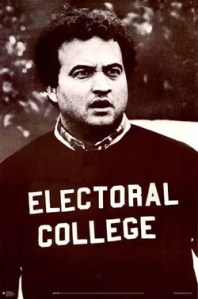
Good News
It looks like the Republican plans to change the way electoral votes are assigned in swing states may be dead in the water. This afternoon, a Virginia Senate committee voted to kill the state’s proposed bill and Republicans in Ohio, Michigan, and Wisconsin are expressing serious doubts about similar bills in their states.
The measure appeared headed for defeat after Gov. Robert F. McDonnell (R) came out against it Friday, as did two GOP senators who sit on the committee that would decide the bill’s fate.
Earlier Tuesday, McDonnell said during a televised interview that he was “afraid people will ignore Virginia” if the commonwealth switched to an electoral college system that picked winners by congressional district.
The governor told MSNBC’s Chuck Todd that the winner-take-all system most states use is the way to go, and that splitting up electoral votes by congressional districts is a “bad idea.”
In Michigan, Gov. Rick Snyder isn’t bullish on the proposed changes.
In another blow to the push to replace the winner-take-all method for awarding electoral votes, Michigan Governor Rick Snyder said he is “very skeptical” of a Republican proposal in his state to adopt the congressional district system for allocating the votes.
“You don’t want to change the playing field so it’s an unfair advantage to someone, and in a lot of ways we want to make sure we’re reflecting the vote of the people, and this could challenge that,” Snyder, a Republican, said today on Bloomberg Television’s “Bottom Line.”
“I don’t think this is the appropriate time to really look at it,” he said.
And the Michigan Senate majority leader has indicated the measure probably won’t be put up for a vote. Michigan Live reports:
Republican Senate Majority Leader Randy Richardville is wary of a proposal to split up Michigan’s Electoral College votes by district, suggesting that such a move could diminish the state’s importance in presidential elections.
“I don’t know that it’s broken, so I don’t know if I want to fix it,” Richardville said Tuesday, becoming the first high-ranking Michigan Republican to question a bill that state Rep. Pete Lund is poised to reintroduce in the House.
“We’ll take a look at it,” Richardville said. “I’ve heard these things before, all or nothing versus splitting it up. I want to make sure that Michigan’s voice is a loud and clear voice, so I’d be a little concerned if we ended up splitting the difference.”
Other Michigan elected officials noted that presidential candidates would be less likely to campaign in the state if they knew they could win only a small number of votes in favorable districts.
In Wisconsin, Gov. Scott Walker says the plan is “risky.”
Walker said Tuesday it’s an interesting idea, but not one he spends time thinking about. He says because Wisconsin is a battleground state, presidential and vice presidential candidates have an incentive to make repeated campaign stops here. He says he’s wary that changing the system could dissuade candidates from visiting.
Finally, in Ohio, several GOP leaders, including Secretary of State Jon Husted, oppose the plan.
COLUMBUS, Ohio — Count Ohio’s Republican leaders out of a GOP-backed effort to end the Electoral College’s winner-take-all format in the Buckeye State and other presidential battlegrounds.
Spokesmen for Gov. John Kasich, State Senate President Keith Faber and House Speaker William G. Batchelder told The Plain Dealer this week that they are not pursuing plans to award electoral votes proportionally by congressional district.Batchelder went a step further, saying through his communications director that he “is not supportive of such a move.” And Republican Secretary of State Jon Husted, the state’s chief elections administrator, emphasized that he does not favor the plan either, despite Democratic suspicions based on reported comments that he said were taken out of context.
“Nobody in Ohio is advocating this,” Husted said in a telephone interview.
That just leaves Pennsylvania and perhaps Florida. Would those states want to discourage candidates from coming in to campaign?
It certainly looks as if the GOP electoral vote-rigging scheme is a loser.
Tuesday Mid-Morning Reads: Immigration Reform, Aaron Swartz Prosecution, and Much More
Posted: January 29, 2013 Filed under: 2014 elections, Barack Obama, morning reads, Republican politics, Tea Party activists, U.S. Politics | Tags: Aaron Swartz, Carmen Ortiz, Harvey Silverglate, immigration reform, Middlesex County (MA) DA, Mitch McConnell, Wikileaks 55 Comments
Good Morning Everyone!!
The media talking heads are going on and on about the supposed “bi-partisan agreement” on Immigration reform. I’m not really clear on what policies have been “agreed” on, but frankly, I’ll believe it when I see it. TPM reports: Gang Of 8’s Path To Citizenship Is Still A Rocky Road.
While reformers are excited that a path to citizenship for illegal immigrants is the centerpiece of the Senate’s new bipartisan immigration deal, it’s still unclear just how accessible that path will be for the undocumented population.
Without the proper components, experts warn the Senate plan could be the beginning of a long process to bringing illegal immigrants fully into American society, one that could take not years but decades.
So what does the process involve?
Under the plan, undocumented immigrants would receive a probationary status if they pass a criminal background check, pay a fine, and pay any back taxes owed to the government. After that, they’d have to wait to apply for permanent residency – a prerequisite to citizenship – until after a series of border security measures go into effect.
None of the new border measures, which will be overseen by a commission of southwestern state officials and community leaders, appear too difficult to implement at first glance (although there are concerns as to how much power conservative state politicians would wield in the process). The big question is what comes next when 11 million newly legal immigrants apply for a green card.
According to the framework, these applicants will then be required to “go to the back of the line of prospective immigrants.” But for many of them, a clear line doesn’t actually exist at the moment. Individuals can apply for green cards through a number of categories, mostly based on having family already in the country or on their employment status, which experts say are inadequate to the task of absorbing so many immigrants at once.
Greg Sargent says that the assumption that conservative Southern governors will control the process because they will be the ones to certify that the border is secure is “not true.”
I’ve now got clarification from Senate staff working on the bill, and it turns out that the enforcement commission’s judgments will only be advisory, and are entirely nonbinding. Congress’ actions will not be dictated by what this commission concludes; neither will actions taken by the Department of Homeland Security. The citizenship process will be triggered by other means (more on this soon).
This is central to the debate. If this commission had the power to dictate when the citizenship process begins, it could endanger the entire enterprise by giving people like Jan Brewer veto power. Second, this enforcement commission is being seen as a major concession Republicans won in exchange for agreeing to grant citizenship to the 11 million.
So what did Republicans get in this deal then?
The concessions Republicans got in this deal — in exchange for agreeing to citizenship for 11 million — include beefed up border security, a new program designed to help employers verify their employees’ status, tougher checks on immigrants overstaying visas, and the need for undocumented immigrants to go to the end of the immigration line.
Meanwhile, President Obama will roll out his own, supposedly “more liberal” immigration reform plan beginning today in a speech in Las Vegas.
The Obama administration has developed its own proposals for immigration reform that are more liberal than a separate bipartisan effort in the Senate, including a quicker path to citizenship for illegal immigrants, people with knowledge of the proposals said.
President Obama is expected to provide some details of the White House plans during a Tuesday appearance in Las Vegas, where he will call for broad changes to the nation’s immigration laws. The speech will kick off a public push by the administration in support of the broadest overhaul of immigration law in nearly three decades.
Obama plans to praise the proposals laid out Monday by an eight-member Senate working group, saying they reflect the core tenets of the administration’s immigration blueprint developed in 2011, a senior administration official said.
But the president’s remarks also are likely to emphasize differences that could foreshadow roadblocks to passage in Congress at a time when both parties say there is momentum for a comprehensive deal.
Naturally, the wingnuts in the House will provide roadblocks galore for whatever plan the Senate approves. Read all about it at Politico.

Politico reported yesterday on a possible collaboration between the Tea Party and Democrats in Kentucky to dump Senate Minority Leader Mitch McConnell.
Big Democratic donors, local liberal activists and a left-leaning super PAC in Kentucky are telling tea partiers that they are poised to throw financial and organizational support behind a right-wing candidate should one try to defeat the powerful GOP leader in a 2014 primary fight.
The idea: Soften up McConnell and make him vulnerable in a general election in Kentucky, where Democrats still maintain a voter registration advantage. Or better yet, in their eyes: Watch Kentucky GOP primary voters nominate the 2014 version of Todd Akin or Richard Mourdock, weak candidates who may actually lose.
Interesting… Once again, I’ll believe it when I see it. Still, anything is possible. Plus McConnell is very unpopular in his home state according to the latest poll
With his re-election bid just a year away, those opposed to U.S. Sen. Mitch McConnell outnumber his supporters 2-1 among Kentucky voters, according to the latest Courier-Journal Bluegrass Poll.
In the poll of 609 registered voters, 34 percent said they plan to vote against McConnell — while just 17 percent say they will vote to give him six more years. Forty-four percent said they will wait to see who is running against him before deciding, and 6 percent said they are not sure.
The poll, conducted by SurveyUSA, has a margin of error of plus or minus 4.1 percentage points. It comes as groups on both McConnell’s right and left seek candidates to challenge him in the primary and general elections in 2014. McConnell, the most powerful Republican in the Senate as minority leader, is seeking his sixth term.
More information is coming out
about the over-the-top prosecution that probably contributed to the suicide of genius cyber-activist Aaron Swartz. Rolling Stone reports:
Swartz’s friends and family have said they believe he was driven to his death by a justice system that hounded him needlessly over an alleged crime with no real victims. “[He was] forced by the government to spend every fiber of his being on this damnable, senseless trial,” his partner Taren Stinebrickner-Kauffman said at the memorial, “with no guarantee that he could exonerate himself at the end of it.”
Two zealous federal prosecutors handled Swartz’s case: U.S. district attorney Carmen Ortiz and assistant attorney Stephen Heymann. In the days after his death, writers, tech experts, and many of Swartz’s friends have called out Heymann and Ortiz for prosecutorial overreach. A White House petition demanding the removal of Ortiz garnered well over 25,000 signatures, reaching the level which guarantees an eventual response from the Obama administration.
Carmen Ortiz
Some of Swartz’s advocates believe the prosecution sought excessive punishment to set an example in the age of Wikileaks and Anonymous.

Declan McCullough writes at CNet that when Swartz’s case was being prosecuted by the Middlesex County DA’s office, there was no thought of sending Swartz to prison for what was essential a minor, victimless crime.
State prosecutors who investigated the late Aaron Swartz had planned to let him off with a stern warning, but federal prosecutor Carmen Ortiz took over and chose to make an example of the Internet activist, according to a report in Massachusetts Lawyers Weekly.
Middlesex County’s district attorney had planned no jail time, “with Swartz duly admonished and then returned to civil society to continue his pioneering electronic work in a less legally questionable manner,” the report (alternate link) said. “Tragedy intervened when Ortiz’s office took over the case to send ‘a message.'”
The report is likely to fuel an online campaign against Ortiz, who has been criticized for threatening the 26-year-old with decades in prison for allegedly downloading a large quantity of academic papers. An online petition asking President Obama to remove from office Ortiz — a politically ambitious prosecutor who was talked about as Massachusetts’ next governor as recently as last month.
Ortiz no longer has a political future, and other abuses of power by her office are now coming out. Read more at the link. I posted links to more damning information about Ortiz in a recent post.
The Massachusetts Lawyers’ Weekly post by Harvey Silverglate is behind a paywall, but it has been republished with permission at Media Nation.

Aaron Swartz
Silverglate writes:
The ill-considered prosecution leading to the suicide of computer prodigy Aaron Swartz is the most recent in a long line of abusive prosecutions coming out of the U.S. attorney’s office in Boston, representing a disastrous culture shift. It sadly reflects what’s happened to the federal criminal courts, not only in Massachusetts but across the country….
the palpable injustices flowing regularly out of the federal criminal courts have by and large escaped the critical scrutiny of the lawyers who are in the best position to say something. And judges tend not to recognize what to outsiders are serious flaws, because the system touts itself as the best and fairest in the world.
Since the mid-1980s, a proliferation of vague and overlapping federal criminal statutes has given federal prosecutors the ability to indict, and convict, virtually anyone unfortunate enough to come within their sights. And sentencing guidelines confer yet additional power on prosecutors, who have the discretion to pick and choose from statutes covering the same behavior.
This dangerous state of affairs has resulted in countless miscarriages of justice, many of which aren’t recognized as such until long after unfairly incarcerated defendants have served “boxcar-length” sentences.
Aaron Swartz was a victim of this system run amok. He was indicted under the Computer Fraud and Abuse Act, a notoriously broad statute enacted by Congress seemingly to criminalize any use of a computer to do something that could be deemed bad.
If you care about this issue, please go read the whole thing. Read Charles Pierce’s take on it here.
There have been some reports that Swartz had contacted Wikileaks’ Julian Assange and could possibly have been working with the organization, but it’s not clear what Swartz could have leaked to them. I can’t imagine Wikileaks being interested in distributing a bunch of academic journal articles that are already available to millions of people from numerous sources. Nevertheless, the Feds are so obsessed with Wikileaks and cyber-security generally that that could have led to their taking over Swartz’s case.
I have a number of other suggested reads that I’ll list link dump style.
Bloomberg: The Fed Is More Out of It Than You Thought It Was
HuffPo: Treasury Disregarded Own Guidelines, Allowed Executive Raises At Bailed-Out GM, AIG: Report
LA Times: A third of Barnes & Noble stores may close in next decade, report says
Alex Pareene at Salon: 3 reasons to be skeptical that immigration reform will pass /
Irin Carmon at Salon: Is abortion about women?
Time: Barbara Walters Has the Chicken Pox
CBS Crimesider: JonBenet Ramsey Case: Grand jury voted to indict parents in 1999, prosecutor refused to sign
USA Today: Iran says it launched a monkey into space (Video)
NYT: The Preppers Next Door – The Doomsday Preppers of New York
ABC News: Bigfoot: Is Mysterious Screech Sasquatch? (Hey, is Bigfoot really any weirder than the Tea Party Republicans? I don’t think so.)

 peej
peej Carissa
 bostonboomer
 dakinikat
 ecocatwoman
 jjlo
jjlo mablue2
 Mama Lopez
 peggysue22
 quixote
 skydancingguestblogger
 Mona (aka Wonk the Vote)





Recent Comments