
Tuesday Reads: The End of an Era
Posted: August 6, 2013 Filed under: Environment, Foreign Affairs, Media, morning reads, Russia, science, U.S. Politics | Tags: Ben Bradlee, Donald Graham, Eugene Meyer, Jeff Bezos, John Henry, Katherine Graham, morning newspapers, Newsweek, Pentagon Papers, Philip Graham, The Boston Globe, The Washington Post 38 Comments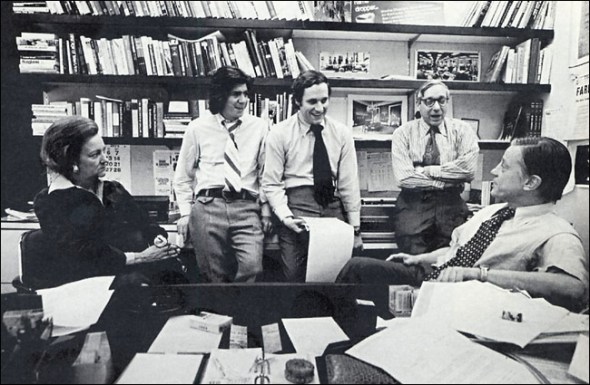
Katherine Graham meets with Carl Bernstein, Bob Woodward, Howard Simons and Ben Bradlee.
Good Morning!!
The big news today is of course the Graham family’s shocking sale of The Washington Post to billionaire Jeff Bezos of Amazon. This, along with the sale of The Boston Globe to Red Sox owner John Henry and the sale of Newsweek to IBT Media, signal the true end of an era.
The days when Americans woke up to the daily newspaper on their doorsteps is long gone. The place to go for the latest news these days is the internet and print newspapers and news magazines are struggling to survive. But the Globe and Newsweek have been on the auction block for a long time; the Post sale was a complete surprise, even to its employees.
From David von Drehle at Time Magazine: A New Age for the Washington Post
It’s hard to startle the journalism business these days, given the scale and speed of disruption of the media industry. But the Graham family selling the Washington Post to Amazon CEO Jeff Bezos for $250 million is an exception. Few newspapers in the world are as closely identified with a single family.
The story of the Grahams and the Post used to be told in giant pictures on the wall of the newspaper lobby on L Street not far from the White House. One grainy photograph documented the day in 1933 when the brilliant financier Eugene Meyer bought the paper for a song at a bankruptcy sale on the courthouse steps. Another (a favorite of all of us who worked there) showed Meyer’s remarkable daughter, Katharine Graham, beaming as she left another D.C. courthouse in the company of her favorite editor, Benjamin C. Bradlee, after they prevailed over the government in the Pentagon Papers lawsuit.

Katherine Graham and Ben Bradlee leaving the courthouse after prevailing in the Pentagon Papers case.
But the most important photograph, according to Mrs. Graham’s son and successor Donald E. Graham, was the one that showed Meyer in the company of Philip L. Graham, the brilliant and tragic husband of Katharine and father of Don. They were smiling like a pair of lotto winners, which they were. The year was 1954, and after years of effort and red ink, they had finally bought out their last remaining rival for dominance of the morning-newspaper market in Washington. As other families would learn in other cities across the country — the Chandlers in Los Angeles, the Coxes in Atlanta, the Knights in Miami and so on — dominance of the morning-newspaper routes would become a decades-long license to print money.
Philip L. Graham and Eugene Meyer look at the first The Washington Post Times Herald, in Washington, March 18, 1954.
Owning the morning meant that the Post would thrive as afternoon newspapers fell to the competition of television news. (The last afternoon paper in Washington, the excellent Washington Star, winked out in 1981.) It meant that advertisers hoping to reach a broad Washington audience had no choice but to pay the Post’s steadily increasing rates. That day in 1954 was the key to everything the Post later became, Don told me one day about 10 years ago when we bumped into each other in the lobby. Watergate, all the Pulitzer Prizes, the foreign correspondents, the celebrity columnists — all of it was possible because the patriarch and his son-in-law managed to lock up the morning.

A couple more links on the Post sale:
James Fallows at The Atlantic: Why the Sale of the Washington Post Seems So Significant
I have known and liked Donald Graham and his family over the years; many of my friends in journalism have at one time or another worked at the Washington Post. My first reaction to news that the family had sold the paper is simple shock. But it is shock based not on my positive-but-not-deep personal connection to the paper and its people but rather on sheer generational disorientation.
Readers below about age 40, who have known the Post only during its beleaguered, downsizing-its-way-out-of-trouble era, may find it hard to imagine the role it once played. Over the past decade-plus, the New York Times and theWall Street Journal have been the national newspaper organizations. It already seems antique even to use the word “newspaper” in such a construction, for reasons I don’t need to belabor now. But their flagship daily print publications make the NYT and the WSJ similar to the Financial Times and different from the other remaining ambitious news organizations — Bloomberg and Thomson Reuters, the broadcast and cable networks, NPR, etc.There was a time when you would automatically have included the Post in that first-tier national grouping. Other mainly regional or local papers were strong — the LA Times, the Chicago Tribune, the Boston Globe, and on down a nostalgic list. But more than any of the rest of them, the Post was fully in the national-newspaper derby and measured itself every day against the Times in talent level, depth and breadth of reporting, international coverage, sophistication, and all the other measures of a nationally ambitious operation. People who have started reading the paper in the past dozen years — rather, who have notstarted reading it — probably can’t imagine this difference in stature. But it is dramatic, and real.
“The pattern of a newspaperman’s life is like the plot of ‘Black Beauty,’ ” A. J. Liebling wrote. “Sometimes he finds a kind master who gives him a dry stall and an occasional bran mash in the form of a Christmas bonus, sometimes he falls into the hands of a mean owner who drives him in spite of spavins and expects him to live on potato peelings.” And sometimes, out of the blue, the ownership changes and you don’t know what the hell you’re getting in your bucket—fresh oats or cut glass.
At around 4:25 Monday afternoon, the staff of the Washington Post was summoned to the paper’s auditorium, a vast room where the presses used to be. The meeting would begin at 4:30 P.M., they were told. Donald E. Graham, the leader of the Graham family, which has owned the paper since Eugene Meyer bought it at a bankruptcy auction in 1933, stood solemnly before journalists who had been demoralized over the years by staff cuts, precipitous plunges in circulation, and endless dark rumors. It was a room full of reporters and editors, and yet, as one told me, “we thought we were there to hear that the Grahams had sold the building.”
In fact, Graham told them, in a voice so full of emotion that he had to stop a few times to gather himself, they were selling the Post and a handful of smaller papers—for two hundred and fifty million dollars, to Jeff Bezos, the founder and C.E.O. of Amazon, who is estimated to be worth more than twenty-five billion dollars. Graham asked the people there not to tweet, just to listen. The assembled were so stunned that when it came time for questions no one had any for a while; Graham had to urge them out of their silence.
“This was just plain sad. Now we belong to a guy who is so rich that the paper is around one per cent of his net worth,” a reporter told me soon after the meeting. “This was the family acknowledging that we can’t do it anymore and we have to give it to someone else. And we love the Graham family, we are proud of the family.”
It’s a long and interesting essay–read the rest at the link.
Neil Irwin and Ylan Q. Mui at The Washington Post write that Bezos paid more than he needed to for the Post.
The purchase price is richer than many of those paid for other legacy print media properties in recent years.
The New York Times Co. agreed to sell the Boston Globe to Red Sox owner John W. Henry for only $70 million. Newsweek sold for a symbolic $1, plus assumed pension liabilities, to billionaire Sidney Harman in 2011.
The Post “has a much stronger position in its market than the Boston Globe does,” said John Morton, an independent newspaper industry analyst. “It doesn’t surprise me that it would command a much higher price.”
Still, Morton suggested that the prominence and the visibility of The Post made Bezos willing to pay a higher price than would be justified by the paper’s finances alone. “I think probably Jeff Bezos was willing to pay a premium to make this happen,” Morton said. “. . . Bezos has enough money that if he wants to make it a hobby, he can.”
Interestingly, The New York Times apparently sold The Globe for less than they could have gotten. According to the AP:
BOSTON — Three bidders who fell short in their attempts to purchase The Boston Globe say they offered more than Boston Red Sox owner John Henry’s winning $70 million bid and criticized the decision of the seller, The New York Times Co., to make a deal with him.
Springfield television station owner John Gormally, West Coast investment executive Robert Loring and U-T San Diego chief executive John Lynch all said their groups’ bids bested Henry’s.
Henry agreed to pay $70 million to buy the Globe, the Boston Metro and the Telegram & Gazette in Worcester, about 50 miles from Boston. The bid, announced Saturday, was a fraction of the $1.1 billion the Times Co. paid 20 years ago.
Lynch said his group offered “significantly more” than Henry and wondered how the Times Co.’s shareholders would react after learning the company accepted a lower offer.
“I’m just stunned,” Lynch told the Boston Herald. “I thought this was a public company that had a fiduciary duty to get the most by its stockholders.”
Gormally says his bit was $80 million, but he admits that local ownership will probably be better for the Globe in the long run. Perhaps the Times wanted to do us Bostonians a favor.
I’m running out of space, so I’ll just add a few more stories in link dump fashion.Mark Ames on Vladamir Putin’s “human rights” record: Snowden’s Savior Announces Plans To Build 83 “Concentration Camps” Across Russia (link unlocked for 2 days)
Nature World News: Enormous Sinkhole, Still Expanding, Creates Spectacle in Western Kansas [VIDEO]
A former student sues her high school for bullying she suffered–first lawsuit based on new Massachusetts anti-bullying law
WSJ: Boston Bombing Suspect was Steeped in Conspiracies
Wendy Davis: Ready to ride for governor of Texas? (Christian Science Monitor)
How the World’s ‘Most Biodiverse Place’ Could Be Ransomed for Oil Money (Miami Herald via PBS)
The Independent: Japan calls for nuclear disarmament at 68th anniversary of Hiroshima bombing
Now it’s your turn. What are you reading and blogging about today? Please post your links on any topic in the comment thread.
Monday Reads: Lousyana Extra
Posted: August 5, 2013 Filed under: morning reads | Tags: Bobby Jindal, bywater new orleans, deficit ceiling, fiscal cliff, Jindal Scandals, Louisiana, Rick Santorum professional hater, Terror threats in MENA, unfit for any office 44 Comments Good Morning!
I got a lot of things that I didn’t bargain for when I moved South. I’ve been here long enough that you must know that I am a New Orleanian. I usually have dreams about not being able to get back to New Orleans when I am anywhere else; and they are usually high anxiety dreams. It’s like I am Dorothy just trying to find her way home.
I want to share some state news with you because the Jindal administration makes every thing about my state seem so damned backward these days. I know many of you think that these kinds of things can’t come to a state near you because the south is–well–so damned backwards. I am not so sure that a lot of this kind of nonsense isn’t going to sneak into places that might surprise you, so I am going to give you a little feel of the news down here that should make you very afraid of how parts of this country can completely toss modernity and the constitution aside to creep back in time. Take North Carolina or Florida or Ohio or a number of states. We’re living in a time where powers that be want to reassert their right to throw away any one that doesn’t fit their agenda.
This story is from right up the street from me. It is about the urban neighborhood between my Bywater and the French Quarter. We are in the process of gentrification. There are a lot of tensions that go with that. Now, it seems we have our own version of the Zimmerman case and a test of “Stand your Ground” laws. Are you in imminent danger when you’re like 30 feet away from an unarmed teenager? Is a minor break in really worth taking a life for?
Louisiana has its own version of the “stand your ground” law that got so much attention last year after neighborhood watch member George Zimmerman fatally shot 17-year-old Trayvon Martin in a Florida town.
The state’s law also embraces the “castle doctrine,” a centuries-old legal principle that grants people the right to legally protect their property — homes, cars, businesses — from intruders.
But some lawyers and legal experts said neither of those provisions seem to fit in the case of 33-year-old Merritt Landry, who was booked last week on an attempted murder count in the shooting of 14-year-old Marshall Coulter in his front yard.
If Orleans Parish District Attorney Leon Cannizzaro’s office decides to charge Landry, the case boils down to a simple argument over self-defense: Whether Landry could reasonably have felt himself in imminent danger of death or great bodily harm when he fired at Coulter, lawyers said.
Coulter reportedly jumped a gate into Landry’s Faubourg Marigny yard in the early morning hours of July 26. Landry, an inspector with the Historic District Landmarks Commission, told police he approached the boy “from his front yard, near his vehicle. As he grew closer, the victim made a thwarted move, as if to reach for something. At that time, Landry fired one shot, striking the victim.”
A witness, unnamed in the brief police account, gave a conflicting account, though the report doesn’t describe the difference.
Just what “thwarted move” means, or what Coulter did, is unclear. But the report says police found a single, spent shell casing some 30 feet from the boy’s blood — about the span from Landry’s back door to the gate.
That distance suggests Landry wasn’t in a “stand your ground” situation, and it may complicate his case for self-defense, local defense attorney Craig Mordock said.
“This is far worse than Zimmerman for the defendant. If Zimmerman had these facts, I think he would have been convicted,” Mordock said. “If you’re 30 feet away, are you under a threat of imminent harm? Remember, Trayvon Martin is on top of Zimmerman.”
According to police, Coulter was not armed.
 We’ve also made news at Politico and I’m not really proud of how we are “reinventing high school with private sector help.” Here is yet one more way to filter funds to republican donors at the expense of public schools and of children. Also, notice that we’re not the only state trying to do this.
Louisiana Gov. Bobby Jindal’s latest plans to reinvent public education with the aid of the business community will accelerate this fall with the launch of a novel program that lets high school students take classes from the private sector on the public dime.
State Superintendent John White said Monday that nearly 3,000 students have enrolled in an array of private-sector classes that the state has agreed to pay for, from math and literature to Japanese and German to hair styling, welding and nail manicuring. The classes, which carry regular high school credits, are taught by an eclectic mix of nonprofits, unions, trade associations and for-profit companies, as well as local colleges.
White said he had only budgeted $2 million for the program but would find another $1 million to cover demand, perhaps by leaving some open jobs in the state education department unfilled. And he plans to expand the program substantially next year. White said he is particularly interested in adding more vocational classes, though an analysis of enrollments that the state provided to POLITICO shows one of the most popular offerings is ACT Prep.
Louisiana’s Course Choice program represents a first foray into a new approach to public education as an “a la carte” offering. States including Utah, Idaho and Florida let public-school students take some classes online from approved providers.
But Louisiana aims to go further still, allowing students of all income levels to customize their course lists using taxpayer dollars to pay a broad range of public and private providers for classes they can’t get — or don’t believe are well taught — in their neighborhood schools.
It’s hard for me to watch our state move backwards to a plantation system of economy while having these steps touted as progress by the media and right wing politicians. Jindal continues to be our absentee governor as he moves around the country stumping with his unusual gift for bad speeches and confused rhetoric. He was in Iowa recently and now he’s gone to Virginia to dis Terry McAuliffe.
Republican Governors Association Chairman Bobby Jindal called on Democrats on Sunday to drop Terry McAuliffe as their nominee for governor of Virginia.
The governor of Louisiana seized on a report that the Securities and Exchange Commission is investigating GreenTech Automotive, the electric car company McAuliffe co-founded, over its conduct in soliciting foreign investors.
This is laughable given the hot water Jindal is in here at home. Jindal’s in trouble on many fronts. First there is the number and types of donors to his wife’s ‘charity’.
- After Jindal’s administration signed off on Marathon Oil’s request to increase its oil refinery’s output, the oil giant committed $250,000 to the foundation.
- AT&T needed Jindal’s signature on a bill giving the company more freedom to sell cable TV services. It committed $250,000 to his wife’s foundation.
- Northrop Grumman, a military contractor, forged a deal with the government to build a maintenance facility at a former Air Force base. It has pledged $10,000.
- Dow Chemical, a petrochemical company, was under investigation for a spill at one of its plants and, in 2009, the state proposed fining the company. Dow has pledged $100,000 to the charity and thus far hasn’t been fined.
- Alon USA, an Israeli oil company, wanted approval to release more pollutants at one of its refineries. It has pledged $250,000.
- D&J Construction has won $67.6 million in state contracts since 2009. It has pledged $10,000.
- Governor Jindal hasn’t “entirely distanced himself” from the charty, notes the Times. He’s pictured with his wife on the charity’s corporate solicitation web page and his chief fund-raiser is the charity’s treasurer, according to its tax returns.
Did Governor Bobby Jindal’s staff and Louisiana’s state education superintendent conspire to suppress a news story that the state had ”not
performed site visits or extensive review of voucher applications?” It looks like it. From reporter Barbara Leader in the Monroe News-Star:
Emails between Louisiana Education Superintendent John White, Gov. Bobby Jindal’s spokesman Kyle Plotkin and Jindal’s policy adviser Stafford Palmieri show White devising a scheme to “muddy up a narrative” and to “take some air out of the room” after a news report about the new voucher program that was published before his Senate confirmation hearing in May.
In the email exchange, White proposes creating a news story about the “due diligence” process for school voucher approvals to counter the impact of a News-Star article that revealed the sate Department of Education had not performed site visits or extensive review of voucher applications.
Read All of Louisiana’s ( School) Vouchergate Scandal Erupts
Then there is the resignation of the Secretary of Health and Human Services over bid rigging.
Louisiana’s health secretary, Bruce Greenstein, is resigning amid state and federal inquiries into the awarding of a Medicaid contract to a company where Mr. Greenstein once worked. Gov. Bobby Jindal’s administration last week canceled the nearly $200 million state contract with CNSI, which is based in Maryland, after details leaked about a federal grand jury subpoena involving the contract award. The governor’s office announced the resignation on Friday but said Mr. Jindal, a Republican, did not seek it. When the Medicaid contract was awarded two years ago, Mr. Greenstein denied any involvement in the selection of the company, but he acknowledged that a change he promoted in the bid solicitation made CNSI eligible for the contract. Mr. Greenstein gave no explanation for quitting in his resignation letter to the governor.
Immediately after the Southeast Louisiana Flood Protection Authority filed an historic lawsuit against over 100 oil and gas companies, Governor Bobby Jindal “demanded” the authority drop the suit. Curiously, though, neither he nor any member of his administration have ever criticized the actual merits of the litigation; instead, Jindal and company seem to be infuriated with the idea that lawyers may make money off of this. “This is nothing but a windfall for a handful of trial lawyers,” Jindal said. “It boils down to trial lawyers who see dollar signs in their future and who are taking advantage of people who want to restore Louisiana’s coast. These trial lawyers are taking this action at the expense of our coast and thousands of hardworking Louisianians who help fuel America by working in the energy industry.”
Governor Jindal, in doing the bidding of the oil and gas industry, failed to mention that the only way these “trial lawyers” could make a significant amount of money from this litigation is if they win. And if they win, Louisiana stands to gain billions that would be used for coastal restoration. If they lose the case, they make nothing. And if, for some political reason, the lawyers, whose contract was unanimously approved by the authority, are forced to abandon the lawsuit, they can only be compensated for the work they’ve already done. It’s a standard contingency fee agreement. Governor Jindal’s contemptuous comments about “trial lawyers” not only reflect a cynical politicization of the most critical issue in Louisiana, they also promote an insidious and ignorant disdain for the rule of law, the legal profession, and the judicial process.
It is easy to try to write this off as just another Louisiana example of corrupt politics or just another example of a backward Southern state. But, remember, this man is running for president as a main stream republican candidate and on the grounds that he is modernizing and bringing a new environment of openness in government. This is hardly the case. All of these Republican governors need to be watched very carefully. I feel like our state is just one big Tea Pot Dome Scandal eruption every few months.
Here are some other headlines you may want to watch:
The State Department has extended its reaction to Terror threats in key MENA regions.
The State Department announced late Sunday it would extend the closures of 19 foreign embassies across the Middle East and Northern Africa through next Saturday, as the terror threat across the region remained high through the final days of Ramadan.
Santorum is heading to Iowa for three days next week, where he’ll attend a GOP fundraiser, a state fair and a leadership summit — a schedule that’s prompted speculation that he’s laying the groundwork for another presidential campaign. In 2012, he made stops in each of Iowa’s counties, ultimately winning the state by a slim margin.
Obama and the Republicans are likely to come to blows even as the deficit closes. Raise the deficit ceiling? Fiscal Cliff? Shut down the Government? Here we go again!
Obama is insisting Congress raise the debt ceiling with no strings attached, while a group of Republicans say they are willing to stop paying the government’s bills unless the president’s signature health care law is defunded.
“Both sides are more dug in than in the past,” said Jared Bernstein, a former chief economist for Vice President Joe Biden who is senior fellow at the Washington-based Center for Budget and Policy Priorities, a fiscal research group.
Lawmakers return from a five-week break on Sept. 9, just three weeks before government funding runs out. For the new fiscal year starting Oct. 1, House Appropriations Committee Chairman Hal Rogers of Kentucky favors a one- or two-month extension of current yearly spending levels, which are $988 billion, said Jennifer Hing, a spokeswoman.
If Congress concurs, that would push the broader fiscal fight into November, when the U.S. is expected to reach its $16.7 trillion debt limit.
So, thanks for letting me let off steam over my freaking incompetent and corrupt governor. Pictures of the Bywater Riviera–that is the west bank of the Industrial canal two blocks behind my house most famously known for overtaking the Lower 9 after Katrina–are courtesy of Youngest Daughter. Those of you that have ever talked to me on the phone know the sound of the New Orleans Beltway Rail Road really well too. You gotta cross it to get to the Bywater Beach.
So, what is on your reading and blogging list today?
The Media and Policy Makers deliberately misrepresent and ignore Economists
Posted: August 4, 2013 Filed under: The Media SUCKS | Tags: economics, journalists and propaganda tools, unemployment 41 CommentsI use to watch PBS a lot. It’s been rather overrun by nutso libertarians and republicans the same way Europe was over run with Bubonic Plague-carrying fleas  during the middle ages. Back in the middle ages, the “enlightened” religious and kingdom policy makers decided cats were the problem–since they obviously represent all things witchy–when they were really part of the solution. Cats ate rats and mice and a lot of the worst of the flea-bearing vermin. The guilty fleas escaped blame. Nowdays, pundits, policy preachers, and the political class believe that economists are part of the problem and have created a serious amount of snake oil-based explanations that simply do not hold up to analysis or data.
So, PBS Newshour gets David Brooks–dilettante extraordinaire–and Ruth Marcus–professional effete intellectual snob for hire–to explain the recent employment numbers. Yup, why get economists to talk about the consensus in our community when you can have inside-the-beltway surrealism ? Why is David Brooks given a platform to spew lies, nonsense, and propaganda? Dr. Baker, I am excerpting you completely. Forgive me the lapse in fair use.
The PBS Newshour won the gold medal for journalistic malpractice on Friday by having David Brooks and Ruth Marcus tell the countrywhat the Friday jobs report means. Brooks and Marcus got just about everything they said completely wrong.
Starting at the beginning, Brooks noted the slower than projected job growth and told listeners:
“Yes, I think there’s a consensus growing both on left and right that we — the structural problems are becoming super obvious.
“So when the — this recession started a number of years ago, you had 63, something like that, out of 100 Americans in the labor force. Now we’re down, fewer than in [the employment to population ratio is now 58.7 percent] — than when the recession started. And so that suggests we have got some deep structural problems. It probably has a lot to do with technological change. People are not hiring — companies are not hiring human beings. They’re hire machines.”
It’s hard to know what on earth Brooks thinks he is talking about. There is nothing close to a consensus on either the left or right that the economy’s problems are structural, as opposed to a simple lack of demand (i.e. people spending money). This is shown clearly by the overwhelming support on the Federal Reserve Board for its policy of quantitative easing. This policy is about trying to boost demand. A policy that the Republican Chairman, Ben Bernanke, has repeatedly advocated to Congress as well. This policy would not make sense if they viewed the weak demand for labor in the economy as being the result of structural problems. So clearly Brooks’ consensus excludes the Fed.
It also is worth noting the other part of Brooks’ story, that instead of hiring workers firms “hire machines,” is completely contradicted by the data. Investment has actually slowed in the last couples of years. (Non-residential investment is up by just 2.4 percent from its year ago level.) This means that firms are not hiring machines, or at least not as rapidly as they had in prior years. Also the rate of productivity growth has slowed sharply from the pre-recession period. In the last three years productivity growth has averaged less than 1.0 percent a year. This compares to more than 2.5 percent a year from 1995 until the recession in 2007. This means that machines are displacing workers much less rapidly than in a decade when we had much lower unemployment.
How does one get a job speculating on national TV on things one knows nothing about? I think I would like a job like that. It has to be easier than actually going to school and become a research specialist in a field. I think I’d be great at astrophysics commentary. Maybe I can replace Dr. Neil DeGrassi who gets all the kewl special effects-based astronomy gigs on PBS. Hell, there’s a doctor in front of my name too. Who cares if it’s not in anything germane or relevant to astrophysics? Certainly not PBS. But,here’s the shrill one with the facile, data-based debunk.
Indeed: one strong indicator that the problem isn’t structural is that as the economy has (partially) recovered, the recovery has tended to be fastest in precisely the same regions and occupations that were initially hit hardest. Goldman Sachs (no link) looks at unemployment in the “sand states” that had the biggest housing bubbles versus the rest of the country; it looks like this:
So the states that took the biggest hit have recovered faster than the rest of the country, which is what you’d expect if it was all cycle, not structural change.
I’ve done a quick and dirty take on unemployment by occupation, looking at changes in unemployment rates from the 2007 business cycle peak to the unemployment peak in 2009-10, and then the subsequent decline; it looks like this:
It’s the same as the geographical story: the occupations that took the biggest hit have had the strongest recoveries.
In short, the data strongly point toward a cyclical, not a structural story — and there is broad agreement, for once, among economists on this point. Yet somehow, it’s clear, Beltway groupthink has arrived at the opposite conclusion — so much so that the actual economic consensus on this issue wasn’t even represented on the Newshour.


Robert Reich thinks that its basically in Republican best interests to keep people unemployed and suffering. Believe me, people are unemployed and suffering. I can really offer us some anecdotal evidence on that as well as the numbers.
Job-growth is sputtering. So why, exactly, do regressive Republicans continue to say “no” to every idea for boosting it — even last week’s almost absurdly modest proposal by President Obama to combine corporate tax cuts with increased spending on roads and other public works?
It can’t be because Republicans don’t know what’s happening. The data are indisputable. July’s job growth of 162,000 jobs was the weakest in four months. The average workweek was the shortest in six months. The Bureau of Labor Statistics has also lowered its estimates of hiring during May and June.
It can’t be Republicans really believe further spending cuts will help. They’ve seen the effects of austerity economics on Europe. They know the study they relied on by Carmen Reinhart and Kenneth Rogoff has been debunked. They’re no longer even trying to make the case for austerity.
It could be they just want to continue opposing anything Obama proposes, but that’s beginning to seem like a stretch. Republican leaders and aspiring 2016 presidential candidates are warning against being the “party of ‘no.’” Public support for the GOP continues to plummet.
The real answer, I think, is they and their patrons want unemployment to remain high and job-growth to sputter. Why? Three reasons:
First, high unemployment keeps wages down. Workers who are worried about losing their jobs settle for whatever they can get — which is why hourly earnings keep dropping. The median wage is now 4 percent lower than it was at the start of the recovery. Low wages help boost corporate profits, thereby keeping the regressives’ corporate sponsors happy.
Second, high unemployment fuels the bull market on Wall Street. That’s because the Fed is committed to buying long-term bonds as long as unemployment remains high. This keeps bond yields low and pushes investors into equities — which helps boosts executive pay and Wall Street commissions, thereby keeping regressives’ financial sponsors happy.
Third, high unemployment keeps most Americans economically fearful and financially insecure. This sets them up to believe regressive lies — that their biggest worry should be that “big government” will tax away the little they have and give it to “undeserving” minorities; that they should support low taxes on corporations and wealthy “job creators;” and that new immigrants threaten their jobs.
It appalls me that some one classified as a “liberal”–like Ruth Marcus supposedly is–can be a mouthpiece for lies that support a decidedly illiberal agenda. I believe Economist Mark Thoma has the correct take on this one.
The arguments serve an ideological goal. Perhaps we shouldn’t assume that the main motivation of many pundits and policymakers is economic rather than political?
True Dat.
Laughing Buddhas and Chuckling Creators: Happiness in American Policy and Politics
Posted: August 3, 2013 Filed under: Happiness | Tags: Happiness 55 CommentsGood Evening everyone…
JJ aka Minkoff Minx here with a quick note of introduction. Yes, we have a new front-pager here on the blog. Someone who has been a welcomed and rather vocal addition to the comment section of late. After finding her remarks so interesting and thoughtful…well argued and considerate…we decided to ask if she would like to become a Sky Dancer…and it is with fantastic joy that I can come here now and tell you that her answer was a resounding “Yes!”
So, without further ado, please welcome peej…
Thanx to Minx for the warm welcome, and to all the Sky Dancers for inviting me into Sky Dancing! A very special thanks for your patience with me as I unfurl my dancing-wings!
And salutations to all! I’m Peej, and I’m what you might call a chronic dabbler. I dabble in art, science, geology, writing, history, archeology, literature, rhetoric, philosophy, folklore, cookery, gardening, and vermicomposting. That’s not an exhaustive list, but it’s a good overview of my dabbling! I have a weakness for books, flyting (a contest of insults in verse), scathing satire, and for anything that pertains to bees and frogs. I’m neither mechanically nor technologically inclined, and I hope to someday perfect a flaky pie crust. I try to keep my mind open, so I appreciate a good nudge in the ribs if anyone notices it shifting toward closed!
This first post I’m hoping will be a jumping point for a number of others with the same theme: happiness. Contextually, happiness in a socio-political context, a lens from which perhaps we may all scrutinize intently or lightly ponder the issues of our day. I’m not an expert on happiness, but I have a penchant for noodling on happiness in a political context. I keep on my desk a torn scrap of barcode I retained from a package of postage stamps to remind me of this ongoing project always going on in the back of my mind: to understand “the pursuit of happiness” as it relates to the confluence of individual, society, government, and politics. This little postage scrap is an impressionistic American flag with four words superimposed on each of the stripes: Justice, Equality, Freedom, and Liberty. But not happiness. I suppose I was so bothered by its omission and its omission just niggled and niggled on my back burners until I had to act on it: I began my pursuit of the pursuit of happiness. My thought is that this could be a mutual pursuit. Rather than keeping my mullings all mulled in my mind, I can share my pursuit of the pursuit; and all of you can share yours with me. Perhaps we can come to some meaning for ourselves individually and together as a society with a government whose stated purpose includes “the pursuit of happiness.”

My inspirational postage scrap. As you can see, there’s plenty of room for “happiness” on the top line. 🙂
Tally Ho! Let the pursuit begin! Our goal; together to find happiness!
First up on our quest, an article published recently in the Atlantic titled: Meaning Is Healthier Than Happiness – Emily Esfahani Smith – The Atlantic
What came to mind immediately while reading it was Barbara Ehrenreich’s Bright Sided: How the Relentless Promotion of Positive Thinking Has Undermined America. Here are some clips of Ehrenreich discussing it: Barbara Ehrenreich – Bright-sided: How Positive Thinking is Undermining America
I also thought of Chris Mooney’s Diagnosing the Republican Brain: Diagnosing the Republican Brain | Mother Jones
With these as jumping points Let us talk happiness!
Saturday: Smash the Patriarchy, Extinct Political Birds, Blurred Feminism, and Mental Illness as Rebellion
Posted: August 3, 2013 Filed under: just because | Tags: Assholes, feminism, hillary2016, mansplainers, Mental health 62 Comments Newsflash: Conservative dodo bird Jonah Goldberg finds Hillary Clinton boring.
(So boring, in fact, that recall Goldberg and/or his wife ghostwrote fed stale old anti-Hillary canards about tea, cookies, and bra-burning for Palin’s America by Heart.)
In other news…
- Water is wetter than the tears on Boehner’s face.
- Breitbart editor-at-large Ben Shapiro echoes the dodo lament that Hillary just isn’t that fascinating.
Keep your popcorn bowls handy, newsjunkies, as we continue to watch the heads explode on all the dodos.
Next up… Two patriarchy-smashing parodies of the misogynist-yet-insidiously catchy earworm that is Robin Thicke’s “Blurred Lines.” I recommend taking the time to view the videos below at some point this weekend if you haven’t seen them already. (Especially after Thicke went on the Today show this week claiming his original track to be “great art” and a “feminist movement in itself.”)
First up, Mod Carousel’s gender role reversal “Sexy Boys”:
From the video’s description:
Mod Carousel, a Seattle based boylesque troupe, does a sexy parody of Robin Thicke’s Blurred Lines music video.
It’s our opinion that most attempts to show female objectification in the media by swapping the genders serve more to ridicule the male body than to highlight the extent to which women get objectified and do everyone a disservice. We made this video specifically to show a spectrum of sexuality as well as present both women and men in a positive light, one where objectifying men is more than alright and where women can be strong and sexy without negative repercussions.
The other video is Melinda Hughes’ “Lame Lines”:
From the lyrics, as transcribed in Hughes’ youtube description:
You think I want it
I really don’t want it
Please get off it
You’re a douchebag
You’re a little flacid
Your dance is spastic
Should go get tested
I hate your lame lines
You think I want it
I really don’t want it
Please get off it
You’re a douchebag
Hey don’t you grab me
Look at me, I’m classy
I said don’t grab me
There are a lot of other parodies out there, but these two had a distinctly gender bender vibe to them. So, what do you think Sky Dancers? Did these versions succeed?
Switching gears a bit, here’s an interesting piece from AlterNet by Bruce E. Levine, called “Why Life in America Can Literally Drive You Insane” with the byline “it’s not just Big Pharma” underneath:
In “The Epidemic of Mental Illness: Why?” (New York Review of Books, 2011), Marcia Angell, former editor-in-chief of the New England Journal of Medicine, discusses over-diagnosis of psychiatric disorders, pathologizing of normal behaviors, Big Pharma corruption of psychiatry, and the adverse effects of psychiatric medications. While diagnostic expansionism and Big Pharma certainly deserve a large share of the blame for this epidemic, there is another reason.
A June 2013 Gallup poll revealed that 70% of Americans hate their jobs or have “checked out” of them. Life may or may not suck any more than it did a generation ago, but our belief in “progress” has increased expectations that life should be more satisfying, resulting in mass disappointment. For many of us, society has become increasingly alienating, isolating and insane, and earning a buck means more degrees, compliance, ass-kissing, shit-eating, and inauthenticity. So, we want to rebel. However, many of us feel hopeless about the possibility of either our own escape from societal oppression or that political activism can create societal change. So, many of us, especially young Americans, rebel by what is commonly called mental illness.
Ah, yes, I believe I called it when I first coined the phrase, “Political Affective Disorder.”
It’s a long read, and not one I can yet say I fully endorse or not, particularly on the issue of diagnosis and the author’s attitude toward the DSM as nothing more than “pseudoscience.”
As a student of the psychological discipline, I am still taking my sweet time to form an opinion on the DSM-5 and the food fight between its proponents and detractors. The DSM in all its versions thusfar has been far from a perfect venture, but having gotten to hear directly from one of the Work Group chairs that was at the frontlines of changes for her respective category at a mental health conference last month, I have to say it makes a difference to hear from the horse’s mouth the reasoning that went into each change, as opposed to reading about it in an op-ed. That’s a rant for another time, though!
Suffice it to say, Levine’s essay is thought-provoking and raises important points for debate. I have long-thought there was a social rebellion aspect to mental illness. (Cassandra, anyone?)
Excerpt from the piece, with some relevant survey trends and research stats on the current state of the American Dream/Nightmare:
Returning to that June 2013 Gallup survey, “The State of the American Workplace: Employee Engagement,” only 30% of workers “were engaged, or involved in, enthusiastic about, and committed to their workplace.” In contrast to this “actively engaged group,” 50% were “not engaged,” simply going through the motions to get a paycheck, while 20% were classified as “actively disengaged,” hating going to work and putting energy into undermining their workplace. Those with higher education levels reported more discontent with their workplace.
How engaged are we with our schooling? Another Gallup poll “The School Cliff: Student Engagement Drops With Each School Year” (released in January 2013), reported that the longer students stay in school, the less engaged they become. The poll surveyed nearly 500,000 students in 37 states in 2012, and found nearly 80% of elementary students reported being engaged with school, but by high school, only 40% reported being engaged. As the pollsters point out, “If we were doing right by our students and our future, these numbers would be the absolute opposite. For each year a student progresses in school, they should be more engaged, not less.”
Life clearly sucks more than it did a generation ago when it comes to student loan debt. According to American Student Assistance’s “Student Debt Loan Statistics,” approximately 37 million Americans have student loan debt. The majority of borrowers still paying back their loans are in their 30s or older. Approximately two-thirds of students graduate college with some education debt. Nearly 30% of college students who take out loans drop out of school, and students who drop out of college before earning a degree struggle most with student loans. As of October 2012, the average amount of student loan debt for the Class of 2011 was $26,600, a 5% increase from 2010. Only about 37% of federal student-loan borrowers between 2004 and 2009 managed to make timely payments without postponing payments or becoming delinquent.
In addition to the pain of jobs, school, and debt, there is increasingly more pain of social isolation. A major study reported in the American Sociological Review in 2006, “Social Isolation in America: Changes in Core Discussion Networks Over Two Decades,” examined Americans’ core network of confidants (those people in our lives we consider close enough to trust with personal information and whom we rely on as a sounding board). Authors reported that in 1985, 10% of Americans said that they had no confidants in their lives; but by 2004, 25% of Americans stated they had no confidants in their lives. This study confirmed the continuation of trends that came to public attention in sociologist Robert Putnam’s 2000 book Bowling Alone.
Oh dear, this makes me want to get into a dialectic with me and myself about Tonnies’ small town Gemeinschaft and big city Gesselschaft and Durkheim’s Anomie.
I’ll spare you and just quote another paragraph from Levine’s piece on Alter Net before I close:
The reality is that with enough helplessness, hopelessness, passivity, boredom, fear, isolation, and dehumanization, we rebel and refuse to comply. Some of us rebel by becoming inattentive. Others become aggressive. In large numbers we eat, drink and gamble too much. Still others become addicted to drugs, illicit and prescription. Millions work slavishly at dissatisfying jobs, become depressed and passive aggressive, while no small number of us can’t cut it and become homeless and appear crazy. Feeling misunderstood and uncared about, millions of us ultimately rebel against societal demands, however, given our wherewithal, our rebellions are often passive and disorganized, and routinely futile and self-destructive.
 I can attest to that much personally, having gone through the self-destructive, passive slow suicide of anorexic rebellion in my adolescence and into my twenties and the process of recovery and trying to reclaim my identity now into my thirties (as a patriarchy-smashing-archery-goddess-witchy-woman-feminist of course!)
Give Levine’s article a read in full if you have the time. I would love to hear everyone’s thoughts, especially from Dr. Bostonboomer, our resident psychologist.
Alright, well that’s all I’ve got for you this morning.
What’s got your blogger juices going this Saturday, Sky Dancers? Let us have a listen in the comments, and have a great weekend!

 peej
peej Carissa
 bostonboomer
 dakinikat
 ecocatwoman
 jjlo
jjlo mablue2
 Mama Lopez
 peggysue22
 quixote
 skydancingguestblogger
 Mona (aka Wonk the Vote)





Recent Comments