
Healthcare is a Right
Posted: October 8, 2013 Filed under: just because 21 Comments Hey newsjunkies. I’ve been reading anything I can about healthcare. I thought it might be worthwhile to highlight some interesting snippets and passages, for anyone else here who might be interested.
I’ll start with this special to Canada’s Globe and Mail by Antonia Maioni, assistant professor at McGill University — Obamacare vs. Canada: Five key differences:
Obamacare is a huge step in American health reform and, if it seen to improve the system, will represent a major victory for Democrats. Like other major reforms of the past, however, it will entrench the private nature of the system, and likely render national health insurance, or anything remotely like “Canadian-style” health care, impossible to attain.
This pretty much sums up my biggest concern about the ACA as it stands.
Maioni makes this bleak assessment after going through the differences between ACA and a Canadian type universal healthcare. The article at the link goes more in-depth on each point as it is listed, but to summarize here quickly, the ACA is:
1) Not single payer
2) Not universal coverage
3) Not “national” health insurance
4) Not equal access
5) Not cost containment
So, that’s one view from the perspective of a country that actually has single payer.
Next up, a pro-ACA argument from John McDonough–as related in a panel segment on Democracy Now called, Is Obamacare Enough? Without Single-Payer, Patchwork U.S. Healthcare Leaves Millions Uninsured.
Here is his background first:
John Donough, professor at the Harvard School of Public Health, director of the New Center for Public Leadership. Between 2008 and ’10, he served as a senior adviser on national health reform to the U.S. Senate Committee on Health, Education, Labor, and Pensions. And between 2003 and ’08, he served as executive director for Health Care for All in Massachusetts, playing a key role in the passage of the 2006 Massachusetts health reform law known as “Romneycare,” regarded by many as the model for the current healthcare law. He recently wrote the book Inside National Health Reform.
So, clearly someone invested in the ACA.
Here is Donough’s take:
JOHN McDONOUGH: Well, yes, the law and the system around the law are complicated, and our underlying healthcare system is incredibly complicated, far more than it needs to be. I don’t really have a disagreement with my—with my friend and colleague, Steffie Woolhandler, about a division of what we would like to see. The reality is that this was probably the best we could have gotten in 2009, 2010. Getting anything even close to this would be politically impossible today. And, you know, I hope this is a movement in the direction toward a more rational and less complex system, but it is an important start and an important step forward for potentially tens of millions Americans, a lot of whom are going to get coverage that’s going to be very affordable and at almost no cost.
I’m a hard sell, so no I’m not convinced.
Here is the bio on Steffie Woolhandler, who Donough mentions, as she also is interviewed in the segment on DN:
Dr. Steffie Woolhandler, professor of public health at CUNY-Hunter College and a primary care physician, visiting professor at Harvard Medical School and co-founder of Physicians for a National Health Program;
Clearly she is invested in single payer as that is what her organization PNHP advocates.
With that noted, I have to say that her response to Amy Goodman below resonates with my understanding of how social policy has been won in this country:
AMY GOODMAN: Is this a road to single-payer, Dr. Steffie Woolhandler?
DR. STEFFIE WOOLHANDLER: Well, it’s only a road to single-payer if we fight for single-payer.
Personally, this is why I won’t throw away my “public option” and “single payer” flags and will keep waving them around. I understand full well that the ACA is the law of the land. I simply refuse to be party to ceding the shaping of the future of healthcare policy in America to the Electeds on the right who have branded a government subsidized expansion of the private insurance industry as a “government takeover.”
Of all the articles I’ve scoured through so far, I have found Healthcare for All Colorado executive director Donna Smith’s example in activism and her commentary on healthcare–of which I am only including a few passages here–of particular interest:
Smith’s work with Health Care For All Colorado currently centers on gathering enough signatures to put on a citizen-driven state initiative on the ballot in November 2014 that establishes health care as a human right and a public good for all Coloradans. The initiative will require100,000 signatures to make it on the ballot in 2014. “I’m not sure if we will reach our goal in the next six months,” Smith said. “But we can bring it back again much like the marijuana initiative here in Colorado that took a couple of tries to get it on the ballot.”
Ah, if only we could be having this discussion nationally. But, more on that in a moment when we come to another passage.
Something I am glad to hear as well:
In addition to promoting the moral and fiscal benefits to a single payer health care system, Smith travels to other countries speaking out against their attempts to move to privatization of health care that would result in other countries adopting a system more like that here in the U.S. She recently spoke to a group in Australia (see below). “Not all countries have a pure single payer system, some have a mixture of public and private, but they have such strict regulations on insurance companies that we here in America would scarcely recognize what those private plans look like. Americans just don’t know about this, in part because they’re not told, they’re not educated. If you go to another country one of the things you notice right away is that you don’t see all this advertising for drugs and medications that are done here, that there is information about medicines everywhere and nootropic faq for all the people to know.”
Exactly.
But, back to our national healthcare struggle here at home:
Does she envision single payer eventually taking hold in the United States? “Short term, at the national level, we’d have a hard time thinking that this Congress and this President would go after a single payer system,” Smith said. “The fight for the ACA bruised so many people on both sides and continues to do so. They are not going to be able to go back in the transformational way that those of us advocating for single payer would like to see it happen.
In other words, there’s no Trojan pony here in and of itself, and this president and this Congress aren’t interested in fixing this bill anyway.
The Silver lining, if we actually fight for single payer instead of settling for the ACA:
But, the one opening we got through the ACA was waivers under Section 1332 of the Affordable Care Act. That allows for states to innovate in terms of how they deliver their health care, provided they cover at least as many people, which would not be an issue with single payer.
Yes, I remember all too well–thanks to Bernie Sanders for getting that small ray of hope into the ACA.
Nonetheless:
“But, passing single payer on a state level is not easy, Smith cautioned. “The same forces that fought it on a national level will fight it on the state level, much the way we’ve seen the Koch Brothers work on state legislatures on union issues. So, we’ve seen Vermont pass Green Mountain Care under (Governor) Peter Shumlin, but they’ve had a difficult time with the funding mechanism there. That happens because there are forces that don’t want to see a smaller state like Vermont move forward on single payer.
“I think the real chance is if a big state like California or New York can be forceful enough and progressive enough to push it across the finish line. And once one state does that and we see it function well there–similar to what we saw happen with Romney Care, which served as the model for the ACA–then I think it will be a similar scenario for single payer. That’s the way it happened in Australia; their national health care system started state-by-state and many of us know the story of Canada and Tommy Douglas. The crisis in health care is not going to get any smaller any time soon. The nation is going to have to go at it again. (Even with full implementation of the ACA, not all U.S. citizens will be covered and medical bankruptcy remains in place with the ACA). The number of people suffering is really not going to back off until we truly transform the system to one that’s universal and financed under a single payer system.”
These are some good guidelines on developments and trends to follow in terms of state single payer and how it might then broaden the national discussion.
Right now that discussion is stuck in tribalist support for-or-against the ACA, which has been a fait accompli for years anyway, and so far from anything I can take hope in personally. It is hard to envision the day where we can talk about say a Gillibrand-care in New York being expanded federally, as opposed to Obama or Romney care. But, a wonk can dream 🙂
Anyhow, I think I may have to do this piece in installments because this post already feels long to me, even though I’m only a very small fraction into the links and excerpts I have. So I will wrap this up for now and if I can keep up with blogging as fast I am reading all this stuff–try to work on a part 2 next.
PS I know at Sky Dancing our writers, readers, and commenters feel intensely and passionately about the issue of healthcare, and so I hope I am explaining where I am coming from well enough for it to be understood as just that–my personal perspective.
Tuesday Reads: Hostage Situation
Posted: October 8, 2013 Filed under: 2012 elections, Affordable Care Act (ACA), Barack Obama, Democratic Politics, Federal Budget, Federal Government Shutdown, Global Financial Crisis, morning reads, Psychopaths in charge, Real Life Horror, Republican politics, U.S. Economy, U.S. Politics | Tags: 14th amendment option, John Boehner, Obamacare, Robert Costa, Tea Party Caucus, US House of Representatives 50 Comments
Good Morning!!
I hardly know where to begin this morning. The insanity that has gripped the nation’s capital is so extreme that some kind of intervention may be necessary.
Is it possible for the UN or the IMF to step in and explain to Tea Party Republicans why the full faith and credit of the United States government cannot be held hostage in an effort to overturn the results of two elections? Or perhaps they could explain to House Speaker John Boehner that his frantic efforts to hold onto his speakership could end with voters replacing him with a Democratic Speaker in 2014?
As depicted in the cartoon above, the Republican majority in the House is being held hostage by around 30-40 delusional Tea Party wingnuts and their putative leader–John Boehner has no clue how to deal with the hostage crisis. It’s a mystery to me why anyone would even want that job, but to Boehner the job is apparently more important than the nation’s–and the world’s–economic well-being. Holding onto his job is apparently so important to him that he is willing to look like a complete fool rather than stand up to a bunch of crazy people in his own party.
Meanwhile, the media pundits are getting a little more restless–realizing that we really could reach the debt limit on October 17 without the House voting on a “clean” continuing resolution or an increase in the government’s ability to borrow to pay its bills.
Normally, I wouldn’t link to the National Review, but yesterday they published a piece by Washington editor Robert Costa, who probably has a pretty good idea what insane caucus in the House is up to. Costa writes:
Speaker John Boehner may be trying to finalize a plan to raise the debt limit, but House conservatives are already skeptical of his efforts. In interviews, several of them tell me they’re unlikely to support any deal that may emerge.
Costa goes on to quote a few of the wackiest of the wackos (emphasis added):
“They may try to throw the kitchen sink at the debt limit, but I don’t think our conference will be amenable for settling for a collection of things after we’ve fought so hard,” says Representative Scott Garrett (R., N.J.). “If it doesn’t have a full delay or defund of Obamacare, I know I and many others will not be able to support whatever the leadership proposes. If it’s just a repeal of the medical-device tax, or chained CPI, that won’t be enough.”
Representative Paul Broun (R., Ga.) agrees, and says Boehner risks an internal rebellion if he decides to broker a compromise. “America is going to be destroyed by Obamacare, so whatever deal is put together must at least reschedule the implementation of Obamacare,” he says. “This law is going to destroy America and everything in America, and we need to stop it.”
“Stay the course, don’t give in on it, that’s what the people in my district are saying,” says Representative Ted Yoho (R., Fla.). “We did a town hall the other day, and 74 percent of people said, ‘don’t raise the debt ceiling.’”
This despite the fact that polls show their ideas are poison to the American public. These people are truly insane, and they believe they’re winning. Nothing will stop them except throwing them out of their jobs. Here are some other reactions to Costa’s piece.
David Atkins of Hallabaloo: Nothing less than Fort Sumter will do.
If you think this is insane–and it is–keep in mind that it’s only going to get worse from here.
Until Republicans are removed from control of all branches of government, the brinksmanship is going to get worse, and the demands are going to become more severe. The lunatics are running the asylum now, the revanchist movement is in full swing, and the Lost Cause is the name of the game.
Not even sequestration-level spending plus cutting Medicare and Social Security will do for these people–and that’s after losing an election. Try to picture where the Republican party was 30 years ago. Then 20 years ago. Then 10 years. Then today. Now picture 10 years from now. Anyone who thinks there’s going to be a retreat from the precipice is deluding themselves. If they lose in 2014, it will be because they didn’t hold firm against Obamacare. If they lose to Hillary in 2016, it will be because they didn’t shout loud enough about Benghazi.
If we don’t stop them somehow, the Tea Party crazies will try to refight the Civil War.
Josh Barro at Business Insider: Republicans Do Crazy Things Because They Have Crazy Beliefs. Barro responds to Georgia Rep Paul Broun’s claim that “America is going to be destroyed by Obamacare….This law is going to destroy America and everything in America, and we need to stop it.”
It’s one thing to oppose Obamacare. It’s quite another to believe it will “destroy America and everything in America.” As Manhattan Institute Senior Fellow Avik Roy, a strong opponent of Obamacare, wrote last month:
The idea that we had a free-market health-care system before Obamacare, and a socialized one after, is completely and utterly incorrect. In 2010, before the passage of Obamacare, U.S.-government entities spent more per capita on health care than all but three other countries in the world. Obamacare adds to that spending by around 10 to 15 percent. Not good, to be sure, but not the whole kit and caboodle either.
The changes from Obamacare, good and bad, are marginal. It will not fundamentally change America….
But if you already believe something crazy — that Obamacare will destroy America — then it’s not additionally crazy to favor drastic, dangerous action to stop it.
Sarah Jones at Politicus USA: From Hostage Takers to Buffoons, House Republican Ineptitude Heads for Default.
Even a short term debt ceiling agreement is up in the air now. Not the actual debt ceiling limit, but a short term agreement. We can’t even do that now, if Robert Costa’s readings are accurate.
Costa tweeted, “One of my best House R sources thinks Boehner may, just may, be able to get votes for short-term DL ext, but even that is up in air” [….]
If you’re wondering how Republicans can be so out of it when the polls keep instructing them otherwise (as if the ONLY issue here is their own political survival, forget the people or this country), perhaps this level of utter cluelessness will be informative. When asked if the Republicans have their next move mapped out and if Boehner has any legislation drawn up regarding the debt ceiling, “Negatory,” Representative Pete Sessions replies. You see, it’s all about “messaging”. “We’re going to keep with our great, positive attitude and tell the president, ‘you’ve got to sit down and negotiate.’”
So, their great positive attitude involves tanking the economy and shutting down the government because they lost an election. Huh. Also: Only in Republican world is holding a gun to the country’s head before being willing to “talk” an act of good faith.
Republicans don’t understand this president very well at all, but then, we tend to project our own values onto others so this is understandable. They never should have threatened the country. They could have threatened anything but the American people and the democratic process, and this President wouldn’t have felt compelled to take a stand.

It’s really getting to be a cliche to point out that reports of Republican behavior are for real and not from The Onion. But seriously, it’s hard to believe The Onion can keep finding ways to exaggerate these people’s insanity. Apparently there was “outrage” after this 2011 Onion story; but does it actually seem crazy two years later to claim that what the Republicans are trying to do is going to hurt–even kill–some children?
A few more comments on the hostage situation from various pundits:
Washington Post Editorial Board: The House GOP has nothing to show for its government shutdown.
WHAT HAVE House Republicans managed to accomplish in a week of government shutdown?
Damage the livelihood of millions of Americans? Check. Government secretaries, food-truck operators, cleaners who work in motels near national parks: They’re all hurting.
Waste billions of taxpayer dollars? Check. It costs a lot to shut agencies, Web sites and parks, and it will cost a lot to reopen them. Meanwhile, the House has voted to pay the salaries, eventually, of hundreds of thousands of employees whom it has ordered not to work. That’s an odd way to manage an enterprise.
Interfere with key government operations? Check. The National Transportation Safety Boardcan’t investigate an accident last weekend on Metro’s Red Line that claimed the life of a worker. That could make future accidents more likely. On the other side of the world, U.S. allies from Tokyo to Singapore are wondering whether they can rely on a nation whose president has to go AWOL from a key summit meeting in their region.
Rattle the markets, slow an economy in recovery, interrupt potentially lifesaving research at the National Institutes of Health? Check, check and check.
Derail the hated Obamacare? Ch . . . — oh, no, wait a minute.
Because it’s not really about “Obamacare.” It’s about making government itself completely dysfunctional. I keep thinking about Dakinikat’s post yesterday and the pieces she quoted by Jonathan Chait and The Economist. Have we really reached the point where the gridlock in DC is so bad that our form of government is in danger of collapse? And what can we do about it? In order to change our system of divided government, we would need to call a Constitutional Convention. Even if we could get to that point in this atmosphere, the final result could be a lot worse than what we have now. I really believe the only way to save our form of government is to somehow throw all the Tea Party Republicans out of it. Is that possible?
Alex Altman at Time: Boehner Holds Weaker Cards In High-Stakes Political Poker
President Barack Obama says he will not pay House Republicans a ransom in exchange for re-opening the government or raising the debt ceiling. House Speaker John Boehner insists he doesn’t have the votes to do either without any White House concessions.
Both men are bluffing. And while Obama’s play is a risky one, Boehner’s bluff is worse: it just doesn’t look very credible.
In a Sunday interview with ABC News, Boehner said the U.S. faced the specter of its first ever federal default if Obama didn’t cave to GOP demands. “There are not the votes in the House,” Boehner declared, to pass a so-called “clean” bill to reopen the government. “The votes are not in the House to pass a clean debt limit,” he added. “And the president is risking default by not having a conversation with us.”
These kinds of threats have worked for Boehner before,
But this is now a less credible threat. A few days before Boehner went on TV to talk tough about the threat of default, he was reportedly confiding to fellow Republicans that he would never allow it. Failure to hike the debt limit would unleash a chain of economic calamities, if not the first ever federal default. Boehner doesn’t want that to be his political epitaph.
To be sure, there are plenty of House Republicans who are willing, if not eager, to hold the line. But if the votes aren’t there for clean bills, that’s only because Boehner hasn’t allowed them to come forward. As Speaker, he and his leadership team control the floor. A clean bill to reopen the government, and a companion measure to lift the debt limit, would draw unanimous or near-unanimous support from the chamber’s 200 Democrats; all but five are on record supporting such a vote. Nearly two-dozen Republicans are also publicly on board. Some say the number is far higher. If Boehner let a clean funding bill hit the House floor, “it would probably get 300 votes,” New York Representative Peter King, a Republican who has been critical of the party’s shutdown strategy, told TIME last week.
Jamelle Bouie at The Daily Beast: Five Boehner Quotes—From One Interview—That Explain Everything.
To watch John Boehner speak Sunday—in a segment with ABC’s George Stephanopoulos—was to watch him issue talking points from another dimension, where legislative hostage-taking is routine and the American public is eager to threaten the full faith and credit of the United States. The interview was rife with dishonesty, but there were five statements—in particular—that stood out for their recklessness and/or brazen disregard for the truth.
I won’t excerpt any more from this one. You need to go read the whole thing–it’s not long.
In my opinion, it’s an open question whether the insanity of the Tea Party can be beaten. Certainly, our democratic Republic cannot survive much more of this. The best solution would be for the Democrats to really hold their ground this time and for President Obama to invoke the 14th Amendment and abolish the debt ceiling unilaterally. But do the Democrats and Obama have the guts to do it? We’ll just have to wait and see.
Now it’s your turn. What stories are grabbing your attention today? Please post your links on any topic in the comment thread.
The World According to Fat Tony
Posted: October 7, 2013 Filed under: SCOTUS | Tags: Antonin Scalia 27 Comments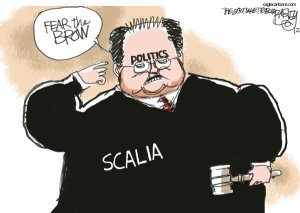 There are so many things wrong with Antonin Scalia that it is really difficult to pick a place to start. Jennifer Senior interviews the man in black for NYM. To know him is to abhor him. For example, some of his best friends are probably closeted gay people.
The one thing I did think, as he said those somewhat welcoming things to gay men and women, is, Huh, this really does show how much our world has changed. I was wondering what kind of personal exposure you might have had to this sea change.
I have friends that I know, or very much suspect, are homosexual. Everybody does.Have any of them come out to you?
No. No. Not that I know of.Has your personal attitude softened some?
Toward what?
Homosexuality.
I don’t think I’ve softened. I don’t know what you mean by softened.If you talk to your grandchildren, they have different opinions from you about this, right?
I don’t know about my grandchildren. I know about my children. I don’t think they and I differ very much. But I’m not a hater of homosexuals at all.
Okay, so is this a softer, gentler Scalia since or before, say, December 2012?
Justice Antonin Scalia, always eager to prove himself in the ongoing competition known as America’s Top Relic, whipped out another doozy on Monday while speaking at Princeton University. A gay student named Duncan Hosie got up and asked Scalia about his avid support for bans on “sodomy,” i.e. same-sex couples doing it, and Scalia answered with this:
“It’s a form of argument that I thought you would have known, which is called the ‘reduction to the absurd,’” Scalia told Hosie of San Francisco during the question-and-answer period. “If we cannot have moral feelings against homosexuality, can we have it against murder? Can we have it against other things?”
Scalia said he is not equating sodomy with murder but drawing a parallel between the bans on both.
Then he deadpanned: “I’m surprised you aren’t persuaded.”
That would be because boldly stating stuff without really bothering to make an argument for it isn’t persuasive, something you’d have thought Scalia’s law professors would have taught him.
The reason I bring this particular part of Scalia’s interview up is that there’s been some weirdness lately about what he has said about marriage equality in recent cases and likely to do this term. Here’s some coverage from The Advocate.
Scalia’s verdicts in both marriage equality cases this summer included strong language, referring to the majority rationale of the court in the DOMA case as legal “argle bargle,” essentially rejecting the court’s conclusion that it was unconstitutional for the federal government to recognize one set of legal marriages (opposite-sex) while denying the existence and equal treatment of others (same-sex).
This perspective clearly put Scalia in the minority on the court and, according to numerous public opinion polls, in the minority of Americans who believe that same-sex marriage is not legally equivalent to opposite-sex marriage. But Scalia is no stranger to standing in opposition, and isn’t concerned with how history will portray him and his legacy.
“Frankly, I don’t care,” said Scalia when asked how the world would view his opinions in 50 years. “Maybe the world is spinning toward a wider acceptance of homosexual rights, and here’s Scalia, standing athwart it. At least standing athwart it as a constitutional entitlement. But I have never been custodian of my legacy. When I’m dead and gone, I’ll either be sublimely happy or terribly unhappy.”
Scalia has been on somewhat of a publicity tour since the Supreme Court recessed in June, appearing at numerous conferences, universities, and in several interviews before the court’s next session, which begins today. Last week he told a crowd at Tufts University in Massachusetts that he had not yet expressed his views on “gay marriage.” In August he said the Supreme Court should not “invent new minorities,” as he alleges it did with the DOMA decision. And in July he told a group of lawyers that federal judges were not qualified to legislate “homosexual sodomy.”
I’m not sure what he’s up to in this current interview but frankly, he has expressed some views and they are worrisome.
Oh, and we should believe in a “literal” DEVIL. Why wouldn’t we?
Can we talk about your drafting process—
[Leans in, stage-whispers.] I even believe in the Devil.You do?
Of course! Yeah, he’s a real person. Hey, c’mon, that’s standard Catholic doctrine! Every Catholic believes that.
Every Catholic believes this? There’s a wide variety of Catholics out there …
If you are faithful to Catholic dogma, that is certainly a large part of it.
Have you seen evidence of the Devil lately?
You know, it is curious. In the Gospels, the Devil is doing all sorts of things. He’s making pigs run off cliffs, he’s possessing people and whatnot. And that doesn’t happen very much anymore.
No.
It’s because he’s smart.
So what’s he doing now?
What he’s doing now is getting people not to believe in him or in God. He’s much more successful that way.
That has really painful implications for atheists. Are you sure that’s the Devil’s work?
I didn’t say atheists are the Devil’s work.
Well, you’re saying the Devil is persuading people to not believe in God. Couldn’t there be other reasons to not believe?
Well, there certainly can be other reasons. But it certainly favors the Devil’s desires. I mean, c’mon, that’s the explanation for why there’s not demonic possession all over the place. That always puzzled me. What happened to the Devil, you know? He used to be all over the place. He used to be all over the New Testament.
Right.
What happened to him?
He just got wilier.
He got wilier.Isn’t it terribly frightening to believe in the Devil?
You’re looking at me as though I’m weird. My God! Are you so out of touch with most of America, most of which believes in the Devil? I mean, Jesus Christ believed in the Devil! It’s in the Gospels! You travel in circles that are so, so removed from mainstream America that you are appalled that anybody would believe in the Devil! Most of mankind has believed in the Devil, for all of history. Many more intelligent people than you or me have believed in the Devil.I hope you weren’t sensing contempt from me. It wasn’t your belief that surprised me so much as how boldly you expressed it.
I was offended by that. I really was.
So this man is also going to hear a case on birth control and a variety of other things this term. We should be very afraid.
Monday Reads
Posted: October 7, 2013 Filed under: 2012 elections, Congress, Federal Budget and Budget deficit, Federal Government Shutdown, House of Representatives, morning reads, Tea Party activists 74 Comments
Good Morning!
I’ve made plans to go to Seattle next month again to stay with my dad and hope that I can also spend time looking for the possibility of a job since my daughter is joining a small ob/gyn practice about an hour north of Seattle. It’s hard not to long for the safety of a blue state given what’s been going on recently and given the conversations that I have with people that safely dwell in the Faux News Reality of Welfare Queens, Pedophile Gays, Scary Black People in Hoodies, and Invading Mexicans. I’ve been in a long Facebook conversation trying to explain the Affordable Care Act details and why the exchanges are not “government-backed” insurance until I’m blue in the face. No amount of numbers convinces them that all the jobs are not becoming part time. I was just told I obviously don’t have common sense if I don’t see the Affordable Care Act as a giant give away to lazy poor people even though I’ve tried to explain that Medicaid still exists and it still is the plan for poor people. There just exists this ever deepening divide between the realities of Red and Blue States. Did Nixon’s Southern Strategy doom our Democracy?
In a merciful twist of fate, Juan Linz did not quite live to see his prophecy of the demise of American democracy borne out. Linz, the Spanish political scientist who died last week, argued that the presidential system, with its separate elections for legislature and chief executive, was inherently unstable. In a famous 1990 essay, Linz observed, “All such systems are based on dual democratic legitimacy: No democratic principle exists to resolve disputes between the executive and the legislature about which of the two actually represents the will of the people.” Presidential systems veered ultimately toward collapse everywhere they were tried, as legislators and executives vied for supremacy. There was only one notable exception: the United States of America.
Linz attributed our puzzling, anomalous stability to “the uniquely diffuse character of American political parties.” The Republicans had loads of moderates, and conservative whites in the South still clung to the Democratic Party. At the time he wrote that, the two parties were already sorting themselves into more ideologically pure versions, leaving us where we stand today: with one racially and economically polyglot party of center-left technocracy and one ethnically homogenous reactionary party. The latter is currently attempting to impose its program by threat upon the former. The events in Washington have given us a peek into the Linzian nightmare.
Traditionally, when American politics encountered the problem of divided government—when, say, Nixon and Eisenhower encountered Democratic Congresses, or Bill Clinton a Republican one—one of two things happened. Either both sides found enough incentives to work together despite their differences, or there was what we used to recognize as the only alternative: gridlock. Gridlock is what most of us expected after the last election produced a Democratic president and Republican House. Washington would drudge on; it would be hard to get anything done, but also hard to undo anything. Days after the election, John Boehner, no doubt anticipating things would carry on as always, said, “Obamacare is the law of the land.”
Instead, to the slowly unfolding horror of the Obama administration and even some segments of the Republican Party, the GOP decided that the alternative to finding common ground with the president did not have to be mere gridlock. It could force the president to enact its agenda.
It used to be that elections came with the usual majority rules ramifications. This current group of Tea Party insurrectionists evidently has changed that equation. The question now is what can we do about it?
And as the saying goes, elections have consequences. It’s how Democratic victories in the 1930s paved the way for Franklin Roosevelt’s New Deal, how Dem victories in the 1960s led to Lyndon Johnson’s Great Society programs, how Republican victories in the 1980s resulted in Ronald Reagan’s tax cuts, how Democratic majorities in 2006 and 2008 led to Obama’s health-care law, and how the GOP’s midterm wins in 2010 extracted spending-cut concessions from Obama the following year.
Yet what’s extraordinary about this current political fight is that Republicans are seeking another round of concessions — over the president’s signature domestic achievement — after losing the last election, which was viewed in part as a referendum on the health-care law.
“It’s as if Ted Cruz slept through the entire 2012 cycle,” a senior Democratic aide tells First Read. “It’s not like Obamacare, spending and debt weren’t major issues in 2012. They were central — and we won.”
Nevertheless, Cruz and House Republicans maintain that Obama and the Democrats must negotiate over the health-care law to re-open the federal government. And House Speaker John Boehnersays Democrats must negotiate to raise the debt ceiling. “The nation’s credit is at risk because of the administration’s refusal to sit down and have a conversation,” he told ABC News. “The votes are not in the House to pass a clean debt limit. And the president is risking default by not having a conversation with us.”
I found that Boehner comment about the lack of votes to be really strange given that he seems to think that the Democrats in the House and their votes do not matter. What exactly is the conversation and why should the rest of the country have it when we thought we decided that about a year ago during the election? Why is Boehner willing to weaponize the debt ceiling again? (This is the same Jonathan Chait article I referenced above.)
The debt ceiling turns out to be unexploded ordnance lying around the American form of government. Only custom or moral compunction stops the opposition party from using it to nullify the president’s powers, or, for that matter, the president from using it to nullify Congress’s. (Obama could, theoretically, threaten to veto a debt ceiling hike unless Congress attaches it to the creation of single-payer health insurance.) To weaponize the debt ceiling, you must be willing to inflict harm on millions of innocent people. It is a shockingly powerful self-destruct button built into our very system of government, but only useful for the most ideologically hardened or borderline sociopathic. But it turns out to be the perfect tool for the contemporary GOP: a party large enough to control a chamber of Congress yet too small to win the presidency, and infused with a dangerous, millenarian combination of overheated Randian paranoia and fully justified fear of adverse demographic trends. The only thing that limits the debt ceiling’s potency at the moment is the widespread suspicion that Boehner is too old school, too lacking in the Leninist will to power that fires his newer co-partisans, to actually carry out his threat. (He has suggested as much to some colleagues in private.) Boehner himself is thus the one weak link in the House Republicans’ ability to carry out a kind of rolling coup against the Obama administration. Unfortunately, Boehner’s control of his chamber is tenuous enough that, like the ailing monarch of a crumbling regime, it’s impossible to strike an agreement with him in full security it will be carried out.
The standoff embroiling Washington represents far more than the specifics of the demands on the table, or even the prospect of economic calamity. It is an incipient constitutional crisis. Obama foolishly set the precedent in 2011 that he would let Congress jack him up for a debt-ceiling hike. He now has to crush the practice completely, lest it become ritualized. Obama not only must refuse to trade concessions for a debt-ceiling hike; he has to make it clear that he will endure default before he submits to ransom. To pay a ransom now, even a tiny one, would ensure an endless succession of debt-ceiling ransoms until, eventually, the two sides fail to agree on the correct size of the ransom and default follows.
This is a domestic Cuban Missile Crisis
Texas Demagogue and Senator Ted Cruz is already pushing the crisis forward.
Sen. Ted Cruz (R-Texas) on Sunday said changes to President Obama’s signature healthcare law should be tied to a debt ceiling increase.
The Texas Republican said any deal on raising the nation’s borrowing authority should include some “significant structural” plans to reduce government spending, avoid new taxes and “look for ways to mitigate the harm from ObamaCare.”
“The debt ceiling historically has been among the best leverage that Congress has to rein in the executive,” he said on CNN’s “State of the Union.”
Of the 55 times Congress has raised the debt limit, Cruz argued that 28 of those times Congress has attached “very stringent requirements,” many designed to reduce spending, including the 2011 sequestration plan.
So, a debt-ceiling increase should “respond to real harms coming from ObamaCare,” Cruz said.
Cruz said Republicans have leverage because of “so many nasty partisan jabs from Democrats” proving that “we’re winning the argument —Obamacare isn’t working.”
Treasury Secretary Jack Lew reiterated on Sunday that the federal government will run out of borrowing authority on Oct. 17.
And the world thinks we’ve completely lost it.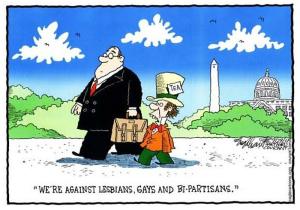 Here’s a taste of the German press as excerpted by Der Spiegel.
Munich’s national Süddeutsche Zeitung offers a slightly more depressing take, pointing blame at all sides. “What has already been apparent in America for a few years now is the self-destruction of one of the world’s oldest democracies. And the great tragedy here is that this work of destruction isn’t being wrought by enemies of democracy, greedy lobbyists or sinister major party donors. America’s democracy is bring broken by the very people who are supposed to be carry and preserve it: the voters, the parties and the politicians.”
The argument? The Republicans who have brought Washington to stillstand are repeatedly and democratically elected by voters and given a mandate to block. The parties themselves are fomenting an increasingly radicalized culture that deepens political, societal and geographic divisions in the country, argues the newspaper. And finally, there are few politicians in America who are willing or capable of thinking beyond their own electoral constituencies.
“At the moment, Washington is fighting over the budget and nobody knows if the county will still be solvent in three weeks,” the paper concludes. “What is clear, though, is that America is already politically bankrupt.”
America enjoys the “exorbitant privilege” of printing the world’s reserve currency. Its government debt is considered a safe haven, which is why Uncle Sam can borrow so much, so cheaply. America will not lose these advantages overnight. But anything that undermines its creditworthiness—as the farce in Washington surely does—risks causing untold damage in the future. It is not just that America would have to pay more to borrow. The repercussions of an American default would be both global and unpredictable.
It would threaten financial markets. Since American Treasuries are very liquid and safe, they are widely used as collateral. They are more than 30% of the collateral that financial institutions such as investment banks use to borrow in the $2 trillion “tri-party repo” market, a source of overnight funding. A default could trigger demands by lenders for more or different collateral; that might cause a financial heart attack like the one prompted by the collapse of Lehman Brothers in 2008. In short, even if Obamacare were as bad as tea-party types say it is (see Lexington), it would still be reckless to use the debt ceiling as a bargaining chip to repeal it, as some Republicans suggest.
What can be done? In the short term, House Republicans need to get their priorities straight. They should pass a clean budget resolution without trying to refight old battles over Obamacare. They should also vote to raise the debt ceiling (or better yet, abolish it). If Obamacare really does turn out to be a flop and Republicans win the presidency and the Senate in 2016, they can repeal it through the normal legislative process.
An FBI hostage negotiator has some hints on how to deal with petulant Tea Party bomb throwers.

So how did it get to this point? “Its fear-driven behavior,” says Voss. “They get angrier because they feel they’ve been defeated. People notice losses twice as much as they notice wins. It’s a sports metaphor you hear all the time: ‘I hate losing more than I like winning’…I think there’s a very strong sense of loss on their part over what they refer to as Obamacare and resentment over that is carried forward.”
But hostage negotiators aren’t the type to give up hope. “Ultimately, everybody wants success. And there are a lot of definitions of success,” Voss says. “Bottom line, they want to be made to look like they were effective and got things done for their side. So it’s a matter of refocusing on what’s in everybody’s best interests.”
He’s looking to the Obama White House to help start the reset: “I would ask them to start saying, ‘I understand that the people on the other side of the table have the best interests of the American people at heart.’ Simply recognize that. Everybody wants to do what’s best for the American public. Those sorts of statements repeated on a regular basis, it’s the start of dialogue. It’s not concession; it’s the beginning of dialogue.”
But the prison siege mentality Voss describes is exacerbated by an absence of strong calming leadership in the congressional GOP. “Those guys are sitting on the sidelines,” Voss says. “There are quite a few Republican politicians that I have a tremendous amount of respect for that are exceedingly silent these days.” He mentions House Intelligence Committee Chairman Mike Rogers: “I’ve never heard anything out of Mike’s mouth that wasn’t really thoughtful and nuanced.”
Another possible constructive calming voice on the conservative caucus could be former President George W. Bush. “I think there’s a possibility that he would be somebody that you would talk to behind the scenes, and potentially an intermediary himself. I think he absolutely has the ability to be a stabilizing influence.”
But how to do you deal with the hyper-partisan congressional bomb-throwers? “Well it’s like a game of tic-tac-toe with the tantrum throwers,” Voss says. “In tic-tac-toe, if you’re going second, the best you can possibly do is tie—if you play the game. There’s a first-mover advantage. The minute you stop playing that game the first mover advantage goes away. So you don’t play their game at all. That’s the way you respond.”
So, the craziness continues and escalates. If things come apart at the seams, I do not want to be stuck in Bobby Jindal’s Louisiana.
What’s on your reading and blogging list today?
The Sedition Set
Posted: October 5, 2013 Filed under: The Media SUCKS, The Right Wing, We are so F'd 38 Comments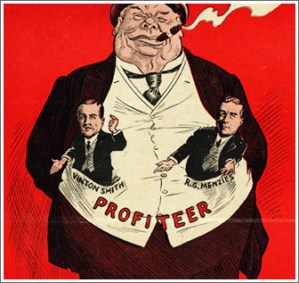
It’s not difficult to see the workings of the usual internet, cable “news”, and beltway pundits as complementary if not causal to the current state of affairs in congress. Much the way the press wanted to embed themselves into a war so badly that they just goosestepped along with the lies spread by the Bush-Cheney administration, it appears much of the media is going right along with the usual memes for the current shutdown and possible disruption of US debt markets. For one, there is an endless meme that “each party should take its share of the blame. Then there is the idea that let partisan hacks sit on TV and spout vituperous and easily debunked lies as just presenting ‘both’ sides of an opinion. It seems that many folks who are either unwilling or not able to dig into a particular issue just assume an earnest media. Nothing could be further from the truth.
But simplistic, reassuring narratives are more profitable than dispassionate descriptions of complex public policy problems. For a collapsing, digital-age news industry desperate for income, partisanship is an economic lifeline.
That was evident Wednesday night. Flipping between Fox and MSNBC for several hours — something I suggest you try — produced two completely different realities.
On MSNBC, Matthews and his guests called House Republicans “wacko-birds,” “birthers,” and “crazy, angry.” They said opponents of Obamacare were driven by bigotry and selfishness.
“There is very little sense on the Hill that they’re there for something bigger than themselves,” said Susan Milligan, a columnist for U.S. News and World Report.
At 8 p.m. on Fox, Bill O’Reilly upped the rhetorical ante. Two days after its introduction, Obamacare was “not ready for primetime,” according to O’Reilly, riven with so many problems “it was pretty much impossible to list them all,” and likely to spawn delays in medical care and fraud.
Over on MSNBC, Chris Hayes opened his 8 p.m. show with a screen logo declaring far-right opponents of the law “frauds.”
Back on Fox, Sean Hannity called Senate Majority Leader Harry Reid (D-Nev.) a “sick, twisted old man” who engaged in “casualty cruelty.” Hannity also mocked the 18 House Republicans who had said they no longer supported a shutdown as a way to stop Obamacare. According to Hannity, they were willing to “bend down at the altar of Reid and Obama.”
Finally, over on MSNBC, 9 p.m. host Steve Kornacki, substituting for Rachel Maddow, said that Senator Ted Cruz (R-Texas) was following the example of former House Speaker Newt Gingrich and using “stunts” to make himself a hero to the Republican base.
“Newt Gingrich, more than anybody else, may be responsible for where we are, what we are now seeing playing out inside the halls of Congress,” Kornacki said. “He wrote the script and Ted Cruz is following it to a t.”
Over the course of the night, Fox made more exaggerated claims and out-of-context statements. But theatrics, demonization, and smugness reigned on both networks.
Polls, meanwhile, show vast public confusion about Obamacare.
Why wouldn’t folks be confused? There is really no place these days to get simple information on anything. Last month, Chuck Todd of NBC said it wasn’t the press’s responsibility to “inform” viewers on misinformation out there on the Affordable Care Act.
On Wednesday morning’s Morning Joe, Todd attracted the attention of liberal critics when, as TPM puts it, he suggested that It’s Not Media’s Job To Correct GOP’s Obamacare Falsehoods. But is that a fair reading of what Chuck said? Not according to him. In response to the criticism, Chuck tweeted“Somebody decided to troll w/mislding headline: point I actually made was folks shouldn’t expect media to do job WH has FAILED to do re: ACA.”
Here’s a slightly longer version of the exchange in question, which begins with Todd challenging theVillager-approved talking point that the President is actually the one who’s threatening to blow up the government. He then talks extensively about the “million disasters” in the political process of health care reform, including some that liberals would quickly agree with.
The key exchange is between Todd and former Governor Ed Rendell (D-PA) in which Rendell talks about the misinformation that has proliferated on the Affordable Care Act. “I think the biggest problem with Obamacare, it’s not a perfect bill by any means, was the messaging,” Rendell says. “If you took ten people from different parts of the country who say they’re against the bill, and sat them down, I’d love to have ten minutes with them and say, ‘Tell me why you are against the bill.’ If they told you anything, it would be stuff that’s incorrect.”
“But more importantly, it would be stuff that Republicans have successfully messaged against it,” Todd says. “They don’t repeat the other stuff because they haven’t even heard the Democratic message. What I always love is people who say, ‘Well, it’s you folks’ fault in the media.’ No, it’s the President of the United States’ fault for not selling it.”
A fair reading of what Chuck said, without endorsing it, is that it’s not the media’s job to promote Democratic messaging. That’s not the same thing as saying they have no duty to correct falsehoods, which is an interpretation by extension. In context, he’s clearly talking about the political process around Obamacare, and not the substance of it.
What I find problematic about this exchange is the pivot that Todd uses to get to the politics. When Rendell says people are being misinformed, Chuck says “But more importantly, it would be stuff that Republicans have successfully messaged against it.”
Perhaps he meant more important in terms of the outcome, but it should matter more, to the news media, if the messaging, Democratic or Republican, is true. In fits and starts, the media has provided context for the policy, but almost always within the horse race frame of who is “winning” the messaging war.
Why does it always come back to a “messaging war”? This brings me to an excellent piece by Charles Pierce on “ratfucking”. Remember when the press actually didn’t get too snookered by the ratfucking let alone perpetuated it?
We are seeing this aspect of ratfucking playing out now. We saw it when Representative Randy Neugebauer bullied a Park Ranger. We saw it when Rep Todd Rokita told CNN anchor Carol Costello, essentially, to sit there and look pretty while he unspooled whatever the line of the day was. We saw it when Rep. Darrell Issa flipped out at a reporter a few days before that. And we are seeing it in the cynicism of the the now-daily Republican gimmick of finding a government service that polls well and then pretending to care about funding it, as though the whole party hasn’t been running against “government” since before Don Segretti was cheating the student body at USC. We will open the National Parks, and all the other good stuff, and we can do it without really paying for it. The last victory of pure Reaganomics is on display.
But, we also see pure ratfucking being displayed, encouraged, and accompanied by “news” outlets.
At 7 p.m. Wednesday night, Fox News reporter Jim Angle, citing conservative experts, reported that Obamacare would force young people to pay vastly higher premiums, face large deductibles and leave 30 million Americans uninsured.
On MSNBC, Chris Matthews called Republican opponents of the program “political lightweights” and “puppatoons.” Tammy Duckworth (D-Ill.) said House Republicans were “sickening.”
A night of debate on the first federal government shutdown in 17 years and the country’s largest new government program in a generation had begun. On balance, Fox was worse than MSNBC. But both broadcasts were emblems of America’s failing news industry.
The triumph of opinion-driven cable TV and the collapse of newspapers has created an American news media that does an increasingly poor job of informing the public. And an excellent job of dividing it.
The result is that huge numbers of people just tune in, Google and bookmark, and listen to stuff that just feeds their own prejudices and beliefs. For-profit media is happy to serve up whatever it takes to beef up numbers that attracts advertisers. Whatever happened to the idea that news was a public service and not a profit center to promote goosestepping? It’s difficult these days to find outlets where advocacy and demagoguery isn’t the main dish. It’s no wonder our government is dysfunctional. An informed electorate whose knowledge is enhanced by an informing fourth estate is essential to democracy. No wonder the Koch Brothers have crept into Public TV and Public Radio. Any where information, reason, and research is freely available to the public must be stomped out until every one is part of the Foxed Nation.

 peej
peej Carissa
 bostonboomer
 dakinikat
 ecocatwoman
 jjlo
jjlo mablue2
 Mama Lopez
 peggysue22
 quixote
 skydancingguestblogger
 Mona (aka Wonk the Vote)





Recent Comments